Unsupervised Learning of Contextual Role Knowledge for Coreference
Resolution
David Bean
Attensity Corporation, Suite 600
Gateway One 90 South 400 West
Salt Lake City, UT 84101
[email protected]
Ellen Riloff
School of Computing
University of Utah
Salt Lake City, UT 84112
[email protected]
Abstract
We present a coreference resolver called BABAR that uses contextual role knowledge to evaluate possible antecedents for an anaphor. BABAR uses information extraction patterns to identify contextual roles and creates four contextual role knowledge sources using unsu-pervised learning. These knowledge sources determine whether the contexts surrounding an anaphor and antecedent are compatible. BABAR applies a Dempster-Shafer probabilis-tic model to make resolutions based on ev-idence from the contextual role knowledge sources as well as general knowledge sources. Experiments in two domains showed that the contextual role knowledge improved corefer-ence performance, especially on pronouns.
1
Introduction
The problem of coreference resolution has received con-siderable attention, including theoretical discourse mod-els (e.g., (Grosz et al., 1995; Grosz and Sidner, 1998)), syntactic algorithms (e.g., (Hobbs, 1978; Lappin and Le-ass, 1994)), and supervised machine learning systems (Aone and Bennett, 1995; McCarthy and Lehnert, 1995; Ng and Cardie, 2002; Soon et al., 2001). Most compu-tational models for coreference resolution rely on prop-erties of the anaphor and candidate antecedent, such as lexical matching, grammatical and syntactic features, se-mantic agreement, and positional information.
The focus of our work is on the use of contextual role knowledge for coreference resolution. A contextual role represents the role that a noun phrase plays in an event or relationship. Our work is motivated by the observa-tion that contextual roles can be critically important in determining the referent of a noun phrase. Consider the following sentences:
(a) Jose Maria Martinez, Roberto Lisandy, and Dino Rossy, who were staying at a Tecun Uman hotel, were kidnapped by armed men who took them to an unknown place.
(b) After they were released...
(c) After they blindfolded the men...
In (b) “they” refers to the kidnapping victims, but in (c) “they” refers to the armed men. The role that each noun phrase plays in the kidnapping event is key to distinguish-ing these cases. The correct resolution in sentence (b) comes from knowledge that people who are kidnapped are often subsequently released. The correct resolution in sentence (c) depends on knowledge that kidnappers fre-quently blindfold their victims.
We have developed a coreference resolver called BABAR that uses contextual role knowledge to make coreference decisions. BABAR employs information ex-traction techniques to represent and learn role relation-ships. Each pattern represents the role that a noun phrase plays in the surrounding context. BABAR uses unsu-pervised learning to acquire this knowledge from plain text without the need for annotated training data. Train-ing examples are generated automatically by identifyTrain-ing noun phrases that can be easily resolved with their an-tecedents using lexical and syntactic heuristics. BABAR then computes statistics over the training examples mea-suring the frequency with which extraction patterns and noun phrases co-occur in coreference resolutions.
experimen-tal results on two corpora: the MUC-4 terrorism cor-pus, and Reuters texts about natural disasters. Our re-sults show that BABAR achieves good performance in both domains, and that the contextual role knowledge improves performance, especially on pronouns. Finally, Section 5 explains how BABAR relates to previous work, and Section 6 summarizes our conclusions.
2
Learning Contextual Role Knowledge
In this section, we describe how contextual role knowl-edge is represented and learned. Section 2.1 describes how BABAR generates training examples to use in the learning process. We refer to this process as Reli-able Case Resolution because it involves finding cases of anaphora that can be easily resolved with their an-tecedents. Section 2.2 then describes our representation for contextual roles and four types of contextual role knowledge that are learned from the training examples.
2.1 Reliable Case Resolutions
The first step in the learning process is to generate train-ing examples consisttrain-ing of anaphor/antecedent resolu-tions. BABAR uses two methods to identify anaphors that can be easily and reliably resolved with their an-tecedent: lexical seeding and syntactic seeding.
2.1.1 Lexical Seeding
It is generally not safe to assume that multiple occur-rences of a noun phrase refer to the same entity. For example, the company may refer to Company X in one paragraph and Company Y in another. However, lex-ically similar NPs usually refer to the same entity in two cases: proper names and existential noun phrases. BABAR uses a named entity recognizer to identify proper names that refer to people and companies. Proper names are assumed to be coreferent if they match exactly, or if they closely match based on a few heuristics. For exam-ple, a person’s full name will match with just their last name (e.g., “George Bush” and “Bush”), and a company name will match with and without a corporate suffix (e.g., “IBM Corp.” and “IBM”). Proper names that match are resolved with each other.
The second case involves existential noun phrases (Allen, 1995), which are noun phrases that uniquely spec-ify an object or concept and therefore do not need a prior referent in the discourse. In previous work (Bean and Riloff, 1999), we developed an unsupervised learn-ing algorithm that automatically recognizes definite NPs that are existential without syntactic modification be-cause their meaning is universally understood. For exam-ple, a story can mention “the FBI”, “the White House”, or “the weather” without any prior referent in the story.
Although these existential NPs do not need a prior ref-erent, they may occur multiple times in a document. By
definition, each existential NP uniquely specifies an ob-ject or concept, so we can infer that all instances of the same existential NP are coreferent (e.g., “the FBI” always refers to the same entity). Using this heuristic, BABAR identifies existential definite NPs in the training corpus using our previous learning algorithm (Bean and Riloff, 1999) and resolves all occurrences of the same existential NP with each another.1
2.1.2 Syntactic Seeding
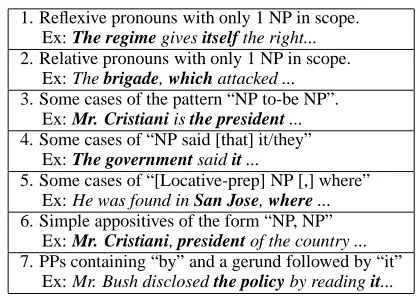
BABAR also uses syntactic heuristics to identify anaphors and antecedents that can be easily resolved. Ta-ble 1 briefly describes the seven syntactic heuristics used by BABAR to resolve noun phrases. Words and punctua-tion that appear in brackets are considered oppunctua-tional. The anaphor and antecedent appear in boldface.
1. Reflexive pronouns with only 1 NP in scope. Ex: The regime gives itself the right... 2. Relative pronouns with only 1 NP in scope.
Ex: The brigade, which attacked ... 3. Some cases of the pattern “NP to-be NP”.
Ex: Mr. Cristiani is the president ... 4. Some cases of “NP said [that] it/they”
Ex: The government said it ...
5. Some cases of “[Locative-prep] NP [,] where” Ex: He was found in San Jose, where ... 6. Simple appositives of the form “NP, NP”
Ex: Mr. Cristiani, president of the country ... 7. PPs containing “by” and a gerund followed by “it”
[image:2.612.321.530.269.417.2]Ex: Mr. Bush disclosed the policy by reading it...
Table 1: Syntactic Seeding Heuristics
BABAR’s reliable case resolution heuristics produced a substantial set of anaphor/antecedent resolutions that will be the training data used to learn contextual role knowledge. For terrorism, BABAR generated 5,078 res-olutions: 2,386 from lexical seeding and 2,692 from syntactic seeding. For natural disasters, BABAR gener-ated 20,479 resolutions: 11,652 from lexical seeding and 8,827 from syntactic seeding.
2.2 Contextual Role Knowledge
Our representation of contextual roles is based on infor-mation extraction patterns that are converted into simple caseframes. First, we describe how the caseframes are represented and learned. Next, we describe four con-textual role knowledge sources that are created from the training examples and the caseframes.
2.2.1 The Caseframe Representation
Information extraction (IE) systems use extraction pat-terns to identify noun phrases that play a specific role in
1
an event. For IE, the system must be able to distinguish between semantically similar noun phrases that play dif-ferent roles in an event. For example, management suc-cession systems must distinguish between a person who is fired and a person who is hired. Terrorism systems must distinguish between people who perpetrate a crime and people who are victims of a crime.
We applied the AutoSlog system (Riloff, 1996) to our unannotated training texts to generate a set of extraction patterns for each domain. Each extraction pattern repre-sents a linguistic expression and a syntactic position in-dicating where a role filler can be found. For example, kidnapping victims should be extracted from the subject of the verb “kidnapped” when it occurs in the passive voice (the short-hand representation of this pattern would be “<subject>were kidnapped”). The types of patterns produced by AutoSlog are outlined in (Riloff, 1996).
Ideally we’d like to know the thematic role of each ex-tracted noun phrase, but AutoSlog does not generate the-matic roles. As a (crude) approximation, we normalize the extraction patterns with respect to active and passive voice and label those extractions as agents or patients. For example, the passive voice pattern “<subject>were kidnapped” and the active voice pattern “kidnapped <direct object>” are merged into a single normalized pattern “kidnapped<patient>”.2 For the sake of sim-plicity, we will refer to these normalized extraction pat-terns as caseframes.3 These caseframes can capture two
types of contextual role information: (1) thematic roles corresponding to events (e.g, “<agent>kidnapped” or “kidnapped<patient>”), and (2) predicate-argument re-lations associated with both verbs and nouns (e.g., “kid-napped for<np>” or “vehicle with<np>”).
We generate these caseframes automatically by run-ning AutoSlog over the trairun-ning corpus exhaustively so that it literally generates a pattern to extract every noun phrase in the corpus. The learned patterns are then nor-malized and applied to the corpus. This process produces a large set of caseframes coupled with a list of the noun phrases that they extracted. The contextual role knowl-edge that BABAR uses for coreference resolution is de-rived from this caseframe data.
2.2.2 The Caseframe Network
The first type of contextual role knowledge that BABAR learns is the Caseframe Network
(CFNet), which identifies caseframes that co-occur in
anaphor/antecedent resolutions. Our assumption is that caseframes that co-occur in resolutions often have a
2
This normalization is performed syntactically without se-mantics, so the agent and patient roles are not guaranteed to hold, but they usually do in practice.
3
These are not full case frames in the traditional sense, but they approximate a simple case frame with a single slot.
conceptual relationship in the discourse. For example, co-occurring caseframes may reflect synonymy (e.g., “<patient> kidnapped” and “<patient> abducted”) or related events (e.g., “<patient> kidnapped” and “<patient>released”). We do not attempt to identify the types of relationships that are found. BABAR merely identifies caseframes that frequently co-occur in coreference resolutions.
Terrorism Natural Disasters
murder of<NP> <agent>damaged killed<patient> was injured in<NP>
<agent>reported <agent>occurred
<agent>added cause of<NP>
<agent>stated <agent>wreaked
[image:3.612.333.520.176.273.2]<agent>added <agent>crossed perpetrated<patient> driver of<NP> condemned<patient> <agent>carrying
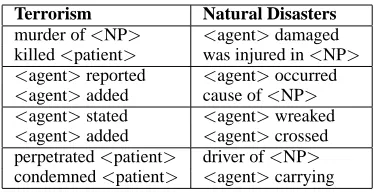
Figure 1: Caseframe Network Examples
Figure 1 shows examples of caseframes that co-occur in resolutions, both in the terrorism and natural disaster domains. The terrorism examples reflect fairly obvious relationships: people who are murdered are killed; agents that “report” things also “add” and “state” things; crimes that are “perpetrated” are often later “condemned”. In the natural disasters domain, agents are often forces of na-ture, such as hurricanes or wildfires. Figure 1 reveals that an event that “damaged” objects may also cause injuries; a disaster that “occurred” may be investigated to find its “cause”; a disaster may “wreak” havoc as it “crosses” ge-ographic regions; and vehicles that have a “driver” may also “carry” items.
During coreference resolution, the caseframe network provides evidence that an anaphor and prior noun phrase might be coreferent. Given an anaphor, BABAR iden-tifies the caseframe that would extract it from its sen-tence. For each candidate antecedent, BABAR identifies the caseframe that would extract the candidate, pairs it with the anaphor’s caseframe, and consults the CF Net-work to see if this pair of caseframes has co-occurred in previous resolutions. If so, the CF Network reports that the anaphor and candidate may be coreferent.
2.2.3 Lexical Caseframe Expectations
extracts Y. We will refer to the set of nouns that co-occur with a caseframe as the lexical expectations of the case-frame. Figure 2 shows examples of lexical expectations that were learned for both domains.
Terrorism Caseframe: engaged in<NP>
NPs: activity, battle, clash, dialogue, effort, fight, group,
shoot-out, struggle, village, violence
Caseframe: ambushed<patient>
NPs: company, convoy, helicopter, member, motorcade,
move, Ormeno, patrol, position, response, soldier, they, troops, truck, vehicle, which
Natural Disasters Caseframe: battled through<NP>
NPs: flame, night, smoke, wall Caseframe: braced for<NP>
NPs: arrival, battering, catastrophe, crest, Dolly, epidemics,
[image:4.612.72.301.129.278.2]evacuate, evacuation, flood, flooding, front, Hortense, hurricane, misery, rains, river, storm, surge, test, typhoon.
Figure 2: Lexical Caseframe Expectations
To illustrate how lexical expectations are used, suppose we want to determine whether noun phrase X is the an-tecedent for noun phrase Y. If they are coreferent, then X and Y should be substitutable for one another in the story.4Consider these sentences:
(S1) Fred was killed by a masked man with a revolver. (S2) The burglar fired the gun three times and fled.
“The gun” will be extracted by the caseframe “fired <patient>”. Its correct antecedent is “a revolver”, which is extracted by the caseframe “killed with<NP>”. If “gun” and “revolver” refer to the same object, then it should also be acceptable to say that Fred was “killed with a gun” and that the burglar “fired a revolver”.
During coreference resolution, BABAR checks (1) whether the anaphor is among the lexical expectations for the caseframe that extracts the candidate antecedent, and (2) whether the candidate is among the lexical expecta-tions for the caseframe that extracts the anaphor. If either case is true, then CFLex reports that the anaphor and can-didate might be coreferent.
2.2.4 Semantic Caseframe Expectations
The third type of contextual role knowledge learned by BABAR is Semantic Caseframe Expectations. Se-mantic expectations are analogous to lexical expectations except that they represent semantic classes rather than nouns. For each caseframe, BABAR collects the seman-tic classes associated with the head nouns of NPs that were extracted by the caseframe. As with lexical expec-tions, the semantic classes of co-referring expressions are
4
They may not be perfectly substitutable, for example one NP may be more specific (e.g., “he” vs. “John F. Kennedy”). But in most cases they can be used interchangably.
collected too. We will refer to the semantic classes that co-occur with a caseframe as the semantic expectations of the caseframe. Figure 3 shows examples of semantic expectations that were learned. For example, BABAR learned that agents that “assassinate” or “investigate a cause” are usually humans or groups (i.e., organizations).
Terrorism
Caseframe Semantic Classes
<agent>assassinated group, human
investigation into<NP> event
exploded outside<NP> building
Natural Disasters
Caseframe Semantic Classes
<agent>investigating cause group, human
survivor of<NP> event, natphenom
[image:4.612.321.531.156.258.2]hit with<NP> attribute, natphenom
Figure 3: Semantic Caseframe Expectations
For each domain, we created a semantic dictionary by doing two things. First, we parsed the training corpus, collected all the noun phrases, and looked up each head noun in WordNet (Miller, 1990). We tagged each noun with the top-level semantic classes assigned to it in Word-Net. Second, we identified the 100 most frequent nouns in the training corpus and manually labeled them with semantic tags. This step ensures that the most frequent terms for each domain are labeled (in case some of them are not in WordNet) and labeled with the sense most ap-propriate for the domain.
Initially, we planned to compare the semantic classes of an anaphor and a candidate and infer that they might be coreferent if their semantic classes intersected. However, using the top-level semantic classes of WordNet proved to be problematic because the class distinctions are too coarse. For example, both a chair and a truck would be la-beled as artifacts, but this does not at all suggest that they are coreferent. So we decided to use semantic class in-formation only to rule out candidates. If two nouns have mutually exclusive semantic classes, then they cannot be coreferent. This solution also obviates the need to per-form word sense disambiguation. Each word is simply tagged with the semantic classes corresponding to all of its senses. If these sets do not overlap, then the words cannot be coreferent.
ex-pectations of the caseframe that extracts the anaphor. If one of these checks fails then this knowledge source re-ports that the candidate is not a viable antecedent for the anaphor.
A different knowledge source, called CFSem-CFSem, compares the semantic expectations of the caseframe that extracts the anaphor with the semantic expectations of the caseframe that extracts the candidate. If the semantic ex-pectations do not intersect, then we know that the case-frames extract mutually exclusive types of noun phrases. In this case, this knowledge source reports that the candi-date is not a viable antecedent for the anaphor.
2.3 Assigning Evidence Values
Contextual role knowledge provides evidence as to whether a candidate is a plausible antecedent for an anaphor. The two knowledge sources that use semantic expectations, WordSem-CFSem and CFSem-CFSem, al-ways return values of -1 or 0. -1 means that an NP should be ruled out as a possible antecedent, and 0 means that the knowledge source remains neutral (i.e., it has no reason to believe that they cannot be coreferent).
The CFLex and CFNet knowledge sources provide positive evidence that a candidate NP and anaphor might be coreferent. They return a value in the range [0,1], where 0 indicates neutrality and 1 indicates the strongest belief that the candidate and anaphor are coreferent. BABAR uses the log-likelihood statistic (Dunning, 1993) to evaluate the strength of a co-occurrence relationship. For each co-occurrence relation (noun/caseframe for CFLex, and caseframe/caseframe for CFNet), BABAR computes its log-likelihood value and looks it up in the χ2 table to obtain a confidence level. The confidence
level is then used as the belief value for the knowledge source. For example, if CFLex determines that the log-likelihood statistic for the co-occurrence of a particular noun and caseframe corresponds to the 90% confidence level, then CFLex returns .90 as its belief that the anaphor and candidate are coreferent.
3
The Coreference Resolution Model
Given a document to process, BABAR uses four modules to perform coreference resolution. First, a non-anaphoric NP classifier identifies definite noun phrases that are exis-tential, using both syntactic rules and our learned existen-tial NP recognizer (Bean and Riloff, 1999), and removes them from the resolution process. Second, BABAR per-forms reliable case resolution to identify anaphora that can be easily resolved using the lexical and syntactic heuristics described in Section 2.1. Third, all remain-ing anaphora are evaluated by 11 different knowledge sources: the four contextual role knowledge sources just described and seven general knowledge sources. Finally,
a Dempster-Shafer probabilistic model evaluates the ev-idence provided by the knowledge sources for all can-didate antecedents and makes the final resolution de-cision. In this section, we describe the seven general knowledge sources and explain how the Dempster-Shafer model makes resolutions.
[image:5.612.313.543.400.545.2]3.1 General Knowledge Sources
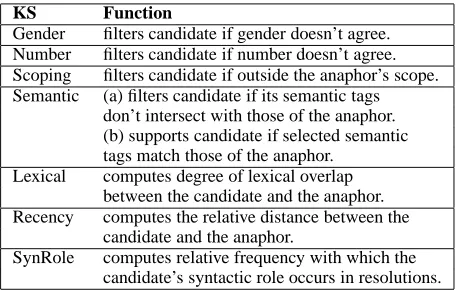
Figure 4 shows the seven general knowledge sources (KSs) that represent features commonly used for corefer-ence resolution. The gender, number, and scoping KSs eliminate candidates from consideration. The scoping heuristics are based on the anaphor type: for reflexive pronouns the scope is the current clause, for relative pro-nouns it is the prior clause following its VP, for personal pronouns it is the anaphor’s sentence and two preced-ing sentences, and for definite NPs it is the anaphor’s sentence and eight preceding sentences. The semantic agreement KS eliminates some candidates, but also pro-vides positive evidence in one case: if the candidate and anaphor both have semantic tags human, company, date, or location that were assigned via NER or the manually labeled dictionary entries. The rationale for treating these semantic labels differently is that they are specific and reliable (as opposed to the WordNet classes, which are more coarse and more noisy due to polysemy).
KS Function
Gender filters candidate if gender doesn’t agree. Number filters candidate if number doesn’t agree. Scoping filters candidate if outside the anaphor’s scope. Semantic (a) filters candidate if its semantic tags
don’t intersect with those of the anaphor. (b) supports candidate if selected semantic tags match those of the anaphor.
Lexical computes degree of lexical overlap
between the candidate and the anaphor.
Recency computes the relative distance between the
candidate and the anaphor.
SynRole computes relative frequency with which the
candidate’s syntactic role occurs in resolutions.
Figure 4: General Knowledge Sources
3.2 The Dempster-Shafer Decision Model
BABAR uses a Dempster-Shafer decision model (Stefik, 1995) to combine the evidence provided by the knowl-edge sources. Our motivation for using Dempster-Shafer is that it provides a well-principled framework for com-bining evidence from multiple sources with respect to competing hypotheses. In our situation, the competing hypotheses are the possible antecedents for an anaphor.
An important aspect of the Dempster-Shafer model is that it operates on sets of hypotheses. If evidence indi-cates that hypotheses C and D are less likely than hy-potheses A and B, then probabilities are redistributed to reflect the fact that{A, B}is more likely to contain the answer than{C, D}. The ability to redistribute belief val-ues across sets rather than individual hypotheses is key. The evidence may not say anything about whether A is more likely than B, only that C and D are not likely.
Each set is assigned two values: belief and plausibil-ity. Initially, the Dempster-Shafer model assumes that all hypotheses are equally likely, so it creates a set calledθ that includes all hypotheses. θhas a belief value of 1.0, indicating complete certainty that the correct hypothesis is included in the set, and a plausibility value of 1.0, in-dicating that there is no evidence for competing hypothe-ses.5 As evidence is collected and the likely hypotheses
are whittled down, belief is redistributed to subsets ofθ. Formally, the Dempster-Shafer theory defines a proba-bility density functionm(S), where S is a set of hypothe-ses. m(S)represents the belief that the correct hypothe-sis is included in S. The model assumes that evidence also arrives as a probability density function (pdf) over sets of hypotheses.6 Integrating new evidence into the existing
model is therefore simply a matter of defining a function to merge pdfs, one representing the current belief system and one representing the beliefs of the new evidence. The Dempster-Shafer rule for combining pdfs is:
m3(S) = X
X∩Y=S
m1(X)∗m2(Y)
1− X
X∩Y=∅
m1(X)∗m2(Y)
(1)
All sets of hypotheses (and their corresponding belief values) in the current model are crossed with the sets of hypotheses (and belief values) provided by the new evi-dence. Sometimes, however, these beliefs can be contra-dictory. For example, suppose the current model assigns a belief value of .60 to{A, B}, meaning that it is 60% sure that the correct hypothesis is either A or B. Then new evidence arrives with a belief value of .70 assigned
5
Initially there are no competing hypotheses because all hy-potheses are included inθby definition.
6
Our knowledge sources return some sort of probability es-timate, although in some cases this estimate is not especially well-principled (e.g., the Recency KS).
to{C}, meaning that it is 70% sure the correct hypothe-sis is C. The intersection of these sets is the null set be-cause these beliefs are contradictory. The belief value that would have been assigned to the intersection of these sets is .60*.70=.42, but this belief has nowhere to go be-cause the null set is not permissible in the model.7 So this
probability mass (.42) has to be redistributed. Dempster-Shafer handles this by re-normalizing all the belief values with respect to only the non-null sets (this is the purpose of the denominator in Equation 1).
In our coreference resolver, we defineθto be the set of all candidate antecedents for an anaphor. Each knowl-edge source then assigns a probability estimate to each candidate, which represents its belief that the candidate is the antecedent for the anaphor. The probabilities are in-corporated into the Dempster-Shafer model using Equa-tion 1. To resolve the anaphor, we survey the final be-lief values assigned to each candidate’s singleton set. If a candidate has a belief value≥.50, then we select that candidate as the antecedent for the anaphor. If no candi-date satisfies this condition (which is often the case), then the anaphor is left unresolved. One of the strengths of the Dempster-Shafer model is its natural ability to recognize when several credible hypotheses are still in play. In this situation, BABAR takes the conservative approach and declines to make a resolution.
4
Evaluation Results
4.1 Corpora
We evaluated BABAR on two domains: terrorism and natural disasters. We used the MUC-4 terrorism cor-pus (MUC-4 Proceedings, 1992) and news articles from the Reuter’s text collection8that had a subject code
cor-responding to natural disasters. For each domain, we created a blind test set by manually annotating 40 doc-uments with anaphoric chains, which represent sets of noun phrases that are coreferent (as done for MUC-6 (MUC-6 Proceedings, 1995)). In the terrorism domain, 1600 texts were used for training and the 40 test docu-ments contained 322 anaphoric links. For the disasters domain, 8245 texts were used for training and the 40 test documents contained 447 anaphoric links.
In recent years, coreference resolvers have been evalu-ated as part of MUC-6 and MUC-7 (MUC-7 Proceedings, 1998). We considered using the MUC-6 and MUC-7 data sets, but their training sets were far too small to learn reli-able co-occurrence statistics for a large set of contextual role relationships. Therefore we opted to use the much
7
The Dempster-Shafer theory assumes that one of the hy-potheses inθ is correct, so eliminating all of the hypotheses violates this assumption.
8
Terrorism Disasters
Anaphor Rec Pr F Rec Pr F
Def. NPs .43 .79 .55 .42 .91 .58
Pronouns .50 .72 .59 .42 .82 .56
[image:7.612.87.285.68.219.2]Total .46 .76 .57 .42 .87 .57
Table 2: General Knowledge Sources
Terrorism Disasters
Anaphor Rec Pr F Rec Pr F
Def. NPs .45 .71 .55 .46 .84 .59
Pronouns .63 .73 .68 .57 .79 .66
Total .53 .73 .61 .51 .82 .63
Table 3: General + Contextual Role Knowledge Sources
larger MUC-4 and Reuters corpora.9
4.2 Experiments
We adopted the MUC-6 guidelines for evaluating coref-erence relationships based on transitivity in anaphoric chains. For example, if{NP1,NP2,NP3}are all coref-erent, then each NP must be linked to one of the other two NPs. First, we evaluated BABAR using only the seven general knowledge sources. Table 2 shows BABAR’s performance. We measured recall (Rec), precision (Pr), and the F-measure (F) with recall and precision equally weighted. BABAR achieved recall in the 42-50% range for both domains, with 76% precision overall for terror-ism and 87% precision for natural disasters. We suspect that the higher precision in the disasters domain may be due to its substantially larger training corpus.
Table 3 shows BABAR’s performance when the four contextual role knowledge sources are added. The F-measure score increased for both domains, reflecting a substantial increase in recall with a small decrease in pre-cision. The contextual role knowledge had the greatest impact on pronouns: +13% recall for terrorism and +15% recall for disasters, with a +1% precision gain in terror-ism and a small precision drop of -3% in disasters.
The difference in performance between pronouns and definite noun phrases surprised us. Analysis of the data revealed that the contextual role knowledge is especially helpful for resolving pronouns because, in general, they are semantically weaker than definite NPs. Since pro-nouns carry little semantics of their own, resolving them depends almost entirely on context. In contrast, even though context can be helpful for resolving definite NPs, context can be trumped by the semantics of the nouns themselves. For example, even if the contexts surround-ing an anaphor and candidate match exactly, they are not coreferent if they have substantially different meanings
9
We would be happy to make our manually annotated test data available to others who also want to evaluate their corefer-ence resolver on the MUC-4 or Reuters collections.
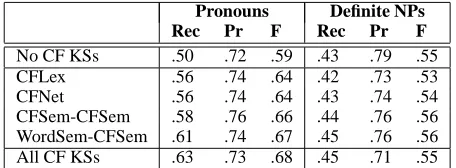
Pronouns Definite NPs
Rec Pr F Rec Pr F
No CF KSs .50 .72 .59 .43 .79 .55
CFLex .56 .74 .64 .42 .73 .53
CFNet .56 .74 .64 .43 .74 .54
CFSem-CFSem .58 .76 .66 .44 .76 .56
WordSem-CFSem .61 .74 .67 .45 .76 .56
[image:7.612.313.541.71.155.2]All CF KSs .63 .73 .68 .45 .71 .55
Table 4: Individual Performance of KSs for Terrorism
Pronouns Definite NPs
Rec Pr F Rec Pr F
No CF KSs .42 .82 .56 .42 .91 .58
CFLex .48 .83 .61 .44 .88 .59
CFNet .45 .82 .58 .43 .88 .57
CFSem-CFSem .51 .81 .62 .44 .87 .58
WordSem-CFSem .52 .79 .63 .43 .86 .57
All CF KSs .57 .79 .66 .46 .84 .59
Table 5: Individual Performance of KSs for Disasters
(e.g., “the mayor” vs. “the journalist”).
We also performed experiments to evaluate the impact of each type of contextual role knowledge separately. Ta-bles 4 and 5 show BABAR’s performance when just one contextual role knowledge source is used at a time. For definite NPs, the results are a mixed bag: some knowl-edge sources increased recall a little, but at the expense of some precision. For pronouns, however, all of the knowledge sources increased recall, often substantially, and with little if any decrease in precision. This result suggests that all of contextual role KSs can provide use-ful information for resolving anaphora. Tables 4 and 5 also show that putting all of the contextual role KSs in play at the same time produces the greatest performance gain. There are two possible reasons: (1) the knowl-edge sources are resolving different cases of anaphora, and (2) the knowledge sources provide multiple pieces of evidence in support of (or against) a candidate, thereby acting synergistically to push the Dempster-Shafer model over the belief threshold in favor of a single candidate.
5
Related Work
Many researchers have developed coreference resolvers, so we will only discuss the methods that are most closely related to BABAR. Dagan and Itai (Dagan and Itai, 1990) experimented with co-occurrence statistics that are sim-ilar to our lexical caseframe expectations. Their work used subject-verb, verb-object, and adjective-noun rela-tions to compare the contexts surrounding an anaphor and candidate. However their work did not consider other types of lexical expectations (e.g., PP arguments), seman-tic expectations, or context comparisons like our case-frame network.
[image:7.612.88.284.155.208.2]ac-quire gender, number, and animacy information from res-olutions produced by a statistical pronoun resolver. The learned information was recycled back into the resolver to improve its performance. This approach is similar to BABAR in that they both acquire knowledge from ear-lier resolutions. (Kehler, 1997) also used a Dempster-Shafer model to merge evidence from different sources for template-level coreference.
Several coreference resolvers have used supervised learning techniques, such as decision trees and rule learn-ers (Aone and Bennett, 1995; McCarthy and Lehnert, 1995; Ng and Cardie, 2002; Soon et al., 2001). These systems rely on a training corpus that has been manually annotated with coreference links.
6
Conclusions
The goal of our research was to explore the use of contex-tual role knowledge for coreference resolution. We iden-tified three ways that contextual roles can be exploited: (1) by identifying caseframes that co-occur in resolu-tions, (2) by identifying nouns that co-occur with case-frames and using them to cross-check anaphor/candidate compatibility, (3) by identifying semantic classes that co-occur with caseframes and using them to cross-check anaphor/candidate compatability. We combined evidence from four contextual role knowledge sources with ev-idence from seven general knowledge sources using a Dempster-Shafer probabilistic model.
Our coreference resolver performed well in two do-mains, and experiments showed that each contextual role knowledge source contributed valuable information. We found that contextual role knowledge was more beneficial for pronouns than for definite noun phrases. This sug-gests that different types of anaphora may warrant differ-ent treatmdiffer-ent: definite NP resolution may depend more on lexical semantics, while pronoun resolution may de-pend more on contextual semantics. In future work, we plan to follow-up on this approach and investigate other ways that contextual role knowledge can be used.
7
Acknowledgements
This work was supported in part by the National Sci-ence Foundation under grant IRI-9704240. The inven-tions disclosed herein are the subject of a patent applica-tion owned by the University of Utah and licensed on an exclusive basis to Attensity Corporation.
References
J. Allen. 1995. Natural Language Understanding.
Ben-jamin/Cummings Press, Redwood City, CA.
C. Aone and S. Bennett. 1995. Applying Machine Learning
to Anaphora Resolution. In IJCAI-95 Workshop on New
Ap-proaches to Learning for NLP.
D. Bean and E. Riloff. 1999. Corpus-Based Identification of Non-Anaphoric Noun Phrases. In Proc. of the 37th Annual
Meeting of the Association for Computational Linguistics.
I. Dagan and A. Itai. 1990. Automatic Processing of Large Corpora for the Resolution of Anaphora References. In
Pro-ceedings of the Thirteenth International Conference on Com-putational Linguistics (COLING-90), pages 330–332.
T. Dunning. 1993. Accurate methods for the statistics of sur-prise and coincidence. Computational Linguistics, 19(1):61– 74.
B. Grosz and C. Sidner. 1998. Lost Intuitions and Forgotten In-tentions. In M. Walker, A. Joshi, and E. Prince, editors,
Cen-tering Theory in Discourse, pages 89–112. Clarendon Press.
B. Grosz, A. Joshi, and S. Weinstein. 1995. Centering: A Framework for Modeling the Local Coherence of Discourse.
Computational Linguistics, 21(2):203–226.
J. Hobbs. 1978. Resolving Pronoun References. Lingua,
44(4):311–338.
A. Kehler. 1997. Probabilistic Coreference in Information Ex-traction. In Proceedings of the Second Conference on
Em-pirical Methods in Natural Language Processing.
S. Lappin and H. Leass. 1994. An algorithm for pronominal anaphora resolution. Computational Linguistics, 20(4):535– 561.
J. McCarthy and W. Lehnert. 1995. Using Decision Trees for Coreference Resolution. In Proc. of the Fourteenth
Interna-tional Joint Conference on Artificial Intelligence.
G. Miller. 1990. Wordnet: An On-line Lexical Database.
In-ternational Journal of Lexicography, 3(4).
MUC-4 Proceedings. 1992. Proceedings of the Fourth
Mes-sage Understanding Conference (MUC-4).
MUC-6 Proceedings. 1995. Proceedings of the Sixth Message
Understanding Conference (MUC-6).
MUC-7 Proceedings. 1998. Proceedings of the Seventh
Mes-sage Understanding Conference (MUC-7).
V. Ng and C. Cardie. 2002. Improving Machine Learning Ap-proaches to Coreference Resolution. In Proceedings of the
40th Annual Meeting of the Association for Computational Linguistics.
G. Niyu, J. Hale, and E. Charniak. 1998. A statistical approach to anaphora resolution. In Proceedings of the Sixth Workshop
on Very Large Corpora.
E. Riloff. 1996. An Empirical Study of Automated Dictionary Construction for Information Extraction in Three Domains.
Artificial Intelligence, 85:101–134.
W. Soon, H. Ng, and D. Lim. 2001. A Machine Learning Ap-proach to Coreference of Noun Phrases. Computational
Lin-guistics, 27(4):521–541.