warwick.ac.uk/lib-publications Manuscript version: Author’s Accepted Manuscript
The version presented in WRAP is the author’s accepted manuscript and may differ from the published version or Version of Record.
Persistent WRAP URL:
http://wrap.warwick.ac.uk/116856
How to cite:
Please refer to published version for the most recent bibliographic citation information. If a published version is known of, the repository item page linked to above, will contain details on accessing it.
Copyright and reuse:
The Warwick Research Archive Portal (WRAP) makes this work by researchers of the University of Warwick available open access under the following conditions.
© 2019, Elsevier. Licensed under the Creative Commons Attribution-NonCommercial-NoDerivatives 4.0 International http://creativecommons.org/licenses/by-nc-nd/4.0/.
Publisher’s statement:
Please refer to the repository item page, publisher’s statement section, for further information.
1
Data Scarcity in Modelling and Simulation of a Large-scale WWTP: Stop sign or a
Challenge
Sina Borzooei
1*, Youri Amerlinck
2, Soroush Abolfathi
3, Deborah Panepinto
1, Ingmar
Nopens
2, Eugenio Lorenzi
4, Lorenza Meucci
4, Maria Chiara Zanetti
11. Department of Environment, land and infrastructure Engineering (DIATI), Politecnico di
Torino, Torino, Italy.
2. Department of Data Analysis and Mathematical Modelling, Faculty of Bioscience
Engineering, Ghent University, Ghent, Belgium.
3. Warwick Water Research Group, School of Engineering, The University of Warwick
Coventry, UK.
4. Società Metropolitana Acque Torino S.p.A. Corso XI Febbraio 14, 10152, Torino (TO),
Italy
*Corresponding author: [email protected]
This is the pre-print version of manuscript. The post-print version can be found online:
https://doi.org/10.1016/j.jwpe.2018.12.010
2
Abstract
Data scarcity can be considered as the main limitation for a more widespread utilization of mathematical
models in the design, optimization and control of biological nutrient removal activated sludge systems
(BNRAS). High cost and demanding workload related to experimental data and sufficient sampling
campaigns make the data collection process an unpleasant necessity for managing stakeholders in
modelling projects. Complicated use of online-sensors leading to frequent erroneous readings and
dynamic nature of wastewater treatment processes can intensify the data scarcity problems. This paper
investigates the influence of data scarcity on the development and calibration of wastewater treatment
plant (WWTP) models. A straightforward methodology is proposed to address the challenges associated
with data quality and quantity problems in modelling of a BNRAS in the largest Italian WWTP located in
Castiglione, Italy. The plant operational modes, weather condition and sensor performance during the
sampling campaigns were the main sources of the data scarcity. Influent, biokinetic, aeration, hydraulic
and transport, clarifier, energy consumption and effluent sub-models were calibrated by use of the
proposed extensive step-wise calibration process. The Monte Carlo analysis was performed to quantify
the uncertainty of the modelling results. The proposed methodology could be implemented in engineering
practice to develop and calibrate the WWTP models while it increases the awareness about modelling
robustness and its characterized uncertainty to avoid bad modelling practice.
3 1. Introduction:
The required effluent limits for wastewater treatment plants (WWTP) proposed in the EU Directive
91/271/EEC were surely the substantial motive for more implementations of the biological process in
wastewater treatment industries. From the inauguration of these stringent effluent criteria, the application
of biological nutrient removal activated sludge (BNRAS) systems has gained great popularity in Europe.
Recently, considering the high capital and operational costs of these systems (Liu et al., 2011), control
and optimization of these processes have become necessities. However, the complex, nonlinear and
dynamic nature of biological and biochemical processes which take place in these systems, make
controlling of their performance a challenging and not straightforward task. Mathematical models provide
a valuable evaluation and decision-making tool for wastewater engineers to move forward towards the
controlling and optimization of various wastewater treatment processes including BNRAS. The by far
mostly used mechanistic models to mimic complex interactions in BNRAS systems are Activated Sludge
Models (ASM) developed by the task group of International Association on Water Pollution Research and
Control (IAWPRC) and summarized in Henze et al. (2000). The successful applications of these models
in learning, design or process optimization and control have been reported in several studies (e.g. Ferrer
et al., 2004; Balku and Berber, 2006; Beraud, 2009).
The large number and complicated nature of the simulated processes which are described by numerous
state variables as well as kinetic and stoichiometric parameters result in high model complexity which is
the main limitations for more frequent use of ASMs (Rieger et al., 2010a). To study the identifiability of
model parameters and to translate the common quality measurements (e.g. TSS, BOD5) into the ASM
family parameters, several calibration guidelines have been developed: BIOMATH (Vanrolleghem et al.,
2003), STOWA (Hulsbeek et al., 2002), HSG (Langergraber et al., 2004), WERF (Melcer, 2004). The
4
guidelines to obtain model parameters, are not usually accepted and welcomed by stakeholders and
wastewater treatment companies. Erroneous on-line measurements due to irregular and deficient sensors
maintenance and cleaning can cause a reduction of the amount of valid data. Consequently, data scarcity
is the prevailing problem in WWTP modelling projects which has been discussed in several studies (e.g.
Sochacki et al., 2009; Rieger et al., 2010b; Martin and Vanrolleghem, 2014; Borzooei et al., 2016).
Each WWTP is somehow unique, considering its service region, influent quality, industrial discharges,
age of instruments, implemented treatment methods, maintenance program, the effluent standards should
be followed, availability of online monitoring systems; their calibration and maintenance schedule,
environmental conditions such as temperature and rainfall in catchment areas etc. (Bott and Parker, 2011;
Schilperoort, 2011). As a result, implementing the calibration protocols cannot address all the issues and
practical problems which may be encountered during a specific modelling project. Therefore, the pathway
through which a WWTP is being modelled is also unique, challenging, and worth investigating.
This study proposes a stepwise approach for model development and calibration of the BNRAS
system of Castiglione Torinese WWTP in Italy, taking into account the limited available operational data
and a few measuring and sampling campaigns could be conducted. The main objective of this study was
model-based optimization and upgrading of the existing plant to meet the effluent criteria and reduce the
energy consumption which will be discussed in an accompanying study (Borzooei et al., in preparation)
to keep this study focused on the framing of the model development and calibration. This paper adds to
the existing knowledge in the field of WWTP modelling and simulation by presenting an additional
real-world case study with its practical specifications and challenges. This research addresses the practical
obstacles and difficulties, authors encountered due to data scarcity, dynamic nature and large-scale of the
5 2. Materials and methods
2.1 Process description of the Castiglione Torinese WWTP
The centralized Castiglione Torinese plant is the largest Italian WWTP located in about 11 km
Northeast of Turin, capital of Piedmont, Northwest of Italy. The plant was designed for treatment of about
590,000 m3/d of combined municipal and industrial wastewater, corresponding to an organic load of 2.1 million of equivalent inhabitants. The influent wastewater after the pre-treatment (coarse and fine screens
and grit, sand and grease removal) is unevenly introduced to 4 wastewater treatment modules, each
consisting of 2 primary clarifiers (volume VPC = 8070 m3) and 2 anoxic tanks (VAN = 13500 m3), 6 aeration
basins (volume VAR = 8736 m3) with fine bubble membrane diffusers and 6 secondary clarifiers (volume
VSC = 8020 m3). This resembles a typical Modified Ludzack-Ettinger (MLE) activated sludge system with
primary clarifiers. The mixed liquor recirculation (MLR) pipes connect the aerobic to the anoxic zones to
bring the nitrate to be denitrified in the anoxic units. The underflow from 6 secondary clarifiers flows back
to the anoxic tanks through a return activated sludge (RAS) recycle channel by three Archimedes screws
in each module. A part of activated sludge also is continuously extracted from the system and sent to the
sludge treatment units as the waste activated sludge (WAS) to ensure the biological balance in the system.
The final effluent of the secondary clarifiers flows to the final filtration units where it is divided between
27 multilayers sand and coal filtrations. Reject water from sludge treatment units (RWS) and reject water
from final filtration units (RWF) are entered to the main wastewater stream after pre-treatment units. The
plant was designed to remove organic matter and nitrogen. In addition, chemical phosphorous removal
(CPR) is achieved by adding a ferric chloride solution (Fecl3) into the RAS stream. Currently, the plant
6 2.2 Collection of existing data
Several visits to the WWTP and frequent meetings with operators and management staff were
carried out to thoroughly understand the plant configuration and identify the current process schemes.
Various implemented operational modes, number and locations of the online measuring instruments and
their cleaning and maintenance periods in addition to number and locations of the automatic samplers
used for regular sampling of the plant, were identified. Further, all the existing information including
routinely collected data based on 24 h time proportional composite samples (available from 2009 to 2016),
physical characteristics of treatment units (e.g. tanks configurations, detail information about aerators and
mixers, capacity and control scheme of pumps etc.) and operational data (e.g. flow splits, aeration control
parameters, recycle streams etc.) were collected and studied.
2.3 Additional measurement campaigns
Due to a large scale of the WWTP, practical challenges in monitoring and controlling of some operational
parameters during the short period of sampling time and financial limitations of the project, a restricted
modelling boundary was determined. In place of modelling of the whole plant, half of the single
wastewater treatment module was investigated. Based on the availability of sensors and accessibility of
measurement points, measurement campaigns were carried out to estimate MLR (QMLR) and RAS (QRAS)
flow rates. MLR tubes were lain down underground with low accessibility and to protect them against
corrosion action of the wet soil, they have been coated by the thick layer of the coal-tar pitch which makes
the applicability of the ultrasonic flowmeter, impossible. Instead, QMLR was estimated based on the
maximum capacity of the recirculation pumps. QRAS was measured by the combination of the float method
(in the access channel) and velocity estimation by ultrasonic velocity meter. The obtained value was
7 2.4 Wastewater characterization
One of the most important factors in WWTP modelling is the characterisation of the influent
wastewater. The initial influent characterization was performed according to the protocol developed by
the Dutch foundation for applied water research (STOWA: Hulsbeek et al., (2002)); however, some minor
modifications were made. For identification of COD fractions, 24 h composite samples with 1.5-hour
intervals were collected in duplicates on 07/03/2016 to 14/03/2016 (4 working days) from influent and
effluent of the studied module. The time between sampling and experimental analyses was kept as short
as possible, and samples preserved in temperature less than 4°C to prevent any biological activities before
laboratory tests. A physico-chemical method based on the combination of flocculation with Zn (OH)2 and
filtration with 0.2 μm nylon filters was implemented for estimation of the readily biodegradable (Ss) and
inert soluble (SI) COD fractions. The slowly biodegradable COD (Xs) fraction was estimated by a BOD
monitoring procedure. For inhibition of nitrification 20 mg/l Allylthiourea (ATU) was added. Each sample
was tested by 2 BOD-flasks for validating the results. The summary of all implemented methods for COD
8 Ta b le 1 . Pr o ce du re , m e tho d a nd re su lts o f CO D fr a cti o na tio n b a se d o n m ea sure m e n ts ca r rie d o u t a t C a stig lio n e T o rin es e WW TP Me as ur ed pa ram et er s C O D f rac ti on s D ef in it ion S ym U ni t A v er ag e v al ue Me th od D ef in it ion S ym U ni t Equat ion A v er ag e v al u e In fl u e n t to tal C OD COD inf g C O D .m -3 557 L T C a In er t so lu b le C OD SI g C OD. m -3 0 .9 C OD s, eff – 1 .5 B OD 5, eff 6 .5 (± 1 .6 ) In fl u e n t so lu b le C OD COD s, inf g C O D .m -3 57 FL
b a
n d L T C a R ea d il y b io d eg rad ab le C OD Ss g C OD. m -3 C OD s, inf – SI 5 0 .1 (± 6 .3 ) E ff lu e n t so lu b le C OD COD s, ef f g C O D .m -3 16 FL
b a
n d L T C a Slo w ly b io d eg rad ab le C OD Xs g C OD. m -3 B C OD – SS 2 4 1 .3 (± 9 .1 ) In fl u e n t B OD 5 BOD 5, i nf g B O D5 .m -3 198.7 L T B c In er t p ar ti cu late C O D XI g C OD. m -3 C OD inf – (S I + SS + X S ) 2 5 8 .5 (± 1 5 .5 ) In fl u e n t B OD u lti m ate BOD u , inf g B O D .m -3 248 CF
d o
f 𝐵 𝑂𝐷 𝑢 = 1 1 − 𝑒 𝐾𝐵𝑂𝐷 𝑡 𝐵 𝑂𝐷 𝑡 R ate co n sta n t o f th e B OD v s. ti m e KB OD - 0.34 CF
d o
[image:9.612.109.379.70.746.2]9 2.5 Additional sampling campaigns
An intensive 20-daysampling campaign was carried out on working days from 26 September to
21 October 2016. The sampling plan including sampling type, location and frequency as well as sufficient
instructions about handling, storage and laboratory analytical tests, were well-prepared and communicated
to the responsible staff. The grab samples were collected from influent and effluent of each treatment unit
(P1 to P5 in Fig. 1) and from the RAS channel (P6). Between samples collected from one and a subsequent
point, a lag time was set according to the average hydraulic retention time (HRT) of the corresponding
unit. For the sludge line, samples were collected from the RAS on 3:00 pm of each sampling day.
(L) Laboratory measurements (S) Online measurements
[image:10.612.62.538.303.561.2](PS) Portable device and online measurements (LS) Laboratory and online measurements
Fig. 1. The scheme of studied half wastewater treatment module in Castiglione Torinese WWTP with locations and types of measurements
Following wastewater characteristics of each grab sample were analysed according to IRSA
methodology (Blundo et al., 1994): total COD (CODt), soluble COD (CODs), supernatant COD (CODsup),
total suspended solids (TSS), total nitrogen (TN), ammonium (NH4), nitrate (NO3). For measurement of
CODsup the supernatant samples were taken from the surface of grab samples after 2-3 min of decantation. Influent
wastewater
Anoxic tank
3 Aeration tanks
Primary sludge
MLR≈ 2000m3/h
RAS ≈ 3250 m3/h
WAS VAN=113500 m3
VAR= 8736 m3
3 Secondary clarifiers VSC=8020 m3
Primary clarifier VPC=8067m
3 P1
Flow(S); CODt(L)
CODs(L); TN(L)
NH4(L); TSS(L)
P2 CODt(L); CODs(L)
TN(L); NH4(L)
TSS(L)
P6
CODs(L); NO3(L); TSS(L)
VSS(L) P3
CODsup(L); NH4(LS)
TSS(L)
P4 CODsup(L);
CODs(L) NO3(LS);
DO(PS) NH4(LS);
TSS(l) VSS(l)
P5 NO3(LS); NH4(S)
TSS(LS)
P7 Flow(S) Air flow (S)
10
All the soluble parameters were measured after filtration with 0.45μm filters following by flocculation.
Starting the sampling point from before primary clarifier, the impact of both reject water streams (RWS
and RWF) was considered. All online measurements (parameters with (S) superscript) were recorded from
the Supervisory Control and Data Acquisition (SCADA) system. To validate some of the online-measured
parameters, laboratory analyses of grab samples (parameters with (LS) superscript) and/or real-time
measurement with the portable device (parameter with (PS) superscript) were carried out. Additionally, a
2-day composite sampling campaign was carried out from influent and effluent of the studied module on
02/11/2016 and 06/11/2016 to understand the dynamic patterns of influent and effluent concentrations on
weekend and weekday. The sampling was conducted from 9:00 am to 6:00 pm. Using two autosamplers,
8 composite samples were collected by 2 h interval and further analyzed in the laboratory to measure
CODt, CODs, N-NH4, N-NO3, and TSS.
2.6 Model development
In this study, wastewater treatment process simulator, GPS-X ver.6.5.1 (Hydromantis, 2016) was
used to mimic various treatment procedures, run the simulations as well as perform parameter estimation
and uncertainty analysis. Since no tracer test was performed during the operation of the WWTP, the
hydraulic characteristics of bioreactors were approximated by a “tanks-in-series” approach. In this
approach for the flow regimes which are between the ideal plug-flow and completely mixed hydraulic
flow patterns, a series of complete-mix reactors are used. The flow condition in aeration units was further
evaluated using an empirical formula. Murphy and Boyko (1970) proposed the Eq. 1 based on the
investigating the results of the dispersed plug flow model in the full-scale aeration reactors with various
depth ratio from 0.87 to 2.04.
𝐸𝐿
𝑊2 = 3.118. (𝑞𝐴)
11
where EL is the longitudinal dispersion coefficient, m2h-1, qA the air flow rate per unit volume of the tank
(T-1) and W is the reactor width (L). The Eq.1 was also recommended in US EPA (1993) for both fine and coarse bubble diffused air systems. For each aeration unit, the average value of EL was calculated in the
sampling campaign period. The corresponding value of the dispersion number was calculated as (EL/uL),
where u is the average longitudinal velocity and L is the length of the aeration tank. Aeration units with a
dispersion number lower than 0.2 and higher than 4 are classified as plug flow and completely mixed
systems respectively (Zima et al., 2008). The average dispersion numbers calculated from Eq. 1 for three
aeration units were between 1.8 and 2. These results suggested that considering continuous
stirred-tank reactor (CSTR) for each aeration unit was a good approximation. Further, assuming the completely
mixed condition in the anoxic unit, it was simulated with a single CSTR. The biochemical activities
occurring in the aeration and anoxic reactors were simulated by the ASM1 model (Henze et al., 2000).
Since due to the data scarcity in this project CPR process was not modelled, ASM1 was the best choice to
mimic carbon and nitrogen removal processes (Gernaey et al., 2004).
Considering the available data about clarifiers, an ideal primary clarifier model (removal efficiency
model) and pre-compiled one-dimensional secondary clarifier model proposed by Takács et al. (1991)
were implemented. The non-reactive flux-based model considers 10 horizontal layers, of which the 5th
(from top) is the feed layer. Since the information regarding the settling parameters was not available, the
correlational model (Hydromantis, 2016) was implemented in which settling parameters are correlated to
the sludge volume index (SVI) and clarification factor (cf). For simplification, assuming an equal
hydraulic load of 3 secondary clarifiers they were modelled as a single flat bottom circular clarifier with
accumulated volume. The endogenous denitrification process due to the presence of biologically active
solids in the secondary clarifiers (see section 3.1) was modelled by placing a virtual anoxic CSTR after
12
by operators, this volume was equal to 50% of VSC. The biochemical processes in this virtual reactor were
described by ASM1.
Available physical and operational parameters were adjusted for each modelling unit. The depth and
volume of the basins, as well as the specification of diffusers (height and number) for each aeration unit
were entered. This information was elaborated for calculation of the standard oxygen transfer efficiency
(SOTE) according to correlation method reported in Hydromantis (2016). To model the aeration system,
initially, SOTE was measured by entering the air flowrates collected during the sampling campaign.
Further, a linear proportional–integral (PI) controller was used to regulate the airflow pumped to each
basin based on dissolved oxygen (DO) measurements.
The energy consumption (EC) of each modelling unit was estimated by implementing the operating cost
models in the GPS-X platform. The aeration energy was estimated based on the air flow rate and the
efficiencies of the blowers and motors. The required blower energy was evaluated from the adiabatic
compression equation (Mueller et al., 2002). Pumping energy was linked with pumping flowrate as well
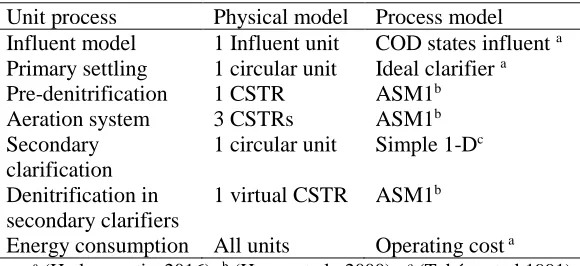
as head losses. Mixing energy was estimated by considering the power per unit volume of the mixing
[image:13.612.162.452.528.661.2](PPUV) parameter. The sub-models used for each process are summarized in Table 2.
Table 2. Sub-models of the Castiglione Torinese WWTP
Unit process Physical model Process model
Influent model 1 Influent unit COD states influent a
Primary settling 1 circular unit Ideal clarifier a
Pre-denitrification 1 CSTR ASM1b
Aeration system 3 CSTRs ASM1b
Secondary clarification
1 circular unit Simple 1-Dc
Denitrification in secondary clarifiers
1 virtual CSTR ASM1b
13 2.7 Model Calibration
Model calibration is an iterative procedure for adjusting model parameters (physical, operational, kinetic)
to improve the fit to observed set of data. The definition does not include additional measurements and
model structural modification. As a general step-wise calibration procedure in this study, the following
steps were undertaken:
Step 1) The first steady-state simulation of the model was conducted with the reference parameters for a
period equivalent to at least three times the average SRT of the system. and Modelling results were
qualitatively (visual and graphical) compared with available measured data.
Step 2) The most sensitive parameters of each sub-model were detected based on experience and common
sense, engineering judgment, BIOMATH (Vanrolleghem et al., 2003) and STOWA (Hulsbeek et al., 2002)
calibration protocols. In a few cases, full-scale observations and sensitivity analysis using
one-variable-at-a-time approach (Makinia et al., 2005) also contributed in the selection of these parameters.
Step 3) To compensate for the correlational impact of adjusted parameters, first the influent model was
calibrated followed by primary and secondary clarifiers to achieve the solids mass balance in the system.
Further, aeration followed by biokinetic models were calibrated. It should be emphasized that the
calibration of each sub-model is not independent as the modelled processes are coupled together. As a
result, several iterations with loops to the earlier steps were required. Selected parameters in each
sub-model were estimated by a Nelder-Mead simplex (polyhedron) algorithm available in GPS-X. The
methodology is a multi-dimensional method not relying on gradient information for minimization of the
objective function (Press, 2007). The maximum likelihood objective function as well as default values of
reflection, expansion, shrink and contraction constants presented in Hydromantis (2016) were used for
14
literature (e.g. Jeppson, 1996; Henze et al., 2000; Afonso and da Conceição Cunha, 2002) or by
experience. It should be stressed that in case of encountering identifiability problem in which more than
one combination of model parameters could result in a good fit to the observed set of data, the realistic
parameter combinations were identified according to objective of the project and real practical and
theoretical data about the involved process in the plant (Kristensen et al., 1998).
Step 4) The obtained parameters and concentrations from steady state runs in step 3 were used as the initial
conditions for dynamic simulations and the dynamic calibration was performed iterating the procedure in
step 3.
For calibration of the aeration process, initially, α factors (ratio of process water to clean water mass
transfer coefficients) were adjusted to improve the fit to observed set of DO, NH4 and NO3 concentrations
measured in the effluent of each aeration unit. Further, the implemented PI controllers were tuned with
adjustment of the DO setpoint (see section 3.1), proportional gain (Kc) and integral time (Ti) tuning
constants.
The calibration of the EC models was performed considering the specific electricity consumption values
reported in Panepinto et al. (2016) for some of the electro-mechanic devices in the Castiglione Torinese
WWTP. These values were acquired from the tele-control system and some direct measurements to
evaluate overall energy features of the plant. Two calibrating parameters namely pressure drop in piping
and diffuser downstream of blower (PD) and combined blower and motor efficiency (BME) were adjusted,
for calibration of the aeration energy model. The pumping energy models were calibrated by adjustment
of pump efficiency (PE) and pipe friction loss (PFL), assuming constant static system head. Mixing energy
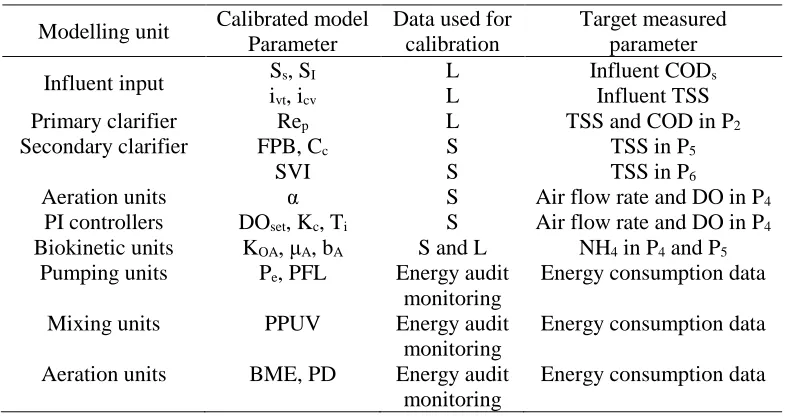
models were calibrated by adjusting power per unit volume (PPUV) parameters. The calibrated parameters
15
Table 3. Calibrated and target parameters
Modelling unit Calibrated model Parameter
Data used for calibration
Target measured parameter
Influent input Ss, SI L Influent CODs
ivt, icv L Influent TSS
Primary clarifier Rep L TSS and COD in P2
Secondary clarifier FPB, Cc S TSS in P5
SVI S TSS in P6
Aeration units α S Air flow rate and DO in P4
PI controllers DOset, Kc, Ti S Air flow rate and DO in P4
Biokinetic units KOA, μA, bA S and L NH4 in P4 and P5
Pumping units Pe, PFL Energy audit
monitoring
Energy consumption data
Mixing units PPUV Energy audit
monitoring
Energy consumption data
Aeration units BME, PD Energy audit
monitoring
Energy consumption data
2.8 Evaluation of the results
The calibrated model was validated to assess the quality of the simulation results by quantifying the
deviations between the model outputs and observations. To this end, the root mean squared error (RMSE)
and the mean absolute percentage error (MAPE) were used as quantitative measures of the model
prediction accuracy with respect to effluent TSS, NH4 and NO3 observations. These statistical criteria
were calculated from Eq. 2 and Eq. 3.
𝑀𝐴𝑃𝐸 =100
𝑛 ∑ |
𝑃𝑡−𝑚𝑡
𝑃𝑡 |
𝑛
𝑡=1 (2)
𝑅𝑀𝑆𝐸 = √∑𝑛𝑡=1(𝑚𝑡−𝑃𝑡)2
𝑛 (3)
where Pt is model predicted output, mt is measured value at the tthtime instance and n is the total number
16 2.9 Uncertainty analysis
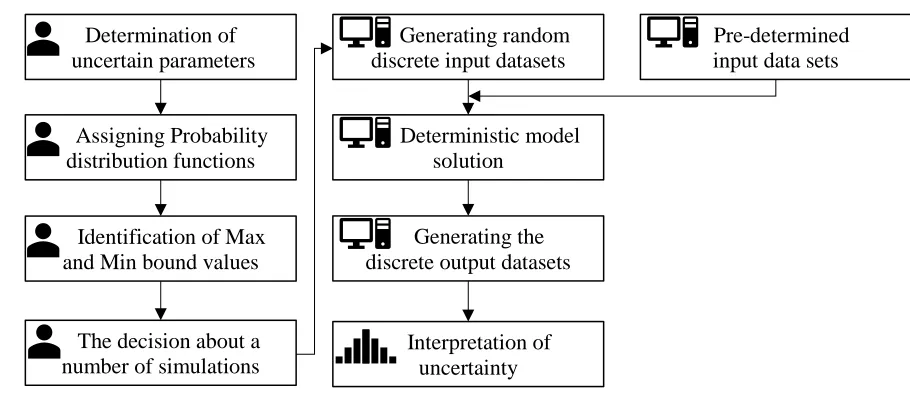
To assess the input (subjective) uncertainty of the developed model, the Monte Carlo Analysis (MCA)
was performed. MCA provides a probabilistic shell around the deterministic models and quantifies the
uncertainty of the model predictions by expanding the small size sample with the use of probability
distribution functions assigned to input parameters and running several simulations with randomly
selected model inputs (Bixio et al., 2002). Fig. 2 demonstrates the stepwise approach implemented in
[image:17.612.73.528.283.483.2]MCA.
Fig. 2. Step-wise Monte Carlo analysis
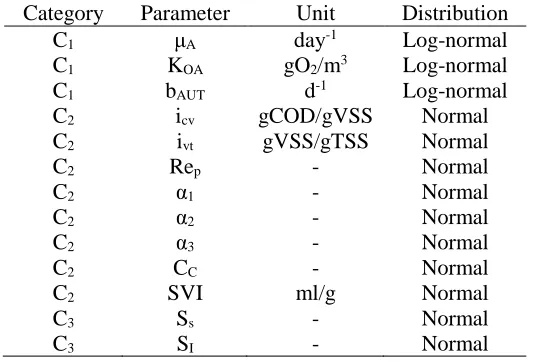
In this study, 13 calibrated parameters (see Table 4) including 7 kinetic and stoichiometric parameters, α
values of aeration basins and 3 operational parameters related to clarifiers were considered as uncertain
input parameters.
Determination of uncertain parameters
Assigning Probability distribution functions
Identification of Max and Min bound values
The decision about a number of simulations
Generating random discrete input datasets
Pre-determined input data sets
Deterministic model solution
Generating the discrete output datasets
17
Table 4. Uncertain parameters and their distribution functions in MCA
These parameters were categorized in 3 uncertainty classes depending on their level of uncertainty and
the extent of available knowledge about them. The first class (C1) corresponded to the numerically
calibrated kinetic parameters. For the parameters in C1 the universal parameter distributions proposed by
Cox (2004) as well as uniform distribution functions were considered. Upper and lower bounds around
their calibrated values were determined according to ranges proposed in the literature (Jeppson, 1996;
Henze et al., 2000; Afonso and da Conceição Cunha, 2002). For the parameters in the second class (C2),
normal distribution functions were assigned with 25% upper and lower bounds around their calibrated
values. The third class (C3) corresponded to 2 influent COD fractions which were obtained by the
calibration process. Parameters in this class were considered as highly uncertain parameters because of
their nature (diurnal, monthly and seasonal variations) and identifiability problems occurred during their
calibration process. For parameters in C3, normal distribution functions were assigned with 50% upper
and lower bounds around their calibrated values. It should be stressed that for the simplicity, parameters
were assumed to be independent and their possible correlations were neglected.
Latin hypercube sampling (LHS) method was implemented for the sampling of the input uncertainty. To
identify the sufficient number of replications in MCA, steady-state simulations were conducted with a
Category Parameter Unit Distribution
C1 μA day-1 Log-normal
C1 KOA gO2/m3 Log-normal
C1 bAUT d-1 Log-normal
C2 icv gCOD/gVSS Normal
C2 ivt gVSS/gTSS Normal
C2 Rep - Normal
C2 α1 - Normal
C2 α2 - Normal
C2 α3 - Normal
C2 CC - Normal
C2 SVI ml/g Normal
C3 Ss - Normal
18
various number of runs (from 100 to 10000) and input probability distribution graphs were developed
accordingly. Graphs were further qualitatively (visual and graphical) analysed and the minimum number
of replications which made the best agreement between assigned distribution function to input variables
and the developed graph, was chosen as the sufficient number of runs. This simplifying method was
chosen considering the available computational power and time of the project. Finally, the results were
represented by mean, 5th and 95th percentiles and cumulative distribution functions (CDF).
3. Results and discussions
3.1 Data collection and practical challenges
Because of the sampling type (daily composite) and location in the plant routine data collection,
the impact of RWS and RWF and wet-weather events could not be captured which makes the historical
data not thoroughly representative of the real condition of the plant. However, modular and temporal
trends of influent flowrate and concentrations in addition to observed ranges for mixed liquor suspended
solids (MLSS) in aeration units and SVI in secondary clarifiers were identified from routinely collected
data which were further elaborated in modelling and calibration (see section 3.3). Since no flow
measurements could be conducted from the effluent of the treatment units, data accuracy evaluation (e.g.
mass balance) could not be scrutinised in both routine data collection and the sampling campaign.
During the additional sampling campaign, mixing deficiency in the anoxic units due to mixer
clogging was frequently observed. Several dead zones and floating sludge areas caused by diffusers
fouling and bulk air emission due to relocated, broken or deformed diffusers bases were noticed in 3
studied aeration tanks.
In the sampling period, managing staff was advised to keep operational conditions of the studied
19
extreme wet-weather events occurred during this period. Since both issues were found very important in
the influent characteristics, recorded results were partitioned into two main categories: the 11-day normal
operational condition in dry weather (NC-D) and the 9-day high load operational condition in wet weather
(HC-W) in which discharge of RWS and heavy rain event occurred. During the 2-day dynamic sampling
campaign the discharge of RWS was recorded in dry weather condition (HC-D). Table 5 shows the
[image:20.612.87.522.276.343.2]average influent concentrations of the studied module in each operational mode.
Table 5. Average of the influent concentration in different operational modes observed in sampling campaign period (26.10-21.11.2016)
Operational mode
Average and standard deviation of measured values [mg/l]
CODt CODs TN NH4 TP TSS
NC-D 238(±45.5) 40.1(±7.3) 26.5(±3.3) 25.2(±0.05) 3.7(±2.7) 134.7(±37.9)
HC-W 407(±110.2) 41.9(±4.2) 34.6(±4.6) 29.3(±0.1) 7(±3.7) 274.1(±95.1)
HC-D 734(±135.7) 73.2(±13.2) 44.5(±4.2) 38.4(±2.2) 9(±1.8) 442(±95.1)
Partitioned results highlight the impact of RWS on influent characteristics since concentrations
recorded in NC-D were found almost doubled or tripled in HC-D operational mode. Moreover, the dilution
effect of a wet weather event on influent concentrations can be clearly detected, comparing the results
recorded in HC-D and HC-W modes. Considering the high deviation of influent concentrations in various
operational modes, it was decided to use collected data in NC-D mode for model calibration. The data
collected in HC-D and HC-W modes were further elaborated in model-based optimization and scenario
planning in an accompanying study (Borzooei et al., in preparation) to keep this study focused on the
framing of the model development and calibration.
The collected data was further analysed to investigate the performance of treatment units.
Comparing the CODs, NH4 concentrations recorded in P2 and P3 (see Fig. 1), the reactive nature of the
primary clarifier was revealed with 270 and 110 kg/d increasing of the NH4 and CODs loads respectively.
Comprehensive investigation of the reactive primary clarifier was performed in Borzooei et al. (2017).
20
average, the occurrence of denitrification during the studied period was confirmed. A tentative study based
on decision tree proposed in Comas et al. (2008) was performed to evaluate the risk of rising sludge. The
results confirmed the high risk of sludge rising in denitrifying clarifiers as a result of their high residence
time and the influent nitrate level above the critical value (Henze et al., 1993). However, to certainly link
the sludge rising phenomena, which were frequently observed in the plant, to the denitrification process,
further investigation was proposed.
A high discrepancy was observed between online measurements of NH4 and lab analyses of grab
samples collected from the effluent of aeration units (P4). These discrepancies resulted from the
occurrence of several types of sensors failure including a long period with sensor fault (constant value) as
well as periodic faults (incorrect scaling and/or out of normal range values) during the campaign (see Fig
A. 2). Therefore, lab resultswere used for calibration process. Considering the performance of NH4 sensor
and investigating the DO concentrations and airflow rate recorded in the sampling period, it was induced
that ammonium-based supervisory control system was not really implemented in controlling of the
aeration systems, rather they were controlled manually.
3.2 Wastewater and biomass characterization
The initial fractionation of organic matter in influent wastewater was carried out according to methods
proposed by standard Dutch guidelines (Roeleveld and Van Loosdrecht, 2002). Obtained results are
presented in Table 1. The average contribution of individual ASM1 components to total COD was found
as follows: SI = 1.1%, Ss = 9.1%, Xs = 44 %, XI = 45.8 %. The estimated Ss fraction corresponds to a low
value but still within the reported range in several studies (e.g. Henze, 1992; Chachuat et al., 2005;
Marquot et al., 2006; Pasztor et al., 2009) in which Ss constituted 3-35% and 14-57% of total COD in raw
municipal and settled wastewater respectively. However, the estimated SI fraction was found to be out of
21
2009). To solve the identifiability problem in the calibration of the influent model (see Table 3), SI value
was numerically calibrated while Ss was kept unchanged. The adjusted SI value remained in the suggested
range. The estimated XI/total COD ratio (45.8%) was higher than the reported range (8-39%) (Henze,
1992; Roeleveld and Van Loosdrecht, 2002). The high XI value can be linked to two factors: long
hydraulic residence time in sewage pipelines and share of industrial wastewater in the. As proposed in
several studies (e.g. Szaja et al., 2015; Pasztor et al., 2009; Quevauviller et al., 2007), for the large WWTPs
like Castiglione Torinese which have more complex sewer collection system with a longer retention time
of wastewater, the biological degradation of substrate fraction occur at bigger scale in sewer system which
results the increase of inert particulate components. The higher inert COD fraction can be also linked with
a presence of industrial wastewater (Mhlanga and Brouckaert, 2013). In the case of this study, Castiglione
Torinese is the municipal WWTPs with a dominant contribution of non-industrial discharges in the
wastewater influent.
The first estimated Xs/XI ratio was revised based on calibration of the influent model. The Xs fraction was
reduced from 44% to 37%. After this adjustment, Xs fraction remained within the typical range of 28-68%
(Kappeler and Gujer, 1992; Roeleveld and Van Loosdrecht, 2002). Although the Ss/(Ss+Xs) ratio was
improved with the adjustment but it is still out of the typical range of 0.3-0.5 reported in Makinia et al.
(2006). It should be emphasized that autotrophic (XBA) and heterotrophic (XBH) biomass concentrations
were assumed equal to 0.1-1 and 0 mg/l respectively because these two fractions are included in particulate
22 3.3 Model calibration
The model was calibrated under a dynamic condition with the data originating from both laboratory and
sensor readings on NC-D operational mode in the sampling period (26.10-21.11.2016) following the
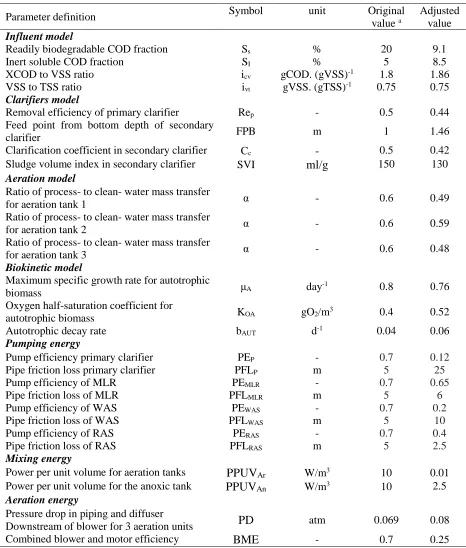
approach presented before. The final set of adjusted parameters and their original values are tabulated in
Table 6. After the adjustment of two COD fractions (SI and SS) according to CODs measurements, the
influent model was calibrated by increasing icv to 1.85gCOD. (gVSS)-1 which was assumed based on the
measurement of the CODt and MLVSS in the aeration tanks while keeping ivt constant.
In the calibration of the secondary clarifier model, clarification coefficient (Cc) was decreased to 0.42 to
improve the final effluent TSS model prediction. The SVI was decreased from 150 to 130 ml/ to calibrate
the sludge thickening process in the secondary clarifier and improve the fit to observed TSS values in
RAS. The adjusted SVI value remained in obtained range (85-148 ml/g) from routine data collection (see
section 2.2).
The calibrated α values for 3 aeration basins indicated higher aeration efficiency of one of the tanks in
comparison to others. Since fouling factor (Ff) equal to 1 was assumed for all three tanks, the differences
23
Table 6. Original and adjusted parameters in the calibration process
Parameter definition Symbol unit Original
value a
Adjusted value
Influent model
Readily biodegradable COD fraction Ss % 20 9.1
Inert soluble COD fraction SI % 5 8.5
XCOD to VSS ratio icv gCOD. (gVSS)-1 1.8 1.86
VSS to TSS ratio ivt gVSS. (gTSS)-1 0.75 0.75
Clarifiers model
Removal efficiency of primary clarifier Rep - 0.5 0.44
Feed point from bottom depth of secondary
clarifier FPB m 1 1.46
Clarification coefficient in secondary clarifier Cc - 0.5 0.42
Sludge volume index in secondary clarifier SVI ml/g 150 130
Aeration model
Ratio of process- to clean- water mass transfer
for aeration tank 1 α - 0.6 0.49
Ratio of process- to clean- water mass transfer
for aeration tank 2 α - 0.6 0.59
Ratio of process- to clean- water mass transfer
for aeration tank 3 α - 0.6 0.48
Biokinetic model
Maximum specific growth rate for autotrophic
biomass μA day
-1 0.8 0.76
Oxygen half-saturation coefficient for
autotrophic biomass KOA gO2/m
3 0.4 0.52
Autotrophic decay rate bAUT d-1 0.04 0.06
Pumping energy
Pump efficiency primary clarifier PEP - 0.7 0.12
Pipe friction loss primary clarifier PFLP m 5 25
Pump efficiency of MLR PEMLR - 0.7 0.65
Pipe friction loss of MLR PFLMLR m 5 6
Pump efficiency of WAS PEWAS - 0.7 0.2
Pipe friction loss of WAS PFLWAS m 5 10
Pump efficiency of RAS PERAS - 0.7 0.4
Pipe friction loss of RAS PFLRAS m 5 2.5
Mixing energy
Power per unit volume for aeration tanks PPUVAr W/m3 10 0.01
Power per unit volume for the anoxic tank PPUVAn W/m3 10 2.5
Aeration energy
Pressure drop in piping and diffuser
Downstream of blower for 3 aeration units PD atm 0.069 0.08
Combined blower and motor efficiency BME - 0.7 0.25
24
The nitrification process was initially calibrated by decreasing the maximum specific growth rate for
autotrophic biomass (μA) from 0.8 to 0.76 (d-1) to improve the modelling results fit to the observed set of
the ammonia level at the effluent of aeration tanks. It should be also mentioned that the nitrate
concentration in aeration tanks was slightly decreased by adjusting the μA. This value corresponds to the
reported range (0.2-1.2 d-1) (Henze et al., 2000; Afonso and da Conceição Cunha, 2002). The ammonia and nitrate fits were further improved by increasing the autotrophic decay rate (bA) from 0.04 to 0.06 (d -1) and oxygen half-saturation index for autotrophic biomass (K
OA) from 0.4 to 0.52 gO2/m3. A higher
estimated bA value can be the result of the long oxic-SRT of the system (average 30 days)
(Liwarska-Bizukojc et al., 2011). As stated in Arnaldos et al. (2015), several factors influence half saturation index
including factors involved in transport in the bulk medium, into the floc, through the cell membrane, in
the periplasm and enzymatic binding/release of a substrate. However, among all the influencing factors,
the bulk mixing condition is logically the first factor to be investigated since its impact may overwhelm
the contributions of other factors especially in case of non-uniform mixing condition. Since actual dead
zones were observed in aeration tanks in the Castiglione Torinese plant during the sampling campaign;
the advection limitation can be the explanation for the need to increase the KOA. Both adjusted parameters
(bA and KOA) corresponded well within the reported ranges (Henze et al., 2000; Jeppson, 1996). In the
calibration of the pumping EC models, since no practical information was available about real PE and
PFL values, one of their obtained combinations in the parameter estimation process was used. However,
for calibration of the aeration EC model, based on the sensitivity analysis results, initially, the PD
parameter was adjusted followed by BME.
3.3 Evaluation of modelling results
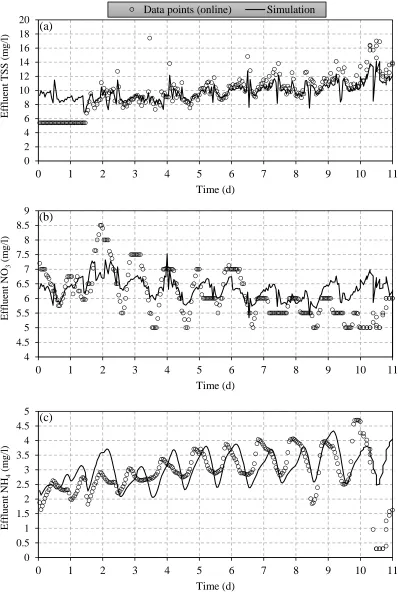
The results of the dynamic simulations for 3 effluent concentrations (TSS, NH4 and NO3) are presented in
25
(Fig. 3a) and expressed by the low values of the MAPE = 19 % and RMSE = 0.33 mg/l. It should be noted
that a short period of sensor failure (constant value) in the first two days of the sampling affected the
model evaluation results.
For both the description of the effluent NO3 and NH4, even though the differences between online data
and model prediction were relatively higher (MAPE = 11-34 % and RMSE= 0.14-1.5 mg/l respectively),
the model predictions reasonably follow the trend of the actual data (Fig. 3 b and c). However, the model
frequently overpredicted the NO3 level in the afternoon (from 14:00 pm) on each simulating day where
real data showed drops and lower values. A possible reason could be the increased residence time (lower
flow rate in afternoons) in the aeration tanks through which simultaneous denitrification can take place,
especially in the dead zones in presence of enough readily biodegradable COD which is not captured by
the way the mixing is currently modelled. Besides, in the ASM1 the same oxygen half saturation
coefficient for heterotrophs (KOH) is considered for modelling both the aerobic and anoxic growth of
heterotrophic biomass. Hence, in the modelling approach, if aerobic growth of heterotrophs decreases, the
capacity for anoxic growth will increase. This emphasizes the importance of KOH in calibration process
which was kept constant in this study due to data scarcity. Moreover, considering the occurrence of the
denitrification in secondary clarifiers during the sampling campaign, a lower flow rate can result in the
higher sludge residence time in the clarifier and consequently intensify the denitrification.
Since the calibration process was conducted based on the results of composite samples, logically the
events with fast dynamics could not be well-captured by the developed model; however, the data with
abrupt changes, disturbance and fluctuations in plant record data brought additional difficulties in the
calibration process and parameter estimation. The removal efficiencies for effluent parameters were
calculated based on actual measurement and dynamically simulated average values. The results proved
26
Fig. 3. Measurements vs. model predictions of effluent TSS (a), N-NO3 (b), N-NH4 (c) within the sampling campaign period (26.10-21.11.2016)
0 2 4 6 8 10 12 14 16 18 20
0 1 2 3 4 5 6 7 8 9 10 11
Eff
luent
TS
S
(m
g/
l)
Time (d)
Data points (online) Simulation
(a)
4 4.5 5 5.5 6 6.5 7 7.5 8 8.5 9
0 1 2 3 4 5 6 7 8 9 10 11
Eff
luent
NO
3
(m
g/
l)
Time (d)
(b)
0 0.5 1 1.5 2 2.5 3 3.5 4 4.5 5
0 1 2 3 4 5 6 7 8 9 10 11
Eff
luent
NH
4
(m
g/
l)
Time (d)
27
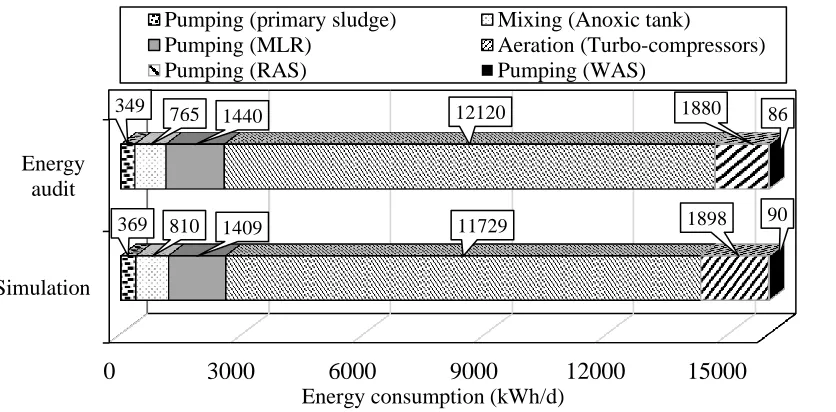
EC modelling results confirmed that aeration and pumping systems are the biggest energy consumers with
70-78% and 20-26 % of the total energy consumption of the studied module respectively. Measured and
simulated daily averaged EC of treatment units were calculated (Fig. 4). The results presented in Fig. 4
[image:28.612.92.510.182.388.2]proved that the model predictions are in relatively good agreement with energy audit data.
Fig. 4. Comparison of the measured and simulated daily averaged energy consumption of the studied module
3.4 Uncertainty assessment and improving proposals
To evaluate the uncertainty analysis results, CDFs of aggregated measure of averaged effluent TSS, CODt,
NO3 and NH4 concentrations were developed (Fig. 5). Comparing the results of the base-case simulation
(Fig. 4) and the results presented in Fig. 5, one observes that there is considerable uncertainty concerning
all effluent parameters. These results proved that uncertainty of the kinetic, stoichiometric, influent
fractions and operational parameters cause significant variance in the predicted effluent concentrations.
As regards the CDF of the effluent TSS (Fig. 5a) it can be noted that the spread of uncertainty is very
broad. This can be due to two main reasons: (i) No MLSS controller was implemented in the model to
counteract the uncertainty in the input parameters and as a result maintaining relatively stable MLSS level
(ii) uncertainty of the operational input parameters regarding secondary and primary clarifiers.
0 3000 6000 9000 12000 15000
Simulation Energy
audit
369 349
810 765
1409 1440
11729 12120
1898 1880
90 86
Energy consumption (kWh/d)
Pumping (primary sludge) Mixing (Anoxic tank)
Pumping (MLR) Aeration (Turbo-compressors)
28
Fig. 5. Representations of uncertainty in four effluent parameters by the cumulative distribution function (CDF)
Conducting settling tests as well as representative COD fractionation and measuring campaigns
associated with each operational mode and the tracer test to set-up an accurate hydraulic model for
clarifiers were proposed to reduce the uncertainty the modelling results. Likewise, a wide range of
uncertainty was observed in predicted effluent COD and nitrogen concentrations which can be linked to
all sources of the uncertainty although the impact of operational parameters of clarifiers and mass transfer
related parameters may be overwhelmed (Sin et al., 2009). Beside above-mentioned additional tests,
application of the DO, NO3, NH4, TSS in-situ probes and actual implemented airflow controlling system
0.0 0.2 0.4 0.6 0.8 1.0
5 35 65 95 125 155 185
C um ul at iv e pr obabi li ty
Effluent TSS (mg/l)
(a) 0.0 0.2 0.4 0.6 0.8 1.0
10 40 70 100 130 160 190 220
Cum ul at iv e p rob ab il it y
Effluent total COD (mg/l)
(b) 0.0 0.2 0.4 0.6 0.8 1.0
0 2 4 6 8 10 12 14 16
C um ul at iv e pr obabi li ty
Effluent Nitrate (mgN/l)
(c) 0.0 0.2 0.4 0.6 0.8 1.0
0 5 10 15 20 25 30
C um ul at iv e pr obabi li ty
Effluent Ammonium (mgN/l)
29
in aeration units and conducting series of experimental batch tests to measure the kinetics parameters were
proposed to improve the certainty of the modelling results.
5. Conclusions
This study proposes a novel methodology to address the impact of data quality and quantity
problems on modelling and calibration of WWTPs. Historical data of the large-scale Castiglione Torinese
WWTP, from January 2009 to December 2016, in addition to data collected in a few sampling and
measurement campaigns, were utilized for model development and calibration. Unprecedented changes
in weather condition, sensor performance and discharge of reject water from sludge treatment units during
the sampling campaign were found intensifying sources of data scarcity in this project. The practical
information presented in this study, stresses the role of a well-designed data collection process for both
performance investigation and troubleshooting of treatment units which is usually overlooked, or its
importance underestimated. The reactive nature of the primary clarifier and denitrification in the
secondary clarifier were identified based on sampling campaign results. The developed model comprises
biokinetic, aeration, hydraulic and transport, clarifier, input, output and energy consumption sub-models,
and was calibrated by use of an extensive step-wise calibration process. Short-term predictability of the
calibrated model was confirmed by comparing the dynamics of simulated and measured TSS, N-NH4 and
N-NO3 effluent concentrations as well as their removal efficiencies. The uncertainty of the model was
investigated by Monte Carlo Analysis (MCA). The results of the MCA emphasized the impact of data
quality and quantity problem on uncertainty of developed model by showing high variances of effluent
concentrations in MCA results. Considering the MCA results, additional tests, sampling and
30 6. Acknowledgments
This research was financially supported by Società Metropolitana Acque Torino (SMAT). The authors
wish to thank all the SMAT laboratory, maintenance and operations personnel for their engagement and
31 References:
Arnaldos, M., Amerlinck, Y., Rehman, U., Maere, T., Van Hoey, S., Naessens, W., and Nopens, I. (2015). From the affinity constant to the half-saturation index: Understanding conventional modeling concepts in novel wastewater treatment processes. Water Res. 70, 458–470.
Balku S, Berber R (2006). Dynamics of an activated sludge process with nitrification and denitrification: Start-up simulation and optimization using evolutionary algorithm. Computer and Chemical Engineering, 30(3), pp. 490-499.
Beraud, B. (2009). Methodology for the optimization of wastewater treatment plant control laws based on modeling and multi-objective genetic algorithms. Université Montpellier II-Sciences et Techniques du Languedoc.
Bixio, D., Parmentier, G., Rousseau, D., Verdonck, F., Meirlaen, J., Vanrolleghem, P.A., and Thoeye, C. (2002). A quantitative risk analysis tool for design/simulation of wastewater treatment plants. Water Sci. Technol. 46, 301–307.
Blundo, C.M., Campanella, L., Capri, S., La Noce, T., Liberatori, A., Pagnotta, R., and Pettine, M. (1994). Metodi analitici per Acque. Man. IRSA–CNR Ist. Poligr. E Zecca Dello Stato Roma.
Borzooei, S., Zanetti, M.C., Genon, G., Ruffino, B., Godio, A., Campo, G., Panepinto, D., Lorenzi, E., De Ceglia, M., and Binetti, R. (2016), Modelling and calibration of the full-scale WWTP with data scarcity. Proceedings of International Symposium on sanitary and environmental engineering, Rome.
Borzooei, S., Zanetti, M.C., Lorenzi, E., and Scibilia, G. (2017). Performance Investigation of the Primary Clarifier-Case Study of Castiglione Torinese. In Frontiers International Conference on Wastewater Treatment and Modelling, (Springer), pp. 138–145.
Bott, C.B., and Parker, D.S. (2011). WEF/WERF study quantifying nutrient removal technology performance (Water Environment Research Foundation Alexandria, VA).
Chachuat, B., Roche, N., and Latifi, M.A. (2005). Long-term optimal aeration strategies for small-size alternating activated sludge treatment plants. Chem. Eng. Process. Process Intensif. 44, 591–604.
Comas, J., Rodríguez-Roda, I., Gernaey, K.V., Rosen, C., Jeppsson, U., and Poch, M. (2008). Risk assessment modelling of microbiology-related solids separation problems in activated sludge systems. Environ. Model. Softw. 23, 1250–1261.
Cox, C.D. (2004). Statistical distributions of uncertainty and variability in activated sludge model parameters. Water Environ. Res. 76, 2672–2685.
32
Ferrer, J., Morenilla, J.J., Bouzas, A., and Garcia-Usach, F. (2004). Calibration and simulation of two large wastewater treatment plants operated for nutrient removal. Water Sci. Technol. 50, 87–94.
Gernaey, K.V., van Loosdrecht, M.C., Henze, M., Lind, M., and Jørgensen, S.B. (2004). Activated sludge wastewater treatment plant modelling and simulation: state of the art. Environ. Model. Softw. 19, 763– 783.
Henze, M. (1992). Characterization of wastewater for modelling of activated sludge processes. Water Sci. Technol. 25, 1–15.
Henze, M., Dupont, R., Grau, P., and De La Sota, A. (1993). Rising sludge in secondary settlers due to denitrification. Water Res. 27, 231–236.
Henze, M., Gujer, W., Mino, T., and Van Loosdrecht, M.C.M. (2000). Activated sludge models ASM1, ASM2, ASM2d and ASM3 (IWA publishing).
Hulsbeek, J.J.W., Kruit, J., Roeleveld, P.J., and Van Loosdrecht, M.C.M. (2002). A practical protocol for dynamic modelling of activated sludge systems. Water Sci. Technol. 45, 127–136.
Hydromantis Environmental Software Solutions, Inc. (2016). GPS-X Version 6.5: GPS-X Technical Reference. Ontario, Canada.
Jeppson, U. (1996). Modeling aspects of wastewater treatement plants. PhD thesis, IAE, Lund, Sweden.
Kappeler, J., and Gujer, W. (1992). Estimation of kinetic parameters of heterotrophic biomass under aerobic conditions and characterization of wastewater for activated sludge modelling. Water Sci. Technol.
25, 125–139.
Kristensen, G.H., la Cour Jansen, J., and Jørgensen, P.E. (1998). Batch test procedures as tools for calibration of the activated sludge model-A pilot scale demonstration. Water Sci. Technol. 37, 235–242.
Langergraber, G., Rieger, L., Winkler, S., Alex, J., Wiese, J., Owerdieck, C., Ahnert, M., Simon, J., and Maurer, M. (2004). A guideline for simulation studies of wastewater treatment plants. Water Sci. Technol.
50, 131–138.
Liu, C., Li, S., and Zhang, F. (2011). The oxygen transfer efficiency and economic cost analysis of aeration system in municipal wastewater treatment plant. Energy Procedia 5, 2437–2443.
Liwarska-Bizukojc, E., Olejnik, D., Biernacki, R., and Ledakowicz, S. (2011). Calibration of a complex activated sludge model for the full-scale wastewater treatment plant. Bioprocess Biosyst. Eng. 34, 659– 670.
Makinia, J., Rosenwinkel, K.-H., and Spering, V. (2005). Long-term simulation of the activated sludge process at the Hanover-Gümmerwald pilot WWTP. Water Res. 39, 1489–1502.
33
Marquot, A., Stricker, A.-E., and Racault, Y. (2006). ASM1 dynamic calibration and long-term validation for an intermittently aerated WWTP. Water Sci. Technol. 53, 247–256.
Martin, C., and Vanrolleghem, P.A. (2014). Analysing, completing, and generating influent data for WWTP modelling: a critical review. Environ. Model. Softw. 60, 188–201.
Melcer, H. (2004). Methods for wastewater characterization in activated sludge modelling (IWA publishing).
Mhlanga, F.T., Brouckaert, C.J., 2013. Characterisation of wastewater for modelling of wastewater treatment plants receiving industrial effluent. Water SA 39, 403–408.
Mueller, J., Boyle, W.C., and Popel, H.J. (2002). Aeration: Principles and practice (CRC press).
Murphy, K.L., and Boyko, B.I. (1970). Longitudinal mixing in spiral flow aeration tanks. J. Sanit. Eng. Div. 96, 211–221.
Panepinto, D., Fiore, S., Zappone, M., Genon, G., and Meucci, L. (2016). Evaluation of the energy efficiency of a large wastewater treatment plant in Italy. Appl. Energy 161, 404–411.
Pasztor, I., Thury, P., and Pulai, J. (2009). Chemical oxygen demand fractions of municipal wastewater for modeling of wastewater treatment. Int. J. Environ. Sci. Technol. 6, 51–56.
Press, W.H. (2007). Numerical recipes 3rd edition: The art of scientific computing (Cambridge university press).
Quevauviller, P., Thomas, O., Van Der Beken, A., 2007. Wastewater quality monitoring and treatment. John Wiley & Sons.
Rieger, L., Takacs, I., Shaw, A., Winkler, S., Ohtsuki, T., Langergraber, G., Gillot, S., and Models, I.T.G. on G.M.P.G. for U. of A.S. (2010a). Status and future of wastewater treatment modelling (IWA Publishing).
Rieger, L., Takács, I., Villez, K., Siegrist, H., Lessard, P., Vanrolleghem, P.A., and Comeau, Y. (2010b). Data reconciliation for wastewater treatment plant simulation studies-planning for high-quality data and typical sources of errors. Water Environ. Res. 82, 426–433.
Roeleveld, P.J., and Van Loosdrecht, M.C.M. (2002). Experience with guidelines for wastewater characterisation in The Netherlands. Water Sci. Technol. 45, 77–87.
Schilperoort, R.P.S. (2011). Monitoring as a tool for the assessment of wastewater quality dynamics. PhD thesis, Water Management Academic Press - Delft, the Netherlands.
Sin, G., Gernaey, K.V., Neumann, M.B., van Loosdrecht, M.C., and Gujer, W. (2009). Uncertainty analysis in WWTP model applications: a critical discussion using an example from design. Water Res.
34
Sochacki, A., Knodel, J., Gei\s sen, S.U., Zambarda, V., Miksch, K., and Bertanza, G. (2009). Modelling and simulation of a municipal WWTP with limited operational data. In Proceedings of a Polish-Swedish-Ukrainian Seminar, pp. 23–25.
Szaja, A., Aguilar, J.A., Lagód, G., 2015. Estimation of Chemical Oxygen Demand Fractions of Municipal Wastewater by Respirometric Method–Case Study. Rocz. Ochr. Śr. 17, 289–299.
Takács, I., Patry, G.G., and Nolasco, D. (1991). A dynamic model of the clarification-thickening process. Water Res. 25, 1263–1271.
Vanrolleghem, P.A., Insel, G., Petersen, B., Sin, G., De Pauw, D., Nopens, I., Dovermann, H., Weijers, S., and Gernaey, K. (2003). A comprehensive model calibration procedure for activated sludge models. Proc. Water Environ. Fed. 2003, 210–237.
Zawilski, M., Brzezińska, A., 2009. Variability of COD and TKN Fractions of Combined Wastewater. Pol. J. Environ. Stud. 18.
Zima, P., Makinia, J., Swinarski, M., and Czerwionka, K. (2008). Effects of different hydraulic models on predicting longitudinal profiles of reactive pollutants in activated sludge reactors. Water Sci. Technol.
35
Appendix:
Fig. A.1. Comparison of sensor and sampling results for effluent NH4 at 3 aeration tanks within the sampling campaign period (26.10-21.11.2016)
0 5 10 15 20 25 30 35
0.0 2.0 4.0 6.0 8.0 10.0
NH
4
C
once
nt
rat
ion
(m
g
/l
)
Time (d)
Aeration tank 1 (sensor) Aeration tank 2 (sensor)
Aeration tank 3 (sensor) Aeration tank 1 (sampling)