warwick.ac.uk/lib-publications
A Thesis Submitted for the Degree of PhD at the University of Warwick Permanent WRAP URL:
http://wrap.warwick.ac.uk/117387
Copyright and reuse:
This thesis is made available online and is protected by original copyright. Please scroll down to view the document itself.
Please refer to the repository record for this item for information to help you to cite it. Our policy information is available from the repository home page.
The Adolescent School Pupil, Psycho-Social
Theory and Practice, and the Construction of a
Pedagogy of Discipline in Britain, 1911-1989
Andrew David Burchell
A thesis submitted in fulfilment of the requirements for the degree of
Doctor of Philosophy
in History
University of Warwick, Department of History
ii
CONTENTS
List of Tables v
List of Figures v
Abbreviations vi
Acknowledgements viii
Abstract/Summary x
Declaration xi
CHAPTER 1: INTRODUCTION 1
(1.1) Historiographical themes and background 8
(1.1.1) Placing adolescence: youth, class and gender 9
(1.1.2) The ‘psycho-social’: psychology, the social sciences and their methodologies
in historiographical perspective 18
(1.1.3) Profession and experience: teachers and their schools in twentieth-century
Britain 28
(1.1.4) Landscapes of adolescence: places and local democratic institutions 37
(1.1.5) The ‘pedagogy of discipline’ 49
(1.2) Sources, methodologies, and the local case-studies 59
(1.3) Structural outline of the thesis 65
CHAPTER 2: ‘A TIDE RISING IN THE VEINS’: ADOLESCENCE, AGGRESSION
AND EDUCATION IN BRITAIN, 1911-1944 70
(2.1) Transatlantic adolescence: adolescence and puberty in America and Britain,
c.1900-1930 71
(2.2) Between ‘consciousness’ and ‘instinct’: British inter-war adolescent psychology 78
(2.2.1) The legacy of the First World War: reconstructing masculinity and youth 80
(2.2.2) Making age and development central to education: the Hadow and Spens
reports, 1927 and 1938 84
(2.2.3) The adolescent at war: a more invisible subject 93
iii
CHAPTER 3: ADOLESCENCE AND THE PSYCHO-SOCIAL IN THE POST-WAR SETTLEMENT: FROM THE 1944 EDUCATION ACT TO THE ‘PERMISSIVE
SOCIETY’ 99
(3.1) Post-war shifts in local authority provision: psychology in the local landscape 101
(3.2) The adolescent and the limitations of the post-war psychological settlement: advice
literature 113
(3.3) Defining adolescence in the ‘teen-age’: the adolescent and social neuroses 124
(3.4) Conclusion 135
CHAPTER 4: ‘TAKE HIS CLASSROOM AS HE FINDS IT’: TEACHERS,
ETHNOGRAPHIC OBSERVATION, AND THE PROBLEMATISATION OF THE
ADOLESCENT LANDSCAPE, 1954-1972 138
(4.1) A rediscovery of place? Imagining the urban environment 143
(4.2) The pedagogy of adolescent discipline and the landscape: shifts towards the social 149
(4.3) Teachers’ writing, gender and the landscape 155
(4.4) ‘Thick description’ and the literary output of Blishen and Croft: between fact and
fiction 161
(4.5) Conclusion 172
CHAPTER 5: ROSLA, STATISTICAL MEASUREMENT, AND ANXIETIES ABOUT
ADOLESCENCE IN 1970S BRITAIN 175
(5.1) ‘Ready in time’: the ‘RoSLA’ adolescent 179
(5.2) Measuring violence 185
(5.2.1) The NAS and the problems of definition 186
(5.2.2) The national survey 188
(5.2.3) Brighton 197
(5.3) Local problems and local solutions: Brighton in the mid-1970s 203
(5.4) Conclusion 209
CHAPTER 6: BEHAVIOURAL ‘SYSTEMS’ FOR DISCIPLINING THE ADOLESCENT: ‘SYSTEMS THEORY’, THE ABOLITION OF CORPORAL
iv
(6.1) ‘Systems’ as a governmental pedagogy of discipline: psychologists and sociologists
prepare the terrain 216
(6.2) ‘Systems’ pedagogies: teachers, theorists, and the ‘therapeutic school’ 222
(6.3) The abolition of corporal punishment and EIDIS 231
(6.3.1) Background to the inquiry 231
(6.3.2) The Elton Inquiry: methods, findings and the appraisal of ‘systems’ 236
(6.4) Conclusion 242
CHAPTER 7: RECORDING DISCIPLINE: TEACHERS, DISCIPLINE AND
LOG-BOOKS 244
(7.1) Log-books and teacher identities: an historical outline 246
(7.2) Gendering a pedagogy of discipline during wartime evacuation 250
(7.3) Log-books as personal and mediating documents in the landscape of post-war
Birmingham 257
(7.4) Pupils’ voices and behaviours: the log-book and discipline in the 1970s 262
(7.5) Racial politics and adolescent behaviour: Birmingham, c.1955-1982 267
(7.6) Conclusion 278
CHAPTER 8: ADOLESCENTS AND THE MEANING OF DISCIPLINE IN THE
EARLY 1960S 280
(8.1) The adolescent voice and the historical record 282
(8.2) Michael Duane: eliciting responses 288
(8.3) Alderlea: texts and writing 293
(8.3.1) Place and landscape 299
(8.3.2) Punishment and violence 303
(8.4) Conclusion 307
CHAPTER 9: CONCLUSION 311
v
LIST OF TABLES
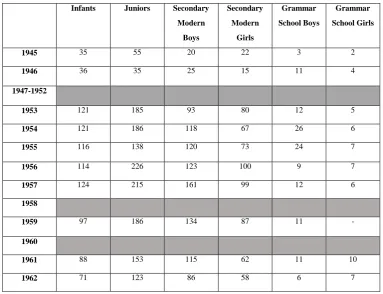
Table 1 – Sources of referral for the Leicester SPS, 1949-1958 105
Table 2 – Distribution of referrals to the Leicester School Psychological Service by
school category 112
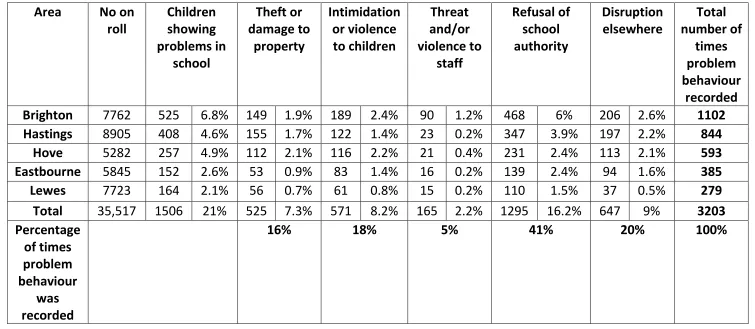
Table 3 – Incidence of behaviour by type in East Sussex secondary schools 211
LIST OF FIGURES
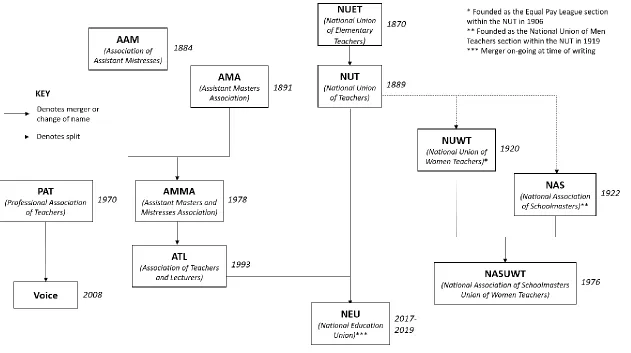
Figure 1 – Schematic representation of splits and amalgamations in teaching union
organisation 69
vi
ABBREVIATIONS
AAM Association of Assistant Mistresses (1884-1978)
AMA Assistant Masters Association (1891-1978)
AMMA Assistant Masters and Mistresses Association (1978-1993)
BAHPS Birmingham Archives Heritage and Photography Service
BBC British Broadcasting Corporation
BJEP British Journal of Educational Psychology
BPS British Psychological Society
CCCS Centre for Contemporary Cultural Studies (University of Birmingham)
CHAS Community History and Archives Service, Sandwell
DES Department of Education and Science
DHSS Department of Health and Social Security
ECHR European Court of Human Rights
ESRO East Sussex Records Office
HMI His/Her Majesty’s Inspector of Schools
IoE Institute of Education (University of London)
IQ Intelligence Quotient
LLRRO Leicestershire, Leicester and Rutland Record Office
MRC Modern Records Centre (University of Warwick)
NAS National Association of Schoolmasters (1922-1976)
NASUWT National Association of Schoolmasters Union of Women Teachers (1976-present)
NEU National Education Union (2017-present)
NFER National Foundation for Educational Research
NHS National Health Service
NUT National Union of Teachers (1889-2019)
PAT Professional Association of Teachers (1970-present; becomes ‘Voice’ 2008)
PLC Pastoral Liaison Committee
vii
RoSLA Raising of the School Leaving Age
SHS School Health Service (post-1948; see SMS)
SMO School Medical Officer
SMS School Medical Service (1906-1948; see SHS)
SPS School Psychological Service
STOPP Society of Teachers Opposed to Physical Punishment (1968-1988)
viii
ACKNOWLEDGEMENTS
The fun part:
Mathew Thomson has been an unfailing source of supervisory inspiration on this project, not least for his ability to put students at ease and for his genuine enthusiasm for historical research on a variety of weird and wonderful topics. Few are those who would react so positively to an undergraduate asking, over four years ago at the very start of the journey that culminates in this thesis, if he would be prepared to supervise an MA dissertation on the corporal punishment of school pupils. His patience with the infinite ineptitude of this doctoral candidate also seems to know no bounds.
Likewise, the wonderfully supportive environment of the Centre for the History of Medicine, and the wider community of historians of medicine, have been unparalleled. Sheilagh Holmes, the Centre’s administrator, has helped me out of uncountable scrapes in navigating expenses claims and wider university bureaucracy. Jennifer Crane kindly took time out of her own busy schedule to offer comments on Chapter Six. Hannah Elizabeth, although not at Warwick, had the misfortune to offer to wade through an earlier version of Chapter Four and has generally been a wonderfully supportive human being at successive conferences on childhood and health. (‘Oh, it’s you again!?’)
The Wellcome Trust made life far easier for me than it should have by agreeing to fund this thesis through their Medical Humanities programme. Their work in supporting young researchers (and their independence) is unparalleled.
Staff at archives around the country helped to root out documents and sort out access permissions. Elizabeth Hughes and her colleagues at The Keep were extremely patient with the sheer scale of my requests (the largest manual issue to date in their new building, no less!) and were diligent with securing permission to view restricted material. Corinna Rayner, Peter Doré and their colleagues at the Wolfson Centre in Birmingham Central Library were
similarly undaunted whenever appointments needed to alter, when dealing with handwritten catalogues, or when arranging permission to view what must have seemed like a never-ending list of log-books. Anthony Day and others at the Institute of Education Archives helped with the materials from the Duane papers used in Chapter Eight, including getting me past the fierce and unpredictable dragons that guard the entrance to the Newsam Library. All of these archivists deserve special mention because they do a formidable job under the pressure of meagre, and ever-receding, resource allocations from philistine superiors.
ix
support in times of trouble and bound the group together. To all the members of this cohort: well, here we are.
Camille Mahé was a formidable force behind the conference that we co-organised and a great contributor to thinking about childhood and its sources. I promise that I have more time to help with administrative things now that the thesis has been submitted!
To Will: for friendship beyond the call of duty, for abstract philosophical discussions over drinks (which we both know do not exist), for therapy sessions when faced with
(multiple) administrative incompetences in our respective projects; now, I’m not saying the thesis would not exist without your input, but I’m not saying that it would have been a smooth ride either.
Emma Barber (I apologise if the thesis is not sufficiently piccante for your tastes), Eduardo Arnold (I’ll be less of a hermit now, I promise), Britannie Gould (we do the best impressions, Madam President), Rhys Rawlings (I’m going to try to mock your language less), Jane Allen (grazie, gracias and merci!), Jordanne Wood (¡Viva las tortugas!), Amy Swain (thanks for putting me up in London, and I promise not to break your door off its hinges next time!), and other dancers past and present: you all know what your individual contributions to this have been.
Across the Channel, Josiane Constans, Pascale da Silva, Carine Roche and Martine Rossetto provided friendship across the kilometres and pleasant places in which to stay while working on the thesis. Astrid Purton and her adventures in Meuse-Inférieure are also often in my thoughts, and maybe I can now come to visit?
x
ABSTRACT/SUMMARY
This thesis argues that ideas about adolescence, and the types of discipline that this age-group required, evolved considerably across twentieth-century Britain; with schools functioning as key sites, and teachers as principal agents, for fashioning and disseminating these. I argue, in particular, that the period was characterised by the emergence of what I term a ‘pedagogy of discipline’, in which teachers came to view discipline as bound together with the fabric of the school itself and its relations with the wider community. This was achieved in several ways. Firstly, through the ideas circulating around adolescence, beginning with the publication of the first British text to popularise the study of the life-stage in 1911. Secondly, through the shifting balance between sociological, psychological and the psycho-social models for understanding adolescents and their needs in school. And finally, through the way in which the landscape beyond the classroom was mobilised – or failed to be mobilised – in debates over why adolescents behaved in the way that they did.
However, I contend that the emphases on these different strands shifted over the course of the period. The early-twentieth-century and inter-war focus was largely on the adolescent as a psychological category, and this drove a heavily reformist agenda concerning access to secondary education. The mid-century period (c.1945-1972) witnessed a greater focus on the sociology of the adolescent. Following scholars in the history of the social sciences, most notably Mike Savage, I argue that the diverse range of social-scientific research in this period contributed to an interest in the ‘landscape’, and, more significantly, influenced teachers to develop popular sociological and ethnographic understandings of their pupils. Lastly, the Raising of the School Leaving Age (RoSLA) in 1972 oversaw a shift towards more quantitative efforts to measure adolescent behaviour. This went together with a more behaviourist trend in psychology, and particularly social psychology, which stressed the school as a ‘system’ for containing the adolescent. This contributed to pedagogical literature in this later half of the century, and culminated in the 1989 Elton Inquiry into Discipline in Schools (EIDIS) which serves as the thesis’ end-point. The thesis is structured around these chronological changes over time, and the shifts in the various actors’ perceptions of both adolescence and discipline which facilitated them. It concludes with two chapters that seek to place these developments in wider context. The first of these analyses school log-books (kept by headteachers) from across the period as a whole; while the second concentrates on a specific moment in the early-1960s in which adolescents’ own views on their lives, and even on discipline itself, were sought and elicited by interested groups. It argues for the importance of examining these as memoirs of socialisation, but also considers them as sources composed in the context of a particularly liberal pedagogy of discipline.
I suggest that those pedagogies of discipline are connected to the shift towards
supposedly more ‘progressive’ educational practices that several historians of education have identified as emerging to the forefront during the twentieth century under the impetus of left-leaning politics and child-centred psychological theories. But I argue that thinking through the framework of discipline – as opposed to curricular content or practices – can contribute to a reassessment of these trends. In particular, examining developments beyond the 1960s suggests that so-called ‘progressive’ theories and practices from earlier in the century have enjoyed strange afterlives in the behaviourist ‘systems’ processes to discipline that
xi
DECLARATION
I hereby declare that this thesis has not been submitted, either in the same or different form,
to this or any other University for a degree.
Signature:
1
CHAPTER 1:
INTRODUCTION
Resistance greeted an attempt at the start of the present decade to give teachers sweeping
powers to detain and search pupils, including the ability to access mobile telephones.1 The
plans were one response to the in-coming coalition government’s concerns about an upsurge
in behavioural problems, but were also reflective of a new agenda in education, driven by
marketisation and examination results. According to this line of argument, examination
success requires the inculcation of a particular behavioural and work ethic, and strict
conditions to further this objective are in the child’s best interests.2 These current debates hint
at the enduring significance of school discipline as a site of professional and public anxiety.
Teaching unions, for instance, have urged the introduction of new sanctions and deterrents,
although only a minority of surveyed parents and teachers support a return to corporal
punishment.3
1 Emma Griffiths, ‘Human rights warning over school discipline plans’, BBC News website,
14 June 2011. Accessed at https://www.bbc.co.uk/news/uk-politics-13764614 on 21 August 2018.
2 George Duoblys, ‘One, two, three, eyes on me! George Duoblys on the new school
discipline’, London Review of Books website, 5 October 2017. Accessed at
https://www.lrb.co.uk/v39/n19/george-duoblys/one-two-three-eyes-on-me on 10 April 2018.
3 Ipsos-MORI, A study into the views of parents on the physical punishment of children for
2
The contentious debates over what kind of punishment is most appropriate also
suggest that there is a complex web of meanings attached to notions of discipline and the
attendant practices of punishment which underpin the cultural context of schooling. It is most
frequently adolescent children from working-class backgrounds who are singled out for
criticism, and it is these teenagers – not least boys – who are likely to serve as vectors of
concern. The recent shift towards highly strict methods for obtaining order – in which rules
govern the minutiae of how children should track their teachers around the room – further
highlight the adolescent’s status as an ‘other’.4 This thesis explores how the working-class
male adolescent came to occupy such a position in the eyes of society and, especially, those
of teachers. It does so by unpicking the varied efforts to understand and discipline the
adolescent male subject across its period of study; beginning in 1911 with the publication of
J. W. Slaughter’s volume The Adolescent (the first attempt to popularise the American G.
Stanley Hall’s theories about this life-stage to a British audience of welfare workers and
teachers) and concluding with the first governmental inquiry into discipline and punishment
in schools in 1989.5 I argue for a need to conceive the approaches towards disciplining the adolescent through a framework that not only recognises significant chronological shifts
(explored below) in the theoretical models employed – and the competing claims of
2012. Accessed at <http://www.theguardian.com/education/2012/apr/04/corporal-punishment-student-behaviour-worse> on 28 June 2015.
4 Duoblys, ‘One, two, three, eyes on me!’. See also: Frances Perraudin, ‘Use of isolation
booths in schools criticised as “barbaric” punishment’, Guardian On-line, 2 September 2018. Accessed at
https://www.theguardian.com/education/2018/sep/02/barbaric-school-punishment-of-consequence-rooms-criticised-by-parents on 3 September 2018. See also: Frances Perraudin and Niamh McIntyre, ‘“She deserves an education”: outcry as academy excludes 41% of pupils’, Guardian On-line, 31 August 2018. Accessed at
https://www.theguardian.com/education/2018/aug/31/english-school-outwood-academy-fixed-term-exclusions-pupils on 3 September 2018.
5 J. W. Slaughter, The Adolescent (London: George Allen & Unwin, 1911); Discipline in
3
social knowledge in twentieth-century Britain – but which also pays attention to the ways in
which discipline was bound up with related pedagogical concerns, or what I term the
‘pedagogy of discipline’. This allows developments in schools to be related more broadly to
extra-mural social changes.6
As far as my chronological intervention is concerned, one primary aim is to provide a
longer periodisation for change. Whereas older historical scholarship on the disciplining of
the working-class child and adolescent – such as that of Harry Hendrick, Anna Davin and
Stephen Humphries – tended to adopt the inter-war period as a finishing point, I continue the
narrative towards the latter half of the twentieth century. I factor in consideration of both
wider social changes across the twentieth century and the new forms of expertise on the
adolescent, in the form of psychology and social science, which were only just emerging at
the earlier moment but developed as the century progressed.7 The fates of these fields of expertise were altered by two factors: firstly, by the rise, and shifting fortunes, of both
psychology and sociology, with several models and frameworks competing for dominance;
and secondly, by the emergence of new forms of writing – both in relation to academic
disciplines like sociology, as well as more personal modes of teacher autobiography and
ethnographic practice – which altered how the relationship between youth and place was
imagined.8
6 Peter Mandler has suggested that the school provides a useful vector for understanding
changes in post-war society and politics; for instance, through analysis of the greater
lobbying powers of parents on the issue of selection: Peter Mandler, ‘Educating the Nation I: schools’, Transactions of the Royal Historical Society, 24 (2014), pp. 5-28.
7 Harry Hendrick, Images of Youth: age, class and the male youth problem, 1880-1920
(Oxford: OUP, 1993); Anna Davin, Growing Up Poor: home, school and street in London 1870-1914 (London: Rivers-Oram Press, 1996); Stephen Humphries, Hooligans or Rebels? An oral history of working-class childhood and youth 1889-1939 (Oxford: Blackwell, 1981).
8 Some excellent work in this direction has recently been produced by Laura Tisdall, but the
4
One of my principal claims in this thesis is that the psychological perspective on
adolescence increasingly gave way among teachers and actors in the local state to a more
sociological one; a trend that began after 1944 and accelerated into the 1960s. Unlike the
aggressive impression of the infant, derived from psychoanalytical theory, adolescent
behaviour problems emerged in a more social-scientific framework that mirrored the
progression of the teenager through the landscape and the social structure around the school
and neighbourhood. This can, in part, be related to shifts in the position and influence of the
psychological profession. But it is also a consequence of how teachers, whose activities
necessitated contact with working-class adolescents, also came to construct impressions of
their pupils around the urban-industrial landscapes in which they lived; and how this, in turn,
predisposed teachers to specific ways of seeing the adolescent. In the early part of the
century, psychology made aggression a more internalised concept, an outward manifestation
of a change inside and potentially caused by the family context. Sociology reoriented the
focus towards society itself as the causative agent. Within this lies a productive story, of the
adolescent ‘found’ through social science, but equally of something ‘lost’; for while the
trajectory for the infant was towards greater understanding and liberalism, psychology lost its
momentum with the teenager. One consequence of this, I argue, was a new wave of
behaviourism, coupled with a ‘systems’-based sociology, which situated aggression and
behaviour in the classroom as something to control. This led to a shift back towards
psychological models for behaviour which took place from the mid-1970s to 1989. Teachers’
5
initiatives to devise pedagogical methods of controlling secondary-school-age pupils
therefore parallel the shifting formulations of the adolescent subject itself.
Thus, although the roots of anxieties around school discipline are located firmly in the
earlier part of the twentieth century, they only coalesced around the figure of the adolescent
most visibly in the post-war period. This coincided with two transitions: first, into a mass
system of secondary schooling within the broader welfare-state, but one often the first area of
government to face budget cuts;9 and, second, by local education authorities (LEAs) moving towards more comprehensive systems during the 1960s and 1970s. The first of these stages
occurred in the early part of the twentieth century, a period bookended by conflict and the
emergence of class and national fitness as major concerns of the state. The First World War
has taken a unique place in the scholarly literature on the eugenics movement, and public
health discourse in general, as a moment when the working-class male body was subjected to
state scrutiny and found lacking.10 The inter-war years are similarly characterised by the development of initiatives, most commonly led at the level of the local state, to survey and
treat the health of the schoolchild (at the time, children aged between five and fourteen).11 School Medical Services (SMS) and School Medical Officers (SMO) had to be appointed in
LEAs under authority of the 1906 Education Act. Many of the Education Committees which
9 Nicholas Timmins claims that education budgets were routinely sacrificed in the 1950s to
protect other parts of the welfare state, such as the NHS: Nicholas Timmins, The Five Giants: a biography of the welfare state, 2nd edition(London: Harper Collins, 2001 [1995]), p. 197.
10 Joanna Bourke, Dismembering the Male: men’s bodies, Britain and the Great War
(London: Reaktion, 1996); Fiona Reid, Broken Men: shell shock, treatment and recovery Britain 1914-1930 (London: Continuum, 2010).
11 Such ages are, of course, general for much of the first two decades of the twentieth century.
6
ran the LEAs began to expand these services after 1918 to offer an elaborate and impressive
range of treatments which predate the NHS.12 It is with these developments that most
histories of youth and behaviour tend to conclude. Hendrick’s analysis, for instance, finishes
in 1920, with the failure of the Day Continuation School movement; one example of an
attempt to fashion an educational system for the adolescent.13 Yet the inter-war period was particularly fertile in thinking about educating the adolescent, and exerted an impact on the
subsequent part of the century. From the two government reports which were published into
secondary education during this time, to the gradual local reorganisation which favoured
moving the ‘adolescent’ child into the separate spaces of the senior schools, the influence of
the period 1918-1939 is notable. This period was also marked by the popularisation of
psychological theories and by a renewed focus on aggression within these as a key aspect of
human nature.14 By the post-war period, however, aggression appears to have developed more sociological connotations as, in Louise Jackson’s analysis, public ‘tolerance’ for
12 Bernard Harris, The Health of the Schoolchild: a history of the school medical service in
England and Wales (Buckingham: Open University Press, 1995); John Welshman, Municipal Medicine: public health in twentieth-century Britain (Oxford: Peter Lang, 2000), pp. 168-284; Alysa Levene, Martin Powell, John Stewart and Becky Taylor, Cradle to Grave: municipal medicine in interwar England and Wales (Bern: Peter Lang, 2011).
13 Hendrick, Images of Youth, pp. 213-249.
14 Mathew Thomson, Psychological Subjects: identity, culture, and health in
twentieth-century Britain (Oxford: OUP, 2006); Jon Lawrence, ‘Forging a peaceable kingdom: war, violence, and fear of brutalisation in post-First World War Britain’, Journal of Modern
7
aggressive and problematic behaviours reduced across all social groups.15 Such anxieties fed
into the ‘blackboard jungle’ moral panic of the mid-1950s,16 while between the 1960s and
1980s, under a backlash against changing social mores, youth became more readily equated
with aggressive and violent behaviour in society and the school and suffered a more hostile
public image.17
This narrative should not be read as suggestive of total antagonism between
psychology and sociology. Rather, it is a product of their interactions, and of how their
different approaches were able to integrate – or failed or integrate – contemporary concerns
into their theoretical frameworks. One such concern was the position of the school in the
adolescent’s ‘landscape’. I shall explore how these more localised concerns evolved through
the use of case-studies, but their influence on a national level was also significant. This was
particularly so at what I consider the ‘mid-century’ moment (c.1945-c.1970), which coincides
with what several scholars have identified as a post-war (or mid-century) ‘settlement’,
marked by greater attention being paid to sociology and the physical landscapes of adolescent
15 Louise Jackson (with Angela Bartie), Policing Youth: Britain, 1945-1970 (Manchester:
Manchester University Press, 2014), p. 87.
16 The phrase entered British usage through the American novel by Evan Hunter (published in
Britain in 1955), and its later film adaptation, which recounted the story of a teacher’s experiences in a New York school: Evan Hunter, The Blackboard Jungle: a novel (London: Constable, 1955). For its use as a rhetorical trope in the press see, by way of example, the following articles from the British press: ‘“Blackboard Jungle” master beaten’, Daily Mail, 23 July 1957, p. 5; : ‘Blackboard Jungle hunt fails here‘, Daily Mail, 20 July 1956, p. 5; ‘Blackboard Jungle comes to NW3’, Daily Mail, 6 February 1958, p. 1; Jack Greenslade, ‘JP
starts “Blackboard Jungle” row’, Daily Mail, 19 March 1958, p. 5; and Michael Gowers, ‘Once more, into the blackboard jungle’, Daily Mail, 17 December 1963, p. 10. Jackson discusses the moral panic around this theme in her work on juvenile delinquency, while Tisdall explores the literary genre of ‘blackboard jungle’ fiction: Jackson, Policing Youth, pp. 86-103; Tisdall, ‘“Inside the blackboard jungle”’.
17 Harry Hendrick, Child Welfare: historical dimensions, contemporary debate (Bristol:
8
socialisation.18 This was defined by Savage’s own ‘moment of sociology’.19 But such
landscapes were also the site of psychological concern, identified under the label of the
‘psycho-social’20 and concerned with the place of psychological subject in the social
framework.21 In short, national concerns are inflected by local debates, and vice-versa, with different theoretical models commingling in these. How these interact with the key themes of
this thesis is explored below.
(1.1) Historiographical themes and background
This thesis engages with chronological shifts in the adolescent. But the nature of its argument
necessitates cutting across several historiographical narratives and literatures. The ways in
18 The phrase ‘post-war settlement’, devised by Paul Addison, has been used by many
scholars of the period. As Thomson notes, the theory of the war as a rupture has been largely abandoned, although the phrase provides a useful shorthand designation (with appropriate caveats) to describe what Thomson calls the ‘powerful structures of feeling’ that the conflict brought to bear in its aftermath: Mathew Thomson, Lost Freedom: the landscape of the child and British post-war settlement (Oxford: OUP, 2013), p. 13 (see also: pp. 10-15). For further examples of an idea of ‘settlement’ in the historiographical literature, see: Paul Addison, The Road to 1945: British politics and the Second World War (London: Pimlico, 1994 [1975]); idem, No Turning Back: the peacetime revolutions of post-war Britain (Oxford: OUP, 2010); Timmins, The Five Giants; Richard Toye, ‘From “consensus” to “common ground”: the
rhetoric of the postwar settlement and its collapse’, Journal of Contemporary History, 48:1 (2013), pp. 3-23.
19 Mike Savage, Identities and Social Change in Britain since 1940: the politics of method
(Oxford: OUP, 2010); Mike Savage, ‘The fall and rise of class analysis in British sociology, 1950-2016’, Tempo Social: revista de sociologia da USP, 28:2 (2014), pp. 57-72; Thomson,
Lost Freedom.
20 An alternative spelling for this (and that preferred by scholars such as Rhodri Hayward)
leaves out the hyphen (‘psychosocial’). Throughout this thesis, I prefer the hyphenated form because it stresses my point (developed later in this introductory chapter) that the psycho-social must be understood as a composite of the psychological and the psycho-social.
21 Rhodri Hayward, ‘The invention of the psychosocial: an introduction’, History of the
9
which the thesis draws from and contributes to existing bodies of historiographical
scholarship are examined below, grouped around five key issues. Three of these – young
people’s identities (age, class and gender), the position of the teaching profession in relation
to social change in twentieth-century Britain, and the role of landscape as a site for analysing
class – are related to questions of subjectivity and belonging. Another heading, on the
interactions of psychology and the social sciences through the prism of the psycho-social,
grapples with issues of defining disciplinary boundaries and methodologies in historical
perspective. The final section on the ‘pedagogy of discipline’ seeks to define a term that is
central to this thesis and bring together the previous strands.
(1.1.1) Placing adolescence: youth, class and gender
Of all the categories examined in this thesis, it is most useful to begin with adolescence. I
argue that the adolescent – as an object of analysis and subject of the school system – was
understood through several disciplinary perspectives. My analysis here is centred around the
complex issues of definition and methodological practice in recovering the history of the
young. The first issue of the American Journal of the History of Childhood and Youth
addressed some of these questions, examining the question of youthful voices in the archive
and considering ways of thinking about ‘agency’ in social histories of the young.22 Drawing
22 Leslie Paris, ‘Through the looking glass: age, stages and historical analysis’, Journal of the
10
from these frameworks, I argue that adolescence can be seen as culturally, rather than
biologically, determined.23 But I do take a more constructionist approach which, while not destabilising entirely the place of the adolescent’s own agency in effecting historical change,
examines instead how ‘adolescence’ as a category was constituted by a range of observers.
Such processes of social construction are visible in how adolescents and their behaviour traits
were written about across twentieth-century Britain, and, ultimately, fed back into how young
people perceived themselves. These were overlaid with the effects of gender, class and race.
The adolescent – not infrequently a working-class male one – served as a metaphor or cipher
for the society which produced him. The historiography on adolescence, not least that
produced by more literary scholars, has used the shifting perceptions of the age at given
historical junctures to interrogate their role as a symbol of everything from sexuality to
stress.24 This mirrors childhood studies, which has often looked to literature, and fiction especially, to collapse disciplinary boundaries and see beyond the socio-scientific
construction around the figure of the child.25
This thesis takes the working-class adolescent boy as its subject. This is not to suggest
that the disciplining of girls or middle-class children was not an issue, but that gender and
class combined to produce an image of the adolescent centred on the working-class boy
which has predominated in the surviving archives on discipline. To discuss the ways in which
the pedagogy of discipline was feminised would require a different approach to recover the
23 Ilana Kraussman Ben-Amos, ‘Adolescence as a cultural invention: Philippe Ariès and the
sociology of youth’, History of the Human Sciences, 8:2 (1995), pp. 69-89.
24 Patricia Meyer Spacks, The Adolescent Idea: myths of youth and the adult imagination
(London: Faber and Faber, 1982); John Springhall, Coming of Age: adolescence in Britain, 1860-1960 (Gill and Macmillan, 1986); and John Neubauer, The Fin-de-Siècle Culture of Adolescence (New Haven: Yale University Press, 1991).
25 Sally Shuttleworth, The Mind of the Child: child development in literature, science, and
11
nature and form of the debates around female adolescence and thus produce a very different
thesis. A focus on male children likewise reflects the importance of adolescence as a time of
increasingly gendered socialisation on gendered identities. The politics of adolescent
representation through the lens of gender is itself one way of analysing the values imported
onto adolescents by society. Hilary Marland, in her work on girlhood’s emergence in the
fin-de-siècle,argues that the ‘further challenge of youth’ should be added to the ‘double burden’
of class and gender.26 Yet attention to how the youthful subject was problematised raises issues not only of gendered differences in treatment, but equally of class and the competing
methodologies. Similarly, to ignore the problematisation of the male child risks perpetuating
the narrative that only the female body can be pathological.27 As Hendrick notes, psychology did provide a language, at least in the early twentieth century in which corporeal changes
could impinge upon the mental state of young men. Moral failings in adult working-class
people, he notes, were identified as a product of class (that is a sociological marker); yet the
same perceived failings when ‘displayed by adolescents … were explained primarily in terms
of physiology and psychology’.28 Adolescence was, for much of twentieth-century Britain,
the stage in the life-cycle when children moved into separate spaces – not least, for part of the
post-war period, single-sex schools.29 Moreover, as Laura King argues, while the post-war child – as a ‘symbol’ and ‘political space’ for consensus and dissent – remained ambiguously
26 Hilary Marland, Health and Girlhood in Britain, 1874-1920 (Basingstoke: Palgrave
Macmillan, 2013, p. 169.
27 Myers, ‘Sex, gender and the history of the adolescent body’, pp. 97, 99. 28 Hendrick, Images of Youth, p. 152.
12
gendered, the teenagers who emerged in the same moment were always gendered more
explicitly and ‘could represent particular social problems’.30
This thesis consequently aims to contribute to our understanding of the social
construction of youth, and to tell the story of how the male adolescent was made a gendered
subject through certain processes of external observation. King’s ‘symbolic’ child is a
particularly apposite foil for the adolescent in this, as teenagers also elicited responses from
adults. Patrick Ryan notes in a study of adolescent absconders in the 1930s United States, for
instance, how the adolescent was able to produce a different ‘emotional impression’ on the
social workers dealing with them compared to younger children, and not necessarily a
positive one.31 Adolescence also possessed a significant metaphorical power for the commentators and observers writing about it. The adolescent boy especially, defined by
awakening strengths and capacities, has been at the centre of political and national strategies;
from the scout movement, to fascisti, to more banal efforts to inculcate thrift.32 The arguable founder of adolescent psychology, G. Stanley Hall (1846-1924), and his successors believed
that adolescence typified and exemplified the age in which they were writing, whether for
good or ill.33 Charles Burns, a psychiatrist based in Birmingham and the director of the city’s
30 Laura King, ‘Future citizens: cultural and political conceptions of children in Britain,
1930s-1950s’, Twentieth Century British History, 27:3 (2016), pp. 391-392, 395, 397-398.
31 Patrick Ryan, ‘“Young rebels flee psychology”: individual intelligence, race and foster
children in Cleveland, Ohio, between the world wars’, Paedagogica Historica, 47:6 (2011), pp. 777, 779.
32 King, ‘Future citizens’; Philippe Ariès, L’Enfant et le vie familiale sous l’ancien regime
(Paris: Éditions du Seuil, 1960) (This was translated into English as: Philippe Ariès,, (trans. Robert Baldick), Centuries of Childhood (London: Jonathan Cape, 1962)); Antonio Gibelli, Il popolo bambino: infanzia e nazione dalla Grande Guerra a Salò (Turin: Einaudi, 2005).
33 G. Stanley Hall, Adolescence: its psychology and its relations to physiology, anthropology,
13
child guidance clinic, noted in 1956 that ‘Child Guidance is … at a kind of adolescent period
– in a plastic stage’, employing the biological stage as a metaphor for possibilities and
expansion.34 Belief, then, in living in an ‘adolescent’ moment was a powerful motif. Indeed, adolescence itself seems to have been perpetually ‘adolescent’; always latent and in a process
of becoming, while adolescents themselves were, to employ the oft-cited dictum of E. P.
Thompson, ‘present at their own making’.
Part of the problem with the more social-historical agency approach to the history of
childhood and youth is its desire to stress freedom. This thesis, by contrast, situates that
adolescent within a framework of discipline. Many of the earlier writers on youth history – in
contrast to the more romanticised work of Philippe Ariès35 – were all writing in the wake of adolescents having become more political figures as a result of student protest in the 1960s
and what Ben-Amos sees as the more liberationist psychology of youth propounded by
Ronald Laing and Erik Erikson.36 Adolescence, in these narratives, was positioned firmly in the urban setting.37 For John Neubauer, for instance, the adolescent moves from the protected
34 Birmingham Archives Heritage and Photography Service (BAHPS), BCC/1/BH/1/1/1/56,
‘Annual Report to the City of Birmingham Education Committee of the School Medical Officer, James R Mitchell, MC, MB, ChB, DPH for the year ended 31st December 1956’, p.
61, in City of Birmingham Education Minutes, 1956-1957.
35 Ilana Ben-Amos has noted ‘the remarkable fit between’ Ariès’ Centuries of Childhood and
contemporary notions of age relations and adolescence. Ariès’ own political conservatism (he had served in the far-right integrist Action Française group as an undergraduate, although he later embraced the Gaullist right) inclined him to produce an adolescence within a heroic, national image: Ben-Amos, ‘Adolescence as a cultural invention’, p. 74.
36 Ben-Amos, ‘Adolescence as a cultural invention’, p. 76. Studies produced after this
moment include: John R. Gillis, Youth and History: tradition and change in European Age Relations 1770-Present (New York: Academic Press, 1974); Springhall, Coming of Age; and Spacks, The Adolescent Idea.
37 Gillis, Youth and History; David Pomfret, Young People and the European City: age
14
spaces of childhood into more dangerous adult worlds, not least the cityscape itself.38 The
narratives of youth culture and rebellion have only recently been questioned within the
historiography, but this opens up the prospect of inscribing school discipline and the
life-cycle more into narratives of the everyday and the ordinary.39
One urban space that has been relatively neglected in work on the British adolescent
is the secondary school, despite the adolescent being the main social category to enter (or
rather, be forced to remain in) school during the twentieth century. I wish to capture this idea
of the school as a key force which emerges into the lives of ever-older cohorts of adolescents
over the course of the century, through no fewer than three increases in the school-leaving
age: to fourteen in 1918, fifteen in 1944 and sixteen in 1973. The secondary school (and
especially the secondary modern), as Laura Carter notes, was a complex institution, whose
curricular and institutional roots date back to the inter-war years and the senior schools
produced following an earlier period of adolescent-centred reorganisation in the aftermath of
the 1926 Hadow report into ‘the education of the adolescent’.40 Adolescence provides a useful way of thinking about continuities within and between these spaces, as all of them
were devised with the specific aim of educating this age-group specifically. Adolescents were
recognised by the new pedagogies as being more verbal, and it is the awareness of their
38 Neubauer, The Fin-de-Siècle Culture of Adolescence, pp. 64-74.
39 Selina Todd, ‘Affluence, class and crown street: reinvestigating the post-war working
class’, Contemporary British History, 22:4 (2008), pp. 501-518; Selina Todd and Hilary Young, ‘Baby-boomers to “beanstalkers”: making the modern teenager in post-war Britain’,
Cultural and Social History, 9:3 (2012), pp. 451-467; Emily Robinson, Camilla Schofield, Florence Sutcliffe-Braithwaite, Natalie Thomlinson, ‘Telling stories about post-war Britain: popular individualism and the “crisis” of the 1970s’, Twentieth Century British History, 28:2 (2017), pp. 268-304.
40 Carter, ‘“Experimental” secondary modern education in Britain, 1948-1958’, Cultural and
Social History, 13:1 (2016), p. 24. The Hadow report is discussed in greater detail in Chapter Two: The Education of the Adolescent: report of the Consultative Committee on the
15
capacity to produce written and verbal interventions that renders them more visible, at least in
part, in the historical record. Yet Tisdall has noted a parallel shift across the twentieth
century, as the child (and especially the adolescent) came to be seen in a more ‘limited’
fashion and deemed ‘unable to reason’ in most vulgarisations of the Swiss psychologist Jean
Piaget’s framework for intellectual development.41 Tisdall suggests that the growing
institutionalisation of these ideas, under the supposed banner of ‘progressivism’ came to
mean that this view was widespread and promoted a series of pedagogies based around using
more concrete ideas to appeal to the adolescent.42 Other literatures constructed the adolescent
as in need of ‘guidance’.43
Certainly, such ideas bear parallels in terms of British schooling. The inter-war period
is marked by the decline of the old ‘standards’ system of classifying pupils according to
ability and towards one based more rigidly on ‘age cohorts’ through which progression is
automatic within a fixed academic calendar. The reorganisation process, like later
comprehensivisation, occurred at different rates in different geographical areas, but
dominated in the post-1945 system.44 In France, scholars such as Agnès Theircé have characterised the nineteenth-century adolescent as one moving from an âge de classe to a
classe d’âge (an age cohort for school purposes to a general designation of position in the
lifecycle more generally).45 In Britain, however, the opposite seems to have occurred as
41 Tisdall, ‘“Inside the Blackboard Jungle”’, pp. 501-502; Laura Tisdall, ‘Education,
parenting and concepts of childhood in England, c.1945 to c.1979’, Contemporary British History, 31:1 (2017), p. 27.
42 Tisdall, ‘“Inside the Blackboard Jungle”’, p. 502. 43 Hendrick, Images of Youth, p. 216.
44 I. G. K. Fenwick, The Comprehensive School 1944-1970: the politics of secondary school
reorganisation (Abingdon: Routledge, 2007 [1976]).
16
theories on adolescence circulated prior to, and drove, reforms. A focus on school has the
benefit of critiquing the liberationist vision of the adolescent present in work that elides
disciplinary structures. This can not only be found in work on revolt and protest, but equally
on younger wage-earners, such as David Fowler’s First Teenagers, which fails to engage
critically with the labels anachronistically employed by its author.46 Fowler seeks so hard to push the idea of the ‘teenager’ back onto the inter-war period that he misses a key difference
between the pre- and post-Second-World-War social structures. Ironically, his 1930s
adolescents in many respects enjoyed greater freedoms than their fourteen- and
fifteen-year-old counterparts two decades later, having already left school and entered a world of greater
financial autonomy in which the disciplinary authority of the adults around them was to a
certain degree more ambiguous.
Adolescence was always produced in dialogue and interaction with the demands of
other labels of identity – the boy; the working-class – developed from within or imposed
from outside. Moreover, such labels were situational and far from being static. The ‘teenager’
of 1950s Britain moved in different spaces to the adolescent ‘lad’ or ‘boy’ of the fin-de-siècle
discussed by Hendrick or Neubauer. The ages of these groups were also more elastic, and this
is the final dimension to adolescence’s definition that I examine here. Throughout this thesis I
employ the term ‘adolescent’ to better reflect the nuances of scholarly language operating in
the twentieth-century context and to stress the continuity in the social construction of the
adolescent as a subject which emerged in the earlier part of the century and travelled through
later labels (such as ‘teenager’). Similarly, it is important to draw a distinction between how
contemporary experts understood the division between ‘adolescence’ and ‘puberty’: the latter
being the bodily, endocrinological changes occurring from the teenage years onwards, and
46 David Fowler, The First Teenagers: the lifestyle of young wage-earners in interwar Britain
17
the former the psychological and physical adaptations made by the mind and body to those
alterations. This distinction has perhaps been lost in current, colloquial English usage, where
the two have become broadly interchangeable. Within this latter point lies the essential
feature of adolescence as a socially and culturally determined category: that it did not mean
the same thing at the beginning of this period as at the end. This is true in both a literal and a
broader, historiographical sense. By the mid-twentieth-century, medical opinion was
coalescing around a belief that there had been a progressive reduction in the average age for
the onset of puberty from the late nineteenth century onwards, attributable to a variety of
factors in public health.47 Such medical analyses enjoyed success and influence because they reflected a popular conception of the adolescent as a more social being; one reflective of both
the major advances of the mid-century decades and of more longstanding concerns about the
dangers to social order posed by young people and youth culture.48
Using these problems of definition as a productive starting point for historical
enquiry, I therefore stress adolescence within this thesis as something made and constituted.
The adolescent figure, as Carolyn Steedman argues about childhood in Strange Dislocations,
becomes part of the ‘story’ that is told about it.49 Adolescence is, as we shall in Chapter Two,
fundamentally bound together with notions of modernity and (as we saw with Ryan’s work in
an earlier part of this section) shifts in the emotional and cultural significance of what
children growing up through different stages of the life-cycle meant in the context of the
family and society. But it is equally the institutional structures that give limits to these:
47 J. M. Tanner, Education and Physical Growth: implications of the study of children’s
growth for educational theory and practice (London: University of London Press, 1961), pp. 48-52, 97-112.
48 See, for example: Gillis, Youth and History.
49 Carolyn Steedman, Strange Dislocations: childhood and the idea of human interiority
18
increases in the school-leaving age in Britain brought ever older age cohorts under the ambit
of the school, while theoretical models for how to discipline affected their movements within
this. Adolescents could, to be sure, interact with forces that attempted to control their lives,
and I discuss some of these in Chapter Eight. However, historians of childhood and youth
should not lose sight of the role of the adult expert or legislator in constructing categories of
age.
(1.1.2) The ‘psycho-social’: psychology, the social sciences and their methodologies in historiographical perspective
In order to explore the construction and reconstruction of the adolescent in twentieth-century
Britain, this thesis analyses the varied contemporary theoretical positions in psychology, the
social sciences, and the psycho-social which drove them. I posit, following the work of Mike
Savage, that the history of social-scientific thought in modern Britain must be recognised as
heterogeneous in a way that complements the approach undertaken by Mathew Thomson in
relation to psychology.50 Yet the parameters of these fields and disciplines pose their own interpretational and definitional difficulties. Writing from the perspective of the history of
medicine, for example, Hilary Marland suggests that psychology and medical understandings
were crucial to the formation of ‘girlhood’ or female puberty.51 Harry Hendrick, meanwhile,
posits the social sciences as more crucial in the development of his conception of ‘youth’
(which is really about boyhood). ‘The transformation’ of the adolescent, he argues, ‘required
a surfeit of social appeal which made it irresistible to youth workers, sociologists,
19
educationalists, moralists and others’.52 These issues in placing the social sciences drive my
analysis within this subsection. In particular, I wish to stress the divergent trajectories of
psychology and the social sciences, but also the fate of the psycho-social as a composite.
One main issue in this regard is where psychology itself should stand in relation to the
social sciences. One of the complicating factors in this is historiographical
compartmentalisation. The historical sociologist, Chris Brickell, writing about adolescence in
1950s New Zealand, argues that the social sciences (in which he includes psychology) were
integral to rendering the adolescent ‘knowable’ as a subject.53 In several recent works by
modern British scholars on the social sciences, psychology has often been strangely absent.
On the other side, meanwhile, consideration of sociology is equally deficient in histories of
psychology and medicine.54 This is in spite of psychology’s position as a ‘social science’ at the start of the twentieth century, and Hendrick employs the term in this sense.55 Historians in North America, such as Rebecca Lemov or Mona Gleason, are also more likely to categorise
psychology under the rubric of the social sciences.56 As late as 1937, meanwhile,
52 Hendrick, Images of Youth, p. 85.
53 Chris Brickell, ‘On the case of youth: case files, case studies, and the social construction of
adolescence’, Journal of the History of Childhood and Youth, 6:1 (2013), pp. 50-80. See also: Chris Brickell, ‘The teenager and the social scientist’, New Zealand Sociology, 28:1 (2013), pp. 36-61.
54 Thomson, Psychological Subjects. The work on the ‘psycho-social’ (see above) has begun
to address this imbalance, as has Mathew Thomson’s more recent work: Thomson, Lost Freedom. Savage also examines the intersections between psychology and sociology, at least in terms of research methods and interviewing techniques: Savage, Identities and Social Change, pp. 165-186.
55 See, for instance: Hendrick, Images of Youth, p. 9.
56 Rebecca Lemov, World as Laboratory: experiments with mice, mazes and men (New York:
20
Observation’s founders claimed their project as the culmination of sociology, Darwinian
evolutionary theory, anthropology and psychology; clearly viewing each discipline as
constitutive of a broader scientific endeavour.57 Understanding this shift in terminology is integral to make sense of the changes within both the disciplines of psychology and sociology
over the course of the period, and Hendrick’s own use of the term, to describe a moment that
marks the beginning of my own period of study, confirms the need to excavate the trend in
usage historically. That psychology’s trajectory saw it move increasingly in the direction of
the hard and experimental sciences, while sociology diversified away from purely empirical
ambitions, positions the mid-century as a key period of transition for the configuration of the
academic disciplines dealing with adolescence.
My conceptualisation of these themes in the thesis is two-fold. Firstly, I present the
narrative of change between different types of psychological and sociological models,
outlined at the beginning of this introduction. Secondly, however, there is a capacity for the
two disciplines to work together. Brickell suggests the existence of an ‘interdisciplinary soup’
at this mid-century juncture, which allowed the adolescent to emerge and be written about
across the boundaries of disciplines concerned with social structure and human
development.58
Rhodri Hayward, Jonathan Toms and others have posited a greater space for such
cross-disciplinary fertilisation in the form of the ‘psycho-social’59 which ‘provided a kind of
psychology, schooling, and the family in postwar Canada (Toronto: University of Toronto Press, 1999).
57 Charles Madge and Tom Harrisson, Mass-Observation (London: Frederick Muller, 1937),
p. 23.
58 Brickell, ‘The teenager and the social scientist’, p. 56.
59 Hayward, ‘The invention of the psychosocial’; idem, ‘Enduring emotions: James L.
21
conceptual glue which allowed individual failings … to be joined to broader transformations
in society or the environment’.60 Even this, however, has competing definitions. For Toms, it ‘remains variously described or interpreted’ by historians, although his preferred usage is as a
form of ‘social psychology’ that was receptive to anthropology.61 More particularly, Toms
uses it offer a constructive critique of Nikolas Rose’s Foucauldian model of psychological
biopower in twentieth-century Britain, suggesting that social psychology’s internal political
divisions helped to hinder its progress.62 For Hayward, the narrative of its developments is based on inter-war divisions between psychologists and sociologists, with the former more
open to aetiological explanations based on social factors, and the latter more rejecting of
psychological insights.63 Adolescence was noted as central to this, and the psycho-social was ‘used to describe the developmental stage around adolescence in which childish
‘Political dimensions of the “psychosocial”; Andrew Hull, ‘Glasgow’s “sick society”? James Halliday, psychosocial medicine and medical holism in Britain c.1920-1948’, History of the Human Sciences, 25:5 (2012), pp. 73-90; Teri Chettiar, ‘Democratizing mental health: motherhood, therapeutic community and the emergence of the psychiatric family at the Cassel Hospital in post-Second World War Britain’, History of the Human Sciences, 25:5 (2012), pp. 107-122; Jonathan Toms, Mental Hygiene and Psychiatry in Modern Britain
(Basingstoke: Palgrave Macmillan, 2013); Rhodri Hayward, ‘Sadness in Camberwell: imagining stress and constructing history in postwar Britain’, in David Cantor and Edmund Ramsden (eds), Stress, Shock, and Adaptation in the Twentieth Century (Suffolk: Boydell & Brewer, 2014), pp. 320-342.
60 Hayward, ‘The invention of the psychosocial’, p. 8.
61 Toms, ‘Political dimensions of the “psychosocial”’, pp. 92, 99-102.
62 Ibid., pp. 92-93. For an outline of Rose’s arguments, see: Nikolas Rose, Governing the
Soul: the shaping of the private self (London: Free Association, 1999 [1989]); idem,
Inventing Our Selves: psychology, power, and personhood (Cambridge: Cambridge University Press, 1998).
63 Hayward, ‘The invention of the psychosocial’, p. 4. See also: Martin Roiser, ‘Social
psychology and social concern in 1930s Britain’, in Geoffrey C. Bunn, Sandy Lovie and Graham Richards (eds), Psychology in Britain: historical essays and personal reflections
22
individualism is replaced by a sense of communal duty and integration’.64 Yet Hayward’s
analysis focuses more on the interactions between the ‘psycho-’ prefix and biology than the
social. If, as both scholars contend, the psycho-social project was a failure, I argue that this
was a direct consequence of the rising dominance of the social at the mid-century moment
and a passage from ‘psycho-’ interest in social factors and aetiologies to ‘social’ interest in
underlying causes. Frank Mort and Chris Waters have noted a similar trajectory in discussion
of the ‘modern’ homosexual which substituted an early-twentieth-century psychopathological
model of sexuality for a mid-century social conception of behaviours.65
The adolescent, in particular, marks something of a limit for this, at least for the
period from the 1950s to the early 1970s, which saw greater attention paid to the social
interactions of the adolescent. Hayward hints at this when he notes that aetiologies ‘shifted
from the biographical to the social’, with the ‘social landscape’ characterised as ‘a field of
threats’ to mental well-being.66 Yet his argument deals more with social psychologists than
other professions. Teachers, not trained in psychology, may well have shifted their
viewpoints towards the ‘social’ in other ways. The period thus witnessed a transition from
one model (psychology) to another (sociology), followed by another in the opposite direction
under the influence of more explicitly behaviourist iterations of the psycho-social in the
‘systems’ theories of discipline developed during the 1970s under the influence of Michael
64 Ibid., p. 5.
65 Frank Mort, ‘Social and symbolic fathers and sons in post-war Britain’, Journal of British
Studies, 38:3 (1999), pp. 371-374; Chris Waters, ‘The homosexual as a social being in Britain, 1945-1968’,Journal of British Studies, 51:3 (2012), pp. 685-710. See also: Vicky Long, ‘“Often there is a good deal to be done, but socially rather than medically”: the psychiatric social worker as social therapist, 1945-1970’, Medical History, 55:2(2011), pp. 223-239.
23
Rutter’s more behaviourally-inclined approach to social psychiatry.67 In paying attention to
the psycho-social, we need to have a greater awareness of it as a concept constituted by two
balanced notions. My argument is that the relationship between the two is articulated in
different ways and to different extents across the period, with the boundaries between them
drawn in different places at difference moments.
Education was a key site of influence for psychological theories, and thus provides a
productive site to reflect on the prefix. Yet psychology was a discipline with many diverse
facets and both popular and intellectual fronts; and ones which were amenable to a variety of
competing claims. In education, it has often been characterised as part of a project of social
control, especially in the work of Nikolas Rose.68 Beginning with Adrian Wooldridge, and continuing through Mathew Thomson’s and Laura Tisdall’s work, this view has been
reassessed.69 Psychology provided many languages, and even the vocabulary of testing, as Wooldridge notes, had educationally ‘progressive’ and child-centred dimensions. Indeed, he
argues that compared to developments in the later half of the twentieth century, and the New
Right model of harsh discipline and schooling, the inter-war models pioneered by Burt appear
enlightened.70 More significantly for this analysis, both Wooldridge and Tisdall appear to
posit some form of mid-century hiatus in the valence of the psychometric, and this, I suggest
here, is part of a broader turn towards the social. Post-war psychology in Britain was also at a
major juncture. The war, as most studies of the discipline appear to concur, bequeathed a
67 See the discussion in Chapter Six.
68 Rose, Governing the Soul; Rose, Inventing Our Selves.
69 Adrian Wooldridge, Measuring the Mind: education and psychology in England,
c.1860-1990 (Cambridge: Cambridge University Press, 1994); Thomson, Psychological Subjects; Laura Tisdall, ‘Education, parenting and concepts of childhood’.