education ‘for learning’?
Why students prefer internal monologue to tutor dialogue
Mark Carver, BA (Hons), QTS, MA
A thesis submitted in partial fulfilment of the requirements of
the degree of Doctor of Philosophy
Lancaster University
May 2016
Abstract
Feedback for student teachers during their work-based learning in schools offers significant advantages over feedback in the university-based element of their degree programme. Students receive frequent, often immediate, feedback from an experienced teacher who sees their gradual development and has only a few students to manage. This includes formal feedback linked to assessment criteria but also opportunities for informal, verbal feedback and dialogue that supports socialisation as a colleague.
This study investigates how student teachers feel about feedback on their classroom teaching and what they do with that feedback. The study therefore asks how effective all this feedback is in terms of its impact on students’ learning and on their identity as a teacher. A mixed-methods approach first used a large scale survey of student teachers to consider their response to key issues highlighted in the literature on feedback. Semi-structured interviews then focused on subtleties in how students’ understanding of feedback, and their engagement with it, relates to how they see their own learning needs.
3 of 283
Acknowledgements
I would like to express my appreciation to my supervisors, Sue Bloxham and Pete Boyd, whose feedback was always exemplary. I am also very grateful to the University of Cumbria for funding this work and providing a forum for rich discussions which helped me to shape my thinking over my three years there. This thesis also owes its inspiration to teaching colleagues over the years and the generous support of tutors at Lancaster University. I would also like to take this opportunity to thank the collegiate spirit shown by universities who welcomed me to their doctoral training programmes. These include the University of Manchester, the University of Edinburgh, the University of Nottingham, and a special mention for the University of Cambridge who welcomed me for free. Academics to single out are Liz Bates, Keith Taber, Les Humphries and Tom Wengraf who all took the time to answer my questions and give some dialogic feedback.
4 of 283
Contents
Tables and figures ... 8
Abbreviations ... 10
1 Introduction ... 12
1.1 Problems with feedback in higher education ... 12
1.2 Organisational context ... 16
1.3 Personal professional context ... 19
1.4 Policy context ... 20
1.5 National context ... 23
1.6 Theoretical context... 24
1.7 Summary ... 25
2 Literature review ... 27
2.1 Defining feedback ... 27
2.2 Coining new terms to explain feedback ... 35
2.3 Student conceptions of feedback ... 40
2.4 Student teachers’ conceptions of feedback ... 50
2.5 Key empirical studies ... 53
2.5.1 Components of a good practicum experience (Beck & Kosnik, 2002) ... 53
2.5.2 Integrating feedback and reflection in teacher preparation (Brandt, 2008) ... 55
2.5.3 Negotiating face and managing tension in feedback meetings (Copland, 2010, 2011) ... 58
2.5.4 The impact of placement assessment on beginning teachers (Orland-Barak, 2002) ... 61
2.5.5 Relating beliefs and practices of mentors to beliefs and practices of their student teachers (Rozelle & Wilson, 2012) ... 62
2.5.6 Mentor-student bullying (Sewell et al., 2009) ... 64
2.6 Summary ... 67
3 Methodology ... 70
3.1 Introduction ... 70
3.2 The appeal of mixed-methods ... 70
5 of 283
3.3.1 Assumptions and norms in educational research ... 72
3.3.2 Assumptions and mixed-methods approaches: finding a philosophical home ... 74
3.4 Summary ... 76
4 Methods... 78
4.1 Introduction ... 78
4.2 Survey methods ... 79
4.3 Methods of statistical analysis ... 85
4.4 Regression ... 86
4.5 Survey administration ... 87
4.5.1 Data entry with QueXF ... 87
4.6 Interview methods ... 89
4.6.1 Preparing for the interview stage ... 93
4.6.2 Using Kelly’s Repertory Grid for session three ... 94
4.7 The interview format ... 100
4.8 Transcribing ... 101
4.9 Summary of ethical considerations ... 103
4.10 Analysis of interview data ... 105
5 Exploring the numerical data ... 109
5.1 Data source ... 113
5.2 Data preparation and missing values ... 114
5.3 Analysis of respondents with very low item response ... 116
5.4 Implications of missing data ... 117
5.5 Distribution of responses ... 118
5.6 Assigning pre-determined variables ... 119
5.7 Foregrounding the research questions ... 125
6 Inferential and multivariate analysis of numerical data ... 127
6.1 Principal Component Analysis ... 127
6.1.1 Appropriateness of the model ... 132
6.2 Drawing the models together ... 133
6.2.1 Exploring groups of students through the components ... 141
6 of 283
7 Matched student narratives ... 149
7.1 Mary ... 151
7.2 Rachel ... 160
7.3 Bella ... 165
7.4 Josh ... 171
7.5 Meg ... 177
7.6 How representative were the interviewed students? ... 184
8 Thematic analysis ... 189
8.1 Mary ... 189
8.2 Rachel ... 192
8.3 Bella ... 195
8.4 Josh ... 196
8.5 Meg ... 198
8.6 Drawing themes together ... 201
9 Applying the new model to students’ narratives ... 209
9.1 Assumed intentions of feedback ... 209
9.2 Managing relationships within feedback ... 217
9.3 Assessment ... 222
9.4 Manner of feedback ... 226
9.5 Students’ roles ... 233
9.6 Summary ... 238
10 Conclusions ... 243
10.1 Overview of the thesis ... 243
10.2 Central claims made in this thesis ... 244
10.3 Learning needs ... 245
10.4 Intentions of feedback ... 249
10.5 Students’ roles in feedback ... 252
10.6 Is feedback in teacher education ‘for learning’? ... 255
10.7 Limitations ... 257
10.8 Reflections on mixed methods ... 259
10.9 Contributions to knowledge ... 263
7 of 283
11 References ... 270
Appendix: survey tool ... 280
8 of 283
Tables and figures
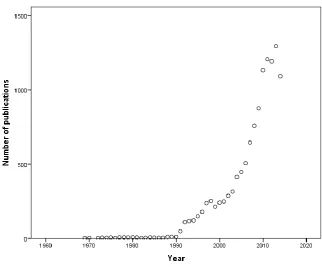
Figure 1 Web of Knowledge citations by year for ‘students’ and ‘feedback’ ... 33
Table 1 Conceptions of learning related to approaches to learning, summarised from Marton and Saljo (2005) ... 49
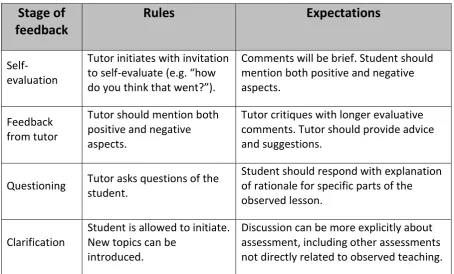
Table 2 Expectations and ‘rules of the game’ in feedback meetings. Adapted from Copland (2011, p.3835). ... 60
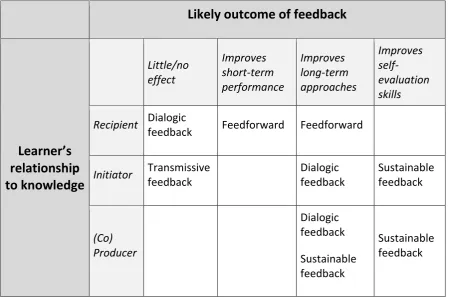
Table 3 Mapping definitions of feedback ... 67
Figure 2 Example of QueXF verification screen ... 88
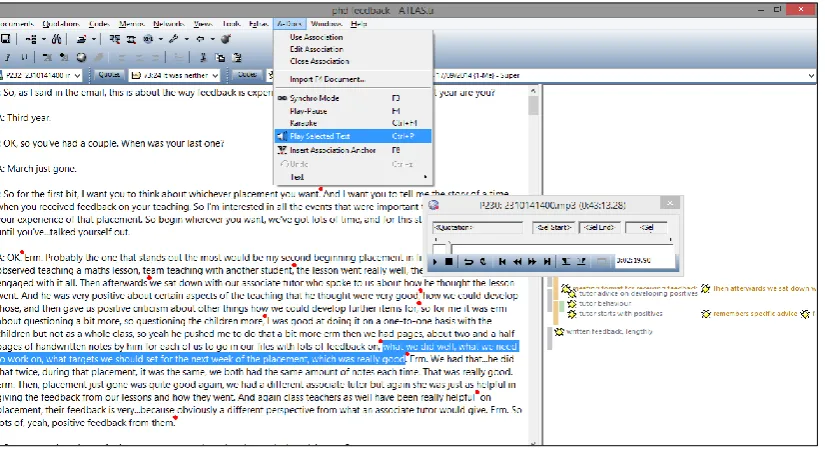
Figure 3 Timestamping and transcribing as early analysis using A-Doc tools in Atlas.ti ... 103
Table 4 Survey items mapped against research questions ... 113
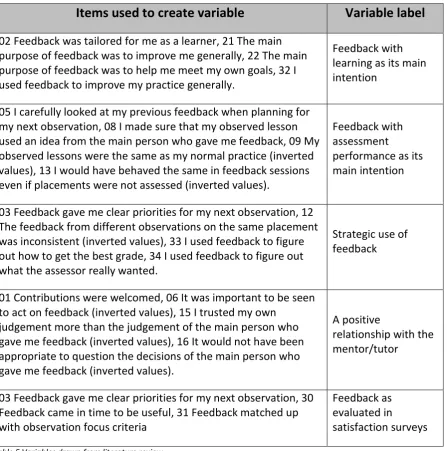
Table 5 Variables drawn from literature review ... 120
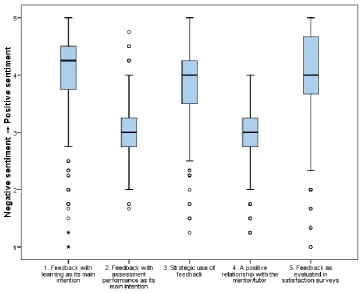
Figure 4 Boxplot of pre-selected variables ... 122
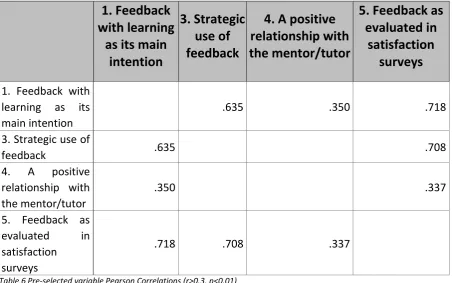
Table 6 Pre-selected variable Pearson Correlations (r>0.3, p<0.01) ... 124
Table 7 Contributing items to rotated PCA ... 131
Table 8 Descriptive statistics for components/variables ... 135
Table 9 Pearson correlations for variables and components (r>0.3, p<0.01) ... 138
Table 10 Students’ study year compared with the year described in their narrative ... 150
Table 11 Component percentile ranks for Mary ... 154
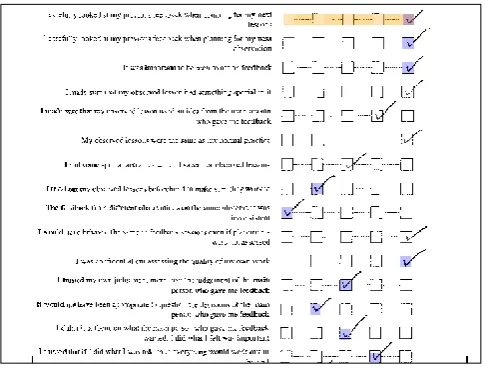
Table 12 Repertory grid responses from Mary (ticks indicate preferences where given) ... 157
Table 13 Repertory grid responses from Rachel ... 162
Table 14 Component percentile ranks for Rachel ... 164
Table 15 Repertory grid responses from Bella ... 169
Table 16 Component percentile ranks for Bella ... 170
Table 17 Repertory grid responses from Josh ... 174
Table 18 Component percentile ranks for Josh ... 176
9 of 283
Table 20 Component percentile ranks for Meg ... 183
Table 21 Component percentile ranks for all five students ... 185
Figure 5 Scatter plot of percentile ranks ... 186
Table 22 Mary’s themes (numbers in brackets indicate percentile rank for
components taken from survey analysis) ... 192
Table 23 Rachel’s themes (numbers in brackets indicate percentile rank for
components taken from survey analysis) ... 194
Table 24 Bella’s themes (numbers in brackets indicate percentile rank for
components taken from survey analysis) ... 196
Table 25 Josh’s themes (numbers in brackets indicate percentile rank for
components taken from survey analysis) ... 198
Table 26 Meg’s themes (numbers in brackets indicate percentile rank for themes
taken from survey analysis) ... 200
Table 27 Compiled components and themes ... 202
10 of 283
Abbreviations
ANOVA Analysis of Variance, a statistical test to compare means of more than two groups.
AT Associate tutor/Associate teacher. Mainly US. The normal teacher of a class which has been taken over by a student teacher. This person is also usually the student teacher’s mentor, but not necessarily.
BNIM Biographical Narrative Interview Method. A method of interviewing which is structured by the participant.
CELTA Certificate in Teaching English to Speakers of Other Languages (formerly Certificate in English Teaching to Adults, hence the acronym). A short course qualification, typically postgraduate, taken in one month full-time or up to one year part-time, which must include 120 contact hours and 6 hours of assessed/observed teaching.
CEQ Course Experience Questionnaire, a multi-scale survey used with graduates of Australian universities.
CSV A generic type of spreadsheet file (comma separated values).
ELT English Language Teaching, especially as a second or additional language.
ETL Enhancing Teaching-Learning Environments, a project at the University of Edinburgh.
EYFS Early Years Foundation Stage, compulsory guidance for education from 0-5 years.
HE Higher Education.
HESA Higher Education Statistics Agency.
HSD Honest Significant Difference, a statistical test developed by John Tukey, used to find statistically significant difference in ANOVA tests.
KRG Kelly’s Repertory Grid, a method for eliciting constructs by making comparisons.
LT Link Tutor, employed by a university to monitor and occasionally visit students on school placements.
MET Measuring the Effectiveness of Teachers, a project of teacher evaluation funded by the Bill and Melinda Gates Foundation.
NSS National Student Survey, a multi-scale survey used with graduates of UK universities.
11 of 283
OFSTED Office for Standards in Education, Children’s Services and Skills. Government inspector.
OIAHE Office of the Independent Adjudicator in Higher Education. The UK body responsible for students’ complaints in Higher Education.
PAT Personal Academic Tutor, a mainly pastoral role performed by a university-based tutor.
PCA Principal Component Analysis, a type of factor analysis.
PT Personal Tutor, see PAT.
QTS Qualified Teacher Status.
SPSS Statistics Package for Social Sciences, software used for statistical tests.
SQL Structured Query Language, a computer language used in maintaining databases.
TEFL Teaching English as a Foreign Language, can refer to the practice or a generic term for the qualifications which lead to this (e.g. a CELTA is a type of TEFL certificate).
12 of 283
1
Introduction
This chapter gives an overview of feedback in higher education in the UK, including context
relevant to the type of course the sampled students are on and the institution where they are
based. The chapter starts with the motivation for this thesis – some of the main problems
with feedback. It then outlines some of my own background, which becomes relevant later as
I try to draw out and compensate for my own assumptions and values. This builds to my
general research topic, which provides a structure to the overall thesis. Important context is
also given for readers with respect to organisational, policy, national and theoretical contexts
relevant to this study.
1.1
Problems with feedback in higher education
From being understood simply as a technique for error detection and correction, feedback is
now recognised as playing a crucial and increasingly nuanced role in learning, particularly in
higher education. However, there remains great variety in how feedback is experienced to
the extent that “when we refer to feedback, we need to be aware that it means different
things to different people” (Carless, 2015, p. 192). In terms of format, the majority of feedback
discussed in the research literature is written feedback on written assignments, since this is
still the dominant assessment method for the vast majority of HE courses. However, feedback
can also take many other forms. For example, it can be generated by adaptive technology, be
intrinsic in the completion of a task (such as a trial and improvement task), be part of an
internal reflective monologue, or be given informally through in-class discussions with peers
and tutors.
As well as competing definitions, the reported experiences of feedback can vary widely and
13 of 283
demand for feedback whilst at the same time displaying apparent nonchalance towards it.
This is indicated by regular complaints from tutors that students often fail to even collect their
written feedback (Bailey & Garner, 2010; Carless, 2006), while written comments by tutors,
even if read, can still be poorly used by students (Dysthe, 2011).
As a result, it is “not inevitable that students will read and pay attention to feedback even
when that feedback is lovingly crafted and provided promptly” (Gibbs & Simpson, 2004, p.
20). What is meant by seemingly straightforward ideas as ‘good feedback’ can therefore be
difficult to define. Indeed, the very idea of feedback in higher education can be in direct
conflict with more passive conceptualisations of feedback which students retain from their
experience of secondary education (Sambell et al., 2012). Other barriers to knowing what
good feedback is include students’ misunderstanding key terms used to evaluate feedback
(Mendes et al., 2011), or a fundamental difference in what the purpose of feedback is seen
to be (Doan, 2013). As a result, there is significant variety in how students and tutors evaluate
feedback and their intentions when using it.
Tutors can also have differing views from other tutors on what makes for good feedback.
Differences in the assumed role of tutors or students, such as in Biggs and Tang (2011), can
affect whether a tutor feels a need to ensure feedback is used or whether their responsibility
ends when they have given their feedback. Boud and Molloy (2013), for example, include
student action in their definition of feedback: if tutors do not ensure action, they are giving
information, not feedback. However, this seems too extreme a position in practice. Instead,
it is generally enough that tutors are open to dialogue when it is sought and make efforts to
ensure their feedback is understandable and accessible, for example through using
14 of 283
if their students have engaged, but the tutor’s responsibility typically falls short of forcing
students to engage, at least in HE.
Understanding of students’ roles in feedback is similarly problematic. Two examples of tutors
encouraging students to engage with feedback illustrate the very different strategies which
can result from different assumptions about students. Withey (2013, p.319) describes
“forcing” students to engage with feedback for their own good by assigning marks for
responding to feedback. An alternative is to refuse to waste tutors’ time creating feedback
until students first show willingness to engage (Jones & Gorra, 2013). As well as such
differences in whose responsibility it is to ensure students engage with feedback, there are
differences in what counts as engagement. For example, simply accessing or reading feedback
is very different from reflecting critically on that feedback. Outcome is also an unreliable
measure, since a critically reflective student might legitimately reject feedback. Engagement
can also relate to accessibility, questioning whether the tutor needs to make their feedback
clearly understandable or whether student engagement should include a certain amount of
struggling and sense-making.
One of the key issues underpinning student engagement with feedback is the relationship
between feedback and assessment. If feedback is not seen to have any transferability beyond
an assessment, engagement will be low. The assumption that the intention of feedback is to
improve assessment performance also influences how feedback is typically evaluated: using
feedback well improves grades, using it poorly does not. While this is a neat way of
distinguishing effective practice from ineffective, it may make too big an assumption that
assessment performance is a reliable proxy for learning. Similarly, feedback being so closely
15 of 283
or justify an assessment judgement (Bloxham et al., 2011).
In addition to influencing the purpose of feedback, assessment can also affect the linguistic
quality of feedback. The clearest example of this is when stock feedback phrases are designed
to match with assessment rubrics, such as in the Rubyric software, where feedback phrases
are generated for the tutor to personalise (Auvinen & Korhonen, 2014). The influence can be
more subtle, however, such as adjectives from assessment criteria being used in feedback or
feedback being structured to give equal consideration to each criterion. This might be a
welcome structure. For example, Andrade (2005, p. 29) describes “rubric-referenced verbal
feedback” as supporting self-assessment and peer feedback. However, these linguistic and
structural influences of assessment might be more problematic when feedback is being given
by an expert. Sadler (1998) describes the tacit nature of expert knowledge, likening it to
connoisseurship. To extend Sadler’s analogy, assessment criteria might usefully function to
give a shared vocabulary and prompt for further detail in much the same way as an aroma
wheel assists a wine connoisseur by breaking ‘floral notes’ into a spectrum from ‘honeysuckle’
to ‘rose’, but this is at the expense of seeking a richer description of the personal nature of
the judgement.
A related concern is that students might discuss using feedback in very narrow terms as what
they do when preparing for an assessment, either failing to appreciate that feedback should
have a longer-term impact or else calling this by another name such as appraisal, supervision,
or reflection. Even when students do engage with feedback for longer-term learning, it might
be difficult for a tutor or researcher to know that they are doing this or what support they
might need. Due to the often tacit nature of knowledge at this level, it can be as difficult for
16 of 283 clearly.
In summary, there are three main problems addressed in this thesis attempting to evaluate
how well feedback supports learning. First, feedback is not clearly defined in the literature,
which adds to confusion over the role of tutors and learners in feedback practice. Second,
feedback is so strongly linked to assessment that it becomes difficult to research one without
researching the other. Finally, even when tutors and students are clear on their expectations
for each other and how they want to use feedback to support learning, it can be very difficult
to give good feedback and ensure it is used effectively.
1.2
Organisational context
This thesis samples students on undergraduate teacher training courses at two new
(post-2000) universities in the UK. Similar courses are offered at many UK universities, although
numbers have recently fallen as more students are recruited to shorter courses primarily
based in schools. Students in this sample attend university for either three or four years
full-time depending on whether they are training for the secondary or primary sectors,
respectively. During this time, they are placed in schools to practice teaching, where they are
observed teaching and given feedback by staff within the school (class teachers or
school-based mentors) or university staff (link tutors or partnership tutors).
Regular observation of teaching contributes to a portfolio of evidence arranged around the
Standards for Qualified Teacher Status. Grades are given from 1-4, with 1 typically referred to
as Outstanding, 2 Good, 3 Satisfactory (sometimes ‘requires improvement’ if using
terminology from the government inspectors, OFSTED) and 4 Unsatisfactory/no evidence.
17 of 283
degree classification – qualified teacher status is awarded on a pass or fail basis. Similarly, a
student’s performance on the university modules of the course has no impact on the award
of Qualified Teacher Status (QTS) beyond pass or fail. A student failing the teaching
component may still be awarded a bachelor’s degree, but failing the degree element would
negate the award of QTS. Similarly, even a first-class honours would not compensate for a
failed teaching assessment.
Places in schools are scarce, and competition between local universities can be intense.
Consequently, a common difficulty experienced by Higher Education teacher-training
providers is managing the consistency of placement experience and professional relationships
with partnership schools (Ellis, 2013). This can restrict the number of places a university can
offer, the convenience of where schools are located, or the quality of the placement
experience as universities have to place students in whichever schools offer space. As a
researcher funded directly by a university in these relationships, it is therefore important to
be sensitive to the risk of being seen as overly critical of school-based practice while still
seeking insight into how these relationships might impact on feedback.
This research is also timely for teacher education in the UK as provision is shifting from being
university-led to being school-led. This thesis might therefore be one of the last chances to
evaluate how feedback is conceptualised by students who primarily belong to a university
which places them in a school, as compared with students who will belong to a school which
occasionally sends them to a university. It is therefore important that this thesis can illustrate
how feedback is experienced in this system so that comparisons might be made once the new
routes become established.
18 of 283
suggestions for improving feedback in higher education are already in place in school-based
components of teacher education, such as very prompt and specific feedback and
one-on-one tutorials. Problems in this context will therefore help to inform the planning of changes
to feedback in higher education more generally. For example, before universities commit to
funding more one-on-one feedback, it is important to understand how students already
respond to high levels of individual attention. Similarly, practices which are effective in
schools might suggest where universities should focus their efforts to improve feedback at
university.
Teacher education in the UK also has a specific concern that reflective practice is becoming
less of a professional value and more just another assessment or compliance task (Hobbs,
2007). Student teachers therefore risk adopting increasingly techno-rational coping strategies
rather than taking a slower or more reflective approach towards learning their craft
(Johnston, 2010). Underlying these concerns is the risk that students retain a limited and
simplistic understanding of quality based either on their experiences as pupils or imitation of
mentors, particularly when a mentor is also a student’s assessor (Bray & Nettleton, 2007).
This is highly relevant for research into feedback in this context since feedback being used
strategically risks losing its focus on learning and instead becomes part of attempting to
“determine the implicit rules of the assessment game” (Entwistle et al., 1979, p. 366).
Finally, courses which blend workplace learning with HE modules seem to be increasing in
popularity, so it is helpful to evaluate this fairly established example. Initiatives such as TESTA
(Jessop et al., 2014) are increasingly emphasising the planning of assessment and feedback at
the design stage of courses, so it is important that this planning is informed by thorough
19 of 283
1.3
Personal professional context
Critiquing an existing system can be difficult for researchers who have been well-served by
the system (Stobart, 2008). It is important therefore to remember that my own relatively
straightforward teacher training experience might not be typical, and I am aware that I was
fortunate to be given a good fit for both of my placement schools. However, this is balanced
against a very difficult induction year, in which my performance management assessments
and feedback seemed random to me, to the extent that I lost confidence self-assessing and
would not know whether my observation was good or a fail. My strategy became very
reactive, and I felt that I lacked any clear direction even a year later.
I also felt some sympathy for students failing placements as I tried to support my partner
during a placement which she failed. She paid close attention to feedback and was eager to
please, but we both felt that the feedback was overly negative and lacked focus. The result
was an overwhelming list of faults which left her stressed and anxious, eventually unable to
teach classes as she obsessed over planning and ran out of time. These feelings carried over
into her re-submission placement, but feedback there was almost entirely positive as she
effectively became a replacement for a teacher who was about to take maternity leave.
From these experiences, I felt sensitive to three problems with feedback. One was the
potential of feedback to seem idiosyncratic or random, whether because it was or because I
failed to understand some underlying principle. Second was the potential for unhealthy
responses to feedback, particularly a need to play safe or visibly increase effort and
preparation. Finally, feedback seemed scarce when teaching was going well, making it difficult
to understand why some lessons went well and creating a strong association with feedback
20 of 283
Based on these mixed experiences, I was aware of the risk of being too focused on negative
experiences, particularly if students had similar features to my experiences. It was important
that I try not to judge tutors too harshly, particularly as I only had the students’ data to draw
upon. I was also aware that my only experience of helpful feedback on my teaching was
essentially being left alone, that not being given feedback should be taken as a subtle
indication that I was doing fine.
My personal professional context influenced my sampling method as I sought as wide a
sample as possible and tested their representativeness. I was particularly attentive to
ensuring a fair representation of students who described their experiences positively. My
working definition of feedback, described in the next chapter, was also careful to avoid overly
criticising feedback which does not directly support learning. I therefore took care to note
other worthwhile functions of feedback, such as performance management or quality control,
to try and see some more charitable reasons for feedback failing to engage students as
longer-term learners. This influence can be seen in the extensive use I make of work by Becker et al.
(1968) and Horowitz (1988), since their work takes a broader view of how students approach
university life and learning in general, whereas more contemporary work seems to focus
much more on how students approach assessment. Avoiding being too critical of feedback
which did not directly support learning is therefore an important aspect of this thesis since it
helps to give a broader focus on learning rather than just assessment.
1.4
Policy context
There are several feedback policies which are informal or local to these two particular
universities, but which provide important context to understanding how feedback operates.
21 of 283
lesson they have been observed teaching for every two weeks of their school placement,
including both written and oral feedback. Their written feedback should make clear
references to the Standards for Qualified Teacher Status, including indicating any standards
which were evidenced in the observation. The student should then have three targets for
their next observation, which can either be negotiated or simply given to them. It is also very
common that feedback should include some praise, which has influenced the adoption of two
main techniques for giving feedback. The first is Two Stars and a Wish, adapted from feedback
practice with school-aged students where two positives should be given for each negative.
The other is the Feedback Sandwich, in which positive feedback should be given both before
and after each negative point. Even when these structures are not used, their influence can
still be seen in feedback which starts with positive comments, and official documentation
typically supports this implicitly by giving larger spaces for positive comments and putting
these above negative comments. Informal or local feedback policies also tend to assume the
principles of reflective practice, so for example it is almost always the case that feedback will
start with the student being prompted to self-evaluate.
More formal and wider adopted policies are also relevant to this study, most notably those
related to student voice and student satisfaction. Students can certainly be thought of as
having more power than ever before, with increased tuition fees leading to students being
thought of more as customers and measures of student satisfaction being used in the national
rankings of universities. Feedback is an especially important part of student satisfaction
policies since feedback is consistently an area which students rate lower than any other
aspects of their experience (Yorke, 2013). Policies therefore exist to ensure that feedback
22 of 283
quantified such as the promptness or level of detail in feedback.
Policies related to extreme student dissatisfaction, however, suggest less interest in
understanding the role of feedback in cases when students experience significant problems.
For example, academic judgement is specifically excluded from the complaints policy of the
Office of the Independent Adjudicator for HE unless the allegation is of personal bias (OIAHE,
2013), suggesting that students cannot formally question the validity of a tutor’s judgements
in their feedback and assessment. Policies in school-based practice also discourage
complaints since students have a small time window within which to make complaints or find
alternative placements, and university tutors are reluctant to challenge schools since it is vital
to keep a positive relationship with the school so that they will take another student the
following year. The difficulty of finding placement schools also contributes to an opportunity
cost, that a student wishing to be assessed by a different tutor will typically have to delay
their graduation whilst another placement is found and therefore incur significant financial
costs or even lose a job which might have been offered on the condition of being awarded
QTS in time for the new academic year. Understanding students’ conceptions of feedback
must therefore be sensitive to the negative messages sent by policies which emphasise
students’ low status in their relationship with tutors, which in turn limits the potential for
truly dialogic feedback.
These policies also risk sending the message that student complaints about feedback
practices are too easily dismissed or discouraged. This is significant for the reporting of this
research, as negative student comments might too easily be dismissed as unfounded
complaints and so limit the impact of this study. It is also important to be aware of how these
23 of 283
of feedback, or if this is only relevant to students who have negative experiences. It is also
important to understand students’ interpretations of these policies and whether this has any
impact on how they rate the honesty of feedback. For example, if a student is aware that they
should be given two positive comments for every negative, they might reduce the value they
place on positive comments.
1.5
National context
The history of teacher education in the UK has been frequently described as being on a
“swinging pendulum” between school-based apprenticeship approaches and college- or
university-led approaches (Robinson, 2006, p. 20). At the time of writing, school-based
approaches seem to be coming into dominance with the increased use of training schools and
routes into teaching such as Teach First. These alternative training routes and increased
freedom of staff selection in Academies and Free Schools have effectively removed some of
the power of universities, including bypassing the requirement in the James Report of 1972
that all teachers should have undergraduate degrees.
Organisation of schools into Academy Trusts has also changed the skills required of many
teachers and even the demands for educational research, with experimental approaches
being used to develop teaching strategies and resources to be delivered by all teaching staff
within an Academy Trust. Feedback might therefore similarly change from the dominant
reflective practitioner model, typically based on Schon (1983), to a more technical or
diagnostic approach. This does not seem to have affected feedback and assessment of
teachers in the UK yet, but some influence can be seen in the United States with the
Measuring the Effectiveness of Teachers (MET) project (2013). This uses random samples of
24 of 283
is seen as more objective and more valid since it comes from multiple observers. This marks
an interesting move away from a one-on-one apprenticeship model relying on knowledge of
the school context, relying more on the impressions of a general community of peers.
However, with recent changes towards performance-related pay for teachers, these methods
may become more important for evaluating teachers rather than giving them feedback.
It is also important to consider the international context, with international comparisons
prompting a range of policy decisions in the UK. For example, attempts to emulate the
performance of Sweden, where teachers are typically educated to masters degree level, can
be seen in policies such as increased bursaries for undergraduates with first-class degrees to
enter teacher training. This may impact the role of feedback by increasing the expectations
on student teachers’ subject knowledge, or even create relationship tension in the
assessment of students by increasing the number of students who hold higher level
qualifications than their mentors.
1.6
Theoretical context
The way feedback is discussed in the research literature, particularly over the last ten years,
is much more complex and ambitious than the everyday definition of feedback. This raises
the possibility of two different activities which might both be called feedback – everyday
feedback for everyday needs such as quick diagnostics or performance appraisals, and
feedback for learning. Both tutors and students may fail to appreciate this difference,
meaning that research into feedback must seek to both be inclusive of the plurality of possible
concepts participants have of feedback whilst also taking care to give a coherent explanation
25 of 283
Feedback also needs to be considered as part of the broader theoretical discussion of
assessment as, of or for learning. This focus on the intention of assessment, whether it acts
as a learning event (‘as’ learning), is a check (‘of’ learning) or seeks to stimulate (‘for’ learning)
affects the balance of assessment tasks. Race (2014) summarises the considerations of
assessment neatly as validity, fairness, whodunit, transparency and real world dimensions.
For example, an unseen, timed exam at the end of a course will reassure on the ‘whodunit’
dimension since students can easily have their identification checked, but the validity of the
exam might be poor – it might disproportionately reward students who can handle time
pressure or memorise quotations. Feedback will be of little value in this situation, since the
course is over.
Compared to this assessment ‘of’ learning, assessment ‘for’ learning might encourage
students to study over a longer period of time and get to know material in more depth.
Feedback becomes an integral part of the course, developing a dialogue between students
and tutors as assessment is gradually improved. Aside from the obvious time pressures, this
approach can be weak in terms of fairness as some students might have greater chances to
engage with their tutors. It also risks students becoming too reliant on tutors, although this
can be addressed by strategies using peer or self feedback. Finally, assessment ‘as’ learning
receives far less consideration in the literature, but is highly relevant for workplace learning
since the real world dimensions can be very thorough – the task itself gives a type of intrinsic
feedback, helping students to self-assess and set their own goals. These are typically much
lower stakes self-assessments, and may not be graded at all.
1.7
Summary
26 of 283
address. These are that there is too much uncertainty in how feedback is understood or what
its objectives are, the roles of learners and tutors are unclear, and that all of these problems
can be exacerbated by the influence of assessment. This can be summarised as the central
research concern reflected in the title of this thesis: is feedback in teacher education ‘for
learning’? In addition to outlining researcher reflexivity, the key contexts for this study have
been described. This is intended to assist readers unfamiliar with these contexts, but can also
be seen to help refine this central research concern into the following research questions:
1. How do students see feedback relating to their learning and assessment needs?
2. How do students see different intentions of feedback?
3. How do students see their own roles and the roles of their tutor in feedback?
Questions one and two consider how learning (or assessment) goals are reflected in feedback,
which is then developed in question three to consider the roles students see themselves as
fulfilling, which is in part defined by the role they assign to their tutor. Answering this question
allows a more general consideration of how students broadly conceptualise feedback in
practice, which may help to explain some points raised by the previous research questions.
Taken together, evaluating the extent to which feedback in teacher education is for learning
will consist of understanding students’ conceptions of learning in this context, the way they
see themselves and others as needing to function within a feedback relationship, and how
students evaluate their success in meeting these goals. The study therefore makes an
important contribution not only to how feedback is evaluated in teacher education, but how
understanding feedback more generally might rely on understanding of students’
expectations concerning their roles, the roles of their tutors, and the nature of their
27 of 283
2
Literature review
The introduction chapter added some context to the general question of the extent to which
teacher education is ‘for learning’. In this chapter, the ‘for learning’ part of this question is
explained in relationship to the research literature, including how it relates to similar terms
such as assessment for learning, formative feedback, and dialogic feedback. This literature
review also starts to refine the research question as gaps in the literature are exposed, first
considering Higher Education students more generally before just looking at student teachers.
In addition to a general overview of the literature, seven key studies are analysed in greater
detail. Each of these gives focused insight into particular aspects of students’ experiences of
feedback relevant to my research context, which helps lead to methodological decisions
which focus my research questions even further.
2.1
Defining feedback
Feedback is understood fairly easily in everyday language, and has only come to be used with
academic precision in the last 25 years. It is therefore easy to overlook significant differences
in how the term is used and how meaning has shifted in different contexts. These shifts in
meaning often mask important and differing assumptions about the role of the learner, so a
clear working definition is vital to understand how phrases such as ‘feedback for learning’ or
‘feedforward’ relate to each other. Some work has already been done in this area, tracing
feedback from its origins in engineering and then following its etymology. One of the more
detailed contributions to this literature is Long (2013), who adds some precision by drawing
on cybernetics. However, I believe that current explanations of the developing meaning of
feedback missed a crucial development in the 1950s which laid the foundation for Sadler’s
28 of 283
attempt to remedy this gap is published as Carver (2016a) and is summarised here.
The Oxford English Dictionary records the first use of feedback as a term in 1920, in the field
of engineering. Feedback described the “return of a fraction of the output signal from one
stage...to the input of the same or a preceding stage” (OED Online, 2015). The direction of
information flow is emphatically backwards and reactive, with any required changes being
implemented either immediately or prior to a repeat performance. The data is also incidental
to the task, since feedback is a return of a part of the output signal. Simple examples might
be moderating the volume of a speaker or the temperature of a radiator, but feedback might
also be more complex or diagnostic such as allowing an engineer to check at what volume the
speaker becomes distorted under different situations or with different inputs.
Adapting this earlier definition to an educational context matches the way that part of a
student’s efforts (e.g. a draft assignment or an observation of one in a series of lessons) is
used to make decisions which help the student to either revise that attempt or make changes
to future attempts. This can be seen to underpin what Long (2013) describes as a behaviourist
approach or what Askew and Lodge (2000) call a receptive-transmission model, in which
feedback is given by an expert to the learner as a gift. The validity of the feedback is not
questioned, and the learner is required to implement the changes, possibly with another task
allowing the expert to check the effectiveness of the change. It is also important to note that
the task upon which feedback is based is a genuine attempt at the final task rather than
something deliberately created to generate feedback. Feedback from this perspective is
therefore closely linked to the repetition of similar tasks.
Defining feedback becomes more problematic when the learner is given a more active role,
29 of 283
to find a clear etymological path to terms such as dialogic feedback (Nicol, 2010) or
sustainable feedback (Boud, 2000). Long (2013) makes a valuable attempt to bridge the gap
by drawing on Wiener’s (1954) description of two different uses of feedback. The first of these
uses was feedback used “as numerical data for the criticism of the system and its regulation”
(Wiener, 1954, p. 61). Here a performance is altered and feedback sought until actual
performance satisfactorily closes the gap with desired performance. However, Weiner notes
an alternative use if feedback “proceeds backward from the performance [and] is able to
change the general method and pattern of performance” (Wiener, 1954, p. 61). In Weiner’s
definition we can start to see a focus on the intent of feedback, whether it is to improve a
particular performance or to make general improvements. Wiener also seems to imply that it
is only suitable to use feedback as numerical data when the intention is regulation, that
improving general performances will require engaging with a more complex or qualitative
understanding of feedback.
An example from The Times in 1955 shows feedback starting to be discussed outside of
engineering, in which “constant” feedback is argued as the only way that a speaker “can
ascertain how far a message has been understood rightly” (OED Online, 2015). This retains
the simple idea of using feedback to regulate performance, which could range from simple
changes such as the volume or pace of speech or result in more significant changes like the
speaker changing their vocabulary or returning to explain key points. It also emphasises that
responses to feedback should be constant, with small changes happening quickly rather than
waiting until the output is complete.
However, an important shift in this example is that the speaker is generating feedback for
30 of 283
by their own observation skills, choose to ignore certain types of feedback, or misunderstand
the data. There is no separate expert role in this example, and the data source has also
changed – the speaker is not gaining feedback from a return of their output, but by a wide
range of sources depending on whatever they are attuned to, for example the audience’s
body language, eye contact, applause, or note-taking habits. Accepting a plurality of possible
data sources marks an important change in how feedback is understood, expanding the
learner’s role to include self-evaluation and allowing for skill and judgement in the generation
and use of feedback data.
A similar example, this time specifically in education, comes from an early teaching guide
(Quirk & Smith, 1959), that in a lecture “the live speaker has a reaction, a ‘feed-back’ from
the listeners” (OED Online, 2015). This still follows the idea of using feedback to moderate
performance, but it also has the speaker seeking feedback and using their own judgement
rather than relying on an expert. There is also a shift from simple numerical feedback data,
with “reaction” allowing for a wide range of possible interpretations. This reaction might be
a return of the fraction of the output since the audience’s reaction is something naturally
occurring during the natural performance of a task - they will react regardless of whether
those reactions are acted upon by the speaker. However, the speaker is also seeking to use
whatever data they are given rather than relying on a simple return of their output, which
helps the definition of feedback to move beyond simple numerical data and consider a much
wider range of information. It is this shift in usage which I believe has so far been overlooked,
and which helps to explain how the standard dictionary definition stabilised from this point,
while the research literature developed its own use of the phrase.
31 of 283
straightforward: essentially something either created by or responding to an action which is
then used to evaluate or modify that action with the intention of reaching a desired result
(OED Online, 2015). The issue of who generates or judges this data, or ensures and evaluates
its effective use, is left vague. In everyday language this seems not to have been addressed
over the last 50 years, but in the research literature it is picked up in the shift from
behaviourist to constructivist theories of learning. Sadler (1989) is instrumental in this shift,
although it should be noted that despite widespread support for ideals such as active learners
“feedback practices enacted on the ground still tend to pull heavily on behaviourist views of
feedback” (Molloy et al., 2013, p. 52). It is therefore worth pointing out that despite the
seminal nature of Sadler’s work and frequent citations, the everyday definition of feedback is
still common in education, and it cannot be assumed that educators referring to feedback (or
even citing Sadler’s work) are aware of this distinction.
Sadler’s use of the term ‘feedback’ helped move the definition forwards by rejecting some
behaviours from the definition. He asserted that if feedback did not improve learning in a
formative sense then it could not be called feedback at all. This effectively excluded many
practices which fit under the everyday definition of feedback, demanding a more involved
role for the learner and a longer-term impact from the feedback. This attention on formative
improvement took the concept of feedback away from performance improvement and firmly
into learning by focussing on “pupil’s learning strategies or understanding [being] formed into
a more developed stage than they were prior to the particular assessment being made”
(Hargreaves et al., 2000, p. 21).
In addition to the requirements for more sustained development in the learner, Sadler also
32 of 283
required standard, make a comparison between that and their performance, and engage in
action to close that gap (Sadler, 1989). Some form of self-evaluation was now an integral part
of the feedback process, as was a notion of sustainability in that the learner should gradually
become less reliant on their teacher.
As well as outlining these increased demands for feedback, Sadler acknowledged difficulties
teachers have in making their knowledge explicit, that teachers’ “conceptions of quality are
typically held, largely in unarticulated form, inside their heads as tacit knowledge” (Sadler,
1989, p. 126). More recently, Sadler (2009) has linked this to requiring the learner to develop
their own understanding of tacit knowledge. This further stresses the central role of feedback
in helping the learner develop their own understanding.
Bodman (2007) explains the contribution of Sadler’s (1989) paper as moving attention from
the information provided in feedback to a focus instead on the effect of that feedback.
Sadler’s strict criteria also allowed other researchers to argue that much of what is called
feedback simply is not, with his term “dangling data” (Sadler, 1989, p. 121) being powerfully
employed by Boud and Molloy (2013). As well as helping to distinguish feedback in education
from its everyday definition, Sadler located his discussion in a constructivist framework by
emphasising how feedback must develop new understanding or critical reflection in the
learner (Sadler, 1998).
Sadler’s work also coincides with a significant increase in educational research using feedback
as a keyword. With information from 1969 to the present day, the Web of Science database
indicates that publications mentioning both “feedback” and “students” saw a sharp increase
from 1990, and then again from 2000, shown in the graph below. Whilst much of this can be
33 of 283
indication that feedback as a term in educational research has only recently become popular
[image:33.595.78.401.138.405.2]and owes much to Sadler’s definition.
Figure 1 Web of Knowledge citations by year for ‘students’ and ‘feedback’
More recent definitions of feedback have continued to distance themselves from the
everyday use of the term, although in doing so they risk expanding the definition too far. For
example, the openly broad working definition offered in Askew and Lodge (2000, p. 1)
“includes all dialogue to support learning in both formal and informal situations”. This
definition clearly distinguishes learner agency by specifying dialogue (rather than
information) and intent by specifying the support of learning (rather than improving
performance). However, it is difficult to imagine any constructivist model of learning that does
not arise from a similar process, particularly if dialogue is taken to include self-reflection. In
this way, the feedback is learning because there is little that could be called learning that does
34 of 283
In seeking a working definition of feedback, it is therefore important not only to reject what
is falsely labelled feedback but also to clearly delineate feedback from learning. Gravett and
Petersen (2002) take their definition of feedback from the learner’s perspective and
distinguish between learning which is teacher-led and independent learning. In this way,
feedback is defined as structured dialogue which enables learners and teachers to “inquire
together” (Gravett & Petersen, 2002, p. 281). A similar approach emphasising the process
rather than product of feedback is evident in the working definition offered in Carless (2015,
p. 192), where feedback is “a dialogic process in which learners make sense of information
from varied sources and use it to enhance the quality of their work or learning strategies”.
Utilising feedback from peers and even technology is included in this definition by the concept
of “internal feedback” (Carless, 2015, p. 190), which emphasises the learner’s central role
since the teacher becomes just one source of feedback.
The inclusion of improving learning strategies also helps to reduce the emphasis on just
assessing feedback by its effect on performance. This is helpful in considering the longer-term
impacts of feedback. For example, prior to Carless’ definition, it would be problematic to
consider a learner whose grades dropped while they changed to a better overall approach –
would such a learner be judged as having used feedback effectively, or even received effective
feedback?
One of the main problems of feedback drawing so heavily on constructivist principles is that
it becomes difficult to talk about feedback in a behaviourist environment. One key difference
is that the notion of expert judgement is absent from all three of the post-2000 definitions
above, implied only by the result that the learner actually does improve. This makes it difficult
35 of 283
poor decisions which fail to improve either their work or their learning strategies. Depending
on the definition of feedback used, the learner might be responsible for their own
shortcomings or could equally feel aggrieved that they were given poor feedback or poor
coaching in using feedback.
To summarise, feedback as it is understood in everyday language is significantly behind how
the term is used in the research literature. The main developments include a more
constructivist approach to learning and deemphasising of the role of the expert. These
developments to the definition mean that the role of the learner is central, and the effect of
feedback should not just be looked for in performance – indeed, performance might get
worse as a learner gradually integrates and refines their use of feedback. I will return to this
when outlining my working definition of feedback, but first it is important to review some
recent feedback literature which introduces new terms to the discussion.
2.2
Coining new terms to explain feedback
An alternative to the redefining work led by Boud, Molloy, and Carless is an attempt to create
new terms rather than fighting to clarify what is understood by feedback. One attempt to
clarify the purpose of feedback is the concept of feedforward, emphasising the vital
requirement that feedback must lead to specific future actions (Duncan, 2007). Irons (2010)
uses feedforward to explain the difference in expectations between tutors and students:
tutors expected that students would have the skills to take their feedback forwards, whereas
students expected their feedback to tell them everything they needed to know. In this case,
feedforward as a concept helped to avoid the complexity of defining feedback in this situation
and focus on the support students needed. Similarly, Price et al. (2010) describe feedforward
36 of 283
2004) in order to make good use of their feedback. This allows ‘feedback’ to simply refer to
information which is used as part of feedforward.
New terms have also been formed by adding descriptive labels, most significantly
‘sustainable’ and ‘dialogic’, but there is also some crossover from similar debates in the
assessment literature, resulting in ‘formative’ and ‘for learning’. Like feedforward, the extra
description helps to distance each term from the everyday definition of feedback. Some of
these descriptive labels also suggest criticism of the standard model of feedback. For example,
while Carless (2015) contrasts ‘sustainable’ with the fairly neutral term ‘conventional’, there
is still the hint of sustainable feedback being better, either through the pejorative sense of
conventional or the implied antonym ‘unsustainable’.
Similarly, feedback which is either aligned to ‘learning-oriented assessment’ or is ‘for learning’
suggests that other feedback is not addressing this basic goal of feedback. Even ‘dialogic’
suggests a value judgement in an environment where student voice is highly valued. Each
term therefore seeks to not only describe a more nuanced type of feedback, but to promote
itself as superior to the everyday definition of feedback. This self-promotion goal helps to
explain why ‘formative feedback’ failed to become widespread, since students saw formative
assessment as less important, so ‘formative feedback’ invited similarly negative connotations
(Carless, 2015) in the sense that it was less valuable than feedback ‘for assessment’, with a
similar effect likely in ‘feedback for learning’.
Sustainable and dialogic feedback both share an intention to improve the learner’s general
approach, not just their performance, and that the learner be actively engaged in this process.
This relates back to Wiener’s (1954) idea that more complex feedback would inform general
37 of 283
adds that the learner must become expert in their own self-evaluation. Sustainable feedback
can therefore be seen as an overall approach defined by its aims, whereas dialogic feedback
and feedforward are most distinguished by their techniques.
Dialogic feedback has strong roots in tutors attempting to get students to engage with their
feedback. For example, the feedback activities in Nicol and Macfarlane‐Dick (2006) present
students reading and thinking about their feedback as the starting point for student
engagement and something they need to do before their tutor will engage in discussion.
Similarly, students might be required to start the dialogue by stating their requirements.
Brannon and Knoblauch (1982) describe a two-margin approach where students give a
running commentary alongside their assignment to indicate what they were thinking or trying
to do. In this way, the learner is given more agency because “the feedback given supports the
student in what they are trying to achieve, rather than as a transmission of feedback given by
an ‘expert’ on what the student should have done” (McGinty, 2007, p. 149). This marks an
important power shift, since feedback is tailored to what students want rather than what
their tutor or an assessment says they need. A tutor may well diagnose a need to change their
student’s desires, but this too can be seen as part of a dialogic learning process as the tutor
attempts to convince the student.
Dialogic feedback can also be seen in the apprenticeship model in workplace learning. The
highly influential Schon (1987) describes the qualities of a coach in forming a dialogic
relationship, supporting a model of reflective practice (Schon, 1983). In teacher education
more specifically, Graham (2006, p. 1126) reports a group of teacher mentors expecting that
their student teachers would “identify areas of strength and weakness that they would
38 of 283
from feedback, although there is a risk that this does not lead to genuine engagement but
rather the learner trying to get maximum return for minimum effort. In either case, the
concept of dialogic feedback was influential in helping Graham to uncover these different
assumptions about the roles of students and tutors. Yorke (2003) offers an insight which
might help clarify how dialogic feedback works in Graham’s example. Yorke argues that there
must be a genuine intention to improve learning behind dialogic feedback, otherwise it is
simply dialogue about feedback.
One of the great challenges of dialogic feedback, particularly in higher education, is that it can
be highly labour intensive for tutors as they need to be constantly engaged in order to keep
the dialogue going (Yang & Carless, 2012), particularly if students do not approach the
dialogue with long-term learning-oriented intentions. Dialogue might therefore be restricted
by the tutor to only give students the feedback they ask for or are ready to engage with (Nicol,
2010), thereby reducing the time tutors spend giving feedback that is not valued. Another
proposal is generating feedback with peers rather than relying just on tutors (Yang & Carless,
2012), which again puts the onus on the learner as needing to be active in seeking out and
engaging with dialogue opportunities, at least at first.
Feedforward as a phrase similarly emphasises the use of feedback by the learner, with the
intent that feedback is taken forward to future tasks. This seems a much more pragmatic view
of feedback than dialogic feedback because it focuses on how feedback is used by the learner
in future performance rather than looking for longer-term impact or the process which
informs their action. In teacher education, Hodkinson and Hodkinson (2005) see feedforward
as entirely a learner skill by equating it with anticipation (in contrast with feedback being
39 of 283
skills should be reflected in students’ grades. Where dialogic feedback is a process,
feedforward is therefore used to describe either a skill to be developed or a resulting action.
Feedforward also appears to have shorter-term and much more specific aims compared with
dialogic feedback, typically not requiring as much self-evaluation from students. Knight simply
describes feedforward as “information intended to help the student do better on a similar
type of task in the future” (Knight, 2006, p. 446), rather than aiming to help with future tasks
in general – a definition which seems very close to a conventional definition of feedback.
Similarly, the tutors reported in Bailey and Garner (2010) only saw feedforward as occurring
within similar modules rather than having greater utility. The tutor might also take a firmer
role in feedforward than in dialogic feedback. Duncan (2007) describes feedforward as relying
on the tutor anticipating the learner’s future needs and tailoring their comments to help in
that specific future task (for example, from their knowledge of future modules the learner will
take), whereas a dialogic approach would encourage the student to articulate their own
needs. Bodman (2007, p. 37) uses a different definition of feedforward in which feedback is
used for “higher cognition and improved learning outcomes”, emphasising a more ambitious
goal whilst still making the tutor responsible for determining learning outcomes and
evaluating success.
From exploring the etymological development of feedback and some new phrases which
developed from it, I have identified different understandings against which students’
descriptions of feedback can be compared. I have also highlighted some gaps and differing
usage in how some of these phrases are used, so analysing the students’ responses might
help to clarify not just which model of feedback best fits their description but also whether
40 of 283
section explains the main ways in which student conceptions of feedback have already been
discussed in the research literature, first considering Higher Education students more
generally before just looking at student teachers.
2.3
Student conceptions of feedback
The previous section considered definitions of feedback from the research literature, showing
how these definitions departed from the everyday definition of feedback. Following the
etymology of feedback helped to show how its meaning was shaped by varying the emphasis
either on the objectives of feedback or on the role assigned to the learner, including the
extent to which the learner was intended to learn how to evaluate their own performance.
This all provided the context against which post-2000 conceptions of feedback could be
understood, including sustainable feedback, feedforward, dialogic feedback, feedback for
learning, and formative feedback. In this section, conceptions of feedback are considered
from the student’s perspective. As might be expected, these are typically less detailed or
refined than definitions from the literature. Student conceptions of feedback are also much
more closely linked with student approaches to assessment, which is again unsurprising since
assessment drives so much of what students do.
One practical limitation with defining feedback from a student perspective, particularly in
UK-based research, is that this is conflated with how feedback is scored in student satisfaction
surveys (Nicol, 2013). Attention is therefore mainly focussed on what students do with how
satisfied they are with the feedback in terms of its level of detail, frequency or promptness.
Despite tuition fee increases generating interest in how students approach higher education,
there is still very little literature that discusses feedback as the servant of learning rather than