aJ.II=
====~.
~6
v') 3S0r NtiS
OLZ10*
IS
SOl~tlJ
NtiS M 08t
~OlO
A~tI~9Il
19nd
3sor
NtiS
8Z9~8£f9ZT
J3S
SlVJIOOI~3d
co
Thinking . ... Computer -
Aided
SCIENCE
&
TECHNOLOGY
July, 1970
THE MA Y ARTICLE
THE ASSASSINATION OF PRESIDENT JOHN F. KENNEDY:
THE APPLICATION OF COMPUTERS
TO THE PHOTOGRAPHIC EVIDENCE
Computers and Automation, published in its May issue a 32-page feature article, "The Assassination of President Kennedy: the Application of Computers to the Photographic Evidence"o
In this article,Richard E. Sprague, President, Personal Data Services, Hartsdale, N.Y., states that analysis of the evidence proves:
• that the Warren Commission conclusions (that Lee Harvey Oswald was the sole as-sassin, and that there was no conspiracy) are false:
• that there were at least four gunmen firing from four locations, none of whom was Oswald:
that the conspiracy to kill Kennedy in-volved over 50 persons (of whom several are identified in the article) including mem-bers of the Dallas police, and elements of the Central Intelligence Agency of the United States: etc.
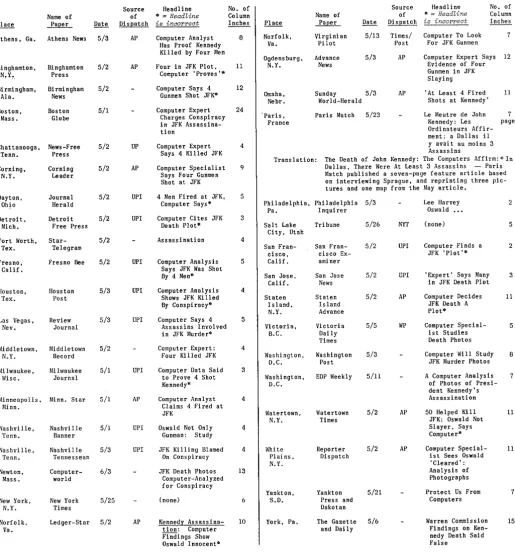
The evidence published in this article includes eleven important photographs. One of them shows Jim Hicks, who admitted he was the radio communi-cator among the firing teams at Dealey Plaza, with his radio transmitter in his back left pocket. The article includes a tabulation of over 500 photo-graphs (counting a movie sequence as one photo) taken in and around Dealey Plaza, Dallas, Texas, Nov. 22, 1963, at the time of President Kennedy's assassination and shortly thereafter. Both a spa-tial chart and a timing chart of the events and the photographs are included in this article.
Sprague, a computer professional for over 24 years, has as an avocation, studied the old and the new evidence for over 6 years, and has analyzed over 400 of the 500 photographs.
The work in computerized analysis of over 300 still photos and over 25,000 frames of movie se-quences has been started.
To obtain your copy of this extraordinary report, please complete and mail the following order:
- -(may be copied on any piece of
paper)-To: Computers and Automation, Dept. P 815 Washington St.
Newtonville, Mass. 02160
Please send me ( ) copy(ies) of the May 1970 issue containing the article on President Kennedy's assassination. I enclose $4.00 ( ) check ( ) money order for each copy. (Please do not send cash.) If not satisfac-tory, returnable in 7 days for full refund (if in salable condition)o
My name and address are attached.
Discount: 10%, 5 to 9 copies; 20%, 10 or more copies
Special price: $1.00 for students (attach evidence); $1.00 for non-profit organizations
An excerpt from the /.Jay article
Part 2. The Photographic Evidence
The assassination of President John F. Kennedy was the most photographed murder in history. Ap-proximately 75 photographers took a total of approxi-mately 510 photographs, either before or during or within an hour after the events in Dealey Plaza, and either there or nearby or related to those events, The word "photograph" in this context includes both still photos and movie sequences. The number of frames in a movie sequence ranges, from about 10 to about 500; and in the count of 510 photographs given above, the 10 to 500 frames of a single movie se-quence are counted just as one photograph. The to-tal number of frames is over 25,000.
The Warren Commission examined 26 photographs, about 5 percent of the 510. The FBI examined about 50 photographs, or about 10 percent. The most fa-mous of all the photographs is the Zapruder film, which had over 480 frames.
Many of the photographs were taken by profes-sional photographers. About 30 of the photographers were professionals who work~d for newspapers, tele-vision networks, and photographic agencies.
The Warren Commission did not interview a single one of the professional photographers, nor did the Warren Commission see any of their photographs.
Fifteen of these professionals were actually in the Kennedy motorcade, no further than 6 car lengths behind the Kennedy car. Five of these photograph-ers were television network cameramen. The Warren Commission looked at none of their photographs.
Two of the photographers were from the White House. One of these men (Thomas Atkins) was the regular photographer for the White House. He made a special film for Lyndon B. Johnson. Atkins used his own film plus some footage obtained from the television photographers. Johnson looked at the film and then put it away. This film is now stored with the Kennedy Memorial Library materials in a warehouse in Washington, D.C.; it is stated to be "unavail able" to researchers. The Commi ssion did not see this film, nor did they interview Atkins.
Because the professionals used movie cameras of professional quality, their films are exceedingly revealing and valuable as primary evidence. The Warren Commission looked at none of these films.
Chart 2 of this article shows the times of about 50 of the photographs taken in Dealey Plaza during Kennedy's passage through it.
Are you keeping pace with the
giant strides in computer science?
Special Introductory Offer:
Take any
3(v:!~~~o\O
for only
$1
00
each
with a short trial membership in
The Library of Computer
and Information Sciences
(retail prices shown)
56430. INTRODUCTION TO STATISTICAL DATA PROCESSING. Theodor D. Sterling and Seymour
V. Pollack. The first and only comprehenc "
book, including brilliant summaries of hf tic techniques and multivariate analysef
pages. '
64520. NEW POWER FOR MANAGEMENT.
Hertz. The definitive work on the revol '
ary management sciences. Indispensable
70070. PRINCIPLES OF HOLOGRAPHY. H
M. Smith. The history, theory and PI
of one of the fastest-moving areas in <J
science today.
77670. SEMANTIC INFORMATION PROCe
Edited by Marvin Minskl". A trail-l
work by six experts. One' of the mo nificant volumes of this decade.
40410. CONVERSATIONAL COMPUTERS. Edi
William D .Orr. Comprehensive review
latest developments by J. C. R. I.icl
John McCarthy. Vannevar Bush. and (
34090. APPLIED NUMERICAL METHODS.
Carnahan. H. A. Luther and JlImes O. I
Tremendously important new book pre:
practical solutions to problems in s
engineering and applied mathematic pages.
56490. INTRODUCTION TO COMPUTA1
LINGUISTICS. David G. Hars. Compre
work in an exciting new field. Ideal fc tuition.
56140. INTRODUCTION TO OPERATIONS RES
Frederick H. Hiller and Gerald J. Lie!;
Basic technology and techniques. with
S!S on motivation and simplicity of e
tIon.
42170. DIGITAL COMPUTER SYSTEM PRIN
Herbert Hellerman. A unified and a
tive overview.
42370. DISPLAY SYSTEMS ENGINEERINe
by H. R. Luxenberg and R. L. Kueh
ough exploration. replete with illu and diagrams.
70350. AN 1NTRODUCTION TO PROS
THEORY AND ITS APPLICATIONS-VO
William Feller. Self-contained intI
cotIrse: mathematical principles. mod niques.
54360. HYBRID COMPUTATION. George
and Walter J. Karplus. Complete ov
theory, mechanization, and applicatic f.or industrial and academic users.
81840. SYSTEMS, ORGANIZATION, ,
MANAGEMENT. Edited III' [)t/I'icl I. Clc
William R. King .Tlie fir.lt com~
evaluation of this startlin~dy succes
lenge to traditional management tl1
70710. PROGRAMMING: An Introducti puter Languages and Techniques. lI'a
las Maurer. Remarkably lucid pr~
defining concepts in terms of com
current use. i" '.,Ju
c
C Gj; PUT S!iS
JUL::
lC1'lU
It isn't easy. But The Library of Computer and Information Sciences helps you tune in with what's happening. By providing you with the most ad-vanced, most essential, most significant bboks in the exploding world of computer science.
Each month, the Library carefully screens hundreds of manuscripts, and chooses only the most informative and most important. Books on program-ming. Software. Hardware. Theory. Management uses of the computer. Books that help thousands of executives, EDP managers, programmers and techni-cians keep up-to-date. And move ahead in their careers.
All books are yours at discounts of up to 30% (sometimes more). And for each four books you buy, you get your choice of a fifth-a free bonus book.
The strides computer technology is taking daily are boundless. No matter how alert you are, it's tough to keep in step. Unless you take advantage of this special introductory offer-now.
ArID
AUIOHAT
lO'"
81870. SYSTEMS ANALYSIS: A Diagnostic Ap-proach. Vall Court Hare. Jr. A highly useful book for "problem solvers," perfect for
self-instruction. $12.50
39990. COMPUTER MODELING AND SIMULATION.
Francis F. Martill. Lucid introduction to this
powerful new technique. Clear and
beauti-fully reasoned. $12.95
84210. 360 PROGRAMMING IN ASSEMBLY LAN'-GUAGE. Ned Chapin. A unique exposition of the basic symbolic language that puts the
pro-grammer close to the computer. $12.50
39940. COMPUTERS, SYSTEM SCIENCE, AND EVOLVING SOCIETY: The Challenge of Man· Machine Digital Systems. Harold Sackmall. A big, 638-page volume that takes a close look
at the computer revolution. $14.50
82560. TECHNIIlUES OF SYSTEM ENGINEERING.
Stanley M. Shinners. The most complete and
up-to-date presentation available on one of
the fastest changing fields today. $14.00
41660. ELEMENTS OF DATA PROCESSING MATHE MATICS. Wilson T. Price and Merlin Miller. All the math necessary for understanding the mysteries of modern computer programming. $10.50
38160. CIRCUIT DESIGN OF DIGITAL COMPUTERS.
Joseph K.Huwkins. At last-a simple.
straight-forward exposition of principles, applications
and limitations. $17 .50
54120. THE HUMAN SIDE OF PLANNING/MOVING
MOUNTAINS. A dual selection. David W. Ewing
on tailoring programs to people. Plus Henry M. Boettinger on the do's and don'ts of
com-municating ideas. $13.90
Trial Membership Application'
The Library of Computer and Information Sciences Riverside, N.J. 08075
7·899
Upon acceptance of this order. please enroll me
as a trial member and send the 3 books whose
numbers I have indicated. Dill me just $3.00 for
all 3 plus shipping and handling. If not delighted.
I will return them within 10 days and my
mem-bership wlll be cancelled. As a trial member. I
need. accept only 3 more selections during the
next 12 months, all at reduced member prices
plus shipping and handllng. I understand that
savings range up to 30'; . and occasionally more.
Each month. I wlll receive advance reviews de-scribing forthcoming selections. along with a convenient form for requesting alternate
selec-tions or no book at all. For every 4 selections
purchased. I may choose a free bonus book. (Introductory offers counts as the first selection).
3 books for only $1 each
(write in numbers)
NAME ••....•.•••••••••••••••••••••••••••••••••
ADDRESS ••••...•.••.•••.••••.••••..••••••••••
~~~is· bOUght ·t'or· i;ro·f~~to~~i 'purpos~:~ay' be . a tax-deductible expen~e. (Otter good in continental
Letters TO'The Editor
Tremendous Reader Interest
I am writing to tell you about the tremendous interest our article "Automated Experiment Control and Data Acquisition - A Minicomputer Application" [December, 1969 issue, page 32] generated among a wide readership of your magazine. We all appreciate the interest of your readers in this exciting field of mini-com-puters.
MIKE SHAH
Digital Equipment Corp. 146 Main St.
Maynard, Mass. 01754
Computer Directory
The State University of New York is a multi-university which comprises in one system over sixty universities and colleges. Our Office of Educa-tional Communications supplies, supervises, and assists in the use of audio-visual materials for this vast system.
At present, we are engaged in a search for materials to construct a course introducing basic computer concepts and the FORTRAN and COBOL programming languages. I am collecting information on what is avail-able in the field.
The National Association for Edu-cational Data Systems tipped me off about your annual "Computer Direc-tory and Buyers' Guide". I would like to receive last year's copy as soon as possible,. and this year's when it is published. Please bill me.
THOMAS J. TURLEY
Research Assistant
State University of New York Thurlow Terrace
Albany, N.
Y.
The Future of Computers
I read with interest your article in your January, 1970 issue, "The" Future of Automatic Computers: 1949,1961, 1970" [page 18] . You did an excel-lent job of forecasting at the time the article was written.
As a student in technological fore-casting, I would like to know if you
4
have made a recent prediction on the future of computers, especially in the area of information services or infor-mation retrieval.
CARLOS RIVERA ABRAMS 922 State St., Apt. #7 Schenectady, N. Y. 12307
Ed. Note - Your kind comments are ap-preciated. I have not made any prediction on the future of computers in the areas you mention.
Teacher Seeks to Correspond on Computer Subjects
I would very much like to corre-spond with teachers of computer sub-jects in non-British schools. I am a teacher in a British senior high school for pupils aged 14 to 19. I teach mathematics mainly, but we have introduced computer studies in our curriculum. I would find it most help-ful and interesting to be able to ex-change ideas with others who are doing similar teaching.
M. G. PAUL HUTCHINSON
Asst. Mathematics Teacher Hreod Burna School Akers Way, Moredon Swindon, Wiltshire, England
The "Humanistic" Aspects of Technology
I began my subscription to your magazine several months ago. I have been quite pleased with the materials that I have found in your journal.
What has struck me mo st is the emphasis which you place on the more "humanistic" aspects of the work of the technologists. This pleases me greatly, since it is my conviction that the prime importance of what we are all engaged in, in the area of tech-nology is that what we do must be for the benefit of man.
BROTHER AUSTIN DA VID, FSC Director, Educational Data Systems Archdiocese of New York
650 Grand Concourse Bronx, N. Y. 10451
Editor Edmund C. Berkeley
AHociate Editor Sharry Langdale
/lss;stallt Editors Linda ladd Lovett Neil D. Macdonald
Software Editor Stewart B. Nelson
AdtJertising Director Bernard Lane
Art Directors Ray W. Hass Daniel T. Langdale
COlltfibtttillK Editors John Bennett
Adt'isofY Committee
Fltlfillme1lt Manager
Moses M. Berlin Andrew D. Booth John W. Carr III Ned Chapin Alston S. Householder Peter Kugel Leslie Mezei Rod E. Packer Jean E. Sammet Ted Schoeters Richard E. Sprague
T. E. Cheatham, Jr. James J. Cryan Richard W. Hamming Alston S. Householder Victor Paschkis
William J. McMillan
Ad~'ertising Representatives
BOSTON 02116, Phillip E. Nutting
1127 Statler Off.ce Bldg., 617-542-7720
NEW YORK 10001 Bernard Lane
254 West 31 St., 212-279-7281
ELSEWHERE, The Publisher Berkeley Enterprises, Inc.
815 Washington St., 617-332-5453
Newtonville, Mass. 02160
Editorial Offices
BERKELEY ENTERPRISES, INC. 815 WASHINGTON STREET, NEWTONVILLE, MASS. 02160
CIRCULATION AUDITED BY AUDIT BUREAU OF CIRCULATIONS
Computers and Automation is published 13 times a year (12 monthly issues plus an annual directory issue published in June) at 815 Washington St., NewtonVille, Mass. 02160, by Berkeley Enterprises, Inc. Printed in U.S.A. Subscription rates: United States, $18.50 for 1 year, $36.00 for 2 years, including annual di-rectory issue - $9.50 for 1 ye,ar $18.00 for two years without annual d!rectory; 'Canada, add 50¢ a year for postage; Foreign, add $3.50 a year for postage. Address all U.S. subscription mail to: Berke-ley EnterprISes, Inc., 815 Washington St., Newtonville, Mass. 02160. Second Class Postage paid at Boston
M"~ ,
Postmaster: Please send all forms 3579 to Berkeley Enterprises, Inc., 815 Washington St., Newtonville,
Vol. 19, No.7-July, 1970 The magazine
0/
the desigll, applicatiolls, alld implications0/
ill/ormation processing s)'stems.Computers and the European Scene
16 An Example of Planned Development of an Organization for Computer Professionals: THE BRITISH COMPUTER SOCIETY
by Maurice C. Ashill
How a keen sense of responsibility, a high degree of objectivity, and a lot of hard thinking and work have helped the Society in its goal "to promote the science of com-puting in every way possible."
20 THE MEDITERRANEAN COMPUTER SCENE
by Ottorino Beltrami
A summary of the potential for computer development in the countries bordering the Medi-terranean Sea - based on each country's current estimated computer census, gross national products, and degree of industrialization.
25 REPORT FROM GREAT BRITAIN
by Ted Schoeters
The effects on the British computer industry of the British election, the Honeywell-GE Tie-up, and the competition between Eurodata and IBM.
C01nputer Prog1'antS and Systems
37 EFFECTIVE PROGRAM DESIGN
by David W. Packer
Why the concept of design as a discipline needs to be accepted, taught, and developed.
10 Forum: SUMMARY OF COMPUTERS INSTALLED IN THE RAILWAY INDUSTRY
Computers and Education
26 A LANDMARK YEAR FOR COMPUTERS IN HIGH SCHOOLS
by Richard E. May
How the ways in which high schools buy and use computers are changing.
Computers and Privacy
42 LORD HALSBURY SPEAKS ON COMPUTER PRIVACY
by The Earl of Halsbury
What basic human rights should we have in order to be protected from the mistakes - let alone malice - that can occur when information about us is fed into a computer?
8 Forum: liTHE INVASION OF PRIVACY" - MORE COMMENT, by William K. Berglund and the Editor
Computers and Society
6 Editorial: COMPUTER-ASSISTED POLITICAL ANALYSIS by Edmund C. Berkeley
Why we need to think about, plan, and prepare Political Management Information Systems.
29 THE MAY ARTICLE, liTHE ASSASSINATION OF PRESIDENT JOHN F. KENNEDY: THE. APPLICATION OF COMPUTERS
TO THE PHOTOGRAPHIC EVIDENCEI I
- REPORT NO.2:
29 Impact, by Edmund C. Berkeley
32 More About Jim Hicks
32 Visual Re-creation of a Scene by Computer Graphics, by Leslie Mezei
32 Confirmation of FBI Knowledge 12 Days Before Dallas of a Plot to Kill President Kennedy, by Edmund C. Berkeley
35 The Second Conspiracy About the Assassination of President Kennedy, by Richard E. Sprague
36 Corrections and Additions - Cumulative
44 The Profession of Information Engineer: THE DANGERS OF SILENCE by Kingman Brewster, Jr.
Some implications for professional information engineers, in a challenge to universities and publishers to def£...nd and utilize their freedom.
6 Forum: FOR MORE HOT LINES
9 Forum: liTHE HOUSE IS ON FIRE" - MORE COMMENT, by Norwood Jones
10 Forum: THE MARTIN LUTHER KING MEMORIAL PRIZE CONTEST
Computer People
48 TRAINING FOR COMPUTER PROGRAMMERS
by Lorin G. Vogeding
A brief history of the training of computer programmers - and a suggested new concept which may bcttcr help us tra in the 500,000 new programmers needed by 1975.
9 Forum: OVER 700 COMPUTER PEOPLE RECEIVE THEIR CERTIFICATE IN DATA PROCESSING (CDP), by R. Calvin Elliott
10 Forum: REPRESENTATIVES OF 40 PROFESSIONAL ORGANIZATIONS PLAN A IINATIONAL COMPUTER YEAR", by Sam Matsa
10 Forum: SYSTEM/3 USERS' GROUP IS FORMED, by Tom Adamski
Computers and Fun
15 NUMBLES, by Neil Macdonald
15 PROBLEM CORNER, by Walter Penney, CDP
COMPUTERS and AUTOMATION for July, 1970
Important decisions are some-thing even young programmers must face, as can be seen in the front cover photograph of Charles Hornig, age 12 . Charles is ponder-ing his next move as he develops a program on a small time-sharing computer during a visit to Digital Equipment Corporation'S plant in Maynard, Mass. He learned pro-gramming while a sixth grader in Lexington, Mass. Besides comput-ers, Charles is interested in foot-ball, basefoot-ball, and is a Boy Scout.
NOTICE
* D ON YOUR ADDRESS IMPRINT
MEANS THAT YOUR
SUBSCRIP-TION INCLUDES THE COMPUTER
DIRECTORY. * N MEANS THAT
YOUR PRESENT SUBSCRIPTION
DOES NOT INCLUDE THE COM-PUTER DIRECTORY. SEE PAGE 64.
D epart1}tents
50 Across the Editor's Desk
50 Applications
51 Education News
52 Research Frontier
52 Automation
14 Calendar of Coming Events
4 Letters to the Editor
13 Punch Lines .•.
Reference InfoTtnation
63 Corrections
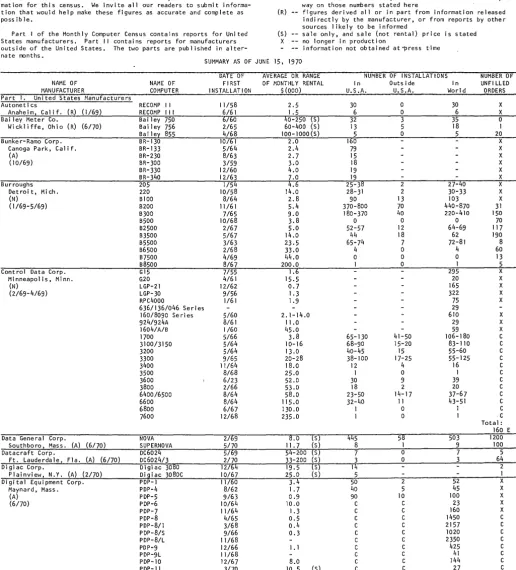
60 Monthly Computer Census
58 New Contracts
59 New Installations
55 New Products and Services
EDITORIAL
Computer.Assisted Political Analysis
There are many great problems in political affairs where a computerized data base and computer-assisted analysis either will shortly become essential or have become essen-tial already. These are problems where:
It is very hard to know the facts;
The facts are changing importantly from day to day or from week to week;
The issues are undeniably important;
A great many people who want to stay informed about these problems are already reading news-papers and magazines, listening to radie, watching TV, and are already paying over $100 to $200 per year for current information of political impor-tance;
And these people are having trouble finding out, learning, and remembering the important parts of the information.
For a personal example, let me take the "highway lobby" and the gasoline tax (which seems very high). I have only some vague information about this field. About a year ago a friend of mine told me that all gasoline taxes had to be spent on highway construction; this shocked me; that clearly was unreasonable. Also, it is clear to me that the environment has suffered from: the construction of many rather unnecessary and undesirable super-highways; the resulting displacement of large numbers of unfortunate people; the production of quantities of polluted air from motor vehicles; huge traffic jams; etc. But in this field there is a great deal I do not know and have not verified:
I do not know the facts;
I do not know any good references in which to look up the matter;
I do not know whose information to believe in this field, which is outside of my own fields of concen-tration;
I am not likely to have time to find out what I need to know.
Suppose some client came to me as a consultant and said:
I have heard that you are a good compu ter profes-sional, with a good reputation. I wish to apply computers to the study of the highway problems in the United States, and to reaching good decisions in the interests of all the people in the United States. I want your help.
I would have to say to him: "I don't see how I can help you. I have no foundations of knowledge for this problem." This area is typical of many giant political problems today in the United States (and undoubtedly elsewhere besides). The pattern is very much the same in dozens of situations:
6
I. A political need is observed, which businessmen
can fulfil.
-2. They stimulate the need; that is, they organize attention from various branches of government, formal and informal; they succeed in exerting enough influence so that public funds start to pour into this field.
3. In this field, business and industry develops; the momentum grows; firms develop; jobs develop; suppliers develop; construction develops; the fin-ished goods such as highways are delivered to the public, sometimes with scandal, most of the time without scandal.
4. For a few years, the field blooms - and much useful work is done.
5. Then the law of diminishing returns begins to operate. The need tends to be overfulfilled, be-cause the public, the legislatures, the city, state, and federal governments have a slow reaction time.
6. But vested interests have now developed; waste, unnecessary activities, intense lobbying, become conspicuous. Many kinds of conflicting, emotional arguments fill the media.
7. It becomes very difficult for everybody to turn off the great flow that has been stimulated.
It is the old parable of the Sorcerer's Apprentice in modern terms.
Even some projects which have almost no reasonable justification receive public funds in huge quantities - such
as the supersonic transport.
The people of the United States do not have enough knowledge, unbiased facts, understanding, so that they can exert reasonable controls over dozens and dozens of impor-tant projects - so that they can correct the situation at the time an~ in the way that the situation needs correction. This kind of out-of-control process would not be tolerated within a business or a factory. These problems demand computerized presentation of facts, background informa-tion, and proposed solutions. They need to be offered by competing public services.
What shall we do as computer professionals? What shall we do as concerned human beings with professional training in an almost miraculous technique of the present century -electronic data processing?
I think the answer is clear. In the capacity of computer businessmen and professionals, we need to become experts also in producing and providing data for the big problems of society and politics. We need to become what might be called a branch of Nader's Raiders so as to apply our knowledge and our computers to the great aching problems of society. We need to think about, plan, and prepare PMIS's - Political Management Information Systems.
To this end, Computers and Automation has in the past and will even more vigorously in the future regularly assign a portion of its pages to discussion and presentation of the aching problems of our society and our times. We shall seek important news and reliable interpretations to publish. We shall look for rel,iable references and publish citations, for information and action. We hope we can publish something like "Environment Hot Line" as it appears in the Boston
Globe from time to time (see sample below).
problems, facts, proposed solutions, and better use of resources: PMIS's.
We plan to deal particularly with the input of reliable knowledge that is needed for successful computerized data banks and computer-assisted analysis, and to avoid the curse of "garbage in, garbage out".
e-~C.~
We invite explanatory articles on these subjects, to point out the benchmarks of facts and systems, and the ways
in-which computers can be applied to provide better data on Editor
FOR. MORE HOT LINES
The adjoining box of information "Environment hot line" is printed from time to time in the Boston Globe
- a daily newspaper that has a large circulation in the Boston metropolitan area and displays a social responsibility. We publish this here as an example of the way in which a periodical can provide useful information so that its readers can take specific actions that they may be moved to take. This example is particularly interesting be-cause it is NOT news, but instead reference information for the purposes of action, for the purposes of making an individual's own influence felt in a democratic society - a society where a citizen who protests does not disap-pear into prison or a concentration camp, but continues to live normally and has a fairly good chance of helping to produce useful change.
COMPUTERS and AUTOMATION for July, 1970
Environment hot line
Tired of having your eardrums rattled by jet noise, your nose
twitch-ing from stinking air or reeking water, your eyes assaulted by the steady erosion of the quality of the. environment? Next time, don't just grimace and bear it, call the following agencies to take action:
Air Pollution-General (smoke, odors, burning dumps). Massa-chusetts Department of Public Health, Metropolitan Air
Pollution Control, Frank Reinhardt ... 727-5194 From motor vehicles. Registry of Motor Vehicles, J. L.
Hourihan, Vehicle Inspection Section, 160 North Wash-ington St., Boston
City of Boston: Boston Air Pollution Control Commission 227-4890 Noise-From airplanes. Massachusetts Port Authority, Thomas P.
Callaghan ... ... 482-2930 From motor vehicles. Registry of Motor Vehicles, J. L.
Hourihan, Vehicle Inspection Section, 160 North Wash-ington st., Boston. License number, color and make of vehicle. Written complaints only. Other noises. Local police department.
Water and/or Oil Pollution-Massachusetts Department of Natural
Resources, Water Pollution Control, Thomas McMahon ... 727-3855 Pollution and Contamination From Pesticides-Massachusetts
De-partment of Public Health, Pesticides Board, Lewis F.
Wells ... ... ... 727-2670 Rubbish and Garbage-City of Boston, Public Works
Depart-ment, Sanitary Division ... . .. 536-7150 Litter and Street Cleaning-City of Boston, Public Works
Depart-ment, Highway Division ... 536-7150 City of Boston, Parks and Recreation (Re litter in parks) 722-4100 Other cities and towns, local police or local city halls.
Wetlands (Filling In Ponds and Marshes)-Massachusetts Depart-ment of Natural Resources, Division of Conservation
Services, George R. Sprague ... ; ... 727-3170
Prellared by John Putnam, exellutLve dluetltr Itt Boston EnvIronment. (ne., 14 BUIlDII It.
Phllne: 227-2669. Volunteers Ihltuld &lllIly there.)
MULTI-ACCESS FORUM
liTHE INVASION OF PRIVACY
I I-
COMMENT
William K. Berglund, Professional Engineer 1923 Highland Dr.
Fernandina Beach, Fla. 32034
Your edi to rial in the April issue, "The Invasion of Privacy" [page 6] contains some introspective reflections on a serious problem. It also poses some asinine suggestions as "solutions".
The most fundamental error is the division of the citizens into two groups: " .... a minority in charge of the government who stand for 'law and order' and who are firmly carrying on a most unpopular war in Vietnam", and "a vocal majority of the people of the country who want domestic change and progress, the stopping of the war in Vietnam, and the diversion of large funds from the military industrial complex to cities, health, environment, improve-ment, and socially useful goods and services".
This premise of such a division is indefensible. One cannot be sorted-out so as to fall neatly in one group or another.
To imply that advocates of "law and order" are the only ones wishing to pursue the war in Vietnam is to make a connection that cannot stand logical scrutiny. To imply that all the advocates of the war in Vietnam are, ipso facto,
for "law and order" is equally ludicrous. To imply that people who want "law and order" are in the minority in this country is incorrect. And to imply that persons interested in "socially useful goods and services are neither interested in nor advocate "law and order" does them a great disservice. I quarrel, too, with "a vocal majority ... want ... the stopping of the war in Vietnam". My quarrel here is that you stopped short. It is practically unanimous
in this country that we want the war stopped. The dif-ference is in methods.
Because I want a community with sufficient "law and order" to make the streets safe to walk at night for all citizens, to be free from the snipers, to be free from the fire bomb, to bring up my children secure from panderers, molesters, and drug pushers, you have classified me as a hawk on Vietnam, against change and progress, opposed to environmental improvement, health, and socially useful goods and services! What gall! What presumption! What utter nonsense!
The tragedy of the matter is not that you have be-smirched me. The tragedy is that too many of your readers
(one is too many), may accept your c1assifcation of our
citizenry which will further polarize a society already rent.
8
II. From the Editor
Thank you for your letter and for your challenge to my remarks in my April editorial.
To deal with what you call my "most fundamental error" and to make clearer what I am asserting, I think I must first quote the paragraph where I refer to "law and order":
The United States appears to be heading into a period where there will be a substantial conflict between a minority in charge of the government who stand for "law and order" and who are firmly carrying on a most unpopular war in Vietnam, and a vocal majority of the people of the country who want domestic change and progress, the stopping of the war in Vietnam, and the diversion of large funds from the military industrial complex to cities, health, environmental improvement, and socially useful goods and services ....
To stand for "law and order" is to support a slogan with two meanings.
One meaning is a literal meaning, desiring law and order (and equal protection from the laws) all over the United States and for all members of our society including minori-ties, sharecroppers, grape pickers, ghetto residents, and persons walking on streets at night.
But any person who looks clearly at what actually goes on in the United States realizes that there are two kinds of law and order actually working; one is for the rich and middle class people, and the other is for the poor people and various minorities.
All persons of good will, including you I am sure, want one kind of law and order actually working - a fair and equal kind, which does not favor or disfavor people because of their property or wealth or education or skin color or ethnic origin. But it does not happen that way - there is not money enough in the governmental system of justice, there is not time enough in the courts, there are not enough trained people in prisons, etc.
THE PURPOSES OF MULTI-ACCESS FORUM
o
To give you, our readers, an opportunity to discuss ideas that seem to you important.o
To express criticisms or comments on what you find published in our magazine.o
To help computer people debate significant prob-lems related to the applications and implications of computers and data processing - such as privacy, garbage-in-garbage-out, unemployment, education, etc.Your participation is cordially invited.
Vietnam, the violence of defoliating 20% of Vietnam with chemicals poisonous to human beings, the violence of a manufacturer and his employees making antipersonnel bombs that bounce and bounce and finally explode hun-dreds of razor-sharp pieces of steel.
A status quo as a general rule regularly requires "law and order", and regularly uses repression and, if necessary, violence in order to maintain the status quo.
The same is true of the status quo in the Soviet Union. Many citizens who protest the lack of freedom of speech guaranteed by the Soviet Constitution, or who picket with signs condemning the Soviet invasion of Czechoslovakia, are
whisked away and disappear, sometimes for years, some-times forever. Of course, violence also includes such actions performed in the name of "law and order"
In my opinion, there is a high correlation among the people in the United States who utter the slogan "law and order", and the people who are in favor of vigorous repression of dissent, and finishing a most unpopular war in Vietnam by "bombing them back into the stone age."
But of course real law and order is a much deeper thing. I sometimes think that the persons who shout the slogan loudest have the least conception of how far the status quo in the United States needs to be changed to really attain it.
o
liTHE HOUSE IS ON FIREII - MORE COMMENT
Norwood Jones, Data Processing Manager First National Bank
EI Dorado, Ark. 71730
With regard to the Multi-Access Forum in your May issue ["The House is on Fire" - Comments, page 8-9] , I would like to make several comments ..
Mr. H. Lynn Beus is correct in asserting there are moral issues deeper than the population explosion and Vietnam. However, when one has committed himself to these deeper,
overall moral principles, then finding solutions to our problems becomes a necessary action. Without this action, the commitment is meaningless.
Mr. Frank Mleko is also correct in his statement that
Computers and Automation contains less technically useful
information than other magazines. This is why I continue to spend my firm's money on it. Technically superior systems help any business, but superior personnel are at least as valuable. I feel that C&A improves the people in my department and thereby contributes to the success of our business.
OVER 700 COMPUTER PEOPLE RECEIVE THEIR CERTIFICATE
IN DATA PROCESSING (COP)
R. Calvin Elliott, Executive Director Data Processing Management Association 50S Busse Highway
Park Ridge, Ill. 60068
A total of 718 computer people have passed the 1970 examination for the Certificate in Data Processing (CDP) given by the certification council of the Data Processing Management Association.
There were 2,312 who took the exam last February at over 100 test centers at colleges and universities in the U.S. and in Canada. Scoring and analysis of the exam results were performed by an independent testing and research organization.
COMPUTERS and AUTOMATION for July, 1970
The new CDP recipients bring to 11,069 the total number who have been granted the certificate since the first examination in 1962.
The exam establishes a method for recognizing individ-uals haVing knowledge considered important to data pro-cessing and information management. Exam applicants must have had three years of EDP experience and also possess certain academic qualifications.
The exam covered five general areas: data processing equipment; computer programming and software; principles of management; quantitative methods; and systems analysis
and design. 0
REPRESENTATIVES OF 40 PROFESSIONAL
ORGANIZATIONS PLAN A
"NATIONAL COMPUTER YEAR"
Sam Matsa, Chairman ACM '70
Association for Computing Machinery 1133 Ave. of the Americas
New York, N.Y. 10036
First steps toward making the ACM-proposed National Computer Year a reality have been taken by the Provisional Co-ordinating Committee. The Committee is composed of representatives of more than 40 diverse professional organi-zations representing science, engineering, finance, medicine, law, government, education and other professions. The members of the Committee have unanimously agreed that the concept of a National Computer Year is in the national interest and have appointed an ad hoc committee to develop a plan and program.
Members of the Ad Hoc Committee ar~:
John J. Alexander, Jr., New York Stock Exchange Barry W. Boehm, American Institute of Aeronautics
& Astronautics
Alec Bumsted, Association of Education Data Sys-tems
John Jacka, National League of Cities
John H. McLeod, Jr., Simulation Councils, Inc. Noel K. Zakin, The American Institute of CPA's Herbert R. Kolleor, American Society for
Informa-tion Service (AFIPS Representative)
The initial objectives of the National Computer Year are to:
Maximize the use of computers in serving national goals.
Deepen the public understanding of the role and potential value of the computer.
Improve the decision-making ability of government, education, and private enterprise. 0
SYSTEM/3
US~RS'
GROUP IS FORMED
Tom Adamski, Secretary -Treasurer c/o Trilog Associates, Inc.
1700 Market St., 15th Floor Philadelphia, Pa. 19103
Representatives of several companies with an active interest in the IBM System/3 have formed the Delaware Valley System/3 Users' Group. At the first meeting of the group, bylaws ·were adopted and temporary officers were selected. The objectives of the organization are:
10
To provide a forum for the discussion of topics of mutual interest to System/3 users.
To serve as a focal point for information relating to System/3
To enable System/3 users to establish working relationships with each other.
- To become a representative group for the Sys-tem/3 community.
The organization is interested in increasing its member-ship, and anyone interested in participating is invited to
write me at the address above. D
SUMMARY OF COMPUTERS INSTALLED
IN
THE RAILWAY INDUSTRY
In Estimated Monthly Rental by Manufacturer
Increase or
Average Monthly Rental $(000) Decrease
M.£.Ih. Model 1/31/69 1/31/70 % Total ~ ~
IBM 360/20 64.4 85.2
/25 43.2
/30 344.1 426.3
/40 798.0 939.0
/50 462.0 600.0
/65 630.0 840.0
1400 176.3 142.6
7000 437.5 225.0
Other 80.1 16.2
2992.4 3317.5 88.3 325.1 10.8
UNIVAC III, 90
& Step 2 119.0 92.0
418 33.0 22.0
1000 19.0 20.5
9000 14.3 15.8
185.3 150.3 4.0 - 35.0 - 18.9
Honeywell All 43.3 21.0 0.5 - 22.3 - 51.5
GE All 104.2 118.5 3.2 14.3 13.7
Collins 20.0 20.0 0.5 0 0
RCA All 172.0 118.0 3.1 - 54.0 - 31.4
Other All --.!Ll --1Q.,Q ~ --hI 20.5
TOTAL 3525.~ 3755.3 100.0 229.8 6.5
*Source: R. A. Petrash, Executive Director, Association of Ameri· can Railroads, Data Systems Div., American Railroads Bldg., Wash· ington, D.C. 20036.
THE MARTIN LUTHER KING
MEMORIAL PRIZE CONTEST
Several entries have been received for the Martin Luther King Memorial Prize Contest. (For reference, see page 14 in the April issue of
Computers and Automation.)
The judges have not finished their appraisal of the entries. Consequent-ly, the announcement of the results of the contest for its second year, 1970, and the publication of the winning entry (if one is selected), are now scheduled for the AugustPUNCH LINES
In the immediate future, knowledge, rather than capital, labor or raw materials, will become the major source of economic growth. Knowledge, not things, will become the new basis of productivity. It will become the force which drives our economy. And the computer, as the central organizer and repository of information, will playa massive role in this new society. But it is an exercise in futility to have massive data banks if we don't have the data transmis-sion capacity to make their information immediate, accessi-ble, and universal. Unless we find a fast, efficient, reliable means of transporting digital data (i.e., knowledge) between computers, data banks, and terminals, we will severely limit our opportunities to make the computer a major instru-ment in human service during the 1970's.
- Sam Wyly, Chairman
University Computing Company 1300 Frito-Lay Tower
Dallas, Tex. 75235
A classic reversal in the value of information is occurring. Advance access to private stores of information, for all time, has been the source of power and wealth. But now commercial firms are finding new ways to share access to their privately and publicly created information stores with mass audiences. Because they can make more money from sharing information than from sequestering it, more and more, rather than less and less, information will be avail-able.
- Paul G. Zurkowski, Executive Director
Information Industry Association 1025 15th St. N. W.
Washington, D.C. 20005
The day is past when computer manufacturers will invest large sums in developments simply because of the computer user's demand. It will become increasingly necessary for the user to ultimately bear the cost of not only the equipment he needs, but of the development of his system. This trend will bring increased emphasis to standardized systems and the production of "utilitarian" industry applications. Al-though new equipment will continue to appear at what may be a bewildering pace, it will be a simple and gradual e x tension of already -available devices which employ already-understood approaches. Changes in ~hl,; seventies are going to be evolutionary, not revolutionary.
- T. Paul Bothwell, Vice Pres. and Gen. Mgr. Honeywell Computer Control Div. Old Connecticut Path
Framingham, Mass. 01701
The fastest growing segment of the small computer market is the minicomputer for monitoring and control applica-tions. These machines are finding increasing use in discrete manufacturing systems, as well as the more traditional continuous process systems. Shipments of computers for
COMPUTERS and AUTOMATION for July, 1970
monit oring and control applications, while insignificant just a few years ago, will exceed 5000 units in 1970, growing to an est ·mated 22,000 in 1975.
- The Diebold Group, Inc. 403 Park Ave.
New York, N.Y. 10022
t changes in the attitude of the government toward e and technology have resulted in reduced federal resea ch and development budgets. The response of the scien ific community has focussed mostly on the deleteri-ous e fects these cutbacks are having on the present health and uture growth of America's scientific and engineering progr ms. Less well debated are the effects these cutbacks will ave on the careers and the professional development and ttitudes of scientific and engineering personnel. While gover ment science and fiscal policy can shift in time perio s as short as one year, the response time of the educ tional institution and its students is much longer - on the 0 der of three to six years. Therefore it is crucial to evalu te the present and future trends in order to be able to plan nd advise students and professionals to meet the chang ng emphases for efficient employment in govern-ment, industry, and academia.
- Dr. Sanborn C. Brown, Associate Dean Gra uate School
M.I.T.
Cambridge, Mass. 02138
Many users of data processing information don't know how much that information costs their departments. A recent survey indicates that only 18% of firms with their own data processing equipment or using service bureaus charged the costs of using the facilities to the individual departments that use it. The remainder charge data costs to financial or to general and administrative expense, and thus have no means for determining the cost of information obtained through automatic data processing.
- Clemens Hathaway Control-a-Gram, Inc. 201 Haven Rd. Elmhurst, Ill. 60126
The high rate of turnover of EDP personnel and the increasing need for higher and more sophisticated levels of knowledge and competence are of ever-increasing concern.
If we assume that we have only a given number of people available to an EDP facility, then it should be self-evident that we must increase the level of competence of the people we have. In order to do this, we must directly use the educational process.
- Dr. Frank R. Berman Sellior Consultant Hazeltine Corp.
Little Neck, N. Y. 11362
o
CALENDAR )F COMING ,EVENTS
July 15·17, 1970: Primer Congreso Argentino de Instruccion
gramada, Pedagogia Universitaria, Buenos Aires, Argentina / tact: Professora Luisa Kohen, Via monte 430, piso 1°, Buenos Argentina
Aug. 18·21, 1970: International Conference on Microelectronics, Cir. cuits & Systems Theory, Univ. of New South Wales, Kensi gton, Sydney, Australia / contact: Jt. Conf. Secretariat, IREE, Aus tralia, Box 3120, GPO, Sydney, 2001 Australia
Aug. 24·28, 1970: IFIP World Conference on Amsterdam, Netherlands / contact: A. A. M. General, IFIP Conference Computer Education skade Amsterdam 13, Netherlands
Aug. 25·28, 1970: Western Electronic Show & Convention (WES Biltmore Hotel, Sports Arena, Los Angeles, Calif. / contact: CON, 3600 Wilshire Blvd., Los Angeles, Calif. 90005
Aug. 31, 1970: Fifth Annual ACM Urban Symposium, New Yor Hil-ton Hotel, New York, N.Y. / contact: Paul R. DeCicco, ACM rban Symposium Chairman, Polytechnic Institute of Brooklyn, 333 Ja St., New York, N.Y. 11201
Aug. 31·Sept. 2, 1970: American Society of Civil Engineers, Conference on Electronic Computation, Purdue University, Lafa Ind. / contact: Robert E. Fulton, Mail Stop 188-C Structures Res Division, NASA Langley Research Center, Hampton, Va. 23365 Sept. 1-3, 1970: 25th National Conference, Association for Comp ting
Machinery, New York Hilton, New York, N.Y. / contact: Sam ACM '70 General Chairman, IBM Corp., 410 E. 62nd St., New N.Y. 10021
Sept. 2-4, 1970: The Institution of Electrical Engineers (lEE) Confe ence on Man-Computer Interaction, UK National Physical Laboratory, Ted-dington, Middlesex, England / contact: Roger Dence, lEE Press ffice, Savoy Place, London WC2, England
Sept. 14-24, 1970: 1970 FlO (International Federation for Docu enta-tion) Conference and International Congress on Scientific Inf6rma. tion, Buenos Aires, Argentina / contact: U.S. National Committ~e for FID, National Academy of Sciences, 2101 Constitution Ave.'jNash-ington, D.C. 20418
Sept. 15·16, 1970: 4th Annual Instrumentation Fair, Washington Hilton Hotel, Washington, D.C. / contact: Norm Ward, AD-TECH, P.O. Box 475, Mclean, VA 22101
Sept. 17·18, 1970: Computer Science and Statistics Symposium, spon-sored by the Los Angeles Chapter of the ACM, University of Cali-fornia, Irvine, Calif. / contact: Dr. Mitchell o. Locks, C-E-I-R Profes-sional Services Div., Control Data Corp., 6060 W. Manchester, Los Angeles, Calif. 90045; or Dr. Michael E. Tarter, Assoc. Prof., Dept. of Mathematics and Dept. of Medicine, University of California, Irvine, Calif. 92664
Sept. 22·24, 1970: The Computers and Communications Conference (IEEE), The Beeches, Rome, N.Y. / contact: Jerold T. McClure, Confer-ence Chairman, P.O. Box 182, Rome, N.Y. 13440
Sept. 22-24, 1970: Univac Users Association Fall Conference, Roosevelt Hotel, New Orleans, La. / contact: User Group Relations, Univac Division, Sperry Rand Corp., P.O. Box 500, Blue Bell, Pa. 19422 Oct. 5-7, 1970: 1970 Symposium on Feature Extraction and Selection in Pattern Recognition, Argonne National Laboratory, Argonne, III. / contact: David Jacobsohn, Argonne National Laboratory, Argonne, IL 60440
Oct. 5-9, 1970: Computer 70-lnternational Computer Exhibition, Olympia, London, England / contact: M. F. Webster, Leedex Limited, 100 Whitechapel Road, London, E.l., England
Oct. 7-9, 1970: American Production and Inventory Control Society 13th Annual International Conference, Ohio Convention Exposition Center, Cincinnati, Ohio / contact: APICS National Office, Suite 504, Wate·rgate Bldg., 2600 Virginia Ave., N.W., Washington, D.C. 20037 Oct. 11·15, 1970: 33rd Annual Meeting of the American Society for
Information Science (ASIS), Sheraton Hotel, Philadelphia, Pa./ con-tact: ASIS 1970 Convention Chairman, Dr. Eugene Garfield, Institute for Scientific Information, 325 Chestnut St., Philadelphia, Pa. 19106 Oct. 12-13, 1970: Sixth National Data Processing Conference of the Information Processing Association of Israel, Tel Aviv Hilton Hotel, Tel Aviv, Israel/contact: S. Shalish, Chmn., Information Processing Association of Israel, P.O.B. 3009, Jerusalem, Israel
Oct. 12-16, 1970: USE Fall Conference, Sheraton-Biltmore Hotel, Atlanta, Ga. / contact: User Group Relations, Univac Division, Sperry Rand Corp., P.O. Box 500, Blue Bell, Pa. 19422
14
Oct. 14·16, 1970: IEEE Systems Science & Cybernetics Conference, Webster Hall Hotel, Pittsburgh, Pa. / contact: Prof. A. Lavi, Car-negie-Mellon Univ., Pittsburgh, Pa. 15213
Oct. 14·16, 1970: International Conference on Management Informa-tion Systems, Copenhagen, Denmark / contact: Harald Josefsen, Program Committee Chmn., The Danish EDP Council, Vesterbrogade 1, DK-1620 Copenhagen V, Denmark
Oct. 14·17, 1970: International Symposium on Digital Computer Appli-cations in Engineering Sciences, Technical University of Istanbul, Turkey / contact: F. A. Akyuz, I.T.U. Hesap Merkezi (Computation Center), Taskisla 114, Istanbul, Turkey
Oct. 15·16, 1970: 1970 Atlantic Div. of Assoc. for Systems Manage. ment Eighth Annual Atlantic Systems Conference, New York Hilton, New York City, N.Y. / contact: Malcolm B. Foster, A.S.C., Box 461, Pleasantville, N.Y. 10570
Oct. 19-21, 1970: 11th National Meeting of The Institute of Manage. ment Sciences, Los Angeles Hilton Hotel, Los Angeles, Calif. / con-tact: Gene Saxby, Security Pacific National Bank, P.O. Box 2097 Terminal Annex, Los Angeles, Calif. 90054
Oct. 20, 1970: Division 11 Fall Conference of the Pittsburgh Chapter of the Data Processing Management Association, Pittsburgh, Pa. / contact: James J. Dean, P.O. Box 2004, Pittsburgh, PA 15230 Oct. 26-28, 1970: Data Processing Supplies Associalion, Fall General
Meeting, The Park Sheraton Hotel, 7th Ave., and 56th St., New York, N.Y. / contact: Data Processing Supplies Association, 1116 Summer St., P.O. Box 1333, Stamford, Conn. 06904
Oct. 26-28, 1970: Forum of Control Data Users (FOCUS) Regional Con· ference, Statler Hilton Hotel, Washington, D.C. / contact: William I. Rabkin, FOCUS Exec. Sec., c/o Itek Corp., 10 Maguire Rd., lex-ington, Mass. 02173
Oct. 26-29, 1970: 25th Annual iSA Conference & Exhibit, Civic Center, Philadelphia, Pa. / contact: K. F. Fitch, Meetings Coordinator, Instru-ment Society of America, 530 William Penn Place, Pittsburgh, Pa. 15219
Oct. 27-30, 1970: Midwest Power Systems Conference and Symposium (IEEE co-sponsor), Iowa State University, Ames, Iowa / contact: H. K. Baker, Engineering Extension, 110 Marston Hall, Iowa State University, Ames, Iowa 50010
Oct. 29-30, 1970: IEEE Joint Engineering Management Conference, Drake Hotel, Chicago, III. / contact: AilE Headquarters, 345 E. 47th St., New York, N.Y. 10017
Nov. 12-13, 1970: Canadian IEEE Symposium on Communications, Queen Elizabeth Hotel, Montreal, Quebec, Canada / contact: IEEE Headquarters, Technical Conference Services, 345 E. 47th St., New York, N.Y. 10017
Nov. 12-13: CAST '70 Conference (AilE), The Americana Hotel, Miami Beach, Fla. / contact: Joseph P. lacusky, American Institute of Industrial Engineers, Inc., CAST '70, P. O. 30x 1081, Miami, Fla. 33148
Nov. 12-13, 1970: 11th IEEE Symposium on Man-Machine Systems, Langford Hotel, Winter Park, Fla. / contact: The Institute of Elec-trical and Electronics Engineers, Inc., 345 East 47th St., New York, N.Y. 10017
Nov. 16, 1970: ACM Computer Graphics Workshop, Houston, Tex. / contact: Jackie Potts, ACM, SIGGRAPH, Box 933, Blair Station, Silver Spring, MD 20910
Nov. 17-19, 1970: Fall Joint Computer Conference, Astro Hall, Hous-ton, Tex. / contact: L. E. Axsom, IBM Scientific Ctr., 6900 Fannin, Houston, Tex. 77025
Dec. 7-9, 1970: 9th IEEE Symposium on Adaptive Processes: Decision and Control, Univ. of Texas, Austin, Tex. / contact: Prof. D. G. lainiotis, Engineering Science Bldg., 502, Univ. of Texas at Austin, Austin, Tex. 78712
Dec. 7·9, 1970: 26th Annual National Electronics Conference and Exhibition (NEC/70), Conrad Hilton Hotel, Chicago, III. / contact: NEC, Oakbrook Executive Plaza #2, 1211 W. 22nd St., Oak Brook, III. 60521
Dec. 9-11, 1970: Fourth Conference on Applications of Simulation, Waldorf-Astoria, New York, N.Y. / contact: Association for Com· puting Machinery, 1133 Avenue of the Americas, New York, N.Y. 11036
Jan. 31-Feb. 5, 1971: IEEE Winter Power Meeting, Statler Hilton Hotel, New York, N.Y. / contact: IEEE Headquarters, Technical Conference Service, 345 E. 47th St., New York, N.Y. 10017
NUMBLES
NUMBER PUZZLES FOR NIMBLE MINDS -AND COMPUTERS
Neil Macdonald Assistant Editor
Computers and Automation
A "numble" is an arithmetical problem in which: digits have been replaced by capital letters; and there are two messages, one which can be read right away and a second one in the digit cipher. The problem is to solve for the digits.
Each capital letter in the arithmetical problem stands for just one digit 0 to 9. A digit may be represented by more than one letter. The second message, which is expressed in numerical digits, is to be transla ted (using the same key) into letters so that it may be read; but the spelling uses puns or is otherwise irregular, to discourage cryptanalytic methods of deciphering.
We invite our readers to send us solutions, together with human programs or computer programs which will produce the solutions. This month's Numble was contributed by:
Stuart Freudberg Newton High School Newton, Mass.
NUMBLE 707
AGE N W 0 R D
X T L E +OPENS
N lOT N
=
G R G P N EG N S L T
PAD G I
W 0 G A N E N
DIP=SLW
74209 41786
Solution to Numble 706
In Numble 706 in the June issue, the digits 0 through 9
are represented by letters as follows:
S=O
L=1 G,K=2 D= 3 A=4
W=5 0=6 N,R=7 I, Y = 8 E=9
The full message is: "A good word is a golden key."
Our thanks to the followir.\g individuals for submitting their solutions to Numble 70S: A. Sanford Brown, Dallas, Tex.; T. Paul Finn, Indianapolis, Ind.; Hank Greene, Dur-ham, N.C.; Kenneth S. Johnson, Newark, N.J.; G. P. Petersen, St. Petersburg, Fla.; Lambert J. Simon, Irving, Tex.; and Robert W. Weden, Edina, Minn. 0
COMPUTERS and AUTOMATION for July, 1970
PROBLEM CORNER
Walter Penney, COP Problem Editor
Computers and Automation
PROBLEM 707: FINDING THE VALUE OF A SMUDGE
"Have you ever written a program to solve one of those arithmetic problems - the kind with letters instead of numbers?", Joe asked.
"No, I've done a few by hand, but I never thought of using a computer. That would take the fun out of it," Bob repli~d.
"Yes, but this is part of the homework in our program-ming class." Joe pointed to the sheet he had been working on.
ADBCDE
+ B F G E H I
J FJ FHAC
"What's that between the A and B? ," Bob asked. "A smudge. My copy of the problem got smeared and I
can't make out what letter that is. I don't like the idea of trying each of the letters in turn in that spot, but I don't see anything else to do."
Bob had been making some calculations on a piece of scrap paper. "Maybe you won't have to do that," he said. "I think I can tell you what that letter is."
What is it?
Solution to Problem 706: Restoration Completed
The number was 110,101. When this is converted to binary the leftmost six bits are 110101.
Readers are invited to submit problems (and their solutions) for publication in this column to: Problem Editor, Computers and Automation, 815 Washington St., Newtonville. Mass. 02160.
An Example of Planned Development
of an Organization for Computer Professionals:
THE BRITISH COMPUTER SOCIETY
Maurice C. Ashill
The British Computer Society 29 Portland Place
London WI, England
"Rules of professional conduct . .. are an essential element of organized co-operation an(i constitute the major characteristics which distinguish a
profession from la trade or other calling."
16
Maurice C. A shill , F. C. A., is Secretary-General of The British Computer Society. He is a Fellow of The Chartered Accountants (F. C. A.) in England and Wales, and for the past seven years has been an Undersecretary of The Institute of Chartered Accountants. Initially, he was Secretary to the Parliamentary and Law Committee of the Institute, and later Secretary to the committees responsible for the policy and direction of post-graduate training courses, ethics, profes-sional standards, and internal services.
Before joining the Institu te, Mr. Ashill was Assistant Chief Accountant, Finance, with the BBC, and was also with the Central Electricity Generating Board for two years.
Origin
The original development of computers took place in the Universities, where scientists became aware of the poten-tialities. Joseph Lyons and Co., the catering and grocery company, had from as long ago as 1935 been searching for a way to cope with masses of paper work by means of a high-speed calculating machine; after the war they felt the computer provided the answer. Since they could not buy one, they built their own Lyons Electronic Office, L.E.Q., which first operated in 1954. Thus in the early nineteen-fifties businessmen also became aware of the computer and saw its possibilities as a management tool.
Both scientists and businessmen alike foresaw the vital importance of the computer to the community and con-sidered that means should be found of initiating lectures on all aspects of computing science and discussions on the problems of its application to industrial and commercial work. From these scientists, engineers, and the London Computer Group, which represented industry and com-merce, the British Computer Society was formed in 1957.
Purpose
The objectives of the new Society were:
1. to further the development and use of computa-tional machinery and related techniques,
2. to facilitate the exchange of information and views and to inform public opinion on the subject, 3. to hold conferences and meetings for the reading
of papers and delivery of lectures, and
4. to publish information for the benefit of mem-bers.
In brief - to promote the science of computing in every way possible.