co
Computers in Banking
The Antisocial Use of Computers Computers and Cartography The Construction of Living Robots
The June 1972 Raid on Democratic Party Headquarters
;
I
;
.3
\'I(I::.S Vv ~Af\l(AR
t-
C)!:> S
T
.;O~t.A
*
OOd(;d
.,~113
SCI~NCE
&
TECtJ~QLdGY
~
August, 1972
Vol.
21,
No.8
Peacock Courtship
Sample page from the Fifth Edition, ''WHO'S WHO IN COMPUTERS AND DATA PROCESSING"
Who's Who in Computers
ANDERSEN, Hans Peter Brostrup / console opera-tor / b: 1946 / ed: Denmark / ent: 1966 / m-i: B Ma P Sa / t: console operator / org: Tretorn Data Center, AB, 25225 Halsingborg, Sweden / pbh:
-/ h: Tranemansgatan 14 3:e van, S-252 44
Halsing-borg, Sweden
ANDERSON, Alfred O. / inathematician / b:
1928 / ed: BS, math / ent: 1953 / m-i: P / t: mathematician / org: Aberdeen Proving Ground, MD 21005 / pb-h: ACM / h: 602 Market St, Aberdeen, MD 21001
ANDERSON, Carl S. / systems analyst / b: 1934
/ ed: BS, Univ of Kansas School of Business / ent:
1962 / m-i: A Mg Sy / t: computing systems ana-lyst"/ org: The Boeing Co, 3801 S Oliver, Wichita, KS 67210 / pb-h: CDP / h: 806 N Florence, Wich-ita, KS 67212
ANDERSON, Edward J. / computer systems scientist / b: 1932 / ed: BS, Univ of California at Berkeley; MA, aero,space operations management, Univ of Southern California; MS, systems engi-neering, West Coast Univ / ent: 1959 / m-i: D Mg Sy / t: computer systems scientist / org: Computer Sciences Corp, .t>50 N Sepulveda, El Segundo, CA 90245 / pb-h: ACM, IEEE, "Design Considerations for a Telemetry Ground Support System", AIAA Aerospace Computer Systems Conference, 1969 / h: 1440 Florida St, Apt 8, Long Beach, CA 90812
ANDERSON, Frederick J. / engineer / b: 1923 /
ed: Stanford Univ / ent: 1947 / m-i: A C / t: director of engineering / org: Sylvania Electric Products, Inc, 100 First Ave Waltham, MA 02154
/ pb-h: - / h: 66 Woodridge Rd, Wayland, MA
01778 / ·C64
ANDERSON, Herbert E. / senior programmer /
b: 1927 / ed: Univ of California, Univ of New Mexico / ent: 1957 / m-i: A P; statistics / t: staff associate / org: Sandia Corp, Sandia Base, Albu-querque, NM 87115 / pb-h: ACM, CDP, several papers / h: 501 Mesilla NE, Albuquerque, NM 87108
ANDERSON, Jess / systems specialist / b: 1935 /
ed: BA / ent: 1955 / m-i: A P Sy; research in physical sciences / t: specialist / org: Univ of Wis-consin, PO Box 6, Stoughton, WI 53589 / pb-h: several papers / h: 2838 Stevens St, Madison, WI 53705
ANDERSON, Kermit C. / systems analyst / b: 1943 / ed: BS, Penn State Univ / ent: 1969 / m-i: L Ma P Sy / t: systems analyst / org: Marsh &
McLennan,70 Pine St, New York, NY 10005 /
pb-h: - / pb-h: 2 Park Ave, Green Brook, NJ 08812
ANDERSON, Marilyn B. (Mrs.) / junior engineer
/ b: 1927 / ed: Miami Univ / ent: 1949 / m-i: P /
Abbreviations include:
b: born ed: education
ent: entered computer field m-i: main interests
t: title org: organization
pb-h: publications, honors, memberships, other distinctions
h: home address v: volume number
Main Interests:
A Appl ications Mg Management
B Business Ma Mathematics
C Construction P Programming
D Design Sa Sales
L Logic Sy Systems
ANDERSON, Walter R. / president / b: 1929 /
ed: AB, Clark Univ; BSEE, Worcester Poly tech Inst / ent: 1958 / m-i: Ma / t: president / org: Spiras Systems Inc, 332 Second Ave, Waltham, MA 02154 / pb-h: IEEE, Committee on Numeri-cal Control EIA TR-31 / h: 36 Winsor Rd, Sud-bury, MA 01776
ANDERSON, Walter W. / systems auditor / b:
1934 / ed: BBA North Texas State Univ / ent: 1962 / m-i: A Sy / t: electronic data processing analyst / org: El Paso Natural Gas Co, PO Box 1492, El Paso, TX 79999 / pb-h: CDP / h: 10256
Luella, El Paso, TX 79925
ANDERSON, William M. / systems programmer
/ b: 1947 / ed: - / ent: 1967 / m-i: A P Sy / t:
assistant data processing supervisor / org: Midway Platt Co, 2233 University, St Paul, MN 55104 /
pb-h: - / h: 441 Lynnhurst W, St Paul, MN 55104
ANDRADE, Luciano P. / programmer / b: 1918/
ed: high school / ent: 1962 / m-i: P / t: senior computer programmer / org: HUD, Washington, DC 20410 / pb-h: - / h: 6419 Maplewood Dr, Falls Church, VA 22041
ANDREE, Richard V. / professor, author, lecturer, consultant / b: 1919 / ed: BS, Univ of Chicago, PhD, Univ of Wisconsin / ent: 1948 / m-i: A Ma P Sy; writing, information science / t: professor of math, research associate in computing science /
org: Univ of Oklahoma, Norman, OK 73069 /
pb-h: ACM, AEDS, ASL, DPMA, MAA, NCTM, SIAM lecturer, American Assn for the Advance-ment of Science, American Math Society, Ameri-can Society for Engineering Education, Mu Alpha Theta, Pi Mu Epsilon, Sigma Xi, 3 fellowships, numerous committees, Who's Who in America,
World Who's Who, editor, 12 books, 8 paperbacks,
PEOPLE
THE MOST ESSENTIAL COMPONENTS IN
COMPUTERS AND DATA PROCESSING
Who they are ...
What they do ...
Where they do it ...
NOW YOU CAN STAY UP-TO-DATE
ON "WHO'S WHO IN COMPUTERS
AND DATA PROCESSING" ...
Effective in April 1972, "Who's Who in Computers and Data Processing" was changed to an annual subscription basis as follows:
1. The latest Cumulative Edition (the 5th edition published 1971, containing over 15,000 cap-sule biographies, over 1,000 pages long, 3 volumes, hardbound) PLUS
2. At least 3 Updating Supplements per year, ex-pected to total over 3,000 en tries PLUS
3. An Inquiry Service: At your request we will obtain and report to you as a subscriber the capsule biography of any person in the computer field (if we can find his address and if he replies), to the extent of a dozen fulfilled requests per year.
ALL for $49.50 per year in any year when a cumula-tive edition is supplied ... and $22.00 per year in any year when a cumulative edition is not supplied.
BASED ON "Computers and Automation" 's continual data gathering from computer professionals
This reference will be particularly useful for:
Personnel managers Libraries
Conference planners
Directors of computer installations Suppliers to the computer industry Executive search organizations Prospective authors
Prospective speakers '"
anyone who needs to keep up with the important people in the field.
COMPUTERS and AUTOMATION for August, 1972
Each computer professional has a capsule biography de-tailing: last name; first name and middle initial (if any); occupation; year of birth; university education and de-grees; year entered the computer field; job title; organi-zation and its address; publications, honors, and member-ships; home address. See sample page opposite.
We are confident that you will find the subscription will repay you many times over. In fact, one day when this wealth of material gives you the inside track with someone important to you, you'll find the information PRICELESS: the most essential component in EDP is GOOD PEOPLE.
RETURNABLE IN 10 DAYS FOR FULL REFUND
(if not satisfactory)
r - - - (may be copied on any piece.of paperl -WHO'S WHO IN COMPUTERS AND DATA PROCESSING
815 Washington St., Newtonville, Mass. 02160
( I YES, please enroll me as a subscriber to WHO'S WHO IN
COMPUTERS AND DATA PROCESSING at the follow-ing rate:
( I $49.50 including the last cumulative edition
OR
( I $22.00 since I already have access to the last cumulative
edition
I understand that in each 12 months: (a) Ishall receive at least three updating supplements, expected to total over 3000 entries; and (b) that as a subscriber I can request the capsule biography of any person in the computer field (if his address can be found and if he replies) to the extent of a dozen fulfilled requests per year.
Name Title Organization Address City
Your Signature
RETURNABLE IN 10 DAYS FOR FULL REFUND
(if not satisfactory)
State & Zip
P.O. No. (if company order)
Editor
Assistant Editors
Software Editor
Advertising Director
Art Director
Publisher's Assistants
Contributing Editors
Advisory Committee
Editorial Offices
Advertising Contact
Vol.
21,
No. 8
August, 1972
Edmund C. Berkeley Barbara L. Chaffee Linda Ladd Lovett Neil D. Macdonald Stewart B. Nelson
Edmund C. Berkeley
Ray W. Hass Paul T. Moriarty Janet M. Rysgaard
John Bennett Moses M. Berlin Andrew D. Booth John W. Carr III Ned Chapin
Alston S. Householder Leslie Mezei
Ted Schoeters Richard E. Sprague James J. Cryan Alston S. Householder Bernard Quint
Berkeley Enterprises, Inc. 815 Washington St. Newtonville, Mass. 02160 617 -332-5453
THE PUBLISHER Berkeley Enterprises, Inc. 815 Washington St. • Newtonville, Mass. 02160 617 -332-5453
"Computers and Automation" is pub-lished. monthly, 12 issues per year, at 815 Washington St., Newtonville, Mass. 02160, by Berkeley Enterprises, Inc. Printed in U.S.A. Second Class Postage paid at Boston, Mass., and additional mailing points.
Subscription rates: United States, $9.50 for one year, $18.00 for two years. Canada: add 50 cents a year for postage; foreign, add $3.50 a year for postage.
NOTE: The above rates do not include our publication "The Computer Directory and Buyers' Gu ide"; see "Directory Notice" on the page stated in the Table of Contents. If you elect to receive "The Computer Di-rectory and Buyers' Guide", please add $9.00 per year to you r su bscription rate. Please .address all mail to: Berkeley Enterprises, Inc., 815 Washington St., New-tonville, Mass. 02160.
Postmaster: Please send all forms 3579 to Berkeley Enterprises, Inc., 815 Washing-ton St., NewWashing-tonville, Mass. 02160.
@ Copyright 1972, by Berkeley Enter-prises, Inc.
Change of address: If you r address changes, please send us both your new address and your old address (as it ap-pears on the magazine address imprint), and allow three weeks for the change to be made.
computers
and automation
Computer Art
8 TENTH ANNUAL COMPUTER ART CONTEST [T A]
1 Peacock Courtship Bharat K. Shah
8 Sunfish Bharat K. Shah
9 Adversity James Lipscomb
10 Nine Perspective Projections Kenneth F. Dunker and Paul Shao
12 Sky Lab WVB Thomas J. Huston
13 Whiskered Frisby Judy Dayhoff
13 Emission Sozo Hashimoto
14 Combinatorial Framework of Manfred Mohr the Ordinal 15
15 Columbus Plus Two Mike Seaters
16 Lak Gou Kenneth F. Dunker and
Paul Shao 18 Flores en Fortranes Thomas J. Huston 19 Who-oo-oo-oo is Watching You Steven A. Schmidt 19 Names and Addresses of Computer Artists Who Entered the
1972 Contest
25 COMPUTERS AND CARTOGRAPHY [T A]
by Dennis L. Bress, California Computer Products, Inc., Anaheim, Calif.
Computer-aided plotting is turning the ancient art of drawing and printing maps into an exact science.
The Computer Industry
20 COMPUTERS IN BANKING [T A]
by J. Q. Hollom, Deputy Governor, Bank of England, London, England
How computers are affecting the Bank of England and the financial center in London.
22 THE ANTISOCIAL USE OF COMPUTERS [NT A]
by Donn B. Parker, Stanford Research Institute, Menlo Park, Calif.
How forces of dishonesty and crime are being attracted to situations where there is a leverage for gain and small chance for detection or apprehension - the computer field.
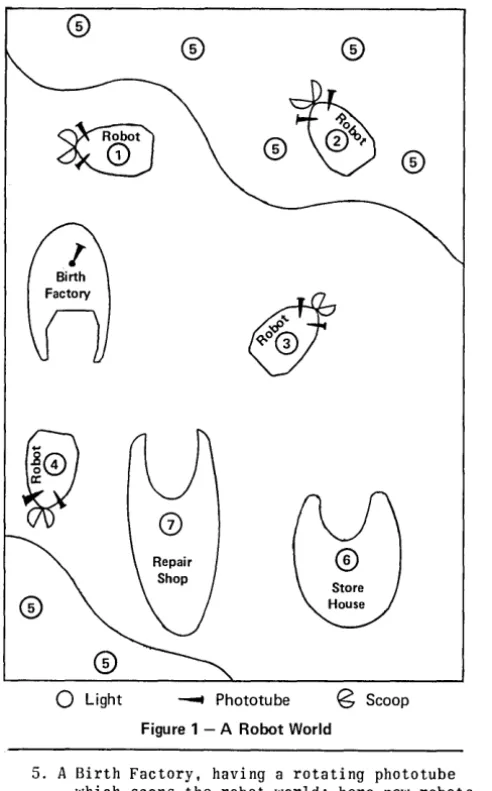
27 The Construction of Living Robots - Part 1 [NT A] by Edmund C. Berkeley, Editor, Computers and Automation
What are the essential properties of a living system? and how can they be materialized in an assembly of hard-ware and softhard-ware?
24 Secrecy in the Data Processing Industry [NT A] by J. L. Dreyer, ADAPSO, New York, N.Y.
The magazine of the design, applications, and implications
of information processing systems - and the pursuit of
truth in input, output, and processing.
The Computer Industry (continued)
39 The Computer Directory and Buyers' Guide, 1972
Notice and Contents
Computer People
[NT R]
2, 3 "Who's Who in Computers and Data Processing" [NT G] The Fifth Edition, continuing supplements, and an inquiry service for obtaining new capsule biographies.
The Profession of Information Engineer and the Pursuit of Truth
6 The Pursuit of Truth in Input, Output, and Processing [NT E] by Edmund C. Berkeley, Editor, Computers and Automation
One of the most urgent of human problems is deliberate, extensive, concealment and lying, in order to protect vested interests.
33 The June 1972 Raid on Democratic Party Headquarters [NT A] by Richard E. Sprague, Hartsdale, N.Y.
A report on five men who have numerous connections with the Republican Party, the White House, the Central
I ntell igence Agency, anti-Castro Cubans, and plans for the assassination of President John F. Kennedy, and who were arrested seeking to bug Democratic National Head-quarters at 2:30 a.m., June 17, 1972.
7 Lead Poisoning: The Hypocrisy of the Presidency and [NT F] of the Appropriations Committee of the House of
Representatives
by Representative William L. Clay, U.S. Congress This year more than 400,000 American children will eat sweet-tasting chips of paint containing lead - and the President and the Appropriations Committee fail to spend authorized money to deal with the problem.
40 "Don't Die, Ducky, Don't Die . . . " [NT A] by Bradley Yeager & Associates Inc., Treasure Island, Fla. How the whole City of St. Petersburg worked to deal with an oil spill, seeking to save their beaches and their water-birds.
38 "The House Is On Fire" by Edmu nd C. Berkeley
The earth as an environment is endangered.
Computers, Science, and Common Sense
37 The C&A Notebook on Common Sense, Elementary and Advanced
[NT E]
[NT G]
Titles of the first 36 issues, and capsule summaries of some of them.
Computers, Games, and Puzzles
50 Numbles, by Neil Macdonald
50 Problem Corner, by Walter Penney, COP
COMPUTERS and AUTOMATION for August, 1972
[T C]
[T C]
Front Cover Picture
"Peacock Courtsh ip", winner of the first prize in C&A's Tenth Annual Computer Art Contest, was created by a "computerized Spiro-graph method." The equipment used was an IBM 360/44 computer and a CalComp 760 drum-type plotter. The artist is Bharat K. Shah, Wichita, Kansas. For more inform-ation, see page 8.
NOTICE
*D ON YOUR ADDRESS IMPRINT MEANS THAT YOUR SUBSCRIP-TION INCLUDES THE COMPUTER DIRECTORY. *N MEANS THAT YOUR PRESENT SUBSCRIPTION DOES NOT INCLUDE THE COM-PUTER DIRECTORY.
Departments
42 Across the Editor's Desk -Computing and Data Processing Newsletter
49 Advertising Index
49 Calendar of Coming Events
48 Monthly Computer Census
46 New Contracts
47 New Installations
Key
Article
Monthly Column Editorial
Forum [A]
[C]
[E] [F]
[G] [NT]
[ R] [T]
The Golden Trumpet Not Technical
Ref~rence Information Technical
Co
a
EDITORIAL
"The Pursuit of Truth
.
In
I nput, Output, and Processi ng"
Two and a half years ago "Computers and Automation" changed its policy from being a trade magazine primarily restricted to the field of computers and data processing to being a trade magazine essentially in two fields:
• the design, applications, and implications of information processing systems; and • the pursuit of truth in input, output, and
processing.
The essential reasons for the change were expressed in our editorial "The House is On Fire," originally printed in the February 1970 issue, and reprinted in this issue on page 38. We invite our readers to read this editorial, again or for the first time, because "the house ," our spaceship Earth, is still on fire, perhaps even more on fire, and still needs help from volunteer crews as well as the profession-al crew (governments and inter-governmentprofession-al associations).
We said then that we need to "shed light on the major urgent problems of the earth today" - that profession-als in the field of computers and data processing have to pay some attention, do at least some work, on urgent hu-man problems outside the computer field. We say that again now.
What do we mean by "the pursuit of truth"? For ob-viously we cannot pursue all the truth in all fields.
One of the most urgent of human problems is deliber-ate, extensive concealment and lying, in order to protect vested interests, both capitalist in a country like the United States, and communist in a country like the Soviet Union
- where people pretend that a situation is one kind of thing and in reality it is something altogether different. The kind of truth we are pursuing is the kind of truth which is socially important and significant and which peo-ple belonging to establishments, governments, organized' groups, are hiding or trying to hide - the kind of truth which, when one finally finds it out, makes one deeply angry that one has been so thoroughly deceived about it.
There are perhaps three kinds of concealmen t. First, the concealment may be the result of frank and open actions on the part of power, simple refusal to an-swer questions and to provide information. For example, Secretary of Defense Melvin R. Laird neglects or refuses to answer requests from Congress concerning the tonnage of bombs being dropped periodically in Laos, North Vietnam, South Vietnam, and Cambodia. This neglect and refusal is wrong, because Congress and the people of the United States are entitled to know, and because the "enemy" cer-tainly knows. For another example, the central committee governing the Soviet Union certainly know approximately how many Soviet Jews wish to emigrate to Israel, but they
are not answering any questions about that. All informa-tion available on this matter is indirect. For a third ex-ample, IBM certainly knows how many and which kinds of its computers are installed and where - information that would be of very great value for many purposes in the thinking that people have to do about computers for social and economic purposes. But IBM refuses to pro-vide any such information.
Second, the concealment may be in the nature of a "si-lent conspiracy" in which a number of persons and organ-izations with common interests cooperate informally to allow some evil that does not hurt them to continue. One example consists of lead poisoning of children in the United States - see the report by Congressman William
L. Clay on the page opposite. The information in this report makes me deeply angry.
Third, the concealment consists of biases, prejudices, stereotypes, and lies which are so deeply woven into the historical fabric of a country and its traditions that even recognizing a different point of view becomes very dif-ficult. For example, take the attitudes towards American Indians which were expressed consistently and insidiously all through the history books I studied in elementary school. The Indians were portrayed as horrible savages, whose normal actions were to torture, scalp, and murder innocent white settlers. The American soldiers who killed and murdered Indian warriors, wives, and babies, were portrayed as gallant heroes. From time to time I would find the statement "The only good Indian is a dead In-dian," a most hideous statement. Unfortunately, I did not realize for many years the thorough atrociousness of such assertions and this mindset.
To escape from these concealments, biases, prejudices, and lies, to fight continuously for the imp9rtant, valuable truth, even if disturbing and unpleasant truth - this is one of the necessary duties of professionals who deal with information, computer people. A person cannot be a re-sponsible information engineer unless he is able to strip off concealments and lies. A computer professional must take responsibility for:
- the truth and applicability of the input informa-tion;
- the correctness of the processing; and
- the truth and applicability of the output infor-mation.
Edmund C. Berkeley
Lead Poisoning: The Hypocrisy of the Presidency
Iand of the
Appropriations Committee of the House of Representatives
Representative William L. Clay (D.-Mo.) The Congressional Black Caucus House of Representatives
u.
S. Congress Washington, D.C.Sweet-Tasting Chips of Paint
Lead poisoning can injure or kill any child--but in all likelihood the child who will contact this man-made disease will be poor, under the age of 3, and black.
He will most likely be a child who does not eat regularly, is not well supervised and will live in tenements, run-down apartments, and dilapidated old houses.
More than 400,000 American children fitting this description will eat the sweet-tasting chips of paint containing lead this year. Over 3200 of them will suffer permanent brain-damage; and over 200 will die.
In reality, no one knows precisely how many really will suffer or die from lead poisoning. The statis-tics just cited are official US figures which, in th~
past, have tended to be underestimated.
What a cruel indictment it is of America to need-lessly subject helpless children to the misery and torture of brain damage, blindness, and kidney mal-function, from lead poisoning!
Funds
The problem of lead poisoning, its prevention, treatment, and cure cannot be met without funds. Congress passed a special law authorizing' such funds. But no money was appropriated for fiscal year 1971, and no money was requested by the White House for that period.
The law authorized $10 million for fiscal year 1971 and $20 million for the present fiscal year. The White House included in its budget, a request for a mere $2 million for fiscal year 1972.
Gall
And, the White House had the gall to suggest that a request for that amount was a clear indica-tion of the President's concern for the problem.
(Reprinted from the "Boston Globe", June 27,1972)
COMPUTERS and AUTOMATION for August, 1972
Appropriations
When Congress did battle with the White House for funds to implement the law, an amount of $7.5 million was obtained. Congress clearly did not do much better in appropriating an amount still less than half the authorization. Already, applications from cities now pending before HEW ask for more than $7.5 million, and many cities haven't yet filed re-ports or requests.
Because the incidents and tragedies of lead pois-oning are so prevalent in black neighborhoods, the Congressional Black Caucus of the House has intro-duced special legislation calling for full funding of the Lead Poisoning Prevention Act.
Lead Content of Household Paint
The Congressional Black Caucus also endorsed a proposal to lower the ceiling on lead content of household paint from the present 1 per cent to the figure supported by the American Academy of Pedi-atrics, 0.06 percent.
President Nixon says we must spend whatever is necessary to find a cure for cancer. But, the cure for lead pOisoning is known. It is a man-made killer of children and should not be considered less deadly.
Additional Funds
It is appalling that no action has been taken by the Appropriations Committee on the request for addi-tional funds.
We are rightfully incensed that the general public, the Congress and the President seemed resolved to wait out lead poisoning -- a man-made disease -- which will eventually cure itself. In the meantime, the little
children suffer. []
Footnote by the Editor: Over $500 million ~ ~ is being spent in the present escalated air war in In-dochina -- and the Presidency and the Appropriations Committee are failing to authorize $7 million dollars
~ year for dealing with the unnecessary lead pois-oning evil in the United States.
TENTH ANNUAL COMPUTER ART CONTEST
SUNFISH
- Bharat K. Shah (U.S.A.)
The first prize in our 1972 Computer Art Con-test has been awarded to Bharat Ko Shah, 3005 East 21 St., Wichita, Kansas 67214. The winning entry, "Peacock Courtship", has been published on the front cover of this issue. Another of his entries, "Sunfish", is shown above.
"Peacock Courtship" and "Sunfish" were created
1972
by the "computerized Spirograph method." The equip-ment used was the IBM 360 System, Model 44, and a CalComp, drum-type, Model ·~6Q.
"'-"'"
The computer art on the pages.. which follow re-ceives honorable mention. Forsdme of the draw-ings, the explanation is obvious or can be inferred easily; for others, explanations are giveno In a number of cases, the computer and the peripheral equipment which produced the drawings have not been specified as much as we would like, because that information did not reach us by the close of
the contest. We would, of course, like to identi-fy the equipment that produced the art. Supple-mentary information of this kind should be sent to us for publication in a future issue.
The response to our Tenth Annual Computer Art Contest was good. We received over 100 computer drawings from allover the world. We are grate-ful to all those persons who sent us entries. A complete alphabetical listing of the names and ad-dresses of all persons who submitted entries in this year's contest appears on the last page of the art section of this issue. In forthcoming issues of Computers and Automation, we hope to publish some of the drawings we were not able to include in this issue.
COMPUTERS and AUTOMATION for August, 1972
ADVERSITY
- James Lipscomb (U.S.A.)
This drawing consists of five three-point nets, in which two nets were modi-fied on one side by the cosine function, plus fif-teen other less easily described manifestations of the same three-point net routine. "Adversity" was programmed in FORTRAN and run on an IBM 1130 computer, driving an on-line Calcomp 565 plotter.
NINE PERSPECTIVE PROJECTIONS
- Kenneth F. Dunker and Paul Shao (U.S.A.)
Professors Dunker and Shao of the Department of Architecture at Iowa State University in Ames have submitted what they believe is the first usage of the computer for per-spective projections other than the flat picture plane method.
The perspective drawing method has long been established as a means for depicting objects in space. Usually, as an expedient, objects are drawn assuming a flat picture plane per-pendicular to the principal line of sight. Since the geometry of this system is only a compromise be-tween reality and technical limi-tations, at wide angles which are often desirable for architectural illustrations, distortions are readily apparent.
Because of the extreme diffi-culty in manual projection, per-spective methods more accurate than the flat picture plane have seldom been employed. To overcome con-struction limitations, a FORTRAN program run on an IBM 360/65 com-puter with a CalComp plotter has been developed which facilitates execution of cylindrical and spher-ical projections.
The nine illustrations show a view of the I.S.U. campus. The verti-cal column on this page shows the view on a flat picture surface, the middle vertical column on the next page shows a spherical picture surface projected onto a plane, and the vertical column on the ex-treme right shows a cylindrical picture surface unrolled onto a plane. The"top horizontal row shows a 450 viewing angle, the middle horizontal row a 900 viewing angle, and the bottom horizontal row a 1200 viewing angle.
As can be seen, at angles great-er than 450 , the least distor-tion occurs in the cylindrical per-spective method. By enabling a wider choice of methods, the compu-ter has improved the quality of two-dimensional representations of three-dimensional objects in space.
Flat Projection 450 Angle of View
Flat Projection 900 Angle of View
Spherical Projection 450 Angle of View
Spherical Projection 900 Angle of View
Spherical Projection 1200 Angle of View
COMPUTERS and AUTOMATION for August, 1972
Cylindrical Projection 450 Angle of View
Cylindrical Projection 900 Angle of View
Cylindrical Projection 1200 Angle of View
(
u
S.A.) ri tten in .mas J. Huston . rogram was w stimulatIng SKY LAB WVB - Tho . f free space.
T~~n~."
prov i dl ng "rBM 1130 compu t erex ress IOn o. three d Imens 1 as d one on an
. drawing is an ·t1 elements In. n" The work w
Th FORTRAN an 1 s d works WI enrich one s • perceptl 0 •
experience to plotter. with a CalComp
WHISKERED FRISBY
- Judy Dayhoff (U.S.A.)
The "dynamic movement" of this en-try was obtained with a program written in FORTRAN and one sub-routine. It was run on an IBM 360/44 computer and plotted on a CalComp 565 off-line plotter.
EMISSION-1
- Sozo Hashimoto (Japan)
This example of computer art was created
on a NEAC-3200 computer with a WX-565 plotter. Mr.
Hashimoto programmed in FORTRAN IV to plot emissional linesj programmed automatic parameter changes allowed many variations.
COMBINATORIAL FRAMEWORK OF THE ORDINAL 15
- Manfred Mohr (France)
()
o
~
-u C -I
m
;;0
(f>
OJ
:::J
Q..
»
c -I
o
~
»
-I
o
Z
~
»
c
<.0
,~
-0 '..J
I\.)
(J1
COLUMBUS PLUS TWO - Mike Seaters (U.S.A.)
LAK GOU
- Kenneth F. Dunker and Paul Shao (U.S.A.)
73
It was generated by CORAD, a FORTRAN IV program, on an IBM 360/65 computer and CalComp 565 drum plotter. CORAD draws a single, linear figure a specified num-ber of times with any desired degree of control.
COMPUTERS and AUTOMATION for August, 1972
Any variation between absolute control and complete randomness may be specified for the parameters of location, size, and X-, y- and z-rotations of each figure.
Copyright 1972, Thomas J. Huston, Computra
FLORES EN FORTRANES
- Thomas J. Huston (U.S.A.)
This program consists of subroutines which control the drawing of the flowers. leaves. stems. and the
vas~ Geometric operations are performed as a subset of the various main subprograms.
I t was run on an IBM computer wi th a
•
WHO -00 -00 -00 IS WATCHING YOU - Steven A. Schmidt (U.S.A.)
D D
This example of computer art, by another student of Grace C. Hertlein at California State University, Chico, is a response to the problem: "Diminishing Polygons. Vary the polygons in a personal mann~r." Programming was done in FORTRAN and run on the CalComp 663.
COMPUTER
The following is an alphabetical listing of all per-sons who submitted entries in the Tenth Annual Com-puter Art Contest of ComCom-puters and Automation. The names of persons whose drawings are published in this issue are marked with an asterisk (*). We are planning to publish in the future some of the draw-ings we were not able to include in this issue.
Anderson, Michael, California State University, Chico, CA 95926
Brunjes, Dr. Shannon, Yale University School of Medicine, 333 Cedar St., New Haven, CT 06510 Contreras, Max, California State University, Chico,
CA 95926
*Dayhoff, Judy, 1618 Tilton Dr., Silver Spring, MD 20902
Dayhoff, Ruth E., National Biomedical Research Foun-dation, Georgetown Univ. Medical School, 3900 Reservoir Rd., N.W., Washington, DC 20007 Dunford, Jim, California State University, Chico,
CA 95926
*Dunker, Kenneth F., Engineering Annex, Dept. of Architecture, Iowa State Univ., Ames, IA 50010 Franke, Dr. Herbert W., 8191 Puppling Nr. 40, West
Germany
Freeman, Dick, California State University, Chico, CA 95926
Giovannoni, S., California State University, Chico, CA 95926
Gros, Ja~ques, I.R.I.A., Institut de Recherche, d'Informatique et d'Atomatique, Domaine de Vol-uceau, 78 - Rocquencourt, France
*Hashimoto, Sozo, 2-28-2 Komazawa, Setagaya-Ku, Tokyo, Japan
Hertlein, Grace C., Computer Science Dept., Califor-nia State University, Chico. CA 95926
Holmes, Dorothy. California State University, Chico. CA 95926
*Huston, Thomas J .. Computra, Box 608, Upland. IN 46989
Lindeman, Jack. California State University. Chico, CA 95926
*Lipscomb. James, 26 Woodfall Rd., Belmont, MA 02178 Livoni, Linden, California State University, Chico.
CA 95926
COMPUTERS and AUTOMATION for August, 1972
ARTISTS
Lloyd-Thurston, Nihan, Hamme House. Kings Mill Lane. South Nutfield, Surrey RHI 5~~, England
Lohuis, John, California State University, Chico, CA 95926
Mahon, Tom, California State University, Chico, CA 95926
*Mohr, Manfred, 58 BId. Latour-Maubourg. Paris - 7, France
McAninch, Ross, California State University. Chico. CA 95926
Olson. Vernon B., California State University, Chi-co. CA 95926
O'Malley, Robert. California State University. Chi-co, CA 95926
Riske, George, California State University, Chico. CA 95926
Roberts, Elaine A., National Biomedical Research Foundation. Georgetown Univ. Medical School. 3900 Reservoir Rd., N.W., Washington. DC 20007
Robertson, Sidney. 5932 Mayflower Ct .• Alexandria, VA 22312
Sankey, Lyle, California State University, Chico. CA 95926
*Schmidt. Steven A., California State University. Chico. CA 95926
*Seaters, Mike, California State University, Chico. CA 95926
*Shah. Bharat K., 3005 E. 21st St .. Wichita. KS 67214 *Shao, Paul, Engineering Annex, Dept. of
Architec-ture. Iowa State Univ .• Ames. IA 50010 Sundqvist. Goran. Kraftdata AB. Box 3118. 103 62
Stockholm 3. Sweden
Tengstrand, Tord. Research Institute of Swedish National Defence, SEKT. 466, Linnegatan 89. S-11523 Stockholm, Sweden
Thompson, Michael, Rechov Remez 1, Kadima. Israel Wong, Wallace M., California State University,
Chi-co, CA 95926
Wu. Peter, California State University. Chico, CA 95926
Young, Edwin C .. California State University. Chico, CA 95926
Zajec, Edward, Via Damiano Chiesa 18. Trieste, Italy 34128
COMPUTERS IN BANKING
Mr. J. Q. Hal/om Deputy Governor Bank of England London, EC2R BAH England
"Increasingly sophisticated users must be expected to require increasingly sophisticated levels of service."
(Based on an address at the British Computer Society Con-ference in London on 11th April 1972)
I welcome this opportunity first to touch on a rarely publicised area of the Bank of England's op-erations -- its work in the field of computers; and second to voice one or two of the thoughts and ques-tions which have been in our minds for some time about the longer-term impact of computers on banking and on the City of London -- matters on which other minds will no doubt be turning.
I would not, of course, attempt to claim that the Bank's E.D.P. activities are different in prin-ciple from those of other institutions or that our thoughts about the present and future impact of com-puters have any particular degree of originality. Nevertheless, though many of the component strands are the same for a central bank as for other banks, the general texture of experience and thought into which they are woven is perhaps sufficiently dif-ferent to be worth describing.
Computer Uses by the Bank of England
As with many other financial institutions, the Bank of England first began to make significant use of computers in the early sixties, partly in re-sponse to pressure from ever-rising staff costs. The first systems were developed for the Bank's stock register work (as was natural given its volume and nature) and were -- and continue to be
very successful cost savers.
In the mid and late sixties there was a very considerable spread in the use of computers in the
Bank, not only to process most of the Bank's day-to-day banking operations but also to cover the pay-roll, some statistical work and a variety of ac-counting operations. In comparison with the clearing banks, many of the Bank of England's com-puter applications are small volume systems, though there are some -- such as the stock register oper-ations with some 2~ million accounts -- which are of a respectable size by most standards. More distinctive features of the Bank's systems, how-ever, are their diversity and their inter-connection with each other.
Future Uses
It was this last aspect, combined with an in-creasing awareness of the limitations and rigidities of batch systems, which led us towards the end of the sixties to stand back from our day-to-day prob-lems of developing, running and maintaining a large variety of discrete batch systems and to take a long hard look at the longer-term future of E.D.P. in the Bank. As many others will have found, such a look tends to take longer and prove harder than expected. In the Bank it resulted in a decision last year to proceed with the development of three large inte-grated on-line systems -- one for the Bank's stock register work, a second for a wide range of statis-tical work (including the creation and use of a data bank), and the third for a large portion of the Bank's actual banking operations -- all aspects of banking, foreign exchange and bullion work, infor-. mation for market operations, management of the bank note issue, and the like. The majority of the Bank's ninety-odd staff in systems and programming are currently engaged on the development of these three projects, which, together with the
nance of existing batch systems will continue to absorb most of the Bank's E.D.P. resources for the next few years.
External Activities
Concurrently with these internal developments, the Bank have been regularly involved in a wide variety of external activities. From the outset
the Bank have sought to take a full part in the inter-bank moves towards automation of money trans-fer mechanisms -- first the magnetic encoding of cheques and later the exchange of data on magnetic tapes via the Inter-Bank Computer Bureau and its successor -- Bankers Automated Clearing Services Limi ted.
Processing Security Dealings
Then the Bank are working closely with the Stock Exchange in the current investigation of a possible new system for processing dealings in securities to take advantage of the opportunities offered by de-velopments in data processing. The Bank also follow with considerable interest many of the Inter-Bank Research Organisation's activities in the field of long-term developments of technology in banking; and we maintain many regular contacts with overseas cen-tral banks and related institutions on the, as yet, largely unexplored field of international computer links.
Moving on from the relatively narrow subject of computers and the central bank to the broader topic of computers and banking in general, we switch from a little publicised subject to one which rightly re-ceives a very great deal of public attention. All told there must be many hundreds of research workers in the Western world producing reports and papers on the future impact of computer technology upon bank-ing. As many persons will already be acquainted with the broad outlines of thought in this area, I mention here only one or two aspects of particular interest to a central bank.
Real-Time Terminals
Firstly, it is predicted that, apart from devel-opments in the banking system, the use of remote real-time terminal facilities in shops, offices and the like will drastically reduce money transmission times and introduce major changes in the demand for physical cash. Many attempts are being made to as-sess what impact this will have on the level of de-posits with banks, on the basis of remuneration for bank services, and on the overall share of money transmission business coming to the banks. Any sizeable shift from cash to banking transfers of one type or another will, of course, have an immediate and direct effect on one of the Bank of England's major functions -- the management of the note issue. But its impact may well be much wider than this and any considerable consequential change in the finan-cial structure of the banking system or in banks' balance sheets must be of vital interest to the central bank as a monetary authority.
International Electronic Links
A second important area where the effect of tech-, nology on banking is of particular interest to
central banks is in the present rapid moves towards international electronic links between commercial banks. Clearly we have a strong material interest here: for not only are we very directly involved as operators in the foreign exchange markets but we must also assure ourselves that technological ad-vances in this field are not going to have or
COMPUTERS and AUTOMATION for August, 1972
make possible -- side effects which might be dam-aging to national interests.
Statistical Data
A third area of vital concern to a central bank is the area of statistical data. Computers should both considerably reduce the cost to commercial banks of providing statistical data and, at the same time, increase the use that can be made of such data. Here central banks and the commercial banks have an evident interest in common in clearly fore-seeing and then co-ordinating their requirements, so that the statistical ambitions of the central banks can be properly married with the management infor-mation needs of the banks, and the resultant mater-ial made available in the most helpful form.
I hope that these three examples will serve suf-ficiently to underline the interest and involvement of the Bank of England in technological developments in the banking industry.
International Financial Centre
I should now like to discuss a few thoughts on the longer-term impact of technology on the role of the City of London as a whole.
Few, I think, would deny that the City'S growth to a position of dominance as an international fi-nancial centre, while helped to a considerable ex-tent by extraneous historical factors, was chiefly founded on the flexibility and adaptability of the men and institutions working in it. It was this above all that put the City in a.position to offer the range of financial services and facilities which, coupled with a reputation for expertise, in-tegrity and despatch, has enabled the City to make such a contribution to the nation's economy.
Information Processing Systems
With one or two exceptions, it is probably fair to say that the actual information processing sys-tems which support the facilities provided by the City, have not been a major determinant of the quality and type of services offered. Even where new technologies have been introduced, they have been absorbed into the City environment without changing it to any great extent. Thus the punched card systems in the thirties and forties tended merely to reproduce, with minimal changes, existing accounting systems; and the same has been true of many of the batch computer systems, though in this latter case the complaint has often been made -- and not always unjustifiably -- that new technology has brought about a decline in service.
The Role of New Technology
But the question that many people must now be asking themselves is whether we are moving into an era when technology will begin to move from this subordinate role to a position where it will have an increasing and vital influence on the nature and quality of service that a financial centre can pro-vide. If this should prove to be the case, then a great deal of thought will need to be given to its implications.
Side by side with the possibly growing influence of technology on the supply of financial services by the City, the same influence can also be seen to be increasing, possibly at a faster rate, on the demand side in the institutions and industries which the City serves.
(please turn to page 32)
The Antisocial Use of Computers
Donn B. Parker
Senior Information Processing Specialist Stanford Research Institute
Menlo Park, CA 94025
"The average financial loss of 20 authenticated cases of computer-related crimes which have been recently studied is $670,400 per case with a range of $1357 to $1,750,000."
Computers have begun to be used as the subj ects, tools, and environment of antisocial activity. The number of incidents of unethical and criminal acts using computers and computer-related materials is increasing. This fact, coupled with the growing im-pact of computers on society, calls for efforts to explore and assess this emerging problem.
Identification of the Problem
Many of the methods and subjects of criminal and unethical conduct are changing as a result of tech-nological advances. The exchange, transfer, and re-cording of wealth and information has been performed manually using the medium of paper and validated by handwritten signatures, affixed seals, and witnes-sing. A transition from these methods to the use of computers and the electronic medium is now taking place. The methods used in financial and informa-tion crimes are rapidly focusing on computer auto-mated systems. The criminal and unethical elements in society are attracted by wealth and activities of great social impact and value where there is lever-age for gain and small chance of detection or appre-hension. There is a continual testing of new tech-nology in an effort to use it for unlawful or un-ethical purposes. Unethical purposes also extend into performing antisocial acts for self-amusement, amusement of others, or accepting a challenge to penetrate a system declared to be adequately pro-tected. These acts too can be harmful to society.
Scope of the Problem
During the 1950s, the largest impact of comput-ers was in science. Payroll applications had the most important direct effect on people outside of the laboratory. Only a few reports about the mis-use of computers were heard; they never erupted into a court of law and were difficult to investigate at the rumor level.
(Based on a portion of proposal submitted to the National Science Foundation, March, 1972)
In the 1960s, computers emerged from the labora-tories into the business and government sectors where their application became increasingly per-vasive. The concept of computer programs and stored data as valuable property was introduced. The As-sociation for Computing Machinery set forth guide-lines for professional conduct in information proc-essing, but concern for behavior was confined to the computing community until potential antisocial use of computers aroused the public interest. Computers acquired an undesirable image with the prediction of unemployment because of automation, computer crimes, and the superior-intelligence concept of computers.
Three Criminal Cases
The first federal criminal case concerning the use of a computer occurred in 1966 (United States vs. Milo Arthur Bennett, U.S. District Court for Minnesota). A young programmer was convicted on two counts of altering bank records. He changed the program running in the bank'S computer to avoid de-tection of overdrafts in his checking account.
In 1969, an accountant was convicted for grand theft and forgery for stealing more than $1 million from his employer during a seven-year period. He performed a financial analysis on a computer using true data and his falsified data to measure and con-trol his thefts to keep them unnoticed.
In a felony trial in Oakland, California, in March, 1972, a programmer was charged with theft of a trade secret. He was alleged to have stolen a program from a competitor's computer through a re-mote terminal and telephone circuit.
brain syndrome among the public, which arises from the highly distorted and sensationalized image of computers created by public news media. Politi-cally motivated acts of vandalism against computer facilities might also be traced to this syndrome.
Factors Leading to Criminal Behavior
In other sectors of society, potential misuse of computers can be anticipated. There are cases of individuals penetrating computer time-sharing ser-vices to cause embarrassment or just for amusement. Organized crime can be suspected of using computers through control of banks. In 1969, computer train-ing was betrain-ing offered to convicted felons in 26 states, which implies that a part of the criminal element has a technical capability in data proc-essing.
There appears to be a small but growing element of new Luddites in society intent on reversing the penetration of computer use into society. Harvey Matusow, an American journalist in London, formed the Society for Abolition of Data Processing Ma-chinery in 1968. He is reported to have had 1,500 members by 1970. His society publishes an anti-computer newsletter, and each member receives a handbook of guerilla tactics against computers.
Research and legislative activity in data bank security and the constitutional privacy issue are largely based on concern over misuse of computers. Computer applications are extending through tele-phone circuits to points of retail sales for source data where credit cards are used. SRI sources in-dicate the automated transaction industry will reach a volume of sales of $500 million by 1980. Crimes associated with retail sales transactions are well known. Computers have not yet been strongly asso-ciated with public safety hazards, but they are finding increasing use to control traffic lights, public transportation schedules to close toler-ances, air traffic, and intensive-care patient monitoring. Thus computers could become associ-ated with crimes of physical violence.
Measures for Greater Security
Most businesses and governments at all levels that use and rely on computers have taken some mea-sures to increase the security of their computing facilities. Unfortunately, security measures are being based on the value of what is to be protected with little concern or knowledge of real threats to computer systems.
The system of law and justice is having diffi-culty coping with the problem, based on recent ex-amples of court cases and attempts to legislate new laws. For example, computer programs represent an entirely new and important commodity for which prop-erty laws, taxing, and protective mechanisms such as copyrighting, patenting, and protecting of trade se-crets are causing many problems.
Lack of Knowledge
Misconceptions and lack of knowledge about com-pu ters and" comcom-pu ter personnel have hampered law en-forcement agencies and the courts in applying exist-ing legal principles and suggestexist-ing new legislation to address gaps in the current laws pertaining to computer-related crimes. Law enforcement officers do not have the necessary expertise or training to identify applicable evidence when conducting a search. Counsel and judges are confused when at-tempting to establish the value of materials be-fore the courts when litigation concerns the
COMPUTERS and AUTOMATION for August, 1972
amount in controversy. For example, a reel of com-puter tape may be worth $20, but the information stored thereon may be a trade secret potentially valued in the tens of thousands of dollars.
Lawyers engaged in preparing cases are handi-capped in ascertaining relevant facts. In a recent vandalism incident, an associate of a prominent San Francisco law firm inquired of a deposee, "Did the computer become inoperable when (Mr. X) sat down on the console?" Answer: "No. When the main swi tch was thrown by (Ms. Y) shutting off power." This dia-logue continued with a total lack of communication and no understanding. A short tutorial session was presented by a third party about unanticipated power fluctuations, damages to circuitry, and loss of data and programs being executed at the time.
In a recent national conference, a criminal court judge stated categorically to the audience that no one had ever heard of a programmer stealing a pro-gram from a computer. The implication was clear that programmers somehow are not subject to the temptations of ordinary men.
Size of the Problem
The incidence of computer-related crimes is still small compared to general crime statistics. Since 1966, less than 80 have been authenticated in the United States. However, many more have been re-ported. IBM receives about 30 reports per month of at least unethical acts occurring among its computer customer installations. No methodical recording or verification has been done. But the average finan-cial loss of 20 authenticated cases recently studied is $670,400 per case with a range of $1,357 to $1,750,000.
The rapid growth of the computer field and fore-casts for the next ten years indicate the potential for growth of computer-related crime. Stanford Re-search Institute sources indicate 80,000 computers currently in use in the United States alone. This is expected to grow to 140,000 by 1975 and 170,000 by 1980. By 1980, annual sales should reach $18 billion and represent 14 percent of all equipment and machinery manufactured in the United States. Employment directly in the computer field is ex-pected to rise from 1,280,000 people in 1970 to 2,230,000 in 1975. This will represent about 3 percent of the 80 million people in the work force. The number of people both directly and indirectly associated with use of computers is approximately double the above figures.
Associating this information with the forecast that the transfer, exchange, and recording of nearly all the wealth of society in the United States will be done using computers makes the future impact of computer-related antisocial activities serious.
Expected Consequences of the Research
The consequences of the proposed exploratory and problem assessment research can have significant leaverage effect at this current, early stage of the problem. The nature of exploratory research is not susceptible to explicit statements of the results, but certain specific goals are foreseen at this time:
• A data base of verified, detailed descriptions of incidences of antisocial use of computers with extensive indexing will be produced.
• Model laws and court rules will be proposed in areas of law shown to be inadequate as a
suIt of the field investigation of inci-dents.
• Methods to deter antisocial acts will be pro-posed in areas of management policies, em-ployee relations, public relations, value systems, and professionalism.
• Technological and procedural methods of pre-venting computer-related crime will be de-scribed from the point of view of methods used or that might be used by perpetrators.
• Detection of antisocial acts will be consid-ered beyond the known techniques of threat monitoring by computer-printed activity logs and adaptation of manual auditing methods. Actual cases that might have been detected more successfully will be studied.
• Successful and unsuccessful methods of field investigation and interdisciplinary ap-proaches will be documented.
Five impact areas of these goals are identified below:
Computer Users
Business and government are relying on computers for vital functioning of their activities. All con-sumers are being involuntarily served or affected by these computers. This highly sensitive dependence on computer systems could reach such proportions as to preclude further advances in use until adequate protection and confidence have been developed.
Cost-effective computer security can hardly be achieved without knowing the real nature of the threat. Known and hypothesized security penetra-tions, and the nature of penetrators, will be in-vestigated and analyzed. The research would seek to measure and put in perspective the cost of crime losses and prevention expenditures.
Computer and Software Manufacturers
Products in the computer field should be de-signed with security as an integral specification to achieve adequate levels of protection at reason-able cost. Investment in such product features is large enough to warrant significant research. In-formation about actual cases should be of value in new product design.
Law, Justice, and Congress
The results of the proposed research should form the basis for effective advances in application of existing laws and development of new laws where nec-essary. The ability of law enforcement agencies and the courts to contend with the new criminal methods will be aided by information supplied as a result of the research effort.
These agencies and the courts would be made aware of the relevance or inadequacies of present legal tools to the new fact situations. They would under-stand more thoroughly what those facts mean and what a crime is relative to computer use and in terms of legal issues. They would then be better able to assume their proper role of determining, if and when a crime has been committed and of what mag-nitude.
(please turn to page 36)
SECRECY IN THE
DATA PROCESSING INDUSTRY
J. L. Dreyer
Association of Data Processing Service Organizations, Inc. (ADAPSO)
551 5th Ave.
New York, N. Y. 10017
"Censorship, imposed secrecy, misplaced cor-porate loyalty, big brotherism, nest feathering or simply failure to disclose because discretion is the better part of valor" were key points raised in an ADAPSO program outlined by Bernard Goldstein, president of ADAPSO, in June 23, at a talk in Bos-ton, Mass. He sought to open up the problems of the services industry to full and fair discussion in the interests of the public as well as the in-dustry itself. Goldstein, who is also president of United Data Centers Inc., said:
"We are becoming increasingly concerned at the tremendous obstacles continuously being placed in the path of our effort to obtain and analyze the information essential for us to decide how to pro-ceed."
He referred to the effort at acquiring infor-mation which was initiated in the hearings conduc-ted by the Economic Committee of ADAPSO in Dallas, Texas, last February. Goldstein stated:
"Another example is the secrecy order issued by the United States District Court for the Southern District of New York in the pending government antitrust litigation against IBM. We are delighted that Chief Judge David N. Edelstein of New York's Southern District Federal Court, who is also the Judge in the IBM case, has for the first time just directed wide circulation of an antitrust consent decree proposal. But even the sixty-day expanded timetable he has fixed is not nearly sufficient for us to be able to come in with a properly con-sidered judgment on such key issues as whether the doctrine of maximum separation should be extended to other IBM operations in the same fashion as it was to the service center segment in 1956.
"Still another example, is the report in the current issue of Datamation of an effort to cen-sor (inferentially attributed to key IBM execu-tives), a certain scholarly book discussing com-puter industry problems. Perhaps the book's re-production for the first time of certain documents in the official court docket of the government's litigation against IBM led to the secrecy order. But the book's only recommendation is that there should be a study of the computer industry and an inter-disciplinary discussion of its affairs. The very fact that those who sought to censor -- who-ever they may be -- conceived such an analysis and recommendation to be somehow dangerous or even worth attacking, is suggestive of the enormous pow-er IBM has in this industry. Isn't it a shocking commentary that each of us must continually keep in mind what IBM will think about what we do, lest we somehow displease IBM?
"I do not wish to be misunderstood -- I haven't the slightest idea what's in the papers that we cannot see in the Federal District Court's Docket. But aren't we, the public, entitled to know ~