warwick.ac.uk/lib-publications
Manuscript version: Author’s Accepted Manuscript
The version presented in WRAP is the author’s accepted manuscript and may differ from the
published version or Version of Record.
Persistent WRAP URL:
http://wrap.warwick.ac.uk/117386
How to cite:
Please refer to published version for the most recent bibliographic citation information.
If a published version is known of, the repository item page linked to above, will contain
details on accessing it.
Copyright and reuse:
The Warwick Research Archive Portal (WRAP) makes this work by researchers of the
University of Warwick available open access under the following conditions.
Copyright © and all moral rights to the version of the paper presented here belong to the
individual author(s) and/or other copyright owners. To the extent reasonable and
practicable the material made available in WRAP has been checked for eligibility before
being made available.
Copies of full items can be used for personal research or study, educational, or not-for-profit
purposes without prior permission or charge. Provided that the authors, title and full
bibliographic details are credited, a hyperlink and/or URL is given for the original metadata
page and the content is not changed in any way.
Publisher’s statement:
Please refer to the repository item page, publisher’s statement section, for further
information.
Computation over Wide-Band Multi-Access
Channels: Achievable Rates Through Sub-Function
Allocation
Fangzhou Wu, Li Chen, Nan Zhao,
Senior Member, IEEE,
Yunfei Chen,
Senior Member, IEEE,
F. Richard Yu,
Fellow, IEEE,
and Guo Wei
Abstract—Future networks are expected to connect an enor-mous number of nodes wirelessly using wide-band transmission. This brings great challenges. To avoid collecting a large amount of data from the massive number of nodes, computation over multi-access channel (CoMAC) is proposed to compute a desired function over the air utilizing the signal-superposition property of wireless channel. Due to frequency-selective fading, wide-band CoMAC is more challenging and has never been studied before. In this work, we propose the use of orthogonal frequency division multiplexing (OFDM) in wide-band CoMAC to transmit functions in a similar way to bit sequences through division, allocation, and reconstruction of functions. An achievable rate without any adaptive resource allocation is derived. To prevent a vanishing computation rate from the increase in the number of nodes, a novel sub-function allocation of sub-carriers is derived. Furthermore, we formulate an optimization problem considering power allocation. A sponge-squeezing algorithm adapted from the classical water-filling algorithm is proposed to solve the optimal power allocation problem. The improved computation rate of the proposed framework and the corresponding allocation has been verified through both theoretical analysis and simulation.
Index Terms—Achievable computation rate, OFDM, optimal power allocation, sub-function allocation, wide-band transmis-sion, wireless networks.
I. INTRODUCTION
C
URRENT 5G and the Internet of Things envision the in-terconnections of up to 1 trillion products, machines and devices through wide-band transmission [1]–[3]. With such an enormous number of nodes, it is impractical to transmit data using conventional orthogonal multi-access schemes inThis research was supported by National Natural Science Foundation of China (Grant No. 61601432), the Fundamental Research Funds for the Central Universities, and the open research fund of National Mobile Communications Research Laboratory, Southeast University (No. 2018D03). This paper was presented in part at the IEEE Wireless Communications and Networking Con-ference (WCNC), Marrakech, Morocco, April 2019.(Corresponding author: Li Chen)
F. Wu, L. Chen and G. Wei are with Department of Electronic Engineering and Information Science, CAS Key Laboratory of Wireless-Optical Communi-cations, University of Science and Technology of China, Hefei, Anhui 230027. (e-mail: [email protected],{chenli87, wei}@ustc.edu.cn).
N. Zhao is with the School of Information and Communication Engineering, Dalian University of Technology, Dalian 116024, China, and also with the National Mobile Communications Research Laboratory, Southeast University, Nanjing 210096, China (e-mail: [email protected]).
Y. Chen is with the School of Engineering, University of Warwick, Coventry CV4 7AL, U.K. (e-mail: [email protected]).
F.R. Yu is with the Department of Systems and Computer Engi-neering, Carleton University, Ottawa, ON, K1S 5B6, Canada. (email: [email protected]).
future networks because this would result in excessive network latency and low spectrum utilization efficiency.
To solve this problem, computation over multi-access channel (CoMAC) was proposed to exploit the signal-superposition property of multi-access channel (MAC) to compute the desired function through concurrent node trans-missions, which combines computation with communication [4]–[19]. A straightforward application of CoMAC to attain transmission and computation in parallel is wireless sensor networks, whose communication goal is typically for a fusion center to obtain a function value of the sensor readings (e.g., arithmetic mean, polynomial or number of active nodes), rather than to store all readings from all sensors. Otherwise, CoMAC can also be applied in networks that focus on computing a class of so called nomographic functions of distributed data via concurrent node transmissions [4].
A simple computation framework, called analog CoMAC, has been studied in [5]–[10]. In analog CoMAC, all nodes par-ticipate in the transmission. The authors used pre-processing at each node and post-processing at the fusion center to deal with channel fading and compute functions [5]. The designs of pre-processing and post-processing used to compute linear and non-linear functions have been discussed in [6], and the effect of channel estimation error was characterized in [7]. In order to verify whether analog CoMAC is feasible in practice, an implementation using software defined radio was built in [8]. A function computation method utilizing a multi-antenna fusion center to collect data transmitted by a cluster of multi-antenna multi-modal sensors has been presented in [9]. Furthermore, using multiplexing gain to compute multiple functions has been discussed in [10]. In summary, simple analog CoMAC has led to an active area focusing on the design and implementation techniques for receiving a desired function of concurrent signals.
fad-ing, a uniform-forcing transceiver design was given in [14]. Achievable computation rates were given in [15]–[17] for digital CoMAC through theoretical analysis. In [17], Jeon and Bang found that the computation rates achieved by the above computation techniques decrease as the number of nodes increases, and eventually go to zero due to fading MAC. To handle this problem, they proposed an opportunistic CoMAC where a subset of the nodes opportunistically participated in the transmission at each time, which provided a non-vanishing computation rate even when the number of nodes in the network goes to infinity.
To the best of our knowledge, the above mentioned works only consider CoMAC with single-carrier flat fading. A wide-band CoMAC has not been discussed before and needs to be extended. Wide-band signal transmission has to endure frequency-selective fading because the coherence bandwidth of the channel is always smaller than the signal bandwidth. In the time domain, the multi-path interference is not easy to be removed [20]. Orthogonal frequency division multiplexing (OFDM) is an effective solution to inter-symbol interference caused by the dispersive channel [21]–[23], and has been applied in many communication fields. Also, the orthogonal channels of OFDM in the frequency domain is equivalent to a chief executive officer (CEO) problem where the decoder is interested in reconstructing the symbols in each sub-carrier [24]–[26]. The CEO problem is relevant for studying the general multi-terminal problem, which is foundational and has great potential. In [25], the authors have studied the rate-distortion region of the discrete memoryless multi-encoder CEO problem. As for the vector Gaussian CEO problem, a complete characterization of the rate-distortion region of it under logarithmic loss distortion measure has been presented by [26]. For a more practical application, the authors in [27] established and utilized the connections between cloud radio access networks and the CEO source coding problem under logarithmic loss distortion measure to analyze the capacity of the radio access network.
Motivated by the above observations, we employ OFDM in the implementation of CoMAC. However, the conventional OFDM systems which load bit sequences of different lengths into different sub-carriers cannot be used directly because CoMAC transmits a desired function over the air, not a bit sequence. Thus, the desired function as a whole cannot be allocated into several sub-carriers. To deal with this issue, we propose a method of sub-function allocation for the division, allocation, and reconstruction of the desired function. This method divides the desired function into some sub-functions, allocates these sub-functions into different sub-carriers, and reconstructs the desired function at the fusion center. The theoretical expression of the achievable computation rate is derived based on the classical results of nested lattice coding [16]–[19]. It is shown to provide a non-vanishing computation rate as the number of nodes increases. An optimization prob-lem considering power allocation is further discussed, and a sponge-squeezing algorithm adapted from the classical water-filling algorithm is proposed to solve the optimal power allo-cation problem. Owing to sub-function alloallo-cation and power allocation, the computation rate is significantly improved. Our
1
h
yDecoding
ˆ ( [1])
fs
ˆ ( [2])
fs
ˆ ( [ ])
f ks
CISCO AIRONET 1200I WIRELESS ACCESS POINT
1
S s1
Encoding 1
x
Node 1
CISCO AIRONET 1200I WIRELESS ACCESS POINT
2
S s2
Encoding 2
x
Node 2
2
h
Fusion Center
CISCO AIRONET 1200I WIRELESS ACCESS POINT K
S sK
Encoding
K
x
Node K
K h
[image:3.612.335.542.63.158.2]Estimated Functions Source
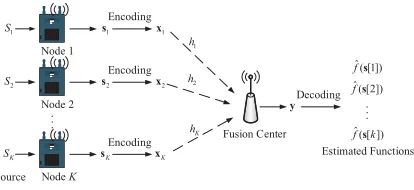
Fig. 1. A classical framework of CoMAC.
contributions can be summarized as follows:
• Novel CoMAC-OFDM. In order to tackle frequency-selective fading, we exploit the mechanism of OFDM to implement wide-band CoMAC. Unlike the conventional CoMAC schemes, CoMAC-OFDM divides a desired function into sub-functions, allocates sub-functions to each sub-carrier and reconstructs the desired function at the fusion center.
• Improved computation rate. A novel sub-function alloca-tion is designed to assign sub-funcalloca-tions to sub-carriers, which provides a non-vanishing computation rate as the number of nodes increases. After that, the theoretical expression of improved computation rate is derived. • Optimal power allocation. An optimal power allocation
is considered to improve computation rate. Since the solution of our optimization is not suitable to utilize the classical water-filling algorithm, we propose a sponge-squeezing algorithm adapted from the classical water-filling algorithm to carry out the power allocation, which provides a simple and concise interpretation of the nec-essary optimality conditions.
The paper is organized as follows. Section II introduces the definitions of CoMAC and the system model for CoMAC-OFDM. In Section III, we summarize the main results of this paper and compare them with existing results. Section IV presents the proposed CoMAC-OFDM with sub-function allocation in detail and analyzes the computation rate. Section V focuses on the improvement of the computation rate using power allocation. Simulation results are presented in Section VI and conclusions are given in Section VII.
II. PRELIMINARIES& NETWORKMODEL
In this section, we give some definitions before introduc-ing CoMAC. Throughout this paper, we denote [1 : n] = {1,2,· · ·, n}, and C+(x) = max1
2log(x),0 . For a set A,
|A| denotes the cardinality of A. dxe is the ceiling function as dxe = min{n∈Z|x≤n}. Let the entropy of a random variable A be H(A) and diag{a1, a2,· · ·, an} denote the diagonal matrix of which the diagonal elements are froma1to an. A set{x1, x2,· · ·, xN}is written as{xi}i∈[1:N] for short.
A. CoMAC
A classical framework of CoMAC is depicted in Fig. 1. In this framework, the fusion center is designed to compute a desired function fromKnodes. Each node obtains data from a corresponding random source forTd times, and then provides a data vector of length Td.
Definition 1 (Data Matrix): Assume that Si is a random source from which the i-th node gets data, and let bv =
[S1, S2,· · ·, SK] be a random vector associated with a joint probability mass function pbv(·). A data matrixS∈C
K×Td
represents the data from K nodes duringTd time slots. It is expressed as
S=
s1[1] · · · s1[j] · · · s1[Td] ..
. . .. ... . .. ... si[1] · · · si[j] · · · si[Td]
..
. . .. ... . .. ... sK[1] · · · sK[j] · · · sK[Td]
=hs[1]T · · · s[j]T · · · s[Td] Ti
=
sT
1 · · · sTi · · · sTK
T
, (1)
wherej∈[1 :Td],i∈[1 :K],si[j]is thej-th data of thei-th node from the random source Si,s[j] = [s1[j],· · ·, sK[j]] is thej-th data of allK nodes andsi= [si[1],· · ·, si[Td]]is the data vector of node i. Note thatsi[j] belongs to[0 : p−1], which means it is mapped to a number between 0 andp−1
through quantization. Also, s[j]is independently drawn from pbv(·).
Using Definition 1, the desired function determined by the random source vector bv can be expressed as f(bv), and its definition is given as follows.
Definition 2 (Desired Function): For allj∈[1 :Td], every function
f(s1[j], s2[j],· · ·, sK[j]) =f(s[j]) (2)
that has to be computed at the fusion center is called a desired function where s[j] is independently drawn from pbv(·)(see Definition 1). Every function f(s[j])can be seen
as a realization off(bv). Thus, it hasTdfunctions where each node gets data from each random source for Td times.
Remark 1: As studied in [16], [18], [19], [28], Co-MAC is designed to compute different types of desired functions. There are two typical functions that we fo-cus on. A function f(s[j]) whose values are in the set
{PK
i=1a1,isi[j],· · ·,P K
i=1aLs,isi[j]} is called the arithmetic
sum function, whereal,i∈Ris the weighting factor for node i, and Ls belongs to N. The arithmetic sum function is a weighted sum function, which includes the mean function for all K nodesf(s[j]) = 1
K
PK
i=1si[j] and the function for the active node onlyf(s[j]) ={s1[j], s2[j],· · ·, sK[j]}as special cases. Apart from this, a functionf(s[j])with values in the set of{PK
i=11si[j]=0,· · ·,
PK
i=11si[j]=p}is regarded as the type
function where1(·)denotes the indicator function. As pointed out in [28], any symmetric function such as mean, variance, maximum, minimum and median can be attained from the type function.
Definition 2 shows that the desired function f(s[j]) is computed by allK nodes participating in the computation. In some cases, we only need to chooseM nodes to participate in the computation each time. Then the desired functionf(s[j])
has to be divided into B = KM ∈ N parts. A function that only uses some of the nodes is called a sub-function, and its definition is given as follows.
Definition 3 (Sub-Function):Let
τu={x∈[1 :K] :|τu|=M} (3)
denote a set where each element x is an index from the M chosen nodes. Supposing that SB
u=1τu = [1 : K] and τuTτv = ∅ for all u, v ∈ [1 : B], a func-tion f {si[j]}i∈τu is said to be a sub-function if and only if there exists a function fc(·) satisfying f(s[j]) = fc f {si[j]}i∈τ1
, f {si[j]}i∈τ2
,· · ·, f {si[j]}i∈τB
. Thus, the fusion center reconstructs the desired function based on B sub-functions, when K nodes are divided into B parts.
In order to achieve reliable computations against noise, we apply block codes named sequences of nested lattice codes [15] throughout this paper. Based on the block coding, the definitions of encoding and decoding are given as follows.
Definition 4 (Encoding & Decoding):For thei-th node, let
sidenote the data vector whose length isTd(see Definition 1). Denotexi = [xi[1], xi[2],· · ·, xi[n]]as the length-n transmit-ted vector for node i. The length-n received vector is given by y = [y[1], y[2],· · ·, y[n]] at the fusion center. Assuming there is a block code with length n ≥Td, the encoding and decoding functions can be expressed as follows.
• Encoding Functions: the univariate functionEi(·)which generatesxi=Ei(si)is an encoding function of nodei. This means thatsiof lengthTdis mapped to a transmitted vectorxi of lengthnfor nodei.
• Decoding Functions: the decoding function Dj(·) is used to estimate thej-th desired functionf(s[j]), which satisfies fˆ(s[j]) = Dj(y). This implies that the fusion center obtains Td desired functions depending on the whole received vector of length n.
Considering a block code of length n, the definition of computation rate [4], [16], [17], [19] can be given as follows. Definition 5 (Computation Rate): The computation rate specifies how many function values can be computed per channel use within a predefined accuracy. It can be written as R= lim
n→∞
Td
nH(f(bv)), whereTd is the number of function values (see Definition 2), n is the length of the block code andH(f(bv))is the entropy of f(bv).Ris achievable only if there is a length-n block code such that the probability
PrSTd
j=1 n
ˆ
f(s[j]6=f(s[j]))o→0 asn increases.
B. Fading MAC with Wide-band signal
symbols, and the length of the block code isn. Then, them-th received OFDM symbol at the fusion center in the frequency domain can be given as
Y[m] =
K X
i=1
Vi[m]Xi[m]Hi[m] +W[m], (4)
where Ts = dNne, Vi[m] =
diagn|hi,1[m]|
hi,1[m]
p
Pi,1[m],· · ·,| hi,N[m]|
hi,N[m] p
Pi,N[m] o
is the power allocation matrix of node i where each diagonal element |hi,g[m]|
hi,g[m] p
Pi,g[m] is the power allocated to the g-th sub-carrier, Hi[m] = diag{hi,1[m],· · ·hi,N[m]} is a diagonal matrix of which the diagonal element is the frequency response of each sub-carrier for node i, the transmitted diagonal matrix of node i at the m-th OFDM symbol is Xi[m] = diag{xi,1[m], xi,2[m],· · ·, xi,N[m]}, the diagonal element xi,g[m] in Xi[m] represents an element whose index is(m−1)N+gin the transmitted vectorxi(see Definition 4) for node i and the diagonal element of W[m]
can be regarded as identically and independently distributed (i.i.d.) complex Gaussian random noise following CN(0,1).
According to the above expression, the received signal in the g-th sub-carrier at the m-th OFDM symbol can be expressed as
yg[m] = K X
i=1
xi,g[m]vi,g[m]hi,g[m] +wi,g[m], (5)
whereg ∈[1 : N], m∈[1 :Ts], vi,g[m] is theg-th diagonal element from Vi[m], hi,g[m] from Hi[m] is the frequency response of the g-th sub-carrier of node iat them-th OFDM symbol and wi,g[m]is i.i.d. complex Gaussian random noise followingCN(0,1).
The above equations assume perfect synchronization and perfect removal of inter-carrier interference.
III. PROBLEMSTATEMENT& MAINRESULTS
In this section, we first introduce several existing CoMAC schemes with their features and limitations. Then, we describe our main results and present their improvements compared with these existing CoMAC schemes. For easy presentation in following sections, we define the ordered indexes to describe the indexes of nodes that are sorted by the corresponding channel gain. For the g-th sub-carrier, letIig∈[1 :K] be the i-th element in the set of ordered indexes of[1 :K]such that
|hIg
1|≥ |hI
g
2|≥ · · · ≥ |hI
g
K|, e.g., mini∈[1:K]|hi,g|
2=|h Ig
K|
2.
Furthermore, g can be omitted if the number of sub-carriers N is 1.
A. Previous Works
In [16], the authors provided the computation rate for the arithmetic sum and type functions (see Remark 1) in fading MAC, i.e., the channel coefficients are i.i.d. and vary indepen-dently over time. The rate of CoMAC based on single carrier (CoMAC-SC) considering flat fading is shown as follows.
Theorem 1 (Direct CoMAC-SC Rate):Based on [16, Theo-rem 3], the computation rate with an average power constraint in each time slot is given as
R=E
C+
1
K +
mini∈[1:K]
|hi|2P
E
min
i∈[1:K]|hi|2
|h|2
(a)
=E
C+
1
K +
|hIK|
2 P
E "
|hIK|
2
|h|2 #
, (6)
where 1
E[|hIK|2/|h|2] ≥1 is the gain from the average power constraint, each channel response of thei-th node hi and the representative coefficienthwithout loss of generality are i.i.d. random variables and the condition(a)follows based on the ordered indexes.
Unfortunately, for wireless networks with a massive number of nodes, the computation rate approaches 0 as K increases, which is a vanishing computation rate. To resolve the problem, an opportunistic CoMAC-SC system has been discussed in [17]. In each time slot, only M nodes with the M largest channel gains participate in the transmission such that the indexes of the M chosen nodes is in the set{Ii}i∈[1:M].
Theorem 2 (Opportunistic CoMAC-SC Rate): As shown in [17, Theorem 1], for any M, B ∈ N satisfying M B = K, the computation rate of the opportunistic CoMAC-SC with average power constraint is given by
R= 1
BE
C+
1
M +
|hIM|
2KP
ME
|hIM|2
|h|2
, (7)
whereIM is theM-th element of the set of ordered indexes
{Ii}i∈[1:K].
Theorem 2 shows an improved computation rate in fading environments and provides a non-vanishing computation rate asKincreases. However, wide-band CoMAC with frequency-selective fading has not been discussed, and the improvement of computation rate is still limited in [4], [12], [16]–[19], [28]– [30]. Therefore, our paper focuses on designing a framework of CoMAC for wide-band transmission, which can be robust against both frequency-selective fading and the vanishing computation rate. Then, under our sub-function allocation and power allocation, we compare our scheme to these CoMAC-SC schemes considered in [16], [17]. The results show that our scheme achieves a higher computation rate and also provides a non-vanishing computation rate.
B. Main Results
Theorem 3 (General CoMAC-OFDM Rate): For any M, N ∈NsatisfyingM ≤K, the computation rate of wide-band CoMAC-OFDM over fading MAC is given by
R= M
KN
1
Ts Ts X
m=1
"N
X
g=1
C+
N
M +N×
min
i∈[1:M] h
|hIg i[m]|
2P Ig
i[m]
i
(8)
(a)
= M
KNE
"N
X
g=1
C+
N
M +Ni∈min[1:M] h
|hIg i|
2P Igi
i
#
, (9)
where the condition(a)follows asTs→ ∞,Tsis the number of OFDM symbols as shown in Eqs. (4) and (5), K is the number of nodes for a desired function (see Definition 2),M is the number of the chosen nodes for a sub-function (see Definition 3), N is the number of the sub-carriers for each OFDM symbol, hIg
i[m]is the frequency response of the g-th
sub-carrier of node Iig[m],PIg
i[m] is the power allocated to
the Iig[m]-th node in theg-th sub-carrier at them-th OFDM symbol and Iig[m] is thei-th element of the ordered indexes in the g-th sub-carrier at the m-th OFDM symbol.
Proof: We refer to Section IV for proof.
Remark 2: The rate in Theorem 3 is given as a general computation rate for wide-band CoMAC-OFDM, and the achievable rate for any power allocation method can be derived through Theorem 3. It also generalizes the results for CoMAC-SC schemes in Theorems 1 and 2 by setting the number of sub-carriersN to 1.
A simple computation rate for wide-band CoMAC-OFDM system without sub-function allocation and adaptive power allocation can be easily obtained from Theorem 3.
Corollary 1 (Direct CoMAC-OFDM Rate):For a straightfor-ward wide-band CoMAC-OFDM system, each desired func-tion is assigned to each sub-carrier directly, and the nodeihas an identical average power constraint in the g-th sub-carrier, i.e., Eh|xi,g[m]|
2i ≤ P
N for all i∈ [1 :K] and g∈[1 : N]. The computation rate can be given as
RC1=E
C+
N
K +
|hIK|
2P
E
|hIK|
2
|h|2
. (10)
Proof: We refer to Section V-A for proof.
By settingN = 1in Corollary 1, the rate of direct CoMAC-OFDM is the same as the rate of direct CoMAC-SC in Theorem 1. By comparing (6) and (10), the computation rate of direct CoMAC-OFDM can be improved as the number of sub-carriers N increases. However, even thoughN can keep increasing, it still has an upper limit and cannot be infinity in practice. Thus, the computation rates in Eqs. (6) and (10) would become vanishing as the number of nodesKincreases and converge to 0 in fading MAC.
In order to deal with this, we propose sub-function alloca-tion to avoid the vanishing computaalloca-tion rate even if the number of nodes K in the network increases. Based on Theorem 3, the computation rate of CoMAC-OFDM with sub-function allocation can be expressed as follows.
Corollary 2 (CoMAC-OFDM Rate With Sub-Function Al-location and Average Power AlAl-location): Suppose that a desired function is divided into B sub-functions, and each sub-function is allocated to a sub-carrier where the channel gains of theM nodes are the largest. The computation rate of wide-band CoMAC-OFDM with sub-function allocation and average power allocation can be given as
RC2= M KE
C+
N
M +
|hIM|2KP
ME
|h
IM|
2
|h|2
. (11)
Proof:We refer to Section V-A for proof.
By setting N = 1, K = M B in Corollary 2, the com-putation rate is the same as that in Theorem 2. Compared with Eq. (7), it shows that the proposed scheme can not only provide a non-vanishing computation rate but also improve the computation rate when the number of sub-carriersNincreases. In addition to average power allocation, OFDM can achieve a higher rate with adaptive power allocation for each node. The instantaneous computation rate for a OFDM symbol is obtained as follows.
Corollary 3 (CoMAC-OFDM Rate With Sub-Function Al-location and Optimal Power AlAl-location): The optimal com-putation rate with sub-function allocation at them-th OFDM symbol is given as
RC3[m] = M KN
N X
g=1
C+
N M +N η
∗ g[m]
, (12)
where ηg∗[m] is the optimal level for the g-th sub-carrier at the m-th OFDM symbol, which will be further explained in Section V-B .
Proof:We refer to Section V-B1 for the proof.
Depending on the proposed sub-function allocation, we con-sider an optimization problem to achieve a higher computation rate in OFDM with a total power constraint for each node. Based on the solution to the optimization problem, we propose a sponge-squeezing algorithm to implement the optimal power allocation method.
IV. SUB-FUNCTIONALLOCATION FORCOMAC-OFDM
In this section, we explain the framework of CoMAC-OFDM, which is designed to transmit wide-band signals and improve the computation rate. In Section IV-A, we present sub-function allocation and expound some technical issues that need to be addressed. Then, we resolve these issues and provide the computation rate in Sections IV-B and Section IV-C.
A. Sub-Function Allocation
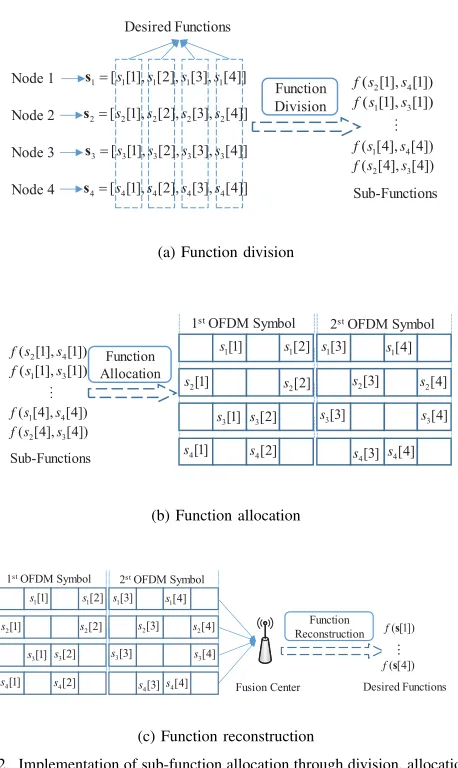
As shown in Fig. 2, sub-function allocation includes three main parts: function division, function allocation, and function reconstruction. We provide a simplified description of sub-function allocation based on the CoMAC-OFDM system as follows.
Sub-Functions Node 1 s1 [ [1], [2], [3], [4]]s1 s1 s1 s1
Node 2 s2 [ [1], [2], [3], [4]]s2 s2 s2 s2
Node 3 s3 [ [1], [2], [3], [4]]s3 s3 s3 s3
Node 4 s4 [ [1], [2], [3], [4]]s4 s4 s4 s4
Function Division
2 4
( [1], [1])
f s s
1 3
( [1], [1])
f s s
1 4
( [4], [4])
f s s
2 3
( [4], [4])
f s s
…
Desired Functions
(a) Function division
1[1]
s s1[2] s1[3] s1[4]
2[1] s
3[2] s
2[3]
s s2[4]
3[1] s
4[1]
s s4[2] s4[3]
3[3] s 2[2] s
4[4] s
3[4] s 1stOFDM Symbol 2stOFDM Symbol
Sub-Functions
2 4
( [1], [1])
f s s
1 3
( [1], [1])
f s s
1 4
( [4], [4])
f s s
2 3
( [4], [4])
f s s
…
Function Allocation
(b) Function allocation
1[1]
s s1[2] s1[3] s1[4]
2[1]
s s2[2] s2[3] s2[4]
3[1]
s
4[1]
s s4[2] s4[3]
3[3]
s
3[2]
s
4[4]
s
3[4]
s
1stOFDM Symbol 2stOFDM Symbol
( [1])
fs
( [4])
fs
瀖
Desired Functions Function
Reconstruction
Fusion Center
[image:7.612.65.294.64.448.2](c) Function reconstruction
Fig. 2. Implementation of sub-function allocation through division, allocation and reconstruction of function in CoMAC-OFDM.
vector si. Then, 4 desired functions are divided into 8
sub-functions, which means that only 2 chosen nodes participate in the computation for a given sub-function. • Function Allocation. Each sub-function is only allocated
to the sub-carrier where the channel gains of the chosen nodes are the largest. For a sub-function f(s1[4], s4[4]) in Fig. 2b, the chosen nodes are Node 1 and Node 4. When the channel gains of Nodes 1 and 4 are the largest ones in the third sub-carrier at the second OFDM symbol, e.g., |h1| ≥ |h4| ≥ |h2| ≥ |h3|, the sub-function f(s1[4], s4[4]) should be assigned to this sub-carrier. After function allocation, all the nodes transmit the corresponding OFDM symbols over the air.
• Function Reconstruction.In Fig. 2c, two OFDM symbols are received at the fusion center, and each sub-function can be obtained in each sub-carrier. Then, 4 desired functions can be reconstructed using 8 received sub-functions.
However, the above description of sub-function allocation is ideal, and the following practical issues should be addressed.
i. The order of the channel gains at each sub-carrier is ran-dom and depends on the channel realizations in practice.
This means that rules for sub-function allocation should be established.
ii. The above description ignores the encoding and decoding of the nested lattice code. How to employ sequences of nested lattice codes in sub-function allocation needs to be addressed.
Further discussion on solving these issues is in Section IV-C.
B. Computation Rate for Sub-Functions
As shown in Section IV-A, the fusion center computes one sub-function at a sub-carrier. Each sub-function is only allocated to the sub-carrier where the channel gains of the chosenM nodes are theM largest ones. The indexes of those chosen nodes are in a set{Iig[m]}Mi=1for theg-th sub-carrier at them-th OFDM symbol. For the sake of fairness, we assume the bandwidth of CoMAC-OFDM withN sub-carriers is the same as the bandwidth of CoMAC-SC. Thus, the bandwidth of the sub-carrier is N1 of the total bandwidth, and the noise power in a carrier scales down with the number of sub-carriers N. Then, the computation rate of a sub-function at them-th OFDM symbol can be given as follows.
Lemma 1: As the length of block code n → ∞, the instantaneous computation rate of a single sub-function in the g-th sub-carrier at them-th OFDM symbol with additive white Gaussian noise and unit variance is given as
Rρ,g[m] =
1
NC +
N
M +Ni∈min[1:M] h
|hIg i[m]|
2P Ig
i[m]
i
,
(13)
wherehIg
i[m]is the frequency response of theg-th sub-carrier
for nodeIig[m](see Eq. (5)) andPIg
i[m]is the allocated power
of theIig[m]-th node in theg-th sub-carrier at them-th OFDM symbol.
Proof: [15, Theorem 4 and Eq. (85)] shows that the computation rate with a noise power of σZ2 and the symbol power ofP is given as
R=C+
1
σ2 Z
kak2− P
hHa
2
1 +Pkhk2
!−1
, (14)
whereais the equation coefficient vector andhis the channel coefficient vector with±1entries.
By settingσ2Z= N1,a=hand using [15, Theorems 4 and 11], the computation rate can be written as
R=C+
N
M +N P
. (15)
Then, by combining Eq. (15) with [16, Theorem 3], the instantaneous computation rate in fading MAC with additive white Gaussian noise whose power is N1 can be expressed as
R[t] =C+
N
M +Ni∈min[1:M]
|hIi[t]|
2P Ii[t]
(16)
number of function values in a sub-carrier is N1 of the number of function values in single carrier referred to Definition 5, which means that the computation rate of a sub-carrier is N1 of the computation rate in Eq. (16). In conclusion, Lemma 1 has been proved.
C. Reconstruction of Sub-Functions
Only M nodes are chosen from all K nodes to compute a sub-function, which means there needs to be B = MK sub-functions to reconstruct a desired function. τ denotes a set where the elements are the indexes of the M chosen nodes for a sub-functionf {si[j]}i∈τ
(see Definition 3). Then, the set
S={τ ⊆[1 :K] :|τ|=M} (17)
includes all the possible sub-functions1, and the cardinality of
S is|S|= K M
. According to Definition 3, the sub-functions can be reconstructed into the desired function if and only if
SB
u=1τu = [1 :K], τuTτv =∅ for all u, v ∈ [1 : B] and τu, τv∈ S. We define
Q=
(
ρ={τ1, τ2,· · ·, τB}: B [
u=1
τu= [1 :K], τu∈ S )
,
(18) which contains all possible combinations that can be used to reconstruct the desired function, and |Q|=QB−1
l=0
K−M l M
. Within our design, the length-n block code is transmitted throughTsOFDM symbols. In order to simplify the derivation, the number of OFDM symbols is Ts = Nn instead of dNne in Eq. (4), which further implies that the number of all the sub-carriers during Ts OFDM symbols is n. Based on sub-function allocation, all the sub-carriers should be assigned to a sub-function. The setMτ for allτ ∈ S includes those sub-carriers that are assigned to sub-function τ. We let a set Mτ ρ include the sub-carriers that are from Mτ and allocated to the combination ρ∈ Q that contains the corresponding sub-functionτ.
As mentioned in Issue i, Section IV-A, the order of the indexes for Knodes in each sub-carrier is random depending on channel realizations in practice. It means that the number of the sub-carriers inMτ is random. Thus, we use the following lemma to characterize the minimum deterministic values of
|Mτ|and
Mτρ
.
Lemma 2: Whennis large, for allρ∈ Qandτ ∈ρ, each setMτ
ρ contains
Mτρ
=
|Mτ|
B|Q||S| = n
B|Q| (19)
sub-carriers.
Proof: The probability,Pr({Iig[m]}Mi=1=τ), for allτ∈ S is |S|1 since channel gains are i.i.d. in theg-th sub-carrier at
the m-th OFDM symbol. Thus, |Mτ|
n =
1
|S| holds depending on [31, Lemma 2.12]. It shows|Mτ|= |S|n for allτ ∈ Sasn
increases. Besides, in the setQ, there areB|Q||S| combinations
1For easy presentation, we use the element τ ∈ S stands for the sub-functionf {si[j]}i∈τ
which is computed by these nodes inτ.
which includeτ as an element for allτ∈ S. Therefore, each combinationρincluding sub-functionτis assigned |Mτ|
B|Q||S| sub-carriers.
According to the definition of Mτ
ρ, we find that there are
Mτρ
sub-carriers that are used to transmit sub-functionτ in the combination ρ over Ts OFDM symbols. It also implies that the length of the transmitted signal vector of each node for sub-function τ ∈ρ is Mτρ
. To simplify the derivation,
the transmitted signal vector is sent centrally inTρ=
|Mτ ρ|
N
OFDM symbols. From Eq. (5), the received vector for sub-function τ based on the combination ρ at the m-th OFDM symbol in the frequency domain can be given as
Yρτ[m] =X
i∈τ
Vi,ρτ[m]Xi,ρτ [m]Hi,ρτ [m] +Wρτ[m]. (20)
Then from Eq. (5), the received signal ing-th sub-carrier can be given as
yρ,gτ [m] =X
i∈τ
xτi,ρ,g[m]vi,ρ,gτ [m]hτi,ρ,g[m] +wτi,ρ,g[m]
=X
i∈τ
xτi,ρ,g[m]h0i,ρ,gτ [m] +wi,ρ,gτ [m], (21)
where h0τ
i,ρ,g[m] = |hτi,ρ,g[m]| q
Pτ
i,ρ,g[m]. From the conclu-sion of Lemma 1 and Eqs. (20) and (21), the average rate for computing a sub-functionf {si[j]}i∈τ
duringTρOFDM symbols is given as
Rρ=
1
Tρ Tρ X
m=1
1
N N X
g=1
C+
N
M +Nmini∈τ
|hi,g[m]|2Pi,g[m]
(a)
= 1
Tρ Tρ X
m=1
1
N N X
g=1
Rρ,g[m], (22)
where the condition(a)follows because{Iig[m]}Mi=1=τ. Note that we employ a nested lattice code in the proposed system and the length of the transmitted signal vector of each node in τ ∈ ρ is Mτρ
. In order to satisfy this length for the transmitted signal vector, the corresponding length
of the data vector should be Uρ =
Rρ|Mτρ|
H(f(bv)) depending on Definition 5, which addresses Issue ii, Section IV-A. Thus, a desired function f(s[j]) reconstructed by combination ρ can be described as fc(
f({si[j]}i∈τ) τ∈ρ) (see Definition 3), and the number of desired function values reconstructed by combination ρ is Uρ. Then, the number of desired function values for allρ∈ Qis
Td = X
ρ∈Q Uρ
=X
ρ∈Q Rρ
Mτρ
H(f(bv))
during Ts OFDM symbols. As a result, the computation rate based on Definition 5 for computing the desired function via CoMAC-OFDM
R= lim
n→∞
Td
n H(f(bv))
(a)
= lim n→∞ X ρ∈Q Rρ
Mτρ
H(f(bv))
n H(f(bv))
(b)
= lim
n→∞
1
B
1
Tρ|ρ| |Q| X
ρ∈Q X
τ∈ρ Tρ X m=1 1 N N X g=1
Rρ,g[m]
(c)
= lim n→∞ 1 BN 1 Ts Ts X m=1 N X g=1
Rρ,g[m]
(d)
= 1 BNE "N X g=1 Rρ,g #
is achievable as n increases where the condition (a) follows because of Lemma 2 and Eq. (23), the condition (b) follows from Eq. (22), the cardinality ofρis|ρ|=Bfrom Eq. (18), the condition (c) follows while Ts =TρB|Q|and the condition
(d) follows due to the increase in n. Hence, Theorem 3 has been proved.
V. POWERALLOCATION FORSUB-FUNCTION
ALLOCATION
In this section, we propose two power allocation methods to implement CoMAC-OFDM with sub-function allocation. For average power allocation, the achievable rate is given in Section V-A. We further consider an optimization problem and propose a sponge-squeezing algorithm which provides a simple and concise interpretation of the necessary optimality conditions based on the solution in Section V-B.
A. Average Power Allocation
Based on sub-function allocation discussed in Section IV-A, we propose a power allocation method with an average power constraint.
LetPi,g[m]represent the transmitted power in theg-th sub-carrier at the m-th OFDM symbol for the node i, which can be given as
PIg i[m] =
c|hI g M[m]|
2
|hIg i[m]|
2 i∈[1 :M]
0 i∈[M+ 1 :K]
, (24)
where c is a constant that needs to be determined later. Considering the average power in the g-th sub-carrier at the m-th OFDM symbol, i.e.,E[xi,g[m]] = PN, we have
E[Pi,g[m]] = K X
j=1
Pr(i=Ijg[m])E[Pi,g[m]|i=I g j[m]]
= c K M X j=1 E "
|hIg M[m]|
2
|hIg i[m]|
2 #
= P
N. (25)
Then, we can calculate
c= P K
N M X j=1 E "
|hIg M[m]|
2
|hIg j[m]|
2
# (26)
and set
PIg i[m] =
KP|hI g M[m]|
2
|hIg i[m]|
2 N M X j=1 E "
|hIg M[m]|
2
|hIg j[m]|
2
# i∈[1 :M]
0 i∈[M + 1 :K]
.
(27) We further put PIg
i[m] from Eq. (27) into Eq. (8) in
Theorem 3, then the computation rate for CoMAC-OFDM with sub-function allocation can be written as
RC2= M KNE N X g=1 C+ N M +
KN P|hIg M|
2
NPM j=1E
" |hIg
M|
2
|hIg j| 2 #
(a)
= M KE C+ N M +
|hIM|
2KP
ME
|hIM|
2
|h|2 , (28)
where the condition(a)follows because the channel gains in different sub-carriers are i.i.d. random variables. In conclusion, Eq. (28) is achievable asTsincreases (see Theorem 3), which completes the proof of Corollary 2. Particularly, Corollary 1 can be proved by settingM =K, which means that a whole desired function is allocated to each sub-carrier.
We assume that the fusion center should have the global channel state information (CSI), whereas each node needs to know its own CSI. The following signaling procedure briefly explains how CoMAC-OFDM works with average power allocation2.
Step 1. The fusion center broadcasts a pilot signal to all nodes, and each node calculates its own CSI at the same time. Step 2. The fusion center collects theN channel gains from
each node.
Step 3. The fusion center calculates the M-th channel gain
|hIg M[m]|
2 in the ordered channel gains and obtains
the setτ ={Iig[m]}Mi=1including theM indexes with the large channel gains at the g-th sub-carrier. Step 4. The fusion center broadcasts|hIg
M[m]|
2and the ID of
τ to all nodes3 at the same time.
Step 5. The fusion center chooses a setρwhich includes the set τ and has not been broadcast for τ. If each ρ including τ has already been broadcast for τ, then a
2The signaling procedure is also used for the optimal power allocation in
the following sub-section.
new round begins, and it repeats the method to choose theρ. Such a setρis expressed asρr
q, whererstands for the r-th round and q stands for the index of the element in the set Q.
Step 6. The fusion center broadcasts the ID of the chosen ρq to all nodes at the same time.
Step 7. Each node finds the set τ through the corresponding ID in its memory. Also, the setρq is obtained through the corresponding ID.
Step 8. The node in the set τ is active to record the number of times when the correspondingρq has already been broadcast in order to obtain the number of the rounds r. Then, ρr
q can be obtained in these active nodes. Step 9. The node i in the set τ is active to transmit the
signal xτ
i,ρ, which is the [(r−1)|Q|+q]-th element in the transmitted vector xi with the transmitted
power through Eq. (27), where PM j=1E
|h
Ig
M
[m]|2
|hIg j
[m]|2
is a deterministic value independent of instantaneous channel gains.
Step 10. The fusion center records the valueyτ ρr
q computed by
the setτ in the specific combinationρrq. Step 11. The fusion center reconstructs yρr
q by yρrq = P
τ∈ρqy
τ ρr
q after all parts have been received.
Step 12. The fusion center reconstructs the desired functions using the whole received vectory.
Using this procedure, all the desired functions can be reconstructed correctly after decoding, since each yρr
q is
re-constructed correctly.
B. Optimal Power Allocation
In the above analysis, we demonstrated the computation rate of CoMAC-OFDM with average power allocation. We further find that the computation rate considering the average power constraint for each node in each sub-carrier is not optimal, since adaptive power allocation can provide a more precise control of the power. Therefore, we formulate an optimization problem and propose an algorithm called sponge-squeezing based on the solution.
1) Problem Formulation: Corollary 3 shows that the com-putation rate in fading MAC is the mean of the instantaneous computation rates, which means Eq. (8) can be rewritten as
R= 1
Ts Ts X
m=1
R[m], (29)
where the instantaneous computation rate at the m-th OFDM symbol is
R[m] = M
KN N X
g=1
C+
N
M +Ni∈min[1:M] h
|hIg i[m]|
2P Iig[m]
i
.
(30)
This implies that our power allocation should focus on the current OFDM symbol depending on the channel gains of each
sub-carrier. Thus, the optimization problem with sub-function allocation is given as
maximize
PIg i
[m] R[m]
s.t. N X
g=1
Pi,g[m]≤P ∀i∈[1 :K]. (31)
From Eq. (30), we find that the problem is difficult to solve, because theminfunction is nested inside the log function in the objective function, and the ordered indexes{Iig[m]}i∈[1:M]
also bring difficulty. In order to make it tractable, we introduce aK×N sub-function allocation matrixω, and each element is given as
ωIg i,g[m] =
(
1 i∈[1 :M]
0 i∈[M + 1 :K] ∀g∈[1 :N]. (32)
Furthermore, mini∈[1:M] h
|hIg i[m]|
2P Ig
i[m] i
in Eq. (30) im-plies that the computation rate is only determined by the node with the minimum product among the M chosen nodes in theg-th sub-carrier. This means that other nodes do not need to put much power to this sub-carrier except for the node with the minimum product, and the unused power can be allocated to other sub-carriers to improve the rate. Thus, we use the level ηg[m] to replace the min function by making
|hIg i[m]|
2P
Igi[m] = ηg[m] for all i ∈ [1 : M] in the g-th sub-carrier. Then, the optimization objective can be written as
RC3[m] = M KN
N X
g=1
C+
N
M +N ηg[m]
. (33)
Therefore, the problem can be expressed as:
maximize
ηg[m]
RC3[m]
s.t. N X
g=1
Gi,g[m]ηg[m]ωi,g[m]≤P ∀i∈[1 :K],
(34)
whereηg[m]≥0 andPi,g[m]≥0 are necessary, Gi,g[m] =
1/|hi,g[m]|2, Pi,g[m] = Gi,g[m]ηg[m] and ωi,g[m] is the element of the sub-function allocation matrix in the m-th OFDM symbol.
Note that the objective function in Eq. (34) is concave since it is a sum of log functions, which are concave themselves. Besides, the constraint set is convex as it is composed of linear constraints. Hence, the above optimization problem is a convex optimization problem, and has a unique maximum. The Lagrangian function
(35)
L= M
KN N X
g=1
C+
N
M +N ηg[m]
−
K X
i=1 µi
N X
g=1
with the complimentary slackness condition
µi N X
g=1
Gi,g[m]ηg[m]ωi,g[m]−P !
= 0 ∀i∈[1 :K]
(36) is given, where {µi} are Lagrange multipliers.
We apply the KKT optimality conditions to the Lagrangian function to obtain the optimal levelηg∗[m]for allg∈[1 :N]in terms of the Lagrange multipliers {µi}
K
i=1. Then, the optimal level η∗
g[m] is expressed as
ηg∗[m] = max
0, vg−
1
M
, (37)
where
vg=
M
KNPK
i=1µiGi,g[m]ωi,g[m]
, (38)
while ηg∗[m]satisfies
K
max
i=1
"N
X
g=1
Gi,g[m]ηg[m]ωi,g[m] #
−P = 0. (39)
Note that the optimal level ηg∗[m] is determined by the dot product of the Lagrange multiplier vector and the channel gain vector, which is different from a family of water-filing solutions [32] determined by the single Lagrange multiplier or the sum of the Lagrange multiplier vector.
Eqs. (37) and (39) also imply that the optimal power in each sub-carrier for each node is
Pi,g∗ [m] =Gi,g[m]ηg∗[m]ωi,g[m]. (40)
In conclusion, Corollary 3 holds.
The signaling procedure for optimal power allocation is similar to the procedure for average power allocation in Sec-tion V-A. The difference is that the fusion center, considering optimal power allocation, needs to broadcast the optimal level η∗g[m]to all nodes at the same time.
2) Sponge-Squeezing: According to the optimal solution proposed in Eqs. (37), (38) and (40), the solution is quite different from the solution of the conventional power allo-cation with OFDM [32], since the solution to our problem is determined by the dot product of the Lagrange multiplier vector and the channel gain vector, whereas a family of water-filing solutions [32] are determined by the single Lagrange multiplier or the sum of the Lagrange multiplier vector. This means that the classical water-filling algorithm cannot be used to solve this problem. Even if the above optimization problem, i.e., a convex optimization problem, is solved by some math-tools such as CVX and MATLAB through gradient descent or interior point method, the performance of such method decreases rapidly as the number of sub-carriers N and the number of nodes K increase. Thus, we propose an algorithm called sponge-squeezing based on the KKT optimality con-ditions, which can achieve the same accuracy as CVX and improve the performance.
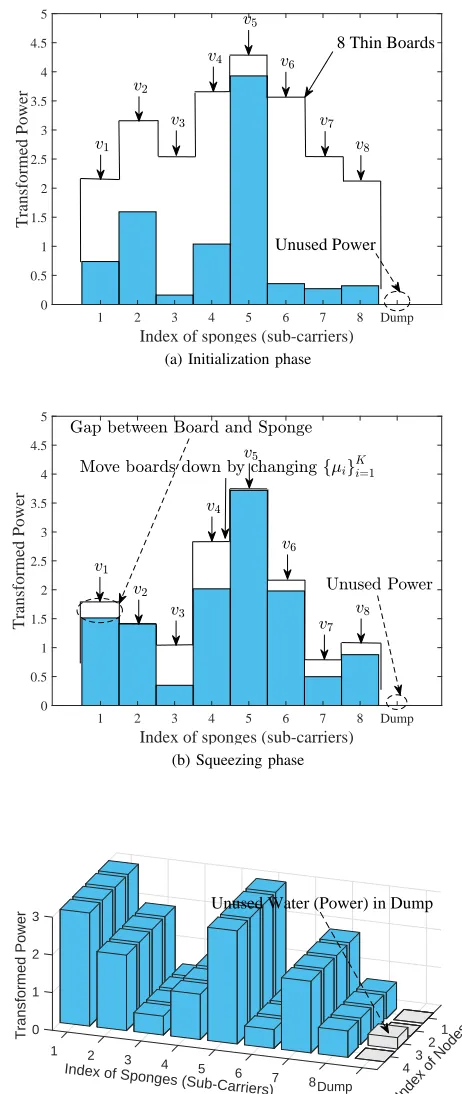
The principle of the algorithm, sponge-squeezing, can be summarized as follows. For any node i, it owns N sponges which stand forN sub-carriers. And the volume of water that a node owns is P, which stands for the power of the node
1 2 3 4 5 6 7 8 Dump
Index of sponges (sub-carriers)
0 0.5 1 1.5 2 2.5 3 3.5 4 4.5 5
Transformed Power
8 Thin Boards
Unused Power
(a) Initialization phase
1 2 3 4 5 6 7 8 Dump
Index of sponges (sub-carriers)
0 0.5 1 1.5 2 2.5 3 3.5 4 4.5 5
Transformed Power
(b) Squeezing phase
1 0
2 1
Index of Nodes
Transformed Power
2
1 3
3 2 3
Index of Sponges (Sub-Carriers)4 5 6 4
7 8Dump
Unused Water (Power) in Dump
[image:11.612.322.553.105.652.2](c) Termination phase
i. Each sponge can swell and become higher after absorbing water. Moreover, different sponges have different swell factors
depending on G 1
i,g[m]ωi,g[m] (see Eq. (40)) for the node i in
[image:12.612.321.540.63.222.2]the g-th sponge. Then, put these sponges into the containeri. Initialization phase. Nodei pours water into the container, and each sponge can evenly absorb water of which the volume is NP. Because of the different swell factors, each sponge reaches different height after absorbing water. We place N thin boards above these containers and the height of the g -th -thin board depends on vg (see Eq. (38)). As shown in Fig. 3a, a node has 8 sponges, and different sponges reach different heights after absorbing the same volume of water. Meanwhile, there are 8 thin boards over these sponges with different heights.
Squeezing phase. We change the value of these Lagrange multipliers{µi}
K
i=1, and all these thin boards start to fall and reach new heights. Note that some boards may fall fast and others fall slow due to vg. When a thin board presses on the sponge, some water in this sponge is squeezed out and is absorbed by other sponges in this container. And the lower the thin board is, the more water the sponge squeezes out. If all these sponges are pressed under these boards, the unused water is put into the dump.
Termination phase. We move these boards down until there is no gap between these boards and every sponge for every node while at least one dump is empty to satisfy Eq. (39). The result with 4 nodes is shown in Fig. 3c.
VI. SIMULATIONRESULTS ANDDISCUSSIONS
In this section, we provide some simulation results of the computation rate under sub-function allocation based on CoMAC-OFDM and compare it with these CoMAC-SC schemes. In our simulation, the average signal-to-noise ratio (SNR) is the same as P because the variance of the noise is set to one. We consider i.i.d. Rayleigh fading channel, i.e., the exponential distribution with parameter one, in each sub-carrier and each OFDM symbol. For easy presentation, the abbreviation for sub-function allocation, average power allocation and optimal power allocation are SFA, APA and OPA, respectively.
The rate of CoMAC-OFDM with SFA and APA in Corollary 2 with respect to M and N is shown in Fig. 4. Under sub-function allocation, M nodes participate in the computation of a sub-function. As the number of sub-carriersN increases, the computation rate increases. Due to the optimal power allocation, the rate of CoMAC-OFDM with SFA and OPA always outperforms others. By setting N = 1 for OFDM with SFA and APA, the rate of opportunistic CoMAC-SC in Theorem 2 is a special case. Furthermore, this shows that there is an optimalM to achieve the largest computation rate with a fixed N, which also means that the computation rate is determined by the number of sub-functions B=MK.
Since the number of sub-functionsBdetermines the compu-tation rate, it is necessary to find the optimalB. In Fig. 5, the relationship between the number of nodes Kand the number of sub-functions B is given. When K is small, we find that there is no need to divide the desired function into several
1 20 40 60 80 100 120
0 0.5 1 1.5 2 2.5 3 3.5 4
Fig. 4. Computation rates with respect toM andN whenK= 128, P = 10 dB.
8 10 100 1000 4000
1 1.1 1.2 1.3 1.4 1.5 1.6 1.7
Fig. 5. Optimal number of sub-functions with respect toK andN when
P= 10 dB.
sub-functions. However, for a largeK(i.e, 4000), the number of sub-functions B increases and converges to 2 because B belongs to N. The result demonstrates that sub-function allocation is necessary to approach the largest computation rate. Furthermore, with the sameP, CoMAC-OFDM with SFA and OPA can use fewer sub-functions since the optimal power allocation provides a more precise way to allocate power to each node. Due to the reconstruction with fewer sub-functions, CoMAC-OFDM with SFA and OPA can provide an improved performance compared with CoMAC-OFDM with SFA and APA.
In addition, considering average power allocation, we com-pare CoMAC-OFDM with CoMAC-SC. As shown in Fig. 6, the rate of direct CoMAC-SC is the worst one and converges to 0 rapidly as K increases. The rate of direct CoMAC-OFDM is improved asN increases compared with the rate of direct CoMAC-SC. However, it still cannot avoid a vanishing computation rate asK increases. Moreover, the result shows that CoMAC-OFDM with SFA and APA can provide a non-vanishing computation rate like opportunistic CoMAC-SC as
[image:12.612.326.553.280.447.2]16 100 1000 0
1 2 3 4 5 6
Vanishing Computation Rate Non-Vanishing Computation Rate
Fig. 6. Comparison between CoMAC-OFDM and CoMAC-SC whenP = 10 dB.
8 10 100 1000
2 3 4 5 6 7 8
[image:13.612.63.283.65.235.2]Non-Vanishing Computation Rate
Fig. 7. Comparison between optimal power allocation and average power allocation in CoMAC-OFDM with sub-function allocation whenP= 10 dB.
achieve a higher computation rate as N increases. Further-more, opportunistic CoMAC-SC is a special case by setting
N = 1 in CoMAC-OFDM with SFA and APA.
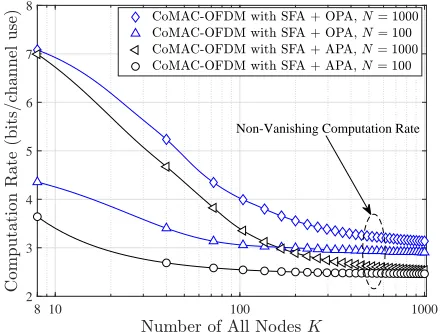
In Fig. 7, CoMAC-OFDM with SFA and OPA provides a higher rate than CoMAC-OFDM with SFA and APA. It shows that the computation rate can be further improved by optimal power allocation and also provide a non-vanishing computation rate as K increases.
Finally, the complexity of the proposed optimal power allo-cation versus the average power alloallo-cation is shown in Fig. 8. For CoMAC-OFDM with SFA and OPA, we compare our sponge-squeezing algorithm with CVX. By setting the same accuracy, i.e.,10−4as the stopping criterion for the iterations, we ran both algorithms on a desktop with 2.40-GHz CPU. This shows that the sponge-squeezing algorithm has a faster speed than CVX. When the number of sub-carriers increases, the advantage of the sponge-squeezing algorithm becomes more obvious. Since we provide a closed-form expression, i.e., Eq. (27), for CoMAC-OFDM with SFA and APA, the complexity of it is very small, and most of the time that it
10 20 30 40 50 60 70 80 90 100 110
10-3 10-2 10-1 100 101 102
CoMAC-OFDM with SFA + APA via closed-form expression CoMAC-OFDM with SFA + OPA via CVX
[image:13.612.319.542.65.232.2]CoMAC-OFDM with SFA + OPA via Sponge-Squeezing
Fig. 8. Complexity of the optimal power allocation versus the average power allocation.
takes is to sort the channel gains in each sub-carrier.
VII. CONCLUSION
In this paper, we have studied CoMAC for wide-band transmission, and focused on designing a framework of Co-MAC that can combat frequency-selective fading and van-ishing computation rate. To tackle these problems, we have utilized OFDM in CoMAC. CoMAC-OFDM cannot execute conventional bit allocation in different sub-carriers, because it aims at transmitting a desired function over the air instead of bit sequences. Hence, a novel sub-function allocation has been proposed to handle this issue through the division, allocation and reconstruction of functions. The theoretical expression of achievable computation rate has been derived based on the classical results of nested lattice coding, which provides a non-vanishing computation rate as the number of nodes increases. Furthermore, we have discussed an optimization problem, and a sponge-squeezing algorithm extended from the classical water-filling algorithm is proposed to carry out the optimal power allocation method. The results have showed that the computation rate can be improved by optimal power allocation, and a non-vanishing computation rate is also provided as K increases.
ACKNOWLEDGMENT
The authors would like to thank Dr. Adam Noel for his advice and proofreading of our manuscript.
REFERENCES
[1] G. Fettweis and S. Alamouti, “5G: Personal mobile internet beyond what cellular did to telephony,” IEEE Commun. Mag., vol. 52, no. 2, pp. 140–145, 2014.
[2] A. Al-Fuqaha, M. Guizani, M. Mohammadi, M. Aledhari, and M. Ayyash, “Internet of things: A survey on enabling technologies, protocols, and applications,” IEEE Commun. Surv. Tutorials, vol. 17, no. 4, pp. 2347–2376, 2015.
[3] A. Gupta and R. K. Jha, “A survey of 5G network: Architecture and emerging technologies,”IEEE access, vol. 3, pp. 1206–1232, 2015. [4] M. Goldenbaum, H. Boche, and S. Sta´nczak, “Nomographic functions:
[image:13.612.63.283.289.457.2][5] M. Goldenbaum and S. Stanczak, “Robust analog function computation via wireless multiple-access channels,”IEEE Trans. Commun., vol. 61, no. 9, pp. 3863–3877, 2013.
[6] O. Abari, H. Rahul, and D. Katabi, “Over-the-air function computation in sensor networks,”arXiv preprint arXiv:1612.02307, 2016.
[7] M. Goldenbaum and S. Stanczak, “On the channel estimation effort for analog computation over wireless multiple-access channels,”IEEE Wireless Commun. Lett., vol. 3, no. 3, pp. 261–264, 2014.
[8] A. Kortke, M. Goldenbaum, and S. Sta´nczak, “Analog computation over the wireless channel: A proof of concept,” inSENSORS, 2014 IEEE. IEEE, 2014, pp. 1224–1227.
[9] G. Zhu, L. Chen, and K. Huang, “Over-the-air computation in MIMO multi-access channels: Beamforming and channel feedback,” arXiv preprint arXiv:1803.11129, 2018.
[10] L. Chen, N. Zhao, Y. Chen, F. R. Yu, and G. Wei, “Over-the-air computation for IoT networks: Computing multiple functions with antenna arrays,”IEEE IoT J., vol. 5, no. 6, pp. 5296–5306, 2018. [11] B. Nazer and M. Gastpar, “Computation over multiple-access channels,”
IEEE Trans. Inf. Theory, vol. 53, no. 10, pp. 3498–3516, 2007. [12] R. Appuswamy and M. Franceschetti, “Computing linear functions by
linear coding over networks,”IEEE Trans. Inf. Theory, vol. 60, no. 1, pp. 422–431, 2014.
[13] U. Erez, S. Litsyn, and R. Zamir, “Lattices which are good for (almost) everything,”IEEE Trans. Inf. Theory, vol. 51, no. 10, pp. 3401–3416, 2005.
[14] L. Chen, X. Qin, and G. Wei, “A uniform-forcing transceiver design for over-the-air function computation,”IEEE Wireless Commun. Lett., vol. 7, no. 6, pp. 942–945, 2018.
[15] B. Nazer and M. Gastpar, “Compute-and-forward: Harnessing interfer-ence through structured codes,”IEEE Trans. Inf. Theory, vol. 57, no. 10, pp. 6463–6486, 2011.
[16] S.-W. Jeon, C.-Y. Wang, and M. Gastpar, “Computation over Gaussian networks with orthogonal components,”IEEE Trans. Inf. Theory, vol. 60, no. 12, pp. 7841–7861, 2014.
[17] S. W. Jeon and C. J. Bang, “Opportunistic function computation for wireless sensor networks,” IEEE Trans. Wireless Commun., vol. 15, no. 6, pp. 4045–4059, 2016.
[18] C.-Y. Wang, S.-W. Jeon, and M. Gastpar, “Interactive computation of type-threshold functions in collocated Gaussian networks,”IEEE Trans. Inf. Theory, vol. 61, no. 9, pp. 4765–4775, 2015.
[19] M. Goldenbaum, “Computation of real-valued functions over the channel in wireless sensor networks,” Ph.D. dissertation, Technische Universit¨at M¨unchen, 2014.
[20] D. Tse and P. Viswanath, Fundamentals of wireless communication. Cambridge university press, 2005.
[21] Z. Hasan, G. Bansal, E. Hossain, and V. K. Bhargava, “Energy-efficient power allocation in OFDM-based cognitive radio systems: A risk-return model,”IEEE Trans. Wireless Commun., vol. 8, no. 12, 2009. [22] C. Mohanram and S. Bhashyam, “Joint subcarrier and power allocation
in channel-aware queue-aware scheduling for multiuser OFDM,”IEEE Trans. Wireless Commun., vol. 6, no. 9, 2007.
[23] Y.-F. Chen and J.-W. Chen, “A fast subcarrier, bit, and power alloca-tion algorithm for multiuser OFDM-based systems,”IEEE Trans. Veh. Technol., vol. 57, no. 2, pp. 873–881, 2008.
[24] T. Berger, Z. Zhang, and H. Viswanathan, “The CEO problem [multi-terminal source coding],”IEEE Trans. Inf. Theory, vol. 42, no. 3, pp. 887–902, 1996.
[25] T. A. Courtade and T. Weissman, “Multiterminal source coding under logarithmic loss,”IEEE Trans. Inf. Theory, vol. 60, no. 1, pp. 740–761, 2014.
[26] Y. Ugur, I. E. Aguerri, and A. Zaidi, “Vector Gaussian CEO problem un-der logarithmic loss and applications,”arXiv preprint arXiv:1811.03933, 2018.
[27] I. E. Aguerri, A. Zaidi, G. Caire, and S. S. Shitz, “On the capacity of cloud radio access networks with oblivious relaying,” in2017 IEEE International Symposium on Information Theory (ISIT). IEEE, 2017, pp. 2068–2072.
[28] A. Giridhar and P. R. Kumar, “Computing and communicating functions over sensor networks,”IEEE J. Sel. Areas Commun., vol. 23, no. 4, pp. 755–764, 2005.
[29] J. Zhan, S. Y. Park, M. Gastpar, and A. Sahai, “Linear function computation in networks: Duality and constant gap results,” IEEE J. Sel. Areas Commun., vol. 31, no. 4, pp. 620–638, 2013.
[30] N. Ma, P. Ishwar, and P. Gupta, “Interactive source coding for function computation in collocated networks,”IEEE Trans. Inf. Theory, vol. 58, no. 7, pp. 4289–4305, 2012.
[31] I. Csiszar and J. K¨orner, Information Theory: Coding Theorems for Discrete Memoryless Systems. Cambridge University Press, 2011. [32] D. P. Palomar and J. R. Fonollosa, “Practical algorithms for a family of
waterfilling solutions,”IEEE Trans. Signal Process., vol. 53, no. 2, pp. 686–695, 2005.
Fangzhou Wu received the B.S. degree in elec-tronic information engineering from North China Electric Power University, Beijing, China, in 2016. He is currently pursuing the Ph.D. degree with the Department of Electronic Engineering and Infor-mation Science, CAS Key Laboratory of Wireless-Optical Communications, University of Science and Technology of China. His research interests include visible light communications, and wireless commu-nication and computation.
Li Chenreceived the B.E. in electrical and informa-tion engineering from Harbin Institute of Technol-ogy, Harbin, China, in 2009 and the Ph.D. degree in electrical engineering from the University of Science and Technology of China, Hefei, China, in 2014. He is currently an Associate Professor with the De-partment of Electronic Engineering and Information Science, University of Science and Technology of China. His research interests include wireless IoT communications and wireless optical communica-tions.
Nan Zhao(S’08-M’11-SM’16) is currently an Asso-ciate Professor at Dalian University of Technology, China. He received the Ph.D. degree in informa-tion and communicainforma-tion engineering in 2011, from Harbin Institute of Technology, Harbin, China.
Dr. Zhao is serving or served on the editorial boards of 7 SCI-indexed journals, including IEEE Transactions on Green Communications and Net-working. He won the best paper awards in IEEE VTC 2017 Spring, MLICOM 2017, ICNC 2018, WCSP 2018 and CSPS 2018. He also received the IEEE Communications Society Asia Pacific Board Outstanding Young Researcher Award in 2018.
F. Richard Yu (S’00-M’04-SM’08-F’18) received the PhD degree in electrical engineering from the University of British Columbia (UBC) in 2003. From 2002 to 2006, he was with Ericsson (in Lund, Sweden) and a start-up in California, USA. He joined Carleton University in 2007, where he is cur-rently a Professor. He received the IEEE Outstanding Service Award in 2016, IEEE Outstanding Leader-ship Award in 2013, Carleton Research Achievement Award in 2012, the Ontario Early Researcher Award (formerly Premiers Research Excellence Award) in 2011, the Excellent Contribution Award at IEEE/IFIP TrustCom 2010, the Leadership Opportunity Fund Award from Canada Foundation of Innovation in 2009 and the Best Paper Awards at IEEE ICNC 2018, VTC 2017 Spring, ICC 2014, Globecom 2012, IEEE/IFIP TrustCom 2009 and Int’l Conference on Networking 2005. His research interests include wireless cyber-physical systems, connected/autonomous vehicles, security, distributed ledger technology, and deep learning.
He serves on the editorial boards of several journals, including Co-Editor-in-Chief for Ad Hoc &Sensor Wireless Networks, Lead Series Editor for IEEE Transactions on Vehicular Technology, IEEE Transactions on Green Communications and Networking, and IEEE Communications Surveys &
Tutorials. He has served as the Technical Program Committee (TPC) Co-Chair of numerous conferences. Dr. Yu is a registered Professional Engineer in the province of Ontario, Canada, a Fellow of the Institution of Engineering and Technology (IET), and a Fellow of the IEEE. He is a Distinguished Lecturer, the Vice President (Membership), and an elected member of the Board of Governors (BoG) of the IEEE Vehicular Technology Society.