warwick.ac.uk/lib-publications
Original citation:
Crevillén-García, D., Wilkinson, R. D., Shah, A. A. and Power, H.. (2017) Gaussian process
modelling for uncertainty quantification in convectively-enhanced dissolution processes in
porous media. Advances in Water Resources, 99 . pp. 1-14.
Permanent WRAP URL:
http://wrap.warwick.ac.uk/85680
Copyright and reuse:
The Warwick Research Archive Portal (WRAP) makes this work by researchers of the
University of Warwick available open access under the following conditions. Copyright ©
and all moral rights to the version of the paper presented here belong to the individual
author(s) and/or other copyright owners. To the extent reasonable and practicable the
material made available in WRAP has been checked for eligibility before being made
available.
Copies of full items can be used for personal research or study, educational, or not-for-profit
purposes without prior permission or charge. Provided that the authors, title and full
bibliographic details are credited, a hyperlink and/or URL is given for the original metadata
page and the content is not changed in any way.
Publisher’s statement:
© 2017, Elsevier. Licensed under the Creative Commons
Attribution-NonCommercial-NoDerivatives 4.0 International http://creativecommons.org/licenses/by-nc-nd/4.0/
A note on versions:
The version presented here may differ from the published version or, version of record, if
you wish to cite this item you are advised to consult the publisher’s version. Please see the
‘permanent WRAP url’ above for details on accessing the published version and note that
access may require a subscription.
Gaussian Process Modelling for Uncertainty Quantification in
Convectively-Enhanced Dissolution Processes in Porous Media
D. Crevill´en-Garc´ıaa,⇤, R.D. Wilkinsonb, A.A. Shaha, and H. Powerc
aSchool of Engineering, University of Warwick, Coventry CV4 7AL, UK bSchool of Mathematics and Statistics, University of Sheffield, Sheffield S3 7RH, UK
cFaculty of Engineering, University of Nottingham, Nottingham NG7 2RD, UK
Abstract
Numerical groundwater flow and dissolution models of physico-chemical processes in deep aquifers
are usually subject to uncertainty in one or more of the model input parameters. This uncertainty
is propagated through the equations and needs to be quantified and characterised in order to rely
on the model outputs. In this paper we present a Gaussian process emulation method as a tool
for performing uncertainty quantification in mathematical models for convection and dissolution
processes in porous media. One of the advantages of this method is its ability to significantly
reduce the computational cost of an uncertainty analysis, while yielding accurate results, compared
to classical Monte Carlo methods. We apply the methodology to a model of convectively-enhanced
dissolution processes occurring during carbon capture and storage. In this model, the Gaussian
process methodology fails due to the presence of multiple branches of solutions emanating from a
bifurcation point, i.e., two equilibrium states exist rather than one. To overcome this issue we use
a classifier as a precursor to the Gaussian process emulation, after which we are able to successfully
perform a full uncertainty analysis in the vicinity of the bifurcation point.
Keywords: Convectively-enhanced dissolution, Partial di↵erential equations with random inputs,
Multiple solutions and bifurcation, Gaussian process emulation and classification, Uncertainty
quantification.
1. Introduction
Geological storage of CO2in deep saline aquifers is a potential way of limiting greenhouse gas
emis-sions to the atmosphere while continuing the use of fossil fuels. The major spreading and trapping
mechanisms of CO2 in geological media are subject to spatial variability due to heterogeneity of
the physical and chemical properties of the medium. Heterogeneity a↵ects the multi-phase flow
properties of the CO2-brine system and can lead to trapping of brine behind the CO2phase as well
as increased spread of the CO2-brine interface [8]. These heterogeneity-induced processes increase
the CO2-brine contact area and thus the dissolution efficiency of CO2. Dissolution of CO2 into the
resident brine of the storage site causes an increase in the mixture density, which promotes the
sink-ing of the enriched brine-CO2mixture, and results in an enhancement of the dissolution process due
to mixing and recirculation. This process is known as convectively-enhanced dissolution (C-ED).
The mixing of the denser CO2 rich water with the reservoir water is dominated by dispersion and
the interaction with spatial heterogeneity as well as buoyancy e↵ects. The efficiency of the chemical
reactions, which are controlled by mass transfer limitations and interaction with the medium, is also
a↵ected by spatial heterogeneity in the properties of the medium [17]. While heterogeneity can lead
to increased spreading and mixing of waters with di↵erent chemical compositions, chemical reaction
rates for heterogeneous media can be much lower than those in a laboratory setting (homogeneous
conditions) [18].
To the best of our knowledge, there are only a limited number of publications in the literature
(e.g., [24]) dealing with multi-phase flow and reactive transport models of CO2 sequestration and
the associated trapping process, taking into account the impact of heterogeneity on front spreading
and mass transfer between high and low permeability zones of the heterogeneous medium, together
with the impact of physical and chemical heterogeneity on the chemical reactions. Most of the
literature on enhanced dissolution in CO2sequestration is concerned with the time evolution of the
process and not with the analysis of the non-uniqueness of solutions, the corresponding bifurcation
map and the stability of solutions. Moreover, in most of these works only molecular di↵usion is
considered (e.g., [44]), chemical reaction is neglected (e.g., [28]) and the porous medium is taken as
homogeneous (e.g., [26, 56]). In this paper we target the problem of uncertainty quantification in
the C-ED mechanism due to the medium heterogeneity, and taking into account dispersivity and
chemical reaction, by considering possible stable (physically feasible) solutions on a bifurcation map,
i.e., the long term evolution.
The impact of medium heterogeneity could be critical; for instance, for assessing the long-term
fate of the geological storage of CO2 during carbon capture and storage (CCS). One of the main
aims of this paper is to develop computationally feasible methods for investigating the e↵ects of
to an apparent macroscopic dispersive transport, enhancing molecular di↵usion. To date, the
quan-tification of uncertainty arising from heterogeneities in rock properties and temporal fluctuations
has not received much attention in large scale CO2 sequestration modelling. The few studies
con-ducted have used classical Monte Carlo (MC) methods and have required enormous computational
resources due to the slow rate of MC convergence: The error scales according N 1/2, where N is the number of MC samples [13].
The aforementioned uncertainties, normally represented as random inputs within the systems of
partial di↵erential equations (PDEs), may have limited impact on the outputs of interest. If this
can be established, it is not necessary to incorporate them explicitly in the model. Those sources of
uncertainty that do have a significant impact, must, on the other hand, be taken into account. This
is a challenging problem. For instance, for the large-scale, time-dependent simulations that must
be carried out when investigating a CO2 storage site, classical MC simulation will be impractical
unless considerable computing resources are available. Even if such resources are available, they
could be better deployed if more efficient methods are available to solve the random-input model,
e.g., investigating alternative conceptual models and models that incorporate more detailed physical
phenomena.
One method for overcoming the computational resource limitations is to build a statistical
sur-rogate model (or ‘emulator’) for the computer model (the ‘simulator’). In this approach, an
approx-imate mapping between the inputs and outputs is established using a supervised machine learning
method (such as Gaussian process (GP) regression) based on the outputs of the simulator (training
points) from a limited number of simulations. The emulator can then be used as a replacement for
the full simulator in, for instance, a classical MC calculation.
A detailed review of surrogate modelling in groundwater flow modelling is provided in [5]. They
split surrogates into three main categories. (a) Data-driven surrogates. These involve empirical
approximations of the complex model output calibrated on a set of inputs and outputs of the complex
model, for instance neural networks [60], Gaussian processes [31, 6], and polynomial chaos expansions
[32]. (b) Projection-based methods. The governing equation(s) or the spatially discretised system
is projected onto a low-dimensional subspace spanned by a set of orthonormal modes. The most
prominent methods are proper orthogonal decomposition [36] and Krylov-subspace methods [21],
both of which are used to define the approximating basis. Karhunen-Lo´eve (KL) expansions of input fields such as the permeability [32] can also be considered in this category. (c) Multifidelity
(or hierarchical) based surrogates. These are built by simplifying the underlying physics or reducing
the numerical resolution (coarse grids or relaxed error tolerances). They include multigrid methods
[4] and multiscale finite element methods [30].
a novel GP emulation/classification with a KL decomposition to perform uncertainty quantification
(UQ) in a C-ED model with random inputs, where the main source of uncertainty is considered to
be the heterogeneity of the porous rock formation. The model presented here has an infinite number
of stochastic degrees of freedom and will be approximated by a finite number of degrees of freedom
using KL decompositions.
The appearance of multiple solutions around a bifurcation point in the C-ED model (located
using arclength continuation), however, poses challenges for any emulator of the simulator outputs.
GP emulation alone is found to be inaccurate. To overcome the difficulties, we develop an
emula-tion/classification approach that allows us to label (or classify) the variety of outputs for a given
input. Once the output has been classified we can apply GP emulation individually to each of
the classes. A further issue is that the GP emulation training is impractical for the original high
dimensional input space (the number of nodes in the numerical formulation), involving an
optimi-sation over a very large number of hyperparameters. Thus, we exploit the properties of the KL
decomposition to develop computationally efficient emulators.
The outline of this paper is as follows. In Section 2 we present the equations with random inputs
for the model problem, the C-ED process. We present the numerical method used to solve the
system of PDEs with random inputs. In Section 3 we describe the GP emulation methodology and
its application to the model problem, including the combination GP emulation and classification to
reduce the uncertainty in regions where the numerical model returns multiple outputs for a given
input. In Section 4 we define the quantity of interest and present our numerical results. Concluding
remarks are provided in Section 5, together with suggestions for future work.
2. Mathematical model: Surface flux in C-ED processes in porous media
In this section we present the C-ED simulator. The goal of this work is to build a statistical surrogate
model for the simulator which will allow us to perform a full uncertainty analysis on the simulator
outputs.
During CCS processes, the CO2 is trapped in saline geological formations located deep
under-ground. Once there, it reacts with minerals in the geologic formation, leading to the precipitation
of a secondary carbonate mineral [26]. When the CO2 is dissolved into the brine, the density of
the resulting solution is higher than that of brine, and this density di↵erence can engender flow
instabilities that lead to the formation of CO2 downward growing plumes with finger structures.
The descending mixed fluid along the fingers will induce recirculation cells of brine fluid with an
associated fluid entrainment into the fingers. The entrained brine reduces the density di↵erence and
the CO2 concentration at the di↵usive boundary layer, resulting in enhancement of the dissolution
In this paper, the dissolution flux will be characterized by a generalization of the Sherwood
number (see, e.g., [44, 56]), which is a dimensionless measure of the convective flux across the upper
boundary of the domain. We call this quantity the surface flux (S). We will consider the e↵ect
of the porous rock heterogeneity on the C-ED process, in which the solute undergoes a first order
chemical reaction, by investigating how S is a↵ected by rock heterogeneities. Thus, the main goal
of this section will be to quantify the uncertainty in theCO2 dissolution flux into the brine due to
uncertainty in the rock morphology.
The complex microscopic flow in a porous medium leads to an apparent macroscopic dispersive
transport, enhancing the molecular di↵usion. We model this phenomenon by an apparent dispersion
tensor,D, dependant on the local Darcy velocity of the fluid u(see e.g., [49, 51]) as follows:
D=DmI+ T||u||I+ ( L T)
u⌦u
||u|| , (1)
where⌦represents the tensor product,Iis the unit (identity) tensor,Dmis the molecular di↵usion
coefficient of the solute in the fluid, and L and T are respectively the longitudinal and transverse
dispersion coefficients, which satisfy L T 0. We use the rule-of-thumb T = L/10 suggested
in [28], which was based on an analysis by Gelhar et al. [23] of measurements from di↵erent field
sites; realistic ranges of values for the dispersivity coefficients T and L obtained from these field
sites are provided in [23]. A detailed discussion on the influence that these coefficients have on the
enhanced dissolution process is given in [47].
We consider the dissolution of a solute (CO2) in a fluid (brine) flowing in a two-dimensional
domain representing a heterogeneous, isotropic porous medium of depth 2H and length L. The
spatial variable is denotedx= (x, z) on the domain [0, L]⇥[ H, H]. The governing equations used to describe the C-ED process are continuity (2), Darcy’s law (3) and convection-di↵usion-reaction
(4) (for more details see [44, 56, 58]):
r·u= 0, (2)
u= K
µ(rP+⇢gez), (3)
@C
@t +u·rC= r·(DrC) cC. (4)
In these equations, ez is the outward-pointing unit vector along the ordinate axis, C is the
con-centration of dissolved CO2, u= (ux, uz) is the liquid velocity and P is the liquid pressure. The
parametersK,µ, , candgare the medium permeability field, the fluid viscosity, the rock porosity,
the reaction rate and acceleration due to gravity.
In the above system of governing equations, the solute locally increases the solution density of
the fluid, and the linearised density of the fluid takes the form, ⇢ = ⇢0+ cC, where ⇢0 and c
small, which enables us to use the Boussinesq approximation [56]. Moreover, the solute undergoes
a first order reaction and is converted into an inert product with no e↵ect on the solution density.
The above system of PDEs is required to satisfy the following boundary conditions:
C(x, z=H) =C0,
ux(0, z) =ux(L, z) =uz(x,±H) = 0,
@C
@z(x, H) =
@C
@x(0, z) =
@C
@x(L, z) = 0.
(5)
By representing the velocity field using a stream function formulation, ux =@ /@z and uz = @ /@x, where is the streamfunction, it is possible to eliminate the pressure field from the governing equations, resulting in a new set of equations for the unknown field variables ( ,C). The resulting set of governing equations and boundary conditions can be written in a dimensionless form
by defining:
(x0, z0) =(x, z)
H ,
0 = µ
HC0K0 cg
, C0 = C
C0
, t0 =tC0K0 c⇢
µ H , (6)
( 0L, T0) =
( L, T)C0K0 cg
D0µ
, K0 = K
K0
, L= L
H, (7)
Ra= K0C0g cH
µD0
, Da= cµH
K0C0g c
. (8)
T and L are respectively the longitudinal and transverse dispersion coefficients [58, 28];K0 and
D0 are reference permeability and di↵usion coefficients, respectively; L is the aspect ratio of the domain;Rais the Rayleigh number, related to the buoyancy driven flow; andDais the Damkh¨oler number, which is the ratio of the chemical reaction rate to the mass transfer rate [56]. In terms
of these dimensionless variables and numbers, the following dimensionless governing equations are
obtained (where for convenience the primes have been dropped):
@ @x ✓ 1 K @ @x ◆ + @ @z ✓ 1 K @ @z ◆
+@C
@x = 0,
@C
@t
@ @z
@C
@x +
@ @x @C @z 1 Ra
✓@J
x @x +
@Jz @z
◆
+DaC= 0.
9 > > > = > > > ;
x= (x, z)2R= [0,L]⇥[ 1,1]
(9)
The Fickian mass flux J= (Jx, Jz) (Scheidegger-Bear [58]) satisfies J=DrC, the components of
which are expressed in terms of the above dimensionless variables and numbers as follows:
Jx= (1 + T||r ||2) @C
@x +
( L T) ||r ||2
✓ @ @z ◆2 @C @x @ @x @ @z @C @z ! ,
Jz= (1 + T||r ||2)@C @z +
( L T) ||r ||2
where|| · ||2 denotes the standard Euclidean norm. Finally, the corresponding dimensionless form of
the boundary conditions is:
C(x,1) = 1, (x,±1) = (0, z) = (L, z) = 0,
@C
@z(x, 1) =
@C
@x(0, z) =
@C
@x(L, z) = 0.
(11)
Note that the above conditions imply that the flow is solely a result of the density-induced instability
and the concurrent flow recirculation to conserve mass.
The quantity of interest for the C-ED problem will be the surface fluxS. Integrating the second
equation of (9) overRwe obtain:
Z
R @C
@tds
Z
R
✓@
@z
@C
@x +
@ @x @C @z ◆ ds Z R 1 Ra
✓@J
x @x +
@Jz @z
◆
ds+
Z
R
DaCds= 0. (12)
If we now defineM=RRCds, we obtain:
dM dt Z R ✓ @ @z @C @x @ @x @C @z ◆
ds= S
Ra MDa. (13)
Since the second integral in the left hand side is equal to zero we can re-write (13) as:
dM
dt =
S
Ra MDa, (14)
with:
S =
Z
R
✓@J
x @x +
@Jz @z
◆
ds. (15)
Applying the divergence theorem to the integral above, we can finally writeS as,
S=
Z L
0
✓
1 + T @
@z z=1
◆ ✓@C
@z
◆
z=1
dx. (16)
Expression (16) above expresses the fact that the total mass flux across the upper boundary is
due to the combined e↵ect of molecular di↵usion and dispersion, where the dispersion component
( T|@ /@z|) determines the enhanced dissolution e↵ect. Equation (14) shows that the total mass
of solute in the domain increases through solute injection across the upper boundary and decreases
through the first order reaction. We also note that in this particular problem, the more CO2 is
absorbed through the upper boundary, the more the process is considered to be efficient.
Although the mathematical formulation of the problem was described in terms of its transient
formulation, in this work we are interested in the long term behaviour of the system and consequently
we will consider only non-trivial solutions of the corresponding steady state equations.
2.1. Arclength continuation for finding numerical solutions of the C-ED
model
The C-ED problem depends on several scalar parameters that need to be specified before attempting
for a given permeability field, equations (9) are solved for the unknowns ( , C) to yieldS.
The system of equations admits multiple solutions. In other words, for a given permeability field,
there exists more than one streamfunction and concentration field, and therefore more than oneS.
Wardet al. [56], for instance, demonstrated the existence of multiple solutions for each givenRa in
the particular case ofK ⌘1, L = T = 0, andDa= 0.1. The existence of multiple outputs for
the same input adds an additional challenge to the search for numerical solutions other than the
no-flow solution. A numerical code, based on the finite element method (FEM) and detailed further
in Section 4, was used to solve the problem (9). The FEM was only able to find one solution (the
no-flow) for the problem. To find di↵erent solutions, it was necessary to use additional techniques
in conjunction with the FEM. In this work we usedarclength continuation theory, as described in
[12] and which is briefly introduced below.
For varying non-dimensional parameters such as Ra, numerous steady-states of (9) appear
through bifurcations [12, 56, 47, 15]. The purpose of this section is to evaluate the e↵ects that
the heterogeneity of the porous medium has on steady-states solutions; in particular, on the
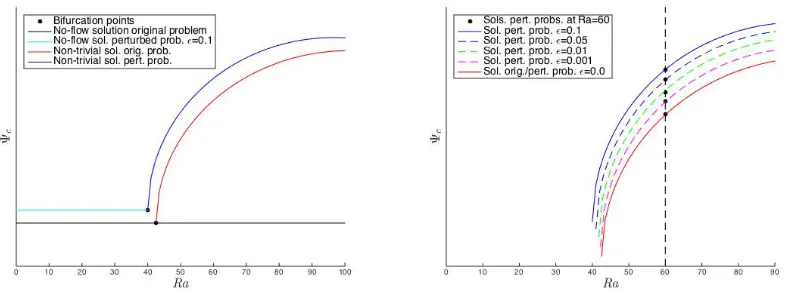
bifur-cations from the no-flow steady-state, as represented in Figure 1.
Let = ( , C) be the state vector and ⌥ = (Ra, Da,L) be the vector of parameters of our model. Then, for given L, T andK, the problem (9) defines a nonlinear time-dependent problem
of the form:
G
✓@
@t
◆
=F( ,⌥)
where:
F( ,⌥) =
0 B B B @ @ @x ✓1 K @ @x ◆ + @ @z ✓1 K @ @z ◆
+@C
@x
@ @z
@C
@x +
@ @x @C @z 1 Ra
✓@J
x @x +
@Jz @z
◆
+DaC
1 C C C A and: G ✓@ @t ◆ = 0 @ @0C
@t
1 A.
The study of steady-states is therefore reduced to the nonlinear problem:
F( ,⌥) =0 (17)
to which we can apply the general bifurcation theory. We can numerically compute paths and
branches of solutions of (17). For each steady-state along the paths, a linear analysis enables us to
determine the linear stability (or instability) of the steady-states. Provided that the Jacobian ofF
exists, the linearization about (solution of (17)) of the equation for the perturbation is:
G
✓@ 0
@t
◆
= @F
@ ( ,⌥)
From the above considerations, we can analytically compute the no-flow steady-state:
= 0, C(z) =cosh( p
RaDa(z+ 1))
cosh(2pRaDa) , (18)
which is a solution of (17) for all ⌥. This solution corresponds to pure di↵usion-reaction of the
solute in the domain. The above base solution is unstable for certain parameter values and new
bifurcation branches of stable steady state solutions can appear (non-trivial solutions). Under steady
state conditions, the mass balance equation (14) reduces to: S =RaDaM. SinceRa andDa are parameters of the model, and recalling thatM=RRCds, this shows thatSis directly proportional to M. For computingS, therefore, it is sufficient to solve equations (9) for andC, followed by the application of equation (14).
Using equation (18), the total mass of solute inRcorresponding to the base steady solution is:
M0=
Z
R
C0dx=Ltanh(2
p
RaDa) p
RaDa , (19)
which is independent of the permeability field, increases with the aspect ratioLand decreases with
the magnitudes ofRaandDa. This value ofM0is due only to the dissolution of the solute across the upper boundary. This is not, however, the case for non-trivial solutions, for which the surface
dissolution flux varies according to the values of the permeability field. In the case of non-trivial
solutions, the surface dissolution flux is enhanced by the e↵ect of the convective recirculating flow, in
which the flow intensity depends on the magnitude and spatial variation of the medium permeability.
The system studied in this paper undergoes a bifurcation, namely the appearance of multiple
solutions (more than one equilibrium state) for values ofRa above a critical value. At the critical value, a supercritical pitchfork bifurcation (first bifurcation) occurs and two additional branches of
stable solutions appear (see Figure 1). Further bifurcations can take place for higher values ofRa, leading to more stable and unstable solutions. For a detailed analysis of the evolution of bifurcations
in porous media convection the reader is referred to, e.g., [46, 56, 47, 15]. All of the stable solutions,
corresponding to di↵erent bifurcation branches, are physically feasible and which one is observed in
reality depends on the e↵ects of natural perturbations occurring during the time evolution process.
Figure 1 shows a representation of the solution bifurcation map, i.e., all stable and unstable
solutions, found with our numerical scheme for the C-ED problem in a homogeneous medium for
di↵erentRaandDafixed. The reference value to characterise each computed solution was the value of the streamfunction (velocity) at the center of the domain, c, according to the correspondingRa.
Note that forRa <42.5, i.e., below the numerically computed bifurcation point, all solutions have the same streamfunction constant value at the centre of the domain, corresponding to the no-flow
base solution corresponds to the lower bound of capture given that the uptake of the solute increases
as soon as convection occurs in the domain. For more details regarding the bifurcation problem, we
[image:11.612.200.414.140.314.2]refer the reader to [12, 56].
Figure 1: Bifurcation diagram with respect toRafor a homogeneous permeability field. The black lines correspond
to steady-state solutions of the streamfunction at the center of the domain. The other model parameters areK⌘1,
Da= 0.1 and T = L= 0.
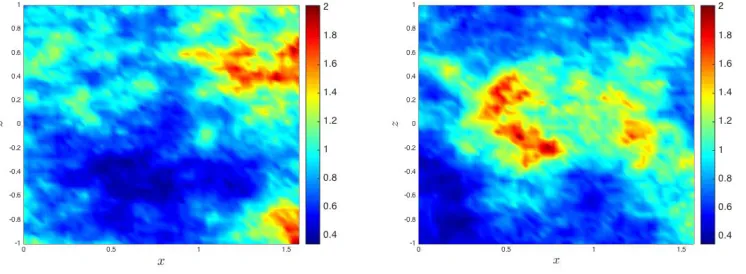
Figure 2: Branches of steady-state solutions for the original and perturbed problems according to di↵erent values of
Ra. The ordinate axis represents steady-state solutions of the streamfunction at the center of the domain. The rest
of parameters areK⌘1,Da= 0.1 and T = L= 0.
[image:11.612.112.506.417.569.2]we first perturb the convection-di↵usion-reaction equation by an amount✏, i.e., we set:
@C
@t
@ @z
@C
@x +
@ @x
@C
@z
1
Ra
✓@J
x @x +
@Jz @z
◆
+DaC+✏= 0, (20)
and solve the ‘perturbed’ problem (20) with the FE method as described earlier for an increasing
sequence ofRavalues (Ra(j),j = 0,1, . . .), where in each stepj+ 1 of the iterative algorithm we set as the initial guess for the next iteration the precomputed solution for Ra(j) (see Figure 2). Once
we have computed the solution for the✏-perturbed problem at the desiredRa, we reduce✏with the
same arclength methodology until✏= 0.
The permeability parameter appearing in our model needs to be characterised in order to be used
as an input for the simulator. Bear [7], for instance, provides empirical data for the permeability and
classifies several scenarios according to the data. Farthinget al. [22] presented results for di↵erent
porous media scenarios by using di↵erent types of sands. It has been shown [11, 29, 48] that although
the permeability values can exhibit large spatial variations, these variations are not entirely random
but spatially correlated. Previously, such fields have been modelled using a log-normal distribution
assumption [39]. In this paper we will also use a log-normal distribution to model the parameter
K, i.e., in the two dimensional case we replace the conductivity tensor by a scalar valued field, the log of which is Gaussian. In the next section we describe how we model the permeability as a
log normal random field and how the C-ED model presented earlier yields a system of PDEs with
random coefficients.
2.2. Generation of random permeability fields
Let (⌦,F,P) be a probability space. Given x 2 R, we use Z(x,!) (or simplyZ(x)) to denote a real-valued random field (RF) indexed by x on the probability space (⌦,F,P). For each x 2 R,
Z(x,·) : ⌦ ! R is a random variable, while for a fixed ! 2 ⌦, Z, is a deterministic function
Z(·,!) :R !R, called a realisation or sample path of the process. We define the mean function
m(·) :R!Rof a RFZ(x) by:
m(x) =E[Z(x)] =
Z
⌦
Z(x)dP(!),
and the covariance functionc(·,·) :R⇥R!R, by:
c(x,x0) =E[(Z(x) m(x))(Z(x0) m(x0)]. (21)
The numerical codes used in this work require the values of the permeability at theM nodesobtained during the discretization of the physical domain. To generate di↵erent permeability fields according
to a log Gaussian distribution, letZ(x) be a RF with given mean functionm(x) and given covariance functionc(x,x0) on the underlying space (⌦,F,P). Then, given the set of nodes{x
Z:= (Z(x1), . . . , Z(xM))T is a discrete random field. In fact,Z:⌦!RM is a multivariate random
variable with mean vector and covariance matrix:
m= (m1, . . . , mM)|=E[Z]2RM, C=E[(Z m)(Z m)|]2RM⇥M (22)
respectively, where:
mi=E[Z(xi)] =m(xi), Cij =c(xi,xj), i, j= 1, . . . , M (23)
Thus, for a given RF,Z, we can set K = exp(Z) to obtain the desired discrete permeability field
[33]. Furthermore, ifZis chosen to be normally distributed thenKis log normal. Note that the log
Gaussian assumption is used to avoid negative (unphysical) values of the permeability.
One possible method to generate di↵erent (Gaussian distributed) Z utilises a Cholesky
decom-position of the covariance matrix associated to the covariance function given in (21) [55]. Even for
a few hundred sampling points, however, the round-o↵ error in this method cannot be neglected
due to the fact that the associated covariance matrix is likely to become extremely ill-conditioned
[19]. An alternative method for simulating a Gaussian RF is the circulant embedding algorithm [20]
described, e.g., in [33]. This method provides an exact simulation of a Gaussian RF, although its
implementation is not straightforward. Another technique that has been used extensively to produce
samples of the permeability fields is the KL expansion method (see for instance [32]).
In this paper, we use a highly efficient and accurate KL decomposition [25, 15]. This method
could be inappropriate for problems in which the simulator necessitates an extremely fine
discretiza-tion of the computadiscretiza-tional domain, but this does not apply to the problem considered in this paper.
Conversely, the advantage of this approach is that it only requires a single eigen-decomposition of
the covariance matrix, the results of which are stored and used to generate new realisations of the
permeability field very cheaply. Moreover, the KL decomposition may be truncated, which leads to
a lower-dimensional input space for our emulator. The main di↵erence between the KL expansion
and KL decomposition methods is that, while KL expansions provide an approximation (due to the
truncation of the infinite series) of the permeability fields at all the points of the continuous domain,
which can be sampled afterwards on any grid, KL decompositions provide the exact decomposition
of the correlation function on a discrete grid. Since the whole eigen-decomposition is considered,
variance preservation is not an issue (the total variance is preserved). We remark that KL
decom-positions may not be useful for models requiring either a very fine discretization of the domain or
several evaluations of the permeability at di↵erent sets of grid points.
For modelling the correlation ofZ, i.e., expression (21), we use the following exponential
covari-ance function [29, 54, 14, 13]:
c(xi,xj) = 2 exp
✓
||xi xj||2◆
where represents the correlation length and 2 represents the process variance. In subsurface
flow applications, is typically chosen to be significantly smaller than the size of the computational
region and also large enough to be taken into account in the numerical formulation [13]. The values
of 2and are therefore problem dependent and are discussed separately for each of the models in
Section 4.
We denote by C the positive semi-definite covariance matrix associated to the functionc, i.e.,
Cij =c(xi,xj),xi,xj 2R. Since this covariance matrixCis real-valued and symmetric, it admits
an eigen-decomposition [55]: C= ( ⇤12)( ⇤ 1
2)|, where⇤is theM⇥M diagonal matrix of ordered
decreasing eigenvalues 1 2 . . . M 0, and is the M ⇥M matrix whose columns
i, i = 1, . . . , M, are the eigenvectors of C. Let ⇠i ⇠ N(0,1), i = 1, . . . , M, be independent and
identically distributed (i.i.d.) random variables. We can draw samples fromZ⇠N(m,C) using the KL decomposition ofZ using the following [33]:
Z=m+ ⇤12(⇠
1, . . . ,⇠M)|=m+
M
X
i=1
p
i i⇠i. (25)
The discrete random permeability field is therefore given by:
K= exp m+
M
X
i=1
p
i i⇠i
!
. (26)
The terms ⇠i ⇠N(0,1) above will be called KL coefficients. With the permeability parameter K
modelled as a log Gaussian random field K = K(x) on R⇥⌦, or the discrete form K given by equation (26), equations (9) become a new system of PDEs with random inputsK(x). This system is solved for the streamfunction (x) and the concentrationC(x), which are also, therefore, random fields. A realisation of the permeability field K 2 RM represents possible sets of permeability
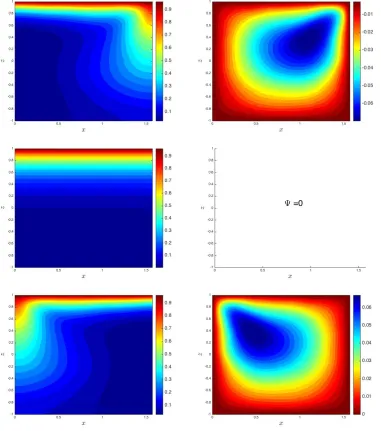
values in a slice of porous rock across which we would like to study the dissolution process. Figure
3 gives two examples of the permeability field that are used later in the numerical simulations.
An approximation of K can be obtained by restricting the expansion in (26) to the first, say, D
KL coefficients, i.e., to the subspace spanned by 1, . . . , D. In the emulator construction, this is
exploited to obtain a computationally practical method, as discussed in the next section.
Let us define the random vector ⇠ 2RD, for D M, distributed according to N(0,I). Note
that although we allowDM, for the simulator runs to generate the training data we strictly set
D=M, i.e., no approximation of the permeability field is made. The numerical code described in Section 2 can be regarded, respectively, as a mapping fromK to S (for a log-normally distributed
random vector K). Alternatively, the representation (26) of the permeability field allows us to
consider the mappingfs:⇠7!S for the C-ED simulator, respectively, where⇠2RD is defined as
Figure 3: Two di↵erent input permeability fields generated with the KL decomposition method where the whole set
of 2601 KL coefficients were retained.
3. Gaussian process emulator of the simulator output
A GP can be interpreted as a family of random variables, any finite number of which have a joint
Gaussian distribution. A GP is fully specified by its mean function and covariance function [45]. A
GP emulator is a statistical approximation of the simulator, in which the mapping between the inputs
and outputs is learned using a limited number of simulator runs at carefully selected inputs (design
points). Such an approximation incurs a fraction of the computational cost and can replace the
simulator in an uncertainty analysis, thereby avoiding a large number of costly or even prohibitive
simulator evaluations. In this section, we outline GP emulation and discuss the selection of the
design points. The majority of the studies in the literature fix the covariance function a-priori.
In this study, we will apply cross-validation (CV), as recommended in [45], to select an optimal
covariance function for each of the two simulators.
3.1. GP emulation general framework
Our aim is to develop an emulator for the simulator fs : ⇠ 7! S, where ⇠ 2 RD, for D M, is
distributed according toN(0,I). Note that M denotes the number of nodes in the computational domain of our model problem and is set toM = 2,601, as discussed further in Section 4. The GP model involves so-called ‘hyperparameters’ in the covariance function, to be discussed below. In
the covariance structures used, each component of the input is associated with a hyperparameter
and the hyperparameters are inferred from the simulator data by solving an optimisation problem.
Thus, for high-dimensional input spaces (D moderately large), the GP model would be impractical. We will discuss optimal values ofD for building the GP emulator in Section 4.2.
In GP emulation, assumptions about the target function are imposed by specifying a prior
in the light of training data (by using Bayes’ rule), which yields a posterior distribution that can be
used for inference. Let us denote byf(·) the GP used to modelfs(·). The prior specification involves
setting a mean functionm(⇠) and a covariance functionk(⇠,⇠0), which are defined as:m(⇠) =E[f(⇠)] andk(⇠,⇠0) =Cov(f(⇠), f(⇠0)) =E[(f(⇠) m(⇠))(f(⇠0) m(⇠0))], in which inE[f(·)] andCov(·,·) are the expectation and covariance operators on the (common) probability space underlying the family
of random variablesf(⇠). The covariance function containshyperparameters, which are collectively assigned the symbol✓✓✓. Typically (as is the case in this paper), these hyperparameters have to be
inferred from the data. We denote the GP prior by:
f(⇠)⇠GP(m(⇠), k(⇠,⇠0)). (27)
Given the GP above, we can approximate the mapping f(·) using a small number d of simulator runs at carefully selected design points{⇠ˆj}dj=1, where⇠ˆj2RD, for someDM. It is not required
that the design points ⇠ˆare distributed according to N(0,I). The choice of design points should be optimal in terms of learning the deterministic mappingf(·) with a limited number of simulator runs and is discussed in Section 3.2. To avoid numerical instabilities (ill-conditioning of the matrix
system), an i.i.d. random noise✏j ⇠N(0, 2
n), where 2n is the variance, is typically introduced into
the model, i.e.:
yj =fs(ˆ⇠j) +✏j, (28)
whereyj is the noisy simulator output at the design point ⇠ˆj. Collectively,{yj}dj=1 are termed the
observed values or targets. We can define the design matrix as X = [⇠ˆ1,⇠ˆ2, . . . ,⇠ˆd] and write the
observed values in vector formy= (y1, . . . , yd)|. The training set is defined as the pairD={X, y}.
A key property of GPs is that their posterior distribution, after taking into account the training
data D, is still a GP; in this case, given a prior as in expression (27) and a training set D, we
obtain aposterior GP process with updated mean and covariance functions. This allows us to make
predictions. The variance-covariance matrix for the distribution overyis given by:
Cov(y) =⌃(X,X) + 2nI, (29)
where the (i, j)-th entry of⌃(X,X)2Rd⇥d is given by k(⇠ˆ
i,⇠ˆj). Predictions can be made for new
input⇠⇤, i.e., we obtain the distribution of f⇤ :=f(⇠
⇤), conditioned on the training dataD. From the joint distribution ofyandf⇤:
2 4y
f⇤
3
5⇠N
0 @ 2 4µ
µ⇤
3 5,
2
4⌃(X,X) + n2I ⌃(⇠⇤,X) ⌃(⇠⇤,X)| k(⇠⇤,⇠⇤)
3 5
1
A, (30)
where µ= (m(⇠ˆ1), . . . , m(⇠ˆd))|, µ⇤ =m(⇠⇤) and ⌃(⇠⇤,X) = (k(⇠⇤,⇠ˆ1), . . . , k(⇠⇤,⇠ˆd))|, the
poste-rior distribution off⇤ conditioned onDis given by [45]:
where
mD(⇠⇤) :=E[f⇤|D,⇠⇤] =µ⇤+⌃(⇠⇤,X)⇥⌃(X,X) + 2nI
⇤ 1
y, (32)
and
kD(⇠⇤,⇠⇤) =k(⇠⇤,⇠⇤) ⌃(⇠⇤,X)|⇥⌃(X,X) + 2nI
⇤ 1
⌃(⇠⇤,X). (33)
Expressions (32) and (33) provide, respectively, a prediction for the simulator output at⇠⇤, and the
predictive variance in the output (encoding the uncertainty in the prediction). In this study, the
GP emulation is implemented using the GPML MATLAB toolbox v3.4 [45].
3.2. Generation of the design points and cross validation
To design an emulator, it is desirable to use a limited number of the expensive simulator runs,
with design points that cover the full range of physically reasonable input values. Design points
that are too close together can lead to ill-conditioned covariance matrices. The design points are
generated using sampling, i.e., a random (or psuedo random) distribution of points in a defined
interval according to some distribution or rule. There are several methods of sampling the input
values, the most common of which are Latin Hypercube Sampling (LHS) [35, 43] and Sobol sequence
sampling [52]. In this paper, we use the latter to build our design. Sobol sequences are a family of
quasi-random sequences that are designed to generate samples of multiple parameters in a highly
uniform manner; consideration of the previously sampled points avoids the occurrence of clusters
and gaps [10, 50].
In practical terms, we use a Sobol sequence to generate d points in [0,1]M. Each of the M
components of these points can be considered as possible values of the cumulative distribution
function of a random variable in R. Each of thedpoints are pushed component wise through the inverse cumulative distribution function of M random variables distributed according toN(0, 2
d),
with 2
d>1, to, jointly, form{⇠ˆj1, . . . ,⇠ˆMj }dj=1. We treat the ensembles{⇠ˆ11, . . . ,⇠ˆM1 }. . .{⇠ˆd1, . . . ,⇠ˆMd }
as sets of KL coefficients, and for each of them compute the corresponding noisy outputs {yj}dj=1. We then, by retaining the first D terms of each of the densembles above, denote the set of design points by{⇠ˆj}dj=1 ⇢RD, where ⇠ˆj := ( ˆ⇠j1, . . . ,⇠ˆjD)|. These design points are used with the noisy
outputs{yj}dj=1 to form the training setD. We use 2
d>1 to ensure that the design points have a greater spread than the random variables
(KL coefficients)⇠ we wish to model, which areN(0,I), i.e., to ensure that the tails of the target input distribution are covered with the design. During this study, alternative training sets based on
training points generated according to di↵erent values of dwhere considered, including⇠ˆ⇠N(0,I),
i.e., 2
d= 1. The best calibrated GP emulator was obtained with a value of d2= 1.44. Henceforth,
in this paper, for both of the models studied in Section 4 we set 2
in the training set.
The properties of the Sobol sequences require a sample size of 2j wherej = 1,2, . . .[10] in order
to exploit the manner in which values are spread in [0,1]M. Thus, the number of design points for
each training set to be considered throughout this paper will be 28= 256 points. Once a model has
been tested and selected, this number of design points can be minimised (see Figure 9) in order to
reduce computational cost depending on the desired accuracy in the predictions.
For complex simulators, such as the one discussed in this paper, is often not possible to gain
a high number of simulator outputs with which to test the emulator accuracy. In such cases we
can use CV to estimate the emulator error. We split the training set into two disjoint sets, one of
which is used for training. The performance on the remaining (‘validation’) set is used to estimate
the prediction error, and model testing and selection are carried out using this measure. We use
the leave-one-out cross-validation (LOO-CV), which consists of using all but a single data point for
training, and computing the model prediction error on the omitted point. This process is repeated
until all availabledpoints have been exhausted.
CV can be used with any loss function, although the squared error loss is the most common for
emulation. In this work, we will use the Dawid score (DS) introduced by Dawid and Sebastiani [16]
and the mean squared error (MSE) defined, respectively, as follows [57]:
DS= 1
d
d
X
j=1
(yj mj)2
s2
j
+ log s2j
!
, (34)
M SE =1
d
d
X
j=1
(yj mj)2. (35)
where mj is the predicted expected value at a given design point, ⇠ˆj, given by (32), s2j its
corre-sponding variance, given by (33), andyj the corresponding observed value at ⇠ˆj.
In the following section, we will describe how we select appropriate parameters and functions for
the GP emulator.
3.3. Specification of the GP emulation model
The selection of the mean and, in particular, the covariance function is crucial in a GP predictor
[45]. In order for a model to be a practical tool, we need to make decisions about the details of
its specification. Some properties may be easy to specify from the context of the problem, while
we typically have only vague information available in regards to other aspects, e.g., length-scales
or process variances. In this study, we test three di↵erent families of covariance functions. For
each function, we test the emulator predictions against the observed values by using the LOO-CV
predicted data will lie within the 95% CI in 95% of cases [27], i.e., we compute the percentage of
points out of range for each emulator and then choose the model (covariance function) with the
smallest number of cases outside the 95% CI. The 95% CIs are computed as in [45], i.e., by using
the intervals (mj 2sj, mj+ 2sj) where mj andsj are respectively the predictive mean (32) and
square root (standard deviation) of the variance (33) for a given design point ˆ⇠j.
The first covariance function (the most commonly used, see e.g., [59]) is the squared exponential
(SE). This function is infinitely di↵erentiable, which means that the associated GP has mean-square
derivatives to all orders. The Mat´ern class1 [34] is often used as an alternative for cases in which a
strong smoothness assumption is deemed unrealistic [53]. The third covariance function tested was
the rational quadratic (RQ), which is as an alternative to the Mat´ern class [34]. The two anisotropic
SE and RQ covariance functions used in this study are defined as follows:
kSE(⇠,⇠0) = 2fexp
✓
1 2(⇠ ⇠
0)>diag(` 2
1 , . . . ,`D2)(⇠ ⇠0)
◆
+ 2n ij, (36)
kRQ(⇠,⇠0) = f2
✓
1 + 1 2↵(⇠ ⇠
0)>diag(` 2
1 , . . . ,`D2)(⇠ ⇠0)
◆ ↵
+ 2n ij, (37)
respectively. The use of di↵erent characteristic length scales```= (`1, . . . ,`D) for each input imple-ments automatic relevance determination (ARD) [40] since the inverse of the length-scale determines
the relevance of each of theDinputs: If the length-scale has a very large value, the covariance will become almost independent of that input, e↵ectively removing it from the inference [45]. The
hyper-parameters for each case are✓✓✓SE= ( 2
f,`, 2n) and✓✓✓RQ= ( f2,`,↵, n2). To obtain estimates of the
hyperparameters we maximize the negative log marginal likelihood (38) w.r.t. the hyperparameters:
logp(y|X,✓✓✓) =1 2y
|(⌃+ 2
nI) 1y+
1
2log|⌃+ 2
nI|+
n
2log 2⇡. (38)
Once the hyperparameters of the four covariances functions have been inferred from the training
data, we apply the LOO-CV technique described in Section 3.2 to each of the corresponding GP
models for model (covariance function) selection.
4. Numerical results
In this section we present the results obtained after using the GP emulator to perform a full UQ
on the distribution of the surface flux described in Section 2. We restrict ourselves to the domain
R= [0,⇡/2]⇥[ 1,1]⇢R2 and set
L=⇡/2. The model parameters are chosen to be: Ra = 100,
Da= 0.1, L =⇡/2 and T = L/10. The permeability fields used as inputs in the simulator were
1There are a whole family of Mat´ern class functions and in this work we consider only the Mat´ern
3/2and Mat´ern5/2.
generated from the correlation function (24) with parameter values = 0.5 (value within the range suggested in [13] for a similar problem) and 2 = 0.1 (a small variance is imposed to study how small variations in the permeability a↵ect the quantity of interest). To be consistent with the non
dimensional formulation of the equations in (9) we generate a set of log Gaussian permeability fields
with pointwise mean 1, i.e.,E[K(xi)], 8xi 2R. For that purpose we set m= ( 2/2)Iin (25).
Numerical approximations to the solution of (9) were computed with aH1-conforming finite el-ement method (FEM) [9]. The numerical approximations were evaluated on a shape-regular
rectan-gular partition ofR= [0,⇡/2]⇥[ 1,1]⇢R2comprising 2,500 elements (i.e.,M = 2601), employing basis functions of polynomial degree 1. All computations were performed using the AptoFEM finite
element toolkit, documented in [3], together with the MUMPS linear solver [1, 2]
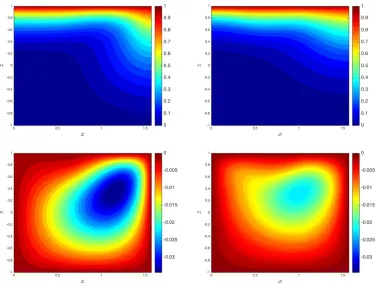
Figure 4 shows the three solutions corresponding to each of the three bifurcation branches shown
in Figure 1 for Ra = 60, i.e., the simulated contours of the streamfunction (right) and the concentration C (left) for the same permeability field K (the left hand field in Figure 3). The middle row shows the solutions corresponding to a constant surface flux, while the top and bottom
rows are the solutions corresponding to the two new bifurcation branches with a non-constant flux
appearing after the criticalRa. We consider two types of solutions; what we called trivial solutions, i.e., solutions of equation (18) that lead to a constant surface flux, S0 = 4.97, and non-trivial solutions, i.e., solutions leading to a non-constant surface flux,S6=S0.
Figure 5 shows contour plots of the streamfunction and the concentration (bottom right and
top right respectively) for the solution on one of the stable bifurcation branches at Ra = 100, corresponding to the heterogeneous permeability field Kon the right in Figure 3. The solution on
the left of Figure 5 corresponds to the homogeneous case,K= 1. In both cases, the base unstable solution is the same (equation (18)), with surface fluxS0 = 4.97. The corresponding enhancement of the dissolution by convection is the di↵erence between the fluxes for the homogeneous (5.42) and heterogeneous (5.17) cases and the flux for the base solution (4.97), i.e., in the homogeneous case the enhancement is 5.42 4.97 = 0.45 and in the heterogeneous case the enhancement is 5.17 4.97 = 0.20. This unexpected result, where heterogeneity reduces enhancement, is analysed in detail in [15, 47].
UQ of the CDF of
S
for the C-ED problem
We use GP emulation to perform a full UA on the C-ED problem. In this case, we estimate the
uncertainty distribution of the surface flux arising from the uncertainty distribution in the input
permeability. As a first attempt, we used the standard GP emulation methodology based on GP
Figure 4: Example of three di↵erent solutions of problem (9) for a given heterogeneous permeability field (the left
hand field in Figure 3) with parameters:Ra= 60,Da= 0.1, L=⇡/2 and T = L/10. The upper branch solution
is shown in the top row of figures, the trivial solution is shown in the middle row and lower branch solution is shown
Figure 5: Concentration and streamfunction contours for both a homogeneous permeability field (K = 1) and a
heterogeneous permeability field (the right hand field in Figure 3) for the C-ED problem with parameters:Ra= 100,
Da= 0.1, L=⇡/2 and T= L/10. The homogeneous case is shown on the left and the heterogeneous case on the
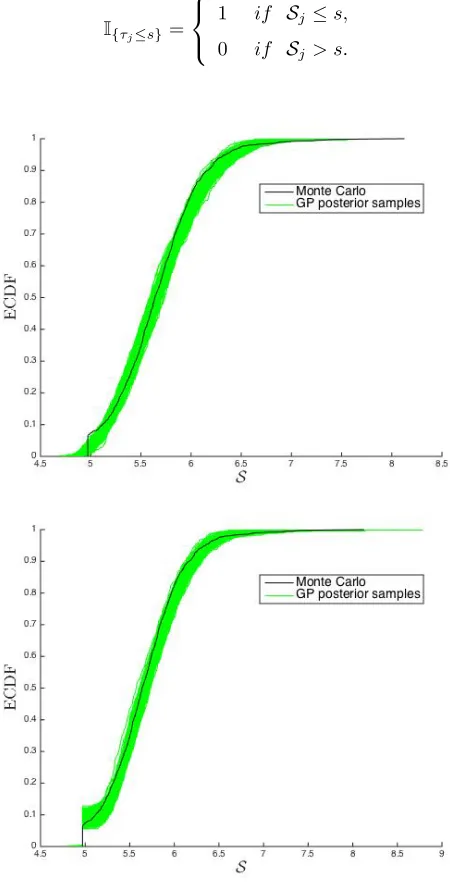
method was not able to accurately predict the CDF around the bifurcation point (see Figure 10).
To overcome this issue, we introduce a precursor to the GP emulation, which we call theclassifier.
The classifier will allow us to predict the ‘class’ of the solution given the input. Once the solution
is classified, we can then use the same approach followed in Section 3.1 to estimate the value of the
S using GP emulation. Before showing the UQ results, let us introduce the GP classifier first.
4.1. The GP classifier
We wish to assign an input pattern⇠⇠N(0,I) to one of two classes: C1:S=S0andC2:S6=S0. We will use a GP classifier, in which test predictions take the form of class probabilities. If we use
the labelsy = +1 and y = 1 to distinguish the two classesC1 andC2, respectively, we predict, for instance,⇡(⇠) = Pr(y = +1|⇠), where⇡ denotes the probability that an input⇠is in the class
y = +1. Since a GP prior over functions does not restrict the output to lie in the interval [0,1], we need to “squash” the prior function (in practical terms, what we squash are the samples, drawn
from the prior distribution of f(·)). A common choice for this squashing function is the function (z) = (1 + exp( z)) 1, called the logistic f unction. The GP prior over f(·) induces a prior over probabilistic classifications⇡. We can then apply the methodology described in Section 3 to obtain
the posterior mean for that⇡(⇠). Thus, we use a Gaussian process in essentially the same way, except
that the Gaussian likelihood function often used for emulation is inappropriate for classification. The
likelihood function considered for our classification model will be the error-function (or cumulative
Gaussian), and does not contain any hyperparameters; the error function of a Gaussian distribution
is defined asErf(x) = p1
⇡
Rx xe
t2
dt.
Since exact inference is only possible for a Gaussian likelihood, we need an alternative
approx-imation inference method. Thus, we will use the Expectation Propagation (EP) algorithm [38]
described in [45]. EP provides an approximations to an intractable factorized probability
distribu-tionp(x) =Qipi(x), using a simpler factored formq(x) =Qiqi(x), where each factorqi(x) belongs
to the exponential family. EP is designed to minimize the distance between the two distributions,
measured by the Kullback-Leibler divergenceKL(p||q). Exact minimization is not feasible because it involves an expectation with respect to the original distributionp(x). EP therefore uses an iterative procedure that at each step minimises the KL divergence between the (new)q(x) and a distribution defined by the current q(x) with one factor qi(x) replaced by the corresponding factor pi(x). The
factor qi(x) is then easily updated, and the process is repeated (going through all the factors in
turn) until convergence [37].
The mean and covariance functions for the GP classification model are chosen to be a mean-zero
the vector of noisy observations. If we split the set X into two disjoint sets, X1 and X2, where
X1 = {⇠ˆ2 X : fs(⇠ˆ) = S0} and X2 = {⇠ˆ2 X : fs(⇠ˆ) 6= S0}, and set D2 = {X2,y2}, where y2 is the set of simulator outputs fs(·) with inputs in X2, we can consider a GP emulator (as
previously described), labelled GP2, based on the training setD2. Thus, for any given input⇠⇤2RD
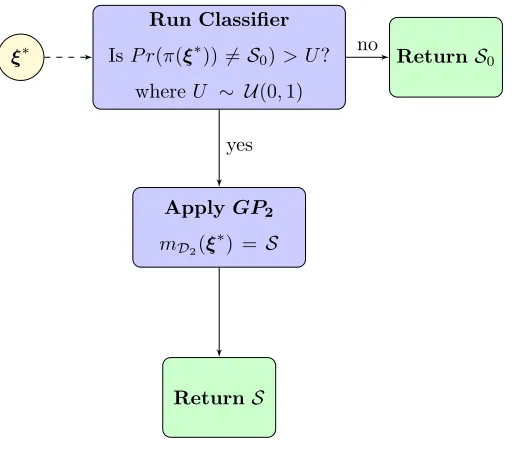
distributed according toN(0,I) we run the classifier as a first step and if the classifier labels the output as a constant S0, we take the emulator output asS0. Conversely, if the output is labelled
as a non-constantS then we use GP2 for making predictions; we will take as the predictedS value,
mD2(⇠
⇤) =S, i.e., the mean of the posterior GP built upon the training setD2. The entire procedure
is illustrated in Figure 6.
Run Classifier
IsP r(⇡(⇠⇤))6=S0)> U? whereU ⇠ U(0,1)
⇠⇤ ReturnS0
ApplyGP2
mD2(⇠
⇤) = S
ReturnS
no
[image:24.612.181.437.231.456.2]yes
Figure 6: Algorithm followed for predicting theSfor any input given by using a Gaussian process classifier.U⇠U(0,1)
is a uniform random variable between 0 and 1 which gives randomness to the classification process.
4.2. GP emulation and classification for UQ of the CDF of
S
In this application, we considered the training setD={⇠ˆj, yj}256j=1where the points⇠ˆj⇠N(0,1.44I)
were generated from an initial Sobol sequence of 256 points over [0,1]M. After running the simulator
fs for the corresponding 256 cases, we found 64 cases leading to a constant surface fluxS0. Thus,
after removing those 64 pairs,{⇠ˆj, yj}, formD, the training set,D2, for the GP2emulator consisted
ofd2= 192 points.
For GP model selection, we applied the LOO-CV analysis discussed in Section 3.2 to the four
covariance functions introduced in Section 3.3, namely, the SE, Mat´ern3/2, Mat´ern5/2, and RQ. The
acceptance interval, was given by the model using the RQ covariance function. Thus, throughout this
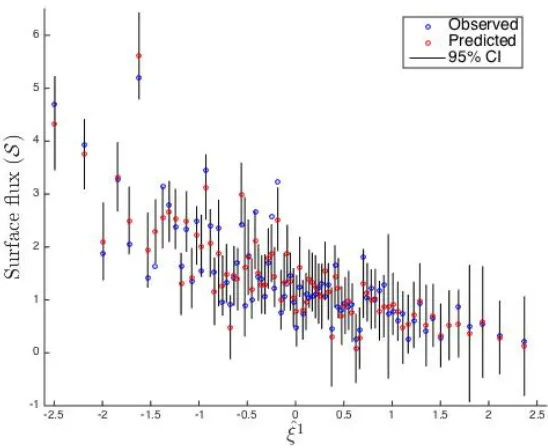
section, we use a GP emulator with a mean-zero function and the RQ covariance function. Figure 7
shows an illustration of the observed (blue) and predicted values (red), and 95% uncertainty bounds
(black vertical bars) for the LOO-CV method applied to the selected GP emulator. The horizontal
axis shows the first component ˆ⇠1 of each of the corresponding 192 design points{ˆ⇠
[image:25.612.164.438.176.400.2]j}dj=1⇢RD.
Figure 7: LOO-CV from the design of GP2 formed by 192 points. 4.06% of the observed values are out of range.
Vertical axis: predicted surface fluxes (red) with 95% bounds (black bars) given by the GP emulator using a mean-zero
function and a RQ covariance function and observed surface fluxes (blue). Horizontal axis: first KL coefficient ˆ⇠1 of
each of the corresponding 192 design points.
We also investigated a further refinement of the model in terms of the GP emulator input space,
i.e., we studied the e↵ectiveness of the GP emulator for di↵erent lower dimensional input spaces
(RD, D
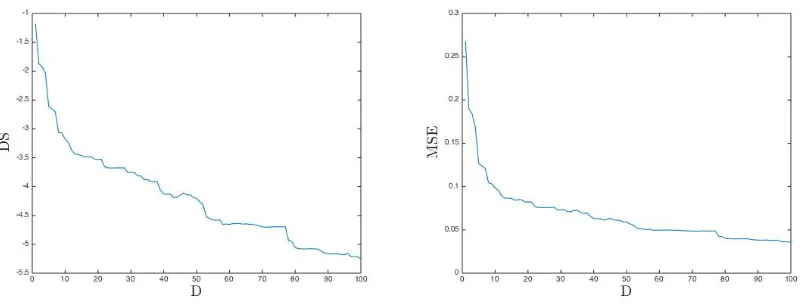
M), by inspecting the M SE (35) and DS (34) scores. From the training set D2 of
d2= 192 points, we considered an ordered sequence of setsDi,i= 1,2, . . ., in which the firstiKL coefficients were retained from the originalM. For instance, D3 ={( ˆ⇠1
j,⇠ˆ2j,⇠ˆj3)|, yj}dj=1. Applying LOO-CV to each of the training sets in the sequence Di, i = 1, . . ., we calculated the M SE and
DS. Figure 8 shows the M SE and DS scores against the number of KL coefficients retained (or
D). The plots show that after around 16 KL coefficients the scores do not vary significantly. Thus, the value ofDin the GP model can be set toD= 16. Note that the lower dimensional input space applies only to the GP emulatorf(·) and not to the simulatorfs, which is always a mapping from RM toR.
em-Figure 8: Two scores, DS (left) and the MSE (right), computed by using the LOO-CV method applied to a sequence of
training sets withd= 192 design points. The GP emulator was built with a mean-zero function and a RQ covariance
function. Thex-axis represents the number D of KL coefficients used in each of the training sets to calculate the
scores.
ulator predictions. For a sample of 103di↵erent sets of
N(0,1) KL coefficients{⇠⇤
1,j, . . . ,⇠⇤M,j}
1,000
j=1 , we used as test points the first 16 terms of each of set to form{⇠⇤j 2 R16}1j=1,000, which are,
there-fore, distributed according to N(0,I). We then computed the relative error between the corre-sponding true observed (simulator) surface fluxes,S1, . . . ,S1,000, and the corresponding predictions, {S⇤
j =f(⇠⇤j)}
1,000
j=1 , using a GP emulator built with d2= 2n design points, n= 1, . . . ,8. The error considered for comparisons between two vectors throughout this work will be the L2-norm relative error unless stated otherwise. For two vectorx= (x1, . . . , xn) and y= (y1, . . . , yn), we define the
L2-norm relative error betweenxand yas:
RE(x,y) = ||x y||2
||x||2
(39)
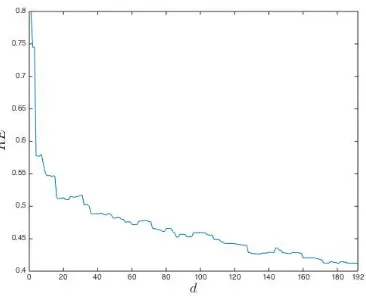
where||x||2 is Euclidean norm. Figure 9 suggests that around 64 the training points are adequate.
The selection of the number of design points to keep will depend on the accuracy desired for each
problem and will depends on whether the user we can a↵ord to run the simulator a large number
of times or not, and therefore retain the entire training set. For the C-ED model discussed in this
paper, a single run can take over 24 hours, in which case the number of design points becomes an
extremely important consideration.
Once the GP emulator specifications have been selected, the accuracy of the GP emulator
predic-tions can be measured by generating an ensemble⇠⇤
1, . . . ,⇠⇤M ofM realizations of aN(0,1) random
variable and running the simulator fs to obtain thetrue observed value S. Then we compare to
the GP emulator predictionS⇤:=f(⇠⇤) for the test input⇠⇤:= (⇠⇤
1, . . . ,⇠D⇤)|formed from the first
D KL coefficients of the original ensemble⇠⇤
1, . . . ,⇠⇤M. In this work, we used a sample of 1,000 test
points {⇠⇤j 2R16}
1,000
[image:26.612.104.506.71.223.2]Figure 9: The relative error curve between the observed and predicted surface fluxes for 192 di↵erent designs using
the RQ covariance function. The curve shows a smooth decreasing tendency and after around 160 design points the
decrease in the relative error is negligible.
points, 825 out of the 1,000 led to a non-trivial solution. For those 825 we computed the relative
er-ror between the corresponding observed surface fluxes,{Sj}825j=1, and the corresponding predictions,
{S⇤
j :=f(⇠⇤j)}825j=1, using the GP2emulator. The results suggested that around 32 training points are adequate, and thus we used the training set formed by the first 32 elements ofD2 (i.e, we retained
the first 32 design points from the original 192 forming GP2).
4.3. GP emulation for UQ of the CDF of
S
We approximate the cumulative distribution ofS empirically based on the GP emulator as follows:
F(s) = Pr(Ss) =
Z
RDI{
f(⇠)|Ds}dG(⇠), (40)
whereG(·) is the probability density function of a random vector⇠2RD, withD= 16, distributed
according toN(0,I),Idenotes the indicator function andf(·)|D⇠GP(mD, kD) as in (31). We will
use the approach described in [42] to derive the posterior moments of F(·). We need to simulate draws F(i)(·) from the posterior distribution of F(·), for which we first draw a realisation of the
posterior distribution f(·)|Dby drawing a large random sample of inputs⇠1⇤, . . . ,⇠⇤N fromG(·), for
some integerN. We then form the joint distribution for those inputs as in (31), and draw random samples (denoted by f(i)) fromf(·)|D. The random samples at a given input ⇠⇤j are generated by
using the following formula [45]:
f(i)(⇠⇤j) =mD(⇠⇤j) + (kD(⇠⇤j,⇠⇤j))1/2#i (41)
where #i ⇠N(0,1), andmD(·) and kD(·,·) are the predictive mean and predictive variance given,
distribution function:
F(i)(s) =
1
N
N
X
j=1
I{f(i)(⇠⇤j)s}. (42)
If we repeat the process a large number of times (n) we can obtain a large sample of distributions
F(1)(·), . . . , F(n)(·), and from this sample we can obtain any required statistic, for instance the sample
mean ¯F(s), which approximates (40) and is given by:
¯
F(s) = 1
n
n
X
j=1
F(j)(s). (43)
Oakley and O’Hagan [42] remark that since F(s) is constrained to take values between zero and one, the distribution ofF(s) may be skewed for low and high values ofs. Hence the mean of this distribution may be a poor location summary; it may overestimate F(s) at low values of s and underestimate F(s) at high values of s. Consequently, the sample median might be preferred as a location summary. Now to find our uncertainty bounds we consider the corresponding quantile
function. If we let p↵ be the 100↵percentile, such that F(p↵) =↵, the distribution ofp↵is given
by:
Pr(p↵t) = Pr{F(t) ↵}, (44)
where Pr{F(t) ↵} can be estimated using the method just described (Pr here denotes ’probabil-ity’). We can estimatep↵ by its sample mean, by findingp(i)↵, the 100↵ percentile for realisation
i, i = 1, . . . , n. To compute the ECDF of the surface flux with the GP emulator, we follow the procedure above and compute the mean (43), and the lower, upper and median quantiles from this
distribution of ECDFs as an approximation of the true CDF of the surface fluxS.
Finally, we show the results achieved after performing a full UA for the CDF of the S by using
the GP emulation/classification emulator. Firstly, Figure 10 demonstrates that the GP emulation
methodology alone led to failure (top). Figure 10, on the other hand, shows how the posterior samples
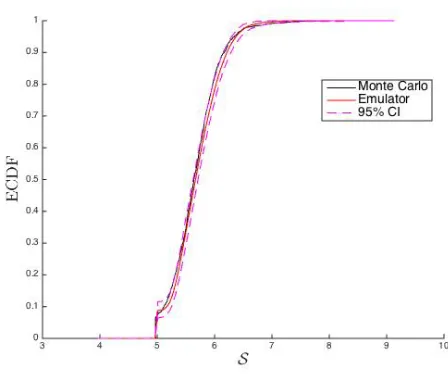
are able to predict the bifurcation aroundS0= 4.9707 when using the combined GP emulation and classification (bottom). Figure 11 shows the 2.5th and 97.5th percentiles (dashed), the median of the predicted distribution (red) computed according with the method given in Section 4.3. For
comparison purposes, an approximation of the Monte Carlo ECDF (black line) was computed from
a sample of 1,000S values as follows: (i) generate a large numberN = 1,000 of di↵erent ensembles
{⇠⇤
1,j, . . . ,⇠⇤M,j}Nj=1 of KL coefficients (M = 2,601), where each ⇠i,j⇤ is distributed according to N(0,1); (ii) use the simulator to compute the corresponding true Sj for each of the ensembles;
(iii) compute the ECDF, ˆF, of the set of values{Sj}Nj=1 according to:
ˆ
F(s) = 1
N
N
X
j=1
whereIis theindicatorfunction:
I{⌧js}=
8 < :
1 if Sjs,
[image:29.612.190.415.90.533.2]0 if Sj> s.
Figure 10: Predicted ECDFs (green) and 1,000 samples based MC approximation of the trueS ECDF (black) with
(bottom) and without (top) using GP classification. The number of design points were 32 and the number of KL
coefficients were 16. The parameters for the E-CD problem were: Ra= 100,Da = 0.1, L=⇡/2 and T = L/10.
Prior mean-zero and SE covariance functions, anErf likelihood function and the Expectation Propagation (EP)
method were chosen for the GP classifier. Prior mean-zero and RQ covariance functions were chosen for GP emulation
Figure 11: Full uncertainty analysis of the predicted CDF ofSusing GP classification/emulation: predicted ECDF
(red), the 2.5th and 97.5th percentiles (dashed magenta). The number of design points was 32 and the number of KL
coefficients was 16. The parameters for the E-CD problem wereRa= 100,Da= 0.1, L=⇡/2 and T = L/10. A
prior mean-zero, a SE covariance, anErf likelihood function and the EP method were used for the GP classifier. A
prior mean-zero and a RQ covariance were used for the GP emulation. An approximation of the true ECDF with the
MC method (black) based on 1,000 samples is also showed for reference.
5. Conclusions and further work
In this paper we developed a methodology for quantifying the uncertainty distribution of
ground-water flow simulator outputs, where the uncertainty arises from the input permeability. In a C-ED
model that admits multiple solutions, the standard emulation methodology was combined with a
classification step in order to predict the simulator outputs around a bifurcation point. The GP
classification/emulation methodology proposed in this paper could be used as a bifurcation
predic-tor and applied to models where the user is interested in finding possible model bifurcations. We
also showed that it is possible to use a much lower dimensional input space for the GP emulator,
leading to a highly efficient emulation.
Acknowledgments This research was funded by the EU Panacea project, FP7, grant agreement
282900.
[1] P. R. Amestoy, I. S. Du↵, J.-Y. L’Excellent, and J. Koster. A fully asynchronous
multi-frontal solver using distributed dynamic scheduling. SIAM J. Matrix Analysis and Applications,
23(1):15-41, 2001.
[2] P. R. Amestoy, A. Guermouche, J.-Y. L’Excellent, and S. Pralet. Hybrid scheduling for the