1
Attentional Processing of Input in Explicit and Implicit Learning Conditions: An Eye-tracking Study
Authors: Bimali Indrarathne and Judit Kormos
Final accepted version 10th of May 2016
Bimali Indrarathne
Lancaster University, Department of Linguistics and English Language Lancaster, United Kingdom
LA1 4YL
Corresponding author: Professor Judit Kormos
Lancaster University, Department of Linguistics and English Language Lancaster, United Kingdom
LA1 4YL
2
Attentional Processing of Input in Explicit and Implicit Learning Conditions: An Eye-tracking Study
Abstract
In this study we examined language learners’ attentional processing of a target syntactic
construction in written L2 input in different input conditions, the change in learners’
knowledge of the targeted construction in these conditions and the relationship between the
change in knowledge and attentional processing. 100 L2 learners of English in Sri Lanka
were divided into four experimental groups and control group: input flood, input
enhancement, a specific instruction to pay attention to the target grammatical construction in
the input, and an explicit metalinguistic explanation of the target construction. Eye tracking
was used to collect data on the attentional processing of 45 participants in the sample. The
eye-tracking measures of learners who received a specific instruction to pay attention to the
target structure and an explicit metalinguistic explanation indicated increased attentional
processing. The learners in these groups also improved their knowledge of the target structure
significantly. The results suggest that increased attentional processing is needed for
development in L2 grammatical knowledge and that explicit instruction to pay attention to
the input and metalinguistic explanation are successful in directing learners’ attentional
resources towards novel grammatical constructions in the input.
Introduction
Input for learners is a necessary condition for language development (R. Ellis, 1994;
3
to take place (Doughty & Williams, 1998) because learners may not pay attention to input or
might not be able to process it in a way that facilitates their linguistic development. There is
an abundance of previous studies in the field of second language acquisition (SLA) that have
investigated the various conditions under which the provision of input might assist language
learning (for a review see Robinson, Mackey, Gass & Schmidt, 2012). Yet little is known
about the attentional processing involved in learning from different types of input and how
attentional processing relates to learning gains in various input conditions. Most studies thus
far have focussed on attentional processing in conditions where participants were exposed to
input flood and where the target structure was textually enhanced (Issa et al., 2015; Simard &
Foucambert, 2013; Winke, 2013), but to our knowledge no previous research has examined
how an instruction to pay attention to specific aspects of input and explicit metalinguistic
explanations facilitate attentional processing.
In this paper, we present the findings of a study that investigated how learners pay
attention to a target syntactic construction in written L2 input in four different conditions:
input flood, input enhancement, instruction to pay attention to the target construction and
explicit metalinguistic explanation. We also examined how the learners’ knowledge of the
targeted construction changed in these conditions and how the changes under different
conditions were related to attentional processing. First, we will discuss conceptualizations of
attention, awareness and consciousness in cognitive psychology and SLA research. This will
be followed by an overview of previous studies on learning under explicit and incidental
conditions. Then we will present the methodology we applied in this study to measure
attention and the results that we obtained. Finally we will discuss the findings of the study
4 Background
Attention, consciousness and awareness in cognitive psychology. To date, ample evidence has been accumulated to indicate that not everything L2 learners are exposed to will
be acquired (see e.g., Sharwood Smith, 1993). One of the major factors that influences
whether or not input will turn into intake is the attention paid to it (Doughty, 2001; Robinson
et al., 2012; Schmidt, 1990, 2010). Although attention is a key concept in the field of SLA
research as well as in cognitive psychology, there is still no consensus as to what attention
actually is (Allport, 1993; Shinn-Cunnigham, 2008; Wolfe & Horowitz; 2004). In a recent
overview, Chun, Golomb and Turk-Browne (2011) define attention as “a core property of all
perceptual and cognitive operations. Given limited capacity to process competing options,
attentional mechanisms select, modulate, and sustain focus on information most relevant for
behavior” (p. 73). Chun et al. (2011) draw up a useful taxonomy of attentional processing
that is particularly relevant for our study. While they acknowledge that attention is not a
unitary system, they argue that there are two fundamental ways in which we process
attentional targets. On the one hand, we can select and adjust stimuli perceived externally
through our senses (e.g., specific information presented on a screen), which they call external
attention. External attention can be a stimulus-driven bottom-up process, as well as a
goal-directed top-down process. On the other hand, internal attention operates over representations
in long-term and working memory, task rules and responses.
Consciousness, which in simple terms describes the understanding of one’s
experiences (Nagel, 1974; Max Velmans, 2009), is a concept that is inseparable from
attention, yet it still needs to be differentiated from it (Bachman, 2006; O’Regan & Noe,
2001). Koch and Tsuchiya (2006) argue that the key function of consciousness is to assist in
5
environment and ensuring this compact summary is accessible to the planning areas of the
brain” (p. 17). They provide a convincing summary of evidence that there are cases when
attentional processing takes place without consciousness. For example, in processes such as
priming, adaptation and visual search, “subjects can attend to a location for many seconds
and yet fail to see one or more attributes of an object at that location” (p.17). This
demonstrates the potential lack of consciousness in these cognitive processes. According to
Koch and Tsuchiya, however, attention, with consciousness, is necessary for the registration
of stimuli in working memory (WM), for distinction between stimuli and the provision of a
full report of the stimuli attended to.
Awareness is another concept that is closely related to attention and consciousness.
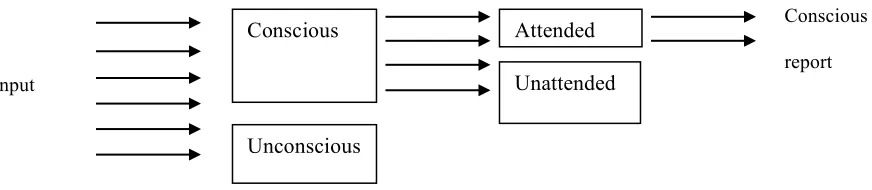
Lamme’s (2003) cognitive psychological model is helpful in elucidating how attention can be
distinguished from both consciousness and awareness (see Fig. 1). Lamme argues that input
can be perceived either consciously or unconsciously. Consciously perceived input can either
be attended to or remain unattended, highlighting that in his model attention is seen as a
phenomena that is distinct from consciousness. Input that has been consciously perceived and
attended to is then available for conscious reporting and can be stored in WM. This final level
in the model is regarded as awareness.
[INSERT FIGURE 1 APPROXIMATELY HERE]
Attention, awareness and noticing in second language acquisition. The role of attention, awareness and consciousness is key to how second language learners process target
language input. Existing studies in the field of SLA unequivocally support that paying
attention to certain features in the input is necessary for language development (for a review
6
(1995, p.132), which is necessary for language learning. He further notes that noticing is
“nearly ‘isomorphic’ with attention” (Schmidt, 1995, p.1) and “[what is noticed is]
consciously registered” (2010, p.2). Schmidt considers noticing to be an attentional process
that involves both consciousness and awareness. Schmidt (1990) also highlights that noticing
is a “private experience, although noticing can be operationally defined as availability for
verbal report, subject to certain conditions” (p.132). According to the definitions in cognitive
psychology cited above, awareness involves the possibility of offering verbal reports, and
therefore what Schmidt calls ‘noticing’ can be equated with ‘awareness’. Schmidt (1990,
1995, 2010) distinguishes between two different levels of awareness: awareness at the level
of noticing and awareness at the level of understanding. Noticing can be considered as a
surface level phenomenon, “the conscious registration of the occurrence of certain events”
(Schmidt, 1995, p.19), whereas understanding represents a deeper level of processing
involving pattern and rule recognition. Therefore, understanding is the conscious outcome of
a learner’s analysis, comparison and hypothesis-testing activities. Truscott (1998) and
Truscott and Sharwood Smith (2011) draw attention to several conceptual problems with the
NH. They argue that noticing, as Schmidt defines it, is an intermediate level of noticing,
because it does not involve rules, generalizations about the language or form-meaning
mapping. They also point out that the NH does not offer a clear explanation of the level of
awareness involved in noticing and how noticing is differentiated from either no awareness or
a higher level of awareness.
In a more recent discussion, Godfroid, Boers and Housen (2013) separate awareness
and attention and view them as two sides of the same coin. They do not disregard the
possibility of awareness having a role to play in noticing; however, their argument is that a
certain level of attention is sufficient for registering new stimuli in long-term memory. This is
7
awareness is not a necessary condition for language learning. In line with Robinson (1995),
Godfroid et al. (2013) define noticing as “a cognitive process in which the amount of
attention paid to a new language element in the input exceeds a critical threshold, which
causes the language element to enter WM and become the object for further processing” (p.
493). Nevertheless, the question remains how to determine the threshold beyond which a
stimulus enters WM. In Godfroid et al.’s (2013) study this threshold is established by
comparing processing times spent on real-words and pseudo-words; however, this might also
reflect different nature of reading involved in reading existing vs. non-existing words
(Coltheart, Curtis, Atkins & Haller, 1993). Therefore processing time differences might not
only result from different attentional processing mechanisms but also from different cognitive
operations.
As our brief review highlights, there are two key unresolved issues in the
investigation of noticing: one concerns the role and degree of awareness involved in noticing
and the other the establishment of a critical threshold of processing above which one can
claim that noticing took place. Given these theoretical and methodological problems and the
fact that the concept of noticing is not present in the psychological literature of awareness,
consciousness and attention, we decided to focus on the construct of attention instead of
noticing and investigated L2 learners’ attentional processing under different input conditions.
One of the currently available tools that can provide insights into the amount of attention paid
to specific features in the input is eye-tracking, which we applied in our study to measure
attention.
Eye-tracking as a method of measuring attention. The basic assumption underlying eye-tracking studies is that eye-movements are to some extent controlled and guided by the
8
processing (Liversedge, Gilchrist & Everling, 2011; Rayner & Pollatsek, 1989). It is
important to note, however, that not all eye-movements are under attentional control and one
can attend to a specific visual stimulus without necessarily fixating on it (Hunt & Kingstone,
2003; Juan, Shorter-Jacobi, Schall, & Sperling, 2004). The eye-tracking measures used to
gain insights into attentional processing vary in the field of cognitive psychology (for a
review see Reichle, Pollatsek & Rayner, 2006). In SLA total reading time, which is
calculated as the total amount of time that one gazes at an area of interest during reading, has been utilised as one of the main measures (Godfroid et al., 2013; Godfroid & Uggen, 2013,
Issa et al., 2015; Smith, 2010, 2012; Winke, Gass & Sydorenko,, 2013).
As pointed out above, total fixation duration and the total number of eye fixations on
a target word/ phrase might tell us for how long and how many times participants view a
target item, but these might not accurately reflect attentional processing (see also Reichle et
al., 2006). In order to overcome this problem, Smith (2010) considered total fixation duration
in excess of 500 milliseconds (ms) to be an indication of noticing (attention); however, how
this threshold was arrived at is not clear. In other eye-tracking studies the difference in total
fixation duration between the experimental condition/s and the control condition on the target
items was regarded as a measure of noticing/attention. This is a more accurate procedure for
establishing extra attentional processing load than the use of total fixation time and the total
number of eye-fixations alone. Nevertheless, the methods of establishing increased
attentional processing in these studies still posit several questions. We already highlighted
issues relating to the comparison of pseudo- and real word reading in Godfroid et.al’s (2013)
and Godfroid and Schmidtke’s (2013) studies. Winke (2013) compared the total reading
times in a textually enhanced condition to those in an unenhanced condition. A significant
difference between the two groups was taken as an indication of noticing. It is possible,
9
the target items, and hence their data might not serve as an accurate baseline. The most
precise measure of noticing was devised by Godfroid and Uggen (2013), who subtracted the
fixation duration on two different forms of the same verb and then compared these subtracted
values for regular and irregular verbs.
Given the problems with treating the total fixation durations of the control group as
base line, we decided to use two eye-tracking measurements in this study to investigate the
amount of attention paid to the target items: total fixation duration (TFD) on areas of interest
(AOI) and the difference between observed total fixation duration and expected total fixation
duration on AOIs (ΔOE). As described above, the first of these measures, TFD, has been
widely applied in previous studies. The second measure, which is in certain ways similar to
the subtracted measure used by Godfroid and Uggen (2013) and to residual reading times in
sentence processing studies (Trueswell, Tanenhaus & Garnsey, 1994; Wilson & Garnsey,
2009), was developed to take into consideration participants’ reading speed when
determining extra attentional processing load. In other words, the expected total fixation
duration was the average reading time that the participants spent on each word/ phrase
presented on the screen. Observed time was the actual time that the participants spent on
target constructions. If a participant spent more time on a word/ phrase than the expected
reading time (difference between observed fixation duration and expected fixation duration),
we considered it as a measure of additional attentional processing (for more details on the
actual calculation of this measure see below).
Attentional processing and learning outcomes in different instructional conditions. Recent eye-tracking studies (e.g., Issa et al., 2015; Winke, 2013) have investigated cognitive and attentional processing in different instructional conditions. In
10
enhancement. In conditions of input flood the frequency of the target construction is
increased in the input. Another commonly applied input enhancement technique involves
making target language constructions visually salient. Salience can also be increased
externally with the help of explicit focus on form (FonF) techniques (Doughty & Williams,
1998), such as the discussion of target forms, metalinguistic explanations, negative evidence
via overt error correction, processing instructions and garden-path techniques (Gascoigne,
2006; Nassaji & Fotos, 2011).
The findings with regard to the potential role of input flood in enhancing learners’ L2
competence are mixed. Reinders and Ellis (2009) report similar post-test gains in both input
enhancement and input flood groups in their study of English negative adverbs. Trahey and
White (1993) found that input flood had a significant effect on learning word order in
English. Hernandez’s (2008) study, however, indicated that input flood combined with
explicit instruction is more effective than input flood alone for learning discourse markers in
Spanish.
The findings of previous research on textual enhancement (TE) are also contradictory.
Alanen (1995), Jourdenais et al. (1995) and Shook (1994) found TE to have a positive impact
on L2 learners’ grammatical development. The results of White (1998), Leow (2001), Wong
(2003), Simard (2009) Overstreet (1998) and Leow, Egi, Nuevo and Tsai (2003) showed no
effect of TE. Overall, Lee and Huang’s (2008) meta-analysis concluded that TE has a
small-sized effect (d = .22) on the acquisition of grammatical constructions in L2 learning. Two
recent studies by Winke (2013) and Simard and Foucambert (2013) indicate increased
attentional processing of input under enhanced conditions when attentional processing is
operationalized as total fixation time, whereas in Issa et al.’s (2015) research, TE had no
effect on total fixation time but resulted in lower skipping rates. Neither Winke (2013) nor
11
There seems to be stronger evidence for the beneficial effects of explicit instruction in
second language learning. In Norris and Ortega’s (2000), Spada and Tomita’s (2010) and
Goo, Granena, Yilmaz and Novella’s (2015) meta-analyses of previous studies, explicit
instruction was found to result in substantially greater improvement in various post-test
scores than implicit instruction, in which no explicit explanation of the grammatical
construction or instruction to pay attention to specific constructions in the input was offered.
In line with the findings of these meta-analyses, studies where implicit and explicit FonF
techniques were jointly investigated also show the advantage of explicit instruction (see e.g.,
Radwan, 2005; Robinson, 1997; Rosa & O’Neill, 1999; Tode, 2007) (for a critical analysis
see also Andringa, De Glopper and Hacquebord (2011).
Recent advances in eye-tracking technology allow us to investigate how successful
explicit and implicit instruction is at directing learners’ attention to the target linguistic
features and how the amount of attention paid to the target constructions is associated with
learning gains under different instructional conditions. In our research we examined how
attention to input facilitates language development under four instructional conditions: input
flood, textual enhancement, instruction to pay attention to a grammatical construction, and
explicit metalinguistic explanation of the target language construction. The chosen syntactic
construction was causative had. The choice of this construction was motivated by the
assumption that the selected intermediate learner sample would have no or very little
pre-existing knowledge of this construction. Another important consideration was that the
construction should form an easily identifiable area of interest for eye-tracking research.
Furthermore, because we used implicit instructional techniques and the intervention was
relatively short, we needed to select a construction whose meaning could be inferred from the
context, and for which there is a one-to-one form to meaning mapping. Our research
12
Research question 1: How does knowledge of the form and meaning of the target syntactic
construction causative had as measured by a production and a comprehension task change
under explicit and implicit instructional conditions in the case of Sri Lankan
pre-intermediate/ intermediate level English language learners?
Research question 2: How does attention paid to examples of the causative had construction
in the input texts differ under explicit and implicit instructional conditions?
Research Question 3: How is the change in knowledge of the target construction under
explicit and implicit instructional conditions related to the attention paid to examples of the
causative had construction in the input texts?
The Study
Context. The data for this study was collected at a state university in Sri Lanka. The student population of the university consists of students from all parts of the country and
almost all of them belong to the first language Sinhala or Tamil communities. The university
receives the majority of its students from schools where the medium of instruction is Sinhala.
In such schools, English is taught as a compulsory subject from Grade 1. Therefore, these
students will have learnt English for nearly 13 years at school by the time they enter
university. The university administers both undergraduate and postgraduate degree courses,
and all the courses are run with English as the medium of instruction. In addition, English
language is taught as a credit-bearing course at the university for all undergraduate students.
13
at the university. 80 students formed part of the experimental condition and 20 students took
part as members of the control group. As we explain below, high-quality eye-tracking data
was available for 45 out of the 80 experimental group participants. The control group
students did not participate in the eye-tracking phase of the study.
The participants had been attending university for five months when the data
collection for this study took place. The participants were 19 to 21 years old, 29 of them were
female and 71 male. The participants in this study were either at a B1 or low B2 level of
English language proficiency in the Common European Framework of Reference (Council of
Europe, 2001) based on scores on the university admission language test. As mentioned
above, all the participants had experience of learning English for more than 10 years. None of
the 100 participants were bilingual speakers of other languages or had learned another foreign
language in addition to English.
Materials.
Input texts. Three short stories written by the researchers were used as input texts (see
IRIS repository for experimental materials). In order to verify whether the vocabulary used
was appropriate for the participants, we checked the texts for lexical complexity by using
Vocabprofile (Heatley, Nation & Coxhead, 2002). All three texts contained more K1 words
(most frequent 1,000 words in English) than K2 words (the second most frequent 1,000
words in English). Text 1 contained a total of 93.56% K1 and K2 words, Text 2 a total of
91.74% of K1 and K2 words, and Text 3 a total of 91.84% of K1 and K2 words. Most of the
off-list words in the texts were proper nouns. Since more than 90% of the words in the texts
belonged to the K1 and K2 bands, it was assumed that the texts were within the lexical
competence of the participants. This lexical analysis also allowed us to control for
word-frequency effects that might potentially impact fixation durations and overall reading speed.
14
over the three texts. The items for target construction were taken from the British National
Corpus to ensure that the main verb in the target construction would be representative of the
most frequent verbs used in this construction. The verbs used in the target construction also
belonged to the K1 and K2 bands. Slight alterations were made to nouns (e.g., had the tools
delivered instead of had the letters delivered) to make the examples compatible with the
overall story line. The target items, which consisted of had + article + noun_+ main verb,
contained four to eight syllables.
In order to ensure that the participants had a purpose for reading, each reading text
contained four multiple choice reading comprehension questions which were included after
the text. Two of the four comprehension questions for each text were based on a general
understanding of the text and the other two were aimed at assessing whether the participants
understood the meaning of the target construction.
Pre-test and post-test. In the pre- and post-tests, two tasks were used so that we could
assess both the production and comprehension of the target construction. In the sentence
reconstruction (SR) task, the participants had to rewrite given sentences starting with the
word/s provided so that the new sentences meant exactly the same as the given ones. This
task, which meant to tap into participants’ explicit knowledge gained in the experiment,
contained 20 items in total: six critical items requiring causative had and 14 fillers.
In the grammaticality judgement (GJ) task, which consisted of a total of 40 items, the
participants had to decide whether sentences were grammatically correct or incorrect. There
were ten target GJ items (five correct and five incorrect) in the pre-/ post-tests. The rest were
distractor items. The ungrammatical items included two items where the –ed suffix was
omitted, three word order errors and one instance of the use of the wrong suffix –ing. In order
15
contained ten words each. The remaining two target GJ items consisted of 11 words. The SR
task was administered in written mode, whereas the GJ task was presented aurally. For the GJ
task the first author, who shared the same first language as the participants, was recorded
reading out loud 40 sentences with a 5-second interval between each of them. The
participants listened to the recording and made their judgements about the correctness of the
sentences during these intervals. This procedure ensured that the participants completed the
GJ task under some degree of time pressure and that they would primarily rely on their
implicit knowledge of the target construction.
The proper nouns and some other nouns in subject or object positions in the SR and
GJ items were changed in the post-test to prevent that the participants remember the answers
that they provided in the pre-test. All the target constructions (in the SR and GJ items) used
in the pre- and post-tests were taken from the British National Corpus; however, the nouns
were altered and phrases were added to the sentences in order to maintain the length of
sentences across two testing occasions. The reliability of the post-test SR task as measured by
Cronbach alpha was 0.681 and that of the post-test GJ task .447. The lower value of for the
GJ task might indicate a higher level of guessing.
Procedures. The 100 participants were randomly assigned to five groups of 20 participants each: Groups A, B, C, D and E. Group E was the control group and the rest were
experimental groups. All the participants signed a consent form, filled in a background
questionnaire and took a pre-test on the first day of the experiment, i.e. five days before the
first eye-tracking session. The participants in the experimental groups met with the first
author individually three times (every other day) between the pre-test and post-test for
individual eye-tracking sessions. Immediately after the third eye-tracking session, the
16
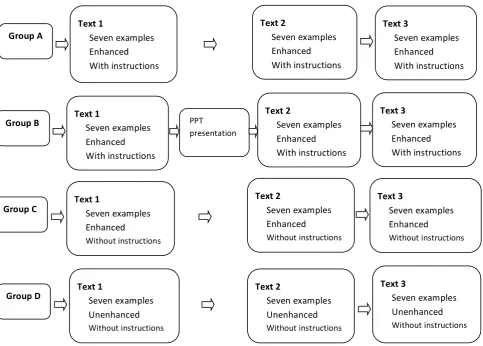
Following the pre-test, the four experimental groups were provided with input on the
target construction in three consecutive sessions in four different ways (see Fig. 2 for an
illustration of the experimental design of the study). Group A received enhanced input, and at
the beginning of each eye-tracking session the participants were asked to pay attention to
highlighted phrases. Group B was exposed to similar input to that of Group A in the first
eye-tracking session. Immediately before the second eye-eye-tracking session, however, the
participants in this group viewed a PowerPoint presentation that explained the form and
meaning of the target construction in writing. The presentation consisted of six slides and
included four examples from Text 1. Thereafter, the participants were exposed to the second
input, i.e. enhanced text with an instruction asking them to pay attention to highlighted
phrases. Input session 3 for Group B was similar to their first input session. Group C received
enhanced input, i.e. all examples of the target construction were highlighted in bold in the
texts that they read. The participants in Group C were not informed that there was a specific
target construction highlighted in the text, and they were not asked to pay attention to
highlighted phrases. To Group D we administered unenhanced input, i.e. examples of the
target construction were not highlighted in their texts nor were they told that there was a
specific target construction in the texts.
[INSERT FIGURE 2 APPROXIMATELY HERE]
Eye-tracking procedures. For the collection of eye-tracking data, a Tobii X2-60
portable eye-tracker was used. It was connected to a laptop computer and placed in a quiet
room. At the beginning of the first session, the participants were informed about the function
eye-17
tracking procedure. At the beginning of each reading session, a 9-point calibration was
performed. Participants sat approximately 67 centimetres away from the screen.
In preparation for the eye-tracking experiment, the three input texts were placed on
PowerPoint slides. After piloting different fonts, font sizes and spacing, 24-point,
double-spaced Calibri was used. This font was selected because it is considered to be suitable for
screen display (Ericson, 2013).
All the words belonging to a particular example of a target structure, i.e. AOI (e.g.,
had the walls painted), were placed on the same line in order to facilitate the measurement of
fixation duration on AOIs (see Fig. 3 for an example of an unenhanced input slides and Fig. 4
for an example of an enhanced input slide). The position of the AOIs within the lines could
not be controlled because the targets formed part of a coherent story line. As the targets and
the texts were identical in all experimental conditions, variations in the position of AOIs were
not expected to influence the findings. Each slide contained 4-5 double-spaced lines. The
PowerPoint slides were transferred to the Tobii eye-tracking software.
[INSERT FIGURES 3 AND 4 APPROXIMATELY HERE]
In the eye-tracking phase of the study, the participants were told that they were going to read
a story on the computer screen. They were informed that they could proceed to the next slide
when they finished reading; however, they were not allowed to go back to previous slides. No
specific time was allocated for reading, the participants could spend as much time on a slide,
reading and re-reading the text, as they felt necessary.
18
Analysis of the eye-tracking data. As already mentioned, we used two eye-tracking
measurements to infer the amount of attention paid to the target items. First, the total fixation
duration of each participant on each AOI was measured and the mean total fixation duration
for each participant for all AOIs was calculated. This calculation was done for each text
separately and resulted in a measure called the mean total fixation duration (TFD). For the
second eye-tracking measurement, the TFD for each participant for the text on the whole
page was measured. Then, the expected total fixation duration on each AOI was calculated
based on the proportion of the number of syllables that the AOI had in relation to the number
of syllables on the whole page where the particular AOI occurred.1 We used syllables,
because Trueswell, Tanenhaus and Garnsey (1994) argue that letter-based standardizations
are inaccurate. Furthermore, in English there is no one-to-one correspondence between letters
and sounds and often letter combinations rather than individual letters denote phonemes. This
results in the fact that beyond initial stages of learning to read, not letters but larger grain
sized units such as onsets and rimes and ultimately syllables constitute the basic units of
word-level decoding in English (Ziegler & Goswami, 2005).
Expected fixation duration of an AOI = no. of syllables of the AOI x TFD-whole page
for a participant no. of syllables of the whole page
Then, the difference between the observed and expected total fixation duration was calculated
again for each participant for each AOI.
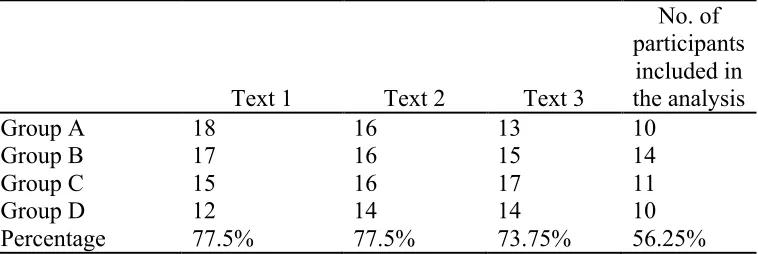
Unfortunately on each testing occasion approximately 13-15% participants’ data had
to be discarded because their eye-fixations went beyond the screen for a considerable amount
of time. As we needed information for all the three text-reading sessions, only those
participants whose data were of appropriate quality for all three texts were included in the
19
loss of data for 35 participants out of the 80 whose eye-tracking measures were taken in the
experimental conditions.
[INSERT TABLE 1 APPROXIMATELY HERE]
Pre-test and post-test results. In both the SR and GJ tasks, correct answers received
one mark and incorrect answers were scored as zero. Half marks were not allocated and
spelling mistakes were ignored. The maximum score on the SR task was 6 points and on the
GJ task 10 points. First, the total for both SR and GJ items was computed. Then, the gain
score was calculated separately for the SR and GJ target items by calculating the difference
between the total score of the post-test and the total score of the pre-test.
Statistical analyses. First, the normality of the distribution of all variables was
checked by means of a Shapiro-Wilks test. Except for the SR task, all the variables were
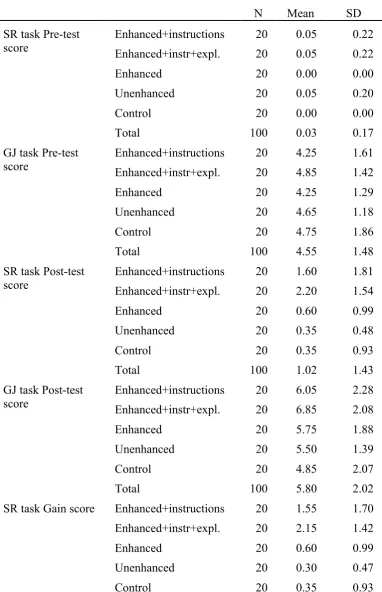
normally distributed (see Tables 2 and 3 for the descriptive statistics). For the SR task we
calculated the standardized residuals and Cook distances. The Normal P-P plot of the
standardized residuals indicated no deviation from normality and none of the residuals fell
outside the +2/-2 range. All Cook distance values were well below the critical threshold of 1
(Tabachnik & Fidell, 2007). Therefore, we decided to use parametric analyses for the study.
In order to answer our first research question, we analysed change in knowledge over time
with repeated measures MANOVA. For this analyses data for all participants (N = 100) was
included. In the analyses pertaining to our second research question, we compared the
eye-tracking measures of the treatment groups by means of one-way analysis of variance. As for
the third research question, the relationship between the gain scores and eye-tracking
20
significance was set at p < .05 and in the case of multiple tests Bonferroni correction was
applied to adjust the significance level and avoid inflated Type I error. Effect sizes were
calculated using partial eta square values. Based on Cohen (1988), partial eta square values
above .06 were taken as indications of medium and above .138 as large effect size.
[INSERT TABLES 2 AND 3 APPROXIMATELY HERE]
Results
Changes in receptive and productive knowledge of the target syntactic constructions under different input conditions. In our first research question we asked how knowledge of the form and meaning of the target syntactic construction causative had
changes under different input conditions. In order to answer this question, we conducted a
repeated measures MANOVA analysis to find out whether there was an improvement in the
SR and GJ task scores for the overall study sample, and whether an interaction between the
effect of instructional conditions and the rate of improvement in the two tasks could be
observed. This was followed by post-hoc Scheffe comparisons across the groups to detect
where the differences between them lay.
For the SR task, we found a statistically significant increase in the scores from
pre-test (M = 0.03, SD = 0.17) to post-test (M = 1.02, SD = 1.43), Wilks’ Lambda = 0.57, F(4,
95) = 69.81, p < .001, partial eta squared = .42. The mean increase was .99 with a 95%
confidence interval ranging from 0.72 to 1.26. For the GJ items, there was also a statistically
significant difference between the total scores of the pre-test (M = 4.55, SD = 1.48) and the
post-test (M = 5.80, SD = 2.02), Wilks’ Lambda = 0.57, F(4, 95) = 71.17, p < .001, partial eta
squared = .42. The mean increase in this task was 1.25 with a 95% confidence interval
21
knowledge of the target construction, whereas the mean for the GJ task was significantly
below the 50% guessing range, t(96) = -3.17, p = .002.
In the case of the SR task, the repeated measures MANOVA analysis showed a
significant between subjects (i.e. treatment) effect with a large effect size, F(4, 95) = 8.22, p
< .001, partial eta squared = .25 and a significant interaction between treatment conditions
and improvement in this task also with a large effect size, Wilks Lambda = 0.71, F(4, 95) =
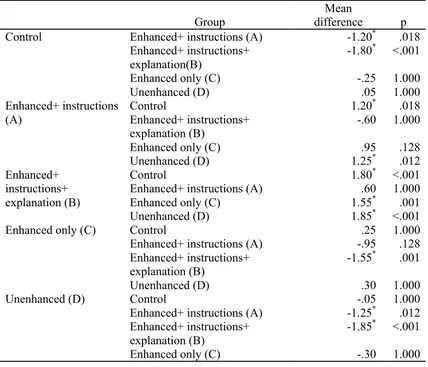
9.62, p < .001, partial eta squared = .288. A follow-up ANOVA with the gain score as the
dependent variable and the post-hoc Bonferroni analysis showed that there is a significant
mean difference in the gain scores for post-test SR items between the control group and the
enhanced+ instructions (A) group (p = .018) and between the control group and the
enhanced+ instructions+ explanation (B) group (p < .001). A significant mean difference was
also found between the unenhanced (D) group and the enhanced+ instructions (A) group (p =
.012) and the enhanced+ instructions+ explanation (B) group (p < .001). Moreover, the
enhanced+ instructions+ explanation (B) group showed a significant improvement (p = .001)
compared to the enhanced only (C) group (see Table 4).
The repeated MANOVA analyses for the GJ task indicated no significant between
group effect, Wilks lambda = 0.57, F(4, 95) = 1.28, p = .281, partial eta squared = .051.
However, a significant interaction between treatment conditions and improvement over time,
Wilks’ Lambda = 0.81, F(4, 95) = 5.48, p = .001, partial eta squared = .188 was found. The
comparison of the gain scores of the groups by means of ANOVA and post-hoc Bonferroni
tests showed that enhanced + instructions (A) group (p = .005), and the enhanced+
instructions+ explanation group (B) (p = .001) and the enhanced (C) group (p = .036)
achieved significantly higher gains than the control group. The pair-wise t-tests comparing
the pre- and post-test GJ task scores revealed that the control group, t(19) = 0.30, p = 0.761,
22
enhanced + instructions (A) group, t(19) = 4.34, p < 0.001 and the enhanced+ instructions+
explanation group (B), t(19) = 8.35, p < 0.001, made significant gains. The improvement of
the unenhanced (D) group did not reach the level of significance once Bonferroni correction
was applied, t(19) = 2.81, p = 0.011.
[INSERT TABLE 4 APPROXIMATELY HERE]
Attentional processing under different input conditions. In our study we also aimed to answer the question of whether the attention that participants pay to the target
grammatical construction differs under different treatment conditions (see our RQ2). First,
mean scores for both variables, i.e. total fixation duration for all AOIs (TFD) and the
difference between the observed and expected total fixation duration for all AOIs (ΔOE),
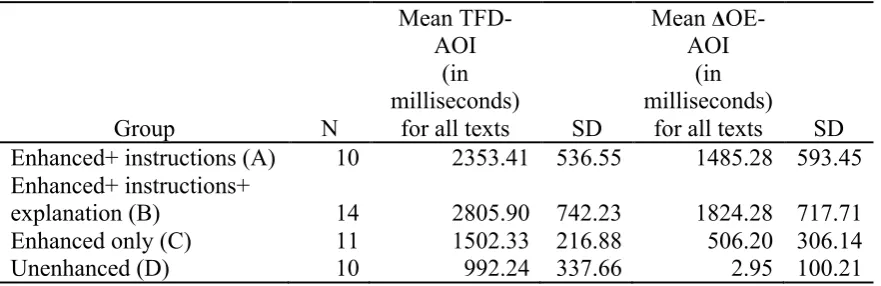
were computed. The descriptive statistics presented in Table 3 above show that the
enhanced+ instructions+ explanation (B) group had the highest TFD and ΔOE values. This
group is followed by the enhanced+ instructions (A) group, while the lowest values were
recorded for the participants in the unenhanced (D) group. ΔOE values indicate that the
enhanced+ instructions (A), enhanced+ instructions+ explanation (B) and enhanced only (C)
groups spent more time than expected gazing at examples of the target construction. The
ΔOE value was around zero in the unenhanced (D) group.
In order to answer our second research question, an ANOVA analysis was conducted
to assess the impact of the treatment conditions on the TFD and ΔOE values averaged for the
three texts. The type of input was found to have an overall significant effect on TFD, F(3,41)
= 27.06, p < .001, partial eta squared = .67, and ΔOE, F(3,41) = 28.42, p < .001, partial eta
squared = .68. The effect size can be considered large for both variables. As can be seen in
23
in both the TFD and ΔOE values between the enhanced+ instructions (A) group on the one
hand and the enhanced only (C) and unenhanced (D) groups on the other. Similarly, the
enhanced+ instructions+ explanation (B) group demonstrated significantly higher TFD and
ΔOE values than the enhanced only (C) and unenhanced (D) groups. But no significant
difference could be detected between the enhanced only (C) and unenhanced (D) groups or
between the enhanced+ instructions (A) and enhanced+ instructions+ explanation (B) groups,
respectively.
[INSERT TABLE 5 APPROXIMATELY HERE]
Relationship between change in knowledge and attention paid to target items. In our study we were also interested in exploring the relationship between the attention paid to
the targeted grammatical construction and changes in knowledge in the different instructional
conditions (see our RQ3). For this purpose, we first computed Spearman rank-order
correlations between the eye-tracking measures and the gain scores of the SR items and GJ
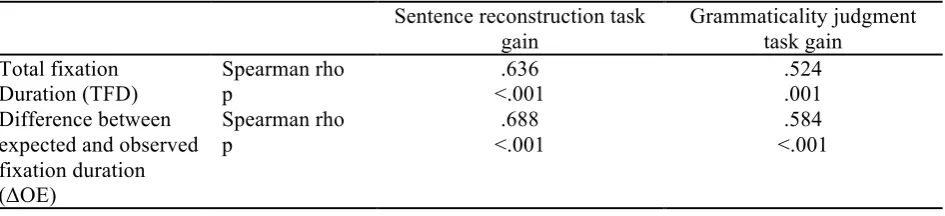
items for the whole sample. As can be seen in Table 6, there are strong positive correlations
between the gain scores of the SR and GJ items and the eye-tracking variables.
[INSERT TABLE 6 APPROXIMATELY HERE]
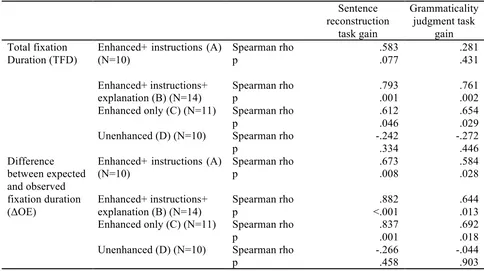
Although the sample size in the experimental groups was relatively small, we computed
non-parametric Spearman rho correlations to investigate the relationship between the gain scores
and eye-tracking measures in different input conditions (see Table 7). In the unenhanced (D)
group, no significant correlations were found, whereas for the other three groups the
24
significant and strong. The TFD was also strongly associated with the improvement
participants made in both of the tasks in the enhanced+ instructions+ explanation (B) and the
enhanced only (C) conditions, but not in the enhanced+ instructions (A) group.
[INSERT TABLE 7 APPROXIMATELY HERE]
Discussion
Attentional processing under different input conditions. In our study we examined how attentional processing of the target grammatical construction causative had varies under
four different input conditions (see our RQ 2). The results of the eye-tracking phase of our
study reveal that, under the input flood condition, the participants’ attention did not seem to
be drawn to examples of the target construction, and this was apparent in the fluctuations of
the observed and expected total fixation duration (ΔOE) around and below the value of zero.
This suggests that the participants in this condition may not have performed additional
attentional processing of the input besides decoding it as part of the text. In other words, they
might neither have exercised goal-directed top-down control over the allocation of their
attention to this feature of the input (Shiffrin, 1988; Styles, 2006) nor did they engage in
additional bottom-up attentional processing (Chun et al, 2011).
The attentional processing of the participants in the enhanced only condition did not
seem to differ considerably from that of the participants in the unenhanced condition. These
findings align with those of Issa et al. (2015), but are different from the results obtained by
Winke (2013) and Simard and Foucambert (2013). The reason for this difference might lie in
the nature of the enhancement. In our study we highlighted the target items in bold, and in
Issa et al.’s (2015) study different coloured font was used. Winke (2013) and Simard and
25
affective in creating an isolation effect (von Restorff, 1933), and consequently it might have
more successfully drawn learners’ attention to the target items than bolding or different
colour fonts. This indicates that bolding as a form of textual enhancement in this
experimental condition was not successful in inducing additional attentional processing. It is
also possible that the externally induced salience in our study might not have corresponded
with learners’ internally generated salience (Sharwood Smith, 1991, 1993). Furthermore,
Lavie, Hirst, De Fockert, and Viding’s (2004) research in the field of cognitive psychology
also suggests that increasing perceptual load, such as the visual enhancement of a section of
text, results in early exclusion of the stimulus from further cognitive processing unless the
stimulus is deemed to be relevant to the task. It can thus be hypothesized that the participants
in the textual enhancement condition did not consider the visually enhanced constructions
essential for comprehension of the text, and consequently did not engage in subsequent active
attentional processing.
Based on the results of our study, one of the most effective experimental
manipulations in our study seems to be the instruction to pay attention to the grammatical
construction embedded in the text. Explicit rule presentation can provide an additional boost
to the learning process, which is attested to by the facts that the enhanced+ instructions+
explanation (B) group demonstrated the highest level of correlations between eye-tracking
measures and learning gains and the largest improvement in the SR task. Wickens’ (2007)
SEEV (salience effort expectancy value) model of attention can offer a possible explanation
for these results. Wickens argues that four factors are important in determining what aspects
of incoming stimuli one attends to: salience, effort, expectancy and value. The model predicts
that when different pieces of information compete for attentional resources, information will
be heeded that is salient, requires less effort to process, is expected in a given situation and
26
learners that a novel grammatical construction is embedded in the text, the expectancy value
of the targeted structure was increased, and concomitantly its salience became relevant to the
task at hand. Therefore, in the two experimental conditions where participants were asked to
pay attention to the specific construction in the input, the participants can be assumed to have
exercised both top-down attention control to search for the relevant feature in the input text
and bottom-up control to select the necessary information among other stimuli (Chun et al.,
2011; Koch and Tsuchiya, 2006).
Attention and performance. In our research we also aimed to answer the questions of how L2 learners’ knowledge of the targeted syntactic construction causative had changes
under different input conditions and how these changes in knowledge are related to the
amount of attention paid to the target construction (see our RQ 1 and 3). With regard to the
changes in participants’ performance in the SR task, the findings mirror those obtained when
we examined differences in the eye-fixation measures. The main difference in learning gains
seems to lie between the explicit FonF conditions (enhanced+ instruction and enhanced+
instructions+ explanation) and the implicit FonF treatments (input flood and input
enhancement), with the two explicit FonF groups making significantly greater improvements
in the post-test than the other groups. The mean value of the change in scores is above 1.5
points for these groups for both tests which signals more than 25% improvement in the SR
task and 15% in the GJ task. Our findings also reveal that, in the SR task, the two implicit
FonF groups did not score significantly higher than the control group which received no
exposure to the target construction at all. In the GJ task, the effect size for the treatment was
small and the post-hoc procedures did not show significant group differences in learning
27
The different pattern of improvement in the two tasks might be explained by making
reference to the kind of knowledge and conditions under which this knowledge had to be
applied in these tasks. Although the SR task required participants to use their knowledge of
the target construction productively, it was not performed under time pressure. This might
have allowed learners to apply their explicit knowledge of the target construction (N. Ellis,
2005). The GJ task, which was presented to the participants in auditory mode, was carried out
under some degree of time pressure. It is still a matter of debate whether a GJ task performed
under time pressure assesses L2 learners’ explicit or implicit knowledge (e.g., R. Ellis, 2005;
Gutiérrez, 2013; Zhang, 2014). Nevertheless, recent evidence from an eye-tracking study by
Godfroid et al. (2015) seems to suggest that, under timed conditions, L2 learners tend to
apply their implicit knowledge. Taking this together with Bialystok’s (1979) finding that,
under auditory conditions, a GJ task encourages learners to rely on their implicit knowledge,
we can hypothesize that, in our study, the participants primarily used implicit knowledge
when making their grammaticality judgements. Based on this reasoning, it can be assumed
that our experimental manipulations were more effective in developing explicit knowledge
representations than participants’ implicit knowledge. Another possible explanation is that
learners need more time for implicit knowledge to develop, and our study was not conducted
on a timescale that would have allowed for this development.
The results of our study with regard to the differential effect of explicit and implicit
learning conditions are in line with the outcomes of Spada and Tomita’s (2010) and Goo et
al.’s (2015) meta-analysis, which showed that explicit FonF conditions have a greater impact
on L2 development than implicit ones. Both an instruction to pay attention to a specific
grammatical construction, which is similar to the rule-search condition in Robinson’s (1997)
study, and explicit metalinguistic explanation resulted in a significantly larger improvement
28
conditions were seen to be effective means of directing L2 learners’ attention to the target
feature and this increased attentional processing was also strongly associated with learning
gains in the SR task. The findings with regard to the differential effects of the explicit and
implicit FonF techniques seem to lend support to the argument that minimally guided
instruction, such as input flood and textual enhancement, might not be beneficial if learners
do not have previous familiarity with the target construction (Jahan & Kormos, 2015).
The results of the correlational analyses point to a strong relationship between the
eye-tracking variables and the learning gains made by our participants. The correlations are
particularly high in the case of the ΔOE measures and the improvement in the SR task. In line
with our hypothesis that the difference between the observed and expected eye-fixation
duration would be reflective of additional attentional processing, this value accounts for a
somewhat larger proportion of variance in gain scores than the total fixation duration value.
As already argued above, the increased fixation duration and the difference between the
observed and expected eye-fixation durations can be seen as indications of top-down and
bottom-up attention control processes (Chun et al., 2011; Koch & Tsuchiya, 2006).
Attentional processing of the target construction is very strongly related to learning gains,
especially in the SR task, which assessed the establishment of explicit knowledge
representations.
Conclusion
The study presented in this paper demonstrates that learning gains on a target L2 grammatical
construction are very strongly associated with the attention learners pay to it in the input.
Using eye-tracking methodology, we have also shown that explicit FonF techniques, most
29
more efficient in directing learners’ attention to the targeted construction than implicit FonF
techniques. An important pedagogical implication of our study is that if learners are given
limited support in what to pay attention to in the input, their attentional processes may not be
directed to the target feature even if there are abundant examples of it in the text or if they are
visually enhanced.
In our paper we also make a theoretical contribution by clearly delineating the
differences between attention, consciousness and awareness based on literature in the field of
cognitive psychology. In addition, we devised a new eye-tracking measure, the difference
between observed and expected eye-fixation durations, which we assume operationalizes
selective attention better than the total eye-fixation duration value. In our study, the
calculations of expected and observed values are based on word length measured in syllables,
but this operationalization can be refined further to take various lexical characteristics into
account, such as word frequency, concreteness and imageability, that potentially influence
how long a word is fixated on (Reichle et al, 2006).
Our study is not without limitations, one of the most important of which is the fact
that a large portion of participants’s eye-tracking data had to be excluded from the analyses.
This was partly because a portable eye-tracker was used to access a sufficiently large number
of participants from a homogenous language learning background and because measurements
were taken at three occasions. In future studies, more sensitive equipment and a larger
number of learners will be needed to gain more nuanced insights into differences in
attentional processing under different experimental conditions and to examine the
relationship between eye-tracking measures and learning gains. Due to data collection
constraints, no delayed post-tests could be administered, and hence we have little knowledge
about how enduring the learning gains were. Although we originally administered a
30
construction in a meaningful context in a written text, so few learners actually used the
construction that the analysis of these data was not possible. Therefore, in future studies,
other means for eliciting the productive use of the target construction will be needed.
Furthermore, in our study we could only hypothesize about the kind of knowledge our
test-tasks assessed. Using confidence ratings or tracking the eye-movements of the participants
while performing a GJ task might yield more reliable information about whether learners rely
on explicit or implicit knowledge in this task. Finally, our study involved only brief and
short-term treatment sessions which might have constrained the gains students made under
the implicit learning conditions.
Notes:
1. In calculating the residualized reading measure we took the text read at a time on the
screen as the baseline and not the total reading time for the whole text. The text on each
screen represented one step of the events in the story the participants read. Each event
might necessitate slightly different cognitive processing in terms of text comprehension
such as inference making, lexical and syntactic decoding. These different cognitive
processing mechanisms might influence reading time. If one takes the whole text as a
baseline, less accurate measure of the differential processing of the target item is
obtained.
References
Alanen, R. (1995). Input enhancement and rule presentation in second language acquisition.
In R. Schmidt (Ed.), Attention and Awareness in Second Language Acquisition (pp.
31
Allport, A. (1993). Attention and control: Have we been asking the wrong questions? A
critical review of twenty five years. In D.E. Meyer & S. Kornblum (Eds.), Attention and
performance: Synergies in experimental psychology, artificial intelligence, and
cognitive neuroscience (pp.183-218). Cambridge, MA: Mit Press.
Andringa, S., De Glopper, K., & Hacquebord, H. (2011). Effect of explicit and implicit
instruction on free written response task performance. Language Learning,61, 868-903.
Bachman, T. (2006). A single metatheoretical framework for a number of conscious-vision
phenomena. In Q. Jing, M.R. Rosenzweig, G. d’Ydewalle, H. Zhang, H. Chen & K.
Zhang (Eds.). Psychological science around the world (pp. 229–242), Sussex, England:
Psychology Press.
Bialystok, E. (1979). Explicit and implicit judgements of L2 grammaticality. Language
Learning, 29, 81-103.
Chun, M. M., Golomb, J. D., & Turk-Browne, N. B. (2011). A taxonomy of external and
internal attention. Annual Review of Psychology, 62, 73-101.
Cohen, J. (1988). Statistical power analysis for the behavioral sciences (2nd ed). Hillsdale,
NJ: Lawrence Erlbaum.
Coltheart, M., Curtis, B., Atkins, P. & Haller, M. (1993). Models of reading aloud:
Dual-route and paralleled distribution processing approaches. Psychological Review, 100,
589-608.
Council of Europe (2011). Common European framework of reference for languages.
Retrieved from http://www.coe.int/t/dg4/linguistic/Source/Framework_EN.pdf
Doughty, C. (2001). Cognitive underpinnings of focus on form. In P. Robinson (Ed.),
Cognition and second language instruction (pp. 206–57). Cambridge, England:
32
Doughty, C., & Williams, J. (1998). Issues and terminology. In C. Doughty & J. Williams
(Eds.), Focus on form in classroom second languageacquisition (pp. 1-12). Cambridge,
England: Cambridge University Press.
Ellis, R. (1994). The study of second language acquisition. Oxford, England: Oxford
University Press.
Ellis, R. (2005). Measuring implicit and explicit knowledge of a second language. Studies in
Second Language Acquisition, 27, 141-172.
Ellis, N. (2005). At the interface: dynamic interactions of explicit and implicit language
knowledge. Studies in Second Language Acquisition, 27, 305–352.
Erickson, A.P., (2013). The ABC's of font: effects of changing default fonts (Master’s thesis).
Retrieved from EWU Masters Thesis Collection. (Paper 108).
Gascoigne, C. (2006). Explicit input enhancement: effects on target and non-target aspects of
second language acquisition. Foreign Language Annals,39, 551-564.
Godfroid, A., Boers, F., & Housen, A. (2013). An eye for word: Gauging the role of attention
in incidental L2 vocabulary acquisition by means of eye-tracking. Studies in Second
Language Acquisition, 35(3), 483-517.
Godfroid, A. & Schmidtke, J. (2013). What do eye movements tell us about awareness? A
triangulation of eye-movement data, verbal reports, and vocabulary learning scores. In
J. M. Bergsleithner, S. N. Frota, & J. K. Yoshioka (Eds.), Noticing and second
language acquisition: Studies in honor of Richard Schmidt (pp. 183–205). Honolulu,
HI: University of Hawai‘i, National Foreign Language Resource Center.
Godfroid, A. & Uggen, M.S. (2013). Attention to irregular verbs by beginning learners of
German: An eye-movement study. Studies in Second Language Acquisition, 35,
33
Goo, J., Grañena, G., Yilmaz, Y., & Novella, M. (2015). Implicit and explicit instruction in
L2 learning: Norris & Ortega (2000) revisited and updated. In P. Rebuschat
(Ed.), Implicit and explicit learning of languages (pp. 443-482). Amsterdam,
Netherlands: John Benjamins.
Gutiérrez, X. (2013). The construct validity of grammaticality judgment tests as measures of
implicit and explicit L2 knowledge. Studies in Second Language Acquisition, 35,
423-449.
Heatley, A., Nation, I.S.P. & Coxhead, A. (2002). Range and frequency programs. Retrieved
from http://www.victoria.ac.nz/lals/staff/paul-nation.aspx.
Hernández, T.A. (2008). The effect of explicit instruction and input flood on students’ use of
discourse markers on a simulated oral proficiency interview. Hispania,91, 665–75.
Hunt, A.R. & Kingstone, A. (2003). Covert and overt voluntary attention: linked or
independent? Cognitive Brain Research,18, 102 – 105.
Issa, B. Morgan-Short, K. Villegas, B. & Raney, G. (2015). An eye-tracking study on the
role of attention and its relationship with motivation. In L. Roberts, K. McManus, N.
Vanek & D. Trenkic (Eds.), EUROSLA Yearbook2015 (pp. 114-142). Amsterdam,
Netherlands: John Benjamin Publishing Co.
Jahan, A. & Kormos, J. (2015). The impact of textual enhancement on EFL learners'
grammatical awareness of future plans and intentions. International Journal of Applied
Linguistics, 25, 46-66.
Jourdenais, R., Ota, M., Stauffer, S., Boyson, B. & Doughty, C. (1995). Does textual
enhancement promote noticing? A think aloud protocol analysis. In R. Schmidt (Ed.)
Attention and awareness in foreign language learning (pp. 183-216). Honolulu, HI:
34
Juan, C., Shorter-Jacobi, S., Schall, J., & Sperling, G. (2004). Dissociation of spatial attention
and saccade preparation. Proceedings of the National Academy of Sciences of the
United States of America,101(43), 15541-15544.
Koch, C. & Tsuchiya, N. (2006). Attention and consciousness: two distinct brain processes.
TRENDS in Cognitive Sciences, 11, 16-22.
Lamme, V.A.F. (2003). Why visual attention and awareness are different. TRENDS in
Cognitive Sciences, 7, 12-18.
Lavie, N., Hirst, A., De Fockert, J. W., & Viding, E. (2004). Load theory of selective
attention and cognitive control. Journal of Experimental Psychology: General, 133,
339-354.
Lee, S.K. & Huang, H.T. (2008). Visual input enhancement and grammar learning: A
meta-analytic review. Studies in Second Language Acquisition, 30, 307–331.
Leow, R. (2001). Do learners notice enhanced forms while interacting with the L2?: An
online and offline study of the role of written input enhancement in L2 reading.
Hispania, 84, 496-509.
Leow, R., Egi, T., Nuevo, A. & Tsai, Y. (2003). The roles of textual enhancement and type of
linguistic item in adult L2 learners’ comprehension and intake. Applied Language
Learning, 13, 1–16.
Liversedge, S., Gilchrist, I. D, & Everling, S. (2011). The Oxford handbook of eye
movements. Oxford, England: Oxford University Press.
Max Velmans, G. (2009). How to define consciousness—and how not to define
consciousness. Journal of Consciousness Studies, 16, 139-156.
Nagel, T. (1974). What is it like to be a bat? The Philosophical Review, 83, 435-450.
Nassaji, H. & Fotos, S. (2011). Teaching grammar in second language classrooms. New
35
Norris, J. M., & Ortega, L. (2000). Effectiveness of L2 instruction: A research synthesis and
quantitative meta-analysis. Language Learning, 50, 417–528.
O’Regan, J.K & Noe, A. (2001). A sensorimotor account of vision and visual consciousness.
Behavioral and Brain Sciences, 24, 939–1031.
Overstreet, M. (1998). Text enhancement and content familiarity: The focus of learner
attention. Spanish Applied Linguistics, 2, 229–258.
Radwan, A. A. (2005). The effectiveness of explicit attention to form in language learning.
System, 33, 69-87.
Rayner, K., & Pollatsek, A. (1989). The psychology of reading. Englewood Cliffs, NJ:
Prentice-Hall.
Reichle, E. D., Pollatsek, A., & Rayner, K. (2006). E–Z Reader: A cognitive-control,
serial-attention model of eye-movement behavior during reading. Cognitive Systems
Research, 7, 4-22.
Reinders, H. & Ellis, R. (2009). The effects of two types of input on intake and the
acquisition of implicit and explicit knowledge. In R. Ellis, S. Loewen, C. Elder, R.
Erlam, J. Philp & H. Reinders (Eds.), Implicit and explicit knowledge in second
language learning, testing and teaching (pp. 281–302). Bristol, England: Multilingual
Matters.
Robinson, P. (1995). Attention, memory and the noticing hypothesis. Language Learning, 45,
283–331.
Robinson, P. (1997). Generalizability and automaticity of second language learning under
implicit, incidental, enhanced, and instructed conditions. Studies in Second Language