© 2019, IRJET | Impact Factor value: 7.211 | ISO 9001:2008 Certified Journal
| Page 4225
Experimental Parametric Study of Diagrid Structure under Seismic
Forces
SUPRIYA MALI
1, D. B. KULKARNI
21
M. Tech (Structural Engineering) Student, Department of Civil Engineering, Rajarambapu Institute of Technology,
Sakhrale, Maharashtra, India.
2
Associate Professor, Department of Civil Engineering, Rajarambapu Institute of Technology, Sakharale,
Maharashtra, India.
---***---Abstract –
As diagrid structures are, recently growing faster, there is need to study the behavior of the diagrid structures under seismic forces. There are many different studies done on the diagrid structures and their diagrid pattern solutions to make the structures strong as well as economical. Now a days strength and economy are having prime importance, due to land and material shortage, also because of their high costs. The main aim of the diagrid system is to reduce the number of columns which occupy more space inside the structures. In this study the four storey steel diagrid model is taken which has 16 inclined columns along the periphery of the structure, there is no column inside the structure. Further the experimentation is done on horizontal shake table for determination of seismic forces. The RPM of the motor is varied and the results for acceleration and displacement are taken at 200, 250 and 300 RPM. The results are taken from observations based on displacement and acceleration.Key Words: Steel structure, Diagrid system, Experimental
model, Horizontal Shake table, seismic performance.
1. INTRODUCTION
The diagrid is a framework of diagonally intersecting inclined column members. Diagrid require less structural steel than conventional structures, that’s why it is getting more popular among the structural engineers. Now days the diagrid structures are focus of all structural researchers involved in structural optimization and column patterns solution studies. There are many researches on the diagrid structures that are on the column arrangement, column patterns and the use of minimum number of columns inside the structure. But there is lack of study on the actual experiment on the diagrid having different patterns. In this study experimental behavior of four storied diagrid structure model is subjected to harmonic base motions with the use of shake table. The structural model is rectangular in plan with stiffness and mass properties distributed uniformly in plan as well as in elevation. The diagrid structural model is designed to facilitate the first three mode shapes with bare eyes. Also the diagrid structural model is configured in such a way that three degrees of freedom
model would serve as a reasonable model, at least to a first approximation. The model however is idealized demonstration of building subjected to harmonic base motions. The frequency of base motion can be varied by changing the RPM of the electric motor. By adjusting the stroke, it is also possible to vary the amplitude of the base motion. This adjustment however, requires somewhat involved manipulations. By changing the motor RPM it is possible to set the model into resonant motions, which will enable you to visualize the first three normal modes of the frame.
For the experimental investigation the shake table apparatus is used. The M.S. plates of dimension 300mmX300mmX2mm are used to connect the inclined columns i.e. diagrid which is having dimension 335.54mmX18mmX2mm. Floor to floor height is 300mm for all floors.
1.1 Configuration of Diagrid Structures
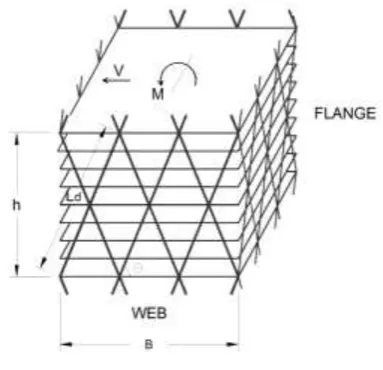
The diagrid structure is the combination of inclined columns arranged in the triangular tessellation. The inclined columns on the periphery connect the floors. There are no vertical columns depend upon the geometry of the structure.
[image:1.595.345.537.553.738.2]© 2019, IRJET | Impact Factor value: 7.211 | ISO 9001:2008 Certified Journal
| Page 4226
2. METHODOLOGY
The details of model geometry and horizontal shake table experiment are explained in the methodology.
2.1 Model Configuration
For the experimental investigation the shake table apparatus is used. The diagrid structure is modelled in ETABS software. The M.S. plates of dimension 300mmX300mX2mm are used to connect the inclined columns i.e. diagrid which is having dimension 335.54mmX18mmX2mm. Floor to floor height is 300mm for all floors.
Fig -2: Diagrid model
2.2 Horizontal Shake Table
Shake Table is one of the important apparatus to analyze the behavior of model subjected to harmonic base motions. The occurrence of resonance phenomenon in simple multi degree of freedom (MDOF) systems enables its understanding by this experiment. The shake table consist the circular mounting plate of dimension 390 mm diameter, which is set above the sliding table of dimension 400mmX360mm. The sliding table is kept in horizontal motion by the electric motor which is set to some revolutions per minute. The motor has 1 HP variable speed dc. The frequency control is 3%.
2.3 Experimental Procedure
A.
Experimental Setup
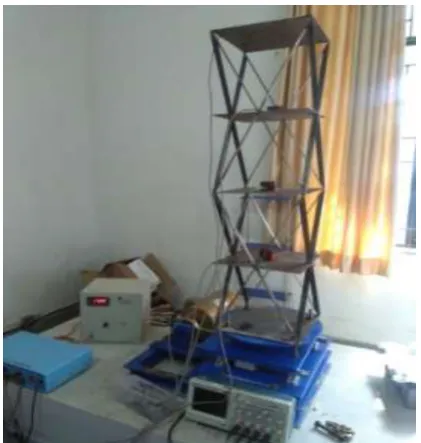
1. The figure 3 shows the experimental setup of the structural model.
2. The model consists of 16 inclined steel columns and four steel slabs; each slab is attached to the columns at an interval of 300mm.
3. The entire structure assembly is placed on the shake table driven by an electric motor.
4. The RPM of the motor can be varied to achieve harmonic base motions at different frequencies.
Fig -3: Diagrid model set on horizontal shake table
Fig -4: Electric motor
B.
Preliminary Measurements
1. Collect the data pertaining to geometric and material properties of the vibrating system. 2. Study the chart/manuals that accompany the
sensors.
[image:2.595.329.540.189.411.2] [image:2.595.84.237.281.473.2] [image:2.595.328.540.447.631.2]© 2019, IRJET | Impact Factor value: 7.211 | ISO 9001:2008 Certified Journal
| Page 4227
would remain unchanged at the speed of motor isvaried. Therefore in subsequent experimentation, the base motion itself need not be measured. 4. After arranging the experiment, the accelerometer
needs to be placed on slab such that displacement along the x-direction is picked up.
5. Set the structural model into free vibrations by applying an initial displacement. This is done by gently pulling the model at about the top slab and after releasing it. On the oscilloscope observe the free vibration decay and record the results. 6. Run the base motion test on the model at different
values of motor RPM making sure that readings at resonant frequencies are not missed. For a given motor RPM allow the model to oscillate for few seconds so that the frame reaches its steady state. At this stage measure the amplitude of the model response.
7. The data obtained by the experiment is then taken from the monitor attached to the shake table which shows the readings, acceleration for each floor, frequency. The file is taken in excel software and used for interpretation of motion of building.
3. EXPERIMETAL RESULTS AND DISCUSSION
The horizontal shake table experiment is done for the 200, 250 and 300 rpm. Following are the results obtained from the horizontal shake table.
3.1 Acceleration of the floors
Table -1: Acceleration of different floors obtained by shake table experiment for 200 rpm
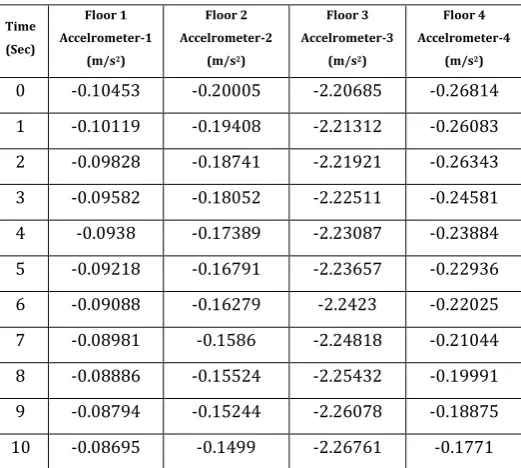
Table -2: Acceleration of different floors obtained by shake table experiment for 250 rpm
Table -3: Acceleration of different floors obtained by shake table experiment for 300 rpm
Time (Sec)
Floor 1 Accelrometer-1
(m/s2)
Floor 2 Accelrometer-2
(m/s2)
Floor 3 Accelrometer-3
(m/s2)
Floor 4 Accelrometer-4
(m/s2)
0 -0.017625 -0.057971 -2.258509 -0.046753
1 -0.017271 -0.059694 -2.256468 -0.048522
2 -0.016695 -0.061266 -2.254792 -0.04991
3 -0.016032 -0.062553 -2.253553 -0.050942 4 -0.015397 -0.063454 -2.252776 -0.051673
5 -0.014888 -0.06393 -2.252452 -0.05218
6 -0.014567 -0.064009 -2.252531 -0.052536
7 -0.014463 -0.063792 -2.252934 -0.052799
8 -0.014572 -0.063421 -2.253569 -0.05303 9 -0.014867 -0.063052 -2.254319 -0.053245
10 -0.015298 -0.062822 -2.255072 -0.053434
Time (Sec)
Floor 1 Accelrometer-1
(m/s2)
Floor 2 Accelrometer-2
(m/s2)
Floor 3 Accelrometer-3
(m/s2)
Floor 4 Accelrometer-4
(m/s2)
0 -0.10453 -0.20005 -2.20685 -0.26814
1 -0.10119 -0.19408 -2.21312 -0.26083
2 -0.09828 -0.18741 -2.21921 -0.26343
3 -0.09582 -0.18052 -2.22511 -0.24581
4 -0.0938 -0.17389 -2.23087 -0.23884
5 -0.09218 -0.16791 -2.23657 -0.22936
6 -0.09088 -0.16279 -2.2423 -0.22025
7 -0.08981 -0.1586 -2.24818 -0.21044
8 -0.08886 -0.15524 -2.25432 -0.19991
9 -0.08794 -0.15244 -2.26078 -0.18875
10 -0.08695 -0.1499 -2.26761 -0.1771
Time (Sec)
Floor 1 Accelrometer-1
(m/s2)
Floor 2 Accelrometer-2
(m/s2)
Floor 3 Accelrometer-3
(m/s2)
Floor 4 Accelrometer-4
(m/s2)
0 0.169098 0.231747 -2.034141 0.481047
1 0.145581 0.226094 -2.010099 0.445977 2 0.122495 0.219967 -1.986548 0.414015
3 0.100584 0.211365 -1.96364 0.385633
4 0.080465 0.198712 -1.941355 0.360977
5 0.062579 0.181127 -1.919769 0.33966 6 0.047143 0.158567 -1.89882 0.321158
7 0.034135 0.131725 -1.878332 0.304538
8 0.023341 0.101889 -1.858111 0.288585
9 0.014385 0.070762 -1.83788 0.271985
[image:3.595.316.577.138.372.2] [image:3.595.30.577.449.796.2]© 2019, IRJET | Impact Factor value: 7.211 | ISO 9001:2008 Certified Journal
| Page 4228
3.2 Seismic Response Recorded in Monitor
Attached to Shake Table
A.
Graphs Obtained From 200 RPM
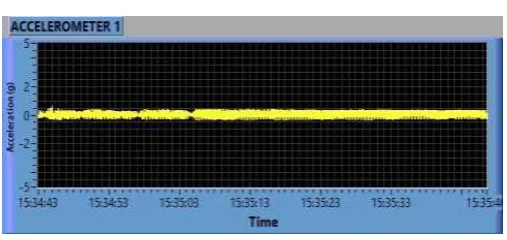
Chart -1: Accelerometer 1
Chart -2: Accelerometer 2
Chart -3: Accelerometer 3
Chart -4: Accelerometer 4
B.
Graphs obtained from 250 RPM
Chart -5: Accelerometer 1
Chart -6: Accelerometer 2
Chart -7: Accelerometer 3
© 2019, IRJET | Impact Factor value: 7.211 | ISO 9001:2008 Certified Journal
| Page 4229
C.
Graphs Obtained from 300 RPM
Chart -9: Accelerometer 1
Chart -10: Accelerometer 2
Chart -11: Accelerometer 3
Chart -12: Accelerometer 4
From the results that is acceleration graphs obtained by horizontal shake table experiment is seen that the acceleration and displacement of the diagrid structure goes increasing from first floor to fourth floor.
4. CONCLUSION
[image:5.595.35.289.116.236.2]Conclusion is made by the results obtained from the shake table experiment. The diagrid structures are having more stiffness and load bearing capacity or resistance to the forces coming on the structure due to their diagrid pattern arranged in triangular patchwork. The steel diagrid structures have a good response to the earthquake forces than conventional structures.
REFERENCES
[1] Asadi Esmaeel and Adeli Hojjat, “Seismic performance
factors for low to mid‐rise steel diagrid structural systems” The Structural Design of Tall and Special Buildings, 27, no. 15, June. 2018, e1505.
[2] Baker W., Besjak C., Sarkisian M., Lee P. and Doo C.,
“Proposed Methodology to Determine Seismic Performance Factors For Steel Diagrid Framed Systems”,Council on Tall Buildings and Urban Habita, 13th U. S. Japan workshop, 2010.
[3] Fu J. Y., Wu J. R., Xu A., Li Q. S. and Xiao Y. Q., “Full-scale
measurements of wind effects on Guangzhou West Tower”,Engineering Structures, vol. 35, Jan. 2012, pp. 120-139, doi:10.1016/j.engstruct.2011.10.022.
[4] Giovanni Maria Montuori, Mele Elena, Brandonisio
Giuseppe and Luca A. D., “Geometrical patterns for diagrid buildings: Exploring alternative design strategies from the structural point of view”, Engineering Structures, vol. 71, May 2014, pp. 112-127, doi:10.1016/j.engstruct.2014.04.017.
[5] Giovanni Maria Montuori, Mele Elena, Brandonisio
Giuseppe and Luca A. D., “Secondary bracing systems for diagrid structures in tall buildings”, Engineering Structures, vol. 75, Jul. 2014, pp. 477-488, doi:10.1016/j.engstruct.2014.06.011.
[6] Jani Khushbu and Patel Paresh V., “Analysis and
Design of Diagrid Structural System for High Rise Steel Buildings”, Procedia Engineering, vol. 51, 2013, pp. 92-100, doi:10.1016/j.proeng.2013.01.015.
[7] Kamath Kiran, Hirannaiah Sachin and Noronha J. C. K.
B.,“An analytical study on performance of a diagrid structure using nonlinear static pushover analysis”, Perspectives in Science,vol. 8, Apr. 2016, pp. 90-92.
[8] Kowalczyk, R., Sinn, R., and Kilmister, M. B., Structural
Systems for Tall Buildings, Council on Tall Buildings and Urban Habitat Monograph, 1995 New York: McGraw-Hill.
[9] Lee Dongkyu, Shin Soomi, Doan Q. H.,“Real-time
robust assessment of angles and positions of nonscaled steel outrigger structure with Maxwell-Mohr method”, Construction and Building Materials,
vol. 186, Aug. 2018, pp. 1611-1176,
doi:10.1016/j.conbuildmat.2018.07.212.
[10] Lee Joonho, Kong Jieun and Kim Jinkoo,“Seismic
© 2019, IRJET | Impact Factor value: 7.211 | ISO 9001:2008 Certified Journal
| Page 4230
International Journal of Steel Structures, vol. 18, Apr.2018, pp. 1035–1047.
[11] Moon Kyoung Sun, “Diagrid Structures for
Complex-Shaped Tall Buildings”,Procedia Engineering, vol. 14,
Jul. 2011, pp. 1343–1350,
doi:10.1116/j.proeng.2011.07.169.
[12] Rai Avnish Kumar, Arya Rajeev and Sakalle R., (2017)
“Cost analysis and comparison of a composite diagrid frame with bare frame under dynamic loading” International Research Journal of Engineering and Technology, vol. 4, Dec. 2017, pp. 1648-1655.
[13] Sadeghi Saman and Rofooei Fayaz R.,“Quantification of
the seismic performance factors for steel diagrid structures”,Journal of Constructional Steel Research,
vol. 146, Mar. 2018, pp. 155-168,
doi:10.1016/j.jcsr.2018.03.018.
[14] Tomeia Valentina, Embimbo M. and Mele
E.,“Optimization of structural patterns for tall buildings: The case of diagrid”, Engineering Structures, vol. 171, May. 2018, pp. 280-297, doi:10.1016/j.engstruct.2018.05.043.
[15] Young-Ju Kim, Kim M., In-Yong Jung, Ju Y. K. and Kim
S.,“Experimental investigation of the cyclic behavior of nodes in diagrid structures”, Engineering Structures,
vol. 33, Apr. 2011, pp. 2134-2144,
doi:10.1016/j.engstruct.2011.03.004.
AUTHORS
Supriya Mali,
M. Tech (Structural Engineering) Student, PG Department of Civil Engineering, Rajarambapu Institute
of Technology, Sakhrale,
Maharashtra, India.
D. B. Kulkarni,