KEEL 3.0: An Open Source Software for Multi-Stage Analysis in Data Mining
Isaac Triguero1, Sergio Gonz´alez2, Jose M. Moyano4, Salvador Garc´ıa2, Jes ´us Alcal´a-Fdez2, Juli´an Luengo2, Alberto Fern´andez2, Maria Jos´e del Jes ´us5, Luciano S´anchez3, Francisco Herrera2
1School of Computer Science University of Nottingham, Jubilee Campus
Nottingham NG8 1BB, United Kingdom E-mail: [email protected]
2Department of Computer Science and Artificial Intelligence University of Granada, Granada, Spain, 18071
3Department of Computer Science University of Oviedo, Gij´on, 33204, Spain
4Department of Computer Science and Numerical Analysis University of Cordoba, 14071 Cordoba, Spain
5Department of Computer Science University of Ja´en, Ja´en, Spain
Abstract
This paper introduces the 3rdmajor release of the KEEL Software. KEEL is an open source Java frame-work (GPLv3 license) that provides a number of modules to perform a wide variety of data mining tasks. It includes tools to perform data management, design of multiple kind of experiments, statistical analyses, etc. This framework also contains KEEL-dataset, a data repository for multiple learning tasks featuring data partitions and algorithms’ results over these problems. In this work, we describe the most recent components added to KEEL 3.0, including new modules for semi-supervised learning, multi-instance learning, imbalanced classification and subgroup discovery. In addition, a new interface in R has been incorporated to execute algorithms included in KEEL. These new features greatly improve the versatility of KEEL to deal with more modern data mining problems.
Keywords:Open Source, Java, Data Mining, Preprocessing, Evolutionary Algorithms.
1. Introduction
Data Mining (DM) techniques25are widely used in a broad number of applications that go beyond the computer science field 41. In order to ease the ac-cess to these models for people not directly related to computer science, many commercial and non-commercial software suites have been made avail-able. The majority of the former are commercially
distributed (e.g. SPSS Clementine, Oracle Data Mining or KnowledgeSTUDIO), but there is still a good number of open source tools. Among the ex-isting open source applications, Workflow-based en-vironments allow us to visually chain a number of DM methods together in a pipeline. The most used DM apps of this kind are: Weka18, KNIME1 and KEEL2.
Received 6 March 2017
The KEEL software 5,4∗(Knowledge Extraction based on Evolutionary Learning) was originally de-veloped as a tool mainly focused on the implementa-tion of evoluimplementa-tionary algorithms and soft computing techniques for standard DM problems such as re-gression, classification or association rules, as well as data preprocessing techniques 23,14. KEEL was launched in 20095 and later upgraded in 20114as a non-commercial Java suite, so that, it could be on all major platforms. KEEL provides a simple GUI to design experiments with different data sets and com-putational intelligence algorithms in order to assess the behaviour of the algorithms. Moreover, it was designed with a two-fold goal: research and educa-tional.
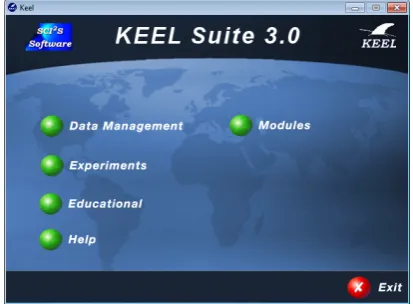
[image:2.595.62.269.497.649.2]A screenshot of the main window of KEEL 3.0 is shown in Figure 1, where its main components are highlighted. This suite came along with KEEL-dataset†, a repository that includes standardized data set partitions for comparison purposes in the KEEL format. These can be used for comparison versus several algorithms of the specialised literature, as it also comprises some experimental results on these data sets. However, this platform is continuously evolving towards a more flexible and comprehensive tool that allows us to deal with new and more com-plex DM problems (namely semi-supervised learn-ing42, imbalanced classification31or multi-instance learning6).
Fig. 1. Screenshot of the main window of KEEL 3.0.
In this paper, we present the 3rd major release
of KEEL, describing its new components. We re-lease this version as an open source software under the terms of the GNU Public License GPLv3. The reasoning behind this is clear; Our implementation is publicly available for all the research community in the DM area, as well as non-specialised users that can take advantage of these models for their own ap-plications. Furthermore, we support transparency, meritocracy, and community development35,3. The major contributions of this new release are:
• We have included four new modules focused on new problems and techniques. This considers a module for semi-supervised problems, imbal-anced data, multi-instance learning and subgroup discovery26.
• A package named RKEEL 32 has been recently created as a layer between R and KEEL, allowing users to execute KEEL functionalities from R.
• A new collection of data sets have been incorpo-rated to the KEEL-dataset repository. We have added data sets for specific problems such as: Im-balanced, multi-label, semi-supervised, noisy and low-quality data.
• A new external GUI for nonparametric statistical analysis has been included. It allows users to anal-yse and compare their results from previous ex-periments on KEEL or any other source15,21.
• Many new algorithms have been added to the orig-inal modules, including preprocessing and learn-ing models.
• Documentation and project administration-wise have been greatly enhanced. We must refer to KEEL 3.0 on platforms such as GitHub and ML-loss to foster external collaboration and usability. In addition, the API (javadocs) is now available to promote better integration with other tools.
This paper is organised as follows. Section 2 de-scribes in detail the main novelties of this version. Section 3 compares KEEL 3.0 to other existing DM software. Section 4 discusses about the availability of KEEL 3.0 and its community. Finally, Section 5 concludes the paper.
∗http://www.keel.es,http://mloss.org/software/users/keel,https://github.com/SCI2SUGR/KEEL
2. KEEL 3.0: New modules and features
This new version of KEEL improves upon the pre-vious versions. From the first release of KEEL, a set of already well-established algorithms are present as classical learning methods in the software. KEEL 3.0 has now 514 algorithms integrated, consisting of 98 data preprocessing algorithms, 368 learning al-gorithms and 24 statistical test procedures.
1
4
5
2
[image:3.595.57.283.230.399.2]3
6
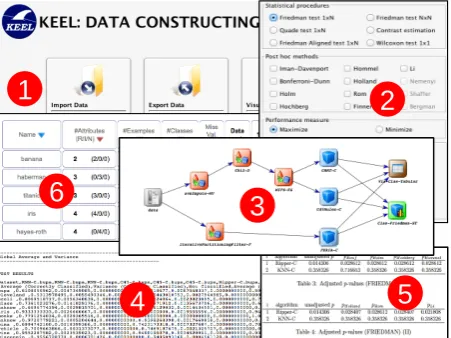
Fig. 2. Some KEEL 3.0 snapshots.
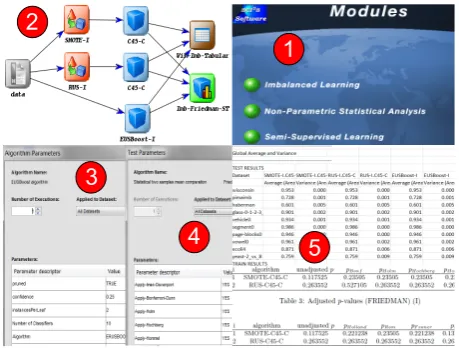
This section revises the main components added to KEEL 3.0, including new modules, new data sets, an interface to connect KEEL and R, as well as a case of study with one of the aforementioned mod-ules. Figure 2 presents a graphic summary of KEEL 3.0, highlighting its main features: (1) data man-agement section, including import/export, visuali-sations, editions and partitioning of data; (2) GUI for statistical analysis, with the statistical procedures described in15,21; (3) Flexible experiments configu-ration, showing an example of experiment illustrated by means of a flowchart, involving four data prepro-cessing algorithms (Chi2 discretizer, Mutual Infor-mation feature selection, SVM missing values im-putation and Iterative Partitioning noise filter), three classifiers (CART, C4.5 Rules and FURIA), tabular visualisation of results and a Friedman test based analysis; (4) Output in CSV format of a tabular sum-mary of results; (5) LATEX output of statistical anal-ysis; (6) Repository of data sets already partitioned, including data sets with missing values, noise, low quality data, imbalanced and semi-supervised
classi-fication, multi-instance and multi-label learning, re-gression and time series.
In the following subsections, we detail the func-tioning of these new features of KEEL 3.0. Nev-ertheless, the full description can be found in the new web-based Reference Manual athttp://www.
keel.es/development.php.
2.1. New data mining scenarios
Real world applications are demanding more flexi-ble DM models that can deal with very challenging scenarios. Traditional supervised and unsupervised techniques may not fit well with the kind of data available in many of these applications. For this rea-son, KEEL now includes a number of extra modules that provide us with more advanced DM models for complex scenarios. In what follows, we discuss the four new modules added in KEEL.
2.1.1. Imbalanced Learning
In many supervised learning applications, we may run into the situation where there is scarcity of a particular class of samples. Taking binary prob-lems as an example, this issue is typically known as the class imbalanced problem31,10, in which pos-itive data samples (usually the class of interest) are highly outnumbered by negative ones29. This issue brings along a series of difficulties such as overlap-ping, small sample size, or small disjunct.
domains, either by modifying the ensemble learning algorithm at the data-level approach to pre-process the data before the learning stage of each classifier or by considering to embed a cost-sensitive frame-work in the ensemble learning process.
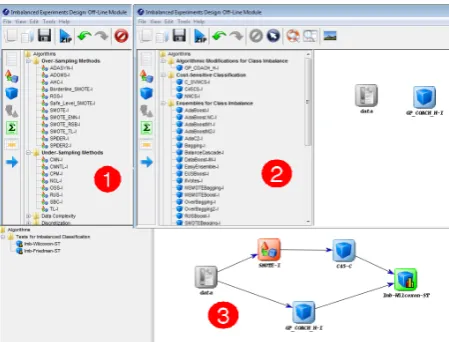
[image:4.595.56.281.215.386.2]KEEL includes all of these approaches in this new module. Figure 3 summarises the three main contributions of this module:
Fig. 3. Imbalanced learning module Main Characteristics: (1) Under-Sampling and Over-Sampling Models, (2) Imbal-anced Learning Algorithms, (3) Tailored Statistical tests.
1. Preprocessing techniques: Apart from the existing preprocessing techniques included in the original KEEL Experiment section, this module includes two new categories: Over-Sampling Methods and Under-Over-Sampling tech-niques. These preprocessing techniques may be later connected to standard data mining models.
2. Methods: KEEL provides tailored algorithm for the class-imbalanced problem. It con-tains the state-of-the-art in ensemble learning 20and cost-sensitive classification.
3. Visualisation and Statistical Tests: As in the case of standard classification, KEEL includes a number of visualisation and statistical utili-ties. For this module, these have been modi-fied to take into account the imbalanced prob-lem. Specifically, it uses geometric mean and area under ROC curve as more appropriate performance measures for this scenario.
2.1.2. Semi-Supervised Learning
The Semi-Supervised Learning (SSL) paradigm has attracted much attention in many different fields where it is easier to obtain unlabelled than labelled data because it typically requires less effort, exper-tise and time-consumption. In this context, tradi-tional supervised learning is limited to using labelled data to build a model. Nevertheless, SSL is a learn-ing paradigm concerned with the design of models in the presence of both labelled and unlabelled data. KEEL 3.0 includes a dedicated module to deal with this kind of problems. Similarly to the stan-dard experiments design module, it allows the user to create experiments on a work-flow fashion. It also grants us the possibility of testing the trans-ductive and intrans-ductive capabilities of these methods. This module already includes a great number of self-labelled techniques for SSL, from classical mod-els such as Self-Training and Co-Training to state-of-the-art techniques as Tri-Training or Democratic Co-Learning. All of those methods were experimen-tally evaluated in 37. The addition of tailored pre-processing techniques for this scenario36as well as other families of methods such as Graph-based mod-els13is still in progress. Nevertheless, the software is ready to add both kind of techniques.
2.1.3. Multi-Instance Learning
learning problem with incomplete labelling informa-tion.
Although MIL is a relatively recent learning framework, the MIL setting has produced numer-ous and interesting applications in different domains which have improved considerably the previous re-sults achieved with other learning frameworks due to greater flexibility in their representation.
This new version of KEEL adds a module to per-form MIL experiments. This module includes 9 al-gorithm from the state-of-the-art6. As in the case of SSL, no preprocessing techniques are available at the moment, but the module is ready to integrate such kind of algorithm when available.
2.1.4. Subgroup discovery
Subgroup discovery (SD)26,9 consists of extracting interesting rules with respect to a target variable. SD is a problem somewhere halfway between predictive and descriptive induction. Its goal is to generate sin-gle and interpretable subgroups to describe the re-lations between independent variables and a certain value of the target variable. Since this kind of tech-niques will work on exactly the same kind of input data as standard classification, this module has been directly incorporated as a section of the experiment design module. Thus, all the preprocessing tech-niques included in KEEL can be used prior to the application of the subgroup discovery models. In addition, these techniques do not only make predic-tions but they also provide descriptive rules and a set of quality measures as output11.
2.2. New Data preprocessing and Learning techniques
KEEL is a project continuously in expansion. There-fore, existing modules such as the standard exper-iments design increase their number of algorithms very rapidly. We enumerate the new additions as fol-lows:
• Preprocessing: An entire set of data preprocess-ing algorithms have been added, includpreprocess-ing the
state-of-the-art in discretisation24,34and noise fil-tering 19. Additionally, newly developed algo-rithms in instance selection, feature selection and missing data imputation have also been incorpo-rated22.
• Learning: New families of models such as lazy learning (including an exhaustive set of Fuzzy k nearest neighbours methods 16) and associa-tive classification as well as new implementations for rule induction and decision trees, statistical learning, association rule mining and fuzzy based learning28,17are now available.
2.3. KEEL-dataset
The KEEL-dataset repository‡was established to provide data sets in KEEL format so that the inte-gration with KEEL would be straightforward. Fig-ure 4 shows a snapshot of the currently existing data sets in KEEL-dataset repository. It includes exper-imental studies and results on many of those data sets. Nowadays, more than 900 data sets are avail-able for download, covering all the modules existing in KEEL 3.0, and more. Specifically, we now in-clude specific data sets and results for: Imbalanced, multi-label, SSL, noisy and low-quality data.
Fig. 4. KEEL-dataset.
2.4. A dedicated module for statistical analyses
Since the previous version, KEEL included a statis-tical library to analyse the results of the algorithms. These analyses were limited to be performed within the design of experiments module. In this way, only those algorithms included in this particular experi-ment were statistically evaluated. To make our sta-tistical library even more flexible, KEEL 3.0 now provides a separated module for non-parametric sta-tistical tests15,21. More information about this kind of statistical test can be found at http://sci2s.
ugr.es/sicidm/.
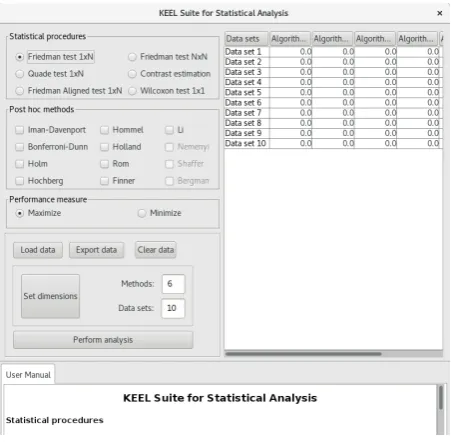
[image:6.595.56.282.334.555.2]This module takes as input a file in CSV format or the user can manually introduce their results or copy-paste them on the cells of an interactive table. Figure 5 shows how the module looks like.
Fig. 5. Non-parametric statistical test Module.
There are a number of statistical procedures for 1-to-N and N-to-N comparisons, respectively. These tests come together with post hoc models to charac-terise the differences detected by the statistical tests. Depending on the characteristics of the prob-lem considered, it is possible to perform the sta-tistical test for maximisation and minimisation pur-poses. This feature allows us to determine if the re-sults have been obtained from a maximisation prob-lem (e.g. using accuracy in supervised classification
problems) or from a minimisation problem (e.g. us-ing mean squared error in regression problems).
The resulting statistical analyses are summarised in a report which is provided in Latex format.
2.5. RKEEL:Run KEEL 3.0 with R
R is an interactive programming language and an en-vironment that provides a wide variety of methods for statistics, classification, association rules, regres-sion, linear and non-linear models, graphical repre-sentation of data, and so on as packages. One of the greatest virtues of R is that it can be easily extended through packages. These packages can be down-loaded from different repositories, being CRAN the main repository. In this way, researchers have avail-able a wide variety of functionalities and algorithms already programmed and tested without needing to know how they are made.
RKEEL 32 is a recently published package at CRAN repository33, which provides an interface to execute from R some preprocessing, classification, regression and association rule algorithms integrated in the KEEL software tool. Thus, R developers can now take advantage of the wide variety of algorithm available in KEEL.
The RKEEL package has the following main structure: the KeelAlgorithm class implements the main methods and properties of any KEEL algo-rithm to be interfaced. Then, the ClassificationAlgo-rithm, PreprocessAlgorithm, RegressionAlgorithm
and AssociationRulesAlgorithm classes, which in-herit from the baseKeelAlgorithmclass, implement each one the main features of a KEEL classification, preprocessing, regression and association rules algo-rithm, respectively. Any interfaced algorithm from KEEL must inherit from its corresponding class. Furthermore, the RKEEL package depends on other R packages to ensure its performance, such as XML 30, R612, doParallel7, foreach8, gdata40and rJava 39. Also, RKEEL needs at least Java version 8
sets in RKEEL can be loaded with the loadKeel-Datasetmethod (line 6). The “?” character shows the help for a specific algorithm or method (line 9) and, in order to create an association rules algorithm, the name of the algorithm with the data set between parenthesis is necessary (line 11).
1 > # I n s t a l l and l o a d the p a c k a g e
2 > i n s t a l l.p a c k a g e s(" R K E E L ") 3 > l i b r a r y( R K E E L )
4 >
5 > # L o a d d a t a set
6 > dat < - l o a d K e e l D a t a s e t (" i r i s ") 7 >
8 > # S h o w a l g o r i t h m h e l p
9 > ? F P g r o w t h_A
10 > # C r e a t e the a l g o r i t h m o b j e c t w i t h the d a t a s e t
11 > a l g o r i t h m < - F P g r o w t h_A ( dat ) 12 >
13 > # Run a l g o r i t h m
14 > a l g o r i t h m$run () 15 >
16 > # R u l e set in a r u l e s f o r m a t
17 > a l g o r i t h m$r u l e s 18 > # S h o w r u l e s
19 > a l g o r i t h m$s h o w R u l e s (2) 20 > # Get i n t e r e s t m e a s u r e s
21 > a l g o r i t h m$g e t I n t e r e s t M e a s u r e s () 22 > # Add new i n t e r e s t m e a s u r e
23 > a l g o r i t h m$a d d I n t e r e s t M e a s u r e (" Y u l e Y "," y u l e s Y ")
24 > # S o r t r u l e set by i n t e r e s t m e a s u r e
25 > a l g o r i t h m$s o r t B y (" y u l e s Y ") 26 >
27 > # E x p o r t r u l e s w i t h i n t e r e s t m e a s u r e s in CSV f o r m a t
28 > a l g o r i t h m$w r i t e C S V (" m y r u l e s ")
29 > # E x p o r t r u l e s w i t h i n t e r e s t m e a s u r e s in P M M L f o r m a t
30 > a l g o r i t h m$w r i t e P M M L (" m y r u l e s ")
31 > # G e n e r a t e . tex f i l e w i t h m e a s u r e s t a b l e
32 > a l g o r i t h m$w r i t e K e e l L a t e x T a b l e s (" t a b l e ")
Fig. 6. Example of use in R.
To run the algorithm, the user simply has to call therunmethod of the object (line 14). Once the al-gorithm is executed, the user can check the number of rules of the generated rules set (line 17), show the rules (line 19) or get the interest measures of the dif-ferent rules (line 21). Also, RKEEL allows us to add new interest measures to the rules set (line 23). Fur-thermore, the user can sort the rules by an interest measure with the sortBymethod (line 25), as well as export the rules and results in CSV and PMML
formats (lines 28-30). Finally, the interest measures of the different rules can be exported as tex file (line 32).
2.6. Case Study in KEEL 3.0
[image:7.595.313.543.269.443.2]The purpose of this section is to illustrate the use and potential of the new KEEL modules. To do so, we have developed a study with several methods in-cluded in the new imbalanced classification module (see Figure 7 (1)) using ten data sets available in the KEEL-dataset repository§for the experiment.
Fig. 7. Some snapshots taken from KEEL for this study case.
The data flow and results from the methods and statistical techniques are shown in Figure 2 (2). In this example, we have used the data preprocessing algorithms SMOTE (based on oversampling) and RUS (based on undersampling) with the classifier C4.5, and the current ensemble classifier EUS-Boost that uses an evolutionary undersampling approach as preprocessing method in a boosting procedure with the classifier C4.5. We have used a 5-fold cross vali-dation procedure and the parameters of the methods have been selected according to the recommenda-tion of the corresponding authors within each pro-posal, which are the default parameter settings in-cluded in KEEL, although they can be adjusted by clicking twice on the node (see Figure 2 (3)). Once the experiment has been run, by including the out-put nodes tabular visualisation and Friedman test,
we can find several summary results files including both the confusion matrices and performance values with the AUC, and statistical analyses of the for-mer results (Figure 2 (4) shows the configuration window of test node). By the analysis of the re-sults presented in Figure 2 (5), we can highlight that EUS-Boost outperforms the remaining methods in terms of average AUC for the test data. Further-more, the Friedman test shows that there are sig-nificant differences among the observed results and the hypothesis of equality is rejected by the post-hoc tests. This experiment can be downloaded following the linkhttp://www.keel.es/software/KEEL_ caseStudy.zip
3. KEEL compared to other DM tools
This section briefly summarises the main dif-ference between KEEL 3.0 and the two most significant workflow-based DM software writ-ten in Java, KNIME and WEKA. A full re-port on KEEL vs. KNIME and WEKA can be found at http://www.keel.es/documents/
KEELcomparisonMLtools.pdf.
We must point out that the ultimate objective of this study is to stress which are those characteristics that support the main strengths for each particular tool, rather than to establish a comparison for the ad-vantages of one against another. Therefore, we have selected several features that will allow the reader to determine the major differences among the software tools, and then to categorise KEEL as a valuable al-ternative to these suites when other specific research requirements are needed.
Specifically, we distinguish four levels of support in these characteristics: none (N), basic support (B), intermediate support (I) and advanced support (A). If features do not have intermediate levels of sup-port, the notation used is checked (3) for supporting and non-checked (7) for not supporting.
The following criteria are used for comparison purposes:
• Off/On-line run of the experiment set up. An On-line run implies that the tool interface and al-gorithm modules need to be in the same machine
and the experiments are completely dependent on the software tool. An off-line run entails the inde-pendence of the experiments created with respect to the suite interface, allowing the experiment to be executed later on in other machines.
• Pre-processing Variety. This comprises the availability of discretisation, feature selection, in-stance selection and/or missing values imputation methods. The trend of most of the suites is to offer a good feature selection and discretisation set of methods, but they often neglect specialised meth-ods of missing values imputation and instance se-lection. Usually, the contributions included are basic modules of replacing or generating null val-ues and methods for sampling the data sets by ran-dom (stratified or not) or by value-dependence.
• Learning Variety. It is supported over main ar-eas of DM, such as predictive tasks (classification, regression, anomaly/deviation detection), and de-scriptive tasks (clustering, association rule discov-ery, sequential pattern discovery). Additionally, we take into account several novel DM scenarios such as SSL, Imbalanced Classification and MIL.
• Advanced Features. This part includes some of the less common criteria incorporated for extend-ing the functionality of a software tool.
• Post-processing techniques, usually devoted to tuning the model learned by an algorithm.
• Meta-learning, which includes more advanced learning schemes, such as bagging or boosting, or meta learning of the algorithm parameters.
• Statistical testsfor establishing comparisons of results. An advanced support of this property requires a complete set of parametric and non-parametric statistical tests; a basic support im-plies the existence of well-known standard sta-tistical tests (such as t-test).
Table 1. Summary of characteristics of KEEL, KNIME, and WEKA software tools: run types and pre-processing variety.
Software Run Type Pre-processing variety
On-line Off-line Discretisation Feature Selection Instance Selection Training Set Selection Missing Values Imputation
KEEL 3 3 A A A A A
KNIME 3 7 I A B N B
WEKA 3 7 I A B N B
Table 2. Summary of characteristics of KEEL, KNIME, and WEKA software tools: learning variety.
Software Learning Variety
Classif. Regression Clustering Association Rules Subgroup Discovery Imbalanced Classification SSL MIL
KEEL A A A A A A A I
KNIME A A A A N N N N
WEKA A A A A N N N I
Table 3. Summary of characteristics of KEEL, KNIME, and WEKA software tools: advanced features
Software Advanced Features
Post-processing Meta - Learning Statistical tests EAs Fuzzy Learning Multi-Classifiers
KEEL B I A A A A
KNIME N N I B B N
WEKA N I B B B N
• Fuzzy Learning Schemesrefer to the case that Fuzzy Rule Based Systems are included for the learning stage. We consider a basic support of if when at least one algorithm of this paradigm is included, whereas an advanced level is given to the tool with the most recent approaches.
• Multi-classifiers stands for the binarisation schemes, i.e. to carry out the learning of multi-ple class data set in a divide and conquer ap-proach. This includes both One-vs-One and One-vs-All methodologies.
Tables 1, 2, 3 collect the main characteristics of these DM software tools. From these tables, it is shown that the main differences between KEEL and the remaining software tools are related to the Run-Mode, preprocessing variety, and the novel learning schemes, i.e. mainly due to the modules for semi-supervised learning, and imbalanced classification. Additionally, the support for non-parametrical sta-tistical tests, evolutionary algorithms, fuzzy learn-ing, and multi-classifiers also allow us to establish a clear distinction of KEEL against WEKA and KN-IME.
4. Availability and Community
As we stated before, KEEL is released under the terms of the GNU Public License GPLv3 as pub-lished by the Free Software Foundation. It requires no additional libraries and it does not need to be con-figured or installed. It can be used under Windows, Linux and MacOS X with Java version 7 or later.
To ease the use of KEEL, and obtain feed-back and input from the DM community, we have adopted a number of mechanisms to make KEEL more broadly accessible.
• A new Getting Started section has been added to the reference Manual to help new users to quickly use the KEEL software. Please check the web Manuel at http://www.keel.
es/development.php.
• We have added a new integration guide to allow researchers to add their own techniques to the KEEL platform. Please refer to the technical re-port38for more details.
methods. Therefore, the KEEL API documenta-tion is now accessible athttp://www.keel.es/ javadoc/index.html
• Google forumis available at:https://groups.
google.com/forum/#!forum/keel to
encour-age discussion about problems or issues found in KEEL.
• AnMLOSS projectpage can be found athttp:
//mloss.org/software/users/keel/.
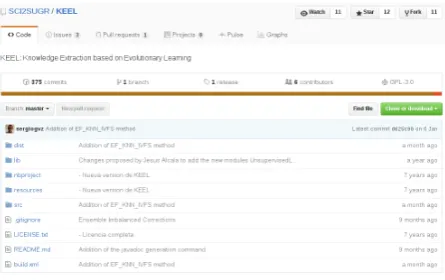
• GitHub: The source code of KEEL 3.0 is now available on GitHub https://github.
com/SCI2SUGR/KEEL(Figure 8). Here, users can
[image:10.595.57.280.318.458.2]report bugs, keep track of changes, and commit their own developments to the platform.
Fig. 8. KEEL 3.0 is on Github.
5. Conclusions
In this work, we have presented the main features of the new release (3.0) of the KEEL software. New advanced modules for novel DM problems such as SSL or MIL are now available, allowing practition-ers and beginnpractition-ers to deal with a wider variety of sce-narios. These new modules are continuously being updated and improved, including new algorithms.
KEEL has become a very rich DM tool kit that contains state-of-the-art algorithm in preprocessing and learning models as well as a number of add-ons for statistical evaluation, data management and so on. In addition, the way in which the data mining community can contribute to the project has been enhanced, including new guidelines for integration
of algorithms, a new API, and a public version con-trol repository.
Acknowledgements
We would like to acknowledge support for these projects from the Spanish Ministry of Education and Science (Grants TIN2014-57251-P, TIN2015-68454-R, TIN2014-56967-R). J.M. Moyano holds a FPU Grant FPU15/02948 from the Spanish Ministry of Education.
References
1. KNIME: The konstanz information miner, 2016. https://www.knime.org.
2. J. Alcal´a-Fdez, R. Alcal´a, and F. Herrera. A fuzzy association rule-based classification model for high-dimensional problems with genetic rule selection and lateral tuning. IEEE Transactions on Fuzzy Systems, 19(5):857–872, 2011.
3. J. Alcal´a-Fdez and J. M. Alonso. A survey of fuzzy systems software: Taxonomy, current research trends, and prospects. IEEE Transactions on Fuzzy Systems, 24(1):40–56, 2016.
4. J. Alcal´a-Fdez, A. Fern´andez, J. Luengo, J. Derrac, S. Garc´ıa, L. S´anchez, and F. Herrera. Keel data-mining software tool: Data set repository, integration of algorithms and experimental analysis framework. Journal of Multiple-Valued Logic and Soft Comput-ing, 17(2-3):255–287, 2011.
5. J. Alcal´a-Fdez, L. S´anchez, S. Garc´ıa, M.J. del Je-sus, S. Ventura, J.M. Garrell, J. Otero, C. Romero, J. Bacardit, V.M. Rivas, J.C. Fern´andez, and F. Her-rera. KEEL: A software tool to assess evolutionary algorithms to data mining problems.Soft Computing, 13(3):307–318, 2009.
6. J. Amores. Multiple instance classification: Review, taxonomy and comparative study. Artificial Intelli-gence, 201:81–105, 2013.
7. Revolution Analytics and Steve Weston. doParallel: Foreach Parallel Adaptor for the ’parallel’ Package, 2015. R package version 1.0.10.
8. Revolution Analytics and Steve Weston.foreach: Pro-vides Foreach Looping Construct for R, 2015. R pack-age version 1.4.3.
9. M. Atzmueller. Subgroup discovery. Wiley Interdis-ciplinary Reviews: Data Mining and Knowledge Dis-covery, 5(1):35–49, 2015.
11. C. J. Carmona, P. Gonz´alez, M. J. del Jesus, and F. Herrera. Overview on evolutionary subgroup dis-covery: analysis of the suitability and potential of the search performed by evolutionary algorithms. Wiley Interdisciplinary Reviews: Data Mining and Knowl-edge Discovery, 4(2):87–103, 2014.
12. Winston Chang. R6: Classes with Reference Seman-tics, 2015. R package version 2.1.1.
13. O. Chapelle, B. Schlkopf, and A. Zien.
Semi-Supervised Learning. The MIT Press, 1st edition,
2010.
14. F. Coelho, A.P. Braga, and M. Verleysen. A mutual in-formation estimator for continuous and discrete vari-ables applied to feature selection and classification problems.International Journal of Computational In-telligence Systems, 9 - 4:726 – 733, 2016.
15. J. Demˇsar. Statistical comparisons of classifiers over multiple data sets. Journal of Machine Learning Re-search, 7:1–30, 2006.
16. J. Derrac, S. Garc´ıa, and F. Herrera. Fuzzy nearest neighbor algorithms: Taxonomy, experimental analy-sis and prospects.Information Sciences, 260:98 – 119, 2014.
17. A. Fern´andez, V. L´opez, M.J. del Jesus, and F. Her-rera. Revisiting evolutionary fuzzy systems: Tax-onomy, applications, new trends and challenges. Knowledge-Based Systems, 80:109 – 121, 2015. 18. Eibe Frank, Mark A. Hall, and Ian H. Witten. The
WEKA Workbench. Online Appendix for “Data Min-ing: Practical Machine Learning Tools and Tech-niques´’. Morgan Kaufmann, Fourth Edition, 2016. 19. B. Fr´enay and M. Verleysen. Classification in the
pres-ence of label noise: A survey. IEEE Transactions on Neural Networks and Learning Systems, 25(5):845– 869, 2014.
20. M. Galar, A. Fern´andez, E. Barrenechea, H. Bustince, and F. Herrera. A review on ensembles for the class imbalance problem: Bagging-, boosting-, and hybrid-based approaches. IEEE Transactions on Systems, Man, and Cybernetics, Part C, 42(4):463–484, 2012. 21. S. Garc´ıa and F. Herrera. An extension on “statistical
comparisons of classifiers over multiple data sets” for all pairwise comparisons.Journal of Machine Learn-ing Research, 9:2677–2694, 2008.
22. S. Garc´ıa, J. Luengo, and F. Herrera.Data
Preprocess-ing in Data MinPreprocess-ing, volume 72 ofIntelligent Systems
Reference Library. Springer, 2015.
23. S. Garc´ıa, J. Luengo, and F. Herrera. Tutorial on prac-tical tips of the most influential data preprocessing al-gorithms in data mining. Knowledge-Based Systems, 98:1 – 29, 2016.
24. S. Garc´ıa, J. Luengo, J. A. S´aez, V. L´opez, and F. Her-rera. A Survey of Discretization Techniques: Taxon-omy and Empirical Analysis in Supervised Learning. Knowledge and Data Engineering, IEEE Transactions
on, 25(4):734–750, 2013.
25. J. Han, M. Kamber, and J. Pei. Data Mining: Con-cepts and Techniques. Morgan Kaufmann Publishers Inc., 3rd edition, 2011.
26. F. Herrera, C.J. Carmona, P. Gonz´alez, and M.J. del Jesus. An overview on subgroup discovery: founda-tions and applicafounda-tions. Knowledge and Information Systems, 29(3):495–525, 2011.
27. F. Herrera, S. Ventura, R. Bello, C. Cornelis, A. Zafra,
D. Sanchez-Tarrago, and S. Vluymans.
Multi-ple Instance Learning. Foundations and Algorithms. Springer, 2016.
28. G. James, D. Witten, T. Hastie, and R. Tibshirani. An Introduction to Statistical Learning. Springer, 2013. 29. B. Krawczyk. Learning from imbalanced data: open
challenges and future directions.Progress in Artificial Intelligence, 5(4):221–232, 2016.
30. Duncan Temple Lang and the CRAN Team. XML:
Tools for Parsing and Generating XML Within R and S-Plus, 2015. R package version 3.98-1.3.
31. V. L´opez, A. Fern´andez, S. Garc´ıa, V. Palade, and F. Herrera. An insight into classification with imbal-anced data: Empirical results and current trends on using data intrinsic characteristics. Information Sci-ences, 250:113–141, 2013.
32. J. M. Moyano and L. Sanchez. RKEEL: using KEEL in R code. 2016 IEEE International Conference on Fuzzy Systems, FUZZ-IEEE 2016, pages 257–264, July 2016.
33. J. M. Moyano and L. Sanchez.RKEEL: Using Keel in R Code, 2017. R package version 1.1.21.
34. S. Ram´ırez-Gallego, S. Garc´ıa, H. Mourio-Tal´ın, D. Mart´ınez-Rego, V. Bol´on-Canedo, A. Alonso-Betanzos, J.M. Ben´ıtez, and F. Herrera. Data dis-cretization: taxonomy and big data challenge. Wiley Interdisciplinary Reviews: Data Mining and Knowl-edge Discovery, 6(1):5–21, 2016.
35. S. Sonnenburg, M.L. Braun, Ch.S. Ong, S. Ben-gio, L. Bottou, G. Holmes, Y. LeCun, K.-R. M¨uller, F. Pereira, C.E. Rasmussen, G. R¨atsch, B. Sch¨olkopf, A. Smola, P. Vincent, J. Weston, and R. Williamson. The need for open source software in machine
learn-ing. Journal of Machine Learning Research, 8:2443–
2466, 2007.
36. I. Triguero, S. Garc´ıa, and F. Herrera. SEG-SSC: A framework based on synthetic examples generation for self-labeled semi-supervised classification. IEEE Transactions on Cybernetics, 45(4):622–634, April 2015.
37. I. Triguero, S. Garc´ıa, and F. Herrera. Self-labeled techniques for semi-supervised learning: taxonomy, software and empirical study. Knowledge and Infor-mation Systems, 2(2):245–284, 2015.
Je-sus, L. S´anchez, and F. Herrera. Keel data-mining software suite: Integration of new algorithms, 2017. http://www.keel.es/documents/keel extension.pdf. 39. Simon Urbanek. rJava: Low-Level R to Java
Inter-face, 2015. R package version 0.9-7.
40. G. R. Warnes, B. Bolker, G. Gorjanc,
G. Grothendieck, A. Korosec, T. Lumley, D. Mac-Queen, A. Magnusson, J. Rogers, and others. gdata: Various R Programming Tools for Data Manipulation,
2015. R package version 2.17.0.
41. I. Yoo, P. Alafaireet, M. Marinov, K. Pena-Hernandez, R. Gopidi, J.-F. Chang, and L. Hua. Data mining in healthcare and biomedicine: A survey of the literature. Journal of Medical Systems, 36(4):2431–2448, 2012. 42. X. Zhu, A.B. Goldberg, R. Brachman, and T.