SYMMETRY IN CONSTRAINT PROGRAMMING
Iain McDonald
A Thesis Submitted for the Degree of PhD
at the
University of St Andrews
2004
Full metadata for this item is available in
St Andrews Research Repository
at:
http://research-repository.st-andrews.ac.uk/
Please use this identifier to cite or link to this item:
http://hdl.handle.net/10023/14983
Symmetry in Constraint Programming
O
O
A thesis to be submitted to the
UNIVERSITY OF ST ANDREWS
for the degree of
DOCTOR OF PHILOSOPHY
by
Iain McDonald
School of Computer Science University of St Andrews
ProQuest Number: 10170992
All rights reserved INFORMATION TO ALL USERS
The quality of this reproduction is dependent upon the quality of the copy submitted. In the unlikely event that the author did not send a com plete manuscript and there are missing pages, these will be noted. Also, if material had to be removed,
a note will indicate the deletion.
uest
ProQuest 10170992
Published by ProQuest LLO (2017). Copyright of the Dissertation is held by the Author.
All rights reserved.
This work is protected against unauthorized copying under Title 17, United States C ode Microform Edition © ProQuest LLO.
ProQuest LLO.
789 East Eisenhower Parkway P.Q. Box 1346
<î-1%;
Abstract
the best symmetries to use.
Finally, we look at areas of redundant computation in constraint solvers that no other re search has examined. New ways of dealing with this redundancy aie proposed with results of an example implementation which improves efficiency by several orders of magnitude.
4
Constraint programming is an invaluable tool for solving many of the complex NP-complete problems that we need solutions to. These problems can be easily described as Constraint Satisfaction Problems (CSPs) and then passed to constraint solvers: complex pieces of software written to solve general CSPs efficiently.
Many of the problems we need solutions to are real world problems: planning (e.g. vehicle routing), scheduling (e.g. job shop schedules) and timetabling problems (e.g. staff rotas) to name but a few. In the real world, we place structure on objects to make them easier to deal with. This manifests itself as symmetry. The symmeti'y in these real world problems make them easier to deal with for humans. However, they lead to a great deal of redundancy when using computational methods of problem solving. Thus, this thesis examines some of the many aspects of utilising the symmetry of CSPs to reduce the amount of computation needed by constraint solvers.
In this thesis we look at the ease of use of previous symmetry breaking methods. We introduce a new and novel method of describing the symmetries of CSPs. We look at previous methods of symmetry breaking and show how we can drastically reduce their computation while still breaking all symmetry.
I
We give the first detailed investigation into the behaviour of breaking only subsets of all symmetry. We look at how this affects the performance of constraint solvers beforeI, Iain McDonald, hereby certify that this thesis, which is approximately 50,000 words in length, has been written by me, that it is the record of work carried out by me, and that it has not been submitted in any previous application for a higher degree.
date ^ f i- ________ signature of candidate_______ __________________
I was admitted as a research student in September 2000 and as a candidate for the degree of Doctor of Philosophy in September 2001; the higher study for which this is a record was carried out in the University of St Andrews between 2000 and 2003.
2 0 /
date ' ID / V T ________ signature o f candidate
I hereby certify that the candidate has fulfilled the conditions of the Resolution and Regu lations appropriate for the degree of Doctor of Philosophy in the University of St Andrews and that the candidate is qualified to submit this thesis in application for that degree.
'2c?/o/o t
date J-O / ( Of O T signature of supervisor
In submitting this thesis to the University of St. Andrews I understand that I am giving permission for it to be made available for use in accordance with the regulations of the University Library for the time being in force, subject to any copyright vested in the work not being affected thereby. I also understand that the title and abstract will be published, and that a copy of the work may be made and supplied to any bona fide library or research worker.
' Z O / f o ^
&
I, Iain McDonald, hereby certify that this thesis, which is approximately 50,000 words in length, has been written by me, that it is the record of work carried out by me, and that it has not been submitted in any previous application for a higher degree.
date_________________________ signature of candidate_________________________
I was admitted as a reseaich student in September 2000 and as a candidate for the degree of Doctor of Philosophy in September 2001; the higher study for which this is a record was caiTied out in the University of St Andrews between 2000 and 2003.
date signature of candidate_____________ ____________
I hereby certify that the candidate has fulfilled the conditions of the Resolution and Regu lations appropriate for the degree of Doctor of Philosophy in the University of St Andrews and that the candidate is qualified to submit this thesis in application for that degree.
date __________________________ signature of supervisor_______________________ _
In submitting this thesis to the University of St. Andrews I understand that I am giving permission for it to be made available for use in accordance with the regulations of the University Library for the time being in force, subject to any copyright vested in the work not being affected thereby. I also understand that the title and abstract will be published, and that a copy of the work may be made and supplied to any bona fide libraiy or research worker.
Acknowledgements
I would like to thank mostly Ian Gent, Tom Kelsey, Steve Linton and Amy Midgley. This document would not have been possible without their help.
I would like to thank all the members of the APES reseaich group, notably Lyndon Drake, Ian Miguel, Patrick Prosser, Evgeny Selensky, Dan Sheridan, and Baibaia Smith and also to Wai*wick Harvey and Meinolf Sellmann.
I would like to thank Maitin Bateman, Bairy Stormont, Andrew Rowley, Scott Walker, Graeme Bell, Stuait Norcross, David Letham and Grant McLay.
Published Research
Excerpts of this thesis have appeared in other forms in published research. We now Hst the reseaich caiiied out during my time as a PhD student:
1. “Unique Symmetry breaking in CSPs using Group Theory” [McDOl] by Iain Mc Donald appeal's in Symmetry in Constraints, pages 75-78, 2001,
2. “Partial Symmetry Breaking” [MS02] by Iain McDonald and Barbaia M. Smith ap peal's in Principles and Practice of Constraint Programming, pages 431 -445. Springer,
2002.
3. “NuSBDS: Symmetry breaking made easy” [McD03] by Iain McDonald appeal's in
Symmetry in Constraint Satisfaction Problems, pages 153-160, 2003.
4. “Symmeti'y and Propagation; Revising an AC algorithm” [GM03] by Ian P. Gent and Iain McDonald appears in Symmetry in Constraint Satisfaction Problems, pages 66-74, 2003.
5. “Conditional Symmeti'y in the All-Interval Series Problem” [GMS03] by Ian P. Gent, Iain McDonald and Baibaia M. Smith appeal's in Symmetry in Constraint Satisfac tion Problems, pages 55-65, 2003,
Contents
List of Figures v
List of Tables vii
1 Introduction 1
1.1 Constraint Satisfaction Problem s... -... 2
1.2 Group T h eo ry ... 7
1.3 Definitions... 9
1.3.1 Group Theory and Symmetry in C S P s... 10
1.4 C ontributions... 15
1.5 Thesis O utline... 17
2 Review of Previous Work 18 2.1 Constraint Program m ing... 18
2.1.1 M odelling... 19
2.1.2 C onstraints... ... ...24
2.1.3 Propagation... 25
2.1.4 H euristics... 28
2.1.5 Search...29
2.2 Constraint Solvers... 30
2.3 Computational Group Theory... 31
2.4 Symmetries in CSPs ... 31
2.4.1 Symmetry Breaking in the 1990s...32
2.4.2 Symmetry Breaking in the 21®^ c e n tu iy ...35
11
3.1.1 Automatic Symmeti’y Detection vs Symmetiy Descriptions...39
3.1.2 Expressiveness... 42
3.1.3 Symmetry R epresentation... 43
3.1.4 Problem Specific or Instance S p ecific... 44
3.1.5 Breaking all Sym m etry... 45
3.1.6 Ease of u s e ... 46
3.1.7 Combinations of methods ... 47
3.2 Unique Symmetry Breaking using Group T h e o ry ...47
3.2.1 Unique Symmetries... 49
3.2.2 Theoretical Analysis and Bound on Symmetry Breaking Constraints N e e d e d ...49
3.2.3 Empirical R esults... 54
3.3 Implementing the GHK Algorithm with G A P ...55
3.3.1 Analysis of Perform ance... 56
3.4 Implementing the GHK Algorithm without GAP ... 58
3.4.1 Group Theory Implementation is s u e s ... 58
3.5 NuSBDS ... 59
3.5.1 NuSBDS code exam ples...61
3.5.2 Comparison of symmetry deseription methods ...64
3.5.3 M a e ro s ...68
3.5.4 Empiiieal Compaiisons...71
3.6 Conelusions and Future W ork...74
3.6.1 Improved Symmetiy Breaking Teehniques... 75
3.6.2 User speeified m a e r o s ... 75
3.6.3 Intelligent Symmetry Breaking... 75
3.6.4 Pai'tial Syimnetiy Breaking... 76
3.6.5 Verifieation of Sym m etries...76
4 Partial Symmetry Breaking 77 4.1 Introduction and M o tiv atio n ...77
4.2 Review of Paitial Symmetry B reak in g ...79
4.3 Definitions and N o ta tio n ... 81
4.4 Paitial Symmetry Breaking and Symmetry Representation ... 82
4.4.1 Explicit Symmetries and Group T h e o ry ... 83
Ill
4.5.1 Fractions P u z z le ...85
4.5.2 Alien T i l e s ... 86
4.5.3 Golfers’ P roblem ... 89
4.6 Partial Symmetry Breaking with Implicit Symmetry Representation . . . . 90
4.6.1 Limited use of Symmetry Breaking Technique ... 91
4.6.2 Using a Subgroup of S ym m etries...91
4.6.3 Limited eomputation of Symmetry Breaking Technique...92
4.7 Symmeti'y Subset Selection... 93
4.7.1 Looking for good subsets...93
4.7.2 The Effect of Different H eu ristics...96
4.8 Algorithm for Symmetry Subset Selection... 98
4.9 Dynamic Algorithm for Symmetry Subset Selection...102
4.10 Symmetry Subset Selection for other Symmetry Breaking System s... 105
4.11 Conelusions and Future W ork...105
4.11.1 Unknown or Dynamic Heuristics . . ...107
4.11.2 Finding Subsets that break all Symmetry ...107
4.11.3 Optimal PSB p o in t... 108
4.11.4 Integration of Symmetiy Subset Selection into Symmetry Breaking System s...108
5 Symmetry and Propagation 109 5.1 Introduction...109
5.1.1 Definition of Symmetry ...110
5.2 Levels of Consistency...I l l 5.2.1 An example modification...112
5.3 Modifying an existing AC algorithm ...113
5.3.1 Refining AC-2001 ... 116
5.4 Experimental R esu lts... 118
5.5 Conclusions and Future W ork...121
5.5.1 Improvements to GAC algorithm s... 122
5.5.2 Support for value sy m m etry ...122
5.5.3 Use of larger subgroups to enforce higher levels of consistency . . . 123
5.5.4 Concise representations of eonstiaints using group theory... 123
IV
6.1 C ontributions... 125
6.1.1 Implementation of Symmetry Breaking Systems ... 125
6.1.2 Concise Representation of Symmetries ... 125
6.1.3 Analysis of Number of Symmetry Breaking Constraints ... 126
6.1.4 A Method for Describing Sym m etries... 126
6.1.5 Using Subsets of all Symmetry... 127
6.1.6 Observed Redundant Computation...128
6.2 Future W ork...128
6.2.1 Symmetry Breaking Im plem entations... 128
6.2.2 An improved version of S B D S ...129
6.2.3 Dynamic Partial Symmetry B re a k in g ... 129
6.2.4 Avoiding more Redundant Computation... 130
Bibliography 131 A Glossary 142 B NuSBDS - User M anual 143 B.l What is N u S B D S ...143
B.2 Installing N u S B D S ...144
B.2.1 Compiling N u S B D S ... 144
B.2.2 Installing A iehive...145
B.3 Using N uS B D S ... 145
B.3.1 NuSBDS in P ra c tic e ... 147
B.4 Using the NuSBDS m acros...149
B.4.1 How to spot the sym m etries...1 5 0 B.4.2 Available NuSBDS m acros...150
C Problems 153 C.l Alien T iles...153
C.2 Balanced Incomplete Block D esign... 154
C.3 Dodecahedron C olouring... 154
C.4 Fractions Puzzle... 155
C.5 Golfers’ P ro b le m ...155
C.6 Most Perfect Magic S q u a re s ...156
List of Figures
1.1 A diagram of a squai'e with numbered corners... 8
1.2 The original squai'e rotated by 90°. Though the numbers have changed, the shape has not... 8
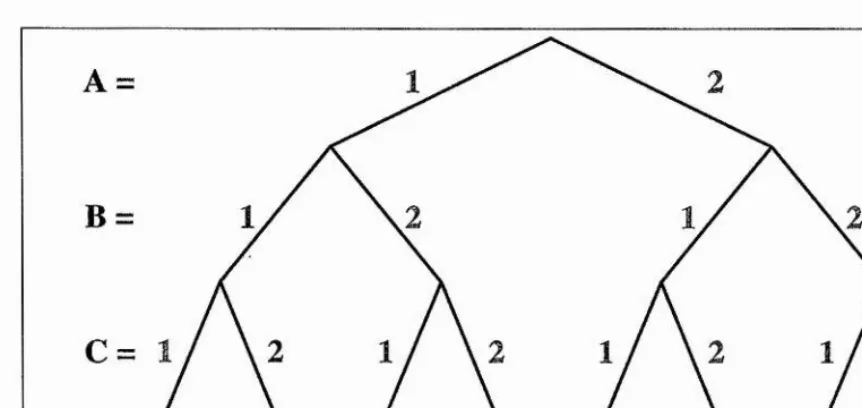
1.3 An example of a binaiy search tree... 10
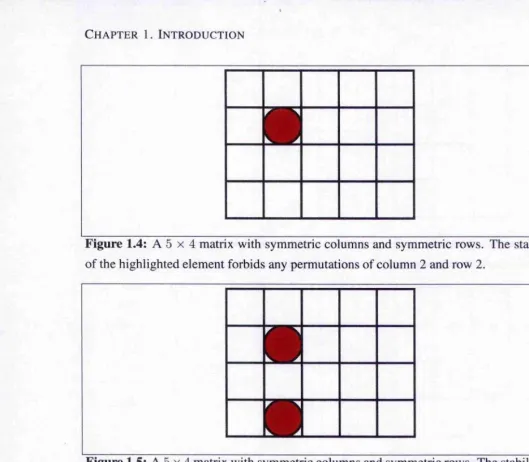
1.4 A 5 X 4 matrix with symmetiie columns and symmetric rows. The stabilizer of the highlighted element forbids any permutations of column 2 and row 2. 14 1.5 A 5 x 4 matrix with symmetric columns and symmeti'ic rows. The stabilizer of the highlighted elements differs depending on whether it is setwise or pointwise stabilized... 14
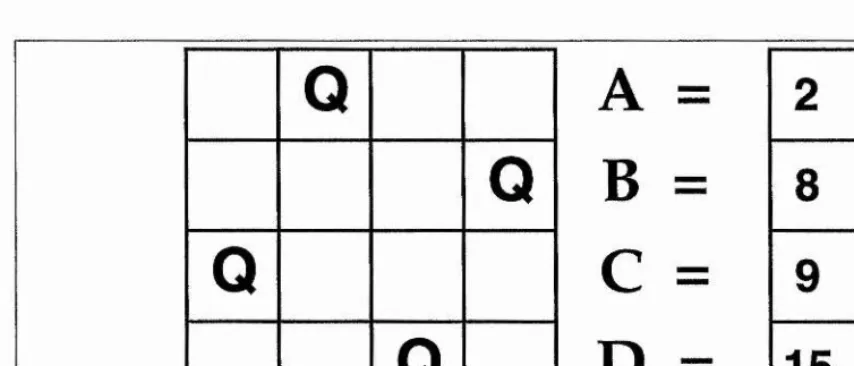
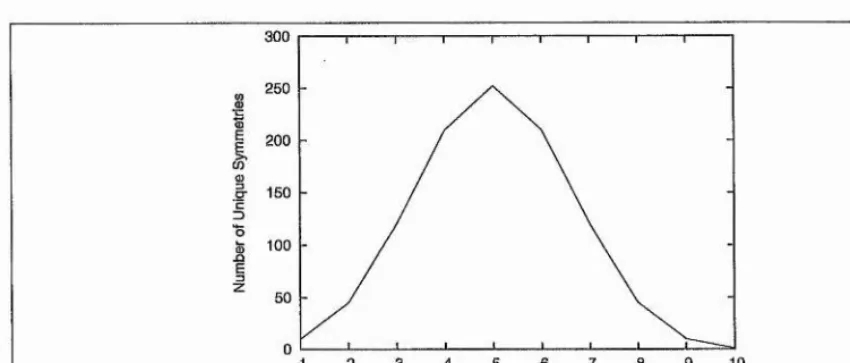
2.1 The relation between a solution to the 4-queens problem and Model 2.1. 2.2 The relation between a solution to the 4-queens problem and Model 2.2. 2.3 The relation between a solution to the 4-queens problem and Model 2.3. 21 21 22 3.1 Unique Symmetries in the Alien Tiles problem...50
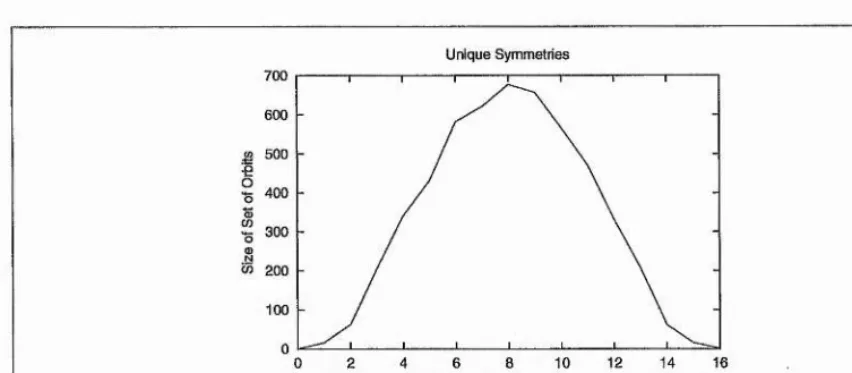
3.2 Unique Symmetries for a problem with Sio acting on the variables...51
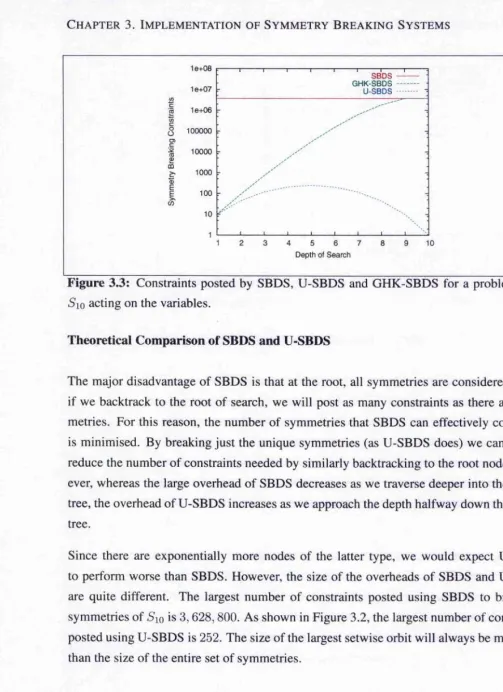
3.3 Consti'aints posted by SBDS, U-SBDS and GHK-SBDS for a problem with S'lo acting on the variables... 52
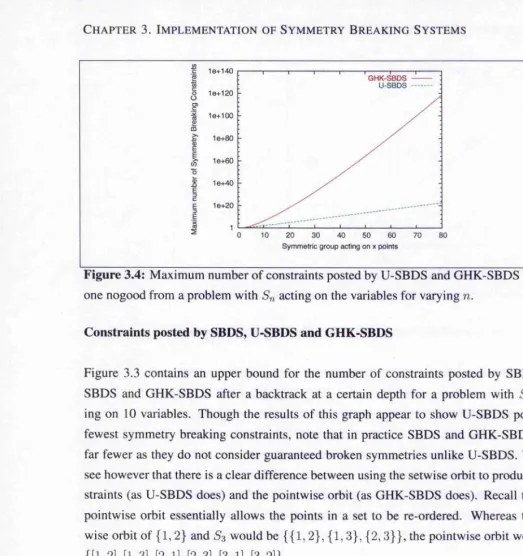
3.4 Maximum number of constraints posted by U-SBDS and GHK-SBDS for any one nogood from a problem with Sn acting on the vaiiables for vaiying n...53
4.1 Finding the optimum p o in t... 84
4.2 Fractions Puzzle P S B ... 85
4.3 Initial State, Goal State and Example Solution... 86
4.4 Random PSB Subsets - Alien T ile s... . 87
4.5 Random PSB Subsets - Alien Tiles (cut-off at 70 seconds) ...87
VI
4.7 PSB - Golfers’ Problem ... 89
4.8 Best & worst times (eut-off at 60 seconds)... 93
4.9 The difference between best & worst times (cut-off at 40 seconds)... 94
4.10 This subset took 140.05 seconds to solve the alien tiles problem...95
'4.11 This subset took 69.05 seconds to solve the alien tiles problem... 96
4.12 Identical subsets of symmetries with different vaiiable ordering heuristics (eut-off 60 seconds). The first heuristic (top) is better up to 376 symmetries after which the second heuristic (bottom) takes less t i m e ...97
4.13 A seai'ch tree illustrating how some symmetry breaking constraints prune more search than others. Given the nogood X, g is a better symmetry to break than h...99
4.14 The alien tiles experiment using Algorithm 4.8.1 101
4.15 A compaiison of runtimes from solving the alien tiles problem with the best random symmetries and those found using the Algorithm 4.8.1 . . . . 101
4.16 The golfers’ problem solved using symmetries from Algorithm 4.9.1 com- pai'ed with the original randomly chosen symmetries. We see a significant improvement in runtime even after the time for sorting symmetries is taken into account... 103
List of Tables
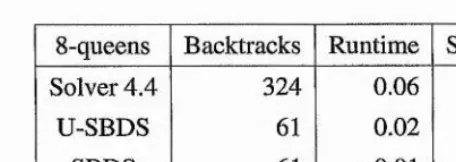
3.1 Results of finding all solutions to the 8-queens problem using different symmetry breaking systems... 54 3.2 Results of finding an optimal solution to an alien tiles problem using dif
ferent symmetry breaking systems...55 3.3 Results of using GAP with a U-SBDS implementation in Hog Solver 5.2 to
solve the n-queens problem. The table shows the cpu-time taken for GAP and Solver as well as the actual overall run-time of U -S B D S ... 57 3.4 Results of using NuSBDS and Solver 5.2 to find all solutions to various
n-queens problems...72 3.5 Results of using NuSBDS and Solver 5.2 to find all 3-eolourings of the
dodecahedron. This problem has 360 symmetries. They consist of the 3! or 6 symmetries from the 3 available colours combined with the 60 symmetries of the dodecahedron itself...72 3.6 Results of using NuSBDS and Solver 5.2 to solve the most perfect magic
squmes problem... 72 3.7 Results of using NuSBDS, SBDS and Solver 5.2 to solve the alien tiles
problems for a 4 x 4 boai'd with 3 colours... . 73 3.8 - Results of using NuSBDS and Solver 5.2 to solve some small BIBDs. Find
ing all solutions to the BIBD problem is generally hard due to the number of symmetries. NuSBDS does not break all symmetry which allows a more efficient symmetry breaking system...73 5.1 Results of comparing the original implementation by Bessière and Régin
with the new Java implementation... 119 5.2 AC on uninstantiated latin squares. The predicted number of constraint
checks is produced experimentally...120 5.3 Maintaining AC while seai’ching for the first solution...120
Chapter 1
Introduction
Many of the real world problems that we need solutions to aie NP-complete problems so efficient techniques of solving them do not exist. These problems aie pervasive in society e.g. scheduling, planning, configuration, circuit design, hardwai e verifieation, vehicle rout ing and timetabling. They can all be represented as constraint satisfaction problems (CSPs) and solved using constraint programming.
Constraint programming has become a populai* method of solving the complex tasks men tioned above due to the natural way constraint problems are described. Also beneficial is that the problem deseription is all that is neeessaiy, since the problem is solved by the computer.
However, constraint programming, no different from other combinatorial symbolic AI teeh niques, places human defined labelling on the problem to be solved. If we have n vehicles to schedule, we can see that each vehicle is identical to the next. In order to solve the problem though, we must label the vehicles, and in effect make each one different.
It is the labelling needed by constraint satisfaction problems that causes individual objects and patterns with the problem to be lost. These patterns, or symmetries, exist all ai'ound us. They put structure into the many things we see every day, making them easier for us to comprehend and work with.
Ch a p t e r 1. In t r o d u c t io n 2
and symmetric problems.
Over reeent yeai’s, reseaieh into how to deal with symmetry in CSPs has become very populai'. Initially, attempts at using symmetry were generally dismissed as too complicated, leading constraint programmers to use more ad-hoe methods in practice.
One of the strengths of constraint programming is the vast collection of algorithms, seai'ch routines, heuristics and specialised constraints that research has developed. Currently, we are at an interesting point in the timeline of constraints reseaieh where methods of using symmetry aie entering mainstream constraint programming.
This has come about by both a greater understanding of symmetry in CSPs as well as the development of effective ways of dealing with symmetry. The realisation of the constraint programming community that the pure mathematics area of group theory deals with the classification and measurement of symmetry has greatly furthered the ways in which we deal with symmetiy in CSPs.
In this thesis we examine some aspects of the complicated relationship between symmetry and CSP solving. More specifically, we introduce one of the first group theoretic based methods of using symmetry in CSPs, we examine how using paitial amounts of symme try affects the complexity of CSP solving. We look at ways to bring symmetry use to mainstream constraint programming and by doing so we bridge the gap that exists between group theorists and constraint programmers. Finally we look at furthering the scope of symmetry use to beyond the dombinatorial seaieh at the heait of constraint programming. These form the main contributions of the thesis, discussed further at the end of the chapter.
1.1
Constraint Satisfaction Problems
A constraint satisfaction problem consists of a finite set of vaiiables (or unknowns), each
variable has a domain which is a finite set of possible values. There are also a set of { constraints, each one forbidding a combination of assignments of values to variables. To
solve a CSP, we must assign (or choose) a value for each vaiiable from its domain such that none of the constraints aie violated.
Ch a p t e r 1. In t r o d u c t io n 3
number 40. In this case, the unknowns aie the five numbers we have to find, thus, these are the 5 vaiiables of the problem.
Eaeh number ranges from 1 to 10 so this is the domain of each vaiiable.
Finally, this problem has the following eonstraints.
Given the above information, we can use a constraint solving toolkit to solve the above problem. Notice however that tlie variables each have the same domain and the eonstraints acting on them are commutative. Thus each vaiiable is said to be symmetric to all the others i.e. if we find a solution to the above problem, we can re-arrange the values of the vaiiables however we like to yield another solution. Though we can see this fact, the constraint solver cannot. Therefore, we may think of the following solutions as the same.
6-f"7-j-8-|-9-|-10 — 40 74-6-1-84-9 + 10 = 40
Ch a p t e r 1. In t r o d u c t io n 4
Finding a solution
In general, the above type of problem (or indeed any CSP) is solved by use of a eombination of inference and seai'ch.
Eaeh vaiiable is considered in an order dictated by some heuristic. The chosen variable is then instantiated to some value taken from its domain. At this point, the set of domains of the variables may be passed to some propagation algorithm which can infer inconsistent choices that aie then removed from the relevant domain. Before moving on to the next vaiiable, the current set of instantiations is considered against the set of eonstraints to see if any of them have been violated. If any constraint has been violated, we backtrack from our previous decision and remove that choice from the relevant domain.
There aie many different heuristics from a simple static lexicographic order based on our labelling, to the more complicated dynamically ordered smallest domain first. The latter heuristic works well in practice though there are other problems that work well with their own specific heuristics.
There are many different general purpose propagation algorithms which yield different levels of inference, as well as filtering algorithms for specific constraints. The aim of these algorithms is to detect and remove domain elements than cannot paiticipate in a solution. These will be discussed in greater detail later.
Though there aie a few backjumping algorithms available to the constraint programmer, a simple backtracking seai'ch procedure is used by default by most constiaint solvers.
Since constraint solving is used in general to solve NP-complete problems, the runtimes aie exponential. In the worst case, a complete backtrack seai'ch of all possible complete instantiations will have a runtime of 0(d") for a CSP with n vaiiables with domains of size
d.
Symmetries and CSPs
Ch a p t e r 1. In t r o d u c t io n
simple backtracking search procedure.
We initially set the first vaiiable, A, to be the first element in its domain.
A = 1
B , C , D , E e {1..10}
We now reeursively instantiate the next vaiiable.
A - 1
B = 1
C , D , E e {1..10}
As you can see, this violates the constraint that each number must be different. We therefore baektraek from this decision and remove the relevant value from the domain of the variable
B.
A ~ 1
B e {2..10}
C , D , E e {1..10}
We eontinue to exhaustively try all the different instantiations of vaiiables B , C , D and E.
After doing so we will discover that no solution exists with A — 1.
A E {2..10}
B , C , D , E e {1..10}
Ch a p t e r 1. In t r o d u c t io n
A , B , C , D , E e {2..10}
This is not something that a constraint solver would do though. By eontinuing our search to find a solution, we come across many inconsistent sets of instantiations that lead to failure. For eaeh of these failures, we could use the symmetries of the problem to avoid making similai* inconsistent sets of instantiations. After much redundant search we come to this first solution. If we were using some propagation algorithm to remove inconsistent assignments, they would also be performing redundant work.
A = 6
B = 7
C = 8
D = 9
E = 10
Note that this is the only solution to this problem that is unique with respect to symmetry. Any other solution can be found by relabelling this solution e.g.
A = 7
B = 6
C = 8
D - 9
E = 10
Ch a p t e r 1. In t r o d u c t io n 7
Failing to appreciate the symmetries of a problem results in a lai'ge increase of computa tion both by increasing the search tree and the amount of reasoning done by propagation algorithms. The study of symmetiy in constraint programming is an extremely important one as utilising the symmetry in highly symmetric problems is the only way to make them solvable.
1.2 Group Theory
Though the study of symmetry in CSPs is a fairly reeent one, the study of symmetiy in gen eral dates back to the Ancient Egyptians who were aware of the symmetiy of geometrical objects used in tiling. The classification of group theory as we know it today was intro duced at the latter part of the 18^^ century and is due to mathematicians such as Cauchy
[OR97], Cayley [Cay78], von Dyck [vD82] and Burnside [Bur97] to name just a few.
To look at group theory in an abstract way, if we wish to measure the number of occurrences
of something, we can use integers. If we wish to measure the amount of something, we can use rational numbers. If we wish to measure the amount of symmetry of an object, we can use group theory. The pure mathematics area of group theoiy is essentially the measurement and application of symmetiy.
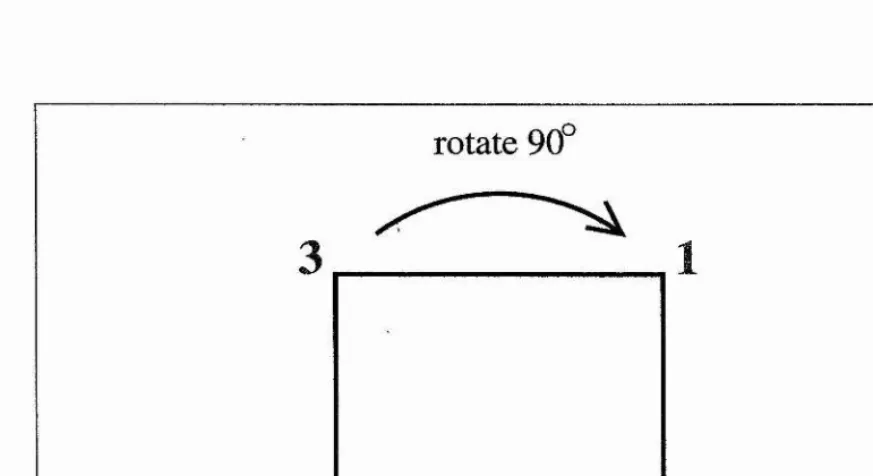
As an example of symmetry, imagine a squai'c with the corners labelled (Figure 1.1). This has geometrical symmetiy. We can rotate the squai'e by 90°, 180° and 270° and the shape will remain the same. We can also invert or flip the squai'e ai'ound the T-axis, ^-axis, around the line bisecting the squai'e diagonally from top left to bottom right, and from top right to bottom left.
We see that by applying any of these symmetries we change the corner labels but the re sulting shape is still a squai'e (Figure 1.2). This is exactly like the'example mentioned at the stai't of the chapter: two vehicles may be conceptually identical but since symbolic AI labels them, the symmetry is lost.
Ch a p t e r 1. In t r o d u c t io n
Figure 1.1: A diagram of a square with numbered corners.
rotate 90
Ch a p t e r 1. In t r o d u c t io n 9
Rather than listing all the different symmetries explicitly, we can list a few symmetries and generate the remaining symmetries by combining the few we store [But91] [Ser03]. All the symmetries of a square can be generated by just the “rotate by 90°” and “invert about the x-axis” symmetries. For example, we can create the “invert about the y-axis” symmetry by combining the “rotate by 90°” synnnetry twice and then applying the “invert about the æ-axis” symmetry.
1.3 Definitions
We now define some of the preliminary ideas and concepts necessai^y before continuing with symmetry in constraint satisfaction problems.
Definition 1.1 A CSP is a set of constraints C acting on a finite set of variables X :
X-\..Xn> each of which has a finite domain of possible values D(Xi). A solution to a CSP L, is an instantiation of all the variables in X where \/i 3j Xi = j , j G D{Xi) such that all the constraints in C are satisfied.
Definition 1.2 A k-ary constraint is a constraint that acts on k variables of a CSP A con straint on k variables describes the allowed combinations of choices allowed for the set of variables { X i,..., X^} as a subset o f the cartesian product ofD{X\) x ... x D{Xk).
Definition 1.3 A variable assignment (or instantiation) is a variable with a domain with only one element i.e. that variable has been assigned a value. A set o f assignments is called a tuple (or partial assignment). An instantiation of all variables in a CSP is called a full assignment. For any given assignment or tuple, it is called consistent if it satisfies all the constraints acting of the variables in the assignment or tuple.
Definition 1.4 A nogood is an assignment or tuple that is inconsistent with at least one of the constraints of the CSP.
Definition 1.5 A solution to a CSP is a consistent instantiation o f all the variables in the CSP. A partial solution is a tuple that does not violate any of the constraints acting on the variables in that tuple.
Ch a p t e r 1. In t r o d u c t io n 10
A =
B =
[image:26.615.77.508.62.266.2]C =
Figure 1.3: An example of a binary search tree.
for all solutions, verifying there are none, or looking for a solution that is optimised with respect to some criteria.
We find solutions to CSPs by traversing the search space of the CSP. This is all the possible combinations of tuples of the CSP. The path of the traversal of the search space is called the search tree (Figure 1.3).
While searching for a solution, we make decisions such as those described above. A posi tive decision is a variable assignment {X^ = a), and a negative decision is a domain removal
f 6).
Definition 1.6 A state in search A, is the set of decisions made (positive and negative) while traversing the search space.
1.3.1 Group Theory and Symmetry in CSPs
We now formally define a symmetry of a CSP. A symmetry is a bijective function. A function is bijective if it is both injective (no two inputs can have the same output), and sur- jective (every possible output can be reached by some possible input). The input and output of this function can be thought of as some representation of a CSP: a set of assignments, a single assignment, a set of domains etc.
Ch a p t e r 1. In t r o d u c t io n 11
function f : A ^ A where A is some representation of a state in search e.g. a list of assigned variables, a set of current domains etc., such that the following holds:
1. Given A, a partial or full assignment of L, if A does not violate the constraints C, then neither does f{A).
2. Similarly, if A is a nogood, then so too is f{A).
Recently, behaviour has been noticed in some problems which resembles symmetries but does not satisfy this definition. Conditional symmetries (also known as dynamic symme tries within planning research) ar e bijective functions that require a condition to be satisfied before they can be considered as symmetries [GMS03]. Pseudosymmetries are symmetries that are not bijective i.e. though f is a symmetry, its inverse may not be [PS98] [PB04].
Though Definition 1.7 describes a symmetry in terms of CSPs, we also want to think of a symmetry as an element of a group. Thus, we formally define a group.
Definition 1.8 A group G is a non-empty set o f elements with a binary operator x, that obeys the following 4 axioms.
1. Every group contains an identity element.
3
e
G(7
GG,
e x g = g x e = g2. Every element o f a group has an inverse element.
Vg G G , G G s.t. g X g~^ = g~^ x g = e
3. The binary operator of a group is associative. Vi, 7, k G G, {i X j ) X k — i X {j x k)
4. The group is closed under the binary operator.
Vi, j G G, i X j G G
Ch a p t e r 1. In t r o d u c t io n 12
Definition 1.9 A subgroup H, of group G, is a group that shares the same binary operator as G and contains a subset of the elements of G. Given groups N and M, we say M is a subgroup of N by writing M C. N.
Throughout this thesis we will think of groups as permutations groups.
Definition 1.10 A group whose elements are bijective permutations from a set to itself are called permutation groups.
We consider the set referred to in Definition 1.10 to be a contiguous set of points of the range 1..p. For example, consider a permutation group acting on 4 points: {1,2, 3,4}. One possible permutation of these points is to permute 1 with 2, 2 with 3, and 3 with 1. This creates the set (3, 1, 2, 4}. A concise representation of permutations is called the cycle form. This form lists the disjoint cycles that represent how the points aie affected. The
cycle form of the above permutation is (1, 2, 3)(4). We read this as “Point 1 goes to point 2, 2 goes to 3, 3 goes to 1. Point 4 goes to point 4.” We usually omit cycles of length one, leaving just (1,2, 3).
Some common groups include the symmetric group whereby any bijective permutation of the points is allowed, and the alternating group whereby any bijective permutation that can be represented as an even number of transpositions is allowed. For groups acting on n
points, the symmetric group has nl elements and the alternating group has y .
Definition 1.11 A generator set G gen of group elements, represents the group G if every element of G can be recreated by some combination of elements in Ggen^
Though the theoretical maximum number of generators needed to recreate the entire group is log2\G\, typically just 2 to 6 elements are needed in a generator set. This theorem is well
known to the group theory community, however for completeness the proof is outlined here.
Consider a generator set = {gi^ 9 2, 9k) for the group Gs^. The group generated by
Sk~i = {9 1,9 2, ■■•,9k-i) is a subgroup of Gs^ since Sk-i Ç Sk. It follows then that Gs^ Ç
Gs2 Ç ... Ç Gsk> Recall that the size of every subgroup is a factor of the original group.
Therefore, is at least half the size of |GgJ > 2 \ |G%| > 2^,..., |Ggj^| > 2^ or k < Io9 2{\Gs^\) i.e. the maximum number of generators in a minimal generator set for
Ch a p t e r 1. In t r o d u c t io n 13
Permutation groups are of particular interest to constraint programmers since it gives a means of translating between the group theory terminology of group elements (or permu tations) acting on sets of points, to symmetries acting on sets of assignments. Thus, rather than considering permutation groups acting on a set of points, we consider permutation groups acting on sets of variables, or assignments. Though we describe the group operator
X for combining group elements, when applying a group element to a point we will use the
notation of a function i.e. p(l).
Definition 1.12 The orbit O of a (set of) point(s) A under a group G is the set of all (sets of) points that A can be mapped to. 'ig G G, g (A) G O.
Even though the size of a group may be large, the size of the orbit of a set of points can be much smaller. The orbit of any one point, for example, cannot be more than the number of points the group acts on.
Definition 1.13 The stabilizer G a of a (set of) point(s) A, under the group G is a subgroup
of G such that: Wg G G a, g (A) = A.
In many cases we will think of the orbit of one point under a group G, or the stabilizing subgroup of one point under a group G. However, when we consider more than one point, it is important to make a distinction between a set of points or a list of points. This is because the orbit of a set of points (called the setwise orbit) is different from the orbit of a list of points (called the pointwise orbit).
For example, given the set of points {1,2} with the symmetric group acting on 3 points, the setwise orbit is {{1, 2}, (2,3}, {1,3}}. The pointwise orbit is {[1,2], [2,3], [1,3], [2,1],
[3,2], [3,1]}. The setwise orbit is always a subset of the pointwise orbit.
The reverse is tme of setwise stabilizers and pointwise stabilizers. Consider the diagram in Figure 1.4 which contains a matrix with freely permutable rows and columns. If we wish to stabilize the highlighted element, we must forbid any group element that permutes any column with column 2, any row with row 2, and any combination of those permutations.
Ch a p t e r 1. In t r o d u c t io n 14
Figure 1.4: A 5 x 4 matrix with symmetric columns and symmetric rows. The stabilizer of the highlighted element forbids any permutations of column 2 and row 2.
Figure 1.5: A 5 x 4 matrix with symmetric columns and symmetric rows. The stabilizer of the highlighted elements differs depending on whether it is setwise or pointwise stabilized.
However, the setwise stabilizer would allow the permutation of row 2 with row 4. Thus we can see that the pointwise stabilizer is a subgroup of the setwise stabilizer.
The complexity of pointwise group theory operations is less than setwise operations since they can be done incrementally. There is an algorithm [Ser03], however, that proposes recording the setwise orbit for a set of points A. The orbit of A can then be used to con struct the orbit of B, where A Ç B, with less computation. This algorithm has yet to be implemented.
Ch a p t e r 1. In t r o d u c t io n 15
1.4
Contributions
Symmetries are prevalent in real world problems which are solved by constraint program ming. As has already been shown, the lack of regard for these symmetries causes much redundancy when solving CSPs. For this reason, the use of symmetry while solving CSPs needs to be investigated thoroughly. Symmetry in CSPs is a vast research area with frequent new avenues of study being introduced. This thesis looks at the problems of symmetry in constraint programming from several angles and contributes to each of them.
From a constraint programmer’s point of view, they are not concerned with the internal workings of their constraint solver. They simply wish to be able to describe their problems easily and have their constraint solver find solutions as efficiently as possible. Much of the research into CSPs culminates in implementations of effective constraint solvers. These solvers take the best algorithms from the many areas within CSP research and make them easy to use.
In this thesis, we look at the problem of symmetry in CSPs from the point of view of the constraint programmer. We discuss the problems with the most popular methods of break ing symmetry in terms of ease of use. We present two new implementations of symmetry breaking systems that advance the inclusion of symmetry breaking into constraint solvers. Firstly, we introduce U-SBDS which has the advantage of a concise symmetry representa tion. This leads to less effort in describing symmetries. U-SBDS also limits the number of symmetry breaking constraints needed to break all symmetry. Secondly, we introduce NuSBDS which contains an intuitive method of describing symmetries that has many ad vantages over all previous methods.
For highly symmetric problems that have an exponential amount of symmetry, there is currently no method to efficiently break all of itF When dealing with such problems, only a subset of all possible symmetry can be dealt with. Though many symmetry breaking methods can be used to break subsets of symmetry, no detailed research into breaking such subsets has previously been carried out.
In this thesis we look at how the amount of symmetiy broken affects the amount of work required in finding solutions. From this investigation we look at why some subsets of symmetry appear to be better than others. We then present an algorithm for choosing the
Ch a p t e r 1. In t r o d u c t io n 16
best symmetries.
Almost all previous research into symmetry in CSPs has looked at how the symmetry af fects search. This is done almost exclusively by adding constraints to the original CSP, or by adding constraints dynamically during search to the solver. We look at trying to use symmetry in CSPs to reduce the amount of work done in other areas of CSP solving. This is the first research to do this. Based on this study we present a modified propagation algo rithm that results in fewer constraint checks by many orders of magnitude. We also suggest many ways in which other redundant work could be reduced.
To summarise, the main contributions of this thesis are:
1. An evaluation of current symmetry breaking systems and a discussion of their suit ability for use within constraint solvers.
2. A new method of breaking symmetry while constraint solving using group theory, U-SBDS.
3. An analysis of the number of required symmetry breaking constraints for breaking symmetry dynamically during search. We introduce an upper-bound on the number of symmetry breaking constraints needed after any one backtrack.
4. A new and novel method of easily describing problem specific symmetries, NuSBDS.
5. The first comprehensive study of breaking subsets of symmetries in highly symmet ric problems. We then discover the properties of a good symmetry and produce an algorithm for selecting the best symmetries to use when breaking symmetries during search.
Ch a p t e r 1. In t r o d u c t io n 17
1.5 Thesis Outline
The rest of this thesis is organised into the following chapters. Chapter 2 will review the previous work in the field of constraint programming including modelling, constraints, propagation and search. We will then look at symmetry breaking in constraint program ming, computational group theory and the continuing convergence of the two areas.
Chapter 3 looks at various symmetry breaking systems from the point of view of the con straint programmer. We examine the advantages and limitations of the previous implemen tations of these systems and argue what the most desired elements of the ideal symmetry breaking system are. We introduce and evaluate two new implementations of symmetry breaking systems.
Chapter 4 contains an investigation into partial symmetry breaking. We look at previous research and discuss how their methods of breaking symmetry were limited in order to min imise run-times. We then present experimental evidence of how breaking varying numbers of symmetry affects the overall run-time of solving symmetric problems. We conclude this chapter by presenting an algorithm for selecting the best symmetries to use when symmetry breaking along with supporting empirical evidence.
Chapter 5 argues that we should re-use all information gathered during search and not just failed search decisions as we currently do. We present a modified definition of symmetry which we use to take account of this. A refinement to a propagation algorithm is presented before implementing a modified ai’c consistency algorithm. Empirical results of using this modified algorithm are presented.
Finally, we conclude with Chapter 6. We reiterate the contributions of this thesis and discuss future directions of research.
Chapter 2
Review of Previous Work
We now review previous work related to this thesis. This work will fall roughly into three categories. The first of these is related to the discipline of constraint programming, how it is used in practice as well as some issues of note for constraint programmers. Secondly, we will briefly look at computational group theory (CGT) which is concerned with imple menting efficient group theoretic operations. Finally we will look at previous methods of symmetry breaking and other investigations into symmetry specifically in CSPs.
2.1 Constraint Programming
The ethos behind the declarative programming paradigm, in which constraint programming lies, is a unique one. Whereas other programming paradigms require the programmer to describe how to solve a problem which the computer then automates, constraint program ming requires the programmer to describe the problem which the computer then solves. Though the types of problems that can be solved by constraint programming are generally limited to NP-complete combinatorial search problems, the ease with which they can be solved is very beneficial to programmers.
For this advantage, a new approach to solving problems is needed i.e. a new programming paradigm. Broadly speaking the methodology for solving CSPs is broken into three sec tions. The first is the modelling stage. Here we define the structure of what a solution looks like i.e. what types of variable we have and what their possible values are. Secondly, we
Ch a p t e r 2. Re v ie w of Pr e v io u s Wo r k 19
constrain the model. In this stage, we describe the constraints which forbid combinations
of assignments i.e. the problem description itself. Finally, we must search for a solution. This stage is concerned with how we traverse the search space or more specifically which heuristics and search routines we use. We can also state what level of propagation we wish to enforce during this search and what algorithms we will use to accomplish this.
Each of these stages are interconnected in that changes to one will affect the others. We will now look in more detail at these three stages as well as other areas important to constraint programmers when solving CSPs.
2.1.1 M
odell
ing
The modelling stage is one the most important in terms of tractability since how we decide to model our problem has far reaching effects on the efficiency of our program. As such, workshops and other research within the constraint progranuning community are devoted to modelling.
Modelling is sometimes referred to as the “bottleneck” in constraint programming, since sometimes expert knowledge and experience is needed to model problems effectively. It is this knowledge that researchers are trying to capture to make constraint programming a more easily accessible tool for industry and academics in general.
In its basic form, modelling is concerned with looking at a problem and identifying the unknowns and realising what their possible values could be i.e. describing the variables and their domains. The main work of this thesis is concerned with finite integer variables
i.e. each variable has a domain which is a finite set of integers. Generally speaking this set of integers is contiguous from 0 or 1 to n, though it does not need to be.
As well as integer variables we can use set variables [ILOOO], whose domain is a set of in tegers and whose value can be any subset of its domain. Particularly relevant to scheduling problems, we can also use interval variables [BPNOl]. Here the domain of such variables is a range between two floating point numbers and its value is a floating point number that satisfies the constraints to within some predefined degree of error.
î
"A
Ch a p t e r 2. Re v ie w of Pr e v io u s Wo r k 20
constraints. These constraints are used to ensure that the two models yield the same an
swer. By including redundant models the search space is increased exponentially, however, the search tree is not affected since the channelling constraints ensure the models behave consistently. The main reason for using redundant models is that some constraints may be easier to express and/or more efficient to deal with when used with a specific model. A good example of this in practice is featured in [DdVC03].
For problems like the sum problem found in the previous chapter, the modelling stage is quite straightforward, we simply had a list of 5 finite domain integer variables. However more complicated problems have many different ways of being modelled.
Example 2.1 n-queens problem. Given a n n x n chessboard, we must place n queens on the board such that none of them can attack another piece i.e. no two queens appear in the same horizontal, vertical or diagonal line.
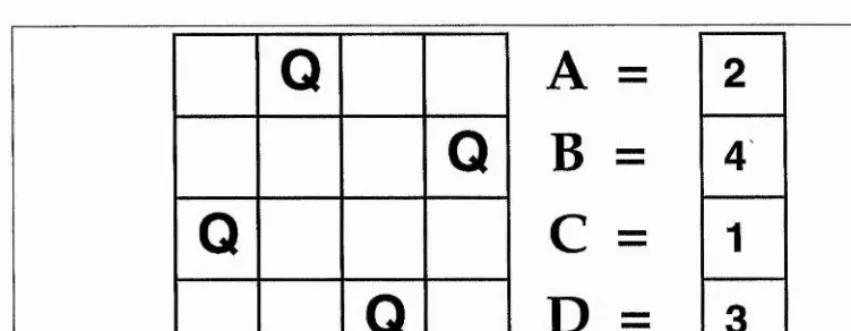
The problem in Example 2.1 has many different ways of being modelled [Nad90]. The reason for this is that we can describe what is unknown in many ways. We can say that the square on the board that each queen takes is unknown. We can say that whether or not a queen goes on a squaie is unknown. We could also say that the column position of the queen in each row is unknown. Each of the descriptions above creates different models and more importantly, each model has a different search space. Also, different models may be easier to describe constraints for.
Model 2.1
Ch a p t e r 2 . Re v ie w of Pr e v io u s Wo r k 21
Figure 2.1: The relation between a solution to the 4-queens problem and Model 2.1.
[image:37.616.73.508.425.619.2]Ch a p t e r 2. Re v ie w of Pr e v io u s Wo r k 22
Figure 2.3: The relation between a solution to the 4-queens problem and Model 2.3.
Model 2.2
The unknowns in this case are the contents of each square. The possible values that each square can take is the existence or non-existence of a queen. For this model, there are rP
variables each with a domain of two. Thus the size of the search space is 2^^. For n = 8
this is 1.8 X 10^®.
Model 2.3
By noticing that each row has to have exactly one queen on it, we can have a variable for each row and its value is the column the queen appears in. In this case we will have n
variables, each with a domain of size n resulting in a search space of n”. For n = 8 this is 1.7 X 10^.
Ch a p t e r 2. R e v ie w o f P r e v i o u s W o r k 23
Modelling and Symmetry
With respect to symmetry, modelling is one of the most important aspects of constraint programming. The model we choose not only affects the seaivh space and how easily the problem can be constrained but it also dictates the number of symmetries that the problem has.
Some problems inherently have symmetry that cannot be avoided, however, poor mod elling can introduce needless symmetry. Similarly, a good model can reduce the amount of symmetry a problem has [SmiOl].
We will now look at a simple example of this by examining the above n-queens models. Given a solution to Model 2.1, we can freely permute the variables to yield another solution. Also, the geometrical property of the square - on which the n-queens problem is based - has 8 symmetries. Thus, this model has 8n! symmetries. The interchangeable symmetry does not exist in Model 2.3, though the symmetries of the square still do. Thus, this model has 8 symmetries regardless of the size of n. So as well as Model 2.1 having a larger search space to Model 2.3, it also has exponentially more symmetries.
M atrix Models
Many problems that can be solved by constraint programming can be modelled as matrices [FFH+01]. ■ A matrix model can be thought of as an n x m array of variables where the rows and columns are considered to be symmetric i.e. the rows can be permuted freely as can the columns. For models such as this, the resulting CSP will have n\ x ml symmetries. Though this seems like a poor modelling decision, in many cases there are not any more preferable alternatives and we must deal with the symmetries in other ways.
As well as the other general methods mentioned in this thesis (such as those presented in Chapter 2.4) there are techniques that can be used specifically for breaking symmetries in matrix models. These techniques involve adding ordering constraints [FFH+02] for which there are GAC algorithms^ [FHK+02] [CB02]. A constraint encoding was described in [GPS02] for matrix models which performs the same domain pruning as the global constraint in [FHK+02].
Ch a p t e r 2. Re v ie w of Pr e v io u s Wo r k 24
The main idea behind these ordering constraints is that by adding superfluous constraints to the model (which rule out some solutions, but not all) we are destroying the symmetry of the problem by stating that rows or columns of variables are different. There are different ways we can order such matrices, for instance using lex constraints, ordered multisets, or either of the previous methods with ordered sums. A detailed analysis of these methods is presented in [Kiz04].
These methods need an exponential number of constraints to break all the nl x ml sym metries of a matrix [CGLR96]. Since adding this number of constraints to the model is not computationally tractable, a subset of the symmetries is broken by adding a polynomial subset of constraints.
2.1.2
Co
nstraints
Describing the constraints of a CSP is where most effort is exerted by the constraint pro grammer. It is the constraints that essentially describe the problem. As we saw in Definition
1.2, constraints act on a set of variables. We can think of a constraint as a list of allowed of tuples, a list of forbidden tuples, or some implicit function that takes a tuple and returns valid, invalid or possibly unknown if a partial assignment is being considered [BR97].
In constraint solvers, constraints are usually constructed using combinations of arithmetic and logical operators e.g. =, <, -H, A etc. All of these are binary operators, which on their own, can create binary constraints. CSPs that contain just binary constraints are called binary CSPs. Any CSP containing a constraint with arity larger than 2 is called a non-binary constraint. It has been shown that any non-binary CSP can be transformed into a binary CSP [RPD90]. Generally speaking, propagation (Chapter 2.1.3) is easier to perform on constraints with a small arity. Thus, research has looked at converting non-binary CSPs to binary CSPs [SteOl] [BCvW02].
We have already observed how constraint programming allows its users to easily describe complex problems. One of the main tools of constraint programming that makes this so is
global constraints. A global constraint is a constraint that acts over a set of variables, thus it is also a non-binary constraint. A global constraint also consists of di filtering algorithm,
Ch a p t e r 2. R e v ie w o f P r e v i o u s W o r k 25
each one takes a different value. Occurrences: given n variables, a number of occurrences
0 and a domain element i, ensure that o of the n variables take the value i. Since the idea
of global constraints is too closely tied to propagation, we will return to these constraints after we have looked at propagation in more detail.
2.1.3 Propagation
One of the many reasons that constraint programming is able to solve complex problems efficiently, is due to the careful balance of propagation and search. We can reduce the exponential search space by using propagation algorithms during search to prune branches of the search tree. The importance of propagation has led to much research into both different levels of consistency and different ways to achieve them. Note that the term propagation is sometimes also referred to as consistency, inference or filtering.
The main idea behind propagation algorithms is to take a current state in search and a set of constraints and remove values from the domains of variables we can show to be inconsistent. For example, imagine the constraint Cij : X i + X j = 5 where D{Xi) = D{Xj) — {1,2,3}, We can see that if = 1 then there is no value that X j can take that will satisfy Cij. Therefore, we conclude that X* = 1 is an inconsistent choice and thus we remove 1 from D{Xi). For the same reason we can infer that X j = 1 is also inconsistent and thus 1 is also removed from D{Xj). Constraint solvers are good at making simple inferences such as these. After making such a domain removal, we can then propagate
these changes i.e. see if we can make any further inferences based on the new smaller domains. By performing these computationally cheap inferences, we drastically reduce the size of the search space.
A propagation algorithm enforces a level of consistency . A consistency level is not con cerned with how the propagation algorithm is implemented, but what the result of applying it to a set of domains is. We will now define some levels of consistency and provide refer ences to some implementations of algorithms that enforce them.
Ch a p t e r 2. Re v ie w of Pr e v io u s Wo r k 26
of consistency to enforce. The most common form of consistency used with constraint programming is arc consistency. One reason for this is that it is the strongest level of propagation that can be enforced by adding unary constraints, or in other words, a domain removal.
Definition 2.1 A binary constraint Cij is arc consistent iff:
2. Vo G D(X() 3b G D % ) g.f. (a, b) G Q
2. Vb G D(Xj) 3ci G D(Xi) s.t. {a, b) G Cij
Definition 2.2 A binary CSP L is arc consistent iff all constraints in L are arc consistent.
The study of arc consistency was introduced by Mackworth in [Mac77]. This paper con tained an algorithm for enforcing arc consistency on binary CSPs called AC-3. This algo rithm has time complexity 0 {e(ff) and space complexity 0 (e + nd) where e is the number of constraints and d is the size of the largest domain. Since then, other implementations with the optimal time complexity Oiedf) and space complexity 0[ed) (except for AC- 4 which has space complexity 0{ed3)) have been created: AC-4 [MH86], AC-6 [BC93], AC-7 [BFR95], AC-2001 [BROl], AC-3.1 [ZYOl]. In practice, AC-7 performs the smallest number of constraint checks and is in many ways preferable. The algorithms AC-2001 and AC-3.1 are the same, though developed independently, and are similar to AC-3. Though the complexities of the above algorithms are similar, how well they work in practice has been an area of interest [Wal93] [vD03].
All of the above algorithms apply only to binary constraints though. Given that constraint solvers allow the construction of larger constraints, and also global constraints, we need to be able to enforce arc consistency on non-binary constraints. This level of consistency is call generalised arc consistency or GAC. An algorithm for enforcing GAC on a set of arbitrary constraints is presented in [BR97] and is loosely based on AC-7. This algorithm is called GAC-Schema and has time complexity 0{edf) and space complexity 0{elPd) and is thus quite impractical for constraints with a large arity.
Ch a p t e r 2. Re v ie w of Pr e v io u s Wo r k 27
consistency is also affective. A CSP is bounds consistent if we ensure that the lai'gest and smallest element of every domain is consistent (Definition 2.3).
Definition 2.3 A binary constraint Cij is bounds consistent iff:
1. a G {D(Xi)smallest, I-^(^i)largest} 36 G D{ Xj ) S.t. (fl, 6) G Cij
2. b G ^D(Xj)smallest, C^(^j)largesty
3
u
G D (X i) S.t.(<2,6)
G CFor some constraints e.g. a binaiy constraint involving an addition operator, performing bounds consistency is as powerful as arc consistency for contiguous domains, but compu tationally cheaper.
A concise representation of some levels of consistency can be described by the following definition.
Definition 2.4 A CSP is (%, j)-consistent if we can make any i consistent instantiations and this state can be extended to a consistent instantiation o f another j variables.
We can see that arc consistency can be described as (1,1)-consistency. In addition, (2,1)- consistency is also known as path consistency, (1,2)-consistency is also known as path inverse consistency and (A: — 1,1)-consistency is also known as k-consistency. In general, we need to perform searches over j variables, and post constraints of arity i, to enforce (i, j)-consistency.
Global Constraints
Ch a p t e r 2. R e v ie w o f P r e v i o u s W o r k 28
One of the most popular global constraints is the all different constraint, for which there is an algorithm that enforces GAC in polynomial time [Reg94]. Other examples of global constraints include the global cardinality constraint [Reg96] and lexicographic ordering constraints [FHK’^02].
2.1.4 Heuristics
The next variable to instantiate while searching is decided by the heuristic we use. Though CSPs have an exponential search space, the size of the search tree can be reduced by prop agation, and also by heuristics. Indeed, given the perfect heuristic for a given CSP, we can find a solution in polynomial time if there is one. In general this is not the case. However, good heuristics can greatly reduce the time taken to find a solution.
The traits of a good heuristic are that it guides the traversal of the search tree toward solu tions, and that it can quickly find paths that lead to failure. Examples of dynamic heuristics include the smallest domain first which instantiates the variable with the smallest domain first, and the most constrained first which instantiates the variable with the most constraints acting on it first. Specific problems can have their own heuristics e.g. the n-queens problem (Model 2.3) can be effectively solved using a heuristic that tries to place queens nearest the center of the board, where it is most constrained. This is done by instantiating the variable nearest to Xa with the value neaiest to ^ first [CHS+03]. A detailed empirical study of dynamic variable ordering heuristics can be found in [GMP+96] and an investigation into why certain variable heuristics are good can be found in [Smi97] [SG98].
As we will see later in this chapter, heuristics can play an important role in solving CSPs with symmetry breaking methods. It was shown in [GHK02] how a poor ordering heuristic can negate the benefit of some methods of symmetry breaking. One of the advantages of the symmetry breaking method described in [GSOO], and later in other symmetry breaking methods such as that in [FSSOl], is that they do not interact badly with the heuristic used.
This becomes particularly important when we are only interested in finding one solution. Generally, symmetry breaking methods are used to find all solutions or an optimal solution as this produces the greatest comparative reduction in search. The reverse is true of good heuristics. Though they try to explore the seaich space that will yield a solution first, the rest of the search space must still be explored later. Thus, the effect of a good heuristic
Ch a p t e r 2. R e v ie w o f P r e v i o u s W o r k 29
is lessened when finding all solutions or an optimal solution. Although, note that a good heuristic will try to search the remaining search in such a way that inconsistent subtrees are found sooner. Since symmetry breaking methods work best when finding all solutions, little symmetry breaking research has been carried out into finding just the first solution
[PreOl].
To eliminate the variability of the effect that dynamic ordering heuristics may have, we will try to avoid their use in experiments. Therefore, unless stated otherwise, experiments in this thesis will use a static lexicographic ordering heuristic.
2.1.5 Search
There are many different strategies for traversing the search space of combinatorial search problems. CSPs are generally solved using a simple backtracking algorithm, and this is the case for the entirety of this thesis. Since it is an important aspect of constraint programming however, we will briefly discuss some alternatives.
A search strategy can be divided into one of two categories: complete and incomplete search. The former deals with methods that systematically traverse the entire seaich space of the problem until a solution is found. The latter may not traverse the entire search space. Complete search has the advantage of being guaranteed to find a solution, or prove that none exist. Incomplete seaich can either find a guaranteed solution or state that none were found, but may still exist.
Complete search records the domains of variables. Instantiations are made and domains are altered. States in search are verified to be consistent before recursively searching further, or we backtrack to the last consistent state to make a different instantiation. Backjumping methods work in a similar manner except they can backtrack further up the search tree [Gas79] [Dec90] [Pro93].
Incomplete search methods work by considering the leaves of the seaich tree i.e. complete instantiations. Many methods of incomplete search can be thought of as a general instance of local search. These include hill-climbing, tabu-search [Glo89], GSAT [SLM92] and stochastic search. For example, the main idea of GSAT is to try a random instantiation of all the variables (possibly guided by some heuristic). We then alter the instantiations
Ch a p t e r 2. Re v ie w of Pr e v io u s Wo r k 30
of individual vaiiables (also called a flip) to try to minimise the number of violated con straints. If we cannot satisfy all of the constraints within a certain number of flips, we then (randomly) choose another complete instantiation of vaiiables. There may also be a limit on the number of restarts we can take.
Symmetries in CSPs cause redundant work when using complete search. Subtrees of search can be considered equivalent under some symmetry. Whatever computation we exerted in proving such a subtree contains no solution, the same work must be done for all its symmetric equivalents. The same is not true for incomplete search however. Consider breaking symmetry by adding redundant constraints e.g. adding lex constraints to a matrix model. Though we are breaking symmetry, we are making the problem more constrained by adding to the constraints that must be satisfied. This leads to a smaller distribution of solutions, which in turn makes it harder for local search to find a solution [PreOl]. It was argued later that super symmetric models are preferable for incomplete search [Pre02].
A survey paper that discusses many different methods of complete search for CSPs was written by Dechter and Frost [DF99]. An introduction to search methods is presented in [PreOO] that covers some complete and incomplete search strategies.
2.2
Co
nstraint Solvers
Research into constraint programming has yielded many different methods of solving CSPs. A constraint solver is an implementation of many of these propagation and search tech niques, global constraints etc. so that CSPs can be solved efficiently. These implementa tions provide a clear method for constraint programmers to encode their problems.
There are many constraint solvers available today. Solver (produced by the company Hog) is a C++ library which provides an imperative constraint solving toolkit. As well as con taining many efficiently implemented global constraints. Solver works by maintaining con sistency on constraints while using a simple backtracking algorithm.
E C D P S ^ (produced by ic-parc, a company owned by Imperial College London) is a con