STUDIES IN STELLAR STRUCTURE AND EVOLUTION
C. Simon Jeffery
A Thesis Submitted for the Degree of PhD
at the
University of St Andrews
1983
Full metadata for this item is available in
St Andrews Research Repository
at:
http://research-repository.st-andrews.ac.uk/
Please use this identifier to cite or link to this item:
http://hdl.handle.net/10023/14304
STUDIES IN STELLAR STRUCTURE AND EVOLUTION
by
G. SIMON JEFFERY
%
A Thesis presented for the Degree of Doctor of Philosophy in the U n iversity o f St Andrews
November 1982
S , #
M
ProQuest Number: 10166970
All rights reserved
INFORMATION TO ALL USERS
The quality of this reproduction is dependent upon the quality of the copy submitted.
In the unlikely event that the author did not send a com plete manuscript and there are missing pages, these will be noted. Also, if material had to be removed,
a note will indicate the deletion.
uest
ProQuest 10166970
Published by ProQuest LLO (2017). Copyright of the Dissertation is held by the Author.
All rights reserved.
This work is protected against unauthorized copying under Title 17, United States C ode Microform Edition © ProQuest LLO.
ProQuest LLO.
789 East Eisenhower Parkway P.Q. Box 1346
To my wi f e
ANGELA
And above a l l th ese put on lo v e , which binds everything together
in p erfect harmony.
Paul, C olossian s, Ch.2, v . 14.
I
I 1
I
I , Christopher Simon J e ffe r y , hereby c e r tify that th is th e s is , which is approximately 30,000 words in len gth , has been w ritten by me,
and that i t has not been subm itted in any previous a p p lica tio n fo r a
higher degree.
X was adm itted as a research student under Ordinance N o,12 on the 1 st October 1979 and as a candidate for the degree of Ph.D. on the 1st October 1980; the higher study for which th is i s a record was carried out in the U n iversity of St Andrews between 1979 and 1982,
1 • M o \ / e v v i : 19 8 9
-C. s . JEFFERY
I hereby c e r tify that the candidate has f u l f i l l e d the conditions
o f the R esolution and R egulations appropriate to the degree o f Ph.D. o f the U niversity o f St Andrews and that he i s q u a lifie d to submit th is th esis in a p p lica tio n for that degree.
T. R. CARSON Supervisor
I
-8-■ ï
ACKNOWLEDGEMENTS
I would lik e to express my thanks to the follow in g :
Dr T.R. Carson, ray su p ervisor, for h is in te r e s t and the valuable advice and guidance which was given throughout the period of the p r o je c t, and also for making h is opacity data a v a ila b le to me. P rofessor D.W.N. S tib b s,
D irector o f the U niversity Observatory, for the f a c i l i t i e s made a v a ila b le to me, which have helped the p roject run smoothly. The Science and
Engineering Research Council for the award of a postgraduate research â studentship.
I also wish to thank Dr R. S tothers and Dr R.W, Hi1ditch for su ggestin g the stu d ies of h orizon tal branch sta r s and the apsidal motion con stant, r e sp e c tiv e ly , and for many other h elp fu l comments. Messrs. A. Bridger and J.K. W orrell made in valu ab le con trib u tion s in providing te s ts for some of the computer programmes, and in developing the computer graphics package GIPSY (used to develop many diagrams in th is th e s is ).
Thanks are a lso due to the s t a f f and research students (past and present) of the U niversity Observatory for many h elp fu l d iscu ssio n s and continuous support and encouragement, to the s t a f f at the St Andrews and Aberdeen U niversity Couputer Centres for th eir a ssista n ce in running lengthy programmes, to Mrs. L. Cuthbert for typing th is d isse r ta tio n and to ray w ife and fam ily for th eir fa ith in me, which was u su ally stronger than mine.
..‘•S’
’
I
4 4
Abs-1 %
ABSTRACT '
We in v e stig a te s t e lla r models for main-sequence and horizontal-branch sta rs constructed using the Carson o p a c itie s and make comparisons w ith models f based on the Cox-Stewart o p a c itie s . A Henyey code based on the p rescrip tio n of Kippenhahn e t a l (1967) i s used for most o f the ca lcu la tio n s of s t e lla r stru ctu re amd ev o lu tio n . In the equation o f s ta te we trea t io n isa tio n equilibrium and n o n - r e la t iv is t ic degeneracy for separate tem perature-density regim es. The opacity is obtained by 4-dim ensional lin e a r in terp o la tio n in %
the Carson op acity ta b le s. Nuclear energy generation rates are taken from Fowler e t a l (1975) and neutrino lo sse s from the approximation due to 4 Beaudet e t a l (1967). E lectron -screen in g factors are from Reeves (1965).
The standard lo c a l m ixing-length theory of Bohm-Vitense (1958) is used to
trea t non-adiabatic con vection, although some models are calcu lated w ith % m od ification s due to Deupree e t a l (1979, 1980), We n eg le ct sem iconvection, 4
The Carson o p a c itie s have only a sm all e ff e c t on the p o sitio n of ZAHB m odels, but th is may be m e ta llic ity dependent. The drop in the hydrogen- '4 s h e ll lum inosity due to the helium -core expansion during HB evolu tion is % greater than that obtained w ith the Cox-Stewart o p a c itie s . Allowing for the in clu sio n o f sem iconvection and convective overshooting, we fin d that
adoption o f the Carson o p a c itie s leads to a reduction o f approximately 25% in the HB life tim e s . For a given range o f values for the masses and
envelope helium abundances of sta rs on a sy n th etic HB, the width in e ffe c tiv e temperature is in creased , and in lum inosity the width is decreased. The dependence of the core lum inosity on the fa llin g core helium abundance is |
increased by approximately 16%. 1
Studies o f main-sequence sta rs lead to agreement w ith S to th ers’ '4 (1974a, 1974b, 1976) r e s u lts for homogeneous models constructed w ith the
Abs"2 (for 1 M© sta r s) su ggest th at the main-sequence life tim e s o f low mass sta rs % may be reduced by as much as 30%. Combined w ith a s h if t in the ZÂMS p o s itio n s
th is w ill move isochrones for low mass sta rs towards lower e ffe c tiv e temperatures and d e n s itie s . I f stu d ies o f red -gian t evolu tio n in d ica te l i t t l e change in the lum inosity le v e l o f the h orizon tal branch, globular c lu ste r ages determined from the p o sitio n o f the main-sequence turnoff p oin t may be su b sta n tia lly reduced (p ossib ly by as much as 50%). This
could save a c o n flic t between observed values for globular c lu ste r ages and a value for the Hubble constant o f 90.
Studies o f the ap sid al motion con stan t, , fo r evolved MS sta r s shows if that the discrepancy between observed values o f k*. fo r e c lip sin g binary
CONTENTS
1 A B rief Introduction to S te lla r Evolution 1
2 Methods for Constructing S te lla r Models and Evolutionary Sequences 9 2.1 The Equations o f S te lla r Structure and E volution 9
2.2 The C alculation o f I n it ia l Models 11
2 .3 Treatment o f the Surface Layers 15
2.4 The Henyey Code 19
2.5 R elaxation o f Zero-Age Models 29
2.6 Construction o f Evolutionary Sequences 32
3 Input Physics 36
3.1 The Equations of S tate 36
3.2 S te lla r Opacity 46
3.3 Subatomic p rocesses 60
3.4 The Temperature Gradient 65
4 Studies o f H orizontal-Branch Stars 69
4.1 An Introduction to the T heoretical Status of
H orizontal-Branch Stars 69
4 .2 Wliy make Studies of the Horizontal-Branch using the Carson
O pacities? 79
4.3 The Grid o f Horizontal-Branch Models 81
4 .4 The Structure and E volution o f a 0.62 Mo Star 82
4*5 Zero-Age H orizontal-Branch Models 99
4.6 Evolutionary Sequences fo r Horizontal-Branch Stars 113
I
5 Studies of Main-Sequence Stars 142
5.1 Introduction 142
5.2 Zero-Age Main-Sequence Models 144
5.3 Main-Sequence Evolution 156
5.4 The Apsidal Motion Constant 169
5.5 Summary 178
6 Conclusion 179
A. 1 References
A .2 The Carson O pacities
TABLES
2.1 M esh-sizes used for model zoning 23
2.2 Convergence c r ite r io n for the Henyey code 30
3.1 Grid p oin ts for which opacity data is given 51 3.2 Chemical con p osition s for which opacity data i s given 52 3.3 R elative abundances of m etals in the Cameron mixture 52 3.4 Nuclear reaction r a te s , screening fa c to r s, e tc . 63 3.5 C o efficien ts for n eutrino-process approximation 64
4.1 The e f f e c t of op acity in creases on p rop erties o f HB models 75 4.2 Changes in Mcc due to a r t i f i c i a l opacity in creases 76 4 .3 HB life tim e as a fu n ction o f (M, Me, Ye) a fte r
Sweigart & Gross (1976) 76
4.4 Model for a 0.62 Mo ZAHB sta r w ith Carson o p a c itie s 83 4.5 In te rio r evolu tion o f a 0.62 M(p HB sta r w ith Carson o p a c itie s 85 4.6 Comparison o f HB models w ith a v ariety o f input physics 92 4 .7 ZAHB models w ith Carson o p a c itie s (sequence Z) 103 4 .8 ZAHB models w ith Carson o p a c itie s (sequence X) 103 4 .9 ZAHB models w ith Carson o p a c itie s (sequence W) 103 4.10 ZAHB models w ith Carson o p a c itie s (sequence DV) 103
4.11 Comparison o f H -sh ell o p a c itie s 101
- j - ■'
5.1 ZAMS models fo r a v a riety o f input physics 145
5.2 ZAMS models w ith Carson o p a c itie s 147
5 .3 The gradient o f the ZAMS 151
5.4 Summary o f MS evolutionary sequences 157
5.5 D etails o f MS evolutionary sequences w ith Carson o p a c itie s 161
c-5.6 c as a function of (M, Xe, Ze) for the r e la tio n ^ 175 5 .7 The ap sid al constant for AG Per and CO Lac 175
il
, V
FIGURES
1.1 HR Diagram showing main groups o f sta rs 2
1.2 HR Diagram for G alactic clu ste r s ^ 3
1 .3 HR Diagram for Globular c lu ste r s | 3
2.1 Flowchart for zero-age s t e lla r stru ctu re ca lcu la tio n s 31 2.2 Flowchart for s t e lla r evolu tio n ca lcu la tio n s 34
3.1 A comparison o f in terp o la ted and ca lcu lated o p a c itie s 53 3.2 The m e ta llic ity con trib u tion ito Helium-core o p a c itie s 56 3.3 Cox-Stewart and Carson o p a c itie s for evolved m ixtures 59
4.1 Zero-age p o sitio n s for a 0.62 M(g HB sta r Ô7 4.2 Evolutionary tracks for a 0.62 M<3 HB sta r 86
4.3 In te r io r evolu tion of a 0,62 HB sta r 89 4 .4 The ZAHB for d iffe r e n t s e ts of input physics 108 4 .5 The ZAHB as a fu n ction of M, Me, Ye and Ze 110
4.6 ZAHB models for low m e t a llic it ie s 112
4 .7 Evolutionary tracks fo r HB sta rs (Z sequences) 138 4 .8 Evolutionary tracks for HB sta rs (W sequences) 138
5.1 ZAMS models fo r d iffe r e n t input physics 146 5.2 Comparison o f our ZAMS w ith that of H ejlesen (1980) 152 5 .3 The ZAMS as a fu n ction o f the m ixing-length 155
5.4 MS life tim e as a fu n ction o f mass 158
5.5 The width o f the MS as a fu n ction of mass 160
5.6 k-2. for ZAMS models 171
3
1 A BRIEF INTRODUCTION TO STELLAR EVOLUTION
T heoretical stu d ies of s t e lla r evolu tion are e s s e n tia l to the
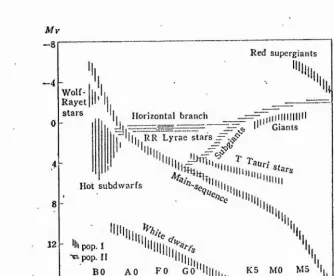
in terp reta tio n o f observations o f the sun and stars and to provide clues to the nature of s t e lla r in te r io r s . The only in t r in s ic p rop erties o f stars av a ila b le to observation are, in gen eral, th eir lu m in o sitie s, surface temperatures and surface com positions. I f we p lo t s t e lla r lu m in o sities again st th eir surface (e ffe c tiv e ) temperatures we obtain what is known as a H ertzsprung-R ussell (HR) diagram^. Figure 1,1 is one such diagram in which the lo ca tio n s o f various groups o f observed sta rs are shown. Most sta r ? , including the Sun, l i e on the main-sequence. They may be roughly divided in to two main groups. Population I sta rs represent young and m etal-rich sta rs ty p ica l o f sta rs in the disk o f the Galaxy, Population II sta rs represent old and m etal-poor sta rs ty p ica l o f sta rs in the oute^ reg io n s, or h alo, o f the Galaxy, Many sta rs are found in c lu s te r s . I t is gen erally b eliev ed that the sta rs w ith in any given clu ster were formed at roughly the same time and from the same m a teria l, d iffe r in g only in th eir i n i t i a l .masses Consequently sta r clu sters provide a very powerful to o l for stu d ies of s te l 1 ev o lu tio n . HR diagrams for some ty p ica l g a la c tic (p op,I) and globular
(p op .II) c lu ste r s are shown in fig u res 1,2 and 1 .3 ,
In th is th e sis we are concerned only w ith pop,I sta rs on the main-sequence and p op .II s ta r s . The main featu res o f HR diagrams for glob u lai c lu ste r s are la b e lle d in f i g . 1*3, In th is in trod u ction we describe
b r ie fly the h is to r ic a l development o f the theory o f s t e lla r ev o lu tio n , and o u tlin e the major phases o f s t e lla r evolu tio n .
^ In fa c t ob servations do not lead d ir e c tly to th is form o f the HR diag,a which is gen erally known as the th e o r e tic a l HR diagram. Observations of
v isu a l magnitude are usually p lo tte d again st colour or sp ectra l type. These ; have to be converted to bolom etric magnitudes and e f fe c tiv e temperatures y by re la tio n s which have been obtained e n ç ir ic a lly .
Mv
3
12
16
Red supergiants
"Hill
Wolf-R a y e t s t a rs
IIIi|*
[image:17.613.129.464.101.377.2]Horizontal branch III Giants l| i||j, R R L y r ae s t a r s z r
r .
Hot s ub d w a r f s
"ill.
'III pop. I pop. n
BO AO FO G o " l | | i | , K5 MO M5 'l,
- t J 1 ______1-1-— -L____llliiU ÎL 1--- 1 - 1
--- 0 . 4 0.0 0.4 0.8 1.2 1.6 2.0
B - V
.1
Figure 1,1 Schematic HR diagram o f s ta r s , showing the lo ca tio n s of various !
. ■5
sequences» The sp ectra l types are for the main-sequence s ta r s . 1
the v isu a l magnitude, i s rela ted to the lum inosity by « 4 .6 3 - 2.5 log L/Lq ” B.C. ,
where B .C ., the bolom etric correction , and B-V, the colou r, are em p irically (and to some exten t th e o r e tic a lly ) known fu n ction s ùM
the e f fe c t iv e tem perature. This fig u re i s from Hayashi e t a l (1962).
- 8
-6
h + ^ PK R SE I
M il M U C O M A }
l/HYAOCS{[ PRAKSnf'H A NG C7à!l 75Ü
M 67 NCCIH3
SUN -■V'
0 0.‘1 1.2 1.6 2.0
B V
Figure 1.2 HR diagrams of g a la c tic c lu s te r s , from
Sandage, A .R ., 1957. Astrophys. J ., 125, 435. Sandage, A .R ,, 1962. Astrophys. J . , 135, 333.
- 1—
.MU h8 ,n
RR
0-B M v
70
SUN-MS
B V
HS Main-sequence
TO T u rn -o ff
GB Giant branch
A6B Asymptotic GB
HB H o riz o n ta l branch
RR RR Lyraes
Figure 1 .3 HR diagrams o f globular c lu s te r s , from Sandage, (1962, c i t . ) .
1
[image:18.614.80.519.23.757.2] [image:18.614.146.469.32.314.2]Early stu d ies o f s t e lla r in te r io r s attempted to construct gaseous spheres in h yd rostatic equilibrium by assuming a p a rticu la r form fo r the equation o f s ta te (Emden, 1907). At th is stage the energy source that
makes sta rs shine was unknown. M echanical, chemical and ra d io -a ctiv e sources f a i l to provide enough energy to keep the sun shining w ith i t s present ,! strength for at le a s t 4,000 m illio n years. In 1920 J. Perrin and A.S.
Eddington (Eddington, 1926) suggested that the nuclear energy released by the f combination o f four hydrogen n u clei to form one helium nucleus could provide i; the energy required. As the neutron was not discovered u n til 1932, Perrin i and Eddington did not know whether the process was p o s sib le , but suggested that s t e lla r in te r io r s were the most lik e ly lo ca tio n s for the form ation of
I
helium. Without knowing the rate o f sub-atomic energy r e le a se , Eddington If
'I
(1926) was able to s e t down the b asic theory o f s t e lla r stru ctu re by -j
combining c la s s ic a l thermodynamics, the theory o f ra d ia tiv e equilibrium and the Bohr theory o f atomic stru ctu re. In order to obtain the s t e lla r o p a city , Eddington adopted Kramers* (1923) op acity based on c la s s ic a l electrom agnetic theory. His achievement was to e sta b lis h a th e o r e tic a l b a sis for the observed rela tio n sh ip between the masses and lu m in o sities o f main-sequence stars*
Progress to 1939 is summarised by Chandrasekhar (1939). He adopts appropriate approximations to most o f the p h ysical processes occurring in s ta r s , which by th is time had been guessed a t, but not p r e c ise ly determined.. Many exten sion s o f previous work are esta b lish ed p r in c ip a lly as so lu tio n s to a number o f sim p lifie d mathematical statem ents o f the problem o f s t e lla r stru ctu re. One o f these was a d eta iled theory of w hite dwarfs. At the same time progress in atomic and nuclear physics enabled Stromgren (1932) and Morse (1940) to obtain o p a c itie s from quantum-mechanical methods and Beth
(1939) to e sta b lish the nuclear o rig in o f s t e lla r energy.
In response to the in crea sin g ly complex ensemble o f p h ysical processes found to be occurring in s t e lla r in te r io r s i t became clea r that approximate j
'i
a n a ly tic so lu tio n s to the s t e lla r stru ctu re equations are no longer r e a lis t ic , j
.'i
The advent o f e le c tr o n ic computers in the early 1950s enabled SchwarzschiId
(1958) and others to ca lcu la te more so p h istica ted models o f s t e lla r in t e r io r s r | Largely through th is work and that o f Baade (1944), the rela tio n sh ip between W
the Hertzsprung-^Russell diagram and s t e lla r evolu tion was f i r s t esta b lish ed . x Schwarzschild*s method for so lv in g the d iffe r e n tia l equations o f s t e lla r stru ctu re was to perform a large number o f numerical in teg ra tio n s
sim ultaneously from the surface and the centre o f the s ta r , improving h is
estim ates o f the boundary values u n til the two se ts o f in teg ra tio n s were f
;
co n sisten t. Henyey et a l. (1959) developed a method whereby the d iffere n tia l, y equations are replaced by d ifferen ce equations. The so lu tio n o f a large
number of sim ultaneous lin e a r equations is required to obtain correctio n s to :• an approximate s t e lla r model. Both of these methods have been used in th is study. The p a rticu la r forms in which they are treated are described in chapter 2 o f th is t h e s is , where a mathematical statem ent o f the problem of
s t e lla r stru ctu re may also be found, |
i
Follow ing SchwarzschiId*s (1958) study, work by Hayashi, Hoshi and Sugimoto (1962) e sta b lish ed the major phases o f s t e lla r evolu tio n and
n u cleo -sy n th esis. In a s e r ie s o f papers summarised by Iben (1967) the
If
evo lu tion o f several sta rs i s described in some d etail*
I t had already been r e a lis e d that sta rs on the main-sequence were burning hydrogen in th eir cores to form helium . In low-mass sta rs the
dominant rea ction network Is the p - p chain which takes p lace in a radiati^Jk core, # In higher mass s ta r s , higher cen tral temperatures enable the CN(0) cy cle to take p la ce . The high temperature s e n s it iv it y o f th is reaction causes the core to be con vective. As hydrogen i s converted in to helium the. mean atomic w eigh t, and hence the d en sity , r is e s in the core. At the same
time the lum inosity r is e s and the sta r expands. When the hydrogen abundance in the core has dropped to about 5% o f the to ta l chemical
rate for the lo ss o f a v a ila b le nuclear fu e l. As the nuclear energy
production drops the core begins to con tract, relea sin g g ra v ita tio n a l energy,
I
which r e su lts in the sta r m aintaining i t s o v era ll s iz e and lu m in osity. -S When the hydrogen in the core has a l l been converted in to helium , the core Icontinues to con tract. The hydrogen-rich m aterial ou tsid e the core follow s th is con traction , in creasin g in tenç>erature and d en sity u n til nuclear
reaction s s ta r t to burn the hydrogen in a s h e ll ju s t o u tsid e the h elium -rich core. At th is p oin t the sta r leaves the m ain-sequence. I t i s evident that s t e lla r evolu tion depends c r it ic a lly on the i n i t i a l mass o f the sta r.
The time spent by a sta r on the main-sequence v aries in v er sely w ith the
i n i t i a l mass. Subsequent evolu tio n only broadly follow s the o u tlin e des crib below.
As hydrogen burns in a thin s h e ll ou tsid e a con tracting h elium -core, S the sta r moves on to and up the red -gian t branch. In the helium -core
d temperatures and d e n sitie s continue to r is e . At th ese d e n sitie s electro n s
l| become degenerate and h igh ly conductive. The core therefore becomes nearly j
1} isotherm al. When the core has reached a temperature high enough for helium
I
reaction s (v ia the 3-tx p rocess) to occur, the helium core i s "ignited"(the "helium fla sh " ). In high mass sta rs the helium reaction s begin b efore the core becomes degenerate. These sta rs may correspond to the supergiant& o f f i g . 1 .1 .
A fter the core-helium fla s h , the core d en sity f a l l s and the electro n degeneracy i s li f t e d . In p op .II s ta r s , the helium core burning phase is
a sso cia ted w ith the h orizon tal branch in the HR diagram for globular olu steru , i
This phase i s described in greater d e ta il in chapter 4. ^ A fter the exhaustion o f helium in the core, the sta r returns to the ^ gian t branch where i t contains a degenerate carbon/oxygen core, a helium - ' burning s h e ll and a hydrogen-burning s h e ll. I f the sta r is massive enough
the cen tral tenqjerature may become s u ff ic ie n t ly high for carbon and more A
m assive elem ents to "burn". I f the mass i s le s s than the Chandrasekhar
mass lim it ( '^1.4 so la r m asses), the exhaustion o f a v a ila b le nuclear fu e l w ill be follow ed by g ra v ita tio n a l co lla p se u n til the sta r becomes a w hite
dwarf. The advanced evolutionary stages o f more m assive sta rs are not w ell understood, but appear to depend on whether the sta r i s a member of a binary system or not. They are suggested to be the progenitors o f neutron stars and black h oles and the p a rticip a n ts in supernovae exp losion s and cataclysm ic variab le system s. As such, these ob jects do not occupy w ell determined regions in the HR diagram.
Hence th e o r e tic a l stu d ies o f s t e lla r ev olu tion have su c c e ssfu lly
a sso cia ted models for s t e lla r in te r io r s w ith many of the observed p o sitio n s o f stars in the HR diagram. Some exceptions (e .g . the WoIf-Raye t s ta r s , the Helium s ta r s , the Blue S tra g g lers, e t c . ) and many q u a n tita tiv e problems
(e .g . mass lo ss in red -gia n t s ta r s , the so lar neutrino flu x e t c .) remain. The d eta iled ev o lu tio n of sta rs is not only s e n s itiv e to the i n i t i a l mass and chemical com position. The p recise nature o f the p h ysical processes w ith in the sta r (e .g . the nuclear reaction r a te s , the convective mixing p ro cesses) and the in te r a c tio n o f the sta r w ith i t s environment (e .g . binary system s) both have important consequences. I t is the aim o f s t e lla r
evolu tio n stu d ies to id e n tify th ese processes and, u ltim a tely perhaps^ to be able to determine the h isto ry o f a ll observed s ta r s . I t is not
p o ssib le in th is in trod u ction to review the work carried out by many authors over the p ast f ift e e n years.
In th is th e sis we examine a number o f asp ects o f s t e lla r ev o lu tio n . In p a rticu la r we in v e s tig a te the e f f e c t o f using o p a c itie s ca lcu la ted by Carson rather than those ca lcu la ted by Cox, Stewart and others which have
been adopted in most other stu d ie s. The methods used in con stru ctin g
J
I s t e lla r models and evolutionary sequences are described in chapter 2. ,j The physics used is described in chapter 3, where a more ex ten sive | d iscu ssion o f the op acity may be found in ad d ition to the treatm ents for
r-pr-I
I
the equation o f s ta t e , the nuclear energy generation p rocesses and convection *
■i
The stru ctu re and evo lu tion o f h orizon tal branch sta rs w ith the Carson
o p a c itie s is examined in chapter 4, w hile some aspects o f main-sequence star- | are stud ied in chapter 5. Some suggestions a risin g from these a su lts a ie made in chapter 6.
The nature o f our in v e stig a tio n i s la rg ely exploratory. Instead of s e ttin g out to so lv e a p a rticu la r problem, we sta r t by asking "What happens to our p ictu re of s t e lla r evolu tio n i f the Carson o p a c itie s are adopted?”
‘•■-•s.-- 'A. 1 /Â ^ “ ', - i
i.i 2 METHODS FOR CONSTRUCTING STELLAR MODELS AND EVOLUTIONARY SEQUENCES
2.1 THE EQUATIONS OF STELLAR STRUCTURE AND EVOLUTION
The c la s s ic a l problem o f s t e lla r stru ctu re i s by now w ell known
(e .g . Schwarzschild, 1958), The assunption o f sp h erica l symmetry reduces the problem to one dimension. We choose the Lagrangian variab le
the mass w ith in a sphere o f radius r around the cen tre, as our independent v a ria b le. A ll unknown fu n ction s describing the stru ctu re o f the sta r may be considered dependent only upon M,. and t , the tim e. The problem o f s t e lla i evolu tion i s the determ ination o f these fu n ctio n s.
We w rite P for the to ta l p ressu re, T for the tem perature, Ly. for the energy leavin g a sphere o f radius per second and Xi fo r the r e la tiv e abundance by mass o f the chemical element i .
From the d e fin itio n of the conditions o f h yd rosta tic equilibrium and energy balance, and from the transport equation, we have
^ = I . (2-1)
3 Mr 4-Tr''’-ç
i k : ^ E _ T ^
SM r ^ (2-2)
èP ^ — <k- Mr
î)Mr ' A -ir r * (2-3)
3T _ Gr M,
• V (2 ,4 )
Here the d en sity , ^ , the nuclear energy gen eration, 6 * the entropy, S , and the temperature gradient V are considered to be functions o f P, T and the chemical con p osition . I f the to ta l nuclear energy generation rate
IS w ritten as
e ' H e ,
k
where for any element i reactio n s Ic^ destroy i and V' produce i , then
where Q represents the energy gain per gram of elem ent i processed.
I f we have a convective region w ith instantaneous mixing which p ossesses nuclear energy sources and/or a boundary moving a t rate
^ in to a region o f mean com position X i*, then the change in com position Xi w ithin the convective region is given by
Æ = L a , l k k . i . ' ’ + c X ' ' ' X . y ^ - _ J M ,
where the in teg ra ls are taken over the whole convective region.
Providing the functions H, S and V are continuous and d iffe r e n tia b le th eir sp e c ia l forms have no in flu en ce on the method described in th is chapter. The forms used are d iscu ssed in chapter 3.
To conplete the mathematical statem ent o f the problem o f s t e lla r structure^ boundary con d ition s for equations (2-1) to (2-4) are given by
r =• O J Ly, - O J cih Mv- = O ^ (2-7)
Pj = O, -r = T- ( L
,R
,^ ..t My = M
^ J(2-8)
where ^ is the gas p ressu re, f i s o p tic a l depth and / \ , L, R are the s t e lla r | mass, lum inosity and radius r e sp e c tiv e ly .
In general a n a ly tic so lu tio n s to (2-1) to (2-4) are not a v a ila b le and sin ce boundary con d ition s appear a t both ends o f the domain o f some form o f numerical ite r a tio n is required.
A number o f methods have been proposed, H aselgrove and Hoyle (1956) and Schwarzschild (1958) developed a procedure for f it t in g inward and outward in teg ra tio n s at a f it t in g p o in t. This method had the advantages o f not requiring an e x is tin g so lu tio n and could be used with a high-order numerical in teg ra tio n algorithm» I t has been used in th is study to con stru ct some i n i t i a l models* Henyey, W ilets, B'dhm,Lehevier and Levee (1959) developed a procedure where the f i r s t order d iffe r e n tia l equations are replaced by a system o f d ifferen ce equ ation s. This method has been w idely adopted, although e x te n siv e ly m odified (e .g . Henyey, Forbes and Gould, 1964), I ts major advantage over the in teg ra tio n procedure i s th at i t is
Weigert and Hofm eister (1967) and w ill be described la te r in th is chapter. A number o f other methods have been proposed, o f which we note the follo w in g. One disadvantage o f the Lagrangian grid is that regions where q u a n tities (e .g . Pressure) vary rapidly w ith mass (e .g . the surface la y ers) have to be treated sep a ra tely . Eggleton (1971) adopts a non-Lagrangian
mesh which enables the e n tire sta r to be treated in a c o n siste n t manner, -g although in creasin g the number o f d ifferen ce equations. Reiz and Petersen^ and Wilson (1981) independently developed a g en era lisa tio n o f the Henyey and in teg ra tio n methods by adopting a number of f it t in g p oin ts (ty p ic a lly |î
2) < y\ ^ 12 ). T rial values serve both as s ta r tin g values for in teg ra tio n s ’’pi to the next f it t in g p o in t, and in forming d ifferen ces w ith in teg ra tio n s from k the preceding p o in t, in order to ite r a te to render d isc o n tin u itie s equal
to zero.
1 Unpublished, but see H ejlesen (1980), Wilson (1981) for d e ta ils .
2.2 THE CALCULATION OF INITIAL MODELS
Beginning w ith the boundary con d ition s (2-7) and (2 -8 ), we choose su ita b le estim ates for
L y = k , T o i My - M l* ,
P = P,
^ T .
o.t My = O ^
where is the to ta l s t e lla r lu m in osity, the e ffe c t iv e tem perature, and where su b scrip t c denotes cen tral valu es. Mass in the s t e lla r atmosphere, i . e . in regions o u tsid e the layer in which T = , is assumed to be n e g lig ib le in ca lcu la tio n s for s t e lla r in te r io r s .
We now have four boundary values at each end o f the domain \ ^ My ^ O j Equations (2-1) to (2-4) may be in tegrated from each boundary to some
f it t in g p oin t M f, to obtain f it t in g v a lu es, ( j , P-L 5
^ where su b scrip ts and refer to values a t the f it t in g p oin t from the in te r io r and e x te r io r , or outward and inward, in teg ra tio n s r e sp e c tiv e ly . I f the conditions
Î
are s a t is f ie d , we have obtained a so lu tio n . | In p r a c tic e , the ex te r io r in teg ra tio n i s sta rted from some p oin t
, where the sta r tin g values v^, , Pg and Tg are obtained as I fu n ction s o f and from a separate in teg ra tio n o f the surface la y e r s, using Pressure as the independent v a ria b le. The treatm ent o f the surface in teg ra tio n w ill be d iscu ssed further in a la te r se c tio n .
S im ilarly the in te r io r in teg ra tio n is not begun a t = 0 .
The inner boundary con d ition (2-^7) may be rew ritten to provide sta r tin g valu es G » , R , a t some p oin t ^ | 0 < 1 |
as fu n ction s o f and . Applying a Madaurins s e r ie s expansion to equations (2^1) (2*^4) and n eg lectin g higher orders o f My, we obtain
r. - ( 3 A T r f ) J ’ m J''*
1 ,=
M ,
V] ^ 4 / 3 2-/3
T: = IT : - %
sin ce a l l v a riab les range over sev era l orders o f magnitude in the S tella in te r io r , i t is convenient to make a su ita b le transform ation. For a ll the in te r io r in teg ra tio n s ( i . e . excluding the in teg ra tio n o f the surface layers -à
mentioned above) we have adopted those suggested by Kippenhahn e t a l (1967),
Thus the independent v aria b le becomes ^
1 = ( 1 - / ( 1 + ^ ) M». ) (2-1/.' i
which provides high r e so lu tio n in My near the surface fo r equal increm ents in ^ . For the unknown q u a n titie s , logarithm ic v a ria b les are used.
X
where the p o s itiv e constant l ! allow s for a n egative L so long as L,, > -'L'
(2-16) The estim ated boundary conditions are now w ritten
A = Ion ( L # / Lü ) ,
~ = lo<^ Tc.j| ^
f t = '• 0 3 , t t = L0 3 c 1
and th eir second forms become
îc^C A ,-!:), Lj ( A ,i: ) , p,. t , ( A y f ) o-t (2-17) I
l„ ( p c .,h ) , p o C f .t t ) , ah (2-18)
Equations (2-1) to (2 -4 ), appropriately transformed, are in tegrated from each o f these se ts o f boundary values using a fourth-order Runge-Kutta algorithm w ith s e lf-a d ju s tin g s t e p -s iz e . At a p oin t ^ ) each in teg ra tio n y ie ld s values for and
pij-» • We have obtained a so lu tio n for the stru ctu re o f the s t e lla r in te r io r when con d ition (2 -9 ), which may be rew ritten as
- X . j . - O , =
‘t, fjL = P e |l - p , f -• O j î . b | = ' O j
is s a t is f ie d . In order to s a t is f y th is con d ition , a Newton-Raphson * ite r a tio n scheme sim ila r to those described by Faulkner (1966) and i
Ezer and Cameron (1962) i s used.
I f i n i t i a l estim ates for the boundary con d ition s A -X , pc ctnoi
are good enough, and are denoted by A » j i); ; i « (, 4} , and i f the à
f it t in g values are denoted by | 1 ^ j ' such that ^
A ‘ V j
then by performing two ad d ition al p airs o f in teg ra tio n s w ith boundary
conditions B - ^ L, -v ^ ^ 1 ^ ^ B/» ^ ^ b / ^ h, < ^
we obtain correction s A b^ ; i - L 4 from the system I
^ b, _ A y ii. ]
^ 2
-_
"'-"3 - ¥ .
ovci
'à L, -
y A
- W ;A
M l
I
Ab.
A t J
A v (
I Avi^
i
m " :
(2- 20)
Then s e ttin g
b ^ - 6- k'l A b :
( 2- 22)
) L = (2-21)
the procedure may be repeated u n til we obtain
A v p -7 v y j j ' I, 4 ; 7 1 where ^ represents the required convergence lim it.
To obtain convergence, i t is necessary that the i n i t i a l estim ates
A,
T, clo se enough to those s a tis fy in g (2 -1 9 ). In order to obtain these estim ates we use a procedure based on one described by Ezer and Cameron (1962) which uses the homology in varian tsu = w ) V à I n -p
11
(2-23)
b U"l Y" è Ly\ Y“ ^ Iv i T ~
T rial inward in teg ra tio n s from p oin ts on a sparse g rid in (^,T ) are carried out. I f the t r ia l in teg ra tio n becomes u n stab le, the in teg ra tio n is h alted I n s ta b ility is sa id to have occurred i f LI orY / very much exceed 3, i f Ü d ecreases, i f V in creases or i f V becomes sm aller than 0. The values
AVc A A
M l ' /
\
I
f iAVc /
I
A t; 3 - - u .
' - V ,
I /
(2-24)
I
s
in order to s a tis fy the conditions
1 3 - U e 1 7 ^ I V , I < / / (2-25)
where y again represents the required convergence lim it.
These in teg ra tio n s now provide ^ A pi H ^ i z /b ] *
2 .3 TREATMENT OF THE SURFACE LAYERS
In the outermost regions o f a s ta r , we find that w hile M^ the p ressu re, P, may vary over several orders o f magnitude. I t is
th erefore no longer appropriate to use an independent Lagrangian v ariab le to so lv e the stru ctu re equations in these region s. Some authors
(e .g . Eggleton, 1971) th erefore p refer to use a non-Lagrangian variab le (e .g . 4 ~ (P, by, M^) as independent variab le for the en tire sta r. The approach adopted here is to trea t the region o f the sta r above i p o in t '
sep a ra tely , using pressure as the independent v a ria b le. Since su ii^ ce layer in teg ra tio n s are time consuming, (they pass through the hydrogen and helium io n isa tio n zones and convection is n on-adiabatic) a scheme to keep the number o f such in teg ra tio n s to a minimum is required. That adopted is described in f u ll by Kippenhahn, Weigert and Hofm eister (1967). The o b ject is to obtain boundary conditions in the form of (2 -17).
In the s t e lla r atmosphere we have to a good approximation
Mv- - Mjy ^ L ^ - L. ^ ^ (2-26)
The black body flu x
= o - T ^ (2-27)
is in tegrated over the sphere to obtain
L v = A tT R ’-ctT ; ! (2-28)
where CT is the rad iation constant. j
Above th is layer equation (2-4) no longer h old s, but may be replaced
by a su ita b le function ^
T - T (
,
17
|t , t )
(
2
-
29
)
obtained from the study of s t e lla r atmospheres (M ihalas, 1978), where, in m reference to s t e lla r atmospheres, X is the o p tic a l depth defined by the | re la tio n
= , ' t ' ( ç = o ) ^ 0 . (2-30)
For a grey atmosphere in lo c a l thermodynamic equilibrium (LTE) and ra d ia tiv e ; equilibrium , th is has the form
= % T ejf ( r + f ( T ) ) (2-31)
where in the Eddington approximation the Hopf function ,
The in flu en ce o f other approximations for T (Lj î ë | | } on s t e lla r stru ctu re ca lcu la tio n s is examined by Henyey, Vardya and Bodenheimer (1965). More recent approximations have been derived, e .g . by Krishna-Swamy (1966) and by Gingerich e t a l . (1971), from ob servation s. Demarque, King and Diaz (1982) have constructed an a n a ly tic f i t to the nongrey model atmospheres for red gian ts due to B ell e t a l , (1976). Since a ll approximations have lim ited v a lid ity , we currently use the Eddington approximation in a ll models. Combining the d e fin itio n o f o p tic a l depth (2-20) w ith the equation o f h yd rostatic equilibrium provides the second atmospheric equation
K
where the surface gravity g is given by
= O (2-32)
ty g is given by
':ï . f
-
I
A sta r tin g value for in teg ra tin g (2-32) is obtained by so lv in g
p = T O , / k( P - T ) -I R ( t ) (2-34) ft
for P at , where M is the value of Y for which X ( v ) - TX 7 and n is the number o f steps used in in teg ra tin g (2 -3 2 ), (2-34) is solved ;<
.'Î using a Newton-Raphson ite r a tio n . I f an error condition a rises during the Â
ite r a tio n , i . e . i f P< ("t) or convergence f a i l s , (2-34) is replaced by ^ Iben's (1971a) condition
"P ) ' 4 R- ) (2-34a) i
With the sta rtin g value B(T^) , (2-32) is in tegrated using a fourth order Runge-Kutta algorithm from Y = T , . The number o f step s n
is usually 25. Varying n from 10 to 50 has l i t t l e e f fe c t on P (X , ^ . Given 1%^ and L^ , we have obtained values for R and P at My - M * , givin g s ta r tin g conditions for the in teg ra tio n o f equations (2-1) to (2-4).
The stru ctu re o f the outermost layers beneath the atmosphere is obtaineeM by in teg ra tin g equations (2-1) , (2-3) and (2-4) from to AAy * M ,
The assumption that Ly = L ^ in these layers holds to a high degree, sin ce nuclear p rocesses make a n e g lig ib le contribution for P < lO K .
Logarithmic varia b les are used throughout w ith a fourth-order Runge-KuttJ. ; in teg ra tio n w ith s e lf-a d ju stin g step -w idth , and w ith log P as the independen ; f: va ria b le. The transformed d iffe r e n tia l equations used in the in tegratio n | be come
~hloc\ Mr 4 i r Py-''* (2-35)
à ? Gr- A A
liH S A L . -
P'-àU c^ P e -M y O (z-3()
à Loo P V (2-37)
fA- is determined in such a way that providing
/ M x ) - (2-38) ^
then the temperature at Mj is required to f u l f i l the condition
4. S" ( b s = ^ (2-3'))
This condition is designed to place the time-consuming treatment o f the H and He io n isa tio n zones w ith in the surface in teg ra tio n scheme (c f. Sweigart
and Gross, 1974). In the current programme, changes to A\$ during i; evolutionary sequences are r e s tr ic te d in the in te r e s t o f computational speed-In ad d ition , most sequences stu d ied w ith the current programme are r e s tr ic te ft to one phase o f ev o lu tio n , where changes in are slow.
In order to reduce the number o f times the surface layers are in teg ra tec,a a scheme is used which avoids repeating the in teg ra tio n procedure each time surface conditions for new values of and T = are required# L inearised rela tio n s between pa and ¥ obtained using fthe * scheme described in d e ta il by Kippenhahn, W eigert and Hofmeister (1967) p ( ^ IV.A). The follow in g is a summary of i t s main fea tu res.
Assuming that the ( A ,T )(p lan e is covered by a net o f congruent rig h t ' tr ia n g le s , outer layer in teg ra tio n s are carried out for the three corners î ( A ^ - 1)3 ) o f the tria n g le in which the ( ) p oin t for a given
model l i e s . From these in teg ra tio n s we can obtain lin e a r ise d conditions of the form
(2-40)
and > - £• C p s ^ h ) » E„ £ | Ps :
where the c o e ffic ie n ts , e t c ., are obtained as so lu tio n s to « systems of the form
X X
Î I
19
While the ( A,Y ) p oin t for a given model remains w ith in th is tr ia n g le , the surface con d ition s do not need to be recomputed. When the evolutionary track in the ( Am ) plane moves to another tria n g le new conditions must be derived, but i f the new tria n g le has one or two corners in common w ith the o ld tr ia n g le , these do not need to be rein tegrated .
In the current study we have used tria n g les w ith sid es A.A 0 ' \
and AY Ï 0 .0 2 , as in Kippenhahn e t a l (1967). No su b sta n tia l d ifferen ce in the zero-age models was found using a reduced g r id -s iz e w ith A A “ C> 0 S A x = O'OI (e .g . Sweigart and Gross, 1974), although w hile constructing zero-age h orizon tal branch m odels, the sm aller g r id -s iz e gave r is e to a so lu tio n which o s c illa t e d between adjacent tria n g les in the (A jY ) plane. This was immediately resolved on using the larger g r id -s iz e . The consequent reduction in the number o f surface in teg ra tio n s required during an evolution# sequence j u s t if ie d using the larger g r id -siz e during the current study.
2.4 THE HENYEY CODE INTRODUCTION
The Henyey code for ca lcu la tin g s t e lla r stru ctu re operates on the follow ing p r in c ip le . Given an i n i t i a l estim ate for the numerical so lu tio n o f a d iffe r e n tia l equation, the d iffe r e n tia l equation may be replaced by a d ifferen ce equation, and a f i r s t order so lu tio n obtained by s e ttin g up and so lv in g a system o f lin ea r equations. We have follow ed the p rescrip tio n given by Kippenhahn, W eigert and Hofmeister (1967). Given an i n i t i a l estim ate for the s t e lla r model c o n sistin g of values for
' > ) : j = i,w i (2-43)
where ^nd are defined by some
transform ation (e .g . 2-14 and 2-15) o f the form
^ X x ( r p % ^ ( P \ i: - i (A ) (2-44)
a system of lin e a r equations i s formed and solved for the correction s
M
When ap p lied , a new estim ate for the s t e lla r model is obtained, and the process i s repeated u n til the correction s become sm all enough to s a tis fy some convergence c r ite r io n . This so lv es the s t e lla r stru ctu re equations. A separate procedure trea ts the time-dependent change o f chemical stru ctu re
X ,j ; i - I k ^ j - 1, 0 , (2-45)
due to n u cleosyn th etic and convective processes by replacing time derivative^ w ith d iffe r e n c e s. The subsequent model must again be relaxed. A number of
such models separated in time is an evolutionary sequence.
REPLACING DIFFERENTIAL EQUATIONS BY DIFFERENCE EQUATIONS.
Kippenhahn e t a l divid e the in terv a l M . ^My Mo in to ryi«2 mass J
■I
s h e lls w ith mesh points
à (M o )
21
Applying transform ation (2-44) and rep lacin g, say, (2-1) w ith a d ifferen ce equation, the equations
_ 1 I 1 (
olx/c&V-L 4TrM ^ J (2-4 7)
( j - \ y . . y n ~ ï ' ) j
are obtained. Subscripts j + ^ in d ica te an average fo r the mass s h e ll between the mesh p oin ts j and j + 1. A number o f p o ssib le ways for determining these averages are a v a ila b le , those adopted are given below, alongside the forms used fo r the d ifferen ce equations. Each o f the
m~T- mass s h e lls provides four d ifferen ce equations w ith the general form
(2-48'-( t - J J ' YYI - 2 ) .
In ad d ition these fu n ction s in volve values o f X; and S at j and j 4 1
and A4; as param eters. As these 4(y>i-2) equations stand again st the 4(m - ! unknowns ^ Ij ^ j^ J= 4 ... m ^ further equations must be obtained from
the boundary con d ition s. We f i r s t w rite out the d ifferen ce equations Gy , i ** 1,4 in the form used in the current programme, w ith the
transform ation (2-14) and (2 -1 5 ).
'
y
(2.49a^l_ o L
4 IT"
i - . ^
X ( lO-" '■- \ ) . V y (2-494) 3
where 5
= ( i j -+ ) / 2 I
)<7'4 = ()"j -" 1 / 2 I
U " < l j • f t -
> / 2 ,^ pj '* Rj-" ^ / -F
PjVI/,
4 ' 4
)
" M + p j * > ) ^ ^
^ V j J / 2
/ r- \ ' ¥
SnuCj^i^^ =
L
Gnytcj ♦ £n u c^ ^ , /( L lj+vi - b iji I/,, ) P v 1/^ . ( L i'A - L 'M /
(2-50)
pj+ '/t, ■
■GjiVz — ^WttT j i - t £.qro.\/j^ j/j_
■ Uj.y^ = ^ ( U j d U j i i ) / 2
P jV /. * M " P j- ) / 2
Superscript o refers to the value in the previous model^ A-L is the tim estep between models.
I
THE CHOICE OF MESH POINTS
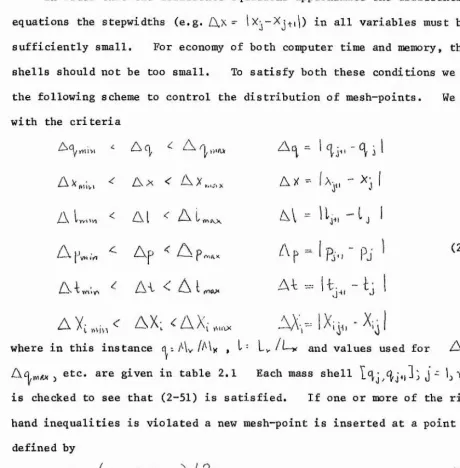
In order that the d ifferen ce equations approximate the d iffe r e n tia l equations the stepwidths (e .g . A.X - + iti a ll v ariab les must be s u ffic ie n tly sm all. For economy o f both computer time and memory, the mass-s h e llmass-s mass-should not be too mass-sm all. To s a t is f y both these conditions we adopt the follow in g scheme to con trol the d istrib u tio n o f m esh-points. We s ta r t w ith the c r ite r ia
< Ac^ ^ A yitaV
A k itMyl A x < A A x =: ■ 1
/A i 'VI < A t A i ' L -- L
k 1 'yM «V» A p A p ! ? y ■- pj
A.4: '
L—S V Y>n > A i ^ At I TViftx A4: - i
XX X( yvVJV <r\ A X L ^ A, ■A'r= 1 Xi^i, ■ X
(2-51)
where in th is in stan ce A\vA\y , t= Ly. /L y and values used for , ) e tc . are given in ta b le 2.1 Each mass s h e ll ; J - ij, Yd
is checked to see th at (2-51) is s a t is f ie d . I f one or more o f the r ig h t-hand in e q u a litie s is v io la te d a new mesh-point is in serted a t a p oin t defined by
■< 1 2 . (2-52)
Table 2,1 Upper and lower lim its on s te p -s iz e s used fo r checking the d istr ib u tio n o f m esh-points w ith in the s t e lla r model
V ariable A<\, A x A I A p A t A Xu AX
rain 0.01 0.05 0.0 5 0.05 0.02 0 .03 0 .0 3
[image:38.614.94.554.103.571.2]Approximate values for a ll other q u a n tities at th is p oin t are obtained by lin e a r in terp o la tio n between e x istin g values at m esh-points j and j + 1.
'I
I f a ll o f the left-h a n d in e q u a litie s f a i l then the meshpoint at
is d eleted , providing that i t s om ission v io la te s none o f the right-hand
in e q u a litie s . F u ll d e ta ils o f an eq u ivalent scheme are given by Kippenhahn -A e t a l (1967). No problems a ffe c tin g the accuracy o f our r e su lts a r isin g
from the d istr ib u tio n o f m esh-points were encountered w h ilst using th is 4
s cheme.
DIFFERENCE EQUATIONS FROM THE BOUNDARY CONDITIONS
We already have the con d ition s (2-41) which hold at | , , y ie ld in g two equations
B , - ( 2 4 , , t , , p , , - I , ) - O , I : 1 . 2 ( 2 - 5 3 ) or in p a rticu la r :
B , = 7" + 7 , p , 1 = Ü (2_5 4a)
U o ' ft, p i ' * L - L| - O (2-54b)
We have a lso obtained equations (2-10) - (2-13) which determine the behaviour of the so lu tio n in a neighbourhood of the s t e lla r cen tre. These may be rew ritten in terms o f the transform ation (2-44) and rearranged to y ie id
C l , h . l , Pm-I ) h ' - i , ) = O '> ^ ' ' > 7 (2-55) (C entral values Xyy, and A are t r iv ia l and do not appear as arguments). The C ’l under transform ation (2-14) - (2-15) as used in the current
programme are w ritten out below. Note that the cen tral values " fc )£c 3 , e tc . are replaced by 3 » e tc . where
the su b scrip t m - ^ represents an average o f the values a t meshpoints m and « m - 1. This approximation is j u s t if ie d as fo llo w s. Equations (2-10) - %
(2-13) may be obtained by e ith e r o f two methods. I f (2-1) - (2-4) are | in teg rated w ith constant values for pM jV over the inbaryal to , then the means o f the boundary values for P , e tc . are b e tte r than the 4
I
• I - ■ ni F' ■
truncated McLaurin s e r ie s expansion, then taking the means o f the boundary values for and
V
in the in te r v a llAç
toMq
allow s for the n eg le ct o f higher order terms.-2
Regarding the choice of Ab , we use tAo - lO . Tests showed that
I -4
using ( 0 gave r is e to a change in the cen tral pressure o f G ¥ R. . Our form for the cen tral con d ition s becomes :
c, f t l» 3 ( - 3 Ml,
TT
C.,= ~ l „ .| ■+ M f I + - M s - . £
C p w , ~ p w J ~ ( l e t ] , h z . M h . pm'A./
-'
V 3 /
2
U l o
/ R
vn - V%Ajy — *■ ^wi„i ^ ~ Cp-yvi ~ Pvy\»i X '/%.
Subscripts m - | represent averages o f values at mass s h e lls m - 1 and m, evaluated using the same conventions as in (2 -5 0 ).
THE SYSTEM OF NON-LINEAR EQUATIONS
Following Kippenhahn e t a l, we now have a system o f 4m - 2 n on -lin ear
I:
equations ;
B t = o .
M = O
:
C; =4 O
for the 4m - 2 unknowns
V =
(2-57)
: " ' ' ~ '
THE METHOD FOR SOLVING THE SYSTEM OF NON-LINEAR EQUATIONS
Kippenhahn e t al (1967) give a d eta iled treatm ent o f the so lu tio n o f the system (2 -5 7 ). In gen eral, a system o f n on -lin ear equations
(2-58) ■ £ 1 ^ '(41 , y I ) - - - L M ) c
. . - i n ) - O
A 1 ^ 0 • • k" )
-w ith an approximate so lu tio n ( o ) ( ü ) ( ü ) a . , 'jv , . . .
may be solved using a Newton-Raphson ite r a tio n . C orrections S>u-, are found ft such that a fte r s s te p s,
(£■<') (s) f ,
y ^ j. '* I - 1J VQ (2—59)
w ill give a b e tte r approximation to the so lu tio n o f (2 -5 8 ), where the are determined by so lv in g the system
t =■ ; k H . v i (2-60)
: : I \ O y \ / ' J
where su p erscrip ts (s) in d ica te that the functions \ aiT^d are ( s)
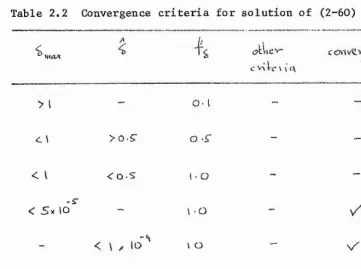
evaluated from the g ; . Since (2-58) are n o n -lin ea r, icj; must be calcu la ted and applied it e r a t iv e ly u n til some convergence c r ite r io n is
s a t is f ie d .
(b) I (o') (cl I (v)
I f an approximate so lu tio n , Ij , pj , \ to the n on -lin ear system (2-5 7) e x is t s , then th is method may be applied to obtain correction s
from the system o f lin e a r equations of the form (2-60) :
?
C". ' Î''’
-2 /
< s X 4- 4- (
^ L , ^ ' V . , p , t k t ,
' M A I
^ P r .
( i = I, . .. . 4 , j'
n\
0
1
I
Ï (2-61)4
bC i X i
^ vvi ' »
l C i _ c ^ ;
^ tyvi-l Y X ■ Y pwl-l
pw' \
f L.. p
vvt
X
Wi 4 ^ ¥
W\ - C l
►VI- I
i
( i = 1 , . . . £ . } .
A ll c o e ffic ie n ts may be ca lcu la ted from equations (2 -4 9 ), (2 -5 0 ), (2-54) and (2-56) using the approximate so lu tio n and the known parameters X; ^S and A t . At the present a l l d eriv a tiv es of p h ysical q u a n tities (e .g .
* e t c .) are obtained by fir s t-o r d é r numerical d iffere n tia tio n # (2-61) represents a system of 4m - 2 inhomogeneous lin e a r equations for 4m - 2 correction s which may be solved by fa m ilia r techniques. That used in the current programme is the one o r ig in a lly used by Henyey et a l (1964) and described fu lly by Kippenhahn e t à l (1967),
(2-61) may be rew ritten in m atrix form
o
^Xt M BO bc
b t- KM S t,
(2-62)
c H !
I
where a ll n o n -tr iv ia l elem ents in the f i r s t m atrix l i e in overlapping blocks