1
Treatment as usual (TAU) as a control condition in trials of cognitive
behavioural-based psychotherapy for self-harm: Impact of content
and quality on outcomes in a systematic review
Katrina Witt (D.Phil);1 Daniela Pache de Moraes (MD);2 Tatiana Taylor Salisbury;3,4
Ella Arensman (PhD);5 David Gunnell (FMedSci);6 Philip Hazell (PhD);7 Ellen
Townsend (PhD);8 Kees van Heeringen (PhD);9 Keith Hawton (FMedSci)1,*
1 Centre for Suicide Research,Department of Psychiatry, University of Oxford,
Oxford, UK.
2 Discipline of Medicine, Pontifícia Universidade Católica do Paraná, Brazil.
3 Institute of Psychiatry, Psychology and Neurology, King’s College London, London,
UK.
4 Centre for Global Mental Health, Institute of Psychiatry, Psychology and
Neuroscience, King’s College London, London, UK.
5 National Suicide Research Foundation and School of Public Health, University
College Cork, Republic of Ireland.
6 School of Social and Community Medicine, University of Bristol, Bristol, UK.
7 Discipline of Psychiatry, Sydney Medical School, Sydney, Australia.
8 Self-Harm Research Group, School of Psychology, University of Nottingham,
Nottingham, UK.
9 Unit for Suicide Research, Department of Psychiatry and Medical Psychology, Gent
University, Gent, Belgium.
* Corresponding author:
Professor Keith Hawton.
Centre for Suicide Research, Department of Psychiatry, Warneford Hospital, Oxford, OX3 7JX, UK.
Phone: +44 (0)1865 902285
Email: [email protected]
ABSTRACT
Background: Randomized controlled trials (RCTs) are the mainstay of evaluations of
the efficacy of psychosocial interventions. In a recent Cochrane systematic review we
analysed the efficacy of cognitive behavioural-based psychotherapies compared to
treatment as usual (TAU) in adults who self-harm. In this study we examine the
content and reporting quality of TAU in these trials and their relationship to outcomes.
Methods: Five electronic databases (CCDANCTR-Studies and References,
CENTRAL, MEDLINE, EMBASE, and PsycINFO) were searched for RCTs, indexed
between 1 January 1998 and 30 April, 2015, of cognitive-behavioural interventions
compared to TAU for adults following a recent (within six months) episode of
self-harm. Comparisons were made between outcomes for trials which included different
categories of TAU, which were grouped as: multidisciplinary treatment,
psychotherapy only, pharmacotherapy only, treatment by primary care physician,
minimal contact, or unclear.
Results: 18 trials involving 2,433 participantswere included. The content and
reporting quality of TAU varied considerably between trials. The apparent
effectiveness of cognitive behavioural psychotherapy varied according to TAU
reporting quality and content. Specifically, effects in favour of cognitive-behavioural
psychotherapy were strongest in trials in which TAU content was not clearly
described (Odds Ratio: 0.29, 95% Confidence Interval 0.15 to 0.62; three trials)
compared to those in which TAU comprised multidisciplinary treatment (Odds Ratio:
0.79, 95% CI 0.63 to 0.97; 12 trials).
Limitations: The included trials had high risk of bias with respect to participant and
3
Conclusions: TAU content and quality represents an important source of
heterogeneity between trials of psychotherapeutic interventions for prevention of
self-harm. Before clinical trials begin, researchers should plan to carefully describe both
aspects of TAU to improve the overall quality of investigations.
INTRODUCTION
Self-harm, defined as intentional self-injury or intentional drug overdoses
irrespective of level of suicidal intent or type or degree of motivation (Hawton et al.,
2003; NICE, 2011). It is a growing problem in many countries worldwide. In England
alone, for example, there are now more than 200,000 emergency department
presentations for self-harm each year (Hawton et al., 2007). Self-harm is also
frequently repeated. Up to one-quarter of patients who present to hospital following
an episode of self-harm will return to the same hospital within one year following a
repeat episode (Carroll et al., 2014; Owens et al., 2002). Self-harm is also a
significant risk factor for death by suicide (Carroll et al., 2014).
Given the prevalence of self-harm, the frequency with which it is repeated,
and its association with suicide, it is important that effective interventions are
developed and rigorously evaluated for their effectiveness (Hawton et al., 2016a).
Guidelines for the evaluation of complex multicomponent interventions, such as those
typically developed for the prevention of self-harm, emphasize the primacy of the
randomized controlled trial (RCTs) design as the randomization process can protect
against selection bias and other threats to internal validity (Craig et al., 2008). RCTs
of psychological interventions for self-harm typically compare the active treatment
condition against “treatment as usual” (TAU). However, within psychiatry trials the
TAU condition is typically poorly defined (Burns, 2009), despite calls since 1996 to
define the components of the TAU condition as precisely as the active intervention
condition (Burns and Priebe, 1996).
Complicating matters is the fact that TAU necessarily varies between studies
as a result of service-related differences over time. It has been demonstrated, for
5
diminished over time as many of the key features of ACT, particularly with respect to
reduced case load and increased service intensity, have come to be integrated into
routine community care (Clarke et al., 2000). TAU will also vary between different
locations, and especially between different countries. TAU practices can also vary
between centres in the case of multicentre trials (Saunders and Smith, 2016), and yet,
these differences have generally been ignored in self-harm trials.
Variability in the TAU condition can seriously affect the magnitude of the
effect size for the experimental intervention in RCTs of psychosocial interventions.
For example, it has been shown that whilst manualized interventions for anxiety and
depression (e.g., cognitive behavioural therapy [CBT]) are associated with significant
benefits in terms of reduced symptomatology when compared to TAU, this effect is
attenuated when limited to RCTs in which TAU contained some component of the
active treatment (Wampold et al., 2011). Similar effects have been observed in
psychosocial trials for cannabis cessation (Cooper et al., 2015). Effect size attenuation
may be particularly likely in RCTs conducted in recent years as CBT has become a
standard therapeutic approach included in the training of mental health professionals
(Sarin et al., 2011).
Despite these important findings the nature of TAU is rarely investigated as an
important source of heterogeneity in meta-analyses of the effectiveness of
psychosocial treatments (Van de Wiel et al., 2007; Watts et al., 2015). For this reason,
we have investigated the quality of reporting for the control condition in trials of
CBT-based therapies for self-harm to highlight the potential impact of the TAU
condition on the magnitude of the reported treatment effect for these interventions and
to provide guidance on reporting of TAU for future trialists in this area (Watts et al.,
effectiveness of psychosocial interventions for self-harm in adults (Hawton et al.,
2016a, b), in which we conclude that there is now evidence to support the use of brief
(i.e., up to 10 sessions) CBT-based psychotherapy for reducing the proportion of
adults who engage in further self-harm and for having other benefits for the emotional
well-being of patients.
METHOD
Electronic Search Strategy
We searched for RCTs of psychosocial treatments in adults following a recent
(within six months) episode of self-harm indexed in five electronic databases
(CCDANCTR-Studies and References, CENTRAL, MEDLINE, EMBASE, and
PsycINFO) between 1 January, 1998 and 29 April, 2015 using the electronic search
strategy outlined in Supplementary Document SD1. The reference lists of 44 major
review papers as well as ten English language specialist suicidology journals were
also manually searched and researchers active in the field were contacted to identify
unpublished literature inadvertently missed by the electronic search.
Trial Eligibility
RCTs were eligible for inclusion provided they met the following criteria: (1)
used random allocation to assign participants to the intervention and control groups;
(2) participants were 18 years or older at the point of randomization; (3) all
participants had engaged in self-harm (defined as any non-fatal act of self-injury
and/or intentional drug overdose irrespective of the extent of suicidal intent or any
other type of motivation; Hawton et al., 2003) no more than six months prior to
7
including cognitive behavioural therapy (CBT), problem-solving therapy (PST), or a
combination of these, relative to treatment as usual (TAU). Non-English language
studies were eligible for inclusion in this review and were translated by native
speakers.
Trials were independently screened for inclusion by KW and one of TTS, EA,
DG, PH, ET, or KvH. Disagreements were resolved following discussion with KH.
Where insufficient information was recorded in the study report to determine
eligibility, study authors were contacted to provide additional clarification.
Data Extraction
Outcome data
For quantitative analyses, the primary outcome measure was repetition of
self-harm at the six month, twelve month, and final follow-up assessment points.
Secondary outcomes included scores for depression, hopelessness, and suicidal
ideation at the final follow-up assessment. Quantitative data relating to these
outcomes were extracted independently by KW and one of TTS, EA, DG, PH, ET, or
KvH. Again disagreements were resolved following discussion with KH. Study
authors were contacted to provide additional information where data were either
missing or unclear.
To investigate homogeneity of the effect size estimate between studies, we
calculated the I2 statistic, which indicates the percentage of variability in effect sizes
between studies resulting from genuine methodological and other differences, rather
than chance alone. This statistic can take any value between 0% and 100%, with
values greater than 75% conventionally interpreted as indicating substantial levels of
TAU content
Information on the content of the TAU condition was assessed independently
by KW and DPDM using a standard pro forma. Details extracted included definition
of the TAU condition and whether any component/s of the active treatment condition
was/were available to participants randomized to the TAU condition. Disagreements
were resolved following discussion with KH.
TAU was classified as either: (1) multidisciplinary treatment (i.e., comprising
both psychological and pharmacological treatment from a range of psychiatric,
personality, addictions, and/or other services according to need); (2) psychotherapy
only; (3) pharmacotherapy only; (4) treatment by GP/primary care physician only; (5)
minimal contact (i.e., psychoeducation, bibliotherapy, or remote contact only); or (6)
unclear/not adequately described (Watts et al., 2015).
Risk of Bias Assessment
We also assessed risk of bias for each included trial using the approach
favoured by the Cochrane Collaboration (Higgins et al., 2008b). Specifically, each
study was rated as at high, unclear, or low risk of bias with respect to the following
domains: adequacy of the random sequence generation procedure, adequacy of
allocation concealment, and presence of participant and clinical personnel blinding,
outcome assessor blinding, incomplete outcome data, selective outcome reporting,
and any other bias. We also recorded information on the proportion of participants for
whom data on the primary outcome, repetition of self-harm, was lacking at the final
9
For the incomplete outcome data criterion, we rated trials as high risk of bias
where there were ≥10% missing data for the primary outcome and data had been
analysed according to per protocol principles, and where no method had been used to
statistically account for missing data. There was one exception to this. Where the last
observation carried forward (LOC) method had been used to account for missing data,
we rated these trials as unclear risk of bias for this criterion as the LOC method has
been shown to introduce bias (Engles and Diehr, 2003).
Statistical Analyses
Proportions of patients repeating self-harm at the six month, 12 month, and
last available follow-up assessment were summarized using the odds ratio (OR) and
the accompanying 95% confidence interval (CI). Data for all continuous secondary
outcome measures, including depression, hopelessness, and suicidal ideation scores,
were assessed using the standard mean difference (SMD) and 95% CI, as
recommended by the Cochrane Collaboration (Higgins et al., 2008a), because the
studies included in the meta-analysis used a variety of different psychometric
measures to assess these outcomes.
Given that departure from the intention-to-treat principle, in which all
participants are analysed in the groups to which they had been randomly allocated
(Hollis, 1999), is associated with artificial inflation of the effect size estimate in
treatment intervention trials (Abraha et al., 2015), where possible we analysed data
according to the ITT principle. This approach was not always possible, however,
particularly in cases where the outcome relied on patient self-reported data (e.g.,
depression, hopelessness, and suicidal ideation scores). In these cases we have
use of these data we have considered the effect of missing data for these outcomes
within the text of the review, as recommended by the Cochrane Collaboration
(Higgins et al., 2011).
All analyses were undertaken in RevMan for Windows, version 5.3, using the
Mantel-Haenszel random effects model for all dichotomous outcomes, and for
continuous outcomes, using the inverted variance random effects model. Sub-group
analyses to investigate whether the effectiveness of CBT-based interventions would
vary as a result of the TAU condition were conducted using the random effects model.
RESULTS
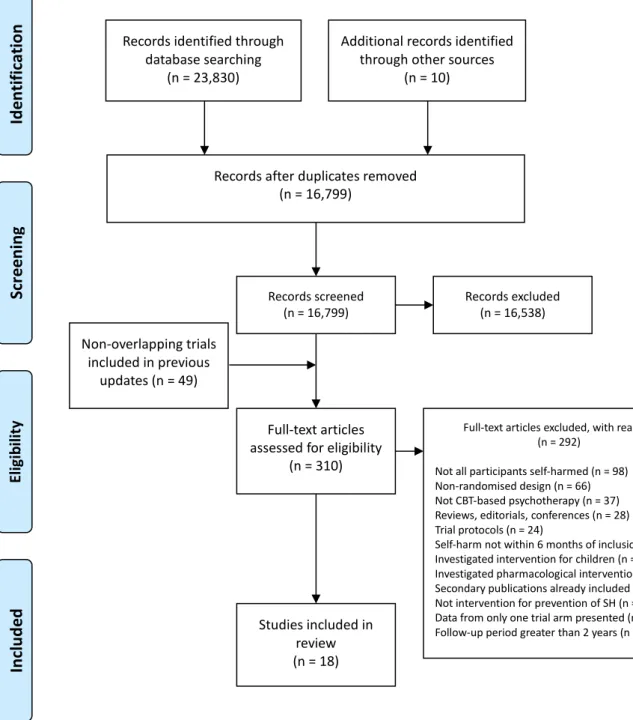
The systematic search outlined in Supplementary Document SD1 retrieved a
total of 23,830 citations. An additional 10 trials ongoing at the time of the systematic
search were identified through correspondence with researchers in the field.
Following de-duplication, the overall figure was reduced to 16,799. A total of 16,538
were excluded following screening, whilst a further 237 were excluded after
reviewing the full text. Seven trials were additionally excluded from the present
review as they evaluated the effectiveness of a pharmacological intervention, whilst a
further 11 trials were excluded as they evaluated an intervention for children and
adolescents.
A further 37 trials were excluded from this version of the review as they
evaluated a psychosocial intervention other than CBT-based psychotherapy. A total of
18 non-overlapping RCTs comparing CBT-based psychotherapy to TAU were
therefore included in this study (Brown et al., 2005; Davidson et al., 2014; Dubois et
al., 1999; Evans et al., 1999; Gibbons et al., 1978; Guthrie et al., 2001; Hatcher et al.,
11
Clum, 1985; Salkovskis et al., 1990; Slee et al., 2008; Stewart et al., 2009; Tapolaa et
al., 2010; Tyrer et al., 2003; Wei et al., 2013; Weinberg et al., 2006) (Figure 1).
Study Characteristics
The included trials comprised a total of 2,433 participants. Of the 13 trials that
recorded information on age, the weighted average age at randomization was 29.6 (SD
8.3; range 15.0 to 66.0) years. Of the 16 trials that recorded information on gender,
62.5% (n=1,833) of participants were female. All participants had engaged in at least
one episode of SH in the six months prior to randomization. Further characteristics of
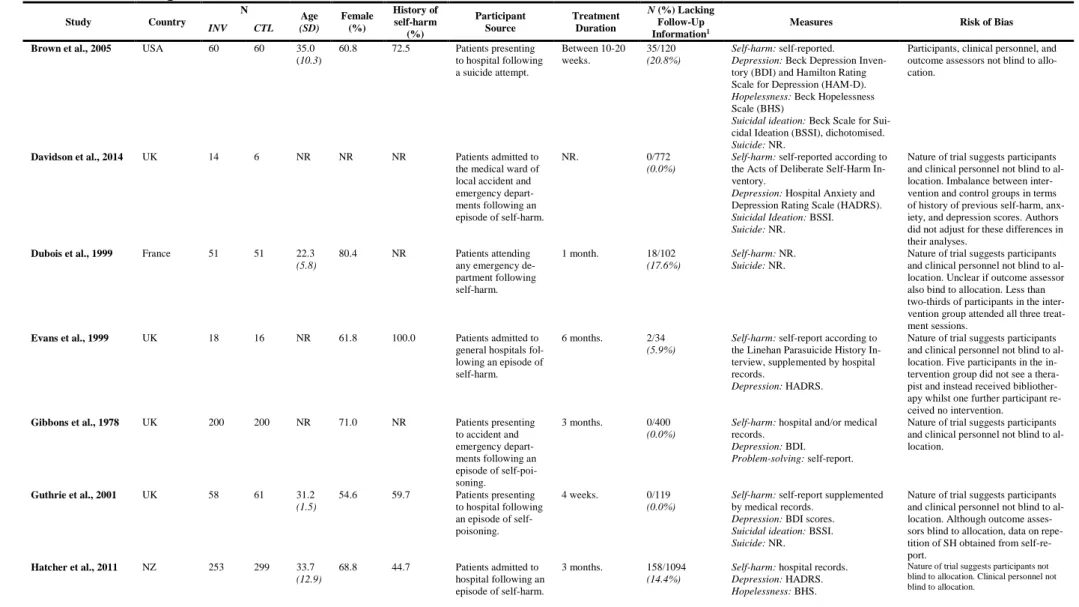
these 18 studies can be found in Table 1.
The majority of these 18 trials were conducted in the United Kingdom (N=7;
(Davidson et al., 2014; Evans et al., 1999; Gibbons et al., 1978; Guthrie et al., 2001;
Hawton et al., 1987; Salkovskis et al., 1990; Tyrer et al., 2003) followed by the United
States of America (N=3; (Brown et al., 2005; Patsiokas and Clum, 1985; Weinberg et
al., 2006) with one trial each from Australia (Stewart et al., 2009), China (Wei et al.,
2013), Finland (Tapolaa et al., 2010), France (Dubois et al., 1999), The Netherlands
(Slee et al., 2008), New Zealand (Hatcher et al., 2011), Pakistan (Husain et al., 2014),
and the Republic of Ireland (McAuliffe et al., 2014).
Methodological Quality
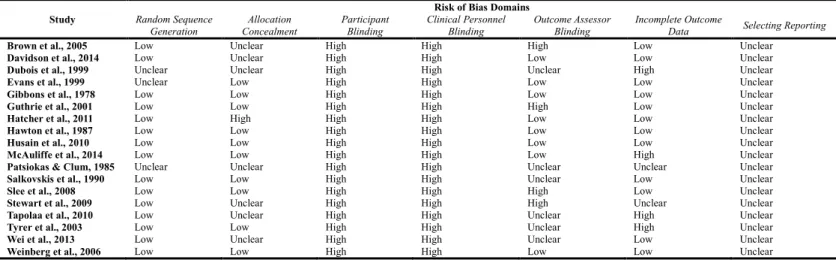
The included trials had high risk of bias. All trials were rated as at high risk of
bias with respect to participant and clinical personnel blinding and at unclear risk of
bias for selective outcome reporting (Table 2). Additionally, trial protocols were
published before the International Committee of Medical Journal Editors’ (ICMJE)
mandatory trial registration guidelines took effect in 2005 (De Angelis et al., 2004).
Four further trials (22.2%) were rated as at high risk of bias for outcome
assessor blinding. In two cases this was because all outcomes relied on self-reported
measures and participants themselves were not blind to treatment allocation (Guthrie
et al., 2001; Slee et al., 2008), whilst in the remaining two cases, outcome assessor
blinding could not be achieved due to feasibility limitations (Brown et al., 2005;
Stewart et al., 2009). Performance and detection bias therefore cannot be ruled out for
the majority of the trials included in this review.
One study (5.6%) was rated as at high risk of bias for allocation concealment
as this study made use of Zelen’s post-randomization consent procedure in which
participants are asked to consent to inclusion in the trial after being notified to which
group, intervention or TAU, they were allocated (Hatcher et al., 2011). Selection bias
therefore cannot be ruled out.
In nine trials there were either no withdrawals from the study (Davidson et al.,
2014; Gibbons et al., 1978; Guthrie et al., 2001; Hawton et al., 1987; Salkovskis et al.,
1990; Weinberg et al., 2006), or, less than 10% of the participant pool could not be
located at follow-up (Evans et al., 1999; Husain et al., 2014; Slee et al., 2008). In two
trials (11.1%) either no information was provided on the amount of missing data at
follow-up (Patsiokas and Clum, 1985), or, no apparent attempt was made to follow-up
patients post-intervention (Stewart et al., 2009). In three further trials, although
greater than 10% of the participant pool could not be located at the final follow-up
assessment, nonetheless, appropriate measures were used to account for missing data
(Brown et al., 2005; Hatcher et al., 2011; Wei et al., 2013). For the remaining four
13
the final follow-up assessment and no apparent attempt was made to statistically
account for missing data (Dubois et al., 1999; McAuliffe et al., 2014; Tapolaa et al.,
2010; Tyrer et al., 2003). Missing data were a greater concern for the TAU arm as
compared to the intervention arm (weighted average 12.4% versus 8.4%).
Description of Treatment As Usual
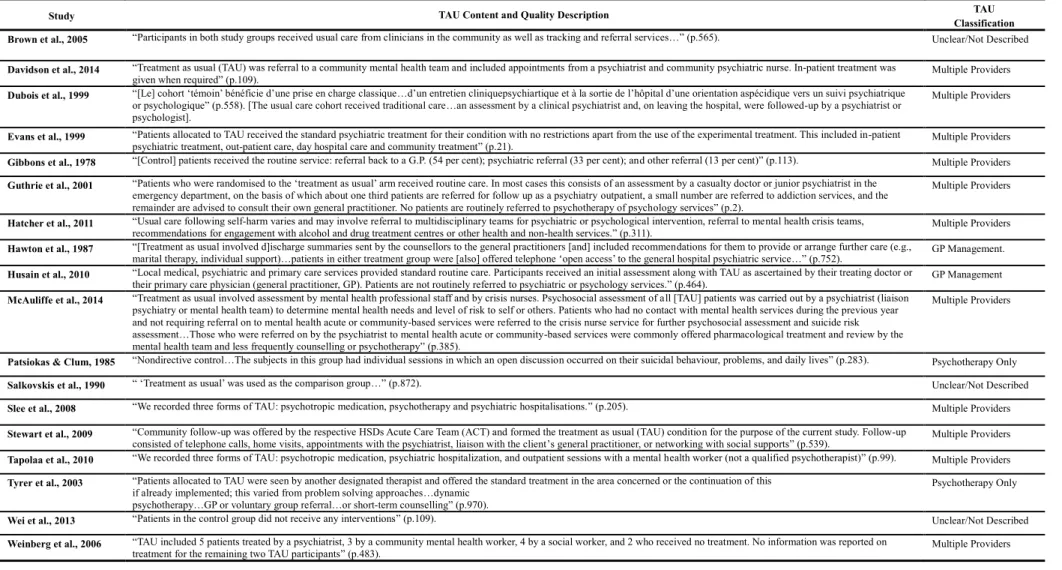
The content of TAU for each of the studies is summarized in Table 3. In most
studies a description of the TAU control condition was provided a priori (83.3%). For
the majority of these trials TAU was multidisciplinary in nature, combining
psychotherapy, pharmacotherapy, and referral to specialist services (e.g., personality
disorder, addictions, and other services) as required (Davidson et al., 2014; Dubois et
al., 1999; Evans et al., 1999; Gibbons et al., 1978; Guthrie et al., 2001; Hatcher et al.,
2011; McAuliffe et al., 2014; Patsiokas and Clum, 1985; Slee et al., 2008; Stewart et
al., 2009; Tapolaa et al., 2010; Tyrer et al., 2003; Weinberg et al., 2006). For two
further trials TAU comprised referral to the participant’s primary care physician
(Hawton et al., 1987; Husain et al., 2014).
In two trials (11.1%), however, there was no description of the TAU condition
(Salkovskis et al., 1990; Wei et al., 2013). In one further trial (5.6%) insufficient
details of TAU content were provided (Brown et al., 2005). In line with previous work
(Watts et al., 2015), we therefore categorized the TAU condition in these three trials
as unclear.
Effect of Treatment As Usual Condition on Repetition of Self-Harm
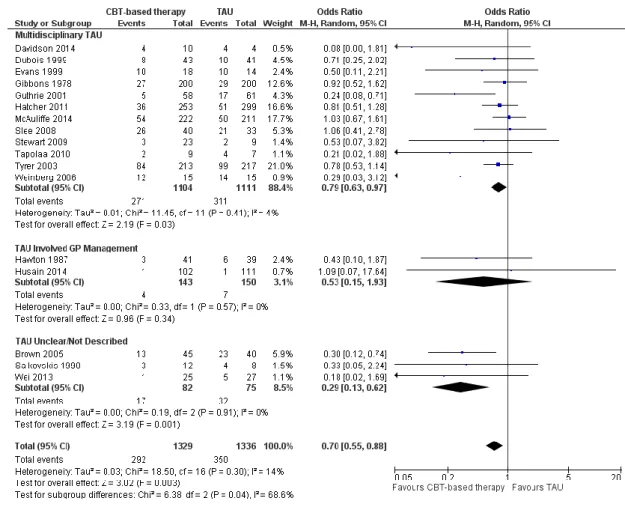
As we have previously reported (Hawton et al., 2016a, b), CBT-based
repeating self-harm at the final follow-up assessment in these trials (OR 0.70, 95% CI
0.55 to 0.88; p=0.003; Figure 2). However, sub-group analyses demonstrated that the
TAU condition was significantly associated with variability in the finding regarding
the effectiveness of CBT-based psychotherapy (χ2=6.38, df=2, p=0.04, I2=68.6%;
Figure 2). Specifically, whilst CBT-based psychotherapy was strongly associated with
a significant treatment effect for repetition of self-harm when compared to an unclear
TAU condition (OR 0.29, 95% CI 0.13 to 0.62; 3 trials), the effect size was reduced
when compared to multidisciplinary TAU (OR 0.79, 95% CI 0.63 to 0.97; 12 trials).
CBT-based psychotherapy was not associated with a treatment effect for repetition of
self-harm at this assessment point when compared to GP management (OR 053, 95%
CI 0.15 to 1.93; two trials; Figure 2). However, it is important to note that only two
trials were included in this latter sub-group and therefore the estimate of effect for this
finding is imprecise.
Effect of Treatment As Usual Condition on Suicidal Ideation Scores
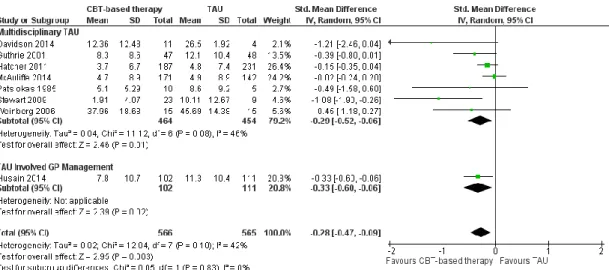
CBT-based psychotherapy was associated with a significant treatment effect
for suicidal ideation scores at the final assessment point (SMD -0.28, 95% CI -0.47 to
-0.09; p=0.003; Figure 3). There was no evidence of a significant difference in the
effect size as a result of the TAU comparator condition used (χ2=0.05, df=1, p=0.83;
I2=0%; Figure 3).
Effect of Treatment As Usual Condition on Depression Scores
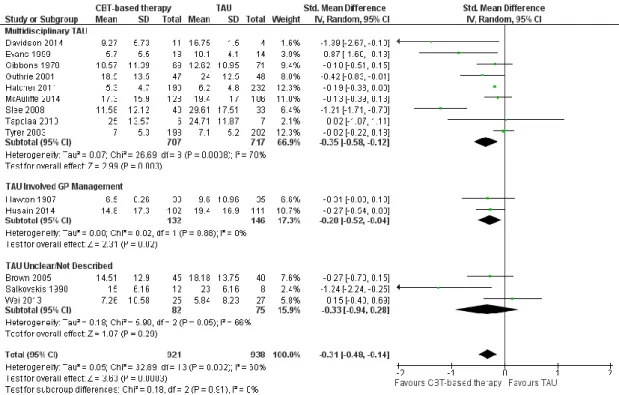
CBT-based psychotherapy was associated with a significant treatment effect
for depression scores at the final followup assessment (SMD 0.31, 95% CI 0.48 to
15
depression scores was strongest when compared against multidisciplinary TAU (SMD
-0.35, 95% CI -0.58 to -0.12; 9 trials), followed by GP management (SMD -0.28, 95%
CI -0.52 to -0.04; 2 trials), and non-significantly associated with a treatment effect for
depression scores when compared to unclear TAU (SMD -0.33, 95% CI -0.94 to 0.28;
3 trials), these sub-group differences were not significant (χ2=0.18, df=2, p=0.91,
I2=0%; Figure 4).
Effect of Treatment As Usual Condition on Hopelessness Scores
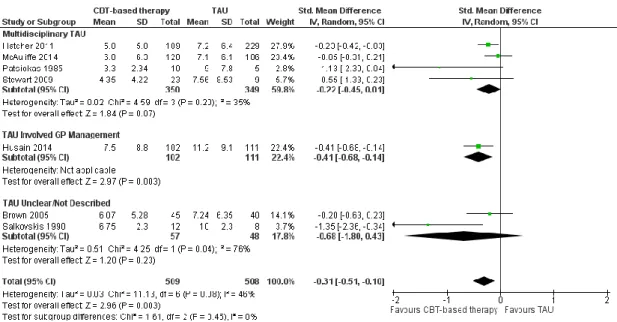
CBT-based psychotherapy was associated with a significant reduction in
hopelessness scores at the final followup assessment (SMD 0.31, 95% CI 0.51 to
-0.10; p=0.003; Figure 5). Although this effect appeared to be strongest when
CBT-based psychotherapy was compared to an unclear TAU condition (SMD -0.68, 95%
CI -1.80 to 0.43; 2 trials), in contrast to where TAU comprised either GP management
(SMD -0.41, 95% CI -0.68 to -0.14; 1 trial) or multidisciplinary TAU (SMD -0.22,
95% CI -0.45 to 0.01; 4 trials), these subgroup differences were not significant
(χ2=1.61, df=2, p=0.45, I2=0%; Figure 5).
DISCUSSION
We have previously shown that CBT-based psychotherapy is associated with
significant post-treatment reductions in self-harm, depression, hopelessness, and
suicidal ideation, but not suicide (although the number of events for this outcome was
relatively small) (Hawton et al., 2016a, b). However, differences in the quality of the
TAU comparator condition between trials still represents an important source of
highlight the potential impact of the TAU condition on estimates of treatment effects
for these interventions and to provide reporting guidance for future trials in this area.
In few trials were details provided of the treatment components offered to
participants allocated to the TAU condition. In fewer still was the number of treatment
sessions attended by control participants reported. Additionally, and particularly
importantly, no author provided a detailed break-down of the treatments actually
received by participants in the TAU condition. This is in contrast to a recent report on
an RCT of dialectical behaviour therapy for self-harm in adults which includes a
supplementary table outlining the various treatments received by participants
allocated to the TAU condition and the mean number of months the participants
received each of these components (Priebe et al., 2012). We recommend that in future
trials of psychosocial interventions for self-harm in which TAU is the control
condition researchers should, where possible, aim to reproduce such tables to assist in
calculating treatment dosage for participants allocated to the TAU arm.
Recommendations for TAU Treatment Conditions
Although in most trials included in this review some description of the content
of the TAU condition was provided (83.3%), sub-group analyses suggested evidence
of a significant difference in effectiveness for CBT-based psychotherapy for the
primary outcome measure, repetition of self-harm, for those studies in which TAU
content was not adequately described. However, it should be noted that, generally, for
those trials in which TAU content was not clearly described they were also rated as
being or poor quality in other aspects of trial design. Thus, we cannot we clear if this
finding is specific to description of TAU content, or a more global consequence of
17
come to be integrated into TAU across a number of services internationally, this
finding may also be partly explained by potential similarities between the CBT-based
psychotherapy treatment condition and the TAU condition. However, this cannot be
verified at the present time due to limited information on TAU content in many of the
included studies.
For the secondary outcome measure of depression scores, in contrast, we
found a non-significant trend towards stronger effects for CBT-based psychotherapy
when compared to multidisciplinary TAU as compared to when TAU content was not
adequately described. However, the effect for hopelessness scores was consistent with
that observed for repetition of self-harm. As no studies that reported outcome data for
suicidal ideation scores were rated as unclear TAU, we were unable to investigate the
impact of an unclear TAU condition on the magnitude of the effect size for this
outcome.
In none of the included trials were there clear descriptions of the treatment
components (e.g., psychotherapy, pharmacotherapy, welfare) available to participants
assigned to the TAU condition and the number of participants that received each of
these. We suggest that in future trials researchers should where possible provide
details on the type(s) of treatments available to participants assigned to the TAU
group, the number of patients in the TAU condition who received each component(s)
and the number of patients involved in follow-up assessments. The number and
frequency of contacts with each component(s) should also be specified where
possible. We acknowledge, however, that it may not always be possible to record
details on the treatment received by participants assigned to the TAU group to the
same level of detail as for those assigned to the intervention group due to budgetary
received, however, will help to determine whether the TAU condition reflects current
clinical best-practice for the treatment setting, and whether the TAU condition
controlled for any non-specific effect(s) of the intervention condition.
For one trial in which the intervention treatment was offered in a group-based
format, TAU involved referral for predominately individual-based psychotherapy
(McAuliffe et al., 2014). Offering psychotherapy in a group-based environment may
provide a number of additional beneficial effects beyond the hypothesized mechanism
of change for this intervention, such as helping participants overcome social isolation.
Alternatively, offering treatment in a group-based format may be detrimental for this
patient group, given findings from one Australian trial of group-based CBT with
adolescent self-harm patients in which information shared during a group-based
psychotherapy session was posted on a participant’s personal web-blog (Hazell et al.,
2009). There may also be more detrimental effects of group-based CBT when
self-harm patients with a history of frequent self-self-harm repetition are involved, as they may
be particularly vulnerable to the social contagion effects of self-harm (Haw et al.,
2013).
Strengths and Limitations
The primary strength of this review relates to the systematic approach used to
identify and include data from all relevant trials and the extent to which most of them
include detailed information on content of therapy and outcomes. In all trials there
were far more details of the experimental treatment compared to TAU. The included
trials all had risk of bias in that they were rated as at high risk of bias with respect to
participant and clinical personnel blinding and at unclear risk of bias for selective
19
this review examined the effectiveness of psychotherapy and it is generally not
possible to blind either the participants themselves, or the therapists delivering
treatment, to psychological therapy. There was also considerable variability in the
proportion of participants for whom follow-up information on the primary outcome
measure, repetition of self-harm, was lacking, ranging from 0% for six studies to over
half (63.2%) for one study. In the main this likely reflects differences in the approach
used to ascertain repetition. For those studies in which repetition of self-harm was
ascertained from medical and/or hospital records, rates of missing data were lower
than in those in which self-reported information was used as these data would only
have been available for those able to be located at follow-up and may additionally
have been affected by recall and other biases.
Conclusions
The present review suggests that whilst, overall, CBT-based psychotherapy
was more effective than TAU in reducing the proportion of participants who self-harm
and also depression, hopelessness and suicidal ideation at final follow-up, results
varied by TAU content. Specifically, effects in favour of CBT-based psychotherapy in
reducing repetition of self-harm were strongest where the TAU was not clearly
described. The study shows that TAU content and quality is a significant, but
infrequently investigated, source of heterogeneity between trials of interventions for
the prevention of self-harm and, furthermore, that TAU is not a homogenous
comparator. We suggest that in future, researchers in this field should carefully
describe both the nature of TAU and what participants in this condition actually
received in order to improve the overall quality of trials of psychological interventions
Role of the Funding Source: This review received no specific source of external
funding. KH used personal funding received from the National Institute for Health
Research (NIHR) to support the project. The NIHR had no role in the research or the
decision to publish. The views expressed are those of the author(s) and not necessarily
those of the NIHR.
Contributions
KH had the idea for this article. All authors extracted data and assessed risk of bias for
included trials. KW and TTS conducted the statistical analyses. KW and KH wrote the
initial version of the article. All authors contributed to the interpretation of results and
revisions of the article and also approved the final version for publication.
Conflict of Interests
KH authored two of the trials included in this article, and EA, DG, PH, and KVH
authored one trial each. We declare no other competing interests.
Acknowledgements
The authors wish to acknowledge the help of all authors who provided additional
Table 1. Methodological details of the 18 trials of CBT included in this review.
Study Country
N Age (SD) Female (%) History of self-harm (%) Participant Source Treatment Duration
N (%) Lacking
Follow-Up Information1
Measures Risk of Bias
INV CTL
Brown et al., 2005 USA 60 60 35.0 (10.3)
60.8 72.5 Patients presenting to hospital following a suicide attempt.
Between 10-20 weeks.
35/120 (20.8%)
Self-harm: self-reported. Depression: Beck Depression Inven-tory (BDI) and Hamilton Rating Scale for Depression (HAM-D). Hopelessness: Beck Hopelessness Scale (BHS)
Suicidal ideation: Beck Scale for Sui-cidal Ideation (BSSI), dichotomised. Suicide: NR.
Participants, clinical personnel, and outcome assessors not blind to allo-cation.
Davidson et al., 2014 UK 14 6 NR NR NR Patients admitted to the medical ward of local accident and emergency depart-ments following an episode of self-harm.
NR. 0/772
(0.0%)
Self-harm: self-reported according to the Acts of Deliberate Self-Harm In-ventory.
Depression: Hospital Anxiety and Depression Rating Scale (HADRS). Suicidal Ideation: BSSI. Suicide: NR.
Nature of trial suggests participants and clinical personnel not blind to al-location. Imbalance between inter-vention and control groups in terms of history of previous self-harm, anx-iety, and depression scores. Authors did not adjust for these differences in their analyses.
Dubois et al., 1999 France 51 51 22.3 (5.8)
80.4 NR Patients attending any emergency de-partment following self-harm.
1 month. 18/102 (17.6%)
Self-harm: NR. Suicide: NR.
Nature of trial suggests participants and clinical personnel not blind to al-location. Unclear if outcome assessor also bind to allocation. Less than two-thirds of participants in the inter-vention group attended all three treat-ment sessions.
Evans et al., 1999 UK 18 16 NR 61.8 100.0 Patients admitted to general hospitals fol-lowing an episode of self-harm.
6 months. 2/34 (5.9%)
Self-harm: self-report according to the Linehan Parasuicide History In-terview, supplemented by hospital records.
Depression: HADRS.
Nature of trial suggests participants and clinical personnel not blind to al-location. Five participants in the in-tervention group did not see a thera-pist and instead received bibliother-apy whilst one further participant re-ceived no intervention.
Gibbons et al., 1978 UK 200 200 NR 71.0 NR Patients presenting to accident and emergency depart-ments following an episode of self-poi-soning.
3 months. 0/400 (0.0%)
Self-harm: hospital and/or medical records.
Depression: BDI. Problem-solving: self-report.
Nature of trial suggests participants and clinical personnel not blind to al-location.
Guthrie et al., 2001 UK 58 61 31.2 (1.5)
54.6 59.7 Patients presenting to hospital following an episode of self-poisoning.
4 weeks. 0/119 (0.0%)
Self-harm: self-report supplemented by medical records.
Depression: BDI scores. Suicidal ideation: BSSI. Suicide: NR.
Nature of trial suggests participants and clinical personnel not blind to al-location. Although outcome asses-sors blind to allocation, data on repe-tition of SH obtained from self-re-port.
Hatcher et al., 2011 NZ 253 299 33.7 (12.9)
68.8 44.7 Patients admitted to hospital following an episode of self-harm.
3 months. 158/1094 (14.4%)
Self-harm: hospital records. Depression: HADRS. Hopelessness: BHS.
23
Suicidal ideation: BSSI. Problem-solving: Social Problem Solving Inventory, Revised (SPS-R). Suicide: Coroners’ records.
Hawton et al., 1987 UK 41 39 29.3 (NR)
66.3 31.2 Patients admitted to a general hospital following an episode of self-poisoning.
NR. 0/80
(0.0%)
Self-harm: self-report, supplemented by hospital and medical records. Depression: BDI.
Problem-solving: self-report. Suicide: collateral informant report.
Nature of trial suggests participants and clinical personnel not blind to allocation.
Husain et al., 2010 Pakistan 108 113 23.1 (5.5)
68.8 4.1 Patients admitted to the medical unit of a university hospital following an episode of self-harm.
3 months. 8/221 (3.6%)
Self-harm: self-report according to the Suicide Attempt Self-Injury Inter-view.
Depression: BDI. Hopelessness: BHS. Suicidal ideation: BSSI. Problem-solving: Coping Resource Inventory (CRI).
Suicide: NR.
Participants and clinical personnel not blind to allocation.
McAuliffe et al., 2014
Republic of Ireland
222 211 33.5 (11.8)
29.8 29.3 Admissions to emer-gency departments or an acute psychiat-ric unit following an episode of self-harm.
6 weeks. 107/433 (24.7%)
Self-harm: self-report (at 6 weeks post-intervention and 6 months’ fol-low-up) and hospital records (at 12 months’ follow-up).
Depression: BDI. Hopelessness: BHS. Suicidal ideation: BSSI.
Problem-solving: Self-Rated Problem Solving Scale (SRPSS).
Suicide: NR.
Participants and clinical personnel not blind to allocation.
Patsiokas & Clum, 1985
USA 10 5 NR NR NR Admissions to a
psy-chiatric ward follow-ing an episode of self-harm.
3 weeks. N/A2 Self-harm: NR.
Hopelessness: BHS.
Suicidal ideation: BSSI and Self-Monitoring of Suicidal Ideation. Problem-solving: Means-Ends Prob-lem-Solving (MEPS).
Nature of trial suggests participants and outcome assessors not blind to allocation. As same therapist delivered intervention and control therapies, clinical personnel also not blind to allocation.
Salkovskis et al., 1990
UK 12 8 27.2
(6.7)
50.0 100.0 Referrals from the duty psychiatrist fol-lowing an episode of self-poisoning in-volving antidepres-sants that necessi-tated admission to an accident and emer-gency department.
1 month. 0/20 (0.0%)
Self-harm: hospital records. Depression: BDI. Hopelessness: BHS. Suicidal ideation: BSSI.
Problem-solving: Personal Question-naire Rapid Scaling Technique. Suicide: NR.
Nature of trial suggests participants, clini-cal personnel, and outcome assessors not blind to allocation.
Slee et al., 2008 The Neth-erlands
40 42 24.7 (5.5)
93.9 NR. Admissions to emer-gency departments or mental health cen-tres.
5.5 months. 8/90 (8.9%)
Self-harm: self-report. Depression: BDI.
Suicidal ideation: Suicide Cognition Scale.
Problem-solving: Coping Inventory for Stressful Situations.
Suicide: NR.
Table Notes: NR: not reported; NZ: New Zealand; UK: United Kingdom; USA: United States of America.
1 Proportion (%) missing data for the primary outcome, repetition of self-harm at the final follow-up assessment.
2 Proportion (%) missing data not reported for this trial cannot be ascertained as data for repetition of self-harm was not reported.
Stewart et al., 2009 Australia 23 9 NR 53.1 NR Admissions to hospi-tal following an epi-sode of self-harm.
2 months. NR Self-harm: hospital records. Hopelessness: BHS. Suicidal ideation: BSSI. Problem-solving: SPS-R. Suicide: NR.
Participants, clinical personnel, and out-come assessors not blind to allocation. Data only collected on treatment completers.
Tapolaa et al., 2010 Finland 9 7 33.2 (NR)
100.0 NR Admissions to emer-gency departments following an episode of self-harm.
4 weeks. 3/16 (18.7%)
Self-harm: self-report according to the SASII.
Depression: BDI. Suicide: NR.
Nature of trial suggests participants and outcome assessors not blind to allocation. Outcome assessor not blind to allocation. Data only collected on treatment complet-ers.
Tyrer et al., 2003 UK 239 241 32.0 (11.0)
67.9 NR Admissions to hospi-tal following an epi-sode of self-harm.
Between 3 and 6 months.
50/480 (10.4%)
Self-harm: self-report supplemented by medical records.
Depression: HADRS. Suicide: Coroners’ records.
Nature of trial suggests participants, clini-cal personnel, and outcome assessors not blind to allocation.
Wei et al., 2013 China 82 77 31.8 (12.9)
73.5 NR Admissions to emer-gency departments following an episode of self-harm.
3 months. 151/239 (63.2%)
Self-harm: self-report. Depression: HAM-D. Suicidal ideation: BSSI. Suicide:collateral informant report.
Nature of trial suggests participants, clini-cal personnel, and outcome assessors not blind to allocation.
Weinberg et al., 2006 USA 15 15 28.2 (8.2)
100.0 NR Community referrals following an episode of self-harm.
2 months. 0/30 (0.0%)
Self-harm: self-report according to the SASII.
Depression: HAM-D.
Suicidal ideation: Suicide Behaviors Questionnaire, suicidal ideation sub-scale.
Suicide: NR.
25
Table 2: Summary of Risk of bias for the included studies according to the Cochrane Risk of Bias Tool.
Study Random Sequence Risk of Bias Domains
Generation Concealment Allocation Participant Blinding Clinical Personnel Blinding Outcome Assessor Blinding Incomplete Outcome Data Selecting Reporting
Brown et al., 2005 Low Unclear High High High Low Unclear
Davidson et al., 2014 Low Unclear High High Low Low Unclear
Dubois et al., 1999 Unclear Unclear High High Unclear High Unclear
Evans et al., 1999 Unclear Low High High Low Low Unclear
Gibbons et al., 1978 Low Low High High Low Low Unclear
Guthrie et al., 2001 Low Low High High High Low Unclear
Hatcher et al., 2011 Low High High High Low Low Unclear
Hawton et al., 1987 Low Low High High Low Low Unclear
Husain et al., 2010 Low Low High High Low Low Unclear
McAuliffe et al., 2014 Low Low High High Low High Unclear
Patsiokas & Clum, 1985 Unclear Unclear High High Unclear Unclear Unclear
Salkovskis et al., 1990 Low Low High High Unclear Low Unclear
Slee et al., 2008 Low Low High High High Low Unclear
Stewart et al., 2009 Low Unclear High High High Unclear Unclear
Tapolaa et al., 2010 Low Unclear High High Unclear High Unclear
Tyrer et al., 2003 Low Low High High Unclear High Unclear
Wei et al., 2013 Low Unclear High High Unclear Low Unclear
Table 3. Treatment as usual (TAU) definition and classification for the 18 studies included in this review.
Study TAU Content and Quality Description TAU
Classification Brown et al., 2005 “Participants in both study groups received usual care from clinicians in the community as well as tracking and referral services…” (p.565). Unclear/Not Described
Davidson et al., 2014 “Treatment as usual (TAU) was referral to a community mental health team and included appointments from a psychiatrist and community psychiatric nurse. In-patient treatment was
given when required” (p.109). Multiple Providers
Dubois et al., 1999 “[Le] cohort ‘témoin’ bénéficie d’une prise en charge classique…d’un entretien cliniquepsychiartique et à la sortie de l’hôpital d’une orientation aspécidique vers un suivi psychiatrique or psychologique” (p.558). [The usual care cohort received traditional care…an assessment by a clinical psychiatrist and, on leaving the hospital, were followed-up by a psychiatrist or psychologist].
Multiple Providers
Evans et al., 1999 “Patients allocated to TAU received the standard psychiatric treatment for their condition with no restrictions apart from the use of the experimental treatment. This included in-patient
psychiatric treatment, out-patient care, day hospital care and community treatment” (p.21). Multiple Providers
Gibbons et al., 1978 “[Control] patients received the routine service: referral back to a G.P. (54 per cent); psychiatric referral (33 per cent); and other referral (13 per cent)” (p.113). Multiple Providers
Guthrie et al., 2001 “Patients who were randomised to the ‘treatment as usual’ arm received routine care. In most cases this consists of an assessment by a casualty doctor or junior psychiatrist in the emergency department, on the basis of which about one third patients are referred for follow up as a psychiatry outpatient, a small number are referred to addiction services, and the remainder are advised to consult their own general practitioner. No patients are routinely referred to psychotherapy of psychology services” (p.2).
Multiple Providers
Hatcher et al., 2011 “Usual care following self-harm varies and may involve referral to multidisciplinary teams for psychiatric or psychological intervention, referral to mental health crisis teams,
recommendations for engagement with alcohol and drug treatment centres or other health and non-health services.” (p.311). Multiple Providers
Hawton et al., 1987 “[Treatment as usual involved d]ischarge summaries sent by the counsellors to the general practitioners [and] included recommendations for them to provide or arrange further care (e.g.,
marital therapy, individual support)…patients in either treatment group were [also] offered telephone ‘open access’ to the general hospital psychiatric service…” (p.752). GP Management.
Husain et al., 2010 “Local medical, psychiatric and primary care services provided standard routine care. Participants received an initial assessment along with TAU as ascertained by their treating doctor or
their primary care physician (general practitioner, GP). Patients are not routinely referred to psychiatric or psychology services.” (p.464). GP Management
McAuliffe et al., 2014 “Treatment as usual involved assessment by mental health professional staff and by crisis nurses. Psychosocial assessment of all [TAU] patients was carried out by a psychiatrist (liaison psychiatry or mental health team) to determine mental health needs and level of risk to self or others. Patients who had no contact with mental health services during the previous year and not requiring referral on to mental health acute or community-based services were referred to the crisis nurse service for further psychosocial assessment and suicide risk assessment…Those who were referred on by the psychiatrist to mental health acute or community-based services were commonly offered pharmacological treatment and review by the mental health team and less frequently counselling or psychotherapy” (p.385).
Multiple Providers
Patsiokas & Clum, 1985 “Nondirective control…The subjects in this group had individual sessions in which an open discussion occurred on their suicidal behaviour, problems, and daily lives” (p.283). Psychotherapy Only
Salkovskis et al., 1990 “ ‘Treatment as usual’ was used as the comparison group…” (p.872). Unclear/Not Described
Slee et al., 2008 “We recorded three forms of TAU: psychotropic medication, psychotherapy and psychiatric hospitalisations.” (p.205). Multiple Providers
Stewart et al., 2009 “Community follow-up was offered by the respective HSDs Acute Care Team (ACT) and formed the treatment as usual (TAU) condition for the purpose of the current study. Follow-up
consisted of telephone calls, home visits, appointments with the psychiatrist, liaison with the client’s general practitioner, or networking with social supports” (p.539). Multiple Providers
Tapolaa et al., 2010 “We recorded three forms of TAU: psychotropic medication, psychiatric hospitalization, and outpatient sessions with a mental health worker (not a qualified psychotherapist)” (p.99). Multiple Providers
Tyrer et al., 2003 “Patients allocated to TAU were seen by another designated therapist and offered the standard treatment in the area concerned or the continuation of this if already implemented; this varied from problem solving approaches…dynamic
psychotherapy…GP or voluntary group referral…or short-term counselling” (p.970).
Psychotherapy Only
Wei et al., 2013 “Patients in the control group did not receive any interventions” (p.109). Unclear/Not Described
Weinberg et al., 2006 “TAU included 5 patients treated by a psychiatrist, 3 by a community mental health worker, 4 by a social worker, and 2 who received no treatment. No information was reported on
27
Figure 1. PRISMA flow diagram of included and excluded studies for this version of
the review.
Records identified through database searching
(n = 23,830)
Scr e e n in g In cl u d e d El ig ib ili ty Id en ti fi cat
ion Additional records identified
through other sources (n = 10)
Records after duplicates removed (n = 16,799)
Records screened (n = 16,799)
Records excluded (n = 16,538)
Full-text articles assessed for eligibility
(n = 310)
Full-text articles excluded, with reasons (n = 292)
Not all participants self-harmed (n = 98) Non-randomised design (n = 66) Not CBT-based psychotherapy (n = 37) Reviews, editorials, conferences (n = 28) Trial protocols (n = 24)
Self-harm not within 6 months of inclusion (n= 11) Investigated intervention for children (n = 11) Investigated pharmacological intervention (n = 7) Secondary publications already included (n = 4) Not intervention for prevention of SH (n = 4) Data from only one trial arm presented (n= 1) Follow-up period greater than 2 years (n = 1) Studies included in
review (n = 18) Non-overlapping trials
29
Figure 3. Random effects standard mean difference (SMD) and 95% confidence
31
Figure 5. Random effects standard mean difference (SMD) and 95% confidence
REFERENCES
Abraha, I., Cherubini, A., Cozzolino, F., De Florio, R., Luchetta, M., Rimland, J., Folletti, I., Marchesi, M., Germani, A., Orso, M., Eusebi, P., Montedori, A., 2015. Deviation from intention to treat analysis in randomised trials and treatment effect estimates: Meta-epidemiological study. BMJ 350, h2445.
Arensman, E., Townsend, E., Hawton, K., Bremner, S., Feldman, E., Goldney, R., Gunnell, D., Hazell, P., Van Heeringen, K., House, A., Owens, D., Sakinofsky, I., Tra skman-Bendz, L., 2001. Psychosocial and pharmacological treatment of patients following deliberate self-harm: The methodological issues involved in evaluating effectiveness. Suicide Life Threat Behav 31, 169-180.
Brown, G., ten Have T, Henriques, G., Xie, S., Hollander J, Beck, A., 2005. Cognitive therapy for the prevention of suicide attempts: A randomized controlled trial. J Am Med Assoc 294, 563–570.
Burns, T., 2009. End of the road for treatment-as-usual studies? Br J Psychiatry 195, 5-6.
Burns, T., Priebe, S., 1996. Mental health care systems and their characteristics: A proposal. Acta Psychiatrica Scand 94, 381-385.
Carroll, R., Metcalfe, C., Gunnell, D., 2014. Hospital presenting self-harm and risk of fatal and non-fatal repetition: Systematic review and meta-analysis. PLoS One 9, e89944.
Clarke, G., Herinckix, H., Kinney, R., Paulson, R., Cutler, D., Lewis, K., Oxman, E., 2000. Psychiatric hospitalizations, arrests, emergency room visits, and homelessness of clients with serious and persistent mental illness: Findings from a randomized trial of two ACT programs vs. Usual care. Mental Health Services Research 2, 155-164.
Cooper, K., Chatters, R., Kaltenthaler, E., Wong, R., 2015. Psychological and psychosocial interventions for cannabis cessation in adults: A systematic review short report. Health Technol Assess 19, 56.
Craig, P., Dieppe, P., Macintyre, S., Mitchie, S., Nazareth, I., Petticrew, M., 2008. Developing and evaluating complex interventions: The new Medical Research Council guidance. BMJ 337, a1655.
Davidson, K., Brown, T., James, V., Kirk, J., Richardson, J., 2014. Manual-assisted cognitive therapy for self-harm in personality disorder and substance misuse: A feasibility trial. Psychiatr Bull 38, 108–111.
De Angelis, C., Drazen, J., Frizelle, F., Haug, C., Hoey, J., Horton, R., Kotzin, S., Laine, C., Marusic, A., Overbeke, J., Schroeder, T., Sox, H., Van der Weyden, M., 2004. Clinical trial registration: A statement from the International Committee of Medical Journal Editors. N Engl J Med 351, 1250-1251.
Dubois, L., Walter, M., Bleton, L., Genest, P., Lemonnier, E., Lachevre, G., 1999. Evaluation comparative et prospective d'un protocole de prise en charge specifique de jeunes suicidants: Analyse du diagnostic psychiatrique initial, de l'observance therapeutique et du taux de recidive a un an (resultats preliminaires) [Evaluation of a comparative and prospective protocol for suicidal youth: Analysis of psychiatric diagnosis, therapeutic compliance and rate of recurrence over one year (preliminary results)] Annales Medico-Psychologiques 157, 557–561.
33
Evans, K., Tyrer, P., Catalan, J., Schmidt, U., Davidson, K., Dent, J., Tata, P., Thornton, S., Barber, J., Thompson, S., 1999. Manual-assisted cognitive-behaviour therapy (MACT): A randomized controlled trial of a brief intervention with bibliotherapy in the treatment of recurrent deliberate self-harm. Psychol Med 29, 19–25.
Gibbons, J., Butler, J., Urwin, P., Gibbons, J., 1978. Evaluation of a social work service for self-poisoning patients. Br J Psychiatry 133, 111–118.
Guthrie, E., Kapur, N., Kway-Jones, K., Chew-Graham, C., Moorey, J., Mendel, E., Marino-Francis, F., Sanderson, S., Turpin, C., Boddy, G., Tomenson, B., 2001. Randomised controlled trial of brief psychological intervention after deliberate self poisoning. Br J Psychiatry 323, 135–138.
Hatcher, S., Sharon, C., Parag, V., Collins, N., 2011. Problem-solving therapy for people who present to hospital with self-harm: Zelen randomised controlled trial. Br J Psychiatry 199, 310–316.
Haw, C., HAwton, K., Niedzwiedz, C., Platt, S., 2013. Suicide clusters: A review of risk factors and mechanisms. Suicide Life Threat Behav 43, 97-108.
Hawton, K., Bergen, H., Casey, D., Simkin, S., Palmer, B., Cooper, J., Kapur, N., Horrocks, J., House, A., Lilley, R., Noble, R., Owens, D., 2007. Self-harm in England a tale of threee cities: Multicentre Study of Self-Harm. Soc Psychiatry Psychiatr Epidemiol 42, 513-521.
Hawton, K., Harriss, L., Hall, S., Simkin, S., Bale, E., Bond, A., 2003. Deliberate self-harm in Oxford, 1990-2000: A time of change in patient characteristics. Psychol Med 33, 987-995.
Hawton, K., McKeown, S., Day, A., Martin, P., O'Connor, M., Yule, J., 1987. Evaluation of out-patient counselling compared with general practitioner care following overdoses. Psychol Med 17, 751–761.
Hawton, K., Witt, K., Taylor Salisbury, T., Arensman, E., Gunnell, D., Hazell, P., Townsend, E., van Heeringen, K., 2016a. Psychosocial interventions following self-harm in adults: a systematic review and meta-analysis. Lancet Psychiatry 3, 740-750.
Hawton, K., Witt, K., Taylor Salisbury, T., Arensman, E., Gunnell, D., Hazell, P., Townsend, E., van Heeringen, K., 2016b. Psychosocial interventions for self-harm in adults. Cochrane Database of Systematic Reviews 5, CD012189.
Hazell, P., Martin, G., McGill, K., Kay, T., Wood, A., Trainor, G., 2009. Group therapy for repeated deliberate self-harming adolescents: Failure of replication of a randomized trial. J Am Acad Child Adolesc Psychiatry 48, 662-670.
Higgins, J., Deeks, J., Altman, D., 2008a. Analysing data and undertaking meta-analyses, In: Higgins, J., Green, S. (Eds.), Cochrane Handbook for Systematic Reviews of Interventions. John Wiley & Sons, Chichester, UK, pp. 243-296.
Higgins, J., Deeks, J., Altman, D., 2008b. Assessing risk of bias in included studies, In: Higgins, J., Green, S. (Eds.), Cochrane Handbook for Systematic Reviews of Interventions. John Wiley & Sons, Chichester, UK, pp. 187-242.
Higgins, J., Deeks, J., Altman, D., 2011. Special topics in statistics: Intention-to-treat issues for continuous data, In: Higgins, J., Green, S. (Eds.), Cochrane Handbook for Systematic Reviews of Interventions, Version 5.1.0. The Cochrane Collaboration, Available from: www.handbook.cochrane.org.
Higgins, J., Thompson, S., Deeks, J., Altman, D., 2003. Measuring inconsistency in meta-analysis. BMJ 327, 557-563.
Husain, N., Afsar, S., Ara, J., Fayyaz, H., ur Rahman, R., Tomenson, B., Hamirani, M., Chaudhry, N., Fatima, B., Husain, M., Naeem, F., IB, C., 2014. Brief psychological intervention after self-harm: Randomised controlled trial from Pakistan. Br J Psychiatry 204, 462–470.
McAuliffe, C., McLeavey, B., Fitzgerald, T., Corcoran P, Carroll B, Ryan L, O’Keeffe B, Fitzgerald E, Hickey P, O’Regan M, Mulqueen J, E, A., 2014. Group problem-solving skills training for self-harm: Randomised controlled trial Br J Psychiatry 204, 383– 390.
NICE, 2011. Self-Harm: Longer-term Management. Clinical Guideline 133. National Institute for Health and Clinical Excellence, London, UK.
Owens, D., Horrocks, J., House, A., 2002. Fatal and non-fatal repetition of self-harm: Systematic reivew. Br J Psychiatry 181, 193-199.
Patsiokas, A., Clum, G., 1985. Effects of psychotherapeutic strategies in the treatment of suicide attempters. Psychotherapy: Theory, Research and Practice 22, 281–290.
Priebe, S., Bhatti, N., Barnicot, K., Bremmer, S., Gaglia, A., Katsakou, C., Molosankwe, I., McCrone, P., Zinkler, M., 2012. Effectiveness and cost-effectiveness of dialectical behaviour therapy for self-harming patients with personality disorder: A pragmatic randomised controlled trial. Psychother Psychosom 81, 356-365. Salkovskis, P., Atha, C., Storer, D., 1990. Cognitive-behavioural problem solving in the treatment of patients who repeatedly attempt suicide. A controlled trial. Br J Psychiatry 157, 871–876.
Sarin, F., Wallin, L., Widerlo v, B., 2011. Cognitive behavior therapy for schizophrenia: A meta-analytical review of randomized controlled trials. Nord J Psychiatry 65, 162-174.
Saunders, K., Smith, K., 2016. Interventions to prevent self-harm: What does the evidence say? Evid Based Mental Health 19, 69-72.
Slee, N., Garnefski, N., van der Leeden, R., Arensman, E., Spinhoven, P., 2008. Cognitive-behavioural intervention for self-harm: Randomised controlled trial. Br J Psychiatry 192, 202–211.
Stewart, C., Quinn, A., Plever, S., Emmerson, B., 2009. Comparing cognitive behavior therapy, problem solving therapy, and treatment as usual in a high risk population. Suicide Life Threat Behav 39, 538–547.
Tapolaa, V., Lappalainen, R., Wahlstro m, J., 2010. Brief intervention for deliberate self harm: An exploratory study. Suicidology Online 1, 95–108.
Tyrer, P., Thompson, S., Schmidt, U., Jones, V., Knapp, M., Davidson, K., Catalan, J., Airlie, J., Baxter, S., Byford, S., Byrne, G., Cameron, S., Caplan, R., Cooper, S., Ferguson, B., Freeman, C., Frost, S., Godley, J., Greenshields, J., Henderson, J., Holden, N., Keech, P., Kim, L., Logan, K., Manley, C., MacLeod, A., Murphy R, Patience L, Ramsay L, de Munroz S, Scott J, Seivewright H, Sivakumar K, Tata P, Thornton S, Ukoumunne OC, S, W., 2003. Randomized controlled trial of brief cognitive behaviour therapy versus treatment as usual in recurrent deliberate self-harm: The POPMACT study. Psychol Med 33, 969–976.
Van de Wiel, N., Matthys, W., Cohen-Kettenis, P., Maassen, G., Lochman, J., Van Engeland, H., 2007. The effectiveness of an experimental treatment when compared to care as usual depends on the type of care as usual. Behav Modification 31, 298-312.
35
anxiety versus treatment-as-usual: A meta-analysis of direct comparisons. Clin Psychol Rev 31, 1304-1312.
Watts, S., Turnell, A., Kladnitski, N., Newby, J., Andrews, G., 2015. Treatment-as-usual (TAU) is anything but Treatment-as-usual: A meta-analysis of CBT versus TAU for anxiety and depression. J Affect Disord 175, 152-167.