PERSPECTIVE IN CONTEXT
RELATIVE TRUTH, KNOWLEDGE, AND THE FIRST PERSON
Dirk Kindermann
A Thesis Submitted for the Degree of PhD
at the
University of St Andrews
2012
Full metadata for this item is available in
Research@StAndrews:FullText
at:
http://research-repository.st-andrews.ac.uk/
Please use this identifier to cite or link to this item:
http://hdl.handle.net/10023/3164
Perspective in Context
Relative Truth, Knowledge, and e First Person
Dirk Kindermann
I, Dirk Kindermann, hereby certify that this thesis, which is approximately . words in length, has been written by me, that it is the record of work carried out by me and that it has not been submitted in any previous application for a higher degree.
I was admitted as a research student in February and as a candidate for the degree of Doctor of Philosophy in February ; the higher study for which this is a record was carried out in the University of St Andrews between and .
August
Signature of candidate
I, Patrick Greenough, hereby certify that the candidate has fulfilled the conditions of the Resolution and Regulations appropriate for the degree of Doctor of Philosophy in the University of St Andrews and that the candidate is qualified to submit this thesis in application for that degree.
August
Signature of supervisor
In submitting this thesis to the University of St Andrews I understand that I am giving permission for it to be made available for use in accordance with the regulations of the University Library for the time being in force, subject to any copyright vested in the work not being affected thereby. I also understand that the title and the abstract will be published, and that a copy of the work may be made and supplied to anybona fide
library or research worker, that my thesis will be electronically accessible for personal or research use unless exempt by award of an embargo as requested below, and that the library has the right to migrate my thesis into new electronic forms as required to ensure continued access to the thesis. I have obtained any third-party copyright permissions that may be required in order to allow such access and migration, or have requested the appropriate embargo below.
e following is an agreed request by candidate and supervisor regarding the electronic publication of this thesis: Access to the printed copy but embargo of the electronic publication of the thesis for a period of years on the ground that publication would preclude future publication.
August
ABSTRACT
is dissertation is about the nature of perspectival thoughts and the context-sensitivity of the language used to express them. It focuses on two kinds of perspectival thoughts: ‘subjective’ evaluative thoughts about matters of personal taste, such asBeetroot is deli-ciousorSkydiving is fun, and first-personal orde sethoughts about oneself, such asI am hungryorI have been fooled. e dissertation is a defence of a novel form of relativism about truth – the idea that the truth of some (but not all) perspectival thought and talk is relative to the perspective of an evaluating subject or group.
In Part I, I argue that the realm of ‘subjective’ evaluative thought and talk whose truth is perspective-relative includes attributions of knowledge of the form ‘S knows that p.’ Following a brief introduction (chapter ), chapter presents a new, error-theoretic objection against relativism about knowledge attributions. e case for re-lativism regarding knowledge attributions rests on the claim that rere-lativism is the only view that explains all of the empirical data from speakers’ use of the word ‘know’ without recourse to an error theory. In chapter , I show that the relativist can only account for sceptical paradoxes and ordinary epistemic closure puzzles if she attributes a problematic form of semantic blindness to speakers. However, in chapter I show that all major competitor theories – forms of invariantism and contextualism – are sub-ject to equally serious error-theoretic obsub-jections. is raises the following fundamental question for empirical theorising about the meaning of natural language expressions: If error attributions are ubiquitous, by which criteria do we evaluate and compare the force of error-theoretic objections and the plausibility of error attributions? I provide a number of criteria and argue that they give us reason to think that relativism’s error attributions are more plausible than those of its competitors.
In Part II, I develop a novel unified account of the content and communication of perspectival thoughts. Many relativists regarding ‘subjective’ thoughts and Lewisians aboutde sethoughts endorse a view of belief as self-location. In chapter , I argue that the self-location view of belief is in conflict with the received picture of linguistic com-munication, which understands communication as the transmission of information from speaker’s head to hearer’s head. I argue that understanding mental content and speech act content in terms ofsequenced worldsallows a reconciliation of these views. On the view I advocate, content is modelled as a set of sequenced worlds – possible worlds ‘centered’ on a group of individuals inhabiting the world at some time.
vi Abstract
ACKNOWLEDGEMENTS
My greatest debt in writing this dissertation is to my main supervisor Patrick Gree-nough. Always encouraging, patient, and generous with his intellectual energy, Patrick has been an ideal supervisor and the model of a constructive and unprejudiced philo-sophical interlocutor. e traces of countless hours of inspiring conversation can be found on every page of this dissertation.
I would like to express my deepest gratitude to Jonathan Schaffer. His advice and comments, before, during and after acting as my second supervisor, have been tremend-ously important. I would also like to thank my other supervisors: Crispin Wright for early guidance, and Brian Weatherson for invaluable feedback especially at the late stages of the project.
During my time at the Arch´e Philosophical Research Centre in St Andrews, I be-nefitted immensely from exchanges with a great number of people. In particular, I would like to thank Derek Ball, Mark Bowker, Jochen Briesen, Bj¨orn Brodowski, Jes-sica Brown, Herman Cappelen, Colin Caret, Yuri Cath, Laura Celani, Josh Clarkson, Michael De, Paul Dimmock, Dylan Dodd, Noah Friedman-Biglin, Ephraim Glick, Steven Hall, Katherine Hawley, Andri Hj´almarsson, omas Hodgson, Nick Hughes, Ole Hjortland, Jonathan Ichikawa, Frederique Janssen-Lauret, Bruno Jacinto, Spencer Johnston, Ira Kiourti, Julia Langkau, Martin Lipman, Federico Luzzi, Toby Mead-ows, Julien Murzi, Andrea Onofri, Nikolaj Pedersen, Walter Pedriali, Laura Porro, Graham Priest, Simon Prosser, Stephen Read, Franc¸ois Recanati, Marcus Rossberg, Anders Schoubye, Daniele Sgaravatti, Stewart Shapiro, Martin Smith, Jason Stanley, Rachel Sterken, Andreas Stokke, Margot Strohminger, Paul Sweeney, Josh orpe, and Elia Zardini. Special thanks go to the members of Arch´e’s Contextualism & Relativism research project and the Arch´e Semantics Group. Torfinn Huvenes, in particular, has been an invaluable philosophical companion.
Some of the material in this dissertation was presented at conferences and work-shops in Edinburgh and Miami, at the Australasian Association of Philosophy Confer-ence in Sydney, the Wolheim Society at the University of California at Berkeley, the conference ‘Meaning, Context and Implicit Content’ in Cerisy, ‘Contexts, Per-spectives and Relative Truth’ in Bonn, at SPE in Bochum, the LOGOS workshop ‘Semantic Content and Context Dependence’ in Barcelona, and at Arch´e’s ‘Contex-tualism and Relativism Workshop II.’ I thank the audiences at all these occasions. I
viii Acknowledgements
am also indebted to Josh Dever, Andy Egan, Chris Kelp, Martin Montminy, Hazel Pearson, and Stephan Torre for their helpful comments and feedback.
In , I visited the philosophy departments at the Australian National University and at UC Berkeley. At the former, I benefitted greatly from conversations with Brian Rabern and Clas Weber, amongst others. At UC Berkeley, I had the fortune to meet a number of exceptional people, who made my visit extremely productive and enjoyable. I would like to thank John MacFarlane and Seth Yalcin, who were remarkably generous with their time, both in personal meetings and in the weekly sessions of the newly formed semantics reading group. I also profited from many interactions with Justin Bledin, Mike Caie, Jessica Gelber, and Mike Rieppel.
Dilip Ninan deserves very special thanks. I learned more from talking to Dilip than I could possibly acknowledge, and his influence on the ideas in Part II of this dissertation will be obvious to anyone who knows his work.
I gratefully acknowledge the financial support of the German Academic Exchange Service (DAAD), the Arts and Humanities Research Council, and the University of St Andrews.
I would like to thank Liz Shannon for her love and friendship, and for brightening up my life.
I am very fortunate to have spent the last decade thinking about philosophy. Without the inspiration and encouragement of Michael Eskin, I probably would not have started. Without the unquestioning and loving support of my parents, Irmgard and Gunther Kindermann, none of it would have been possible. is dissertation is¨ dedicated to my parents.
CONTENTS
Abstract v
Acknowledgements vii
Contents ix
Introduction
I Knowledge
Relativism and Semantic Blindness
. Introduction . . . . Contextualism and the Case for Relativism . . . . An Error-theoretic Objection against Relativism . . . . Relativist Replies . . . . Sceptical Paradox and Index-Blindness . . . . Context Confusion without Index-Blindness? . . . . Epistemic Closure Puzzles . . . . Conclusion . . .
Knowledge Attributions and Speaker Error
. Introduction . . . . Nonindexical Contextualism and Use-Index-Blindness . . . . Moderate Insensitive Invariantism and Pragmatic Blindness . . . . Sceptical Insensitive Invariantism and Pragmatic Blindness . . . . Interest-Relative Invariantism and Supervenience-Blindness . . . . e Views on the Scoreboard . . . . On the Evaluation and Comparison of Blindness Attributions . . . . . Relativism Rescued? . . . . Conclusion . . .
II De Seand Subjective Attitudes
Perspective in Context: Sequenced Worlds
. Introduction . . . . Centered Content . . .
x CONTENTS
.. AttitudesDe Se . . . .. Attitudes Towards ‘Subjective’ Matters . . . .. Egocentricity and Other Similarities . . . . e Lockean Picture of Communication . . . . e Conflict . . . . Sequenced Worlds Content . . . . Belief in Context . . . . Assertion and the Common Ground . . . .. Common Ground . . . .. Assertion and Acceptance . . . . A Semantic Proposal . . . . Speech Act Content . . . . Competing Solutions . . . .. Centered Belief Content without Lockean Communication . .. Lockean Communication without Centered Belief Content . . Objections . . . .. Belief and Sequenced Worlds Content . . . .. On Believing in Context . . . .. Objecting on Someone Else’s Behalf . . . .. Sameness of Content . . . .. ‘Tasty to us’ . . . .. Negated Taste Claims . . . . Conclusion . . . .A Diagonalisation and Context-Sensitivity . . .
Sequenced Worlds, Eavesdropping, Retraction
. Introduction . . . . Contextualism and Relativism . . . . On Two Implementations of Relativism . . . . Eavesdroppers . . . . Norms of Assertion . . . . e Objection from ‘tasty to us’ . . . . Retraction . . . .. e Data and Its Interpretation . . . .. e Common Ground and the Passage of Time . . . .. Retraction and the Common Ground . . . .. Norms for Retraction . . . . Conclusion . . .
Sequenced Worlds, Disagreement, Truth Ascriptions
CONTENTS xi
.. A Note on Transworld Disagreement . . . .. Faultlessness . . . .. Nonindexical Contextualism and Disagreement . . . . On the Dynamics of (Dis)agreement . . . . Believing Alike, Agreement, and Cognitive Significance . . . . Truth Ascriptions, Tense, and Predicates of Personal Taste . . . .. Monadic ‘true’ . . . .. Cross-temporal Truth Ascriptions . . . .. Tense and Predicates of Personal Taste . . . . Modality, Transworld Assessments, and Predicates of Personal Taste . . On Content . . . . Conclusion . . .
INTRODUCTION
Truth is a virtue we want our thought and talk to possess. It is good to believe what is true. It helps our actions if we get the facts right. What we believe and assert thus trades in truth and falsity – it is truth-apt. is assumption of truth-aptness pervades contemporary philosophy, and it is the heart and soul of one of the most fruitful projects in the study of meaning – the project oftruth-conditional semantics.
Yet some of the things we believe and assert seem to resist classification into the true and the false. Is it a truth that twelve-tone music is bizarre, that skydiving is fun, or that beetroot is tasty? If this question has an odd ring, it is perhaps because Truth with a capital ‘T’ seems to be the wrong dimension of evaluation for these claims. ey seem to be ‘subjective’ – the assessments of a subject rather than judgments of objective fact. At the same time, giving up the idea that truth and falsity are central features of the objects of our beliefs and assertions is a radical departure from well-established theorising. Moreover, in some sense we do want to call even our most subjective claims true or false, for instance when we express our agreement by remarking, ‘at’s true.’
Relativism about truth promises to give us both. It secures a place for evaluative sentences and their contents among the truth-apt, declarative sentences of our language for which truth-conditional semantics can be given, and it guarantees that evaluative thought and talk is subjective rather than objectively true or false. As I understand it,
relativism about truth, for a piece of language and thought, is roughly the idea that a single assertion or belief of this kind can be true relative to one perspective and false relative to another.
e relativism that is the topic of this dissertation is an empirical thesis about how wein factthink and talk when we make subjective, evaluative judgments. e core of the view is a semantic and pragmatic account of our use of expressions such as ‘bizarre,’ ‘fun’, and ‘tasty,’ which allow us to talk about matters of personal taste. e main motivation for relativism comes from facts about our use of such expressions, notably from cases involving disagreement, eavesdropping, or retraction. Such facts about use, the relativist maintains, are straightforwardly predicted by relativism. In contrast, none of the competing theories regarding the semantics and pragmatics of these expressions makes all and only correct predictions in these cases. Hence, relativism should be preferred on empirical grounds.
In what follows, I will largely take it for granted that the empirical data gives us
Introduction
ficient motivation to take seriously the idea that the truth of expressions about matters of personal taste is relative to the evaluator’s perspective. Not everyone will agree with this starting point. Many think that alternative views such as contextualism, objectiv-ism, or expressivism regarding expressions of personal taste receive enough empirical support to spare us the need for an idea as radical as the relativisation of truth. Others object that the very idea of relative truth is incoherent. Although I put these reason-able concerns to one side, I do not intend to dismiss them. But I submit that the recent wave of pioneering work on relative truth by philosophers and linguists such as Andy Egan, Max K¨olbel, Peter Lasersohn, John MacFarlane, Mark Richard, Tamina Stephenson and others has done enough to justify the dual assumption of conceptual coherence and significant empirical support as the point of departure for the present investigation.
I hope to convince the reader of two points. First, the prospects are bright for ex-tending this relativism to other areas of thought and talk, areas whose subject matter has a less ‘subjective’ semblance; in particular to our ascriptions of knowledge of the form ‘Sknows [does not know] thatp’. Second, the prospects are bright for integrat-ing relativism with an account of first-personal thought and talk, which crucially also depends on the subject’s perspective.
e dissertation falls into two parts. Part I explores the empirical prospects for providing a relativist semantics for knowledge attributions, an area of thought and talk in which dependence on the evaluator’s perspective is far from obvious. Chapter presents a problem for relativism. e case for relativism about knowledge attributions as championed by MacFarlane (a, b) rests on the argument that relativism is the only theory that makes the correct predictions for all of the empirical data and is to be preferred on these grounds to other views, all of which must resort either to unsatisfactory pragmatic explanations of the troublesome data or to the attribution of systematic error to speakers. Chapter argues that this way of motivating relativism fails. Sceptical paradoxes and epistemic closure puzzles present data that the relativist can only explain in a satisfactory way if she attributes an implausible form of semantic blindness to ordinary speakers. Relativism is thus subject to an error-theoretic objection just like its contextualist and invariantist competitors.
Error-theoretic objections are ubiquitous in the debate on the semantics and prag-matics of knowledge attributions. eir shape is simple. First, it is shown that a theory makes the wrong predictions for a particular set of data from speakers’ use of ‘know.’ en it is claimed that the theory’s best account of the data involves the attribution of systematic error to speakers. Finally, it is claimed that this error attribution is implaus-ible. Given their ubiquity and simplicity, it is surprising that it is far from clear what
A version of chapter is forthcoming as ‘Relativism, Sceptical Paradox, and Semantic Blindness’ in
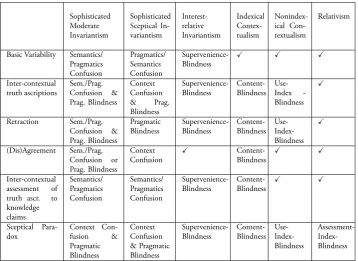
makes an error attribution implausible. But distinguishing different error-theoretic ob-jections in terms of their force is crucial in the dialectical situation the debate is facing. If every view must have recourse to attributions of systematic error, we need to evalu-ate and compare the given error theories if we want to come to an adequevalu-ately reasoned decision between rival views. Chapter does just this. I start by establishing in some detail for which data points invariantist and contextualist theories need to posit error, even where a pragmatic account of the data is provided. In so doing, I distinguish between different kinds of semantic, pragmatic, and metaphysical error. is allows us to put the views on the scoreboard, where we can read off and compare their success in empirical predictions. I then suggest adequacy conditions for error theories by identi-fying a number of criteria for the evaluation of kinds of error and their attribution. I end by using these criteria to suggest a defence strategy for relativists. e moral of Part I is that while the empirical case for relativism about ‘know’ is less straightforward than relativists may have hoped, reflection on the force of error-theoretic objections and the adequacy conditions of error theoretic explanations paints a bright picture for relativism about knowledge attributions. ere is thus good reason to think that the dependence of truth on the perspective of the evaluating subject is not restricted to intuitively subjective parts of our thought and talk.
Part II explores the connection between subjective attitudes and de se or personal attitudes – attitudes about oneself, which we typically express using the first-personal pronouns ‘I’, ‘me’, ‘my.’ On a widespread version of relativism about subject-ive attitudes, the content of these attitudes is understood in similar ways to a Lewisian account of the content of de seattitudes. On the Lewisian account, ade se thought such asI am hungryhascentered content, which is modelled by a set of centered worlds. Centered worlds are possible worlds ‘centered’ on an individual at a time. us, the thoughtI am hungryhas a content modelled by the set of centered worlds such that the center is hungry in the world at the time. A subjective thought such asBeetroot is tastyhas a content modelled by the set of centered worlds such that beetroot is tasty to the center at the time. But while the centered contents of subjective andde seattitudes share many similarities, their roles in linguistic communication are crucially different. In Part II, I argue that this gives us reason to modify our account of centered content. In particular, I argue for what I call sequenced worlds relativism: a novel unified ac-count ofde seand subjective attitudes and their communication, on which contents are understood as sets ofsequenced worlds– sets of possible worlds ‘centered’ on a sequence of individuals.
Introduction
then argue that sequenced worlds content provides a solution to the conflict that recon-ciles the insights of both views. In the rest of the chapter, I implement the sequenced worlds view in a broadly Stalnakerian model of communication and give a semantics for predicates of personal taste on which sentences like ‘Beetroot is tasty’ express sequenced worlds contents.
Chapter and develop the details of the sequenced worlds view. I show that the view itself forces no decision between contextualism and relativism upon its supporters because it is neutral between a nonindexical contextualist and a truth relativist view of predicates of personal taste. However, subsequent discussion of key pragmatic phe-nomena that the views are designed to explain shows that the relativist version makes better predictions. Chapters and thus present an argument in favour of sequenced worlds relativism.
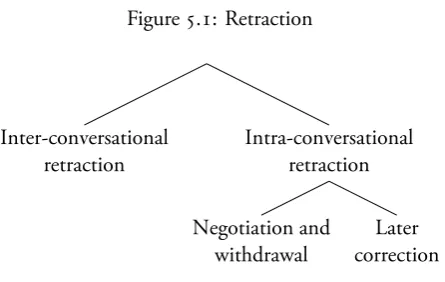
In chapter , I start by presenting the nonindexical contextualist and truth relativist versions of the sequenced worlds view. I then extend the basic framework to explain the empirical data from eavesdropping cases and retraction cases. Crucial for the ex-planation of eavesdropping cases is an account of the relationship between a discourse and subjects who are not participants in the discourse but nonetheless receive inform-ation from it. In order to explain retraction cases on the broadly Stalnakerian model of discourse, I provide an account of how the information accumulated in the course of the conversation must be updated with the passage of time. I introduce a taxonomy for retraction cases and show how to account for the withdrawal of information in each of these cases.
Part I
Knowledge
RELATIVISM AND SEMANTIC BLINDNESS
. Introduction
e case for relativism about knowledge attributions, as made by John MacFarlane (a, b), rests on the following line of thought. Indexical epistemic contextu-alism – the view that the content of sentences of the form ‘Sknows thatp’, and ‘Sdoes not know thatp’ may vary with the epistemic standards salient in the context of use – is supported by appeal to linguistic data from ordinary speakers’ use of knowledge sentences: the same speakers tend to accept ‘Sknows thatp’ as true when uttered in one context but not when uttered in another context. But contextualism makes incorrect predictions about, for instance, speakers’ inter-contextual truth ascriptions and their retraction of knowledge claims. e best explanation of this data available to contextu-alists involves the attribution of semantic blindness to speakers. Similarly, classical and subject-sensitive invariantists face troubling data, whose explanation commits them to some error theory or other. In contrast, MacFarlane claims, relativism can account for all of the data. Relativism is the only view that avoids the ‘double-edged sword’ of attributing systematic error to speakers (MacFarlane, a, ). at is its main virtue.
e relativist has aprima faciestrong empirical case.PaceMacFarlane, however, I argue in this chapter that relativism cannot explain all of the data from speakers’ use of knowledge sentences without the attribution of semantic blindness to speakers. In section ., I introduce the relativist’s case against contextualism and in favour of re-lativism. In section ., I present a recent error-theoretic objection against relativism that appeals to speakers’ inter-contextual judgments of relativised truth ascriptions to knowledge claims. In section ., I show why the strategy behind this objection fails. However, there is a simpler semantic blindness objection to relativism that is immune to the given replies, as I argue in section .. Speakers tend to be puzzled by scep-tical paradoxes, and relativist explanations of this phenomenon are bound to appeal to speakers’ semantic blindness. I identify two different kinds of semantic blindness
In this chapter, I will not be concerned with MacFarlane’s arguments against traditional and
subject-sensitive versions of invariantism that complete his case for relativism. e presentation of his argument against contextualism is intended to exemplify his argument-by-elimination strategy and to introduce the semantic framework.
Relativism and Semantic Blindness
involved in the debate: content-blindness and index-blindness. In section ., I con-sider and reject a reply on behalf of the relativist. Finally, in section . I show that the objection generalises to ordinary cases of epistemic closure from a variety of data on which relativists have rested their case.
is chapter thus presents an argument against relativism based on the error-theoretic objection from sceptical paradox. But to relieve the anxious reader: this is not the final word. As I will argue in chapter , the prospects for relativism look bright once all the views’ commitments to blindness theses are evaluated and compared.
. Contextualism and the Case for Relativism
On contextualist semantics, the content expressed by an occurrence of ‘S knows that
p’, and ‘S does not know thatp’, depends in part on the epistemic standards salient in the conversational context, where this dependence can be traced to the occurrence of ‘know’ (Cohen (); DeRose (); Lewis (); cf. Schaffer (a)). When John uses the sentence ‘Bill knows that he has hands’ in an everyday context with low epistemic standards (L) he expresses, very roughly, the contentBill knows relative to low standards that he has hands. When Mary is in a context with high epistemic stand-ards (H), for instance in an epistemology class on scepticism or in a courtroom, she uses the sentence to express the contentBill knows relative to high standards that he has hands. e sentence is true as used by John in L, but false as used by Mary in H. e truth value of knowledge sentences can vary across contexts of use even when the facts about the knowing subject’s situation do not change. Contextualists motivate the variability of content by appeal to ordinary speakers’ use of ‘know’. While speakers accept many knowledge attributions as true in mundane contexts of use, they tend to give in to, e.g., sceptical considerations that raise the epistemic standards and reject these attributions as false in such contexts.
Trouble for contextualism comes, among other things, from speakers’ inter-con-textual truth ascriptions to and retraction of knowledge claims, and from disagreement. When Mary is in H, say in a conversation about brains-in-vats, she will judge know-ledge attributions expressed by the sentence ‘Bill knows that he has hands’ false, even when the attribution is made by John in L. Likewise, speakers in L will judge knowledge denials, e.g. ‘Bill does not know that he has hands’, false even when they are made in H. But contextualism predicts that in judging knowledge attributions
is characterisation is simplified in two respects. First, epistemic standards – the strength of epistemic
. Contextualism and the Case for Relativism
and denials uttered in other contexts, speakers are sensitive to the epistemic standards at play in the context of use.
What is more, speakers will retract earlier knowledge claims when their context changes in relevant respects. Suppose John sincerely asserts ‘I know that my car is parked in the driveway.’ Mary points out that car thieves could be roaming John’s neighbourhood and that his car might have been stolen. She thereby raises the stand-ards, and it is natural for John to retract his earlier assertion by saying ‘I guess I was wrong. I did not know that my car was parked in the driveway.’ But according to contextualism, John is mistaken in his retraction. After all, his earlier assertion is true in the context of its use. Contextualism predicts that it would be appropriate for John to reply: ‘I did not say that Iknowthat my car is parked in the driveway. I only meant that I know by low epistemic standards that my car is parked in the driveway. And that is still true.’ is, however, is not a natural reply for John.
Finally, speakers are reported to disagree when one of them, in L, asserts ‘S
knows thatp’ and the other one, in H, asserts ‘Sdoesn’t know thatp.’ On the con-textualist semantics, however, the first speaker expresses the content that S knows that prelative to low standards, and the second expresses the content that S does not know thatprelative to high standards. Since these contents are perfectly compatible, speakers should not be inclined to judge that they disagree. at is, speakers are mistaken in their disagreement judgments.
Contextualists’ best response to the recalcitrant data is to adopt an error theory: Speakers are systematically mistaken in their inter-contextual truth ascriptions and re-traction of knowledge claims. ese mistakes are explained by speakers’semantic blind-ness: ‘users of the word ‘know’ are blind to the semantic workings of their language.’ (Hawthorne (, ); cf. DeRose (, )) e kind of semantic blindness contextualists need to ascribe is what I propose to call content-blindness:
C-
Speakers are blind to the fact that particular sentences (sentences of the form ‘S
knows thatp’/‘Sdoes not know thatp’) can express different contents in different contexts (bar indexical expressions in the substitution instances of ‘S’ or ‘p’).
Contextualists take the content of knowledge sentences to depend on the context of use, so the kind of semantic blindness they must attribute can be further specified as
See MacFarlane (a) and Williamson (). Further objections to epistemic contextualist semantics
concern, e.g., disagreement judgments (MacFarlane, b), belief reports (Cappelen and Lepore, ; Hawthorne, ), the analogy between ‘know’ and gradable adjectives (Stanley, ), the analogy with indexicals and with quantificational determiners like ‘all’ and ‘every’ (Schaffer and Szab´o, forthcoming).
Regarding (dis)agreement reports as evidence for shared content, see Cappelen and Hawthorne ().
Relativism and Semantic Blindness
use-content-blindness.
Let me settle some terminology. An expression isindexical iff its content at a con-text depends on features of the concon-text. A sentence is (semantically)context-sensitive
iff either its content or its truth value (or both) at a context depends on features of the context. us, contextualism about knowledge is the view that sentences of the form ‘S knows that p’ are indexical – specifically, that the content of ‘S knows that
p’ depends on epistemologically significant features of the context. It is one among other views that hold that sentences of the form ‘Sknows thatp’ are context-sensitive. Content-blindness is ignorance of an expression’s indexicality.
According to MacFarlane, the attribution of semantic blindness undermines the contextualist’s cause. Contextualists appeal to the variability of speakers’ intra-con-textual truth ascriptions in support of their view. But the more data they explain away by appeal to speakers’ ignorance of the semantic workings of ‘know’, the weaker is their appeal to speakers’ usage of ‘know’ as evidence in favour of their semantics. For MacFarlane, the point generalises:
[A]generalproblem with positing speaker error to explain away facts about use is that such explanations tend to undermine the evidential basis for the semantic theories they are intended to support. All of these semantic theories are justified indirectly on the basis of facts about speakers’ use of sentences, and the more error we attribute to speakers, the less we can conclude from these facts. (MacFarlane, a, )
Relativists piggyback on the case against contextualism. On MacFarlane’s relativist semantics, the truth value of knowledge sentences can vary from one context of assess-ment to another: ‘S knows thatp’ may be true at (context of use) CU and (context of assessment) CA1 and false atCU andCA2. Underlying the relativist semantics
is a roughly Kaplanian picture (Kaplan, ). Sentences in contexts of use express
For the above notion of indexicality and a different notion of context-sensitivity, see MacFarlane (). ese views include nonindexical contextualism (Brogaard, ; Kompa, ; MacFarlane, ) and
relativism (MacFarlane, a, b).
On the above notion of sensitivity, contingent sentences and tensed sentences count as
context-sensitive. is broad notion of context-sensitivity is useful as an umbrella term for specific kinds of context-sensitivity, among which is the sensitivity to the epistemic standards salient at a context.
Akerman and Greenough () propose an alternative way of distinguishing between kinds of
context-sensitivity and corresponding kinds of blindness. ey provide a helpful discussion and comparison of these kinds of blindness for the case of vague expressions.
For a defence of contextualism from semantic blindness objections see Blome-Tillmann (), Cohen
(a), DeRose (), and Schaffer and Szab´o (forthcoming).
In this chapter, I will focus on MacFarlane’s version of relativism. Similar relativist semantics for
. Contextualism and the Case for Relativism
contents. Contents are evaluated at an index (Lewis, ), what Kaplan called a cir-cumstance of evaluation, to yield truth values. Kaplan took the index (circumstances of evaluation) to include at least a world and a time coordinate, determined by the context of use. Relativism can be located in this picture by the following three theses:
. I
‘Sknows thatp’ expresses a content that is invariant across contexts of use (bar indexical expressions in the substitution instances of ‘S’ and ‘p’).
. I
e index contains an epistemic standards coordinate, to which the truth value of ‘Sknows thatp’ is sensitive. More generally, call a sentenceindex-sensitiveiff its truth value depends on (some coordinate in) the index.
. A
e truth value of ‘Sknows thatp’ depends on the epistemic standards salient at the context of assessment, which may be different from the context in which the sentence is uttered. Put together with , the epistemic standards-coordinate in the index is determined by the context in which a knowledge claim is assessed.
Relativism about knowledge attributions can thus be characterised as the view that while the semantic contribution of ‘knows’ to a sentence ‘S knows thatp’ does not make the sentence indexical, the sentence is assessment-index-sensitive: Its truth value depends on the epistemic standards coordinate in the index, which is determined by the context of assessment.
Relativism yields an elegant account of the data that troubles contextualism. An assessor in H is correct in ascribing falsity to ‘Bill knows that he has hands’ as uttered in L, since it is the standards at play in the assessor’s context that matter to her truth value ascription. Moreover, relativism predicts that John will retract his earlier assertion ‘I know that my car is parked in the driveway’ when the context is shifted to H by Mary in conversation. When John in H assesses his past assertion, it is appropriate for him to use the standards salient in his present context to judge his assertion false and to correct himself. Relativism also explains intra-contextual truth ascriptions. When I judge knowledge sentences uttered in my own context as true (false), context of assessment and context of use are identical. Relativism’s predictions in these cases coincide with those of contextualism. Finally, relativists can explain the
I will here ignore the differences between Lewisian index and Kaplanian circumstance of evaluation. ey
have no bearing on any of arguments discussed in this chapter. I will henceforth use the shorter ‘index’.
Contextualism can also be situated in this picture of semantics: It locates the relevant epistemic standards
Relativism and Semantic Blindness
felicity of disagreement reports of two speakers in relevantly different contexts of use, one of whom grants and the other denies that a subject knows thatp, by the fact that, on account of I , one speaker expresses the negation of the other speaker’s knowledge claim.
MacFarlane completes the case for relativism by making similar points against tra-ditional invariantism and interest-relative invariantism. ese views run into trouble with data, e.g., from intra-contextual truth ascriptions and temporal and modal em-beddings of ‘know’, respectively. And again, relativism makes correct empirical predic-tions where invariantist views must wield error theories to their defence. MacFarlane concludes that since relativism is the only view that respects all of the data without requiring the attribution of systematic speaker error, it is superior to all other views.
. An Error-theoretic Objection against Relativism
Contextualism and all forms of invariantism each face trouble from cases in which their view does not predict the assessor’s egocentric sensitivity to epistemic standards (or stakes) in their inter-contextual judgments of knowledge attributions. One error-theoretic strategy against relativism, exemplified by Montminy (), presents cases for which relativism supposedly cannot predict this egocentric focus either. As we will see in section ., this particular strategy is not promising.
According to the first variant of the strategy that Montminy pursues, relativism is committed to the attribution of systematic speaker error when speakers make judg-ments about explicitly relativised truth claims, made in other contexts, concerning knowledge attributions. Montminy has us consider, first, the following dialogue in L:
(.) John: We both know that Neil Armstrong was the first man to set foot on the moon.
Bob: at’s true.
Suppose Mary is in H and is presented with (.). It is natural for her to judge false not only John’s knowledge attribution but also Bob’s assessment of John’s claim. is is what relativism predicts. Mary is right in taking the standards salient in her context as relevant for the assessment of John’s knowledge attribution as well as Bob’s truth ascription to John’s claim. Mary thinks that John and Bob do not know that Neil Armstrong was the first man to set foot on the moon, and that it is false that they know this, so Bob’s claim that it is true that they know is false in Mary’s context.
. An Error-theoretic Objection against Relativism
(.) John: We both know that Neil Armstrong was the first man to set foot on the moon.
Bob: at’s true relative to this context.
According to Montminy, Mary in H will judge John’s knowledge attribution false and she will also judge Bob’s truth ascription false,regardless of the relativisation. is runs against relativism’s prediction. On relativist semantics, the explicitly relativised truth ascription made by Bob in L is true at every context of assessment, hence also at Mary’s.
Relativists hold that there are (at least) two different truth predicates. e first is the ordinary English monadic predicate ‘true’. Its application to propositions yields sentences that are themselves assessment-sensitive. at is, sentences of the form ‘It
is true thatp’ or ‘e proposition thatpis true’ have truth values that vary with the context of use and context of assessment. Importantly, monadic ‘true’ is disquotational in the following sense: Whenever, in a context of assessment, we correctly judge that S knows thatp, we can also judge correctly that it is true that S knows thatp, and vice versa. e equivalence schemaIt is true that piff p is true at anyCU andCA. Since ‘true’ is assessment-sensitive, the left-hand side will be true (false) at aCUandCAjust in case the right-hand side is true (false) at thatCUandCA.
In dialogue (.), Bob is ascribing ordinary monadic ‘true’ to the proposition ex-pressed by John’s knowledge attribution. In the context of assessment of the dialogue, L, this truth ascription is correct; ‘at’s true’ is true atCU(J&B) andCA(Low). However, ‘at’s true’ is false atCU(J&B)andCA(High). Relativists predict correctly
that it is appropriate for Mary in her context of assessment to reject Bob’s assertion as false.
e second truth predicate is relational. ‘True relative to context C’ relates truth bearers to contexts in which they are evaluated. It is assessment-insensitive. at is, the truth value of ascriptions of this truth predicate to sentences or propositions, as in ‘It is true relative to this context thatp’, does not vary with contexts of assessment. us, the proposition expressed by the following assertion is true relative to any context of assessment: ‘It is true relative to L that John and Bob know that Neil Armstrong was the first man to set foot on the moon.’ Since this is plausibly what Bob is saying in (.), relativism predicts that Mary in H will judge the proposition expressed by Bob’s utterance as true.
Egan et al. () take the bearers of monadic truth to be utterances. I shall here stick with MacFarlane
(b, a) and take ordinary ‘true’ as applying to propositions.
Egan et al. () treat the binary predicate ‘true relative to context C’ as applying to utterances.
Mac-Farlane prefers the metalinguistic predicate ‘true atCUandCA’ used in the formulation of the relativist
Relativism and Semantic Blindness
However, speakers in H such as Mary seem to judge explicitly relativised truth ascriptions to knowledge attributions made in L as false. So on the relativist picture, they are systematically mistaken in these judgments. e conclusion of this objection is that relativism, too, is committed to an error theory; the best argument for relativism fails.
. Relativist Replies
ere are at least two replies available to the relativist in response to this error-theoretic objection.
() Discarding the data. Relativists may remind us that while ‘true’ is a natural
lan-guage English truth predicate that speakers frequently and competently use, ‘true relat-ive to context C’, or ‘true atCU andCA’, is a technical, metalinguistic truth predicate used to formulate relativist semanticsforEnglish sentences. To ordinary speakers, Bob’s assertion of ‘at’s true relative to this context’ will sound stilted and odd, and contrary to Montminy’s Mary, they are most likely to have no clear truth value judgments. But even if speakers had clear judgments, we could not just assume that ‘true relative to context C’ in their mouths expressed the relativist’s technical concept of truth. In fact, trying to accommodate speakers’ intuitions about this expression would be bad methodology. By analogy, we would be ill-advised to take into account speakers’ re-actions to ‘at’s a context-sensitive sentence’ in constructing a semantics for English. As a result, speakers’ reactions to expressions involving ‘true relative to this context’ do not constitute data against relativism.
Montminy () does not claim that this first objection goes through against the relativist, for roughly
the reasons I give at the beginning of the next section. He does hold, however, that another variant of the strategy is successful, one on which the claims involving the explicitly relativised truth predicate are replaced by supposedly extensionally equivalent counterfactual conditionals. I argue in the next section that that objection does not succeed against the relativist either.
In Kindermann (forthcoming), I mention, in footnote , MacFarlane’s views on norms of assertion from
chapter of his unpublished book manuscript. At the time the article was publishedOnline First, the book manuscript available on MacFarlane’s website did not include a chapter on knowledge attributions. In a more recent draft (February , ), MacFarlane discusses Montminy’s objection in chapter on ‘knows.’ Much of his response is broadly consonant with the first reply I am giving here. We differ, however, in the response to the part of Montminy’s objection that is concerned with retraction (see footnote in Kindermann (forthcoming)/footnote below for my response). More broadly, my goal in the article and this chapter is to show that the successful error-theoretic objection that relativists need to worry about comes from sceptical paradox and epistemic closure puzzles.
Results from Google searches should not serve as conclusive evidence, but the fact that a Google search
. Relativist Replies
Relativists could further argue that there is no ordinary, non-technical English ex-pression that correctly captures the theoretical concept of relative truth. is would forestall all attempts to run the error-theoretic objection with everyday expressions that purport to stand a better chance of expressing relative truth in the mouths of English speakers. Relativists could give this reply without compromising their claim that or-dinary speakers can make sense of relative truth as a concept of truth. According to MacFarlane, we understand the meaning of ‘true atCU andCA’, or ‘true relative to context C’, if we grasp ‘the role [this predicate] plays in a broader theory of language use: specifically, an account of the speech act of assertion’ (MacFarlane, b, ). In brief, an assertion is a commitment to the truth of what is asserted. is commitment is honoured by providing adequate grounds for the truth of what is asserted relative to the context of assessment in which the assertion is challenged. e commitment also requires that one withdraws the assertion in any futureCAin which what is asserted is shown to be untrue relative toCA. Retraction data, the relativist can conclude, gives evidence that speakers take themselves to be bound by such a relativised assertoric commitment. us, even if speakers lack ordinary expressions to express the technical concept of relative truth, they have an implicit grasp of it.
See for instance MacFarlane (a, ) and (b, -) for further details of the commitment
undertaken by assertions.
Montminy argues that even this connection between the notion of truth atC
UandCAand language use
requires the attribution of systematic error to speakers. As he points out, the commitment to withdrawing an assertion in any future context of assessment in which what is asserted is shown to be untrue relative to that context of assessment entails (*):
(*) In asserting ‘Sknows thatp’ (‘Sdoes not know that Q’), one commits oneself to withdrawing the assertion in any future contextCA(High)(CA(Low)) in which what is asserted by ‘Sknows that
p’ (‘Sdoes not know that Q’) is shown to be untrue relative toCA(High)(CA(Low)).
Montminy grants for the sake of argument that speakers do in fact withdraw their assertions of ‘Sknows thatp’ (‘Sdoes not know that Q’) made in L (H) when challenged in H (L). But he denies that speakers ‘take themselves to be bound by [(*)]’: ‘the fact that a speaker in L would withdraw her previous knowledge denial made in H does not entail thatwhen she is inH, the speaker takes herself to be committed to withdrawing her current knowledge denial, if this denial is challenged in some future L. As a matter of fact, a speaker in H would reject this commitment, that is, such a speaker would hold that it would beincorrect to withdraw her current knowledge denial in some future low-standards context’ (Montminy, , ). Montminy concludes that relativism implies that speakers are systematically mistaken about their commitments to withdraw knowledge claims.
Relativism and Semantic Blindness
But perhaps the relativist’s blank dismissal of any sort of data involving the use of vocabulary expressing relative truth is too quick. Montminy agrees that the relativist’s reply successfully rebuts the objection based on an explicitly relativised truth predicate in cases like (.). But he maintains that there are perfectly ordinary English locutions that do express relativised truth claims. e following counterfactual conditionals are supposed to express in ordinary English the relativist’s thesis that the proposition that John and Bob know that Neil Armstrong was the first man to set foot on the moon is true relative to John and Bob’s context L:
(.) If it were to be assessed in John and Bob’s context, the proposition that they know that Neil Armstrong was the first man to set foot on the moon would be true.
(.) If I were in John and Bob’s context, then they would know that Neil Armstrong was the first man to set foot on the moon.
(.) If the stakes were low and no error possibilities had been mentioned, then it would be true that John and Bob know that Neil Armstrong was the first man to set foot on the moon.
Montminy claims that ordinary speakers like Mary in H would understand (.) – (.) and reject them as false. But the relativist must hold that (.) – (.) are true, since they express the relativist’s thesis that the attribution of knowledge to John and Bob is true relative to John and Bob’s context. e relativist, Montminy concludes, is after all committed to the claim that Mary’s judgments are systematically mistaken (Montminy, , -).
I think relativists have good reasons to reject both that (.) – (.) express relativ-ised truth claims and that Mary’s falsity judgments concerning these conditionals (if she has any clear judgments) run against relativism’s predictions. On a mainstream se-mantics of counterfactuals, the antecedent has an effect on theworldsat which the con-sequent is evaluated for truth and falsity. For instance, on the Lewis-Stalnaker account, a conditionalA > Bis true iffBis true at the closest world(s) at whichAis true. But
Second, relativists may even grant that speakers do make judgments to the effect it is incorrect to withdraw a knowledge attribution in H, but deny that speakers’ explicit judgments are relevant for an account that links the concept of relative truth to speakers’ languageuse. By analogy, syntacticians would have to predict widespread error if part of their evidence was speakers’ acceptance or rejection of explicitly stated grammatical rules which speakers, as a matter of fact, employ in their use of language.
. Relativist Replies
it is an open question whether, when combined with relativism, the antecedent also affects the epistemic standards coordinate in the index. Relativism has Montminy’s problem only if the antecedent does affect the epistemic standards coordinate. How-ever, there seem to be no independent theoretical reasons why this must be the case. And the alleged data from Mary’s falsity judgments give us pre-theoretical reasons to think that that the antecedent has no effect on the epistemic standards coordinate with respect to which the consequent is evaluated. So relativists can make the right pre-dictions by simply adopting the unamended Lewis-Stalnaker analysis of conditionals: When Mary assesses the knowledge claim in the consequent at the closest world(s) in which she is in John’s context, or in which the stakes are low and no error possibilities have been mentioned, she will still judge this knowledge claim as false relative to her actual context of assessment H. As a result, (.) – (.) are not extensionally equi-valent to, and do not express, relativised truth ascriptions, and Lewis-Stalnaker-cum-relativist semantics of (.) – (.) make the intuitively right predictions concerning Mary’s (putative) rejection.
() Override. It is worth noting that there is a reply available to relativists even if they are inclined to take the data from (.) at face value and affirm that ‘true relat-ive to context C’, as used by ordinary speakers, is the relativist’s metalinguistic truth predicate. On this assumption, what the data shows is that speakers take their own current contexts of assessment to override all other contexts of assessment. Adapting Moruzzi and Wright (), the relativist can capture the phenomenon of overriding by introducing two principles governing the metalinguistic truth predicate.
Let the relativist’s metalinguistic truth predicate be represented by the dyadic pre-dicate T(S, CA) relating sentences-at-contextsand contexts of assessment.
First-order truth ascriptions such as Bob’s in (.) are represented by sentences of the form T(S, CA); second-order truth ascriptions such as Mary’s by T(T(S, CA1),CA2). (Of
course, Mary makes a second-order ascription of falsity; see below.) A context CA1 overridesa contextCA2 when the assessment inCA1 of the facts dictates their proper
assessment inCA2. e fact that Mary judges Bob’s use of ‘at’s true relative to this
context’ as false in accordance with the epistemic standards in her own context of assess-ment, and in spite of the standards at play at Bob’s context of assessassess-ment, is captured by the ideas of (Upward Override) and (Downward Override). Upward Override with
Sentences-at-contexts can be understood as pairs of sentences and contexts of use. We could make contexts
of use explicit and conceive of the truth predicate as a tryadic predicate relating sentences, contexts of use, and contexts of assessment. To keep the discussion as simple as possible, we will let ‘S’ stand for sentences-at-contexts.
In the following, I will accept harmless use/mention confusion in favour of better readability.
(Upward Override) and (Downward Override) are derived from Moruzzi and Wright’s idea of trumping
Relativism and Semantic Blindness
respect to a sentenceStakes place if wheneverSis true at a context of assessmentCA1
it is thereby true atCA1thatSis true atanycontext of assessment. In short:
(Upward Override) (∀CA1, CA2)(T(S, CA1)⊃T(T(S, CA2),CA1))
is principle is called ‘Upward Override’ because the direction of dictation is from the first-order truth ascription inCA1 to the second-order ascription inCA1 of truth to
the first-order truth ascription in someCA2. Provided thatSranges over knowledge
sentences, (Upward Override) entails that speakers will judge as true that a knowledge sentence is true relative to any context of assessmentCA2if they judge it true relative
to their own (CA1).
e converse of this principle is (Downward Override). Downward Override with respect toStakes place if whenever it is true at a context of assessmentCA1 thatSis
true at a context of assessmentCA2,Sis true atCA1. In short:
(Downward Override) (∀CA1, CA2)(T(T(S, CA2),CA1)⊃T(S, CA1))
is principle is called ‘Downward Override’ because its direction of dictation is from the second-order ascription inCA1 of truth to the first-order truth ascription in any
CA2to the first-order truth ascription inCA1. Provided thatSranges over knowledge
sentences, (Downward Override) entails that speakers will judge a knowledge sentence true relative to their own context of assessment CA1 if they judge as true that the
knowledge sentence is true relative to a context of assessmentCA2. (Upward Override)
and (Downward Override) together entail that it is inconsistent for a speaker to accept a knowledge sentence as true relative to their own context of assessment while rejecting as false truth ascriptions to this knowledge sentence at other contexts of assessment, and vice versa.
Mary’s second-order falsity ascription to Bob’s first-order truth ascription is a con-traposition instance of (Downward Override). Let SK stand for John’s knowledge attribution,CM for Mary’s context of assessment, andCBfor Bob’s context of assess-ment. Interpreting falsity as the negation of truth, we get:
(.) ∼T(SK, CM)⊃ ∼T(T(SK, CB),CM))
Loosely speaking, (.) says that since Mary judges John’s knowledge attribution false from her context of assessment, she also judges that Bob’s truth ascription (in his context of assessment) to John’s knowledge attribution is false. e epistemic standards in her context of assessment override those in Bob’s context of assessment.
(Upward Override) and (Downward Override) thus allow the relativist to make the right predictions for (.). Acceptance of these principles is also compatible with the
. Relativist Replies
other data relativists have been keen on. Firstly, it does not affect the predictions about intra-contextual truth ascriptions. Secondly, it supports retraction data and makes even slightly stronger predictions. We retract knowledge attributions or denials if they turn out to be false from our current context of assessment. Given Override, wealsojudge that the knowledge claim was false in our earlier context of assessment (in fact, in any context of assessment), contrary to our previous judgment. We concede that we were wrong back then and do not tend to justify our knowledge claim by insisting that it was true relative to our previous context of assessment. Finally, (Upward Override) and (Downward Override) leave the data from ordinary disquotational ‘true’ untouched, since they exclusively target the explicitly relativised, technical truth predicate.
Override principles also lend support to an intuitive difference between, on the one hand, discourse featuring knowledge claims and discourse about the contingent future, and, on the other hand, discourse about matters of personal taste and perhaps moral and aesthetic discourse. Relativism about knowledge sentences and future contingents (see Moruzzi and Wright) promote override principles. On the contrary, the idea of override is questionable in moral and aesthetic discourse and entirely out of place in matters of personal taste. Consider (.).
(.) John: Watching: A Space Odysseyis fun.
Bob: No, watching: A Space Odysseyis not fun. Still, it may be true for you that it’s fun.
Accepting on the current strategy that ‘true for you’ in (.) expresses a relativised truth predicate, relativists can say that it is true relative to John, i.e. the standards of taste at his context of assessmentCJ, and false relative to the standards of taste at Bob’s context CB, that watching: A Space Odysseyis fun: T(S2001, CJ) and∼T(S2001, CB),
whereS2001 is the sentence ‘Watching: A Space Odysseyis fun’ in (.). Would
Relativism and Semantic Blindness
(.) John: I know that Neil Armstrong was the first man to set foot on the moon.
Bob: No, you don’t know that. Still, it may be true for you that you know it.
Override principles plausibly hold for relativism about knowledge sentences and future contingents but are misplaced in the case of discourse involving predicates of personal taste. Formally, this is easily captured by restricting the range ofS in (Upward Over-ride) and (Downward OverOver-ride) to sentences with which we make contingent claims about the future as well as knowledge claims.
Override principles mark the difference between discourses that typically exhibit
Tolerance and those which do not. Tolerance here captures the idea that speakers can acknowledge that there might be other perspectives than their own which are (equally) appropriate; that is, speakers can acknowledge that given different relevant features in other contexts of assessment, what they judge to be true (false) may not be true (false) from other contexts of assessment. Speakers are likely to be tolerant towards other perspectives on taste, but not on whether or not someone has knowledge.
. Sceptical Paradox and Index-Blindness
e error-theoretic strategy from speakers’ inter-contextual judgments in sections . and . appealed to data involving the use of ‘true relative to context C’ and other locu-tions allegedly expressing relativised truth claims. e replies available to the relativist correspondingly targeted the use of these expressions to avoid the charge of system-atic error attribution. However, there is a simpler error-theoretic objection that makes
Cf. Moruzzi and Wright’s () idea of ‘even-handedness’
Override principles commit the relativist to second-order relativism. First-order relativism about
know-ledge sentences is the claim that there is at least one sentence containing ‘know’ which, as used in a context of useCU, is true relative to one context of assessment and false relative to another:
(REL) (∃S, CA1, CA2)(T(S, CA1)∧ ∼T(S, CA2))
Second-order relativism about knowledge sentences is the claim that there is at least one sentence of the form T(S, CA), whereSranges over, say, knowledge sentences, and which is true relative to one context
of assessment and false relative to another:
(REL2) (∃S, C
A1, CA2, CA3)(T(T(S, CA1),CA2)∧ ∼T(T(S, CA1),CA3))
Given first-order relativism, an instance of (REL2) can be derived from override principles. Suppose for a
knowledge sentenceSand two contexts of assessmentca1andca2that T(S, ca1) and∼T(S, ca2). en
from T(S, ca1) it follows by (Upward Override) that T(T(S, ca2),ca1). And from∼T(S, ca2), takingca2
for bothCA1andCA2, it follows by contraposition on (Downward Override) that∼T(T(S, ca2),ca2).
. Sceptical Paradox and Index-Blindness
no appeal to data involving relativised truth claims and is thus immune to the above replies. As I argue in this section, the solution to sceptical paradoxes and epistemic clos-ure puzzles that naturally falls out of the relativist semantics requires the implausible attribution of a kind of semantic blindness I call index-blindness. Although relativ-ists have not explicitly addressed sceptical paradoxes, they cannot reject this solution without significant costs, as I show in section ..
Consider the following sceptical argument:
(SA) I don’t know that I’m not a BIV (i.e., a bodiless brain in a vat who has been caused to have just those sensory experiences I’ve had).
If I don’t know that I’m not a BIV, then I don’t know that I have hands. ————————————
I don’t know that I have hands.
As Schiffer (, ) remarks, ‘this argument presents a paradox because it tempts us to say three things that are mutually inconsistent: its first premise is true; its second premise is true; and its conclusion is false.’ at is, the following three sentences are mutually inconsistent: ‘I don’t know that I’m not a BIV’; ‘If I don’t know that I’m not a BIV, then I don’t know that I have hands’; and ‘I know that I have hands.’ Yet each of these sentences strikes us as intuitively true.
A ‘fully satisfactory’ solution, Schiffer continues, must accomplish two things: First, it must explain why (SA) in fact does not present a paradox. at is, it must show which one of the three sentences is false, and explain why the argument is in fact valid. And second, it must explain why (SA)seemed to present a paradox. at is, it must explain why the false sentence seemed true, and why we were tempted to believe that the premises are true but the conclusion false.
e relativist semantics has the resources to provide a fully satisfactory solution to sceptical paradox. Going for the first task, relativists may remind us that we assess knowledge attributions and denials from a context of assessment. Sceptical hypotheses, as introduced by the first premise of (SA), raise the epistemic standards in the context of assessment to a high level (H), since one must be in quite a strong epistemic position to rule out that a sceptical hypothesis like the BIV scenario obtains. us, we assess ‘I don’t know that I’m not a BIV’ as true atCU andCA(High). Importantly, the
epistemic standards are now raised for a context of assessment that encompasses the en-tire argument (SA). Hence, we must also assess the second premise and the conclusion of (SA) atCU andCA(High). is allows the relativist to explain why (SA) in fact is
valid, thus capturing the intuitive force of the sceptic’s argument. To understand how, we need to have a look at the relativist’s notion of validity.