Dynamical patterns of coexisting strategies in a hybrid
discrete-continuum spatial evolutionary game model
A.E.F. Burgessa, P.G. Schofieldb, S.F. Hubbardb, M.A.J. Chaplaincand T. Lorenzic1
aDivision of Mathematics, University of Dundee, Dundee DD1 4HN, Scotland b College of Life Sciences, University of Dundee, Dundee DD1 4HN, Scotland
cSchool of Mathematics and Statistics, University of St Andrews,
St Andrews KY16 9SS, Scotland
Abstract. We present a novel hybrid modelling framework that takes into account two aspects which have been largely neglected in previous models of spatial evolutionary games: random mo-tion and chemotaxis. A stochastic individual-based model is used to describe the player dynamics, whereas the evolution of the chemoattractant is governed by a reaction-diffusion equation. The two models are coupled by deriving individual movement rules via the discretisation of a taxis-diffusion equation which describes the evolution of the local number of players. In this framework, individ-uals occupying the same position can engage in a two-player game, and are awarded a payoff, in terms of reproductive fitness, according to their strategy. As an example, we let individuals play the Hawk-Dove game. Numerical simulations illustrate how random motion and chemotactic re-sponse can bring about self-generated dynamical patterns that create favourable conditions for the coexistence of hawks and doves in situations in which the two strategies cannot coexist otherwise. In this sense, our work offers a new perspective of research on spatial evolutionary games, and provides a general formalism to study the dynamics of spatially-structured populations in biologi-cal and social contexts where individual motion is likely to affect natural selection of behavioural traits.
Key words:spatial evolutionary games, hybrid models, random motion, chemotaxis, Hawk-Dove game, spatial patterns
AMS subject classification: 35Q92, 91A80, 92B05
1.
Introduction
The term ‘spatial evolutionary game theory’ was coined in the 1990s to identify the branch of mathematics that employs methods and tools from game theory to study phenotypic evolution in spatially-structured populations. In classical models of spatial evolutionary games, players are distributed over a bounded domain in the physical space. The domain is modelled by a grid con-sisting of discrete nodes which can either host one player or be vacant. At a given time instant, every individual plays a two-player game with its immediate neighbours, and it is awarded a payoff according to its strategy. The occupancy of each node in the grid is consequently updated to follow the strategy that scored the highest payoff in the immediate environs. This mimics an evolutionary scenario in which the fittest phenotypes are favoured by natural selection.
Since the seminal papers of Nowak and May [27, 28, 29, 30], a torrent of theoretical analyses and modelling efforts have emerged which indicate that the results from spatial evolutionary games can be strikingly different from the outcomes of the same games played in well-mixed populations. This relates to the fact that distributing individuals over physical space allows them to become spontaneously organised into spatial structures according to their strategy. Besides leading to the generation of beautiful spatial patterns, such a form of spatial organisation fosters the emergence of spatial correlation, thus paving the way for scenarios which are much different from those encountered in well-mixed populations, where every player has the same probability to interact with any other player in the population.
Most of the classical models of spatial evolutionary games are cellular automata that do not account for the explicit motion of players. However, increasing attention has been given to spa-tial extensions of evolutionary game models that incorporate individual movement. For instance, Dugatkin & Wilson [11] and Enquist & Leimar [13] allowed individuals to migrate between patches without spatial structure. Diffusion-based dispersal of offspring was considered in [17, 22, 23, 41]. Ferriere & Michod [15] studied an explicit diffusive process in the context of the repli-cator equation, and then extended their approach by including a diffusive term [16]. Stochastic cellular-automaton models in which individuals can jump to a nearest empty site were developed in [20, 36, 40]. A dynamical system of reaction-diffusion type was investigated by Durrett & Levin [12]. A conditional mobility model on a lattice was presented in [9]. Helbing & Yu [19] introduced a model of success-driven migration, where individuals move to the sites with the highest estimated payoffs. Chenet al.[6] explored the effects of mobility when individuals interact with neighbours within a prescribed view radius. The case of heterogenous view radii was analysed by Zhang et al. [45]. An aspiration-induced migration mechanism – inducing individuals to move to new sites if their payoffs are below their aspiration level – was investigated by Yanget al. [44] and Lin et al. [24], while Meloni et al. [26] explored the effects of mobility in a population of Prisoner’s Dilemma players.
a stochastic individual-based model is used to describe the dynamics of players. Following the modelling strategy that Schofieldet al. [34, 35] developed from the original approach of Ander-son & Chaplain [1], we couple the two models by deriving the individual movement rules from a taxis-diffusion equation which describes the evolution of the local number of players.
For illustrative purposes, in this model we let individuals play the Hawk-Dove game originally developed by Smith & Price [25] to describe certain scenarios in animal conflict. In this particular game, individuals playing the dove strategy (i.e., ‘doves’) avoid all conflict, and hence they retreat at once from a given conflict if the opponent escalates. In contrast, individuals playing the hawk strategy (i.e., ‘hawks’) always escalate the conflict and continue until injured or until the opponent retreats.
Spatial aspects of the Hawk-Dove game were first mentioned in passing by Nowak & May [29, 30], and then discussed in more detail by Killingback & Doebeli [21], who reached the con-clusion that, in the presence of spatial structure, doves can become spontaneously organised into clusters in which the benefits of mutual proximity can outweigh losses against hawks. Also, Hauert [18] considered the Hawk-Dove game on a lattice and remarked that “Compared to mean field calculations, spatial extension generally favours the hawk strategy. Consequently, in spatially-structured populations, we would expect to observe more frequent escalations of conflicts than predicted by mean field theory’’. Finally, the Hawk-Dove game on various spatial networks was analysed by Tomassini et al. [39], who reported that the abundance of doves depends crucially upon the network structure.
In these previous papers, although the individual players are distributed over a spatial domain, there is no explicit motion as such. Here, we provide evidence through computational simulations that letting individuals diffuse through space, and move chemotactically (i.e. up semiochemical gradients), can bring about self-generated patterns which create favourable conditions for the co-existence of hawks and doves in situations in which the two strategies cannot coexist either in spatially homogeneous models or in cellular automaton models.
2.
The model
We study the dynamics of players who move in a square domainΩ≡[−`, `]×[−`, `]. Individual movement is seen as the superposition of spatial diffusion and chemotactic response. The former is due to random motion, whilst the latter is guided by the gradient of a semiochemical emitted by the players themselves. At each time instant, players occupying the same position can engage in a two-player game, and are awarded a payoff according to their strategy. The accumulated payoff then determines the number of offspring which can be produced by a player.
2.1.
Movement rules
The evolution ofS(t, x, y)is governed by the following reaction-diffusion equation
∂S
∂t =βS ∇
2S+ν P −γ S, (2.1)
which is completed with reflective (no-flux) boundary conditions. Eq.(2.1) relies on the assump-tions that the semiochemical is produced by all players at the same rateν ≥0, undergoes a linear decay process at rateγ >0, and diffuses at rateβS >0.
To describe the movement of players, we make use of the following strategy:
(i) We introduce the taxis-diffusion equation below
∂P
∂t =βP ∇
2P −χ∇ ·(P ∇S), (2.2) which we complete with no-flux boundary conditions. In Eq.(2.2), the diffusion term models the tendency of players to diffuse through space with motilityβS > 0. The advection term accounts for the fact that players move up the semiochemical gradient, and the parameter χ >0is the chemotactic sensitivity coefficient.
(ii) We fix a time step∆t and set tn = n∆t. Also, we discretise the squareΩwith a uniform mesh as
∆x= `
2L, xi =i∆x, i∈[−L, L]⊂Z, (2.3)
∆y= `
2L, yj =j∆y, j ∈[−L, L]⊂Z, (2.4) and thereafter we approximateS(tn, xi, yj)andP(tn, xi, yj)by discrete valuesSi,jn andPi,jn, respectively.
(iii) Following Schofieldet al. [34, 35], we discretise Eq.(2.2) by using an explicit five-point cen-tral difference scheme to obtain the following algebraic equation forPi,jn+1,i.e., the number of players at grid-point(xi, yj)at the time stepn+ 1:
Pi,jn+1 =r0 Pi,jn +r1 Pin+1,j+r2 Pin−1,j+r3 P n
i,j+1+r4 P
n
i,j−1, (2.5) where the coefficientsr0,1,2,3,4are given by
r0 : rni,j := 1− ∆t
(∆x)2
2βP −χ(Sin+1,j+Sin−1,j−2Si,jn)
− ∆t
(∆y)2
2βP −χ(Si,jn+1+Si,jn−1−2Si,jn)
,
r1 : rni−1,j:= ∆t
(∆x)2 h
βP −
χ
4(S n
i+1,j−Sin−1,j)
i
, (2.6)
r2 : rni+1,j:= ∆t
(∆x)2 h
βP +
χ
4(S n
i+1,j−Sin−1,j)
i ,
r3 : rni,j−1:=
∆t
(∆y)2 h
βP −
χ
4(S n
i,j+1−Si,jn−1) i
,
r4 : rni,j+1:=
∆t
(∆y)2 h
βP +
χ
4(S n
i,j+1−Si,jn−1) i
These coefficients are proportional to the probabilities of a player being stationary (r0), or moving left (r1), right (r2), down (r3) or up (r4), and hence the above system may be used to generate the movement of players from grid-point to grid-point.
In this framework, at any stepn >1, the algorithm for individual movement is as follows:
(i) The value ofPn
i,j is identified by counting the number of players at every grid-point(xi, yj), and the semiochemical concentration is computed by calculating the numerical solutions of the mathematical problem defined by completing Eq.(2.1) with zero Neumann boundary conditions and suitable initial conditions.
(ii) The probabilitiesri,jn+1are evaluated at each grid-point by substituting the local semiochem-ical concentrations into Eqs.(2.6).
(iii) At each grid-point(xi, yj), the values of the spatial-transition probabilities are used to define five intervals as
R0:= [0, r0] and Rp :=
p−1 X
q=0 rq,
p
X
q=0 rq
withp= 1,2,3,4.
(iv) For each player at a given grid-point, a random real number between0and1 is generated, and a comparison of this number with the above ranges yields the direction of movement of the player. Namely, the player will not move if the random number belongs to R0, or it will move left if the number belongs toR1, right if the number belongs toR2, down if the number belongs toR3 and up if the number belongs toR4.
2.2.
Interaction and reproduction rules
At any stepn > 1, players that occupy the same grid-point engage in a two-player game and are awarded a payoff according to their strategy. Each player can play at mostM rounds of the game, either with the same opponent or with different opponents. We assume that all players have the same lifetimeτ, and consider two possible underlying models for the reproduction rules:
(i) a synchronous model, where players give birth a number of offspring equal to the integer part of the accumulated payoff at the end of their lives;
(ii) a non-synchronous model, where reproduction occurs at each time step with an individual producing a number of offspring equal to the integer part of its current accumulated payoff, and the reproductive fitness being then decreased by this same number.
As a specific example, we let individuals play the Hawk-Dove game, a two-player game in which each player can adopt either one of two strategies: Hawk (H) –i.e., escalate and continue until injured or until opponent retreats – or Dove (D) –i.e., retreat at once if opponent escalates [25]. In this case, the outcome of the game is determined by the following payoff matrix:
H D
H b−c
2 b
D 0 b
2
(2.7)
If both players play the strategy H, one wins and receives a benefitb > 0 with probability 1/2, while the other loses and pays a costc >0with the same probability. Hence, the expected payoff for each player is(b−c)/2. If both players play the strategy D, one receives a benefitb > 0with probability1/2, whereas the other neither pays any cost nor receives any benefit. Therefore, the expected payoff isb/2. Finally, if one player plays H while the other plays D, the former wins and receives payoffb, while the latter retreats and receives payoff0.
3.
Simulation results
To perform numerical simulations, we choose ` = 100 and use the mesh defined by (2.3)-(2.4) withL = 50(i.e., ∆x = ∆y = 1) to discretise the spatial domain. Focussing on the case where a single hawk invades a population of doves, we let the initial system consist of 1 hawk located at the centre of a randomly scattered population of4.999×103 doves. Moreover, we assume that there is no semiochemical inside the system att= 0, that is, we set
S(t= 0,·,·) = 0. (3.1)
The method we use to construct numerical solutions of the mathematical problem defined by com-pleting Eq.(2.1) with (3.1) and zero Neumann boundary conditions, is based on an explicit five-point central difference scheme for the discretisation of the diffusion term. Since∆x = ∆y = 1, we select ∆t = 0.05 to meet the CFL condition, and thus ensure the stability of the numerical scheme.
We focus on a set of parameter values that is representative of an extensive range of simulation results. In analogy with the choice made by Schofield et al. [34], we define the semiochemical diffusion coefficientβS := 5×10⁻⁴, the semiochemical decay constantγ := 1, the chemotactic sensitivity coefficientχ:= 2×10⁻⁴and the player motilityβP := 5×10⁻³. To study the dynamics of the system with or without semiochemical secretion, we alternatively use the definitionν := 1
3.1.
Dynamics with synchronous generations
We focus here on the case in which the players proliferate in a synchronous way (as previously defined). We begin by examining the effects of semiochemical secretion on the spatial-temporal dynamics of hawks and doves. We will then investigate how the dynamics change in response to variations in the value of the parameterbof the payoff matrix (2.7).
3.1.1. Dynamics without semiochemical secretion
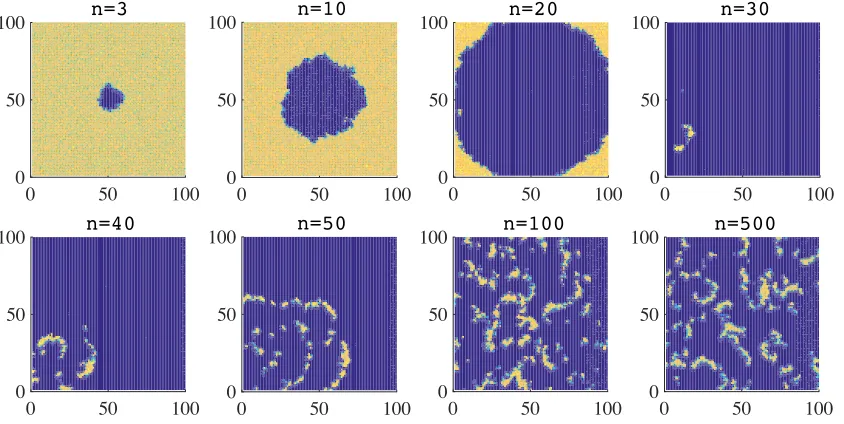
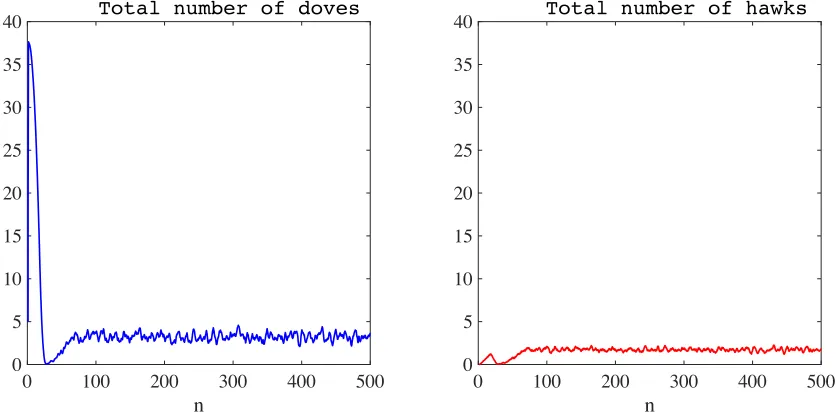
In the absence of semiochemical secretion (i.e., whenν := 0, no chemotaxis), the results in Fig-ure 1 and FigFig-ure 2 show that the proliferation of the central hawk gives rise to an almost circular wavefront made up of hawks, whose expansion causes a rapid and drastic decline in the local den-sity of doves. A substantial number of hawks survive in the space behind the invasive front, leading to the formation of a trailing edge of hawks. In the trailing edge, hawks are left without doves with which they can interact. As a consequence, they die out within a few generations. Such a process culminates in the formation of small and highly concentrated clusters of hawks and doves, which are confined to a small area of the spatial domain. Successively, the interaction between these clus-ters leads to the emergence of densely populated filamentary structures of doves which are chased by sparser filaments of hawks.
0 50 100
0 50
100 n=3
0 50 100
0 50
100 n=10
0 50 100
0 50
100 n=20
0 50 100
0 50
100 n=30
0 50 100
0 50
100 n=40
0 50 100
0 50
100 n=50
0 50 100
0 50
100 n=100
0 50 100
0 50
[image:7.612.98.520.354.566.2]100 n=500
Figure 1: Plots summarising the time-evolution of the spatial distribution of doves, in the absence of semiochemical secretion (i.e., whenν = 0) and with synchronous generations. The colour scale ranges from blue (low density) to yellow (high density). The time stepnis in units of103.
0 50 100 0
50
100 n=3
0 50 100
0 50
100 n=10
0 50 100
0 50
100 n=20
0 50 100
0 50
100 n=30
0 50 100
0 50
100 n=40
0 50 100
0 50
100 n=50
0 50 100
0 50
100 n=100
0 50 100
0 50
[image:8.612.98.520.79.290.2]100 n=500
Figure 2: Plots summarising the time-evolution of the spatial distribution of hawks, in the absence of semiochemical secretion (i.e., whenν = 0) and with synchronous generations. The colour scale ranges from blue (low density) to yellow (high density). The time stepnis in units of103.
0 100 200 300 400 500 n
0 5 10 15 20 25 30 35
40 Total number of doves
0 100 200 300 400 500 n
0 5 10 15 20 25 30 35
40 Total number of hawks
Figure 3: Plot of the total number of doves (left panel) and hawks (right panel) as a function of time, in the absence of semiochemical secretion (i.e., whenν = 0) and with synchronous generations. The time average of the total number of doves is3.9853×104, while that of hawks is1.5820×104. The time stepnis in units of103, and the total numbers of doves and hawks are in units of104.
3.1.2. Dynamics with semiochemical secretion
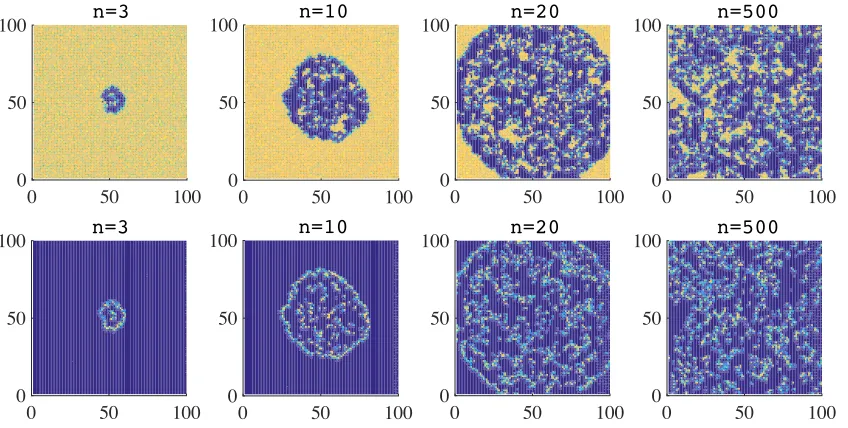
[image:8.612.97.516.357.566.2]organised into an almost circular expanding wavefront (vid. Figure 4). However, compared with the case when there is no semiochemical secretion, the wavefront is thiner, and leaves in its wake a few doves that coexist with a few hawks. We observe the formation of clusters of doves which are followed closely by flocks of hawks. The interaction between doves and hawks induces a rapid decline in the local number of doves, yielding dynamical and fluctuating spatial patterns.
0 50 100
0 50
100 n=3
0 50 100
0 50
100 n=10
0 50 100
0 50
100 n=20
0 50 100
0 50
100 n=500
0 50 100
0 50
100 n=3
0 50 100
0 50
100 n=10
0 50 100
0 50
100 n=20
0 50 100
0 50
[image:9.612.97.521.161.375.2]100 n=500
Figure 4: Plots summarising the time-evolution of the spatial distribution of doves (top panels) and hawks (bottom panels), in the presence of semiochemical secretion (i.e., when ν = 1) and with synchronous generations. The colour scale ranges from blue (low density) to yellow (high density). The time stepnis in units of103.
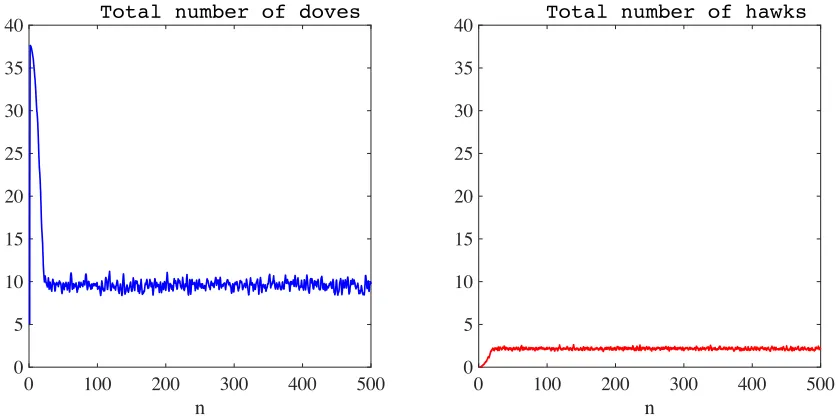
Once again, the strategies coexist in a stable way (see the results presented in Figure 5). The mean (with respect to time) of the total number of hawks and the equivalent mean of doves are, respectively,10.3450×104 and2.1118×104. These values are higher than those obtained in the case when there is no semiochemical secretion (compare the results in Figure 5 with the curves in Figure 3). Also, the ratio between the time average of the total number of hawks and the time average of the total number of doves is lower than that obtained without semiochemical secretion.
3.1.3. Effects of varying the benefit parameterb
Finally, to investigate how the value of the benefit parameterbimpinges on the interaction dynam-ics of hawks and doves, we perform again the same simulations of the two previous subsections while holding all parameters constant except for the benefit b, and we record the time average of the total number of doves and hawks.
0 100 200 300 400 500 n
0 5 10 15 20 25 30 35
40 Total number of doves
0 100 200 300 400 500 n
0 5 10 15 20 25 30 35
[image:10.612.98.517.76.286.2]40 Total number of hawks
Figure 5: Plot of the total number of doves (left panel) and hawks (right panel) as a function of time, in the presence of semiochemical secretion (i.e., whenν = 1) and with synchronous generations. The time average of the total number of doves is10.3450×104, while that of hawks is2.1118×104. The time step nis in units of103, and the total numbers of doves and hawks are in units of104.
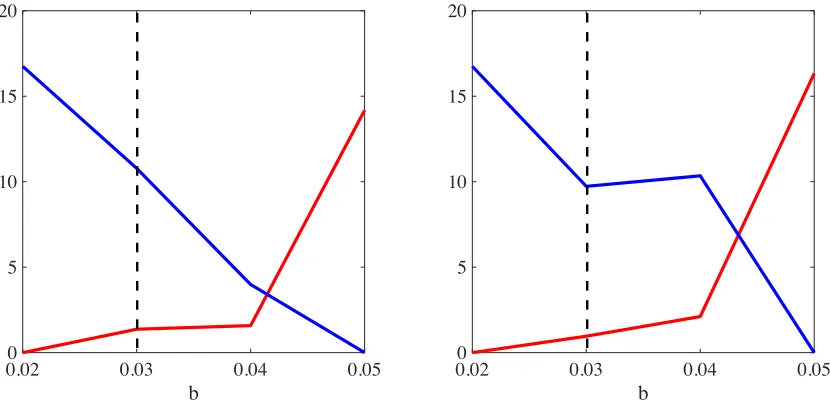
costc, the two strategies cannot coexist, and hawks go extinct. Again, for values ofb sufficiently larger thanc, all doves die out and only hawks survive. Between these extremes, we observe the stable invasion of a minority of hawks along with a substantial decrease in the average size of the resident population of doves. The limitingbvalue consistent with the stable coexistence of the two strategies is approximately the same, both in the presence and in the absence of semiochemical secretion.
3.2.
Dynamics with non-synchronous generations
We now consider the scenario in which players’ generations are non-synchronous (as previously defined). In analogy with the case of synchronous generations, we study the effects of semiochem-ical secretion on the spatio-temporal dynamics of hawks and doves first, and then we investigate how the dynamics change in response to variations in the value of the parameterb of the payoff matrix (2.7).
3.2.1. Dynamics without semiochemical secretion
0.02 0.03 0.04 0.05 b
0 5 10 15 20
0.02 0.03 0.04 0.05
b 0
[image:11.612.100.515.76.280.2]5 10 15 20
Figure 6: Plot of the time average of the total number of doves (blue lines) and hawks (red lines) as a function of the parameterb, in the absence (left panel) or in the presence (right panel) of semiochemical secretion and with synchronous generations. The black dashed lines highlight the value of the parameterc used to perform simulations. Time averages are in units of104.
small empty regions of the domain. These regions emerge due to the presence of small islands of highly concentrated hawks which outcompete the resident doves.
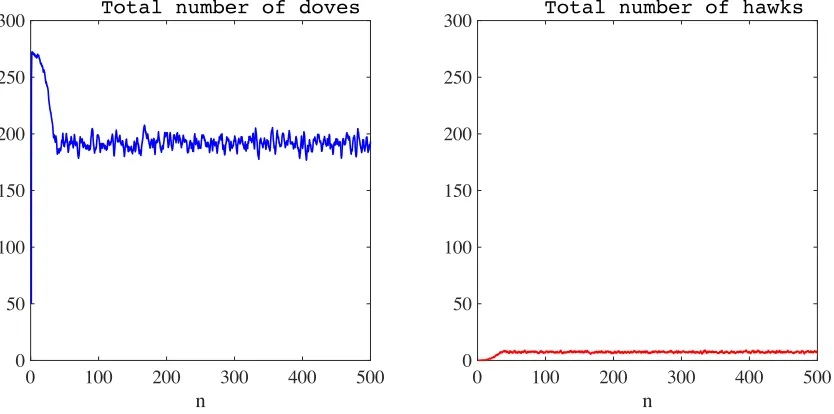
As highlighted by the results presented in Figure 8, the total numbers of doves and hawks fluctuate about well-defined non-zero values, and the two strategies coexist in a stable way. The time average of the total number of doves is195.590×103, while that of hawks is7.039×103.
3.2.2. Dynamics with semiochemical secretion
When semiochemical is secreted by players (i.e., when ν = 1, chemotactic movement present), the spatial dynamics of doves and hawks are similar to those observed in the case where there is no semiochemical secretion (compare the plots in Figure 9 with the plots in Figure 7).
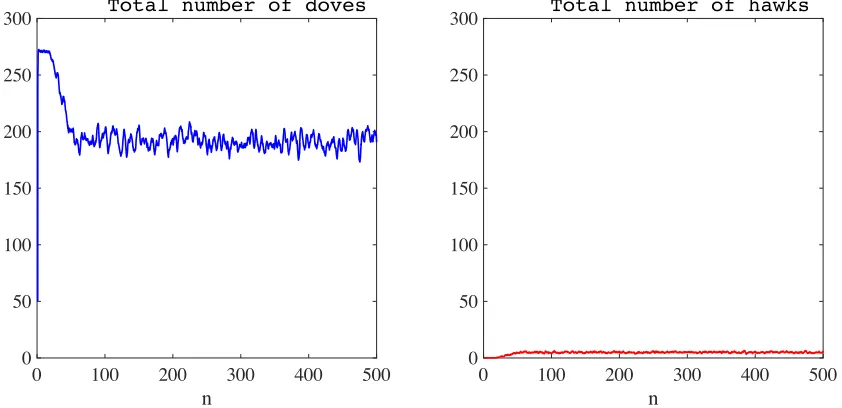
The strategies coexist in a stable way (see the results presented in Figure 10). The mean (with respect to time) of the total number of hawks and the equivalent mean of doves are, respectively,
4.631 ×10³ and 197.080× 10³. These values are similar to those obtained in the absence of semiochemical secretion (compare the results in Figure 10 with those in Figure 8). Also, the ratio between the time average of the total number of hawks and the time average of the total number of doves is lower than that obtained without semiochemical secretion.
3.2.3. Effects of varying the benefit parameterb
0 50 100 0
50
100 n=3
0 50 100
0 50
100 n=10
0 50 100
0 50
100 n=20
0 50 100
0 50
100 n=500
0 50 100
0 50
100 n=3
0 50 100
0 50
100 n=10
0 50 100
0 50
100 n=20
0 50 100
0 50
[image:12.612.99.520.77.286.2]100 n=500
Figure 7: Plots summarising the time-evolution of the spatial distribution of doves (top panels) and hawks (bottom panels), in the absence of semiochemical secretion (i.e., whenν = 0) and with non-synchronous generations. The colour scale ranges from blue (low density) to yellow (high density). The time stepnis in units of103.
0 100 200 300 400 500 n
0 50 100 150 200 250
300 Total number of doves
0 100 200 300 400 500 n
0 50 100 150 200 250
300 Total number of hawks
Figure 8: Plot of the total number of doves (left panel) and hawks (right panel) as a function of time, in the absence of semiochemical secretion (i.e., whenν = 0) and with non-synchronous generations. The time average of the total number of doves is195.590×103, while that of hawks is7.039×103. The time stepn is in units of103, and the total numbers of doves and hawks are in units of103.
[image:12.612.99.516.368.575.2]0 50 100 0
50
100 n=3
0 50 100
0 50
100 n=30
0 50 100
0 50
100 n=40
0 50 100
0 50
100 n=500
0 50 100
0 50
100 n=3
0 50 100
0 50
100 n=30
0 50 100
0 50
100 n=40
0 50 100
0 50
[image:13.612.97.521.77.290.2]100 n=500
Figure 9: Plots summarising the time-evolution of the spatial distribution of doves (top panels) and hawks (bottom panels), in the presence of semiochemical secretion (i.e., whenν = 1) and with non-synchronous generations. The colour scale ranges from blue (low density) to yellow (high density). The time stepnis in units of103.
0 100 200 300 400 500
n 0
50 100 150 200 250
300 Total number of doves
0 100 200 300 400 500
n 0
50 100 150 200 250
300 Total number of hawks
[image:13.612.97.518.373.577.2]we setc = 0.03. The results obtained are presented in the plots of Figure 11, which show how the time average of the total numbers of doves and hawks vary as a function ofb, in the absence (left panel) or in the presence (right panel) of semiochemical secretion. In analogy with the case of synchronous generations, for values ofb sufficiently smaller than the costc, the two strategies cannot coexist, and hawks go extinct. Again, for values ofbsufficiently larger thanc, all doves die out and only hawks survive. Between these extremes, the situation is more complicated than in the case of synchronous generations. In fact, there exist intermediate values ofb for which the stable coexistence of the two strategies occur but there are also intermediate values ofbthat bring about the co-extinction of hawks and doves. We note that the range of b values where co-extinction is present becomes wider in the presence of semiochemical secretion
0.02 0.03 0.04 0.05 0.06 b
0 5 10 15 20
0.02 0.03 0.04 0.05 0.06 b
[image:14.612.97.515.231.434.2]0 5 10 15 20
Figure 11: Plot of the time average of the total number of doves (blue lines) and hawks (red lines) as a function of the parameterb, in the absence (left panel) or in the presence (right panel) of semiochemical secretion and with non-synchronous generations. The black dashed lines highlight the value of the parameter cused to perform simulations. Time averages are in units of104.
3.3.
Extension of the current modelling framework
In order to demonstrate the flexibility of the modelling framework presented here, which can be easily extended to span a broad spectrum of biologically relevant scenarios, we carry out compu-tational simulations in the case in which the secretion rate of semiochemical can mutate over time. To do this, instead of modelling the rate of semiochemical secretion by means of the constant pa-rameterν, we associate to each playeria secretion rateνn
c= 0.03, whilst we choose b = 0.03andc= 0.04in the case with non-synchronous generations. In both cases, the evolution of the total numbers of hawks and doves and the related time averages are actually very similar to those presented in the previous subsections for the case without semio-chemical secretion, therefore we report here the plots of the total number of doves and hawks in the case of synchronous generations only in Figure 12 (these should be compared to the results in Figure 3). These results can be justified by noting that, at the end of simulations, the mean value of the secretion rate of semiochemical for doves and hawks are quite low, being0.007 ± 0.04and
0.143 ± 0.097in the synchronous generation case, and0.1415 ± 0.0901and0.136 ± 0.0729in the non-synchronous generation case.
0 500 1000 1500 2000
n
0 5 10 15 20 25 30 35
40 Total number of doves
0 500 1000 1500 2000
n
0 5 10 15 20 25 30 35
40 Total number of hawks
Figure 12: Plot of the total number of doves (left panel) and hawks (right panel) as a function of time, when mutations in the production rate of semiochemical occur and with synchronous generations. The time average of the total number of doves is3.4288×104, while that of hawks is1.7193×104. The time stepn is in units of103, and the total numbers of doves and hawks are in units of104.
4.
Discussion and conclusions
We have presented a hybrid modelling framework to study spatial evolutionary games. The origi-nality of our approach stems from the fact that players explicitly move in space via random motion and chemotaxis.
[image:15.612.97.517.222.428.2]doves will therefore be outcompeted by hawks. Our findings complement these previous studies by showing that, even ifb > c, when one single hawk is introduced in a population of randomly scattered doves at time t = 0, allowing players to diffuse through space and perform chemotaxis can bring about self-organised dynamical patterns in which hawks and doves coexist in propor-tions that fluctuate about non-zero values. There is a striking difference between the patterns that emerge in the case where players’ generations are synchronous and the patterns observed in the presence of non-synchronous generations. In the former case, hawks become spontaneously or-ganised into a travelling front which displaces the resident doves while expanding, whereas in the latter case hawks spread through the surrounding space leading to the formation of small holes (empty islands) in the distribution of doves. The waves of invasion created by hawks in the case of synchronous generations share some similarities with propagating waves arising in certain models of activator-inhibitor systems, excitable media and amoeboid aggregation, such as those reported by Erneux and Nicolis [14], Vasievaet al.[43] and Vasiev [42].
For synchronous generations, we have found that ifb is sufficiently smaller thanc, hawks are outcompeted by doves, which retain a competitive advantage because of their tendency to retreat at once if opponents escalate the conflict. On the other hand, for values ofbsufficiently larger thanc, doves are outcompeted by hawks. For intermediate values ofb, we observe the stable coexistence of hawks and doves. The range ofbvalues corresponding to stable coexistence is roughly the same both in the presence and in the absence of semiochemical secretion. Analogous considerations hold true for non-synchronous generations, although in this case there is a range of intermediate values ofbfor which coextinction of hawks and doves may take place. This range is wider in the presence of semiochemical secretion.
When coexistence occurs, we have shown that, compared with the situation without semio-chemical, the presence of semiochemical sensing reduces the ratio between the time averages of the total number of hawks and doves, both for synchronous and non-synchronous generations. This result suggests that the chemotactic response to semiochemicals can be beneficial to doves, namely because it enhances the rate of conspecific interactions, and thus leads hawks to play a higher number of unproductive game rounds. Also, chemotactic response to the semiochemical alters the spatial patterns generated by doves and hawks in the case where generations are syn-chronous. In fact, when semiochemical is not present, doves form densely populated filamentary structures which are chased by relatively sparser filaments of hawks. Whereas, in the presence of semiochemical, doves become organised into dynamical clusters which are followed closely by flocks of hawks. On the other, when generations are non-synchronous the structure of patterns seems to remain essentially the same both in the presence and in the absence of semiochemical sensing.
players’ production rate of semiochemical to mutate over time.
While in this paper we have focused on the Hawk-Dove game, the modelling framework pre-sented here can be used to explore the dynamics of any other spatial evolutionary game. For instance, we have already performed numerical simulations in the case where the players play ei-ther the Prisoner’s Dilemma game or the Rock-Paper-Scissors game. Overall, the results that we have obtained support the idea that our modelling framework allows for the study of unexplored scenarios in spatial evolutionary games. We also emphasise that we have not focussed on a specific system or bench-marked our model against any particular organisms. Rather the work presented here is intended to offer the perspective that mathematical modelling can complement more tra-ditional methods of evolutionary biology research by capturing in qualitative terms the implicit assumptions of evolutionary hypotheses (and any hidden underlying assumptions) and clarifying the conditions under which certain evolutionary paths are possible. The generic modelling frame-work presented in this paper potentially covers a wide range of actual applications across a spec-trum of biomedical systems including ecology (host-parasitoid systems, predator-prey systems; the colonisation of new habitats by invasive and, primarily, asexually reproducing plant species), epidemiology (the invasion of new host tissues by a pathogen,e.g., the invasion of organs outside of the lungs byMycobacterium tuberculosis [33]) and oncology (including the colonisation of a new niche by tumour cells following metastasis, the evolution of drug resistance [2, 3, 4]). Initial conditions that are far from the long-time limiting behaviour embody an organism encountering a new environment to which it is not currently phenotypically well-adapted, a rather ubiquitous scenario in biology and medicine.
In conclusion, we would like to remark that experience in a variety of contexts has demon-strated the value of relating individual-based stochastic models to deterministic continuum models [5, 7, 8, 10, 31, 32, 38], which make it possible to complement numerical simulations with rigorous analytical results, to achieve conclusions with broad structural stability under parameter changes. In this regard, a fundamental problem is what method of proof can be employed to derive deter-ministic mesoscopic models from the type of stochastic individual-based models which are defined in our framework. Addressing this fundamental question has potential to give unrivalled oppor-tunities to link the phenotypic characteristics of single individuals with patterns of evolution and adaptation at the population level, and it can help to address pervasive biological problems con-cerning the mechanisms underlying the selection of behavioural traits in the presence of random motion and chemotaxis.
References
[1] A.R.A Anderson and M.A.J Chaplain. Continuous and discrete mathematical models of tumor-induced angiogenesis. Bulletin of Mathematical Biology, 60(5):857–899, 1998.
[3] D. Basanta, H. Hatzikirou, and A. Deutsch. Studying the emergence of invasiveness in tu-mours using game theory. Euro. Phys. J. B, 63(3):393–397, 2008.
[4] D. Basanta, J.G. Scott, M.N. Fishman, G. Ayala, S.W. Hayward, and A.R.A. Anderson. In-vestigating prostate cancer tumour–stroma interactions: clinical and biological insights from an evolutionary game. Br. J. Cancer, 106(1):174–181, 2012.
[5] N. Champagnat, R. Ferri`ere, and S. M´el´eard. Unifying evolutionary dynamics: from individ-ual stochastic processes to macroscopic models. Theoretical population biology, 69(3):297– 321, 2006.
[6] Z. Chen, J. Gao, Y. Cai, and X. Xu. Evolution of cooperation among mobile agents. Physica A: Statistical Mechanics and its Applications, 390(9):1615–1622, 2011.
[7] R.H. Chisholm, T. Lorenzi, L. Desvillettes, and B.D. Hughes. Evolutionary dynamics of phenotype-structured populations: from individual-level mechanisms to population-level consequences. Zeitschrift f¨ur angewandte Mathematik und Physik, 67(4):100, 2016.
[8] R.H. Chisholm, T. Lorenzi, A. Lorz, A.K. Larsen, L. Neves De Almeida, A. Escargueil, and J. Clairambault. Emergence of drug tolerance in cancer cell populations: an evolutionary outcome of selection, nongenetic instability, and stress-induced adaptation.Cancer research, 75(6):930–939, 2015.
[9] P.R. De Andrade, A.M.V. Monteiro, G. Cˆamara, and S. Sandri. Games on cellular spaces: How mobility affects equilibrium. Journal of Artificial Societies and Social Simulation, 12(1):5, 2009.
[10] C. Deroulers, M. Aubert, M. Badoual, and B. Grammaticos. Modeling tumor cell migration: from microscopic to macroscopic models. Physical Review E, 79(3):031917, 2009.
[11] L.A. Dugatkin and D.S. Wilson. Rover: a strategy for exploiting cooperators in a patchy environment. American Naturalist, pages 687–701, 1991.
[12] R.T. Durrett and S.A. Levin. The importance of being discrete (and spatial). Theoretical Population Biology, 46(3):363–394, 1994.
[13] M. Enquist and O. Leimar. The evolution of cooperation in mobile organisms. Animal Behaviour, 45(4):747–757, 1993.
[14] T. Erneux and G. Nicolis. Propagating waves in discrete bistable reaction-diffusion systems.
Physica D: Nonlinear Phenomena, 67(1):237 – 244, 1993.
[16] R. Ferriere and R.E. Michod. The evolution of cooperation in spatially heterogeneous popu-lations. American Naturalist, pages 692–717, 1996.
[17] I.M. Hamilton and M. Taborsky. Contingent movement and cooperation evolve under gen-eralized reciprocity. Proceedings of the Royal Society of London B: Biological Sciences, 272(1578):2259–2267, 2005.
[18] C. Hauert. Effects of space in 2×2 games. International Journal of Bifurcation and Chaos, 12(07):1531–1548, 2002.
[19] D. Helbing and W. Yu. Migration as a mechanism to promote cooperation. Advances in Complex Systems, 11(04):641–652, 2008.
[20] G. Jian-Yue, W. Zhi-Xi, and W. Ying-Hai. Evolutionary snowdrift game with disordered environments in mobile societies. Chinese Physics, 16(12):3566, 2007.
[21] T. Killingback and M. Doebeli. Spatial evolutionary game theory: Hawks and doves revisited.
Proceedings of the Royal Society of London B: Biological Sciences, 263(1374):1135–1144, 1996.
[22] J.C. Koella. The spatial spread of altruism versus the evolutionary response of egoists. Pro-ceedings of the Royal Society of London B: Biological Sciences, 267(1456):1979–1985, 2000.
[23] J.-F. Le Galliard, R. Ferriere, and U. Dieckmann. Adaptive evolution of social traits: origin, trajectories, and correlations of altruism and mobility.The American Naturalist, 165(2):206– 224, 2005.
[24] Y.-T. Lin, H.-X. Yang, Z.-X. Wu, and B.-H. Wang. Promotion of cooperation by aspiration-induced migration. Physica A: Statistical Mechanics and its Applications, 390(1):77–82, 2011.
[25] J. Maynard Smith and G.R. Price. The logic of animal conflict. Nature, 246:15, 1973.
[26] S. Meloni, A. Buscarino, L. Fortuna, M. Frasca, J. G´omez-Garde˜nes, V. Latora, and Y. Moreno. Effects of mobility in a population of prisoner’s dilemma players. Physical Review E, 79(6):067101, 2009.
[27] M.A. Nowak, S. Bonhoeffer, and R.M. May. More spatial games. International Journal of Bifurcation and Chaos, 4(01):33–56, 1994.
[28] M.A. Nowak, S. Bonhoeffer, and R.M. May. Spatial games and the maintenance of coopera-tion. Proceedings of the National Academy of Sciences, 91(11):4877–4881, 1994.
[30] M.A. Nowak and R.M. May. The spatial dilemmas of evolution. International Journal of Bifurcation and Chaos, 3(01):35–78, 1993.
[31] K.J. Painter and T. Hillen. Navigating the flow: individual and continuum models for homing in flowing environments. Journal of The Royal Society Interface, 12(112):20150647, 2015.
[32] Catherine J Penington, Barry D Hughes, and Kerry A Landman. Building macroscale models from microscale probabilistic models: a general probabilistic approach for nonlinear diffu-sion and multispecies phenomena. Physical Review E, 84(4):041120, 2011.
[33] E. Pienaar, V. Dartois, J.J. Linderman, and D.E. Kirschner. In silico evaluation and explo-ration of antibiotic tuberculosis treatment regimens. BMC Sys. Biol., 9(1):79, 2015.
[34] P.G. Schofield, M.A.J. Chaplain, and S.F. Hubbard. Mathematical modelling of host– parasitoid systems: effects of chemically mediated parasitoid foraging strategies on within-and between-generation spatio-temporal dynamics. Journal of Theoretical Biology, 214(1):31–47, 2002.
[35] P.G. Schofield, M.A.J Chaplain, and S.F. Hubbard. Dynamic heterogeneous spatio-temporal pattern formation in host-parasitoid systems with synchronised generations.Journal of Math-ematical Biology, 50(5):559–583, 2005.
[36] E.A. Sicardi, H. Fort, M.H. Vainstein, and J.J. Arenzon. Random mobility and spatial struc-ture often enhance cooperation. Journal of Theoretical Biology, 256(2):240–246, 2009.
[37] J.M. Smith. Evolution and the Theory of Games. Cambridge university press, 1982.
[38] A. Stevens. The derivation of chemotaxis equations as limit dynamics of moderately inter-acting stochastic many-particle systems. SIAM Journal on Applied Mathematics, 61(1):183– 212, 2000.
[39] M. Tomassini, L. Luthi, and M. Giacobini. Hawks and doves on small-world networks.
Physical Review E, 73(1):016132, 2006.
[40] M.H. Vainstein, A.T.C. Silva, and J.J. Arenzon. Does mobility decrease cooperation? Journal of Theoretical Biology, 244(4):722–728, 2007.
[41] M. Van Baalen and D.A. Rand. The unit of selection in viscous populations and the evolution of altruism. Journal of Theoretical Biology, 193(4):631–648, 1998.
[42] B.N. Vasiev. Classification of patterns in excitable systems with lateral inhibition. Physics Letters A, 323(3):194–203, 2004.
[44] H.-X. Yang, Z.-X. Wu, and B.-H. Wang. Role of aspiration-induced migration in cooperation.
Physical Review E, 81(6):065101, 2010.