;9 1;?> 69 /;A2>! ;= <2=8@?.?6;9 <.??2=9
07.>>2> .91 =24@7.= [email protected]>
=TSI 5OGGMBN
. ?IFRJR >TCMJSSFE GOQ SIF 1FHQFF OG <I1
BS SIF
@NJUFQRJSX OG >S .NEQFVR
'%&*
3TLL MFSBEBSB GOQ SIJR JSFM JR BUBJLBCLF JN
=FRFBQDI->S.NEQFVR,3TLL?FWS
BS,
ISSP,$$QFRFBQDI"QFPORJSOQX#RS"BNEQFVR#BD#TK$
<LFBRF TRF SIJR JEFNSJGJFQ SO DJSF OQ LJNK SO SIJR JSFM,
ISSP,$$IEL#IBNELF#NFS$&%%'($+%()
On Dots in Boxes
or
Permutation Pattern Classes
and Regular Languages
Ruth Hoffmann
Doctor of Philosophy in Computer Science
Abstract
This thesis investigates permutation pattern classes in a language theoretic context. Specifically
we explored the regularity of sets of permutations under the rank encoding. We found that the
subsets of plus- and minus-(in)decomposable permutations of a regular pattern class under the
rank encoding are also regular languages under that encoding. Further we investigated the sets of
permutations, which in their block-decomposition have the same simple permutation, and again
we found that these sets of permutations are regular languages under the rank encoding. This
natural progression from plus- and minus-decomposable to simple decomposable permutations led
us further to the set of simple permutations under the rank encoding, which we have also shown
to be regular under the rank encoding. This regular language enables us to find the set of simple
permutations of any class, independent of whether the class is regular under the rank encoding.
Furthermore the regularity of the languages of some types of classes is discussed. Under the
rank encoding we show that in general the skew-sum of classes, separable classes and wreath classes
are not regular languages; but that the direct-sum of classes, and with some restrictions on the
cardinality of the input classes the skew-sum and wreath sum of classes in fact are regular under
this encoding.
Other encodings such as the insertion encoding and the geometric grid encoding are discussed
and in the case of the geometric grid encoding alternative and constructive ways of retrieving the
basis of a geometric grid class are suggested.
The aforementioned results of the rank encoding have been implemented, amongst other
pre-viously shown results, and tested. The program is available and accessible to everyone. We show
that the implementation for finding the block-decomposition of a permutation has cubic time
com-plexity with respect to the length of the permutation. The code for constructing the automaton
that accepts the language of all plus-indecomposable permutations of a regular class under the
rank encoding has quadratic time complexity with respect to the alphabet of the language. The
procedure to find the automaton that accepts the language of minus-decomposable permutations
has complexityO(k5) and we show that the implementation of the automaton to find the language
of simple permutations under the rank encoding has time complexityO(k52k), wherekis the size
of the alphabet. Further we show benchmark testing on previous important results involving the
Acknowledgements
I would like to express my special appreciation and thanks to my supervisor Professor Steve Linton
for his patience and understanding over the last three and a half years. For his words of wisdom
and advice, when it seemed that I was lost in the woods, or just going too fast for my own good.
Without his expert guidance this thesis would not have been possible. Further I would like to
express my appreciation to everyone in the CIRCA group, the GAP community and the staff at
both the School of Computer Science and Mathematics and Statistics for their support and advice
when it was needed.
A special thank you goes to my previous and current office mates and the Taint for your insane
attempts at keeping me sane.
Thanks to all the people in St Andrews and outside who stuck by me in high and low times,
supplying gin and banter while enduring my baking, cooking and insistent calls to the pub. You
know who you are and I love you.
Finally, I am eternally and unspeakably grateful to my brother Scott and my parents Maria
and Christoph, for being there and supporting me throughout my life, you got me here and made
Declarations
I, Ruth Hoffmann, hereby certify that this thesis, which is approximately 23000 words in length, has been written by me, and that it is the record of work carried out by me, or principally by myself in collaboration with others as acknowledged, and that it has not been submitted in any previous application for a higher degree.
I was admitted as a research student in September, 2011 and as a candidate for the degree of Doctor of Philosophy in September 2011 the higher study for which this is a record was carried out in the University of St Andrews between 2011 and 2015.
Date: Signature of candidate:
I hereby certify that the candidate has fulfilled the conditions of the Resolution and Regulations appropriate for the degree of Doctor of Philosophy in the University of St Andrews and that the candidate is qualified to submit this thesis in application for that degree.
Date: Signature of supervisor:
In submitting this thesis to the University of St Andrews I understand that I am giving per-mission for it to be made available for use in accordance with the regulations of the University Library for the time being in force, subject to any copyright vested in the work not being affected thereby. I also understand that the title and the abstract will be published, and that a copy of the work may be made and supplied to any bona fide library or research worker, that my thesis will be electronically accessible for personal or research use unless exempt by award of an embargo as requested below, and that the library has the right to migrate my thesis into new electronic forms as required to ensure continued access to the thesis. I have obtained any third-party copyright permissions that may be required in order to allow such access and migration, or have requested the appropriate embargo below.
The following is an agreed request by candidate and supervisor regarding the electronic pub-lication of this thesis:
Access to printed copy and electronic publication of thesis through the University of St Andrews.
Date: Signature of candidate:
Contents
1 Permutation Pattern Classes 9
1.1 The Very Basics . . . 10
1.2 General Permutation Pattern Classes . . . 11
1.3 Separable Classes . . . 12
1.4 Wreath Closed Classes . . . 13
1.5 Grid Classes . . . 15
2 Encodings 19 2.1 The Rank Encoding of Permutations . . . 19
2.2 Classes, Token Passing Networks and the Rank Encoding . . . 21
2.3 Insertion Encoding of Permutations . . . 27
2.4 Regular Insertion Encoded Pattern Classes . . . 28
2.5 Context Free Insertion Encoded Pattern Classes . . . 29
2.6 Geometric Grid Class Encoding . . . 29
3 Languages of Sets of Permutations and Classes 32 3.1 Introduction . . . 32
3.2 Plus-Decomposable and Plus-Indecomposable Permutations . . . 34
3.3 Minus-Decomposable and Minus-Indecomposable Permutations . . . 37
3.4 Regularity of the Direct Sum and Skew Sum of Classes . . . 39
3.5 Decomposition by a Specific Simple Permutation . . . 41
3.6 Regularity of the Inflation of Classes . . . 46
3.7 Language of Simple Permutations . . . 47
3.8 Language of Simple Permutations of Non-Regular Pattern Classes . . . 56
3.9 Regularity of Wreath Closed Classes . . . 58
4 Implementations 63 4.1 New Algorithms . . . 63
4.1.1 Block-Decomposition . . . 65
4.1.2 Plus-Indecomposable Language . . . 67
4.1.3 Minus-Decomposable Language . . . 69
4.1.4 Non-Simple Language . . . 71
4.2 Analysis of Known Algorithms . . . 76
4.3 Conclusions . . . 80
5 Grid Class Encoding 82
6 Conclusion 89
Index of Definitions 91
List of Figures
1.1 Plot ofπ= 465312. . . 11
1.2 Plot of 465312 with an occurrence of 231 indicated. . . 11
1.3 Plots of the direct and skew sums of 2413 and 13542. . . 13
1.4 π = 346978215 with an interval (solid square) and a factor (dashed rectangle) in-dicated. . . 14
1.5 Plot of inflation 24513[12,1,312,21,1] = 346978215. . . 14
1.6 AnM-gridding ofπ= 259836471. . . 16
1.7 Standard figure of M, withπindicated, and the plot ofπ with grid lines. . . 17
1.8 Example of the cell graph of a matrix. . . 18
1.9 Cell graph ofM. . . 18
1.10 Plots ofπ= 1324. . . 18
2.1 Single size 3 stack TPN. . . 21
2.2 Minimal automaton accepting the rank encoded permutations from the TPN in figure 2.1. . . 22
2.3 Example of a transducer. . . 23
2.4 One point deletion transducer over the alphabets Σ ={1,2,3}, Γ ={ε,1,2,3}. . . 24
2.5 Transpose of the one point deletion transducer, which is now a transducer over the input alphabet{ε,1,2,3}and output alphabet{1,2,3}. . . 25
2.6 Diagram of involvement transducer Hfork= 3. . . 25
2.7 A TPN with infinite but regular basis. . . 26
2.8 Deterministic automaton accepting the language of the class. . . 26
2.9 Non-deterministic automaton accepting the language of the basis. . . 27
2.10 Gridded figure and plot ofEG(M)(π) =w=a12a21a21a32a11a12a11a12, whereπ = 54638127. . . 31
3.1 Plots of 346978215 and 526184937, with all non-trivial intervals indicated. . . 33
3.2 Plot of inflation 25413[12,1,12,321,1] = 459783216. . . 33
3.3 Plot of unique block-decomposition of 459783216 = 2413[12,312,321,1] as defined by Proposition 21, where 2413 is simple. . . 34
3.4 Two plus-decompositions of 21436875, the right one being the decomposition with α1 plus-indecomposable. . . 35
3.5 Two minus-decompositions of 86735241, the right plot showing the unique decom-position with the first interval being minus-indecomposable. . . 38
3.6 Plot of a minus-decomposable permutation, where 1≤d < k. . . 38
3.7 Plot ofρ∈ C D. . . 40
3.8 Plot ofπ, with the lengths of the intervals indicated. . . 41
3.9 Possible positioning of maximal intervalsα, β inπwithα∩β=6 ∅,α∪β=π. . . . 43
3.10 Plots of parts 45, 458 and 4581 with the gaps indicated. . . 47
3.11 Gap automaton withk= 3. . . 49
3.12 Plot of position of intervalIin a non-simple permutation. . . 49
3.13 Plot of permutations represented by rank encodings inL1. . . 51
3.14 Plot of permutations represented by rank encodings inL2. . . 51
3.15 Plot of permutations represented by rank encodings inL3. . . 52
3.17 Plots of the four different types of exceptional permutations of length 8. . . 54 3.18 Plots of the four different types of exceptional permutations with the grey points
indicating two-point deletion. . . 57
4.1 Example of a non-deterministic automaton . . . 64 4.2 Plot with logarithmic axes of the test results for calculating the block-decomposition
of a permutation. . . 67 4.3 Plot with logarithmic axes of the test results for constructing the automaton
ac-cepting the language of rank encoded plus-indecomposable permutations up to rank k. . . 68 4.4 Plot with logarithmic axes of the test results of the construction of the automata
accepting the rank encodings of minus-decomposable permutations up to rankk. . 71 4.5 Plot of test results for constructing the language of non-simple permutation over
rankkwhich is the same as the size of the alphabet of the automaton against time. 76 4.7 Plot of run time ofBasisAutomaton when applied to languages of different types of
TPNs and Ωk. . . 78 4.8 Plot of run time of ClassAutomaton when applied to languages of the bases of
List of Notation
12[α1, α2] plus-decomposition
21[α1, α2] minus-decomposition
δ transition function
Γ output alphabet
Geom(M) geomentric grid class ofM
Grid(M) (monotone) grid class ofM
Λ standard figure
hCi wreath closure ofC
L|n1 union of all possible shifts ofLup ton
|w| length ofw
A[B] wreath product ofAand B
A o B wreath product ofAand B
C permutation pattern class
C D skew sum of pattern classesCand D
C ⊕ D direct sum of pattern classesC andD
Ck set of permutations corresponding toEk(C)
G(k, A) gap automaton with Σ ={1, . . . , k}and final statesA
L(n) set of words ofLfrom 1 up to lengthn∈
N
N Sk set of non-simple permutations with rank up tok in their rank encodings
Sk set of simple permutations with rank up tok in their rank encodings
Tt transposed transducerT
Pl language of prefixes of rank encoded permutations, wherePgs0(w) =l
Qi,j language of prefixes of rank encoded permutations, where ings0(w) =hg1, . . . , gni there is agx=i, 1≤x≤n, andP
x−1
h=1gh=j
Ωk set of permutations, with rank at mostkin their rank encoding
π(i) ith element ofπ
π, σ permutations
π⊕σ direct sum of permutationsπandσ
πi=π(x). . . π(y) subsequence ofπ=σ[α1, . . . , αn] corresponding to αi
Σ (input) alphabet
σ[α1, . . . , αn] block-decomposition or inflation of a permutation
σ[C1, . . . ,Cn] inflation of a permutation by classes
σπ permutation contaiment/involvement
ε empty word
AC complement set ofA
Av(B) notation for a pattern class avoiding the basisB
E rank encoding
E( ˆΩk) sublanguage ofE(Ωk) containing the words of length>1
E(π)[x, . . . , y] subword ofE(π) corresponding to πi
EG(M) geometric grid class encoding overM
EICF context free insertion encoding, achieved through insertion boundedness
EIR regular insertion encoding, achieved through slot boundness
EI insertion encoding
Ek(C) language of all rank encoded permutations with rank at mostk
ER rank encoding
gs0(w) gap sizes ofw=E(π)[1, . . . , y], y≤ |π|
gs(A) gap sizes ofA,hg1, . . . , gni
M 0/±1 matrix
M×q refinement ofM
Si(C) set of all simple permutations ofC
w=w1. . . wn word
wi letter
Chapter 1
Permutation Pattern Classes
The idea of permutation pattern classes has arisen from an exercise question in Knuth’s Art of
Computer Programming Volume 1 (section 2.2.1 exercise 5) [Knu97], where Knuth was looking into
what turned to be now known as stack sorting of permutations. Later Robert Tarjan expanded the
exercise into the research of sequences being sorted by different types of data structures. In [Tar72]
he describes the data structures as graphs. Research into seeing which permutations or unsorted
sequences can be sorted by different graphs or data structures was further pursued because of that
[AMR02, B´03, SV09]. A similar approach is to look at the permutations that are being generated
by a graph or network when a ordered sequence is given [ALT97, ALR04, Wat07]. This concept
gave rise to a natural encoding of the sets of permutations [ALT97, AAR03, ALR04, Wat07], which
turned the sets of permutations over an infinite alphabet into regular languages.
Simion and Schmidt [SS85] were amongst the first to characterise and enumerate closed sets of
permutations based on the patterns or permutations that they avoid. Further enumeration results
were of interest as the original set of permutations as determined in Knuth’s exercise, presented
to be the Catalan numbers. Amongst other constructions the enumeration of the classes of data
structures was investigated [Wes95, B´03, Atk99]. These enumeration results and the research into
it were especially driven by a conjecture proposed by Herbert Wilf at the 1992 SIAM meeting,
which stated that every permutation pattern class which avoids one permutation pattern has an
exponential growth rate. This conjecture has been found to be true and been proven by Marcus
and Tardos in [MT04].
Amongst these enumeration results the research extended into the languages of permutation
sets and their generation through token passing networks, especially when a different proof to
Knuth’s exercise was shown in [ALT97]. At the same time an interest in being able to compute
pattern classes and finding patterns in permutations developed [BBL98, UY00, AAAH01, XHP05].
An explicit language theoretic approach was first introduced in [AAR03] which also showed that
it is possible to find the regular basis of a regular class and vice versa.
In [AA05] Albert and Atkinson stipulated that the knowledge of the set of simple permutations
in a class is vital to the understanding of the whole class. This is based on the more general
research of Schmerl and Trotter into binary relational structures [ST93], which permutations are
a special case of. In fact, simple permutations are indeed crucial building blocks when it comes
to pattern classes. As seen in [AAK03, BRV08, BHV08a, BHV08b, BRBP10, BRV10, AAB11a,
AAB+11b, Vat11, PR12, Bri12, ARV12, ASV12, AV13], simple permutations are vital for
introducing a new type of classes. This new type of classes is grid classes, where we are looking at
permutation classes consisting of permutations that have blocks of sequences order isomorphic to
subpermutations placed in different positions [Wat07, VW11a, VW11b, Bri12, AV13, Bev13].
In this thesis we will be discussing different types of encodings of permutations and the language
theoretic consequences of these encodings. Especially we will be looking at the rank encoding,
which is the natural encoding of permutations generated by token passing networks. We will
show the regularity of sets of plus- and minus-(in)decomposable permutations andσ-decomposable
permutations. Further we will prove that the set of simple permutations under the rank encoding is
regular and that we can find the set of all simple permutations in a non-regular class. Additionally
we discuss the insertion encoding and the encoding of geometric grid classes, where for the latter
we suggest constructive ways of finding the basis of a geometric grid class. Finally, for the results
involving the rank encoding, we have written implementations. This program is available for
anyone to use.
1.1
The Very Basics
First, here are several basic but important definitions before we start talking about permutation
pattern classes.
Definition 1. A word w=w1. . . wn is a sequence of symbols wi (called letters) which lie in an
ordered set called thealphabet. An alphabet can be a finite or infinite set. A word can be empty. Thelength of a wordw=w1. . . wn is denoted as|w|=n, wheren is the number of letters ofw. The empty word has length 0.
Definition 2. Asubsequence of a wordwis a word itself and is obtained by removing some or no
letters ofwand preserving the order of the remainder.
Definition 3. Afactor of a word wis a consecutive subsequence ofw.
Definition 4. Apermutation πis a bijective function of a set onto itself.
In permutations, we will be typically using the set [n] = {1, . . . , n} , where n ∈N and allow
for the possibility that the set can also be empty. A permutation can be represented intwo-line notation π= π(1)1 π(2)2 ...... π(nn)
; incycle notation as a sequence of cycles (x, π(x), π(π(x)), . . .) for x∈ [n], until the image reaches x; as asequence π(1)π(2). . . π(n) of the set{1, . . . , n}, which is the same as reading the lower line of the two-line notation; or as aplot where (i, π(i)) are points of the permutation drawn on a discrete (x, y) plane.
A permutationπ=π(1). . . π(n) can be interpreted as a word in which the letters are distinct
and taken from the alphabet{1, . . . , n}, n∈N. The sequence or word notation of a permutation
is the main notation that will be used.
Example. The permutationπ= 465312is in cycle notation π= (1435)(26), in two-line notation
π= 1 2 3 4 5 6 4 6 5 3 1 2
1 1
2 2
3 3
4 4
5 5
[image:13.595.253.346.83.179.2]6 6
Figure 1.1: Plot ofπ= 465312.
1.2
General Permutation Pattern Classes
Definitions. order isomorphism, involvement, containment
Two sequences π= π(1), . . . , π(n) and σ = σ(1), . . . , σ(n) of the same length are said to be
order isomorphic if, for all i, j, π(i) ≤ π(j) if and only if σ(i) ≤ σ(j) [Atk99]. The notion of patterns in permutations is known asinvolvement or containment. We say that a permutation σ = σ(1). . . σ(n) is contained or involved in a permutation π = π(1). . . π(m), where n ≤ m, if there is a subsequence in π that is order isomorphic to σ. This is denoted by σ π . The
containment order is a partial order on the set of all permutations [Bri10].
Example. 231465312 as231is order isomorphic to453, along with other subsequences.
1 1
2 2
3 3
4 4
5 5
6 6
Figure 1.2: Plot of 465312 with an occurrence of 231 indicated.
Definitions. permutation pattern class, basis
Apermutation pattern class is a set of permutations closed downwards under the containment order. In other words, a setC of permutations is a pattern class ifπ∈ C andσπimpliesσ∈ C.
Unless otherwise mentioned, if we say a set is closed, we mean that it is closed downwards under
the above mentioned order. The complement set,CC, of a pattern classC is closed upwards under
the containment order, i.e. ifπ∈ CC with πσthenσ∈ CC. The set of minimal permutations
ofCC is called thebasis B ofC and we can describe pattern classes
C=Av(B) ={π:σπ, for allσ∈B}
as the set of permutations avoiding the basis [AAR03]. The classCcan be represented by its basis
asAv(B).
Example. The class of all strictly increasing permutations, C ={1,12,123,1234,12345, . . .} has
[image:13.595.251.348.400.498.2]In [Atk99] M. D. Atkinson states the following theorems on the construction of pattern classes
based on the knowledge of other pattern classes.
Theorem 5. [Atk99] Suppose thatC andDare closed sets. ThenC ∩ DandC ∪ Dare also closed.
Moreover, ifC andD each have a finite basis then bothC ∩ D andC ∪ Dhave a finite basis.
Theorem 6. [Atk99] Suppose thatC and D are closed. Let [C,D] be the set of all permutations
which are concatenations σπ, where σ is order isomorphic to a permutation in C andπ is order isomorphic to a permutation in D. Then[C,D] is closed. Moreover, ifC andD are each finitely based then so is[C,D].
These theorems allow us to construct new classes from the basic ones that are known. Further
interest lies in the different types of classes, which are bound to permutations with the same
properties.
1.3
Separable Classes
Definitions. direct sum of permutations, skew sum of permutations
The research into constructing pattern classes from smaller or known pattern classes has been
extensive. Particularly, research in observing the enumerative properties of the constructed classes
[Wes95]. Separable classes come from the idea of the direct and skew sum of permutations, which
are the generalisation of two special cases of block-decomposition of permutations (see section 3.1).
Thedirect sum of permutations πandσ, with lengthsm, nrespectively, is defined as (π⊕σ)(i) =
(
π(i) if 1≤i≤m
σ(i−m) +m ifm+ 1≤i≤m+n
[AAV11].
Theskew sum of permutations πandσ, with lengthsm, nrespectively, is defined as (π σ)(i) =
(
π(i) +n if 1≤i≤m
σ(i−m) ifm+ 1≤i≤m+n
[AAV11].
Example. Let π= 2413andσ= 13542 then
π⊕σ= 241357986
1 1
2 2
3 3
4 4
5 5
6 6
7 7
8 8
9 9
1 1
2 2
3 3
4 4
5 5
6 6
7 7
8 8
9 9
Figure 1.3: Plots of the direct and skew sums of 2413 and 13542.
Definitions. direct sum of pattern classes, skew sum of pattern classes, separable pattern classes
Following the definitions of the direct and skew sums of permutations, the direct and skew sums
of pattern classes are defined as follows. Thedirect sum of pattern classes C,Dis
C ⊕ D={ρ : ρ=π⊕σ, π ∈ C, σ∈ D}.
Theskew sum of pattern classes C,Dis
C D={ρ : ρ=π σ, π ∈ C, σ∈ D}.
Combining the notions of direct sums and skew sums leads us to another pattern class.
Proposition 7. [AAV11] The class of separable permutations is the smallest non-empty class C
that satisfies bothC ⊕ C ⊆ C andC C ⊆ C.
The basis of the class containing all separable permutations is{2413,3142}[BBL98].
1.4
Wreath Closed Classes
Definitions. interval, block
To define wreath classes we have to start at the definition of the wreath product (or inflation)
of permutations. Aninterval (or block see [AA05]) in a permutation σis a factor of contiguous values ofσ.
Example. In π= 346978215,π(4)π(5)π(6) = 978 is an interval and a factor, whereas
1 1
2 2
3 3
4 4
5 5
6 6
7 7
8 8
[image:16.595.232.368.83.223.2]9 9
Figure 1.4: π= 346978215 with an interval (solid square) and a factor (dashed rectangle) indicated.
Definitions. inflation, block-decomposition, deflation of permutations
Given a permutationσ =σ(1). . . σ(m) of length m and non-empty permutationsα1, . . . , αm
the inflation of σ by α1, . . . , αm, written as σ[α1, . . . , αm], is the unique permutation obtained
by replacing each entry σ(i) by an interval that is order isomorphic to αi, where the relative
ordering of the intervals corresponds to the ordering of the entries of σ [AA05]. Conversely, a
block-decomposition or deflation [AA05] of a permutation πis any expression of πwritten as an inflationπ=σ[α1, . . . , αm].
Example. The inflation of σ = 24513 with α1 = 12, α2 = 1, α3 = 312, α4 = 21, α5 = 1 is
24513[12,1,312,21,1] = 346978215. In other words a possible block-decomposition of346978215 is
24513[12,1,312,21,1].
1 1
2 2
3 3
4 4
5 5
6 6
7 7
8 8
9 9
Figure 1.5: Plot of inflation 24513[12,1,312,21,1] = 346978215.
Definitions. inflation of classes, wreath product, wreath closed, wreath closure
We can extend the definition of inflation of permutations to classes as follows
σ[C1, . . . ,Cn] ={σ[α1, . . . , αn] :αi∈ Ci}
where|σ|=n [AA05] . This is a set of permutations, which are bound by the permutationσ in
their decomposition. Furthermore, we can say that thewreath product [AS02, Bri07, Kit11] of two classesAandBis
[image:16.595.231.368.440.579.2]The wreath product is also sometimes denoted asA[B] . The following lemma is from [AS02], it
shows that we can build further permutation classes through the wreath product.
Lemma 8([AS02]). If AandB are closed thenA o B is closed.
Now, we can define a class A to be wreath closed if A=A o A, and in [AA05] the following proposition was shown.
Proposition 9([AA05]). A class is wreath closed if and only if its basis consists entirely of simple
permutations.
See chapter 3 for more information on simple permutations and the block-decomposition of
permutations.
Thewreath closure hAiof a pattern classAis the smallest wreath closed set that containsA. We can describehAias union of wreath products
hAi=
∞
[
n=1 An,
whereA=A1andAn+1=A o An [AA05].
Corollary 10([AA05]). LetA be a wreath closed class. Then
A=hSi(A)i,
whereSi(A) ={π:π∈ A, πsimple}.
1.5
Grid Classes
We now want to introduce a different way of representing classes. Similarly to the wreath product
we are thinking of blocks in the plot of a permutation and how we position points in those blocks.
Here we are given a grid on the plot of a permutation and we define the positioning of the points
of the permutation in those cells. The behaviour of the permutations over the grid is described
by matrices. Grid classes unify different theories concerning pattern classes of permutations of a
specific form, amongst others. For example, the skew-merged permutations [HV06, AV13], which
in the past were described as the permutations of a union of a decreasing subpermutation with
an increasing subpermutation. Now this pattern class can be more easily defined as the grid class
over the matrix −1 1 1 −1
!
[HV06].
Remark 11. Please note that all matrices, in a grid class context, are indexed starting at the bottom left corner and the order is swapped. Namely, the entryijof a matrix is in thei-th column
from the left andj-th row from the bottom. This change in notation is due to the more natural
correspondence to the plot representation of permutations.
Example. The 3×4-matrixM is indexed in the following way
(1,4) (2,4) (3,4)
(1,3) (2,3) (3,3)
(1,2) (2,2) (3,2)
(1,1) (2,1) (3,1)
soM2,3= (2,3)denotes the entry in the second column from the left, and the third row from below.
In general, the entries of matrices of grid classes are permutation classes, usually represented
by their bases. We will be concentrating on matrices withAv(21) orAv(12) as entries. These grid
classes are calledmonotone grid classes.
Definitions. gridding matrix, 0/±1 matrix, M-gridding
Let M be anm×n matrix, where the entries are either 0, 1 or −1. This matrix is called a
gridding matrix [Wat07] or a 0/±1matrix [AAB+11b, VW11a]. AnM-gridding of a permutation
π, |π| =k, is a pair of sequences, 1 = c1 ≤ · · · ≤ cm+1 = k+ 1 of m+ 1 distinct vertical lines
(column divisions) and 1 =r1≤ · · · ≤rn+1 =k+ 1 ofn+ 1 distinct horizontal lines (row divisions)
which divide the plot of a permutation into cells, such that for eachi, jpoints ofπin cellij are
• increasing, ifMij = 1;
• decreasing, ifMij=−1 or
• there are no points ofπinij, ifMij= 0. [Vat11, VW11a]
Example. An example of a0/±1matrix is
M = 0 −1 1
1 −1 −1
!
.
The permutationπ= 259836471has anM-gridding, with column divisionsc1, c2, c3, c4= 1,3,7,10
and row divisionsr1, r2, r3= 1,6,10, which is shown in figure 1.6.
1 1
2 2
3 3
4 4
5 5
6 6
7 7
8 8
[image:18.595.231.367.439.580.2]9 9
Figure 1.6: AnM-gridding ofπ= 259836471.
Definitions. M-griddable permutation, M-gridded permutation, M-griddable class, monotone
grid class, standard figure, geometric grid class
Ifπhas anM-gridding, thenπis said to be M-griddable. A permutation with such a gridding is called an M-gridded permutation. Similarly, a permutation class C is said to be M-griddable
if everyπ∈ C isM-griddable. The class consisting of allM-griddable permutations is called the
(monotone) grid class ofM, and is denoted Grid(M) [Vat11, Bri12, AAB+11b].
LetM be a 0/±1 matrix. Thestandard figureofM, denoted Λ, is the point set inR2constrained
to increasing line segments from (i−1, j−1) to (i, j) ifMij = 1, decreasing line segments from
(i−1, j) to (i, j−1) if Mij =−1, and no points between (i−1, j−1) and (i, j) ifMij = 0. The
geometric grid class of M, denoted as Geom(M), is the set of permutations that can be drawn on the standard figure Λ as follows: choosenpoints in Λ where no two points lay on a common
horizontal or vertical line, label these points from 1 tonfrom bottom to top, and read the labels
off from left to right [ARV12, AAB+11b]. In other words, the plot of each permutation is a subset
of Λ [Bev13].
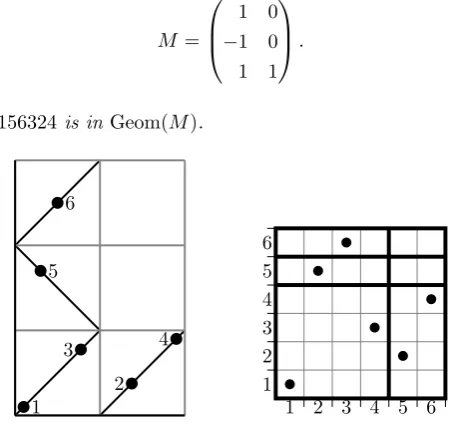
Example. Let the 0/±1 matrix be
M =
1 0
−1 0
1 1
.
The permutationπ= 156324is inGeom(M).
1 5
6
3
2 4
1 1
2 2
3 3
4 4
5 5
[image:19.595.182.407.240.451.2]6 6
Figure 1.7: Standard figure ofM, with πindicated, and the plot ofπwith grid lines.
In [AAB+11b] it has been noted that Geom(M)⊆Grid(M), this is due to the fact that the
points of the permutations in a geometric grid class are fixed on the lines in the plane, whereas in
monotone grid classes the placement is more flexible.
Definitions. cell graph
Thecell graph of a matrixM is a graph with set of vertices {(i, j) :Mij 6= 0}, where vertices are adjacent if the corresponding cells ofM share a row or a column.
Theorem 12([AAB+11b]). If the cell graph ofM is a forest thenGeom(M) = Grid(M).
Example. Let
M = 1 0 −1
−1 1 0 !
1,1 1,2
2,1
[image:20.595.242.351.79.144.2]3,2
Figure 1.8: Example of the cell graph of a matrix.
Example. Here is an example of a matrix M and a permutation π such that π∈ Grid(M)but
π /∈Geom(M). Let
M = 1 −1
−1 1 !
andπ= 1324.
The cell graph ofM is
1,1 1,2
2,1 2,2
Figure 1.9: Cell graph ofM.
and the geometric gridding ofπ is
1 1
2 2
3 3
4 4
1 3
[image:20.595.206.394.410.503.2]2 4
Figure 1.10: Plots ofπ= 1324.
The plot of π reveals that even though an M-gridding can be found for π it is not possible to find a geometrical gridding ofπ overM because if the points 1 and4 are set on line segments in
Λ, then moving the points 2 and3 is not possible without moving1 and 4 off their line segments. Thus
1324∈Grid(M)but 1324∈/ Geom(M).
Theorem 13([AAB+11b]). Every geometrically griddable class is finitely based.
Proposition 14([AAB+11b]). The union of a finite number of geometrically griddable classes is
geometrically griddable.
We can see again that having an understanding of smaller geometric grid classes allows us to
Chapter 2
Encodings
Most research in permutation pattern classes was and still is interested in classifying and
enumer-ating pattern classes. The cross-over from permutation pattern classes to formal languages came
naturally and as there is more knowledge and computing power within languages. Overall the
research into pattern classes is benefiting from this alternative representation.
In this chapter we will present three different encodings, namely therank encoding, theinsertion encoding and the encoding of geometric grid classes. Many permutation pattern classes lead to regular languages under the rank encoding [AAR03], which is a form of Lehmer code [Leh60]. Under
the insertion encoding many pattern classes are either regular [Vat12] or context-free languages
[ALR05]. All geometric grid classes have been found to be regular under their encoding [AAB+11b].
Having regular and context-free languages makes pattern classes highly computable through their
representation as regular expressions and automata. For more details on the theory of languages
and automata see [HMU06]. We will not restate basic facts about languages and automata.
2.1
The Rank Encoding of Permutations
Definitions. rank encoding, rank
Therank encoding of a permutationπ=π(1)π(2). . . π(n) is the sequenceER(π) =p1p2. . . pn,
where for alli∈ {1, . . . , n},
pi= n
j:j∈ {i, . . . , n}, π(j)≤π(i)o
is the rank of π(i), amongst the entries of π that have not occurred yet while reading the per-mutation π from left to right. [AAR03]. We denote the rank encoding of a permutation π as
ER(π).
below.
Permutation Encoding Unused values
541963728 ∅ 123456789
41963728 5 12346789
1963728 54 1236789
963728 541 236789
63728 5416 23678
3728 54163 2378
728 541632 278
28 5416322 28
8 54163221 8
∅ 541632211 ∅
Reversely, the sequenceER(σ) = 314341221represents the rank encoding of σ= 316582794. Encoding Permutation Unused values
314341221 ∅ 123456789
14341221 3 12456789
4341221 31 2456789
341221 316 245789
41221 3165 24789
1221 31658 2479
221 316582 479
21 3165827 49
1 31658279 4
∅ 316582794 ∅
Definitions. inversion
The rank encoding is a natural encoding of the permutations sorted by networks and stacks,
as introduced in [ALT97]. Another way of thinking of the rank encoding is as the language of
inversions. An inversion in a sequence s1. . . sn is a subsequence sisj, i < j, which is order isomorphic to 21. Therank encoding of a permutationπ, |π|=nis the sequence of the numbers of inversions (plus 1) that involvesπ(i) of every factor of the formπ(i). . . π(n), i∈ {1, . . . , n} of
the permutation.
It is important to note for the characterisation of the language of rank encoded permutations
that not every sequence in {1, . . . , n}n represents a permutation, as there are nn sequences in
{1, . . . , n}n and onlyn! permutations of lengthn. For example the sequence 334644211 is the rank encoding of the permutation 346978215, whereas the sequence 234664311 cannot be decoded into a
permutation as the second 6 in the encoding decodes to 10 but the decoded word will be of length
2.2
Classes, Token Passing Networks and the Rank
Encod-ing
The abstract theory oftoken passing networksis essential to different aspects of computer science in real world situations. For example, a token passing network can represent a distributed computing
network and the data communication within it or parallel computers and the bits and bytes flowing
along the architecture. Feeding networks with numbered tokens and analysing the patterns of the
output, has implications for the resequencing problem of packet-switching networks. Furthermore,
the understanding of the outputs of token passing networks could lead to the improved apprehension
of real world applications. The problem of sorting permutations using a stack, as specified by Knuth
in [Knu97] can also be represented as an infinite token passing network.
Definitions. token passing network (TPN)
Formally, a token passing network is a finite directed graph with a designated input node and a designated output node. The input node has no incoming edges from other nodes whereas the
output node has no outgoing edges to other nodes. The input node generates a sequence of tokens,
labelled 1,2,3, . . ., and the output node collects the tokens in the order they arrive. These tokens
are passed on to the nodes within the graph, where each node, apart from the input and output
nodes, can hold at most one token at any time. The edges do not hold tokens but are there to
pass them on.
The following must hold if a tokentmoves from a node xto a nodey;
• There is an edge fromxtoy;
• xis the input node, and the tokens 1, . . . , t−1 have been moved, orxis any other node but
not the output node;
• lastly, either y is the output node or y is not the input node and currently is not occupied by a token [ALT97].
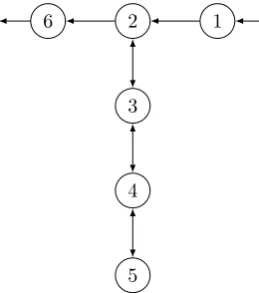
Example. The TPN described in Knuth’s exercise in [Knu97] is based on an infinite stack.
Fig-ure 2.1 represents such a TPN with a finite stack of size3.
1 2
3
4
[image:23.595.231.361.547.694.2]5 6
A token passing network outputs permutations of the input sequence 1, . . . , n. The set of
permutations output by a token passing network is closed under the containment order (or single
point deletion) [ALR04].
Example. The class of the TPN in figure 2.1 is Av(312).
The rank encoding of the permutations output by TPNs is a natural encoding. The rank of
each token is the number of tokens still in the TPN (plus 1) which have smaller value than the
currently output token. This is the reason for the name of this encoding. In general we know that
the maximal rank of the language cannot exceed the number of internal (not including the input
and output node) nodes of the network [ALR04].
Theorem 15. [ALT97] The rank encoded class of output permutations of a TPN is regular.
The non-minimal and non-deterministic automaton accepting the rank encoded language of a
pattern class that is output by a TPN is built by letting each state of the automaton represent a
possible configuration of tokens in the network [ALT97].
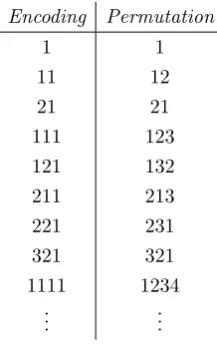
Example. Let the token passing network be the single stack of size3as in figure 2.1. The network
can be saturated with4tokens, so our maximal rank will be4. The language of all words representing permutations created by the single stack of size3, over the alphabetΣ ={1,2,3,4}is accepted by the minimal automaton below, the originally constructed non-deterministic automaton has32states.
1 start
2
3
4
5 1
2 3
4 1
2
3
4
1 2
3
4
1,2 3
4
1,2,3,4
Figure 2.2: Minimal automaton accepting the rank encoded permutations from the TPN in fig-ure 2.1.
The regular expression has the form
(44∗3|3) (44∗3|3)∗2|2 (44∗3|3) (44∗3|3)∗2|2∗1|1
with the shortest words being
Encoding Permutation
1 1
11 12
21 21
111 123
121 132
211 213
221 231
321 321
1111 1234
..
. ...
Definitions. Ωk, regular class
In [AAR03] it was shown that the set of rank encoded permutations with highest rank k,
denoted as ER(Ωk), is regular. If we have a pattern class that is a subset of Ωk and a regular
language under the rank encoding, we will call that pattern class aregular class. Further, in that same paper the following theorem was proven.
Theorem 16. [AAR03] A closed subset of Ωk is regular if and only if its basis is regular.
The proof and the construction of the regular language of the basis is set around the theory
of transducers, which translate one language to another using given rules. In this case the rules
are based around point deletion in permutations and the effect point deletion has on the rank
encoding.
Definitions. finite state transducer
Afinite state transducer is a type of finite automaton with output strings. Thus it is a sextuple (Σ,Γ, S, δ, s1, A), where Σ is the input alphabet, Γ is the output alphabet, S is the finite set of
states,δis the transition functionS×(Σ×Γ)→S,s1∈S is the start state andA⊆S is the set
of accept states.
Example. Below is an example of a transducer that takes words over the alphabet {1,2} and
returns words over the same alphabet.
1
start 2
2|1 1|2
2|2 1|1
[image:25.595.242.351.97.273.2]2|2 1|1
Figure 2.3: Example of a transducer.
First let us look at the construction of the language of the basis from the class. Let C be a
regular class under the rank encoding with the languageER(C). We want to find the basisB ofC
which is the minimal set of permutations not in the class. In [AAR03] it is shown that the language
ER(B) ofB can be found using the equation
ER(B) = (ER(C))C∩((ER(C))CDt)C,
whereDis a transducer that deletes an arbitrary letter in a rank encoded permutation, and returns
a word that represents the permutation that had the point removed that corresponds to the removed
letter. Further,Dtis the transpose of the transducerD, which means that the transducerDtwill
add a letter to the word, because the transpose of a transducer has the input and output alphabets
interchanged, as well as the letters on the transitions.
Example. Let k= 3then the one point deletion transducer Dhas input alphabet{1,2,3}, output
alphabet{ε,1,2,3} and the following form.
4 start
2
1 3
2|1 3|2
1|1
3|2
1|1 2|2
1|1 2|2 3|3
1|ε 2|ε 3|ε
[image:26.595.201.396.308.530.2]1|1 2|2 3|3
Figure 2.4: One point deletion transducer over the alphabets Σ ={1,2,3}, Γ ={ε,1,2,3}.
So if the permutation π = 243516 with the encoding ER(π) = 232211 has the point π(3) = 3
point deleted, then the output permutation is π0 = 23415 with the encoding ER(π0) = 22211. The one point deletion transducer does exactly that, but without knowing what the underlying permutation is. So it takes the wordw = 232211 and returns a set of words, which are all valid rank encodings with a letter less than the starting word andw0= 22211is amongst them.
Just to re-iterate, to transpose a transducerDtmeans to change the letters on the transitions,
so the output letter is turned to the input letter and vice versa.
Example. Figure 2.4 shows the deletion transducer over the input alphabet {1,2,3}, whereas the
4 start
2
1 3
1|2 2|3
1|1
2|3
1|1 2|2
1|1 2|2 3|3
ε|1 ε|2 ε|3
1|1 2|2 3|3
Figure 2.5: Transpose of the one point deletion transducer, which is now a transducer over the input alphabet{ε,1,2,3}and output alphabet{1,2,3}.
This means that the transducer now adds a letter to a rank encoded word, and thus a point to the corresponding permutation. Take w = 22211 and add a letter to get w0 = 232211. The corresponding permutations areER(π) =w= 23415andER(π0) =w0= 243516.
Secondly, it has been shown in [AAR03] that it is also possible to move from knowing the
language of the basis to the language of the class under the rank encoding. This is done by using
an involvement transducerHthat removes any number of letters from the input word while still
returning a valid rank encoded word which corresponds to the permutation with the same set of
points removed.
ER(C) = (ER(B)Ht)C∩ER(Ωk).
Example. The involvement transducer fork= 3has the following form.
4
start 3
2 1 3|2
2|1
3|ε 1|1
1|ε 2|ε
1|ε 3|2
2|ε
3|ε 1|1
2|2 2|1
1|1
1|ε 2|ε 3|1 3|ε
1|ε
2|ε 1|1 2|2 3|3 3|ε
Figure 2.6: Diagram of involvement transducerHfork= 3.
classC of that TPN is regular under the rank encoding. So is the language of the basis B, where the basis is infinite.
1 2 3 4 5 6
Figure 2.7: A TPN with infinite but regular basis.
The language of the class is
ER(C) = (22∗3|3) (12∗3|3)
∗
12∗1|2 (33∗1|33∗2|2) (33∗1|2)∗1|1
|22∗1|1∗
and the language of the basis is
ER(B) = 31(31)∗321|322321.
The shortest words of these languages are Class Encoding Permutation 1 1 11 12 21 21 111 123 211 213 121 132 .. . ... Basis Encoding Permutation 322321 324651 3231321 3251764 323131321 325174986 .. . ...
The two figures below show the automata accepting these languages.
1 start 2 3 4 5 6 7 8 1 2 3 1 2 3 1 2 3 1 2 3 1 2 3 1,2 3 1 2 3 1,2,3
1
start 2 3
4
5
6
7
8
9
10
1 2
2
3
3
1
2
3
1
1 2
Figure 2.9: Non-deterministic automaton accepting the language of the basis.
It is interesting to see that the automaton of the basis, although larger is less complicated than the automaton of the language. This is similar in the regular expressions of these languages.
2.3
Insertion Encoding of Permutations
Definitions. insertion encoding, configuration, slot
For completeness we mention a generalisation of the rank encoding. The idea of theinsertion encoding is to keep track of how a permutation is built by adding the next highest element into a configuration of the permutation containing slots [Eld04]. A configuration is the state of a permutation after adding a maximal element. It is represented as a sequence of numbers andslots, denoted by . The manner of the insertion is recorded and builds the insertion encoded word.
There are four different ways of inserting a new elementxinto a slot:
→ x is represented bym, for middle,
→ x is represented byl, for left,
→ x is represented byr, for right,
→ x is represented byf, for fill.
Each of these insertion operations carries a subscript that indicates on which slot in the current
configuration it operates [ALR05, SV09]. The alphabet of the insertion encoding will be those
operations with their subscripts and the words over that alphabet will be the instructions how to
construct the corresponding permutation. We denote the insertion encoding of a permutationπ
asEI(π).
Example. The permutationπ= 316582794is insertion encoded asEI(π) =m1m2f1r2m1f1l2f1f1.
Configuration Encoding
1 m1
1 2 m1m2
31 2 m1m2f1
31 2 4 m1m2f1r2
31 5 2 4 m1m2f1r2m1
3165 2 4 m1m2f1r2m1f1
3165 27 4 m1m2f1r2m1f1l2
3165827 4 m1m2f1r2m1f1l2f1
Conversely,m1r2m2m1f4f3f2f1 is decoded to the permutation84716352.
Encoding Configuration
m1r2m2m1f4f3f2f1
r2m2m1f4f3f2f1 1
m2m1f4f3f2f1 1 2
m1f4f3f2f1 1 3 2
f4f3f2f1 4 1 3 2
f3f2f1 4 1 352
f2f1 4 16352
f1 4716352
84716352
The language of a set of permutations under the insertion encoding will be regular if we limit
the subscript of the letters to at mostk. In other words, we are limiting the depth of the filling of
the open slots in each configuration [Vat12].
A set of permutations is context-free under the insertion encoding if we let the push-down
automaton accepting the language be such that each transition of the automaton must correspond
to some single letter of the insertion encoding and the number of symbols in the stack is equivalent
to the number of slots available after the prefix of the word has been interpreted [ALR05].
2.4
Regular Insertion Encoded Pattern Classes
Let us observe that it is possible to get a regular language of permutations under the insertion
encoding, by limiting the number of slots available at any configuration of the permutation. We
will denote this insertion encoding byEIR .
Definitions. slot bounded permutation
For each positive integerkthe setSB(k) of permutations for which the insertion encoding never
includes more thankslots is called the set ofkslot bounded permutations [ALR05].
Proposition 17. [ALR05] For each positive integer k the setSB(k)is a pattern class. Its basis
consists of the(k+ 1)!k!permutations of length2k+ 1of the formbabab . . . babwhere the positions marked withb are occupied by the numbers {k+ 1, k+ 2, . . . ,2k+ 1} while those marked by aare occupied be the numbers{1,2, . . . , k}.
Theorem 18. [ALR05] Let C be a pattern class that is a subclass of SB(k) for some k. The
following are equivalent:
• The languageEIR(C) is regular.
• There is a regular language EIR(B)defining a subset of B⊆ SB(k)such that C=Av(B)∩ SB(k).
Encoding permutations with this version of the insertion encoding is more inefficient than using
the rank encoding and does not lead to different or improved results. Thus, so far the rank encoding
has been commonly used instead, when wanting to look at permutation pattern classes with regular
languages.
2.5
Context Free Insertion Encoded Pattern Classes
To reach context free pattern classes with the insertion encoding, the subscripts on the slot
oper-ations will stay limited but we will allow for counting slots from the right additionally to counting
from the left side. The counting direction will be distinguished through the negative sign in the
index. We will denote this context free insertion encoding byEICF.
Definitions. insertion bounded class
Letk be a positive integer. The set IB(k) consists of all those permutations whose insertion
encodings can be written using only operations whose subscripts come from{±1,±2, . . . ,±k}. We
call this theinsertion bounded class of depth k. [ALR05]
Example. The permutationπ= 2413657can be encoded asEICF(π) =m1l1l−1f1m−1f1f1.
Configuration Encoding
1 m1
2 1 m1l1
2 13 m1l1l−1
2413 m1l1l−1f1
2413 5 m1l1l−1f1m−1
241365 m1l1l−1f1m−1f1
2413657 m1l1l−1f1m−1f1f1
Soπ∈ IB(1).
Proposition 19. [ALR05] Each setEICF(IB(k))is a context free pattern class. Its basis consists
of the set of permutations of the form:
c1a1c2a2. . . ckak(2k+ 1)ak+1ck+1. . . a2kc2k
where{a1, . . . , a2k}={1, . . . ,2k}and{c1, . . . , c2k}={2k+ 2,2k+ 3, . . . ,4k+ 1}.
Theorem 20. [ALR05] Any context free class is a subclass ofIB(k)for somek.
2.6
Geometric Grid Class Encoding
Definitions. refinement
Before we can talk about the encoding of geometric grid classes, we have to introduce a couple
of definitions on the 0,±1 matrices. Let M be a 0,±1 matrix of size m×n. As mentioned in
mq×nqmatrix obtained by replacing every 0 entry ofM by aq×qzero submatrix, every 1 entry
ofM by aq×q submatrix of the form
0 0 · · · 1 ..
. ... . .. ...
0 1 · · · 0
1 0 · · · 0
and every−1 entry ofM is replaced by a q×qsubmatrix of the form
−1 0 · · · 0 0 −1 · · · 0
..
. ... . .. ...
0 0 · · · −1 .
Example. The refinementM×2 of M = 1 0 −1
−1 1 0 !
is
M×2=
0 1 0 0 −1 0
1 0 0 0 0 −1
−1 0 0 1 0 0
0 −1 1 0 0 0
.
Definitions. partial multiplication matrix (PMM), column and row signs
The matrix M is a partial multiplication matrix (PMM) if it has column and row signs
c1, . . . , cm, r1, . . . , rn ∈ {1,−1} such that Mij = cirj or Mij = 0. In [AAB+11b] it is shown
that for every 0,±1 matrixM, its refinementM×2is a PMM. Furthermore there it is also proven
that every geometric grid class is a geometric grid class of a PMM. We can thus assume that from
now on our matrixM is a PMM, if it is not we can replaceM with its refinement M×2.
Example. The matrixM = 1 0 −1
−1 1 0 !
has column and row signsc1=r2 =−1, c2=c3 =
r1= 1.
Definitions. cell alphabet
We can now introduce the language of geometrically griddable permutations. LetM be am×n
PMM with column and row signsc1, . . . , cm, r1, . . . , rn. Thecell alphabet ofM is Σ ={aij:Mij 6= 0}. Any word in Σ∗ describes a permutation that is geometrically griddable by M by following
the rules below of how to construct permutations from these words. Each letter of Σ describes the
cell that the point is placed into, the order we place these points into the cells is defined by the
ci rj Order of insertion
1 1 left to right and bottom to top %
1 -1 left to right and top to bottom &
-1 1 right to left and bottom to top
--1 -1 right to left and top to bottom .
Table 2.1: Procedure of adding points into cells based on the column and row signs.
Example. TakeM = 1 0 −1
−1 1 0 !
with column and row signsc1=r2=−1, c2=c3=r1= 1
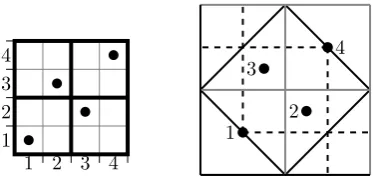
and w = a12a21a21a32a11a12a11a12 over the cell alphabet of M. Then the permutation that is
encoded bywand is geometrically griddable by M isπ= 54638127.
w1
w2
w3
w4
w5
w6
w7
w8
8
12
7
3 6
4 5
1 1
2 2
3 3
4 4
5 5
6 6
7 7
8 8
Figure 2.10: Gridded figure and plot ofEG(M)(π) = w =a12a21a21a32a11a12a11a12, where π =
54638127.
We will denote this encoding by EG(M)(π). It is worth noting that the whole language Σ∗
over the cell alphabet Σ, is the regular language of the geometric grid class of M. But there
are multiple encoded words that correspond to the same permutation. This non-uniqueness is
Chapter 3
Languages of Sets of Permutations
and Classes
In this chapter we will be concentrating on the rank encoding solely. So when we talk about the
encoding, we mean the rank encoding and that the language is regular under the rank
encod-ing. Further, unless otherwise stated in this chapter we will be denoting the rank encoding of a
permutationπasE(π).
We will be looking at the languages constructed by plus- and minus-(in)decomposable
permuta-tions,σ-decomposable permutations, and as there are equivalent definitions for classes, we will be
also investigating the languages of the direct and skew sum of classes and the wreath product of
classes. Further we will be proving that the language of simple permutations is regular under the
rank encoding and that we can find the set of simple permutations in a non-regular class. First we
will recall some definitions and vital results.
3.1
Introduction
As mentioned before, we denote the set of permutations with maximum rank k ∈ N as Ωk. In
[AAR03] Albert, Atkinson and Ruˇskuc determined thatE(Ωk) is a regular language.
Definitions. interval, block
Furthermore we re-introduce the concept of block-decomposition of permutations. Aninterval
(orblock see [AA05]) in a permutationσis a factor of contiguous values ofσsuch that their indices are consecutive.
Example. In the permutation π = 346978215, π(4)π(5)π(6) = 978 is an interval, whereas
π(1)π(2)π(3)π(4) = 3469is not.
Definitions. simple permutation
It is easy to see that every permutation of lengthnhas intervals of length 0, 1 andn, at least.
The permutations of lengthnthatonly contain intervals of length 0, 1 andnare said to besimple
[Bri10].
Example. The permutation π = 346978215 is not simple as we have seen in the example above
of length strictly greater than1, except the whole ofσ. Figure 3.1 showsπ andσ, with non-trivial intervals indicated. 1 1 2 2 3 3 4 4 5 5 6 6 7 7 8 8 9 9 1 1 2 2 3 3 4 4 5 5 6 6 7 7 8 8 9 9
Figure 3.1: Plots of 346978215 and 526184937, with all non-trivial intervals indicated.
Definitions. inflation, block-decomposition, deflation, σ-decomposable
Recall that, given a permutationσ of lengthm and non-empty permutationsα1, . . . , αm, the
inflation of σ by α1, . . . , αm, written asσ[α1, . . . , αm], is the permutation obtained by replacing each entryσ(i) by an interval that is order isomorphic to αi, where the relative ordering of the
intervals corresponds to the ordering of the entries ofσ[AA05]. Conversely ablock-decomposition
or deflation [AA05] of π is any expression of π as an inflation π = σ[α1, . . . , αm]. We say that
a permutation π is σ-decomposable if π = σ[α1, . . . , αn]. For notation, we will say that πi = π(x). . . π(y) is the contiguous subsequence of π = σ[α1, . . . , αn] corresponding to the block αi.
Additionally, we will use the same notation for the blocksπi ofπin its plot. In the rank encoding
ofπ,E(π), we will identify the subword corresponding toπi=π(x). . . π(y) asE(π)[x, . . . , y].
Example. The inflation of σ = 25413 with α1 = 12, α2 = 1, α3 = 12, α4 = 321, α5 = 1 is
25413[12,1,12,321,1] = 459783216 and alternatively a possible block-decomposition of459783216
is25413[12,1,12,321,1]. This inflation and decomposition are shown in figure 3.2.
1 1 2 2 3 3 4 4 5 5 6 6 7 7 8 8 9 9
Figure 3.2: Plot of inflation 25413[12,1,12,321,1] = 459783216.
This decomposition is not unique forπ. However, Albert and Atkinson proved:
Proposition 21([AA05]). Letπbe a permutation of finite length greater than1. There is a unique
such that
π=σ[α1, . . . , αn].
If σ6= 12,21 thenα1, . . . , αn are also uniquely determined by π. Ifσ= 12or 21, then α1, α2 are
unique so long as we require thatα1 is plus-indecomposable or minus-indecomposable, respectively.
Example. Utilising the above proposition, the unique block-decomposition of 459783216 with a
simple permutation is given by2413[12,312,321,1]as shown in figure 3.3.
1 1
2 2
3 3
4 4
5 5
6 6
7 7
8 8
[image:36.595.230.367.193.334.2]9 9
Figure 3.3: Plot of unique block-decomposition of 459783216 = 2413[12,312,321,1] as defined by Proposition 21, where 2413 is simple.
Definitions. ε,L(n),x+L, L|n
1
Lastly, let us introduce some language theoretic notation that will be used. We writeεfor the
empty word. IfL is any language then L(n) is the set of words ofL up to length n∈
N, and as
the set is finite, it is regular.
Furthermore, ifL ⊆ {l1, . . . , ln}∗is any language, then we definex+L,x∈N, to be a language
over the alphabet{l1+x, . . . , ln+x:l1, . . . , ln ∈ L},x+L ⊆ {l1+x, . . . , ln+x}∗.
We observe that this new language is still regular if Lis regular and say that the language L
is shifted upwards byx.
Lemma 22. If Lis a regular language then so is x+L.
Proof. LetA(L) be the automaton accepting the regular languageL. We can construct the auto-matonA(x+L) by replacing the lettersl1, . . . , lnin the transitions ofA(L) with the corresponding
lettersl1+x, . . . , ln+x. Clearly the resulting automaton accepts the languagex+L.
Let us say that the union of all possible shifts up tonof a regular languageL, is
L|n1 = n [
i=1
i+L
which is a regular language as regularity is preserved under a finite number of unions.
3.2
Plus-Decomposable and Plus-Indecomposable
Permuta-tions
One of the special cases in proposition 21 is the block-decomposition withσ= 12. A
permuta-tionπis said to be plus-decomposable (or is adirect sum ofα1and α2) if it can be written in the
block-decomposition as
π= 12[α1, α2].
Conversely, we call a permutationplus-indecomposable if it has no plus-decomposition [AA05]. In general,α1andα2are not unique, but if we requireα1 to be plus-indecomposable, bothα1
andα2 are unique toπ.
Example. The permutation21436875is plus-decomposable. A possible decomposition is21436875 =
12[2143,2431], but that is not unique, as2143 is plus-decomposable. Thus, the plus-decomposition of21436875with unique α1 andα2 is21[21,214653].
1 1 2 2 3 3 4 4 5 5 6 6 7 7 8 8 1 1 2 2 3 3 4 4 5 5 6 6 7 7 8 8
Figure 3.4: Two plus-decompositions of 21436875, the right one being the decomposition withα1
plus-indecomposable.
The following lemma is a characterisation of plus-decomposable permutations, to outline the
form these permutations have. It additionally facilitates the characterisation of plus-indecomposable
permutations.
Lemma 23. Let π=π(1). . . π(n)be a permutation, then the following are equivalent:
1. π= 12[α1, α2] is plus-decomposable with|α1|=` and|α2|=n−`for`∈N\ {0}, ` < n.
2. E(π) = E(π)[1, . . . , `, `+ 1, . . . , n] = E(π)[1, . . . , `]E(π)[`+ 1, . . . , n] = E(α1)E(α2), ` ∈ N\ {0}, ` < n.
3. π = ητ, where η = π(1). . . π(`) is a permutation of {1, . . . , `} and τ is a permutation of
{`+ 1, . . . , n},`∈N\ {0}, ` < n.
Proof. First we will show that point 1 implies point 3. So letπ= 12[α1, α2] be plus-decomposable
with|α1|=`and|α2|=n−`for`∈N\{0}, ` < n. Then by the definition of block-decompositions
of permutations, π consists of the concatenation of two intervalsA1 and A2, where A1 is a
con-tiguous sequence order isomorphic to α1 and A2 is a contiguous sequence order isomorphic to
α2. Further, the relative ordering of A1 and A2 corresponds to the permutation 12. Thus A1 is
a sequence over {1, . . . , `} order isomorphic to α1 and A2 is a sequence over {`+ 1, . . . , n} order
isomorphic toα2. In other words,A1=ηis a permutation of length`andA2=τis a permutation
Next, let us show that point 3 implies point 2. Let π = ητ, where η = π(1). . . π(`) is a
permutation of{1, . . . , `}andτ is a permutation of{`+ 1, . . . , n}. Then the encoding of πis
E(π) =E(ητ) =E(η)E(τ).
This is becauseηis a permutation, hence a closed interval and thus has a valid rank encoding, which
is concatenated with the encoding ofτ, as the rank encoding of two order isomorphic sequences is
the same.
Finally, we will prove that point 2 implies 1. Let E(π) = E(π)[1, . . . , `, ` + 1, . . . , n] =
E(π)[1, . . . , `]E(π)[`+ 1, . . . , n] = E(α1)E(α2). Then π consists of the concatenation of two
contiguous sequences, a1 a sequence of {1, . . . , `} order isomorphic to α1 and a2 a sequence of {`+ 1, . . . , n} order isomorphic to α2. We can see that every letter in a1 is less than any
let-ter ina2. Thus giving us the relative ordering of a1 anda2 corresponding to 12. Thus π has a
block-decomposition of the formπ= 12[α1, α2], with|α1|=`and|α2|=n−`.
To prove that the set of plus-decomposable permutations and the set of plus-indecomposable
permutations of a regular pattern classC are regular under the rank encoding, we will first prove
that the subset of plus-indecomposable permutations of a regular pattern classCform a regular
lan-guage under the rank encoding. Then it will follow that the complement set of plus-decomposable
rank encoded permutations is also regular, since the family of regular languages are closed under
complement. The proof considers the automaton that accepts the regular classC and modifies it
to accept only plus-indecomposable rank encoded permutations.
Theorem 24. LetCbe a regular class. ThenIP(C), the set of all plus-indecomposable permutations
ofC, is also regular under the rank encoding.
Proof. Conversely to the characterisation in lemma 23, the rank encodingE(π) of a plus--indecomposable permutationπof lengthnnever contains an initial segment of the form
E(π)[1. . . `] =E(p), where` < nandpis a permutation of length`.
We will utilise this description to construct the automaton accepting the language of the set of
plus-indecomposable permutations under the rank encoding.
The automaton acceptingE(IP(C)) is based on the unique minimal automaton ofE(C). Let
that automaton be
A = Σ, S, δ, s1, A,
where Σ is the alphabet, S the set of states, s1 the start state, A the set of accept states and
δ:S×Σ→S the transition function.
We will construct the automaton accepting only the plus-indecomposable rank encoded
per-mutations as follows
IP = Σ, S∪ {x, y}, δ0, x, A∪ {x}
,
wherex andy are new states andδ0: (S∪ {x, y})×Σ→S∪ {x, y} is a new transition function
defined as:
δ0(y, α) =y δ0(x, α) =δ(s1, α)
δ0(sa, α) =y δ0(s, α) =δ(s, α)
InIP the new statesx, yare the new start state and sink state, respectively. A sink state is a
stateq, where qis not the start state and q /∈A, and the transitionδfrom qfor any letterα∈Σ
isδ(q, α) =q. We are introducing a new start state, to avoid the resulting language being empty,
in case the original start states1is an accept state.
Let us now show that the new automatonIP indeed only accepts the rank encodings
corres-ponding to plus-indecomposable permutations from the automatonA of the regular classC. Let
wbe a word accepted byA. If we end up in an accept state ofA before reading the entire word,
so there is an initial segment in w that is a rank encoding of a permutation inC, then the new
transition functionδ0 will send us to the sink state yand the wordwwill not be accepted byI
P.
On the other hand ifw is a word accepted byA and by IP, we end up in an accept state only
when the entire wordwis read. The first case is only possible for plus-decomposable permutations,
as shown in lemma 23.
The automatonIP only accepts the words corresponding to plus-indecomposable permutations
ofC under the rank encoding. Thus the languageE(IP(C)) is regular, which concludes the proof
of Theorem 24.
Corollary 25. LetCbe a regular class. ThenDP(C), the set of all plus-decomposable permutations
ofC, is also regular under the rank encoding.
Proof. LetIP(C)⊆ Cbe the set of all plus-indecomposable permutations in C. AsDP(C) andIP(C) are complementary inC we have
DP(C) =C\IP(C)⇒E(DP(C)) =E(C)∩E(IP(C))C.
As regular languages are closed under intersection and complement,E(DP(C)) is regular.
In summary we have shown that the subsets of plus-decomposable and plus-indecomposable
permutations of a regular class are also regular languages under the rank encoding. Next let us
see whether the same is true for minus-(in)decomposable permutations.
3.3
Minus-Decomposable and Minus-Indecomposable
Per-mutations
Definitions. minus-decomposable, skew sum of permutations, minus-indecomposable
The other special case in proposition 21 is the block-decomposition withσ= 21. We say that
a permutationπisminus-decomposable (or is askew sum ofα1 andα2) if it can be written in the
block-decomposition as
π= 21[α1, α2].
Conversely we say that a permutation isminus-indecomposable if it has no minus-decomposition. The decomposition of a minus-decomposable permutation is unique, ifα1 is assumed to be
minus-indecomposable.
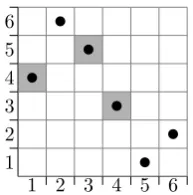
Example. The permutation 86735241 is minus-decomposable as for example 21[312,35241], but
the unique decomposition of86735241, where the first subpermutation is minus-indecomposable, is
![Figure 1.5: Plot of inflation 24513[12, 1, 312, 21, 1] = 346978215.](https://thumb-us.123doks.com/thumbv2/123dok_us/8752901.389857/16.595.232.368.83.223/figure-plot-ination.webp)


![Figure 3.3: Plot of unique block-decomposition of 459783216 = 2413[12, 312, 321, 1] as defined byProposition 21, where 2413 is simple.](https://thumb-us.123doks.com/thumbv2/123dok_us/8752901.389857/36.595.230.367.193.334/figure-plot-unique-block-decomposition-dened-byproposition-simple.webp)