Engineering, 2010, 2, 65-77
doi:10.4236/eng.2010.21009 lished Online January 2010 (http://www.SciRP.org/journal/eng/).
65 Pub
An Adaptive Differential Evolution Algorithm to Solve
Constrained Optimization Problems in Engineering Design
Youyun AO1, Hongqin CHI2
1School of Computer and Information, Anqing Teachers College, Anqing, China 2Department of Computer, Shanghai Normal University, Shanghai, China
Email: [email protected], [email protected]
Received July 28, 2009; revised August 23, 2009; accepted August 28, 2009
Abstract
Differential evolution (DE) algorithm has been shown to be a simple and efficient evolutionary algorithm for global optimization over continuous spaces, and has been widely used in both benchmark test functions and real-world applications. This paper introduces a novel mutation operator, without using the scaling factor F, a conventional control parameter, and this mutation can generate multiple trial vectors by incorporating dif-ferent weighted values at each generation, which can make the best of the selected multiple parents to im-prove the probability of generating a better offspring. In addition, in order to enhance the capacity of adapta-tion, a new and adaptive control parameter, i.e. the crossover rate CR, is presented and when one variable is beyond its boundary, a repair rule is also applied in this paper. The proposed algorithm ADE is validated on several constrained engineering design optimization problems reported in the specialized literature. Com-pared with respect to algorithms representative of the state-of-the-art in the area, the experimental results show that ADE can obtain good solutions on a test set of constrained optimization problems in engineering design.
Keywords:
Differential Evolution, Constrained Optimization, Engineering Design, Evolutionary Algorithm,
Constraint Handling1. Introduction
Many real-world optimization problems involve multiple constraints which the optimal solution must satisfy. Usu-ally, these problems are also called constrained optimiza-tion problems or nonlinear programming problems. En-gineering design optimization problems are constrained optimization problems in engineering design. Like a con-strained optimization problem, an engineering design optimization problem can be generally defined as follows [1–4]:
Minimize f(x), x[x1,x2,...,xn]n
Subject to gj(x)0,j1,2,...,q
(1) m
q q j x
hj()0, 1, 2,..., where LixiUi,i1,2,...,D
Here, is the number of the decision or parameter variables (that is,
n
x is a vector of size ), the variable varies in the range . The function
D ith
i
x [Li,Ui]
) (x
f is the objective function, gj(x) is the ine-quality constraint and
th j )
(x
hj is the equality con-straint. The decision or search space is written as
, the feasible space expressed as th
S
0 j
) ( ;
S
{
D i 1[Li,Ui]
(
| )0, 1,2,..., , 1,
x S gj x j qhj x j q
F
} ,...,m 2
q is one subset of the decision space (ob-viously, ) which satisfies the equality and ine-quality constraints.
S S
F
optimization problems. Zhang et al. [8] proposed a dif-ferential evolution with dynamic stochastic selection to constrained optimization problems and constrained en-gineering design optimization problems. Akhtar et al. [9] proposed a socio-behavioural simulation model for en-gineering design optimization. He and Wang [10] pro-posed an effective co-evolutionary particle swarm opti-mization for constrained engineering design problems. Wang and Yin [11] proposed a ranking selection-based particle swarm optimizer for engineering design optimi-zation problems. Differential evolution (DE) [12,13], a relatively new evolutionary technique, has been demon-strated to be simple and powerful and has been widely applied to both benchmark test functions and real-world applications [14]. This paper introduces an adaptive dif-ferential evolution (ADE) algorithm to solve engineering design optimization problems efficiently.
The remainder of this paper is organized as follows. Section 2 briefly introduces the basic idea of DE. Section 3 describes in detail the proposed algorithm ADE. Sec-tion 4 presents the experimental setup adopted and pro-vides an analysis of the results obtained from our em-pirical study. Finally, our conclusions and some possible paths for future research are provided in Section 5.
2. The Basic DE Algorithm
Let’s suppose that [ ,1, ,2,..., t, ] D i t i t i t
i x x x
x
are solutions at generation t, Pt {x1t,x2t,...,xNt} is the population, where denotes the dimension of solution space, is the population size. In DE, the child population
D N
1 t
P is generated through the following operators [12,15]:
1) Mutation Operator: For each xit
in parent popu-lation, the mutant vector vit1 is generated according to the following equation:
)
( 2 3
1 1 t r t r t r t
i x F x x
v (2)
where are randomly chosen and
mutually different, the scaling factor i
N r
r
r1, 2, 3{1,2,..., }\
F controls
ampli-fication of the differential variation
(
3)
. t rx
2 t rx
2) Crossover Operator: For each individual xit, a trial vector t1
i
u is generated by the following equation:
otherwise , ]) , 1 [ || ( if , , 1 , 1 , t j i t j i t j i x D rand j CR rand v
u (3)
where is a uniform random number distributed be- tween 0 and 1, is a randomly selected index from the set { , the crossover rate
rand ] , 1 [ D rand } ,..., 2 ,
1 D CR[0,1]
controls the diversity of the population.
3) Selection Operator: The child individual xit1 is
selected from each pair of xit
and uit1
by using gree- dy selection criterion:
, )) ) ( if , 1 1 1 t i t t i t i x u
x (
t i
x f otherwise
(ui
f
(4)
where the function is the objective function and the condition
f f( ) )
(uit 1 xit
f means the individual t1 i
u is better than xit
.
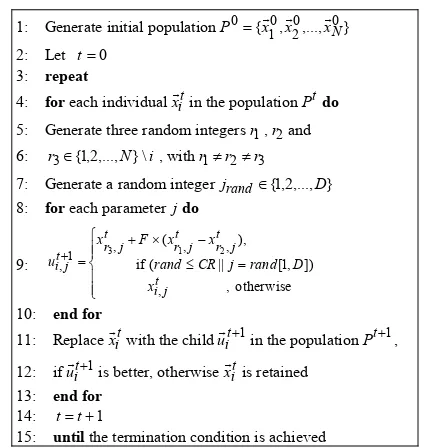
Therefore, the conventional DE algorithm based on scheme DE/rand/1/bin is described in Figure 1 [15].
3. The Proposed Algorithm ADE
3.1. Generating Initial Population Using Orthogonal Design Method
Usually, the initial population P0{x10,x20,...,xN0}
( rj U
D
of evolutionary algorithms is randomly generated as follows:
) :
, j D xi0 Lj j Lj
N
i
,j (5)
where is the population size, is the number of variables, is a random number between 0 and 1, the
variable of N
j
r
th
j xi0
is written as , which is initial-ized in the range . In order to improve the search efficiency, this paper employs orthogonal design method to generate the initial population, which can make some points closer to the global optimal point and improve the diversity of solutions. The orthogonal design method is described as follows [16]:
0 ,j i x ,..., , 2 1 x ] j x , jU L [
For any given individual [x xD]
, the ith
1: Generate initial populationP0{x10,x20,...,xN0}
2: Let t0 3: repeat
4: for each individualxitin the populationPtdo
2 r ,..., 2 , 1 D
5: Generate three random integersr1, and 6: r3{1,2,...,N}\i, withr1r2r3
j
7: Generate a random integer rand{ } 8: for each parameterjdo
9: otherwise ( if ), ( , , , 1 , 1 3 t j i t j r t j r t j i x rand rand x F x u , || , 2 t j r j CR x ]) , 1 [ D
10: end for
11: Replacexitwith the childuit1in the populationPt1,
12: ifuit1is better, otherwisexitis retained 13: end for
14: tt1
[image:2.595.316.529.472.696.2]15: until the termination condition is achieved
Figure 1. Pseudocode of differential evolution based on scheme DE/rand/1/bin.
Y. Y. AO ET AL. 67 decision variable varies in the range . Here,
each is regarded as one factor of orthogonal design. Suppose that each factor holds levels, namely, quan-tize the domain into Q levels
i
x
[Li
] , [Li Ui
i
x
Q ]
,Ui ,...,Q
j i,
, 2
1 .
The level of the factor is written as , which is defined as follows:
th
j ith
Q j U Q j j L j L a i Q L U i i j
i i i
, 1 2 , ) )( 1 ( 1 , 1
, (6)
And then, we create the orthogonal array M
with factors and Q levels, where is the number of level combinations. The procedure of con-structing one orthogonal array is de- scribed in Figure 2.
D N j i
b )
( , D N
D N j i b ( , ) M
Therefore, the initial population is generated by using the orthogonal array , where the variable of individual
D N j i x P0( 0, )
N j i
b M ( , )
0 i
x
D th
j is 0
,j i
x
. j i b ja
, ,3.2. Multi-Parent Mutation Scheme
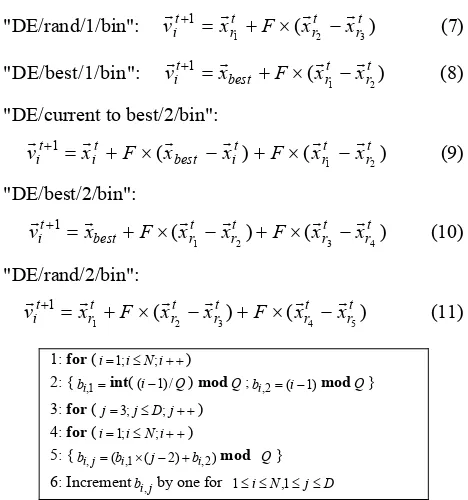
According to the different variants of mutation, there are several different DE schemes often used, which are for-mulated as follows [12]:
"DE/rand/1/bin": vit1 xrt1 F(xrt2 xrt3) (7)
"DE/best/1/bin": 1 ( 1 t2) r t r best
t
i x F x x
v (8)
"DE/current to best/2/bin":
) (
)
( 1 2
1 t r t r t i best t i t
i x F x x F x x
v (9)
"DE/best/2/bin":
) (
)
( 1 2 3 4
1 t r t r t r t r best t
i x F x x F x x
v (10)
"DE/rand/2/bin":
) (
)
( 2 3 4 5
1 1 t r t r t r t r t r t
i x F x x F x x
v (11)
1: for (i1;iN;i)
2: {bi,1int((i1)/Q) modQ;bi,2(i1)modQ} 3: for (j3;jD;j)
4: for (i1;iN;i)
[image:3.595.55.289.437.687.2]5: {bi,j(bi,1(j2)bi,2)mod Q} 6: Incrementbi,jby one for 1iN,1jD
Figure 2. Procedure of constructing one orthogonal array
D N i j)
(b
M .
best
x is the best individual of the current popula-where
tion. Usually, based on both the control parameter F and the selected multiple parents, using these DE schemes can only generate a vector after a single mutation. Tsutsui et al. [17] proposed a multi-parent recombination with simplex crossover in real coded genetic algorithms to utilize the selected multiple parents and improve the di-versity of offspring. Inspired by multi-parent recombina-tion with simplex crossover, this paper proposes a novel multi-parent mutation in differential evolution. The multi- parent mutation is described in the following.
For each individual xit
from the population Pt with population size N , i1,2,...,N . A perturbed ector
1 t i v v
is generated ccor following formula:
K
a ding to the
k t r t r k t i ti x w xk xk v
1
1 ( )
1 (12)
where r1,r2,...,rK{1,2,...,N}\i, K r d andomly chosen integers t r t r x
xK1 1
are mutually different, an . The weighted valuewkis defined as follows:
) , 1 ( K dn
ran ,w/sum() (13) where randn(1,K) is a 1-by-Kmatrix with normally distributed random numbers, su () is used for calcu-lating the sum of all compon he vector
m nts
e of t , and
] ,..., ,
[w1 w2 wK
w .
vary
According to the ingw, repeat Formulas (13) and (12) forKtimes,Knew vectors vit1{1}, vit1{2}, ...,
} { 1 K
vit
are gen ated from theer seKsele ents. n
cted par And the K vectorsxit1{1}, xit1{2},..., xit1{K} are
created by ossover and tr t
de-scribed in Subsections 3.3-3.5 respectively. Finally, an offspring individual t1
i
x
cr , repair cons ain handling
of the (t1)th generation population Pt1 is ob d by selecting the best indi-vidual from these Koffspring and their common parenttaine
t i
x .
.3. Adaptive Crossover Rate
rate is a constant
3 CR
conventional DE, the crossover CR In
value between 0 and 1. This paper prop an adaptive crossover rate CR, which is defined as follows:
oses
) )^ ( exp(
0 a b
CR Tt
CR (14)
where the initial crossover rate is and usually is set to 0.8 or 0.85
0
CR ,
a constant value t is the current
tion number and T is the max generation number, b is a shape parameter determ ing the degree of de-pendency on the g eration number, a and b are po- s ive constants, usually a is set to 2, b is set to 2 or 3. At the early stage, DE uses a bigger crossover ate CR to preserve the diversity o solutions and revent prema-ture; at the later stage, DE employs a smaller crossover rate CR to enhance the local search and prevent the better solutions found from being destroyed.
3.4. Repair Method
imal in
more of t w
en it
e
r
variables in t f
r
p
After crossover, if one o he he
n vector uit1
are beyond their bound es, e vio-ari th lated variable value uit,j1 is either reflected back from the violated b dary r set to the corresponding bound-ary value using the repair rule as follows [18,19]:
oun o 1 , t j i
e p num zation p ) ( ) 3 / 1 ( if , 1 , 1 , j t j i t j i j L u p u L ( j e e ( ) 3 / 2 2 2 3 , ) ( ) 3 / ( 2 ( ) 3 / 2 2 ) ( 2 3 / ,2 , 1 , , j j t j i j t j i t i j j j j t i j U u U U u p U u p u U L u L L u p L u
er uniform y distributed
ran-ber in g
g chni of
olv constr e
m thod ha
) ) 1 1 j j ain to ) 3 / ) 3 / 1 , 1 , t j i t j i u U u l qu ing on m ( if / 1 ( if 1 ( if 1 ( if p p
e[0,
n , if , , 1 , 1 , 1 , t j i j t j i
is a probability and the ran Feasibility-Based Rule ) (15) d opti-ndle wh dom In e i ] 1 .
3.5. Constraint Handli Te
volutionary algorithms for s roblems, the most com m
constraints is to use penalty functions. In general, the constraint violation function of one individual x is transformed by m equality and inequality constraints as follows [4]:
q m
j j w x
G()
(16) q j
j
j x w x
1 1 ) ) ( max( ( max re the |
)) hj
g , 0 ( nt |, 0
whe expone is usually set to 1 or 2, is a tolerance allowed (a very small value) for the equality constraints and the c fficient wj is greater than zero. If x
oe
is a feasible solution, G(x)0 , otherwise 0
) (x
G . The function value G(x) shows that the degree of constraints violation of individual x. is
d wj is set to 1 in this study.
In this study, a simple and efficient constraint and ing technique of feasibility-based rule is intro
also a co
set to
h l duced, which is
ra
with the better
le, the one with smaller
roposed algorithm ADE
tion Problems in
use
b , which are commonly used
2: orthogonal design method,set nd let 3: repeat
4: for each individual
2 an
nstraint handling technique without using pa-meters. When two solutions are compared at a time, the following criteria are always applied [1]:
1) If one solution is feasible, and the other is infeasible, the feasible solution is preferred;
2) If both solutions are feasible, the one objective function value is preferred;
3) If both solutions are infeasib
constraint violation function value is preferred.
3.6. Algorithm Framework
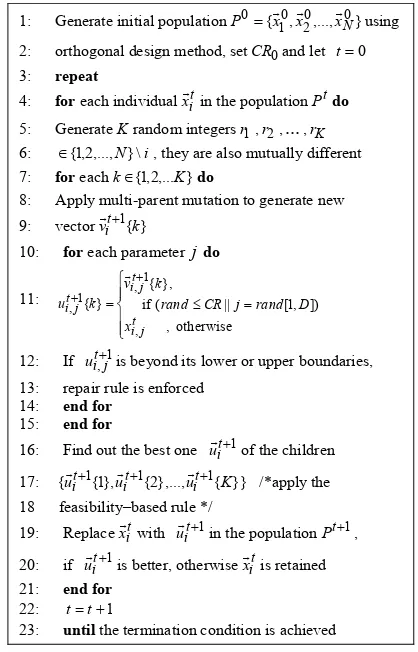
The general framework of the p is described in Figure 3.
4. Experimental Study
4.1. Constrained Optimiza Engineering Design
In order to validate the proposed algorithm ADE, we enchmark test problems
six
1: Generate initial populationP0{x10,x20,...,xN0}using
0
CR a t0
t i
x
in the population do
5: Generate andom integer 6:
t
P Kr sr1,r2,...,rK
i N}\ ,..., 2 , 1 {
, they are also mutually different 7: for eachk{1,2,...K}do
8: Apply multi-parent mutation to generate new 9: vectorvit1{k}
10: for each parameterjdo
11: otherwise , ]) , 1 [ || ( if }, { } { , 1 , 1 , t j i t j i t j i x D rand j CR rand k v k u
12: If is beyond its lower or upper boundaries, 13: repair rule is enforced
14: end for
15: end for
16: Find out the best one of the children
17: 1 , t j i u 1 t i u }} { },..., 2 { }, 1 {
{uit1 uit1 uit1 K /*apply the 18 feasibility–based rule */
19: Replacexitwith uit1in the populatio ,
20: if
nPt1
1 t i
u is better, otherwise is retained 21: end for
22: t i x 1 t t
[image:4.595.318.527.378.704.2]23: until the termination condition is achieved
Figure 3. The general framework of the ADE algorithm.
Y. Y. AO ET AL. 69
in th d which are de d in
the following. 1)
M
e specialized literature, an scribe
Three-bar truss design [8]: inimize f(x)(2 2x1x2)l
Subject to 0
2
2x12 x1x2 , 2
(x x1x P
g ) 2
1
0 )
( 2 2
2 x P
g
2 2x1 x1x2
x , 0 2 1 )
(x
g
2 1
3
x P
x
where 0x11 and 0 x2 1; l100cm, ,
KN/cm2 and 2
P 2KN/cm2.
2) desi
M
Spring gn [8]:
inimize f(x) 2
2 1 3 2) (x x x
Subject to 0
71785 1
)
( 1 4
1
x x g , 2 3 3 x x 0 1 51 )
125 08 2
1 ( 66 4 ) ( 2 1 x x g 2 2
1
x x x , 4 2 3 2 1 2
x x
x 0 45 . 140
1 2
x ) ( 3 x g 3 2 1 x x , 0 1 )
(x x1x2 g 5 . 1 4
where 0.25x11.3, 0.05x22.0, and 2x315. 3) Pressure vessel design [9,20]:
Minimize f(x)0.6224x1x3x41.7781x2x323.1661x12x4
3 2 1 84 . 19 x x
Subject tog1(x)x10.0193x3 0
, 0 00954 . 0 )
( 2 3
2 x x x
g ,
0 000 , 296 , 1 3 4 )
( 32 4 33
3 x x x x
g ,
0 240 )
( 4
4 x x
g
where x1 0.0625n1, x2 0.0625n2, 1n199, .
, 99
10x3 1n2
4) W design
,
200 10x4 200
elded beam [9]:
Minimize ) 0 . 14 ( 04811 .
0 x3x4 x2
10471 . 1 )
(x x12x2
f
Subject tog1(x)(x)max 0, 0 )
( )
( max
2 x x
g ,
0 )
( 1 4
3 x x x
g ) 0 . 14 ( 04811 . 0 10471 . 0 )
( 12 3 4 2
4 x x x x x
g
5.00, 0 125 . 0 ) ( 1
5 x x
g 0 ) ( ) ( max
6 x x
g ,
0 ) ( )
(
7 x PP x
g c
The other parameters are defined as follows:
, ) " ( 2 ) ' (
) 2 2
R x 2'"x
( 2
,
2x1x2 '
P " , J MR ), 2 2 x , ) 2 ( 4 2 3 1 2
2 x x
x
R
(L P
M
, 2 12 2 2 2 3 1 2 2 2 1 x x
x x x
J ( ) 6 2 ,
3 4x x PL x , 4 ) ( 3 3 4 3 x Ex PL x , 4 2 1 36 / 013 . 4 )
( 2 3
L 6 4 2 3 G E L x x EGx x Pc
where P6000lb., L14in, max 0.25in., , psi 600 , 13 max , psi 106
G
30
E 12106psi,
, psi 0 00 , 30 max
0.1x12.0, 0.1x2 10.0,
, 0 . 10 1 .
0 x3 and 0.1x4 2.0. 5) Speed reducer design [8]: Minimize ) 0934 . 43 9334 . 3333
. x3214 x3 3 ( 7854 . 0 )
(x x1x22
f ) ( 4777 . 7 ) ( 508 .
1 x1 x62x72 63x72
x
) (
7854 .
0 x4x62x5x72
Subject to ( ) 1 0
3 2 27
2 1
1
x x x x
g ,
0 1 5 . 397 ) ( 2 3 2 2 1
2
x x x x
g ,
0 1 93 . 1 ) ( 4 6 3 2 3 4
3
x x x
x x
g ,
0 1 93 . 1 ) ( 4 7 3 2 3 5
4
x x x
x x
g ,
0 1 0 . 110 ] 10 9 . 16 )) /( 745 [( ) ( 3 6 2 / 1 6 2 3 2 4
5
x x x x x
g ,
0 1 0 . 85 ] 10 5 . 157 )) /( 745 [( ) ( 3 7 2 / 1 6 2 3 2 5
6
x x x x x
g ,
0 1 40 )
( 2 3
7
x x x
g , ( ) 5 1 0
1 2 8 x xx
g ,
0 1 12 ) ( 2 1
9 x
x x
g ,
0 1 9 . 1 5 . 1 ) ( 4 6
10 x x
g x ,
0 1 9 . 1 1 . 1 ) ( 5 7
11
x x x g
where 2.6 x1 3.6, 0.7 x2 0.8, , 3 . 8 3
.
7 5
,
28 7.3x4
17x3 8.3, x
, 9 .
3 5.0 x7 9
.
2 x6 5.5. r
6) Himmelblau’s Nonlinea Optimization Problem This problem was proposed by Himmelblau and simi-lar to problem [22] of the hmark except for the second coefficient of the first constraint. There are five design variables. The problem can be stated as fol-lows:
Minimize
Subject t [21]:
04
g benc
5 1 2
3 0.8356891 3578547
. 5 )
(x x xx
f
141 . 40792 293239
.
37 1
x
og1(x)85.3344070.0056858x2x5
5 3 4
1 0.0022053 00026
.
0 xx xx
,
0 92
5 2 2(x) 85.334407 0.0056858x x
g
0 0022053 .
0 00026 .
0 1 4 3 5
xx xx , 5 2 3(x) 80.51249 0.0071317x x
g
2, 3 2
1 0.0021813 0029955
.
0 xx x
0 110
5 2 4(x) 80.51249 0.0071317x x
g
2 3 2
1 0.0021813 0029955
.
0 xx x
,
0 90
5 3 5(x) 9.300961 0.0047026x x
g
4 3 3
1 0.0019085 0012547
.
0 xx xx
,
0 25
5 3 6(x) 9.300961 0.0047026x x
g
4 3 3
1 0.0019085 0012547
.
0 x xx
x ,
0 20
[image:6.595.311.539.76.258.2]where 78x1102, 33x2 45, and 27xi 45 (i3,4,5).
[image:6.595.57.287.203.700.2]Figure 5. Convergence graph for spring design.
Figure 6. Convergence graph for pressure vessel design.
4.2. Convergence of ADE
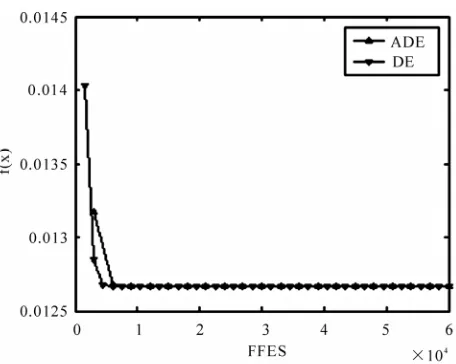
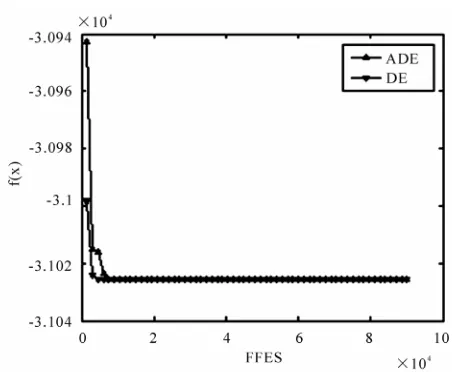
In this section, Figures 4-9 depict the convergence graphs for 6 engineering optimization problems described above respectively. From Figures 4-6, we know that ADE and DE all can be quickly convergent. In the figures, FFES is the number of fitness function evaluations.
4.3. Comparing ADE with Respect to Some S
In this experimental study, the parameter values used in ADE are set as follows: the population size
tate-of-the-Art Algorithms
50
N e level num
, the maximal generation number T 300, th ber
NQ , the mutation parent number KD1, the Figure 4. Convergence graph for three-bar truss design.
[image:6.595.311.539.297.480.2]Y. Y. AO ET AL.
Copyright © 2010 SciRes. ENGINEERING 71
Fi r
optimization problem.
initial crossover rate
[image:7.595.310.536.75.261.2]gure 9. Convergence graph for Himmelblau’s nonlinea Figure 7. Convergence graph for welded beam design.
8 . 0 0
CR , the coefficient a2, the shape parameter b3, the exponent 2. The
s equal number of fitness fu uations (FF
to
nction eval ES) i
K T
N . The achieved sol tion at the end ofu K
T
N
[image:7.595.59.287.76.262.2]. Convergence graph for speed re gn.
Figure 8 ducer desi
FFES is easure the pe
ADE. ADE is independently run 30 times on each test problem above. The optimized objective function values (of 30 runs) arranged in ascending order and the 15th value in the list is called the median optimized function value. Experimental results are presented in Tables 1-12. And NA is the abbreviation for “Not Available”.
For three-bar truss design problem, the experimental results are given in Tables 1-2. According to Table 1, ADE and DSS-MDE [8] can obtain the approximate best and median
Table 1. Comparison of statistical results f over 30 ru
Algorithms Best Median
used to m rformance of
values, which are slightly better than those obtained by Ray
or three-bar truss design ns.
Mean Worst Std FFES
ADE 263.89584338 263.89584338 263.89584338 263.89584338 4.72e-014 45,000
DSS-MDE [8] 263.8958434 263.8958434
Ray and Liew [6] 263.8958466 263.8989
263.8958436 263.8958498 9.72e-07 15,000
[image:7.595.73.525.529.599.2]263.9033 263.96975 1.26e-02 17.610
Table 2. Comparison of best solutions
Function ADE DSS-MDE [8] Ray a
found for three-bar truss design.
nd Liew [6] ECT [23] Ray and Saini [24]
1
x 0.7886751376014 0.7886751359 0.7886210370 0.78976441 0.795
2
x 0.4082482819599 0.4082482868 0
263.8958466 263.896710000 264.300
FFES 45,000 15,000 17,610 55,000 2712
.4084013340 0.40517605 0.395
) (x
[image:7.595.71.525.636.720.2]Table 3. Comparison of statistical results for spring design over 30 runs.
Algorithms Best Median Mean Worst Std FFES
ADE 0.0126652328 0.0126652458 0.0129336018 0.02064372078 1.46e-03 60,000
SiC-PSO [20] 0.012665 NA 0.0131 NA 4.1e-04 24,000
F 0.01266 0.0126 0.012 2.
DSS-M ] 0.0 0 0. 0
Ray 0.01 0. 0.0 0.
0.0 0.0 0.01 0.0
SA [25] 5285 NA 65299 665338 2e-08 49,531
DE [8 12665233 .012665304 012669366 .012738262 1.25e-05 24,000
and Liew [6] 266924934 012922669 12922669 016717272 5.92e-04 25,167
[image:8.595.68.528.243.340.2]Coello [26] 1270478 1275576 276920 1282208 NA 900,000
Table 4. Comparison of best solutions found for spring design.
SiC-PSO [20] DSS-MDE [8] FSA [25] He et al. [7]
Function ADE
1
x 0.35674653865 0.354190 0.3567177469 0.35800478345599 0.356750
2
x 0.05169025814 0.051583 0.0 0.0 26 90
1 11.2 1 9 6
0.01 8 0.0 0.012 0. 85 65
FFES 60 15,000
516890614 51742503409 0.0516
3
x 1.28727756428 11.438675 889653382 1.2139073627873 11.28712
) (x
f 2665232 12665 65233 0126652 0.0126
,000 24,000 24,00 49,531
Table 5. Comparison of stat sults for e ve r 30 r
M rst
istical re pressur ssel design ove uns.
Algorithms Best edian Mean Wo Std FFES
ADE 5885.3327736 32775885.3 85 5885.3349564 5885.3769425 8.66e-03 75,000
SiC-PSO [20] 6
R
H 2
Montes et al.[3] 6059.702 6059.702 6059.702 6059.702 1.0e-12 24,000
059.714335 NA 6092.0498 NA 12.1725 24,000
ay and Liew [6] 6171.00 NA 6335.05 NA NA 20,000
e et al.[7] 6059.714 NA 6289.929 NA 3.1e+ 30,000
and L respectiv he mean
obtained b ADE mong t rithms,
while the FFES (45 the h est. And
we also find that th s can f
ear-op-timal solutions. Fr can see that ADE can find the best value pared with respect to
DSS-MDE [ ], Ray and ], ECT [22 and
Saini [2 e best res ined by AD
iew [6] ely. T and worst values
y are the best a
,000) of ADE is alsohree algoigh ese algorithm ind the n om Table 2, we
when com Liew [6
8 ] and Ray
3]. Th ult obta E is
) (x
f =263.8958433764684, corresponding to
x [x1,x2]=[0.788675137 2, 0.40824 90]
and constr
6014 8281959
aints
[g1(x), g2(x), g3(x) ]
162 -0.535898 9484].
For gn prob experime results
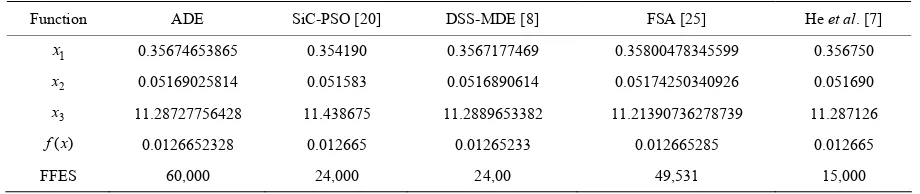
are given in Tables 3-4. According to Table 3, ADE,
[20], FSA MDE [8 ut the
e when espect to Ray and Liew
oello [25] ue ob ADE
han ob method e mean
t value becau E can
d 29 near- utions in nd the
tio (i.e., the alue is
64372078). Tab esents the det ach best value obtained by ADE, SiC-PSO [20], DSS-MDE [8], ely. The best result
=[0, -1.46410 480516, 3751
spring desi lem, the ntal
Sic-PSO [24], DSS- ] can find o
best valu
[6] and C compared with r. The median val tained by is better t tained by other s, but th and wors s are worse, this is se that AD only fin
other is an excepoptimal soln solution 30 runs aworst v
0.020 le 4 pr ail of e
FSA [24] or He et al. [7] respectiv obtained by ADE is
) (x
f = 0.01266523 832, ing
278
correspond to
x [x1,x2,x3]
=[0.3567 021031, 0.051689065
11.288 7073
and constraints
1785 67225,
9592785 ]
[image:8.595.67.528.375.476.2]Y. Y. AO ET AL. 73 [g1(x),g2(x), g3(x), g4(x)]
=[-2.220446049250313e-016, -4.4408
) of ADE
is also the highest. etail of each
ed by 20], Ray and
l. [7] or Montes et al. [3] respectively. The best
92098500626e-016, 4.05378584839796, -0.72772872274496].
For pressure vessel design problem, the experimental results are given in Tables 5-6. According to Table 5, the best, median, mean, worst and standard deviation of val-ues obtained by ADE are the best when compared with respect to Sic-PSO [20], Ray and Liew [6], He et al. [7], and Montes et al. [3], while the FFES (75,000
Table 6 presents the d ADE, SiC-PSO [ best value obtain
Liew [6], He et a
result obtained by ADE is )
(x
f =5885.332773616458, corresponding to
and constraints
[x1,x2,x3,x4] x
= [0.778168641375, 0.384649162628, 40.319618724099, 200]
[g1(x),g2(x), g3(x), g4(x)] =[-1.110223024625157e-016,0,0,-40].
elded b gn pro the e ental
results are provided with Tables 7-8. According to Table 7, the best, median, mean, worst and standard derivation
For w eam desi blem, xperim
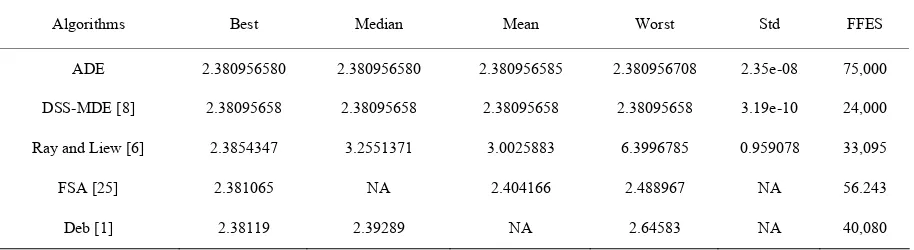
of values obtained by ADE are slightly worse than those obtained by DSS-MDE [8] and are better than those ob-tained by Ray and Liew [6], FSA [25] and Deb [1]. However, the FFES (75,000) of ADE is the highest. Ta-ble 8 presents the detail of each best value obtained by DSS-MDE [8], He et al. [7], FSA [25], Ray and Liew [6], and Akhtar et al. [9] respectively. The best result ob-tained by ADE is
) (x
f = 2.3809565 8032252, corresponding to
x [x1,x2,x3,x4]
= [0.24436897580173, 6.21751971517460, .2 14 13 48 684, 0.24436897580173] and constrai
8 9 7 90 n ts
[g1(x), g2(x), g3(x), g4(x), g5(x), g6(x), g7(x)] 27514e-011, -3.310560714453459e-010, -1. 78 78144 -016, -3.02295 760400, -0.
[image:9.595.69.529.424.559.2]-1.27
Table 6. Comparison of best solutions
Function ADE Sic-PSO [20] R
=[-1.0913936421
387778 0 6e 458
11936897580173, -0.23424083488769, 3292582482100e-011].
found for pressure vessel design.
ay and Liew [6] He et al. [7] Montes et al. [3]
1
x 0.7781686414 0.812500 0.8125 0.8125 0.8125
2
x 0.3846491626 0.437500
40.319618724 42.098445
200 176.636595
5885.3327736 6059.714335 6171.0 60
FFES 75,000 24,000 30,000 24,000
0.4375 0.4375 0.4375
41.9768 42.098446 42.098446
182.9768 176.636052 176.636047
3
x
4 x
) (x
f 6059.7143 6059.7016
20,000
Table 7. Comparison of statistical results for welded
Algorithms Best Median Worst Std FFES
beam design over 30 runs.
Mean
ADE 2.380956580 2.380956580 2.380956585 2.3809 708 2.35e-08 75,000 56
DSS-MDE [8] 2.38095658 2.38095658 2.38095 ,000
Ray and Liew [6] 2.3854347 3.2551371
FSA [25] 2.381065 NA
Deb [1] 2.38119 2.39289
658 2.38095658 3.19e-10 24
3.0025883 6.3996785 0.959078 33,095
2.404166 2.488967 NA 56.243
NA 2.64583 NA 40,080
[image:9.595.71.528.592.717.2]ions found for
Ray and Liew [6] Akhtar et al. [9]
[image:10.595.71.525.101.229.2]welded beam design. Table 8. Comparison of best solut
Function ADE DSS-MDE [8] He et al. [7] FSA [25]
1
x 0.24436897580 0.2443689758 0.244369 0.24435257 0.244438276 0.2407
2
x 6.21751971517 6.2175197152 6.217520
8.2 05 8.291471 9
7580 0.2443689758 0.244369 0.2497
2.3809 8032 2.38095658 2.380957 2.381065 2.3854347 2.4426
FFES 75,000 24,000 30,000 56,243 33,095 19,259
6.2157922 6.237967234 6.4851
8.2939046 8.288576143 8.239
0.24435258 0.244566182
3
x 9147139049 8.29147139
4 0.2443
x 689
565
[image:10.595.69.538.268.376.2]) (x f
Table 9. Comparison of statistical results cer desi runs.
Algorithms Mean Worst Std ES
for speed redu gn over 30
Best Median FF
ADE 2994.4710662 2994.4710662 2994.4710662 2994.4710662 1.85e-012 120,000
DSS-MDE [8] 066 2994.4 2994.471 3.58e-012 0
Ray and Liew [6] .744241 3001.7 3009.96 423 6
Monte [27] 689 2996.36 NA 8.2e-03
et al. [9] 8.08 3012 3028 NA 154
2994.471 2994.471066 71066 066 30,00
2994 3001.758264 582264 4736 4.0091 54,45
s et al. 2996.356 NA 7220 24,000
Akhtar 300 NA .12 19,
Functi ADE DSS-MDE Ray and L Mon [27] khtar et
Table 10. Comparison of best solutions found for speed reducer design.
on [8] iew [6] tes et al. A al.[9]
1
x 3.5 3.5 3.50000681 3.500010 3.506122
2
x 0.7 0.7 0.70
17 17 1 17
7.3 7.3 7.3276 7.5491
7.715319911478 7.7153199115 7.71532175 7.800027 7.859330
3.350214666096 3.3502146661 3.35026702 3.350221 3.365576
5.28665446 5.289773
2994.4710662 2994.471066 2994.744241 2996.356689 3008.08
1
000001 0.7 0.700006
3
x 7 17
4
x 0205 7.300156 26
5 x
6 x
7
x 4980 5.2866544650 5.28665450 5.286685
) (x f
FFES 20,000 30,000 54,456 24,000 18,154
T aris al res imme linear problem.
Algor ms Best ean Wor Std S
able 11. Comp on of statistic ults for h lblau’s non optimization
ith Median M st FFE
ADE -31025.56024 -31025.56024 -31025.56024 -31025.56024 5.91e-010 000 90,
COPSO [28] 56024 A 25.56024 NA 0 ,000
HU-PSO [29] -31025.56142 NA -31025.56142 NA 0 200,000
-31025. N -310 200
[image:10.595.67.529.416.594.2] [image:10.595.67.531.634.719.2]Y. Y. AO ET AL.
[image:11.595.64.531.107.239.2]Copyright © 2010 SciRes. ENGINEERING 75
Table 12. Comparison of best solutions found for himmelblau’s nonlinear optimization problem.
Function ADE COPSO HU-[28] PSO [29] Colleo [21] Homaifar et al. [30]
1
x 78.00000000000000 78 78.0 78.0495 78.0000
2
x 33.0000 070 33.00
0709 0 29.99
0000 45.0000 45.00
.969242 9242 924255 44.9400 36.77
-31025.56024249794 -31025.56024 -31025.56142 -31020.859 -30665.609
FFES 9 NA
0000000000 33 33.0 33.0 00
3
x 27. 9710517604 27.070997 27.070997 27.081 50
4
x 45. 0000000000 45 45.0 00
5
x 44 55010549 44.96 44.96 60
) (x f
0,000 200,000 200,000 NA
F reduce gn problem mental
results ar given in Ta es 9-10. Accordi o Table 9, the best, median, mean, worst and standa erivation of values ob ained by A nd DSS-MDE [ re superior to those obtained by R Liew [6], M s et al. [27]
and Akh et al. [9 ely, wh e FFES
(120,000 of ADE is highest. Table shows the
detail of h b ned b -MDE
[8], Ray and Liew [6], Montes et al. [27] and Akhtar et
al. [9] respective ult ob E is
or speed r desi , the experi
e bl ng t
rd d
t DE a 8] a
ay and ] respectiv
onte ile th tar
) the 10
eac est value obtai y ADE, DSS
ly. The best res tained by AD )
x
x [x1,x2,x3,x4,x5]
= [78, 33 971051760
44.96924 010549] constraints
, 27.0709 4, 45,
255 and
[g1(x),g2(x),g3(x),g4(x),g5(x), g6(x)] =[0, -92, -9.59476568762383, -10.40523431237617,
, 0].
m, compar espect to sev -of-the-
rithms, AD erform bett
bench-mark test problems. It is clearly shown that ADE is
fea-d effect e constrain mization
ems in enginee esign. The rea hat ADE uses multi-parent mutation to generate a better offspring, and applies self-adaptive control parameter and effective
Conclusion
d Future
rk
paper p dapti ntial ution
) algorithm constrained timizat ngi-neering Design. Firstly, ADE employs the orthogonal
method to erate the initial popul im-prove the diversity of solutions. Secondly, a multi-parent mutation scheme is developed to improve the capacity of DE. Thirdly, in order to improve the adaptive capacity of crossover
w app djusti rate
is p ted. In addi E introduc w repair
rule onstraint ing technique he
feasi-ble- rule is also when com o
solu-t me. Finally, ADE is tested on strained
engi ing design op problem om the
specialized literature. C ared with resp eral art algori e experimen lts show
highly e and ca
re-su rms of a test set of constraine timization -5
In su ed with r eral state
art algo E can p er on six
sible an ive to solv ed opti
probl ring d son is t
= 2994.471 (
f 06614
corresponding to
] = [3.5, 0.7, 17, 7.3, 7.71531991147825,
3.3 and constraints
682020,
x
[x1,x2,x3, x4,x5,x6,x7
5021466609645, 5.28665446498022] repair rule etc.
[g1(x
),g (x),g3(x)
, 4 x)
,g5(x)
,
2 g ( g (x)
6 ,g7(x)
, )
( 8 x
g ,
5.
s an
Wo
This roposes an a ve differe evol
(ADE for op ion in E
design gen ation to
) ( 9 x
g ,g10(x),g11(x)] =[-0.073915280
4991722481039787, -0.19799852, -0.904643 2714195, 7,
-0. 24 9045560
-6 509 0.70250 00000,
-2.220 031 333333 33,
-0.05132575354183, -8.881784197001252e-016]. For Himme
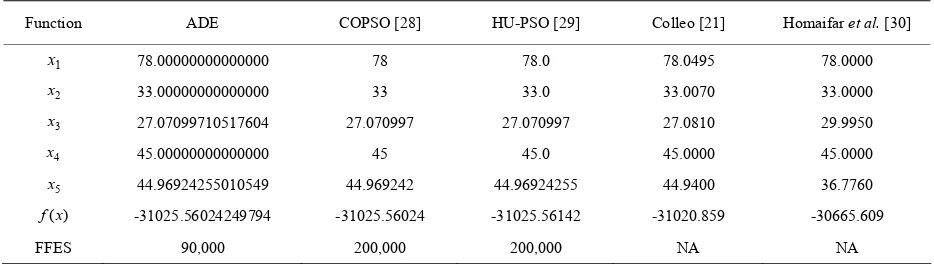
best, median, mean, worst and standard derivation of
valu wn in Tab -12, it is cle at
ADE, CO O [28] [29] all can d one
near-optimal solu . Ad nally,
ADE only require which is su ior to
other sev ral algo OPSO [ 00
FFES and HU-PS FES. The b result
obtained by ADE i .6613381477
44604925
39e016, 0, -3e-016, -0.58
0000 3333
lblau’s nonlinear optimization problem, the exploration and the convergence speed of A
es is sho les 11 arly seen th
PS , and HU-PSO
tion after a single run
fin ditio
s 90,000 FFES, per
e rithms, such as C 28] 200,0
O [29] 200,000 F est
s )
operator, a ne roach to a ng the crossover resen
and a c
tion, AD handl
es a ne of t
based applied paring tw
ions at a ti six con
neer timization
omp
s taken fr ect to sev
state-of-the- thms, th tal resu
that ADE is competitiv n obtain good
lts in te d op
(x
f =-3.1025.5602424979 corres
roblems in engineering design. However, there are still so
genetic algorith plied Me-ngineering, Vol. 186, No. 2, pp. 311–338,
[2] E. Mezura o es A al e ,
“Parame-ter c d
opti-miza
-putation
ontes, C. A. Coello Coello, J. Velázquez- Re s, and . Muñoz-Dávila, “Multiple trial ctors i differential evolution for e design,” Engineer-ing Optimization, Vol. 39, No. 5, pp. 567–589, 2007.
merical con- th-, No.
[5]
for mechanical design optimiz
problems,” Eng .
.
. . Luo, and X. F. Wang, “Differential lution with y m selection for constrained
optim . 178, pp.
3043
. Tai, and T. Ray, “A socio-behavioural odel for engineering design optimization Engineering Optimization, Vo 34, No. 4, pp. 3 54,
[10]
[12] R. Storn and K. Price, “Differential evolution—A simple
, 1997.
ferential evolu-tion,” Berlin: Springer-Verlag, 2005.
nina, S. C. Esquivel, and C. A. Coello Coello, “Solving engineering optimization problems with the
rained particle swarm optimizer,” Infor-2, pp. 319–326, 2008.
[21] C. A. Coello Coello, “Use of a self-adaptive penalty
evolutionary optimization,” IEEE Transactions on
al technique
ima, “Derivative-free filter p
me things to do in the future. Firstly, we will further validate ADE in the case of higher dimensions. Secondly, we also will take some measures to improve the conver-gence speed during the evolutionary process. Addition-ally, testing some initial parameters of ADE is another future work.
6. References
[1] K. Deb, “An efficient constraint handling method for ms,” Computer Methods in Ap
chanics and E 2000.
-M nt and . G. P om que-Qrtiz ontrol in differential evolution for constraine tion,” 2009 IEEE Congress on Evolutionary Com
(CEC'2009), pp. 1375–1382, 2009. [3] E. Mezura-M
ye L ve n
ngineering
[4] C. A. Coello Coello, “Theoretical and nu
straint-handling techniques used with evolutionary algo-rithms: A survey of the state of the art,” Computer Me ods in Applied Mechanics and Engineering, Vol. 191 11-12, pp. 1245–1287, 2002.
R. Landa-Becerra and C. A. Coello Coello, “Cultured differential evolution for constrained optimization,” Computer Methods in Applied Mechanics and Engineer-ing, Vol. 195, No. 33–36, pp. 4303–4322, 2006.
[6] T. Ray and K. M. Liew, “Society and civilization: An optimization algorithm based on the simulation of social behavior,” IEEE Transactions on Evolutionary Computa-tion, Vol. 7, No. 4, pp. 386–396, 2003.
[7] S. He, E. Prempain, and Q. H. Wu, “An improved particle
swarm optimizer ation proach for engineering optimization problems,” Com-puters in Industry, Vol. 41, No. 2, pp. 113–127, 2000. [22] T. P. Runarsson and X. Yao, “Stochastic ranking for
con-strained ineering Optimization, Vol. 36, No. 5, pp
585–605, 2004
[8] M. Zhang, W J evo- Evolutionary Computation, Vol. 4, No. 3, pp. 284–294, 2000.
[23] K. Hans Raj, R. S. Sharma, G. S. Mishra, A. Dua, and C. Patvardhan, “An evolutionary computation
d na ic stochastic
ization,” Information Sciences, Vol –3074, 2008.
[9] S. Akhtar, K
simulation m ,” f
l. 41–3
2002.
Q. He and L. Wang, “An effective co-evolutionary parti-cle swarm optimization for constrained engineering de-sign problems,” Engineering Applications of Artificial Intelligence, Vol. 20, No. 1, pp. 89–99, 2007.
[11] J. H. Wang and Z. Y. Yin, “A ranking selection-based particle swarm optimizer for engineering design optimi-zation problems,” Structural and Multidisciplinary Opti-mization, Vol. 37, No. 2, pp. 131–147, 2008.
and efficient heuristic for global optimization over con-tinuous spaces,” Journal of Global Optimization, Vol. 11, pp. 341–359
[13] K. Price, R. Storn, and J. Lampinen, “Dif tion: A practical approach to global optimiza
[14] Z. Y. Yang, K. Tang, and X. Yao, “Self-adaptive differ-ential evolution with neighborhood search,” 2008 Con-gress on Evolutionary Computation (CEC'2008), pp. 1110–1116, 2008.
[15] H. A. Abbass, R. Sarker, and C. Newton, “PDE: A Pareto-frontier differential evolution approach for mul-tiobjective optimization problems,” Proceedings of IEEE Congress on Evolutionary Computation, Vol. 2, pp. 971– 978, 2001.
[16] Y. W. Leung and Y. P. Wang, “An orthogonal genetic algorithm with quantization for global numerical optimi-zation,” IEEE Transactions on Evolutionary Computation, Vol. 5, No. 1, pp. 40–53, 2001.
[17] S. Tsutsui, M. Yamamure, and T. Higuchi, “Multi-parent recombination with simplex crossover in real coded ge-netic algorithms,” Proceedings of the Gege-netic and Evolu-tionary Computation Conference, pp. 657–664, 1999. [18] J. Brest, V. Zumer, and M. S. Maucec, “Self-adaptive
differential evolution algorithm in constrained real-pa-rameter optimization,” 2006 IEEE Congress on Evolu-tionary Computation (CEC'2006), pp. 919–926, 2006. [19] Y. Wang and Z. X. Cai, “A hybrid multi-swarm particle
swarm optimization to solve constrained optimization problems,” Frontiers of Computer Science in China, Vol. 3, No. 1, pp. 38–52, 2009.
[20] L. C. Cag simple const matica, Vol. 3
or constrained optimisation in engineering design,” Journal of the Institution of Engineers India Part Me Me-chanical Engineering Division, Vol. 86, pp. 121–128, 2005.
[24] T. Ray and P. Saini, “Engineering design optimization using a swarm with intelligent information sharing among individuals,” Engineering Optimization, Vol. 33, No. 33, pp. 735–748, 2001.
[25] A. R. Hedar and M. Fukush
simulated annealing method for constrained continuous global optimization,” Journal of Global Optimization, Vol. 35, No. 4, pp. 521–549, 2006.
Y. Y. AO ET AL.
Copyright © 2010 SciRes. ENGINEERING 77
Evolu-sity in differential
ing
ence Symposium, pp. 53–57, [26] C. A. Coello, “Self-adaptive penalties for GA- based
optimization,” Proceedings of the Congress on
tionary Computation 1999 (CEC'99), Vol. 1, pp. 573–580, 1999.
[27] E. Mezura-Montes, C. A. Coello, and J. V. Reyes, “In-creasing successful offspring and diver
and C
evolution for engineering design,” Proceedings of the Seventh International Conference on Adaptive Comput-ing in Design and Manufacture (ACDM 2006), pp. 131– 139, 2006.
[28] A. E. Muñoz Zavala, A. Hernández Aguirre, E. R. Villa Diharce, and S. Botello Rionda, “Constrained
optimiza-tion with an improved particle swarm optimizaoptimiza-tion algo-rithm,” International Journal of Intelligent Comput
ybernetics, Vol. 1, No. 3, pp. 425–453, 2008. [29] X. H. Hu, R. C. Eberhart, and Y. H. Shi, “Engineering
optimization with particle swarm,” Proceedings of the 2003 IEEE Swarm Intellig
2003.