A Fast Algorithm for Automated Quality Control in
Surface Engineering
Ehsan Sheybani, Singli Garcia-Otero, Fedra Adnani, Giti Javidi
DSP Lab, Virginia State University, Petersburg, USA. Email: [email protected]
Received January 31st,2012; revised March 2nd, 2012; accepted March 8th, 2012
ABSTRACT
In this article an approach to surface image quality assessment for surface pattern and object recognition, classification, and identification has been described. The surface quality assessment finds many industrial applications such as auto- mated, advanced, and autonomous manufacturing processes. Given that in most industrial applications the target surface is an unknown variable, having a tool to measure the quality of the surface in real time has a significant value. To add to the complication, in most industrial applications, the surface (and therefore its image) suffers from several physical phenomena such as noise (of several different kinds), time, phase, and frequency shifts, and other clutter caused by in- terference and speckles. The proposed tool should also be able to measure the level of deterioration of the surface due to these environmental effects. Therefore, evaluation of quality of a surface is not an easy task. It requires a good under- standing of the processing methods used and the types of environmental processes affecting the surface. On the other hand, for a meaningful comparative analysis, some effective parameters have to be chosen and qualitatively and quanti- tatively measured across different settings and processes affecting the surface. Finally, any algorithm capable of han- dling these tasks has to be efficient, fast, and simple to qualify for the “real-time” applications.
Keywords: Surface Characterization; Advanced Techniques
1. Introduction
This research aims at providing image processing tools for comparison and assessment of a surface processed under different grades of a manufacturing process all the way up to optimal processing. Ability to measure the sur- face quality in real-time has many applications in manu- facturing automation and product optimization, especially in processes in which the surface qualities such as roughness, grain size, thickness of coding, impurities size and distribution, hardness, and other mechanical proper- ties are of importance. Surface analysis in manufacturing environments requires specialized filtering techniques. Due to the immense effect of rough environment and corruptive parameters, it is often impossible to evaluate the quality of a surface that has undergone various grades of processing. The algorithm presented here is capable of performing this comparison analytically and quantitatively at a low computational cost (real-time) and high efficiency. The parameters used for comparison are the degree of blurriness and the amount of various types of noise asso- ciated with the surface image. Based on a heuristic analy- sis of these parameters the algorithm assesses the surface image and quantifies the quality of the image by character- izing important aspects of human visual quality. Exten-
sive effort has been set forth to obtain real-world noise and blur conditions so that the various test cases presented here could justify the validity of this approach well. The tests performed on the database of images produced valid re- sults for the proposed algorithm consistently. This paper presents the description and validation (along with test results) of the proposed algorithm for surface image qual- ity assessment.
sive remarks for this research and the direction of the future work in this field.
2. Background
In many advanced and automated industrial and manu- facturing processes image processing algorithms are em- ployed to analyze object surfaces and use the information obtained to improve the quality of the product such as finish, texture, color, placement, temperature, cracks, etc. [1-3]. One major disadvantage of these techniques is that collective environmental noise, speckles, and other arti-facts from different sensors degrade the surface image quality in tasks such as surface pattern restoration, detec- tion, recognition, and classification [4,5]. While many techniques have been developed to limit the adverse ef- fects of these parameters on image data, many of these methods suffer from a range of issues such as computa- tional involvement of algorithms to suppression of useful information [6,7]. Therefore, there is a great demand for a tool that could perform an accurate surface quality as-sessment. Since most surface images in industrial en- vironments suffer from clutter, noise, and phase/pixel shifts, we have based this surface quality assessment algo- rithm on these parameters [8,9].
Furthermore, to achieve a comprehensive model and an algorithm that can handle a wide-range of surface im- aging applications, we have proposed adaptive parame- ters and thresholds that can be adjusted to the type of object surface, manufacturing process, and optimal grade of operation. The noise in this case consists of Gaussian, salt and pepper, and shot noise. The blur consists of dif- ferent levels of pixel displacements and angular rotations. We have used a variety of the most prevalent techniques
recommended in the literature to include noise and blur in the images [10,11]. Wavelet transforms have been employed for analyzing noise in image data as suggested by relevant literature [12-15]. This research requires sev-eral hardware and software components that set up the framework for image processing and analysis. These include Matlab analysis and modeling software, a laptop equipped with at least 2 GB of memory to run computa-tionally intensive calculations, and programming (C/C++) environments to run programs and extract data. The digital signal processing algorithms serve to manipulate data so that they would be a good fit for image processing and analysis. In these algorithms a wavelet based approach has been considered for de-noising the image datasets. A detailed description of the technique follows in the next section.
3. Methodology
Figures 1 and 2 below show the placement of the pro-
posed algorithm in a given industrial image processing setup and its functional block diagram. Ideally, the pro- posed algorithm should be able to look at an image re- ceived from the processing sensor of the manufacturing cell (which is cluttered with various noise and blur ef-fects of the environment), compare it to the outcome of various grades of the same cell (A1, A2, and A3) for the same surface (Image 1, Image 2, and Image 3), and de- cide which one is closer to the optimal threshold set for that particular process. As such, to validate the capability of the proposed algorithm in assessing and comparing the quality of surface images, it must be tested with known images as compared to their cluttered and processed ver- sions.
Image from
Processing Cell Clutter and Noise Various Added Added Time Shifts and Blur Effects Received Image 1
Proposed Algorithm+Optima
l Thresholds
Received Image 2
Received Image 3 A
A
A Optimum Cell
Processing
Figure 3 shows the block diagram of the validation
approach combined with the details of the proposed al- gorithm shown in Figure 2. Consistency in quality meas-
ure figures is the key to the successful validation of this approach and its applicability to a wide range of surface images from different manufacturing processes. The ob- jective is to have one algorithm that works with surface images from different set of surface processes. To show
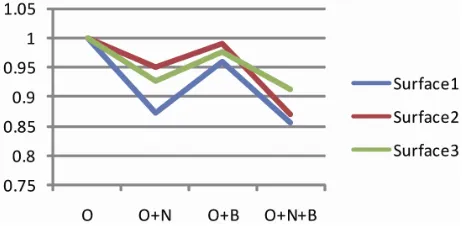
consistency in results, the tests have been repeated with the original image (O), original image plus noise (O + N), original image plus blur (O + B), and original image plus noise and blur (O + N + B) and the results have been shown for all cases in Table 1. As depicted in Figure 2, the pro-
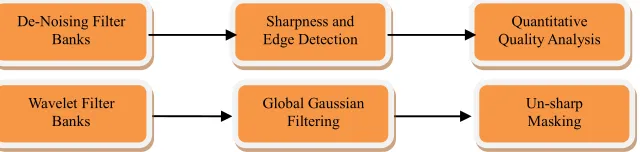
posed algorithm consists of several modules, each unique in its design and purpose, while applicable to a broad array of surface images. These modules are described below:
De-Noising Filter
Banks Edge Detection Sharpness and Quality Analysis Quantitative
Wavelet Filter Banks
Global Gaussian Filtering
Un-sharp Masking
Figure 2. Components of the proposed algorithm for image quality assessment and details of the de-noising filter banks.
Reconstructed Image 1 Various Added
Clutter and Noise Added Time Shifts and Blur Effects
Proposed Algorithm
Reconstructed Image 2
Reconstructed Image 3
Image Quality Measures Original
Image
Various Added Clutter and Noise
[image:3.595.91.511.305.502.2]Added Time Shifts and Blur Effects
Figure 3. The validation approach functional block diagram for the proposed algorithm for surface image quality assessment.
Table 1. Examples of images used for validation of the proposed algorithm for surface image quality assessment. The algo-rithm has been tested with original image (O), original image plus noise (O + N), original image plus blur (O + B), and origi-nal image plus noise and blur (O + N + B).
Examples
of Images O O + N O + B O + N + B Image Edge
Surface 1
Surface 2
[image:3.595.55.539.568.736.2]De-noising Filter Banks: A noisy image can be sim-
ply modeled as S(i,j) = f(i,j) + σe(i,j), where S is cor- rupted image with noise e, and σ is the noise level. To de-noise is to remove σe(i,j) and recover f(i,j). Noise is a wide-band phenomenon. Therefore, de-noising would require a delicate balance of high, low, and mid band filters with proper threshold that would minimize inter- ference with the main signal. The proposed filters in this research use a combination of wavelet based filter banks and Wiener/Gaussian filters as a means of multiband noise suppression and wide band noise reduction, respec- tively.
The Wiener filters are specialized in (additive) noise smoothing (compression low-pass filter) and blur inver- sion (deconvolution highpass filter) while reducing the mean square error. In the Fourier transform domain the Wiener filters can be expressed as:
*
1, 2 1, 2
1, 2 2
1, 2 1, 2 1, 2
xx
xx nn
H f f S f f W f f
H f f S f f S f f
where and are power spectrum
of the original image and noise, respectively and xx
1, 2
S f f
1, 2
nn
S f f
1, 2H f f is the blurring filter [17].
The Gaussian filters perform signal smoothing by ap-plying convolution (blurring) and therefore removing high frequency noise (mean filtering). The 2D Gaussian filter can be expressed as
2 2 2 2 2 1 , e 2π x yG x y
where the standard deviation (σ) determines the degree to which the image is smoothed. The Gaussian filters smooth the image more gently than the mean filter and preserve the edges better. Therefore, the Gaussian filter is not only better for edge detection due to its sharp cut-off frequency, but also it is the perfect pair for Wiener filter as it neutralizes the blur effect of these filters and reduces the noise in bands that Wiener filter is not effec- tive [16-19].
Wavelet de-noise method is proven to be one of the better methods [15-17]. This method involves three steps. First, a mother wavelet is used to generate the discrete wavelet transform (DWT) which in turn is employed to decompose the image. Then hierarchical DWT represen-tations of the image make it possible to determine de-noise layer number by a proper soft threshold and threshold function algorithm. Finally, reconstructing the image by applying the threshold coefficients and inverse discrete wavelet transform (IDWT), reconstructs the de-noised image. Wavelet transforms are the result of translation and scaling of a finite-length waveform known as mother wavelet. A wavelet divides a function into its frequency components such that its resolution
matches the frequency scale and translation. To represent a signal in this fashion it would have to go through a wavelet transform. Application of the wavelet transform to a function results in a set of orthogonal basis functions which are the time-frequency components of the signal. Due to its resolution in both time and frequency wavelet transform is the best tool for decomposition of signals that are non-stationary or have discontinuities and sharp peaks. In this work the wavelet transform has been used to de-noise images. The approach consists of decompos-ing the signal of interest into its detailed and smoothed components (high-and low-frequency). The detailed com-ponents of the signal at different levels of resolution local-ize the time and frequency of the event. Therefore, the wavelet filter can extract the “short-time”, “extreme value”, and “high-frequency” features of the image. Usually a subset of the discrete coefficients is used to reconstruct the best approximation of the signal. This subset is generated from the discrete version of the generating function:
2 ,
m m m n a a t n
b
where a and b are scale and shift, and m and n represent the number of levels and number of coefficients used for scaling and shifting of wavelet basis, respectively. Ap- plying a subset of this set to a function x with finite en- ergy will result in wavelet transform coefficients from which one can closely approximate (reconstruct) x using the coarse coefficients of this sequence [12,13]:
, m n, . m n, (m Z n Z
)
x t x
tSharpness and Edge Detection: The proposed blind
image quality assessment approach is based on immedi- ate human visual factors such as lighting, contrast, tone, noise, and blurriness. These parameters have been care- fully simplified, filtered, merged, and optimized to result in a quantitative measure for quality of a broad range of images. As part of the filtering and simplification process, the edge detection and sharpening filters have been em- ployed.
amplify image interference of the original and therefore result in very bumpy and unnatural image effects. In fact, too much masking could cause “halo” effect (light/dark outlines near edges). It can also bring in slight color shifts by emphasizing certain colors while diminishing others. The proposed filters in this research have been carefully designed to optimize masking without causing “halo” effect and to emphasize luminance channel rather that color to avoid any color shift [20].
Edge detection is an essential part of any feature de- tection or extraction in image processing or computer vision algorithms. The technique consists of recognizing the points at which the brightness of a digital image changes abruptly (points of discontinuity). These changes could be an indication of important incidents in an image such as sudden changes in depth or surface orientation, properties of material, or illumination of the scene. De- spite different techniques presented to solve this non- trivial problem, one of the early ones by Canny is con- sidered the state-of-the-art edge detector [21]. In his ap-proach, Canny considered an optimal smoothing filter given the criteria of detection, localization, and mini-mizing multiple responses to a single edge. He proved that this filter can be implemented as the sum of four ex-ponential terms and approximated by first-order deriva-tives of Gaussians. He used central differences as a gradi-ent operator to estimate input image gradigradi-ents [21,22]:
, 1
1,
0
, 1
2 2
x
L x y L x y L x y L x1,y
, 1
, 1
0
, 1
,
2 2
y
L x y L x y L x y L x y1
The gradient magnitude and orientation then can be computed as
2 2
x y
L L L
tan 2 y, x
A L L
Quantitative Quality Analysis: For the purposes of
comparison and assessment of various surface images from a processed object, it is desired to have a quantita- tive measure based on parameters involved in visual quality. In this research, the ideal quantitative measure has been analytically calculated based on a delicate balance be- tween the signal to noise ratio (SNR) and norm of the reconstructed image. Furthermore, important factors in human visual system such as scene lighting, contrast, and edges have been considered to come up with these pa- rameters. As depicted in Figure 2, a cluttered image is
de-noised to an optimal level (measured by SNR) and then using the un-sharp masking its useful information has been extracted to realize a factor that is an indication of the portion of the true image that is embedded inside the cluttered version. The closer this number is to one, it
shows a higher portion of the true image inside the re- constructed version. A number larger than one (as shown in the case of exceptional images in Table 1) is an indi-
cation that the image has picked up a few extra pieces in addition to what was intended in the original image.
SNR is a measure of how well a signal is preserved as it travels through a noisy environment. It is the ratio of signal power to background noise power measured in dB. It is calculated as follows:
10 10 10 10
10 log log s 20 log log s
n n
P A
SNR
P A
where Ps and Pn are signal and noise power, and As and An are signal and noise amplitude, respectively.
Since all data acquisition systems suffer from envi- ronmental noise, SNR can be partially improved by lim- iting the amount of noise injected into the system from the environment. This can be done by reducing the sensi- tivity of the system and/or filtering out the noise. An- other type of noise (additive noise) is introduced to the system at the quantization phase. This type of noise is non-linear and signal-dependent and therefore, requires more selective filtering for noise cancellation. The filters used in this research for noise reduction are a delicate balance between Weiner, Gaussian, and wavelet filter banks which optimally adjust themselves to the level of noise in signal and noise frequency bands for maximum noise cancellation and minimum signal deterioration [23]. Thinking of an image as a two dimensional matrix, norm can be used to measure the “size” of the image or the “distance” or “difference” between two images. 1-Norm of a vector is given by
1 1
n
i i
X x
Accordingly, 1-norm of a matrix would be
, 1 maxj i j
i
A a
This amounts to the maximum of column sums. Fol-lowing the same pattern, the 2-norm of a vector is
2 2
1
,
n
i i
X x X
X
Which amounts to matrix 2-norm being
2 Largest eigenvalue of
A A A
Otherwise known as singular values of matrix A [24].
4. Results and Future Work
Table 1 shows examples of images from the image data-
base used for this experiment. Figure 4 shows examples
Figure 4. Examples of the normalized validation results for the proposed algorithm for surface image quality assess- ment. The algorithm has been tested for original image (O), original image plus noise (O + N), original image plus blur (O + B), and original image plus noise and blur (O + N + B).
Section 3 of the paper. As shown in Figure 3, the set of
images for this experiment were cluttered in 3 different ways (Table 1) and all processed with the proposed sur-
face image quality assessment algorithm. Quantitative results prove to be consistent for each and every image type tested. Here are some observations from these test results:
1) The algorithm consistently rates the original better than the noisy (O + N), blurry (O + B), and noisy- blurry (O + N + B). Depending on the type and quality of the image, the qualitative measure ob-tained is not rating the O + N, O + B, and O + N + B consistently. In most cases, as the quality of the image is degraded (by introducing more clutter such as noise and blur or both), the quality measure keeps decreasing. The lack of consistency here re-mains a question until further improvements to the algorithm and a comparison to human visual system (HVS) are performed.
2) The results also indicate that the proposed quality assessment figure is a robust and reliable measure based on limited visual parameters for a fast conver- gence suitable for real-time applications with lim-ited sensor data. The measure has proved to differ-entiate between different grades of processing of the same object (surface images) very accurately. Ac-cordingly, it can also detect anomalies in the image in the same way that human eye can.
The authors plan to further examine the validity of this algorithm in comparison to human visual system (HVS). This is rather an important task as it finds applications in many automated systems in which human observation and validation is part of the process (CIM cells, manu- facturing, etc.). Once validated, the algorithm will be matched to relevant applications in the real world.
5. Conclusions
Object surface image extraction, recognition, and proc-
essing are of great interest to many industrial and manu- facturing fields such as surface detection, smoothness, finish, and classification. The long-term goal of this re- search is to enable increased autonomy and quality of im- age processing systems, with special emphasis on auto- mated processing, validation, and reconfiguration. The overall theme of this work is automatic extraction and processing of high-resolution surface images by adding a real-time surface image quality assessment algorithm. Wiener, Gaussian, un-sharp masking, and Multi-resolu- tion wavelet filter banks have been proposed to enable an efficient and fast solution to this problem. A delicate balance of these filters in the proposed algorithm is ca- pable of recognizing the quality of an optimal surface (image) in comparison to unfinished versions of it.
This research has led to accelerate research in theories, principles, and computational techniques for surface qual- ity assessment in image processing. The results obtained indicate that the proposed algorithm can effectively assess the quality of any given surface from a wide range of variations in finish. Additionally, the proposed algorithm is fast, efficient, and robust and can be implemented in hardware for real-time applications.
6. Acknowledgements
The authors would like to acknowledge Commonwealth Center for Advanced Manufacturing (CCAM), and NASA CIPAIR, Fellowship, and NSTI grants for the financial support of the research in surface engineering and image processing applications.
REFERENCES
[1] J. D. Maxwell, Y. Qu and J. R. Howell, “Full Field Tem-perature Measurement of Specular Wafers during Rapid Thermal Processing,” IEEE Transactions on Semicon-ductor Manufacturing, Vol. 20, No. 2, 2007, pp. 137-142. doi:10.1109/TSM.2007.895204
[2] K.-C. Huang, C.-L. Chang and W.-H. Wu, “Novel Image Polarization Method for Measurement of Lens Decen- tration,” IEEE Transactions on Instrumentation and Mea- surement, Vol. 60, No. 5, 2011, pp. 1845-1853.
doi:10.1109/TIM.2011.2108070
[3] Y. Cheng and M. A. Jafari, “Vision-Based Online Process Control in Manufacturing Applications,” IEEE Transac-tions on Automation Science and Engineering, Vol. 5, No. 1, 2008, pp. 140-153. doi:10.1109/TASE.2007.912058 [4] D.-M. Tsai and J.-Y. Luo, “Mean Shift-Based Defect
Detection in Multicrystalline Solar Wafer Surfaces,” IEEE Transactions on Industrial Informatics, Vol. 7, No. 1, 2011, pp. 125-135. doi:10.1109/TII.2010.2092783 [5] F. Bernardini, I. M. Martin and H. Rushmeier, “High-
Quality Texture Reconstruction from Multiple Scans,”
doi:10.1109/2945.965346
[6] J. P. W. Pluim, J. B. A. Maintz and M. A. Viergever, “Mutual-Information-Based Registration of Medical Im-ages: A Survey,” IEEE Transactions on Medical Imaging, Vol. 22, No. 8, 2003, pp. 986-1004.
doi:10.1109/TMI.2003.815867
[7] S. Reed, I. T. Ruiz, C. Capus and Y. Petillot, “The Fusion of Large Scale Classified Side-Scan Sonar Image Mosa-ics,” IEEE Transactions on Image Processing, Vol. 15, No. 7, 2006, pp. 2049-2060.
doi:10.1109/TIP.2006.873448
[8] H. R. Sheikh and A. C. Bovik, “Image Information and Visual Quality,” IEEE Transactions on Image Processing, Vol. 15, No. 2, 2006, pp. 430-444.
doi:10.1109/TIP.2005.859378
[9] Z. Wang and A. C. Bovik, “A Universal Image Quality Index,” IEEE Signal Processing Letters, Vol. 9, No. 3, 2002, pp. 81-84. doi:10.1109/97.995823
[10] R. Samadani, T. A. Mauer, D. M. Berfanger and J. H. Clark, “Image Thumbnails That Represent Blur and Noise,” IEEE Transactions on Image Processing, Vol. 19, No. 2, 2010, pp. 363-373. doi:10.1109/TIP.2009.2035847 [11] M. Mignotte, “A Post-Processing Deconvolution Step for
Wavelet-Based Image Denoising Methods,” IEEE Signal Processing Letters, Vol. 14, No. 9, 2007, pp. 621-624. doi:10.1109/LSP.2007.896183
[12] V. Chappelier and C. Guillemot, “Oriented Wavelet Transform for Image Compression and Denoising,” IEEE Transactions on Image Processing, Vol. 15, No. 10, 2006, pp. 2892-2903. doi:10.1109/TIP.2006.877526
[13] E. J. Balster, Y. F. Zheng and R. L. Ewing, “Feature- Based Wavelet Shrinkage Algorithm for Image Denois-ing,” IEEE Transactions on Image Processing, Vol. 14, No. 12, 2005, pp. 2024-2039.
doi:10.1109/TIP.2005.859385
[14] E. Sheybani, “Enhancement of Data in Integrated Comm-
unications, Navigation, and Surveillance Systems,” Pro-ceedings of NASA/IEEE/AIAA ICNS 2011, Washington DC, 10-12 May 2011.
[15] N. C. Pramod and G. V. Anand, “Nonlinear Wavelet De-noising for DOA Estimation by MUSIC,” 2004 Interna-tional Conference on Signal Processing & Communica- tions (SPCOM), Bangalore, 11-14 December 2004, pp. 388-392.
[16] E. Davies, “Machine Vision: Theory, Algorithms and Practicalities,” Academic Press, New York, 1990, pp. 42- 44.
[17] R. Gonzalez and R. Woods, “Digital Image Processing,” Addison-Wesley Publishing Company, Reading, 1992, p. 191.
[18] R. Haralick and L. Shapiro, “Computer and Robot Vi-sion,” Addison-Wesley Publishing Company, Reading, 1992.
[19] F. Jin, P. Fieguth, L. Winger and E. Jernigan, “Adaptive wiener filtering of noisy images and image sequences,”
Proceedings of IEEE ICIP 2003, Barcelona, 14-17 Sep- tember 2003.
[20] LaserSoft Imaging, “SilverFast Unsharp Masking,” 2011. http://www.silverfast.com/highlights/
[21] D. Ziou and S. Tabbone, “Edge Detection Techniques: An Overview,” International Journal of Pattern Recog- nition and Image Analysis, Vol. 8, No. 4, 1998, pp. 537- 559.
[22] J. Canny, “A Computational Approach to Edge Detec- tion,” IEEE Transactions on Pattern Analysis and Ma-chine Intelligence, Vol. 8, 1986, pp. 679-714.
doi:10.1109/TPAMI.1986.4767851 [23] Wikipedia, “Signal-to-Noise Ratio,” 2011.
http://en.wikipedia.org/