DETECT AND DEVELOP DRINKING WATER QUALIT
Department of Chemistry, Govt. M.L.B.
ARTICLE INFO ABSTRACT
The volume of groundwater is much greater than that of all fresh water lakes and streams combined. Underground water
fresh water in several urban and rural areas. The quality of ground water in some parts of the country, particularly shallow ground water is changing as a result of human
bacterial pollution than surface water, as the soil and rocks through which it percolates screen out most of the bacteria. But freedom from bacterial pollution alone does not mean that the water is fit to drink. Many di
concentrations. Most are harmless or even beneficial; though occurring in frequently, others are harmful, and a few may be highly toxic. Ground water quality comprises the physi
biological qualities of water. Naturally it contains mineral ions which slowly dissolve from sediments and rocks as the water travel along mineral surfaces in the pores or fractures of the unsaturated zone and the aquifer. These are refe
is long, but it can be classified into major constituents, minor constituents, and trace constituent. In water all of the dissolved solids are either positively charged ions or negati
recent years the growth of industry
water resources. Locally the quality of ground water has been degraded. Municipal and industrial waste entered the soil, infiltrated so
recognition of the potential for pollution, physical and chemical analyses are made routinely on water supplies. State and local agencies are taking steps to increase water quality monitoring. Analytic techniques have been refined so that early warning can be given, and plans can be implemented to mitigate water pollution.
Copyright © Dr. Ratna Roy. This is an open access article distributed under the Creative Commons Att distribution, and reproduction in any medium, provided the original work is properly cited.
INTRODUCTION
Water is essential natural resource for sustaining life and environment. It makes up 50-97% of the weight of all plants and animals and about 70% of human body. Ground water is the most essential suitable fresh water resources in both urban as well as rural areas (WHO, 2004 and WHO,
property of groundwater is dissolving and carrying in solution a variety of chemical and other material. More than 90% of the rural population use ground water for domestic purposes. It is also a source used for agricultural and industrial sector nowadays. In recent years, an increasing threat to ground water quality due to human activities has become of great concern. The adverse effect on ground water quality are due to over burden of the population pressure, unplanned urbanization, unrestricted exploration and dumping of the polluted water at
*Corresponding author: Dr. Ratna Roy,
Department of Chemistry, Govt. M.L.B. Girls PG Autonomous College Bhopal, M.P. India.
ISSN: 0975-833X
Article History:
Received 24th February, 2015
Received in revised form 20th March, 2015
Accepted 17th April, 2015
Published online 31st May,2015
Citation Dr. Ratna Roy2015. “Detect and develop drinking water quality to prevent health hazardous effect
Current Research, 7, (5), 16065-16069. Key words: Organic constituent, Sediment, Fracture, Aquifer.
RESEARCH ARTICLE
RINKING WATER QUALITY TO PREVENT HEALTH
*Dr. Ratna Roy
Department of Chemistry, Govt. M.L.B. Girls PG Autonomous College Bhopal, M.P. India
ABSTRACT
The volume of groundwater is much greater than that of all fresh water lakes and streams combined. Underground water plays an important role in the water balance of the earth. It is a primary source of fresh water in several urban and rural areas. The quality of ground water in some parts of the country, particularly shallow ground water is changing as a result of human
bacterial pollution than surface water, as the soil and rocks through which it percolates screen out most of the bacteria. But freedom from bacterial pollution alone does not mean that the water is fit to drink. Many dissolved mineral and organic constituent are present in ground water in various concentrations. Most are harmless or even beneficial; though occurring in frequently, others are harmful, and a few may be highly toxic. Ground water quality comprises the physi
biological qualities of water. Naturally it contains mineral ions which slowly dissolve from sediments and rocks as the water travel along mineral surfaces in the pores or fractures of the unsaturated zone and the aquifer. These are referred to as Total Dissolve Solid. A list of dissolved solids in any water is long, but it can be classified into major constituents, minor constituents, and trace constituent. In water all of the dissolved solids are either positively charged ions or negati
recent years the growth of industry and technology has increased the stress upon both our land and water resources. Locally the quality of ground water has been degraded. Municipal and industrial waste entered the soil, infiltrated some aquifers, and degraded the ground water quality. In recognition of the potential for pollution, physical and chemical analyses are made routinely on water supplies. State and local agencies are taking steps to increase water quality monitoring. Analytic techniques have been refined so that early warning can be given, and plans can be implemented to mitigate water pollution.
is an open access article distributed under the Creative Commons Attribution License, which distribution, and reproduction in any medium, provided the original work is properly cited.
Water is essential natural resource for sustaining life and 97% of the weight of all plants human body. Ground water is the most essential suitable fresh water resources in both urban WHO, 1984). The property of groundwater is dissolving and carrying in solution a variety of chemical and other material. More than 90% of the rural population use ground water for domestic purposes. It is also a source used for agricultural and industrial sector adays. In recent years, an increasing threat to ground water quality due to human activities has become of great concern. The adverse effect on ground water quality are due to over burden of the population pressure, unplanned urbanization, loration and dumping of the polluted water at
Department of Chemistry, Govt. M.L.B. Girls PG Autonomous
inappropriate place enhance the infiltration of harmful compounds to the ground water. It is highest in urban areas than rural areas. In urbanization the farming fields are also used as residential plots. Geologic formation and anthropogenic activities also influence the ground water quality. Now the pollution in ground water has beco
concern all over the world. The objective of the present work is to analyse and discuss the physical
ground water that is suitable for drinking and agricultural purpose or not.
Study Area
The study area comprises villages in Raisen District of 80 to 150 km from the city Bhopal. The geological formation of the land is mainly basalt rock. The locality is selected from Gairatganj, Begumganj and Silwani Block of Raisen District which is situated in North East direction of Bhopal.
Available online at http://www.journalcra.com
International Journal of Current Research
Vol. 7, Issue, 05, pp.16065-16069, May, 2015
INTERNATIONAL
Detect and develop drinking water quality to prevent health hazardous effect
z
Y TO PREVENT HEALTH HAZARDOUS EFFECT
Girls PG Autonomous College Bhopal, M.P. India
The volume of groundwater is much greater than that of all fresh water lakes and streams combined. plays an important role in the water balance of the earth. It is a primary source of fresh water in several urban and rural areas. The quality of ground water in some parts of the country, particularly shallow ground water is changing as a result of human activity. It is less susceptible to bacterial pollution than surface water, as the soil and rocks through which it percolates screen out most of the bacteria. But freedom from bacterial pollution alone does not mean that the water is fit to ssolved mineral and organic constituent are present in ground water in various concentrations. Most are harmless or even beneficial; though occurring in frequently, others are harmful, and a few may be highly toxic. Ground water quality comprises the physical, chemical, and biological qualities of water. Naturally it contains mineral ions which slowly dissolve from sediments and rocks as the water travel along mineral surfaces in the pores or fractures of the unsaturated zone rred to as Total Dissolve Solid. A list of dissolved solids in any water is long, but it can be classified into major constituents, minor constituents, and trace constituent. In water all of the dissolved solids are either positively charged ions or negatively charged ions. In technology has increased the stress upon both our land and water resources. Locally the quality of ground water has been degraded. Municipal and industrial me aquifers, and degraded the ground water quality. In recognition of the potential for pollution, physical and chemical analyses are made routinely on water supplies. State and local agencies are taking steps to increase water quality monitoring. Analytical techniques have been refined so that early warning can be given, and plans can be implemented to
ribution License, which permits unrestricted use,
inappropriate place enhance the infiltration of harmful water. It is highest in urban areas than rural areas. In urbanization the farming fields are also used as residential plots. Geologic formation and anthropogenic activities also influence the ground water quality. Now the pollution in ground water has become a major subject of public The objective of the present work is to analyse and discuss the physical and chemical parameter of ground water that is suitable for drinking and agricultural
The study area comprises villages in Raisen District of 80 to 150 km from the city Bhopal. The geological formation of the land is mainly basalt rock. The locality is selected from Silwani Block of Raisen District d in North East direction of Bhopal.
INTERNATIONAL JOURNAL OF CURRENT RESEARCH
MATERIALS AND METHODS
Ground water samples are collected from near the agricultural field. The collected samples were transferred into plastic container for analysis. These water samples were analysed for pH, electrical conductivity using pH and EC meter. Total dissolved solid (TDS) determine by computation depending on the relative concentration of ions; Total alkalinity was estimated by titrating with hydrochloric acid. Total hardness (TH) were analyzed volumetrically, using standard EDTA.
Chloride estimated by standard AgNO3 titration. Other ions
were analysed by spectrophotometer as given by APHA, 1992.
RESULTS AND DISCUSSION
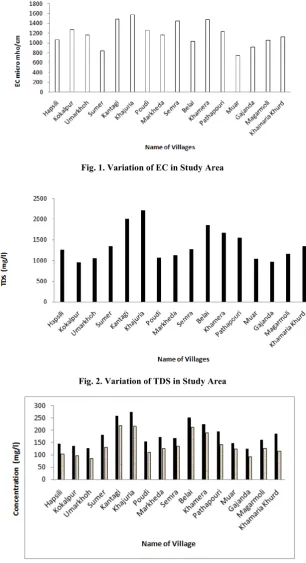
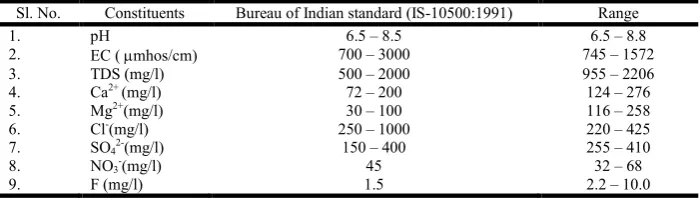
The result of chemical analyses of ground water sample from study area is represented in Table 1. The analytical data revealed that pH value ranges from 6.5 - 8.8 indicating alkaline nature. The electrical conductivity ranges from 745 to
1572micromho/cm at 25o C lie within desirable limit for
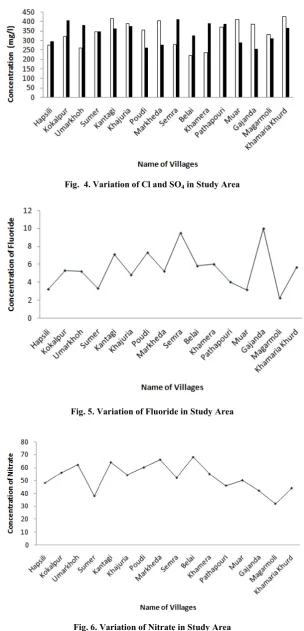
[image:2.595.144.451.211.775.2]drinking purpose. TDS in most of the sample exceeds the desirable limit. Calcium and total hardness also is high. Fluoride and nitrate concentration shows high value in majority of area. Fluoride is important for the development of teeth and bones.
Fig. 1. Variation of EC in Study Area
[image:2.595.160.439.214.357.2]Fig. 2. Variation of TDS in Study Area
Concentration within permissible limit is beneficial by hardening the enamel and reducing the increase of caries but overdose cause dental and skeletal fluorosis (Czarnowski, 1999) (Deformation of Teeth and bones) and other disorder
[image:3.595.142.447.63.696.2](Lu et al., 2000 and Billings et al., 2004). The major source of fluoride in ground water is fluoride bearing rock from which it get leached and contaminate the water. Nitrate (Malik and Banerji, 1981) generally occurs in trace quantities in surface
[image:3.595.149.438.75.223.2]Fig. 4. Variation of Cl and SO4 in Study Area
Fig. 5. Variation of Fluoride in Study Area
Fig. 6. Variation of Nitrate in Study Area
16067 International Journal of Current Research, Vol. 7, Issue, 05, pp.16065-16069, May,2015
[image:3.595.145.446.423.668.2]water but may attain high level in some ground water (Handa, 1983). The nitrogenous fertilizers are one of the important
sources for ground water nitrate. Leaching of nitrate (Mehta
et al., 1990) to ground water is mainly due to excessive
application of nitrogen fertilizer, the absence of proper soil and water management practices. The result shows that the concentration of EC, Total dissolved solid, Total Hardness, Calcium, Nitrate and fluoride are exceeding the permissible limit for drinking purpose (McCasland, 2007). Ground water quality (ISI, 1983) is strongly influenced by geologic formation and climate, but may also be attributed to the impact of agricultural pollution.
Chloride is a widely distributed element in all types of rock in one or other form therefore its concentration is high in ground water. Mostly the Chloride are found in the form of Sodium Chloride in the Ground Water and soil.
Conclusion
Groundwater quality (Groundwater, 2007) is strongly influenced by bedrock geology and climate, but may also be attributed to the impacts of agricultural pollution. The present water availability situation in the study area is under great threat.
The chief sources of fluoride in groundwater are the fluoride-bearing minerals in the rocks and the sediments. The high fluoride (Billings et al., 2004) content in the groundwater of this area has affected villagers in the form of primary level of fluorosis resulted in stained and darkened tooth enamel. The source of fluoride in the natural water can be traced to the occurrence of fluorine-rich granitic rocks and soils derived from those rocks.
The high fluoride content in the drinking water should also be given attention and defluoridated (Chaturvedi et al., 1998) (treatment for removal of high concentration of fluoride) water should be provided for drinking purposes in the rural areas. Some areas are prone to have high fluoride content due to its geological formation. Hence the need to mark out areas with low, recommended and high level of fluoride in water should not be underestimated. Preventionary steps / methods for removing fluoride to acceptable limit is most essential. The methods to remove excess of fluoride can be broadly categorized into three techniques
Using Activated Alumina,
By reverse osmosis where the source of water is plenty.
By Electrodialysis reversal process.
The prime sources of nitrate enrichment (Malik and Banerji, 1981) are leaching from (Wakida, 2006) the sewage effluents being utilized extensively for irrigation, leakage from sewerage systems, septic tanks and natural drains carrying municipal wastes (Wakida, 2005), and application of more than required
fertilizers (Handa, 1983). Prevention methods must be
considered to protect groundwater aquifers from nitrate leaching. Many devices and techniques, through ion-exchange
and other processes (Chaturvedi et al., 1998)can rehabilitate
[image:4.595.54.539.65.228.2]already contaminated water. Regular monitoring of water quality is recommended to improve understanding of nitrate pollution (Mehta et al., 1990 and McCasland, 2007) in the groundwater in these villages and in surrounding region. Exposure of high level of nitrate in the drinking water has been linked to a variety of effects ranging from enlargement of the thyroid to 15 types of cancer and two kinds of Birth defects and even hypertension. Research shows a definite relationship between increasing rate of stomach cancer with increasing
Table 1. Physicochemical Parameter of the Ground Water of the Study Area
Name of Villages pH EC micro mho/cm TDS mg/l Ca mg/l Mg mg/l Cl mg/l F mg/l SO4 mg/l NO3 mg/l
Hapsili 6.8 1064 1257 145 104 275 3.2 295 48
Kokalpur 7.2 1276 955 136 98 320 5.3 405 56
Umarkhoh 7.6 1168 1052 128 86 260 5.2 380 62
Sumer 8.1 842 1344 182 132 345 3.3 345 38
Kantagi 8.5 1484 2016 260 220 415 7.1 360 64
Khajuria 8.4 1572 2206 276 218 390 4.8 372 54
Poudi 8.6 1258 1062 155 112 355 7.3 260 60
Markheda 7.4 1164 1134 172 128 405 5.2 274 66
Semra 6.5 1448 1280 168 136 280 9.5 410 52
Belai 7.8 1034 1854 252 212 220 5.8 325 68
Khamera 8.6 1474 1670 224 190 235 6.0 390 55
Pathapouri 7.7 1234 1555 195 142 370 4.0 386 46
Muar 6.9 745 1049 148 124 410 3.14 288 50
Gajanda 8.3 922 975 124 94 385 10.0 255 42
Magarmoli 8.8 1056 1162 162 126 330 2.2 310 32
Khamaria Khurd 8.0 1128 1342 186 116 425 5.65 365 44
Table 2. Permissible Value of Constituent and its ranges in Ground Water Samples
Sl. No. Constituents Bureau of Indian standard (IS-10500:1991) Range
1. pH 6.5 – 8.5 6.5 – 8.8
2. EC (mhos/cm) 700 – 3000 745 – 1572
3. TDS (mg/l) 500 – 2000 955 – 2206
4. Ca2+ (mg/l) 72 – 200 124 – 276
5. Mg2+(mg/l) 30 – 100 116 – 258
6. Cl-(mg/l) 250 – 1000 220 – 425
7. SO42-(mg/l) 150 – 400 255 – 410
8. NO3-(mg/l) 45 32 – 68
[image:4.595.121.471.257.356.2]nitrate intake. Contamination of water (Anon, 1993) cause 80% disease of the world and result in more than one third of the total deaths. It has been already elaborated that quality of ground water (Groundwater, 2007) is very much dependent on several factors. The water used for drinking purpose should be free from any toxic elements, living and non living organism and excessive amount of minerals to avoid furtherance of health hazard.
REFERENCES
Anon, 1993. Geology and Mineral resource of Anantapur
District., A.P. Department of Mines and Geology and A.P.M.d.C. ltd., Govt. of Andhra Pradesh.
APHA, 1992. Standard methods for the examination of water and wastewater, American Public Health Association,
Washington, DC.
Billings R.J., Berkiowitz R.J. and Watson G. 2004. Teeth.,
Pediatrics 113: p. 112-117.
Chaturvedi, A.K., Pathak K.C. and Singh V.N. 1998. Fluoride
removal from water by adsorption on china clay, Appl.Clay. Sci., 3: p. 337-346.
Czarnowski, W., Krechniaki, J., Urbanska, B., Stolarska, K., Taraszewsks-Czunowska, M., Murasko-Klaudel. 1999. The
impact of water-borne fluoride on bone density, 32:p.91-95.
Garret, J. 2006. Enviresearch Limited, A case study Vol 62(12): 1138-1149.
Groundwater, 2007. Wikipedia http://en . wikipedia. org/wiki
/Groundwater.
Handa, B.K. 1983. Effect of festiliser on groundwater quality in
India. In: Symp. on groundwater Development – A
perspective for the year 2000 A.D. imivevsly 06 Roorkee, India.
ISI, 1983. Indian standard specification for drinking water, ISI 10500, ISI, New Delhi.
Lu, Y., Sun, Z.R., Wu, L.N., Wang, X., Lu, W. and Lru, S. S.S. 2000. Effect of high fluoride water on intelligence of
children, 33(2)L: p.74-78.
Malik, S. and Banerji S. 1981. NItrate pollution of ground
water as a result of agriculture development in Indo-Gango Plain, India, In : proc; Int. symp. on Quality of
Groundwater the Nether lands.
McCasland and Margaret, 2007. "Nitrate: Health Effect in
Drinking Water". Water Encyclopedia.
Mehta, B.C., Singh, R.V., Srivastava and Das, S. 1990. Impact
of fertilizer use on groundwater quality in parts of Ganjam District, Orrisa, Bh-Jal News, 5, p.44-48.
Wakida, F.T. 2005. Non agricultural source of groundwater
nitrate: a review and case study, Water Research Vol. 39
No.l: 3-16.
Wakida, F.T. 2006. Potential nitrate leaching to ground water.
Hydrological Processes 20: 2077-2081.
WHO, Guidelines for drinking water quality, Vol 12. Health
criteria and other supporting information, World Health Organization, Geneva, 1984.
WHO, Guidelines for Drinking- Water Quality. Third Edition.
World Health Organization. Geneva 2004.
*******
16069 International Journal of Current Research, Vol. 7, Issue, 05, pp.16065-16069, May,2015