INFLUENCE OF STRATEGY FORMULATION ON PERFORMANCE OF HIV AND AIDS
INTERVENTIONS MANAGED BY NON
*,1
Leon Hongo Awiti
1
School of Business Administration, Jomo Kenyatta University of Agriculture and Technology, Kenya
2Department of Extra Mural Studies, School of Continuing and Distance Education
ARTICLE INFO ABSTRACT
Nyanza region in the Western part of Kenya has the highest concentration of non (NGOs) implementing HIV and AIDS
HIV infection of 15.3% while the prevalence rate for Kenya stands at 7.4%, this has partly been blamed on poorly formulated strategies that have failed to reduce new HIV infections
was to examine the influence of strategy formulation on performance of HIV and Acquired Immune
Syndrome (AIDS) interventions managed by NGOs in Nyanza Region and the moderating influence of stakeholder
ex post facto research survey design. Both quantitative and qualitative approaches. study was 18 the departmental heads of
implementation in NGOs registered by the NGO council as implementing HIV and AIDS interventions as a major focus and operating within Nyanza Region.
HIV programming. The population was thus
the respondents. The research used two instruments: questionnaires, Interviews schedules. Content measur
the internal consistency of the questionnaires, statistics and inferential statistics such
Organisations that did strategy formulation to a small extent were 1.091 more likely to have non HIV/AIDS interventions compared to those that conducted
p= 0.049, CL=95%. Similarly organizations 1.111 more likely to more likely to have non stakeholders
strategy formulation and performance
organisations in Nyanza Region, critical value= 3.84 and the
significant moderating influence of stakeholder participation on the relationship between st performance of HIV and AIDS interventions managed by non
Critical value= 3.84 and the HIV and AIDS interven
meaningfully in the strategy formulation process.
Copyright©2017, Leon Hongo Awiti et al. This is an open access article distributed under the Creative Commons Att use, distribution, and reproduction in any medium, provided the original work is properly cited.
INTRODUCTION
Over time the concept and practice of strategic planning has been embraced worldwide and across sectors because of its perceived contribution to organisational effectiveness and efficiency. Today organisations from both the private and public sectors have taken the practice of strategic planning seriously as a tool that can be utilized to fast track their performances (Arasa and K’Obonyo, 2012). Case in point a study by O’Regan and Ghobadian (2007) reveal that 81% of companies worldwide reported doing strategic planning and in
*Corresponding author: Leon Hongo Awiti,
School of Business Administration, Jomo Kenyatta University of Agriculture and Technology, Kenya.
ISSN: 0975-833X
Article History:
Received 20th January, 2017
Received in revised form 15th February, 2017
Accepted 22nd March, 2017
Published online 30th April,2017
Key words:
Strategic planning, Strategy formulation, Stakeholder participation, Performance of HIV and AIDS interventions.
Citation: Leon Hongo Awiti, Dr. Margaret Oloko and Prof. Charles Rambo
interventions managed by non-governmental organisations in Nyanza region, Kenya
RESEARCH ARTICLE
INFLUENCE OF STRATEGY FORMULATION ON PERFORMANCE OF HIV AND AIDS
INTERVENTIONS MANAGED BY NON-GOVERNMENTAL ORGANISATIONS
IN NYANZA REGION, KENYA
Leon Hongo Awiti,
1Dr. Margaret Oloko and
2Prof. Charles Rambo
School of Business Administration, Jomo Kenyatta University of Agriculture and Technology, Kenya
Department of Extra Mural Studies, School of Continuing and Distance Education
University of Nairobi (UON), Kenya
ABSTRACT
Nyanza region in the Western part of Kenya has the highest concentration of non
(NGOs) implementing HIV and AIDS interventions. Nonetheless, the region is cited to have a high prevalence HIV infection of 15.3% while the prevalence rate for Kenya stands at 7.4%, this has partly been blamed on poorly formulated strategies that have failed to reduce new HIV infections in Nyanza to zero.
was to examine the influence of strategy formulation on performance of HIV and Acquired Immune
Syndrome (AIDS) interventions managed by NGOs in Nyanza Region and the moderating influence of stakeholder participation on such relationship. This study used a positivist and interpretive paradigms adopting an ex post facto research survey design. Both quantitative and qualitative approaches.
study was 18 the departmental heads of program management, 18 monitoring and 18 evaluation and program implementation in NGOs registered by the NGO council as implementing HIV and AIDS interventions as a major focus and operating within Nyanza Region. The study also targeted the directors of t
HIV programming. The population was thus 60 respondents. Non-probability purposive sampling was used to pick the respondents. The research used two instruments: questionnaires, Interviews schedules. Content
measured by using the Content Valid Index (CVI). The researcher used Cronbach's Alpha reliability to measure the internal consistency of the questionnaires, r (6 items)=0.839. Data analysis was done through descriptive statistics and inferential statistics such as chi-square odds ratio, hypothesis testing, logit regression modeling. Organisations that did strategy formulation to a small extent were 1.091 more likely to have non
HIV/AIDS interventions compared to those that conducted strategy formulati
p= 0.049, CL=95%. Similarly organizations engaging stakeholders in strategy formulation to a small extent were 1.111 more likely to more likely to have non-performing HIV/AIDs interventions compared to those that engaged stakeholders to a large extent, X2(1) =5.030, p= 0.033, CL=95%. There was a significant relationship between
strategy formulation and performance of HIV and AIDS interventions managed by non organisations in Nyanza Region, critical value= 3.84 and the X2(1) value
significant moderating influence of stakeholder participation on the relationship between st
performance of HIV and AIDS interventions managed by non-governmental organisations in Nyanza Region. Critical value= 3.84 and the X2(1) value =5.030, 3.84 <5.030. The study recommends that the NGOs managing the
HIV and AIDS interventions should strengthen their strategy formulation processes and engage stakeholders more meaningfully in the strategy formulation process.
is an open access article distributed under the Creative Commons Attribution License, which use, distribution, and reproduction in any medium, provided the original work is properly cited.
Over time the concept and practice of strategic planning has been embraced worldwide and across sectors because of its perceived contribution to organisational effectiveness and efficiency. Today organisations from both the private and taken the practice of strategic planning seriously as a tool that can be utilized to fast track their K’Obonyo, 2012). Case in point a study by O’Regan and Ghobadian (2007) reveal that 81% of egic planning and in
School of Business Administration, Jomo Kenyatta University of
the United States (US) for example, 89% practice it. Strategic planning is arguably important ingredient in the conduct of strategic management. Steiner (1979) noted that the framework for formulating and implementing strategies is the formal strategic planning system was lacking.
many NGOs in Kenya is at a crisis due to poorly formulated strategies that are incapable of addressing the root causes of the problems that the people face. Some of the priorities that NGOs have are misplaced or no
the pressing needs of the community (
Survey, 2012). These pressing concerns are blamed on poor strategy formulation. Strategy formulation is the third step of strategy formulation, it is preceded by crafting of organizational purpose, and environmental scanning.
International Journal of Current Research Vol. 9, Issue, 04, pp.49637-49646, April, 2017
INTERNATIONAL
OF CURRENT RESEARCH
Leon Hongo Awiti, Dr. Margaret Oloko and Prof. Charles Rambo, 2017. “Influence of strategy formulation on performance of HIV and aids governmental organisations in Nyanza region, Kenya”, International Journal of Current Research
INFLUENCE OF STRATEGY FORMULATION ON PERFORMANCE OF HIV AND AIDS
GOVERNMENTAL ORGANISATIONS
Prof. Charles Rambo
School of Business Administration, Jomo Kenyatta University of Agriculture and Technology, Kenya
Department of Extra Mural Studies, School of Continuing and Distance Education
Nyanza region in the Western part of Kenya has the highest concentration of non-governmental organizations interventions. Nonetheless, the region is cited to have a high prevalence HIV infection of 15.3% while the prevalence rate for Kenya stands at 7.4%, this has partly been blamed on poorly in Nyanza to zero.The purpose of the study was to examine the influence of strategy formulation on performance of HIV and Acquired Immune-Deficiency Syndrome (AIDS) interventions managed by NGOs in Nyanza Region and the moderating influence of This study used a positivist and interpretive paradigms adopting an ex post facto research survey design. Both quantitative and qualitative approaches. The target population for the program management, 18 monitoring and 18 evaluation and program implementation in NGOs registered by the NGO council as implementing HIV and AIDS interventions as a major The study also targeted the directors of the three governing bodies for probability purposive sampling was used to pick the respondents. The research used two instruments: questionnaires, Interviews schedules. Content validity was The researcher used Cronbach's Alpha reliability to measure . Data analysis was done through descriptive square odds ratio, hypothesis testing, logit regression modeling. Organisations that did strategy formulation to a small extent were 1.091 more likely to have non-performing strategy formulation to a large extent, X2(1) =11.018,
engaging stakeholders in strategy formulation to a small extent were performing HIV/AIDs interventions compared to those that engaged 5.030, p= 0.033, CL=95%. There was a significant relationship between of HIV and AIDS interventions managed by non-governmental value=11.018, 3.84 <11.018.There was a significant moderating influence of stakeholder participation on the relationship between strategy formulation and governmental organisations in Nyanza Region. The study recommends that the NGOs managing the tions should strengthen their strategy formulation processes and engage stakeholders more
ribution License, which permits unrestricted
United States (US) for example, 89% practice it. Strategic planning is arguably important ingredient in the conduct of strategic management. Steiner (1979) noted that the framework for formulating and implementing strategies is the formal ng system was lacking. The performance of many NGOs in Kenya is at a crisis due to poorly formulated strategies that are incapable of addressing the root causes of the problems that the people face. Some of the priorities that NGOs have are misplaced or not timely executed to address the pressing needs of the community (Kenya Aids Indicator ). These pressing concerns are blamed on poor strategy formulation. Strategy formulation is the third step of it is preceded by crafting of organizational purpose, and environmental scanning.
INTERNATIONAL JOURNAL OF CURRENT RESEARCH
According to Arasa (2008), strategic management is a continuous process to design and review future-oriented strategies that enable an organization to achieve its outlined objectives, putting into account its constraints, capabilities, and the environment in which it operates. Strategy formulation is a crucial step in the strategic management process and comprises four major phases; crafting of organizational goals and objectives, crafting of strategic choices, operational planning and financial planning.
Strategy formulation, provides a clear set of recommendations, with supporting justification that facilitates adequate revision of the organisational mission, goals and objectives and supply the strategic options for making them succeed. In strategy formulation, organisations strive to modify the current goals, objectives and strategic choices in ways that would facilitate their success. It is also an attempt to create sustainable competitive advantages (Johnson et al., 2008).A good strategy is one that is capable of effectively solving outlined problems and practical in the sense that it can be implemented with the available resources, is cost-effective, feasible within a reasonable time frame, not overly disruptive, and is acceptable to chief stakeholders in the NGO. It is crucial to put into account fits between resources and competencies with available opportunities, and fits between expectations and risks (Muturia, 2009). NGOs operating in Nyanza region can succeed in formulating strategies for HIV/AIDS intervention by reviewing their current objectives and strategies, and these are often identified and assessed as part of the diagnosis (KNASP, 2014). The second step is to identify strategic alternatives and to deal with critical issues. The third step is to come up with a plan of operationalizing the strategies and do a balanced evaluation of the alternatives. Finally, the organization has to allocate resources in order to maximize on the outcomes. NGOs incorporate operational planning while formulating strategies for their interventions. An operational plan is a detailed plan that provides them with a clear picture of how their teams, sections or departments will contribute towards their strategic goals (Franklin, 2011). It helps in identifying areas of organisational strengths and weaknesses, its position in the marketplace, potential growth areas, and areas of vulnerability. Strategy formulation also incorporates financial planning of how much financial resources are needed to complete each task. Financial budgeting is an integral part of formulation (Arasa and K’obonyo, 2012). The organizations have to plan what they need to spend and how much income they need to carry out their activities and fulfil their missions.
Nyanza region is located on the shores of Lake Victoria, the largest freshwater lake in Africa and second in the world. The region is predominately inhabited by the Luo community and other ethnic groups such as the Kisii and Kuria. Nyanza region of Kenya is cited to have a high prevalence HIV infection of 15.3% while the prevalence rate for Kenya stands at 7.4% (Kenya AIDS Response Progress Report, 2014). Three randomized controlled trials (RCTs) conducted in South Africa, Kenya and Uganda showed that male circumcision (MC) can reduce the risk in heterosexual men by 51 and 60 percent (Auvert et al., 2005, Bailey et al., 2007; Gray et al., 2007).Several NGOs operate in the area in an effort to implement intervention programmes to contain the pandemic (Ong’ayo, 2012). Traditionally the Luo communities do not practice male circumcision, unlike most other ethnic groups in Kenya.
The gendered social dynamics of fishing communities in contexts of poverty bring together several key contextual factors that shape both women’s and men’s risk of acquiring HIV, such as gender inequality, poverty, migratory processes, and highly differentiated occupational sex segregation (Dworkin and Ehrhardt, 2007). Fishing communities that include both fishermen and others who process or trade the fish are among those groups with the highest prevalence of HIV and other STIs (Pickering, Okongo, Ojwiya, Yirrell & Whitworth, 1997; Voeten, Egesah and Habbema, 2004; Kissling, Allison, Seeley, Russell, Bachmann, Musgrave & Heck, 2005; Ng’ayo, Bukusi, Rowhani-Rahbar, Koutsky, Feng, Kwena and Holmes, 2008). Several NGOs operate in the area in an effort to implement intervention programmes to contain the pandemic (Ong’ayo, 2012).Some of the NGOs’ HIV/AIDS programmes include prevention of new HIV infections, care and treatment for those who are already infected.
2. Statement of the Problem
A major challenge at the strategy formulation stage is that people and organizations often resist giving up activities and strategies of implementing them even when they cease to become effective or relevant, this has led to the poor performance of projects (Mulunga, 2007).Thaw and Petersen (1999) observed that in most NGOs strategic planning, assessing the implications of taking certain options is often not done, this has led to the choice of ineffective strategy options. Mulunga further points out that the context in which majority of the NGOs work, where donors have so much power to decide what to fund and what not to fund, limits the freedom of NGOs to choose what would really help them and the people they serve. This has led to the imposition of strategy options, goals, activities, and operational plans which has led to poor project performance because they lack relevance. Stakeholders participation have notably been very low especially at the strategy formulation, this has made their participation in the strategy implementation, evaluation and control very complex.
3.Objective of the Study
To determine the influence of strategy formulation on performance of HIV and AIDS interventions managed by non-governmental organisations in Nyanza Region, Kenya.
To examine the moderating influence of stakeholder participation on the relationship between strategy formulation and performance of HIV and AIDS interventions managed by NGOs in Nyanza Region, Kenya.
4. Research Hypothesis
H0: There is no significant relationship between strategy
formulation and performance of HIV and AIDS interventions managed by non-governmental organisations in Nyanza Region
H0: There is no significant moderating influence of
5. Conceptual Framework of the Study
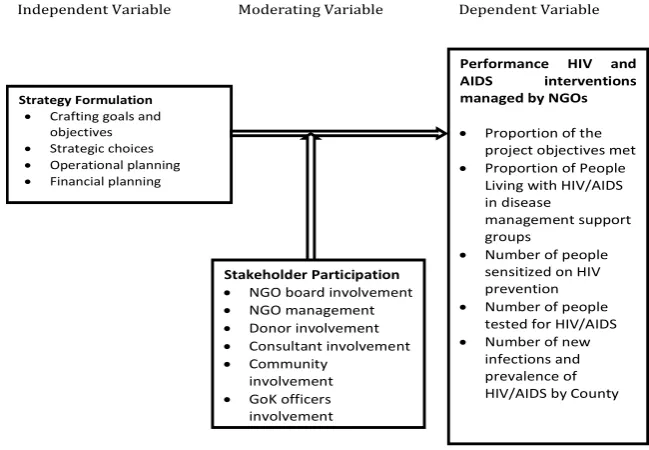
The conceptual framework of the study is as shown in Figure 1
6.Literature Review
Theoretical Framework
The study is anchored on human resource-based theory postulated by Paauwe (1998), the theory emphasizes the importance of the human element in the strategy development and business success of organisations. Most importantly, the Human resource-based theory emanates from the principle that the source of firm’s competitive advantage lies in its highly skilled and efficiency workforce, which is not easily copied by competitors. The human resource-based theory is fundamental to this study in that the successes of strategic planning heavily rely on the meaningful engagement of employees in the particular organisation. The engagement of employees in strategic planning will ensure that they show ownership and commitment to the process and hence its success. It will also be important that the organisation invests in building the skills and capabilities of its employees for quality output and organisational competitiveness.
Empirical Literature Review
The third step in strategic planning is strategy formulation (David, 2013; Arasa and K’Obonyo, 2012). Strategy formulation “refers to the process of choosing the most appropriate course of action for the realization of organisational goals and objectives and thereby achieving the organisational vision” (Grattan, 2011). Strategy formulation involves developing long-range plans to manage environmental opportunities and threats properly. The long-range plans include defining the corporate mission, specifying achievable objectives, developing strategies, and setting policy guidelines (Wheelen and Hunger, 2010). A component of strategy formulation is crafting goals and objectives, according to Bordean et al. (2009) strategy formulation consists of determining the organisation’s goals and objectives and selecting or crafting an appropriate strategy. Strategy
formulation involves much research and decision making, yet it is primarily a process to answer the question. According to Nedelea and Paun (2009), this component of the strategic
[image:3.595.135.460.104.329.2]management process brings in the critical issue of just how the targeted objectives are to be accomplished, and it involves managers in various positions and at various organisational levels. While objectives are the “end product”, the strategy is the “means” of achieving them. Nedelea and Paun further note that the task of strategy formulation entails taking into account all of the relevant aspects of the organisation’s internal and external situation and coming up with a detailed action plan for achieving the targeted short-run and long-run results. Another component of strategy formulation is the making strategic choices,strategic formulation allows organisation to decide what new business to enter and what are those it needs to abandon, how to allocate resources and whether to merge or form a joint venture. More importantly, strategic formulation allows organisations to re-direct resources from an area of low or diminishing returns toward an area of higher or increasing returns (Choo, 2010). According to Bordean et al. (2009), the strategic choice has to address these two questions: “How are we going to accomplish our goals and get where we want to go?” Essentially, crafting the strategy can be thought of as a continuous effort to develop a set of directions, draft a blueprint or draw a road map. According to Thompson et al. (2012), strategic choice means choosing among the various strategic alternatives – proactively searching for opportunities to do new things or to do existing things in new or better ways. Operational planning is also a key constituent of strategy formulation, in order to facilitate its implementation and improve project performance; the strategic plan document must be accompanied by an action plan. The action plan must specify the actions to be carried out, the persons responsible for the activities when activities are to be carried out and finally what indicators and targets will be used to assess failure or success (Drucker, 1990). The action plan must be based on a thorough stakeholder and resource audit. The operational plan must clearly state the indicators of success and the targets that the organisation has set for itself. These are used as a benchmark to gauge success or failure of the implementation of the strategic plan (Crosby, 1991).
Figure 1. Conceptual Framework of the study
Strategy Formulation
Crafting goals and
objectives
Strategic choices
Operational planning
Financial planning
Performance HIV and
AIDS interventions
managed by NGOs
Proportion of the
project objectives met
Proportion of People
Living with HIV/AIDS in disease
management support groups
Number of people
sensitized on HIV prevention
Number of people
tested for HIV/AIDS
Number of new
infections and prevalence of HIV/AIDS by County
Independent Variable Dependent Variable
Stakeholder Participation
NGO board involvement
NGO management
Donor involvement
Consultant involvement
Community
involvement
GoK officers
involvement
The last important component of strategy formulation is the financial planning. According to Sagar (2009), a budget is a financial representation of an organization’s mission and strategic goals. Essentially it is a plan translated into money and tools for allocating resources and implementing strategic plans. A budget is a way of allocating and maximizing the use of resources. A budget - be it an organisational budget or specific project budget, must be carefully planned. To be effective it must also be implemented and controlled. Baligh and Ian (2011) did a study on Battling AIDS in America: An Evaluation of the National HIV and AIDS Strategy. They noted that the National HIV and AIDS Strategy for the United States (NHAS) was unique and avoided many of its predecessors' failures. First, it is focused, with only 3 main objectives. Second, the NHAS was released with two companion documents: the NHAS Federal Implementation Plan details actions for each goal, assigns responsibility to appropriate government agencies and includes a timeline for completion, and the President's Memorandum to Federal Agencies directs government agencies to develop a detailed operational plan based on assigned tasks identified in the implementation plan. Third, the strategy makes a concerted effort to increase transparency and monitor progress through annual public reporting, with the first progress report due for release at the end of 2011. These components distinguish the NHAS from previous attempts and have resulted into better project performance. The new strategy still faces the same challenge that confronted its forerunners: transforming broad national goals into specific, timely, and effective interventions within communities across America.
Mulunga (2007) did a study on improving the effectiveness of strategic planning in local NGOs in Malawi. Employing qualitative methods, the study used the ‘levels of complexity’ and ‘stages of organization development’ models to analyze factors influencing strategic planning and the roles and responsibilities played by the board, management, donors, consultants, and communities respectively in five selected local NGOs. A comparison between the HIV and AIDS NGOs and human rights NGOs revealed that the level of implementation was higher in the HIV and AIDS NGOs (60%) as compared to the human rights NGOs (40%).The study also established that HIV and AIDS NGOs have relatively more strategic fit than human rights NGOs. HIV and AIDS NGOs have a higher degree of fit as compared to human rights NGOs because funding for HIV and AIDS NGOs is relatively more readily accessible as compared to human rights NGOs. Mulunga (2007) found out that Center for Youths and Children Affairs felt that the participants to their strategic planning formulation workshop were not given enough time to do a deeper analysis of the environment and the organization in order to arrive at effective strategic decisions. They felt this was the case because the workshop included activities, which were skipped during the preparation stage. As a result, they did not have enough time to articulate focus, projects, indicators, targets and budgets. They had to do extra work on the document produced after the workshop. They also felt that since they did not do adequate work during the preparation stage to identify their organizational priorities, the participants from the other organisations in the workshop ‘manipulated them as they pushed for priorities which were not essentially their own’. He concludes that this scenario is likely to impact negatively on the performance of HIV and AIDS intervention in Malawi.
Research Gaps
Baligh and Ian (2011) did a study on battling AIDS in America: An evaluation of the National HIV and AIDS Strategy. Their study looks at strategy for implementing HIV and AIDS interventions at a national level as opposed to the organizational level. The study also failed to point out the different components of strategy formulation and how they contribute to the performance of HIV and AIDS interventions. The performance indicators of HIV and AIDS at the national level were about coordination, proper planning transparency and progress. The research did not assess the intervention specific indicators like relevance, effectiveness, efficiency and impact. Mulunga (2007) study was about improving the effectiveness of strategic planning in local NGOs in Malawi. The study compared the level of implementation between an HIV and AIDS interventions and Human Rights Interventions managed by NGOs. The study failed to mention the components of strategy implementation that were interrogated. The link between levels of implementation and performance of such interventions remains unknown.
Methodology of the Study
This study used a positivist and interpretive paradigms adopting an ex post facto research survey design. Ex-post facto research is one of the several well-established quantitative design methods to establish the direction and strength of relationships among variables under study. The study used both quantitative and qualitative approaches. The target population for the study was all the departmental heads of program management, monitoring and evaluation and program implementation in NGOs registered by the NGO council as implementing HIV and AIDS interventions as a major focus and operating within Nyanza Region. The NGOs meeting this criterion are 18 (NGO Coordination Board, 2014).The study also targeted the directors of the three governing bodies for HIV programming: Kenya AIDS NGO Consortium, National AIDS and AIDS and STDs Control program and Network of People National AIDS Control Council. The directors were targeted as key informants. According to NGO Coordination Board (2013), there were 18 NGOs having HIV and AIDS intervention as the main programming focus and operating in Nyanza Region, the sample size comprised the departmental heads of program/unit management, monitoring and evaluation and program implementation. The study picked the head of each department in the 18 NGOs giving a total of 54 respondents.
Study Findings
Descriptive analysis on strategy formulation and
performance of HIV and AIDS Interventions
Views of the respondents were collected in line with the indicators of strategy formulation: Crafting goals and objectives, Strategic choices, Operational planning and financial planning. The respondents were given statements to react to in 5-points Likert Scale: 1-Strongly Disagree (SD), 2-Disagree(D), 3-Neutral(N),4-Agree(A) and 5-Strongly Agree(SA). The results were as shown in Table 1.
All the respondents who participated in the study agreed that their organization had project implementation strategies well formulated. This meant that all organizations had looked at the future risks and developed mechanisms for overcoming them. The strategies also guided the direction the company was taking as well as the internal performance. The item mean (4.58) <mean of means (4.76), SD=0.499 this meant that formulation of project implementation strategies contributed to strategy formulation to a small extent. All the respondents at 50(100%), stated that strategy selection/options were informed by the program related issues that their organisation needed to address. This meant that the strategy development process was informed by the program related issues which organizations faced. This would increase the chances of addressing them effectively. The organizations were true to the assertions by Thompson et al. (2012), that strategic choice involves choosing among the various strategic alternatives by proactively searching for opportunities to do new things or to do existing things in new or better ways. The item mean (4.70) <mean of means (4.76), SD=0.463 this meant that strategy selection/options that are informed by program related issues that the organisation needed to address contributed to strategy formulation to a small extent.
All the respondents at 50(100%), stated that their organisation had clearly outlined objectives for the HIV and AIDS interventions. It could be derived that the HIV and AIDS interventions had a clear indication of what was to be achieved by which to evaluate the success. The objectives enabled the implementation team to reflect on the specificity, measurability, attainability and timeliness of project activities. It was evident that the organizations managing HIV and AIDS were in agreements with Nedelea and Paun (2009) that the strategy formulation component of the strategic management process brings in the critical issue of just how the targeted objectives are to be accomplished, and it involves managers in various positions and at various organizational levels. It can be concluded that the organisations had the understanding that while objectives are the “end product”, the strategy is the “means” of achieving them. The item mean (4.84)>mean of means (4.76), SD=0.370 this implied that outlining objectives
clearly for HIV and AIDS projects contributed to strategy formulation to a large extent.
All the respondents at 50(100%), Mean=4.90, SD=0.303) stated that their organization had established long-term goals. None of the respondents had a view to the contrary nor was undecided/uncertain about their organizations’ establishment of long-term goals. This meant that most organizations have had their concrete steps for achieving organizational to achieve the organizational purpose. The goals also gave the organizational image and justified to organizational activities. The organisations were aware of the importance of crafting
goals and objectives during strategy planning process. Bordean et al. (2009), emphasized that strategy formulation consists of determining the organisation’s goals and objectives and selecting or crafting an appropriate strategy. The item mean (4.90)>mean of means (4.76), SD=0.303 this implied that establishing long-term goals contributed to strategy formulation to a large extent.
All the respondents at 50(100%), stated that their organisation has a financial plan to guide the proper allocation of funds for the implementation of HIV and AIDS interventions. This meant that the organisations had decided on in advance how much to spend, on what to spend according to the funds at their disposal. They were therefore well placed to use the available resources efficiently. The outcome realized by NGOs managing HIV and AIDS interventions was a realization of the prescription by Sagar (2009), a financial plan is a way of allocating and maximizing the use of resources. Sagar further noted that to be effective, the financial plan must also be implemented and controlled. The item mean (4.84)>mean of means (4.76), SD=0.370 this implied that financial planning contributed to strategy formulation to a large extent.
[image:5.595.46.552.223.324.2]A preponderance of the respondents at 45(90.0%) stated that their organisation had a detailed activity action plan, with a minority at 5(10.0%) stating that their organisation lacked a detailed activity action plan. None of the respondents was undecided. It was evident that majority of the organizations had identified the steps needed to achieve the goals as well as the timelines for accomplishing the tasks. This was supported by Drucker (1990) that operational planning is also a key constituent of strategy formulation in order to facilitate its implementation and improve project performance. Drucker notes that the strategic plan document must be accompanied by an action plan; the action plan must specify the actions to be carried out, the persons responsible for the activities when activities are to be carried out and finally what indicators and targets would be used to assess failure or success. The item mean (4.70)< mean of means (4.76), SD=0.647this implied that detailed activity planning contributed to strategy formulation to a small extent. The greatest convergence in the
Table 1. Strategy Formulation and Performance of Interventions
Statements SD D N A SA x̅ SD
Our organization have project implementation strategies formulated 0(0%) 0(0%) 0(0%) 21(42%) 29(58%) 4.58 0.499 Strategy selection/options were informed by the programme related issues
that our organization needed to address
0(0%) 0(0%) 0(0%) 15(30%) 35(70%) 4.70 0.463
Our organization has clearly outlined objectives for the HIV and AIDS project
0(0%) 0(0%) 0(0%) 8(16%) 42(84%) 4.84 0.370
Our organization has established long term goals 0(0%) 0(0%) 0(0%) 5(10%) 45(90%) 4.90 0.303 Our organization has a financial plan 0(0%) 0(0%) 0(0%) 8(16%) 42(84%) 4.84 0.370 Our organization has a detailed activity action plan 0(0%) 0(0%) 5(10%) 5(10%) 40(80%) 4.70 0.647
views of the respondents was seen around the establishment of long-term goals SD=0.303 with the biggest divergence of opinion seen around the utilization of the detailed implementation plans (SD=0.647). The mean of means was 4.76, this meant that the strategy formulation was carried out to a very large extent among organizations managing HIV and AIDS interventions.
The study also assessed the participation of various stakeholders i.e. Donors, NGO board members, Staffs, Primary beneficiaries, Civil society organizations and Consultants) in strategy formulation. The mean of means was =3.86, this implied that stakeholder participation in strategy formulation among NGOs managing HIV and AIDS interventions in Nyanza Region was to a large extent.
Implementation strategies and performance of HIV and AIDS interventions
[image:6.595.310.556.330.409.2]The respondents were asked to state the strategies that they have formulated for use in the implementation of HIV and AIDS interventions, further analysis was done on the effectiveness of the strategies in enhancing performance of HIV and AIDS interventions and the finding shown in Table 2.
Table 2. Implementation Strategies and Performance of Interventions
Implementation strategies f(%) Sig. Exp(B) Capacity Strengthening 44(88.0%) 0.033 0.044 Lobbying and advocacy 25(50.0%) 0.002 2.053 Research and development 38(76.0%) 0.000 1.479 Modeling and scaling up 42(84.0%) 0.001 8.572 Home based care 27(54.0%) 0.012 3.714 Awareness and sensitization 33(66.0%) 0.004 1.270 Peer support groups 32(64.0%) 0.081 0.203
Constant 0.468 12.517
Capacity strengthening strategy was the most popular among the organisations managing HIV and AIDS interventions in Nyanza Region at 44(88.0%), this strategy did not enhance performance of HIV and AIDS interventions OR=0.044(p-value=0.033). Modeling and scaling up strategy was also common as indicated by 42(84.0%) respondents, this strategy enhanced the performance of HIV and AIDS interventions, OR= 8.572(p-value=0.001). A sizeable number of NGOs who used research and development as a strategy as indicated by 38(76.0%) of the respondents, this strategy enhanced performance of HIV and AIDS interventions by 1.479(p-value=0.000) times. Peer support group strategy was used by a good number of organisations managing HIV and AIDS interventions at 32(64.0%), this did not enhance the performance of HIV and AIDS interventions, OR=0.203(p-value=0.081). Home based care was used by more than half of the NGOs as a strategy of prevention and treatment for HIV and AIDS, the strategy was effective in enhancing performance of HIV and AIDS interventions OR=3.714 (p-values=0.012). Lobbying advocacy strategies was least applied as indicated to be used by 25(50.0%) respondents OR=2.053 (p-value =0.002).
Detailed implementation plan and performance of HIV and AIDS interventions
The respondents were asked to state the components of the detailed activity plan, the responses were further used to
analyze their contribution to the performance of HIV and AIDS interventions in managed by NGOs in Nyanza Region, the results were as shown in Table 3.
All the respondents at 50(100.0%) stated that their detailed implementation plans had specific objectives (OR=0.263,p-value=0.783) and activities (OR=1.170,p-value=0.014) as components. Majority of the respondents also mentioned that their organisations had general objectives at 44(88.0%) OR=0.243 p-value=0.028, an equal number of the respondents mentioned Key performance indicators. Place of implementation formed a component of the detailed implementation plan for 41(82.0%) OR=1.61 p-value=0.029 respondents and resources needed mentioned by 38(76.0%), OR=1.07, p-value=0.005. This meant that activities, place of implementation, resources needed and key performance indicators were effective components of detailed implementation plan. The general and specific objectives were not effective in enhancing the performance of HIV and AIDS interventions.
Table 3. Detailed Implementation Plan and Performance of Interventions
Elements of DIP n=50 Sig. Exp(B)
General Objective 44(88.0%) 0.028 0.243 Specific objective 50(100.0%) 0.783 0.263
Activities 50(100.0%) 0.014 1.170
Place of implementation 41(82.0%) 0.029 1.610 Resourced needed 38(76.0%) 0.005 1.070 Key performance indicators 44(88.0%) 0.006 1.890
Constant 0.012 10.96
Players in the modification of detailed implementation plan and performance of HIV and AIDS interventions
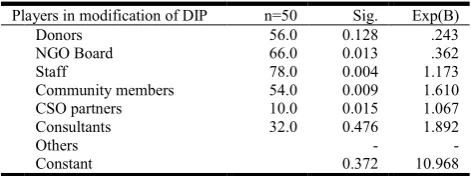
[image:6.595.315.551.541.629.2]The respondents were asked to state the players in the modification of the detailed implementation plan, the efficacy of each player was also analyzed. The results were as shown in Table 4.
Table 4. Plan Modification Players and Performance of Interventions
Players in modification of DIP n=50 Sig. Exp(B)
Donors 56.0 0.128 .243
NGO Board 66.0 0.013 .362
Staff 78.0 0.004 1.173
Community members 54.0 0.009 1.610
CSO partners 10.0 0.015 1.067
Consultants 32.0 0.476 1.892
Others - -
Constant 0.372 10.968
meant that donors and NGO Board members did not participate meaningfully in the modification of the detailed implementation plans for enhanced performance of HIV and AIDS interventions. The stakeholders who participated effectively were staff, community members CSO partners and consultants.
Elements of financial plan and performance of HIV and AIDS interventions
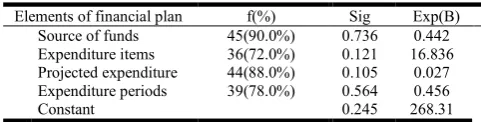
[image:7.595.41.282.255.316.2]The respondents were asked to state the elements in their financial plans, analysis was further done on the effectiveness of elements of financial plan in enhancing performance of HIV and AIDS interventions. The findings are as shown in Table 5.
Table 5. Elements of Financial Plan and Performance of Interventions
Elements of financial plan f(%) Sig Exp(B) Source of funds 45(90.0%) 0.736 0.442 Expenditure items 36(72.0%) 0.121 16.836 Projected expenditure 44(88.0%) 0.105 0.027 Expenditure periods 39(78.0%) 0.564 0.456
Constant 0.245 268.31
Majority of the respondents at 45(90.0%) stated that source of funds/income formed a component of the financial plan (OR=0.442,p-value=0.736). A huge proportion of the respondents at 44(88.0%) indicated that projected expenditure formed part of their financial plan (OR=16.83, p-value=0.121). Among the respondents, 39(78.0%) mentioned expenditure periods (OR=0.456,p-value=0.564). The least of the respondents at 36(72.0%) mentioned expenditure items (OR=16.836, p-value=0.121).
Key informant interview results
The interviews with the Key Informants revealed that the organizations managing HIV and AIDS interventions have done strategy formulation to a large extent. They noted that this process involved coming up with the goals, objectives, strategic options and operational plans. The interviewees noted that strategic formulation has suffered rigor because most organizations lack the technical knowhow to properly formulate strategies. There was a consensus that strategy formulation influences the performance of HIV and AIDS interventions.
“By clear defining project goals, objective and picking appropriate strategies, the organizations have been able effectively deliver on their mandate in HIV prevention, care
and treatment.” Said the director at Kenya AIDS NGO
Consortium.
“Strategy formulation cristalises the strategic thoughts into a
roadmap, therefore needs a lot of skill which is lacking in most organizations, stakeholder participation has not been handled
properly during this stage” Said a Coordinator at NASCOP
The interview findings coincided with the questionnaire respondents that the strategy formulation has been adopted to a large extent and that it adds value to HIV and AIDS programming in Nyanza Region.
Odds Ratio
The study computed the chi-square odds ratio to ascertain the relationship between strategy formulation, stakeholder
participation and performance of HIV and AIDS interventions managed by non-governmental organisations in Nyanza Region. The odds ratio showed the likelihood for non-performing outcomes for HIV and AIDS interventions if strategy formulation was practiced to a small extent, this was done at 95% Confidence Interval. The results were as shown in Table 6.
Table 6. Odds Ratio Analysis
Statistic descriptor Value 95% CI
Lower Upper Odds Ratio for Strategy Formulation 1.091 0.301 3.959 Odds Ratio for Stakeholder Participation 1.111 0.334 3.692
It was established that organisations that did strategy formulation to a small extent were 1.091 more likely to have non-performing HIV/AIDS interventions compared to those that conducted strategy formulation to a large extent. The difference was statistically significant, X2(1) =11.018, p= 0.049, CL=95%. This meant that strategy formulation was effective in enhancing the performance of HIV/AIDS interventions implemented by NGOs in Nyanza Region. It was established that engaging stakeholders in strategy formulation to a small extent were 1.111 more likely to more likely to have non-performing HIV/AIDs interventions compared to those that engaged stakeholders to a large extent. The difference was statistically significant, X2(1) =5.030, p= 0.033, CL=95%. The findings showed that engaging stakeholder in strategy formulation would lead to enhanced performance for the HIV/AIDS interventions in Nyanza Region.
Correlation Analysis
[image:7.595.312.554.533.660.2]The study conducted a bi-variate correlation test using Spearman’s Rho coefficient to analyse the direction and magnitude of the relationship between strategy formulation, stakeholder participation and performance of HIV and AIDS intervention, the results were as shown in Table 7.
Table 7. Correlation Analysis
Strategy Formulation
Stakeholder Participation
Performance of HIV and AIDS interventions Strategy
Formulation 1
Sig. (2-tailed) Stakeholder Participation
0.150 1
Sig. (2-tailed) 0.297 Performance of HIV and AIDS interventions
0.019* 0.024* 1
Sig.(2-tailed) 0.049 0.033
how strategic formulation affects growth of business entities, a significant association was established. The second objective of the study was to examine the moderating influence of stakeholder participation on the relationship between strategy formulation and performance of HIV and AIDS interventions managed by NGOs in Nyanza Region. The study established that there was an insignificant weak positive relationship between strategy formulation and stakeholder participation r
(50) =0.150, p-value= 0.297, CL=95%. Nonetheless, a significant weak positive association was established between stakeholder participation and performance of HIV and AIDS interventions managed by non-governmental organizations in Nyanza region. This meant that by strengthening the stakeholder participation in strategy formulation, the performance of HIV and AIDS would be enhanced.
Hypothesis testing between strategy formulation and performance of HIV and AIDS interventions
The study tested the null hypotheses (H0) using chi-square
[image:8.595.80.527.403.490.2]statistic to ascertain the statistical insignificance of the relationship between strategy formulation and performance of HIV and AIDS interventions, the results were as shown in Table 9.
Variables X2 Value Df Asymp. Sig. (1-sided)
Strategy formulation 11.018 1 0.049 Stakeholder participation 5.030 1 0.033
The study tested the null hypothesis (H0) that there is no
significant relationship between strategy formulation and performance of HIV and AIDS interventions managed by non-governmental organisations in Nyanza Region. The Chi-square distribution table gave a reading of critical value= 3.84 and the
X2(1) value=11.018, 3.84 <11.018, therefore we reject the null hypothesis. This meant that it is statistically very unlikely to that the null hypothesis (Ho) is true, for that reason, we adopt
the alternative hypothesis (H1) that there is a significant
relationship between strategy formulation and performance of HIV and AIDS interventions managed by non-governmental organisations in Nyanza Region. The outcome of the hypothesis testing corroborates with those of the correlation analysis that there is a significant relationship between strategy formulation and the performance of HIV and AIDS interventions. The study tested the null hypothesis (H0) that
there is no significant moderating influence of stakeholder participation on the relationship between strategy formulation and performance of HIV and AIDS interventions managed by non-governmental organisations in Nyanza Region. The Chi-square distribution table gave a reading of critical value= 3.84 and the X2(1) value =5.030, 3.84 <5.030, therefore we reject the null hypothesis, this means that its is statistically very unlikely that the null hypothesis is true. We revert to the alternative hypothesis (H1): that there is a significant
moderating influence of stakeholder participation on the
relationship between strategy formulation and performance of HIV and AIDS interventions managed by non-governmental organisations in Nyanza Region.
Strategy formulation elements and performance of HIV and AIDS interventions
The carried out a logistic regression analysis to establish the relationship between the elements of strategy formulation and the performance of HIV and AIDS interventions managed by non-governmental organisations in Nyanza Region, the findings were as shown in Table 8.
Strategy formulation to a large extent increased the chances for performing HIV and AIDS interventions by 2.723(p-value=0.003) times compared to strategy formulation to a small extent. Establishing long-term objectives to a large extent increased the chances for performing HIV and AIDS interventions by 560969949.00(p-value=0.009) times compared to strategy formulation to a small extent. Having clear objectives (OR= 0.000,p-value=0.999), conducting financial planning (OR= 0.342,p-value=1.000) and the detailed action plan (OR=0.000, p-value=0.999) did not increase the chances for performing HIV and AIDS interventions.
Conclusion
It was concluded that Organisations managing HIV and AIDS interventions in Nyanza Region formulated implementation strategies, had long-term goals, objectives, detailed implementation action plans and financial plans to a large extent. However, their strategy formulation processes were not effective. It was concluded that there was a significant relationship between strategy formulation and performance of HIV and AIDS interventions managed by non-governmental organisations in Nyanza Region. It was inferred that organisations that did strategy formulation to a large extent were more likely to have performing HIV and AIDS interventions compared to those that conducted strategy formulation to a small extent. There is a significant weak positive relationship between strategy formulation and the performance of HIV interventions. Stakeholder involvement in strategy formulation is still weak. Organizations that involve stakeholders more in the strategy formulation had better outcomes in terms of performance of HIV and AID interventions in Nyanza Region Kenya.
Recommendations
The NGOs managing HIV and AIDS interventions in Nyanza Region should modify their capacity strengthening strategies
Table 8. Strategy Formulation Elements and Performance of Interventions
Elements of strategy formulation B Wald df Sig. Exp(B) 95% C.I. for EXP(B)
Lower Upper
Strategy selection -1.072 1.110 1 0.292 .342 .047 2.516
Strategies formulation 1.002 6.420 1 0.003 2.723 .524 14.153
Project objectives -20.491 .000 1 0.999 0.000 .000 .
Long term goal 43.171 7.875 1 0.009 560969949.00 .000 .
Financial plan -1.072 .000 1 1.000 0.342 .000 .
Detailed action plan -20.420 .000 1 0.999 0.000 .000 .
with communities and partners. The curriculum content and its delivery should be adequately reviewed and only qualified personnel engaged to facilitate the processes. They should also strengthen the peer support group strategy for those infected with HIV and AIDS to enhance effectiveness. The NGOs need to review the general and the specific objectives of in the detailed implementation to ensure that they are in line with the strategies and properly understood by all the stakeholders. The activities generated the general and the specific goals should also be assessed for relevance. The level and mechanism of engaging the donors and NGO board in the modification of the detailed activity action plan should be reviewed to enhance their effectiveness. Overall, the NGOs managing the HIV and AIDS interventions should strengthen their strategy formulation processes to enhance the performance of HIV and AIDS interventions. There is need for NGOs to engage stakeholders more meaningfully in the strategy formulation process, this will enable them to participate actively in the subsequent strategic planning processes for better HIV and AIDS programing outcomes.
REFERENCES
Arasa, R. 2008. Strategic planning, employee participation and firm performance in Kenya’s insurance industry.
Unpublished MBA thesis. Nairobi: University of Nairobi.
Arasa, R. and K’Obonyo, P. 2012. The Relationship between strategic planning and firm performance. International
Journal of Humanities and Social Science, 2 (22).
Auvert, B., Taljaard, D., Lagarde, E., Sobngnwi-Tambekou, J., Sitta, R., Puren, A. 2005. Randomized controlled intervention trial of male circumcision for reduction of HIV infection risk: the ANRS 1265 Trial. PLoS Med., 2 (11), 298.
Bailey, R., Moses, S., Parker, C.B., Agot, K., Maclean, I., Krieger, J.N., Williams, C.F., Campbell, R.T. and Ndinya-Achola, J.O. 2007. Male Circumcision for HIV prevention in young men in Kisumu,Kenya: Randomised controlled trial. Lancet, 369(9562),643-656.
Baligh, Y. and Ian, F. 2011. Battling AIDS in America: An Evaluation of the National HIV and AIDS Strategy. Am J
Public Health, 101(9)
Bordean, O., Borza A., Rus, C. and Mitra, C. 2009. An investigation on the strategy formulation process within the
Romanian companies. Cluj-Napoca, Risoprint Publishing
House.
Choo, C. 2002. Information management for the intelligent
organisation, the art of scanning the environment.
Medford, NJ: Information Today, Inc.
Crosby, B. 1991. Strategic planning and strategic management: What are they and how are they different. Technical Notes no. 1 October 1991.
David, F.R. 2013. Strategic management: Concepts and cases
(11th ed.).Harlow: Pearson Education Ltd.
Drucker, P. 1990. Managing the Non-Profit organisation.
London: Butterworth- Heinemann.
Dworkin, S.L. and Ehrhardt, A. A. 2007. Going beyond ‘ABC’ to include ‘GEM’: critical reflections on progress in the HIV and AIDS epidemic. American Journal of Public
Health 97(1), 13–18.
Franklin, P. 2011. Relationship Between Strategic Planning
and Non-profit Organizational Performance. Ph.D.
dissertation, Capella University, United States. ProQuest Dissertations and Theses: (Publication No.3440040).
Grattan, R.F. 2011. Strategic review: The Process Strategy Formulation in Complex Organisations. Farnham, Surrey, England: Gower Publishing Limited
Gray, R.H., Kigozi, G., Serwadda, D., Makumbi, F., Watya, S., Nalugoda, F., Kiwanuka, N., Mouton, L.H., Chaudhary, M.A., Chen, M.Z., Sewankambo, N.K., Wabwire-Mangen F, Bacon, M.C., Williams, C.F., Opendi, P., Reynolds, S.J., Laeyendecker, O., Quinn, T.C., Wawer, M.J. 2007. Male Circumcision for HIV prevention in men in Rakai, Uganda: A randomized controlled trial. Lancet, 369(9562), 67-666. Johnson, G. Scholes, K. and Whittington, R. 2008. Exploring
corporate strategy: text and cases. London: Pearson
Education.
Kameri-Mbote, P. 2008. Strategic planning and implementation of public involvement in environmental
decision. Environmental Law Research Centre Working.
Nairobi.
Kathama, L. K. 2012. Strategic planning practices and performance of state corporations in Kenya. Unpublished
MBA thesis. Nairobi: University of Nairobi.
Kenya Aids Indicator Survey 2012. Final Report June 2014.
Retrieved from http://www.nacc.or.ke/images/documents/ KAIS-2012.pdf
Kenya AIDS Response Progress Report 2014. Progress
towards Zero. Retrieved from http://www.unaids.org/sites/
default/files/country/documents/KEN_narrative_report_201 4.pdf
Kissling, E., Allison, E.H., Seeley, J.A., Russell, S., Bachmann, M., Musgrave, S.D. and Heck, S. 2005. Fisherfolk are among groups most at risk of HIV: cross-country analysis of prevalence and numbers infected. AIDS 19(17), 1939–1946.
KNASP 2014. Draft KNASP Review Reporting Format, Inception Report: Strategic Review of the Kenya National
HIV and AIDS Strategic Plan (KNASP) 2005/06 - 2009/10
and Development of a New KNASP 2009/10-2013/14 Mulunga, W.M. 2007. Improving the effectiveness of strategic
planning in local NGOs In Malawi. Unpublished Thesis. University of South Africa: Pretoria.
Muturia, J. 2009. Multidimensional strategic planning practices and firm performance. Unpublished MBA thesis.
Nairobi: University of Nairobi.
Muturia, J. M. and Oeba, L. K. 2012. Strategic planning, planning outcomes and organizational performance.
Unpublished MBA project, University of Nairobi.
Nedelea, S. and Paun, L. A. 2009. The importance of the strategic management processing the Knowledge based economy. Review of international comparative
Management, 10 (1), 95-105
Ng’ayo, M.O., Bukusi, E., Rowhani-Rahbar, A., Koutsky, L.A., Feng, Q., Kwena, Z.A. and Holmes, K.K. 2008. Epidemiology of human papilloma virus infection among fishermen along Lake Victoria shore in Kisumu district, Kenya. Journal of Sexually Transmitted Infections, 84(1), 62–66.
NGO Coordination Board. (2013, March). Monies utilized by the NGO sector in Kenya. 2nd HIV capacity building partner’s summit, Johannesburg, South Africa. Retrieved From http://www.slideshare.net/RegionalAIDSTraining/ sekoh-nyadiero-ngo-board-kenya#
O’Regan, N. and Ghobadian, A. 2007. Formal Strategic Planning: Annual Raindance or Wheel of Success.
Strategic Change, 16(1-2), 11-22. doi:10.1002/jsc.777.
ministry of Foreign affairs, Kenya. Unpublished MBA thesis. Nairobi: university of Nairobi.
Pickering, H., Okongo, M., Ojwiya, A., Yirrell, D. and Whitworth, J. 1997. Sexual networks in Uganda: mixing patterns between a trading town, its rural hinterland and a nearby fishing village. International Journal of AIDS and
STDs, 8(8), 495–500.
Sagar, R. 2009. Finance management system of NGOs and it’s adequacy in relation to the project implements. Thesis Report. TIIS, Delhi
Steiner, G.A. 1979. Strategic Planning: What Every Manager Must Know. New York: The Free Press Publishing.
Thaw, D. and Petersen, R. 1999. How are you managing organisational change? Durban: Olive Publications.
Thompson, A.A., Peteraf, M.A., Gamble, J.E. and Strickland, A.J. 2012. Crafting and executing strategy: The quest for competitive advantage. New York:McGraw-Hill/Irwin. Voeten, H.A., Egesah, O.B. and Habbema, J.D. 2004. Sexual
behavior is more risky in rural than in urban areas among young women in Nyanza Province, Kenya. Journal of
Sexually Transmitted Diseases, 31(8), pp. 481–487.
Wheelen, T. L. and Hunger, J. D. 2010. Concepts in strategic management and business policy (12th ed.). Retrieved from The University of Phoenix eBook Collection.