ISSN Print: 2327-5952
DOI: 10.4236/jss.2019.73006 Mar. 8, 2019 75 Open Journal of Social Sciences
A Study on the Cost of Production in Film
Project Management: Taking Small-Budget
Films in China as an Example
Xiaolu Lu
National Institute of Development Administration of Thailand, Bangkok, Thailand
Abstract
At present, Chinese film has been becoming industrialized with the produc-tion management system still being imperfect. Small-budget films account for the largest proportion of Chinese film output while with the problems in production management being the most, which influences the development of the entire cultural industry to a certain extent. Among them, the waste of funds caused by management problems emerges endlessly. In this article, in-depth interviews with nine veterans in the industry and multiple case stu-dies into six small-cost film crews for practical observations are combined and the cost control problem in small-cost films is explained from the pers-pective of project cost elements for the first time. Four aspects of personnel expenses, material costs, equipment rental expenses and other living expenses are analyzed and discussed and the details of the cost and the hidden factors are studied to expand the application of the theoretical framework of project cost elements in this field.
Keywords
Film Project, Cost of Production, Small-Budget Films in China
1. Introduction
In some developed countries in the West, the film has become the core of the cultural industry with its operational management experience being quite ma-ture [1]. For example, every aspect of the film production management in Hol-lywood in the United States is relatively mature after years of development [2]. The Chinese film industry really got off the ground in 2002, and its production management mechanism was relatively backward with a series of problems How to cite this paper: Lu, X.L. (2019) A
Study on the Cost of Production in Film Project Management: Taking Small-Budget Films in China as an Example. Open Jour-nal of Social Sciences, 7, 75-88.
https://doi.org/10.4236/jss.2019.73006
Received: February 1, 2019 Accepted: March 5, 2019 Published: March 8, 2019
Copyright © 2019 by author(s) and Scientific Research Publishing Inc. This work is licensed under the Creative Commons Attribution International License (CC BY 4.0).
http://creativecommons.org/licenses/by/4.0/
DOI: 10.4236/jss.2019.73006 76 Open Journal of Social Sciences emerging in the process of production management [3]. Due to the small amount of funds and the limited allocation of resources in all aspects, many problems have been highlighted in the production management process of small-budget films. At present, the project management of the small-budget films accounting for the largest proportion of the total Chinese film production is chaotic, and the management of the actors is especially in utter disorder, which has caused serious problems to the production unit in producing small-budget film. The problem has brought huge losses to the cycle, quality and cost of film production, deeply affecting the international status of Chinese film. Conse-quently, there exists such a situation that Chinese film production ranks first in the world with only a very small number of films profitable and most of them turning out to be with deficit. In 2017, less than 10% of all the Chinese films can be profitable [4], which impresses the development of the entire cultural indus-try to a certain extent.
Based on a clear investment quota, the film project begins to formulate a pro-duction plan. Once the propro-duction plan is determined, detailed planning is re-quired for the use and distribution of funds throughout the film-producing pe-riod [5]. As far as small-budget films are concerned, there are still many man-agement deficiencies in the process of producing films, which leads to waste of funds, especially the waste of funds caused by many human factors, and ulti-mately results in unnecessary cost overruns. In this article, the author studies, concludes and summarizes the cost overruns and cost savings involved in the production process of small-budget film from the perspective of cost control with an aim to help managers avoid unnecessary expenditures, contain unne-cessary losses and successfully complete the film production on the basis of sav-ing funds. In the film production, much consumption is abstract. High costs do not necessarily bring about high benefit, and low costs do not necessarily lead to low quality. For example, providing there are two similar films in scale with their production cost varying greatly, the problems are impossible to be penetrated for investors and managers lack of experience. As a matter of fact, laymen are in-volved in investing and managing most of the current small-budget films. In the production process of the film, the five main aspects involved in the costs are: personnel expenses; material costs, digital photography costs, equipment rental expenses, and other living expenses [6]. Among them, small-budget films’ de-mand for digital photography cost including special effects, film trick and other expenses is small. In addition, the digital photography link belongs to the cate-gory of post-production, which is beyond the scope of this article. Therefore, the author will discuss and analyze the personnel expenses, material costs, equip-ment rental expenses and other living expenses in this paper.
Unless specified, the small-budget films mentioned in the paper refer to “small-budget films in China”, and the currency mentioned in the paper is “RMB”.
DOI:10.4236/jss.2019.73006 77 Open Journal of Social Sciences films” in this article are defined as “a film with an investment of less than 10 mil-lion” based on the statements of the academic authority and the mainstream of the industry [7].
2. Literature Review
Project management originated from the US military and mostly referred to de-fense project management, and the project managers or directors did not involve direct financial interests. Therefore, cost control and management seemed insig-nificant for quality and time. With the passage of time, the concept of project management has gradually been accepted by the business community. It was first applied in the construction industry. Since then, the importance of cost has gradually been increased and has been called as the three elements of project management together with time and quality. In most projects, cost overrun is a long-standing problem, and the participation of many stakeholders in project production inevitably leads to project overruns [8]. The determination of the production scope has a great impact on the cost control. That the scope of the project is unchanged will help to control the cost more favorably. The final cost will increase if the production rhythm of the project is changed because of cer-tain factors [9].
DOI: 10.4236/jss.2019.73006 78 Open Journal of Social Sciences The existing literature has laid the status of cost elements in project manage-ment. As to the cost of film project production, the status quo of the organiza-tion and the strategy of cost management are explained and discussed in detail. However, the existing studies mainly based on the macroscopic perspective focus on the form of the control and the cost management strategy, while ignore the characteristics of the film crew and the specific reasons for the high cost and have difficulties in explaining the deeply hidden unregistered logic of the cost problem. Therefore, based on the logic and generality of the film production management in formulating cost control method and strategy, the author has deeply explained and discussed the details of the cost problem caused in the film production process and classified the attributes of the cost problem in this ar-ticle.
3. Methodology
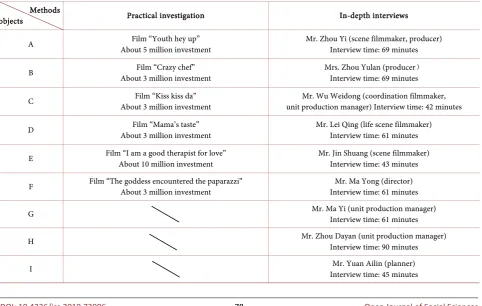
In this study, practical observations and in-depth interviews (Table 1) are ap-plied to collect data for qualitative research analysis.
[image:4.595.58.541.440.746.2]1) In the cases of six small-budget film crews, the researchers have entered and worked in the crews and conducted in-depth observation and research on the issues of costs in the crew to form a multi-case study based on replication logic. Multi-case studies are supplemented by iterations of things in different environments to make research conclusions more stable and reliable and more general [16].
Table 1. Methods of Collecting Data.
Methods
objects Practical investigation In-depth interviews
A About 5 million investment Film “Youth hey up” Mr. Zhou Yi (scene filmmaker, producer) Interview time: 69 minutes
B About 3 million investment Film “Crazy chef” Mrs. Zhou Yulan (producerInterview time: 69 minutes )
C About 3 million investment Film “Kiss kiss da” unit production manager) Interview time: 42 minutes Mr. Wu Weidong (coordination filmmaker,
D About 3 million investment Film “Mama’s taste” Mr. Lei Qing (life scene filmmaker) Interview time: 61 minutes
E Film “I am a good therapist for love” About 10 million investment Mr. Jin Shuang (scene filmmaker) Interview time: 43 minutes
F Film “The goddess encountered the paparazzi” About 3 million investment Interview time: 61 minutes Mr. Ma Yong (director)
G Mr. Ma Yi (unit production manager) Interview time: 61 minutes
H Mr. Zhou Dayan (unit production manager) Interview time: 90 minutes
DOI:10.4236/jss.2019.73006 79 Open Journal of Social Sciences 2) The researcher has conducted one-to-one in-depth interviews with veterans of the nine small-budget film production management teams. The issues of costs in the film crew have great hidden features, and the experienced small-budget film crews have an intuitive and visual feeling about the hidden features of the industry, so the information obtained from their interviews is very suitable for the study in this paper. In-depth interviews help to trigger interviewees to share relevant events, their experience of successes and failures, and enable intervie-wees and researchers to participate in understanding the researched questions [17]. The researcher in this article will conduct face-to-face, in-depth and long-term interviews with people who have years of experience in film produc-tion management and artistic creaproduc-tion in small-budget film producproduc-tion. The in-terview is carried out around the research content in this article by virtue of semi-structured and open-ended questioning methods. The respondent has been invited to discuss topics around the following points. 1) Which processes of small-budget films production are usually found with overspending; 2) Which processes of small-budget films production are most likely to help save costs; 3) What is the relationship between small-budget film production and the film quality and filming cycle; 4) How to balance the relationship between them? And what is their importance in film production? The researcher also needs to care-fully watch what the interviewee is doing and saying during the interview process, and perform on-the-spot recording or brain memory on the tone, facial expression, expressions in their eyes, and speech rhythm of the interviewee, so as to summarize deeper and more implicit implication with combining the text content.
4. Results
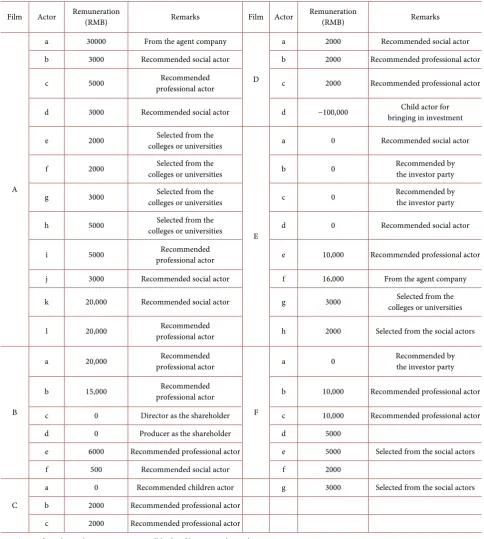
gra-DOI: 10.4236/jss.2019.73006 82 Open Journal of Social Sciences titude or other interests are usually paid at a low price in addition to some ex-ceptional cases. The non-professional actors who are recommended to join the shooting are also low-paying, and some even act for no remuneration. However, there exist special cases in which non-professional actors can get high remunera-tion, and most of the people who can bring in the investment are children actors.
Table 2. The Remuneration statistics table of the research objects-main actors.
Film Actor Remuneration (RMB) Remarks Film Actor Remuneration (RMB) Remarks
A
a 30000 From the agent company
D
a 2000 Recommended social actor
b 3000 Recommended social actor b 2000 Recommended professional actor
c 5000 professional actor Recommended c 2000 Recommended professional actor
d 3000 Recommended social actor d −100,000 bringing in investment Child actor for
e 2000 colleges or universities Selected from the
E
a 0 Recommended social actor
f 2000 colleges or universities Selected from the b 0 Recommended by the investor party
g 3000 colleges or universities Selected from the c 0 Recommended by the investor party
h 5000 colleges or universities Selected from the d 0 Recommended social actor
i 5000 professional actor Recommended e 10,000 Recommended professional actor
j 3000 Recommended social actor f 16,000 From the agent company
k 20,000 Recommended social actor g 3000 colleges or universities Selected from the
l 20,000 professional actor Recommended h 2000 Selected from the social actors
B
a 20,000 professional actor Recommended
F
a 0 Recommended by the investor party
b 15,000 professional actor Recommended b 10,000 Recommended professional actor
c 0 Director as the shareholder c 10,000 Recommended professional actor
d 0 Producer as the shareholder d 5000
e 6000 Recommended professional actor e 5000 Selected from the social actors
f 500 Recommended social actor f 2000
C
a 0 Recommended children actor g 3000 Selected from the social actors b 2000 Recommended professional actor
DOI:10.4236/jss.2019.73006 83 Open Journal of Social Sciences Material costs mainly include expenses of scenes, clothing, makeup, props, and scenery. Small-budget films are mostly modern or contemporary ones, so their cost in this area is small. The scenes are basically ready-made, and there is almost no need to set up scenes specially. Therefore, the film crew should use their own resources and connections to try to use the free scenes; thus, the out-reach producers here are quite crucial. The outout-reach producers are mostly locals. Lots of outreach producers collude with the scene party and raise the price of the original free scenes when making offers for the film crew, accordingly they ap-propriate the gains to themselves. Sometimes, they reach agreement with the scene party, raise the original price to a higher price and then make that offer to the film crew. Finally, the outreach producer and the scene party divide the money proportionally. Most of the regular clothing is brought into the film crew by the actors themselves. Even if they buy or have others make it, there will be no big difference in cost. However, there will be great flexible space for the cost when there are special requirements for clothing. That’s because this type of clothing is often tailored or rented, which involves the local costume market. Actually, the costumers are quite familiar with this field and usually have several long-term fixed cooperation objects. Many costumers customize or rent clothing at the lowest cost, and make an offer for the film crew at a high price. What is more, they often make the offer for the film crew just before the filming with an aim to leave the film crew no time to examine the cost of clothing. The most important thing about make-up is the quality of cosmetics. The cosmetics used in producing films are different from the cosmetics used in life. At present, al-most all the cosmetics in Chinese film crews are sold by a shop at the entrance of Beijing Film Studio, and they are all international famous brands. The generally used cosmetics are easy to cause skin allergies. If something happens to the ac-tors, the consequences are unimaginable, which will not only affect the shooting progress, but also result in compensation paid to the actors. Usually, the cost of a small-budget film is about 6000 to 10,000 RMB. Especially, the actress’s makeup consumes a lot of cosmetics. Many make-up men accumulate some cosmetics that have not been used by other film crews. When the crew invites the make-up man, the make-up man can also bring his or her own cosmetics into the film crew and the film crew only needs to pay about 50% of the cost. The cost of cosmetics is great, and if there are many characters, the cost of cosmetics will be higher. The most worrying thing is that the make-up man has the fluke mind to buy low-quality cosmetics at a high price and make profit from it. In the small-budget films, the props and the scenery are usually completed by the arts designer. According to the actual situation, the arts designer chooses to buy the ready-made material or self-made material. Both methods involve the purchase cost. Sometimes, the cost of some props and scenery is quite high, and many arts designers gain extra income from this and the amount is astonishing.
DOI:10.4236/jss.2019.73006 85 Open Journal of Social Sciences
Table 3. The Minimum Price List for Major Rental Equipment.
Department Description Expense Remarks
The production unit
5D2 300/day
ALEXA 2000/day Including the costs of monitors, UP lens, 1 opera-t
ALEXAmini 3000/day
3600/day
Including the costs of monitors, UP lens, 1 opera-t
large rocker arm 500/day
Including the cost of 1 operator small rocker arm 150/day
track 300/day
Steadicam 500/day
Large aerial photography aircraft 8000/day Including the cost of 1 operator Large aerial photography aircraft 2000/day Including the costs of 1 operator The lighting unit A whole set of lightings 25,000/month
The recording unit A whole set of recorders 2500/day Three persons
Vehicles
Power-generating cars 400/day Including the costs of 1 driver and operator
Buses 800/day Including the cost of 1 driver
Commercial vehicle (Ruifeng) 280/day including the cost of 1 driver Commercial vehicle (Jinbei) 240/day Including the cost of 1 driver
Small truck 350/day Including the cost of 1 driver
Data Source: from the production units in six small-budget film cases in this study.
them, the expenses of renting Ruifeng, Jinbei and mini-trucks are calculated based on two vehicles, and the basic necessary equipment in the photographic equipment only includes packaged equipment with the total price being 205,800 RMB. The application of Steadicam or aerial photography aircraft will increase the total expense. If a layman or a newcomer is in charge of the production management, the expenses of this series of equipment cannot be estimated, and may be over 400,000 RMB. In addition, the management party should also ra-tionalize the rental management of these equipment and vehicles according to the needs of the shooting and the production cycle so as to minimize the unne-cessary expenditure.
DOI: 10.4236/jss.2019.73006 86 Open Journal of Social Sciences themselves, most of the production directors generally do not easily disclose them. The driver’s salary in the film crew is usually 80 to 100 RMB per day; and that of the bus driver is generally 150 RMB, and the power-generating cars driv-er’s salary ranges generally from 150 to 200 RMB. Their income is not high, so many of them rely on other means to supplement their income. If calculated ac-cording to a 20-day production period, the oil expense can amount up to 4000 RMB, thus increasing the pressure on the funds of the film crew. However, the oil expense of a car can be controlled within 1000 RMB, with an average of 50 RMB per day. In this case, the production director will not interfere too much. There are still many unpredictable costs in life, such as the cost of public rela-tions and film crew dinners, the cost of purchasing insurance, the medical ex-penses for sickness and injury, etc. These are unpredictable costs but exist objec-tively to a certain degree.
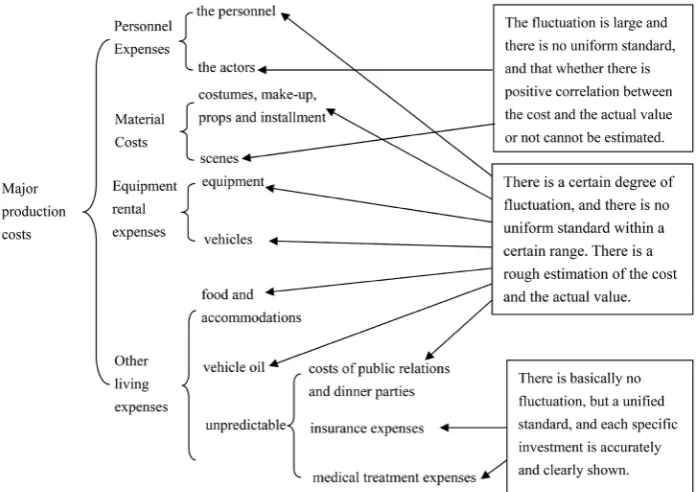
[image:12.595.189.538.445.691.2]In general, the main costs of small-budget films in film production are rough-ly divided into three categories according to the control attributes (Figure 1). Among them, actors and scene producers only consider whether this price is ac-ceptable or not and it is difficult for them to control the real value of the selected party. The real value refers to the price actually obtained by the selected party or the actual market value. The producer can control the costs invested in person-nel, costumes, make-up, props and scenes, equipment rental, vehicle rental, food and accommodation, vehicle refueling, public relations and dinners within a certain range and estimate their prices within certain limits; for example, the costs of insurance and medical care are more specific, which can be fully con-trolled by the producer and every expenditure can be clearly grasped.
Figure 1. The attributes of cost control in small-budget film production. Data source: The
DOI:10.4236/jss.2019.73006 87 Open Journal of Social Sciences
5. Conclusion
The investors and producers of small-budget films are mostly laymen, which is an important reason for the increase in cost during the production process. The costs of personnel account for the largest proportion of investment. Among them, in terms of the costs of personnel, there are certain fluctuations due to human favors. As for the total costs of the entire staff, the cost fluctuation of personnel at lower strata is less influenced by human favors. However, the over-all cost of personnel is relatively fixed, while the cost disparity of the main actors is huger. Sometimes, the price is not proportional to the quality. Thus, a prin-ciple should be grasped in choosing the main actors: “right actors should be chosen rather than expensive ones. The cost of the non-main actors is relatively fixed. In addition, the casting director’s taking “kickback” phenomenon which leads to an increase in the cost of the film crew should be prevented in choosing actors. Most of the costs invested in materials can be estimated, because the damage caused by human factors is very small, and the producers should active-ly communicate with the parties or departments. Onactive-ly the cost of the scenes is more abstract and unpredictable. Also, the crossing-border behavior of outreach producers in the scenes should also be prevented to avoid an increase in the cost of the film crew. The equipment rental requires the producer to have a certain personal relationship so as to rent the required equipment at a low price. In ad-dition, a reasonable plan for the rented equipment in the use period should be formulated to avoid unnecessary waste. It needs to be taken into consideration that whether the living costs can be changed with the film crew’s own resources firstly. The living costs should be appropriate and reasonable and should not be too economical, but the crossing-border behavior of drivers should be paid more attention to. Generally speaking, there is no need to worry too much about fully controlling the cost. To control the cost to a certain degree, the producers should communicate with the parties more and more to arouse attention of the latter, and the producers must establish certain prestige in the other parties’ mind. The uncontrolled and abstract costs are judged and determined according to the ex-perience and the keen social insight of the producer.
The Limitations of the Study
The case data collected in this study are reminiscent narrative. Although the data deriving from the personal experience of the author are true and reliable, there is no further analysis on the cause and effect of the incidents.
The veterans interviewed in this study are involved in some sensitive topics and inevitably have some reservations. In particular, there may be no objective judg-ments on the specific related work issues that the parties are engaged in. Some negative problems may involve the parties themselves, and the other parties may avoid making any reply, or just make a reply with non-authentic phenomena.
prac-DOI: 10.4236/jss.2019.73006 88 Open Journal of Social Sciences tice observation and in-depth interview and literature data is rarely applied.
The research questions are supported by multiple data as much as possible in order to greatly increase the reliability and validity of the study and subjective insights of the researcher in the research process still exist inevitably.
Conflicts of Interest
The author declares no conflicts of interest regarding the publication of this paper.
References
[1] Cao, L.Q. (2011) Research on Application of Project Management in Video Re-cording of Movie & Television. Master’s Thesis, Tianjin University, Tianjin. [2] Zhao, H.C. and Zhao, J.C. (2010) An Interview with Zhao Haicheng. Contemporary
Cinema, 27, 67-70.
[3] Sun, B. (2016) A Comparative Study on Management Mechanism of Film Produc-tion between China and the United States. Art Science and Technology, 29, 35. [4] Sohu Finance (2018) Comprehensive Analysis on the Profit and Loss of 2017
Chi-nese Film TOP 100. https://www.sohu.com/a/221548578_473379
[5] Fang, L. (2007) Program and Management in Process of Film Making. Master’s Thesis, Sichuan University, Chengdu.
[6] Bu, S.S. (2012) Discussion on Cost Control in Film Production. Chinese Film Mar-ket, 62, 12-13.
[7] Zheng, D.T. (2009) The Market Outlet of the Film with Low Budget. Contemporary Cinema, 26, 14-24.
[8] Doloi, H.K. (2011) Understanding Stakeholders’ Perspective of Cost Estimation in Project Management. International Journal of Project Management, 29, 622-636.
https://doi.org/10.1016/j.ijproman.2010.06.001
[9] Jackson, G. (2012) Contingency for Cost Control in Project Management: A Case Study. The Australian Journal of Construction Economics and Building, 3, 1-11.
https://doi.org/10.5130/AJCEB.v3i1.2906
[10] Si, J. (2014) Discussion on the Problems That Should Be Paid Attention to in the Cost Accounting of Film and Television Industry. China Chief Financial Officer, 12, 118-119.
[11] Chen, G.Z. (2018) Study on the Cost Control in Film and Television Industry. Chi-na Civil Entrepreneur, 6, 143-144.
[12] Wang, X.H. (2017) The Applied Research of the Cost Control in Film and TV Pro-grams. Accountant, 14, 37-38.
[13] Li, F.J. (2018) The Application of Project Management in Cost Control of Film and TV Plays. China Chief Financial Officer, 16, 58-59.
[14] Long, L.F. (2015) The Cost Control of Film Production. Chinese Film Market, 65, 28-30.
[15] Li, Y.C. (2016) Several Problems of the Cost Accounting in Film and Television In-dustry. Business, 6, 172.
[16] Eisenhardt, K.M. and Graebner, M.E. (2007) Theory Building from Cases: Oppor-tunities and Challenges. Academy of Management Journal, 50, 25-32.
https://doi.org/10.5465/amj.2007.24160888