doi:10.4236/am.2011.29156 Published Online September 2011 (http://www.SciRP.org/journal/am)
Reflection of Plane Waves from
a Free Surface of an Initially Stressed Transversely
Isotropic Dissipative Medium
Baljeet Singh1, Jyoti Arora2 1
Department of Mathematics, Post Graduate Government College, Chandigarh, India 2
B.S.A.I.T.M, Alampur, Faridabad, India E-mail: bsinghgc11@gmail.com
Received June 23, 2011; revised July 15, 2011; accepted July 23, 2011
Abstract
The governing equations of a transversely isotropic dissipative medium are solved analytically to obtain the speeds of plane waves. The appropriate solutions satisfy the required boundary conditions at the stress-free surface to obtain the expressions of the reflection coefficients of reflected quasi-P (qP) and quasi-SV (qSV) waves in closed form for the incidence of qP and qSV waves. A particular model is chosen for numerical computation of these reflection coefficients for a certain range of the angle of incidence. The numerical val-ues of these reflection coefficients are shown graphically against the angle of incidence for different valval-ues of initial stress parameter. The impact of initial stress parameter on the reflection coefficients is observed significantly.
Keywords:Transversely Isotropic,Dissipative Medium, Initial Stress, Plane Waves, Reflection, Reflection Coefficients
1. Introduction
We can not know the Earth completely by assuming mere an elastic body. If we consider various additional parameters, e.g. porosity, initial stress, viscosity, dissipa-tion, temperature, voids, diffusion, etc., then we can un-derstand better the interior of the Earth. Initial stresses in a medium are caused by various reasons such as creep, gravity, external forces, difference in temperatures, etc. The reflection of plane waves at free surface, interface and layers is important in estimating the correct arrival times of plane waves from the source. Various research-ers studied the reflection and transmission problems at free surface, interfaces and in layered media [1-12]. The study of reflection of plane waves in the presence of ini-tial stresses as well as dissipation is interesting. With the help of Biot [13] theory of incremental deformation, Selim [14] studied the reflection of plane waves at a free surface of an initially stressed dissipative medium. In the present paper, we studied the problem on reflection of plane waves at a free surface of an initially stress-ed transversely isotropic solid half-space with dissipation. The reflection coefficients of reflected waves are
com-puted numerically to observe the effect of initial stress.
2
. Formulation of the Problem and Solution
Following Biot [13], the basic dynamical equations of motion in x-z plane for an infinite, initially stressed me-dium, in the absence of external body forces are,
2 13
11
2 2 31 33
2
s
s u
P ,
x z z t
s s w
P ,
x z x t
(1)
where is the density, 1 w u
2 x z
is rotational
component, sij (i, j = 1, 3) are incremental stress compo-
nents, u and w arethe displacement components. Following Biot [13], the stress-strainrelations are
11 11 13
13 31 44 33 33 13
u w
s C P C P ,
x z
u w w u
s s C , s C C
z x z x
,
(2)
B. SINGH ET AL. 1130
, ,
For dissipative medium, elastic coefficients are re-placed by the complex constants:
R I R I
11 11 11 13 13 13
R I R I
33 33 33 44 44 44
C C iC , C C iC C C iC , C C iC
(3)
where, i 1 ,
are real. Following Fung [15], the stress and strain components in dissipative medium are,
R I R I R I R
11 11 13 13 33 33 44
C , C , C , C , C , C , C ,
I 44
C
i t i t
ij ij i i
s s e , u u e, (4) where (i, j = 1, 3) and being the angular frequency.
With the help of Equations (3) and (4), the Equation (2) becomes,
R I R I
11 11 11 13 13
R I
31 13 44 44
R I R I
33 33 33 13 13
u w
s C iC P C iC P ,
x z
u w
s s C iC ,
z x
w u
s C iC C iC ,
z x (5)
With the help of Equation (5), the Equation (1) be-comes,
2 2 2u
R R R R
11 2 13 44 44 2
2 2 2
2
I I I I
11 2 13 44 44 2
u P w P
C P C C C
2 x z 2
x z
u w u
u i C C C C 0,
x z x z (6)
2 2R R R
33 2 13 44
2
2 R
44 2
2 2 2
I I I I
13 44 44 2 33 2
w P u
C C C
2 x z
z
P w
C w
2 x
u w w
i C C C C 0,
x z x z
,
n
(7)The displacement vector is
given by,
(n ) u , O, wn n
U
n n i n
n
A e
U d (8)
where (n) assigns an arbitrary direction of propagation of waves, dn
d , d1n 3 is the unit displacement vectork c t
X
and n n n
. n is the phase factor, in n
n n
which 1 3 is the unit propagation vector,
cn is the velocity of propagation = (x, z), and kn is corresponding wave number, which is related to the an-gular frequency by
,
X
n n
The displacement components un and wn are written
k c
.
as
(9)
Making use of Equation (9) into the Equations (6) and (7
n n
n 1 3 n n
n
ik x z c t n 1 n n n 3 A d u e , A d w
), we obtain a system of two homogeneous equations, which as non-trivial solution if
22 2
n n n
c c I P
0, (10)
where,
2
1 2 n 1 3 2
ID D , P D D D ,
2 2 2 2 n n R R1 11 1 44 3
n n
R R
11 1 44 3
P
D C R C
2
i C C ,
R R n n I I n n
2 13 44 1 3 13 44 1 3
P
D C C i C C
2 ,
22 2 2
3
n
R n R n I n I
44 1 33 3 44 1 33 3
D
P
C C i C C
2 , 2 2 n n 2 2 n n
I I 4P I I 4P
c , c
2 2
The roots
correspond to quasi-P (qP) waves and quasi-SV (qSV)
waves respectively.
The above two roots give the square of velocities of propagation as well as damping. Real parts of the right hand sides correspond to phase velocities and the respec-tive imginary parts correspond to damping velocities of qP and qSV waves, respectively. It is observed that both
2 1
c and 2
2
c depend on initial stresses, damping and
ction propagation n
dire of . In the absence of initial
stresses and damping, the ve analysis corresponds to
the case of transversely isotropic elastic solid.
. Reflection of Plane Waves from Fr
abo
3
ee
e an initially stressed dissipative half-space
Surface
consider W
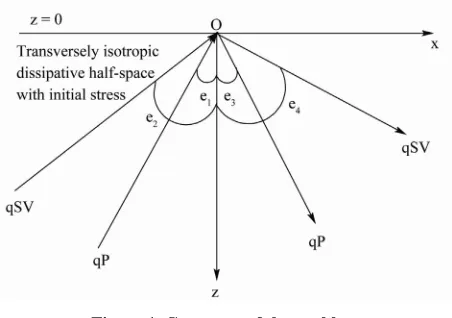
occupying the region z > 0 (Figure 1). In this section, we shall drive the closed form expressions for the reflection coefficients for incident qP or qSV waves.
The displacement components of incident and re-flected waves are as,
4 j j
j4
i i
j 1 j 3
j 1 j 1
u x, z, t A d e , w x, z, t A dj e,
(11)Figure 1. Geometry of the problem.
(12)
Here, subscripts 1, 2, 3 and 4 correspond to incident qP
nt and stress compo-ne
1 1 1 1 1
2 2 2 2 2
3 3 3 3 3
4 4 4 4 4
k c t sin e x cos e z , k c t sin e x cos e z , k c t sin e x cos e z , k c t sin e x cos e z ,
wave, incident qSV wave, reflected qP wave and reflected qSV wave, respectively.
In the x-z plane, the displaceme nts due to the incident qP wave
( 1 1 1 1 ritten as
,
3 1
1
sin e , cos e
) are w
1 i1 1 1d e ,
1 1 i1 1 3
u A
w A d e
1 1 1 i1
13 1 4 1 1 1 3 1
s iA Q k d cos e d sin e e
(13)
where,
.
In the x-z plane, the displacement and stress compo-ne
itten as
,
1
1 1
i 133 1 1 3 3 1 2 1 1
s iA k Q d cos e Q d sin e e
R I R R
1 11 11 2 13 13
R I R I
3 33 33 4 44 44
Q C iC , Q C iC , Q C iC , Q C iC
nts due to the incident qSV wave ( 1 2 sin e ,2 2 cos e2) are wr
2 i 2
d e ,
3 2
u A
2
2 1
2 2 i
2 3
w A d e
2 2 2 i 2
13 2 4 2 1 2 3 2
s iA Q k [d cos e d sin e ] e
2
2 2
i 233 2 2 3 3 2 2 1 2
s iA k Q d cos e Q d sin e e (14) In the x-z plane, the displacement and stress com ne
ritten as
,
,
(15)
In the x-z plane, the displacement and stress compo-nents due to the reflected qSV wave
4 are written as
,
po-nts due to the reflected qP wave
( 1 3 sin e ,3 3 cos e3) are w 3 i 3
d e ,
3 3
3
3 1
3 3 i
3 3
u A
w A d e
3 3 3 i 3
13 3 4 3 1 3 3 3
s iA Q k d cos e d sin e e
3 3 3 i 3
33 3 3 3 3 3 2 1 3
s iA k Q d cos e Q d sin e e ,
( 14 sin e ,4 34 cos e )
4
4
4 4 i
4 1
4 4 i
4 3
u A d e , d e
w A
4 4 4 i 4
13 4 4 4 1 4 3 4
s iA Q k d cos e d sin e e
4
4 4
i 433 4 4 3 3 4 2 1 4
s iA k Q d cos e Q d sin e e , (16) The boundary conditions required to be satisfied at the free surface z = 0,
,
n n
z 33
f s e P 0 f s 0,
x 13 13 n
(17)
The above boundary conditions are written as 1 2 3 4 1 2 3
13 13 13 13 13 13 13 13
1 2 3 4
s s s s P(e e e e 4) 0,
33 33 33 33
s s s s 0,
(18)
The Equations (11) to (16) will satisfy the boundary conditions (18), if the following Snell, s law holds
3
1 2 sin e 4
sin e sin e sin e
A11 + A22 + A33 + A4
37 + A48 = 0, (21)
where
1 2 3 4
,
c c c c (19)
and the following relations hold
4 = 0, (20)
A15 + A26 + A
1 1 1 3 1
k L d cos e d sin e ,
1 1
1
2 2
2 2 1 2 3 2
3 3
3 3 1 3 3 3
4 4
4 4 3 4 1 4
1 1
5 1 3 3 1 2 1 1
2 2
6 2 3 3 2 2 1 2
3 3
7 3 3 3 3 2 1 3
4
8 4 2 1 4 3
k L d cos e d sin e ,
k L d cos e d sin e ,
k L d sin e d cos e ,
k Q d cos e Q d sin e ,
k Q d cos e Q d sin e ,
k Q d cos e Q d sin e ,
k Q d sin e Q d
4
3 cos e4 ,
(22)
and 4
P
L Q
2
B. SINGH ET AL. 1132
1) For incident qP wave (A2 = 0),
3 4 5 1 8 4 3 5 1 7
1 3 8 4 7 1 3 8 4 7
A A
,
A A
, (23)
2) For incident qSV waves (A1 = 0),
3 4 6 2 8 4 3 6 2
2 3 8 4 7 2 3 8 4
A A
,
A A
7 7
. (24)
For isotropic case,C11 = + 2 + P, C13= P = –S11, then, the above theoretical derivations reduce to Selim [14].
4. Numerical Example
For numerical purpose, a particular example of the mate-rial is chosen with the following physical constants,
2
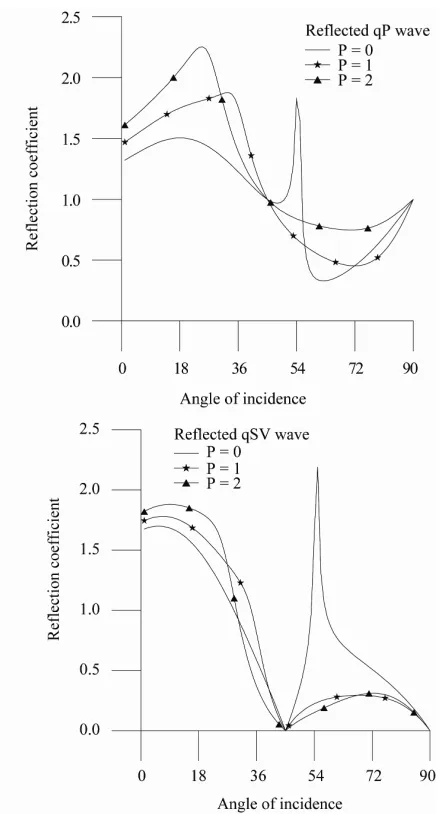
From Equations (23) and (24), the reflection
cients of reflected qP and qSV waves are computed for th
own graphically in Figure 2 for incident qP wave
and in Figure 3 for incident qSV wave.
coefficient of reflected qP ge of the angle of
inci-r P = 1 and P = 2 also change at each angle of incidence as shown by solid line with asters and solid lines with trian-gles, respectively. The comparison of the variations of reflection coefficients for P = 0, P = 1 and P = 2, show the significant effect of initial stress on reflected qP wa for incident qP wave. Similarly, reflected qSV is also affected significantly due to the presence of initial stress as show
R 1
C11 0 2 33R 10
10 2
13 44
I 10 2 I 10 2
11 33
I 10 2 I 10 2
13 44
2.628 10 N m , C 1.562 10 N m , 0.385 10 N m , C 1.025 10 N m , C 0.950 10 N C 0.425 10 N m , C 0.325 10 N m ,
R 10 2 R
C 0.508 10 N m , C
3 3
7.14 10 kg m .
m ,
coeffi-e incidcoeffi-ent qP and qSV wavcoeffi-es. Thcoeffi-e numcoeffi-erical valucoeffi-es of the reflection coefficients of reflected qP and qSV waves are sh
For P = 0, the reflection ave oscillates for the whole ran w
dence of qP wave as shown by solid line in Figure 2.
The variations of reflection coefficients of qP wave fo
s ve
n in Figure 2.
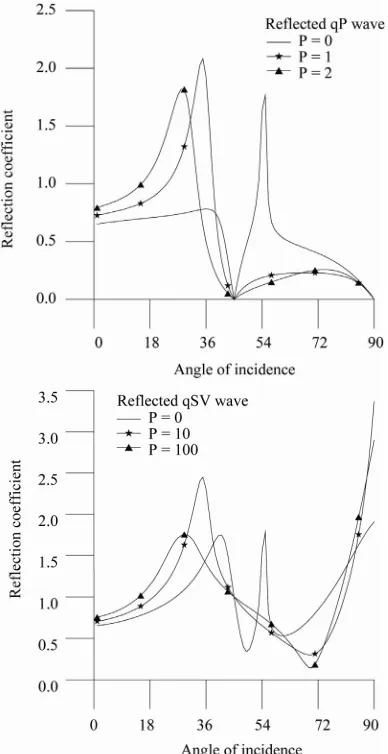
For incident qSV wave, the reflection coefficient of reflected qP wave first increases to its maximum value
and then decreases to its minimum value at angle e2 =
[image:4.595.314.534.74.481.2]45˚ when P = 0. Thereafter, it oscillates as shown by solid line in Figure 3. The variations of reflection coef-ficients of qP wave for P = 1 and P = 2 are similar to that for P = 0. The comparison of solid line, solid line with asters and solid line with triangles shows the significant effect of initial stress on reflected qP wave for incident qSV wave. Similarly, reflected qSV is also affected sig-nificantly due to the presence of initial stress as shown in Figure 3.
Figure 2. Variation of the reflection coefficients of qP an qSV waves against the angle of incidence for incidence of qP wave.
5. Conclusions
The reflection from the stress-free surface of a trans-versely isotropic dissipative medium is considered. The expressions for the reflection coefficients of reflected qP and qSV waves are obtained in closed form for the inci-dence of qP and qSV waves. For a particular material, these coefficients are computed and depicted graphically against the angle of incidence for different values of ini-tial stress parameter.From the figures, it observed that 1) the initial stresses affect significantly the reflection coef-ficients of all reflected waves. 2) For incident qP wave, the critical angle for reflected qSV wave is observed at e1
= 45˚ and for incident qSV wave, the critical angle f
d
or
reflected qP wave is observed also at e2 = 45˚. 3) The
Figure 3. Variation of the reflection coefficients of qP and qSV waves against the angle of incidence for incidence of qSV wave.
minimum at e1 = 45˚ for incidence qP wave and at e2 =
45˚ for incidence qSV wave.
6. References
[1] S. B. Sinha, “Transmission of Elastic Waves through a Homogenous Layer Sandwiched in Homogenous Media, Journal of Physics of the Earth, Vol. 12, No. 1, 1999, pp. 1-4. doi:10.4294/jpe1952.12.1
”
[2] R. N. Gupta, “Reflection of Plane Waves from a Linear Transition Layer in Liquid Media,” Geophysics, Vol.
No. 1, 1965, pp. 122-131. doi:10.1190/1.1439528
Compressional Waves,” Geo-physics, Vol. 30, No. 4, 1965, pp. 552-570.
Reflection of Elastic Waves from a Linear Transition Layer,” Bulletin of the Seismological Society [3] R. D. Tooly, T. W. Spencer and H. F. Sagoci, “Reflection
and Transmission of Plane
[4] R. N. Gupta, “
of America, Vol. 56, 1966, No. 2, pp. 511-526. doi:10.1190/1.1439622
[5] R. N. Gupta, “Propagation of SH-Waves in Inhomoge-neous Media,” Journal of the Acoustical Society of America, Vol. 41, No. 5, 1967, pp. 1328-1329.
doi:10.1121/1.1910477
[6] H. K. Acharya, “Reflection from the Free Surface of
Coefficients homogeneous Media,” Bulletin of the Seismological So-ciety of America, Vol. 60, No. 4, 1970, pp. 1101-1104.
[7] V. Cerveny, “Reflection and Transmission
for Transition Layers,”Studia Geophysica et Geodaetica, Vol. 18, No. 1, 1974, pp. 59-68.
doi:10.1007/BF01613709
[8] B. M. Singh, S. J. Singh and S. D. Chopra, “Reflection
atic Initial Stresses on Waves
7-0049-8
and Refraction of SH-Waves and the Plane Boundary between Two Laterally and Vertically Heterogeneous Solids,”Acta Geophysica, Vol. 26, 1978, pp. 209-216.
[9] B. Singh, “Effect of Hydrost
in a Thermoelastic Solid Half-Space,” Applied Mathe-matics and Computation, Vol. 198, No. 2, 2008, pp. 498- 505.
[10] M. D. Sharma, “Effect of Initial Stress on Reflection at the Free Surfaces of Anisotropic Elastic Medium,” Jour-nal of Earth System Science, Vol. 116, No. 6, 2007, pp. 537-551. doi:10.1007/s12040-00
30,
,” Recent Ad-[11] S. Dey and D. Dutta, “Propagation and Attenuation of
Seismic Body Waves in Initially Stressed Dissipative Medium,”Acta Geophysica, Vol. XLV1, 1998, pp. 351- 365.
[12] M. M. Selim and M. K. Ahmed, “Propagation and Atte- Nuation of Seismic Body Waves in Dissipative Medium under Initial and Couple Stresses,” Applied Mathematics and Computation, Vol. 182, No. 2, 2006, pp. 1064-1074.
[13] M. A. Biot, “Mechanics of Incremental Deformation,” John Wiley and Sons Inc., New York, 1965.
[14] M. M. Selim, “Reflection of Plane Waves at Free Surface of an Initially Stressed Dissipative Medium
vances in Technologies, Vol. 30, 2008, pp. 36-43.