MONITORING SYSTEM FOR ELECTRICAL EQUIPME
EMBEDDED WITH RASPBE
*Prerit Jain
School of Electronics Engineering, VIT
ARTICLE INFO ABSTRACT
In many application and industries it is required to monitor the electrical and physical conditions around electrical equipment. But it is very difficult to monitor all the
equipment systems at different places far away simultaneously. Here, the system monitors the parameters like pressure, gas, temperature, etc. and transmit the parameters to a Raspberry Pi through Serial Protocol, SPI. The Raspberry P
named Apache server embedded in it. These parameters can be viewed on a PC by connecting it to Raspberry Pi via Ethernet cable. From where the client can monitor all the industrial devices from remote location using its own local browser by just typing the IP address in a web browser. Ethernet communication is depicted and data and packet flow are analysed.
Copyright©2017, Prerit Jain et al. This is an open access article distributed under distribution, and reproduction in any medium, provided the original work is properly cited.
INTRODUCTION
The advent of Internet has reduced the whole world communication boundary to a single village boundary. The communication throughout the world is now as simple and easy as it used to be 20 years ago for a small village. This is leading to the “everybody on internet” wave to now forthcoming “everything on the internet” wave. An embedded system is a dedicated computer system with real computing constraints, designed for application specific control function within a larger electrical and mechanical system. An embedded system is itself a strong technology when combined with networking technology; the scope of the embedded system is increased multiple times along with the improvement in the results obtained in terms of time delay and communication errors. Some electronic circuits, chemical reactions, and biological processes require specific temperature, pressure, gaseous, acceleration, humidity and other parameters for proper functioning. These parameters are mostly used in hospital, power plants, chemical
medicine production companies, etc. In this paper, these parameters are measured using the Arduino Microcontroller for a specific location and they are displayed on an LCD screen through Arduino. At the same time, Arduino transmits the data collected through these sensors to the Raspberry pi
*Corresponding author: Prerit Jain,
School of Electronics Engineering, VIT University, Vellore Campus, 632014, Katpadi Road, Vellore, Tamil Nadu, India.
ISSN: 0975-833X
Article History: Received 28th July, 2017 Received in revised form 12th August, 2017
Accepted 28th September, 2017 Published online 31st October, 2017
Available online at http://www.journal
Citation: Prerit Jain, Sanya Gupta and Ritika Pathi
raspberry PI”, International Journal of Current Research Key words:
TCP/IP, Raspberry Pi, Arduino Mega, Ethernet, Wordpress.
RESEARCH ARTICLE
R ELECTRICAL EQUIPMENT USING TCP/IP ON A
EMBEDDED WITH RASPBERRY PI
*Prerit Jain, Sanya Gupta and Ritika Pathi
School of Electronics Engineering, VIT University, Vellore Campus, 632014, Katpadi Road, Vellore,
Tamil Nadu, India
ABSTRACT
In many application and industries it is required to monitor the electrical and physical conditions around electrical equipment. But it is very difficult to monitor all the
equipment systems at different places far away simultaneously. Here, the system monitors the parameters like pressure, gas, temperature, etc. and transmit the parameters to a Raspberry Pi through Serial Protocol, SPI. The Raspberry Pi then uploads the received values to the embedded web server named Apache server embedded in it. These parameters can be viewed on a PC by connecting it to Raspberry Pi via Ethernet cable. From where the client can monitor all the industrial devices from remote location using its own local browser by just typing the IP address in a web browser. Ethernet communication is depicted and data and packet flow are analysed.
is an open access article distributed under the Creative Commons Attribution License, which distribution, and reproduction in any medium, provided the original work is properly cited.
The advent of Internet has reduced the whole world communication boundary to a single village boundary. The communication throughout the world is now as simple and easy as it used to be 20 years ago for a small village. This is internet” wave to now forthcoming “everything on the internet” wave. An embedded system is a dedicated computer system with real-time computing constraints, designed for application specific control function within a larger electrical and mechanical m. An embedded system is itself a strong technology when combined with networking technology; the scope of the embedded system is increased multiple times along with the improvement in the results obtained in terms of time delay and ome electronic circuits, chemical reactions, and biological processes require specific temperature, pressure, gaseous, acceleration, humidity and other parameters for proper functioning. These parameters are mostly used in hospital, power plants, chemical industries, medicine production companies, etc. In this paper, these parameters are measured using the Arduino Microcontroller for a specific location and they are displayed on an LCD screen through Arduino. At the same time, Arduino transmits
lected through these sensors to the Raspberry pi
School of Electronics Engineering, VIT University, Vellore Campus, 632014,
through Serial Communication Protocol, SPI via
connections between Arduino and Raspberry Pi. Raspberry pi then uploads this data to its HTTP embedded web server, Apache. To access this data the Raspberry pi can be connected to the client PCs through Ethernet RJ45 cable. The heart of the communication is TCP/IP protocol. All the communications take place using TCP/IP model. Embedded system combines with networking called “Embedded Internet Technology” provides means of fast and reliable communication standards.
Embedded Webserver
Web server software, that is inbuilt in a hardware system, is an embedded web server. Almost all networking devices which provide a control panel for configuring the device have embedded Web servers (HTTP servers). The embedded Internet technology is implemented by emb
It serves a web documents having both static and dynamic information about the embedded system and makes them available to the web browser with limiting computing resource. Any electronic device/equipment can be connected to a web server and the real-time status information and remote equipment can be controlled without time and space restriction through web page released by embedded web server. Single chip implementation of the "Ethernet networking standard" is called embedded web server.
which help in communication are: International Journal of Current Research
Vol. 9, Issue, 10, pp.59157-59161, October, 2017 Available online at http://www.journalcra.com
Prerit Jain, Sanya Gupta and Ritika Pathi, 2017. “Monitoring system for electrical equipment using TCP/IP on apache server embedded with
International Journal of Current Research, 9, (10), 59157-59161.
NT USING TCP/IP ON APACHE SERVER
632014, Katpadi Road, Vellore,
In many application and industries it is required to monitor the electrical and physical conditions around electrical equipment. But it is very difficult to monitor all the parameters of multiple equipment systems at different places far away simultaneously. Here, the system monitors the parameters like pressure, gas, temperature, etc. and transmit the parameters to a Raspberry Pi through i then uploads the received values to the embedded web server named Apache server embedded in it. These parameters can be viewed on a PC by connecting it to Raspberry Pi via Ethernet cable. From where the client can monitor all the industrial devices from any remote location using its own local browser by just typing the IP address in a web browser. Ethernet
ribution License, which permits unrestricted use,
through Serial Communication Protocol, SPI via USB port connections between Arduino and Raspberry Pi. Raspberry pi then uploads this data to its HTTP embedded web server, Apache. To access this data the Raspberry pi can be connected to the client PCs through Ethernet RJ45 cable. The heart of the ication is TCP/IP protocol. All the communications take place using TCP/IP model. Embedded system combines with networking called “Embedded Internet Technology” provides means of fast and reliable communication standards.
ftware, that is inbuilt in a hardware system, is an embedded web server. Almost all networking devices which provide a control panel for configuring the device have embedded Web servers (HTTP servers). The embedded Internet technology is implemented by embedded web server. It serves a web documents having both static and dynamic information about the embedded system and makes them available to the web browser with limiting computing resource. Any electronic device/equipment can be connected to a web time status information and remote equipment can be controlled without time and space restriction through web page released by embedded web server. Single chip implementation of the "Ethernet networking standard" is Two inbuilt primary elements which help in communication are:
INTERNATIONAL JOURNAL OF CURRENT RESEARCH
i) An ARM processor contained server and an Ethernet controller and
[image:2.595.40.292.112.247.2]ii) A user computer connected to the controller via RJ45 interface.
Figure 1. Block Diagram of Embedded Webserver
The IP address has to be entered to access this server. The operating system of the client gives the request and the LAN controller of the client system is obtains the control. The request is sent to the router by the LAN controller that processes. It also helps for the system connected to the network with the particular IP address to check for error. If entered IP address is correct and matches to that of the server, the LAN controller of the server receives a request establishing a session and a TCP/IP connection is established and the web pages are sent to the client by the server through which one can monitor and control the sensor and device status respectively.
1.TCP/IP Protocol
The OSI reference model partitioned the communication process into seven layers. They are: Application layer, Presentation layer, Session layer, Transport layer, Network layer, Data link layer and Physical layer. TCP/IP protocol is a set of protocols that allows communication across multiple diverse networks. It consists of four layers those are: Application layer, Transport layer, Internet layer and Network interface layer. The application layer provides services that can be used by other applications. For example, protocols have been developed for remote login, for e-mail, for file transfer, and for network management. The TCP/IP applications layer incorporates the function of the top three OSI Layers. HTTP is a TCP/IP protocol. The TCP/IP application layer programs are intended to run directly over the transport layer. Two basic types of services are offered in the transport layer. The first service consists of a reliable connection-oriented transfer of a byte stream, which is provided by the TCP(transmission control protocol) The second service consists of a best-effort connectionless transfer of individual messages, which is provided by the UDP (user datagram protocol). The internet layer handles the transfer of information across multiple networks through the use of gateways/routers. It corresponds to the part of the OSI layer that is concerned with the transfer of packets between machines that are connected to different networks. Finally, the network interface layer is concerned with the network-specific aspects of the transfer of packets. As such, it must deal with the part of the OSI network layer and data link layer. Various interfaces are available for connecting end computer systems to specific networks such as ATM, frame relay, Ethernet and token ring. Every layer acts independently. An Ethernet interface is controlled by the
[image:2.595.322.535.217.320.2]controller driver. The communication between hosts is controlled by the network layer on the Ethernet the translation of IP addresses to Ethernet MAC addresses is done by the Address Resolution Protocol (ARP) at the network layer. Packets are delivered to Transmission Control Protocol (TCP), UDP, and Internet Control Message Protocol (ICMP) by the IP (internet protocol), PING requests is answered by ICMP. Data is delivered to the applications by TCP/UDP. On the top of TCP/IP protocol runs the HTTP. It is set of the rules for transferring files like text, image, sound and other multimedia file on the World Wide Web. When one is set up with direct access to the Internet, a copy of the TCP/IP program is provided to the computer.
Figure 2. Layers of TCP/IP Protocol
2.System Description
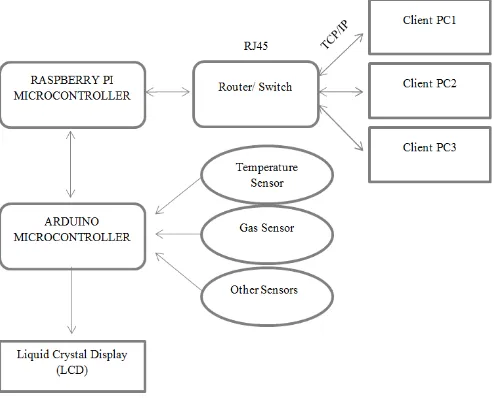
The industrial monitoring system consists of two different modules. The first module includes the hardware consisting of sensor network connected to Arduino which is further connected to Raspberry pi with inbuilt Ethernet controller and web server. And the second module consists of software-based GUI (Graphical User Interface) on PC where the parameters are monitored. This is created using a python code on Wordpress for Web page development. Given below is the block diagram for hardware construction of the monitoring system.
Figure 3. Block Diagram of Proposed System
[image:2.595.311.558.508.707.2]Communication done with Raspberry Pi microcontroller through is USB 2.0 port. The measured values are transmitted to the web browser, Apache browser. These measured values can be obtained through the RJ45 Ethernet cable and can be viewed on a local web browser through a web page created using Wordpress which is the part of software-based GUI interface to view and monitor the values through a python code.
3.System Design
The designing part includes both hardware and software simulations.
Hardware Design
It includes Arduino Mega, Liquid Crystal Display (LCD), Joystick Sensor, Raspberry pi and RJ45 Ethernet cable.
Arduino Mega
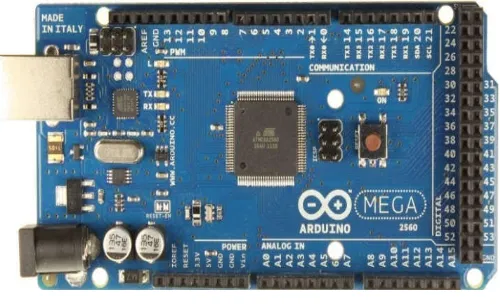
[image:3.595.311.556.204.353.2]The Arduino Mega is a microcontroller board based on the ATmega1280. It has 54 digital input/output pins (of which 14 can be used as PWM outputs), 16 analog inputs, 4 UARTs (hardware serial ports), a 16 MHz crystal oscillator, a USB connection, a power jack, an ICSP header, and a reset button. To get it started one must simply connect it to a computer using a USB cable or power it with an AC-to-DC adapter or battery of 5V. The Mega is compatible with most shields designed for the Arduino Duemilanove or Diecimila.
Figure 4. Arduino Mega
Raspberry Pi
The Raspberry Pi was developed by the Raspberry Pi Foundations. It is a credit-card-sized single-board computer with a Broadcom BCM2835 system on a chip (SoC), which includes an ARM1176JZF-S 700 MHz processor, Video Core IV GPU. Its GPU provides Open GL ES 2.0, hardware-accelerated Open VG, and 1080p30 H.264 high-profile decode which is capable of 1Gpixel/s, 1.5Gtexel/s or 24GFLOPs with texture filtering with 512 MB RAM. It does not include a built-in hard disk or solid-state drive but uses an SD card for booting and persistent storage. It has 10/100 Base-T Ethernet socket. In the paper, Raspberry Pi 2+ is used.
Liquid Crystal Display (LCD)
LCD (Liquid Crystal Display) screen is an electronic display module and finds a wide range of applications. A 16x2 LCD
[image:3.595.38.288.410.562.2]means it can display 16 characters per line and there are 2 such lines. In 16x2 LCD each character is composed of 5x7 pixel matrix which means that each character uses 35 pixels, 5 in breadth and 7 in length. This LCD has two registers, namely, Command and Data. The command register is used to store the command instructions given to the LCD for sequential display. A command is an instruction given to LCD to do a predefined task like initializing it, clearing its screen, setting the cursor position, controlling display etc. The data register is used to store the data that needs to be displayed on the LCD. The data is the ASCII value of the character to be displayed on the LCD.
Figure 5. Raspberry Pi
Joystick Sensor
The Joystick sensor triggers whenever the joystick moves. It also detects events on a range of ancillary controls on the joystick device (hat, buttons, etc.). It works in 360-degree format resulting x and y-axis as both the sensors. On the principle, the control rod can be considered that it is organized by the two potentiometers and a button. More than one joystick may be used. The exact layout of the joystick controls will depend on the make and model of the joystick used as a dual sensor. It works as a dual sensor.
RJ45 Ethernet Cable
RJ45 is an un-keyed 8-position, 8-contact modular plug. It is used on patch cables for Ethernet and computing and telecommunications interconnections. Occasionally used for serial network connections. When the RJ-45 connectors first came into use, they were basically used for telephones. The great advances in technology created a need for another size connector. After then RJ-45 was adapted to fit. Now a day 2 different RJ-45 connector sizes are available, one is for Cat 5 cable and another is for Cat 6 cable. The user has to make sure that he has the one suited to his job. The easiest way to differentiate is to compare them side by side. The Cat 6 connector is larger between the both.
Software Design
It includes the Raspbian OS, Secure Shell (SSH) and Wordpress.
Raspbian OS
basic programs. This OS is utilised to make the Raspberry Pi run. However, Raspbian OS is better than a pure OS. It comes with over 35,000 packages; pre-compiled software bundled in a nice format that is useful for easy installation on the Raspberry Pi. The initial build is over 35,000 Raspbian packages which are optimized for best performance on the Raspberry Pi. It was completed in June of 2012. However, Raspbian is still under active development with an emphasis on improving the stability and performance.
Secure Shell (SSH)
Secure Shell (SSH) is a cryptographic network protocol. It is used for operating network services securely over a network which is unsecured.The best example application is for remote login to computer systems by the users. The protocol specification distinguishes between two major versions, which is SSH-1 and SSH-2. Access to shell accounts on Unix-like operating systems is the most visible application of the protocol but it sees some limited use on Windows as well.
WordPress
WordPress is a free and open-source system based on PHP and MySQL. WordPress is installed on a web server if it’s either part of an Internet hosting service or a network host. A local computer may be used for single-user testing and learning purposes. WordPress was used by more than 27.5% of the top 10 million websites as of February 2017. WordPress is reportedly the most popular website management. It is also a blogging system in use on the Web, which supports more than 60 million websites. WordPress is open source software. It can be used to create a beautiful website, blog, or app. Word press has customizable designs, SEO friendly, responsive mobile sites, high performance, manage on the go, high security, powerful media management, easy and accessible.
RESULTS AND DISCUSSION
[image:4.595.332.536.46.318.2]The individual testing of different modules are developed and the final setup was made arranging all devices in proper manner. After this final arrangement the whole system was tested.
[image:4.595.45.281.559.776.2]Figure 6. Circuit
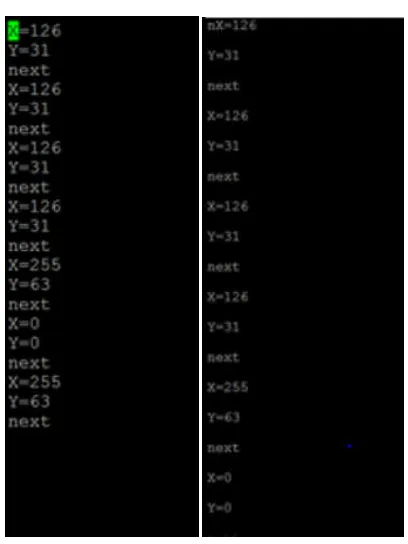
Figure 7. Output
The joystick sensor acts as dual sensor and reads the analog data and sends it in digital from to the Arduino from where the data is sent to the LCD screen where it was displayed. The data was sent to Raspberry Pi via USB cord where the data was transferred to Apache web server with the help of RJ45 Ethernet cable through TCP/IP protocol.
CONCLUSION
Implementation of web server using Raspberry Pi for intelligent monitoring is a new method to monitor an environment which designed here for the real time implementation. It is possible to interface different kind of Sensors with these modules and make various applications. So it can monitor embedded system operation state through Internet, achieving network monitoring purposes. This work can further be extended with usage of high end embedded servers along with wireless sensor networks with increase in parameters and increase in sensor nodes. Further, the system can be made wireless using modules like Xbee module and other means of wireless communication.
REFERENCES
Bhuvaneswari.S. and Sahaya AnselinNisha, Implementation of Tcp/Ip on EmbeddedWebserver Using Raspberry Pi In IndustrialApplication.International Journal of Advanced Research in Computer and communication Engneering, March 2014, Vol. No.3, Issue No. 3
Dr. K.B. Khanchandani, International Journal of Engineering
Science and Technology (IJEST), Embedded Web Server,
Sarika Chhatwani. February 2011, Vol. No.3, Issue No.2 Jiang. J.N, Peng D.G, Zhang. H. 2008. Design and Realization
ofEmbedded Web Server Based on ARM and Linux.
Mechatronics, Vol.14 (10):37-40.
Manasa, K. and T.Swapnarani, Implementation of Tcp/Ip Ethernet Webservices Based On Arm 7. Feb 2013, Vol. No.1, Issue No.1 & Page No.20-24
NakulPadhye, Preet Jain Implementation of Arm Embedded WebServer for DAS using Raspberry Pi, Vol.3 No.4 April 2013.
Pallavi and R., C.Veeranna Implementation of TCP/IP Ethernet Web Services Based On Arm7 LPC2148 for Embedded Ethernet Applications. January 2015, Vol. No.5, Issue No.1