
© 2014, IJCSMC All Rights Reserved 745
Available Online atwww.ijcsmc.com
International Journal of Computer Science and Mobile Computing
A Monthly Journal of Computer Science and Information Technology
ISSN 2320–088X
IJCSMC, Vol. 3, Issue. 8, August 2014, pg.745 – 749
RESEARCH ARTICLE
VIRTUALIZATION IN CLOUD COMPUTING
LAKSHAY MALHOTRA
1, DEVYANI AGARWAL
2, ARUNIMA JAISWAL
31
STUDENT, ASET-CSE AMITY UNIVERSITY NOIDA, INDIA 2
STUDENT, ASET-CSE AMITY UNIVERSITY NOIDA, INDIA 3
ASSISTANT PROFESSOR, ASET AMITY UNIVERSITY NOIDA, INDIA
Abstract— Cloud computing technology is one of the biggest milestones in leading us to next generation technology and booming up business and IT field. It helps to overcome the problems of data loss, accessing data whenever needed and data security. This technology is mainly service oriented and focuses on cost reduction, hardware reduction and pay just for service concept. Virtualization in cloud computing is making a virtual image of the storage devices, servers or network resources so that they can be used on multiple machines at the same time.
Keywords— Virtualization, Cloud computing, Hypervisor, Host, Redundancy
__________________________________________________________________________________________
I. INTRODUCTION
Cloud computing is one of the most useful technology that is been widely used all over the world. It generally provides on demand IT services and products. Virtualization plays a major role in cloud computing as it provides a virtual storage and computing services to the cloud clients which is only possible through virtualization. This paper discusses about cloud computing, how virtualization is done in cloud computing, virtualization basic architecture, its advantages and effects.[6]
II. CLOUD COMPUTING
“Cloud computing technology is based on three factors- grid computing, utility computing and automatic computing.”
All the data is stored on the servers and can be accessed simply by authenticating with the help of the internet anywhere in the world. Apple, google , Microsoft , etc. are the biggest cloud service providers provide very large storage to its users and making the work easier.[2]
.
III.VIRTUALIZATION
Virtualization is basically making a virtual image or “version” of something such as server, operating system, storage devices or network resources so that they can be used on multiple machines at the same time.
The main aim of virtualization is to manage the workload by transforming traditional computing to make it more scalable, efficient and economical. Virtualization can be applied to a wide range such as operating system virtualization, hardware-level virtualization and server virtualization.
© 2014, IJCSMC All Rights Reserved 746
IV. ARCHITECTURE OF VIRTUALIZED TECHNOLOGY
In cloud computing space/ memory is virtually allocated to the users in the servers which requires a host(platform) on which hypervisor(software which interacts with the hardware) runs. [7]
CLOUD CLIENT
SERVICE MODELS
VIRTUALISED LAYER OR HOST
HARDWARE AND RESOURCES
Figure 1: Basic architecture
The virtualization model is consisting of cloud users, service models, virtualized models and its host software and as well as their hardware. It is based on three service models that are SAAS (software as a service) , PAAS (platform as a service) and IAAS (infrastructure as a service). SAAS provides applications to the cloud users to full fill their needs and demands. PAAS provides the cloud users a common platform on which they can execute their applications and IAAS provides the security and hardware to maintain the cloud resources [3]
Host : for virtualization the hypervisor software runs on a virtualization platform i.e. Is host.
Hypervisor : the software program which handles the virtual machine to work under the virtually simulated environment is called hypervisor.
V. TRADITIONAL SERVERS AND VIRTUAL SERVERS
It plays a very important infrastructure in the cloud computing technology. It receives the requests sent by they cloud users and formulates it and also performs various tasks.
A. BASICTRADITIONAL SERVERS
Traditionally the servers that were used has a lost of disadvantages and were not at all cost effective. “These servers are maintained by system administrator, normally these servers are described as combined unit that consist of operating system, the hardware, the storage and the application.”[7] In traditional server if the storage becomes full then it has to be replaced by a new server.
© 2014, IJCSMC All Rights Reserved 747 ●MERITS
a. Things are easily deployed in them. b. Easy to maintain backup.
c. Application can be run virtually with traditional servers.
●DEMERITS
a. Hardware maintenance is very cost effective. b. Duplication is very difficult.
c. Physical infrastructure cannot be updated. d. Redundancy implementation is very difficult.[4]
B. VIRTUAL SERVER
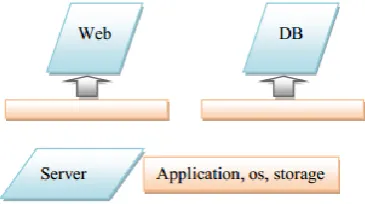
“Virtual server seeks to encapsulate the server software away from the hardware the virtual server consists of the operating system (os) , storage and application”[7]. By maintaining virtual server we can reduce the service provided by the cloud provider.
Figure 3: Virtual server concept [1]
● MERITS
a. IT pool maintenance.
b. High availability of hardware.
c. Deployment of servers in virtually based environment.[4]
VI. ADVANCEMENT FOR REAL WORLD
There are many positive and negative effects of virtualization technology on the environment as well as the business and IT field.
A. TEMPERATURE
Virtualization technology is based on the group of hardware machines due to which a large amount of heat is released when they are used. So to overcome this problem special cooling mechanism should be employed to cool them and rise its performance.
B. ENERGY CONSUMPTION
With virtualization the power consumption due to machines has reduced as the number of hardware machines has been reduced which makes this technology more efficient and eco friendly.
C. REDUNDANCY
Redundancy is basically the repetition of data which is mainly encountered when the systems don’t shares a common storage and different memory storages are created. Due to the large number of data centres the fault tolerance is very high due to which redundancy is reduced.
VII. TYPES OF VIRTUALIZATION
In cloud computing the virtualization can be done in two ways either by storage virtualization or by software virtualization.
a. storage virtualization :the storage available is virtualized to get large virtual storage access and it is
© 2014, IJCSMC All Rights Reserved 748
b. Software virtualization : software built by the company can be used by a large number of systems at the
same time with the help of virtualization. A virtual layer is created on which the software is installed and used.[9]
VIII. WHY VIRTUALIZATION ?
With the help of virtualization we can increase the use of resources available to us in many to get more benefits.
We should virtualize because of the following reasons :
a. Isolation among users: one user should be isolated from the other users so that he/she may not get
information about the others user’s data and usage and cannot even access other’s data .
b. Resource sharing : a big resource can be fragmented into multiple virtual resources so that it can be
used by multiple users using virtualization technique.
c. Dynamical resources : reallocation of resources such as storage and computational resources is very
difficult but if they are virtualised then they can be easily re-allocated.
d. Aggregation of resources : the small resources available can be increased at a large extent with the help
of virtualization.[8]
IX. BENIFITS OF VIRTUALIZATION TECHNOLGY
a. Virtualization is one of the cost-saving, hardware-reducing and energy-saving technique. b. It helped to make cloud computing more efficient and eco-friendly.
c. A big step towards new technology making life easier and better. d. Isolation .
e. Resource sharing . f. Aggregation of resources.
g. Dynamical resource.
X. BENIFITS OF CLOUD COMPUTING
Cloud computing provides lots of benefits to the users and makes the work much easier and some of the key benefits are mentioned below:
a. Pay just for service
b. On demand self service
c. Resources are shared
d. Business is the main focus e. Accessible all over the world f. Data is secured
XI.FUTURE SCOPE
Data loss, data security and inconvenience to access the data are some of the major problems that users face but with the use of cloud computing these problems can be resolved easily. Some of the major future aspects are:
a. Migration time will become negligible
b. Data is secured and data loss is minimised
c. One user-many devices relationship
d. Good service quality for computational resources e. Good service quality for computational resources
f. Problem of geographical distance between clients and servers can be avoided g. Band width will be sufficient for the users
© 2014, IJCSMC All Rights Reserved 749
XII. CHALLENGES
One of the major problems which can be faced by using this technology are mass data loss , infected application and data integrity.
a. mass data loss : if some calamity hits the datacentres then it might destroy the data stored in the
datacentres or might shutdown servers.
b. Infected application : if a virus is infects one file then it may corrupt whole system.
c. Data integrity :the integrity of data can be affected as anyone can access it from anywhere.[10]
REFERENCES
[1] Virtualization Technology in Cloud Computing Environmentby :Krishnatej , Koganti,EswarPatnala , Sai SagarNarasingu, J.N. Chaitanya,2013 , IJETAE
[2] Secure virtualization for cloud computing by :Flavio Lombardi , Roberto Di Pietro in Journal of Network and Computer Applications
[3] The Case for Cloud Computing by : R. L. Grossman Mar-April, 2009 ISSN
[4] Virtualization and Cloud Computing “Security is a Process, not a Product” by : Guillermo Macias CIP Security Auditor, Sr Texas reliability entity
[5] VIRTUALIZATION IN CLOUD COMPUTING by:DeepanshuThakral, Mahesh SinghIssue. 5, May 2014IJCSMC
[6] VIRTUALIZATION IN CLOUD COMPUTING by T.Swathi1, K.Srikanth, S. Raghunath ReddyIJCSMC, Vol. 3, Issue. 5, May 2014
[7] Virtualization in cloud computing by YupingXing andYongzaho Zahn , 2012 Springer journals
[8]Network Virtualization and Software Defined Networking for Cloud Computing: A Surveyby :Raj Jain and Subharthi Paul, IEEE
[9] Cloud Computing: Types, Architecture, Applications, Concerns, Virtualization and Role of IT Governance in Cloud: by Pankaj Sareen , March 2013,IJARCSSE
![Figure 3: Virtual server concept [1]](https://thumb-us.123doks.com/thumbv2/123dok_us/1977401.1261150/3.595.217.398.279.391/figure-virtual-server-concept.webp)
