Available online: https://edupediapublications.org/journals/index.php/IJR/ P a g e | 1984
Optimized Managed Mobile Adhoc Networks Using
Intermittent Clusters
Mohammad Riyazuddin & K. Parisuddha Babu,
M.Tech Scholar, Vignan's Lara Institute Of Technology & Science, Vadlamudi, Guntur District, A.P Assistant Professor, Vignan's Lara Institute Of Technology & Science, Vadlamudi, Guntur District, A.P
ABSTRACT: We consider the problem of appropriate cluster head selection in wireless ad-hoc networks where it is necessary to provide robustness in the face of topological changes caused by node motion, node failure and node insertion/removal. The main contribution of our work is a new strategy for clustering a wireless AD HOC network and improvements in SWCA. Prior approaches didn’t implement any security aspects leading to a open manet architecture which is not feasible mission critical applications. So we propose a digital certificate based Key-Request(KREQ) optimization algorithm that is void of latency factors required for rendering a certificate to support secure communications. Using these new messaging formats and combined with the above optimization algorithm we claim that node authentications and communications are secure with the possible usage of certificate schemes and the performance is highlighted through our extensive simulations.
Keywords-component; ad hoc network; clusters; Load-balacing; stability
I. INTRODUCTION
Ad hoc networks are wireless, infrastructure less, multi-hop, dynamic networks established by a collection of mobile nodes, which provides significant features to the modern communication technologies and services. In ad hoc networks, clustering is an important and familiar technique to divide the large network into several sub networks.
Cluster-based routing is a solution to address node heterogeneity, and to limit the amount of
routing information that propagates inside the network.
The idea behind clustering is to group the network nodes into a number of overlapping clusters. Clustering makes possible a hierarchical routing in which paths are recorded between clusters instead of between nodes. This increases the routes lifetime, thus decreasing the amount of routing control overhead. Inside the cluster, one node that coordinates the cluster activities is known as a clusterhead (CH).
The set of clusterheads is known as a dominant set. Inside the cluster, there are also ordinary nodes and have direct access only to this one clusterhead, and gateways. Gateways are nodes that can hear two or more clusterheads. Groups of the nodes are organized with respect to their nearness to other nodes. Two nodes are said to be neighbors of each other when both of them lie within their transmission range and set up a bidirectional link between them.
Available online: https://edupediapublications.org/journals/index.php/IJR/ P a g e | 1985
and thus reconfiguration of clusterheads is unavoidable. This is an important issue since frequent clusterhead changes adversely affect the performance of other protocols such as scheduling, routing and resource allocation that rely on it. The choice of the clusterheads is here based on the weight associated to each node: the bigger the weight of a node, the better that node is for the role of clusterhead.
The authors have proposed a distributed weighted clustering algorithm by making some modifications and improvements on some existing algorithms. They demonstrated that their algorithm reduces the clusterhead formation and control messages overhead thus improving overall performance and reducing energy utilization. Here, authors claimed that since energy utilization is the most important criteria in cluster based routing schemes, their protocol provides better results than existing distributed clustering algorithms.
A weight based distributed clustering algorithm (WCA) which can dynamically adapt itself with the ever changing topology of ad hoc networks was proposed. In this approach, the number of nodes is restricted to be catered by a cluster head, so that it does not degrade the MAC functioning. It has also the flexibility of assigning different weights and takes into account a combined effect of the ideal degree, transmission power, mobility and battery power of the nodes. The algorithm is executed only when there is a demand, i.e., when a node is no longer able to attach itself to any of the existing cluster heads. Clustering algorithm tries to distribute the load as much as possible.
In WCA, the number of nodes that a clusterhead can handle ideally is δ. This is to ensure that clusterheads are not over-loaded and the
efficiency of the system is maintained at the expected level. But how to select δ is not addressed explicitly. If δ is not well selected, many clusterheads are generated which increases energy consumption. Furthermore, computing the clusterhead serving time cannot guarantee a good assessment of energy consumption, because data communication consumes a large amount of energy and varies greatly from node to node.
Our contribution is to extend WCA by solving these inefficiencies. In using a heuristic approach, the authors give some interesting equations for the cluster density and cluster order of homogeneously distributed nodes running the DMAC algorithm. Since the DMAC structure is unique, the equations also hold in a mobile scenario if the mobility model used retains the homogeneous distribution of the nodes. If the nodes are not homogeneously distributed, the cluster density will decrease. The authors claim that the validity of their result is not restricted to the DMAC algorithm. It also holds for other algorithms that limit the cluster size to two hops.
The authors introduced a new type of algorithm called Enhancement on Weighted Clustering Algorithm [EWCA] to improve the load balancing, and the stability in the MANET. The cluster head selected efficiently based on these factors, like high transmission power, transmission range, distance mobility, battery power and energy. Since the cluster head will not be changed dynamically, the average number of cluster formations will be reduced. By applying the load balancing factor, the overhead in the cluster is reduced.
Available online: https://edupediapublications.org/journals/index.php/IJR/ P a g e | 1986
mobility. The main objective of their algorithm is ensure the stability of the clusters and to reduce the re-election of the cluster head. They introduce some metrics to choose the cluster head in order to respect the capacities of the node and to reflect the state of the network. They claim that these metrics merge together and provide a higher connectivity and economy of energy, as well as the best value of transmission range. The authors propose a mobility scheme to evaluate periodically the node mobility in order to expect the future state of the network. However, this scheme is complicated and requires overhead calculations.
The motivation for the present work is three-fold. First, we have identified some weakness where the authors declared that according to their notation, the number of nodes that a clusterhead can handle is ideally constrained by a value δ. Second, we have identified another weakness where the authors compute the degree-difference for every node to ensure that clusterheads are not over-loaded. Third, the stability is overlooked in WCA. Consequently, we introduce our analytical models to overcome the previous inefficiencies.
II.PROPOSED SYSTEM
In ad hoc networks, clustering is an important and familiar technique to divide the large network into several sub networks. Cluster-based routing is a solution to address node heterogeneity, and to limit the amount of routing information that propagates inside the network. The idea behind clustering is to group the network nodes into a number of overlapping clusters.
Clustering makes possible a hierarchical routing in which paths are recorded between clusters
Available online: https://edupediapublications.org/journals/index.php/IJR/ P a g e | 1987
FIG 1.ACTIVITY DIAGRAM OF UML 1. Mobile ad hoc networks are of two types:
(A)Pure(open)
Pure (open) MANETs are formed without any prearrangements or pre-requirements. These ad hoc networks are formed spontaneously and are self-organized. The nodes in such a network do not need any prior registration.
(B)Managed
In mission critical applications, e.g., military communications, critical area surveillance, sensitive task , etc., only authorized nodes are allowed in the network. It is not easy to incorporate such authorization/authentication features in pure MANETs and hence we need managed MANET’s. Managed MANETs have the provision of pre-registered or authorized nodes and have the opportunity for pre-deployed exchange of security parameters like public keys, session keys or certificates.
2. Prior approaches didn’t implement any security aspects leading to a open manet architecture which is not feasible mission critical applications.
3. For upholding the security aspect in MANET’s architecture usually requires usage of any of the security parameters such as public keys, session keys or certificates etc.
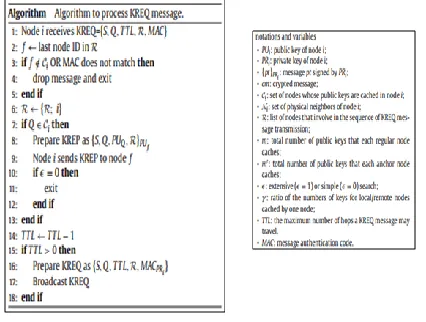
4. So we propose a digital certificate based Key-Request(KREQ) optimization algorithm that is void of latency factors required for rendering a certificate to support secure communications.
5. The usual MANET Message Formats involved in node joining’s and address allocations are as follows:
Route Request (RREQ) Message Format
Route Reply (RREP) Message Format
Available online: https://edupediapublications.org/journals/index.php/IJR/ P a g e | 1988
Route Reply Acknowledgment (RREP-ACK) Message Format 6. For supporting certificate based schemes
we introduce new messaging formats
called KREQ and KREP for
authenticating nodes.
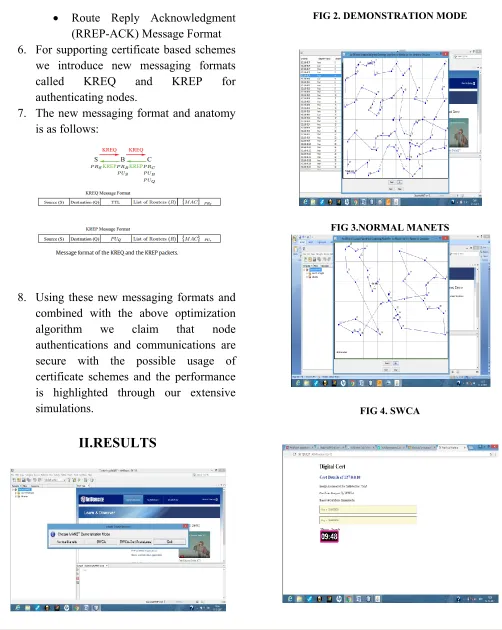
7. The new messaging format and anatomy is as follows:
8. Using these new messaging formats and combined with the above optimization algorithm we claim that node authentications and communications are secure with the possible usage of certificate schemes and the performance is highlighted through our extensive simulations.
II.RESULTS
FIG 2. DEMONSTRATION MODE
FIG 3.NORMAL MANETS
Available online: https://edupediapublications.org/journals/index.php/IJR/ P a g e | 1989
FIG 5.SWCA CERTIFICATE LESS DIGITAL CERTIFICATE
IV.CONCLUSION
We have considered the problem of constructing a framework for dynamic organizing mobile nodes in wireless ad-hoc networks into clusters where it is necessary to provide robustness in the face of topological changes caused by node motion, node failure and node insertion/removal. Extending previous works, we have also mathematically derived a new clustering stability scheme. In the same objective We derived a simple clustering load balancing scheme. These two proposed schemes are considered as new mechanisms to overcome some inefficiencies detected in WCA and other similar clustering algorithms. It was shown that our proposed clustering algorithm performs similar to the best well-known algorithms (such as the WCA). The performance of our SWCA algorithm is proven by manual computation at this stage. However, we are now carrying a simulation based comparative study to validate the manual results.
V.REFERENCES
[1] R. Pandi Selvam et al, Stable and Flexible Weight based Clustering Algorithm in Mobile Ad hoc Networks / (IJCSIT) International Journal of Computer Science and Information Technologies, Vol. 2 (2), 2011,824-828.
[2] R. Pandi Selvam et al, Stable and Flexible Weight based Clustering Algorithm in Mobile Ad hoc Networks / (IJCSIT) International Journal of Computer Science and Information Technologies, Vol. 2 (2), 2011,824-828.
[3] Suchismita Chinara, Santanu Kumar Rath. A Survey on One-Hop Clustering Algorithms in Mobile Ad Hoc Networks. Journal Network System Management; 17:183–207; 2009.
[4] Naveen Chauhan et al. A Distributed Weighted Cluster Based Routing Protocol for MANETs. Wireless Sensor Network; 2011; 3, 54-60, doi:10.4236/wsn.2011.32006 Published
Online February 2011
(http://www.SciRP.org/journal/wsn)
[5] M. Chatterjee, S. K. Das, and D. Turgut. WCA: a weighted clustering algorithm for mobile Ad Hoc networks. Cluster Computing 5, 193-204; 2002.
[6] Christian Bettstetter. The Cluster Density of a Distributed Clustering Algorithm in Ad Hoc Networks. IEEE International Conference Communications; Page(s): 4336 - 4340 Vol.7; 2004.
[7] S. Basagni. Distributed clustering for ad hoc networks. In: Proc. Intern. Symp. Parallel
Architectures, Algorithms, and Networks
(ISPAN); (Perth/Fremantle, Australia); June 1999.
[8] S. K.B. Rathika and J. Bhavithra. An Efficient Fault Tolerance Quality of Service in Wireless Networks Using Weighted Clustering Algorithm; Bonfring International Journal of Research in Communication Engineering; Vol. 2, Special Issue 1, Part 4; February 2012.