New Machine Learning Developments in ROOT/TMVA
KimAlbertsson1,6,∗,SergeiGleyzer4,MarcHuwiler5,VladimirIlievski5,LorenzoMoneta1, SauravShekar8,AkshayVashistha,StefanWunsch1,7, andOmar AndresZapata Mesa2,3
1CERN
2University of Antioquia
3Metropolitan Institute of Technology
4University of Florida
5EPFL
6Lulea University of Technology
7Karlsruhe Institute of Technology
8ETH Zurich
Abstract.
The Toolkit for Multivariate Analysis, TMVA, the machine learning pack-age integrated into the ROOT data analysis framework, has recently seen im-provements to its deep learning module, parallelisation of multivariate methods and cross validation. Performance benchmarks on datasets from high-energy physics are presented with a particular focus on the new deep learning module which contains robust fully-connected, convolutional and recurrent deep neural networks implemented on CPU and GPU architectures. Both dense and convo-lutional layers are shown to be competitive on small-scale networks suitable for high-level physics analyses in both training and in single-event evaluation.
Par-allelisation efforts show an asymptotical 3-fold reduction in boosted decision
tree training time while the cross validation implementation shows significant speed up with parallel fold evaluation.
1 Introduction
Machine learning in high-energy physics research has a long standing tradition and is recently seeing increased adoption in a variety of applications. Boosted decision trees remains a pop-ular baseline and different deep learning approaches are being investigated in areas including
tracking, particle identification, jet reconstruction, and physics analysis.
This work describes recent developments included in the toolkit for multivariate analysis (TMVA) [1] and evaluates their performance on selected examples relevant to high-energy physics. Additionally, the future development direction is discussed based on identified trends in particle physics research.
In particular, deep learning has seen successful application, surpassing previous methods in classification performance in both ATLAS and CMS studies. Small-scale neural networks on the order of 5 dense layers has been proven beneficial in top-quark/W-boson tagging and
Higgs searches respectively [2][3][4]. Both convolutional and recurrent networks have been applied to jet tagging. CMS’s DeepJet [5] architecture uses a 1 by 1 convolution followed
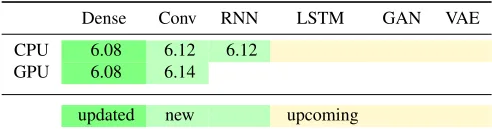
Table 1: Features of the TMVA deep learning module and the ROOT version in which the features was implemented. A green color indicates that the feature is currently available while a yellow color indicates it is in the process of being integrated. Future plans include the integration GAN’s, VAE’s and support for LSTM layers.
Dense Conv RNN LSTM GAN VAE
CPU 6.08 6.12 6.12
GPU 6.08 6.14
updated new upcoming
by recurrent layers while an ATLAS Quark/Gluon tagger [6] uses three convolutional layers
followed by a 128 unit dense layer. The convolutional layers used 128 filter banks, and 5 by 5 kernels.
The upcoming upgrade of the LHC, the High Luminosity LHC[7], will bring an unprece-dented data rate with an expected 200 collisions per event, compared to the current 20 - 60. generating an order of magnitude increase in the number of generated particles and detec-tor hits. Due to the algorithmic scaling complexity in e.g. tracking the increased number of detector hits will yield an exponential increase in required computational resources. New approaches that can scale to the required event complexity, while maintaining selection per-formance, need to be developed.
TMVA is a ROOT-integrated framework for machine learning. ROOT is a software suite designed to facilitate data analysis for high-energy physics experiments with TMVA provid-ing an environment to evaluate and compare supervised learnprovid-ing methods. The toolkit is expanding to incorporate machine learning trends both through internal and external inter-faces e.g. the integrated module for deep learning and better inter-operation with industry and open source community tools.
2 New Developments
The deep learning library of TMVA has been redesigned to incorporate more general network layer types; Convolutional and recurrent layers are now supported on CPU. Convolutional layers are also supported using a GPU backend. Table1summarizes the implementation sta-tus of the different features. Dense layers have been in TMVA since ROOT version 6.08 and
are recently updated. Convolutional and recurrent layers with CPU support were introduced in ROOT 6.12 while from version 6.14 and onwards a GPU implementation is provided for convolutional layers.
Cross validation has received improved integration with the rest of TMVA, in particular with the GUI facilities for plot generation. Additionally, a cross validation technique called cross validation in applicationhas been implemented.
Finally, as part of the ongoing efforts to improve the framework’s performance, training
of boosted decision trees and the evaluation of folds in cross validation has been parallelised.
Convolutional layer implementation
Convolutional layers provide the possibility of detecting the position of localized features in an input signal, often images or audio. The effectiveness of learning is increased through
Table 1: Features of the TMVA deep learning module and the ROOT version in which the features was implemented. A green color indicates that the feature is currently available while a yellow color indicates it is in the process of being integrated. Future plans include the integration GAN’s, VAE’s and support for LSTM layers.
Dense Conv RNN LSTM GAN VAE
CPU 6.08 6.12 6.12
GPU 6.08 6.14
updated new upcoming
by recurrent layers while an ATLAS Quark/Gluon tagger [6] uses three convolutional layers
followed by a 128 unit dense layer. The convolutional layers used 128 filter banks, and 5 by 5 kernels.
The upcoming upgrade of the LHC, the High Luminosity LHC[7], will bring an unprece-dented data rate with an expected 200 collisions per event, compared to the current 20 - 60. generating an order of magnitude increase in the number of generated particles and detec-tor hits. Due to the algorithmic scaling complexity in e.g. tracking the increased number of detector hits will yield an exponential increase in required computational resources. New approaches that can scale to the required event complexity, while maintaining selection per-formance, need to be developed.
TMVA is a ROOT-integrated framework for machine learning. ROOT is a software suite designed to facilitate data analysis for high-energy physics experiments with TMVA provid-ing an environment to evaluate and compare supervised learnprovid-ing methods. The toolkit is expanding to incorporate machine learning trends both through internal and external inter-faces e.g. the integrated module for deep learning and better inter-operation with industry and open source community tools.
2 New Developments
The deep learning library of TMVA has been redesigned to incorporate more general network layer types; Convolutional and recurrent layers are now supported on CPU. Convolutional layers are also supported using a GPU backend. Table1summarizes the implementation sta-tus of the different features. Dense layers have been in TMVA since ROOT version 6.08 and
are recently updated. Convolutional and recurrent layers with CPU support were introduced in ROOT 6.12 while from version 6.14 and onwards a GPU implementation is provided for convolutional layers.
Cross validation has received improved integration with the rest of TMVA, in particular with the GUI facilities for plot generation. Additionally, a cross validation technique called cross validation in applicationhas been implemented.
Finally, as part of the ongoing efforts to improve the framework’s performance, training
of boosted decision trees and the evaluation of folds in cross validation has been parallelised.
Convolutional layer implementation
Convolutional layers provide the possibility of detecting the position of localized features in an input signal, often images or audio. The effectiveness of learning is increased through
weight sharing; a small kernel is applied repeatedly to different patches of the input thus
receiving more updates compared to the non-convolutional case. TMVA currently supports 2-d convolution where the kernel is convolved over the two spatial dimensions, M and N. A third dimension,C, allows coupled inputs. For input colored images this third dimension can be interpreted as the color channels of the image. In subsequent layers, the third dimension corresponds to the output of a particular kernel in the previous layer. The output for a given kernel is given by
oi,j=σo
M−1
m=0 N−1
n=0 C−1
c=0
Km,n,cIi+m,j+n,c+b
with the output at feature map locationoi,jgiven by the convolution of the kernel and a patch of the input passed through an activation function,σo. TMVA allows configuration of both limits both and stride.
Recurrent layer implementation
Recurrent layers models the output of the layer as explicitly depending on past inputs with two central operations: Thehidden stateupdate,h(t), modelling the output dependence on past inputs; and the outputo(t)calculation. In TMVA the layer type is implemented as described in [8] where these relations are given by
h(t) =σ h
Wh(t−1)+Ux(t)+b h
o(t)=σ o
Vh(t)+b o
.
Hereh(t) represents the hidden state of the layer at time t, which is updated given weight matricesW andUcorresponding to the previous hidden state,h(t−1), and the current input, x(t), respectively. The output of a particular layer is given by o(t) whereσ
o is the output activation function andVis the output weight matrix. TMVA implements backpropagation-through-time to train the recurrent layer as described in e.g. [9].
3 Performance benchmarks
Performance of the new developments of the deep learning module and the parallelisation of the TMVA boosted decision tree and cross validation implementations is reported in this section. Where relevant, comparisons between models achieve a similar classification perfor-mance, hence focus is placed on the run-time performance.
For performance evaluation of the deep learning module an Intel Xeon E5-2683 machine with 28 physical cores was used for the CPU benchmarks. GPU measurements were run using two different nVidia graphics cards, one GTX1080Ti and one TitanX card. Evaluation
of BDT and cross validation performance used an Intel Xeon CPU E5-2695 v2 @ 2.40GHz machine with 24 physical cores.
The TMVA networks were compared against identical implementations using Keras [10], a high-level interface to Tensorflow and other backends. Tensorflow is a deep learning frame-work designed for efficient training and deployment of large scale models and datasets. It
is also efficient for training models fitting on a single machine and compares favourably to
other frameworks such as Caffe, Neon, and Torch for both use cases [11].
3.1 Deep learning module
In the following experiments architecture layouts are modeled after recent studies, discussed in Section1, of the ATLAS and CMS experiments at CERN.
TMVA CPU (S)KERAS CPU (S)TMVA CPU (P)KERAS CPU (P)TMVA TitanXKERAS TitanXTMVA 1080TiKERAS 1080Ti 4
10 5 10
6 10
Number of Events Trained / second
(a) Event throughput for different backends for
batch size 128.
0 500 1000 1500 2000 2500 3000 3500 4000 Batch size 0
100 200 300 400 500 600
3 10
×
Number of Events Trained / second
TMVA TitanX
Keras TitanX
TMVA GTX 1080Ti
Keras GTX 1080Ti
(b) Scaling for GPU implementations with varying batch size, from 64 to 4096 at increasing powers of 2.
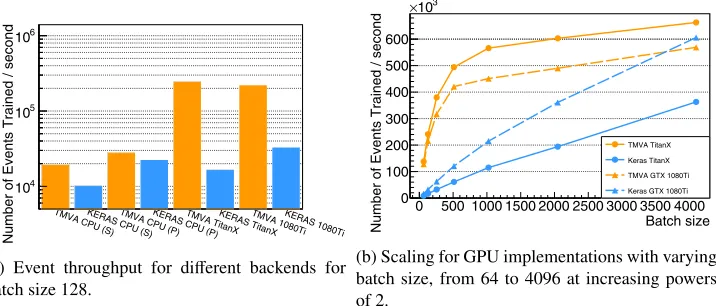
Figure 1: Number of events processed per second for training of a dense layer only network consisting of 5 dense layers, each 200 units wide, applied to 1M events with 28 features. 1a
compares the performance using a single core (S), 28 cores (P) and GPU’s (TitanX, 1080Ti) at a batch size of 128, while1bshows the scaling with respect to batch size.
compared to a background top-quark decay process. The architecture setup used 5 dense layers with 200 hidden units each.
The performance of the TMVA convolutional layers was investigated using a non-public CMS data set containing images of simulated electromagnetic showers originating from pho-tons and electrons and measured by the CMS calorimeter. The input images are cropped to 32×32 pixels, centered on active regions in the calorimeter. The evaluated architecture con-sisted of two convolutional layers with 12 kernels of size 3×3 followed by a max-pooling layer and two additional convolutional, max-pool layer pairs of the same specification. The final two layers were dense layers of width 64 and 32.
Single-event evaluation, i.e. evaluating on a single physics event at a time, is of interest in low-latency settings, where time for accumulating data into batches is insufficient.
Appli-cations include real-time processing of data streams such as in particle physics experiment triggers.
Where not otherwise specified TMVA is configured to use OpenBLAS as it matrix multi-plication backend.
3.1.1 Training dense networks
In Figure1athe throughput of different backends are compared with a fixed batch size. For
both TMVA and Keras the single-threaded, multi-threaded and GPU performance is investi-gated. The multi-threaded test uses one thread per physical cores of the machine. The GPU throughput is evaluated using an nVidia TitanX and GTX1080Ti.
It is expected that there is a strict increase of performance going from serial to parallel, and from parallel to GPU execution, given that the data can be effectively transferred between
TMVA CPU (S)KERAS CPU (S)TMVA CPU (P)KERAS CPU (P)TMVA TitanXKERAS TitanXTMVA 1080TiKERAS 1080Ti 4 10 5 10 6 10
Number of Events Trained / second
(a) Event throughput for different backends for
batch size 128.
0 500 1000 1500 2000 2500 3000 3500 4000 Batch size 0 100 200 300 400 500 600 3 10 ×
Number of Events Trained / second
TMVA TitanX
Keras TitanX
TMVA GTX 1080Ti
Keras GTX 1080Ti
(b) Scaling for GPU implementations with varying batch size, from 64 to 4096 at increasing powers of 2.
Figure 1: Number of events processed per second for training of a dense layer only network consisting of 5 dense layers, each 200 units wide, applied to 1M events with 28 features. 1a
compares the performance using a single core (S), 28 cores (P) and GPU’s (TitanX, 1080Ti) at a batch size of 128, while1bshows the scaling with respect to batch size.
compared to a background top-quark decay process. The architecture setup used 5 dense layers with 200 hidden units each.
The performance of the TMVA convolutional layers was investigated using a non-public CMS data set containing images of simulated electromagnetic showers originating from pho-tons and electrons and measured by the CMS calorimeter. The input images are cropped to 32×32 pixels, centered on active regions in the calorimeter. The evaluated architecture con-sisted of two convolutional layers with 12 kernels of size 3×3 followed by a max-pooling layer and two additional convolutional, max-pool layer pairs of the same specification. The final two layers were dense layers of width 64 and 32.
Single-event evaluation, i.e. evaluating on a single physics event at a time, is of interest in low-latency settings, where time for accumulating data into batches is insufficient.
Appli-cations include real-time processing of data streams such as in particle physics experiment triggers.
Where not otherwise specified TMVA is configured to use OpenBLAS as it matrix multi-plication backend.
3.1.1 Training dense networks
In Figure1athe throughput of different backends are compared with a fixed batch size. For
both TMVA and Keras the single-threaded, multi-threaded and GPU performance is investi-gated. The multi-threaded test uses one thread per physical cores of the machine. The GPU throughput is evaluated using an nVidia TitanX and GTX1080Ti.
It is expected that there is a strict increase of performance going from serial to parallel, and from parallel to GPU execution, given that the data can be effectively transferred between
the CPU and the GPU. The figure shows, for this particular batch size, TMVA performing be-tween 1.3 (parallel) and 22 (GPU) times better that the corresponding network implemented in Keras.
TMVA CPU (P)KERAS CPU (P)TMVA TitanXKERAS TitanXTMVA 1080TiKeras 1080Ti 2 10 3 10 4 10
Number of Events Trained / second
(a) Event throughput for different backends for
batch size 32.
0 200 400 600 800 1000 Batch size 5 10 15 20 25 30 35 40 45 3 10 ×
Number of Events Trained / second
TMVA TitanX Keras TitanX TMVA GTX 1080Ti Keras GTX 1080Ti
(b) Scaling for GPU implementations with varying batch size, from 32 to 1024 at increasing powers of 2.
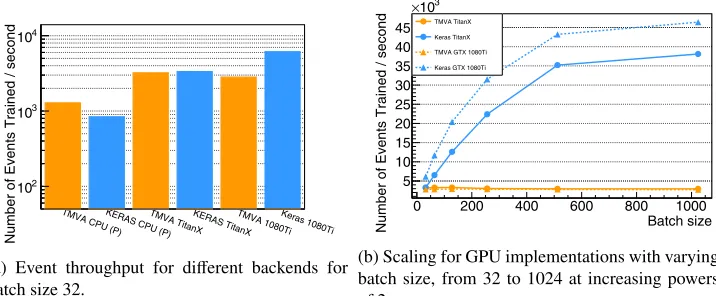
Figure 2: Training throughput of a convolutional network consisting of 4 conv layers and 2 max-pool layers followed by two dense layers of 64 and 32 units. The convolutional layers all use 12 kernels of dimension 3×3. 320k images of simulated calorimeter showers with size 32×32 was used as input. The y-axis shows number of events processed per second.2a
compares the performance for parallel (P), and GPU (TitanX, 1080Ti) execution. Single-core data was dropped since it seldom an interesting use case for convolutional nets.2bshows the scaling with respect to the batch size.
In Figure1bthe throughput of TMVA and Keras, using the GPU backends, is compared with varying batch size. It is expected that the throughput quickly increases for small batch sizes since the studied architecture is small and neither the memory bus, nor the GPU is fully exploited. As the problem size increases, the throughput curve should flatten out as mem-ory and GPU load saturates. Here TMVA outperforms Keras/Tensorflow on all investigated
setups except for a batch size of 4096 using the GTX1080Ti card.
3.1.2 Training convolutional networks
In Figure 2aonly parallel and GPU runs are included in the throughput study due to the heavy workload. As for dense networks it is expected that throughput increases as we move from CPU to GPU. For a batch size of 32, the TMVA and Keras GPU implementations both process about 3200 events per second. This is compared to the CPU backends which process 1285 and 840 images per second for TMVA and Keras respectively.
Figure2bcompares the throughput of TMVA and Keras, using the GPU backends, with varying batch size. The same scaling behaviour as for training dense layers is expected with one notable exception: TMVA currently does not parallelise over batches in convolving lay-ers, hence the throughput is expected to be linear across all batch sizes.
Table 2: Throughput of the 5-layer dense network with batch size of 1, comparing TMVA backed by two different BLAS implementations and LWTNN. The evaluation is run on the
CPU for both libraries with TMVA outperforming LWTNN with a factor of 1.5 using a tuned BLAS implementation.
TMVA OpenBLAS LWTNN TMVA macos-BLAS
Events/sec 5195 12829 18500
3.1.3 Dense networks in application
The achieved throughput when comparing TMVA with LWTNN [13], a light-weight software package for evaluating neural networks especially geared towards the low latency setting, is tabulated in Table2with LWTNN achieving 12829 processed events per second.
TMVA is shown to process between 5195 and 18500 events per second depending on what matrix multiplication library is being used. The former result uses OpenBLAS while the latter uses the macos tuned Accelerate framework.
3.2 Parallelisation
ROOT version 6.14 introduced parallel training of the boosted decisions tree and parallel execution of independent folds in cross validation. To evaluate the benefits of these improve-ments, the software was evaluated using 1M events from the HIGGS dataset.
3.2.1 Boosted decision trees
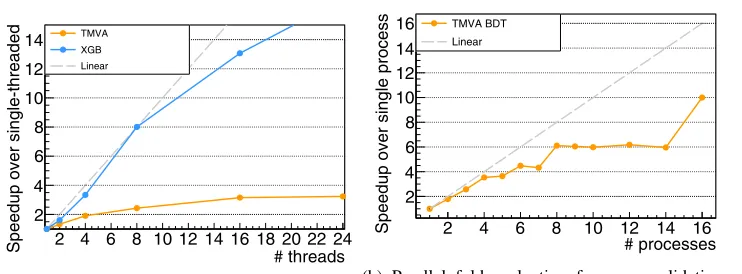
The relative boosted decision tree training time with respect to the number of worker threads can be seen in Figure3awhere the time taken for the single threaded implementation serves as a baseline. The TMVA implementation reaches a top speedup of about 3.6 with 24 threads used; The speedup at 4 threads is close to 2. This can be compared to xgBoost[14], another popular implementation of boosted decision trees, achieving close to linear speedup across the measurement points.
3.2.2 Cross validation
The 1M events from the HIGGS dataset were split into 16 folds, with each fold trained with a single-threaded boosted decision tree using 100 boost iteration and trees fully expanded to a depth of 4 without subsampling.
It is expected that the evaluation time decreases linearly with respect to the number of processes, with a start-up cost per process spawned.
Figure3bshows the execution time dependence on the number of parallel processes used. Time taken for sequential execution is 3900 seconds and for fully parallel execution 390 sec-onds; a speedup of 10 using 16 processes. It is noteworthy that for up to 4 parallel processes, the scaling was found to be close to perfect.
4 Discussion
4.1 Deep learning module
Table 2: Throughput of the 5-layer dense network with batch size of 1, comparing TMVA backed by two different BLAS implementations and LWTNN. The evaluation is run on the
CPU for both libraries with TMVA outperforming LWTNN with a factor of 1.5 using a tuned BLAS implementation.
TMVA OpenBLAS LWTNN TMVA macos-BLAS
Events/sec 5195 12829 18500
3.1.3 Dense networks in application
The achieved throughput when comparing TMVA with LWTNN [13], a light-weight software package for evaluating neural networks especially geared towards the low latency setting, is tabulated in Table2with LWTNN achieving 12829 processed events per second.
TMVA is shown to process between 5195 and 18500 events per second depending on what matrix multiplication library is being used. The former result uses OpenBLAS while the latter uses the macos tuned Accelerate framework.
3.2 Parallelisation
ROOT version 6.14 introduced parallel training of the boosted decisions tree and parallel execution of independent folds in cross validation. To evaluate the benefits of these improve-ments, the software was evaluated using 1M events from the HIGGS dataset.
3.2.1 Boosted decision trees
The relative boosted decision tree training time with respect to the number of worker threads can be seen in Figure3awhere the time taken for the single threaded implementation serves as a baseline. The TMVA implementation reaches a top speedup of about 3.6 with 24 threads used; The speedup at 4 threads is close to 2. This can be compared to xgBoost[14], another popular implementation of boosted decision trees, achieving close to linear speedup across the measurement points.
3.2.2 Cross validation
The 1M events from the HIGGS dataset were split into 16 folds, with each fold trained with a single-threaded boosted decision tree using 100 boost iteration and trees fully expanded to a depth of 4 without subsampling.
It is expected that the evaluation time decreases linearly with respect to the number of processes, with a start-up cost per process spawned.
Figure3bshows the execution time dependence on the number of parallel processes used. Time taken for sequential execution is 3900 seconds and for fully parallel execution 390 sec-onds; a speedup of 10 using 16 processes. It is noteworthy that for up to 4 parallel processes, the scaling was found to be close to perfect.
4 Discussion
4.1 Deep learning module
Comparing dense layer throughput, TMVA is performing as expected with throughput satu-rating at approximately 30000 events per seconds with a fully loaded GPU. Keras on the other
2 4 6 8 10 12 14 16 18 20 22 24 # threads 2
4 6 8 10 12 14
Speedup over single-threaded
TMVA XGB Linear
(a) Parallel training of BDT’s.
2 4 6 8 10 12 14 16
# processes 2
4 6 8 10 12 14 16
Speedup over single process
TMVA BDT Linear
(b) Parallel fold evaluation for cross validation with 16 folds.
Figure 3: Performance gain when using parallel execution for training of boosted decision trees (3a) and evaluation of all folds in cross validation (3b). The speedup over a baseline can be seen, for both plots, on the y-axis with the baseline being single-threaded performance in
3aand single-process performance in3b. The x-axis shows the number of parallel workers used in the respective setup.
hand is performing below expectation and exhibiting linear scaling, indicating that there is a large constant overhead in the memory transfer rate. This is further suggested by the be-haviour of the convolutional layers since there the increase in throughput is more rapid for increasing batch size than for dense layers. Further optimisation of the Keras setup is possi-ble, should one use low level tensorflow constructs. However, since we focus on comparing high level interfaces, this is outside the scope.
In figure Figure 2b, it is clear that implementing parallelisation over the batches could benefit TMVA. What is promising is that the sequential evaluation of TMVA shows compet-itive throughput to the parallel evaluation of Keras up to a batch size of 32.
Single-event evaluation is, for TMVA, largely dependent on the backing matrix multipli-cation library. A well tuned implementation can significantly increase the throughput, enough to compete with software currently in active use in the ATLAS experiment.
4.2 Parallelisation
The parallelisation effort of the TMVA boosted decision trees shows an asymptotic speedup
of 3.6 times is possible. However, as is shown in Figure3a, better performance is achievable as evidenced by the scaling of xgboost. Workflows already employing training of boosted decision trees will benefit from the implicit multithreading.
The parallelised cross validation shown in Figure3bshows linear speed up over sequential evaluation with overhead introduced due to process forking. The plateaus can explained by the workloads having similar duration. The final two folds cannot be started until any of the first 14 are done. A varying workload duration would smoothen the curve appropriately.
5 Future direction
Firstly, the number of open source machine learning frameworks available has prolifer-ated in recent years and while there exists many flourishing ecosystems built around different
languages, the python ecosystem for scientific computing shows promising growth. By bridg-ing the gap between ROOT/TMVA and external tools, physicists can easily integrate them in
their workflows, leveraging e.g. multi-GPU training without explicit support in TMVA. Ad-ditionally, such an interface will make TMVA more easily accessible to a wider audience, potentially bringing new users to the High-Energy Physics ecosystem.
Secondly, deep learning is gaining increased adoption in a multitude of physics applica-tions. In this environment TMVA aims to provide a framework for deep learning targeted specifically for high-energy physics applications including an easy-to-use high-level inter-face, performant training and evaluation on network sizes commonly used in physics research and fast single-event evaluation. This as a complement to the point above.
Thirdly, the future evolution of the LHC requires and order-of-magnitude increase in compute capacity. A final goal for TMVA is then to continue to increase performance of commonly used methods and incorporating new parallelism constructs from ROOT as they are made available.
In the near future, work is ongoing to expand the capabilities and performance of the deep learning module. New layer types are to be integrated and research to incorporate generative adversarial networks is ongoing. Furthermore improvements to existing layers remain, the parallelisation of convolutional layer batch evaluation being the most important.
References
[1] A. Hoecker, P. Speckmayer, J. Stelzer, J. Therhaag, E. von Toerne, H. Voss, PoSACAT, 040 (2007),physics/0703039
[2] M. Aaboud et al. (ATLAS) (2018),1808.07858
[3] A.M. Sirunyan et al. (CMS) (2018),1804.03682
[4] M. Aaboud et al. (ATLAS), Journal of High Energy Physics2017, 141 (2017) [5] M. Stoye et al. (CMS), Journal of Physics: Conference Series1085, 042029 (2018) [6] Tech. Rep. ATL-PHYS-PUB-2017-017, CERN, Geneva (2017),http://cds.cern.
ch/record/2275641
[7] G. Apollinari, O. Brüning, T. Nakamoto, L. Rossi, CERN Yellow Report pp. 1–19 (2015),1705.08830
[8] D.E. Rumelhart, G.E. Hinton, R.J. Williams (MIT Press, Cambridge, MA, USA, 1986), chap. Learning Internal Representations by Error Propagation, pp. 318–362, ISBN 0-262-68053-X,http://dl.acm.org/citation.cfm?id=104279.104293
[9] P.J. Werbos, Neural Networks1, 339 (1988)
[10] F. Chollet et al.,Keras,https://github.com/fchollet/keras(2015)
[11] M. Abadi et al.,TensorFlow: Large-scale machine learning on heterogeneous systems (2015),https://www.tensorflow.org/
[12] P. Baldi, P. Sadowski, D. Whiteson, Nature Commun.5, 4308 (2014),1402.4735
[13] D.H. Guest, J.W. Smith, M. Paganini, M. Kagan, M. Lanfermann, A. Krasznahorkay (2017)