Cryptosystem with Basic Secure Trapdoor
Wuqiang Shen and Shaohua Tang?
School of Computer Science & Engineering, South China University of Technology, Guangzhou 510006, China
[email protected],[email protected]
Abstract. In this paper, we design a novel one-way trapdoor function, and then propose a new multivariate public key cryptosystem called TOT, which can be used for encryption, signature and authentication. Through analysis, we declare that TOT is secure, because it can resist current known algebraic attacks if its parameters are properly chosen. Some practical implementations for TOT are also given, and whose secu-rity level is at least 290. The comparison shows that TOT is more secure
than HFE, HFEv and Quartz (whenn≥81 andDHF E ≥129, HFE is still secure), and it can reach almost the same speed of computing the secret map by C∗ and Sflashv2 (even though C∗ was broken, its high speed has been affirmed).
Keywords: TOT; multivariate public key cryptosystem; one-way trapdoor function; algebraic attack
1
Introduction
Since Shor [1] [2] proposed the polynomial-time algorithms for prime factor-ization and discrete logarithms on a quantum computer, researchers had been devoting to studying public key cryptosystems that can resist quantum com-puter attacks to replace the traditional public key cryptosystems, such as RSA, ECC, etc.. The system that is immune to quantum computer attacks goes by the name of Post Quantum Cryptography (PQC) [3]. Multivariate Public Key Cryptosystem (MPKC) [4] [5] [6] is a branch of PQC.
MPKC is based on the observation that solving a system of Multivariate Quadratic polynomial equations over a finite field is an NP-complete problem [7]. This problem is also known as MQproblem. In other words, the security of a MPKCs relies on the intractability of the MQ problem.
In the 1980s, the development of MPKCs was great, but many of them were broken. Matsumoto and Imai [8] presented C∗ scheme (or called MI) with a special type of trapdoor. However, it was broken by Patarin’s algebraic attack via linearization equations [9]. Surprisingly, Patarin lately applied the idea of the linearization equation attack on C∗ to construct an Oil-Vinegar signature
?
scheme (OV) [10]. The basic OV signature scheme was broken by Kipnis et al. in 1999, and they presented a modified scheme called Unbalanced Oil-Vinegar scheme (UOV) [11]. So far, UOV is secure from the structural point of view. In 2005, Ding and Schmidt introduced a multi-layer unbalanced Oil-Vinegar con-struction calledRainbowsignature scheme [12]. Rainbow is still secure currently with parameters properly choosen. Moreover, C∗ cryptosystem can be
general-ized by the Plus method, the Minus method, and the Perturbed method. There are thus many variants of C∗, such as Sflash [13] [14], Flash [15], C∗+ [16], C∗± [16], PMI [17], and PMI+ [18]. It is worth mentioning that Paterin ful-ly generalized C∗ cryptosystem and eventually invented HiddenField Equation cryptosystem (HFE) [19] in 1996. Researchers also utilized the Plus method, the Minus method, and the Perturbed method to generate many variants of HFE, for example HFE− [19], HFE± [19], IPHFE [20] and HFEv [20] [11]. HFEv is a combination of the basic HFE with the idea of Oil-Vinegar. In succession, many variants of HFEv also came out, such as Quartz [21].
On the other hand,TriangularScheme (TS) family is a different and special kind of construction in MPKC. In 1999, Moh [22] proposedTameTransformation Method (TTM) cryptosystem which belongs to TS family. Unfortunately, it was attacked by Goubin and Courtois [23] in 2000. It is interesting that they also formulated a new family of cryptosystems calledTriangular-Plus-Minus (TPM) to let their attack in a more general way. Both TTM and TPM can be attacked by the MinRank method [23]. Later, new TTM schemes were introduced in [24]. However, Ding and Schmidt [25] pointed out that they are insecure. Besides, Tame Transformation Signature (TTS) of the TS family also experienced the same rough process [26] [27] [28]. In a nutshell, MPKCs are always heuristic.
that our proposed TOT is a novel, secure, and fast cryptosystem, and is a better choice among MPKCs in terms of both security and efficiency.
Organization.The rest of this paper is organized as follows. In Section 2, we introduce some notations and concepts on the multivariate public key cryptosys-tems. In Section 3, we design a novel one-way trapdoor function, and propose a multivariate cryptosystem named TOT. We analyze the security of TOT by methods of current known algebraic attacks in Section 4, and assess its security level. In Section 5, we evaluate the performance of TOT, and present the com-putation complexity and some practical parameters. In Section 6, we compare TOT with other multivariate schemes including HFE, HFEv, PMI+, Sflashv2, Quartz, UOV and Rainbow. Finally, we summarize the paper in Section 7.
2
Preliminary
2.1 Notation
Throughout this paper, we will use the following notations. Let F be a finite field of cardinalityqand characteristicp, wherepis a prime number andq=pk (k ∈ N). We take f(x) ∈ F[x] to be any irreducible polynomial of degree n
(∈N), then define the field E=F[x]/(f(x)) as an extension of degreen ofF. ObviouslyEis isomorphic toFqn, and hasqnelements. We then letϕ:E→Fn
be the standard F-linear isomorphism betweenE andFn given by
ϕ(a0+a1x+...+an−1xn−1) = (a0, a1, ..., an−1).
The subfieldF ofE is embedded inFn in the standard way:
ϕ(a) = (a,0, ...,0), ∀a∈F.
Moreover, in a (bipolar) multivariate public key cryptosystem we also let
n∈N be the number of variables,m∈N be the number of equations. Note that
nmay be equal to m.
The public key is given by a mapP:Fn →Fm,
P(x1, ..., xn) = (p1, ..., pm),
where eachpi(i∈N,1≤i≤m) is a polynomial inF[x1, ..., xn]. We build a mapP :Fn→Fm, which is defined by
P(x1, ..., xn) = (p1, ..., pm),
where eachpi (i∈N,1≤i≤m) is a polynomial inF[x1, ..., xn]. We will know that P is a map of the intermediary structure in multivariate cryptosystem.
2.2 Some Concepts on MPKC
Multivariate public key cryptosystem can also be based on the problem of solving any nonlinear system of multivariate polynomial equations over a finite field. However, from the perspectives of both security and efficiency we usually choose polynomial equations of total degree two to construct multivariate public key schemes. MPKC schemes thus also go by the name of Multivariate Quadratic (MQ) schemes [6].
From a structural point of view, this system of equations must be embedded into a special trapdoor which can make it possible to solve this system efficiently [6] [7]. Hence we can distinguish difference multivariate cryptosystems from their basic trapdoors. Generally, a multivariate public key cryptographic system con-sists of a trapdoor (S, P , T) and a public key mapP, where the trapdoor (S, P , T) is embedded into the system of equationsP, namelyP =T◦P◦S(x1, ..., xn).S andT are secret keys, and the mapP may or may not be part of the secret key depending on its precise nature. In addition, we call the mapP as “the central map”,P as “the public map”, andP−1as “the secret map”. Obviously, we must need the knowledge of the basic trapdoor to compute the secret map P−1, or equivalently “inverting” the public map P.
3
The Proposed Multivariate Cryptosystem
Notations are the same as ones described in Section 2.
3.1 A Novel One-Way Trapdoor Function
We design a new one-way trapdoor function in this sub-section, which is used to construct the new multivariate public key cryptosystem TOT.
We first define a functiong over the extension fieldE (with cardinality qn) by
g(X) = d X
i=1
(X−hi), (1)
wherehi∈E andd= deg(g(X)).
Next, we define another functionGover the filedE by
G(X) =g(X)t, (2)
wheret∈Zqn is the time ofg, and gcd(t, qn−1) = 1. Ifvis an inverse oft, then t·v≡1 mod (qn−1).
Moreover, we denote the degree ofGbyD= deg(G(X)). The function G is our expected one-way trapdoor function.
Obviously, for a given specific value Y0 ∈ E, we can solve the equation
(1) We compute the Modular Exponentiation (Y0)vmod (qn−1), and denote the result byY00. This step can be performed by the square-and-multiply method. Note that the square-and-multiply method can be enhanced, or we can use more efficient methods of [13] and [14] to compute the Modular Exponentiation.
(2) We solve the equation g(X) = Y00 in unknown X by the probabilistic Berlekamp algorithm [29] [30] [31] [32].
The solving process of this equation G(X) = Y0 is based on the following
observation:
G(X) =Y0
⇒ g(X)t=Y0
⇒ g(X)t·v=Y0v
⇒ g(X) =Y0v
⇒ X=g−1(Y0v).
This observation is a well-done job. We can utilize it to establish a cryptosystem with basic secure trapdoor. In the following sub-sections, we are going to describe our proposed multivariate public key cryptosystem in detail.
3.2 TOT for Encryption
We let n= m, then P and P are maps from Fn to Fn. Let S and T be two affine transformations inFn. Moreover, let
P(x1, ..., xn) =ϕ◦G◦ϕ−1(x1, ..., xn), and
P(x1, ..., xn) =T◦P◦S(x1, ..., xn).
The TOT public key cryptosystem is based on the fieldF of characteristicp. Public Key:
The public key includes the following information.
1) The field F, which contains its additive and multiplicative structure. 2) The mapP, which containsp1, ..., pn satisfying
p1(x1, ..., xn), ..., pn(x1, ..., xn)∈F[x1, ..., xn]. Private Key:
The private key includes the following information.
1) The parameters hi,d,t and their resultant functionsgandG. 2) Two invertible affine transformationsS andT.
Encryption:
Given a plaintext (x01, ..., x0n), we evaluate the mapP with (x01, ..., x0n), and denote its result by (y01, ..., yn0). That is
Then the corresponding ciphertext is (y10, ..., y0n).
Decryption:
Given the ciphertext (y01, ..., y0n), the process of decryption includes the fol-lowing steps.
(1) Compute (y1, ..., yn) by
(y1, ..., yn) =T−1(y10, ..., yn0).
(2) ObtainY by computing
Y =ϕ−1(y1, ..., yn).
(3) Calculate the inverse oft, namely findvsuch that
t·v≡mod(qn−1).
Apply the resultedvto Y, and we getYb by
b
Y =Yv.
(4) Compute the setXb, whose elementXbi(1≤i≤d) is the root of the function
gfor the given valueYb. That is
g(Xbi) =Y .b
Note that Steps (3) and (4) are equivalent to computing the functionG−1(Y). (5) For each elementXbi∈Xb, we compute
(x0i1, ..., x0in) =S−1◦ϕ(Xbi).
Ifi= 1, then the solution (x011, ..., x01n) is our expected plaintext. Otherwise, we need apply some techniques, such as Hash Functions and Plus Method, to detect the expected plaintext.
3.3 TOT for Signature or Authentication
TOT can be used for signature, where the public key and the private key are the same as Section 3.2. For a given messageM = (y0
1, ..., y0n) to be signed, the signer first calculates Y = ϕ−1◦T−1(y0
1, ..., y0n), then computes the set Xb like Steps (3) and (4) of the decryption in Section 3.2. After that, the signer arbitrarily chooses an elementX in the setXb, and generates a signatureσ= (x01, ..., x0n) on the messageM by computing (x01, ..., x0n) =S−1◦ϕ(X). Finally, the verifier can verify the signatureσby evaluating P(x01, ..., x0n). IfP(x01, ..., x0n) = (y10, ..., y0n), then the signatureσis valid; otherwise, invalid.
4
Security Analysis
Currently, MPKC is still hard to rigorously reduce to some intractable problems from a provable security point of view. In general, we can analyze the security of a multivariate cryptosystem by algebraic attacks. At present, current known algebraic attacks for MPKC are divided into two classes [33]. The first one isthe structural attackwhich can break some multivariate schemes according to the particular properties on the inner structure of the cryptosystem. Another isthe direct attackthat can solve a system of polynomial equations over a finite field, which usually contains Gr¨obner bases method [34] [35] [36] [37], XL method [38] [39] [40] and Zhuang-Zi method [41]. In the following sub-sections, we are going to adopt these approaches to elaborately analyze the TOT system. We assert that TOT is a secure multivariate cryptosystem, which can resist current known algebraic attacks if properly used.
4.1 Exhaustive Search Attack
Usually, in order to avoid exhaustive search attack [19], the length of a message
M should be at least 64 bits. This can be easily realized by TOT.
4.2 Affine Multiple Attack
The affine multiple attack, which can attack the basic HFE algorithm, was intro-duced by Patarin [19]. The idea is that for some polynomialG, there are always some affine multiples A(X, Y0) of the polynomial G(X)−Y0. In other words, each solutionX0toG(X) =Y0is also a solution toA(X, Y0) = 0. Unfortunately, this case might occur in our system. However, this is not a flaw of TOT, but it will generate a weak key of TOT. Patarin [19] claimed that the asymptotic complexity of the affine multiple attack isO(nO(D)) for a polynomialGof degree
D. We thus can easily avoid this attack. Ifn≥64,D≥17, andGis well chosen to contain at least two monomials in X, then the complexity of the attack is greater than 2102. Therefore, this attack is expected to fail completely in our system, since the degree ofGin TOT is designed to be greater than 24.
4.3 Linearization Equation Attack
The linearization equation attack was introduced to destroy C∗scheme by Patarin [9]. However, the mapGof the TOT system is not a bijection, thus this attack is no longer applicable to ours.
4.4 Kipnis-Shamir Attack and Distillation Attack
The Kipnis-Shamir attack is a general cryptanalytic approach, which is based on the fact that a system ofnmultivariate polynomials innvariables over a fieldF
E of F. This cryptanalytic method was used to attack both the HFE scheme [7] and the Dragon scheme [42] [7] . Unfortunately, owing to employing the “big field” structure which is used in the HFE scheme, the TOT system might also be attacked by the Kipnis-Shamir method. However, from the analyses of [7] and [43], we find that the original Kipnis-Shamir attack is in at mostnO(log2qD)
for TOT. This means that when choosing n ≥ 64, q = 2 and D ≥ 16, the TOT scheme is broken in at least 296. Obviously, the Kipnis-Shamir attack has a negligible effect on our scheme. Moreover, Courtois [43] presented a new ad-vanced attack method called the distillation attack that is more efficient than the Kipnis-Shamir attack. However, the distillation attack need n32logqD
com-putations to break our TOT system. Therefore, if we choose proper parameters, such as n≥85, q= 2 and D ≥400, then TOT can be broken in at least 282. In addition, with the increase of nand D, the attack complexity will increase accordingly. For example, for n≥170,q= 2 andD ≥800, the attack needs at least 2108 computations to wreck TOT. According to Section 3, we know that the decryption (or the signing process) of the TOT is almost not affected by the parameterD which is the degree of G(X). Thus, TOT can resist both attacks if properly used.
4.5 Differential Cryptanalysis
Differential cryptanalysis is a general and powerful method to attack some cryp-tographic schemes. In multivariate quadratic systems, the differential of the pub-lic key is a affine map, and the dimension of its kernel is invariant [44]. One can then utilize these facts to obtain some information on the secret key. The d-ifferential attack was successfully applied to break some multivariate schemes, such as C∗, PMI and Sflash [44] [45]. However, it cannot break the TOT system. Reasons are elaborated as follows.
Let us consider the linear part of the differential of the public keyP. We can define the differential ofP of TOT asDPk(x) =P(x+k)−P(x)−P(k)−P(0), wherex, k∈(F)n. It is not difficult to infer that the dimension of the expected kernelK (in thecleartext space) of the mapDPk is inO(D). Thus an attacker has a success probability qn·Oε(D) to find O(D) linearly independent vectors to
construct the kernelKby some probabilistic algorithm, whereεis a probabilis-tic coefficient. Obviously, the success probability is negligible. Therefore, it is unpractical to attack ours by the differential method.
4.6 Attacks using Gr¨obner Bases and XL
new Gr¨obner basis algorithm is actually more powerful than the XL algorithm [40]. Thus, we can focus on how some multivariate scheme behaves under an attack by Gr¨obner bases algorithm, instead of XL algorithm [4].
For Gr¨obner bases algorithm, we know that computing Gr¨obner bases of a random system of multivariate quadratic polynomials is simply exponential in 2n [33] [47]. Thus, from a practical point of view, when choosing n≥80, it is impossible to solve a system of nequations of degree 2 innvariables. In other words, Gr¨obner bases method need to run in time at least 280to break the TOT system for using the parametern≥80. Obviously, this method is unpractical to attack our algorithm so long as we properly choose parameters of TOT.
5
Performance
5.1 Computation Complexity of TOT
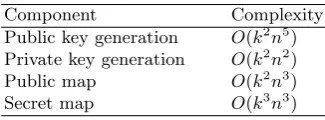
As we know, for two elements ofF, an addition requiresO(k) basic computations and a multiplication needs O(k2) basic computations [9]. Thus, we can easily compute the complexity of the components of TOT according to this fact. The resultant complexities are shown in Table 1. Moreover, we need to notice that ifkis not too big, we can turn multiplication of two elements ofF into a table and store it [9]. So computing TOT algorithm will be aboutk2 times faster.
Table 1.The Computation Complexity of TOT
Component Complexity Public key generation O(k2n5) Private key generation O(k2n2)
Public map O(k2n3) Secret map O(k3n3)
5.2 Practical Parameters for TOT
According to the security analysis in Section 4, we can give some practical im-plementations of TOT.
(1) When utilizing TOT to encrypt a plaintext, we suggest that the worthy parameters areq= 2, n= 160, d≥6 andt≥128. In this case, both P andP
are maps from F160 toF160.
– The public key. It consists of 160 quadratic polynomials with 160 variables. The total number of coefficients for the public key is at least 160×161× 162/2 = 2086560 bits≈254.71 KB.
– The length of ciphertext: 160 bits.
– Complexity of best known attack: greater than 2105.
(2) When using TOT to sign a message, we recommend that practical pa-rameters areq= 2,n= 128,d≥6 andt≥64. In this case, both P andP are maps from F128 toF128.
– The public key. It consists of 128 quadratic polynomials with 128 variables. The total number of coefficients for the public key is at least 128×129× 130/2 = 1073280 bits≈131.02 KB.
– The private key. It consists of at least 7 elements in the fieldEof cardinality 2128, and two affine transformations over F128. The total number of coeffi-cients for the private key is at least 2×(128×128+128)+7×128 = 33920 bits, or about 4.14 KB of storage.
– The length of signature: 128 bits.
– Complexity of best known attack: greater than 290.
Overall, the security of TOT should be at least 290 under our values in accordance with the existing attack complexity. We thus claim that the best known attack method against the TOT system will be the brute force checking of all possible plaintexts one-by-one.
6
Comparison with Other Multivariate Schemes
Security and efficiency that are two important factors in evaluating a crypto-graphic system. We are going to compare TOT with other multivariate schemes, including encryption schemes and signature schemes.
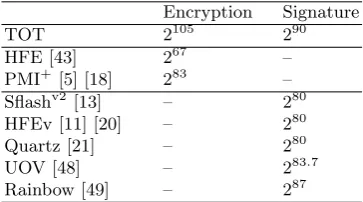
In the aspect of security level, the comparison is presented in Table 2. In the aspect of efficiency, we compare the computation complexity of TOT with ones of HFE, HFEv, Quartz, PMI+ and Sflashv2from the structural point of view, as shown in Table 3. We also compare TOT with UOV and Rainbow according to the size of public/private key, since it can determine the time to verify the signature or to sign a document. The comparison on the size of mes-sage, signature, and public/private key is summarized in Table 4, where Mes., Sig., PK, and SK stands for Message, Signature, Public Key, and Private Key, respectively.
We notice that the efficiency comparison of MPKC is often reflected in com-puting the secret map. That is, the computation speed of the secret map can estimate whether a MPKC scheme is efficient or not.
6.1 Comparison with HFE and HFEv
From the structural point of view, the secret map of HFE contains inverting two affine transformations THF E and SHF E , and inverting the central map
PHF E=ϕ◦GHF E◦ϕ−1. Namely, computingTHF E−1 ,G
−1
HF EandS
−1
Table 2.Comparison on Security Level
Encryption Signature
TOT 2105 290
HFE [43] 267 –
PMI+[5] [18] 283 –
Sflashv2 [13] – 280
HFEv [11] [20] – 280 Quartz [21] – 280
UOV [48] – 283.7 Rainbow [49] – 287
Table 3.Comparison on Computation
Scheme Time
TOT 2A−1+O(log(qn−1)3) +O(n)
HFE 2A−1+O(n(qn−1)2log(qn−1) + (qn−1)3)
HFEv T ime(HFE) +Fv−1+O(n) Quartz T ime(HFE) +F−1
v +O(n) PMI+ 2A−1+O(log(qn−1)3) +O(qr) Sflashv2 2A−1+O(log(qn−1)3) +O(n)
A−1 denotes the time to invert an affine transformation A. F−1
v denotes the time to invert the “vinegar” functionFv. T ime(·) denotes the time to call a function “·”.
Table 4.Comparison on Size of Mes/Sig/PK/SK
Mes. Sig. PK SK Total
Unit bits bits KB KB KB
TOT 128 128 131.02 4.14 135.16 UOV [48] 224 672 99.94 87.31 187.25 Rainbow [49] 192 336 22.17 16.86 39.03
using the probabilistic Berlekamp algorithm [29] [30] [31] [32], a greater upper bound is O(nDHF E3 ) [4], where DHF E = deg(GHF E(X)). For TOT, the se-cret map also containsT−1,G−1 andS−1. However, computingG−1(Y) in the TOT system is transformed into computingYb0=Y
v
mod (qn−1) andg−1( b
Y0),
namely Steps 3 and 4 in Section 3.2. The complexity of Step 3 isO(log(qn−1)3) by using the square-and-multiply method. It can be done ten times faster than naive square-and-multiply method [13] [14]. The complexity of Step 4 is O(n), because the degree of g is designed as a small value. Thus the total complexi-ty of G−1(Y) of TOT is O(log(qn−1)3+n). For both complexities, since the range of each parameter is different, it seems difficult to compare the complexi-tyO(log(qn−1)3+n) withO(nD2
HF ElogDHF E+DHF E3 ). However, we know that the upper bound of DHF E is O(qn−1), thus we can think in theory that
O(nD2
HF ElogDHF E+D3HF E) is greater than O(log(qn −1)3+n). In other words, the computation speed of the secret map of TOT is faster than that of HFE, at least not slower than it.
From the security point of view, we know thatDHF E plays a vital role in HFE. In theory, the largerDHF E is, the more secure HFE is. The situation is similar in TOT, i.e., the largerD is, the more secure TOT is. However, DHF E cannot unlimitedly grow, otherwise, the decryption process of HFE is inefficient. The difference between D and DHF E is that,D can expand indefinitely, while the computation speed of the secret map of TOT may be more faster. This is a beautiful point of TOT. All in all, comparing with HFE, TOT can easily gain a higher security level.
For HFEv, we know that it is a combination of HFE with the idea of Oil-Vinegar. Its efficiency and security strictly rely on the basic HFE [20] [11]. Ob-viously, the running speed of the secret map of TOT is also faster than that of HFEv, then TOT can also get a higher security level.
Therefore, TOT is a better choice than HFE and HFEv.
6.2 Comparison with PMI+
PMI+ is a combination of PMI with the plus method, namely, a few addition-al polynomiaddition-als are added to PMI which is an extension of C∗ with an internal perturbation. The secret map of PMI+ is the same as that of PMI. Therefore, the total computation workload of the secret map of PMI+is equivalent to com-puting the secret map of C∗ and inverting “the perturbed map”. Obviously, the workload of Steps 1-3, 5 of TOT (in Section 3.2) is equivalent to computing the secret map of C∗. While the workload of Step 4 of TOT is less than that of in-verting the perturbed map of PMI+, because inverting the perturbed map needs
O(qr) basic computations to obtain tentatively a correct solution. In general, the computations of the secret map of TOT is less than that of PMI+.
In the aspect of security, Ding [5] [18] claimed that the security level of PMI+ is 283with given practical parameters, while the security level of TOT is greater than 2105 in our first example.
6.3 Comparison with Sflashv2
Currently, Sflashv2 is still considered to be secure [14]. Sflashv2is a combination of C∗ with the minus method. From the above analyses in Sections 6.1 and 6.2,
we know that the running speed of the secret map of TOT is very close to that of C∗ from a structural point of view. Therefore, we believe that the signature generation process of TOT will take as much time as Sflashv2.
With the parameters in [13], Sflashv2 generates a signature of 259 bits, and its security level is up to 280. However, our second example has a short signature of 128 bits and a security level of 290. Thus, from aspects of both security and efficiency, we believe that TOT is a better choice compared to Sflashv2.
6.4 Comparison with Quartz
Quartz is a practical HFEv− signature scheme with length of 128 bits. It was accepted as a short digital signature by NESSIE (New European Schemes for Signature, Integrity, andEncryption). The parameters for a Quartz scheme [21] are q = 2,DQuartz = 129,n = 103,v = 4 andr = 3. In this case, the public key of Quartz is a map fromF107 to F100, and has the length of 71 KB which is about 1.8 times less than our second practical example. This implies that our public computation of verifying the signature will take about 1.8 times longer. However, from the structural point of view, the computation speed of the secret map of Quartz is obviously slower than that of HFE. In Section 6.1, we knew that the computation speed of the secret map of TOT is faster than that of HFE. Therefore, the computation speed of the secret map of TOT must be faster than that of Quartz. Moreover, both TOT and Quartz can generate signatures with the same length of 128 bits.
From the secure point of view, the security level of Quartz is 280, yet ours is greater than 290. Thus, we conclude that our scheme should be a better choice in terms of both security and efficiency.
6.5 Comparison with UOV
Up to now, UOV has not been broken from the structural side. A suit of practical parameters (28,84,28,56) for UOV was given in [48]. In this case, the public key of UOV is a map from F84 to F28, and has a length of 8×28×(85×86)/2 = 818720 bits≈99.94 KB. Its private key consists of 28 Oil-Vinegar polynomials in 56 Vinegar variables and 28 Oil variables, and an invertible affine transformation
With given practical parameters, the security level of our second example is greater than 290, while that of UOV is 283.7.
Therefore, we still think that UOV is a better choice from both security and efficiency.
6.6 Comparison with Rainbow
Rainbow is a multi-layer UOV scheme. A set of practical parameters GF(28) and (18,12,12) for Rainbow was given in [49], which is a two-layer construction. Therefore, its public key consists of 24 quadratic polynomials in 42 variables. That is, the size of the public key is 8×24×(43×44)/2 = 181632 bits ≈ 22.17 KB. Its private key consists of 12 polynomials in 18 Vinegar variables and 12 Oil variables in the first layer, and 12 polynomials in 30 Vinegar variables and 12 Oil variables in the second layer, and two invertible affine transformations
S : F42 → F42 and T : F24 → F24. The total size of the private key is thus about 16.86 KB. Obviously, the size of the public key of Rainbow is about 6 times less than our second example, but the size of the private key of Rainbow is roughly 4 times larger than ours. Moreover, Rainbow generates a signature of 336 bits from a message of 192 bits. The size of signature is larger than that of message. This case is similar to UOV. Thus ours is better than Rainbow in this aspect. Besides, both TOT and Rainbow have almost the same security level.
7
Conclusion
We design a novel one-way trapdoor function with special properties, which can compute the secret map quickly. With the growth ofting(X), the security level of TOT can be enhanced, while the process of decryption or signing will not be affected. On the contrary, ift is properly chosen, the speed of decryption or signing can be faster. This is a good job compared to HFE, HFEv and Quartz. In addition, because the degreed of g(X) is designed to choose a small value, the computation speed of the secret map of TOT is as fast as C∗ and Sflashv2. Meanwhile, TOT can withstand current known algebraic attacks as long as be-fittingly used. We give some practical implementations of TOT with the security level of greater than 290. Of course, one can choose more suitable parameters and let TOT reach a higher security level according to concrete situations. It is worth mentioning that TOT can generate a signature with the same length of 128 bits as Quartz. In terms of both security and efficiency, we believe that TOT will be a good choice for encryption, signature and authentication.
Acknowledgement
The authors thank Jiahui Chen, Fengxia Li, Zhiniang Peng, and Xiaoyu Li for plenary discussions and suggestions on this paper.
References
1. Shor, P.W.: Polynomial-Time Algorithms for Prime Factorization and Discrete Logarithms on a Quantum Computer. SIAM Journal on Computing26(5) (1997) 1484–1509
2. Shor, P.W.: Polynomial-Time Algorithms for Prime Factorization and Discrete Logarithms on a Quantum Computer. SIAM Review41(2) (1999) 303–332 3. Bernstein, D.J., Buchmann, J.: Post-Quantum Cryptography. Springer (2009) 4. Ding, J., Schmidt, D.: Multivariate Public Key Cryptosystems. In: Advances in
Information Security, Citeseer (2006)
5. Ding, J., Yang, B.Y.: Multivariate Public Key Cryptography. In: Post-Quantum Cryptography. Springer (2009) 193–241
6. Wolf, C., Preneel, B.: Taxonomy of Public Key Schemes based on the Problem of Multivariate Quadratic Equations. Cryptology ePrint Archive, Report 2005/077 (2005) http://eprint.iacr.org.
7. Kipnis, A., Shamir, A.: Cryptanalysis of the HFE Public Key Cryptosystem by Relinearization. In: Advances in Cryptology–CRYPTO’99, Springer (1999) 19–30 8. Matsumoto, T., Imai, H.: Public Quadratic Polynomial-Tuples for Efficien-t SignaEfficien-ture-VerificaEfficien-tion and Message-EncrypEfficien-tion. In: Advances in CrypEfficien-tology– EUROCRYPT’88, Springer (1988) 419–453
9. Patarin, J.: Cryptanalysis of the Matsumoto and Imai Public Key Scheme of Eurocrypt’88. In: Advances in Cryptology–CRYPTO’95. Springer (1995) 248–261 10. Patarin, J.: The Oil and Vinegar Signature Scheme. In: Dagstuhl Workshop on
Cryptography. Volume 80. (1997)
11. Kipnis, A., Patarin, J., Goubin, L.: Unbalanced Oil and Vinegar Signature Schemes. In: Advances in Cryptology–EUROCRYPT’99, Springer (1999) 206–222 12. Ding, J., Schmidt, D.: Rainbow, a New Multivariable Polynomial Signature Scheme. In: Applied Cryptography and Network Security, Springer (2005) 164–175 13. Akkar, M.L., Courtois, N.T., Duteuil, R., Goubin, L.: A Fast and Secure Imple-mentation of Sflash. In: Public Key Cryptography–PKC 2003. Springer (2003) 267–278
14. Nicolas T. Courtois, L.G., Patarin, J.: SF LASHv3, a Fast
Asymmet-ric Signature Scheme. Cryptology ePrint Archive, Report 2003/211 (2003) http://eprint.iacr.org.
15. Patarin, J., Courtois, N., Goubin, L.: Flash, a Fast Multivariate Signature Algo-rithm. In: Topics in Cryptology–CT-RSA 2001. Springer (2001) 298–307
16. Patarin, J., Goubin, L., Courtois, N.: C−∗+ and HM: Variations Around
T-wo Schemes of T. Matsumoto and H. Imai. In: Advances in Cryptology– ASIACRYPT’98, Springer (1998) 35–50
17. Ding, J.: A New Variant of the Matsumoto-Imai Cryptosystem through Perturba-tion. In: Public Key Cryptography–PKC 2004. Springer (2004) 305–318
18. Ding, J., Gower, J.E.: Inoculating Multivariate Schemes against Differential At-tacks. In: Public Key Cryptography–PKC 2006. Springer (2006) 290–301 19. Patarin, J.: Hidden Fields Equations (HFE) and Isomorphisms of Polynomials (IP):
20. Ding, J., Schmidt, D.: Cryptanalysis of HFEv and Internal Perturbation of HFE. In Vaudenay, S., ed.: Public Key Cryptography–PKC 2005. Volume 3386 of Lecture Notes in Computer Science. Springer Berlin Heidelberg (2005) 288–301
21. Patarin, J., Courtois, N., Goubin, L.: Quartz, 128-bit Long Digital Signatures. In: Topics in Cryptology–CT-RSA 2001. Springer (2001) 282–297
22. Moh, T.: A Public Key System with Signature and Master Key Functions. Com-munications in Algebra27(5) (1999) 2207–2222
23. Goubin, L., Courtois, N.T.: Cryptanalysis of the TTM Cryptosystem. In: Advances in Cryptology–ASIACRYPT 2000. Springer (2000) 44–57
24. Moh, T., Chen, J.M.: On the Goubin-Courtois Attack on TTM. preprint (2001) 25. Ding, J., Schmidt, D.: The New Implementation Schemes of the TTM
Cryptosys-tem Are Not Secure. In: Coding, Cryptography and Combinatorics. Springer (2004) 113–127
26. Chen, J.M., Yang, B.Y.: A More Secure and Efficacious TTS Signature Scheme. In: Information Security and Cryptology–ICISC 2003. Springer (2004) 320–338 27. Yang, B.Y., Chen, J.M., Natl Taiwan, U.: TTS: Rank Attacks in Tame-Like
Mul-tivariate PKCs. IACR Cryptology ePrint Archive2004(2004) 61
28. Ding, J., Yin, Z.: Cryptanalysis of TTS and Tame-like Multivariate Signature Schemes. In: Pre-Proceedings of the The Third International Workshop for Applied PKI, Fukuoka, Japan. (2004)
29. Berlekamp, E.R.: Factoring Polynomials over Finite Fields. Bell System Technical Journal46(1853-1859) (1967) 3
30. Berlekamp, E.R., Rumsey, H., Solomon, G.: On the Solution of Algebraic Equations over Finite Fields. Information and Control10(6) (1967) 553–564
31. Berlekamp, E.R.: Algebraic Coding Theory. Volume 111. McGraw-Hill New York (1968)
32. Berlekamp, E.R.: Factoring Polynomials over Large Finite Fields. Mathematics of Computation24(111) (1970) 713–735
33. Faugere, J.C., Joux, A.: Algebraic Cryptanalysis of Hidden Field Equation (HFE) Cryptosystems using Gr¨obner Bases. In: Advances in Cryptology–CRYPTO 2003. Springer (2003) 44–60
34. Buchberger, B.: A Criterion for Detecting Unnecessary Reductions in the Con-struction of Gr¨obner-Bases. In: Symbolic and Algebraic Computation. Springer (1979) 3–21
35. Buchberger, B.: Gr¨obner Bases: an Algorithmic Method in Polynomial Ideal The-ory. Multidimensional Systems Theory (1985) 184–232
36. Faugere, J.C.: A New Efficient Algorithm for Computing Gr¨obner Bases (F4).
Journal of Pure and Applied Algebra139(1) (1999) 61–88
37. Faug`ere, J.C.: A New Efficient Algorithm for Computing Gr¨obner Bases without Reduction to Zero (F5). In: Proceedings of the 2002 International Symposium on
Symbolic and Algebraic Computation, ACM (2002) 75–83
38. Courtois, N., Klimov, A., Patarin, J., Shamir, A.: Efficient Algorithms for Solv-ing Overdefined Systems of Multivariate Polynomial Equations. In: Advances in Cryptology–EUROCRYPT 2000, Springer (2000) 392–407
39. Moh, T.: On the Method of ”XL” and Its Inefficiency to TTM. Cryptology ePrint Archive, Report 2001/047 (2001)
40. Diem, C.: The XL-Algorithm and a Conjecture from Commutative Algebra. In: Advances in Cryptology–ASIACRYPT 2004. Springer (2004) 323–337
the International Workshop on Post-Quantum Cryptography (PQCrypto 2006). (2006) 227–240
42. Patarin, J.: Asymmetric Cryptography with a Hidden Monomial. In: Advances in Cryptology–CRYPTO’96, Springer (1996) 45–60
43. Courtois, N.T.: The Security of Hidden Field Equations (HFE). In: Topics in Cryptology–CT-RSA 2001. Springer (2001) 266–281
44. Fouque, P.A., Granboulan, L., Stern, J.: Differential Cryptanalysis for Multivariate Schemes. In: Advances in Cryptology–EUROCRYPT 2005. Springer (2005) 341– 353
45. Gilbert, H., Minier, M.: Cryptanalysis of SFLASH. In: Advances in Cryptology– EUROCRYPT 2002, Springer (2002) 288–298
46. Ars, G., Faugere, J.C., Imai, H., Kawazoe, M., Sugita, M.: Comparison between XL and Gr¨obner Basis Algorithms. In: Advances in Cryptology–ASIACRYPT 2004. Springer (2004) 338–353
47. Bardet, M., Faugere, J.C., Salvy, B.: On the Complexity of Gr¨obner Basis Com-putation of Semi-Regular Overdetermined Algebraic Equations. In: Proceedings of the International Conference on Polynomial System Solving. (2004) 71–74 48. Thomae, E., Wolf, C.: Solving Underdetermined Systems of Multivariate Quadratic
Equations Revisited. In: Public Key Cryptography–PKC 2012. Springer (2012) 156–171