
Asynchronous MPC with a Strict Honest Majority
Using Non-equivocation
Michael Backes1 Fabian Bendun1 Ashish Choudhury2 Aniket Kate3
1Center for IT-Security, Privacy and Accountability (CISPA), Saarland University, Germany 2International Institute of Information Technology—Bangalore, India
3MMCI, Saarland University, Germany
{backes,bendun}@cs.uni-saarland.de, [email protected],
Abstract
Multiparty computation (MPC) amongnparties can tolerate up tot < n/2active corruptions in a synchronouscommunication setting; however, in anasynchronouscommunication setting, the resiliency bound decreases to onlyt < n/3active corruptions. We improve the resiliency bound for asynchronous MPC (AMPC) to match synchronous MPC usingnon-equivocation.
Non-equivocation is a message authentication mechanism to restrict a corrupted sender from mak-ing conflictmak-ing statements to different (honest) parties. It can be implemented usmak-ing an increment-only counter and a digital signature oracle, realizable with trusted hardware modules readily available in com-modity computers and smartphone devices. A non-equivocation mechanism can also be transferable and allow a receiver to verifiably transfer the authenticated statement to other parties. In this work, using transferable non-equivocation, we present an AMPC protocol toleratingt < n/2faults. From a practical point of view, our AMPC protocol requires fewer setup assumptions than the previous AMPC protocol witht < n/2 by Beerliov´a-Trub´ıniov´a, Hirt and Nielsen [PODC 2010]: unlike their AMPC protocol, it does not require anysynchronous broadcast round at the beginning of the protocol and avoids the threshold homomorphic encryption setup assumption. Moreover, our AMPC protocol is also efficient and provides a gain ofΘ(n)in the communication complexity per multiplication gate, over the AMPC protocol of Beerliov´a-Trub´ıniov´a et al. In the process, using non-equivocation, we also define the first asynchronous verifiable secret sharing (AVSS) scheme witht < n/2, which is of independent interest to threshold cryptography.
1
Introduction
“stage” of an asynchronous protocol, no party can afford to wait to hear from all the parties and so the communication fromt(potentially honest) parties may be ignored [Can96]. Due to their complexity, only a few asynchronous MPC (AMPC) protocols are available [BOCG93, BOKR94, SR00, HNP05, HNP08, BTH07, PCR09, CHP13].
In this work, we focus on an asynchronous model with acomputationally boundedadversaryA, where the parties are connected by pairwise authenticated links. In this setting, AMPC protocols are possible if and only ift < n/3[HNP05, HNP08]. This is in contrast to the synchronous world, where we can tolerate uptot < n/2corruptions [HN06]. Interested in bridging this gap between the resilience of synchronous and asynchronous MPC protocols, Beerliov´a-Trub´ıniov´a, Hirt and Nielsen [BTHN10] observed that it is possi-ble to design an AMPC protocol toleratingt < n/2corruptions in a “partial” synchronous network. More specifically, assuming onesynchronous broadcastround at the beginning of the protocol, where each party can synchronously broadcast to every other party, they designed an AMPC protocol toleratingt < n/2 corruptions. Due to the availability of the synchronous broadcast round, their protocol could also ensure “input provision”, i.e. the inputs of all the (honest) parties are considered for the computation, which other-wise is impossible to achieve in an asynchronous protocol [Can96]. Nevertheless, their requirement of one synchronous broadcast round per MPC instance may not always be realizable: deterministic broadcast pro-tocols [DS83] requireΘ(t)rounds of communication over the pairwise channels or randomized broadcast protocols [Tou84, FM85] requireO(1)(with a large constant) expected rounds of communication. It was left as an open problem in [BTHN10] to see whether one can design an AMPC protocol witht < n/2under other simplified assumptions.
In distributed computing research, a similar problem with asynchronous protocols has recently been ad-dressed by introducing a small trusted hardware assumption [CMSK07,LDLM09,CVL10, CJKR12,JMS12, KBC+12]. In particular, it was shown that, the resilience of asynchronous distributed computing tasks such as reliable broadcast, Byzantine agreement, and state machine replication (SMR) can be improved using a smalltrusted hardware moduleat each party. The hardware module utilized is just a trusted, increment-only local counter and a signature oracle, which can be realized with pervasively available trusted hardware-enabled devices. Using such trusted hardware with each party, one can design asynchronous reliable broad-cast tolerating up tot < nactive faults [CJKR12, CVL10], and asynchronous Byzantine agreement (ABA) and SMR protocols tolerating up to t < n/2 [CMSK07, LDLM09, KBC+12] active faults, all of which otherwise requiret < n/3[Tou84].
At a conceptual level, such a trusted module makes it impossible for a corrupted party to perform equiv-ocation, which essentially means making conflicting statements to different (honest) parties. The use of signatures (or transferable authentication) complementsnon-equivocation(i.e., making equivocation impos-sible) by making it transferable as required in the asynchronous environment with unknown delays. Clement et al. [CJKR12] generalized the results [CMSK07,LDLM09,CVL10] and proved that non-equivocation with signatures (i.e.,transferablenon-equivocation) allows treating active (or Byzantine) faults as crash failure for many distributed computing primitives. In particular, they present a generic transformation that enables any crash-fault tolerant distributed protocol to tolerate the same number of Byzantine faults using trans-ferable non-equivocation. Nevertheless, their generic transformation considers only the basic distributed computing requirements of safety and liveness. It does not apply to cryptographic tasks such as AMPC whereconfidentiality (or privacy)of inputs is also required. This presents an interesting challenge to assess the utility of transferable non-equivocation for the secure distributed computing task of AMPC.
1.1 Contribution and Comparison
Our protocol, called NeqAMPC , improves upon the previous AMPC protocol [BTHN10] withn≥2t+ 1 in the following ways:
(a) Simplified assumptions. The NeqAMPC protocol needs a transferable non-equivocation mechanism, but unlike [BTHN10] neither makes a synchronous broadcast round assumption nor requires a threshold homomorphic encryption setup. Given the feasibility of realizing transferable non-equivocation over preve-lent computing devices, we argue that transferable non-equivocation is a more practical assumption than the synchronous broadcast round assumption.
(b) Efficiency. For a security parameter κ, our AMPC protocol requires an amortized communication complexity ofO(n3κ)bits per multiplication gate, which improves upon the AMPC protocol of [BTHN10] by a factor ofΘ(n).
To reduce the setup assumptions for the NeqAMPC protocol, we avoid the traditional threshold additive homomorphic encryption based circuit evaluation approach as used in [HNP05, HNP08, BTHN10]. Instead, we employ a secret-sharing based circuit evaluation approach [BOGW88, CCD88, RBO89], where privacy of the computation is maintained via secret sharing. Nevertheless, as detailed in our protocol overview (Section 2), secret-sharing based AMPC with n = 2t+ 1 andO(n3κ) communication complexity (per multiplication) presents several interesting challenges. As a result the NeqAMPC protocol is significantly different than those in the literature [HNP05, HNP08, BTH07, BTHN10].
In the process, we also present the first computationally secure asynchronous verifiable secret sharing (AVSS) [Can96,CKAS02,BKP11,BDK13] scheme forn≥2t+ 1withO(n2κ)communication complexity (using transferable non-equivocation), which otherwise requirest < n/3[Can96]. Our AVSS scheme has an additional useful feature—it is the first publicly verifiable [Sta96] AVSS scheme, as it allows any third party to publicly verify the “consistency” of the shares. With its efficiency and public verifiability, our AVSS scheme may be of independent interest to other cryptographic protocols.
Comparison with Existing Work. The best known computationally secure AMPC protocols are reported in [HNP08, BTHN10]. The protocol in [HNP08] considers a fully asynchronous setting with t < n/3, whereas [BTHN10] assumes one synchronous broadcast round and can tolerate up tot < n/2corruptions. Both the protocols require a threshold additive homomorphic encryption instantiation, and incur an (amor-tized) communication complexity ofO(n2κ)andO(n4κ)bits per multiplication gate respectively.1
We do not employ a threshold encryption setup, but rather prefer a more standard public key encryption setup with the addition of transferable non-equivocation. Our NeqAMPC protocol witht < n/2performs circuit evaluation by secret-sharing the inputs and incurs a communication complexity ofO(n3κ) bits per multiplication gate. Nevertheless, by modifying our protocol and employing a threshold encryption setup (coupled with transferable non-equivocation), we can toleratet < n/2faults with communication complex-ityO(n2κ)bits per multiplication gate. However, we prefer the secret-sharing based AMPC, as we aim to reduce the assumptions relied upon.
We note that unlike [BTHN10], our AMPC protocol could not enforceinput provision: the input from
tpotentially honest parties may be ignored for computation. As discussed earlier, this is inherent to asyn-chronous systems and presents a trade-off between our protocol and that of [BTHN10] based on what is more important: input provision or avoiding the synchrony assumption. Finally, we note that using a transferable non-equivocation mechanism, one can realize asynchronous reliable broadcast (see Section 3.3) witht < n
and consequently get rid of the synchronous broadcast round required in [BTHN10]. Nevertheless, the re-sultant protocol will still require the threshold homomorphic encryption setup andO(n4κ)communication complexity per multiplication, and it will no longer support input provision.
1
Beerliov´a-Trub´ıniov´a et al. [BTHN10] focused on designing a protocol witht < n/2, and the communication complexity of O(n4κ)
2
Overview of Our NeqAMPC Protocol
Without loss of generality, we assumen = 2t+ 1; thus, t = Θ(n). We assume that the functionf to be computed is expressed as an arithmetic circuit over the fieldZp, wherep > nis aκbit prime andκ is the
security parameter. The circuit consists of two-input addition (linear) and multiplication (non-linear) gates, apart from random gates. The AMPC protocol consists of two phases: an input phase and a computation phase. During the input phase, the parties share their inputs, while during the computation phase, the parties jointly evaluatef on the shared inputs and publicly reconstruct the output. Linear gates can be evaluated locally if the underlying sharing scheme is linear; thus, we use the polynomial-based (Shamir) secret-sharing scheme with thresholdt[Sha79]. We denote a sharing of a valuesby [s]. It follows that locally adding the shares of[x]and[y]provides the shares for[x+y].
Multiplication gates cannot be evaluated locally since multiplying the individual shares results in the underlying sharing polynomial having degree2t instead of t. Therefore we evaluate multiplication gates using the standard Beaver’s circuit-randomization technique [Bea91]. This technique requires three “pre-processed” secret-shared values, say ([u],[v],[w]), unknown to the adversary A, such that w = u·v. Given such a sharedmultiplication triple, and shared inputs of a multiplication gate, say [x]and[y], the multiplication gate is securely evaluated using the equation[x·y] = (x−u)·(y−v) + [v]·(x−u) + [u]·(y−v) + [u·v]. In particular, the parties compute the sharings of(x−u)and(y−v), and publicly reconstruct the same. Once(x−u)and(y−v)are public, the parties can compute their shares ofx·y, using the above equation and employing linearity of the secret sharing. Asuandvare random and unknown to A, the public knowledge of(x−u)and(y−v)does not violate the privacy ofxandy.
2.1 Pre-processing Phase
Although our above AMPC protocol idea is the same as the existing information-theoretically secure MPC and AMPC protocols [DN07, BTH07, BTH08, CHP13], our major challenge lies in generating the required shared multiplication triples withn= 2t+ 1parties; the existing protocols [DN07,BTH07,BTH08,CHP13] employ at leastn >3tparties for this purpose2. These triplets are independent of the circuit and the inputs of the parties, and generated in an additionalpre-processingphase. Generating these triplets efficiently is the important problem we solve in our protocol. In the rest of the section, we give an overview of how (cM +cR)shared random triples are generated, wherecM andcR are the number of multiplication gates
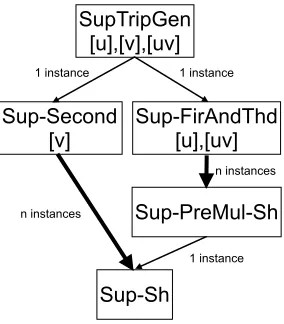
and random gates in the circuit. As a first step, we describe how a single triple is generated (see Figure 1 for a pictorial representation of the protocols involved) and then extend this tocM +cRtriples.
Supervised Triple Generation (Section 6). The idea for generating a random shared multiplication triple [u],[v],[w]is to compute a random sharing[v]and then combining “several” [u(i)]s and [u(i)·v]s to get [u]and[w]. The triple generation protocol uses two sub-protocols: Sup-ShandSup-PreMul-Sh. Protocol Sup-Sh allows adealer D to “verifiably” generate the sharing [u] of his valueu, while Sup-PreMul-Sh allows a dealerDto “verifiably” generate a sharing[u]and[u·v], givenuand[v]. To generate([u],[v],[w]), we use Sup-Shand Sup-PreMul-Shin the following way: first, we ask each party Pi to act as a dealer
Dand invoke an instance of Sup-Shto share a uniformly random value, say v(i). The parties then agree on a common subset (sayTv) oft+ 1dealers whoseSup-Shinstances will be eventually terminated by all
the parties. We setv = P Pi∈Tvv
(i). The shared valuev will be random and unknown to A, asT v has
at least one honest party. Next, each partyPi is asked to act as aDand invoke aSup-PreMul-Shinstance
to share a uniformly random valueu(i) as well asu(i)·v. The parties then agree on a common subset of
2
SupTripGen [u],[v],[uv]
Sup-FirAndThd [u],[uv] Sup-Second
[v]
Sup-PreMul-Sh
Sup-Sh
1 instance 1 instance
n instances
1 instance n instances
Figure 1:Multiplication Triple Generation under Supervision of aPking
t+ 1dealers, sayTu, whoseSup-PreMul-Shinstances will be eventually terminated by all the parties. For
u=P Pi∈Tuu
(i)andw=P Pi∈Tuu
(i)·v, the triple(u, v, w)is a random multiplication triple.
There is, however, an important subtlety: As a precondition, the Sup-PreMul-Shprotocol expects its dealerDto also haveencryptionsof allnshares of[v], encrypted under the individual keys of the respec-tive share-holders; here, the encryption scheme is addirespec-tively homomorphic (and not threshold addirespec-tively homomorphic). For any sharing, we call a party having suchnencrypted shares to beprivileged. Due to asynchronicity, theSup-Shprotocol cannot guarantee thatallthen−thonest parties are privileged with respect to every [v(i)]sharing ofPi ∈ Tv. We solve the problem by ensuring in Sup-Shthat there exists
a designated (possibly corrupted)supervisorPking (calledking), who is a privileged party with respect to
each[v(i)]. An honestPking then computes all thenencrypted shares of[v]using the homomorphic
prop-erties of encryption, and reliably broadcasts those encrypted shares. Using non-equivocation, the required asynchronous reliable broadcast is possible forn > t(Section 3.3). OncePking(correctly) broadcasts then
encrypted shares ofv, then eachPican invoke itsSup-PreMul-Shinstance.
The resultant wrapper protocols are calledSup-SecondandSup-FirAndThd, whereSup-Second gen-erates [v] under the supervision of Pking and Sup-FirAndThd generates [u] and [w = u ·v] under the
supervision ofPking. A combination ofSup-SecondandSup-FirAndThdleads to the protocolSupTripGen
under the supervision of a designatedPking, which outputs a uniformly random and private multiplication
triple([u],[v],[w]).
Preprocessing Phase Protocol. ProtocolSupTripGenmay not terminate for acorruptedPking. Therefore,
we ask each partyPito act as a king and generate shared random multiplication triples under its supervision
by invoking an instance of SupTripGen. As the instances of honest kings will eventually terminate, we distribute the load of generatingcM+cRshared random multiplication triples amongnparties. Each party Piis asked to act as a king and generatecMt+1+cR shared multiplication triples in itsSupTripGeninstance. The
parties then agree on a common subsetTking oft+ 1kings whoseSupTripGeninstances will be eventually
completed by everyone and the|Tking| · cM+cR
t+1 = cM +cR shared triples obtained in these instances are
considered as the final output.
2.2 Important Sub-protocols for the Preprocessing Phase
ProtocolSup-Sh(Section 5.1). OurSup-Shprotocol is almost equivalent to the AVSS primitive [CKAS02, Can96, BKP11]: it allows adealerDto “verifiably” share a secret s, thus generating[s], and ensures that at leastonehonest party is privileged to obtain all thenshares encrypted for the respective share holders. The existing computational AVSS protocols (e.g., [CKAS02, BKP11]) are designed withn = 3t+ 1and are based on sharing a secret using a bivariate polynomial of degreetin each variable and (homomorphic) commitments. In this paradigm, it is ensured thatDhas distributed “consistent” shares ton−t= 2t+ 1 parties such that (at least)t+ 1honestparties among them can “enable” the remaining parties to get their shares. Unfortunately, this approach cannot be used withn= 2t+ 1, as here we can only ensure thatDhas distributed consistent shares ton−t=t+ 1parties. In the worst case, there will beonly onehonest party in this set, who does not have sufficient information to help the other honest parties to complete a sharing.
We solve this problem by introducing encryptions of the shares3, and by employing univariate polyno-mials instead of bivariate polynopolyno-mials. Here,Dprovides a vector ofnencrypted shares as well as homo-morphic commitments of those shares to each party. The non-equivocation mechanism is used to ensure that acorruptedDdoes not distribute different sets of encrypted and committed shares to the different parties. Oncen−t=t+ 1parties confirm that they have received “consistent”nencrypted and committed shares, there must exist at least one honest privileged party with allnencrypted shares, who can transfer the indi-vidual encrypted shares to the indiindi-vidual parties. Transferability of non-equivocation ensures that corrupted privileged parties do not transfer incorrect encryptions.
ProtocolSup-PreMul-Sh(Section 5.2). The protocol takes as input an existing sharing [v]of a valuev
unknown to everybody includingA, such thatallthe parties are privileged, i.e., all the parties hold encryp-tions of all shares. The protocol then allows a dealerDto verifiably share its valueuas well asu·v(i.e.[u] and[u·v]). The protocol ensures thatu·vremains secure in general anduis secure for anhonestD. The idea behind the protocol is that knowing the encrypted and committed shares ofvand employing the homo-morphic properties of encryptions and commitments,Dcan compute the encrypted and committed shares corresponding tou·vfor his choice ofu, even without knowingv. The dealer can then (non-equivocally) distribute the encrypted and committed shares to the parties. Once it is confirmed thatt+ 1 parties have received all thenencrypted and committed shares ofu·v, it is ensured that there exists a honest privileged party, who can relay the individual encrypted shares ofu·vto the respective parties.
We take a more bottom-up approach in the rest of the paper. We describe our model, and define non-equivocation and other primitives in Section 3. We present our AVSS protocol in Section 4. We start our AMPC construction with subprotocolsSup-ShandSup-PreMul-Shin Section 5. We then present our supervised multiplication triple generation in Section 6 and finally describe the complete AMPC protocol in Section 7.
3
Preliminaries
In this section, we discuss our adversary and communication model, define the AMPC protocol and the non-equivocation mechanism, and describe the required primitives.
3.1 Model
We consider a setP = {P1, . . . , Pn} of nparties connected by pairwise authenticated channels, where n = 2t+ 1. These communication channels are asynchronous with arbitrary but finite delay (i.e. the
3
messages reach their destinations eventually). A centralized static adversaryAcan actively corrupt anyt
out of then parties and force them to deviate in any arbitrary manner. A party not under the control of Ais calledhonest. The adversaryAis modeled as a probabilistic polynomial time (PPT) algorithm, with respect to a security parameterκ. During a protocol execution, the message delivery order is decided by aschedulercontrolled byA. Nevertheless, the scheduler cannot modify the messages exchanged between honest parties. A protocol execution is considered as a sequence of atomic steps, where a single party is active in each such step. A party is activated upon receiving a message, after which it performs some computation and possibly outputs messages on its outgoing links. The scheduler controls the order of these atomic steps. At the beginning of the execution, each party will be in a specialstartstate. A party is said toterminate/completethe execution if it reaches a halt state. A protocol execution is said tobe complete
when all honest parties complete it. We assume that every message sent by a party during an execution has a publicly known uniqueidentifier (key)associated with it. By[y, z]we denote the set{y, y+ 1, . . . , z} ⊂N.
3.2 Definitions
Computationally Secure AVSS. Informally an AVSS scheme consists of two phases, a sharing phase, where a special party calleddealershares a secret and a reconstruction phase, where the parties reveal their shares to reconstruct the secret.
More formally, let (Sh,Rec) be a pair of protocols for parties inP, where a dealer D ∈ P has a pri-vate input s ∈ Zp for Sh. Then (Sh,Rec) is an computationally secure AVSS scheme, if the following requirements hold for every possible adversaryA, except with a negligible probability inκ:
- TERMINATION: (a)IfDishonestand all the honest parties participate in the protocolSh, then each
honestparty eventually terminates the protocolSh;(b)If somehonestparty terminatesSh, then everyhonest
party eventually terminatesSh;(c)If all the honest parties invokedRec, then eachhonestparty eventually terminatesRec.
- CORRECTNESS: If some honest party terminatesSh, then there exists a fixed values∈Zp such that
the following requirements hold except with a negligible probability inκ:(a)IfDishonest, thens=s, and all the honest parties outputsupon terminatingRec;(b)Even ifDiscorrupted, all the honest parties output
supon terminatingRec.
- PRIVACY: IfDishonestduring the protocolShand no honest party has started to execute the protocol Rec, then the adversaryAhas no information about the secrets.
Computationally Secure AMPC. We briefly review computationally secure AMPC here, and refer the readers to [HNP05, HNP08] for a formal definition. Informally, in an AMPC protocolΠMPC, every party first provides its input inZp to the computation (in a secure fashion). Due to the asynchronous nature of
communication, the parties cannot wait to consider the inputs of all nparties, and instead they agree on inputs from a setCOREofn−tparties. The parties then compute an “approximation” off on the inputs from theCORE set and assuming a default value (say 0) as the remainingt inputs. For every possible Aand for all possible inputs and random coins of the (honest) parties, we expect the following properties for aΠMPCinstance, except with a negligible probability (inκ):
• Termination:all the honest parties eventually terminateΠMPC;
• Correctness:the honest parties obtain the correct output of the functionf;
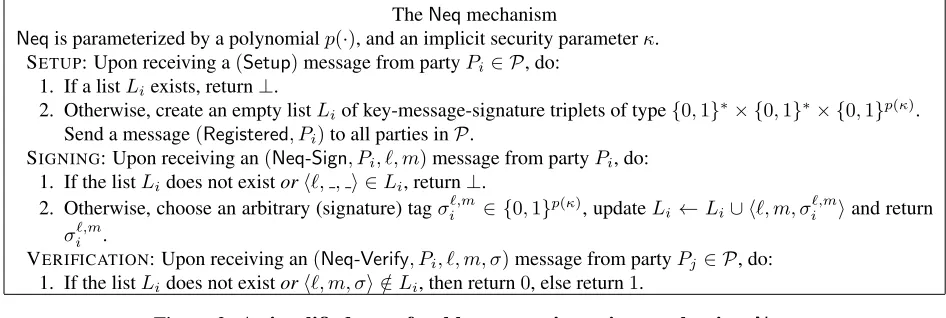
TheNeqmechanism
Neqis parameterized by a polynomialp(·), and an implicit security parameterκ. SETUP: Upon receiving a(Setup)message from partyPi∈ P, do:
1. If a listLiexists, return⊥.
2. Otherwise, create an empty listLiof key-message-signature triplets of type{0,1}∗× {0,1}∗× {0,1}p(κ). Send a message(Registered, Pi)to all parties inP.
SIGNING: Upon receiving an(Neq-Sign, Pi, `, m)message from partyPi, do: 1. If the listLidoes not existorh`, , i ∈Li, return⊥.
2. Otherwise, choose an arbitrary (signature) tagσ`,mi ∈ {0,1}p(κ), updateL
i ←Li∪ h`, m, σ `,m
i iand return
σ`,mi .
VERIFICATION: Upon receiving an(Neq-Verify, Pi, `, m, σ)message from partyPj ∈ P, do: 1. If the listLidoes not existorh`, m, σi∈/ Li, then return0, else return1.
Figure 2:A simplified transferable non-equivocation mechanismNeq
The above properties are formalized to the standard simulation-based definition following the real-world/ideal-world paradigm [Can96, BOCG93, HNP05, HNP08].
(Transferable) Non-equivocation. Non-equivocation restricts a corrupted party from making conflicting statements to different parties, and it has been used in several asynchronous distributed systems [CMSK07, LDLM09, CVL10, CJKR12, KBC+12] to improve their resiliency. In particular, these systems employ transferable non-equivocation, which (similar to digital signatures) allows a party to verifiably transfer a non-equivocation tag (or signature) provided by a sender to other parties. Clement et al. [CJKR12] justify the necessity of transferability of non-equivocation by proving that non-equivocation or signature alone are powerless inasynchronousdistributed systems. Nevertheless, (transferable) non-equivocation has not been formalized so far, and we present a simplified, idealized definition for transferable non-equivocation.
In Figure 2, we define a simplified mechanism (Neq) which is intended to model the event for a transfer-able non-equivocation instantiation: (1) during the setup phase, every partyPigets associated with a unique
non-equivocation listLi characterized by its index i, and all parties are informed about this association.
(2) The list owner party can create a non-equivocation signature for any key-message pair except that she cannot equivocate and obtain a signature for thesamekey twice. (3) Given a key-message-signature triplet associated with a sender, any party successfully verifies only correctly generated signatures except with a negligible probability.
We survey existing transferable non-equivocation instantiations and analyze their relations to Neq in Appendix A. In most instantiations, the transferable non-equivocation is implemented using an increment-only counter for keys and signatures with public key infrastructure (PKI) [CMSK07, LDLM09, CVL10, CJKR12] or message authentication codes (MACs) generated with a replicated secret key [KBC+12]. In Neq, we generalize these using the listLiof key-message-signature triplets associated with partyPiindexed
byparty-defined ordered keys`. Similar to signatures, onlyPican useNeq-Signto add triplets (one per each
key) toLi. Similar to PKI, anybody canNeq-Verifyif a tripleth`, m, σibelongs toLi ofPi, and verifiably
transfer authentication to others. Note that the increment-only counter provides a space-efficient way to implement a listLias only the counter value has to be maintained and not the whole list.
For ease of exposition, we use a phrasePi sendsmσi toPj andPj receivesmσifromPito suggest that
Pisends a triplet h`, m, σi`,mifor a key`toPj andPj delivers it only after applyingNeq-Verifyto check
ifσ`,mi is obtained byPiusingNeq-Signon`andm. Similarly, we use a phrasePj forwardsmσi toPkto
suggest thatPj received (in the above sense) messagemσi (ofPi) from some party, and then forwards it to
Pkwho should also (non-equivocally) receive it. Note that we avoid the keys`in the above phrases as they
3.3 Employed Primitives
We now discuss the existing primitives used in our protocols.
Homomorphic Encryptions and Commitments. We assume an IND-CPA secure linear homomorphic encryption scheme (Enc,Dec). Every partyPi has its own key-pair(pki,ski), for which the public key
pki is known to all parties. Given two ciphertexts cm1 = Encpki(m1,·) andcm2 = Encpki(m2,·), we
require that there exist operationsandon ciphertexts such thatcm1 cm2 =Encpki(m1+m2,·)and
acmi =Encpki(a·mi,·)holds. We also assume an unconditional hiding and computational bindinglinear
homomorphic commitmentscheme (Commit,Open) with the analogous homomorphic operations; these are denoted by⊕and. For the sake of readability, we sometimes leave the randomness of encryptions and commitments implicit.
For instantiating encryptions and commitments over messages inZp, we use the encoding-free additive
El-Gamal encryption scheme [CMPP06] and Pedersen commitment scheme [Ped91] respectively. In partic-ular, we only require that the scheme is CPA secure (Theorem 3 in [CMPP06]) and it is not necessary that applying homomorphism twice to the same encrypted values leads to different ciphertexts.
Zero-knowledge (ZK) Proofs. We assume the presence of the following two-party ZK protocols.
1) Zero knowledge proof of equality of encrypted and committed values (PoE). There exists a prover P ∈ P who computes and publishes a commitment Comm = Commit(m, r), and ciphertexts cm =
Encpki(m,·)andcr=Encpki(r,·). Then usingPoE, the proverPcan prove toanyverifierV∈ P(knowing
Comm,cm,crandpki) that the message encrypted incmis also committed inComm, under the randomness
encrypted incr; i.e.,
∃m, r, r1, r2 :Comm =Commit(m, r) ∧ cm =Encpki(m, r1) ∧ cr=Encpki(r, r2).
2) Zero knowledge proof of correct pre-multiplication (PoCM). Given publicly known commitments Comvj = Commit(vj, rj) and corresponding ciphertextscvj = Encpkj(vj,·),crj = Encpkj(rj,·)forj ∈
[1, n], there exists a proverP ∈ P who selects a randomu ∈ Zp andt-degree random polynomialsm(·)
andmˆ(·)inZp[x]withm(0) = ˆm(0) = 0. Letmj = m(j)andmˆj = ˆm(j)forj ∈ [0, n]. In addition,
PpublishesComu =Commit(u,·)andCommj =Commit(mj,mˆj). Using the homomorphic property of
commitments and encryptions,Pcomputes and publishes the commitmentComu·vj+mj =Commit(u·vj+
mj, u·rj+ ˆmj)and encryptionscu·vj+mj andcu·rj+ ˆmj ofu·vj+mjandu·rj + ˆmj respectively. Then
usingPoCM,Pcan prove toanyverifierV∈ P that all valuesComu·vj+mj were generated by multiplying
Comvj with the sameufollowed by re-randomization using the samem(·)andmˆ(·)polynomials, and that
allcu·vj+mj andcu·rj+ ˆmj values were generated by multiplyingcvj andcrj respectively with the sameu,
followed by re-randomization using the samem(·)andmˆ(·)respectively. i.e.,
∃u,ρ, m(·),mˆ(·),{kj,ˆkj}j∈[1,n]:Comu =Commit(u, ρ) ∧ deg(m(·))≤t ∧ deg( ˆm(·))≤t∧ m(0) = 0 = ˆm(0) ∧ Comu·vj+mj =uComvj⊕Commit(mj,mˆj)∧
cu·vj+mj =ucvjEncpkj(mj, kj) ∧cu·rj+ ˆmj =ucrjEncpkj( ˆmj,kˆj).
Both the ZK protocols are based on standard Σ-protocols [BG92] and have communication complexity O(κ)bits andO(nκ)bits respectively. See Appendix B for their instantiations based on the ZK protocols in [CS97].
Pi ∈ P using an appropriate zero-knowledge (ZK) protocol. A verifierPi, upon successful verification,
sends a signature toPon an “appropriate” message (known publicly), corresponding tom. P cannot wait for allnsignatures in the asynchronous environment; thus, upon receiving(n−t) = t+ 1signatures, the proverPconcatenates them to construct a certificateαfor the claimm. Theset+ 1signatures ensure that at least one honest party has verified the claim, and thatmis true with an overwhelming probability. Assuming each signature to be of sizeO(κ)bits, the size ofα will beO(nκ)bits; this can be reduced to O(κ)bits using athreshold signature schemewith thresholdt[BTHN10]. Here, the verifiers send signature shares
and the proverP, instead of concatenating, combines(n−t)shares to a single signature.4
Letzkpbe the ZK protocol corresponding to the claimm. We denote the task of constructing a certificate
αformasα =certifyzkp(m). Similarly we say that “Piverifies the certificateαfor the claimm” to mean
that thatPi verifies thatαis a valid (threshold) signature on the appropriate message corresponding tom.
The communication cost of constructingαis the same as that of executingninstances of the corresponding ZK protocolzkp.
Reliable Broadcast (r-broadcast). This asynchronous primitive [Bra84, Tou84, HT94] allows a senderSto send a messagemidentically toallthe parties: For a given instanceτb ofr-broadcast, whenSishonest, all
honest parties eventually terminate with output(τb, m); ifSiscorruptedand some honest party terminates
with(τb, m0), then every honest party also eventually terminates with(τb, m0); for any instance, at most one
message can be delivered by an honest party.
The resiliency bound forr-broadcastisn≥3t+ 1[Bra84, Tou84, HT94]; however, assuming transfer-able non-equivocation, anr-broadcastprotocol withn ≥ t+ 1andO(n2(`+κ))bits of communication for broadcasting an`-bit message is available [CJKR12, CVL10]. The high-level idea of the protocol is as follows: S first (non-equivocally) sends mσS to all the parties; this prevents a corrupted Sfrom
send-ing different messages to different honest parties. However, a corruptedScan avoid sendingmσS to some
honest parties. Thus, to ensure that all the honest parties eventually receivemσS, whenever an honest party
(non-equivocally) receives some messagemσS, before delivering the message, it non-equivocally forwards
it to every other party. This ensures that whenever an honest party receivesmσS then it will be eventually
received by every other honest party.
In the rest of the paper, the term “Pi broadcastsm” means that Pi as a sender invokes anr-broadcast
instance form. Similarly, “Pjreceivesmfrom the broadcast ofPi” means thatPjterminates ther-broadcast
instanceτbinvoked byPiwith the output(τb, m).
Agreement on a Common Subset (ACS). This primitive allows the parties to agree on a common sub-set of(n−t)parties, who correctly invoked some protocol, say Π, satisfying the following requirements: (a) If an honest party invokes an instance of Π then all the (honest) parties eventually terminate the in-stance; (b) If some honest party terminates an instance ofΠinvoked by a corrupted party, then every hon-est party eventually does the same. ACS can be realized by executing n instances (one for each party) of an asynchronous Byzantine agreement (ABA) protocol to decide if it should be included in the com-mon subset. Assuming transferable non-equivocation, ABA, and hence ACS, can be implemented with
n ≥ 2t+ 1[CJKR12, CVL10, KBC+12]. An efficient ACS protocol with expected communication com-plexity ofO(n3κ)bits can be obtained by using theNeqmechanism in the multi-valued ABA of [CKPS01].
3.4 Secret Sharing Notations
Given a secrets∈Zp, letφ(·), ψ(·)∈Zp[x]be, respectively, a degreetsharing polynomialwithφ(0) =s
and at-degreerandomness polynomialrequired for commitments; here, pis a κ-bit prime. For partyPj, sj = φ(j) andrj = ψ(j) are respectively her shares of s and the randomness polynomial. Let csj =
4
Encpkj(sj,·),crj =Encpkj(rj,·)andComsj =Commit(sj, rj)and letComs=Commit(s, ψ(0)). We call
{csj,crj}j∈[1,n]the encrypted shares and{Comsj}j∈[1,n]the committed shares ofs.
[·]-sharing:A secretsis said to be[·]-shared, if every (honest) partyPi ∈ P holdssi,ri,{Comsj}j∈[1,n]
andComs. The information held by the (honest) parties corresponding to[·]-sharing ofsis denoted
as[s].
Privileged party: Pi is called a privileged party of [·]-sharing of s if it holds the encrypted shares
{csj,crj}j∈[1,n].
Due to linearity of sharing and commitments,[·]-sharing is alsolinear: given[a],[b]and a public constant
c, every party can locally compute its information corresponding to[a+b]and[c·a], as[a+b] = [a] + [b] and[c·a] =c·[a]resepctively.
4
Our AVSS Protocol
ProtocolsShandRec presented in Figure 3 constitutes an AVSS scheme with n = 2t+ 1. ProtocolSh allows adealerDto “verifiably” generate[s]for a secrets∈ Zp. It ensures that if the protocol terminates then there exists a value (says) which will be[·]-shared among the parties; ifDishonestthens= s, and Alearns no new information ons. The protocol always terminates for anhonestDand has communication complexityO(n2κ). ProtocolRecallows the parties to reconstructs, given thatsis[·]-shared.
In theShprotocol,Dpolynomial-shares the secretswith thresholdtto generate shares{sj}j∈[1,n]and
computes the commitmentsComsj = Commit(sj, rj), where rj is a share of a randomt-degree
random-ness polynomialψ(·). It also computes the encryptionscsj = Encpkj(sj)andcrj = Encpkj(rj) of each
share-pairsj, rj, and the commitmentComs=Commit(s, ψ(0)). Dthen (non-equivocally)sends{csj}σD,
{crj}σD and {Comsj}σD for all j∈[1, n], and{Coms}σD to every party and claims that it has correctly
[·]-shared a secret: the claim involves proving that the plaintexts incsj andcrj are committed inComsj
and that the values committed in {Comsj}j∈[1,n] constitute shares of the secret committed in Coms with
thresholdt. Note that although sending the full vector{csj}σD,{crj}σDand{Comsj}σDto each party looks
a bit non-intuitive, it is thecruxof ourShprotocol to ensure that every party eventually receives its shares for[s].
To verifyD’s claim, upon (non-equivocally) receiving information fromD, everyPiverifies if the
com-mitted shares{Comsj}j∈[1,n]constitute Shamir sharing of the secret committed inComswith thresholdt.
For this, the parties use the fact that given the commitments to at leastt+ 1 distinct points on atdegree polynomial, it is possible to (homomorphically) compute the commitments of the coefficients of the polyno-mial [GRR98,CKAS02]. In particular, partyPitakesComsalong with{Comsj}j∈[1,t]and homomorphically
computes the commitments of the sharing and randomness polynomial. Using these commitments, partyPi
then computes the commitments of the remainingn−tpoints and matches them with{Comsj}j∈[t+1,n].
Ad-ditionallyPiengages inninstances ofPoE(one per triplet{csj,crj,Comsj}) withD. By non-equivocally
sending messages to the parties, it is ensured that the parties who receive the messages fromD, receive the
samemessages.Dthen constructs a certificateαD,τ (for session idτ) to support its claim of correct sharing and broadcasts it. A party proceeds further only upon receiving a valid certificate. A validαD,τ ensures that at least one honest party, sayPh, has verifiedD’s claim;Phwill be anhonest privileged party.
A valid certificate fromDdoes not ensure that every (honest)Piwill eventually hold its information
cor-responding to[s]: due to asynchrony or possible corrupted behavior ofD,thonest parties may not receive their shares corresponding to[s]. We solve this problem by usingtwoadditional “rounds” of communica-tion, which we call theD-independent phase. Eachprivilegedparty non-equivocallyforwards only{csj}σD,
{crj}σD, and{Comsj}σD to every partyPj, who can decryptcsj andcrj to obtainsj, rj. Existence of at
least one honest privileged party ensures that everyPj eventually receivessj, rj andComsj. Next, every
ProtocolSh(D, τ, s): τ is the session id
I.D-Dependent Phase:
Share Computation and Certificate Generation—Given the secrets∈Zp,Dexecutes the following code:
1. Selectt-degree polynomialsφ(·), ψ(·) withφ(0) = s. For j ∈ [1, n], computeshare-pairssj = φ(j), rj = ψ(j), ciphertexts csj = Encpkj(sj),crj = Encpkj(rj)andcommitted shareComsj =
Commit(sj, rj). ComputeComs=Commit(s, ψ(0)).
2. Send messages{csj}σD,{crj}σD and{Comsj}σD for allj∈[1, n], and{Coms}σDto eachPi. Start
constructing a certificateαD,τ =certifyPoE(claimD,τ)claiming that “Dhas correctly shared a secret
in sessionτ”: This indirectly requires a proof that “∃φ(·), ψ(·) : deg(φ(·)) ≤ t ∧ deg(ψ(·)) ≤
t ∧ csj =Encpkj(φ(j),·) ∧ crj =Encpkj(ψ(j),·) ∧ Comsj =Commit(φ(j), ψ(j)) ∧ Coms=
Commit(φ(0), ψ(0))”. For this, run an instance ofPoEfor each(csj,crj,Comsj)triplet with every
partyPi. BroadcastαD,τ once it is constructed.
Share Verification and Certification—Every partyPi ∈ PincludingDexecutes the following code:
1. On receiving{csj}σD, {crj}σD and{Comsj}σD for all j∈[1, n], and{Coms}σD fromD, perform
the following verifications:
(a) Verify if{Comsj}j∈[1,n]andComsdefine uniquet-degree polynomials.
(b) If the above verification is successful, then participate in the PoE instances of D to verify claimD,τ and enableDto construct a certificateαD,τ forclaimD,τ.
II.D-Independent Phase and Termination—Every partyPi ∈ P includingDexecutes the following
code:
1. Upon receiving the broadcasted certificateαD,τ fromD, verifyαD,τ forclaimD,τ. Upon successful
verification, if{csj}σD,{crj}σDand{Comsj}σDfor allj∈[1, n]have been received fromD,
(a) then compute si = Decski(csi), ri = Decski(cri), and ∀j ∈ [1, n] forward only
{csj}σD,{crj}σD,{Comsj}σDtoPj,
(b) else wait for{csi}σD,{cri}σD, and{Comsi}σDto be forwarded by some party. Once received,
compute the share-pairsi=Decski(csi)andri =Decski(cri).
2. Forward {Comsi}σD to each Pj. On receiving t+ 1 {Comsj}σD, homomorphically compute
{Comsj}j∈[1,n],Comsand terminate.
ProtocolRec(D, τ,[s]):τ is the session id
Every partyPi ∈ Pexecutes the following code:
1. Send the share-pair(si, ri)to every partyPj ∈ P.
2. On receiving the share-pair(sj, rj)from partyPj, verify whetherComsj
?
=Commit(sj, rj). If the
verification is successful, then includesj in a setTj, initialized to∅.
3. Once|Tj|=t+ 1, construct at-degree polynomialφ(·)by interpolating the points{(j, sj)}sj∈Tj.
Outputs=φ(0)and terminate.
Figure 3:AVSS withn= 2t+ 1using Transferable Non-equivocation
{csi}σD,{cri}σD, and{Comsi}σD messages at the end of first “round” of theD-independent phase,
eventu-ally every honest party will receivet+1forwarded committed shares. Now using the homomorphic property of commitments every party can compute the remaining committed shares andComs, thus possessing all
the necessary information of[s].
s. In the protocol, each party sends its share-pair to all the parties, which are verified with the corresponding commitment, available with the parties (as part of[s]). Oncet+ 1“correct” share pairs are received, the sharing polynomial, and hences, is reconstructed. As there exist at leastt+ 1honest parties whose shares will eventually be communicated among themselves, theRecprotocol eventually terminates. As stated in Lemma 4.1. the pair of protocols(Sh,Rec)constitutes an AVSS scheme withn= 2t+1and communication complexityO(n2κ)bits.
Lemma 4.1. Protocols(Sh,Rec)constitute a computational secure AVSS scheme toleratingt < n/2 cor-ruptions, where bothShandRecincur communication cost ofO(n2κ)bits.
This lemma follows immediately from lemma 5.1 comparing the protocolsSup-ShandSh.
Notice that the above AVSS scheme is also publicly verifiable [Sta96] as any third party can verify the consistency of the shares using the valid certificate broadcasted byD.
Commitment to Shares instead of Polynomial Coefficients duringSh: In most existing computational secure VSS schemes [Ped91, BKP11],Dcommits to the polynomial coefficients of sharing and randomness polynomials during the sharing phase, and the parties homomorphically generates the committed shares from those. This approach makes VSS simpler as the parties are not required to verify whether the committed shares lie on degreetpolynomial.
If we follow this approach in our Sh protocol, thenD has to non-equivocally distribute the commit-ment to polynomial coefficients of the sharing and randomness polynomials. In that case, however, the homomorphically generated committed shares will not have the necessary equivocation tag as the non-equivocation mechanism is not required to be homomorphic in nature. As a result, a corrupted privileged party can forward some incorrect committed shares to the respective parties during theD-independent phase, and the correctness of the protocol. Although the privileged parties can be asked to non-equivocally forward the polynomial coefficients during theD-independent phase, and it will result in an additionalΘ(n) com-munication overhead.
5
Supervised Sharing Protocols
In this section, we present two protocols for generating[·]-sharings with different properties under the su-pervision of a kingPking. Here, if the protocols terminate, then anhonestPking will be aprivilegedparty
with respect to the generated sharings.
5.1 ProtocolSup-Sh: Supervised[·]-sharing
In our first supervised sharing protocolSup-Sh, adealerDverifiably generates[s]for a secretsunder the supervision ofPking ∈ P. If the protocol terminates then there exists a value (says) which will be[·]-shared
among the parties; if Dis honest then s = s, and A learns no new information on sfrom the protocol execution. Moreover, ifPkingishonestthen it will be a privileged party. The protocol always terminates for
anhonestDandPking and has communication complexityO(n2κ).
We obtain protocolSup-Shby adding two small verification steps during theD-dependent phase in the protocolShin Figure 3. Specifically, in the term of propertiesSup-Shis the same asSh, with the additional requirement thatPking is a privileged party. To ensure the same, in protocol Sh, during theD-dependent
phase, we askPking to broadcast an “acknowledgement” (a special message) after verifying the claim of
Dduring the D-dependent phase. Additionally, we enforce that every party should this receive acknowl-edgement fromPking, before proceeding further. As an honestPking will broadcast the acknowledgement
only after verifying the claim ofD, these additional steps ensure that indeedPkingwill be a privileged party.
ProtocolSup-PreMul-Sh(D, τ, Pking,P,[v]):τis the session id
Let{cvj,crj,Comvj = Commit(vj, rj)}j∈[1,n] andComv = Commit(v,·)be information corresponding to[v]
available toallparties;
I.Generating[u]: On having a valueu,Dinvokes an instanceSup-Sh(D, τ, Pking, u)ofSup-Shto generate[u] under the supervision ofPking and every party inP participates in this instance and wait for its termination. Let Comu = Commit(u,·) be the commitment ofuwhich is computed and communicated during this instance of
Sup-Sh(along with the other information corresponding to[u]).
II.Generating[u·v]—The following code is executed by the respective parties only upon terminating theSup-Sh instance ofD:
a.D-Dependent Phase
1. Share Computation and Certificate Generation—The following code is executed only byD:
(a) Select random masking polynomials m(·) and mˆ(·) of degree at most t with m(0) = ˆm(0) = 0. For j ∈ [1, n], compute mj = m(j),mˆj = ˆm(j),Commj = Commit(mj,mˆj) and Comm = Commit(m(0),mˆ(0)).
(b) Forj∈[1, n], using the homomorphic property of the encryption and commitment scheme, compute the new encrypted share paircu·vj+mj = ucvj Encpkj(mj,·),cu·rj+ ˆmj =ucrj Encpkj( ˆmj,·)
and thenew committed share Comu·vj+mj = uComvj ⊕Commj. In addition, compute the new commitmentComu·v=uComv⊕Comm.
(c) Send messages {cu·vj+mj}σD,{cu·rj+ ˆmj}σD,{Comu·vj+mj}σD and {Commj}σD for all j∈[1, n]
and {Comu}σD,{Comu·v}σD and {Comm}σD to each Pi. Start constructing a certificate β D,τ =
certifyPoCM(claimD,τ)claiming that “D has correctly done the pre-multiplication in sessionτ.” This claim indirectly requires the following proof:
∃u, ρ, m(·),mˆ(·),{kj,ˆkj}j∈[1,n] :Comu=Commit(u, ρ) ∧ deg(m(·))≤t ∧ deg( ˆm(·))≤t ∧ m(0) = 0 = ˆm(0) ∧Comu·vj+mj =uComvj ⊕Commj
∧cu·vj+mj =ucvjEncpkj(mj, kj)∧cu·rj+ ˆmj =ucrj Encpkj( ˆmj,
ˆ
kj)
For this, run an instance ofPoCMfor
({cvj,crj,Comvj,cu·vj+mj,cu·rj+ ˆmj,Comu·vj+mj,Commj}j∈[1,n],Comu,Comm)
with every partyPi. Broadcast the certificateβD,τ once it is constructed.
2. Share Verification and Certification—Every Pi ∈ P upon receiving {cu·vj+mj}σD,{cu·rj+ ˆmj}σD,{Comu·vj+mj}σD and {Commj}σD for all j∈[1, n] and {Comu}σD,{Comu·v}σD and {Comm}σD from D, participate (as a V) in the instance of PoCM with
Dto verify the claimclaimD,τ and enableDto construct the certificateβD,τ forclaimD,τ. Upon successful verification, broadcast the message(approve,D)ifPi=Pking.
b.D-Independent Phase and Termination—Every partyPi∈ Pexecutes the following code:
1. Upon receiving the broadcasted certificate βD,τ fromDand the broadcasted message(approve,D)from
Pking, verifyβD,τ forclaimD,τ. Upon successful verification:
(a) If ∀j∈[1, n],{cu·vj+mj}σD, {cu·rj+ ˆmj}σD,{Comu·vj+mj}σD have been received from D, then compute wi = Decski(cu·vi+mi),rˆi = Decski(cu·ri+ ˆmi), and forward only {cu·vj+mj}σD, {cu·rj+ ˆmj}σD,{Comu·vj+mj}σDto eachPj,
(b) else wait for{cu·vi+mi}σD,{cu·ri+ ˆmi}σD, and{Comu·vi+mi}σDto be forwarded by some party. Once
received, compute the share-pairwi =Decski(cu·vi+mi)andrˆi=Decski(cu·ri+ ˆmi).
2. Forward{Comu·vi+mi}σD to every Pj. On receiving t+ 1{Comu·vi+mi}σD messages, homomorphically
compute{Comu·vj+mj}j∈[1,n],Comu·vand terminate.
Figure 4:Supervised Pre-multiplication Protocol for generating[u]and[u·v]underPking
Lemma 5.1. Letsbe theD’s secret. Then for every possibleAand scheduler, protocolSup-Shachieves the following properties up to a negligible probability inκ: (1)TERMINATION: ifDandPking are honest
protocol, then every other honest party eventually does the same. (2)CORRECTNESS: if some honest party
terminates the protocol, then there exists a valueswhich will eventually be[·]-shared among the parties. Moreover, if Dis honest then s = s. Furthermore if Pking is honest then Pking will be a privileged party.
(3)PRIVACY: ifDis honest thensremains private. (4)COMMUNICATION COMPLEXITY: the protocol has
communication complexity ofO(n2κ)bits.
The proof can be found in Appendix C.1.
5.2 Supervised Pre-multiplication Protocol
TheSup-PreMul-Shprotocol (Figure 4) takes input a[·]-shared uniformally random and private valuevand allows a dealerD ∈ P to verifiably generate[u]as well as [u·v]for a value u of his choice, under the supervision of a designatedPking ∈ P. As apre-condition, the protocol assumes that every (honest) party
is a privileged party with respect to the input [v]. The protocol ensures that v andu·v remains private, and whenD ishonestthenAlearns no new information onu. Finally ifPking ishonestthen it will be a
privileged party with respect to[u]as well as[u·v]. The protocol always terminates for anhonestDand
Pkingand has communication complexityO(n2κ)bits.
Let{cvj,crj,Comvj}j∈[1,n]andComvbe the encrypted shares and the committed shares corresponding
to[v]that is available to all the parties. Letφ(·)andψ(·)be the sharing and randomness polynomial corre-sponding to[v]. Thusvi =φ(i),ri =ψ(i)is the share-pair available withPiandcvj =Encpkj(vj),crj =
Encpkj(rj),Comvj = Commit(vj, rj)andComv =Commit(φ(0), ψ(0)). To generate[u],Dfirst invokes
an instance ofSup-Sh. The next task for Dwould be to generate[u·v]and that too without knowingv. To do this, we observe thatu·φ(·) +m(·)andu·ψ(·) + ˆm(·)constitue correct sharing and randomness polynomial respectively for[u·v], wherem(·)andmˆ(·)are randommasking polynomialsof degree at most
tselected byDwith the constraintm(0) = ˆm(0) = 0. This is becauseu·φ(·) +m(·)andu·ψ(·) + ˆm(·) will have degree at mostt, with the constant term ofu·φ(·) +m(·)beingu·v. Thuswj =u·vj +m(j)
andrˆj = u·rj + ˆm(j) constitute valid share-pair for[u·v]and so by using the homomorphic property
of encryption and commitment,D can compute the encrypted shares and committed shares of[u·v]and distribute the same to the parties; the presence of masking polynomials preserves the privacy ofuandu·v. The rest of the protocol is now similar to Sup-Sh, except that PoCMis used instead of PoEby Dto construct the certificate that it has done “correct pre-multiplication”. As nothing about the masking polyno-mials is revealed,uremains private. The properties of the protocol are stated in Lemma 5.2, with the proofs being in Appendix C.2.
Lemma 5.2. Let v be a completely random and unknown value which is [·]-shared among P and let u
be a value selected byD. Then for every possibleAand scheduler, protocolSup-PreMul-Shachieves the following properties up to a negligible probability in κ: (1) TERMINATION: if D andPking are honest
then all the honest parties eventually terminate the protocol. Moreover, if some honest party terminates the protocol, then every other honest party eventually does the same. (2)CORRECTNESS: if some honest party terminates the protocol, then there exists a valueu, such thatuandu·vwill eventually be[·]-shared among the parties. IfDis honest thenu = u. Moreover ifPking is honest thenPking will be a privileged party
with respect to[u]as well as[u·v]. (3) PRIVACY: vandu·v remains private at the end of the protocol. Additionally, ifDis honest thenualso remains private.(4)COMMUNICATION COMPLEXITY: the protocol has communication complexity ofO(n2κ)bits.
6
Supervised Triple Generation
Sup-SecondandSup-FirAndThd. We only include informal description of the protocols here; for details see Appendix D.
6.1 Generating the Second Component of the Triple
ProtocolSup-Secondgenerates[v]for a uniformly random valuev, unknown toA, under the supervision of
Pking. For a requirement clarified in the sequel,Sup-Secondalso ensures that each (honest) party becomes
a privileged party with respect to[v]. In the protocol, eachPiinvokes an instanceSup-Shi ofSup-Sh(as a
D) to generate[v(i)]for a uniformly randomv(i). LetTking be the set of firstt+ 1parties whose instance
ofSup-Shis terminated by Pking, and letv =
P
Pk∈Tkingv
(k). As at least one party in T
king is honest,v
is uniformly random and private. Next,Pking broadcastsTking and every party waits until it terminates all
Sup-Shkinstances ofPk∈ Tking; this ensures that every party obtains its share-pair and all committed shares
ofv.
AsPking is a privileged party forevery[v(k)], it computes all encrypted shares of [v], using the
homo-morphic property of encryptions. However, unlikePking, other honest parties may be non-privileged for one
or more[v(k)]s, and thus may not compute the encrypted shares of[v]. The way out is thatPking “helps”
other parties by broadcasting the encrypted shares ofv, which costsO(n3κ)bits. To confirm whetherPking
indeed broadcasted the correct encrypted shares of v, Pking is also asked to non-equivocally forward the
encrypted shares corresponding to each[v(k)]to every other party. We stress that this information isnot
broadcasted, and rather communicated over thepoint-to-pointchannels, which costsO(n3κ)bits. Once this information isnon-equivocally receivedby a party, itre-computesthe encrypted shares ofv, verifies them with thePking’s broadcast, and broadcasts the verification result. Ift+ 1parties broadcasts “positively” for
Pking, then at least one honest party must have successfully verified those encrypted shares; so every party
terminates the protocol with[v]and the broadcasted encrypted shares of[v].
Lemma 6.1. For every possibleAand every possible scheduler, protocolSup-Secondachieves the follow-ing properties up to a negligible probability inκ: (1)TERMINATION: ifPking is honest, all honest parties
eventually terminate the protocol. Even if Pking is corrupted and some honest party terminates, then
ev-ery other honest party eventually does the same. (2) CORRECTNESS: if the honest parties terminate the protocol, then the parties output [·]-sharing [v]of a value v. Moreover, each party will be a privileged party having all the encrypted share-pairs ofv. (3)PRIVACY:the output shared value will be random from the viewpoint ofA. (4) COMMUNICATION COMPLEXITY: the protocol has communication complexity of
O(n3κ)bits.
The proof can be found in Appendix D.1.
6.2 Generating First and Third Components of the Triple
Protocol Sup-FirAndThd takes as input a [·]-shared uniformly random, say v, unknown to A such that
every party is a privileged party for[v]. It then generates [u]for a uniformly randomu, unknown toA, along with the[·]-sharing[u·v], under the supervision ofPking. The protocol follows the same principle as
Sup-Second, except that each partyPinow invokes an instanceSup-PreMul-ShiofSup-PreMul-Shwith[v]
and a uniformly random valueu(i)to generate[u(i)]and[u(i)·v]; this is possible as everyPiis a privileged
party with respect to[v]. Now the parties setu=P
Pk∈Tkingu
(k)andw=P
Pk∈Tkingu
(k)·v, whereT
kingis
the set oft+ 1partiesPksuch that the instanceSup-PreMul-Shkhas been terminated byPking.
Lemma 6.2. For every possible A and every possible scheduler, the protocol Sup-FirAndThd achieves the following properties up to a negligible probability inκ: (1) TERMINATION: if Pking is honest, then
eventually terminate. (2) CORRECTNESS: after termination, all parties hold a sharing[u],[w]such that
[w] = [u·v]. (3) PRIVACY: the view of the adversary is indistinguishable for different values ofuandv.
(4) COMMUNICATIONCOMPLEXITY:the protocol has communication complexity ofO(n3κ)bits.
The proof can be found in Appendix D.2.
6.3 Sup-Second+Sup-FirAndThd=⇒SupTripGen
Finally SupTripGen consists of two steps: (1). The parties executeSup-Secondand output [v]; (2). On terminatingSup-Second, the parties executeSup-FirAndThd, output[u]and[w] = [u·v]and terminate (cf. Figure 5). Lemma 6.3 describes theSupTripGenproperties, and follows easily from lemmas 6.1 and 6.2, and the protocol steps:
Lemma 6.3. For every possible A and every possible scheduler, the protocol SupTripGen achieves the following properties up to a negligible probability in κ: (1) TERMINATION: if Pking is honest then all
honest parties eventually terminate the protocol. Moreover, even ifPkingis corrupted and some honest party
terminates the protocol, then every other honest party eventually does the same. (2)CORRECTNESS: if the honest parties terminate the protocol, then the parties output[·]-sharing([u],[v],[w])of a multiplication triple(u, v, w). (3)PRIVACY:the shared multiplication triple(u, v, w)will be random from the viewpoint ofA.(4)COMMUNICATION COMPLEXITY:the protocol has communication complexity ofO(n3κ)bits.
ProtocolSupTripGen(Pking, τ):τis the session id
i. GENERATING THE SECOND COMPONENT OF THE TRIPLE—The parties in P execute an instance of Sup-Second(Pking, τ)to generate a uniformly random[·]-shared value, say[v].
ii. GENERATING THE FIRST AND THIRD COMPONENT OF THE TRIPLE—On terminating the instance of Sup-Second(Pking, τ), the parties executeSup-FirAndThd(Pking,[v], τ)to obtain[u]and[w=u·v], output ([u],[v],[w])and terminate.
Figure 5: Supervised generation of a uniformaly random[·]-shared multiplication triple, unknown to
A, under the supervision ofPking.
7
The NeqAMPC Protocol
The key idea of the NeqAMPC protocol has already been discussed in Section 2. It is a sequence of three phases, where a party proceeds to the next phase only after completing the current phase:
Preprocessing Phase. To generatecM +cR [·]-shared random multiplication triples, the preprocessing
phase protocol PreProcess performs the following steps: each party Pi ∈ P is asked to act as a king
and invoke cM+cR
t+1 parallelinstances of SupTripGen to generate cM+cR
t+1 random [·]-shared multiplication
triples under its supervision. The parties then execute an instance of ACS and agree on a common sub-set Tking of (n−t) = t+ 1 kings whose instances of SupTripGen (as a king) will eventually be ter-minated by all the parties. The parties finally output the shared multiplication triples, generated during the instances of SupTripGen, corresponding to the kings in Tking and terminate; thus they will obtain
|Tking| ·cM+cR
t+1 =cM +cRshared multiplication triples. As there exist at leastt+ 1honest parties, whose
SupTripGencorresponding to each king inTkingremain private, the output shared triples remain private. It is easy to see thatPreProcesshas communication complexityO(n·cM+cR
t+1 ·n3κ) =O((cM+cR)n3κ)bits
ast= Θ(n). As the protocol is quite straightforward, we skip the formal details.
Input Phase.The goal of the input phase protocolInputis to allow each individual partyPi ∈ Pto generate
[·]-sharing of its private inputxifor the computation. For this each partyPi ∈ P invokes an instance of the
sharing protocolSh(see Section 4) asDto generate[xi]. To avoid indefinite waiting, the parties execute an
instance of ACS and agree on a common subset of(n−t)parties, sayCORE, whose instances ofSh(as a dealer) will eventually be terminated by all the parties. The parties finally output the sharings, generated during the instances of Sh, corresponding to the parties in CORE; on behalf of the remaining parties in P \ CORE, a default [·]-sharing of 0 is considered. As there exist at least t+ 1honest parties, whose instances of Shas a dealer will eventually be terminated by all the (honest) parties, protocol Input will eventually terminate. The shared inputs generated in the instances ofShcorresponding to thehonestparties inCOREremain private due to the privacy property ofSh. TheInputprotocol runsninstances ofSh, and has communication complexity ofO(n·n2κ) =O(n3κ)bits. Again as the protocol is quite straight-forward, we skip the formal details.
Computation Phase.The computation phase protocolComputeperforms the shared circuit evaluation on a gate-by-gate basis, by maintaining the followinginvariantfor each gate of the circuit: given the[·]-sharing of the input(s) of a gate, the protocol allows the parties to securely compute the [·]-sharing of the output of the gate. The invariant is trivially maintained for the addition (linear) gates in the circuit, thanks to the lineaity property of[·]-sharings. For a multiplication gate, the invariant is maintained by applying the Beaver’s circuit randomization technique and using a[·]-shared multiplication triple from the pre-processing stage (recall from Section 2). For a random gate, a[·]-shared multiplication triple from the pre-processing stage is considered and the first component of the triple is associated with the random gate. Finally, once the[·]-sharing[y]of the circuit outputy is generated, the parties execute the reconstruction protocolRec, reconstructyand terminate.
Again as the protocol is quite standard in the literature (see for example [CHP13]), we omit the complete details and state only the main theorem here.
Theorem 7.1 (The NeqAMPC Theorem). Let f : Znp → Zp be a function expressed as an arithmetic
circuit over Zp, consisting ofcM multiplication gates andcRrandom gates. Assume a non-equivocation
oracle associated with every party. Then for every possibleAand for every possible scheduler, there exists a computationally secure AMPC protocol to securely computef with communication complexityO(((cM+ cR)·n3+n3)κ)bits.
Acknowledgments. We would like to thank the anonymous reviewers for their feedback, and Martin Hirt for his suggestions on an earlier draft of the paper. This work was supported by the German Ministry for Education and Research (BMBF) through funding for the Center for IT-Security, Privacy and
Accountability (CISPA) and the German Universities Excellence Initiative.
References
[BDK13] M. Backes, A. Datta, and A. Kate. Asynchronous Computational VSS with Reduced Communication Complexity. InProc. of CT-RSA’13, pages 259–276, 2013.
[BG92] M. Bellare and O. Goldreich. On Defining Proofs of Knowledge. InProc. of CRYPTO’92, pages 390–420, 1992.
[BKP11] M. Backes, A. Kate, and A. Patra. Computational Verifiable Secret Sharing Revisited. In
Proc. of ASIACRYPT’11, pages 590–609, 2011.
[BOCG93] M. Ben-Or, R. Canetti, and O. Goldreich. Asynchronous Secure Computation. InProc. of STOC’93, pages 52–61, 1993.
[BOGW88] M. Ben-Or, S. Goldwasser, and A. Wigderson. Completeness Theorems for
Non-Cryptographic Fault-Tolerant Distributed Computation. InProc. of STOC’88, pages 1–10, 1988.
[BOKR94] M. Ben-Or, B. Kelmer, and T. Rabin. Asynchronous Secure Computations with Optimal Resilience (Extended Abstract). InProc. of PODC’94, pages 183–192, 1994.
[Bra84] G. Bracha. An Asynchronous [(n-1)/3]-Resilient Consensus Protocol. InProc. of PODC’84, pages 154–162, 1984.
[BSFO12] E. Ben-Sasson, S. Fehr, and R. Ostrovsky. Near-Linear Unconditionally-Secure Multiparty Computation with a Dishonest Minority. InProc. of CRYPTO’12, pages 663–680, 2012.
[BTH06] Z. Beerliov´a-Trub´ıniov´a and M. Hirt. Efficient Multi-party Computation with Dispute Control. InProc. of TCC’06, pages 305–328, 2006.
[BTH07] Z. Beerliov´a-Trub´ıniov´a and M. Hirt. Simple and Efficient Perfectly-Secure Asynchronous MPC. InProc. of ASIACRYPT’07, pages 376–392, 2007.
[BTH08] Z. Beerliov´a-Trub´ıniov´a and M. Hirt. Perfectly-Secure MPC with Linear Communication Complexity. InProc. of TCC’08, pages 213–230, 2008.
[BTHN10] Z. Beerliov´a-Trub´ıniov´a, M. Hirt, and J. B. Nielsen. On the Theoretical Gap between
Synchronous and Asynchronous MPC Protocols. InProc. of PODC’10, pages 211–218, 2010.
[Can96] R. Canetti. Studies in Secure Multiparty Computation and Applications. PhD thesis, The Weizmann Institute of Science, 1996.
[CCD88] D. Chaum, C. Cr´epeau, and I. Damg˚ard. Multiparty Unconditionally Secure Protocols. In
Proc. of STOC’88, pages 11–19, 1988.
[CDN01] R. Cramer, I. Damg˚ard, and J. B. Nielsen. Multiparty Computation from Threshold Homomorphic Encryption. InProc. of EUROCRYPT’01, pages 280–299, 2001.
[CHP13] A. Choudhury, M. Hirt, and A. Patra. Asynchronous Multiparty Computation with Linear Communication Complexity. InProc. of DISC’13, pages 388–402, 2013.
[CJKR12] A. Clement, F. Junqueira, A. Kate, and R. Rodrigues. On the (limited) Power of Non-Equivocation. InProc. of PODC’12, pages 301–308, 2012.
[CKAS02] C. Cachin, K. Kursawe, A.Lysyanskaya, and R. Strobl. Asynchronous Verifiable Secret Sharing and Proactive Cryptosystems. InProc. of CCS’02, pages 88–97, 2002.
[CMPP06] B. Chevallier-Mames, P. Paillier, and D. Pointcheval. Encoding-Free Elgamal Encryption Without Random Oracles. InProc. of PKC’06, pages 91–104, 2006.
[CMSK07] B.-G. Chun, P. Maniatis, S. Shenker, and J. Kubiatowicz. Attested Append-only Memory: Making Adversaries Stick to their Word. InProc. of SOSP’07, pages 189–204, 2007.
[CS97] J. Camenisch and M. Stadler. Proof Systems for General Statements about Discrete Logarithms. Technical report, 1997. 260, Dept. of Computer Science, ETH Zurich.
[CVL10] M. Correia, G. S. Veronese, and L. C. Lung. Asynchronous Byzantine Consensus with 2f+1 Processes. InProc. of SAC’10, pages 475–480, 2010.
[DN07] I. Damg˚ard and J. B. Nielsen. Scalable and Unconditionally Secure Multiparty Computation. InAdvances in Cryptology—CRYPT0, pages 572–590, 2007.
[DS83] D. Dolev and H. R. Strong. Authenticated Algorithms for Byzantine Agreement. SIAM J. Comput., 12(4):656–666, 1983.
[FM85] P. Feldman and S. Micali. Byzantine Agreement in Constant Expected Time (and Trusting No One). InFOCS, pages 267–276, 1985.
[GMW87] O. Goldreich, S. Micali, and A. Wigderson. How to play ANY mental game. InProc. of STOC ’87, pages 218–229, 1987.
[GRR98] R. Gennaro, M.O. Rabin, and T. Rabin. Simplified VSS and Fast-Track Multiparty Computations with Applications to Threshold Cryptography. InProc. of PODC’98, pages 101–111, 1998.
[GT89] A. S. Gopal and S. Toueg. Reliable Broadcast in Synchronous and Asynchronous Environments (Preliminary Version). InWDAG, pages 110–123, 1989.
[HN06] M. Hirt and J. B. Nielsen. Robust Multiparty Computation with Linear Communication Complexity. InProc. of CRYPTO’06, pages 463–482, 2006.
[HNP05] M. Hirt, J. B. Nielsen, and B. Przydatek. Cryptographic Asynchronous Multi-party Computation with Optimal Resilience (Extended Abstract). InProc. of EUROCRYPT’05, pages 322–340, 2005.
[HNP08] M. Hirt, J. B. Nielsen, and B. Przydatek. Asynchronous Multi-Party Computation with Quadratic Communication. InProc. of ICALP’08, pages 473–485, 2008.
[HT94] V. Hadzilacos and S. Toueg. A Modular Approach to Fault-Tolerant Broadcasts and Related Problems. Technical report, Ithaca, NY, USA, 1994.
[JMS12] A. Jaffe, T. Moscibroda, and S. Sen. On the Price of Equivocation in Byzantine Agreement. InProc. of PODC’12, pages 309–318, 2012.
[KBC+12] R. Kapitza, J. Behl, C. Cachin, T. Distler, S. Kuhnle, S. V. Mohammadi,
W. Schr¨oder-Preikschat, and K. Stengel. CheapBFT: Resource-efficient Byzantine Fault Tolerance. InProc. of EuroSys’12, pages 295–308, 2012.
[LSP82] L. Lamport, R. E. Shostak, and M. C. Pease. The Byzantine Generals Problem. ACM Trans. Program. Lang. Syst., 4(3):382–401, 1982.
[MLQ+10] J. M. McCune, Y. Li, N. Qu, Z. Zhou, A. Datta, V. Gligor, and A. Perrig. TrustVisor: Efficient TCB Reduction and Attestation. InProc. of the 2010 IEEE Symposium on Security and Privacy, pages 143–158, 2010.
[PCR09] A. Patra, A. Choudhary, and C. Pandu Rangan. Efficient Asynchronous Byzantine Agreement with Optimal Resilience. InProc. of PODC’09, pages 92–101, 2009.
[Ped91] T. P. Pedersen. Non-Interactive and Information-Theoretic Secure Verifiable Secret Sharing. InProc. of CRYPTO’91, pages 129–140, 1991.
[RBO89] T. Rabin and M. Ben-Or. Verifiable Secret Sharing and Multiparty Protocols with Honest Majority (Extended Abstract). InProc. of STOC’89, pages 73–85, 1989.
[Sha79] A. Shamir. How to Share a Secret. Commun. ACM, 22(11):612–613, 1979.
[SR00] K. Srinathan and C. Pandu Rangan. Efficient Asynchronous Secure Multiparty Distributed Computation. InProc. of INDOCRYPT’00, pages 117–129, 2000.
[Sta96] M. Stadler. Publicly Verifiable Secret Sharing. InProc. of EUROCRYPT’96, pages 190–199, 1996.
[Tou84] S. Toueg. Randomized Byzantine Agreements. InProc. of PODC’84, pages 163–178, 1984.
[Yao82] A.C. Yao. Protocols for secure computations. InProc. of FOCS’82, pages 160–164. IEEE, 1982.
A
Non-equivocation Implementations
Chun et al. [CMSK07] observed that the fundamental distributed computing problem of “Byzantine gener-als” has been proved unsolvable for three parties when one of those is corrupted [LSP82] precisely because the corrupted party can spread contradictory messages to the remaining two honest parties. They demon-strated that if we can stop the corrupted party from equivocating (i.e., making conflicting statements to different honest parties) using a small trusted module on every party, it is possible to improve the resilience of distributed computing tasks in the asynchronous setting. They implemented non-equivocation using a (signed) trusted log abstraction called Attested Append-Only Memory (A2M), and designed a Byzantine-tolerant state machine replication (SMR) system forn≥2t+ 1.
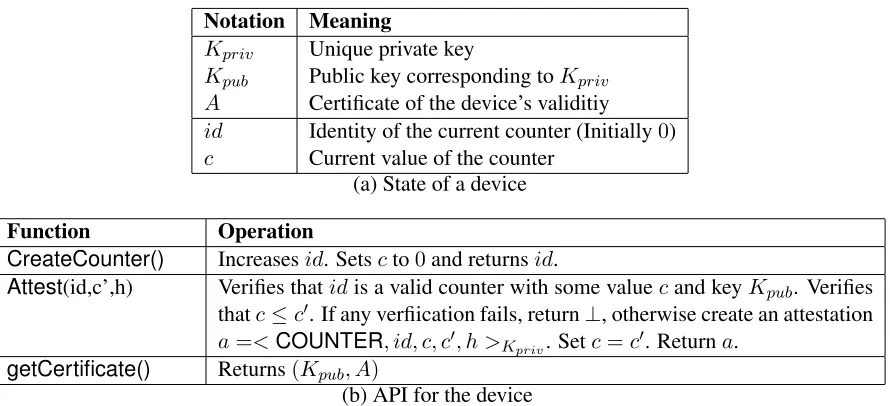
Levin et al. [LDLM09] further simplified the trust assumption from [CMSK07] and showed that a min-imal trusted module calledTrIncconsisting of only a non-decreasing counterc∈Nand a signing key-pair (pk,sk) is sufficient to generate A2M logs and to implement SMR withn ≥ 2t+ 1. Conceptually,TrInc provides a unique, once-in-a-lifetime attestations, and implements non-equivocation using the fact that the counter cannot be decreased, and consequently for every counter valuecthere is at most one message signed by the module.
![Figure 9: Supervised generation of [u] and [w = u · v] for a random u under the supervision of Pking,where v is an existing [·]-shared value, with every party being a privileged party with respect to [v].](https://thumb-us.123doks.com/thumbv2/123dok_us/7898386.1311046/35.612.72.538.275.532/figure-supervised-generation-supervision-existing-shared-privileged-respect.webp)
