Improving Performance of Complex Dynamic Websites
Using ORM, Entity Framework, SQL Server and MVC
Ravindra KumarP
#1
P
, Mohd. Suaib0TP
#2
P0T
, Sheikh Fahad Ahmad0TP
#3
P
#1
P
CSE, Integral University, Lucknow, India E-mail- [email protected]
P
#2
P
Assistant Professor CSE, Integral University, Lucknow, India E-mail- [email protected]
P
#3
P
Assistant Professor CSE, Integral University, Lucknow, India E-mail- [email protected]
#1- Corresponding author
Abstract: Presently, Every day the numbers of internet users
is increasing exponentially and they come across numbers of websites. The user expect high performance website. The numbers of website users increases if it is user friendly and faster. These website are visited on different devices like mobile, tablet or desktop so accordingly it should function to attract users again and again so modern website need to be developed accordingly. In this present work the MVC architecture, entity framework, and ORM has been used to manage the complex dynamic websites. Thus high performance is achieved and development time and cost is reduced.
1T1TKeywords: ORM, MVC, Entity framework, Web
Performance
1. INTRODUCTION
Complex and dynamic web applications need to be designed and developed very tactfully in order to gain high performance and popularity among the users having different bandwidth and devices. The website performance is affected by many factors like User Interface design (UI), database design and network speed. The response time should be higher to deal with complex web applications. The responsive and optimised websites are more revenue generating.
In 2007 Amazon reported that for every 100 MS increase in load time of Amazon.com their sales decreased by 1%. Google also reported similar results in 2006 with their Google Maps product. Google found that by reducing the size of the page from 100KB to 80KB, their traffic shot up by 10% in the first week and then 25% in the following three weeks [12]. 57 % website users will leave a site after waiting 3 seconds for a page load.80% person will never return and half of these spread its negative experience among the people. This propaganda reduces the revenue and
causes great loss to the dynamic websites owners. Mobile first technology is dominant as one fifth population of the world access website on mobile thus device adaptation nature of the website is more important. The web
performance can be estimated as load performance, rendering performance and programming performance. The design pattern of the website matters from different point of view like user interface design, programming, and database design. Many modern website design and development methodologies are used to develop complex websites with heavy databases. Different design patterns for web application design are used like DNA architecture, two tier, three tier and N-tier architecture. MVC design pattern is one of the best architecture to develop modern web applications which is supported by modern web browsers and different devices. The Asp.net MVC uses HTML5, CSS3, JQUERY, Java Script, and Bootstrap, Razor View Engine, Entity framework to develop modern mobile first applications.
2. BACKGROUND
MVC (Model, View and Controller) is a design pattern to develop responsive and modern web applications. It is an open source available in the market. Because of its robustness the scalability and maintainability of the web application becomes easier.
Figure1. MVC Design Pattern
It allows less coupling among the modules and parallel development. .The web page renders in ideal time and reduces HTTP request on server.Asp.net MVC also uses razor view engine. Razor is an ASP.NET programming syntax used to create dynamic web pages with the C# or Visual Basic .NET programming languages. Razor was in development in June 2010 and was released for Microsoft Visual Studio 2010 in January 2011. Razor is a
syntax view engine and was released as part of ASP.NET MVC 3 and the Microsoft WebMatrix tool set [13].
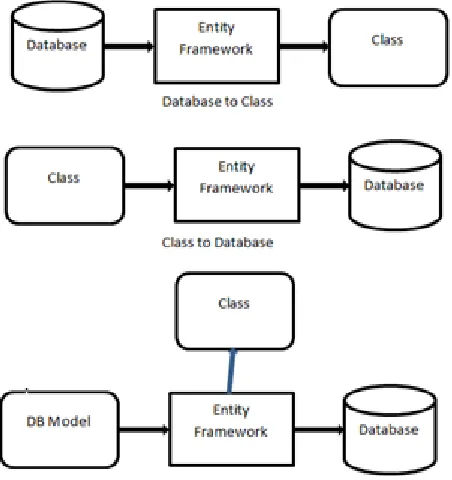
Figure2. MVC Page Life Cycle Using Razor View Engine ORM is a tool used to store data from entity state to relational database like MS SQL Server automatically in easy and maintainable way. ORM has three main parts: Domain class objects, Relational database objects and Mapping information on how domain objects map to relational database objects (tables, views & stored procedures)[1].
Figure 3. Entity Framework
Using ORM database design is kept separate from domain class design. Due to this application becomes extendable,
robust and maintainable and standard CRUD operation (Create, Read, Update & Delete) are maintained automatically. There is need to write manual programmes. ORM is implemented using entity framework.
3. IMPLEMENTATION
The project has been developed in Microsoft visual studio 2013 IDE with ASP.NET MVC using C# on Microsoft Windows7 operating system. IIS7 has been used as a webserver. An object-oriented database management system SQL SERER 2008 is used as a backend. The hardware and software requirements are given in the table 1 below:
Hardware Requirement Min Recommended Used
Processor 400MHZ 2.10GHZ Intel® Core
RAM 256 MB 1GB 256 MB
Software Requirements Operating
System
Windows 7 Application
Software
Microsoft Visual Studio Microsoft .NET Framework4.0 MS SQL SERVER 2008
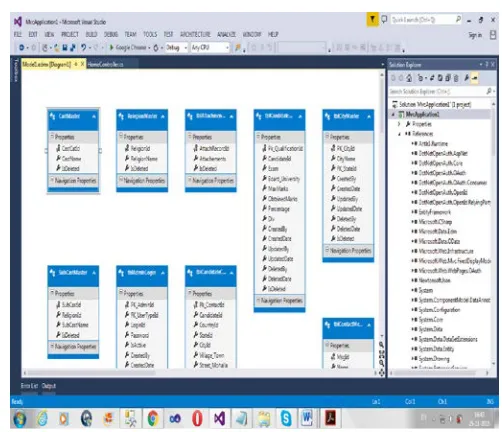
Table 1. Hardware and Software Requirement To start the developments of the project install Microsoft Visual Studio, Microsoft .NET Framework4.0 and MS SQL SERVER 2008.The open Microsoft Visual Studio 2013 as shown in the figure .4 below. Select File Menu then Project the below given window will open. Now, Selecting MVC Project Template as given in figure 5. By right clicking the solution explorer add entity data model as given in the figure 6. It will establish database connection with MS SQL Server 2008 and will fetch all the database objects like tables, views and stored procedures as given in the figure 7. The ORM also generates classes for the corresponding entries and direct mapping helps in avoiding the data type mismatch problem. The key constraint and validation are activated by the HTML helper classes of the Razor View Engine. The Bootstrap CSS, java script and jquery avails to rendering fast to the webpages in the browser hence the web performance increases. The ACID property of the database is automatically handled by entity framework and ORM. The large and complex application is developed rapidly and the robustness, scalability, maintainability and robustness of the application remains good.
Figure 4. Creating MVC Project
Figure 5. Selecting MVC Project Template
Figure 6. Adding Entity Data Model
Figure 7. Populated Entities using ORM
4. WEB PAGE PERFORMANCE TESTING
Test has been conducted using VSTS and telerik load test software, of which specifications is given below:
Sl. Credential Description
1 User Load 30
2 Hardware Configuration HP 4 GB Ram, Core i3,2.10 GHZ
3 Hosting Server IIS8
4 Front End Asp.net MVC5
5 Network Type Lan
Connection(no network slag)
6 Browsers Used Chrome, Internet
Explorer Table 2. Webpage Testing Credentials 4.1. Criteria of Performance Test
The web page performance has been measured in two ways i.e. Average page response time and content rendering time in bytes.
Average Page Load Time: - The average time value is time taken in rendering the page having 30 users accessing web page during the load test.
Response content Length:-On every request total number of average bytes transferred.
4.2 Performance Test Reports
Load test name LoadTest2
Description
Start time 25/11/2015 8:41:57 PM
End time 25/11/2015 8:51:57 PM
Warm-up duration 00:00:00
Duration 00:10:00
Controller Web run
Number of agents 1
Run settings used Run Settings1
Table 3. Test Run Information
Max User Load 25
Tests/Sec 20.4
Tests Failed 0
Avg. Test Time (sec) 0.67
Transactions/Sec 0
Avg. Transaction Time (sec) 0
Pages/Sec 20.4
Avg. Page Time (sec) 0.66
Requests/Sec 20.40
Requests Failed 4
Requests Cached Percentage 0
Avg. Response Time (sec) 0.66
Avg. Content Length (bytes) 57,909
Table 4. Overall Results
URL (Link to More Details) 95% Page Time (sec)
http://50.6.255.131/Admin /Candidates
1.38
Table 5. Key Statistic Top 5 Slowest Pages
Name 95% Test Time (sec)
WebTest2_Avg 1.39
Table 6. Key Statistic: Top 5 Slowest Tests
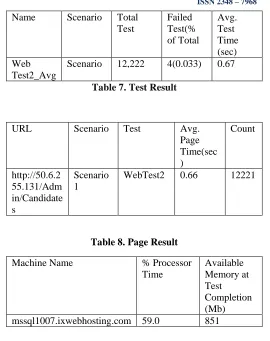
Name Scenario Total Test
Failed Test(% of Total
Avg. Test Time (sec) Web
Test2_Avg
Scenario 12,222 4(0.033) 0.67 Table 7. Test Result
URL Scenario Test Avg.
Page Time(sec )
Count
http://50.6.2 55.131/Adm in/Candidate s
Scenario 1
WebTest2 0.66 12221
Table 8. Page Result
Machine Name % Processor
Time
Available Memory at Test Completion (Mb) mssql1007.ixwebhosting.com 59.0 851
Table 9. Controller and Agents Resources
6. Improved Query Response Time
Thus from the above analysis the query response time is directly proportional to the line of codes which are executed. QRT α LOC (Line of codes) [11]
Figure 8. Web Page Rendering Comparison Chart
7. CONCLUSION
The results of the present work show that higher web performance is achieved using MVC, ORM and entity framework. The development cost reduces because of object relation mapping with the database objects in the MS SQL Server. The ease of the design pattern causes the best rendering of the webpages in different browsers and different devices. So responsive and mobile first web development has become easier and the management of complex dynamic websites becomes faster and more revenue and customer interest.
8. REFERENCES
[1] Dr Terry Halpin ,” UML Data Models from an ORM perspective:Part1”, Journal of Conceptual Modeling, no. 1,1998. 35Twww.inconcept.com35T
[2] R. Elmasri and S. Navathe, “Fundamentals of Database Systems,” 4th Edition, Addison Wesley, New York, 2003. [3] Sabu M. Thampi and Ashwin A.K, “Performance Comparison of Persistence Frameworks,”. http://www.chimu.com
[4] OMG, “When an Object Database Should Be Used,”
http://www.service-architecture.com/articles/object-orienteddatabases/when_an_object_database_should_be_use d.html
[5] Rick Cattell, “Scalable SQL and NoSQL Data Stores,” SIGMOD Record, December 2010 (Vol. 39, No. 4)
[6] RoMiller on CodePlex Project Hosting for Open Source
Software,“What is EF,” 2013.
35T
https://entityframework.codeplex.com/35T
[7] Barry & Associates, Inc on service architecture, “When an Object Database Should Be Used,” 2015.
http://www.service-architecture.com/articles/object-orienteddatabases/when_an_object_database_should_be_use d.html
[8]. Object Oriented Query Response Time for UML Models Journal of Software engineering and Applications Vol. 5 No. 7 (2012), Article ID: 19736,6
esDOI:10.4236/jsea.2012.57059
[9] IBM, IBM Rational Software Modeler Version 7.0.5 Information Center, IBM Corporation, 2005-2007, [E-Book] Available: IBM Support Portal.
[10] A. Holzinger, K. H. Struggl, Appling Model-View-Controller (MVC) in design and development of information
systems, e-Business (ICE-B), Proceedings of the 2010 International Conference, 26-28 July 2010, Pages 1-6. [11] Saxena v. and Kumar S., 2012, Object Oriented Query Response Time for UML Models, Journal of Software Engineering and Applications, Vol. 5, Issue 7, pp. 508-512. [12]Evantotuts+,
Webdesigntutorials,http://webdesign.tutsplus.com/articles/be
st-practices-for-increasing-website-performance--webdesign-9109
[13]ASP.NET Razor view engine, https://en.wikipedia.org/wiki/ASP.NET_Razor_view_engine