461
Detecting Rumor in Social Networks Using SVM and Comparing with
Supervised Techniques
Prashanth Donda
PG Scholar in CSE, CVRCE,
Hyderabad, India,
[email protected]
Dr.R.UshaRani Associate Professor in CSE,CVRCE,
Hyderabad, India, [email protected]
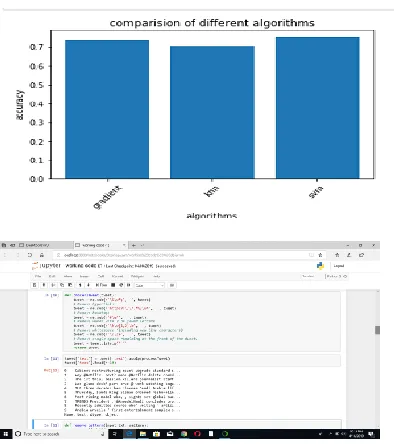
A support vector machine (SVM) is a machine-learning algorithm that analyzes data for classification and regression analysis. SVM is a supervised learning method that looks at data and sorts it into one of the two categories. Using SVM in this project, The main aim is to categorize a message into rumor and non-rumor content which will increase the efficiency for identifying the rumor propagation in the social network. This rumor detection approach is based on the hashtags (#tags) classification and comparing different supervised learning techniques for getting better and accurate detection of rumors. The process of this approach is divided into four parts: Preprocessing, Feature Extraction, Sentiment Analysis and Classification. In this process, feature extraction methods used are Bow and TF-IDF .This methods intension is look at the histogram of the words with in the text .i.e. considering each word count as a feature .There are many classifiers available for detecting rumors. In This Proposed Model KNN (k-nearest), Gradient Boosting and Support Vector Machine achieves a high accuracy of SVM classifier than the other two. So that our proposed method gives the better accuracy for SVM classifier. The accuracy rates are 70.2% for KNN ,74% for Gradient Boosting and 75.3
%for SVM.In this project, the future work will
be
extend as propagation of messages i.e. tracing of rumors and automatic blocking of that rumors. IntroductionA. What is Rumor?
Rumors are the “unverified and untrusted events" which hurts the general population's feelings. We
characterize talk to an unconfirmed explanation that begins from at least one sources and spreads after some time. Talk can finish in three different ways: it very well may be settled as either obvious, false or remain unresolved.
B. How it will affect?
As the information spread on social media so fast and easy by one or more users/sources over time. This diffusion of information can change the scenario towards the real world because of some rumors are affecting to people’s life. Most of people believe that whatever information spread on social media it has to be true rather than to check it on verified news sites or news channel. For example, a millions of peoples believe that President of US Barack Obama was injured during the Boston Marathon. A lot of money and time had spent by US government to recover from this rumor.
C. Introduction about Social Networks
The main motive behind why I had chosen Twitter platform is that, twitter is most popular platform in which common peoples are also share their information and their opinions with each other. All the celebrities, politicians, etc. are very powerful peoples, which are comfortable to share their status and their updates with this social media.
The proposed project is aimed at detecting the rumors in social networks .In our project we are taken twitter as main example in social networks. We are designed based on the content based, user-based and propagation based features into consideration. Here we are taken hash tags based rumor detection using SVM classification technique.
And comparing the accuracy results with other supervised learning algorithms like Gradient Boosting and KNN (K-nearest neighbors)
Literature Survey
In 2010 Mendoza, M., Poblete, B, and Castillo, C.had published a “Twitter under Crisis: Can we Trust what we RT?”
In this article, they analyze the bearing of Twitter users under an alternative. In specific, they examine the movement associated to the 2010 earthquake in Chile and portray Twitter in the hours and days following this disaster. Furthermore, they perform a preliminary study of certain social phenomenon’s, such as the dissemination of false gossipy tidbits and affirmed news. They dissect how this data engendered through the Twitter organize, with the purpose of evaluating the unwavering quality of Twitter as a data source under extraordinary conditions. Their analysis shows that the proliferation of tweets that relate to gossipy tidbits varies from tweets that spread news on the grounds that rumors tend to be addressed more than news by the Twitter people group. This outcome demonstrates that it is possible to detect rumors by using aggregate analysis on tweets.
In 2011, Castillo, C., Mendoza, M., and Poblete, P had published a “Information Credibility on Twitter”
They analyze the data believability of news spread through Twitter, a famous smaller scale blogging service. Previous research has shown that most of the messages posted on Twitter are truthful, but the service is also used to spread misinformation and
false rumors, often unintentionally. On this paper, their attention on programmed techniques for evaluating the credibility of a given arrangement of tweets. In particular, they break down small-scale blog postings identified with "slanting" subjects, and classify them as solid or not dependable, in light of highlights separated from them. They use highlights from clients' posting and re-posting ("re-tweeting") conduct, from the content of the posts, and from references to outer sources. They evaluate our strategies utilizing a critical number of human appraisals about the believability of things on an ongoing example of Twitter postings. Their outcomes demonstrates that there are quantifiable contrasts in the manner messages engender, that can be used to group them naturally as sound or not valid, with accuracy and review in the scope of 70% to 80%. In 2012 Himani Bhavsar, Mahesh H. Panchal circulated "A Review on Support Vector Machine for Data Classification"
Support vector machines are a particular kind of machine learning figuring that are among the transcendent generally pushed off for some quantifiable learning issues, for instance, spam filtering, content course of action, handwriting examination, face and article affirmation, and unending others. Support vector machines have in like manner come into wide strategy in essentially every district of bioinformatics inside the latest ten years, and their locale of impact remains to expand today. The assistance vector machine has been industrialized as healthy gadget for course of action and backslide in tumultuous, complex spaces. The two key features of assistance vector machines are improvement speculation, which prompts a decent strategy to pick a hypothesis; and, part works, which present nonlinearity in the hypothesis space without obviously requiring a non-straight algorithm. Supervised learning is a locale of AI in which we are given some "planning set" of data for which we know from the prior the reasonable courses of action. The geometrical interpretation of assistance vector classification (SVC) is that the estimation filters for the perfect confining surface, for instance the hyperplane that is, in a manner of speaking, equidistant from the two classes.SVC is spread out first for the legitimately unmistakable case. Bit limits are then familiar all together with create non-direct decision surfaces.
463 In this paper, they look at web based life information.
Online networking examination is the planning of get-together information from web journals and web-based social networking sites and exploring that information to settle on business choices. The most widely recognized utilization of internet based life examination is to removal client estimation so as to help promoting and client administration activities. At that point they take twitter huge information to anticipate named element. Thinking about wide utilization of Twitter as the wellspring of data, achieving an animating tweet for a client among a pack of tweets is testing. In this work, it is meant to diminish the Twitter client's push to access to the tweet conveying the data of intrigue. To this point, a tweet suggestion technique under a client intrigue model created through named substances is open. To achieve their objective, Hybrid Segment is created by means of named substances extricated from client's devotees and client's very own posts. What's more, stretch out their way to deal with examine short content in tweets and talk based tweets. Along these lines, they execute KNN way to deal with dispense with talk based tweets with improved precision rates.
SYSTEM ARCHITECTURE AND DESIGN
SYSTEM ARCHITECTURE
For every project, the architecture of the project is more important, it serves as blueprint for the project implementation. In our project, we use social networking data set i.e twitter dataset pre-processing, feature selection, sentiment analysis and classification based on hashtags, which are from content-based features.
Fig:1 rumor detection in social networks using SVM
Our proposed approach is divided into three step: 1) Pre-processing, 2) Sentiment Analysis, and 3) Classification.
In initial step, we are going to preprocess on the ongoing tweets to decide the point about which the given information tweet is posted.
In second step, we are finding of each tweets by using sentiment score.
In final step, we are going to apply this sentiment score as an input to the different classification algorithm. For dataset collection, we are going to collect tweets from twitter using Twitter streaming API or from external websites. We are preprocessing on tweets and going to decide the features for classification.
ALGORITHMS DESIGN
SVM (SUPPORT VECTOR MACHINE)
Support Vector Machine” (SVM) is a supervised machine learning algorithm which can be used for both classification and regression analysis consider a hyperplane just a line in 2-dimensional space but n-dimensional plane it is a hyperplane.
IMPLEMENTATION AND RESULTS
IMPLEMENTATION AND CONFIGURATION
In order to run the project, we have to set up proper environment. However, our project is developed in the Python scripting language since Python is a high-level, interpreted, interactive and object-oriented scripting language. It was created by Guido van Rossum, and released in 1991.
Python has many library functions and packages. Not as much of number of lines of codes that be sure of on the complexity of code with other programming languages, and it is easy to learn and implement. We have an IDE for developing python code i.e. Anaconda for Python. It supports cooperative mode, which allows a user can test and debug the code at any time that saves time.
Fig 2: python folder in C drive
Installing dependencies:
In python, for the installation of dependencies, there is
a handler is offered inside the python. It is pip. With
this, it is very simple to install dependencies. It
automatically verifies existence, compatibility and
installs proper update version. For this purpose, we
have to follow the following steps Step-1: Browse to
C:\Python27\Scripts. Now shift to command prompt
from this location. This can be done by simply typing
“cmd”in the address bar of the present window.Step-2:
Now type pipin the command and then enter. A list of
help commands with description will be appearing.
Fig 3:Configuring the pip installer
Installing Anaconda for python IDE:
IDE stands for Integrated Development Environment. As discussed in the past, Anaconda tool is good environment for programmers because it creates an environment that supports debugging for detecting bugs and improving code, interactive mode which having consoles integrated inside it for showing execution results, and other features in this are file explorer for browsing files, In Anaconda it integrates various environments that are application specific packages for running projects. For example, jupyter supports for scientific applications that having a powerful python IDE. Below is the dashboard or home screen of Anaconda IDE
Fig 4: anaconda IDE for home page
RESULTS
IMPLEMENTATION DETAILS
465 clearly SVM algorithms achieves better accuracy
than other two classifier algorithms.
EVALUATION MEASURES
Here, we use measurements for estimating enactment.one is by using hashtags which are based on content based features. In addition, another one is analysis of the rumor detection performance by using three algorithms such as KNN, SVM and GRADIENTBOOSTING.For content-based features, Ratkiewicz et al. (2010) formed the Truthy system, detecting misleading political memes on Twitter using content-based features, such as hashtags.Qazvinian et al. (2011) applied unigrams, bigrams and pos-tagging results to detect rumors. Our proposed method was based on hashtags using on content-based features. To evaluate the performance of our methods; we use the standard information retrieval metrics of precision, recall F1-score and support. The precision is the ratio of the number of rumors classified corrected to the total number of microblogs predicted as rumors. The recall is the ratio of the number of rumors classified correctly to the total number of true rumors. The F1-score is a comprehensive assessment of precision and recall rate and The support is the number of examples of the true response that lie in that class
Fig 5: remove hyperlink. Hashtags, whitespace
and process the tweet.
Fig 6: SVM accuracy which is obtained as 75.3%
Fig 7: Gradient Boosting accuracy 74%
Fig 8: KNN accuracy 70.2%
Conclusion
Future Work
This rumor problem is seen in almost all major social networks not only on Twitter. Our proposed method extended with some modifications. In this approach, research will be extend as propagation of messages i.e. tracing of rumors and automatic blocking of that rumors.
References
[1]Mendoza, M., Poblete, B., Castillo, C.: Twitter under crisis: Can we trust what we rt? In: Proceedings of the First Workshop on Social Media Analytics (2010).
[2]Qazvinian, V., Rosengren, E., Radev, D.R., Mei, Q.: Rumor has it: Identifying misinformation in microblogs. In: Proceedings of the Conference on Empirical Methods in Natural Language Processing, pp. 1589–1599. Association for Computational Linguistics (2011).
[3] Ratkiewicz, J., Conover, M.D., Meiss, M., Goncalves, B., Flammini, A., Menczer, F.M.: Detecting and tracking political abuse in social media. In: Proceedings ofIcwsm (2011
)
[4]Himani Bhavsar, Mahesh H.Panchal,: A Review on Support Vector Machine for Data Classification International Journal of Advanced Research in Computer Engineering & Technology (IJARCET)Volume 1, Issue 10, December 2012
[5]Kwon, S., Cha, M., Jung, K., Chen, W., Wang, Y.: Prominent features of rumor propagation in online social media. In: 2013 IEEE 13th International Conference on Data Mining (ICDM), pp. 1103–1108 (2013)
[6]Soroush Vosoughi, PhD Thesis, “Automatic Detection and Verification of Rumors on Twitter”, June 2015
[7]Sahana V P, Alwyn R Pias, Richa Shastri, and Shweta Mandloi. “Automatic detection of Rumored Tweets and finding its Origin”, Intl. Conference on Computing and Network Communications (CoCoNet'15), pp. 607-612, IEEE 2015.
[8]Sardar Hamidian and Mona Diab. “Rumor Detection and Classification for Twitter Data”, The Fifth International Conference on Social Media
Technologies, Communication, and Informatics, pp. 71-77, SOTICS 2015
[9]Suchita Jain, Vanya Sharma and Rishabh Kaushal. “Towards Automated Real-Time Detection of Misinformation on Twitter”, Intl. Conference on Advances in Computing, Communications and Informatics (ICACCI), pp. 2025-2020, IEEE 2016.
[10]iwei Jin, Juan Cao, Han Guo, Yongdong Zhang, Yu Wang, and Jiebo Luo. “Detection and Analysis of 2016 US Presidential Election Related Rumors on Twitter”, Springer International Publishing AG 2017, pp. 230–239, Springer 2017.
[11]Qiao Zhang, Shuiyuan Zhang, Jian Dong, Jinhua Xiong, and Xueqi Cheng. “Automatic Detection of Rumor on Social Network”, Springer International Publishing Switzerland 2015, pp. 14-24, Springer 2017.
[12]Yan Zhang, Weiling Chen, Chai Kiat Yeo, Chiew Tong Lau, Bu Sung Lee, “Detecting Rumors on Online Social NetworksUsing Multi-layer Autoencoder”, IEEE Technology & Engineering Management Conference (TEMSCON), pp. 1-5, IEEE 2017 .
Prashanth Donda is pursuing his Masters of Technology in CVR College of Engineering Hyderabad, India in Computer Science and Engineering specialization. He will complete his PG in 2019.
Dr.R.UshaRani is working