Scholarship@Western
Scholarship@Western
Electronic Thesis and Dissertation Repository
9-14-2018 3:00 PM
Electrocatalysts with high activity and stability for polymer
Electrocatalysts with high activity and stability for polymer
electrolyte membrane fuel cells
electrolyte membrane fuel cells
Zhongxin Song
The University of Western Ontario
Supervisor Sun, Xueliang
The University of Western Ontario
Graduate Program in Mechanical and Materials Engineering
A thesis submitted in partial fulfillment of the requirements for the degree in Doctor of Philosophy
© Zhongxin Song 2018
Follow this and additional works at: https://ir.lib.uwo.ca/etd
Part of the Catalysis and Reaction Engineering Commons, and the Nanoscience and Nanotechnology Commons
Recommended Citation Recommended Citation
Song, Zhongxin, "Electrocatalysts with high activity and stability for polymer electrolyte membrane fuel cells" (2018). Electronic Thesis and Dissertation Repository. 5700.
https://ir.lib.uwo.ca/etd/5700
This Dissertation/Thesis is brought to you for free and open access by Scholarship@Western. It has been accepted for inclusion in Electronic Thesis and Dissertation Repository by an authorized administrator of
i
In addressing the activity and durability challenges facing electrocatalysts in polymer electrolyte membrane fuel cells (PEMFCs), atomic layer deposition (ALD) is emerging as a powerful technique for deposition of noble metals and transition metal oxides due to its exclusive advantages over other methods. The primary advantages of ALD are derived from the sequential, self-saturating, gas-surface reactions, and angstrom level control that take place during the deposition process. Therefore, ALD possesses the advantage in precisely control the particle size and uniform distribution on the substrate. By forming chemical bonds between the initial layer of ALD precursor and support atoms during the first cycle of deposition, the strong interaction between the deposited material and support could be enabled, which is benefit for achieving the highly stable NPs.
In this thesis, an area-selective ALD of tantalum oxide (TaOx) on Pt/C catalyst to fabricate TaOx-anchored Pt NPs with triple-junction structure of Pt–TaOx–C was investigated in the first part of research work. By introducing a protective agent (oleylamine) to the Pt surface, TaOx NPs were selectively nucleated and grown around Pt NPs, thus forming the TaOx anchored-Pt NPs on the carbon surface. The electrochemical durability tests indicated that the 35ALD–TaOx–Pt/C catalyst exhibited superior durability compared to Pt/C. The enhanced stability of the 35ALD–TaOx–Pt/C catalyst is attributed to the anchoring effect of TaOx via the strong triple-junction of TaOx–Pt–C, which plays a significant role in stabilizing the Pt catalyst by preventing Pt NPs from migration/coalescence and detachment from the carbon support. Afterwards, to both improve the Pt/C catalyst activity and durability, a nitrogen-doped Ta2O5 was developed by ALD approach. It was found that the
as-prepared Pt/N-ALDTa2O5/C catalyst showed enhanced catalytic activity and
significantly improved electrochemical durability toward oxygen reduction reaction (ORR). X-ray absorption spectroscopy provided direct evidence of change of the electronic structure of Pt NPs on N-ALDTa2O5/C support compared to other supports,
ii
modified N-ALDTa2O5/C support. It was revealed that by tuning the metal support
interface, the highly active and stable Pt catalyst could be enabled.
To achieve the extremely low Pt loading while maintaining the high catalytic activity and long-life stability, ALD technique was applied to deposit Pt NPs into the PEMFCs anode layer. By controlling the ALD cycle number, the Pt NPs with different size and loading amount were directly deposited on the carbon coating layers to form the anode catalyst layers. The PEMFCs composed with ALD catalyst showed much better performance and durability than that prepared by the commercial catalyst with a conventional method. The electron microscopy reveals that the application of ALD for Pt deposition directly on the electrode carbon layers could effectively reduce the Pt loading while enhance the Pt dispersion, utilization, and Pt-support interaction, which achieve the high PEMFCs performance and excellent durability under the ultra-low Pt loading. Furthermore, downsizing Pt NPs size to subnano-clusters or even single atoms is highly desirable to maximize Pt atom utilization efficiency. Here we report on a practical synthesis method to produce isolated Pt single atoms and subnano-clusters using ALD technique. The Pt single atoms/subnano-clusters catalysts supported on metal-organic framework-derived nanocarbon support are investigated for the ORR, where they exhibit significantly enhanced catalytic activity and superior stability in comparison with the Pt NPs catalysts. The X-ray absorption indicates that the partially unsaturated coordination environment of Pt single atoms/subnano-clusters on nanocarbon support is responsible for the excellent performance.
iii
adopted in this work offer a strategic consideration for designing the high performance nanocarbon electrocatalyst.
Keywords
iv
Co-Authorship Statement
1.
Title: Metal organic frameworks for energy storage and conversion
Authors: Yang Zhao1, Zhongxin Song1, Xia Li, Qian Sun, Niancai Cheng, Stephen Lawes,
Xueliang Sun
The final version of this manuscript was published as a review paper in Energy Storage
Materials 2016, 2, 35-62. This review paper was organized and written by Yang Zhao,
Zhongxin Song under the guidance of Dr. Xueliang Sun. Co-authors contributed to designing, writing, and modifying the manuscript.
2.
Title: Recent progress on MOF-derived nanomaterials as advanced electrocatalysts in fuel
cells
Authors: Zhongxin Song, Niancai Cheng, Andrew Lushington and Xueliang Sun
The final version of this manuscript was published as a review paper in Catalysts 2016, 6 (8), 116. The manuscript was organized and written by Zhongxin Song under the guidance of Dr. Xueliang Sun. Coauthors contributed to reviewing, modifying and polishing the manuscript.
3.
Title: MOF-derived materials for extremely efficient electrocatalysis
Authors: Zhongxin Song, Lei Zhang, Matthew Zheng, Xueliang Sun
The final version of this manuscript was submitted as a chapter to the book of Layered
Materials for Energy Conversion and Storage. The manuscript was organized and written
v
4.
Title: Atomic layer deposited tantalum oxide to anchor Pt/C for a highly stable catalyst in
PEMFCs
Authors: Zhongxin Song, Biqiong Wang, Niancai Cheng, Lijun Yang, Dustin Banham,
Ruying Li, Siyu Ye, and Xueliang Sun
The final version of this manuscript was published in Journal of Materials Chemistry A, 2017, 5, 9760-9767. The experimental and theoretical work was carried out by Zhongxin Song under the supervision of Dr. Xueliang Sun. The manuscript was organized and written by Zhongxin Song under the guidance of Dr. Xueliang Sun. Biqiong Wang conducted the ALD experiment. Niancai Cheng, Lijun Yang, Dustin Banham and Siyu Ye help analysis results, provide valuable suggestions and revise the manuscript. Ruying Li provided access to the equipment and samples shipping to Ballard company.
5.
Title: Origin of the high oxygen reduction reaction of nitrogen and sulfur co-doped
MOF-derived nanocarbon electrocatalysts
Authors: Zhongxin Song, Weiwei Liu, Niancai Cheng, Mohammad Norouzi Banis, Xia Li,
Qian Sun, Biwei Xiao, Yulong Liu, Andrew Lushington, Ruying Li, Limin Liu and Xueliang Sun
vi
6.
Title: Origin of achieving the enhanced activity and stability of Pt electrocatalysts with
strong metal-support interactions via atomic layer deposition
Authors: Zhongxin Song#, Mohammad Norouzi Banis#, Lei Zhang, Biqiong Wang, Lijun
Yang, Dustin Banham, Yang Zhao, Jianneng Liang, Matthew Zheng, Ruying Li, Siyu Ye*, Xueliang Sun*
The final version of this manuscript is published by Nano Energy, 2018. The experimental and theoretical work was carried out by Zhongxin Song under the supervision of Dr. Xueliang Sun. The manuscript was organized and written by Zhongxin Song under the guidance of Dr. Xueliang Sun. Dr. Mohammad N. Banis conducted the synchrotron radiation and data analysis. Dr. Biqiong Wang carried out the ALD experiment. Yang Zhao conducted the ICP analysis to determine the Pt content. Lei Zhang, Jianneng Liang, Lijun Yang, Dustin Banham, Siyu Ye, Matthew Zheng provided comments, suggestions and discussion for this project designing, and contributed to the manuscript revision. Ruying Li provided access to the equipment.
7.
Title: Ultra-low loading and high-performing Pt catalyst for PEMFC anode achieved by
atomic layer deposition
Authors: Zhongxin Song, Mohammad Norouzi Banis, Hanshuo Liu, Lei Zhang, Yang Zhao,
Junjie Li, Kieran Doyle Davis, Ruying Li, Siyu Ye, Shanna Knights, Gianluigi A. Botton, Ping He, and Xueliang Sun
vii
characterization under the supervision from Dr. Gianluigi A. Botton. Lei Zhang Junjie Li and Kieran D. Davis provided comments, suggestions and discussion for this project designing, and contributed to the manuscript revision. Ruying Li provided access to the equipment.
8.
Title: Platinum single-atom and subnano-cluster on MOF-carbon as superior oxygen
reduction reaction catalysts
Authors: Zhongxin Song, Hanshuo Liu, Mohammad Norouzi Banis, Lei Zhang, Junjie Li,
Ruying Li, Gianluigi A. Botton, Xueliang Sun
viii
Acknowledgments
This Ph.D work was accomplished in Professor Andy Xueliang Sun’s Advanced Materials for Clean Energy Group at the University of Western Ontario in London, Canada. Herein, it is my tremendous pleasure to express my acknowledgements to everyone who contributed to my research work throughout the past four years.
I would like to express my sincere gratitude to my supervisor Dr. Xueliang (Andy) Sun, an excellent professor at the Department of Mechanical & Materials Engineering of University of Western Ontario, Canada Research Chair, Fellow of the Canadian Academy of Engineering and the Royal Society of Canada, for giving me with this great opportunity and for his full support throughout my Ph.D project. He always provides guidance and encouragement during my thesis project and is an invaluable resource for anything related to nanomaterials and energy storage and conversion. Dr. Sun’s dedication to the research work, his intelligence, diligence, brilliance, patience and kindness greatly inspired me and steered me towards highly successful research. He is the best advisor and one of the smartest people I know. I hope that someday I could be as lively, enthusiastic, and energetic as Dr. Sun.
I am also grateful forever to Mrs. Ruying (Kathy) Li, Prof. Sun’s wife and lab manager in our group, for her kind help and strong support not only in my work, but also in my life. She has always been interested in the well-being of all our group members and her kindness is unending. Her hard work to keep the lab running smoothly has played a large role in the success of this group and she has always been willing to help whenever I needed it. Thanks Kathy for being a mother-figure for us all.
ix
have taught me more than any textbook or course ever could. Many of my research would be impossible without suggestions and comments from Lei, Mohammad and Niancai.
I would like to extend my appreciation to Dr. Siyu Ye, Dr. Ping He, Dr. Dustin Banham and Dr. Lijun Yang from Ballard Power Systems Inc. Dr. Ye and Dr. He provided me with the opportunities to carry out internships in Ballard during the summer of 2016 and 2017. They mentored me directly and taught me the electrochemical and fuel cell testing techniques which were instrumental to my work at Western. The experience in Ballard help me gain knowledge of the connections between academic to industry. There is no doubt this industry experience will greatly benefit for my future career. Sincerely thanks to Prof. Gianluigi Botton and Dr. Hanshuo Liu from McMaster University for their help in TEM characterizations and discussions. I would also like to acknowledge Dr. Limin Liu and Dr. Weiwei Liu from Beijing Computational Science Research Center, for their kind help on the principle calculations and result analysis.
I am also grateful to my advisory committee members, Dr. Aaron David Price and Dr. Takashi Kuboki, professors in Engineering Department at UWO, for their advices, support, and concern in every step of my Ph. D project. I would also like to thank the examiners of my thesis defense, Dr. Zhifeng Ding, a professor in the Department of Chemistry at UWO, Dr. Jun Yang and Dr. Hamid Abdolvand, professors in the Department of Mechanical and Materials Engineering at UWO and Dr. Brad Easton, a Professor from the University of Ontario Institute of Technology, for their careful examination on my thesis and valuable consideration and suggestions.
x
Jianneng Liang for XRD testing and data analysis. I also would like to extend my appreciation to my colleagues, Miss Xiaoting Lin, Mr. Yang Zhao, Dr. Changtai Zhao, Mr. Changhong Wang, Dr. Dawei Wang, Mr. Junjie Li, Mr. Fanpeng Kong, Dr. Li Hou, Dr. Jianwen Liang, Dr. Xiaona Li, Dr. Muhammad Iqbal, Dr. Sixu Deng, Dr. Xiaofei Yang, Miss Fei Sun, Mr. Jiwei Wang, Mr. Heng Xiang, Mr. Feipeng Zhao, Miss Xuejie Gao, Miss Jing Luo, Mr. Yipeng Sun, Mr. Keegan Adair, Miss Alicia Koo, Mr. Ali Feizabadi, Mr. Yao Yao, Mr. Sizhe Wang, for your support and always being side of me during my Ph. D. time. I would also thank all other former members, Mr. Qizheng Li, Dr. Yuhai Hu, Dr. Xiaohui Zhang, Dr. Yujing Bi, Dr. Hong Guo, Dr. Xiaoyuan Zeng, Dr. Xianqing Liang, Dr. Jianshe Wang, Dr. Yisi Liu, Dr. Hossein Yadegari, Mr. Adam Riese, Mr. Stephen Lawes, Mr. Craig Langford, Dr. Karthikeyan Kaliyappan, Mr. Ali Fathalla Abdulla. It was a tremendous honor to work with such a dynamic and professional group, you all have made my life and research enjoyable and pleasant.
Thanks to the funding support from the Natural Science and Engineering Research Council of Canada (NSERC), the Canada Research Chair Program (CRC), the Canada Foundation for Innovation (CFI), Canadian Light Source (CLS) at the University of Saskatchewan, University of Western Ontario (UWO) and China Scholarship Council (CSC). Without them my Ph.D project would not have been possible to be finished.
Last but not least, I would like to express my gratitude to my parents and my sisters. Mr. Qingguo Song and Mrs. Fengzhi Han, they are the best parents in the world. Always all the time, they gave me their unconditional and unending love to support me and my research work. I should sincerely thank them for their good way of bringing me up and fully appreciate their love, commitment, and hard work. I would express my deep thanks to my sisters. They always share their experiences and feelings with me, which encourage me to be brave and strong when facing the challenges in my own life. Thanks all the understanding, encouragement, supports and everybody in my life!
Zhongxin Song
xi
Table of Contents
Abstract ... i
Co-Authorship Statement... iv
Acknowledgments... viii
Table of Contents ... xi
List of Tables ... xvii
List of Figures ... xviii
List of Appendices ... xxvi
Chapter 1 ... 1
1 Introduction ... 1
1.1 Fundamentals of PEMFCs ... 1
1.2 Challenges of PEMFCs... 4
1.3 Solutions by designing highly stable and active electrocatalysts through ALD technique ...5
1.3.1 Atomic layer deposition (ALD) ... 5
1.3.2 Highly stable electrocatalysts: with strong metal-support interactions ... 6
1.3.3 Highly active electrocatalysts: from nanoparticles to single atom ... 7
1.4 Thesis objectives ... 8
1.5 Thesis organization ... 9
References ... 11
Chapter 2 ... 14
2 Literature review ... 14
xii
2.2 Progress of highly stable electrocatalysts for PEMFCs ... 17
2.2.1 Novel stable catalyst support ... 17
2.2.2 Novel structure of Pt nanoparticles ... 21
2.2.3 Pt NPs encapsulation or confinement ... 24
2.3 Progress of highly active single atom catalysts ... 26
2.3.1 Preparation and characterization of single atom catalysts ... 27
2.3.2 Electrocatalytic performance of single-atom catalysts ... 34
2.3.3 Perspectives of Pt single atoms catalyst ... 38
2.4 MOFs-derived nanomaterials for electrocatalysis ... 39
2.4.1 Introduction of MOFs ... 39
2.4.2 MOFs-derived electrocatalysts for ORR ... 40
2.4.3 MOFs-derived electrocatalysts for HER ... 48
2.4.4 MOFs-derived electrocatalysts for OER ... 52
2.5 Summary and perspectives ... 56
References ... 57
Chapter 3 ... 66
3 Experiment and Characterizations ... 66
3.1 Experiment ... 66
3.1.1 Atomic layer deposition of tantalum oxide on carbon support... 66
3.1.2 Nitrogen-doping of tantalum oxide prepared by ALD ... 67
xiii
3.1.4 Synthesis of MOFs-derived nanocarbon ... 68
3.2 Characterizations ... 69
3.2.1 Physical characterizations ... 70
3.2.2 Electrochemical characterizations ... 73
3.2.3 Membrane electrode assembly fabrication and single fuel cell test ... 74
References ... 75
Chapter 4 ... 76
4 Atomic layer deposited tantalum oxide to anchor Pt/C for a highly stable catalyst in PEMFCs ... 76
4.1 Introduction ... 76
4.2 Experimental ... 78
4.2.1 Area-selective ALD of TaOxon the Pt/C catalyst ... 78
4.2.2 Physical characterization ... 79
4.2.3 Electrochemical characterization ... 79
4.2.4 Membrane electrode assembly (MEA) fabrication and single fuel cell testing .. 80
4.3 Results and discussion ... 81
4.4 Conclusions... 92
Acknowledgment ... 92
References ... 93
Supporting information ... 98
Chapter 5 ... 101
xiv
5.1 Introduction ... 101
5.2 Experiment ... 104
5.2.1 Surface modification of carbon black with tantalum oxide via ALD ... 104
5.2.2 Pt deposition on modified carbon support ... 105
5.2.3 Physical characterization ... 105
5.2.4 X-ray absorption spectroscopy ... 105
5.2.5 Electrochemical characterization ... 106
5.3 Results and discussion ... 107
5.3.1 Nanocomposite electrocatalysts preparation and characterization ... 107
5.3.2 Electrocatalytic activity and durability ... 112
5.3.3 X-ray absorption spectroscopy studies ... 114
5.4 Conclusion ... 117
Acknowledgment ... 118
Reference ... 118
Supporting information ... 123
Chapter 6 ... 124
6 Ultra-low loading and high-performing Pt catalyst for PEMFC anode achieved by atomic layer deposition ... 124
6.1 Introduction ... 125
6.2 Experiment ... 127
6.3 Result and discussion ... 129
xv
Acknowledgment ... 141
Reference ... 141
Supporting information ... 144
Chapter 7 ... 147
7 Platinum single-atom and subnano-cluster on MOFs-carbon as superior oxygen reduction reaction catalysts ... 147
7.1 Introduction ... 147
7.2 Experiment ... 149
7.2.1 Synthesis of MOFs-derived nanocarbon ... 149
7.2.2 ALD process and loading analysis for Pt deposition on ZIF-C ... 150
7.2.3 Physical characterization ... 150
7.2.4 X-ray Absorption Spectroscopy ... 150
7.2.5 Electrochemical characterization ... 151
7.3 Result and discussion ... 152
7.4 Conclusion ... 159
Acknowledgment ... 160
References ... 160
Supporting information ... 164
Chapter 8 ... 166
8 Origin of the high oxygen reduction reaction of nitrogen and sulfur co-doped MOFs-derived nanocarbon electrocatalysts ... 166
8.1 Introduction ... 166
8.2 Experimental ... 168
xvi
8.2.2 Physical characterization ... 169
8.2.3 Electrochemical measurements ... 169
8.3 Results and discussion ... 171
8.4 Conclusions... 181
Acknowledgment ... 182
References ... 182
Supporting information ... 186
Chapter 9 ... 190
9 Conclusion and future perspectives ... 190
9.1 Conclusion ... 190
9.2 Perspectives ... 193
Appendices ... 196
xvii
List of Tables
Table 5-1. Pt L3-edge and Pt L2-edge threshold and whiteline parameters of different catalysts. ... 116
xviii
List of Figures
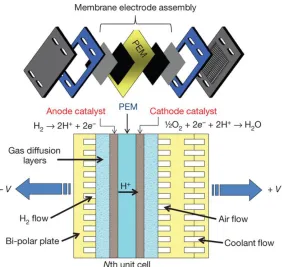
Figure 1.1. Schematic of the working principle of a typical PEMFC and the involved porous components: bipolar plate; gas diffusion layer (GDL); electrocatalyst layer and membrane. . 3
Figure 2.1. Schematic illustration of nanoparticle size effect for activity and durability. [2] Wiley-VCH Verlag GmbH & Co. KGaA. Copyright 2018. ... 15
Figure 2.2 Schematic illustration of the suggested degradation mechanisms for Pt NPs on a carbon support in fuel cells. [3-6] Reproduced with permission from Nanotechnology. Copyright 2014. ... 16
Figure 2.3. (a) Schematic illustration of the preparation of CNTs/PBIs/Pt, and TEM images of CNTs/PBIs/Pt. [20] (b) The schematic illustration of high stable catalyst of Pt/ZrO2/NGNs, and the structure, electrochemical performance of Pt/ZrO2/NGNs. [21]
Wiley-VCH Verlag GmbH & Co. KGaA. Copyright 2013. ... 19
Figure 2.4. Normalized XANES spectra of Pt NPs on composite catalyst support at (a) the Pt L3 edge and (b) the Pt L2 edge. (c) Schematic illustration of ALD-Pt growth on ZrC support.
Loss of electrochemical surface area (ECSA) (d) and mass activity (e) for ALD-Pt/Zr before and after ADT. Reproduced from [22] with permission from the Royal Society of Chemistry. ... 21
Figure 2.5. Shape control of nanoparticles for durable and active electrocatalysts. Durability results and TEM analysis: (a) Pt3Ni nanoframe structure. [23] Reprinted by permission from
Science. Copyright 2014 (b) Hollow structure of Pt nanocage. [29] Reprinted by permission from Science. Copyright 2015 (c) 1D Pt nanowire. [30] Reprinted by permission from Science. Copyright 2016 ... 23
xix
Figure 2.7. HAADF-STEM images and EXAFS spectra of Pt1/FeOx (a), Pt1/MoS2 (b),
Pt1/TiN (c), Pt1/C (d) to confirm the existence of isolated Pt atoms... 28
Figure 2.8. Schematic illustration showing the synthesis of Pt single atom on Al-TCPP for photocatalytic hydrogen production. [37] Wiley-VCH Verlag GmbH & Co. KGaA. Copyright 2018. ... 30
Figure 2.9. Illustration of Pt NPs sintering, showing how ceria can trap the mobile Pt to suppress sintering. Cubes appear to be less effective than rods or polyhedral ceria. [39] Reprinted by permission from Science. Copyright 2016 ... 32
Figure 2.10. Schematic illustrations of Pt ALD mechanism on graphene nanosheets (a). HADF-STEM images Pt configurations on N-doped and pristine graphene (b). [42] Reprinted by permission from Macmillan Publishers Limited, Nature Communications. Copyright 2016. ... 33
Figure 2.11. (a) HAADF-STEM image of Pt1/TiN, electrochemical ORR polarization curves
and H2O2 selectivity curves obtained for the Pt/TiN with various Pt loading. [43] Wiley-VCH
Verlag GmbH & Co. KGaA. Copyright 2016. (b) HAADF-STEM image proposed atomistic structure and ORR activities of the Pt1/sulfur-doped carbon catalyst. [62] Reprinted by
permission from Macmillan Publishers Limited, Nature Communications. Copyright 2016. 35
Figure 2.12. Physical characterization of HAADF-STEM images (a) and the k2-weighted
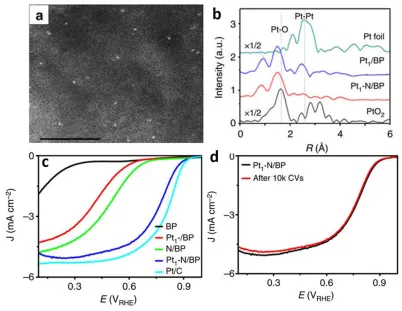
R-space FT spectra from EXAFS (b) for Pt1/N-carbon. electrochemical ORR activity (c) and
durability (d) of Pt1/N-carbon. [48] Reprinted by permission from Macmillan Publishers
Limited, Nature Communications. Copyright 2017. ... 36
Figure 2.13. (a) HAADF-STEM images of Pt1/MoS2 showing the Pt atoms occupying the
positions of Mo atoms. HER activity and durability measurement of Pt1/MoS2 and
counterparts catalysts. (b) HER activity, durability curves and HAADF-STEM image of Pt1/N-doped graphene prepared by ALD. [42] Reprinted by permission from Macmillan
Publishers Limited, Nature Communications. Copyright 2016 ... 38
Figure 2.14. (a) Schematic illustration of preparation of Co9S8@NS-C; TEM images of
Wiley-xx
VCH Verlag GmbH & Co. KGaA. Copyright 2016. (b) Schematic representation for the preparation of the GPC catalyst; TEM images of GPC; ORR curves of Fe/N-GPC. [82] American Chemical Society. Copyright 2017. ... 42
Figure 2.15. (a) Illustration of bi-metal-MOFs self-adjusted synthesis of Co/N/C; SEM and TEM images of Co/N/C derived from bi-metal-MOFs; electrocatalytic ORR performance of Co/N/C and Pt/C in different PH media. [83] American Chemical Society. Copyright 2015 (b) Illustration of the formation of Co SAs/NC; TEM and HAADF-STEM images of Co SAs/NC; ORR polarization curves of Co SAs/NC and comparative catalysts in O2-staurated
0.1 M KOH. [84] Wiley-VCH Verlag GmbH & Co. KGaA. Copyright 2016 (c) Schematic illustration of the formation of Fe3C@NCNT assembly; SEM, TEM images of
Fe3C@NCNT; ORR activity and durability of Fe3C@NCNT electrocatalyst. Reproduced
from [85] Royal Society of Chemistry... 44
Figure 2.16. (a) Schematic of the formation process of CoOx/NG-A; STEM image of CoOx/NG-A and EDS profile of Co3O4 NP; ORR activity and durability of CoOx/NG-A in
0.1 M KOH. [86] American Chemical Society. Copyright 2017. (b) SEM, TEM images and elemental mapping of MSZIF-900; electrochemical performance of the MSZIF-900 catalyst for ORR, HER, OER. [87] Wiley-VCH Verlag GmbH & Co. KGaA. Copyright 2015. ... 47
Figure 2.17. (a) Schematic illustration for the fabrication of CoP@BCN nanotubes; TEM image of CoP@BCN nanotubes; HER activity and stability of CoP@BCN nanotubes in 0.5 M H2SO4 solution. [88] Wiley-VCH Verlag GmbH & Co. KGaA. Copyright 2017. (b)
Schematic illustration of the synthesis of CoP@NC; HER activity and stability of CoP@NC in 0.5 M H2SO4 solution. [89] American Chemical Society. Copyright 2017. ... 50
Figure 2.18. (a) Schematic for the synthesis for porous MoCx nano-octahedrons; Polarization HER curves before and after continuous potential sweeps in 0.5 M H2SO4 and 1.0M KOH.
[90] Nature Communications. Copyright 2015 (b) Schematic illustration for the preparation of the MoO2@PC-rGO nanocomposite; HER polarization curves of MoO2@PC-RGO and
xxi
Figure 2.19. (a) SEM and TEM images for structural characterization of NCNTFs; Electrochemical activity and stability of NCNTFs and Pt/C catalysts for OER. [92] Nature Energy. Copyright 2016. (b) Schematic illustration for fabrication of hybrid Co3O4-carbon
porous nanowire arrays; SEM image and electrochemical OER activity, stability of Co3O4
-carbon. [93] American Chemical Society. Copyright 2014. ... 53
Figure 2.20. TEM and elemental mapping images of NiCo-MOFs; OER electrochemical activity of NiCo-MOFs electrocatalysts. [96] Reprinted by permission from Macmillan Publishers Limited. Nature Energy. Copyright 2016... 55
Figure 3.1. Savannah 100 ALD system (Cambridge Nanotech, USA) ... 67
Figure 3.2. Schematic illustration of ALD Pt on carbon black film electrode. ... 68
Figure 3.3. Schematic illustration of the fabrication of the MOFs-derived N, S-co-doped nanocarbon. ... 69
Figure 3.4. Field emission scanning electron microscope (Hitachi S-4800). ... 70
Figure 3.5. FEI Titan Cubed 80-300 kV high resolution transmission electron microscope. 71
Figure 3.6. A Krato AXIS Ultra Spectrometer XPS. ... 71
Figure 3.7. (a) Bruker D8 Advance Diffractometer XRD. (b) HORIBA Scientific LabRAM research Raman spectroscopy. ... 72
Figure 3.8. Micromeritics TriStar II 3020 Surface Area and Pore Size Analyzer ... 72
Figure 3.9. (a) three-electrode electrochemical cell. (b) Autolab potentiostat equipped with rotating controller... 74
Figure 4.1. Schematic illustrations of TaOx-anchored Pt NPs via area-selective atomic layer deposition (ALD). ... 82
xxii
Figure 4.3. (a) XPS spectra of survey scan and (b) Ta 4f XPS spectra obtained for 35ALD– TaOx–Pt/C. ... 84
Figure 4.4. Intermediate characterization CV curves of (a) 35ALD–TaOx–Pt/C and (b) Pt/C catalysts during the load-cycling (0.6 V–1.0 V) durability tests in a N2-saturated 0.1 MHClO4
solution at a scan rate of 50 mV·s-1. (c) ECSA variation with cycling number for different catalysts cycled from 0.6 to 1.0 V. ORR curves for (d) 35ALD-TaOx-Pt/C and (e) Pt/C before and after ADT-10000. (f) Mass activity of different catalysts at 0.9 V before and after ADT-10000. ... 86
Figure 4.5. Intermediate characterization CV curves of (a) 35ALD–TaOx–Pt/C and (b) Pt/C catalyst during the start-up/shut-down (1.0 V–1.6 V) durability tests in a N2-saturated 0.1 M
HClO4 solution at a scan rate of 100 mV·s-1. (c) Variation of ECSA with cycling number for
different catalysts cycled from 1.0 to 1.6 V. ORR curved for (d) 35ALD-TaOx-Pt/C and (e) Pt/C catalyst before and after cycling between 1.0 to 1.6V. (f) mass activity of catalysts at 0.9 V (vs. RHE) before and after ADT-6000... 87
Figure 4.6. H2–air fuel cell polarization curves for MEA using 35ALD–TaOx–Pt/C as the
cathode after different aging cycles with the Pt loading on the anode and cathode of 0.1 and 0.15 mg·cm-2, respectively. ... 89
Figure 4.7. Schematic of the stability mechanism of the 35ALD–TaOx– Pt/C catalyst with triple junctions of TaOx–Pt–C. (a) TaOx alleviating Pt NPs migration and coalescence; (b) TaOx inhibiting the detachment and coalescence of Pt NPs. ... 91
Figure 5.1. Schematic illustration for fabrication of nanocomposite electrocatalyst of Pt/N-ALDTa2O5/C with strong metal-support interactions. ... 108
Figure 5.2. HRTEM and STEM images of ALDTa2O5/C (a-b), N-ALDTa2O5/C (c-d), and
Pt/N-ALDTa2O5/C (f-g); EELS map of the C (green), N (yellow), O (red) elements for the
N-ALDTa2O5/C (e); STEM-EDS line scan and spectra of Pt/N-ALDTa2O5/C (h). ... 110
Figure 5.3. X-ray photoelectron spectra for N-ALDTa2O5/C. a) survey spectrum, b) Ta 4f5/2
xxiii
Figure 5.4. The polarization curves of (a) Pt/N-ALDTa2O5/C, (b) Pt/ALDTa2O5/C, and (c)
Pt/C before and after 10,000 cycles of accelerate durability (ADT) test in O2-saturated 0.1M
HClO4, 1600 rpm, scan rate of 10 mV·s-1. (d) mass activity of different catalysts at 0.9 V (vs.
RHE) before and after ADT-10000 (BOL stands for beginning of life). ... 114
Figure 5.5. X-ray absorption studies. (a) The normalized and (b) derivative XANES spectra at the Pt L3-edge of the Pt/N-ALDTa2O5/C, Pt/ALDTa2O5/C, Pt/C and Pt foil. The inset
shows the enlarged spectra at the Pt L3-edge white line (WL). (c) The normalized and (d) derivative XANES spectra at the Pt L2-edge of Pt/N-ALDTa2O5/C, Pt/ALDTa2O5/C, Pt/C
and Pt foil. The inset shows the enlarged spectra at the Pt L2-edge white line (WL). ... 116
Figure 6.1. Schematic illustration of deposit Pt NPs on anode carbon layers by ALD for PEMFCs. ... 129
Figure 6.2. HRTEM images and corresponding size distribution histogram of anode catalyst layer with Pt NPs made by (a) commercial Pt/C, (b) 50ALD, (c)30ALD, (d)20ALD. ... 130
Figure 6.3. (a) the H2-air polarization curves of ALDPt-MEAs and commercial Pt-MEA with
varied anode Pt loading. (b) the CV and CO stripping I-V curves of ALDPt-MEAs and commercial Pt-MEA to investigate the anode catalyst active surface, scanning from 0.1-1.0 V at the rate of 20 mV·s-1. (c) HOR cyclic voltammograms acquired with anode as working
electrode feeding of 1%H2/N2 gas mixer and cathode as the counter electrode feeding of H2,
scanning from OCV to 0.6 V at the scan rate of 10 mV·s-1. ... 132
Figure 6.4. H2-air PEMFC polarization and power density curves for MEAs with cathode of
0.4 mg·cm-2 commercial Pt/C and anode of (a) 0.035 mg·cm-2 50ALDPt, (b) 0.02 mg·cm-2 30ALDPt, (c) 0.01 mg·cm-2 20ALDPt, (d) 0.035 mg·cm-2 commercial Pt/C catalyst. (e) The relationship between voltage loss and current density for MEAs after 2000 SUSD cycling. (f) the ECSA of ALDPt-MEAs and commercial Pt-MEA before and after SUSD cycling (BOL: beginning-of-life, EOL: end-of-life after 2000 cycles). ... 135
xxiv
Figure 6.6. Characterization of cycled MEA cross-sections: (a) cross-sectional HAADF-STEM image of the 50ALDPt-MEA-EOL, (b) high-resolution HAADF-HAADF-STEM image of the Pt catalyst from EOL anode layer, (c) EDX maps of the 50ALDPt-MEA-EOL cross-section, (d) cross-sectional HAADF-STEM image of commercial Pt-MEA-50ALDPt-MEA-EOL, (e) high-resolution HAADF-STEM image of the Pt catalyst from commercial Pt-MEA-EOL anode layer, (f) EDX maps of the commercial Pt-MEA-EOL cross-section. ... 138
Figure 7.1. STEM images and Pt size distribution for samples of (a-c) Pt1min-ZIF-C, (d-f) Pt2min-ZIF-C, and (g-i) Pt5min-ZIF-C prepared by ALD. ... 152
Figure 7.2. The X-ray diffraction patterns for Pt5min-ZIF-C, Pt2min-ZIF-C, Pt1min-ZIF-C and ZIF-C. ... 154
Figure 7.3. The XAFS structural characterization. (a) the normalized XANES, (b) the derivative spectra and (c) the K3-weighted Fourier transform spectra of Pt1min-ZIF-C,
Pt2min-ZIF-C, Pt5min-ZIF-C and Pt foil at the Pt L3-edge. ... 155
Figure 7.4. Electrocatalytic performance. (a) the CV curves, (b) the ORR curves and (c) the mass activity of the catalysts Pt1min-ZIF-C, Pt2min-ZIF-C, Pt5min-ZIF-C before and after cycling. The ORR performance of the catalysts (d) Pt1min-ZIF-C, (e) Pt2min-ZIF-C, (f) Pt5min-ZIF-C before and after 10,000 cycles durability test. ... 157
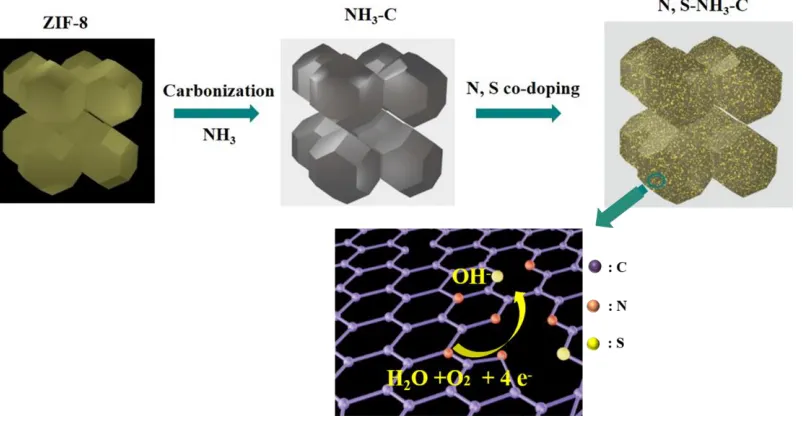
Figure 8.1. Schematic illustration of the fabrication of the N,S-co-doped nanocarbon as the electrocatalyst toward ORR. ... 171
Figure 8.2. SEM images of (a) NH3-C-7 and (b) N,S-NH3-C-7; (c) TEM image of N,S-NH3
-C-7; (d) STEM images of N,S-NH3-C-7 and EELS mapping of C, N, S. ... 172
Figure 8.3. (a) XRD patterns and (b) Raman spectra of the nanocarbons of ZIF-C, NH3-C-7
and N,S-NH3-C-7. ... 173
Figure 8.4. (a) N2 adsorption–desorption isotherms and (b) pore size distribution data
obtained by the Barrett–Joyner–Halenda (BJH) method of ZIF-8, ZIF-C and NH3-C-x. .... 175
Figure 8.5. Chemical binding state of the nanocarbons. (a) N1s XPS spectra of N,S-NH3-C-7,
xxv
nitrogen species (left); atomic structure of the N,S-doped nanocarbon with chemical bonding configurations of nitrogen and sulfur dopants (right). (c) S2p XPS spectra of N,S-NH3-C-7.
... 177
Figure 8.6. (a) Cyclic voltammograms of N,S-NH3-C-7 with a scan rate of 10 mV·s-1 in O2
-(red) and N2-saturated (black) 0.1 M KOH solution. (b) Linear sweep voltammograms
(LSVs) of ZIF-C (black), NH3-C-7 (blue), N,S-NH3-C-7 (red), and 20% Pt/C (cyan) in O2
-saturated 0.1 M KOH solution at 1600 rpm. The LSV curves for NH3-C-X are shown in
Figure SI8.5. (c) LSV curves of N,S-NH3-C-7 in O2-saturated 0.1 M KOH with various
rotation speeds. The corresponding K-L plots at various voltages are shown in (d). Stability (e) and methanol tolerance (f) curves for N,S-NH3-C-7 and Pt/C catalysts in O2-saturated 0.1
M KOH. ... 179
Figure 8.7. Optimized structures for the stable adsorbed O2 on the N-doped nanocarbon (a),
xxvi
List of Appendices
Appendix A: Permission from Royal Society of Chemistry (RSC) For Published Article
... 196
Chapter 1
1
Introduction
Due to the global warming issue and the ever-growing environmental concerns, the need for advanced clean energy technology has never been more urgent. To meet the coming energy challenges, a broad suite of alternative energy and renewable resources will be required, including biomass, solar, hydro, wind and nuclear. Among them, hydrogen has been identified as one of the most promising clean source for energy conversion and will certainly play a significant role in solving the energy challenges. [1]
Polymer electrolyte membrane fuel cell (PEMFCs) (also called proton exchange membrane fuel cells) as an innovative clean energy conversion device is considered as one of the technology for the future. PEMFC uses the chemical energy of hydrogen to cleanly and efficiently produce electricity, with water and heat as the only byproducts. [2, 3] PEMFCs have several advantages over the conventional combustion technologies currently used in many power plants and passenger vehicles. (i) PEMFCs can operate at higher efficiency than combustion engines and can convert the chemical energy to electricity with efficiency of up to 60%. [2, 3] (ii) PEMFCs have lower emissions than combustion engines. Hydrogen fuel cells emit only water, so there are no carbon dioxide emissions and no air pollutants that create smog and cause health problems at the point of operation. (iii) PEMFCs are quiet during operation as they have fewer moving parts. PEMFCs are unique in their variety of potential applications; they can provide power for systems as large as a utility power station and as small as a laptop computer. In fact, PEMFCs are already being used in a wide application, including transportation (bus, trail, automotive etc.), materials handling, stationary, portable power and emergency backup power system. [4]
1.1 Fundamentals of PEMFCs
to prevent leakage of gases, and bipolar plates, which are used to assemble individual PEM fuel cells into a fuel cell stack and provide channels for the gaseous fuel and air. The catalysts layers, membrane and gas diffusion layers together form the MEA of a PEMFC. The catalyst coated membrane layers are the key part for the PEMFC technology. A layer of anode catalyst is coated on one side of the membrane and cathode catalyst layer on the other side. Conventional catalyst layers include nanoparticles (NPs) of platinum (Pt) dispersed on a high-surface-area carbon support. The supported Pt catalyst is mixed with an ion-conducting polymer (ionomer) and sandwiched between the membrane and the GDLs. In a hydrogen-oxygen PEMFC, the Pt catalyst at the anode separates hydrogen fuel into protons and electrons, which take different paths to the cathode. The electrons go through an external circuit, creating a flow of electricity. The protons migrate through the membrane to reach the cathode. On the cathode side, the Pt catalyst enables oxygen reduction reaction (ORR) by uniting with protons and electrons to produce water and heat. The ionomer mixed into the catalyst layers allows the protons to travel through these layers. The membrane electrolyte permits only the necessary protons to pass between the anode and cathode, other substances passing through the electrolyte would disrupt the chemical reaction. With the hydrogen oxidation reaction (HOR) and ORR occurring simultaneously during PEMFCs operation, the theoretical output cell voltage is given as 1.229 V.
Anode (HOR): 2H2 4H+ + 4e- E0=0 V
Figure 1.1. Schematic of the working principle of a typical PEMFC and the involved
porous components: bipolar plate; gas diffusion layer (GDL); electrocatalyst layer and
membrane.
1.2 Challenges of PEMFCs
With remarkable efficiency, high energy density and negligible emission of harmful gases, the polymer electrolyte membrane fuel cell (PEMFC) is considered to be a green technology that meets the energy requirement for future electrical vehicles and portable electronics. Unfortunately, a major limitation for the low-temperature PEMFCs is the kinetically-sluggish oxygen reduction reaction (ORR) at the cathode, which requires a large amount of catalyst to reach the adequate energy output. [5, 6] The state-of-the-art high-performance catalysts for ORR are the noble metal Pt-based catalysts. [7] To effectively utilize this expensive metal, Pt NPs are often supported on substrates such as high surface carbon support. However, Pt catalysts are seriously deactivated under severe PEMFCs operation conditions, resulting in the loss of Pt performance. Cost, performance, and durability are still key challenges in PEMFCs commercialization. [8]
Currently, carbon black is the most widely used support material to promote Pt activity in PEMFCs. However, carbon black suffers from severe corrosion during long-term PEMFCs operation (especially at potential above 0.9 V) which results in the Pt detaching from carbon surface and rapid degradation of the PEMFC performance. Moreover, the weak interactions between carbon support and metal catalysts trigger Pt NPs migration and aggregation to form big particles, consequent loss the surface area and decrease the activity. [9, 10] Besides the challenges in catalyst stability, it is highly desirable to improve Pt activity and decrease Pt loading in PEMFCs because of the high cost and limited availability of Pt. Therefore, it is extremely desirable to develop highly stable and active electrocatalysts with lower Pt loading.
starvation, differential pressure imbalance, oxidation-reduction cycling, and oxygen ingress to the anode, resulting in high cathode potentials. Significant progress has been made in determining the degradation mechanisms of fuel cell components and developing improved materials.
1.3 Solutions by designing highly stable and active
electrocatalysts through ALD technique
1.3.1
Atomic layer deposition (ALD)
Atomic layer deposition (ALD) is a vapor phase technique used to deposit thin films and nanostructures. [12, 13] It is a technique that has pushed the advancement of semiconductor technology and hold promise for application in the field of energy storage and conversion. As materials become increasingly complex and move toward the nanoscale regime, coating techniques that can provide accurate control of growth and material composition becoming increasingly necessary. ALD can provide both these advantages due to its cyclic, self-saturating nature. This advantage results in ALD being the technique of choice for coating nanomaterials compared to other deposition techniques such as chemical vapor deposition and physical vapor deposition. In general, the ALD process consists of introducing gaseous chemical precursors that can react to the substrate. Additionally, a purge step separates precursor introduction ensuring that gas-surface reactions occur as half-reactions. This allows for each dose of the precursor to completely react with the substrate through a self-limiting process. As a result, ALD is a non-line-of-sight technique that can conformally coat complex, nanostructure substrates in a pin-hole free manner. Although ALD can be used to grow thin films, careful selection of substrate and chemical precursor can allow for the growth of nanoparticles. This imparts ALD with the ability to grow particles with atomic level control. Furthermore, particles can be grown in a non-line-of-sight fashion on nanomaterials, providing an optimal route in taking advantage of high surface area to volume materials.
control that take place during the deposition process. Therefore, ALD possesses the advantage in controlling the target materials with precise particle size and uniform distribution on the substrate. The highly dispersed and uniform Pt particles designed by ALD method is supposed to possess the high active surface area. On the other hand, by forming chemical bonds between the initial layer of ALD precursor and support atoms during the first cycle of deposition, the strong interaction between the deposited Pt NPs and support could be enabled, which is benefit for achieving the highly stable catalyst.
1.3.2
Highly stable electrocatalysts: with strong metal-support
interactions
1.3.3
Highly active electrocatalysts: from nanoparticles to single atom
To overcome the challenges associated with the Pt catalysts activity and high-cost issue, it is very important to markedly decrease the Pt loading and increase the Pt utilization efficiency. Currently, supported Pt NPs are typically used to promote Pt activity towards the ORR and HOR. Unfortunately, the geometry of the NPs limits the majority of the Pt atoms to the particle core, deeming them ineffective, as only surface atoms are involved in the electrochemical reaction. Reducing the size of the Pt NPs to clusters or even single atoms could significantly decrease the noble metal utilization and increase their catalytic activity, which is highly desirable to enhance the Pt atomic efficiency and decrease the cost of the electrocatalysts.[17, 18] It has been shown that single Pt atoms dispersed on an FeOx surface have a higher catalytic activity for CO oxidation compared with the corresponding Pt NPs.[17] Moreover, the single-atom catalysts also exhibited a significantly improved catalytic activity towards methanol oxidation, up to 10 times higher than the state-of-the-art commercial Pt/C catalysts.[19]
promising approach for the design of highly active and stable next-generation catalysts based on Pt single atoms and clusters, which have a great potential to reduce the high cost of industrial commercial noble-metal catalysts.
1.4 Thesis objectives
PEMFCs have been applied as the clean energy conversion devices for electric vehicles and portable power supply. Unfortunately, the high-cost of noble metal catalysts and poor long-time stability are the main challenges that limit PEMFCs for widespread commercialization. To improve the performance and long-lifetime of PEMFCs for future application, development of advanced electrocatalysts with high activity and stability becomes necessary and urgent. Fabrication of strong metal-support interactions and downsizing the noble metal catalyst to clusters or even single atoms, are the key research directions to improve the PEMFCs performance and long-lifetime. In this thesis, the author focusses on two aspects to design the highly stable and active electrocatalysts.
Part I: To design highly stable Pt NPs electrocatalysts
(1) To develop a highly stable Pt/C electrocatalysts by area-selective deposition of tantalum oxide (TaOx) anchors. The synthesis of TaOx was carried out via an ALD technique. By adjusting the TaOx anchors loading and coverage area on the Pt/C catalyst, we can purposely design high stable electrocatalyst for PEMFCs application.
(2) To stabilize Pt NPs on carbon support by decorating a bridge layer of nitrogen-doped tantalum oxide (N-Ta2O5). The uniformly dispersed Ta2O5 NPs on carbon surface are
developed by ALD. With NH3-treatment to doping nitrogen into the tantalum oxide, the
strong metal-support interactions between Pt catalyst and carbon support will be formed. This approach allows us to fabricate a highly stable electrocatalyst by enabling the strong metal-support interactions.
(1) To achieve the extremely low Pt loading in the anode catalyst layer while maintain the high PEMFC performance and long-life time, a series of high-performance PEMFCs with low Pt loading in anode layer are successfully prepared using an ALD technique. By controlling the ALD cycle number, the Pt NPs with different size and loading amount are directly deposited on the carbon coating layers to form the anode catalyst layers.
(2) To investigate the impact of Pt atom utilization on the electrocatalysis for oxygen reduction reaction (ORR), Pt single atoms, subnano-clusters as well as NPs with different size and density on MOFs-derived carbon support are designed. Based on the advantages of high surface area, high porosity and rich of nitrogen doped species, MOFs-carbon is anticipated to be a promising support for single atoms catalysts. The supported Pt single atoms were prepared by ALD via chemical incorporation Pt atoms into the nitrogen or oxygen species from MOFs-carbon, which is considered to enable the sinter-resistant isolated Pt atoms with high dispersion on the support.
(3) To minimize the use of precious metals, a metal-free catalyst of nitrogen and sulfur-co-doped nanocarbon would be designed as the electrocatalyst for ORR. First-principles calculations were investigated to reveal the catalytic mechanism and understand the active sites. This research will be of great significance for the rational design of a new-generation of nanocarbon electrocatalysts.
1.5 Thesis organization
This thesis is consisted of nine chapters (one introductory chapter, one literature review chapter, one experimental chapter, five articles, and one conclusive chapter) and is organized according to the requirements on “Integrated-Article” form as outlined in the Thesis Regulation Guide by the School of Graduate and Postdoctoral Studies (SGPS) of the University of Western Ontario. Specifically, it consists of the following parts:
Chapter 1 gives an introduction of polymer electrolyte membrane fuel cells. In this chapter,
Chapter 2 is literature review, which summarize the development and progress of highly stable and active electrocatalysts for PEMFCs.
Chapter 3 outlines the experimental synthetic approaches of as-prepared nanomaterials. The
characterizations techniques used to determine the materials physical and electrochemical properties are demonstrated in this chapter.
Chapter 4 presents a study on the atomic layer deposition of tantalum oxide to anchor Pt/C
for a highly stable catalyst in PEMFCs. Controlled synthetic process with different tantalum oxide mass loading is investigated, detailed relationship between tantalum oxide loading and the electrocatalyst stability for ORR are also studied.
Chapter 5 investigates the nitrogen-doped tantalum oxide as a bridge layer to stabilize Pt
catalyst on carbon surface. By testing the electrochemical activity and stability, the electrocatalyst decorated with nitrogen-doped tantalum oxide demonstrate a significantly enhanced performance compared with their counterparts.
Chapter 6 reports the Pt catalyst of particle size and loading effect on catalytic activity and
stability for PEMFCs anode. The real fuel cell is designed in this study. Moreover, the hydrogen-oxygen fuel cell performance and startup/shutdown stability are evaluated here.
Chapter 7 presents the fabrication of single atoms and sub-nano clusters Pt catalyst on
MOFs-derived nanocarbon. The ALD method used here shows great advantages in preparing single atoms catalysts. Electrochemical activity and stability are evaluated on all the as-prepared Pt/MOFs-C catalysts. It is find that the single atom and subnano-clusters make great contributions to achieve better catalytic activity for ORR.
Chapter 8 reports the development of a metal-free electrocatalysts derived from MOFs
Chapter 9 summarizes the results and contributions of the thesis work. Additionally, the author states the perspective and suggestions for future work on electrocatalysts.
References
[1]. Pivovar, B. H2@SCALE: Deeply Decarbonizing our Energy System.
http://www.energy.gov/sites/prod/files/2016/07/f33/fctowebinarslides_h2_at_scale_07
2816.pdf.
[2]. Debe, M.K., Nature, 2012. 486, p. 43-51.
[3]. Banham, D., T. Kishimoto, Y. Zhou, T. Sato, K. Bai, J.-i. Ozaki, Y. Imashiro, and S. Ye, Science Advances, 2018. 4 (3): p. 7180.
[4]. Fuel Cell Technical Team Rodamap. https://www.energy.gov/sites/prod/ files/2017/11/f46/FCTT_Roadmap_Nov_2017_FINAL.pdf, .
[5]. Banham, D. and S. Ye, ACS Energy Letters, 2017. 2(3): p. 629-638.
[6]. Su, L., W. Jia, C.M. Li, and Y. Lei, ChemSusChem, 2014. 7(2): p. 361-378.
[7]. Sui, S., X. Wang, X. Zhou, Y. Su, S. Riffat, and C.-j. Liu, Journal of Materials Chemistry A, 2017. 5(5): p. 1808-1825.
[8]. DOE Hydrogen and Fuel Cells Program: Program Record. 2017. https://www.hydrogen.energy.gov/program_records.html.
[9]. Dubau, L., L. Castanheira, F. Maillard, M. Chatenet, O. Lottin, G. Maranzana, J. Dillet, A. Lamibrac, J.C. Perrin, E. Moukheiber, A. ElKaddouri, G.D. Moor, C. Bas, L. Flandin, and N. Caqué, Wiley Interdisciplinary Reviews: Energy and Environment, 2014. 3(6): p. 540-560.
[11]. DOE Technical Targets for Polymer Electrolyte Membrane Fuel Cell Components.https://www.energy.gov/sites/prod/files/2017/05/f34/fcto_myrdd_fuel_c ells.pdf.
[12]. Cheng, N., Y. Shao, J. Liu, and X. Sun, Nano Energy, 2016. 29: p. 220-242.
[13]. Grillo, F., H. Van Bui, J.A. Moulijn, M.T. Kreutzer, and J.R. van Ommen, The Journal of Physical Chemistry Letters, 2017. 8(5): p. 975-983.
[14]. M., A.P., C. Massimiliano, and S. Ferdi, Angewandte Chemie International Edition, 2006. 45(48): p. 8224-8227.
[15]. Lee, S.H., D.M. Hoffman, A.J. Jacobson, and T.R. Lee, Chemistry of Materials, 2013. 25(23): p. 4697-4702.
[16]. Niancai, C., B.M. Norouzi, L. Jian, R. Adam, L. Xia, L. Ruying, Y. Siyu, K. Shanna, and S. Xueliang, Advanced Materials, 2015. 27(2): p. 277-281.
[17]. Qiao, B., A. Wang, X. Yang, L.F. Allard, Z. Jiang, Y. Cui, J. Liu, J. Li, and T. Zhang, Nature Chemistry, 2011. 3: p. 634.
[18]. Yang, S., J. Kim, Y.J. Tak, A. Soon, and H. Lee, Angewandte Chemie International Edition, 2016. 55(6): p. 2058-2062.
[19]. Sun, S., G. Zhang, N. Gauquelin, N. Chen, J. Zhou, S. Yang, W. Chen, X. Meng, D. Geng, and M.N. Banis, Scientific reports, 2013. 3: p. 1775.
[20]. Uzun, A., V. Ortalan, Y. Hao, N.D. Browning, and B.C. Gates, ACS Nano, 2009.
3(11): p. 3691-3695.
[21]. Mackus, A.J.M., M.A. Verheijen, N. Leick, A.A. Bol, and W.M.M. Kessels, Chemistry of Materials, 2013. 25(9): p. 1905-1911.
[23]. Kim, J., H.-E. Kim, and H. Lee, ChemSusChem, 2018. 11(1): p. 104-113.
[24]. Zhang, X., J. Guo, P. Guan, C. Liu, H. Huang, F. Xue, X. Dong, S.J. Pennycook, and M.F. Chisholm, Nature Communications, 2013. 4: p. 1924.
[25]. Yan, H., Y. Lin, H. Wu, W. Zhang, Z. Sun, H. Cheng, W. Liu, C. Wang, J. Li, and X. Huang, Nature communications, 2017. 8(1): p. 1070.
Chapter 2
2
Literature review
Polymer electrolyte membrane fuel cells (PEMFCs) are one of the promising energy-conversion devices due to their high efficiency and zero emission. However, the overall efficiency of PEMFCs is severely hindered by their high overpotential, which is mainly caused by the sluggish reaction kinetics of the oxygen reduction reaction (ORR) at the cathodic side. To mitigate the overpotential issue, in recent decades, Pt has been widely used as the active electrocatalyst, but its high-cost and low-durability are still problems in PEMFCs technology. Therefore, in electrochemical and materials science, the search for effective strategies to reduce the Pt loading while maintain the high activity and durability of the electrocatalyst has become critical. In this chapter, recent progress on the development of low-cost, highly stable and active electrocatalyst for PEMFCs is involved from the nanomaterial perspective. First, a functional link between the activity and durability on catalytic nanoparticles (NPs), as well as the degradation mechanisms, will be discussed. Then, we summarize the current strategies for developing the advanced Pt-based electrocatalysts with high stability and activity in reactions related to PEMFCs, and their structure impact on electrochemical performance will be discussed. Finally, an outlook on the future trends and developments of nanomaterial electrocatalysts in PEMFCs is presented.
2.1 Nanoparticle electrocatalysts issues and their degradation
mechanisms
activity is ultimately what matters as this metric is directly transferable to cost. In this thesis, when discussing next-generation ORR catalysts, the primary activity metric will be mass activity. Electrochemical studies have shown the relationship between the ORR activity and the durability affected by particle size: in general, when the NP size is decreased, the activity increases, while the durability decreases (Figure 2.1). [2] Therefore, increasing nanoparticle durability while maintaining the high activity is critical for NP design.
Figure 2.1. Schematic illustration of nanoparticle size effect for activity and durability.
[2] Wiley-VCH Verlag GmbH & Co. KGaA. Copyright 2018.
mechanism of Pt NPs was suggested to be the coalescence of the Pt NPs on the support. Based on the control analysis, they also suggested that geometric barriers to prevent particle merging are effective for protecting nanoparticles.
Figure 2.2 Schematic illustration of the suggested degradation mechanisms for Pt NPs
on a carbon support in fuel cells. [3-6] Reproduced with permission from
Nanotechnology. Copyright 2014.
durability, and from supports with enhanced stability is a key point for improving PEMFCs performance.
2.2 Progress of highly stable electrocatalysts for PEMFCs
Improving electrocatalyst stability is pivotal for maintaining performance without activity loss. Many advances have been suggested to improve catalyst particle and catalyst support stability based on the suggested degradation mechanisms. The durability of catalysts is inherently determined by the properties of both the catalytic metals and the support materials and the specific interaction between them. It is reasonably expected that the higher the durability of catalytic metals and support materials, and the stronger the specific interaction between them, the higher the durability of the resultant catalysts. The strategies to improve the durability of catalysts can be in general categorized into two aspects: support materials and catalytic metals.
2.2.1
Novel stable catalyst support
The selection of catalyst support materials has a remarkable impact on the durability of the resultant supported catalysts. There are several basic requirements for an improved catalyst support: (i) high electrochemical stability under PEMFCs operating conditions (high potential, low PH); (ii) high surface area for the uniform dispersion of Pt NPs; (iii) excellent electronic conductivity. With the current state of technology, the state-of-the-art and the most practical electrocatalysts for PEMFCs are still carbon black supported Pt NPs catalysts. Although the carbon black with merits of large surface area, high electrical conductivity and pore structure, the phenomenon of carbon corrosion caused by electrochemical oxidation has been identified to be the major drawback for catalyst durability. Therefore, it is necessary to explore more stable catalyst supports to replace the traditional carbon black. In order to address the carbon corrosion issue, materials with high electrochemical stability have been studied as catalyst support, ranging from highly graphitic carbons (e.g. carbon nanotubes or graphene) to noncarbon supports (e.g. transition metal oxides, carbides). [12-14]
It is reported that the extent of graphitization of carbon plays an important role on carbon support stability, with more graphitic carbon being more thermally and electrochemically stable, which is due to the decreased defect sites on carbon surface. With the development of novel carbon nanostructure, carbon nanotubes (CNTs) have emerged as a promising support material for PEMFCs due to their large surface area, good electrical conductivity and excellent electrochemical durability. However, pristine CNTs contain relatively few binding sites for anchoring the Pt NPs due to the chemical inert surface of CNTs. To overcome these barriers, many studies have focused on the surface modification of CNTs. The surface modification involves (i) using special organic functional groups, functional polymers, and heteroatoms (e.g. N, P, S, F etc.) to decorate CNTs surface, [15, 16] and (ii) using homogeneous silica or metal oxides (e.g. TiO2, ZiO2, SnO2 etc.) shell to link metal NPs and
CNTs support. [17-19]
It was found that an ideal conducting polymer modified-CNTs used for stabilization of supported Pt NPs should not only provide an anchoring site for Pt NPs, but also maintain the original perfect structure of CNTs rather than destroying it. Fujigaya and co-workers [20] reported an “in situ surface growth method” to fabricate CNTs supported Pt NPs using polybenzimidazole (PBIs) as linker polymers, by means of which binding sites could be non-covalently introduced onto a CNT surface. PBI, recognized as a powerful candidate for use in PEMFCs due to its high proton conductivity, has a strong physical interaction with CNTs and serves as an effective binding site for anchoring of Pt NPs. A schematic of the structure of Pt/PBIs/CNTs is shown in Figure 3a. Due to the non-destructive functionalization of the CNTs, the Pt/PBIs/CNTs showed higher electrocatalytic activity and better stability for the ORR than Pt NPs supported on pure CNTs. In addition, the Pt/PBIs/CNTs have a highly dispersed Pt NPs, which promote the larger electrochemical active surface area than that of Pt/CNTs. The interface structure of Pt/PBIs/CNTs is most likely the “ideal” triple-phase boundary structure that enables excellent durability and activity of Pt catalyst.
hybrid as a support for further enhance the performance and durability of Pt/NGNs catalyst. The novel ZrO2/NGNs hybrid support was prepared by growing ZrO2 NPs on NGNs using
atomic layer deposition (ALD) technique. Based on sequential and self-limiting surface reactions, ALD provides a powerful approach for the coating of ultra-fine metal oxides. The Pt NPs located and anchored at the interface of ZrO2 and NGNs, which improves the
interaction of Pt with support by metal-metal oxide-NGNs junction. High resolution transmission electron microscopy (HRTEM) image in Figure 2.3b shows that Pt NPs dispersion on ZrO2/NGNs is uniform, with no indication of agglomeration. Moreover, it is
revealed that major Pt NPs are exactly located between the grain boundaries of ZrO2 NPs on
NGNs, suggesting the formation of a unique triple-junction interaction in Pt/ZrO2/NGNs
nanostructure. For the electrochemical performance, Pt/ZrO2/NGNs had a higher mass
activity for ORR (∼102 mA·mg−1 Pt) than the Pt/NGNs (∼78 mA·mg−1 Pt). When 4000
continuous cycles of accelerated durability test (ADT) were performed, Pt/ZrO2/NGNs
retained 50.2% and 59% of its initial ECSA and mass activity, respectively, compared to only 23.5% and 28% for Pt/NGNs. The ADT test indicated that the Pt/ZrO2/NGNs had 2.2
times higher durability than Pt/NGNs due to a stronger triple-interaction in ZrO2-Pt-NGNs,
as confirmed by X-ray absorption spectra. This unique metal oxide-metal-NGNs triple interaction is a promising stable catalyst structure for PEMFCs.
Figure 2.3. (a) Schematic illustration of the preparation of CNTs/PBIs/Pt, and TEM
images of CNTs/PBIs/Pt. [20] (b) The schematic illustration of high stable catalyst of
Pt/ZrO2/NGNs, and the structure, electrochemical performance of Pt/ZrO2/NGNs. [21]
Novel noncarbon support
As discussed above, physical and chemical stability are highly demanding criteria for durable support materials. Among the several candidates, the transition metal oxides, metal carbides have been suggested as promising support materials because a specific metal oxide/carbide is corrosion-resistant in strong acidic media. Among the various metal oxides/carbides, the limited materials such as ZrO2, TiO2, CeO2, Ta2O5, WO3, MoO3 and their carbides show
chemical stability for strong acidic conditions for PEMFCs. For example, zirconium carbide (ZrC), a conductive ceramic material with high corrosion resistance, stability and high electron conductivity, has draw a great attention for the electrocatalysts support. It is reported that ZrC could promote the Pt activity and showed the superior electrochemical corrosion resistance. Sun et al. [22] for the first time used commercial ZrC as the catalyst support to develop the Pt/ZrC catalyst by an ALD method (Figure 2.4). TEM measurements revealed that the average size of Pt in ALD-Pt/ZrC was ∼3.2 nm. Analysis of the X-ray absorption near edge structure (XANES) spectra at Pt L3 and L2 edges suggest that ALD-Pt/ZrC
catalysts show noticeable change in the electronic structure of Pt due to strong interactions with ZrC support enabled by ALD. The analysis of intensity of the white line in both Pt L3 edges and Pt L2 edges indicates a stronger interaction between Pt and ZrC in the ALD-Pt/ZrC than in the Pt/C. Electrochemical measurement for ORR showed that ALD-ALD-Pt/ZrC catalyst exhibited a mass activity of 0.122 A·mg-1Pt at 0.9 V (vs. RHE), which was much
higher than those for Pt/C (0.041 A·mg-1Pt). After an ADT of 4000 continuous cycles, the
ALD-Pt/ZrC had an ORR activity loss of ∼26%, which was much lower than Pt/C (76% loss), while the ECSA loss of ALD-Pt/ZrC was only 17%, compared with 78% Pt/C. Based on the strong metal-support interactions, the ALD-Pt/ZrC catalyst exhibited promising electrocatalyst durability being almost five times more stable than Pt/C. The stabilization of Pt NPs on ZrC can be understood through the strong metal-support interaction, which is evidenced through XANES. Tightly bound Pt NPs are protected by the migration on the ZrC support, inhibiting Pt agglomeration.
nitride and carbide materials can be considered as an alternative, delicate understanding and investigations are required for further advances.
Figure 2.4. Normalized XANES spectra of Pt NPs on composite catalyst support at (a)
the Pt L3 edge and (b) the Pt L2 edge. (c) Schematic illustration of ALD-Pt growth on
ZrC support. Loss of electrochemical surface area (ECSA) (d) and mass activity (e) for
ALD-Pt/Zr before and after ADT. Reproduced from [22] with permission from the
Royal Society of Chemistry.
2.2.2
Novel structure of Pt nanoparticles
Pt nanoframe
In 2014, Chen and co-workers presented highly crystalline bimetallic nanoframes with 3D structure as highly durable and active ORR electrocatalysts. [23] After synthesis of PtNi3
polyhedral NPs, the interior corrosion of Ni in solution transforms the solid PtNi3
nanocrystals into the Pt3Ni nanoframes. Subsequently, a controlled thermal treatment of the
resulting Pt3Ni nanoframes forms the desired Pt-skin surface structure (Figure 2.5a). The
combination of the 3D structure and the Pt-skin surface promoted ORR activity, achieving a remarkably high ORR activity. Moreover, the Pt-skin nanoframe also showed superior long-term durability without appreciable activity loss. After long-long-term durability tests, scanning TEM images indicated that the 3D frame structures were well preserved without noticeable changes. The origin of the long-term durability is ascribed to the lower coverage of oxygenated species arising from the weaker oxygen-binding energy and optimal Pt skin layer, which prevents the dissolution of the transition metals. Based on these superior electrochemical properties, various advances have been proposed by structure modification [24, 25] and expanded to various bimetallic or trimetallic nanoframe systems. [26-28]
In 2015, Zhang et al. reported the synthesis of catalytically active octahedral and cubic Pt NPs. The NPs are not solid but instead are hollow nanocages entirely enclosed by either (111) facets (octahedra) or (100) facets (cubic). [29] Unlike earlier studies on shape-selected Pt-Pd bimetallic core-shell NPs, the authors managed to carefully dissolve the metallic core without compromising the well-defined thickness and composition of a Pt shell that is a mere atomic layer thickness as shown in Figure 2.5b. The ORR performance of the octahedra nanocages showed a mass activity of 0.75 A·mg-1Pt and a specific activity of 1.98 mA·cm-2 at 0.9 V,