Available online: https://edupediapublications.org/journals/index.php/IJR/ P a g e | 1709
Effect of Surface Coating on the Bonding Strength of
Reinforcing Steel Bars in Concrete Structures
MN Uddin
& MA Islam
1,2MME Department, Bangladesh University of Engineering and Technology, Dhaka-1000, Bangladesh
Abstract: Concrete is very poor in bearing tensile load. In order to increase the tensile strength of concrete structures, they are reinforced with steel bars. At the same time, in many practical applications, bar corrosion is one of the vital reasons that decrease the service life of the concrete structures as well as the safety of the users. To avoid such a problem, various metallic and nonmetallic (polymer) coatings are applied to reduce the corrosion attack on the reinforcing steel bars. In the present work, reinforcing steel bar-concrete bonding strength for the as-received and steel bars coated with two different synthetic paints of local brands and one other band have been investigated. The investigation shows that steel bars coated with epoxy paint showed the highest bonding strength, which is very similar to the as-received uncoated bars.
Keywords: Polymer, Humidity, Steel Bar, Coating, Corrosion
1. Introduction
Reinforced concrete is one of the most widely used construction materials in the world [1-6]. It is a versatile and economical material that generally performs its intended use well over its service life. Reinforced concrete is used in numerous ways, some of the larger and better known uses including roadways, bridges, car parks, residential buildings and in industries; for example it is widely used in nuclear power as well as for making hydraulic power plants. Recently, the aspects of concrete durability and performance have become a major subject of discussion, especially when the concrete is subjected to a severe environment. Corrosion of steel bars is the main factor in influencing both the concrete durability and strength [1-3]. The corrosion products of the steel reinforcement expand up to seven times the original size, developing high pressures within the concrete, which cause cracking and spalling of the concrete cover and expose the rebar to further corrosion activity [3-8]. Corrosion reduces the ribs height of the bar, which causes reduction in the contact area between the ribs leading to reduction in the bond strength [9]. In marine environments and
where de-icing salts are applied, the degradation of reinforced concrete structures due to chloride induced corrosion of the reinforcement is a major problem [10,11]. Corrosion of embedded steel bars is a major problem for RC structures as it may affect their residual capacity and life through four aspects, including loss of concrete section as a result of longitudinal cracking and spalling, loss of reinforcement section, change of reinforcement mechanical properties (especially fatigue) and a reduction in bond between reinforcement and concrete. To delay the rate of concrete deterioration and increase the service life of reinforced concrete structures, researchers have recommended a series of corrosion prevention strategies. Of these, the use of polymer coated reinforcement was identified as one of the most effective methods [12-14].
Because of high temperature along with high level of humidity and polluted air, reinforced concrete structures in Bangladesh are continuously under threat of bar corrosion, where olymer coated bars could be a solution. There are lots of company producing their own brands of synthetic polymeric paints. Some local users are also interested to use these synthetic paints to protect the steel bars inside the concrete, especially in the coastal areas. However, the effect of these paints on the bonding strength between steel bars and the concrete is not well established. The aim of this research work is to understand and evaluate the bonding strength between polymer paint (local brand and other international one) coated bars and concrete.
2. Materials and Experimental Procedure
Available online: https://edupediapublications.org/journals/index.php/IJR/ P a g e | 1710
and steel bar-concrete bonding testing 12 inch long samples were used. After cutting, 12 inch steel bars were divided in four different groups as i) as-received, enamel paint (local brand Pailac) coated, wajala paint (another local brand) coated and epoxy (international brand) paint coated. Polymeric paints of respective varieties were then applied on the cut steel bars
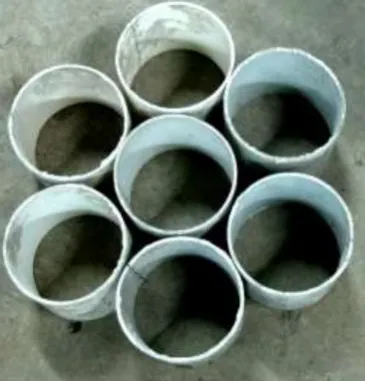
manually and they were dried properly. For epoxy resin, a hardener was used before applying for coating. Keeping one steel bar at the centre of the plastic moulds (Figure 1) of 8 inch height and 6 inch diameter concrete was cast inside the mould and it was properly compacted by pocking action.
The cast concrete blocks with steel bars at the centre were then cured for 28 days continuously in fresh water, which are shown in Figure 2 and 3.
The 28-day wet cured samples were taken from the water vat and they were dried properly in air for about three days and tested on Universal testing machine to know the bonding strength between the
Figure 1. Photographs of plastic mould for concrete casting.
Figure 2. As-received (left) and epoxy paint coated (right) steel bars in cast concrete blocks.
Available online: https://edupediapublications.org/journals/index.php/IJR/ P a g e | 1711
steel bars and the cured concrete. For testing, a special fixture with a central hole was used (Figure 4), where sample was placed over it and a compressive load was applied from the upper part of the bar to take it out from the bottom level of the concrete block.
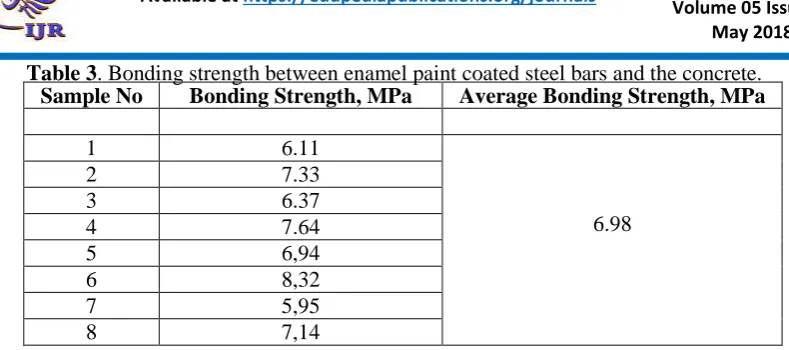
Following the same procedure, for each group, eight samples were tested and the average was considered as the representative value of the bonding strength. The bonding strength test results are presented in Tables 1-4.
Sample No Bonding Strength, MPa Average Bonding Strength, MPa
1 9.19
9.25
2 9.70
3 8.10
4 10.50
5 8.76
6 11.00
7 8.00
8 8.75
Sample No Bonding Strength, MPa Average Bonding Strength, MPa
1 8.49
9.15
2 8.95
3 9.11
4 10.9
5 10.7
6 9.13
7 8.06
8 7.89
Figure 4. Universal testing machine with special fixture (left) and close-up view of concrete
block under test (right).
Table 1. Bonding strength between as-received steel bars and the concrete.
Available online: https://edupediapublications.org/journals/index.php/IJR/ P a g e | 1712
In order to understand the bonding strength between the coated steel bars and the concrete the shore hardness (Hardness Testing Machine: Bareiss HPE Shore A, Model: HPE DGM 93 18 389.5) of the polymer coating was also measured, which is presented in Table 5. Here it is to be noted that for each case the indentation period was 15 seconds.
3. Results and Discussion
The bonding strengths between the steel bars (both as-received and with various types of polymeric paint coatings) were measured with the help of Universal testing machine, which are presented in Tables 1-4. From these experimental results presented in the above tables the following observation are made:
1. The interface bonding between as-received steel bar and concrete is the highest.
2. Epoxy paint coated bars resulted bonding strength, which is comparable (very similar) to that of the as-received bar.
3. Both enamel paint and ujala paint coating resulted deteriorations in the bonding strengths, where enamel paint coated bar resulted the lowest level of bonding strength.
Sample No Bonding Strength, MPa Average Bonding Strength, MPa
1 6.11
6.98
2 7.33
3 6.37
4 7.64
5 6,94
6 8,32
7 5,95
8 7,14
Sample No Bonding Strength, MPa Average Bonding Strength, MPa
1 6.17
7.77
2 7.44
3 7.08
4 8.50
5 8.46
6 10.46
7 6.39
8 7.67
Epoxy Paint Coating Enamel Paint Coating Ujala Paint Coating
97 83 87
Table 3. Bonding strength between enamel paint coated steel bars and the concrete.
Table 4. Bonding strength between ujala paint coated steel bars and the concrete.
Available online: https://edupediapublications.org/journals/index.php/IJR/ P a g e | 1713
Now, the question is why the ujala and enamel paints deteriorated the bonding strengths, however, epoxy paint coated bar maintain the bonding strength of nearly of that of the as-received bar. We know that both the steel bars and cured concrete are very hard. In this respect, used polymer based paints are softer, Table 5. Enamel and ujala paint coatings are also softer than the epoxy one. For these two paints, the interfaces between steel to polymeric paint and polymeric paint to concrete are relatively soft and weak. This means, relatively softer interfaces created
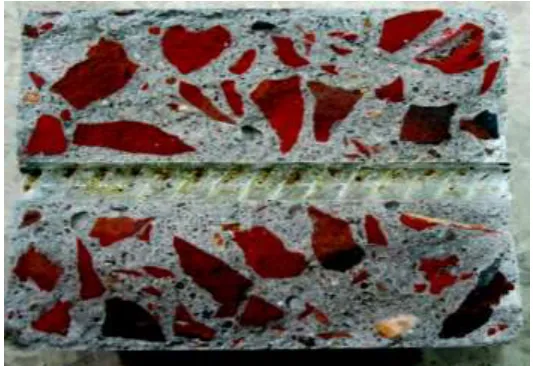
weakness along the surfaces of the steel bars. From Table 5, it is also clear that epoxy coating is harder than other two paints. Because of higher hardness, when the epoxy coated bar was compressed from upper part to pull out from the concrete bottom, the coating was broken, that caused higher level of interfacial friction. The higher level of pulling friction means more energy absorption to take out the bar from inside the concrete. This caused the coating to be partially broken, especially from the bar ribs, which is clear from Figures 5 and 6.
Figure 5. Pulled out epoxy paint coated bar from inside the concrete block.
Available online: https://edupediapublications.org/journals/index.php/IJR/ P a g e | 1714
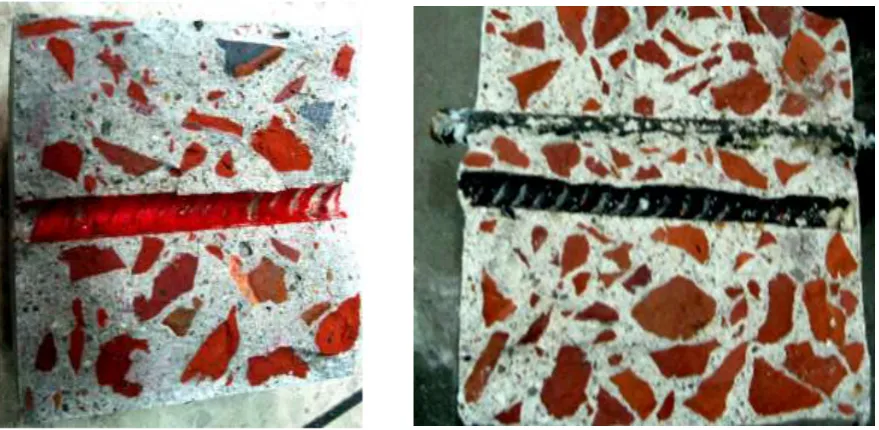
However, for steel bars with other two polymeric paints, the coatings were remained almost fully attached on the concrete-steel bar mating surfaces,
Figure 7. This means the bonding between paints and the steel bar was not sufficiently strong.
Another possible reason behind the weak bonding between ujala or enamel paint and the reinforcing steel bar is the use of some sort of oil (thinner) that usually makes the paint thin and wets the steel bar surface easily. Gradually, the oil goes out and the paint gets dried. However, the removal of oil at the interfaces of paint and steel is somewhat difficult as the paints start to solidify from the surface and creates a barrier to come out from the inner surfaces. So, small portion of the oily substance might remain inside that make weak bond with the steel bars. When compressive load was applied, the bar came out keeping almost all paint layers over the mating concrete surfaces. This type slippage of reinforcing steel bars due to presence of oil has been mentioned many investigators [15-18]. However, the case for epoxy paint is not like that. Here methyl ethyl ketone peroxide was used as hardener before the application of the paint over the steel bar surfaces and that this hardener is not oil based. After full chemical reaction, the epoxy paint coating became very hard, which is clear from Table 5. So, like other two paints there no point or line of interfacial weakness. So, epoxy paint coating showed higher level of bonding strength with the concrete. The higher performance of epoxy coated steel bars in terms of bonding strength and corrosion resistance have also observed some other researchers [19-21].
4. Conclusions
In this paper, the effects of various types of polymer based paint coatings on the bonding strength of the reinforcing steel bars with concrete have been studied. Experimental results revealed that epoxy coating on steel bar is very good option to avoid bar corrosion in concrete without deteriorating the bonding strength with the concrete. However, locally produced brand as ujala paint or synthetic enamel paint that contains oily substance at the initial stage of application is very harmful for bonding strength between coated steel bars and the surrounding concrete interfaces. Use of these type of paints over the steel bar surfaces to protect their corrosion can cause slippage of the bar under high level of applied loads.
5. Acknowledgement
The authors, especially the first author is indebted to the CASR of Bangladesh University of Engineering and Technology (BUET) for providing necessary fund for research project which is pre-requisite for his Master Degree. They are also grateful to the Department of Materials and Metallurgical Engineering for allowing them to use the departmental lab facilities.
Available online: https://edupediapublications.org/journals/index.php/IJR/ P a g e | 1715
6. References
[1] Quraishi1 MA, Nayak DK, Kumar R and Kumar V 2017. Journal of Steel Structures & Construction, 3 1.
[2] Mohammed TU, Otsuki N, Hamada H 2003. Journal of Material in civil Engineering
14 660.
[3] Alsadey S 2015. Journal of Agricultural Science and Engineering 1 70.
[4] Quraishi MA, Kumar V, Abhilash PP and Singh BN 2011. J Mater Environ Sci. 2
365.
[5] Isgor OB, Razaqpur AG 2006. Materials and Structures 39 291.
[6] Gaidis JM 2004. Journal of Cement and Concrete Composite 26 181.
[7] Mullick DAK 2004. The Indian Concrete Journal 74 168.
[8] Mohammed TU, Otsuki N and Hamada H 2003. J. of Material in Civil Engineering 15: 460.
[9] Chung L, Kim JHJ and Yi ST 2008. Journalof Cement & Concrete Composites 30
603.
[10] Skoglund P, Silfwerbrand J, Holmgren J and Tragardh J 2008. Journal of Materials and Structures 41 1001. [11] Mehta P K and Monteiro PJM 2006.
Journal of Concrete Microstructures, Properties and Materials 4 159.
[12] Publication No. FHWA-HRT-04-090 2004, US Department of Transportation. [13] Broomfield JP 2007. London: Taylor & Francis 2nd ed. 16.
[14] Sagüés AA and Lau, K 2009. Report No. BD544-23, Tampa, Florida, Florida Department of Transportation.
[15] Albarwary, IHM 2013. European Scientific Journal 9 1857.
[16] Fang C, Lundgren K, Chen L and Zhu C 2004, Journal of Cement and Concrete Research 34 2159.
[17] Fang C, Lundgren K, Plos M and Gylltoft K 2006. Journal of Cement and Concrete Research, 36 1931.
[18] Foroughi A, Dilmaghani S and Famili H 2008. International Journal of Civil Engineering, 6 24.
[19] Pravin J, Pravin Y and Priyanka M 2016. International Journal of Technical Research and Applications 4 130. [20] Gerald GM, Jennifer LK and David D. ACI Structural Journal Technical Report No. 100 S34 P.