On the Communication Complexity of Reliable
and Secure Message Transmission in
Asynchronous Networks
Ashish Choudhury⋆1 and Arpita Patra2 1
Department of Computer Science University of Bristol
[email protected], [email protected]
2
Department of Computer Science ETH Zuruch
[email protected], [email protected]
Abstract. In this paper, we study the communication complexity of Re-liable Message Transmission(RMT) and Secure Message Transmission (SMT) protocols inasynchronous settings. We consider two variants of the problem, namely perfect(where no error is allowed in the protocol outcome) and statistical (where the protocol may output a wrong out-come with negligible probability). RMT and SMT protocols have been investigated rigorously in synchronous settings. But not too much at-tention has been paid to the asynchronous version of the problem. In a significant work, Choudhury et al. (ICDCN 2009 and JPDC 2011) have studied the network connectivity requirement for asynchronous perfect and statistical SMT protocols. Their investigation reveals the following two important facts:
1. perfect SMT protocols require more network connectivity in asyn-chronous network than synasyn-chronous network.
2. Connectivity requirement of statistical SMT protocols is same for both synchronous and asynchronous network.
Unfortunately, nothing is known about the communication complexity of RMT and SMT protocols in asynchronous settings. In this paper, we derive tight bounds on the communication complexity of the above prob-lems and compare our results with the existing bounds for synchronous protocols. The interesting conclusions derived from our results are:
1. RMT: Asynchronyincreasesthe communication complexity of per-fectRMT protocols. However, asynchrony hasno impacton the com-munication complexity ofstatisticalRMT protocols.
2. SMT: Communication complexity of SMT protocols is more in asynchronous network, forbothperfect as well as statistical case.
⋆Part of this work was done when the author was working at Center of Excellence
1
Introduction
Reliable Message Transmission(RMT) andSecure Message Transmission(SMT) [4] are fundamental problems in secure distributed computing as well as in cryp-tography. In the problem of RMT, there aren disjoint channels (also called as wires) between a senderSand a receiverR.Sand Rshares no information in advance. There is acomputationally unbounded activeadversary, denoted asAt, who can listen and forge the communication over t out of the n wires, where t < n. Shas a message mS
, which is a sequence of ℓ elements, chosen from a finite field F, where ℓ ≥ 1 and |F| > n. The challenge is to design a protocol, such that at the end of the protocol,Rcorrectly outputsmR
=mS
. Now there are two flavors of RMT:
1. Perfect RMT (PRMT): HeremR =mS
, without any error. 2. Statistical RMT (SRMT): HeremR
=mS
with probability at least 1−δ, where 0< δ <1/2 and is called the error probability.
Notice that there is no issue of privacy in RMT protocols; i.e., the adversary can also knowmS
during the protocol execution. If we add the issue of privacy to RMT protocols, then we arrive at the notion of SMT protocols. In SMT protocols, we require that not only Routputs mR
= mS
, but also At should not learn any information aboutmS
ininformation theoreticsense. We can have two types of SMT protocols:
1. Perfect SMT (PSMT): HeremR =mS
, without any error. 2. Statistical SMT (SSMT): Here mR
= mS
with probability at least 1−
δ, where 0 < δ < 1/2 and is called error probability. However, there is no compromise in the privacy which should be error free and information theoretic.
RMT and SMT problem were first formulated by Dolev et al. [4]. Any RMT or SMT protocol has the following important parameters:
1. Connectivity: It is the total number of wiresn(expressed as a function oft) required in the protocol. We consider following two types of wires:
(a) Uni-directional wires: where all thenwires are uni-directional, directed fromStoR, allowing only one way communication (i.e., no interaction) fromStoR;
(b) Bi-directional wires: where all the n wires are bi-directional, allowing bi-directional communication (i.e., interaction) betweenSandR. 2. Communication Complexity: It is the number of field elements communicated
bySandR(expressed as a function ofn, ℓ) in the protocol.
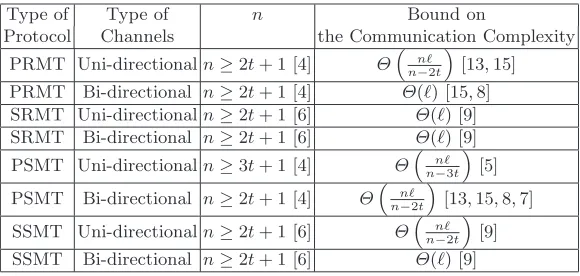
Table 1.Existing bounds for RMT and SMT protocols
Type of Type of n Bound on
Protocol Channels the Communication Complexity
PRMT Uni-directionaln≥2t+ 1 [4] Θ nℓ n−2t
[13, 15] PRMT Bi-directional n≥2t+ 1 [4] Θ(ℓ) [15, 8] SRMT Uni-directionaln≥2t+ 1 [6] Θ(ℓ) [9] SRMT Bi-directional n≥2t+ 1 [6] Θ(ℓ) [9] PSMT Uni-directionaln≥3t+ 1 [4] Θ nℓ
n−3t
[5]
PSMT Bi-directional n≥2t+ 1 [4] Θ nℓ n−2t
[13, 15, 8, 7]
SSMT Uni-directionaln≥2t+ 1 [6] Θ nℓ n−2t
[9] SSMT Bi-directional n≥2t+ 1 [6] Θ(ℓ) [9]
Remark 1. (Note on the Communication Complexity of SRMT and SSMT Protocols) In any SRMT/SSMT, the field size |F| is selected as a function of the error probabilityδ. So though δis not figuring out explicitly in the communication complexity expressions of SRMT/SSMT protocols in Table 1, it is implicitly present. More specifically, each element ofFcan be represented by log|F|bits, which will be a function ofδ. So if we consider the total number of bits communicated during any SRMT/SSMT protocol, δ will be present in the communication complexity expression. This point will be made more clear,
when we discuss our protocols. 2
Motivation of Our Work. The results given in Table 1 assume that the under-lying network issynchronous, where there is a global clock and the transmission delay over each wire is bounded by an upper bound. Though theoretically inter-esting, this does not model the real life scenario (like the Internet) appropriately, as the delay in the transmission of even a single message will affect the overall properties of the protocol. In a typical large network like the Internet, every mes-sage can have arbitrary delay and this can be modeled more appropriately by asynchronousnetworks, where no timing assumptions are made. Unfortunately, unlike synchronous networks, not much attention has been paid to RMT and SMT protocols in asynchronous settings. In this paper, we improve this situa-tion by deriving tight bounds on the communicasitua-tion complexity of asynchronous RMT and SMT protocols.
Asynchronous Network Model. In an asynchronous network, every wire
distinguish between aslow wireand acorrupted wire. That is, if in the protocol, some information is supposed to arrive over a wire and if no information arrives, then it cannot be distinguished whether the wire is honest and the information is simply delayed (due to the malicious scheduling byAt) or whetherAthas simply blocked the transmission over the wire by taking its control. Due to this, neither
SnorRcan afford to wait for all thenwires to transmit their information, as waiting for all of them may turn out to be endless. So they have to start the computation, as soon as they receive information over at leastn−t wires and they may have to ignore the transmission overt (potentially honest) wires. Due to this limitation, the techniques from the synchronous world cannot be adapted straight forwardly to the asynchronous settings.
We call the asynchronous PRMT, SRMT, PSMT and SSMT protocols as APRMT, ASRMT, APSMT and ASSMT respectively. Now in addition to the reliability and secrecy condition (as in the synchronous protocols), these asyn-chronous protocols also have to explicitly satisfy termination condition, ac-cording to which both SandRshould eventually terminate the protocol.
Existing Results for Asynchronous Protocols. The first asynchronous
SMT protocol was proposed in [10], where the authors have designed an APSMT protocol with n = 2t+ 1 uni-directional wires from S to R. However, in [2], Choudhury et al. have shown that the protocol of [10] is insecure. Moreover, they have also studied the connectivity requirement for APSMT and ASSMT protocols. More specifically, they have shown the following twosurprisingresults:
1. Any APSMT protocol requires n ≥ 3t+ 1 wires, irrespective of whether the wires are uni-directional or bi-directional. This is quiet surprising, since we can design PSMT protocols in synchronous settings with n ≥ 2t+ 1 bi-directional wires (see sixth row of Table 1). This shows thatasynchrony affects the connectivity of PSMT protocols.
2. Any ASSMT protocol requiresn≥2t+ 1 wires, irrespective of whether the wires are uni-directional or bi-directional. The same connectivity is required even for SSMT protocols (see the last two rows of Table 1). This implies asynchrony has no affect on the connectivity of SSMT protocols.
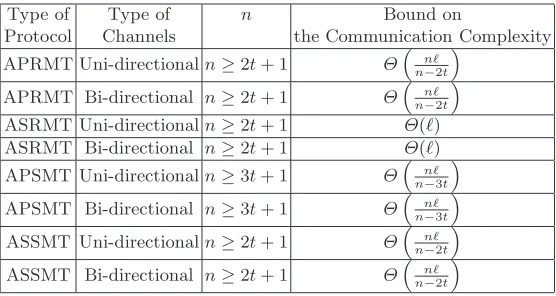
Our Results and their Significance. So far nothing is known about the com-munication complexity of APRMT, ASRMT, APSMT and ASSMT protocols. We derive tight bounds on the communication complexity of the above problems. These bounds are summarized in Table 2.
Comparing Table 1 and Table 2, we find the following surprising facts:
1. PRMT: Asynchrony increases the communication complexity of PRMT
Table 2.Our Bounds for Asynchronous RMT and SMT Protocols
Type of Type of n Bound on
Protocol Channels the Communication Complexity
APRMT Uni-directionaln≥2t+ 1 Θ nℓ n−2t
APRMT Bi-directional n≥2t+ 1 Θ nℓ n−2t
ASRMT Uni-directionaln≥2t+ 1 Θ(ℓ)
ASRMT Bi-directional n≥2t+ 1 Θ(ℓ)
APSMT Uni-directionaln≥3t+ 1 Θ nℓ n−3t
APSMT Bi-directional n≥3t+ 1 Θnnℓ −3t
ASSMT Uni-directionaln≥2t+ 1 Θnnℓ −2t
ASSMT Bi-directional n≥2t+ 1 Θ nℓ n−2t
2. SRMT: Asynchrony does not affect the communication complexity of SRMT protocols. In this case, the communication complexity issamefor both syn-chronous as well as asynsyn-chronous protocols (third and fourth row of Table 1 and Table 2 respectively).
3. PSMT: Asynchrony increases the communication complexity of PSMT pro-tocols.From [2], asynchrony increases the connectivity requirement of PSMT protocols. Our results show that the same holds even for the communication complexity (see the sixth row of Table 1 and Table 2).
4. SSMT: Interestingly, we find thatasynchrony even increases the communi-cation complexity of SSMT protocols. Specifically, forn= 2t+1 bi-directional wires, SSMT protocol can be designed with a communication complexity of Θ(ℓ) (last row of Table 1), where as ASSMT scheme must have a commu-nication complexity ofΘ(nℓ) (last row of Table 2). However, [2] shows that asynchrony does not increase the connectivity of SSMT protocols.
The Road-map. We present our results on APRMT, ASRMT, APSMT and
ASSMT in Section 2, 3, 4 and 5 respectively. We conclude the paper and discuss few open problems in Section 6.
2
Bound on the Communication Complexity of APRMT
Throughout Section 2, we assumen≥2t+ 1, asn≥2t+ 1 wires (uni-directional or bi-directional) are required for any PRMT protocol (Table 1), we require the same for APRMT protocols as well.
2.1 Bounds for Uni-Directional Wires
Theorem 1. Any APRMT protocol, executed overn(n≥2t+1) uni-directional wires has a communication complexity ofΩ nℓ
n−2t
Proof: Easy, as the bound holds for PRMT protocols [13]. 2 Theorem 2. Let theren(n= 2t+ 1) uni-directional wires from StoR. Then there exists an APRMT protocol with communication complexity of O(nℓ) =
O nℓ n−2t
.
Proof: Consider the following protocol: To reliably send a message of sizeℓ,S
sends the message over all thenwires.Rwaits for a message received identically over t+ 1 wires and output the message. The output is correct, since at least one wire out of theset+ 1 wires is honest, which will deliver the original mes-sage. Moreover, termination is guaranteed since there are at least t+ 1 honest wires, which will eventually deliver correct message. It is easy to verify that the
communication complexity isO(nℓ). 2
2.2 Bounds for Bi-Directional Wires
LetSandRbe connected bynbi-directional wires, denoted byW={w1, . . . , wn}, wheren≥2t+1. Then we show that any APRMT protocol has a communication complexity ofΩ nℓ
n−2t
. For this, we prove the following:
1. We first show that the information exchanged overanyn−2t wires should completely determine the message in any APRMT protocol executed overn bi-directional wires (Lemma 1).
2. Next, we show that any APRMT protocol where the information exchanged overanyn−2twires completely determine the message, must communicate Ωnnℓ−2t(Lemma 2).
Lemma 1. In any APRMT protocol executed over n ≥ 2t+ 1 bi-directional
wires, the information exchanged over any n−2t wires completely determines the message.
Proof: On contrary, letΠAPRMT
be an APRMT protocol where the information exchanged over anyn−2twires is independent ofmS
. We divide the set ofnwires intothreegroups, namelyG1, G2andG3. The groupG1consists of the firstn−2t wires w1, . . . , wn−2t, group G2 consists of the next t wires wn−2t+1, . . . , wn−t and groupG3 consists of the lastt wireswn−t+1, . . . , wn.Now according to our assumption, the information exchanged over the wires in groupG1(consisting of n−2t wires) in any execution ofΠAPRMT will be independent of message. That is, there exist a pair of messages, say mS
1 and m S
2 such that the information communicated over G1 while sending mS1 and respectively m
S
2 are same. We define the following variables with respect to any executionEof ΠAPRMT:
1. time(E,R, wi): lists the arrival time-stamps of different messages (with re-spect to the local clock ofR) received byR along wirewi, for i= 1, . . . , n in executionE.
3. Etime: denotes the total time taken (with respect toR) by executionE; i.e., the time at whichRterminates the protocol in executionE.
SinceΠAPRMT is an APRMT protocol, any executionE ofΠAPRMT must termi-nate. Now consider the following two possible executions ofΠAPRMT,E
1andE2. LetRterminatesE1(E2) at timeE1time(Etime2 ), correctly outputtingm
S 1 (m
S 2). 1. ExecutionE1: The random coins of Sand Rare r1 and r2 respectively.S
wants to reliably send the messagemS
1. The adversary strategy is to passively listen (without modifying them) the communication over the wires in group G2 and arbitrarily delaying the communication over the wires in groupG3, till the timeEtime
1 +E2time+ 1. Let αand β1 denote the messages that are exchanged betweenSandR, along the wires in groupG1andG2respectively. 2. ExecutionE2: The random coins of Sand Rare r3 and r2 respectively.S
wants to reliably send the messagemS 2 6=m
S
1. The adversary strategy is to passively listen (without modifying them) the communication over the wires in groupG2 and arbitrarily delaying the communication over the wires in groupG3, till the timeE1time+E2time+ 1. Letαandβ2denote the messages that are exchanged betweenSand R, along the wires in groupG1 andG2 respectively.Notice thatαis same as in executionE1 due to our assumption about the distribution of information over the wires inG1 in ΠAPRMT. We now show another possible execution ofΠAPRMT and an adversary strategy, whereRoutputs an incorrect message.
3. ExecutionECor: The random coins of SandRarer
1and r2 respectively.S wants to reliably send the messagemS
1. Letαdenote the messages exchanged over the wires inG1.Notice thatαis same as in executionE1 andE2. Now the adversary strategy inECoris as follows: adversary delay any information along the wires in group G3 for time E1time+E2time+ 1. In addition, the adversary controls the wires in groupG2in Byzantine fashion and change the communication over these wires, such thatR gets messages corresponding to β2 along G2, while S receives messages corresponding to β1 along G2. Moreover, adversary schedules the messages along the wires inG1andG2in such a way thattime(ECor
,S, wi) =time(E1,S, wi), for everywi∈G1∪G2 andtime(ECor
,R, wi) =time(E2,R, wi), for everywi∈G1∪G2. Thus the view ofSisα β1, while view ofRisα β2.
Thus the view of S in E1 and ECor are same, so S will assume that mS1 has been communicated reliably. However, the view of R in ECor is same as inE
2 and henceRwill outputmS
2. But this violates the perfect reliability property of ΠAPRMT
, which is a contradiction. HenceΠAPRMT
does not exist. 2
Lemma 2. Any APRMT protocol toleratingAt executed overn(n≥2t+ 1) bi-directional wires, in which the information exchanged over anyn−2twires com-pletely determine the message, has a communication complexity of Ωnnℓ−2t.
information exchanged overanyn−2twires completely determine the message. We now define the following notations:
1. Mdenotes the message space from whereSselects the message to be sent. SoM=Fℓ.
2. Tmi denotes the set of all possible transmissions that can occur on wire wi∈ {w1, . . . , wn}, whenStransmits messagem∈ MusingΠAPRMT. 3. Forj≥i,Mmi,j⊆Tmi ×Tmi+1×. . .×Tmj denotes the set of all possible
trans-missions that can occur over the wires{wi, wi+1, . . . , wj}, whenStransmits messagem∈ Musing protocolΠAPRMT
. 4. Mi,j=Sm∈MM
m
i,jandTi=Sm∈MT m
i . We callTias thecapacityof wire wi andMi,j as thecapacityof the set of wires{wi, wi+1, . . . , wj}.
In protocolΠAPRMT, one element from the setT
i is transmitted over each wire wi, for i = 1, . . . , n. Moreover, each element of the set Ti can be represented by log|Ti| bits. Thus, the lower bound on the communication complexity of ΠAPRMT isΣn
i=1log|Ti|bits. In the sequel, we try to estimateTi.
Since the transmission over any set of n−2t wires in ΠAPRMT completely determines the message, it must hold that|M2t+1,n| ≥ |M|.
Though the above relation must hold for any set ofn−2twires, for simplicity, we have focussed specifically on the lastn−2twires. From the definition ofTi andMi,j, we get
n Y
i=2t+1
|Ti| ≥ |M2t+1,n| ≥ |M|.
Let g = n−2t. The above inequality holds for any selection of g wires D ⊂ {w1, . . . , wn}, where |D| = g; i.e., Qwi∈D|Ti| ≥ |M|. In particular, it holds for every selection Dk ={wkg+1 modn, wkg+2 modn, . . . , wkg+g modn}, with k∈ {0, . . . , n−1}. If we consider all the Dk sets collectively, then each wire is counted exactlyg times in the collection. Thus, the product of the capacities of allDkyields the capacity of the full wire set to thegthpower and also since each
Dk has capacity at least|M|, we get n−1
Y
k=0 Y
wj∈Dk
|Tj|= n Y
i=1
|Ti| !g
, and|M|n≤ n−1
Y
k=0 Y
wj∈Dk
|Tj|
and therefore
nlog(|M|)≤g n X
i=1
log(|Ti|).
As log(|M|) =ℓlog(|F|), from the above inequality, we get n
X
i=1
log(|Ti|)≥
nℓlog(|
F|) g
≥
nℓlog(|
F|) n−2t
.
As mentioned earlier, Pn
bound isnℓnlog(−2t|F|)bits. Now each field element can be represented by log(|F|) bits. Thus the lower bound is nℓ
n−2t
field elements. 2
From the previous two lemmas, we get the following theorem.
Theorem 3. Any APRMT protocol executed over n(n≥2t+ 1) bi-directional wires has a communication complexity ofΩ nℓ
n−2t
.
Any protocol executed overnuni-directional wires can also be executed overn bi-directional wires. From Theorem 2, there exists an APRMT protocol which can be executed overn= 2t+ 1 wires and requires a communication complexity ofO nℓ
n−2t
. Thus the bound in Theorem 3 is tight.
3
Bounds on the Communication Complexity of ASRMT
Throughout Section 3, we assume n ≥ 2t+ 1. These many wires wires (uni-directional or bi-(uni-directional) are required for any SRMT protocol (Table 1). So it will also be required for ASRMT protocols.
3.1 Bounds for Uni-Directional Wires
Theorem 4. Any ASRMT protocol executed over the n (n ≥ 2t + 1)
uni-directional wires has a communication complexity ofΩ(ℓ).
Proof: Easy, as any ASRMT protocol has to at least send the message. 2
We now show that the bound in Theorem 4 isasymptotically tight. That is, suppose there exists n= 2t+ 1 uni-directional wires fromStoRand consider a finite fieldF, where|F|= tδ2. Then we design an ASRMT protocol tolerating
At called ASRMT-Uni-Directional, which reliably sends a message mS of size (t+ 1)2 = Θ(n2) field elements and has a total communication complexity of
O(n2). The protocol has an error probability of δ. The high level idea of the protocol is as follows: let the nwires be denoted byW ={w1, . . . , wn} and let mS
={mS
i,j : i, j = 0, . . . , t}, consisting of (t+ 1)2 elements of F. S selects a bi-variate polynomialQS
(x, y) of degree-tinxandy, whose (t+ 1)2coefficients are elements of mS
. Now QS
(x, y) is evaluated at y = 1, . . . , n to obtain the uni-variate polynomials fS
i (x) = Q S
(x, i) and fS
i (x) is sent over wire wi (by sending its coefficients). To recover mS
, R should correctly recover QS (x, y) which requires R to know t+ 1 correct fS
i (x)’s. In order to facilitate R to identify the correctfS
i(x)’s,Sauthenticates eachf S
i (x) usingndifferent secret authentication keys and sends the authentication information and authentication key across the n wires. Now at the receiving end, R will consider anfS
i (x) as valid only if it passes the authentication test with respect to the keys of t+ 1 wires. Since at least one of these t+ 1 wires is honest and the adversary will have no information about the authentication keys delivered over an honest wire, with very high probability a polynomial considered as valid byRwill be indeed a correct polynomial. Moreover, there are at least t+ 1 honest wires, who will eventually delivert+ 1 correctfS
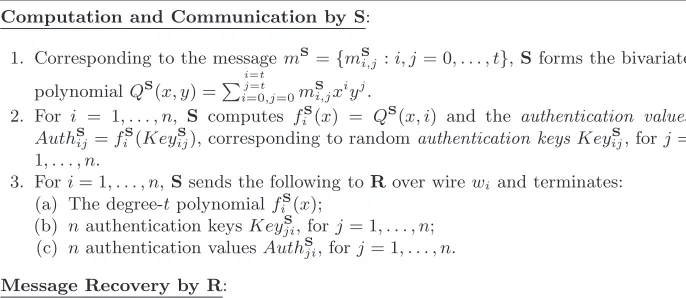
Fig. 1.ProtocolASRMT-Uni-Directionalwithn= 2t+ 1 unidirectional wires Computation and Communication by S:
1. Corresponding to the messagemS={mSi,j:i, j= 0, . . . , t},Sforms the bivariate
polynomialQS(x, y) =P
i=t j=t
i=0,j=0m
S
i,jxiyj.
2. For i = 1, . . . , n, S computes fS
i(x) = Q
S
(x, i) and the authentication values AuthSij=f
S
i(Key
S
ij), corresponding to randomauthentication keysKey
S
ij, forj=
1, . . . , n.
3. Fori= 1, . . . , n,Ssends the following to Rover wirewiand terminates:
(a) The degree-tpolynomialfS
i(x);
(b) nauthentication keysKeyS
ji, forj= 1, . . . , n;
(c) nauthentication valuesAuthS
ji, forj= 1, . . . , n.
Message Recovery by R:
Forr= 0, . . . , t,Rdoes the following in iterationr:
1. LetWR
be the set of wireswiover whichRreceives a complete set of values; i.e.,
(a) A degree-tpolynomialfR
i (x);
(b) nAuthentication keysKeyR
ji, forj= 1, . . . , n;
(c) nauthentication valuesAuthRji, forj= 1, . . . , n.
LetWR
r denote the contents ofW
R
, whenWR
contains exactlyt+ 1 +rwires. 2. Wait until|WR
| ≥t+ 1 +r. Now corresponding to everywi∈W
R
r ,Rcomputes
Supporti={wj∈W
R
r :Auth
R
ij=f
R
i (Key
R
ij)
3. If Supporti≥t+ 1, thenRconcludes thatf
R
i (x) is avalidpolynomial.
4. If Rfindst+ 1 valid polynomials, then using them R constructs the bi-variate
polynomialQR(x, y) = P
i=t j=t
i=0,j=0m
R
i,jx i
yj, outputsmR ={mRi,j :i, j = 0, . . . , t}
and terminates the protocol. OtherwiseRproceeds to the next iteration.
Lemma 3. In protocol ASRMT-Uni-Directional, if R concludes thatfR
i (x) is a valid polynomial, thenfR
i (x) =f S
i (x) except with probability |Ft|.
Proof: The lemma trivially holds without any error if wi is honest. So let wi be a corrupted wire, which deliversfiR(x)6=f
S
i (x). In order thatf R i (x) is considered as a valid polynomial by R, it must hold that Supporti ≥ t+ 1. This further implies that there exists at least one honest wire, saywj, such that wj ∈ Supporti. This implies that AuthRij = f
R i (Key
R
ij). Now notice that wj is an honest wire and so AuthR
ij = Auth S ij = f
S i (Key
S
ij) and Key R
ij = Key S ij. HoweverAtwill have no information aboutAuthRij andKey
R
ij, as they are sent overwj. So the probability thatfiR(Key
S ij) =f
S i (Key
S
ij), even iff R i (x)6=f
S i (x) is at most t
|F|. This is because two different polynomials of degree-t can agree on at most tpoints and KeyS
ij is selected randomly by S. So except with error probability t
|F|,f R i (x) =f
S
i (x) for every valid polynomialf R
Lemma 4 (Termination). Rwill eventually terminateASRMT-Uni-Directional.
Proof: The proof follows from the fact that there always exists at least t+ 1 honest wires, who will eventually deliver valid polynomials. 2
Lemma 5 (Communication Complexity).ASRMT-Uni-Directionalhas a
com-munication complexity ofO(n2)to send a message of size(t+ 1)2=Θ(n2).
Proof: Easy and follows from the protocol description. 2
Lemma 6 (Reliability).In protocolASRMT-Uni-Directional,Rwill output the correct message, except with error probability δ.
Proof: From Lemma 3,fR i (x) =f
S
i (x) for every valid polynomialf R
i (x), except with probability t
|F|. In the worst case, out of thet+ 1 wires which have delivered valid polynomials, t could be corrupted. So the probability that Routputs an incorrect message is at most t2
|F|=δ(since|F|= t 2
δ). 2
Theorem 5. Assume that there aren(n= 2t+ 1) uni-directional wires fromS
toR. Then there exists an ASRMT scheme which can reliably send a message containing Θ(n2) elements from F by communicating O(n2) elements from F, where|F|=t2
δ andδ is the error probability.
3.2 Bounds for Bi-Directional Wires
It is obvious that Θ(ℓ) can be the most tight bound on the communication complexity of any ASRMT protocol, irrespective of whether the wires are uni-directional or bi-uni-directional. Now in the previous section, we have already shown that this bound is achieved if we consider only uni-directional wires. The same bound will also hold even if we consider bi-directional wires.
Till now, we have focussed only on RMT protocols, without worrying about the privacy. We next begin our discussion on SMT protocols, where we have to ensure privacy, in addition to reliability.
4
Bounds on the Communication Complexity of APSMT
Throughout Section 4, we assume that n≥3t+ 1 sincen≥3t+ 1 wires (uni-directional or bi-(uni-directional) are required for any APSMT protocol [2].
4.1 Bounds for Uni-Directional Wires
In [5], it is shown that any PSMT protocol has a communication complexity of Ω nℓ
n−3t
, when there existsn ≥3t+ 1 uni-directional wires from S to R. The lower bound will also hold for APSMT protocols. Moreover, in [2], the authors have designed an APSMT protocol, which requires a communication complexity ofO(nℓ) =O nℓ
n−3t
Theorem 6. Any APSMT scheme executed over n uni-directional wires from
StoR, where n≥3t+ 1 has a communication complexity ofΘ nℓ n−3t
.
4.2 Bounds for Bi-Directional Wires
LetSandRbe connected bynbi-directional wires, denoted byW={w1, . . . , wn}, wheren≥3t+1. Then we show that any APSMT protocol has a communication complexity ofΩ nℓ
n−3t
. To derive the lower bound, we use an approach similar to the one used Theorem 3. Specifically, we show the following:
1. We first show that in any APSMT protocol executed over nbi-directional wires, wheren ≥3t+ 1, the information exchanged overany n−2t wires completely determine the message (Lemma 7).
2. Next, we show that any APSMT protocol where the information exchanged over n−2t wires completely determine the message has a communication complexity ofΩ nℓ
n−3t
(Lemma 8).
Lemma 7. In any APSMT protocol executed overn bi-directional wires, where n≥3t+ 1, the information exchanged over any n−2t wires should completely determine the secret message mS
.
Proof: The proof follows using same arguments as in Lemma 1. 2 Lemma 8. Any APSMT protocol executed over n (n ≥ 3t+ 1) bi-directional wires, in which the information exchanged over any n−2t wires completely determine the message, has a communication complexity ofΩnnℓ−3t.
Proof: Here we will use same arguments as used in Lemma 2. But we will also use an additional fact about APSMT protocols. LetΠAPSMTbe an APSMT protocol, executed over n bi-directional wires (where n ≥ 3t+ 1), to securely send a message of sizeℓ, such that the information exchanged overany n−2t wires completely determine the message. We now define the notationsM,Tmi ,
Mmi,j andMi,j, which are exactly the same as in Lemma 2.
SinceΠAPSMT is an APSMT protocol, it implies that in ΠAPSMT, the trans-mission on any set oftwires isindependentof the secret message. If it is not the case, then adversary will also know the secret message by passively listening the t wires. Thus, for any two messagesm1, m2∈ M, it must hold that
Mm12t+1,3t=Mm22t+1,3t.
Notice that the above relation must hold for any selection oftwires. We focussed on the set{w2t+1, . . . , w3t}just for simplicity. Now inΠAPSMT, the transmission over any set ofn−2twires hasfullinformation about the secret message. Thus it must also hold that
We again stress that the above relation must hold for any selection of n−2t wires. We focussed on the set{w2t+1, . . . , wn}just for simplicity. As mentioned earlier, Mm2t+1,3t will be same for all messages m ∈ M. Thus, in order that the above relation holds, it must hold thatMm
3t+1,n isuniquefor every message m∈ M. This implies that
|M3t+1,n|=|M|. From the definition ofTiand Mi,j, we get
n Y
i=3t+1
|Ti| ≥ |M3t+1,n| ≥ |M|.
Let g = n−3t. The above inequality holds for any selection of g wires D ⊂ {w1, . . . , wn}, where |D| = g; i.e., Qwi∈D|Ti| ≥ |M|. In particular, it holds for every selection Dk ={wkg+1 modn, wkg+2 modn, . . . , wkg+g modn}, with k∈ {0, . . . , n−1}. If we consider all the Dk sets collectively, then each wire is counted exactlyg times in the collection. Thus, the product of the capacities of allDk yields the capacity of the full wire set to the g-th power, and since each
Dk has capacity at least|M|, we get
|M|n≤ n−1
Y
k=0
Πwj∈Dk|Tj|= n Y
i=1
|Ti| !g
,
and therefore
nlog(|M|)≤g n X
i=1
log(|Ti|).
As log(|M|) =ℓlog(|F|), from the above inequality, we get n
X
i=1
log(|Ti|)≥
nℓlog(|
F|) g
≥
nℓlog(|
F|) n−3t
.
NowPn
i=1log(|Ti|) denotes the lower bound on the communication complexity of protocol ΠAPSMT
in bits. From the above inequality, we find that the lower bound isnℓnlog(−3t|F|)bits. Now each field element can be represented by log(|F|) bits. Thus the lower bound is nℓ
n−3t
field elements. 2
Theorem 7. Any APSMT protocol executed overn (n≥3t+ 1) bi-directional wires has a communication complexity ofΩ nℓ
n−3t
.
Now any protocol executed over n uni-directional wires can also be executed over nbi-directional wires. From Theorem 6, there exists an APSMT protocol which can be executed over n = 3t+ 1 uni-directional wires and requires a communication complexity ofO nℓ
n−3t
5
Bounds on the Communication Complexity of ASSMT
Any ASSMT protocol requiresn≥2t+ 1 wires, irrespective of whether the wires are uni-directional or bi-directional [2]. So we assume thatn≥2t+ 1 throughout Section 5.
5.1 Bounds for Uni-Directional Wires
Theorem 8. Any ASSMT protocol executed overn(n≥2t+ 1) uni-directional wires has a communication complexity ofΩ nℓ
n−2t
.
Proof: The theorem follows from the fact that any SSMT protocol with n≥
2t+ 1 uni-directional wires [9] requires the same communication complexity. 2
We now show that the bound in Theorem 8 is asymptotically tight. Let there existsn= 2t+ 1 uni-directional wiresW={w1, . . . , wn}fromStoR. Then we design a protocol calledASSMT-Uni-Directional, which securely sends a message
mS ={mS
k :k= 1, . . . , n} containingℓ=nelements from the fieldFand has a communication complexity ofO(n2) =O nℓ
n−2t
, where |F|= ntδ. The high level idea of the protocol is as follows: for eachmS
k, sender gener-ates n Shamir shares [12]. Now the ith share of each mS
k is sent over wire wi. However, it is not enough to just send the shares, as the adversary can delay the communication overthonest wires and it can also change the shares overt cor-rupted wires. SoSalso sends some authentication information, which will enable
R to identify the corrupted shares with very high probability. For performing the authentication, we use similar idea as used in our ASRMT protocol (see Fig. 1), with some additional steps. More specifically, we interpret theith shares of nsecrets as the coefficients of a polynomialfS
i (x) of degree-n. This polynomial will be sent overwi (this is same as sending the ith shares for then messages). Now the polynomial fS
i(x) can be authenticated by n random authentication keys KeyS
ij by computing Auth S ij = f
S i (Key
S
ij). However, the communication of KeyS
ij, Auth S
ij over wire wj will breach the privacy of fiS(x), ifwi is honest andwj is corrupted. To avoid this, we perform the authentication in the follow-ing way: correspondfollow-ing to KeyS
ij, we select a random masking keyM ask S ij and define AuthS
ij = f S i (Key
S
ij) +M ask S
ij. Finally, Key S ij, Auth
S
ij will be sent over wj, whileM askijS will be sent overwi, along withfiS(x). As we will show later, this will help to maintain the perfect privacy and will also help to identify the corrupted shares with very high probability. OnceRreceivest+ 1 correct shares (which he will receive eventually), Rwill correctly recover each mS
k with very high probability. The details are in Fig. 2.
We now prove the properties of protocolASSMT-Uni-Directional. Lemma 9. In protocol ASSMT-Uni-Directional, if R concludes that fR
i (x) is a valid polynomial, thenfR
i (x) =f S
i (x) except with probability |nF|.
Fig. 2.ProtocolASSMT-Uni-Directional. LetmS
={mS
k:k= 1, . . . , n}.
Computation and Communication by S:
1. For k = 1, . . . , n, corresponding to mSk, Sselects a random degree-t polynomial
pS
k(x), wherep
S
k(0) =m
S
k and computesSh
S
ki=p
S
k(i), fori= 1, . . . , n.
2. Fori= 1, . . . , n,Sforms a polynomialfiS(x) =Sh
S
1i·x+Sh
S
2i·x
2
+. . .+ShSni·xn.
3. Fori= 1, . . . , n, corresponding to the polynomialfS
i(x),Sselects nrandom
au-thentication keysKeyS
ij andn random masking keysM ask
S
ij, for j= 1, . . . , n.S
then computesAuthS
ij=f
S
i(Key
S
ij) +M ask
S
ij.
4. Fori= 1, . . . , n,Ssends the following to Rover wirewiand terminates:
(a) The polynomialfiS(x) of degree-nby sending its coefficients;
(b) nMasking keysM askS
ij, forj= 1, . . . , n;
(c) n authentication keys KeyjiS and n authentication values Auth
S
ji, for j =
1, . . . , n.
Message Recovery by R:
Forr= 0, . . . , t,Rdoes the following in iterationr:
1. LetWR
be the set of wireswiover whichRreceives a complete set of values; i.e.,
(a) A polynomialfR
i (x) of degree-n;
(b) nMasking keysM askRij, forj= 1, . . . , n;
(c) n authentication keys KeyR
ji and n authentication values Auth
R
ji, for j =
1, . . . , n. LetWR
r denote the contents ofW
R
, whenWR
contains exactlyt+ 1 +rwires. 2. Wait until|WR
| ≥t+ 1 +r. Now corresponding to everywi∈W
R
r ,Rcomputes
Supporti={wj∈W
R
r :Auth
R
ij=f
R
i (Key
R
ij) +M ask
R
ij}
3. If Supporti ≥ t+ 1, then R concludes that f
R
i (x) is a valid polynomial. Let
fR
i (x) =Sh
R
1i·x+Sh
R
2i·x
2
+. . .+ShR
ni·xn. ThenSh
R
ki is considered as a valid
share formSk, fork= 1, . . . , n.
4. IfRfindst+ 1 valid polynomials, then from their coefficients,Rfindst+ 1 valid shares for eachmS
k, fork= 1, . . . , n. Now using these valid shares,Rreconstructs
the degree-tpolynomialspR
k(x), outputsm
R
={pR
k(0) :k= 1, . . . , n}and
termi-nates the protocol. OtherwiseRproceeds to the next iteration.
Lemma 10 (Termination). Rwill eventually terminateASSMT-Uni-Directional.
Proof: The proof follows from the fact that there always exists at least t+ 1 honest wires, who will eventually deliver valid polynomials. 2
Lemma 11 (Communication Complexity). ASSMT-Uni-Directional has a
communication complexity of O(n2)to send a message of sizen.
Proof: Easy and follows from the protocol description. 2
Proof(sketch): The proof follows using similar arguments as used in Lemma
6 and the fact that|F|=ntδ. 2
Lemma 13 (Perfect Secrecy). In protocol ASSMT-Uni-Directional, the mes-sage mS
will be perfectly secure.
Proof: Without loss of generality, let w1, . . . , wt be under the control of At. So the adversary will knowt shares for eachmS
k, for k = 1, . . . , n through the polynomials fS
1(x), . . . , f S
t(x). The adversary will also know Authji, for j = t+ 1, . . . , nandi= 1, . . . , t. But this will not reveal any new information about fS
j(x), for j = t+ 1, . . . , n, as the adversary will not know the corresponding masking keysM askji, forj=t+ 1, . . . , nandi= 1, . . . , tbecause they are sent over wires wj, for j =t+ 1, . . . , n, which are honest. Now the secrecy of each mS
k follows from the properties of Shamir secret sharing [12]. 2
Theorem 9. Let there exists n(n≥2t+ 1) uni-directional wires fromStoR. Then there exists an ASSMT protocol, which securely sends a message of size ℓ=n and requires a communication complexity ofO(n2) =O nℓ
n−2t
.
5.2 Bounds for Bi-Directional Wires
Theorem 10. Any ASSMT protocol executed overn(n≥2t+ 1) bi-directional wires has a communication complexity ofΩ nℓ
n−2t
.
Proof(sketch): We give the high level idea. We first claim that in any ASSMT protocol executed over n (n ≥2t+ 1) bi-directional wires, the communication over any set of n−t wires should completely determine the secret message. This is obvious, since the adversary can arbitrarily delay the communication over t wires. So R should have the capacity to recover the message even from the communication done overn−t wires. We next claim that in any ASSMT protocol, the communication over any set oft wires should be completely inde-pendent of the secret message. Now from these two facts, we can derive that the communication complexity will beΩ nℓ
n−2t
. 2
From Theorem 9, there exists an ASSMT scheme, which can be executed over n = 2t+ 1 uni-directional wires and which has an asymptotic communication complexity ofO nℓ
n−2t
. The same protocol can also be executed overn= 2t+ 1 bi-directional wires. Thus the bound in Theorem 10 is asymptotically tight.
6
Conclusion and Open Problems
References
1. S. Agarwal, R. Cramer, and R. de Haan. Asymptotically optimal two round per-fectly secure message transmission. InCRYPTO, LNCS 4117, pp 394–408, 2006. 2. A. Choudhary, A. Patra, Ashwinkumar B. V, K. Srinathan, and C. Pandu
Ran-gan. On minimal connectivity requirement for secure message transmission in asynchronous networks. InICDCN, LNCS 5408, pp 148–162, 2009. Full version to appear inJPDC2011.
3. A. Choudhury. Protocols for reliable and secure message transmission. Cryptology ePrint Archive, Report 2010/281, 2010.
4. D. Dolev, C. Dwork, O. Waarts, and M. Yung. Perfectly secure message transmis-sion. JACM, 40(1):17–47, 1993.
5. M. Fitzi, M. K. Franklin, J. A. Garay, and S. H. Vardhan. Towards optimal and efficient perfectly secure message transmission. InTCC, pp 311–322, 2007. 6. M. Franklin and R. Wright. Secure communication in minimal connectivity models.
Journal of Cryptology, 13(1):9–30, 2000.
7. K. Kurosawa and K. Suzuki. Truly efficient 2 round perfectly secure message transmission scheme. InEUROCRYPT, LNCS 4965, pp 324–340, 2008.
8. A. Patra, A. Choudhary, K. Srinathan, and C. Pandu Rangan. Constant phase bit optimal protocols for perfectly reliable and secure message transmission. In INDOCRYPT, LNCS 4329, pp 221–235, 2006.
9. A. Patra, A. Choudhary, K. Srinathan, and C. Pandu Rangan. Unconditionally reliable and secure message transmission in undirected synchronous networks: Pos-sibility, feasibility and optimality.IJACT, 2(2):1599–197, 2010.
10. H. Sayeed and H. Abu-Amara. Perfectly secure message transmission in asyn-chronous networks. In IEEE Symposium on Parallel and Distributed Processing, pp 100–105, 1995.
11. H. Sayeed and H. Abu-Amara. Efficient perfectly secure message transmission in synchronous networks. Information and Computation, 126(1):53–61, 1996. 12. A. Shamir. How to share a secret. Communications of the ACM, 22(11):612–613,
1979.
13. K. Srinathan, A. Narayanan, and C. Pandu Rangan. Optimal perfectly secure message transmission. InCRYPTO, LNCS 3152, pp 545–561, 2004.
14. K. Srinathan, A. Patra, A. Choudhary, and C. Pandu Rangan. Probabilistic per-fectly reliable and secure message transmission - possibility, feasibility and opti-mality. InINDOCRYPT, LNCS 4859, pp 101–122, 2007.