Reflected eclipses on circumbinary planets
H.J. Deeg
1& L.R. Doyle
21
Instituto de Astrof´ısica de Canarias, C/ V´ıa L´
actea S/N, E-38200 La Laguna,
Spain [[email protected]]
2
SETI Institute, 189 N. Bernardo Avenue, Mountain View, CA 94043, USA
Abstract.
A photometric method to detect planets orbiting around
short-periodic binary stars is presented. It is based on the detection of eclipse-signatures
in the reflected light of circumbinary planets. Amplitudes of such ’reflected eclipses’
will depend on the orbital configurations of binary and planet relative to the
ob-server. Reflected eclipses will occur with a period that is distinct from the binary
eclipses, and their timing will also be modified by variations in the light-travel
time of the eclipse signal. For the sample of eclipsing binaries found by the
Ke-pler mission, reflected eclipses from close circumbinary planets may be detectable
around at least several dozen binaries. A thorough detection effort of such
re-flected eclipses may then detect the inner planets present, or give solid limits to
their abundance.
1.
Introduction
To date, no unambiguous planets orbiting around a main-sequence binary star have
been detected. Such ”circumbinary” or ”P-type” (Dvorak et al. 1989) planets would
constitute a new class of planets, whose potential existence is supported by the existence
of several cases of circumbinary dust discs (e.g. Pichardo et al., 2008). The discovery
of short-periodic circumbinary planets would also have some impact on the viability
of migration scenarios: The closest stable coplanar (in the binary plane) planet orbits
around equal-mass binaries have critical radii of about
a
c= 2
.
4
a
b, where
a
bis the
distance between binary components
1. This distance ratio corresponds to a ratio in
planet/binary period of about 3.7. However, for the planet orbits there exist regions of
instability at small integer mean-motion resonances such as 4:1, and possibly for ratios
up to 9:1 (Chambers et al. 2002). The existence of planets in orbits between zones
of instability would therefore require compatible formation scenarios, with strict limits
on potential migration routes. In the following, we give an outline of a method that
might lead to the detection of such short-period binary planets, based on the detection
of reflected light from the central binary off the planet.
1For binaries with other mass-distributions or non-coplanar planets, this ratio will be somewhat larger,
for details see Dvorak et al. 1989, Chambers et al. 2002
© Owned by the authors, published by EDP Sciences, 2011
EPJ Web of Conferences
2. Characteristics of the reflected eclipses
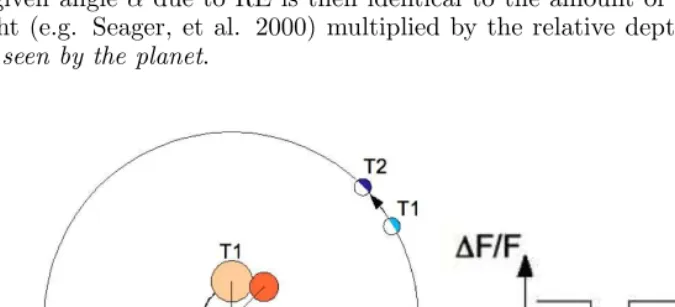
The basic idea is the detection of the binary eclipses in the reflected light signal from the planet (referred to hereafter as ’reflected eclipses’ or RE, see Fig. 1). That is, the light that is reflected from the planet will vary with the brightness of the central binary stars as they are ’seen’ by the planet, and will have the signatures of the binary-eclipses imprinted on it. A further modulation of the observed reflected light is given through a planetary phase-function, determined by the binary-planet-observer angle (Fig. 2). Such phase functions are indicative of a planet’s atmospheric or surface composition (Seager et al. 2000; Sudarsky et al. 2005). Most commonly, Lambert phase functions are assumed, which are a reasonable approximation for cloud-free giant exoplanets. For atmospheres with clouds or aerosols, as well as for solid cloudless bodies, peaks in reflection for small phase angles are expected. The observed brightness variation for a given angleα due to RE is then identical to the amount of an exoplanet’s reflected light (e.g. Seager, et al. 2000) multiplied by the relative depth of the binary eclipses as seen by the planet.
Figure 1.: Schematic of a binary star with a coplanar (binary and planet in the same plane) orbiting planet. The observer is at a semi-infinite distance towards the bottom. At time T1, the observer perceives a primary eclipse from the binary component. At a later time T2, the binary is not eclipsing to the observer, but the planet perceives an eclipse from the binary, which will be imprinted in the light that is reflected from the planet. This appears to the observer as a much shallower eclipse at T2.
For circular and coplanar orbits, reflected primary eclipses occur whenever the binary’s and the planet’s orbital phases are identical. This leads to a periodicity Pre
of the RE given by 1/Pre = 1/Pb±1/Pp, wherePb and Pp are the binary and
plane-tary periods, respectively, and the minus or plus signs corresponds to prograde respec-tively retrograde planetary orbits. Considering the above-mentioned minimum in the planet/binary period ratio of about 3.7, we may constrainPre to values fairly close to
Pp, namely: 0.78Pp ∼< Pre <∼1.37Pp; out of which, for the prograde case only,Pre > Pp
need be considered. This restricted range of possible periods should facilitate any RE detection attempts.
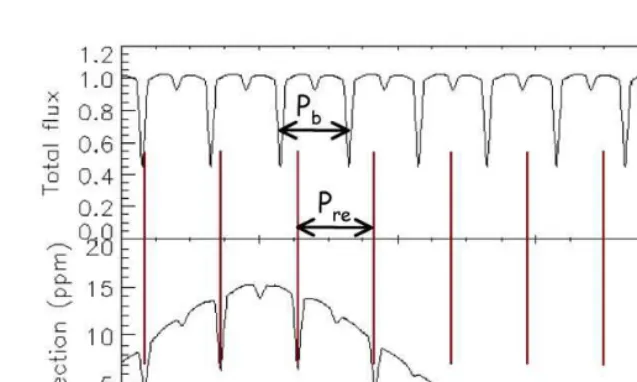
Figure 2.: Simulated lightcurve from a system with aPb=1d binary orbited by a prograde
Pp=10d planet, with an inclination of ib =ip = 90◦. The upper panel shows the total observed flux, which is dominated by the eclipses observed directly from the binary. The lower panel shows the reflected light from the planet. Note that its amplitude is on the order of ppm. The general shape of this sinusoidal light curve is due largely to the planetary phase function, upon which the reflected eclipses (positions indicated by vertical red lines) are imprinted, with a periodicity of Pre=1.11d.
decreases away from 90◦. However, the depth of the eclipses as seen by a coplanar
planet does not change, although the total amount of reflected light from the planet to the observer changes with inclination, given by the phase function. Of interest is that circumbinary planets in strongly inclined systems may generate RE even when the central binary is not eclipsing from the observer’s point of view (For an example, see the curve for i= 30◦ in Fig. 3). Thus, planets around a non-eclipsing binary system
may also be detected by their RE. Lastly, in systems of arbitrary mutual inclinations (ib 6= ip) , the reflected light curves depend not only on the respective inclinations
but also on the angle between the nodal line (formed by planet and binary orbit) and the plane of the sky; the variety of possible models is therefore very large and beyond this discussion. It is important to note that all circumbinary planets will cross the binary plane at least twice during each orbit, and therefore will be subject to RE at least during part of their orbits (though, depending on respective orbital periods and phases, RE may not occur at each planet crossing of the binary plane). In principle, all circumbinary planets should therefore be detectable by RE irrespective of their orbital configurations. The one exception will be coplanar or near-coplanar systems with inclinations near 0◦, where the direct binary eclipses are not observable, and the
EPJ Web of Conferences
Figure 3.: Similar to Fig. 2, showing the total light and the reflected light from coplanar systems at several inclination values. Note the absence of directly observable eclipses at
i = 30◦ in the upper panel while still allowing the detection of reflected light from the
binary-coplanar planet.
3. Light time effects (LTE)
Up to this point, we have used purely geometrical arguments about the positions of binary and planet while ignoring any light time effects (LTE) from the varying distances between binary, planet and observer. Without the LTE, and considering only coplanar circular orbits, the RE will be strictly periodic withPre, as given previously. However,
the light with the imprinted eclipse needs to travel from the binary to the planet, and then from the planet to the observer. This leads to advances or delays over strict periodicities with amplitudes principally determined by the light-travel time for the binary - planet distance.
For the binary and planetary orbit being both circular and coplanar, this corre-sponds to a sinusoidal ’O-C’ (observed-minus-calculated) timing variation of the REs respective to strict periodicity. More complex behavior will occur if eccentricity and/or significant non-coplanarity are present. We expect however that the timing of the RE – with the binary’s total mass being given – should in principle allow the derivation of a full orbital solution of a circumbinary planet’s orbit.
4. Detectability of RE signals
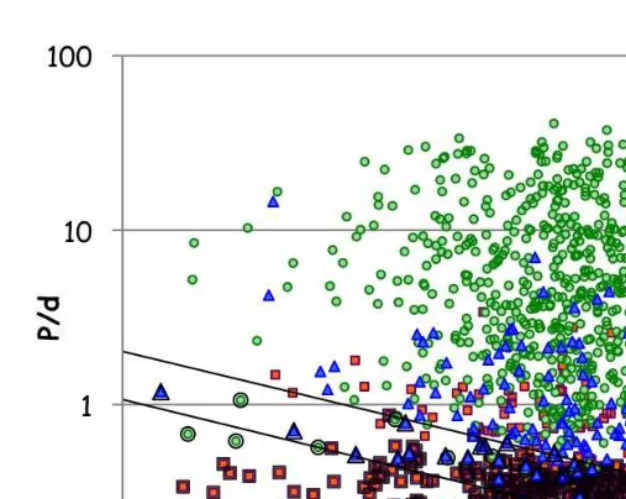
Figure 4.: Detectability of RE from planets at minimum stable orbital distances for eclipsing binaries in the Kepler data. Shown are 1601 eclipsing binaries from Prsa et al. 2010, plotted against Kepler-magnitude and period. Green circles are detached systems, blue triangles are semi-detached, and orange squares are over-contact systems. Systems with an RE detectability of σdet >3are indicated by larger symbols. The two black lines give the approximate slope below which 3 or 10 sigma detections are possible.
orbital stability limit. For planets around deeply eclipsing (∆I = 0.4−0.5) short periodic binaries withPb∼<1d, and corresponding minimal stable orbits withPp∼<4d,
EPJ Web of Conferences
the observability of the LTE for these systems, the sinusoidal ’O-C’ amplitude for
planets at the inner stability limit is simply ∆
τ
=
−
a
c/c
. For all EBs with an RE
detection sigma
≥
3, this amplitude is typically around 10 seconds, and never above 20
seconds. For the most suitable candidates (in the lower left corner in Fig. 4) Kepler
should be able to detect RE of planets at orbital distances up to 4 times the stability
limit, with corresponding LTE amplitudes approaching about 1 minute. Considering,
however, that RE detections themselves will not be an easy task, we expect that LTE
detections of the RE may only be marginally possible with Kepler. LTE detections of
circumbinaries’ RE may however be feasible with future missions focussed on brighter
stars (e.g. ESA’s PLATO mission), for which the RE of longer-periodic planets may
be detectable, which consequently will have larger timing effects.
Acknowledgements. H.J.D. acknowledges support by grant ESP2007-65480-C02-02 of the Span-ish Ministerio de Ciencia e Innovaci´on. L.R.D. acknowledges a NASA Kepler Participating Scientist Program grant NNX08AR15G. We also thank Dr. Aviv Ofir for useful discussions about this subject.
References
Chambers, J. E., Quintana, E. V., Duncan, M. J., & Lissauer, J. J. 2002, AJ, 123, 2884 Dvorak, R., Froeschle, C., & Froeschle, C. 1989, A&A, 226, 335
Jenkins, J. M. et al. 2010, ApJ, 713, L120
Pichardo, B., Sparke, L. S., & Aguilar, L. A. 2008, MNRAS, 391, 815 Prsa, A. et al. 2010, AJ in press, arXiv:1006.2815