
Improved High-Order Conversion From Boolean to Arithmetic
Masking
Luk Bettale1, Jean-S´ebastien Coron2, and Rina Zeitoun1
1
IDEMIA, France
[email protected], [email protected]
2
University of Luxembourg
Abstract. Masking is a very common countermeasure against side channel attacks. When combining Boolean and arithmetic masking, one must be able to convert between the two types of masking, and the conversion algorithm itself must be secure against side-channel attacks. An efficient high-order Boolean to arithmetic conversion scheme was recently described at CHES 2017, with complexity independent of the register size. In this paper we describe a simplified variant with fewer mask refreshing, and still with a proof of security in the ISW probing model. In practical implementations, our variant is roughly 25% faster.
1 Introduction
The masking countermeasure. Masking with random values is a well known and effective countermeasure against side-channel attacks. Every variable x in the circuit can be masked into x0 =x⊕r, wherer is a random value with the same bitsize as x. When the two shares x0 andr are manipulated separately, any first-order attack is thwarted because every intermediate variable considered separately has the uniform distribution. However a second-order attack combining the two sharesx0 andr can still be feasible in practice, though it usually requires a much greater amount of side-channel acquisitions; see for example [OMHT06].
To prevent first order attacks, Boolean masking can be naturally extended to nshares, where every variable xin the circuit is written as:
x=x1⊕ · · · ⊕xn
In that case, a side-channel countermeasure should be resistant against anyt-th order attack, in which the side-channel information from at most t < n variables is combined. More precisely, it should have a proof of security in thet-probing model introduced by Ishai, Sahai and Wagner [ISW03]. In this model, the adversary can probe at mosttwires in the circuit, and should not learn anything about the secret inputs. It was shown in [ISW03] that any circuitC can be transformed into a new circuitC0 of size O(t2· |C|) that is secure againstt probes, usingn≥2t+ 1 shares.
algorithm itself must be secure against side-channel attacks. More precisely, starting from a Boolean masking withn sharesxi such that:
x=x1⊕x2⊕ · · · ⊕xn
one must compute narithmetic shares Ai such that:
x=A1+A2+· · ·+An (mod 2k)
without leaking information about x. In general all arithmetic operations are performed modulo 2k for some fixed integer k; for example,k= 32 in SHA-1.
The first conversion algorithms between Boolean and arithmetic masking secure against first-order attacks were described by Goubin in [Gou01]. Goubin’s first-first-order Boolean to arithmetic conversion is very efficient with complexity independent of the register size k. This is based on a surprising property of the function
ψ(x, y) = (x⊕y)−y (mod 2k)
Although it contains an arithmetic operation, the function is affine in y with respect to the xor; see [Gou01] for a proof. The other direction (from arithmetic to Boolean) is less efficient with complexityO(k); this was later improved toO(logk) in [CGTV15]; however theO(logk) complexity hides a larger constant, and in practice fork= 32 the number of operations is similar.
For security against high-order attacks (i.e. with nshares), the first conversion algorithms were described in [CGV14], with complexityO(n2·k) forn shares andk-bit addition in both directions, with a proof of security in the ISW model. As in Goubin’s first-order case, the complexity can be improved toO(n2·logk) using the same technique as in [CGTV15]; however fork= 32 this does not really improve the practical efficiency.
Recently, an efficient high-order Boolean to arithmetic conversion algorithm was described in [Cor17c], with complexity independent of the register sizek(as in Goubin’s first-order algorithm), following an approach initiated by Hutter and Tunstall in [HT16]. The conversion algorithm has a security proof in the ISW model; in contrast, the original algorithm described in [HT16] had no such security proof, and quite unsurprisingly, a third-order attack was described in [Cor17c] for any number of shares n; the updated Hutter-Tunstall algorithm is also vulnerable to a similar third-order attack.1
Although the complexity of the new algorithm is O(2n), in practice for small values ofn it is at
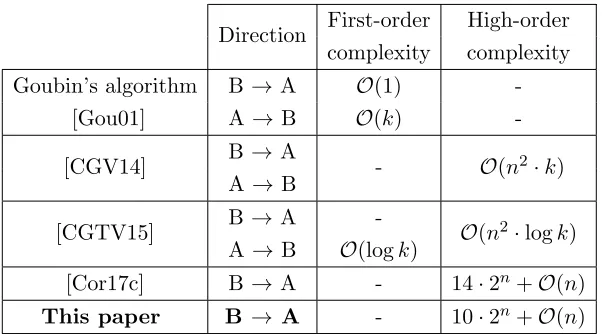
least one order of magnitude more efficient than [CGV14, CGTV15]. We summarize in Table 1 the complexities of Boolean to arithmetic conversions in both directions, for first-order attacks, and for high-order attacks.
1
The attack against [HT16], version posted on 02-Mar-2018, works as follows. We only look at Step 1, which computes the variableω=x+ (α⊕r1⊕ · · · ⊕rn) + (µ1⊕ · · · ⊕µn−1) with the intermediate variableζ= (x+ (α⊕r1⊕
· · · ⊕rn))⊕(µ1⊕ · · · ⊕µn−1) which is computed in (26). We also have the intermediate variablef= (x0⊕γ1⊕α) +γ1 which is computed in (24), wherex0=x⊕r1⊕ · · · ⊕rn.
We probe the 3 intermediate variablesω,ζ andf. LettingR=α⊕r1⊕ · · · ⊕rn andU =µ1⊕ · · · ⊕µn−1, we
obtainω=x+R+U,ζ= (x+R)⊕U andf= (x⊕R⊕γ1) +γ1. It is easy to check that for uniformly distributed
Direction First-order High-order complexity complexity
Goubin’s algorithm B→ A O(1)
-[Gou01] A→ B O(k)
-[CGV14] B→ A - O(n2·k)
A→ B
[CGTV15] B→ A - O(n2·logk)
A→ B O(logk)
[Cor17c] B→ A - 14·2n+O(n)
This paper B → A - 10·2n+O(n)
Table 1.Complexities of Boolean to arithmetic conversions in both directions, for first-order attacks, and for high-order attacks.
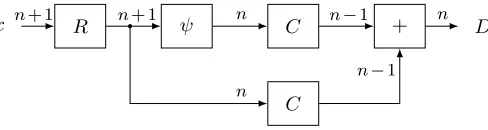
Our contribution. In this paper we describe a simplified variant of the Boolean to arithmetic conversion algorithm from [Cor17c], with fewer mask refreshing, and still with a proof of security in the ISW probing model. As illustrated in Figure 1, our new conversion algorithm is simpler than [Cor17c]: it still makes two recursive calls to the same conversion algorithm C at order n−1, but performs only a single mask refreshingR instead of 3; moreover it does not use a compression function F. The asymptotical complexity of our variant is still O(2n), that is exponential in the
number of sharesnand independent of the register size k. More precisely, the number of operations is 10·2n+O(n), instead of 14·2n +O(n) in [Cor17c]. In section 7, we describe a practical implementation of our new algorithm, showing that for smallnit is still one order of magnitude faster than [CGV14], and roughly 25% more efficient than [Cor17c].
R ψ R F C +
R F C
x D
(a) The original countermeasure from [Cor17c].
R ψ C +
C
x D
(b) Our new countermeasure.
Source code. A proof-of-concept implementation of our high-order conversion algorithm, using the C language, is available at:
https://pastebin.com/WKnNyEU8
2 Security Definitions
The ISW probing model. The theoretical study of securing a circuit against an adversary who can probe a fraction of its wires was initiated by Ishai, Sahai and Wagner [ISW03]. They showed how to transform any circuit of size|C|into a circuit of size O(|C| ·t2) secure against any adversary who can probe at most twires. The construction is based on secret-sharing every variablex inton shares withx=x1⊕ · · · ⊕xn, and processing the shares in a way that prevents at-limited adversary
from learning any information about the initial variable x, forn≥2t+ 1.
The ISW approach for proving security against an adversary who can probe at most tprobes is based on simulation. The goal is to show that any set of t probes in the circuit can be perfectly simulated without the knowledge of any of the original (non-masked) input variables of the initial circuit; in particular, for a block-cipher, such simulation can be performed without knowing the secret key. This implies that probing thosetwires is not going to help the adversary, since he could simulate those tprobes by himself.
A proof in the ISW model usually proceeds as follows: given any set of tprobes, one constructs iteratively a subset I of indices of the input sharesxi that are sufficient to simulate thet probes.
If we can ensure that |I|< n, then only a proper subset of the input shares is required for the simulation. Then if the sharesxi are initially generated in such a way that anyn−1 subset of shares
are uniformly and independently distributed, the simulation can be performed without knowing the original variable x.
t-SNI Security. Recently, a refined security definition under the ISW probing model was introduced in [BBD+16], called t-SNI security. Thet-SNI security definition enables to prove that a gadget can be used in a full construction withn≥t+ 1 shares only, instead ofn≥2t+ 1 in the original ISW security proof. The main advantage of thet-SNI approach is that it enables modular security proofs, by first considering thet-SNI security of individual gadgets and then composing them in a more complex construction. In this paper, the security of our Boolean to arithmetic conversion algorithm will be proven under the t-SNI definition, as in [Cor17c].
We recall below the t-NI and t-SNI security notions introduced in [BBD+16]. We consider a gadget taking as input a singlen-tuple (xi)1≤i≤nof shares, and outputting a singlen-tuple (yi)1≤i≤n.
Given a subsetI ⊂[1, n], we denote byx|I all elements xi such that i∈I.
Definition 1 (t-NI security). Let G be a gadget taking as input (xi)1≤i≤n and outputting the vector (yi)1≤i≤n. The gadget G is said t-NI secure if for any set of tc≤t intermediate variables, there exists a subset I of input indices with |I| ≤tc, such that the tc intermediate variables can be perfectly simulated from x|I.
The difference between the t-NI and t-SNI security notions is that in the t-SNI definition the upper-bound on the size of the input subset I does not depend on the number of output shares |O|that must be simulated. As shown in [BBD+16], if several gadgets are t-SNI secure, then the composition of those gadgets remainst-SNI secure. Moreover the t-SNI security notion enables to prove the security of a full construction forn>t+ 1 shares, instead ofn>2t+ 1 in the original ISW security proof.
3 Existing Boolean to Arithmetic Conversion Algorithms
3.1 Goubin’s First-order Conversion
We first recall Goubin’s first-order algorithm for conversion from Boolean to arithmetic masking [Gou01]. The algorithm is based on the affine property of the functionΨ(x, r) : F2k×F2k→F2k
Ψ(x, r) = (x⊕r)−r (mod 2k)
More precisely, we have for anyx, r1, r2 ∈F2k:
Ψ(x, r1⊕r2) =x⊕Ψ(x, r1)⊕Ψ(x, r2) (1)
In the remaining of this paper, all additions and subtractions are performed modulo 2k for some
fixed parameterk, so we omit the mod 2k. Moreover we grant higher precedence to xor than addition, so we simply writeΨ(x, r) =x⊕r−r.
Goubin’s Boolean to arithmetic conversion is based on the affine property of ψ, see (1). Given as input two Boolean shares x1,x2 such that
x=x1⊕x2
we can write from the definition of Ψ and from (1):
x= (x1⊕x2−x2) +x2 =Ψ(x1, x2) +x2
= x1⊕Ψ(x1, r⊕x2)
⊕Ψ(x1, r)
+x2
where r← {0,1}k is a randomly generated value. One can therefore compute the arithmetic share:
A← x1⊕Ψ(x1, r⊕x2)
⊕Ψ(x1, r)
which eventually gives two arithmetic shares of x, as required:
x=A+x2 (mod 2k)
We note that the above Boolean to arithmetic conversion algorithm is quite efficient as it requires only a constant number of operations, independent ofk. Moreover it is easy to see that the above algorithm is secure against first-order attacks, because the left termx1⊕Ψ(x1, r⊕x2) is independent
of x2 (thanks to the maskr), and the right term Ψ(x1, r) is also independent from x2; eventually
3.2 The High-Order Boolean to Arithmetic Conversion Algorithm from [Cor17c]
A high-order Boolean to arithmetic conversion algorithm was recently described at CHES 2017 [Cor17c], with a security proof in the ISW model for n≥t+ 1. The algorithm can be seen as a generalization of Goubin’s algorithm to any order, still with a complexity independent of the register sizek. The algorithm takes as input nBoolean sharesxi such that
x=x1⊕ · · · ⊕xn
and using a recursive algorithm computesnarithmetic shares Di such that
x=D1+· · ·+Dn (mod 2k)
As illustrated in Fig. 2 the algorithm is recursive and makes two recursive calls to the same algorithmCwith n−1 inputs. The algorithm works as follows. One first performs a mask refreshing R, while expanding thexi’s ton+ 1 shares. One obtains, from the definition of the Ψ function:
x=x1⊕x2⊕ · · · ⊕xn+1
= (x1⊕ · · · ⊕xn+1−x2⊕ · · · ⊕xn+1) +x2⊕ · · · ⊕xn+1
=Ψ(x1, x2⊕ · · · ⊕xn+1) +x2⊕ · · · ⊕xn+1
From the affine property of theΨ function, the left term can be decomposed into the xor ofnshares Ψ(x1, xi) for 2≤i≤n+ 1, where the first share is (n∧1)·x1⊕Ψ(x1, x2):
x= (n∧1)·x1⊕Ψ(x1, x2)⊕Ψ(x1, x3)⊕ · · · ⊕Ψ(x1, xn+1) +x2⊕ · · · ⊕xn+1
We obtain that xis the arithmetic sum of two terms, each with nBoolean shares; this corresponds to the two branches in Fig. 2. One then performs a mask refreshingR on both branches, and then a compression functionF that simply xors the last two shares, so there remains only n−1 shares on both branches. One can then apply the Boolean to arithmetic conversion C recursively on both branches, taking as input n−1 Boolean shares (instead of n), and outputting n−1 arithmetic shares; we obtain:
x= A1+· · ·+An−1
+ B1+· · ·+Bn−1
Eventually it suffices to do some additive grouping to obtain n arithmetic shares as output, as required:
x=D1+· · ·+Dn (mod 2k)
R ψ R F C +
R F C
x n n+ 1 D
n n
n n
n−1
n−1 n−1
n−1
n
Fig. 2.The sequence of gadgets in the Boolean to arithmetic conversion algorithm from [Cor17c].
nshares. On both branches the compression functionF decreases ton−1 shares in order to apply the algorithm recursively. Thus, on the whole, when calling Cn the number of shares follows the sequence:
Cn:n→n+ 1→n→n−1
and Cn−1 is recursively called withn−1 shares.
In this paper, our main contribution is to simplify the above Boolean to arithmetic conversion algorithm with the more compact sequence:
Cn:n+ 1→n
As illustrated in Fig. 3, our new recursive algorithmCn takes as input n+ 1 shares (instead of n)
and recursively calls Cn−1 with n shares on both branches, and eventually outputs n arithmetic
shares after some arithmetic grouping. Actually we rely on theΨ function to decrease the number of shares by one; therefore the previous compression function F is not necessary anymore, and we only need a single mask refreshing instead of 3. Finally, to obtain an algorithm that converts fromn Boolean shares (instead of n+ 1 as input ofCn) to narithmetic shares, it suffices to initially fix xn+1 = 0 as input. We describe our new algorithm in more details in the next section, and we show
that it achieves the same level of security as the original algorithm, namely t-SNI security with n=t+ 1 shares.
R ψ C +
C
x n+ 1 n+ 1 D
n
n n−1
n−1
n
Fig. 3.The sequence of gadgets in our new Boolean to arithmetic conversion algorithm.
4 Improved High-order Conversion from Boolean to Arithmetic Masking
In this section, we describe our improved high-order Boolean to arithmetic conversion algorithm. We first describe a recursive algorithm Cn which, givenn+ 1 Boolean shares as input, output n arithmetic shares. Then as mentioned previously, to convert from nBoolean shares instead of n+ 1, it suffices to initially letxn+1 = 0.
4.1 The new Algorithm
Our recursive algorithm Cn takes as input n+ 1 Boolean shares xi such that:
x=x1⊕ · · · ⊕xn+1
and outputs narithmetic shares Di such that
x=D1+· · ·+Dn (mod 2k)
For n= 1, the algorithm takes as input two sharesx1 andx2 and simply outputsD1 =x1⊕x2. We
1. We first perform a mask refreshing of the n+ 1 sharesxi’s, so that we obtain the followingn+ 1
shares:
y1, . . . , yn+1 ←RefreshMasksn+1(x1, . . . , xn+1)
See below for the definition of the RefreshMasksalgorithm. We can write:
x=y1⊕y2⊕ · · · ⊕yn+1
=y2⊕ · · · ⊕yn+1+ (y1⊕ · · · ⊕yn+1−y2⊕ · · · ⊕yn+1)
=y2⊕ · · · ⊕yn+1+Ψ(y1, y2⊕ · · · ⊕yn+1)
2. Thanks to the affine property ofΨ, this gives:
x=y2⊕ · · · ⊕yn+1+ (n∧1)·y1⊕Ψ(y1, y2)⊕ · · · ⊕Ψ(y1, yn+1)
Therefore, we letz1 ←(n∧1)·y1⊕Ψ(y1, y2) and zi ←Ψ(y1, yi+1) for all 2≤i≤n. This gives:
x=y2⊕ · · · ⊕yn+1+z1⊕ · · · ⊕zn (2)
3. We perform two recursive calls to the Boolean to arithmetic conversion algorithm Cn−1:
A1, . . . , An−1 ← Cn−1 y2, . . . , yn+1
B1, . . . , Bn−1 ← Cn−1 z1, . . . , zn
This gives from (2):
x=A1+· · ·+An−1+B1+· · ·+Bn−1
4. We reduce the number of arithmetic shares from 2n−2 to n by some additive grouping as in [Cor17c], letting Di ←Ai+Bi for 1≤i≤n−2, andDn−1 ←An−1 and Dn←Bn−1. This
gives as required the narithmetic shares as output:
x=D1+· · ·+Dn (mod 2k)
This completes the description of the recursive algorithm. Note that our recursive algorithm takes as inputn+ 1 Boolean sharesxi and outputs narithmetic sharesDi. To convert from nBoolean
shares only, we simply let xn+1= 0. Formally, we obtain the following algorithm.
Algorithm 1 High-order Boolean to Arithmetic Conversion
Input: x1, . . . , xn
Output: D1, . . . , Dnsuch thatx1⊕ · · · ⊕xn=D1+· · ·+Dn (mod 2k)
1: D1, . . . , Dn← Cn(x1, . . . , xn,0)
Algorithm 2 Cn: Recursive high-order Boolean to Arithmetic Conversion (n+ 1→nshares)
Input: x1, . . . , xn+1
Output: D1, . . . , Dnsuch thatx1⊕ · · · ⊕xn+1=D1+· · ·+Dn (mod 2k)
1: if n= 1then
2: returnD1←x1⊕x2 3: end if
4: y1, . . . , yn+1←RefreshMasks(x1, . . . , xn+1)
5: z1←(n∧1)·y1⊕Ψ(y1, y2) 6: fori= 2 tondo
7: zi←Ψ(y1, yi+1)
8: end for
9: A1, . . . , An−1← Cn−1(y2, . . . , yn+1)
10: B1, . . . , Bn−1← Cn−1(z1, . . . , zn)
11: fori= 1 ton−2do 12: Di←Ai+Bi
13: end for 14: Dn−1←An−1 15: Dn←Bn−1 16: returnD1, . . . , Dn
Algorithm 3 RefreshMasks
Input: x1, . . . , xn
Output: y1, . . . , ynsuch thaty1⊕ · · · ⊕yn=x1⊕ · · · ⊕xn
1: y1←x1
2: fori= 2 tondo 3: ri← {0,1}k
4: yi←xi⊕ri
5: y1←y1⊕ri . y1,i=x1⊕Lij=2rj
6: end for
7: returny1, . . . , yn
Theorem 1 (Completeness). Algorithm 1, when taking x1, . . . , xn as input, outputs D1, . . . , Dn such that x1⊕ · · · ⊕xn=D1+· · ·+Dn (mod 2k).
Proof. The proof is straightforward from the above description. Since Algorithm 1 runs the recursive Cn algorithm withxn+1 = 0, it suffices to prove the completeness ofCn. The completeness property
clearly holds forn= 1. Assuming that completeness holds forn−1 shares, we obtain:
n X
i=1
Di = n−1 X
i=1
Ai+ n−1 X
i=1
Bi = n+1 M
i=2
yi+ n M
i=1
zi= n+1 M
i=2
yi+Ψ y1, n+1 M i=2 yi ! = n+1 M i=1
yi= n+1 M
i=1
xi
and therefore completeness of Cn holds for nshares. ut
4.2 Complexity Analysis
Time Complexity. We denote by Tn the number of operations of theCn algorithm, with n+ 1
RefreshMasks withn+ 1 shares is 3(n+ 1)−3 = 3noperations. The computation of theΨ function requires 2 operations, and as in [Cor17c], we assume that computing (n∧1)·y1⊕Ψ(y1, y2) requires
5 operations, which gives a total of 2n+ 3 operations. Finally, the additive grouping requires n−2 operations. We obtain:
Tn= [3·n] + [2·n+ 3] + 2·Tn−1+ [n−2]
= 2·Tn−1+ 6·n+ 1
which gives:
Tn= 10·2n−6·n−13 ,
compared toTn= 14·2n−12·n−21 in [Cor17c]. Therefore, the complexity of our algorithm is still
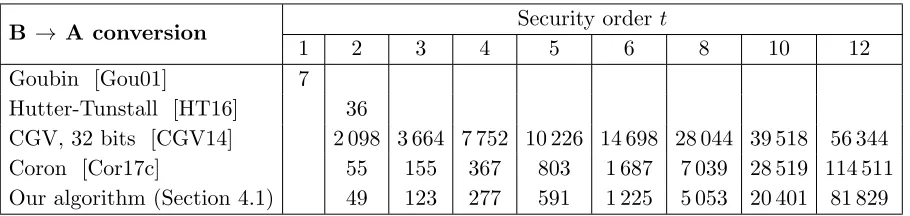
exponential in n, but with an expected speed-up factor of 29% for largen, compared to [Cor17c]. Note that the complexity of our algorithm isO(2n), instead ofO(n2·k) in [CGV14]. However for
small values ofnour conversion algorithm is still one order of magnitude more efficient than [CGV14]; see Table 2 for a comparison with existing algorithms; for [CGV14] we use the same operation count as estimated in [Cor17c], for k= 32 bits. Concrete implementation results will be further given in Section 7.
B → A conversion Security ordert
1 2 3 4 5 6 8 10 12
Goubin [Gou01] 7
Hutter-Tunstall [HT16] 36
CGV, 32 bits [CGV14] 2 098 3 664 7 752 10 226 14 698 28 044 39 518 56 344
Coron [Cor17c] 55 155 367 803 1 687 7 039 28 519 114 511
Our algorithm (Section 4.1) 49 123 277 591 1 225 5 053 20 401 81 829
Table 2.Operation count for Boolean to arithmetic conversion algorithms, up to security ordert= 12, withn=t+ 1 shares. For the Hutter-Tunstall algorithm we have written 36 operations instead of 31 to include the generation of 5 randoms.
Memory Complexity. Along with then+ 1 input shares, the algorithm requires 2n+ 1 other sharesyi andzi’s, 2 (n−1) sharesAi and theBi, and finally noutput sharesDi for a total of 5n−1
shares (excluding the input shares). As the two recursive calls are done sequentially, we add the memory consumption of a single call to Cn−1. Denoting Mn the memory consumption of Cn, we
obtain:
Mn= 5n−1 +Mn−1
with M1= 1. This gives:
Mn= 1 + n X
i=2
(5i−1) = 5 2n
2+ 3
2n−3
which is quadratic in the number of shares n.
Note that if the algorithm Cn computes its result in place, the input sharesxi can be used to
to store the Bi as the recursive call toCn−1 also performs in place. In this context, the memory
complexity is reduced to
Mn=n+Mn−1=
n(n+ 1)
2 .
Random Generation. We denote byRn the number of random generations performed within the
Cn algorithm. Since theCn algorithm executes aRefreshMasks with n+ 1 shares, which requires the generation of nrandom values, and then recursively callsCn−1 twice, we have:
Rn=n+ 2·Rn−1
where R1 = 0 sinceC1 only performs a xor. This gives the following complexity forRn:
Rn= 3·2n−1−n−2 ,
which is also exponential in the number of shares, but about 50% smaller than in [Cor17c] for which Rn=n+ 2·(n−1) + 2·Rn−1 with R2= 2, which gives Rn= 3·2n−3·n−4; see Table 3 for a
comparison.
B → A conversion Security order t
1 2 3 4 5 6 8 10 12
Previous algorithm [Cor17c] 2 11 32 77 170 359 1505 6107 24533 Our algorithm (Section 4.1) 2 7 18 41 88 183 757 3059 12273
Table 3. Number of random generations for Boolean to arithmetic conversion algorithms from [Cor17c] and this paper, up to security ordert= 12, withn=t+ 1 shares.
5 Security Proof of Algorithm 1
We prove that our new algorithm achieves the same level of security as the previous algorithm in [Cor17c], namelyt-SNI security withn=t+ 1 shares, that is (n−1)-SNI security. This means that the algorithm with nshares is secure against an adversary with at most n−1 probes. Furthermore, the t-SNI property allows to compose the algorithm in a larger construction, without decreasing the security order.
Theorem 2 (t-SNI of Algorithm 1).Let (xi)1≤i≤n be the input and let (Di)1≤i≤n be the output of the Boolean to arithmetic conversion Algorithm 1. For any set oftc intermediate variables and any subset O ⊂ [1, n] with tc+|O| < n, there exists a subset I of input indices such that the tc intermediate variables as well as D|O can be perfectly simulated from x|I, with|I| ≤tc.
5.1 Properties of RefreshMasks
In this section we first recall some security properties of the RefreshMasksalgorithm for proving Theorem 2; we refer to [Cor17c] for the proof of lemmas 1, 2, 3, 4 and 5 below; we then prove an additional lemma. The following lemma shows that when RefreshMasks is not probed, any subset of n−1 output shares yi is uniformly and independently distributed; see Fig. 4 for an illustration of RefreshMasks.
Lemma 1. Let (xi)1≤i≤n be the input and let (yi)1≤i≤n be the output of RefreshMasks. Any subset of n−1 output sharesyi is uniformly and independently distributed.
The following lemma shows that when RefreshMasks is not probed, the distribution of the n output shares yi’s can be perfectly simulated from the knowledge ofx1⊕ · · · ⊕xn only; that is, the
knowledge of the individual sharesxi’s is not required.
Lemma 2. Let (xi)1≤i≤n be the input and let (yi)1≤i≤n be the output of RefreshMasks. The distri-bution of(yi)1≤i≤n can be perfectly simulated from x1⊕ · · · ⊕xn.
x1 x2 · · · xi · · · xn r2
.. .
ri
.. .
rn
y1 y2 · · · yi · · · yn
Fig. 4.TheRefreshMasksalgorithm, with the randomsriaccumulated on the first column.
The following lemma shows thatRefreshMasksachieves the (n−1)-NI property in a straightforward way. Namely it is easy to show that any tcprobes inRefreshMasks can be perfectly simulated from
the knowledge of x|I, with|I| ≤tc.
Lemma 3 (t-NI of RefreshMasks).Let(xi)1≤i≤n be the input ofRefreshMasks and let(yi)1≤i≤n be the output. For any set oft < n intermediate variables, there exists a subset I of input indices such that the tc intermediate variables can be perfectly simulated from x|I, with|I| ≤tc.
The following lemma is a refinement of the basic t-NI property ofRefreshMasks; namely it shows that a slightly better bound on |I| can be obtained if we assume that y1 is among the probed
variables. Note that in this paper we consider aRefreshMasks algorithm where the randoms are accumulated onx1, instead of xn in [Cor17c], and therefore we must assume thaty1 is among the
probed variables, instead ofyn. The improved bound will be required to prove the t-SNI property
of Algorithm 1. Namely the adversary can probe for example tc of the variableszi =Ψ(y1, yi+1),
whose simulation then requires the knowledge oftc+ 1 variablesyi; thanks to the stronger bound,
since y1 is always among the variables to be simulated, this requires the knowledge of onlytc input
Lemma 4 ( [Cor17c]). Let x1, . . . , xn be the input of a RefreshMasks where the randoms are accumulated onx1, and let y1, . . . , yn be the output. Lettc be the number of probed variables, with
tc< n. Ify1 is among the probed variables, then there exists a subset I such that all probed variables can be perfectly simulated from x|I, with|I| ≤tc−1.
The following lemma is similar, except that we consider an adversary withtc=nprobes, instead
of tc< n. In that case the adversary could probe all yi’s and learnx1⊕ · · · ⊕xn=y1⊕ · · · ⊕yn;
as shown in Lemma 2, if only the yi’s are probed, then all yi’s can be perfectly simulated from
the knowledge of x1⊕ · · · ⊕xn only, without the knowledge of the individual xi’s. The following
lemma shows that this is essentially the best that the adversary can do, when we assume that y1 is
among the probed variables; in that case, either allnprobes in the circuit can be simulated from x1 ⊕ · · · ⊕xn only, or they can be simulated from x|I with the improved bound |I| ≤ n−1. As
explained in [Cor17c], the restriction on probingy1 is necessary, otherwise one could probe then
input shares xi directly, and learn the value of the individual shares xi (and not only their xor).
Lemma 5 ( [Cor17c]). Let x1, . . . , xn be the input of a RefreshMasks where the randoms are accumulated onx1, and let y1, . . . , yn be the output. Lettc be the number of probed variables, with
tc=n. Ify1 is among the probed variables, then either all probed variables can be perfectly simulated fromx1⊕ · · · ⊕xn, or there exists a subsetI with |I| ≤n−1such that they can be perfectly simulated from x|I.
Finally, we prove the following additional lemma for the proof of Theorem 2. We show that if the adversary probes exactly one intermediate variablez in the RefreshMasksalgorithm except y1,
then this variable can be simulated with at most one input xi, and moreover y1 has the uniform
distribution given z. In Section 6 we will describe a formal verification of the lemma.
Lemma 6. Let x1, . . . , xn be the input of RefreshMasks and let y1, . . . , yn be the output, for n≥3. Consider a single probe z on any intermediate variable of the circuit except y1. The distribution of z
can be simulated fromx|I with |I| ≤1, and given z the distribution of y1 is uniform. Proof. We consider the four possible cases for the probez inRefreshMasks:
• if the probe is an input variablez=xi, then we setI ={i}and the variablexi can be perfectly
simulated from x|I with |I| ≤ 1. Furthermore, from Lemma 1, the variable y1 is uniformly
distributed given z.
• if the probe is a random variable z= ri, then we can perfectly simulate the variable ri by a
random value as in the real circuit, and we can take I =∅. Furthermore, since we have n≥3, at least another random rj has not been probed, and therefore the value y1 has the uniform
distribution given z.
• if the probe is an output variable z = yi (recall that y1 is not probed), then one can apply
Lemma 1 sincen≥3 and thereforen−1≥2, which ensures that the two variablesy1 andyi are
uniformly and independently distributed. As a consequence, the variablez=yi can be perfectly
simulated by a random value, with I =∅, and the distribution ofy1 is uniform given z.
• if the probe is an intermediate variable z =y1,i =x1⊕r2⊕ · · · ⊕ri with 2≤i < n (since by
assumption the probe cannot be y1,n =y1), then because the random ri has not been probed,
the variable y1,i can be perfectly simulated by a random value, withI =∅. Furthermore, since
i < n and the random rn has not been probed, we deduce thaty1 has the uniform distribution
Thus we have shown that if the probe z is not y1, thenz can be simulated fromx|I with |I| ≤1,
and given z, the valuey1 has the uniform distribution. This concludes the proof of Lemma 6. ut
5.2 Security of the Recursive Algorithm Cn
In order to prove Theorem 2, it suffices to show that the recursiveCn algorithm (Algorithm 2) has
the (n−1)-SNI property. As illustrated in Fig. 5, the algorithm is recursive, and therefore our security proof will be also recursive, i.e. the (n−1)-SNI property of Cn will be proven assuming the
(n−2)-SNI property of Cn−1.
R ψ C +
C
x n+ 1 n+ 1 D
n
n n−1
n−1
n
Fig. 5.The sequence of gadgets inCn.
Globally, our security proof is relatively similar to the security proof in [Cor17c]. However, to make our recursive proof work, we must prove a stronger property for Cn. Namely when considering
the (n−1)-SNI property of Cn, the adversary has n−1 probes at his disposal, so he could use all those n−1 probes inside one of the two recursive calls to Cn−1 (see Fig. 5); in that case the
(n−2)-SNI condition of Cn−1 would not be satisfied (since in principle Cn−1 can accommodate at
most n−2 probes), and nothing could be said about the (n−1)-SNI property of Cn. Therefore we must prove recursively an additional property of Cn, similar to the property of RefreshMasksin
Lemma 5: when the adversary has nprobes (which corresponds ton−1 probes when considering Cn−1), those nprobes can be simulated either from the xor of the input shares xi, or fromx|I with
|I| ≤n (remember thatCnhas n+ 1 input shares). Formally, we prove the following lemma.
Lemma 7 (Security of Cn). Let (xi)1≤i≤n+1 be the input and let (Di)1≤i≤n be the output of the Boolean to arithmetic conversion algorithm Cn. For any set of tc intermediate variables and any subset O ⊂ [1, n] with tc+|O| < n, there exists a subset I of input indices such that the tc intermediate variables as well asD|O can be perfectly simulated from x|I, with|I| ≤tc. Moreover, if
tc+|O|=n, either there exists a subset I of input indices such that the tc intermediate variables and
D|O can be simulated from x|I with |I| ≤n, or those variables can be simulated fromx1⊕ · · · ⊕xn+1 only.
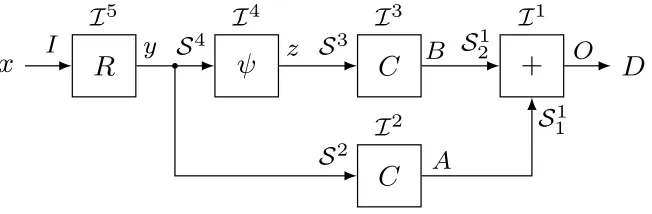
We prove Lemma 7 recursively, following the same process as in [BBD+16, Sect. 4.1], where the t-SNI security of a construction is deduced from thet-NI ort-SNI property of its component gadgets. The sequence of gadgets of our construction is illustrated in Figure 6. The gadgets are numbered from 1 to 5, and we denote by Ii the set of probed variables in Gadgeti. Gadget 5 corresponds
R
ψ
C
+
C
x
y
D
A
B
O
z
I
1I
2I
3I
4I
5S
1 2S
11S
2S
3S
4I
Fig. 6.The sequence of gadgets in the Boolean to arithmetic conversion algorithm.
It is easy to see that Lemma 7 is verified for n = 1, where only D1 = x1 ⊕x2 is computed.
Namely the first condition is tc+|O| < 1, which implies tc = |O| = 0 and we can take I = ∅.
Secondly, when considering n= 1 probe, ifxi is probed then we can let I ={i}, and ifx1⊕x2 is
probed, it can be simulated from the knowledge ofx1⊕x2 only.
Now we show the induction step. We denote by tc the total number of probes in the circuit, and
we let O ⊂[1, n] be any subset of output shares. We must prove the following two properties from Lemma 7:
• P1(n): if tc+|O|< n, then alltc probed variables in the circuit and all variables D|O can be
perfectly simulated from x|I, for some subsetI satisfying |I| ≤tc;
• P2(n): iftc+|O|=n, then either there exists a subsetI of input indices such that thenvariables
can be simulated fromx|I with|I| ≤n, or the nvariables can be simulated fromx1⊕ · · · ⊕xn+1
only.
The two properties P1(n) andP2(n) will be proven by assuming thatP1(n−1) and P2(n−1) are satisfied. As explained previously,P1(1) andP2(1) are trivially satisfied.
Property P1(n). We first consider the property P1(n) and therefore we assume:
tc+|O|< n
As in [BBD+16], the technique consists in starting from the output variablesD|O, which corresponds
to Gadget 1, and showing for each successive gadget that any subset of the output variables of the gadget can be simulated from a subset of its input variables; that is, we proceed in reverse order back to the input shares of the full algorithm.
Gadget 1. We have Di = Ai+Bi for 1 ≤ i ≤ n−2, and Dn−1 = An−1 and Dn = Bn−1. For
simplicity, to avoid a change of index, we denote the last wire of the Bi’s byBninstead of Bn−1,
so that we can write Dn =Bn. We denote byP1 the set of probed indices in Gadget 1, with
|P1| ≤ |I1|. To simulate Di for 1≤i≤n−2, we must know bothAi and Bi; to simulate Dn−1
we must knowAn−1 and to simulate Dn we must know Bn. The simulation of Gadget 1 can
therefore be performed from the shares A|S1
1 and B|S21, where the subsetsS 1
1 andS21 are defined
as follows:
S11= O∪P1
∩[1, n−1] (3)
S21= O∪P1
∩ [1, n−2]∪ {n}
We obtain the upper bound:
|S11|+|S21|=|S11∪ S21|+|S11∩ S21|=|O∪P1|+|(O∪P1)∩[1, n−2]|
≤ |O|+|P1|+n−2≤ |O|+|I1|+n−2 (5)
Gadgets 2 and 3. The gadgets 2 and 3 are recursive applications of the Boolean to arithmetic conversion, with n−1 shares. Thet-SNI conditions for gadgets 2 and 3 correspond to property P1(n−1) and are therefore respectively:
|S1
1|+|I2|< n−1, |S21|+|I3|< n−1 (6)
We highlight that both conditions in (6) are not necessarily simultaneously satisfied. Indeed, the adversary could probe the n−1 shares Ai’s which would give|S11|=n−1. However, we
show that at least one of the two conditions in (6) must be satisfied. Indeed, if none of the two conditions is satisfied, we have |S1
1|+|I2| ≥ n−1 and |S21|+|I3| ≥n−1, which would give
|S1
1|+|S21|+|I2|+|I3| ≥2n−2. However, from (5) and|I1|+|I2|+|I3| ≤tc, withtc+|O|< n,
we get:
|S1
1|+|S21|+|I2|+|I3| ≤ |O|+|I1|+n−2 +|I2|+|I3|
≤tc+|O|+n−2<2n−2
which contradicts the previous inequality. Therefore, at least one of the t-SNI conditions for gadgets 2 and 3 must be satisfied. We now distinguish three cases depending on which of the two conditions in (6) is satisfied:
• Case |S1
1|+|I2|< n−1 and |S21|+|I3| ≥ n−1. Since we have |S21| ≤ |O|+|I1|from (4)
and from the conditiontc+|O|< n, we obtain:
n−1≤ |S21|+|I3| ≤ |O|+|I1|+|I3| ≤ |O|+tc< n
which gives |S1
2|+|I3|=|O|+|I1|+|I3|=|O|+tc=n−1, and therefore|I1|+|I3|=tc.
This implies that there are no other probes in the circuit, that is, we must have|Ii|= 0 for
i= 2,4,5. In particular, since we have |I2|= 0, and the t-SNI condition for Gadget 2 is
satisfied, we can apply the recursive propertyP1(n−1) and simulate all outputs of Gadget
2 with |S2| ≤ |I2|= 0, which means that we can take S2=∅.
However, since thet-SNI condition for Gadget 3 is not satisfied, we cannot applyP1(n−1), but we can still useP2(n−1), because|S21|+|I3|=n−1. This ensures that then−1 corresponding
variables can either be simulated from z|S3 with|S3| ≤n−1, or from z1⊕ · · · ⊕zn only. In
the following, we deal with both cases:
• if the n−1 variables can be simulated fromz|S3 with |S3| ≤n−1, we obtain|S4| ≤n.
Thanks to the initialRefreshMasks (Gadget 5) which is not probed in that case, one can apply Lemma 1 which ensures that the n (out of n+ 1) variables to be simulated are uniformly and independently distributed. Therefore they can be perfectly simulated by a random value. Moreover since S2 =∅, thosenvariables are the only ones that must be
• if the n−1 variables can be simulated from the knowledge ofz1⊕ · · · ⊕zn only, since by
definition we have
z1⊕ · · · ⊕zn=Ψ(y1, y2⊕. . .⊕yn+1) =y1⊕ · · · ⊕yn+1−y2⊕. . .⊕yn+1
and since we also have x=x1⊕ · · · ⊕xn+1=y1⊕ · · · ⊕yn+1, we get:
z1⊕ · · · ⊕zn=x−x⊕y1
Moreover since S2 = ∅ and I4 = ∅, this is the only variable that must be simulated.
Thanks to the initialRefreshMasks (Gadget 5) which is not probed in that case, this has the uniform distribution (becausey1 has the uniform distribution from Lemma 1), and
this can therefore be perfectly simulated by a random value. Therefore we can takeI =∅.
• Case|S1
1|+|I2| ≥n−1 and|S21|+|I3|< n−1. The reasoning is similar to the previous case.
As previously we have |I1|+|I2|=t
cand there are no other probes in the circuit, that is,
we have |Ii|= 0 fori= 3,4,5. Since thet-SNI condition of Gadget 3 is satisfied and Gadget
3 is not probed, we can simulate all outputs of Gadget 3 with S3=∅, and therefore we can
takeS4 =∅. Since thet-SNI condition for Gadget 2 is not satisfied but |S1
1|+|I2|=n−1,
we can apply P2(n−1) to Gadget 2. This ensures that then−1 corresponding variables can either be simulated fromy|S2 with|S2| ≤n−1, or from y2⊕ · · · ⊕yn+1 only. We deal with
both cases similarly as before:
• if the n−1 variables can be simulated fromy|S2 with|S2| ≤n−1, thanks to the initial RefreshMasks (Gadget 5) which is not probed, Lemma 1 ensures that then−1 variables are uniformly and independently distributed. Therefore they can be perfectly simulated by a random value, and we can take I =∅ for the simulation of the entire circuit. • if the n−1 variables can be simulated from the knowledge ofy2⊕ · · · ⊕yn+1=x⊕y1
only, thanks to the initial RefreshMasks (Gadget 5) which is not probed, this has the uniform distribution (because y1 has the uniform distribution from Lemma 1), and this
can therefore be perfectly simulated by a random value. Therefore we can takeI =∅ for the simulation of the entire circuit.
• Case|S1
1|+|I2|< n−1 and|S21|+|I3|< n−1. In this case, thet-SNI condition is satisfied
for both gadgets 2 and 3. Therefore, we obtain from the recursive hypothesis P1(n−1) that
the intermediate variables of gadgets 2 and 3 and the output variablesA|S1
1 andB|S21 can be
perfectly simulated fromy|S2 and z|S3, where:
|S2| ≤ |I2|and |S3| ≤ |I3| (7) In the sequel, we can assume that (7) is satisfied, since in the two other cases (when only one of the twot-SNI conditions is satisfied), as explained previously the simulation of all probed variables and D|O can be performed with I =∅.
Gadget 4. By definition of theΨ function, we havez1 ←(n∧1)·y1⊕Ψ(y1, y2) andzi ←Ψ(y1, yi+1)
for all 2≤i≤n. Therefore, the probed variables and the output variables z|S3 can be simulated
with the knowledge ofy|S4, where|S4|is such that:
|S4| ≤ |I4|+|S3|+ 1 (8)
Note that since the variable y1 is involved during the computation of all thezi’s we must have
Gadget 5. Lett0=|S4|+|S2|+|I5|be the total number of variables within the initialRefreshMasks
that must be simulated (see Fig. 6). By using (7) and (8), we get
t0 =|S4|+|S2|+|I5| ≤ |I4|+|S3|+ 1 +|I2|+|I5| ≤ |I2|+|I3|+|I4|+|I5|+ 1≤tc+ 1< n+ 1
Therefore we have t0 < n+ 1 and since 1∈ S4, we can apply Lemma 4 wherey
1 is among the t0
probes variables (note that the initial RefreshMaskshas n+ 1 inputs and outputs, so we must apply Lemma 4 withn+ 1 instead ofn). We obtain that all variables can be perfectly simulated from x|I, where:
|I| ≤t0−1≤tc+ 1−1≤tc
In summary all tc probed variables in the circuit and all output variables D|O can be perfectly
simulated fromx|I with|I| ≤tc. Hence the (n−1)-SNI property is satisfied forCn, which concludes
the recursive proof of the first propertyP1(n). Note that for the recursive proof of P1(n) we needed
both properties P1(n−1) andP2(n−1), that is we cannot prove the two properties P1 and P2 separately.
PropertyP2(n). We now consider the second propertyP2(n), assuming that there aretc+|O|=n
variables to be simulated in the circuit. We must show that either there exists a subsetI of input indices such that thosenvariables can be simulated from x|I with |I| ≤n (remember that theCn
algorithm takesn+ 1 shares as input), or thenvariables can be simulated from x1⊕ · · · ⊕xn+1 only.
We first distinguish two cases depending on whether the RefreshMasks (Gadget 5) is probed or not. If RefreshMasksis not probed, then from Lemma 2 we can simulate all the variablesyi from the
knowledge ofx1⊕ · · · ⊕xn+1 only. Then the rest of the circuit can be simulated as in the real circuit,
and property P2(n) is satisfied. We now assume thatRefreshMasks is probed, that is|I5| ≥1.
Gadget 1. As in theP1(n) property, we obtain:
S11= O∪P1
∩[1, n−1] (9)
S21= O∪P1
∩ [1, n−2]∪ {n}
(10)
Gadgets 2 and 3. As forP1(n), we start by showing that at least one of the two gadgets must satisfy the t-SNI condition, that is, we cannot have|S1
1|+|I2| ≥n−1 and|S21|+|I3| ≥n−1.
Namely from |I5| ≥1 and |I1|+|I2|+|I3|+|I5| ≤t
c, we obtain:
|I1|+|I2|+|I3| ≤tc−1
From (5) and using the conditiontc+|O|=n, we get:
|S11|+|S21|+|I2|+|I3| ≤ |O|+|I1|+n−2 +|I2|+|I3| ≤tc−1 +|O|+n−2
≤tc+|O|+n−3≤2n−3
and therefore as previously we cannot have both |S1
1|+|I2| ≥n−1 and |S21|+|I3| ≥n−1.
• Case|S1
1|+|I2|< n−1 and |S21|+|I3| ≥n−1. From (10), we know that |S21| ≤ |O|+|I1|
and since we have |I1|+|I3| ≤t
c−1 and tc+|O|=n, we get:
n−1≤ |S1
2|+|I3| ≤ |O|+|I1|+|I3| ≤ |O|+tc−1≤n−1
which gives|O|+|I1|+|I3|=|O|+t
c−1, and therefore|I1|+|I3|=tc−1. Since|I5| ≥1
andP5
i=1|Ii|=tc, we deduce that|I5|= 1, and that there are no other probes in the circuit, i.e. |I2|= |I4|= 0. As a consequence, since the t-SNI condition for Gadget 2 is satisfied,
we can apply the recursive property P1(n−1) and simulate all outputs of Gadget 2 with |S2| ≤ |I2|= 0, hence we can takeS2 =∅.
However, since thet-SNI condition for Gadget 3 is not satisfied, we cannot applyP1(n−1), but
we can still useP2(n−1), because|S21|+|I3|=n−1. This ensures that then−1 corresponding
variables can either be simulated from z|S3 with|S3| ≤n−1, or from z1⊕ · · · ⊕zn only. In
the following, we deal with both cases:
• if the n−1 variables can be simulated from z|S3 with |S3| ≤n−1, then one can apply
the same reasoning as for Gadget 4 when considering the property P1(n) and we obtain:
|S4| ≤ |I4|+|S3|+ 1≤0 + (n−1) + 1≤n
with 1∈ S4. Therefore, by using that|I5|= 1 and|S2|= 0, the total number of variables
t0 within the initialRefreshMasks that must be simulated is such that
t0=|S4|+|S2|+|I5| ≤n+ 1
As a consequence, one can apply Lemma 5 on the initialRefreshMaskswith n+ 1 inputs and n+ 1 probed variables, one of whom being y1. Then either all probed variables can
be perfectly simulated from x1⊕ · · · ⊕xn+1, or there exists a subsetI with |I| ≤nsuch
that they can be perfectly simulated fromx|I; this is exactly the property P2(n).
• if the n−1 variables can be simulated from the knowledge ofz1⊕ · · · ⊕zn=x−x⊕y1
only, we proceed as follows. Recall that there is a single probed variable in RefreshMasks. For simplicity we assume that this probed variable is not y1, because we can consider
that the probing of y1 is rather done in I4. We can therefore apply Lemma 6, which
shows that z can be simulated fromx|I with|I| ≤1, and given z, the distribution ofy1
is uniform; thus the distribution of x−x⊕y1 is also uniform (since xis fixed). Therefore
one can perfectly simulatez1⊕ · · · ⊕zn=x−x⊕y1 by a random value, and the remaining
variablez can be perfectly simulated from x|I with |I| ≤1≤n.
• Case|S1
1|+|I2| ≥n−1 and|S21|+|I3|< n−1. The reasoning is similar to the previous case,
with|I1|+|I2|=t−1, |I5|= 1 and |I3|=|I4|= 0. Since thet-SNI condition of Gadget 3
is satisfied and Gadget 3 is not probed, we can simulate all outputs of Gadget 3 withS3 =∅,
and therefore we can take S4 = ∅. Since the t-SNI condition for Gadget 2 is not satisfied
but |S1
1|+|I2|=n−1, we can apply P2(n−1). This ensures that then−1 corresponding
variables can either be simulated from y|S2 with|S2| ≤n−1, or from y2⊕ · · · ⊕yn+1 only.
We deal with both cases similarly as before:
• if the n−1 variables can be simulated from y|S2 with |S2| ≤n−1, then one can apply
the basic t-NI property of RefreshMasksfrom Lemma 3, which gives |I| ≤ |S2|+|I5| ≤
• if the n−1 variables can be simulated from the knowledge ofy2⊕ · · · ⊕yn+1=x⊕y1
only, then we can apply Lemma 6 as in the previous case. We obtain that all probed variables can be perfectly simulated from x|I with|I| ≤1≤n, henceP2(n) is satisfied.
• Case|S1
1|+|I2|< n−1 and|S21|+|I3|< n−1. In this case, thet-SNI condition is satisfied
for both gadgets 2 and 3. Therefore, we obtain from the recursive hypothesisP1(n−1) that: |S2| ≤ |I2|and |S3| ≤ |I3| (11) In the sequel, we can assume that (11) is satisfied, since in the two other cases (when only one of both t-SNI conditions is satisfied), the simulation of all probed variables and D|O is already
performed.
Gadget 4. As in the proof of P1(n), by definition of the Ψ function, we have that the probed variables and the output variables z|S3 can be simulated with the knowledge of y|S4, where
1∈ S4 and:
|S4| ≤ |I4|+|S3|+ 1≤ |I4|+|I3|+ 1 (12)
Gadget 5. Lett0=|S4|+|S2|+|I5|be the total number of variables within the initialRefreshMasks
that must be simulated. By using (11) and (12), we get
t0=|S4|+|S2|+|I5| ≤ |I4|+|I3|+ 1 +|I2|+|I5| ≤tc+ 1≤n+ 1
Since 1∈ S4, we can apply Lemma 5 with n+ 1 inputs andn+ 1 probed variables, one of whom
beingy1. This allows to deduce that all tc probed variables in the circuit and all output variables
D|O can be perfectly simulated either fromx1⊕ · · · ⊕xn+1, or from x|I with |I| ≤n, and the
property P2(n) is satisfied.
This concludes the recursive proof of the second property P2(n). Thus we have shown that both
propertiesP1(n) andP2(n) in Lemma 7 are satisfied, which terminates the proof of Lemma 7. u t
5.3 Proof of Theorem 2
The proof of Theorem 2 is straightforward from Lemma 7. Namely Algorithm 1 consists in applying theCn algorithm withxn+1 = 0. By applying the propertyP1(n) of Lemma 7, we obtain that for
any set oftc intermediate variables and any subsetO ⊂[1, n] withtc+|O|< n, there exists a subset
I0 of input indices such that the tcintermediate variables as well as D|O can be perfectly simulated
fromx|I0, with|I0| ≤t. Sincexn+1 = 0 it suffices to takeI =I0∩[1, n] for the input of Algorithm 1,
and we still have |I| ≤tc as required for the (n−1)-SNI property. This terminates the proof of
Theorem 2.
6 Formal verification of Algorithm 1
6.1 Partial formal verification
In this section, we perform a partial formal verification of our new countermeasure, focusing on the properties ofRefreshMasks. More precisely, the correctness of lemmas 4 and 5 for theRefreshMasks
algorithm has already been formally verified in [Cor17b], and we have performed a formal verification of our Lemma 6, following the same approach as in [Cor17b]. In other words, all the non-trivial security properties of RefreshMasksconsidered in Section 5.1 and used in the proof of Theorem 2 are formally verified, at least for small values ofn.
The generic verification of the masking countermeasure was initiated by Bartheet al.in [BBD+15]
based on the EasyCrypt framework. The approach consists in considering all possiblet-tuples of intermediate variables, and proving that for each particulart-tuple the adversary learns nothing from the secret key. The authors obtained a formal verification of various masked implementations, up to second order masked implementation of AES, and up to 5-th order for the masked Rivain-Prouff multiplication [RP10].
In this paper we have used the CheckMasks tool described in [Cor17b]; the source code of the
CheckMaskslibrary is publicly available at [Cor17a], under the GPL v2.0 license. The circuit to be verified is represented as nested lists, which leads to a simple and concise implementation in Common Lisp, a programming language well suited to formal manipulations. In [Cor17b] a formal verification of the security of the Rivain-Prouff multiplication is described, with running times similar to those in [BBD+15]; additionally a formal verification of lemmas 4 and 5 for theRefreshMasks algorithm is
described.
For the formal verification of Lemma 6, the approach consists in considering all possible intermediate variablesz in theRefreshMasks circuit (including the output variables but noty1), and
checking that z can be simulated from at most one variable xi, and moreover the variable y1 is
uniformly distributed givenz. In principle, when applying a generic verification, the running time is exponential inn, because all possiblet-tuples of intermediate variables must be considered, with t= n−1; this implies that in general such generic verification can only be performed for small values ofn. However in the particular case of Lemma 6, there is only a single intermediate variable z to consider (instead of a t-tuple), and the formal verification is therefore polynomial inn, and quite efficient in practice, so it can be performed for anyn. For example, forn= 3 we obtain:
> ( c h e c k−r e f r e s h m a s k s−o n e p r o b e 3 ) I n : ( X1 X2 X3 )
Out : ((+ R2 (+ R1 X1 ) ) (+ R2 X2 ) (+ R1 X3 ) ) Number o f i n t e r m e d i a t e v a r i a b l e s : 8
T
which means that for all intermediate variables z ofRefreshMasks(excepty1), the formal tool has
verified thatz can be simulated from somexi, and moreover y1 is uniformly distributed given z. We
have run the verification algorithm up ton= 10. The source code is publicly available at [Cor17a]. Using the same tool, we can also quickly verify that Lemma 6 does not hold if the randoms in
RefreshMasksare accumulated onxn instead of x1. More precisely, with the modifiedRefreshMasks
forn= 3, we obtain:
> ( c h e c k−r e f r e s h m a s k s−o n e p r o b e 3 : r e v ’ t ) I n : ( X1 X2 X3 )
Out : ((+ R1 X1 ) (+ R2 X2 ) (+ R2 (+ R1 X3 ) ) ) Number o f i n t e r m e d i a t e v a r i a b l e s : 8
NIL
Namely, when the randoms are accumulated on x3, we have y1 = x1 ⊕r1, y2 = x2 ⊕r2 and
y3 =x3⊕r1⊕r2, and the formal tool has correctly identified that by probing z=r1, the variable
y1 =x1⊕r1 is not uniformly distributed.
6.2 Full formal verification
In the previous section we have described a formal verification of the security properties of Refresh-Masks that are required for the security proof of the Boolean to arithmetic conversion algorithm. However this provides only apartial verification of the algorithm, since in that case the adversary is restricted to only probing the Boolean operations performed within theRefreshMasks. To obtain a full verification, we must consider an adversary who can probe any variable in the Boolean to arithmetic algorithm. In that case the formal verification becomes more complex as we must handle both Boolean and arithmetic operations.
In [Cor17b], it was shown how to extend [BBD+15] to handle a combination of arithmetic and Boolean operations, with an application to the full formal verification of the Boolean to arithmetic conversion algorithm from CHES 2017 [Cor17c]. In this section we first recall this approach, and we show that exactly the same verification tool can be used to formally verify our new Boolean to arithmetic conversion algorithm, moreover with better timings because our new conversion algorithm is simpler.
In order to verify the (n−1)-SNI property of the Boolean to arithmetic algorithm, we must check that for all possible (n−1)-tuples of intermediate variables (including the outputs Di), the
number of input variablesxi’s that remain after the application of a sequence of simplification rules
is always ≤tc, where tc is the number of non-output variables in the (n−1)-tuple.
For the verification of Boolean circuits in the previous section, we used only a single simplification rule, namely replacingx⊕r byr when the randomrappears only once in the intermediate variables. For the verification of circuits combining Boolean and arithmetic operations, we use the same sequence of simplification rules as in [Cor17b]:
• Rule 1: when ω=x1+x2 mod 2k must be simulated, simulate bothx1 and x2.
• Rule 2: from the affine property of the function Ψ, replaceΨ(x, y)⊕Ψ(x, z) byx⊕Ψ(x, y⊕z). • Rule 3: from the definition of Ψ, replace Ψ(x, y) by (x⊕y)−ymod 2k.
• Rule 4: when a random r is used only once, replacex⊕r by r, and similarly forx+rmod 2k
and x−rmod 2k.
• Rule 5: when a random r is not used in two intermediate variables e1 and e2, replace the
simulation of (e1⊕r, e2⊕r) by the simulation of (r,(e1⊕r)⊕e2); this corresponds to the change
of variabler0 =e1⊕r.
• Rule 6: when Ψ(x1, x2) must be simulated, simulate bothx1 and x2.
R1 R2 R4 no R3+R4 R5 R6
yes yes
no no
yes yes no
As explained in [Cor17b], the ordering of the application of the rules matters; we used the same ordering strategy as in [Cor17b], as illustrated in Fig. 7. We summarize in tables 4 and 5 the timings of formal verification for the algorithms in [Cor17c] and this paper. Note that the Boolean to arithmetic conversion algorithm has complexity O(2n), and therefore the number of possible
(n−1)-tuples of intermediate variables is O(2n2
); that is why we could only perform the formal verification up ton= 5.
n #var. #tuples Security Time
2 11 11 X ε
3 48 1,128 X 0.08 s
4 133 383,306 X 85 s
5 312 387,278,970 X 88 h
Table 4.Formal verification of thet-SNI property of the Boolean to arithmetic conversion algorithm from [Cor17c], fort=n−1.
n #var. #tuples Security Time
2 14 14 X ε
3 39 741 X 0.06 s
4 94 134,044 X 30 s
5 207 74,303,685 X 12 h
Table 5. Formal verification of thet-SNI property of the Boolean to arithmetic conversion algorithm from Section 4.1, fort=n−1.
7 Implementation Results
In Section 4.2, we showed that the number of operationsTnof our Boolean to arithmetic conversion
algorithmCn isTn= 10·2n−6·n−13, compared to Tn= 14·2n−12·n−21 in [Cor17c]. Therefore,
the complexity of our algorithm is still exponential in n, but with an expected speed-up factor of 28.6% for large n, compared to [Cor17c]. Furthermore, the complexity is independent of the register sizek, while the conversion algorithm from [CGV14] has complexityO(k·n2).
We have implemented our new algorithm, in C on an iMac running a 3.2 GHz Intel processor, using the Clang compiler; see
https://pastebin.com/WKnNyEU8
B → A conversion Security ordert
2 3 4 5 6 8 10 12
CGV, 32 bits [CGV14] 1 593 2 697 4 297 5 523 7 301 10 919 15 819 21 406
Coron [Cor17c] 45 119 281 611 1 270 5 673 22 192 87 322
Our algorithm (Section 4.1) 42 96 214 448 921 3 774 13 899 54 572
Table 6. Running time in µsfor Boolean to arithmetic conversion algorithms, up to security order t = 12, with
n=t+ 1 shares. The implementation was done in C on a iMac running a 3.2 GHz Intel processor.
References
[BBD+15] Gilles Barthe, Sonia Bela¨ıd, Fran¸cois Dupressoir, Pierre-Alain Fouque, Benjamin Gr´egoire, and Pierre-Yves Strub. Verified proofs of higher-order masking. InAdvances in Cryptology EUROCRYPT 2015 -34th Annual International Conference on the Theory and Applications of Cryptographic Techniques, Sofia, Bulgaria, April 26-30, 2015, Proceedings, Part I, pages 457–485, 2015. Publicly available at
https://eprint.iacr.org/2015/060.
[BBD+16] Gilles Barthe, Sonia Bela¨ıd, Fran¸cois Dupressoir, Pierre-Alain Fouque, Benjamin Gr´egoire, Pierre-Yves Strub, and R´ebecca Zucchini. Strong non-interference and type-directed higher-order masking. In Proceed-ings of the 2016 ACM SIGSAC Conference on Computer and Communications Security, Vienna, Austria, October 24-28, 2016, pages 116–129, 2016. Publicly available athttps://eprint.iacr.org/2015/506.pdf. See also a preliminary version, under the title “Compositional Verification of Higher-Order Masking: Ap-plication to a Verifying Masking Compiler”, publicly available athttps://eprint.iacr.org/2015/506/ 20150527:192221.
[BSS+13] Ray Beaulieu, Douglas Shors, Jason Smith, Stefan Treatman-Clark, Bryan Weeks, and Louis Wingers. The SIMON and SPECK families of lightweight block ciphers.IACR Cryptology ePrint Archive, 2013:404, 2013.
[CGTV15] Jean-S´ebastien Coron, Johann Großsch¨adl, Mehdi Tibouchi, and Praveen Kumar Vadnala. Conversion from arithmetic to boolean masking with logarithmic complexity. InFast Software Encryption - 22nd International Workshop, FSE 2015, Istanbul, Turkey, March 8-11, 2015, Revised Selected Papers, pages 130–149, 2015.
[CGV14] Jean-S´ebastien Coron, Johann Großsch¨adl, and Praveen Kumar Vadnala. Secure conversion between boolean and arithmetic masking of any order. InCryptographic Hardware and Embedded Systems - CHES 2014 - 16th International Workshop, Busan, South Korea, September 23-26, 2014. Proceedings, pages 188–205, 2014.
[Cor17a] Jean-S´ebastien Coron. CheckMasks: formal verification of side-channel countermeasures, 2017. Publicly available athttps://github.com/coron/checkmasks.
[Cor17b] Jean-Sebastien Coron. Formal verification of side-channel countermeasures via elementary circuit trans-formations. Cryptology ePrint Archive, Report 2017/879, 2017. http://eprint.iacr.org/2017/879. [Cor17c] Jean-S´ebastien Coron. High-order conversion from boolean to arithmetic masking. In Cryptographic
Hardware and Embedded Systems - CHES 2017 - 19th International Conference, Taipei, Taiwan, September 25-28, 2017, Proceedings, pages 93–114, 2017. Full version available athttp://eprint.iacr.org/2017/ 252.
[CRRY99] Scott Contini, Ronald L. Rivest, Matthew J. B. Robshaw, and Yiqun Lisa Yin. Improved analysis of some simplified variants of RC6. InFSE, 1999.
[Gou01] Louis Goubin. A sound method for switching between Boolean and arithmetic masking. InCHES, pages 3–15, 2001.
[HT16] Michael Hutter and Michael Tunstall. Constant-time higher-order boolean-to-arithmetic masking. Cryp-tology ePrint Archive, Report 2016/1023, 2016. http://eprint.iacr.org/2016/1023. Version posted on 22-Dec-2016.
[ISW03] Yuval Ishai, Amit Sahai, and David Wagner. Private circuits: Securing hardware against probing attacks. InCRYPTO, pages 463–481, 2003.
[NIS95] NIST. Secure hash standard. InFederal Information Processing Standard, FIPA-180-1, 1995.
[NW97] Roger M. Needham and David J. Wheeler. Tea extentions. InTechnical report, Computer Laboratory, University of Cambridge, 1997.
[OMHT06] Elisabeth Oswald, Stefan Mangard, Christoph Herbst, and Stefan Tillich. Practical second-order DPA attacks for masked smart card implementations of block ciphers. InCT-RSA, pages 192–207, 2006. [RP10] Matthieu Rivain and Emmanuel Prouff. Provably secure higher-order masking of AES. InCHES, pages
![Fig. 2. The sequence of gadgets in the Boolean to arithmetic conversion algorithm from [Cor17c].](https://thumb-us.123doks.com/thumbv2/123dok_us/7983550.1324414/6.612.124.490.554.622/fig-sequence-gadgets-boolean-arithmetic-conversion-algorithm-cor.webp)
![Table 3. Number of random generations for Boolean to arithmetic conversion algorithms from [Cor17c] and thispaper, up to security order t = 12, with n = t + 1 shares.](https://thumb-us.123doks.com/thumbv2/123dok_us/7983550.1324414/11.612.117.492.349.413/number-generations-boolean-arithmetic-conversion-algorithms-thispaper-security.webp)



![Table 4. Formal verification of the t-SNI property of the Boolean to arithmetic conversion algorithm from [Cor17c],for t = n − 1.](https://thumb-us.123doks.com/thumbv2/123dok_us/7983550.1324414/23.612.216.392.320.388/table-formal-verication-property-boolean-arithmetic-conversion-algorithm.webp)
