4(10): 2025-2036, 2014 SCIENCEDOMAINinternational
www.sciencedomain.org
Association between Perceived Social Support
and Postpartum Depression in Turkey
Dilek Özmen
1*, Aynur Çakmakçı Çetinkaya
1, Seval Cambaz Ulaş
2and Erol Özmen
3 1Department of Public Health Nursing, School of Health, Celal Bayar University, Manisa,Turkey.
2Department of Midwifery, School of Health, Celal Bayar University, Manisa, Turkey. 3Department of Psychiatry, Faculty of Medicine, Celal Bayar University, Manisa, Turkey.
Authors’ contributions This work was carried out in collaboration between all authors. Authors DÖ, AÇÇ and SCU designed the study, performed the statistical analysis and wrote the protocol. Authors DÖ and EÖ wrote the first draft of the manuscript. Authors AÇÇ and SCU managed the analyses of the study. Authors DÖ, AÇÇ and SCU managed the literature searches. All authors read and approved the final manuscript.
Received 23rdJuly 2013 Accepted 30thDecember 2013 Published 16thJanuary 2014
ABSTRACT
Aims: The purpose of this study was to find out the association between perceived social support and postpartum depression.
Study Design:This study was a cross-sectional study.
Place and Duration of Study: The cross-sectional study was carried out in Manisa, a city in western part of Turkey.
Methodology:Two hundred eighty seven postpartum women were included in the study using stratified sampling from the records of 11 primary health care centers in Manisa city centre. Depression and social support were measured using, Edinburgh Postnatal Depression Scale and Multidimensional Scale of Perceived Social Support.
Results: It was found that the point prevalence of post partum depression (Edinburgh Postnatal Depression Scale total score >12) was 13.5%. Smoking, pregnancy number, social support from family and from a significant other predicted postpartum depression, but baby’s gender, family type, perceived family income, educational level, occupation, having a health insurance, antenatal care, unwanted pregnancy and social support from
friends did not.
Conclusion: Postpartum depression is a public health problem in Turkey and social support from family and from a significant other is associated with postpartum depression. This finding highlights that there is a need to address this unmet need in planning interventions. But prevalence rate of postpartum depression and differential effects of risk factors on postpartum depression vary substantially among countries and regions, this should be taken into consideration when planning interventions for postpartum depression.
Keywords: Postpartum depression; social support; risk factors; public health; preventive health care.
ABBREVIATIONS
EPDS: Edinburgh Postnatal Depression Scale; PPD: Postpartum depression; MSPSS: Multidimensional Scale of Perceived Social Support
1. INTRODUCTION
Postpartum depression (PPD) is a public health problem which adversely affects health of both the mother and the newborn. Review studies show prevalence rates of postpartum depression varying from 5% to 22% [1] and from 4.4% to 73.7% [2]. Furthermore, a meta-analysis based on the results of a large number of studies showed that the average prevalence rate of non-psychotic postpartum depression was 13% [3]. In Turkey PPD prevalence ranges from 9.6% to 42.7% [4-13]. Postnatal depression strongly influences all dimensions of life quality of mothers negatively [14]. Depressed mothers in the postnatal period had significantly higher levels of disability [15]. There is a statistically significant association between ‘maternity blues’ and ‘postpartum maternal attachment’ [16] and between depressive symptoms and attachment style in postpartum women [17]. Breastfeeding discontinuation at 12 weeks was associated with maternal depressive symptoms [18]. Maternal postnatal depression has been found to be associated with poor growth and development in infants [15,19]. Women with history of postpartum depressive symptoms were more prone to have subsequent depressive symptoms and experience illness [20].
The cause of PPD is not known clearly. Many studies indicated the relationship between PPD and psychosocial variables [3,11,13,21,22,23]. A meta-analysis of 59 studies in 1996 has shown that the strongest predictors of postpartum depression were past history of psychopathology and psychological disturbance during pregnancy, poor marital relationship and low social support, and stressful life events [3]. In another meta-analytic study conducted in 2001, 13 significant predictors of PPD were identified: prenatal depression, self esteem, childcare stress, prenatal anxiety, life stress, social support,marital relationship, history of previous depression, infant temperament, maternity blues, marital status, socioeconomic status and unplanned/unwanted pregnancy [21]. Similar results have been found in Turkey [4,11-13,24].
support by using a standardized and well validated screening instrument [11-13,22,25-30]. In some studies it has seen that perceived social support depends on the source of support [22]. Despite these findings, many studies have failed to differentiate support received from different sources [31]. It is important to use appropriate scales with psychometric qualities to find out the impact of social support on PPD and to identify the sources of social support that are associated with PPD. The purpose of the study was to find out the association between perceived social support and PPD and to identify the sources of social support that are associated with PPD in Turkish women who were within 0-3 month’s postpartum period.
2. MATERIALS AND METHODS
The cross-sectional study was carried out in Manisa, a city in western part of Turkey. The study sample was derived from the records of 11 primary health care centres in Manisa city centre and there were 1707 women who were within 2-12 weeks postpartum period. Sampling size was calculated to be 330 by using EpiInfo 2000. The study population was selected by using stratified sampling method. Senior students of Celal Bayar University Health of School, Department of Midwifery collected the data through face to face interview. A home visit was performed at 2-12 weeks postnatally. 287 interviews were conducted.
A questionnaire, Edinburgh Postnatal Depression Scale and Multidimensional Scale of Perceived Social Support, was administered during interview. Approval was obtained from the Regional Health Directorate and from participants.
The questionnaire which was developed by authors consisted of 48 questions related to “demographic and socioeconomic factors”, “history of a chronic illness”, “prenatal, natal and postnatal features” and “social support”.
2.1 Edinburgh Postnatal Depression Scale
Edinburgh Postnatal Depression Scale (EPDS) was developed by Cox, Holden, and Sagovsky to detect mothers suffering from postpartum depression [32]. Turkish version of EPDS was used in this study. The reliability and validity study of the Turkish version was conducted by Engindeniz, Küey and Kültür [33]. It is a self-report rating scale with ten items answered on a four point scale and cut-off score 12/13. Mothers who scored 13 points or above were defined as having PPD.The Cronbach alpha of EPDS for this study was .82.
2.2 Multidimensional Scale of Perceived Social Support
Multidimensional Scale of Perceived Social Support (MSPSS) was developed by Zimet, Dahlem, Zimet and Farley to assess subjective perceived support from three sources (family, friends and significant others). The reliability and validity study of the Turkish version was conducted by Eker & Arkar [34]. The Cronbach alpha of MSPSS for this study was .79.
depression. Because of that all of the variables have been included in the multivariate model. Sample characteristics (smoking, pregnancy number, baby’s gender, family type, perceived family income, educational level, occupation, having a health insurance, unwanted pregnancy, antenatal care, social support from family, social support from a significant other and social support from friends) were accepted as independent variables, and postpartum depression was accepted as dependent variable.
3. RESULT
3.1 Sample Characteristics
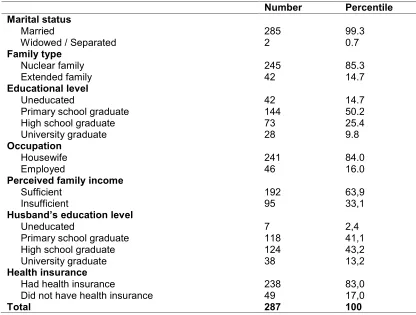
The mean age of the sample was 25.82 (sd 5.04; range 17 to 42; median 26). Half of the women were primary school graduates, 99.3% were married, 85.0% lived in a nuclear family, 84.0% were housewives, 5.2% had a chronic illness and 59.9% had a sufficient income level. The mean age of the women’s husband’s was 29.64 (sd 4.74; range 18 to 46), 43.2% of the women’s husband were high school graduates and 48.4% of them were workers (Table 1).
Table 1. Sample characteristics
Number Percentile
Marital status
Married 285 99.3
Widowed / Separated 2 0.7
Family type
Nuclear family 245 85.3
Extended family 42 14.7
Educational level
Uneducated 42 14.7
Primary school graduate 144 50.2
High school graduate 73 25.4
University graduate 28 9.8
Occupation
Housewife 241 84.0
Employed 46 16.0
Perceived family income
Sufficient 192 63,9
Insufficient 95 33,1
Husband’s education level
Uneducated 7 2,4
Primary school graduate 118 41,1
High school graduate 124 43,2
University graduate 38 13,2
Health insurance
Had health insurance 238 83,0
Did not have health insurance 49 17,0
Approximately forty percent of women had not used any family planning method and 22.0% of them had had used condoms as a family planning method. Approximately half of the women had delivered boys (Table 2). The mean number of pregnancy (n=259) was 2.00 (sd 1.41; range 1 to 9, median 1.41), the mean number of abortion (n=240) was 1.34 (sd 0.56; range 1 to 3; median 0.56), the mean number of curettage (n=259) was 1.10 (sd 0.41; range 1 to 3; median 0.41), the mean number living children was 1.73 (sd 1,08; range 1 to 3; median 1.08). 81.2% of the pregnancies were planned pregnancies. 71.8% of the women had received antenatal care (Tabel 2).
Table 2. Obstetrical characteristics of women
n %
Antenatal care
Yes 206 71.8
No 81 28.2
Mode of delivery
Spontaneous delivery 181 63.1
Caesarean section 106 36.9
Unwanted pregnancy
Wanted 233 81.2
Unwanted 54 18.8
Baby’s gender
Female 153 53.3
Male 134 46.7
Chronic illness
Yes 15 5.2
No 272 94.8
Smoking
Yes 37 12.9
No 250 87.1
Total 287 100.0
One fifth of the women had experienced pregnancy problems and 6.3% had experienced problems during delivery. 8.4% of the women had experienced problem about care of baby.
3.2 Point Prevalence of Postpartum Depression
Thirty-nine of the 287 women achieved an EPDS score of 13 or above, indicating a point-prevalence of postpartum depression of 13.5%.
3.3 The association between Social Support and Postpartum Depression
Table 3. The association between Multidimensional Scale of Perceived Social Support Subscales means and depression according to Edingburgh Postnatal Depression
Scale
MSPSS subscales Depresssion n Mean ± Standart
deviation t P
Family Positive 39 20.82 ± 6.06 4.44 0.00
Negative 245 25.38 ± 5.20
Friends Positive 39 19.17 ± 6.89 3.02 0.00
Negative 245 22.65 ± 5.09
Significant Others Positive 39 22.76 ± 5.26 3.84 0.00
Negative 245 26.08 ± 2.82
3.4 The Effect of Sample Characteristics and Social Support on Postpartum
Depression
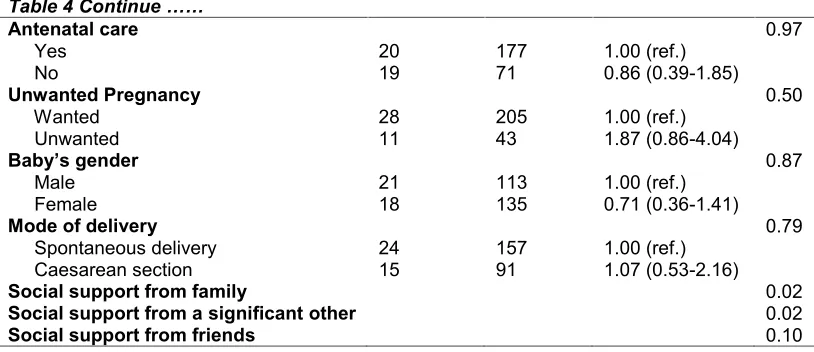
Logistic regression analysis indicated that 4 of 14 variables were determined as predictive factors. Smoking, pregnancy number, social support from family and from a significant other predicted postpartum depression but no association was found between baby’s gender, family type, perceived family income, educational level, occupation had health insurance, antenatal care, unwanted pregnancy, mode of delivery and social support from friends and postpartum depression (Table 4).
Table 4. The effect of social support, sociodemographic and obstetrician features on postpartum depression
Postpartum depression OR (95% CI) P Positive Negative
Family Type 0.51
Nuclear 32 213 1.00 (ref.)
Others 7 35 1.33 (0.54-3.25)
Perceived family income 0.30
Sufficient 28 164 1.00 (ref.)
Insufficient 11 84 0.76 (0.36-1.61)
Educational level 0.29
Educated 34 211 1.00 (ref.)
Uneducated 5 37 0.83 (0.30-2.28)
Occupation 0.67
Employed 8 38 1.00 (ref.)
Unemployed 31 210 0.70 (0.30-1.64)
Health insurance 0.12
Had health insurance 29 209 1.00 (ref.)
Did not have health insurance 10 39 1.84 (0.83-4.09)
Smoking 0.04
No 30 220 1.00 (ref.)
Yes 9 28 2.35 (1.01-5.47)
Pregnancy number 0.03
2 < 20 147 1.00 (ref.)
Table 4 Continue ……
Antenatal care 0.97
Yes 20 177 1.00 (ref.)
No 19 71 0.86 (0.39-1.85)
Unwanted Pregnancy 0.50
Wanted 28 205 1.00 (ref.)
Unwanted 11 43 1.87 (0.86-4.04)
Baby’s gender 0.87
Male 21 113 1.00 (ref.)
Female 18 135 0.71 (0.36-1.41)
Mode of delivery 0.79
Spontaneous delivery 24 157 1.00 (ref.)
Caesarean section 15 91 1.07 (0.53-2.16)
Social support from family 0.02
Social support from a significant other 0.02
Social support from friends 0.10
4. DISCUSSION
In this study, it was found that different types of social support have differential effects on PPD and post partum depression was associated with social support from family and a significant other but not with social support from friends.
Our study further supports previous evidence that women with low levels of social support from family and a significant other are at high risk of developing postpartum depression. The findings from a meta-analyses of over 14,000 subjects and subsequent studies of nearly 10,000 additional subjects indicated that depression during pregnancy, anxiety during pregnancy, experiencing stressful life events during pregnancy or the early puerperium, low levels of social support and a previous history of depression were the strongest predictors of postpartum depression [35]. Similar findings were reported in other studies. Anxiety and social support were identified as the predictors of postpartum depression in Thai women [36]. Both social support and social networks were statistically significant and independently related to depressive symptomatology [37]. Nonwhite race, physical symptom burden, infant colic, lack of social support and lower self-efficacy scores are associated with early postpartum depressive symptoms [38]. Lack of support has been seen to be a key risk factor in postpartum depression in Korean society [39]. Among Chinese women, marital dissatisfaction, antenatal life events, past depression, late antenatal depressive symptoms and lack of social support predicted postpartum affective morbidity [30]. In a study conducted in Pakistan it has found that depressed mothers were significantly more disabled, had more threatening life events and poorer social and family support than non-depressed mothers [40]. In a study conducted in Israeli it has been seen that lack of social support, marital disharmony, depressive symptoms during pregnancy, history of emotional problems and prolonged infant health problems were most predictive of PPD [41]. Mothers who had a postpartum depression in Germany complained more often about having low or no support by the partner [42]. In other studies conducted in Turkey it has seen that EPDS mean score was related to family support during the postpartum period [11,13].
is social support assessment method. Multidimensional Scale of Perceived Social Support has been used to assess social support and associations between PPD and social support have been analyzed by using multivariate analysis in this study. Our findings also highlight the importance of source of social support. Although depressed women’s MSPSS three subscales (social support from family, social support from a significant other, social support from friends) scores were significantly lower than those in non-depressed women in the bivariate analyses; social support from family and from a significant other predict postpartum depression but not social support from friends in logistic regression analysis. In the study conducted in Pakistani women [25] it has shown that three sources of social support was associated with postpartum depression in bivariate analysis. There are only a few studies which have systematically examined the effect of different sources of social support to postpartum depression. Because of this, more research is required to find out the relationship between different sources of social support and PPD.
Although most of the studies indicates that postpartum depression appears to be related to social support. The findings of Chaaya et al. [26] and Leoung, Martinson and Arthur [44] constitute an exception to this conclusion. In the study of Chaaya et al. conducted in Lebanon it has been observed that lack of social support and lifetime depression were not significant predictors in the multivariate analysis, although they were significant in the bivariate analyses [26]. But it might be a result of measuring social support method. Chaayaa et al. has taken social support as “to have social support from more than one person” [26].
Although there is a wealth of literature that highlights the relationship between social support and depression, there is a need to find out possible mediating or moderating factors to the associations between social support and depression. For example personality features like self-esteem and locus of control may act as a mediating or moderating factor. In fact the findings of Josefsson & Sydsjö have shown that the women with postpartum depression differ in personality from healthy postpartum women and from healthy non-postpartum controls [45]. Verkerk, Denollet, Van Heck, Van Son and Pop have also shown that high neuroticism in combination with high introversion was a stable predictor of clinical depression across the whole first year postpartum [46].
On the other hand when interpreting the associations between social support and depression, the effect of depression on perceiving social support should also be considered. Perception of social support may be different from the actual availability of social support in depressed patients. Depressed patients could not utilize social support more efficiently than non-depressed persons. Perceived social support represents cognitive component of social support and depression-related negative cognitions may affect this component. So it is critical for clinicians to understand that it is the perception of lack of social supports from family and significant others that predicts PPD.
PPD in both areas, whereas stressful life events, lifetime depression, vaginal delivery, little education, unemployment and chronic health problems were significantly related to PPD in one of the areas. These findings suggest that the effects of predictive factors may be complex and aspects of these effects may vary with cultural features [25].
This study has some limitations. The study population does not represent general population. All the data are self reported and depression has been determined by using a screening test which could not give a definitive diagnosis of depression.
5. CONCLUSION
In conclusion, our study confirms that postpartum depression is a public health problem in Turkey as in other parts of world and social support from family and a significant other is associated with postpartum depression. This finding highlights that there is a need to address this unmet need in planning interventions. But prevalence rate of PPD and differential effects of risk factors on PPD vary substantially among studies and this should be taken into consideration when planning interventions for postpartum depression.
CONSENT
All participants were informed that their participation in this study is voluntary and they are allowed to withdraw at any time. Further, they assured that their identities will not be revealed; only aggregate data was reported.
ETHICAL APPROVAL
All authors hereby declare that this study has been examined and approved by the appropriate ethics committees and has therefore been performed in accordance with the ethical standards laid down in the 1964 Declaration of Helsinki.
ACKNOWLEDGEMENTS
We would like to thank Ayşegül Karaağaçlı, Birsel Sağlam, Dicle Özdemir, Emine Öztürk, Esra Güneş, Gülşen Sarı, Naime Ülker, Özgül Gür, Pelin Ağır, Yıldız Sevim for their contribution to data collection.
COMPETING INTERESTS
Authors have declared that no competing interests exist.
REFERENCES
1. Richards JP. Postnatal depression: a review of recent literature. Br J Gen Pract. 1990;40(340):472-6.
2. Leahy-Warren P, McCarthy G. Postnatal depression: prevalence, mothers' perspectives, and treatments. Arch Psychiatr Nurs. 2007;21(2):91-100.
4. Danaci AE, Dinç G, Deveci A, Sen FS, Icelli I. Postnatal depression in Turkey:epidemiological and cultural aspects. Soc Psychiatry Psychiatr Epidemiol. 2002;37(3):125-129.
5. Inandi T, Elci OC, Ozturk A, Egri M, Polat A, Sahin TK. Risk factors for depression in postnatal first year, in eastern Turkey. Int J Epidemiol. 2002;31(6):1201-1207.
6. Ekuklu G, Tokuc B, Eskiocak M, Berberoğlu U, Saltık A. Prevalence of postpartum depression in Edirne, Turkey and related factors. J Reprod Med. 2004;49(11):908-914. 7. Bugdayci R, Sasmaz CT, Tezcan H, Kurt AO, Oner S. A cross-sectional prevalence study of depression at various times after delivery in Mersin province in Turkey. J Womens Health. 2004;13(1):63-68.
8. Ayvaz S, Hocaoğlu C, Tiryaki A, Ak I. Incidence of postpartum depression in Trabzon province and risk factors at gestation. Turk Psikiyatri Derg. 2006;17(4):243-251. 9. Gulseren L, Grol A, Gulseren S, Kuey L, Bilic B, Ergor G. From antepartum to
postpartum: a prospective study on the prevalence of peripartum depression in a semiurban Turkish community. J Reprod Med. 2006;51(12):955-60.
10. Dindar I, Erdoğan S. Screening of Turkish women for postpartum depression within the first postpartum year: the risk profile of a community sample. Public Health Nurs. 2007;24(2):176-83.
11. Ege E, Timur S, Zincir H, Geçkil E, Sunar-Reeder B. Social support and symptoms of postpartum depression among new mothers in Eastern Turkey. J Obstet Gynaecol Res. 2008;34(4):585-593.
12. Yagmur Y, Ulukoca N. Social support and postpartum depression in low-socioeconomic level postpartum women in Eastern Turkey. Int J Public Health. 2010;55(6):543-549.
13. Ozbasaran F, Coban A, Kucuk M. Prevalence and risk factors concerning postpartum depression among women within early postnatal periods in Turkey. Arch Gynecol Obstet. 2010;283(3):483-490.
14. de Tychey C, Briancon S, Lighezzolo J, Spitz E, Kabuth B, de Luigi V, Messembourg C, Girvan F, Rosati A, Thockler A, Vincent S. Quality of life, postnatal depression, and baby gender. J Clin Nurs. 2008;17(3):312-322.
15. Patel V, Rahman A, Jacob KS, Hughes M. Effect of maternal mental health on infant growth in low income countries: new evidence South Asia. BMJ 2004;328:820-823. 16. Nagata M, Nagai S, Sobajima H, Ando T, Nishide Y, Honjo S. Maternity blues and
attachment to chidren in mothers of full-term normal infants. Acta Psychiatrica Scandinavica. 2000;101(3):209-217.
17. Sabuncuoglu O, Berkem M. Relationship between attachment style and depressive symptoms in postpartum women: findings from Turkey. Turk Psikiyatri Derg. 2006;17(4):252-258.
18. Taveras EM, Capra AM, Braveman PA, Jensfold NG, Escobar GJ, Lieu TA. Clinician support and psychosocial risk factors associated with breastfeeding discontinuation. Pediatrics. 2003;112(1):108-115.
19. Patel V, de Souza N, Rodrigues M. Postnatal depression and infant growth and development in low income countries: a cohort study from Goa, India. Archieves of Disease in Childhood. 2003;88:34-37.
20. Josefsson A, Larsson C, Sydsjö G, Nylander PO. Temperament and character in women with postpartum depression. Arch Womens Ment Health. 2007;10:3-7.
21. Beck CT. Predictors of postpartum depression: an update. Nurs Res. 2001;50:275-285.
23. Sword W, Bai YQ, Thabane L, Foster G, Kurtz Landy C, Watt S, Krueger P, Farine D. Predictors of postpartum depression over the first year following childbirth. J Paediatr Child Health. 2012;48(Suppl.1):62.
24. Aydin N, Inandı T, Karabulut N. Depression and associated factors among women within their first natal year in Erzurum province in eastern Turkey. Women Health. 2005;41(2):1-12.
25. Husain N, Beve I, Husain M, Chaudhry IB, Atif N, Rahman A. Prevalence and social correlates of postnatal depression in a low income country. Arch Womens Ment Health. 2006;9:197-202.
26. Chaaya M, Campbell OMR, El Kak F, Shaar D, Harb H, Kaddour A. Postpartum depression: prevalence and determinants in Lebanon. Arch Womens Ment Health. 2002;5(2):65-72.
27. Forman N, Videbech P, Hedgeard M, Salvig JD, Secher NJ. Postpartum depression: identification of women at risk. British Journal of Obstetrics and Gynaecology. 2000;107:1210-1217.
28. Stuchbery M, Matthey S, Barnett B. Postnatal depression and social supports in Vietnamese, Arabic and Anglo-Celtic mothers. Soc Psychiatry Psychiatr Epidemiol. 1998;33:483-490.
29. Heh SS, Coombes L, Barlett H. The association between depressive symptoms and social support in Taiwanese women during the month. International Journal of Nursing Studies. 2004;41:573-579.
30. Lee DT, Yip US, Leung YT, Chung TK. Ethnoepidemiology of postnatal depression. Prospective multivariate study of sociocultural risk factors in a Chinese population in Hong Kong. Br J Psychiatry. 2004;184:34-40.
31. Haslam DM, Pakenham KI, Smith A. Social support and postpartum depressive symptomatology: The mediating role of maternal self-efficacy. Infant Mental Health Journal. 2006;27(3):276-291.
32. Cox JL, Holden JM, Sagovsky R. Detection of postnatal depression. Development of the 10-item Edinburgh Postnatal Depression Scale. Br J Psychiatry. 1987;150:782-6. 33. Engindeniz AN, Küey L, Kültür S. Validity and reliability of Turkish version Edinburgh
Postnatal Depression Scale. Book of Annual Meeting of Psychiatric Association of Turkey. Turkish Psychiatric Association Press, Ankara. 1996;51-52.
34. Eker D, Arkar H, Yaldiz H. Factorial structure, validity, and reliability of revised form of the Multidimensional Scale of Perceived Social Support. Turk Psikiyatr Derg. 2001;12:17–25.
35. Robertson E, Grace S, Wallington T, Steward DE. Antenatal risk factors for postpartum depression: a synthesis of recent literature. Gen Hosp Psychiatry. 2004;26(4):289-95.
36. Liabsuetrakul T, Vittayanont A, Pitanupong J. Clinical applications of anxiety, social support, stressors, and self-esteem measured during pregnancy and postpartum for screening postpartum depression in Thai women. J Obstet Gynaecol Res. 2007;33(3):333-40.
37. Surkan PJ, Peterson KE, Hughes MD, Gottlieb BR. The role of social networks and support in postpartum women's depression: a multiethnic urban sample. Matern Child Health J. 2006;10(4):375-83.
38. Howell EA, Mora P, Leventhal H. Correlates of early postpartum depressive symptoms. Matern Child Health J. 2006;10(2):149-57.
40. Rahman A, Iqbal Z, Harrington R. Life events, social support and depression in childbirth: perspectives from a rural community in the developing world. Psychol Med. 2003;33(7):1161-7.
41. Glasser S, Barell V, Boyko V, Ziv A, Lusky A, Shoham A, Hart S. Postpartum depression in an Israeli cohort: demographic, psychosocial and medical risk factors. J Psychosom Obstet Gynaecol. 2000;21(2):99-108.
42. Ballestrem CL, Strauss M, Kachele H. Contribution to the epidemiology of postnatal depression in Germany--implications for the utilization of treatment. Arch Womens Ment Health. 2005;8:29-35.
43. Leahy-Warren P, McCarthy G, Corcoran P. Postnatal depression in first-time mothers: prevalence and relationships between functional and structural social support at 6 and 12 weeks postrpartum. Arch Psychiatr Nurs. 2011;25(3):174-184.
44. Leoung SS, Martinson IM, Arthur D. Postpartum depression and related psychosocial variables in Hong Kong Chinese women: findings from a prospective study. Res Nurs Health. 2005;28(1):27-38.
45. Josefsson A, Sydsjö G. A follow-up study of postpartum depressed women: recurrent maternal depressive symptoms and child behavior after four years. Arch Womens Ment Health. 2007;10(4):141-5.
46. Verkerk GJ, Denollet J, Van Heck GL, Van Son MJ, Pop VJ. Personality factors as determinants of depression in postpartum women: a prospective 1-year follow-up study. Psychosom Med. 2005;67:632-637.
© 2014 Özmen et al.; This is an Open Access article distributed under the terms of the Creative Commons Attribution License (http://creativecommons.org/licenses/by/3.0), which permits unrestricted use, distribution and reproduction in any medium, provided the original work is properly cited.
Peer-review history:
The peer review history for this paper can be accessed here: