© 2014, IJCSMC All Rights Reserved 1223 Available Online atwww.ijcsmc.com
International Journal of Computer Science and Mobile Computing
A Monthly Journal of Computer Science and Information Technology
ISSN 2320–088X
IJCSMC, Vol. 3, Issue. 5, May 2014, pg.1223 – 1230
RESEARCH ARTICLE
A Framework for MEMS Based
Hand Gesture Recognition System
for Controlling the Mouse Cursor
using Wireless Technology
Khushbu Agrawal
1, Vikrant Chole
21
Department of Computer Science and Engineering, GHRAET, Nagpur, India
2
Department of Computer Science and Engineering, GHRAET, Nagpur, India
1
[email protected];
2[email protected]
Abstract— HAND gesture recognition provides an intelligent, natural, and convenient way of human–
computer interaction (HCI). Sign language recognition (SLR) and gesture-based control are two major applications for hand gesture recognition technologies. SLR aims to interpret sign languages automatically by a computer in order to help the deaf communicate with hearing society conveniently. Since sign language is a kind of highly structured and largely symbolic human gesture set, SLR also serves as a good basic for the development of general gesture-based HCI. It provides us the means to create a communication between human and computer to operate a mouse cursor on the screen of a PC.
Keywords— — HCI; SLR; Accelerometer; Flex sensors; CC2500 transreceivers
I. INTRODUCTION
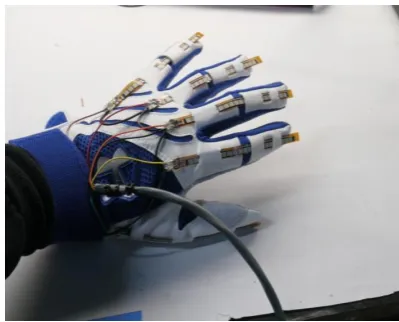
These projects basically based on flex sensor and gesture sensor accelerometer, which will provide the efficiency to recognise the gesture of the fingers and controlling the desktop application remotely.
© 2014, IJCSMC All Rights Reserved 1224 II. GESTURE RECOGNITION
NOW A DAYS, the expansion of human machine interaction technologies in electronic circuits has been greatly reduced the dimension and weight of consumer electronics products such as smart phones and handheld computers, and therefore will increases our day to day convenience. Recently, an attractive alternative, a conveyable embedded device with inertial sensors, has been projected to sense the activities of human and to capture their motion trajectory information from accelerations for handwriting and recognizing gestures. The foremost necessary advantage of inertial sensors for general motion sensing is that they can be operated without any external reference and limitation in operating conditions.[1]
According to the sensing technologies used to capture gestures, conventional researches on hand gesture recognition can be categorized into two main groups: data glove-based and computer vision-based techniques. In the first case, data gloves equipped with bending sensors and accelerometers are used to capture the rotation and movement of the hand and fingers. Fang reported a system using two data gloves and three position trackers as input devices and a fuzzy decision tree as a classifier to recognize Chinese Sign Language (CSL) gestures. The average classification rate of 91.6% was achieved over a very
impressive 5113-sign vocabulary in CSL [10]. In similar pattern we are going to use flex sensors on gloves so as to recognize the sign language used by human being.
III.RELATED WORK
All A brain-computer interface (BCI) is a communication channel connecting the brain to a computer or another electronic device[5]. There are mainly two existing types of gesture recognition methods [1], i.e., vision-based accelerometer and/or gyroscope based[1]. Due to some limitations like ambient optical noise, slower dynamic response, and relatively large data collections/processing of vision-based method [1] , our recognition system is implemented based on an inertial
measurement unit based on MEMS acceleration sensors[1]. If gyroscopes are used for inertial measurement it causes heavy computational burden, thus our system is based on MEMS accelerometers only and gyroscopes are not implemented [1]. Many researchers have focused on developing effective algorithms for error compensation of inertial sensors to improve the
recognition accuracy. For examples, Yang et al proposed a pen-type input device to track trajectories in 3-D space by using accelerometers and gyroscopes [1]. An efficient acceleration error compensation algorithm based on zero velocity compensation was developed to decrease the acceleration errors for acquiring accurate reconstructed trajectory [1]. An extended Kalman filter with magnetometers [1] (micro inertial measurement unit (μIMU) with magnetometers)[1], proposed by Luo et al was employed to compensate the orientation of the proposed digital writing instrument. If the orientation of the instrument was estimated precisely, the motion trajectories of the instrument were reconstructed accurately [1]. Dong et al. proposed an optical tracking calibration method based on optical tracking system (OTS) to calibrate 3-D accelerations, angular velocities, and space attitude of handwriting motions [1]. The OTS was developed for the following two goals: 1) to obtain accelerations of the proposed ubiquitous digital writing instrument (UDWI) by calibrating 2-D trajectories and 2) to obtain the accurate attitude angles by using the multiple camera calibration[1]. However, in order to recognize or reconstruct motion trajectories accurately, the aforementioned approaches introduce other sensors such as gyroscopes or magnetometers to obtain precise orientation [1]. This increases additional cost for motion trajectory recognition systems as well as computational burden of their algorithms [1].
In referenced paper, a portable device has been developed with a trajectory recognition algorithm [1]. The portable device consists of a triaxial accelerometer, a microprocessor, and a zigbee wireless transmission module [1]. The acceleration signals measured from the triaxial accelerometer are transmitted to a computer via the CC2500 wireless module. Users can utilize this portal device [1].
A brain-computer interface (BCI) is a hardware and software communications system that permits cerebral activity alone to control computers or external devices [2]. The immediate goal of BCI research is to provide communications capabilities to severely disabled people who are paralysed or ‗locked in‘ by neurological neuromuscular disorders, such as amyotrophic lateral sclerosis, brain stem stroke, or spinal cord injury[2].
Here, we review the state-of-the-art of BCIs, looking at the different steps that form a standard BCI: signal acquisition, pre-processing or signal enhancement, feature extraction, classification and the control interface [2]. We discuss their
advantages, drawbacks, and latest advances, and we survey the numerous technologies reported in the scientific literature to design each step of a BCI [2].
IV.HARDWAREIMPLEMENTED
© 2014, IJCSMC All Rights Reserved 1225
connected to the Arithmetic Logic Unit (ALU), allowing two independent registers to be accessed in one single instruction executed in one clock cycle[11]. The resulting architecture is more code efficient while achieving throughputs up to ten times faster than conventional CISC microcontrollers[11].
Figure 1 Microcontroller AtMega 16
B. Flex Sensor: A property of bend sensors worth noting is that bending the sensor at one point to a prescribed angle is not the most effective use of the sensor[13]. As well, bending the sensor at one point to more than 90˚ may permanently damage the sensor[13]. Instead, bend the sensor around a radius of curvature[13]. The smaller the radius of curvature and the more the whole length of the sensor is involved in the deflection, the greater the resistance will be (which will be much greater than the resistance achieved if the sensor is fixed at one end and bent sharply to a high degree)[13]. In fact, Infusion Systems define the sensing parameter as ―flex angle multiplied by radius‖[13].
Figure 2 Flex Sensor
Features:-
Angle Displacement Measurement
Bends and Flexes physically with motion device
Possible Uses
Robotics
Gaming (Virtual Motion)
Medical Devices
Computer Peripherals
Musical Instruments
Physical Therapy
© 2014, IJCSMC All Rights Reserved 1226
C. Accelerometer:- Breakout board for the 3 axis ADXL335 from analog Devices[18]. This is the latest in a long, proven line of analog sensors - the holy grail of accelerometers [18]. The ADXL335 is a triple axis MEMS accelerometer with extremely low noise and power consumption - only 320uA! The sensor has a full sensing range of +/-3g.
There is no on-board regulation, provided power should be between 1.8 and 3.6VDC[18].
Board comes fully assembled and tested with external components installed. The included 0.1uF capacitors set the bandwidth of each axis to 50Hz [18].
Figure 3 Accelerometer
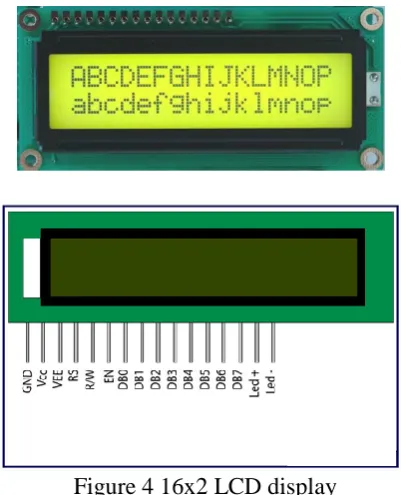
D. 16 x 2 LCD Display:- LCD (Liquid Crystal Display) screen is an electronic display module and find a wide range of applications. A 16x2 LCD display is very basic module and is very commonly used in various devices and circuits[19]. These modules are preferred over seven segments and other multi segment LEDs[19]. The reasons being: LCDs are economical; easily programmable; have no limitation of displaying special & even custom characters (unlike in seven segments), animations and so on[19]..
A 16x2 LCD means it can display 16 characters per line and there are 2 such lines[19].. In this LCD each character is displayed in 5x7 pixel matrix. This LCD has two registers, namely, Command and Data[19]..
© 2014, IJCSMC All Rights Reserved 1227
E. 7805 Voltage Regulator:-7805 is a voltage regulator integrated circuit. It is a member of 78xx series of fixed linear voltage regulator ICs[20]. The voltage source in a circuit may have fluctuations and would not give the fixed voltage output. The voltage regulator IC maintains the output voltage at a constant value. The xx in 78xx indicates the fixed output voltage it is designed to provide[20].. 7805 provides +5V regulated power supply. Capacitors of suitable values can be connected at input and output pins depending upon the respective voltage levels[20]..
Figure 5 7805 Voltage regulator
Pin Description:-
Features:-
Output Current up to 1A
Output Voltages of 5, 6, 8, 9, 10, 12, 15, 18, 24V
Thermal Overload Protection
Short Circuit Protection
Output Transistor Safe Operating Area Protection
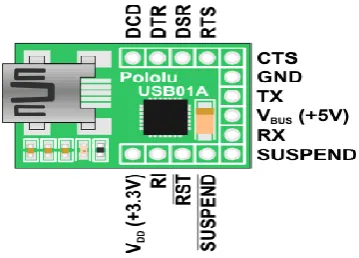
F.Serial to USB converter device:- It is used to connect the microcontroller output to the PC for Speech conversion.
Figure 6 Serial to USB converter device
G.6V dc battery
Pin No Function Name
1 Input voltage (5V-18V) Input
2 Ground (0V) Ground
© 2014, IJCSMC All Rights Reserved 1228 V. METHODOLOGY
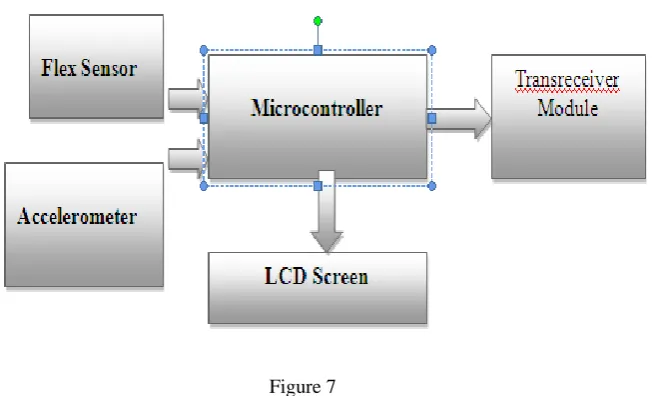
As per the block diagram, there will be two types of sensor used to generate the analog voltage for detecting the movement of the figure. The analog voltage will be directly processed by the microcontroller for sending the control signal using transreceiver module. The status of the sensor ADC values will be displayed in the LCD Screen.
Figure 7
At the receiver end, the transreceiver module will receive the signal from the transmitter end and process it to the computer system for its logical processing and control of the desktop application.
Figure 8
VI.DESCRIPTION
A. Embedded C:- The language used to write the programs for programming is Embedded C. Reason for using C is C is largely machine-independent[21]. Programs written in C are easily ported from one computer to another[21]. C is widely available. Commercial C compilers are available for most personal computers, mini-computers, and mainframes. C includes certain low-level features that are normally available only in assembly or machine language [21].. Programs written in C compile into smaller programs that execute efficiently. It is a flexible, high-level, structured programming language.
© 2014, IJCSMC All Rights Reserved 1229
B.AVR Studio:- The AVR is a modified Harvard architecture 8-bit RISC single chip microcontroller which was developed by Atmel in 1996[11]. The AVR was one of the first microcontroller families to use on-chip flash memory for program storage, as opposed to one-time programmable ROM, EPROM, or EEPROM used by other microcontrollers at the time. Flash, EEPROM, and SRAM are all integrated onto a single chip, removing the need for external memory in most applications[11]. Some devices have a parallel external bus option to allow adding additional data memory or memory-mapped devices[11]. Almost all devices (except the smallest TinyAVR chips) have serial interfaces, which can be used to connect larger serial EEPROMs or flash chips [11].
C. PROGISP: - It is used for burning the programs into the microcontroller devices.
D. Visual Studio 10:- Microsoft Visual Studio is an integrated development environment (IDE) from Microsoft[12]. It is used to develop computer programs for Microsoft Windows superfamily of operating systems, as well as web sites, web applications and web services[12]. Visual Studio uses Microsoft software development platforms such as Windows API, Windows Forms, Windows Presentation Foundation, Windows Store and Microsoft Silverlight. It can produce both native code and managed code[12].
Visual Studio includes a code editor supporting IntelliSense as well as code refactoring. The integrated debugger works both as a source-level debugger and a machine-level debugger[12]. Other built-in tools include a forms designer for building GUI applications, web designer, class designer, and database schema designer [12]. It accepts plug-ins that enhance the functionality at almost every level—including adding support for source-control systems (like Subversion) and adding new toolsets like editors and visual designers for domain-specific languages or toolsets for other aspects of the software development lifecycle (like the Team Foundation Server client: Team Explorer)[12].
Visual Studio supports different programming languages and allows the code editor and debugger to support (to varying degrees) nearly any programming language, provided a language-specific service exists. Built-in languages include C,[5] C++ and C++/CLI (via Visual C++), VB.NET (via Visual Basic .NET), C# (via Visual C#), and F# (as of Visual Studio 2010[6])[12]. Support for other languages such as M, Python, and Ruby among others is available via language services installed separately[12]. It also supports XML/XSLT, HTML/XHTML, JavaScript and CSS. [12]
E. MEMS accelerometer mostly based on gesture recognition algorithm and its applications [1]. The hardware module consists of a triaxial mems accelerometer, microcontroller, and CC2500 wireless transmission module for sensing and
collecting accelerations of handwriting and hand gesture trajectories[1]. Users will use this hardware module to write down digits, alphabets in digital kind by making four hand gestures[1]. The accelerations of hand motions measured by the accelerometer are transmitted wirelessly to a personal computer[1]
F. Brain-computer interfaces create alternate communication channels for people with severe motor impairment. The ability to enable the brain to control an external device with thoughts alone is emerging as a real option for patients with motor disabilities. [6]
VII. CONCLUSION
We conclude from all the above study that the project can be a very helpful device for all those persons who are disable in some way and can use their hands motion for using this device. This can make those people to get opportunities in their lives to get work for them and be self sufficient. This device is basically designed aiming the people who are suffering from disabilities but their hands and brain are sufficiently working. It can be proved as a boon for them to get a job and be self sufficient. The analog signals from hands can be captured through sensors so the signal values can be assigned number of operations as per the handling capacity of that person who is going to use it.
REFERENCES
[1] Meenaakumari.M1, M.Muthulakshmi2 ―MEMS ACCELEROMETER BASED HAND GESTURE RECOGNITION‖ (IJARCET) Volume 2, No 5, May 2013.
[2] Luis Fernando Nicolas-Alonso and Jaime Gomez-Gil, ―Sensors-Brain Computer Interfaces‖ Published: 31 January 2012. [3] Leigh Hochberg & David Orenstein ―People with paralysis control robotic arms using brain-computer interface‖ ,
© 2014, IJCSMC All Rights Reserved 1230
[4] Khalid, M.B.; Rao, N.I.; Rizwan-i-Haque, I.; Munir, S.; Tahir, F. Towards a Brain Computer Interface Using Wavelet Transform with Averaged and Time Segmented Adapted Wavelets‖ Karachi, Sindh, Pakistan, February 2009; pp. 1–4. [5] Ming Cheng, Xiaorong Gao, Shangkai Gao, Dingfeng Xu, ―Design and Implementation of a Brain-Computer Interface With High Transfer Rates‖ ―TRANSACTIONS ON BIOMEDICAL ENGINEERING‖, VOL. 49, NO. 10, published: OCTOBER 2002.
[6] The Evolution of Brain-Computer Interfaces, Author: Eric C. Leuthardt .
[7] CBC News. "Out of the Dark." Jan. 5, 2003. http://www.cbc.ca/sunday/sight/index.html.
[8] J. R. Wolpaw ―Brain-computer interface technology: A reviewof the first international meeting, June 2000.,vol. 8, pp.164–173.
[9] Farwell, L.A.; Donchin, E. Talking off the top of your head: Toward a mental prosthesis utilizing event-related brain potentials. Electroencephalogr. Clin. Neurophysiol. 1988, 70, 510–523.
[10]Xu Zhang, Xiang Chen, Associate Member, IEEE, Yun Li, Vuokko Lantz, Kongqiao Wang, and Jihai Yang, “A Framework for Hand Gesture Recognition Based on Accelerometer and EMG Sensors‖ IEEE TRANSACTIONS ON SYSTEMS, MAN, AND CYBERNETICS—PART A: SYSTEMS AND HUMANS, VOL. 41, NO. 6, NOVEMBER 2011.
[11] http://en.wikipedia.org/wiki/Atmel_AVR.
[12]http://en.wikipedia.org/wiki/Microsoft_Visual_Studio.
[13]http://www.google.co.in/url?sa=t&rct=j&q=&esrc=s&frm=1&source=web&cd=2&cad=rja&uact=8&sqi=2&ved=0CDI
QFjAB&url=http%3A%2F%2Fmech207.engr.scu.edu%2FSensorPresentations%2FJan%2520- %2520Flex%2520Sensor%2520Combined.pdf&ei=H_d5U-DaPIy3uAThxYCwBQ&usg=AFQjCNFSikgj77Pbo8rdlO_-QzQ7-IH5dQ&bvm=bv.66917471,d.c2E.
[14]Pedro Neto, J. Norberto Pires, Member, IEEE, and A. Paulo Moreira, Member, IEEE.
[15]S. Zhang, C. Yuan, and V. Zhang, ―Handwritten character recognition using orientation quantization based on 3-D accelerometer,‖ presented at the 5th Annu. Int. Conf. Ubiquitous Systems, Jul. 25th, 2008.
[16]J. Yang, W. Chang, W. C. Bang, E. S. Choi, K. H.Kang, S. J. Cho, and D. Y. Kim, ―Analysis and compensation of errors in the input device based on inertial sensors,‖ in Proc. IEEE Int. L. Wang, ―Feature selection with kernel class
separability,‖ IEEE Trans.Pattern Anal. Mach. Intell., vol. 30, no. 9, pp. 1534–1546, Sep. 2008.
[17]Z. Dong, G. Zhang, Y. Luo, C. C. Tsang, G. Shi, S. Y. Kwok, W. J. Li,P. H. W. Leong, and M. Y. Wong, ―A calibration method for MEMS inertial sensors based on optical tracking,‖ in Proc. IEEE Int. Conf.Nano/Micro Eng. Mol. Syst., 2007, pp. 542–547.
[18]http://en.wikipedia.org/wiki/Accelerometer.
[19]http://www.google.co.in/url?sa=t&rct=j&q=&esrc=s&frm=1&source=web&cd=1&cad=rja&uact=8&ved=0CDAQFjAA &url=http%3A%2F%2Fwww.csus.edu%2Findiv%2Fp%2Fpangj%2F166%2Fhandout%2FHandout_Character_16x2_L CD.pdf&ei=vvp5U47vKNOXuATC64D4BQ&usg=AFQjCNHt89AGAaH39nxTC7mseqStAhF9YA&bvm=bv.6691747 1,d.c2E.
[20] Semiconductor Technical Data , KEC, Korea electronics company limited.