Available Online atwww.ijcsmc.com
International Journal of Computer Science and Mobile Computing
A Monthly Journal of Computer Science and Information Technology
ISSN 2320–088X
IMPACT FACTOR: 5.258
IJCSMC, Vol. 5, Issue. 7, July 2016, pg.436 – 440
Multi Notarized Identity Management in
Cloud using Level based Cryptography
V.Prasath
1, R.Buvanesvari
2¹Department of Computer Science, PKIET, Karaikal & Pondicherry University, India
²Department of Computer Science, PKIET, Karaikal & Pondicherry University, India
1
[email protected], 2 [email protected]
Abstract—Cloud computing is a recently developed with a new technology for complex systems with
massive-scale services sharing among numerous users. Today most cloud computing system use asymmetric and traditional public key cryptography to provide data security and mutual authentication. Federated Identity Management is a secure single sign-on process between each other and it can enable the portability to share their identity across different networks. In this paper, a multi notarized federated identity system together with level-based cryptography for secure transaction management in cloud is implemented. An effective implementation of this notarized federated identity management together with level-based cryptography not only solves the complex problem of secure key sharing but also provide the access to the number of unknown cloud system can mutually authenticate in notary server.
Keywords—cloud computing, federated identity, notarized server, level-based cryptography, single sign on
I. INTRODUCTION
Level-based cryptography is a public key technology that allows the use of a public identifier of a user as the user’s public key. It has also some attraction characteristics that seem to fit well the requirements of cloud computing. Currently the majority of cloud computing systems provide digital identity for users to access their services [1].
communications between identity providers and service providers which improved privacy protection for users [3].
Most of cloud computing, it is important to intend an encryption and signature schemes for the entities to communicate mutually. In order to achieve the secure communication in cloud, one well-known identity management solution that deals with security issue is the single sign-on technique, which requires the user to authenticate only once to a cloud server, and then automatically authenticates the user to other cloud system.
II. SECURITY IN CLOUD COMPUTING
Cloud computing have many advantages in cost reduction, resource sharing, and timesaving for new service deployment. Cloud servers are potentially based at multiple locations and the services provided by the cloud may use different infrastructures across organizations which bring some new challenges for the system, especially security and privacy. All these characteristics of cloud make it complicated to provide security in cloud computing [4].
To ensure adequate security in cloud computing various security issues such as authentication, data confidentiality and integrity and non-repudiation, all need to be taken into account. WS-Security, WS-Trust, and WS-Security Policy provide a basic model for federation between Identity Providers and relying parties. Currently, WS-Security is wildly used in the cloud system to provide security at user level. WS-Federation enables the mechanisms for brokering of identity, attribute discovery and retrieval, authentication and authorization claims between federation partners, and protecting the privacy of these claims across organizational boundaries [5].
III. LEVEL BASED CRYPTOGRAPHY
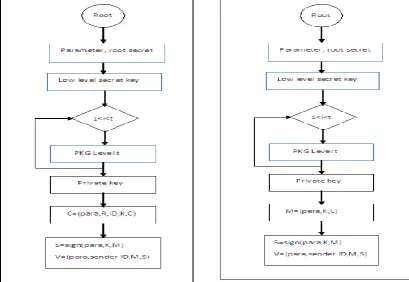
Fig. 1 Encryption and Decryption flow for level based security
IV. PROPOSED ARCHITECTURE
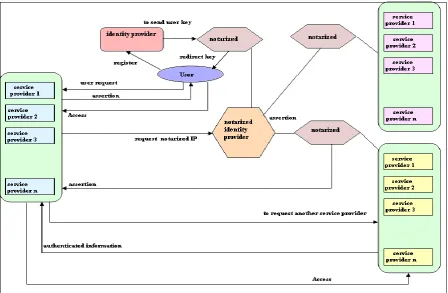
We present the model for multi notarized server management for cloud user. This model has entities such as: a user, a service provider, notarized identity provider and many notary servers. As is well-known, identity provider that supports automatic user authentications when the cloud providers are unknown to each other. In this model, we introduce a notarized identity provider which is owned by a trusted third-party to dynamically notarize assertions generated by identity providers and notarized server. As an extra feature provided by the notarized identity server in single sign on mechanism reduces possible collusions between identity providers and service providers and gives improved privacy protections for users on single sign on authentication by notarized server.
Fig. 2 Architecture for Multi Notarized Server in Cloud
Identity provider authenticates itself to the notary server, and submits the id, assertion, signature to the notarized identity provider. A service provider queries in the notarized identity provider for assertions associated with identity provider and the notary server returns to the notarized identity server. Identity provider focus on authentication through dictionary technique of cloud user as well as managing and sharing identity information with various notarized server to notarized identity server. An assertion that stored on the notary server implies the identity provider that generates the assertion is trustworthy.
on the assertion to unknown cloud with the help of WS security. User can easily access the service from unknown cloud using single sign-on process through notarized identity server that build by multi notarized server. That the multiple notarized server model not only more efficient but also mutually authenticate on unknown cloud service provider.
V. CONCLUSIONS
In this paper, we present a multi notarized server together with identity provider model for single sign-on process to effectively access the unknown cloud provider. An efficient implementation of multi notarized identity management model based on the level based cryptography provides more advanced way of key sharing in secure communication. The proposed multi notarized Identity server together with level-based cryptography, not only to access number of unknown cloud can provider mutually authenticate between notary servers but also for secret key distribution. That the multiple notarized server model not only be effective and efficient but also mutually authenticate number of unknown cloud provider be simplified in the clouds security.
R
EFERENCES
[1] Venugopal Gaddam et al, “Protection for Cloud Computing Using Level-Based Cryptograph”, International Journal of Computer Science and Information Technologies, Vol. 5 (2), 2014.
[2] J. Breckling,“Cyber Security Industry Alliance”. Internet security national survey, No. 2, December 2005. https://www.csialliance.org/StateofCyberSecurity2006/.
[3] Bhargav-Spantzel,A.C.Squicciarini, and E. Bertino. “Establishing and protecting digital identity in federation systems”, In Proceedings of the 2005 ACMWorkshop on Digital Identity Management, pages 11–19, November 2005.
[4] Leavitt,N et al, “Is Cloud Computing Really Ready for Prime Time?”, Computer 42(1), 15–20 (2009) 166 H.
[5] “Web Services Federation Language (WS-Federation)”,December 2006, http://specs.xmlsoap.org/ws/2006 /12/federation/
[6] D. Yao, N. Fazio, Y. Dodis, and A. Lysyanskaya. “ID-based encryption for complex hierarchies with applications to forward security and broadcast encryption”. In Proceedings of the ACM Conference on Computer and Communications Security (CCS), pages 354–363. ACM Press, 2004.