© 2014, IJCSMC All Rights Reserved 878 Available Online atwww.ijcsmc.com
International Journal of Computer Science and Mobile Computing
A Monthly Journal of Computer Science and Information Technology
ISSN 2320–088X
IJCSMC, Vol. 3, Issue. 6, June 2014, pg.878 – 886
RESEARCH ARTICLE
OPNET based Performance Evaluation of
MANET using IEEE 802.11a/b
Seema
1, Vikram Nandal
2, Kuldeep Vats
3, Sonia
41 M.Tech, Department of CSE, RN College of Engineering, Rohtak, Haryana, India
2
Assistant Professor, Department of CSE, RN College of Engineering, Rohtak, Haryana, India,
3B.E. (Honors), M.Tech, Department of Computer Science Engineering, Sonepat, Haryana, India
4M.Tech, Department of ECE, RN College of Engineering, Rohtak, Haryana, India
________________________________________________________________________________________________________
ABSTRACT- A mobile ad-hoc network is a network (MANET) of wireless mobile nodes (MNs) that communicate with each other without centralized control or established infrastructure. Routing protocols are divided into Proactive and Reactive Proactive is a table–driven protocols. The proactive routing protocols use link- state routing algorithm which frequently flood the link information about its neighbors. Reactive or on-demand routing protocols create routes when they are needed by the source host and these routes are maintained while they are needed. This paper proposes a solution for performance enhancement of Ad-hoc WLANs. This paper compares the performance of Small size and large network over different IEEE 802.11a and IEEE 802.11b standards and draws a conclusion based on performance of the network over different QoS parameters. The different QoS parameters are delay, network load, throughput, routing traffic sent and received and hello traffic sent.
KEYWORDS- IEEE 802.11a/b, MANET, Routing protocols, OPNET, QoS
_____________________________________________________________________________________________
I. INTRODUCTION
© 2014, IJCSMC All Rights Reserved 879
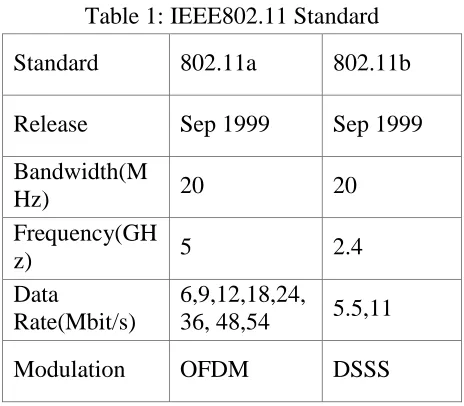
most applications. For this reason, ordinary 802.11 wireless products are no longer manufactured .In our research 802.11a and 802.11b operational modes are used to assign the parametric value in network model. Table show the IEEE 802.11a/b standard with release year, bandwidth, frequency, data rate, modulation technique is used to simulate our networks.
Table 1: IEEE802.11 Standard
Standard 802.11a 802.11b
Release Sep 1999 Sep 1999
Bandwidth(M
Hz) 20 20
Frequency(GH
z) 5 2.4
Data
Rate(Mbit/s)
6,9,12,18,24,
36, 48,54 5.5,11
Modulation OFDM DSSS
The 802.11a task group created a standard for WLAN operation in the 5 GHz band, with data rates up to 54 Mbps.
The 802.11b task group produced a standard for WLAN operations in 2.4 GHz band, with data rates up to 11 Mbps and backward compatibility[2][3].
Mobile Ad-Hoc Network is the rapidly growing technology from the past 20 years. The gain in their popularity is because of the ease of deployment, infrastructure less and their dynamic nature. MANETs created a new set of demands to be implemented and provided efficiently better end-to-end communication. MANETs work on TCP/IP structure to provide the means of communication between communicating work stations. Work stations are mobile and they have limited resources, therefore the traditional TCP/IP model needs to be refurnished or modified, in order to compensate the MANETs mobility to provide efficient functionality. Therefore the key research area for the researchers is routing in any network. Routing protocols in MANETs [4] are a challenging and attractive tasks, researchers are giving tremendous amount of attention to this key area [5].
Routing protocols for MANETs can be broadly classified [6][7] into three main categories:-
1.) Reactive routing protocols (on demand driven reactive protocols) :- Every node in the network obtains a route to a destination on a demand fashion. Reactive protocols do not maintain up-to-date routes to any destination in the network and do not generally exchange any periodic control messages.
Normally reactive protocols
Don’t find route until demanded
When tries to find the destination “on demand”, it uses flooding technique to propagate the query.
© 2014, IJCSMC All Rights Reserved 880
They consume bandwidth only, when the node start transmitting the data to the destination node.
2.) Proactive routing protocols (Table-driven routing protocols) :- Every node in the network has one or more routes to any possible destination in its routing table at any given time. The primary characteristic of proactive protocols is that each node in the network maintains a route to every other node in the network at all times. Route creation and maintenance are accomplished through some combination of periodic and event-triggered routing updates.
3.) Hybrid routing protocols:- Hybrid routing protocols combines the characteristics of both reactive and proactive routing protocols under different scenarios. In this every node acts reactively in the region close to its proximity and proactively outside of that region or zone.
II. Related Works
Extensive research work has been done in the field of MANET routing protocols. Different routing protocols were simulated in different kind of simulators. Here we will discuss different research papers about MANET routing protocols performance. Below we will study now different simulators with different routing protocols and their performance evaluation.
Keshtgary and Babaiyan, 2012, evaluated the performance of four MANET routing protocols using simulations of AODV, OLSR, DSR and GRP. The evaluation metrics were End-to-End delay, network load, throughput and media access delay. Most of the papers consider the first three parameters, but they also considered MAC delay [8].
© 2014, IJCSMC All Rights Reserved 881
Path routing and protocol selection are the primary strategies to design any wireless network. In Mobile Ad hoc Network (MANET) the selected protocol should have best in terms of data delivery and data integrity. Hence the performance analysis of the protocols is the major step before selecting a particular protocol. Mohapatra and Kanungo, 2011, carried out the performance analysis on Adhoc On-demand Distance Vector (AODV), Dynamic Source Routing (DSR), Optimized Link State Routing (OLSR) and Destination Sequenced Distance Vector (DSDV) protocols using NS2 simulator. The delay, throughput, control overhead and packet delivery ratio were the four common measures used for the comparison of the performance of above protocols [10].
III. Simulation Infrastructure
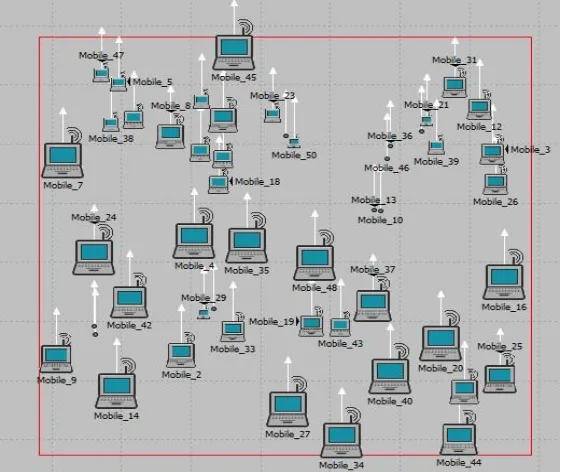
In this paper we have evaluated performance of MANET using OLSR routing protocol by considering IEEE 802.11a/b WLAN Standard in two scenarios. In first scenario we have taken 50 mobile nodes and in second scenario there are 60 mobile nodes and in both scenarios IEEE 802.11a and IEEE 802.11b standards are considered to simulate the environment and evaluate the performance of MANET. Thus, in total we ran four scenarios. Two scenarios ran for IEEE 802.11a WLAN Standard, one for 50 nodes and other for 60 nodes and similarly two scenarios for IEEE 802.11b WLAN Standard. Each scenario was run for 1000 seconds. After successful completion of the simulations, results are selected according to the problem solution. Results are collected in the form of graphs, with overlaid data displaying.
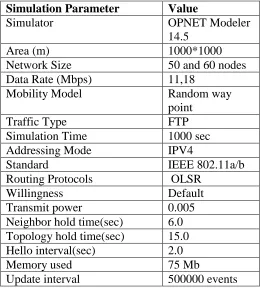
Fig. 2 shows the simulation environment of one scenario containing 50 WLAN mobile nodes. We have configured the mobile nodes in the scenario1 and scenario2 to work with 11Mbps and 18 Mbps respectively. The network size is 1000* 1000 meters. After that IPV4 addressing is assigned to all nodes
© 2014, IJCSMC All Rights Reserved 882
Table 1: Simulation Parameters
Simulation Parameter Value
Simulator OPNET Modeler
14.5
Area (m) 1000*1000
Network Size 50 and 60 nodes Data Rate (Mbps) 11,18
Mobility Model Random way point
Traffic Type FTP
Simulation Time 1000 sec Addressing Mode IPV4
Standard IEEE 802.11a/b
Routing Protocols OLSR
Willingness Default
Transmit power 0.005
Neighbor hold time(sec) 6.0 Topology hold time(sec) 15.0 Hello interval(sec) 2.0
Memory used 75 Mb
Update interval 500000 events
Table 5 Wireless LAN Parameters
Short retry limit 7 Long retry limit 4
Seed 128
Maximum receive lifetime(sec)
0.5
Buffer size 256,000 Value per static 100
IV. SIMULATION AND DISCUSSION
© 2014, IJCSMC All Rights Reserved 883
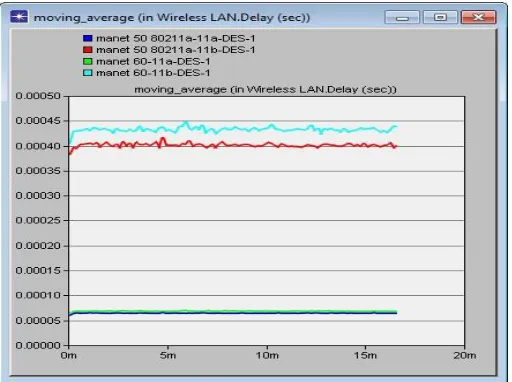
Fig 3 End to end network delay
From figure 3 we conclude that average values of end to end delay are higher with IEEE standard 802.11b and smaller with that of IEEE standard 802.11a.
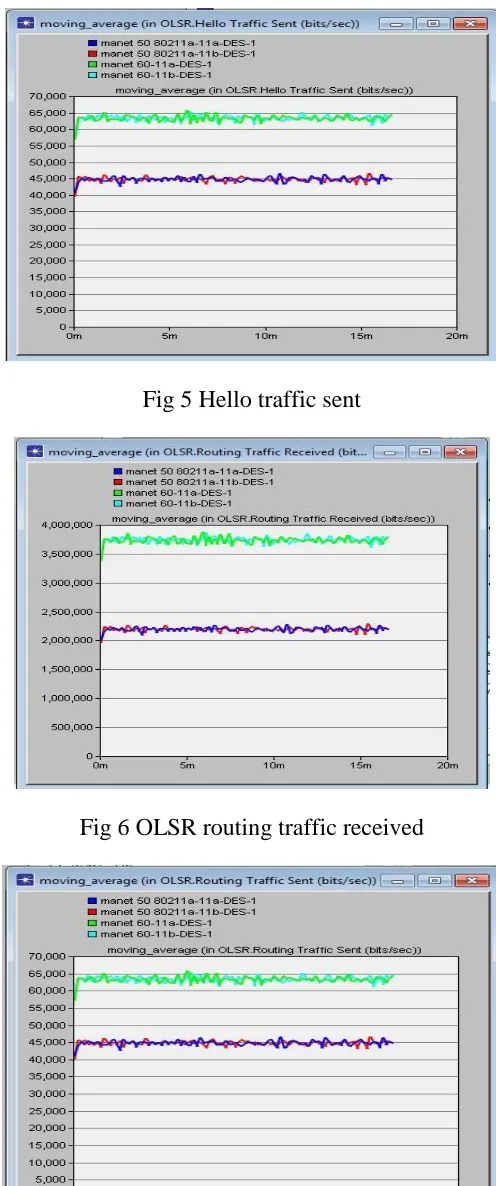
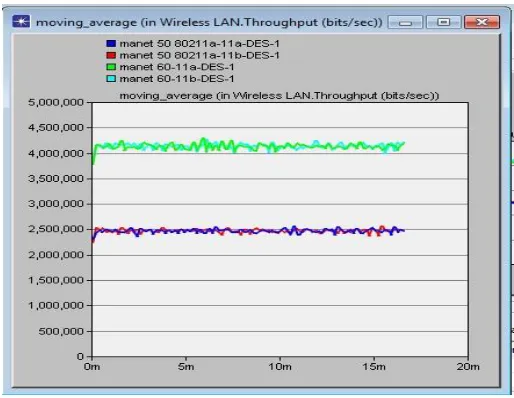
Figures (4-8) shows the moving average values of Wireless network load, throughput, hello traffic sent, OLSR traffic routing sent and received. And from the results we conclude that average values of all these performance metrics are highest for larger network and lowest for smaller network.
© 2014, IJCSMC All Rights Reserved 884
Fig 5 Hello traffic sent
Fig 6 OLSR routing traffic received
© 2014, IJCSMC All Rights Reserved 885
Fig 8 Network Throughput
V. CONCLUSION
In this paper, performance of MANET routing Protocol was analyzed using OPNET modeler 14.5. The protocols were tested using the same parameters with random mobility. Performance of IEEE 802,11a/b based MANET protocol with respect to scalability has also analyzed with different QoS parameters. Results showed that, with MANET 60 nodes experienced higher throughput compared to MANET 50 nodes. This was due to maintain cluster of nodes in the topology by dividing them into different node sets performance of Small size and large network over different IEEE 802.11a and IEEE 802.11b standards and draws a conclusion based on performance of the network over different QoS parameters. According to my results overall batter performance of large scale network in different QoS parameters are delay, network load, throughput, routing traffic sent and received and hello traffic sent.
REFERENCES
[1] http://en.wikipedia.org/wiki/IEEE_802.11s
[2] Anjali ,Maninder Singh,”Performance Analysis of Proactive, Reactive and Hybrid MANET Routing Protocols on IEEE 802.11 Standard”, International Journal of Computer Applications (0975 – 8887) Volume 54– No.12, September 2012.
[3] Pravin GhoseKar, Girish Katkar and Dr. Pradip Ghorpade, “Mobile Ad Hoc Networking: Imperatives and Challenges”,IJCA, pp. 153-158, 2010.
[4] Murty, M.S. and Das, M.V. (2011) “Performance evaluation of MANET Routing protocol using reference point group mobility and random waypoint models”, International Journal of ad hoc, sensor & Ubiquitous computing, vol.2, 1, pp.63-71.
[5] Bouke, A. (2011) “Routing protocols in ad hoc networks: A survey”, vol. 55, pp. 3032–3080. [6] Routing techniques for Mobile Ad Hoc Networks Classification and Qualitative/Quantitative Analysis, by Mr. Ankur Khetrapal,Delhi University.
© 2014, IJCSMC All Rights Reserved 886
[8] Keshtgary, M. and Babaiyan, V. (2012) “Performance Evaluation of Reactive, Proactive and Hybrid Routing Protocols in MANET”, International Journal on Computer Science and Engineering, Vol. 4, 2, pp. 248-254.