ITERATIVE DESIGN AND COMPARISON
OF LEARNING SYSTEMS
FOR REFLECTION IN
Two
DIMENSIONS
SIOBHAN HEALY
Thesis submitted for the PhD degree of the University of London
Abstract
This research involved the iterative design and comparison of learning systems
aiming to mediate between students' personal knowledge of reflection and
conventional mathematical knowledge.
The study comprised a two-phase teaching experiment. In the first phase, four
learning systems were developed using an iterative methodology that cycled between
design of computer-based tools and observation of students interacting with them.
Each learning system was structured according to a filling-outwards or a filling-inward instructional approach and incorporated a computer microworld based on either dynamic Euclidean geometry (DEG) or multiple-turtle geometry (MFO).
Learning systems were intended (i) to help students build from views of reflection
based on internal (intra) properties of two-dimensional figures to views taking
account of external (inter) relationships between figures and (ii) to emphasise a
functional perspective on the transformation.
In the second phase, analysis focused on how meanings for reflection evolved as six
students' interacted in each system. Results suggested that, in all four systems,
students developed meanings by coordinating intra and interfigural analyses while
they built computational models of reflection. Microworld tools had a role in
mediating all aspects of students' activities: with DEG tools, reflection tended to be
represented as a correspondence relationship based on perpendicular distances; MTG
tools led to expression of reflection as a mapping of one set of turtles onto another
and emphasised equal turns and distances. In all learning systems, mathematical meaning-making involved forging connections between general models of reflection
and physical movements of screen objects. Additionally~ students using MTG tools
gave more meaning to their models by connecting feedback to imaginary social
practices. The impact of instructional approach on learning trajectories was also
mediated by microworld tools. Specific effects associated with filling-inwards and
filling-outwards interventions were identifie~ but were limited to particular tasks and the tools used to negotiate them.
2-CONTENTS
ABSTRAC1" ...•••..•...•..••.•...•••...••...•..•....•...•.•...••..•..•...•...••...•..•..•.•..••••••.•••.•••.•. 2
LIST OF FIGURES ....•••• _ ...•.•...•••.•....•.•••....•••••...••.•.•. _ •.. _ ...••.••..•.•..•••••.••..•••••. _ •.•..•....•..•..•••.•. , LIST OF T ABLES ...•...•...•...••...•...•...•...•...•...•...•...•. 8
ACKNOWLEDGEMENTS •...•.•...•...•....•.•..•...•...•...•...•.••.•...••. , CHAPTER 1 INTRODUCTION ...•...•...•...•••...•...•...•.• 10
CHAPTER Z THE CONSTRUCTION OF CUL TURALL Y INFORMED KNOWLEDGE ••••••• 14 2.1 CoNSTRUCflVlSM AND THE LEGACY OF PrAGET ... 15
2.1.1 Construction of personal knowledge ... 16
2.1.2 Social interaction ... 17
2.13 Hierarchical theories of mathematics learning ... 17
2.1.4 Role of the teacher ... 20
2.1.5 Conceptual structures, language and other tools ... 21
2.2 VYGOTSKY AND SOCIOCULTURAL THEORIES OF DEVELO~ ... 23
2.2.1 The role of culture ... 24
2.2.2 Material and Psychological tools ... 24
2.2.3 Development of concepts ... 26
2.3 UPWARDS ANDOOWNWARDS ORINWARDSANDOurwARDS? ... 28
2.4 DESIGN OF INSTRUCfIONAL ACfIVITIES AND PRACflCES ... 31
2.4.1 A filling-inwards example: ascent from the abstract to the concrete ... 33
2.4.2 A filling-outwards example: the emergent approach ... 36
2.5 S~Y AND RESEARCH ISSUES ... 39
CHAPTER 3 MEDIATION, EXPRESSIVE MEANS AND MICROWORLDS ... 44
3.1 MAT~TICAL SYlffiOL SYSTafS ... 45
3.2 COMPUTER-BASFD MICROWORlDS FOR MATHFMATICS LEARNING ... 47
3.2.1 Two microworld models of gcometry ... 50
3.2.2 Instructional approaches and role of the teacher ... 53
3.2.3 Four learning systems ... 55
3.3 THE MATHEMATICAL FOCUS ... 56
3.3.1 Geometry. the science of space ... 56
3.3.2 Three theories of geometry learning ... 57
3.3.3 Transformation geometry and reflection ... 61
3.4 S~Y AND REsEARCH QUESTIONS ... 81
3-CHAPTER 4 METHODOLOGY OF THE STUDy ...•.•..•...••...•.•...•...•••... 85
4.1 CENTRAL ~ AND lviETHODOLOGICAL ISSUES ... 86
4.1.1 Teaching experiments as research design ... f!!7 4.2 THE LEARNING SYSTWS ... 90
4.3 OVERVIEW OF THE RESEARCH ACTIVITIES ... 93
4.3.1 Iterations in the design phase ... g'7 4.3.1 Stages in the comparison phase ... 98
4.4S~Y ... 103
CHAPTER 5 DESIGNING THE FOUR LEARNING SYSTEMS: ... 105
5.1 ITERATION 1: GROUND LAYING ... 106
5.1.1 Probing students' knowledge about reflection ... 106
5.1.2 Tool and task development. ... 122
5.2 ITERATION 2: PILOTING OF TESTS, TOOLS AND TASKS ... 140
5.2.1 The pilot paper-and-pencil test ... 140
5.2.2 The computer-based tasks ... 144
5.3 ITERATION 3: PEDAGOGIC STRUCTURING ... 159
5.3.1 Global structuring ... 160
5.3.2 Local structuring ... 163
5.3.3 The learning systems at the end of the third iteration ... 165
5.4 S~Y OF DESIGN PHASE ... 165
CHAPTER 6 THE COMPARISON PHASE: ... 169
6.1 THE STUDENTS ANDTHEIRPAPER-AND-PENCILMEDIATED VIEWS OF REFLECTION ... 169
6.1.1 Overall picture of student responses ... 172
6.1.2 Selecting the four groups of six students ... 175
6.2: MICROWORID TOOLS, TASKS AND TEACHING IN ACTION ...
In
6.2.1 Microworld interactions within the DEG learning systems ... 1786.2.2 Microworld interactions with the MTG learning systems ... 217
6.3 BEYONDTHEMCROWORLDS ... 253
6.3.1 Analysis of the final interview ... 254
6.4 SUMMARISING THE TRAJECTORIES THROUGH THE DEG AND MfG lEARNING SYSTEvfS ... 263
4-CHAPTER 7 CONCLUSIONS ...•..•...••...•... _ ...•••••...••...•...•.•...•...•.•... 269
7.1 BACKGROUND AND AIMS ... 269
7.2 TOOLSFORANALYSIS ... 271
7.3 FINDINGS FROM THE DESIGN PHASE ... 272
7.3.1 Paper-and-pencil-mediated situated abstractions ... 272
7.3.2 Microworld design issues ... 275
7.4 FINDINGS FROM THE CO~ARISON PHASE ... 280
7.4.1 DEG-mediated situated abstractions and the trajectories by which they evolved ... 280
7.4.2 MTG-mediated situated abstractions and the trajectories by which they evolved ... 283
7.4.3 Comparing across the MTG and DEG systems ... 285
7.4.4 The impact of the instructional approaches ... 288
7.4.5 Microworlds and mathematics learning ... 291
7.5 LIMIT A TIONS OF THE STUDY AND SUGGESTIONS FOR FUl'URE RESEARCH ... 292
BIBLIOGRAPlIY ... 295
APPENDIX 1 ANALYSIS OF THE PAPER· AND ·PENCIL TESTS •••••••••••••••••••••••• m ••••••••••••• 307 A 1.1 TESTS AI'PUED DURING THE DESIGN PHASE ... 307
A 1.2 TESTS APPUED DURING THE CO~ARISON PHASE ... 316
APPENDIX 2 DEFINITIONS OF MICROWORLD TOOLS •••••••••••••••••••••••••••••••••••••••••••••••••••• 326 A2.1 THEDEGTOOLS ... 326
A2.1 THE MTG TOOLS AND INTERFACE ... 327
APPENDIX 3 FINAL VERSION OF THE PAPER AND PENCIL TEST ... 339
APPENDIX 4 STUDENTS' INITIAL PROFILES ... 348
APPENDIX S STUDENTS' COMPUTER CONSTRUCTIONSERRORI BOOKMARK NOT DERNED.
5-LIST OF FIGURES
FIGURE 2. 1: KNOWLEDGE DEVELOPMENT FROM A SOCIOCULTURALPERSPECfIVE. ... 30
FIGURE 2.1: KNOWLEDGE DEVELOPMENT FROM A CONSTRUCTIVIST PERSPIlCI1VE •..••.••••.•••••••.•.•...•••...••..•••.•..••••••.•...••..••...••••.•••• 30
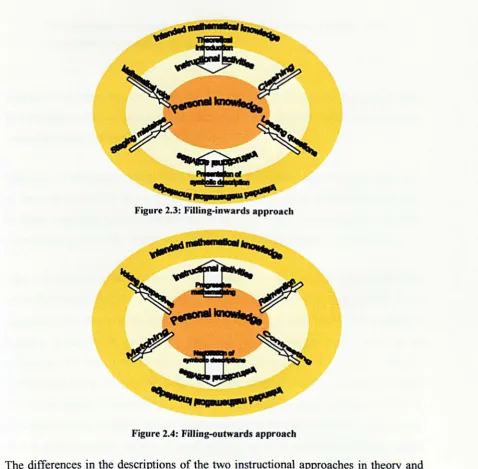
FIGURE 2.3: Flu.JNG-INW ARDS APPROACH ... 42
FIGURE 2.4: Flu.JNo-ourw ARDS APPROACH ... 42
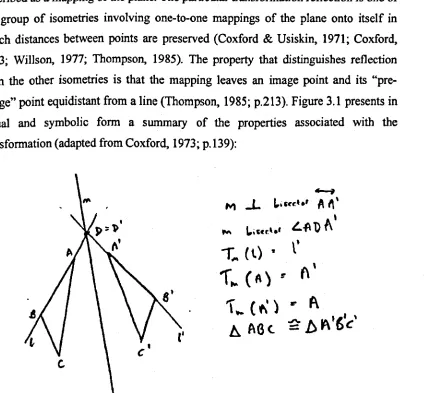
FIGURE 3.1 :PROPERTIES ASSOCIATED WITH THE REf.LECI10N TRANSRlRMATION ... 61
FIGURE3.2A: TASKlNVOLVlNG CONSTRUcrlON OF AN lMAGE UNDER REPUlCl'lON TRANSFORMATION ... 63
FlGURE3.2B: SKEI'CHOFTHElMAGE ... 63
FIGURE 3.3A: TASK REQUlRlNG CONSTRVCl1ON OF MlSSlNG AXIS OF REFLECfION ... 64
FIGURE3.3B: SKEI'CHOFTHEAXIS ... 64
FIGURE3.4: DlFFiCULTYOFDETERMININGTHECOMMANDSRlRTHETRANSRlRMATIONOFTHESECONDTURTLE ... 78
FIGURE 4. 1: SCHEMATISATION OF THE AcrIVITIES WlTHINEACH OFTHE RlUR SYSTEMS RlRLEARNING ... 92
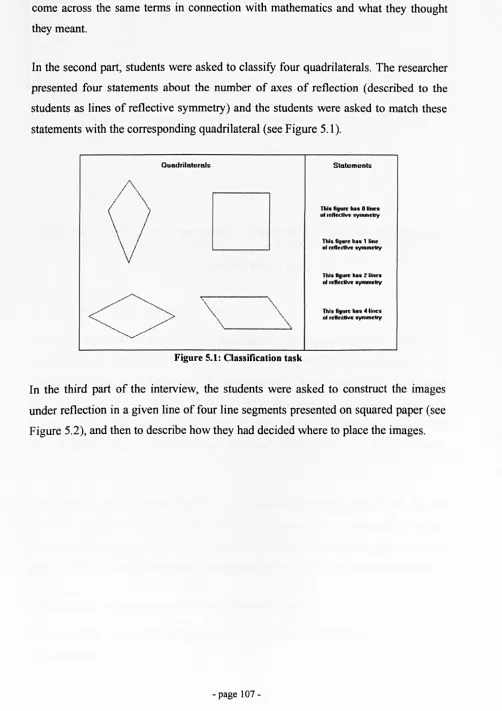
FIGURES.l: Q..ASSlRCATIONTASK ... ... If'17 FIGURES.2: FOUR REFLECTION TASKS ... 108
FIGURE S.3: APPLYING A REf.LECI1ON IN A VERTICAL AXIS ... 115
FIGURES.4: CoNSTRUcrlNG AHORIZONTALIMAGEOFA HORIZONTAL SEGMENT ... 116
FIGURE5.SAA HORlZONTALSllDINGSTRATEOY? ... 118
FIGURE 5.58 ... OR A POSSIBLE 3-D INTERPRETATION ... 118
FIGURES.6A: CoNFUSION WlTHROl"ATION? ... 118
FIGURES.6B: ... ORAPOSSmLE3-D INTERPRETATION ... 118
FIGURES.7A: l'LAaNGONLY ONE VERTEX CORRECTLY? ... 118
FiGURE.5.78: ... OR A POSSmLE3-D INTERPRETATION ... 118
FIGURES.8: A TRANSRlRMATIONOFASEMl-PLANE. ... 119
FIGURE S.9A: TRANSLATING THE SEGMENT? ... 119
FIGURES.9B: ... OR A POSsmLE3-D INTERPRETATION ... 119
FIGURE S.10: THE CAaRl STICK-PERSON CONSTRUCTION ... 126
FIGURES.ll: REsEARCHfX'S 1NTR0DUcrION OF CONSTRUCTION TOOLS (AS SHOWN IN EXPOSITION) ... 126
FIGURE 5.12: THE STICK-PERSON AND A LINE TO BE USED AS AN AXIS R>R REFLECTION ... 128
FIGURE 5.13: THE STICK PERSON AND ITS IMAGE UNDER REFLECTION ... 128
FIGURE .5.14: THE TURTLE MRRORS TOOL-KIT ... 131
FIGURE S. IS: SCREEN WlTHTHREE TURTLE TEXTBOXES ... 132
FIGURE 5.16: MfG TOOL-KIT (FIRST KERNEL) ... 133
FIGURE 5.17: DEscRIBING THE PROCESS OF CONSTRucrINO AN IMAGE UNDER RERECl'ION OF A Looo FIGURE ... 133
FIGURE S.18: THE PROCEDURE RlR THELooo STICK-PERSON ... 135
FIGURE .5.19: A PERSON AND ITS IMAGE ... 136
FIGURE S.20: MfG TOOLKIT AT THE END OF FIRST ITERATION ... 137
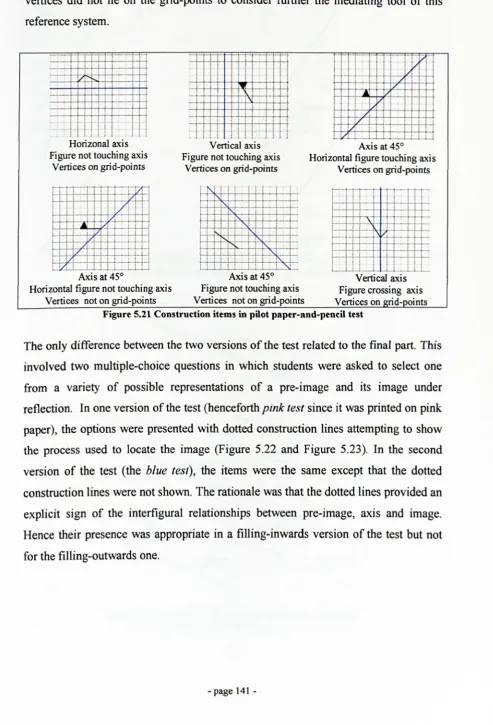
FIGURES.21 CoNSTRUcrIONITEMSlNm.orPAPER-AND-PENCIL TEST ... 141
FIGURE S.22: OPTIONS IN THE FIRST MULTIPLE.aroICE QUESTION ... 142
FIGURE S.23: 0PI10NS IN THE SECOND MULTIPLE.aroICE QUESTION ... 142
FIGURE 5.24: A QUADRILATERAL FORMID BY REA..ECI1NG ONE VERTEX OF A TRIANGLE IN ITS OPPOSITE SIDE ... 145
FIGURE S.2.5: USING A CONSTRUCTION TO OUlDE DRAGGING ... 146
FIGURE 5.26: A LoGo QUADRILATERAL MADE UP OF TWO SYMM1ITRICAL TRlANGUlS ... 147
FIGURE S.27: INcmNo A HATCHED TURTLE TOWARDS THE AXIS ... 148
FIGURE 5.28: THREE SNAPSHOl"S OF THE MEET TOOL IN AcrION (BLUE, MEET "MI RROR) ... 148
FIGURES.29: THE FlNALMfG COMMUNICATINOTURTIJ>S TOOL-KIT ... 149
FIGURE 5.30: REMEMBERING A DISTANCE BETWEEN TURTLES ... 149
-page6-fiGURE 6. 1: AN ITEM FROM THE FOURTH PART OFllffiPAPER-AND-PENcn. TEST ... 171
fiGURE 6.2: A DESCRIPTION DESIGNED TO SHOW llffi MEANINOS COMMONLY EXPRESSED BY STUDENTS ... 173
fiGURE 6.3: DRAGGING THE IMAGE-AGURE INTO PLACE ... ISO fiGURE 6.4: LocATING PROPERTIES IN A SYMBOUC DESCRIPTION ... 181
fiGURE 6 . .5: THE BEGINNINGS OF A FUNCTIONAL APfROACH? ... 182
fiGURE 6.6: STUDENT TRAJECl'ORIES TIIROUOH THE DEG lEARNING SYSTEMS TO llffi END OF fIRST MICROWORlD TASK ... 186
fiGURE 6.7: REcoRDINoTHE PATH OF AN IMAGE POINT ... 189
fiGURE 6.8: STUDENT TRAJECl'ORIES TIIROUOH THE DEG lEARNING SYSTEMS TO THE END OF SECOND M1CROWORlD TASK ... 191
fiGURE 6.9: A QUADRILATERAL SYMMETRIC ABOlJl' ONE OF ITS DIAGONALS ... 192
fiGURE 6.10: VERIFYING THE CONSTRucrlON BY THE USE OF CONSTRUCTION TOOLS ... 193
fiGURE 6.11: CoNSTRUCTING A UNE DEPENDENT ON PRE-IMAGE AND IMAGE POINTS ... 194
fiGURE 6.12: SOFf CONSTRucrING TWO EQUAL DISTANCES ... 196
fiGURE 6.13: THE fOUR ROBUST IMAGE POINT CONSTRucrlONS DEFINED BY REBEKKA AND MAiA ... I97 fiGURE 6. 14: STuDENTTRAJECl'ORIESTIIROUOHTHEDEGlEARNINGSYSTEMSTOTHEENDOFTHIROMICROWORlDTASK ... 201
fiGURE 6.15: IILuSTRATING THAT ZELDA" S IMAGE POINT WAS NOT THE REFLECTIVE IMAGE ... 203
fiGURE 6.16: MODIFYING ZELDA' S CONSTRUCTION ... 203
fiGURE 6.17: STUDEN1' TRAJECI'ORIES THROUGH THE DEG lEARNING SYSTEMS TO THE END OF fOURTH M1CROWORlD TASK ... 207
fiGURE 6.18: PRE IMAGE AND IMAGE FOlNTS IN THE DEG M1CROWORlD ... 208
FiGURE6.19: CoNSTRucrlONSBUILT USING PERPENOICULAA LINEANDCOMPASS (2) TOOLS ... 210
fiGURE 6.20: STUDEN1' TRAJECI'ORIES THROUGH THE DEG lEARNING SYSTEMS TO THE END OF flFfH M1CROWORlD TASK ... 213
FiGURE6.21: SYMMErRYINTHEVISUALANDTHESYMBouc ... 219
fiGURE 6.22: ExAMH.EOFPROCEDURES USEDTOCONSTRucr SYMMETRICALSTICK-PERSON ... 219
fiGURE 6.23: STUDEN1' TRAJECI'ORIES THROUGH THE MTG lEARNING SYSTEMS TO THE END OF ARST MICROWORlD TASK ... 222
fiGURE 6.24: MoVING THE TURTlES BACK TO THEIR ORIGINAL LOCATION ... 224
fiGURE 6.25: REuNITING BLUE AND RED AT THE MIDPOINT BETWEEN THEM ... 225
fiGURE 6.26: SENDING TURTlES TOTIfEIR 'MEETING" POINT (POINT OF INTERSECTION) ... 225
fiGURE 6.27: SIMON AND AIMEE HOlDING HANDS ... 227
fiGURE 6.28: STUDENT TRAJECl'ORIES THROUOH THE MTG UW{NING SYSTEMS TO llffi END OF SECOND M1CROWORlD T ASK. ... 230
fiGURE 6.29: Two METHODS fOR CONSTRUCTING A SQUARE AROUND AN AXIS OF RF:I"UCI10N ... 232
fiGURE 6.30: Two MIrrHODS fOR PRODUONG AN IMAGE TURTLE ... 233
fiGURE 6.31: A VARIATION ON THE MIRROR-TURTLE METHOD ... 236
fiGURE 6.32: STUDENT TRAJECl'ORIES THROUOH THE MTG LEARNING SYSTEMS TO THE END OF THIRD M1CROWORlD T ASK. ... 239
fiGURE 6.33: PRE-IMAGE AND IMAGES TURTLES ... 243
fiGURE 6.34: TURNS INVOLVED IN POSITIONING IMAGE TURTLES ASSOCIATfD WITH DIFFERENT WAYS OF MEErING THE AXIS ... 243
FiOURE 6.3.5: MODIFYING COMMAND SEQUENCES FOR DIFfERENT TURTlES ... 244
fiGURE 6.36: TRYING TO COMPI.EI"E THE PERSON IN THE MTG-Fl SYSTEM ... 246
fiGURE 637: STUDEN1' TRAJECl'ORIES THROUOHllffi MTG UW{NING SYSTEMS TO THE END OF f1FTH M1CROWORlD TASK ... 250
fiGURE 6.38: TREATING THE AXIS AS VERTICAL OR ADOPTING A 3-D PERSPECI'IVE? ... 254
fiGURE 639: PAPER-AND-PENCIL MIrrHODS fOR REFLECTION ... 256
fiGURE 6.40: WRITTEN ADDITIONS TO STUDENTS" DESCRIPI"IONS OF RERECI10N AND REFLECTIVE SYMMETRy ... 258
fiGURE 6.41: STUDENT TRAJECl'ORIES AND KNOWLEDGE EXPRESSED IN DEG UW{NING SYSTEMS ... 261
fiGURE 6.42: STUDEN1' TRAJECl'ORIES AND KNOWLEDGE EXPRESSED IN MTG UW{NING SYSTEMS ... 262
7-LIST OF TABLES
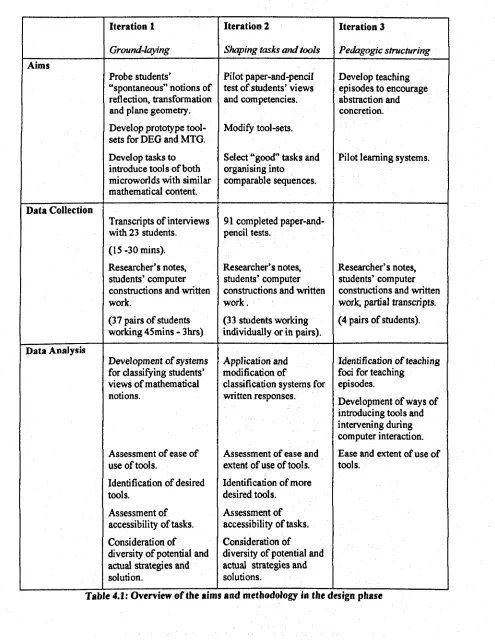
TABU; 4.1: OVERVIEW OF THE AIMS AND METHOIX>LOGY IN THE DESIGN PHASE ... 95
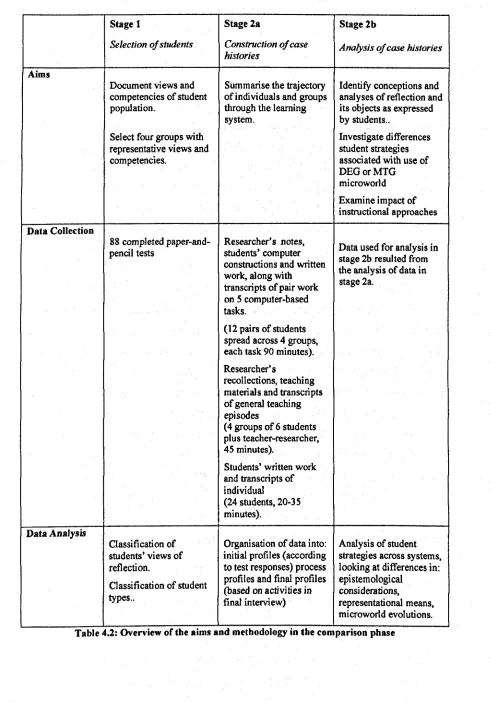
TABU; 4.2: OVERVIEW OF THE AIMS AND METHODOLOGY IN THE COMPARISON PHASE ... 96
TABU; 6.1: DlSTRIBurloN OF STUDENrS' CHOICES ACCORDING TO CONJOCI1JRE FORM FOR THE FOUR ITEMS INVOLVING THE IDENrJFJCATION OF PROPERTIES ... 173
TABU; 6.2: THE PARTICIPANTS IN THE LEARNING SYSTEMS ACCORDING TO PROFILE TYPES ... 176
T ABUl6.3: DlSTRIBurlON OF STUDENr PAIRS ACCORDING TO CONSTRUCTION STRATEGY USED FOR SECOND TASK ... 183
TABLE 6.4: IMAGEFOINT CONSTRUCTIONS OF THE STUDENr PAIRS ... 196
TABLE 6.5: DiSTRIBurJON OF snJDENT PAIRS ACCORDlNO TO STRATEGIES USED FOR RXJRTH TASK ... 204
TABLE 6.6: DlSTRIBurlON OF STUDENT PAIRS ACCORDING TO STRATEGIES USED FOR THE AFTH TASK ... 210
TABU; 6.7: DlSTRIBurlON OF STUDENr PAIRS ACCORDING TO STRATEGIES USED TO rosmoN BLUE AND RED TURTLES (N SYMMETRICAL POSITIONS ... 226
TABLE 6.8: D1STRIBurJON OF STUDENT PAIRS ACCORDING TO STRATEGIES USED TO REUNITE BLUE AND RED TURTLES AT A POINT ON THE AXIS ... 226
TABUl6.9:DlSTRIBurIONOFSTUDENTPAIRSACCORDINGTOSTRATEGIESUSEDTOCONSTRUCTSYMMETRICALQUADRlLATERAL ... 235
TABLE 6.10: DlSTRIBurlON OF STUDENr PAIRS ACCORDING TO STRATEGIES USED TO CONSTRUCT IMAGE TURTLE ... 235
TABLE 6.11: DrSTRIBurlONOF STUDENT PAIRS ACCORDING TO STRATEGIES USED TO CONSTROCT IMAGE TURTLES AND CONSTRUCTION OF THE IMAGE OF A TURTLE INVARIANT UNDER REFLECI10N ... 245
8-Acknowledgements
I would like to thank Celia Hoyles for her guidance and insightful advice. not only in supervising this thesis. but at every stage in my research career. I am also grateful to all my colleagues in the Mathematical Sciences Group, especially to Paul Clifford, Dietmar Kuchemann, Candia Morgan, Richard Noss and Stefano Pozzi, for the invaluable suggestions and support they offered as the thesis took shape.
My thanks, too, go to my colleagues at PROEM, PUC, Silo Paulo, whose interest and encouragement were greatly appreciated, and particularJy to Ana Paula Jahn for being so willing to share her ideas about the learning of geometric transformations.
The thesis would not have been possible without the collaboration of the staff and students of the Mathematics department at Parliament Hill School. I am indebted to them for all the time and energy they invested in the study.
Finally, I would like to thank my families in both the northern and southern hemispheres, who have helped me in more ways than it is possible to mention.
-page9-Chapter 1
Introduction
reflection ... (in a line) A transformation, involving a mirror line or axis I, such that a line segment joining a point to its image is perpendicular to 1 and has its midpoint on I. Reflection of points of the plane in the line with equation y
=
xtan8 maps the points with co-ordinates (x,y) onto the point(xcos29 + ysin29, xsin2.p - ycos28).
In particular, reflection in the y-axis maps (x, y) onto (-x, y) .
... See also symmetry.
The Penguin Dictionary of Mathematics (1998; p.361)
The dictionary definition of reflection illustrates some of the complexities involved in
mathematics learning. First, it describes how reflection is a transformation,
suggesting that understanding reflection requires understanding of the group of
objects to which it belongs. Another view can be found in the guidelines of the
English mathematics curriculum (DEE, 1999): transformations as objects are not
mentioned until Key Stage 3 (which begins after students have reached the age of 11
years), whereas aspects of reflection are to be covered in all four Key Stages,
beginning, in Key Stage 1. with the recognition of reflective symmetry in familiar
2-D shapes and patterns. The curriculum guidelines hence indicate that students should
learn about reflection as a property before, and separately from, reflection as a
transformation.
The dictionary definition goes on to define the transformation reflection with
reference to two different formal systems of mathematics, with terms associated with
Euclidean geometry (perpendicular, midpoints) as well as trigonometric functions
employed to describe reflection in a co-ordinate geometry context. Here, what is
worth noting is how concise are both the definitions. They do not list all the
properties that could be associated with the reflection transformation. Instead they
In school mathematics7 reflection is also represented in both Euclidean and
co-ordinate geometry contexts. The message of the curriculum is of a gradual build up
towards the kind of generalis ability expressed in the dictionary definition, so students
are expected to learn that reflections are specified by a mirror line " ... at first using a
line parallel to an axis, then a mirror line such as y
=
x or y=
-x" (DEE, 1999~ p.50).Mathematical dictionaries and school curriculum documents have in common that
they contain specifications related to institutionalised knowledge of mathematics.
Dictionary definitions of reflection can be viewed as resources to aid the construction
of mathematical meanings. They tend to present general statements from which more
specific cases can be derived. Curriculum documents prescribe the mathematical
knowledge that school-students are supposed to develop and, to a substantial degree,
determine the ways in which it will be encountered in the school subject In contrast
to the dictionary definition, the English mathematics curriculum suggests particular
cases are presented before learners confront more general models.
While both kinds of institutionally accepted descriptions of knowledge are written to
be precise and complete, understanding the meanings that individuals attach to the
concepts defmed involves understanding the whole range of images, representations,
properties and situations that they evoke, as well as the inter-relationships between
them. An idea like reflection is not confined to the mathematics classroom. It is encountered in a variety of other situations and has a range of physical, visual, cognitive and meta-cognitive associations. For the 12-13 year-old students involved
in this study, reflection is quite regularly experienced in their day to day life - as
looking into mirrors is likely to be a particularly familiar activity.
It would be surprising if personal meanings of reflection associated with these day to
day activities were to match exactly the mathematical defmitions associated with institutional knowledge of reflection. What is important about a mirror reflection is
what is seen (the image) because this provides a way of viewing what is reflected (the
pre-image). The position of the image relative to the mirror is not likely to be a focus
of attention. In contrast, what are emphasised in mathematical definitions are the
-geometrical relationships between pre-image point~ the axis and image points. How
to bring these two worlds together was one motivation for this research.
The study involves the design and comparison of learning systems built to mediate
between students' personal knowledge of reflection and the institutional mathematical
knowledge they are supposed to learn. Two aspects of mediation were selected for
investigation: the ways in which different instructional approaches might serve as
connecting links between what students know and how they are supposed to know it;
and the mediational role of computational tools with which students can simultaneous
act with, see and express mathematical properties as general relationships or specific
cases.
To focus on teacher mediations, two instructional approaches were developed and, to
investigate tool mediation, two sets of computational tools were designed These were
combined, along with a set of paper-and-pencil activities and computer-based tasks,
into four learning systems designed for use with groups of six girls aged between 12
and 13 years. Learning systems were compared by examining if and how knowledge
about reflection (in a line and in two dimensions) came to be expressed in different
ways according to the resources available within the systems.
Developing an instructional approach involves first making some assumptions about
the relationships between students' personal mathematical knowledge and culturally
embedded mathematical knowledge. Chapter 2 introduces two theoretical
perspectives on how mathematical ideas emerge as learners interact in systems. Both
perspectives stress the importance of constructive activity in the building of internal
cognitive resources, but identify different approaches to mediate the flow between
personal and institutional knowledge within learning systems, which were used as the
basis for the instructional approaches, termed filling-outwards (FO) and filling-inwards (FI), used in this study.
Chapter 3 focuses particularly on tool mediation and presents a model of mathematics
learning in which learners interact with developing tools and symbol-systems in
fonnalisation, which involves the making explicit of mathematical objec~ properties
and relations through their expression in a mathematical symbol-system. The chapter
also introduces the idea of a microworld, a special arena aiming to support a
fonnalisation process that does not require the detachment of fonnalisms from the
phenomena they express. It goes on to consider research specifically related to the learning oftransfonnation geometry and particularly the isometry reflection.
Chapter 4 explains the methods by which the issues raised in the preceding chapters
became operationalised and investigated. The empirical work was divided between
two phases: the design phase, in which the main emphasis was directed towards
creating tools, tasks and teaching interventions that would enable learners to extend
their knowledge of reflection; and the comparison phase, which concentrated on
analysing how learners' meaning-making activities were contingent upon the
mediational means with which the systems were endowed.
Chapter 5 describes the research activities of the design phase. These included
probing students' knowledge of reflection as expressed in paper-and-pencil settings in order to develop a picture of the knowledge students could be expected to bring to the
system; the building of accessible and relevant microworld kernels and deciding upon
the nature of teacher interventions before, after and during learners' microworld
activity.
Chapter 6 presents the comparison phase. It describes how four groups of students
were selected on the basis of their responses to a paper-and-pencil test and goes on to
analyse the evolution of the four learning systems from a variety of perspectives:
evolutions in students' expression of mathematical meanings for reflection and its
objects; evolution of the microworlds tools; and evolution of the instructional
approaches. In this way, it examines how the different fonns of mediations shaped
and were shaped by the interactions of system participants.
Finally, Chapter 7 looks back over the discussions in the preceding chapters and
presents the main findings of the thesis.
13-Chapter 2
The construction of culturally informed knowledge
... any theory about children's growing understanding of mathematics has to account for at least two factors. One is the learning of invariants: the second is the acquisition of cultural tools ... "
(Nunes and Bryant, 1997; p.4S)
It can hardly be controversial to claim that we develop and that we learn by interacting within the various biological, social, cultural and even virtual systems that
make up the world as we experience it. Or that we evolve as individuals and we
evolve as societies. The meanings individuals evolve for the knowledge culturally
labelled as mathematics depend upon the ways they come in to contact with it as well
as upon their own individual resources - physical, visual, auditory and mental. At the
same time, mathematics is an ever-evolving practice, which has developed (and is
developing) over time as a result of activities of individuals with the cultural heritage
laid down before them. It could be argued, as, for example, Sutherland and BalachefI (1999) have, that it is therefore useful to recognise two types of mathematical
knowledge:
"(i) knowledge as shared intellectual constructs which allow co-operative learning, communication and mutual control, and (ii) knowledge as personal intellectual constructs"
(p.2)
In the mathematics teaching that goes on in schools, the intended knowledge is the former - aspects of the socio-cultural artefact (that changes over time) known as
mathematics. To be perceived as mathematically literate, learners need to construct
mathematical meanings that are not only efficient in solving problems, but are also
in developing and communicating what they know in ways that emphasise its
relationship with the intended, institutionalised knowledge.
The question of the relationship between personal, social and cultural aspects of
knowledge and its development and learning has been addressed from a variety of
points of view in a multitude of different research contexts - education, philosophy,
psychology~ sociology, anthropology to name just some. Within the mathematics
education literature we can point to two broad theoretical "camps", In the first, the
impetus for the development of logico-mathematical reasoning comes from the
individual and involves active construction of personal knowledge, progressing from
individual relationships with material objects and private symbolism to social
practices and collective symbolism. In the second, the direction is reversed and it is
the social rather than the individual plane that drives learning and development
While somewhat of an oversimplification, the first view can be used to group together
theories that have collectively become constructivism and can be described as having a connection to, if not a direct hereditary path fro~ the work of Piaget. The second
trend describes perspectives linked to sociocultural theories of learning inspired in a large measure by Vygotsky. As Confrey (1994) suggests, research in mathematics
education continues to draw heavily from the work of these two scholars. In the
following sections a sketch of each theory will be outlined briefly to give an
indication of the key concepts that can be found in contemporary theories of
mathematics education. By reference to these introductions, aspects of the design of
instructional activities and practices associated with these theories will be considered.
2.1 Constructivism and the Legacy of
Pia get
In this section, five aspects of constructivism are briefly discussed, from their roots in
Piagetian psychology to their transposition to the mathematics education context:
construction of personal knowledge; social interaction; hierarchical levels of
development; role of the teacher; and language and tools.
15-2.1.1 Construction of personal knowledge
For Piaget, every act of intelligence is characterised by an equilibrium between the
assimilation of events, objects or situations into existing ways of thinking and the
accommodation of existing mental structures to incorporate new aspects of the
external environment (piaget, 1951). Human beings are viewed as self-regulating,
self-organising, living systems (Steffe, 1996) whose conceptual operative structures
come about as they strive to maintain an equilibrium in the face of the endless
movement in a system driven by biological maturation, sensory experiences, and
social interaction The individual actively manipulates or transforms his or her world
in ways that have already proven viable.
The concept of viability comes from von Glasersfeld. He maintains that, in cognising
activity, the individual does not aim to construct a mental copy of some outer reality
or ''truth''; rather thinking is instrumental. Satisfaction results from the successful
accomplishment of the task or goal. Hence knowledge serves to organise experience.
In this sense, cognition is entirely subjective and "neither does nor can concern
anything except the experiential world of the knower" (von Glasersfeld, 1996; p.308).
The equilibration process is frequently described in terms of scheme theory (piaget
1971; Dubinsky, 1991; Confrey 1994). Using the description in Confrey (1994),
knowledge comes about as a result of a three-stage recursive process involving a
"problematic, an action and a reflection" (p.4). After managing to operate
successfully in a way that resolves a perturbation, a learner may consciously attend to
the effective pattern of actions (operations) which brought about this resolution, and
store it as a routine for future action. Where the learner becomes aware of the
schemes and is able to use them consciously for prediction and explanation, they can
be said to have engaged in reflective abstraction. So, from this perspective, logico-mathematical knowledge derives from reflective abstraction involving the isolation
by an individual of the properties and relations of their own operations. This process
can be contrasted with that of the building of physical knowledge through empirical
abstraction, which, rather than attention to operations, involves the isolation of
2.1.2 Social interaction
From the Piagetian perspective too, comes the recognition that social interaction has
an important role in the development of thinking. This was given particular
precedence in the classic studies in the 1980's of the phenomenon of socio-cognitive
conflict (e.g. Perret-Clermont, 1980; Mugny, Perret-Clermont & Doise, 1981). In situations in which peers interacted together in learning tasks, the confrontation of
difference is disequilibriating and each participant, perturbed by the conflict, attempts
to restructure his or her understanding in the light of an alternative view (Kruger,
1993). Through such encounters, the learner can become more consciously aware of
his or her own operational practices and the corresponding practices of others.
Balacheff (1991) points to Piaget's contention that learners become aware of contradictions only when they possess the necessary cognitive resources to overcome
them. If they are not ready, they will experience no disequilbrating effects from
alternative viewpoints. Balacheff argues that this contention is too strong and
suggests it is critical only that a contradiction be seen to provoke the initiation of a,
perhaps long, process of overcoming. From this it can be concluded that the experience of socio-cognitive conflict can have the effect of sparking the learner in
embarking on the essentially private cognitive process of reflective abstraction.
2.1.3 Hierarchical theories of mathematics learning
Probably the most well-known facet of Piaget's work amongst those concerned with
mathematics education is his stage theory (Bidell, 1988; von Glasersfeld, 1994). Two
important comments can be made about this theory. First, it is based on the
recognition that a child's way of thinking is significantly different to an adult's.
Second, it assumes that development from one to the other universally follows
successive hierarchical stages from sensori-motor, through concrete operations, to
abstract thought (Confrey and Costa, 1996). Both these have had important influences
on research work within the mathematics education community. The first idea spurred
considerable research efforts in identifying precisely how learners' approaches and
perspectives differed from the accepted (and intended) orthodox mathematical
practices (see, for example, Hart, 1981).
17-The second can be linked to the development of various hierarchical theories of
mathematical education. Confrey and Costa (1996) point to a collection of
contemporary theories, that they call theories of reification (p.140). They argue that these theories express a strong Piagetian influence by equating progress with the
construction of increasingly "abstract mathematical objects" by successively leaving
behind concrete operational referents. Central to work in this paradigm has been the
discussion of the object-process duality of mathematical thinking and, in particular,
the developmental relationship underlying this duality (see, e.g. Dubinsky, 1991~ 1997; Sfard, 1991; Sfard & Linchevski, 1994; Gray & Tall, 1994). Sfard and Linchevski (1994) describe the growth of mathematical thinking (focussing on the
context of algebra) as "a sequence of ever more advanced transitions from the
operational to structural outlook" (p.191). In a similar vein, Dubinsky (1997)
describes his view of the development of mathematical knowledge;
"Mathematical knowledge begins with actions that are mental or physical transformations of objects. These actions are interiorized to processes. That means an internal mental operation is constructed to do the same job as did the more external action. Finally when it is necessary to apply an action to what has become an object, the process is encapsulated to become a mental object."
(Dubinsky, 1997; p.71-72)
Although Confrey and Costa stress the endorsement in these theories of reifications of
the classical Piagetian hierarchy, they can be even more closely related to a second
less known epistemological hierarchy described in Piaget's last book, which he wrote
with Garcia (piaget & Garcia, 1989~ This framework proposed that the development of a major mathematical idea passes through three stages:
CJ the intra-level where actions are performed with the objects of consideration and
attention is directed to the objects themselves;
c the trans-level which is characterised by the construction of an underlying
structure into which the relations of the previous level can be coherently
organised.
Each stage operates upon the objects from the preceding stage., transforming them so
they can become participants in the next level. This continues, as in the reification
theories, following an ordered and iterative process of abstraction. The structures
emerging from trans-level actions can be used as intra-objects in a new round of the
process. The intra-inter-trans triad, like theses-antitheses-syntheses in classical
dialectics, has its basis, according to Piaget and Garcia, in the "role of disequilibria
and re-equibriliations" towards higher levels of thought (p.134). This new triad,
however, is argued to be more flexible than its classical counterpart. For the authors,
it is a mechanism so general and constantly repeatable that it can be found in the
transition from one level to the next in epistemological development irrespective of
the absolute height of the levels. To support the epistemological sequencing of these
three stages, Piaget and Garcia claim that they can be located in history as well as in
the individual. For example., with respect to the development of geometry, they write:
"Geometry begins with Euclid - with a period during which the object of study is geometrical properties of figures and solids seen as internal relations between elements of figures and solids. No consideration is given to space as such, or consequently, to transformations of these figures within a space that contains them all. We shall call this period "intrafigural" - an expression already used in developmental psychology to account for the development of geometrical concepts in the child.
The following period is characterized by efforts to find relationships between the figures. This manifests itself specifically in the search for transformations relating figures according to various forms of correspondence. However these transformations are not yet subordinated to structured sets. This is the period where projective geometIy predominates. We shall call this period "inlerjigural ".
Following next is a third period, which we shall call "transfigural". It is characterized by the predominance of structures. The work most characteristic of this period is the Erlangen Program of Felix Klein.
19-This description of epistemological differences between classical Euclidean geometry
and transformation geometry is particularly relevant to this study and will form an
important focus of the analysis of student meaning-making.
2.1.4 Role of the teacher
Dubinsky (1994) suggests that Piaget was not especially concerned with the
pedagogic implications of his ideas. Mathematics educators, however, have imported
aspects of his theorising in their attempts to characterise situations conducive to
learning mathematics. Unlike Piaget, in their applications, constructivist mathematics
educators tend to assign an important role to the teacher. The theory of didactical
situations (Brousseau, 1997) serves as a useful example. Piagetian cycles of
problematic, action and reflection can be associated with the adidactical situations
outlined in this theory: problematics can be engineered with the intention of
provoking a conceptual rupture, an activity in which learners are confronted with a
situation which cannot be resolved using their existing meanings. The rupture alone
is, of course, not enough to engender the reconceptualisation and the situation must
be structured so that it affords the means (possible actions and resulting feedback) for
successful resolution.
Following situations of action, the different meanings suggested by them must
become the focus of attention. In didactical situations, moments of formulation
(establishing a language through which learners can communicate their actions, and
models of actions, to others) and validation (providing reasons to accept a true
conjecture or reject a false one) allow learners to reflect on their activity and to
consolidate new meanings.
This consolidation must also pass through an institutionalisation phase in which
"some external person must look at her [the learner's] activities and identify those
which are interesting and have a cultural status" (Brousseau, 1997, p.44).
From a constructivist perspective, and consistent with a Piagetian approach, the
interpreted in terms of the scheme theory outlined above. The learner experiences a
perturbation, which disturbs internal equilibrium. To resolve the conflict, a new
meaning and the production of a new scheme are required. The situation has been
fortuitously structured to guide the construction of such a new scheme; that is> to
encourage reflective abstraction involving the operations underlying it In contrast to
the Piagetian model, the theory of didactical situations necessitates the presence of
the teacher as the engineer behind the learning. The teacher makes sure the intended
knowledge is not forgotten. Hence, it could be argued that the learners' activities
result in them forming the necessary internal resources to assimilate, or perhaps even
accommodate to~ the historical and cultural counterparts and ways of representing the knowledge emphasised by the teacher during institutionalisation.
2.1.5 Conceptual structures, language and other tools
Common to the various constructivist perspectives introduced thus far, is the
association of mathematics learning with some process of abstraction, whereby
actions and processes become recognised as objects in themselves (Kent, 1998).
Dubinsky's view most closely corresponds to the Piagetian tradition since he argues it
represents the means of transition between ways of thinking. For him, reflective
abstraction involves the encapsulation of all possible processes involving the objects
of concern into a single totality or structure. Accordingly, before learners are able to
use notations (and presumably other cultural artefacts) they need to have built the
conceptual structures "fitted" to these artefacts. That is, the usefulness of the symbol
system necessitates the pre-existence of the concept
"Once it [encapsulation] has been accomplished. however, a notational scheme can be developed and connected to the concept by the relatively simple act of associating a syntactically governed set of symbols with a mental object that an individual has already constructed."
(Dubinsky, 1994~ p.l69)
Dubinsky focuses above on the learner in isolation, but, according to Sierspinska
(1998), the idea that conceptual structures determine language use dominates the
-constructivists' position on language as an activity of communication that does not change the course of development, but only provides evidence of it:
"According to Piaget, when the child actually starts to discuss his or her ideas with others, it is because his or her thinking is more geared toward comparing different points of view, and not the other way round."
(Sierspinska, 1998; p.37)
According to Nunes and Bryant (1997) the argument that social phenomenon and cultural artefacts can have an impact on mental life only after the groundwork has been laid by individual cognitive development is becoming le.ss and less tenable, with growing evidence that the activity of the same individual varies widely across different practices. While in one context (usually a familiar, everyday one) reasoning of an individual is indicative of an awareness of the mathematical invariants necessary to solve a problem, when the same mathematical invariants are encountered in a practice associated with a different semiotic discourse (usually a school-related practice), a much lower level of success is achieved. Actually, this rmding alone is not enough to reject the Piagetian story. It could be said that the child has the necessary conceptual structures but has not yet incorporated the particularities of the means of communication used in the second practice.
A more direct challenge to the constructivist argument that conceptual construction comes before the expression of invariants in particular notations, is proffered by Nunes (1997) when she claims that different systems of signs enable and constrain possible problem-solving strategies. In this way, sign systems not only communicate but also shape the meanings associated with the activities within any practice.
language and supports the idea that cultural tool and conception are reflexively
related.
This view appears to be gathering momentum among constructivist theorists, who are
beginning to respond to criticisms that semiotic considerations typically play little if
any role in their accounts of mathematical development or in the terminology of
assimilation, accommodation, schemes, equilibrium and reflective abstraction (see,
for example, Sfard, 2000; Cobb, Gravemeijer, Yackel, McClain & Whitenack, 1997). Such analysis involves acknowledging the mediating role of languages and moves
beyond the Piagetian perspective to the work of Vygotsky and the development of
sociocultural theories of learning.
2.2
Vygotsky
and sociocultural theories of development
According to Glassman (1994h Vygotsky shares with Piaget the same basic beliefs
about development. The major agreement between them is that there are two parts of
development, two lines that continuously interact with each other in the development
of behaviour. There is the natural line of ontogenetic development and the dynamic
impact of sociaVcultural development, an active child and an active environment.
(p.307).
A major disagreement can be found in that, whereas Piaget postulated a co-equal
relationship between individual and environment (e.g. Piaget. 1971 p.l14; Tudge &
Winterhoff, 1993), Vygotsky assigns analytic primacy to the social and cultural rather
than the individual:
"Every function in the child's cultural development appears twice: first, on the social level, and later, on the individual level; first between people (interpsychological), and then inside the child (intrapsychological). This applies equally to voluntary attention, to logical memory, and to the formation of concepts. All higher functions originate as actual relations between human individuals."
(Vygotsky, 1978; pS7)
23-2.2.1 The role a/culture
Cole and Wertsch (1996) argue that the major difference between the two theories is expressed in relationship to the role of culture ("the accumulated products of prior generations") and, especially, the role of mediation of action through cultural artefacts on the development of mind. A central tenet of sociocultural theory is that human beings have a special mental quality which involves the need and ability to make use of artefacts - be they physical, symbolic or cognitive - to mediate their activities and to encourage the appropriation of these forms of mediation by subsequent generations (Cole and Wertsch 1996). Artefacts are created at a particular moment in the historical trajectory of a culture, as a response to the demands of a particular practice. These artefacts modify the activities of those using them and can also, in their turn, be modified in use.
2.2.2 Material and Psychological tools
Material tools serve as mediators between the human body and an object of action, they are externally orientated, affording to humankind the means to control, or at least purposefully manipulate, nature. The concept of a psychological tool arose by analogy with material tools. These too are artificial human inventions. In their external form, they are symbolic artefacts (signs, symbols, languages, formulae, graphic devices). Vygotsky argued that such symbol systems restructure mental activity in a manner similar to the way that material tools restructure physical activity. This allowed him to claim that basic psychological processes (memory, attention, reasoning) are universal human processes, but that their functional organisation varies, depending on the nature of the psychological tools that are available to the society and, via society, to the individual.
" ... by being included in the process of behavior, the psychological tool alters the entire flow and structure of the mental functions. It does this by determining the structure of a new instrumental act, just as a technical tool alters the process of natural adaptation by determining the forms oflabor operation".
All higher mental functions according to Vygotsky are culturally mediated Or~ to put
it another way, the mental functioning that characterises human thought inherently
involves the use of mediational means. A mediated mental function involves an
indirect action on the world, which incorporates and transforms the
natura4
basic mental processes, extending their range and mode of functioning. The inclusion ofthe tool in activity hence alters the course both of the activity and of all the mental
processes that enter into the instrumental act In this way ~ tools do not only facilitate
mental processes, they transfo~ they re-organise and they shape them (Vygotsky,
1981; p.139).
Various contemporary descriptions of the development of sociocultural theories have
documented a serious ideological difference between Vygotsky and other Soviet
theorists, centering on the distinction between material and psychological tools (for
details of this rift see, for example, Kozuli~ 1990; 1998; Cobb~ Perlwitz and Underwood, 1996). A similar criticism re-emerges in the mathematics education
community: Confrey (1995a) points to a privileging of abstract sign use over
functional practical intelligence that can be found in Vygotsky's original work, which
she is worried may lead to the neglect or devaluation of concrete activity. She argues
also that
« .. .in directly replacing the tools of labor with the psychological tools of signs, he virtually severed the connections between signs and the underlying tools, actions and operations that produced them and placed his emphases solely on the movement among signs"
(Confrey 1995a; p.207)
In this vein, Noss and Hoyles (1996) argue that Vygotsky tended to overshadow
informal, practical and enactive concerns in favour of formal and theoretical aspects
(p.42-43). As a possible response to this criticism, the next section considers
Vygotsky's view of concepts and, in particular~ focuses on Vygotsky's distinction
between spontaneous and scientific concepts, in which he does seem to have paid
some attention to connecting, through the mediations permitted by tool-use,
theoretical factors with their empirical counterparts.
25-2.2.3 Development of concepts
The use of concepts occurs within activities. At any particular moment, the less experienced actor (let's say the learner) engages in forms of thinking that depend on
the resources available to mediate the activity and on the collaboration with, or rather the guidance of, other more well-versed actors (a teacher, for example). During
activity, the learner and teacher enter into a dialogue in which, at times, the learner
may display reasoning patterns before having gained conscious awareness of them.
The teacher can exploit such displays to provide external signs of the concept in
question in its culturally sanctioned form, reinterpreting and rephrasing the learner's
contributions. To the extent that the learner is able to participate in the dialogue, he
or she experiences possibilities of becoming more conscious of the underlying
structure of his or her thinking, gradually intemalising more advanced levels of
performance. In this way, a learner can accomplish much more in collective activity
than alone. Or, as Vygotsky had it, there is a:
" ... distance between the actual development level as determined by individual problem solving activity and the level of potential development as determined through problem solving under adult-guidance or in collaboration with more capable peers"
(Vygotsky, 1978; p.86)
In this very well-known quote, Vygotsky introduces the notion of the zone of proximal development or zpd. The zone of proximal development is not a property of the individual - some innate capacity, waiting in an inert form to be awakened.
Rather it is an intersubjective zone created in activity. Hence, it represents the
conceptual site of learning, for the internalisation of functions from the social plane to
the individual. It can be understood as the distance between the cultural or intended
knowledge and the personal knowledge at play in the activity setting. (Davydov
&
Markova, 1983; Hedegaard, 1988; Lave, 1996). Vygotsky described schooling as an
activity especially associated with the creation of zpds and this led to the distinction
Scientific concepts seem to have initially been described as those originating from the rather special kinds of interaction particular to schools and are characterised by their systematic, logical organisation. They are described as dynamic changeable structures (Vygotsky, 1962). Spontaneous concepts, on the other hand, are described as those emerging from the learner's everyday interactions, mediated, of course, by cultural and social artefacts (Kozulin, 1990).
Davydov (1988) felt that Vygotsky's apparent limiting of scientific concepts to those introduced in school resulted in a rather procedural definition, which needed expanding from an epistemological angle. He stressed the theoretical content of scientific concepts and he contrasted this with the empirical nature of spontaneous concepts. Wardekker (1998), on the other hand, suggests the procedural distinction might be more consistent with the overall Vygotskian framework, since accepting the epistemological view would imply that scientific concepts are universal ideal~ transcending history and conveying "truth". Because the registers associated with generalis able, logical reasoning are cultural constructs, scientific concepts could be considered simply as those very concepts that have been developed and that are in use in scientific practices. That is, scientific concepts can be thought of as those which result from social demand (Glassman, 1994). As such, scientific concepts represent the current models used to understand the "essence" of a phenomenon, the role it plays in human activities as they occur in their cultural and historical contexts (Il'enkov, 1977). Not objective truths then, but a general "truth" about the connection between object and activity. From this view concepts:
" ... are models: representations to ourselves of what we do, and of what we hope for. The model is not, therefore, simply a reflection or copy of some state of affairs, but beyond this a putative mode of action, a representation of prospective practice, or of acquired modes of action."
(Wartofsky, 1979 xv)
Under this definition and, taking into account the previous description of activity in the zpd, scientific concepts appear to bear some resemblance to the reflective abstractions described by the constructivists, although there is still a rather fundamental difference. Reflective abstractions, in the constructivist sense, work
27-upwar~ moving thinking structures towards more general and systematic
organisation. To describe the reciprocal relationship Vygotsky sees between
scientific and spontaneous concepts, he also employs a metaphor of growth:
"In working its slow way upwards, an everyday concept clears the path for a scientific concept in its downward development It creates a series of structures necessary for the evolution of a concept's more primitive, elementary aspects, which gives it body and vitality. Scientific concepts, in tum, supply structures for the inward development of the child's spontaneous concepts toward consciousness and deliberate use."
(Vygotsky, 1986; p.l94 quoted in Kozulin, 1998; p.49)
In their appropriation as personal knowledge, scientific concepts grow downwards or
inwardly to meet and intertwine with the upwardly growing spontaneous ones, fusing
into a form of thinking that is all at once personal, social and cultural, in the sense
that general classes and transformations characteristic of particular societies become
"bound into the networks works of personal experiences and perceptions unique to
each person" (Renshaw, 1996; p.63).
The use of the downwards metaphor to describe the learning of scientific concepts
illustrates another significant difference between Piaget and Vygotsky. Vygotsky is
suggesting that scientific concepts develop following a process in which the learner is
presented with concepts of a general applicability which are valued in the culture
(Saxe and Posner, 1983) and can be connected with experiences of a more particular
and personal nature.
2.3 Upwards and downwards or
inwards and outwards?
Until now, abstraction has been the major mechanism associated with the transition between qualitatively different modes of reasoning and there is a tendency in both the
constructivist and sociocultural literature to privilege abstract over concrete
reasoning. This has come under increasing criticism in recent years. For example,
"Allowing mathematics to continue to require students to disengage from their personal sources of experience and to learn a system of rituals that makes little sense to them but which will admit them to the ranks of the elite is one of the most effective ways of maintaining this oppression."
(Confrey 1995b; p,4l)
She is by no means alone in this charge of elitism; for example, from rather different
perspectives, Noss and Hoyles (1996), Walkerdine, (1988; 1997) and Turkle and
Papert, (1991) all make similar charges. The description of the two-way relationship
between scientific and spontaneous - although perhaps not the intention of the
Russian psychologists at the time it was defined (see Lerman, 1998) - permits the
suggestion of an alternative process that Wilensky (1991) has termed concretion.
Using Wilensky's definition, concreteness is no longer a property of an object or
thing, but "a property of a person's relationships to an object" (Wilensky, 1991;
p.198 emphasis in original). This leads him to suggest "the actual process of
knowledge development moves from the abstract to the concrete" (p.20 1). Like the
reification theorists described in §2.1.3, Wilensky seems to be saying that knowledge
development is characterised by movement between concrete and abstract, though for
him the development proceeds in the opposite direction. Building from Wilensky's
view, Noss and Hoyles (1996) offer a definition of concrete as "well connected to
what the learner already knows" (Noss & Hoyles, 1996; p.73) and see abstraction as the means of adding new connections:
"Abstracting can be seen as a way of layering meanings on each other, connecting between different ways of knowing and seeing, rather than replacing one kind of meaning with another."
(Hoyles & Noss, 1996; p.73)
Mason's (1989) view of abstraction of a "delicate shift of attention" (p.2) in which
learners move between seeing and using expressions as processes or objects also
stresses the layering rather than letting go of meaning. The idea of layers of meanings
suggests the use of less hierarchical metaphors to describe the relationships between
different forms of knowledge. Instead of upwards and downwards, learning can be
described using the metaphors of inwards and outwards. Constructivists who focus on
the construction of knowledge by learners' progressive abstractions during attempts
to organise their experienced world emphasise the outwards layering of meanings
towards the intended knowledge. Socioculturalists who argue that development
involves an internalising from an outer to an inner plane emphasise layering inwards.
Neither constructivist nor sociocultural schools can be considered as inclusively
inwards or outwards: the environment acts back on the learner in the former and, within the individual at least, there is some outwards layering in the latter. Figure 2.1 attempts to characterise schematically these differences.
Figure 2.1: Knowledge development from a social cultural perspective
Key
'---
Cultural knowledge Leaming Activity-
Personal KnowledgeFigure 2.2: Knowledge development from a constructivist perspective
the matter of the design of instructional materials and practices which will form the
focus of the next section.
2.4 Design of instructional activities and practices
"The central difference between the Piagetian and Vygotskian approaches lies in their respective interpretation of who is the active subject the learning process. For Piaget it is the individual child. who through active interaction with the physical and social environment. enhances his own cognitive schemata. For Vygotsky the learning process has a sociocultural character from its very beginning. The true subject of learning is an integrative whole that includes the child, the adult. and the symbolic tool provided by the given society. If in the Piagetian system the child is presupposed as a true agent of his or her own learning, in the Vygotskian system the child becomes an independent agent at the end of the formal learning experience. These two opposite approaches have found their realisation in classroom practices."
(Kozulin. 1998; p.3)
In co-ordinating their specific goals with what is known about (particular) students'
thinking. the designer of instructional material strives to create an environment, a
system, in which students can act in ways conducive to the production of
mathematical knowledge (Greeno, 1991; Cobb, 1997). This is still a very global
statement of intent.
Gravemeijer (1997a) stresses that much of the development work in mathematics education has been guided by philosophies rather than instructional theories (he, for
example, works within Freudenthal's philosophy concerning realistic mathematics
education). Philosophies provide powerful heuristics, but not procedural guidelines.
Hence, instructional sequences generally fit the adopted educational philosophy.
Developmental research in instructional design, according to Gravemeijer, consists of
a cyclical process of thought experiment and teaching experiment. Instructional
activities are designed on the basis of a priori analysis in which hypothesised learning trajectories (Simon, 1995; p.133) connected to particular mathematical content are
envisioned. The activities are then enacted in the classroom and an analysis of what
happens is used to guide the next instructional activity.
-Gravemeijer (1997b) points to two contrasting heuristics that can be used to structure
the overall presentation of instructional approaches and which he distinguishes using
a metaphor borrowed from information-processing theories. In the top-down approaches~ "formal crystallised expert mathematical knowledge is taken as a starting point for developing instructional activities" (p.316). This means that~ in top-down models, prefabricated systems of mathematical knowledge represent the immediate
goal for instruction and activities focus on connecting the informal and situated
personal knowledge of the students with this given system. In bottom-up approaches, on the other hand, the initiative is with the students and the idea is to make it possible
that all their mathematical knowledge emerges out of their own constructive efforts.
Instead of presenting students with given models of general applicability and symbol
systems, bottom-up approaches encourage students to come up with their own. In
light of the discussion in the previous section, and the revisioning of the relationship
between concrete and abstract in mathematics learning, the terminology of top-down
and bottom-up no longer seems advisable. Rather than top-down, the first approach
could be characterised as a filling inwards from intended to personal knowledge. Similarly the bottom-up approach becomes filling outwards from personal to intended knowledge.
In relation to sociocultural theories, where emphasis is on appropriation of cultural
artefacts and priority is given to social and cultural processes when accounting for
individual activity, it is perhaps not surprising that examples of filling-inwards
approaches can be located For example, Lave (1997) describes a curriculum of
tailoring in which the outermost level is "learn to make garments" and the next level
"learn to sew, then learn to cut them out" (p.33). Apprentices start with a clear notion
of the general goal, then fill in the procedures and details which will make this
possible. Another good example is the instructional theory of "ascending from the
abstract to the concrete" developed by the research group led by Davydov in the
former Soviet Union. This example will be examined below as a generic example of
the filling-inwards approach.
Filling-outwards instructional approaches can be seen as particularly compatible with