Available Online atwww.ijcsmc.com
International Journal of Computer Science and Mobile Computing
A Monthly Journal of Computer Science and Information Technology
ISSN 2320–088X
IMPACT FACTOR: 6.199IJCSMC, Vol. 8, Issue. 4, April 2019, pg.88 – 93
Fake Currency Detection
Using Image Processing
Vidhi Roy
1; Gangey Mishra
2; Rahul Mannadiar
3; Sushant Patil
41Computer Engineering, St. John College of Engineering and Management, India
²Computer Engineering, St. John College of Engineering and Management, India ³Computer Engineering, St. John College of Engineering and Management, India 4Computer Engineering, St. John College of Engineering and Management, India
1 [email protected]; 2 [email protected]; 3 [email protected]; 4 [email protected]
Abstract— Fake Currency has always been an issue which has created a lot of problems in the market. The increasing technological advancements have made the possibility for creating more counterfeit currency which are circulated in the market which reduces the overall economy of the country. There are machines present at banks and other commercial areas to check the authenticity of the currencies. But a common man does not have access to such systems and hence a need for a software to detect fake currency arises, which can be used by common people. This proposed system uses Image Processing to detect whether the currency is genuine or counterfeit. The system is designed completely using Python programming language. It consists of the steps such as grayscale conversion, edge detection, segmentation, etc. which are performed using suitable methods.
Keywords— Counterfeit currency, Image Processing, Python programming language, grayscale conversion, edge detection, segmentation
I. INTRODUCTION
Different countries around the world use different types of currencies for the monetary exchange of some kinds of goods. One common problem faced by many countries related to currency, is the inclusion of fake currency [1] in the system. India is one of the countries that face a lot of problems and huge losses due to the fake currencies. Due to this there are losses in the overall economy of the country‘s currency value.
The technological advancements have made a pathway for currencies to be duplicated such that it cannot be normally recognized [2]. Advanced printers and new editing computer softwares are used to create counterfeit currencies. Fake currencies can just be slipped into bundles of genuine currency which is how they are usually circulated in the market.
The system is based on Image processing where a number of steps are used to process the image of a currency and give the result to the user that the currency is genuine or not.
The remainder of the paper mentions the following details. In section II, there are brief information on some related papers that are used for reviewing. In section III, the methodology is mentioned which specifies the different steps used in the entire process of currency detection. In section IV, the details of the proposed system are mentioned. Section V shows the result and conclusions. Section VI mentions the referred papers and links.
II. LITERATURE REVIEW
Various papers are available that contain information on Fake currency detection. Some referred papers are mentioned here.
In [4], as mentioned, no one can be 100 percent sure of the manual recognition and so the system was proposed to compare images of currency with the stored data and detect whether the currency is fake or genuine. This system used MATLAB to run and perform the operations of the system. The feature extraction process mostly focuses on HSV values of the currency where the image is divided into blocks and the operations are performed on the ROI.
In [5], the survey paper proposes a system to improve the currency detection system especially in commercial areas like banks, shopping malls, etc. Here some different pre-processing techniques were mentioned such as Radiometric corrections and Geometric corrections for correcting spectral errors or distortions due to sensor- Earth geometric variations etc. Different papers were compared and results were provided based on the accuracy rate obtained by using different methods.
In [6], a system is proposed to detect fake currency based on different features that can be extracted for comparison. Various methods are used at different stages histogram equalization, using feature vectors to stored extracted features, etc. The features that were used for currency detection were security thread, RBI micro-print and serial number detection.
III. METHODOLOGY
The current systems that are present are only machine based i.e. it is only for commercial use. The systems that use image processing are performed on MATLAB [4], [7]. These machines are based on optical sensing or proximity detection. In optical detection , the currency is kept under the machine and the UV light is scanned over the currency and if the currency shines due to fluoresense then it is a genuine currency. In proxy detection the ink used to make the currency contains ferromagnetic properties, so when the currency is passed through a magnetic belt and if it shows some movement then it is concluded that it is a genuine currency [8].
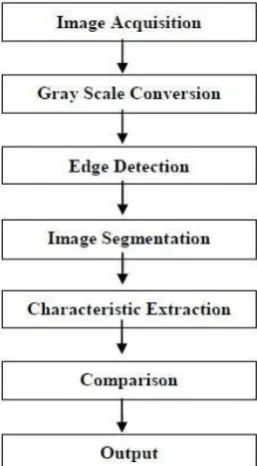
Figure 1 is the flowchart that shows the general methods used to detect fake currency using image processing
A. Image Acquisition
The image of the currency that has to be checked or verified as a genuine currency is taken as an input for the system. The input image can be acquired using techniques like scanning the image or clicking a picture with the phone and then uploading it to the system.
B. Grey Scale Conversion
Conversion of a color image to a grayscale image requires more knowledge about the color image. A pixel color in an image is a combination of three colors Red, Green, and Blue (RGB).Similarly, A Grayscale image can be viewed as a single layered image. Different techniques can be used to convert a coloured image to grayscale image. [9]
C. Edge Detection
Edge detection is an image processing technique for finding the boundaries of objects within images [12]. It works by detecting discontinuities in brightness. Edge detection is used for image segmentation and data extraction in areas such as image processing, computer vision, and machine vision. The purpose of detecting sharp changes in image brightness is to capture important events and changes in properties of the world. Edge detection helps to detect all the edges of the necessary ROI to perform various operations in the latter stages.
D. Segmentation
Image segmentation is the process of dividing an image into multiple parts. This is typically used to identify objects or other relevant information in digital images. [10] shows a few examples of the techniques that can be used to perform segmentation.
E. Feature Extraction
Feature extraction is a type of dimensionality reduction that efficiently represents interesting parts of an image as a compact feature vector. This approach is useful when image sizes are large and a reduced feature representation is required to quickly complete tasks such as image matching and retrieval. The features are extracted and then used for comparison in the further step.
F. Comparison
The features that are extracted from the previous step are used for comparing with the stored features and then the results are displayed as to the currency being genuine or fake.
IV. PROPOSED SYSTEM
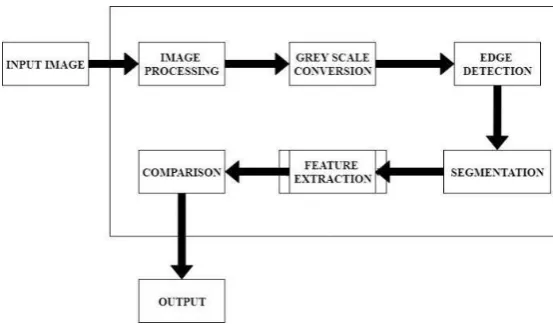
The proposed system is using image processing to detect the currency. The input is a photographed or scanned image that is given to the system which can be of .png and the output tells whether the currency is genuine or not. The process contains techniques such as image pre-processing, grey scale conversion, edge detection, segmentation, feature extraction and comparison of feature.
Figure 2 shows the architecture diagram that is for the proposed system.
Fig. 2 Architecture diagram of proposed System
Step 1: Image Pre-processing
Pre-processing is a common name for operations with images at the lowest level of abstraction — both input and output are intensity images. The aim of pre-processing is an improvement of the image data that suppresses unwilling distortions or enhances some image features important for further processing.
In this system, noise filtration is done in image pre-processing [11]. Here, the salt and pepper type of noise is removed.
Step 2: Grey scale conversion
that can be used to convert an RGB image to a grayscale image such averaging method, luminance method, desaturation method,etc. [15]. The system uses the luminance method to perform grayscale conversion.
Step 3: Edge Detection
The grayscale image is the input to this step. The system uses Canny Edge detection as it gives best results compared to the other techniques [13]. Canny edge detection is a technique to extract useful structural information from different vision objects and dramatically reduce the amount of data to be processed.
Step 4: Segmentation
There are various methods like thresholding, clustering methods, region based segmentation, etc. to perform segmentation in image processing. Here thresholding method is used to perform segmentation where threshold values which are obtained from the histogram of the edges of the original image are used. [14]
Step 5: Feature Extraction and Comparison
If the features extracted are carefully chosen it is expected that the features set will extract the relevant information from the input data. The system uses SSIM (Structure Similarity Index Method) method for feature comparison.
The features that are being compared in the system are as follows for 2000 Rupess note: 1)Portrait of Mahatma Gandhi at the center
2)Micro letters ‗RBI‘ and ‗2000‘ on the left side of the bank note 3)Windowed security thread with inscription of RBI
4)Gurantee Clause, Governor‘s Signature with Promise Clause and RBI emblem towards right 5)Denominational numeral with rupee symbol in the bottom right
6)Ashoka Pillar emblem on the right and electrotype watermarks
7)Number panel with numerals growing in size on top left side and bottom right side 8)Seven angular bleed lines on left and right side of currency
9)Year of printing of the currency on the left 10)Swacch Bharat logo with slogan
Fig. 3 Features of the Indian currency
Step 6: Output
Fig. 4 Initial window screen
Fig. 5 Dialogue box to provide the testing currency to the system
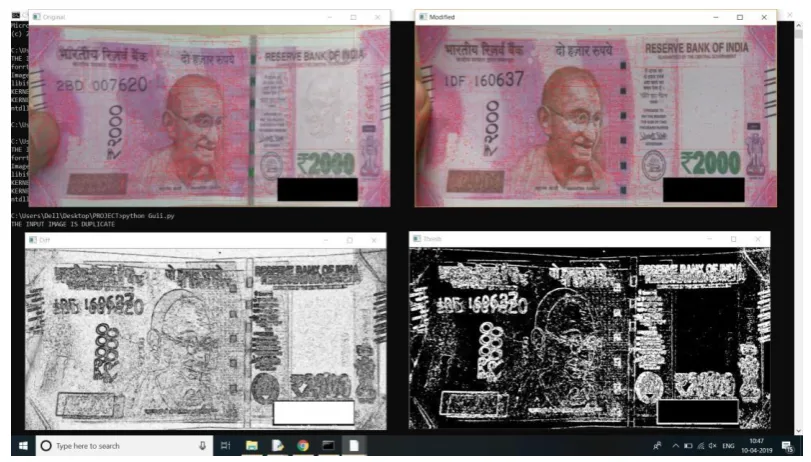
Fig. 6 Output from the system showing the comparison of features
V. RESULT AND CONCLUSION
Currency use is a necessity for survival and hence it is always necessary to keep in track of its originality. Paper currencies are used much more in India and hence a system to detect the fake currency is needed. As the new currencies are used in the market, the proposed system seems to be useful to detect the currency to be genuine or not. This system compares more features for feature extraction than other proposed systems. It also shows where the differences are in the currencies instead of simply displaying the result.
This system can be further implemented for foreign currencies like Dollars, Euros, Taka, etc. as a future scope.
REFERENCES
[1] Fake Indian Currency Note [Online]. Available: https://en.wikipedia.org/wiki/Fake_Indian_currency_note [2] Chinmay Bhurke, Meghana Sirdeshmukh, Prof. Mrs. M.S.Kanitkar, ―Currency Recognition Using Image
Processing‖ International Journal of Innovative Research in Computer and Communication Engineering, Vol. 3, Issue 5, May 2015
[3] Trupti Pathrabe G and Swapnili Karmore 2011 Int. J. CompTrends Tech 152-156
[4] Eshita Pilania, Bhavika Arora, ―Recognition of Fake Currency Based on Security Thread Feature of Currency‖ International Journal Of Engineering And Computer Science, ISSN: 2319-7242
[5] P. Julia Grace, Ph.D., A. Sheema, ―A survey on Fake Indian Paper Currency Identification System‖ Grace et al., International Journal of Advanced Research in Computer Science and Software Engineering 6(7), July- 2016, pp. 340-345 ISSN: 2277 128X
[6] Komal Vora, Ami Shah, Jay Mehta, ―A Review Paper on Currency Recognition System‖ International Journal of Computer Applications (0975 – 8887), Volume 115 – No. 20, April 2015
[7] Tushar Agasti, Gajanan Burand, Pratik Wade and P Chitra, ―Fake currency detection using image processing‖ 14th ICSET-2017
[8] Fake currency detectors using machines [Online]. Available: https://en.wikipedia.org/wiki/Currency_detector
[9] Pramod Kaler, ―Study of Grayscale image in Image processing‖ International Journal on Recent and Innovation Trends in Computing and Communication, ISSN: 2321-8169, Volume: 4 Issue: 11
[10] Image segmentation techniques with output images [Online]. Available: https://www.mathworks.com/discovery/image-segmentation.html
[11] Abdalla Mohamed Hambal, Dr. Zhijun Pei, Faustini Libent Ishabailu, ―Image Noise Reduction and Filtering Techniques‖ International Journal of Science and Research (IJSR) ISSN (Online): 2319-7064 [12] Muthukrishnan.R and M.Radha ―Edge Detection Techniques for Image Segmentation‖ International
Journal of Computer Science & Information Technology (IJCSIT) Vol 3, No 6, Dec 2011
[13] Ireyuwa. E. Igbinosa, ―Comparison of Edge Detection Technique in Image Processing Techniques‖ International Journal of Information Technology and Electrical Engineering, Volume 2, Issue 1 ISSN: - 2306-708X,February 2013
[14] Dilpreet Kaur1, Yadwinder Kaur, ―Various Image Segmentation Techniques: A Review‖ International Journal of Computer Science and Mobile Computing, IJCSMC, Vol. 3, Issue. 5, May 2014, pg.809 – 814 [15] Greyscale techniques in image segmentation [Online]. Available: