doi:10.1136/bmj.324.7343.947
2002;324;947-
BMJ
and Rebecca Turner
Michael King, Oliver Davidson, Fiona Taylor, Andrew Haines, Deborah Sharp
trial
patients with depression: randomised controlled
skills in brief cognitive behaviour therapy to treat
Effectiveness of teaching general practitioners
http://bmj.com/cgi/content/full/324/7343/947
Updated information and services can be found at:
These include:
References
http://bmj.com/cgi/content/full/324/7343/947#otherarticles
11 online articles that cite this article can be accessed at:
http://bmj.com/cgi/content/full/324/7343/947#BIBL
This article cites 22 articles, 7 of which can be accessed free at:
Rapid responses
http://bmj.com/cgi/eletter-submit/324/7343/947
You can respond to this article at:
http://bmj.com/cgi/content/full/324/7343/947#responses
at:
7 rapid responses have been posted to this article, which you can access for free
service
Email alerting
the top left of the article
Receive free email alerts when new articles cite this article - sign up in the box at
Topic collections
(155 articles)
Postgraduate: Family/General Practice
(625 articles)
Health Services Research
(393 articles)
Psychology
(707 articles)
Mood disorders (including depression)
(578 articles)
Randomized Controlled Trials: examples
(705 articles)
Clinical Research
Articles on similar topics can be found in the following collections
Notes
To order reprints follow the "Request Permissions" link in the navigation box
http://resources.bmj.com/bmj/subscribers
go to:
BMJ
To subscribe to
on 9 July 2008 bmj.com
Primary care
Effectiveness of teaching general practitioners skills in
brief cognitive behaviour therapy to treat patients with
depression: randomised controlled trial
Michael King, Oliver Davidson, Fiona Taylor, Andrew Haines, Deborah Sharp, Rebecca Turner
Abstract
ObjectiveTo assess the effectiveness of teaching general practitioners skills in brief cognitive behaviour therapy.
DesignParallel group, cluster randomised, controlled trial of an educational package on cognitive behaviour therapy.
SettingGeneral practices in north London. Participants84 general practitioner principals and 272 patients attending their practices who scored above the threshold for psychological distress on the hospital anxiety and depression scale.
InterventionA training package of four half days on brief cognitive behaviour therapy.
Main outcome measuresScores on the depression attitude questionnaire (general practitioners) and the Beck depression inventory (patients).
ResultsDoctors’ knowledge of depression and attitudes towards its treatment showed no major difference between intervention and control groups after 6 months. The training had no discernible impact on patients’ outcomes.
ConclusionGeneral practitioners may require more training and support than a basic educational package on brief cognitive behaviour therapy to acquire skills to help patients with depression.
Introduction
Most people with psychological problems receive no treatment. Those who do seek help have severe problems, and most are managed by their general practitioners.1–3 Although counselling is more
fre-quently used in general practice, it is mainly carried out by trained professionals4; psychological interventions
for use by general practitioners need to be evaluated.5
Cognitive behaviour therapy is as effective as pharma-cotherapy for treating depression, with the benefit of reduced rates of long term relapse.6It is also effective in
depressed patients presenting to general practitioners.7
Cognitive behaviour therapy is effective when deliv-ered by general practitioners who have received exten-sive instruction, but most doctors do not have the time or inclination to undergo comprehensive training.8 9
We assessed whether teaching general practitioners skills in brief cognitive behaviour therapy improved
their attitudes to the management of depression and the outcomes of their patients with common mental disorders.
Methods
We undertook a parallel group, cluster randomised, controlled trial of basic training in brief cognitive behaviour therapy for general practitioners. Between October 1997 and January 1998 we contacted a random sample of general practitioners on the registers of the family health service authorities in the former North Thames Regional Health Authority.
Randomisation
General practitioners were assigned to a group receiv-ing brief cognitive behaviour therapy trainreceiv-ing and a control group. For randomisation we used a series of sealed, opaque envelopes in blocks of six; for every consecutive six general practitioners entered into the trial three were in each group, but the order of recruit-ment to the groups was random. Doctors from the same practice were randomised together to avoid exchange of training material and knowledge. The research assistant could not be kept blind to the alloca-tion of doctors as she collected assessments at the training day, liaised with practice receptionists, and col-lected data from practice records. To avoid systematic bias we relied on self reported outcomes for both doc-tors and patients.
Training
The training aimed to increase professional ease and positive attitudes towards managing patients with depression and to enable the acquisition of skills in the application of brief cognitive behaviour therapy. General practitioners were not expected to become proficient cognitive behaviour therapists. Rather, we aimed to teach them techniques for use in routine con-sultations. The course, consisting of four half day work-shops at one week intervals, was developed and piloted in an earlier feasibility study (box).10 Doctors in the
control group were offered the course at the end of the trial but received no other advice or training at entry to the trial.
Department of Psychiatry and Behavioural Sciences, Royal Free and University College Medical School, Royal Free Campus, London NW3 2PF Michael King
head
Oliver Davidson
honorary senior lecturer
Fiona Taylor
research fellow
Department of Primary Care and Population Sciences, Royal Free and University College Medical School Andrew Haines
head
Division of Primary Health Care, Department of Clinical Medicine, University of Bristol, Bristol BS8 2PR Deborah Sharp
head
Medical Research Council Clinical Trials Unit, London NW1 2DA Rebecca Turner
research associate
Correspondence to: M King
bmj.com 2002;324:947
page 1 of 6
Evaluation of training
Learning objectives
General practitioners completed two questionnaires at baseline and then six months after training: the depression attitude questionnaire11 12and a
question-naire developed by us in a feasibility study that explores doctors’ knowledge of cognitive behaviour therapy and the extent to which they feel confident in applying it in their practice.10A high score for the
con-fidence outcomes indicates lack of concon-fidence in treat-ing depression or anxiety.
The depression attitude questionnaire contains four factors: treatment attitude (high scores indicate a preference for biological theories and antidepressants, low scores indicate an orientation to psychotherapy), professional ease (high scores indicate that the doctor is uncomfortable in dealing with depression and sees it as unrewarding), depression malleability (high scores indicate pessimism about modifying the course of depression), and depression identification (high scores indicate difficulty in differentiating depression from unhappiness and little confidence in treatments beyond those usually provided).
Patient outcomes
We used the hospital anxiety and depression scale to screen consecutive patients aged 18 and over consulting the trial doctors.13 14 Screening took place
for the doctors in the intervention group within two weeks of training between January and July 1998. We excluded patients with psychoses, organic brain syndromes, learning disabilities, or who were unable to read English. In each practice a trained receptionist asked patients to complete questionnaires. The receptionist told participants in both trial arms that their doctor had been involved in a training programme, without specifying the nature of that training. We contacted patients with a subscale score of 11 or more for anxiety or depression on the hospital anxiety and depression scale and asked them to enter the study. To recruit patients with major psychological symptoms we chose a high threshold. We offered par-ticipants a £5 gift token for their time.
On receipt of a signed consent form patients were asked to complete the following questionnaires: the
Beck depression inventory, which measures severity of depressive symptoms and is a sensitive measure of change (high scores indicate greater depression)15; the
state trait anxiety inventory, which measures changes in controlled trials of psychological and pharmacologi-cal therapies (high scores for the first dimension indicate greater “state” or short term anxiety, high scores for the second indicate greater “trait” or long term anxiety)16 17; and the short form 36 (SF-36), a brief
measure of quality of life (comprises eight dimensions for which high scores indicate better quality of life).18
We told the doctors which of their patients scored above the threshold on the hospital anxiety and depression scale. Doctors in the control group provided their usual care, which could include any intervention or referral.
Patient follow up
We followed up participants by post three and six months later, and again asked them to complete the three questionnaires. We collected data from the prac-tice on consultation rates, home visits, psychotropic prescribing, referrals to mental health professionals and other health service providers, and certificated absences for sickness.
Power calculation
To plan the trial we used data from a study of a mental health facilitator in general practice.19 Using the
observed difference between psychiatrists and general practitioners on the professional ease subscale of the depression attitude questionnaire, we designed the trial to detect a difference of 0.65 standard deviations between intervention and control doctors. To provide 85% power at a two sided 5% level of significance, 43 general practitioners were needed in each group. At the time of the study we had little information on spontaneous change in scores on the Beck depression inventory for patients attending general practitioners. From changes in scores every four months on the gen-eral health questionnaire in patients attending gengen-eral practitioners (R Blizard, personal communication, 1995), we aimed to detect a difference of 0.5 standard deviations between patients attending intervention and control doctors. With individual randomisation we needed 73 patients in each group (1.7 patients per practitioner) to provide 85% power at a two sided 5% level of significance. Using a correction formula to allow for the clustered design, with an estimated intrac-lass correlation of 0.26 (R Blizard, personal communi-cation, 1995), the revised sample size was 105 patients in each arm (2.5 patients per doctor).20As up to 30% of
eligible patients might not take part, we estimated we would need to identify four to five patients per doctor.
Analysis
We used linear regression to estimate differences in the four dimensions of the depression attitude question-naire, while adjusting for baseline scores. We assessed the impact of training on patients’ emotional symptoms by examining differences in scores on the Beck depression inventory and state trait anxiety inventory and four of the SF-36 dimensions that were most relevant to patients with depression. The SF-36 dimension representing role limitations due to emotional problems was dichotomised for analysis, since the original scale contains only four values. For Content of training
First half day
Clinical presentations of anxiety and depression, classification schema in general practice, recognition skills, common causes, and antidepressant treatment
Second half day
Introduction to the theory of behaviour and cognitive therapies, functional assessment of the presenting problems, and diaries, monitoring, and goal setting Third half day
Informing patients of the cognitive model, behavioural and cognitive assessments, activity scheduling, cognitive restructuring, and therapy guidelines
Fourth half day
Problem solving, guidelines for cognitive behaviour therapy in general practice, and summing up and review
Primary care
page 2 of 6 BMJVOLUME 324 20 APRIL 2002 bmj.com
on 9 July 2008 bmj.com
secondary outcomes at general practitioner level we examined confidence in treating depression and anxi-ety, whereas for patients we explored differences in resource use. For continuous outcomes we report esti-mated mean differences with 95% confidence intervals and corresponding P values, whereas for binary outcomes we report odds ratios. Normality was assumed for each continuous outcome. We compared primary patient outcomes on the basis of both mid-point and end point measurements, using all available values, while adjusting for baseline measure-ments. We estimated differences between the trial arms within hierarchical regression models, which allowed for both the repeated measurements structure and the clustering of patients within doctors.21 22We analysed
resource use outcomes within hierarchical regression models, which allowed for the clustering of patients within doctors. Only three pairs of colleagues were recruited from the same practices. Since there was therefore insufficient information to estimate variation both between doctors and between practices, we made no allowance for this in the analysis. As exploratory analyses we investigated the relation between prac-titioner confidence and pracprac-titioner effects on primary patient outcomes. These relations were estimated as regression slopes within multivariate hierarchical models, with adjustment for baseline patient scores. We used bayesian estimation for computational reasons, with vague priors placed on all variables.23We followed
an intention to treat approach throughout. Analyses were performed with Stata (version 6), MLwiN (version 1.10, Institute of Education, London), and WinBUGS (version 1.3, Medical Research Council Biostatistics
Unit, Cambridge).
Results
Response rates
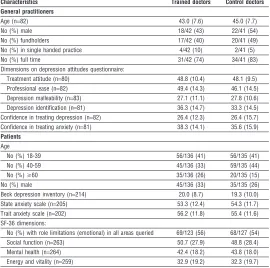
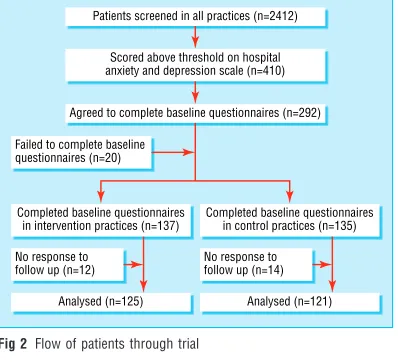
Of 116 doctors randomised, 32 subsequently withdrew because of work commitments (fig 1). Training took place in four blocks, with 9 to 14 doctors attending any one block. Overall, we screened 2412 patients consult-ing the participatconsult-ing doctors; 410 (17%) scored above the threshold for the hospital anxiety and depression scale and, of these, 272 (66%) answered questionnaires at baseline (fig 2). No major differences were found at baseline between each arm of the trial for doctors or patients (table 1).
Primary outcomes
General practitioners
Doctors’ knowledge and attitudes as measured by the depression attitude questionnaire showed little differ-ence at six months between the intervention and con-trol groups. In the primary analysis (table 2) we adjusted for the baseline value of each outcome
Eligible doctors contacted (n=1121)
Expressing interest (n=210)
Randomised (n=116)
Allocated to training group (n=59)
Training group (n=42)
Allocated to waiting list for training (n=57) Unable to take part because
of work constraints (n=94)
Analysed (n=25) No response to postal follow up (n=17) Withdrew (n=17)
Waiting list control group (n=42)
Analysed (n=26) No response to postal follow up (n=16) Withdrew (n=15)
Fig 1 Flow of general practitioners through trial
Table 1 Characteristics and baseline scores of doctors (42 in trained group, 42 in control group) and patients (137 in trained group, 135 in control group) Values are means (SDs) unless stated otherwise
Characteristics Trained doctors Control doctors
General practitioners
Age (n=82) 43.0 (7.6) 45.0 (7.7) No (%) male 18/42 (43) 22/41 (54) No (%) fundholders 17/42 (40) 20/41 (49) No (%) in single handed practice 4/42 (10) 2/41 (5) No (%) full time 31/42 (74) 34/41 (83) Dimensions on depression attitudes questionnaire:
Treatment attitude (n=80) 48.8 (10.4) 48.1 (9.5) Professional ease (n=82) 49.4 (14.3) 46.1 (14.5) Depression malleability (n=83) 27.1 (11.1) 27.8 (10.6) Depression identification (n=81) 36.3 (14.7) 33.3 (14.5) Confidence in treating depression (n=82) 26.4 (12.3) 26.4 (15.7) Confidence in treating anxiety (n=81) 38.3 (14.1) 35.6 (15.9)
Patients
Age
No (%) 18-39 56/136 (41) 56/135 (41) No (%) 40-59 45/136 (33) 59/135 (44) No (%)>60 35/136 (26) 20/135 (15) No (%) male 45/136 (33) 35/135 (26) Beck depression inventory (n=214) 20.0 (8.7) 19.3 (10.0) State anxiety scale (n=205) 53.3 (12.4) 54.3 (11.7) Trait anxiety scale (n=202) 56.2 (11.8) 55.4 (11.6) SF-36 dimensions:
No (%) with role limitations (emotional) in all areas queried 69/123 (56) 68/127 (54) Social function (n=263) 50.7 (27.9) 48.8 (28.4) Mental health (n=264) 42.4 (18.2) 43.8 (18.0) Energy and vitality (n=259) 32.9 (19.2) 32.3 (19.7) Standard deviations between patients for patient characteristics have been calculated with allowance for variation between doctors.
Table 2 Primary and secondary outcomes in doctors after adjustment for baseline levels. Values are means (standard deviations) unless stated otherwise
Trained doctors (n=42)
Control doctors
(n=42) Intervention effect (95% CI)* P value
Treatment attitude 46.3 (10.9) (n=25) 48.2 (8.8) (n=24) –1.6 (–6.9 to 3.7) (n=46) 0.54 Professional ease 42.2 (14.0) (n=24) 47.3 (13.9) (n=25) –5.1 (–11.9 to 1.7) (n=48) 0.14 Depression malleability 30.8 (9.7) (n=25) 28.1 (12.9) (n=23) 2.0 (–2.9 to 6.8) (n=48) 0.42 Depression identification 36.3 (11.4) (n=25) 36.3 (14.4) (n=25) –0.5 (–7.1 to 6.0) (n=48) 0.87 Confidence in treating depression 20.9 (8.3) (n=25) 29.2 (17.4) (n=26) –8.2 (–15.4 to –1.0) (n=50) 0.03 Confidence in treating anxiety 30.3 (14.5) (n=25) 36.5 (15.9) (n=25) –7.8 (–15.3 to –0.2) (n=49) 0.04 *Sum of numbers in intervention and control groups differs owing to adjustment for baseline levels.
3
variable, whereas in an exploratory analysis we made additional adjustments for the five personal character-istics at baseline (table 1).
Patients
In the primary analysis we adjusted for the baseline value of each outcome variable (table 3), whereas in an exploratory analysis we made additional adjustments for the doctors’ and patients’ personal characteristics at baseline (table 1). The training had no discernible impact on the patients’ outcomes, apart from slight evidence that the proportion of patients with role limi-tations due to emotional problems in the three areas queried was greater for patients registered with intervention than with control doctors.
Secondary outcomes
General practitioners
When adjusted for baseline scores, visual analogue scores for confidence in treating depression and anxi-ety showed some differences between intervention and control doctors at six months (table 2). Some evidence
was found of lower scores in intervention doctors, which indicated greater confidence in treating both depression and anxiety.
Patients
Differences were found between the trial arms in refer-rals to mental health professionals and other health service providers and absences due to sickness (table 4). Intervention doctors were more likely than control doctors to refer their affected patients (odds ratio 3.4, 95% confidence interval 1.0 to 11.3) and less likely to offer certificates for sickness (0.4, 0.2 to 1.0). These bor-derline differences should be interpreted cautiously given the number of outcomes examined. No differences were found for the other secondary outcomes.
Exploratory analyses of doctors’ confidence in their skills and patient outcomes
Given no evidence of benefit in patient outcomes, the question arises at what stage the intervention failed—for example, did the general practitioners use their skills but to no effect? Direct information on the extent to which their skills in brief cognitive behaviour therapy were implemented is not available, since prac-titioners indicated strongly at the feasibility stage that collection of this information would be unacceptable and might prevent their participation in the trial. How-ever, we investigated the relation between practitioner confidence in treating depression and practitioner effects on patient depression, as measured by the score on the Beck depression inventory. We undertook simi-lar analyses for practitioner confidence in treating anxiety and patients’ scores on the state and trait anxi-ety inventory. All analyses were exploratory, as the trial was not designed for this purpose. In each case the confidence interval for the relation was wide and included the value corresponding to no association, meaning that we found no evidence of a relation between practitioners’ confidence in applying skills in
Patients screened in all practices (n=2412)
Agreed to complete baseline questionnaires (n=292) Scored above threshold on hospital anxiety and depression scale (n=410)
Completed baseline questionnaires in control practices (n=135) Completed baseline questionnaires
in intervention practices (n=137) Failed to complete baseline questionnaires (n=20)
Analysed (n=125) No response to follow up (n=12)
Analysed (n=121) No response to follow up (n=14)
Fig 2 Flow of patients through trial
Table 3 Primary outcomes in patients at 6 months. Intervention effects are estimated in a repeated measures analysis with adjustment for baseline levels. Values are means (standard deviations) unless stated otherwise
Trained doctors (n=137)
Control doctors
(n=135) Intervention effect (95% CI)* P value
Beck depression inventory 17.5 (9.6) (n=104) 16.6 (11.5) (n=105) –0.2 (–2.3 to 1.9) (n=196) 0.84 State anxiety 48.6 (13.8) (n=103) 48.2 (14.9) (n=98) 0.8 (–2.4 to 4.0) (n=181) 0.62 Trait anxiety 52.3 (13.2) (n=101) 50.4 (13.7) (n=95) 0.9 (–2.0 to 3.8) (n=177) 0.53 SF-36 dimensions:
No (%) with role limitations (emotional) in all areas queried
54/115 (47) 35/106 (33) 2.7 (1.1 to 6.4)† (n=225) 0.03
Social function 58.5/118 (29.7) 61.7/111 (29.2) –3.1 (–9.4 to 3.1) (n=237) 0.32 Mental health 51.8/117 (20.8) 54.1/109 (21.0) 0.1 (–4.4 to 4.6) (n=238) 0.96 Energy and vitality 37.9/117 (21.7) 39.0/109 (25.1) –1.0 (–5.7 to 3.6) (n=233) 0.66 *Sum of numbers in intervention and control groups differs owing to adjustment for baseline levels.
†Odds ratio.
Table 4 Secondary outcomes in patients. Values are numbers (percentages) unless stated otherwise
Trained doctors (n=137)
Control doctors
(n=135) Intervention effect(95% CI) P value
Mean (SD) consultations 4.5/130 (3.2) 4.3/124 (3.3) 0.1 (–1.0 to 1.2) (n=254) 0.81 Home visit took place 5/129 (4) 1/124 (1) 5.0 (0.6 to 43.1)* (n=253) 0.15 Psychotropic drugs prescribed 48/130 (37) 45/124 (36) 1.0 (0.6 to 1.8)* (n=254) 0.95 Patient referred 43/129 (33) 22/123 (18) 3.4 (1.0 to 11.3)* (n=252) 0.05 Certificates for absence due to sickness 9/130 (7) 18/124 (15) 0.4 (0.2 to 1.0)* (n=254) 0.06 *Odds ratio.
Primary care
4 BMJVOLUME 324 20 APRIL 2002 bmj.com
on 9 July 2008 bmj.com
brief cognitive behaviour therapy and clinical outcome in their patients.
Missing data
For each primary outcome the pattern of non-response was similar in each arm of the trial. Non-response of doctors to the depression attitude questionnaire at follow up was unrelated to baseline values on the questionnaire. However, being younger or not having fundholder status was independently associated with non-completion of the questionnaire at follow up. For patients’ primary outcomes, we found age and sex were not related to missing data on the Beck depression inventory and state trait anxiety inventory but some evidence that fewer men completed the SF-36 at six months. For each outcome, those with clinically worse values at baseline or at three months were more likely to have missing values at the next measurement.
Cluster effects
We report the observed intraclass correlations that were taken into account in analysis of the patients’ pri-mary outcomes—that is, those representing the cluster-ing between doctors remaincluster-ing after adjustment for both intervention effect and baseline values (table 5). We also present corresponding estimates of variance both between general practitioners and within general practitioners. The unadjusted estimates of intraclass correlation are also presented. All estimates were obtained using hierarchical regression models. Cluster-ing information for the role limitations (emotional) SF-36 outcome is reported on the original rather than dichotomous scale.
Discussion
Basic training in brief cognitive behaviour therapy has little effect on general practitioners’ attitudes to the identification and treatment of depression or the outcome of their patients with emotional problems. Our findings run counter to other studies where brief interventions by general practitioners have been regarded as effective in problem drinking and diabetes.24–26However, these disorders are more clearly
defined and easier to target, and the interventions were only loosely based on behaviour principles. Interven-tions that included the delivery of behavioural and educational self help materials have been used success-fully by general practitioners for patients with depression, somatisation disorders, and obsessive-compulsive disorder.27–29 However, our finding of no
benefit is important as it suggests that acquiring more complex skills in cognitive behaviour therapy is not straightforward for general practitioners.
Our trial has several limitations. Owing to the losses to follow up among general practitioners, the impact of training on attitudes to depression was assessed within a smaller sample than planned. Although we recruited more patients than we had anticipated, we also had losses to follow up. However, since the observed intraclass correlations for the patients’ primary outcomes were far lower (table 5) than the value of 0.26 allowed for in our power calcula-tions, we retained sufficient power to detect the prespecified difference in patient outcomes. Although patients with clinically worse outcomes at one time of
measurement were somewhat more likely to have missing data later on, the pattern of non-response was similar for both groups and thus differential bias was unlikely.
The high threshold on the hospital anxiety and depression scale may have meant that we focused too much on patients with severe problems or those with long term difficulties who general practitioners may not have considered suitable for cognitive behaviour therapy, had they been able to express their views. Basic skills in brief cognitive behaviour therapy may assist general practitioners in dealing with patients who are less disturbed than those in our trial. Our find-ing that trained doctors may have referred more of their depressed patients would suggest that the doctors had acquired sufficient skills to know when their own management was likely to be unproductive. Thus train-ing may have had a paradoxical effect in maktrain-ing them feel unable to deal with more complex cases. A further limitation is that we could not guarantee patients always saw the same general practitioner. Finally, our earlier feasibility work had shown it was unacceptable to collect process measures on the extent to which the new skills were applied, and we lacked power to show whether or not confidence in use of the skills was related to patient outcome.
We presented the intraclass correlations for our patients’ primary outcomes (table 5) to inform people designing cluster randomised trials using similar outcomes. It is generally agreed that clustering information should be published, but reporting varies; in particular, intraclass correlations may be calculated at the baseline or end point of the trial.30Our observed
intraclass correlations at the end point were smaller than corresponding baseline values. The clusters may have become more alike during the course of the trial as a result of the shared experience of the trial. We sug-gest that intraclass correlations at the end point are more relevant for the design of future trials because power calculations require allowance for the clustering expected at the end rather than beginning of a trial.
Showing changes in patient outcomes is a challenging task in any trial of training for general practitioners. It may be possible that skills in brief cog-nitive behaviour therapy cannot be taught in this basic manner and that general practitioners require much more training if they are to change their attitudes and acquire skills that have a positive impact on their patients.8Conversely, it may be that the doctors did
learn new skills but had no time to apply them. Our outcomes do not allow us to examine such possibilities. Future studies might also consider the inclusion of
Table 5 Clustering between doctors for primary outcomes in patients (intraclass correlation coefficient measured at end point)
Intraclass correlation
coefficient Variance
Unadjusted Adjusted Between doctors Within doctors
Beck depression inventory 0.11 0.013 0.5 41.4 State anxiety <0.001 <0.001 <0.001 86.7 Trait anxiety 0.033 <0.001 <0.001 66.8 SF-36 dimensions:
Role limitations (emotional) 0.12 0.11 59.0 469.0 Social function 0.090 0.067 24.2 334.8 Mental health 0.063 0.010 2.1 207.2 Energy and vitality <0.001 <0.001 <0.001 252.8
5
written materials for patients to improve adherence to and understanding of cognitive behaviour therapy.
We thank all patients and health professionals who took part, the late John Cohen who provided facilities for the training, and Robert Blizard who advised on the randomisation and data entry and provided then unpublished data for use in the power calculation. The exploratory analyses made use of methodology developed jointly with Simon Thompson and Rumana Omar.
Contributors: MK, OD, DS, and AH conceived the idea for the trial and obtained research funding. MK and OD supervised the conduct of the trial and the data collection. FT undertook recruitment of doctors and patients and managed the data. RT and MK analysed the data. All authors contributed to the writing of the paper. MK will act as guarantor for the paper.
Funding: MK received funding from the NHS research and development programme. The views expressed are those of the authors’ and not necessarily those of the NHS Executive or the Department of Health.
Competing interests: None declared.
1 Bebbington PE, Brugha TS, Meltzer H, Jenkins R, Ceresa C, Farrell M, et al. Neurotic disorders and the receipt of psychiatric treatment.Psychol Med2000;30:1369-76.
2 Bebbington PE, Meltzer H, Brugha TS, Farrell M, Jenkins R, Ceresa C, et al. Unequal access and unmet need: neurotic disorders and the use of primary care services.Psychol Med2000;30:1359-67.
3 Goldberg D, Huxley P.Common mental disorders: a bio-social model. London: Routledge, 1992.
4 Sibbald B, Addington-Hall J, Brenneman D, Freeling P. Counsellors in English and Welsh general practices: their nature and distribution.BMJ
1993;306:29-33.
5 Cape J, Barker C, Buszewicz M, Pistrang N. General practitioner psycho-logical management of common emotional problems (II): a research
agenda for the development of evidence-based practice.Br J Gen Pract
2000;5:396-400.
6 Paykel ES, Scott J, Teasdale JD, Johnson AL, Garland A, Moore R, et al. Prevention of relapse in residual depression by cognitive therapy: a con-trolled trial.Arch Gen Psychiatry1999;56:829-35.
7 Ward E, King M, Lloyd M, Bower P, Sibbald B, Farrelly S, et al. Randomised controlled trial of non-directive counselling, cognitive-behaviour therapy and usual general practitioner care for patients with depression. I: Clinical effectiveness.BMJ2000;321:1383-8.
8 Scott C, Tacchi MJ, Jones R, Scott J. Acute and one-year outcome of a ran-domised controlled trial of brief cognitive therapy for major depressive disorder in primary care.Br J Psychiatry1997;171:131-4.
9 Mynors-Wallis LM, Gath DM, Llyof-Thomas AR, Tomlinson D. Randomised controlled trial comparing problem solving treatment with amitriptyline and placebo for major depression in primary care.BMJ
1995;310:441-5.
10 Davidson O, King M, Sharp D, Taylor F. A pilot randomized trial evaluat-ing GP registrar management of major depression followevaluat-ing brief train-ing in cognitive behaviour therapy.Educ Gen Pract1999;10:485-8. 11 Botega N, Mann A, Blizard R, Wilkinson G. General practitioners and
depression—first use of the depression attitude questionnaire.Int J
Methods Psychiatr Res1992;4:169-80.
12 Kerr M, Blizard R, Mann A. General practitioners and psychiatrists: com-parison of attitudes to depression using the depression attitude question-naire.Br J Gen Pract1995;45:89-92.
13 Zigmond AS, Snaith RP. The hospital anxiety and depression scale.Acta
Psychiatr Scand1983;67:361-70.
14 Wilkinson MJB, Barczak P. Psychiatric screening in general practice: com-parison of the general health questionnaire and the hospital anxiety and depression scale.J Roy Coll Gen Pract1988;38:311-3.
15 Beck AT, Ward CH, Mendelson M, Mock J, Erbaugh, J. An inventory for measuring depression.Arch Gen Psychiatry1961;4:561-71.
16 SpieIberger CD, Gorsuch RL, Lushene RE, Vagg PR, Jacobs GA.Manual
for the state-trait anxiety inventory.Palo Alto, California: Consulting
Psychologists Press, 1983.
17 Smith RC, Lay CD. State and trait anxiety: an annotated bibliography.
Psychol Rep1974;34:519-94.
18 Jenkinson C, Coulter A, Wright L. Short form 36 (SF36) health survey questionnaire: normative data for adults of working age. BMJ
1993;306:1437-40.
19 Bashir K, Blizard B, Bosanquet A, Bosanquet N, Mann A, Jenkins R. The evaluation of a mental health facilitator in general practice: effects on recognition, management and outcome.Br J Gen Pract2000;50:626-9. 20 Dunn G. Statistical methods for measuring outcomes.Soc Psychiatry
Psy-chiatr Epidemiol1994;29:198-204.
21 Omar RZ, Wright EM, Turner RM, Thompson SG. Analysing repeated measurements data: a practical comparison of methods. Stat Med
1999;18:1587-603.
22 Omar RZ, Thompson SG. Analysis of a cluster randomized trial with binary outcome data using a multi-level model.Stat Med 2000;19:2675-88.
23 Spiegelhalter DJ, Myles JP, Jones DR, Abrams KR. An introduction to bayesian methods in health technology assessment.BMJ 1999;319:508-12.
24 Fleming M, Manwell L. Brief intervention in primary care settings; a pri-mary treatment method for at-risk problem and dependent drinkers.
Alcohol Res Health1999;23:128-37.
25 Cordoba R, Delgado MT, Pico V, Altisent R, Fores D, Monreal A, et al. Effectiveness of brief intervention on non-dependent alcohol drinkers (EBIAL): a Spanish multi-centre study.Fam Pract1998;15:562-8. 26 Ridgeway NA, Harvill DR, Harvill LM, Falin TM, Forester GM, Gose OD.
Improved control of type 2 diabetes mellitus: a practical education/ behaviour modification program in a primary care clinic.South Med J
1999;92:667-72.
27 Robinson P, Katon W, Von-Korff M, Bush T, Simon G, Lin E, et al. The education of depressed primary care patients: what do patients think of interactive booklets and a video?J Fam Pract1997;44:562-71. 28 Lidbeck J. Group therapy for somatization disorders in general practice:
effectiveness of a short cognitive-behavioural treatment model.Acta
Psy-chiatr Scand1997;96:14-24.
29 Gedenk M, Nepps P. Obsessive-compulsive disorder: diagnosis and treat-ment in the primary care setting.J Am Board Fam Pract1997;10:349-56. 30 Ukoumunne OC, Gulliford MC, Chinn S, Sterne JAC, Burney PGJ,
Don-ner A. Evaluation of health interventions at area and organisation level.
BMJ1999;319:376-9.
(Accepted 2 January 2002)
What is already known on this topic
Trained professionals can deliver effective cognitive behaviour therapy to depressed patients presenting to general practitioners
Limited evidence shows that cognitive behaviour therapy is effective when delivered by general practitioners who have received extensive instruction
Most doctors do not have the time or inclination to carry out such comprehensive training
What this study adds
Basic training in brief cognitive behaviour therapy has little effect on general practitioners’ attitudes to the identification and treatment of depression or the outcome of their patients with emotional problems
General practitioners may require more extensive training and support if they are to acquire skills in brief cognitive behaviour therapy that will have a positive impact on their patients
Primary care
6 BMJVOLUME 324 20 APRIL 2002 bmj.com
on 9 July 2008 bmj.com