R E V I E W
Present and future for technologies to develop
patient-speci
fi
c medical devices: a systematic
review approach
This article was published in the following Dove Press journal: Medical Devices: Evidence and Research
Clara-Isabel López
Gualdrón
1Edna-Rocío Bravo Ibarra
2Andrea-Patricia
Murillo Bohórquez
2Israel Garnica Bohórquez
21Industrial Design School, Universidad Industrial de Santander, Bucaramanga, Colombia;2Industrial and Business Studies School, Universidad Industrial de Santander, Bucaramanga, Colombia
Abstract:
The main purpose of this investigation was to systematically review the literature
regarding case studies on patient-speci
fi
c implants and devices, with the goal of analyzing
the process of developing custom-made medical devices. A content analysis was performed
to identify design processes and methodologies implemented to develop devices such as
implants adapted to bone geometries. Reverse engineering, computer-aided design,
simula-tion of assets, and rapid prototyping technologies were selected according to their
interoper-ability in a process framework for developing new products. Finally, results from the case
studies and process stages identi
fi
ed in the consulted research were analyzed. These results
showed a relationship between the scope and complexity of the process and the stage of
technology integration of the patient-speci
fi
c device development. The analyzed case studies
were characterized by technical, scienti
fi
c, and multidisciplinary components to achieve
research goals. Likewise, integration of technologies using patient-speci
fi
c technologies is
needed for product development that converges into designing devices, such as implants,
biomodels, and cutting drilling guides.
Keywords:
customized implants, virtual planning, integration of CAx technologies,
technologies for patient-speci
fi
c medical devices
Introduction
Currently, orthopedic research and development studies highlight investigations
into the design and manufacturing of patient-speci
fi
c implants (PSI), also called
patient-speci
fi
c devices (PSD). Such implants or devices provide an effective and
precise method for the treatment of a bone fracture or several defects like
oncolo-gical or congenital malformation.
1–4PSDs are designed to be adapted to bone
geometry, according to the fracture type to be stabilized.
5This concept arose
from advances in technology and systems integration, allowing the generation of
new design methods. The inclusion of the imaging techniques used in reverse
engineering (RE) for the 3D virtual reconstruction of reference models or
biomo-dels of living tissues has been proposed.
6Those tools are sometimes called
BIOCAD
5or, more traditionally, Computer-Aided Design (CAD).
7Results from this technology have been integrated into other software tools
used in the design and development of PSDs.
8The PSD model is often adapted to
3D bone geometry. The mechanical behavior of the resulting devices can be
evaluated
by
the
fi
nite
element
method
(FEM)
using
Computer-Aided
Engineering (CAE).
9Correspondence: Clara-Isabel López Gualdrón
Industrial Design School, Universidad Industrial de Santander, Bucaramanga 680002, Colombia
Tel +57 301 356 3743 Email [email protected]
Medical Devices: Evidence and Research
Dovepress
open access to scientific and medical research
Open Access Full Text Article
Medical Devices: Evidence and Research downloaded from https://www.dovepress.com/ by 118.70.13.36 on 24-Aug-2020
Some design methods include a visualization phase
where a physical model is manufactured by rapid
proto-typing (RP) for additive manufacturing (AM) or
machin-ing by computer numerical control by computer-aided
manufacturing (CAM) using subtractive manufacturing
(SM).
10These tools can be con
fi
gured in an architecture
that supports PSD design and production processes.
Speci
fi
c conditions are needed to design a precise implant
in anatomical areas of complex geometry such as the skull,
hip, or femur.
11–13The current literature does not identify a marker to
validate which technologies should be integrated, or
which technologies are the most appropriate for the design
and development of PSDs to provide optimal treatment for
speci
fi
c patients.
Based on this, it is proposed to de
fi
ne phases of
devel-opment for technology integration. This work was
con-ducted by consulting research involving successfully
implemented PSDs with known software architectures,
convergences, and divergences. A systematic review of
selected case studies may help identify trends and
oppor-tunities to improve the technologies used in developing
these devices.
The present article details the materials and methods
used in these studies, followed by a content analysis
sys-tematic literature review identifying common features
related to the design and manufacturing processes,
tech-nologies involved in each stage of development, and
asso-ciated reference practices. Later in the discussion, the
results of the literature review are contrasted and analyzed.
Finally, the conclusion gives an account of the literature
review as support for understanding the integration of
technologies in the development of PSDs.
Materials and methods
In the
fi
rst stage of the study, an exploratory literature
review was carried out on the development of custom
medical devices. Different keywords were identi
fi
ed such
as BIOCAD, CAD/CAE, RP, CAM, diagnosis, virtual
pre-planning, implant manufacturing, and PSD design and
development. Research questions were de
fi
ned relating to
the process, technological resources, and results in PSD
development, as illustrated in
Figure 1
.
The second stage of this study was to carry out a
systematic review of bibliometric to survey relevant
tech-nologies. The ISI Web of Science database was searched
from 2006
–
2018, applying the same criteria of quality,
inclusion, and exclusion to the selected articles. Although
WOS could be set since 2001, according to Meline
103a
systematic review for contemporary studies could covered
prior 10 years. The bibliometric review was run in 2018.
The equation used is shown in
Figure 2
.
This search identi
fi
ed 394 articles. Duplicate articles
were eliminated, as were articles with fewer than 10
cita-tions. Abstracts were then read to identify papers with case
studies involving the design of customized implants,
highly complex surgical intervention, technologies for
patient-speci
fi
c devices applied to orthopedic surgery,
Research
questions
Answers to identify
methods, and stages of the
To identify methodologies,
design process
CAx computer-assisted
technologies
Medical devices
development for
specific patients
What is the design and
development process for
customized implants?
What kind of
technol-ogies are used in
implant
develop-ment?
What case studies have
been investigated?
Research
Process
Results
Technological
resources
Figure 1Research questions for exploratory literature review.
Abbreviation:CAx, Computer-aided Tools.
Medical Devices: Evidence and Research downloaded from https://www.dovepress.com/ by 118.70.13.36 on 24-Aug-2020
maxillofacial surgery, orthognathic surgery, and other
technologies related to the development of PSDs. From
this, 70 articles were selected. Despite time-period
selected, seminal papers from 1998
–
2005 were 10%,
from 2006
–
2010 were 20%, from 2011
–
2015 were 36%,
and from 2016
–
2018 were 34%.
In a third stage, a content analysis of the selected
scienti
fi
c articles was carried out to understand the
pro-cesses used, the tools used, the anatomical regions treated,
and the obtained results from the identi
fi
ed case studies of
PSDs using computer-aided tools (CAx) technologies.
Finally, the bibliometric results were analyzed using the
Tree of Science (ToS) web tool to understand trends.
Results
The selected papers were categorized according to main
topics: technology integration models, and trend analysis.
The main
fi
ndings for each topic are given below.
Technology integration models
The integration of technologies was not explicitly
expressed when searching for PSD design case studies.
Nonetheless, the 70 documents were analyzed for this
content. These studies addressed complex fractures caused
by trauma, oncological, or congenital pathologies. The
stage in the process of PSD design and manufacture was
identi
fi
ed for each study. Also, each stage was associated
with the application of a CAx software tool: RE or
BIOCAD in virtual reconstruction, CAD in virtual
pre-planning and modeling, CAE in simulation, and RP in
3D printing, or machining by CAM.
Each technology integration model could also be
described
by
combinations
of
stages,
ie,
RE + CAD + CAE + RP and/or CAM, de
fi
ning the scope
of the technology development of each patient-speci
fi
c
device
.
14Models with higher numbers of stages involve
more technologies, with models possibly having up to 5
Main search
terms group Second search terms group
Third search terms group
AU=(LANTADA AD)
“Medical device design”
“Reverse engineering”
“Computer-aided design”
“Finite element analysis”
“Finite element simulation”
“Biomechanical engineer*”
“Orthop biomechanics” “Computer aided engineering”
“Cae” “Rapid prototyping”
“Rapid prototyping techniques”
“3dimensional printing”
“Medical rapid prototyping
“Rapid prototype* models”
“Rapid prototype* technology”
“Rapid prototype*”
“Stereolithographic model*”
“Cad”
“Biocad” “Reverse innovative
“3d
computational
“Computer aided medicine”
“Virtual prototyping”
“Computer supported design” “Custom-designed
orthopedic”
“Specific patient modeling”
“Biology based cad”
“Biocad model*” “Implant
adjustable to bone”
“Reconstruct patient-specific”
“Reconstructing a surface model”
“Patient-specific biomechanical
“Computer-aided reverse
“3d bone reconstruction” “Computer-aided tissue
“Bone reconstruction” “Virtual engineer*” “3d
reconstruction” “Orthopedic
implant design”
OR OR OR OR OR
OR
OR
OR
OR
OR
OR OR
OR OR
OR
OR
OR OR
OR
OR OR
AND OR
OR
OR
OR
OR
OR OR
OR
OR OR
OR OR
OR OR
OR
OR OR
Figure 2Research equation for literature review.
Medical Devices: Evidence and Research downloaded from https://www.dovepress.com/ by 118.70.13.36 on 24-Aug-2020
technology types, BIOCAD + CAD + CAE + RP + CAM. In
the equation below, it is observed that the combinatorial of
these 5 elements
“
n,
”
without selecting repeated elements
and with a restricted order, form groups
“
k
”
from a minimum
of 2 to a maximum of 5 components, with up to 26 possible
combinations.
½
n
!
=
ð
ð
n
k
Þ
!
k
!
Þ
¼
26
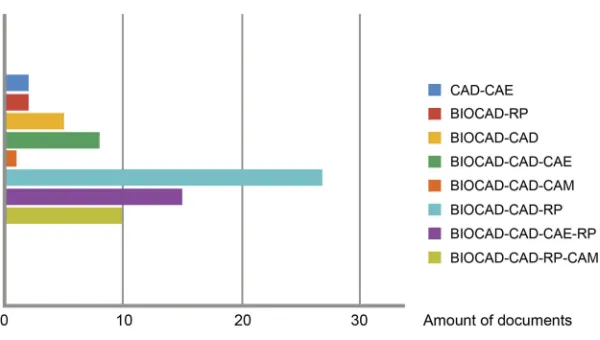
A total of 8 applied integration models were identi
fi
ed.
The model with the highest number of cases was the
integra-tion of BIOCAD + CAD + RP with a frequency of 38.6%,
followed by the BIOCAD + CAD + CAE + RP model with
21.4% of cases. The BIOCAD + CAD + RP + CAM
model accounted for 14.3% of cases, and the BIOCAD +
CAD + CAE model accounted for 11.4% of cases.
The BIOCAD + RP model accounted for 7.1%, the
CAD + CAE and BIOCAD + RP models accounted for
2.9% each, and the BIOCAD + CAD + CAM model
represented only 1.4% of cases.
Figure 3
shows the
fre-quencies observed for each technology integration model.
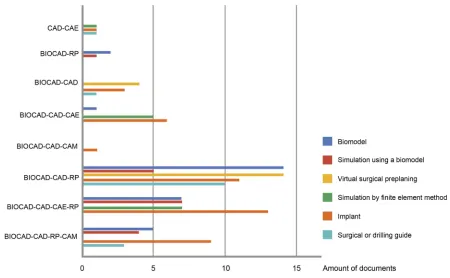
The type of medical device or process was classi
fi
ed,
according to the technology integration model
implemen-ted in each study. PSIs were the most explored products
obtained by RP and CAM in the case studies, representing
62.9%. The biomodel was the next most studied,
repre-senting 41.4%. Surgical drilling or cutting guides were
developed in 21.4% of the studies. The virtual and
physi-cal pre-planning carried out in CAD represented 25.7%
and 24.3% of the studies, respectively. The least explored
product was the FEM mechanical simulation associated
with CAE, which represented 18.6% of the cases. These
results are shown in
Figure 4
.
Some implementation patterns were identi
fi
ed. As
evi-dent in the matrix of correlations in
Table 1
, there is a
strong incidence between the biomodel and physical
simu-lation, implant, and surgical guide, physical simulation and
implant, and virtual preplanning with a surgical guide,
among high values of 0.75
–
0.99 . A moderate correlation
was observed for values of 0.40
–
0.74 , between biomodel
and surgical preplanning, physical simulation and FEM
analysis, virtual preplanning and implant, FEM analysis
and implant, and implant with cutting guide. A low
correla-tion was observed with values close to 0, , between
biomo-del and FEM analysis, physical simulation and virtual
preplanning, and physical simulation with cutting guide.
Negative values have revealed an inverse relationship
between virtual pre-planning with FEM analysis, and
FEM analysis with the use of cutting guides.
The analysis by anatomical regions studied for the
development of custom medical devices yielded 93 case
studies reported from the 70 articles analyzed. Of the
cases, 57% were related to reconstructive surgeries of the
skull and face, while 43% were orthopedic surgery cases.
Papers were categorized according to the technology
integration models, PSDs, and the anatomical regions
stu-died, as shown in
Table S1
.
The regions with the highest number of case studies
were the maxillofacial area, representing 32.3% of cases,
and the skull vault, representing 17.2%. Pelvic fractures
represented 12.9% and the femur represented 11.8% of the
case studies. Case studies of the hands, feet, knee, and
humerus were observed with less frequency. The data
detailing the anatomical areas in the case studies are
shown in
Figure 5
.
Figure 3Frequencies of technology integration models observed.
Abbreviations:BIOCAD, Biological Computer-aided Design; CAD, Computer-aided Design; CAE, Computer-aided Engineering; CAM, Computer-aided Manufacturing; RP, Rapid Prototyping.
Medical Devices: Evidence and Research downloaded from https://www.dovepress.com/ by 118.70.13.36 on 24-Aug-2020
Integration of BIOCAD + CAD + CAE technologies
was reported in 8 cases.
2,12,13,15–19In these cases, PSIs
were designed and simulations were made for the
treat-ment of maxillofacial, hip, skull, and femur fractures.
The integration of BIOCAD + CAD + CAE + RP was
used in 15 cases. The authors
11,20–33focused on PSI design,
simulating evaluation, and 3D printing. These cases included
fractures in the skull, femur, maxillofacial area, and pelvis, as
well as the knee, spine, hip, and the orbital area.
The integration of BIOCAD+CAD+RP was used in
27 cases.
10,34–54The authors described PSI and RP
applications. In most cases, this integration was for
fractures of the skull, maxillofacial region, and pelvis.
The BIOCAD + CAD integration was used in 5
cases,
55–59while 2 cases were reported using BIOCAD
+ RP integration.
5,60CAD + CAE integration was used in
2 more cases.
7,61These binomial models were applied in
cases that required the design of custom-made implants,
evaluation of standard implants, surgical guides, surgical
pre-planning, and simulation with prototype biomodels.
These applications were observed in the spine, pelvis,
femur and orbital area.
Figure 4List of medical devices and technology integration models.
Abbreviations:BIOCAD, Biological Computer-aided Design; CAD, Computer-aided Design; CAE, Computer-aided Engineering; CAM, Computer-aided Manufacturing; RP, Rapid Prototyping.
Table 1
Correlation among speci
fi
c medical devices. Stronger correlations were among 0.75
–
0.99; moderate correlations for 0.4
–
0.74; low
correlations for values close to 0; and inverse correlations for negative values
Biomodel Simulation
using a biomodel
Virtual surgi-cal
preplanning
Simulation
byfinite
element method
Implant Surgical or
drilling guide
Biomodel 1.00
Simulation using a biomodel 0.84 1.00
Virtual surgical preplaning 0.66 0.20 1.00
Simulation byfinite element method 0.21 0.57 −0.27 1.00
Implant 0.85 0.86 0.46 0.52 1.00
Surgical or drilling guide 0.78 0.34 0.91 −0.31 0.57 1.00
Medical Devices: Evidence and Research downloaded from https://www.dovepress.com/ by 118.70.13.36 on 24-Aug-2020
The integration of BIOCAD + CAD + RP + CAM
was
observed
in
10
cases.
3,39,62–69These
works
focused on 3D printing of biomodels to perform
diag-nostics, visualize bone defects, and de
fi
ne the surgical
approach for cases on the skull and orbital area. In the
maxillofacial cases, PSD design was required. Finally,
a single implant case for the humerus was identi
fi
ed
that used the integration model BIOCAD + CAD +
CAM.
70Trend analysis
The ToS web tool allowed citations from the scienti
fi
c
articles to be analyzed, classifying them as classic
docu-ments (root), structural docudocu-ments (trunk), and trend
documents (leaves). The trend articles obtained by ToS
were analyzed using Nvivo V12 software. As shown in
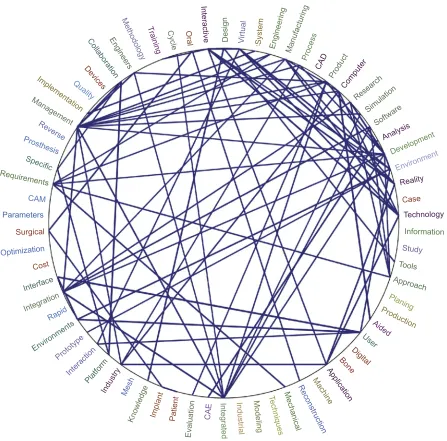
Figure 6
, these papers predominantly use CAx software
tools for product development.
The trend topics are associated with CAx technologies:
data management and quality, product life-cycle
manage-ment, project data managemanage-ment, human-machine interface,
applications of technologies in industries, virtual-physical
prototyping, manufacturing simulation, design education,
and health applications. As shown in
Figure 7
, key issues
were categorized and organized as a network of nodes.
This analysis provides evidence for strong interest in
data integration for the development of digital products
through editable
fi
les and collaborative work platforms
Figure 5Anatomical regions treated with specific-patient devices.
Medical Devices: Evidence and Research downloaded from https://www.dovepress.com/ by 118.70.13.36 on 24-Aug-2020
connected to interfaces, and interpretation of data among
geographically separated researchers. Also of interest was
the realization of complex data simulations, monitoring, and
control of the design and production phases in real time.
71,72These technologies are anticipated to be used in the
virtual prototyping of industrial factories, for virtual
simulation of manufacturing, for training purposes,
teleoperation,
73,74virtual
immersion
from
open
platforms,
75relocation of the productive chain, and
industrial machinery.
76In addition, research is being conducted into efforts to
reduce
computational
requirements,
to
improve
interoperability during FEM validations by multiple work
teams,
77and the use of haptic interfaces during CAD/CAE
activities.
78AM is challenged to manufacture a
fi
nal product, as
well as to establish virtual and physical evaluation
meth-ods that enable the determination of the performance of
manufactured parts.
79Algorithms are being developed to optimize product
design by reducing time and costs,
80to build decision
models for knowledge management, decision making,
and virtual veri
fi
cation in the development of complex
pieces,
81,82to
propose
creative
solutions
between
Case
Technology
Information
Study
Tools
Approach
Production
Planing
Aided
User
Digital Bone Application Machine Reconstruction Mechanical Techniques
Modeling
Industrial
In
te
grated
Reality Analysis
CAE
Evaluation Patient Implant Knowledge Mesh Industry Platform Interaction Prototype Environments
Rapid Integration Interface
Cost Optimization
Surgical
Parameters
CAM Requirements
Specific Prosthesis
Reverse Management
Implementa
tion Quality
Devices
CollaborationEngineers Methodology
T
raining Cycle Oral Interactive
Design Virtual System
Engineering Manufactu ring
Pro cess
CAD
Computer Product
Research Simulation
Software
Development
Environment
Figure 6Relationships between the most frequent words in Tree of Sciencefiles.
Abbreviations:CAD, Computer-aided Design; CAE, Computer-aided Engineering; CAM, Computer-aided Manufacturing.
Medical Devices: Evidence and Research downloaded from https://www.dovepress.com/ by 118.70.13.36 on 24-Aug-2020
interdisciplinary teams,
83and to work collaboratively with
external groups that use different software during product
development.
72In the health sector, the documents indicated trends
towards the use of CAx technologies for external cosmetic
and functional implants of compromised body areas such
as the nose
84and the ears.
85Currently, methods for the direct manufacture of parts for
orthopedic rehabilitation are being de
fi
ned,
86optimizing
work
fl
ows, timelines, and costs for implant development,
39craniosynostosis correction,
87and mandible reconstruction.
88Anthropometric predictive models are being developed
for the estimation of cortical zones for FEM analysis,
89and for dental implants with precise drill guides.
90Strategies have been proposed to control the sources of
error in RE such as imaging
91or by point cloud.
92Collaborative work will be promoted through the
development of open virtual design platforms, as stated
by Castellano-Smith et al
93using the speci
fi
c patient
mod-eling method.
Discussion
Advantages and disadvantages of
technological integration
From the RE + CAD + CAE + RP technologies, other
types of personalized products have been generated,
such
as
pre-operative
devices
adjusted
to
bone
geometry.
34,36,37,40–42,45,50,59,61,66,67,94–96These
research-ers used common practices for product development
such as bone reconstruction software and performing
alignment and healthy bone symmetry operations on
the affected area.
Design requirements were de
fi
ned based on pre-planning
and manufacturing devices with medical grade resin
accep-table for
fi
nal use. PSI models can be created to adjust the
shape, geometry, and topology of the device based on the
patient
’
s needs, following surgical requirements.
39,49,55,64,70Another advantage was the application of CAx tools in
surgical pre-planning, predicting bone
fi
xation and reducing
surgical risk, manufacturing time for PSD, and time for
surgery.
32,44,49,54,57,66,68,71,72,77,102,107Data management
Application
Human safety and failure prevention
Minimize cost/time to market
Accuracy
Cloud network
Remote collaboration
PLM standard
Mandible reconstruction
Craniofacial implant
Leg prosthetic socket
Dental implant
Virtual bone reconstruction
Tibial orthopedic
devices Cosmetic-functional prothesis
Design methodology
CAx experience
Factory simulation Design optimization
Haptic design Virtual reality
for R&D Virtual-physical
prototyping
Packages sustainability Industry 4.0
Engine optimization Natural hazard risk RP
CAM
Chemical simulation Automatization
CAE CAD
Digital workflow
Health
Design education
Manufacturing simulation Human-machine
interface HMI RE
Quality-sustainability
PDM-PLM
Data Management CAx
Application
CAx
Figure 7Coding of trends by networking.
Abbreviations:CAD, Computer-aided Design; CAE, Computer-aided Engineering; CAM, Computer-aided Manufacturing; CAx, Computer-Aided Technologies; HMI, Human Machine interface; PDM, Product Data Management; PLM, Product Life-cycle Management; RE, Reverse Engineering; RP, Rapid Prototyping.
Medical Devices: Evidence and Research downloaded from https://www.dovepress.com/ by 118.70.13.36 on 24-Aug-2020
Implementing virtual technologies has advanced
strate-gies such as participatory development, according to Peel et
al,
39allowing multidisciplinary collaboration between
clin-ical teams (dentists, surgeons, and orthopedists) and
devel-opment teams (technical engineers and designers).
18,65This
type of collaborative work
98has reduced the gap between
user expectations and results and has allowed the
manufac-turing of complex devices.
22,32On the other hand, some disadvantages of technology
integration were also identi
fi
ed. Some authors claim that
the integration of tools for rapid design and manufacture
are economically sustainable,
60,61speci
fi
cally identifying
3D printing as an accessible, accurate, and pro
fi
table
resource.
22,41,60Other authors claim that barriers such as
the high cost of 3D printing
61and increased manufacturing
time will keep the implementation of these technologies
low.
3,10,19,35,60,62,95Problems were also identi
fi
ed related to preoperative
explorations, data transfer, and segmentation, decision
making for PSD fabrication,
39and mistakes in
pre-plan-ning that cause irreversible effects on the patient.
603D
printed models are not yet suitable for some surgical
procedures
involving
soft
tissue
anchors.
22Implementation of intraoperative navigation systems
remains low due to their costs and the level of radiation
exposure for both the patient and the medical team.
18Also,
technical limitations for using specialized software cause
surgeons to be dependent on external technicians.
95Impact on the quality of patient care
PSD as a tool after virtual diagnosis provides greater
treatment precision,
60while 3D printing helps both
physi-cian and patient plan and understand treatment through
simulation.
99Biomodels and PSD are clinically justi
fi
ed
27as they reduce the complexity and improve the precision
of diagnosis.
Alloplastic implants are a powerful tool for developing
PSDs, especially when working with extensive or complex
bone defects. The intraoperative adjustment of plates or
meshes for
fi
xation is minimized due to planning,
facilitat-ing fast and effective treatment of unilateral or bilateral
defects
62and functional and aesthetic restoration.
49Surgeons and designers can also restore mechanical
prop-erties of bone and promote osseointegration,
39providing
greater stability and minimizing patient risk
16due to the
accelerated time for effective treatment.
97Few complications have been reported during the
post-operative period
45following neurosurgery, craniomaxillofacial
surgery, orthopedic surgery, cardiothoracic surgery, and
vascu-lar surgery.
22However, patients are exposed to high doses of
ioniz-ing radiation durioniz-ing imagioniz-ing acquisition
19because of the
use of computed tomography (CT) and cone-beam CT.
These images are used to inform treatment, but the
radia-tion may put a patient
’
s health at risk.
The bene
fi
ts of pre-planning must be weighed against
this risk, and children are particularly susceptible to the
effects of radiation.
61Errors in setting cutting or drilling
guides could also have negative functional and aesthetic
effects on patients.
40Bene
fi
ts of technology for specialists
Patient-speci
fi
c technologies (PSTs) facilitate the
inter-pretation of CT images and reduce uncertainty in
diag-nosis and treatment.
99PSTs also improve fracture
characterization and inform the surgical approach, from
de
fi
ning a preoperative plan to producing a
fi
nal
PSD.
21,35,37,40,41,43,45,46,48,56,57,65,66,70,95,99Surgical time is reduced because the time spent on
repetitive plate
fi
xation adjustments is eliminated or
decreased.
2,22,38,39,43–45,49,54,57,60,68The
use
of
PSTs
allows less experienced surgeons to acquire practical skills
safely with less training time.
56PSDs are useful in complex and dif
fi
cult cases,
36or in
cases with a high risk of complications and unfavorable
sequelae for the patient.
38,44,45,64Digital and physical
resources can improve data visualization during surgery,
58and surgical pre-planning expands the utility of
intraopera-tive navigation devices.
37,48Although some experienced surgeons prefer manual
techniques for conventional surgical pre-planning, this
can result in clinical failures
60or poor margin resection.
40In these cases, surgeons may rely more on their own
technical skills than on technologies because the
technol-ogies are outside their
fi
eld of expertise.
56Increasing the
adoption of PSDs depends on specialist criteria
39,48and
the availability of technology.
10Regarding the quality of the product, important factors
included the simplicity of piece positioning, the ease of
alignment, surgical guide safety to improve cutting
accu-racy, and continuous and symmetrical bone restoration
results.
34The accuracy of position, inclination, and depth of
fi
xation holes and osteotomies compare favorably with
those achieved using conventional techniques, reducing
collateral damage to nerves and adjacent organs.
Medical Devices: Evidence and Research downloaded from https://www.dovepress.com/ by 118.70.13.36 on 24-Aug-2020
The impact on cost-effectiveness for the
health system
Various authors stated that certainty in the surgical
proce-dure would reduce the cost and time of treatment,
decreas-ing the risks of infections or adverse outcomes.
2,34,45Decreased surgery time would improve the quality of
the
intervention
and
make
the
procedure
more
pro
fi
table.
37,39,41,48The need for specialized software and hardware to support
PSD development requires additional personnel with technical
skills in design and product development.
37Because these
tools require high
fi
nancial investment for a health care
institu-tion, their availability in hospital units is limited and they are
more commonly found in laboratories and universities.
39The consulted papers rarely analyzed the cost-bene
fi
t
of these technologies. While the decreased time and cost
was mentioned in most of the documents, few compared
these technologies with conventional techniques. This type
of information is essential to determine whether the use of
these techniques can become the standard of care during
treatment requiring complex surgery.
37Reconstruction planning software and RP technologies
are crucial for the design and development of PSDs such
as PSIs, guides, and biomodels. Still, this software and
technology
is
relatively
expensive,
laborious,
and
multidisciplinary, requiring investment in infrastructure,
regulatory compliance, training, and planning time.
39Marketing challenges
CAx in the surgical
fi
eld can help specialists plan and
per-form safe, reliable, and precise surgical procedures,
10,41,56but the medical sector must diversify its value proposition
through the development of new products, services, and
processes.
57Enabling development units based on PSTs in
remote health facilities could create new business models,
decrease
technological
dependence,
35,41and
decrease
response and delivery times.
37Adapting 3D printing for rapid response times and
integrating it into standard care protocols could create a
new paradigm in surgical planning,
10,22,38,41guaranteeing
multidisciplinary collaboration between engineering and
clinical specialties.
37,39Universal implementation of 3D printing depends on
the advancement of the technology, availability of
free-ware resources, and familiarity of surgeons, designers, and
engineers with the technique.
56However, anticipating the
demand or number of cases that could use this technique
over a certain time period is a complex task.
3Despite the
recognized time savings and accuracy, there is still a lack
of pedagogy to enable PST as a standardized approach.
39Requirements
Tasks
Technologies Reverse engineering (RE) - (BIOCAD)
Computer aided design (CAD)
Computer aided Engineering (CAE)
Computer aided manufacturing (CAM) or rapid prototyping (RP)
Processes
Start
To get and to deliver the patient’s CT
To undestand surgeon requirements for cost,
time and quality
To validate static behavior for virtual
device To select available resources
To build and to post-process the
products
To deliver and to validate the device
To sterilizate and to use on surgery
End
Fabrication process Design process Validation process
To select a material and a manufacturing
process
To validate the detailed design To work among
shakeholders for surgical pre-planning.
To design concepts for a surgical guide or an implant according to
requirements Geometric assest for
shape alternatives Material selection
Predictable behavior between bone structure
and device
To reconstruct the virtual bone tissue
To fix and to align the virtual surface
To segment the region of interest into
a virtual biomodel
Figure 8Requirements for design and development of specific medical devices.
Abbreviations:BIOCAD, Biological Computer Aided Design; CT, Computed tomography.
Medical Devices: Evidence and Research downloaded from https://www.dovepress.com/ by 118.70.13.36 on 24-Aug-2020
A consensus in the
fi
eld of PSTs
Of the analyzed studies, 80% used imaging or RE
techniques.
2,3,5,10–13,18,20,21,23,24,30,33–35,39,41,44,45,48,49,51–53,55,56,58,62–64,66–70,94,95,99,100
Fewer articles were identi
fi
ed
that used methods to obtain virtual models, measurement
references, or de
fi
nition of contours by 3D sketching.
12,49CAD tools were used in 50% of the consulted studies,
while only 38% of these studies carried out validations
through CAE simulations. The physical prototypes used
for diagnosis allow proposed solutions to be visualized and
were analyzed in each case study.
In the design phase, iterative veri
fi
cation
58was
per-formed to understand deviations between surgical
pre-planning and the
fi
nal results.
52,96,101The cases analyzed included implant prototypes
devel-oped with
fi
nal materials such as titanium casting,
101poly-methylmethacrylate
casting,
46computer
numerical
controlled machining of titanium alloy Ti6Al4V,
13Ti
pow-der sintering using AM,
1and RP of
polyether-ether-ketone.
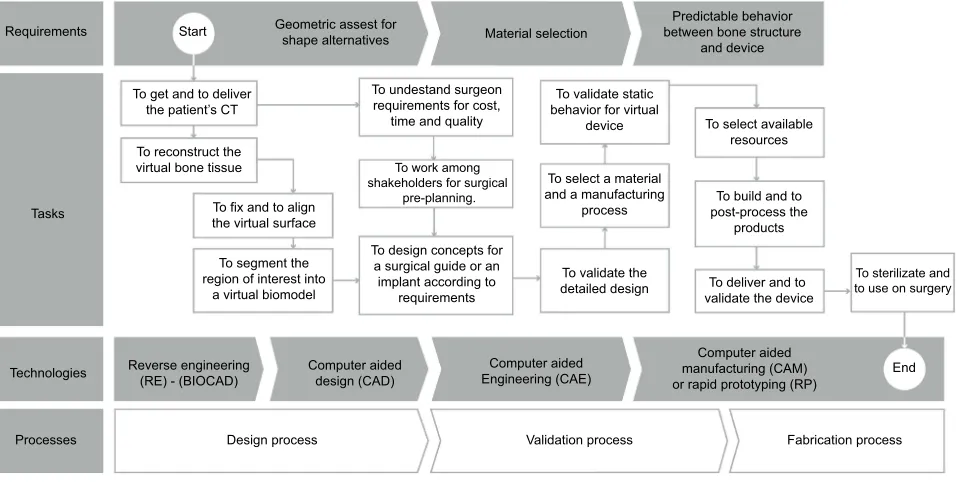
39This analysis identi
fi
ed three basic requirements for the
design, evaluation, and prototyping of customized medical
devices. A conceptual map of the integration of
technolo-gies was outlined from the requirements and the possible
design process and is shown in
Figure 8
.
Conclusion
The systematic literature review allowed us to
under-stand
the
different
technological
integrations
that
researchers have adopted in the design and development
of PSDs such as biomodels, surgical guides, and
implants.
In 70 documents, 93 clinical case studies were
identi-fi
ed that used interoperable technologies, including RE,
CAD, evaluation by FEM simulation, CAE, and RP by
AM, SM, or CAM. The analysis showed a relationship
between the scope and complexity of the process, the
number of stages in the process, and the integration of
technologies de
fi
ned during the process of new product
development. The analyzed case studies used technical,
scienti
fi
c, and multidisciplinary strategies to achieve their
proposed objectives.
Although there were 26 possible combinations of
inte-gration models, only 8 were identi
fi
ed in the literature. The
most frequent was the BIOCAD + CAD + RP model
which was used in 38.6% of cases, followed by the
BIOCAD + CAD + CAE + RP model which was used in
21.4% of cases. This is evidence for the disuse of CAM
tools for the manufacture of
fi
nal devices, replaced in part
by AM.
Although the trends indicated increased attention being
paid to technologies for process management for data
generated during collaborative work, different barriers
remain for the incorporation of these technologies in
pro-duct development related to the cost of resources. It is
expected that the bene
fi
ts of integrated technologies in the
health sector will exceed their limitations and that these
technologies will become common practice in the
treat-ment of complex pathologies.
Abbreviations list
AM,
Additive
Manufacturing;
BIOCAD,
Biological
Computer
Aided
Design;
CAx,
Computer-Aided
Technologies;
CAD,
Computer-Aided
Design;
CAE,
Computer-Aided
Engineering;
CAM,
Computer-Aided
Manufacturing; CT, Computed tomography; FEM, Finite
Element Method; HMI, Human Machine interface; PDM,
Product Data Management; PLM, Product Life-cycle
Management; PSI, Patient-Speci
fi
c Implant; PSD,
Patient-Speci
fi
c Devices; PST, Patient-Speci
fi
c Technologies; RE,
Reverse
Engineering;
RP,
Rapid
Prototyping;
SM,
Subtractive Manufacturing; ToS, Tree of Science.
Acknowledgments
The authors wish to express their gratitude to the following
research groups: IINTERFAZ for the industrial design
school,
GRICES
(Research
Group
in
Surgery
and
Specialties) for the medical school, and INNOTEC
(Research
Group
on
Technological
Innovation
and
Knowledge Management), which supports the doctoral
pro-gram in the electrical engineering, electronics, and
telecom-munications school. Also, our extended thanks to the VIE
2353 project (Vice-provost for Research and Extension),
COLCIENCIAS (Administrative Department of Science,
Technology, and Innovation), Universidad Industrial de
Santander, and the Santander Government. Funding sources
were collected from the Inner Project at Universidad
Industrial de Santander and the Administrative Department
of Science, Technology and Innovation, COLCIENCIAS.
Author contributions
All authors contributed towards data analysis, drafting and
critically revising the paper, gave
fi
nal approval of the
version to be published, and agreed to be accountable for
all aspects of the work.
Medical Devices: Evidence and Research downloaded from https://www.dovepress.com/ by 118.70.13.36 on 24-Aug-2020
Disclosure
The authors report no con
fl
icts of interest in the present work.
References
1. Kang H, Long J-P, Urbiel Goldner G-D, Goldstein S-A, Hollister S-J. A paradigm for the development and evaluation of novel implant
topologies for bone fixation: implant design and fabrication. J
Biomech. 2012;45(13):2241–2247. doi:10.1016/j. jbiomech.2012.06.011
2. Moiduddin K, Darwish S, Al-Ahmari A, ElWatidy S, Mohammad A, Ameen W. Structural and mechanical characterization of custom design cranial implant created using additive manufacturing.
Electron J Biotechnol. 2017;29:22–31. doi:10.1016/j. ejbt.2017.06.005
3. Thor A, Palmquist A, Hirsch J-M, Rännar L-E, Dérand P, Omar O. Clinical, morphological, and molecular evaluations of bone
regen-eration with an additive manufactured osteosynthesis plate. J
Craniofac Surg. 2016;27(7):1899–1904. doi:10.1097/ SCS.0000000000002939
4. Balogh Z-J, Reumann M-K, Gruen R-L, et al. Advances and future directions for management of trauma patients with musculoskeletal injuries. Lancet. 2012;380(9847):1109–1119. doi:10.1016/S0140-6736(12)60991-X
5. Bruns J, Habermann C-R, Rüther W, Delling D. The use of CT derived solid modelling of the pelvis in planning cancer resections.
Eur J Surg Oncol. 2010;36(6):594–598. doi:10.1016/j.ejso.2009. 11.005
6. Robiony M, Salvo I, Costa F, et al. Accuracy of virtual reality and
stereolithographic models in maxillo-facial surgical planning. J
Craniofac Surg. 2008;19(2):482–489. doi:10.1097/SCS.0b013e3 1814fb5c1
7. Senalp A-Z, Kayabasi O, Kurtaran H. Static, dynamic and fatigue behavior of newly designed stem shapes for hip prosthesis using finite element analysis. Mater Des. 2007;28(5):1577–1583. doi:10.1016/j.matdes.2006.02.015
8. Rama-Murthy S, Mani M. Design for sustainability: the role of CAD. Renew Sustain Energy Rev. 2012;16(6):4247–4256. doi:10.1016/j.rser.2012.03.009
9. Gujarathi G-P, Ma Y-S. Parametric CAD/CAE integration using a
common data model. J Manuf Syst. 2011;30(3):118–132.
doi:10.1016/j.jmsy.2011.01.002
10. Bagaria V, Deshpande S, Rasalkar -D-D, Kuthe A, Paunipagar B-K. Use of rapid prototyping and three-dimensional reconstruction
modeling in the management of complex fractures.Eur J Radiol.
2011;80(3):814–820. doi:10.1016/j.ejrad.2010.10.007
11. Parthasarathy J, Starly B, Raman S. A design for the additive manufacture of functionally graded porous structures with tailored
mechanical properties for biomedical applications. J Manuf
Process.2011;13(2):160–170. doi:10.1016/j.jmapro.2011.01.004 12. Griza S, Kwietniewski C, Tarnowski G-A, et al. Fatigue failure
analysis of a specific total hip prosthesis stem design.Int J Fatigue. 2008;30:1325–1332. doi:10.1016/j.ijfatigue.2007.11.005
13. Ojeda CJ, Carlín J, Saavedra P, Moscol G, Almeida J. Diseño, Análisis por Ct y construcción por CAD/CAM de endoprótesis femoral personalizada: caso de una paciente con subluxacion congénia. 8 °Congreso Iberoamericano de Ingeniería Mecánica;
2007; Cusco. doi:10.1094/PDIS-91-4-0467B
14. Thompson R-G. Anatomics 3d-printed Titanium Implants from
Head to Heel. Cambridge: Woodhead Publishing; 2018.
doi:10.1016/b978-0-12-812456-7.00010-x
15. Faegh S, Müftü S. Load transfer along the bone-dental implant
interface. J Biomech. 2010;43(9):1761–1770. doi:10.1016/j.
jbiomech.2010.02.017
16. Ammar -H-H, Ngan P, Crout R-J, Mucino V-H, Mukdadi O-M.
Three-dimensional modeling andfinite element analysis in
treat-ment planning for orthodontic tooth movetreat-ment. Am J Orthod
Dentofac Orthop. 2004;139(1):e59–e71. doi:10.1016/j. ajodo.2010.09.020
17. Perestrelo P, Bártolo P, Torres M-P, Noritomi P, Silva J. Human
cranium biomechanical simulation. High Value Manufacturing:
Advanced Research in Virtual and Rapid Prototyping;2013:531– 536.
18. Mircheski I, Gradišar M. 3Dfinite element analysis of porous
Ti-based alloy prostheses. Comput Methods Biomech
Biomed Engin. 2016;19(14):1531–1540. doi:10.1080/ 10255842.2016.1167881
19. Thevenot J, Koivumäki J, Kuhn V, Eckstein F, Jämsä T. A novel
methodology for generating 3Dfinite element models of the hip
from 2D radiographs. J Biomech. 2014;47(2):438–444.
doi:10.1016/j.jbiomech.2013.11.004
20. Borghi A, Rodgers Ã, Schievano Ã, et al. Proof of concept study for the design, manufacturing, and testing of a patient-specific shape memory device for treatment of unicoronal craniosynostosis.
J Craniofac Surg. 2017;00(00):1–4. doi:10.1097/ SCS.0000000000004025
21. Malyala S-K, Alwala A-M. A 3D printed osseointegrated combined
jaw and dental implant prosthesis—a case study.Rapid Prototyp
J.2016;23(6):1164–1169.
22. Provaggi E, Leong -J-J-H, Kalaskar D-M. Applications of 3D
printing in the management of severe spinal conditions.2 Proc
IMechE Part H: J Engineering in Medicine.2017;231: 471–486. doi:10.1177/0954411916667761
23. Doerfler H-M, Huempfner-hierl H, Kruber D, Schulze P, Hierl T.
Template-based orbital wall fracture treatment using statistical
shape analysis. J Oral Maxillofac Surg. 2017;75(7):1475.e1–
1475.e8. doi:10.1016/j.joms.2017.03.048
24. Iqbal T, Shi L, Wang L, et al. Development offinite element model for customized prostheses design for patient with pelvic bone
tumor. Proc IMechE Part H: J Engineering in Medicine.
2017;231:525–533. doi:10.1177/0954411917692009
25. Yosibash Z, Katz A, Milgrom C. Toward verified and validated
FE simulations of a femur with a cemented hip prosthesis.Med
Eng Phys. 2013;35(7):978–987. doi:10.1016/j.medengphy.2012. 09.007
26. El Halabi F, Rodriguez JF, Rebolledo L, Hurtós E, Doblaré M. Mechanical characterization and numerical simulation of
polyether-ether-ketone (PEEK) cranial implants. J Mech Behav Biomed
Mater.2011;4(8):1819–1832. doi:10.1016/j.jmbbm.2011.05.039 27. Jun Y, Choi K. Design of patient-specific hip implants based on the
3D geometry of the human femur.Adv Eng Softw.2010;41(4):537– 547. doi:10.1016/j.advengsoft.2009.10.016
28. Dhakshyani R, Nukman Y, Azuan A-O-N. FDM models and FEA
in dysplastic hip. Rapid Prototyp J. 2012;18(3):215–221.
doi:10.1108/13552541211218144
29. Kluess D, Souffrant R, Mittelmeier W, Wree A, Schmitz K-P,
Bader R. A convenient approach for finite-element-analyses of
orthopaedic implants in bone contact: modeling and experimental validation.Comput Methods Programs Biomed.2009;95(1):23–30. doi:10.1016/j.cmpb.2009.01.004
30. Isaza J-F. Prototipaje rápido de estructuras craneofaciales.Ing Y Cienc.2008;4(8):27–43.
31. Harrysson O-L-A, Cansizoglu O, Marcellin-Little J, Cormier D-R, West H-A. Direct metal fabrication of titanium implants with tailored materials and mechanical properties using electron beam
melting technology. Mater Sci Eng C. 2008;28(3):366–373.
doi:10.1016/j.msec.2007.04.022
32. Sun W, Starly B, Nam J, Darling A. Bio-CAD modeling and its
applications in computer-aided tissue engineering. Comput Des.
2005;37(11):1097–1114. doi:10.1016/j.cad.2005.02.002
Medical Devices: Evidence and Research downloaded from https://www.dovepress.com/ by 118.70.13.36 on 24-Aug-2020
33. Hosni Y-A. Contribution of CAD-CAM and reverse engineering tech-nology to the biomedicalfield. In:Current Advances in Mechanical Design and Production VII. Cairo: Pergamon;2000:491–499. 34. Azimifar F, Hassani K, Saveh A-H, Tabatabai-Ghomshe F. A low
invasiveness patient’s specific template for spine surgery. Proc IMechE Part H J Eng Med.2017;231(2):143–148. doi:10.1177/ 0954411916682770
35. Msallem B, Jaquiéry C, Thieringer F, Jaquiéry C, Thieringer F. Craniofacial reconstruction by a cost-efficient template-based
pro-cess using 3D printing.Plast Reconstr Surg Glob Open.2017;5
(11):1–5. doi:10.1097/GOX.0000000000001582
36. Schweizer A, Mauler F, Vlachopoulos L, Nagy L, Fürnstahl P. Computer-assisted 3-dimensional reconstructions of scaphoid frac-tures and nonunions with and without the use of patient-specific guides: early clinical outcomes and postoperative assessments of
reconstruction accuracy. J Hand Surg Am. 2016;41(1):59–69.
doi:10.1016/j.jhsa.2015.10.009
37. Kalamaras M, McEniery P, Thorn K, Bindra R. Rapid prototyping and 3D modeling of osteotomy jigs and drill guides in hand and
wrist surgery. Tech Orthop. 2016;31(3):164–171. doi:10.1097/
BTO.0000000000000185
38. Singhal A-J, Shetty V, Bhagavan K-R, et al. Improved surgery planning using 3-D printing: a case study.Indian J Surg.2016;78
(April):100–104. doi:10.1007/s12262-015-1326-4
39. Peel S, Bhatia S, Eggbeer D, Morris D-S, Hayhurst C. Evolution of design considerations in complex craniofacial reconstruction using
patient-specific implants.Proc IMechE Part H: J Engineering in
Medicine.2017;231:509–524. doi:10.1177/0954411916681346 40. Weijs W-L-J, Coppen C, Schreurs R, et al. Accuracy of virtually
3D planned resection templates in mandibular reconstruction. J
Craniomaxillofac Surg. 2016;44(11):1828–1832. doi:10.1016/j. jcms.2016.08.024
41. Cartiaux O, Paul L, Francq B, Banse X, Docquier P-L. Improved accuracy with 3D planning and patient-specific instruments during
simulated pelvic bone tumor surgery.Ann Biomed Eng.2014;42
(1):205–213. doi:10.1007/s10439-013-0890-7
42. Ma T, Xu Y-Q, Cheng Y-B, et al. A novel computer-assisted drill guide template for thoracic pedicle screw placement: A cadaveric study.Arch Orthop Trauma Surg.2012;132(1):65–72. doi:10.1007/ s00402-011-1383-5
43. Wang G, Li J, Khadka A, Hsu Y, Li W, Hu J. CAD/CAM and rapid prototyped titanium for reconstruction of ramus defect and
condy-lar fracture caused by mandibucondy-lar reduction.Oral Surg Oral Med
Oral Pathol Oral Radiol. 2012;113(3):356–361. doi:10.1016/j. tripleo.2011.03.034
44. Rotaru H, Stan H, Florian IS, et al. Cranioplasty with custom-made
implants: analyzing the cases of 10 patients. J Oral Maxillofac
Surg.2012;70(2):e169–e176. doi:10.1016/j.joms.2011.09.036 45. Mazzoni S, Marchetti C, Sgarzani R, Cipriani R, Scotti R, Ciocca
L. Prosthetically guided maxillofacial surgery: evaluation of the accuracy of a surgical guide and custom-made bone plate in
oncology patients after mandibular reconstruction. Plast
Reconstr Surg. 2013;131(6):1376–1385. doi:10.1097/PRS.0b01 3e31828bd6b0
46. Soler R, Moreno J-L, Cabrera C. Implante craneano individual de gran volumen en polimetilmetacrilato de metilo a partir de un
prototipo rápido. Reporte de un caso. Odontoestomatologia.
2011;13(17):26–36.
47. Mustafa SF, Evans PL, Bocca A, Patton DW, Sugar AW, Baxter PW. Customized titanium reconstruction of post-traumatic orbital
wall defects: a review of 22 cases. Int J Oral Maxillofac Surg.
2011;40(12):1357–1362. doi:10.1016/j.ijom.2011.04.020 48. Zhang Y-Z, Lu S, Yang Y, Xu Y-Q, Li Y-B, Pei G-X. Design and
primary application of computer-assisted, patient-specific navigational templates in metal-on-metal hip resurfacing arthroplasty.J Arthroplasty. 2011;26(7):1083–1087. doi:10.1016/j.arth.2010.08.004
49. Casallo C-A, Tantas G, Pineda R-A. Craneoplastía con implante de
polieteretercetona diseñado por computadora. Acta Med Per.
2010;27(3):193–195.
50. Kunz M, Rudan JF, Xenoyannis GL, Ellis RE. Computer-assisted hip resurfacing using individualized drill templates.J Arthroplasty. 2010;25(4):600–606. doi:10.1016/j.arth.2009.03.023
51. White D, Chelule K-L, Seedhom B-B. Accuracy of MRI vs CT imaging with particular reference to patient specific templates for
total knee replacement surgery.Int J Med Robot Comput Assist
Surg.2008;4(August):224–231. doi:10.1002/rcs
52. Dai K-R, Yan M-N, Zhu Z-A, Sun Y-H. Computer-aided
custom-made hemipelvic prosthesis used in extensive pelvic lesions. J
Arthroplasty.2007;22(7):981–986. doi:10.1016/j.arth.2007.05.002 53. Gibson I, Cheung LK, Chow SP, et al. The use of rapid prototyping
to assist medical applications.Rapid Prototyping Journal. 2006;12
(1):53–58. doi:10.1108/13552540610637273.
54. Heissler E, Fischer F, Lehmann S-B-T, et al. Custom-made cast titanium implants produced with CAD/CAM for the reconstruction of cranium defects.Int J Oral Maxillofac Surg.1998;27(5):334– 338.
55. Owen B-D, Christensen G-E, Reinhardt J-M, Ryken TC. Rapid prototype patient-specific drill template for cervical pedicle screw placement.Comput Aided Surg.2007;12(5):303–308. doi:10.3109/ 10929080701662826
56. Hu Y, Li H, Qiao G, Liu H, Ji A, Ye F. Computer-assisted virtual surgical procedure for acetabular fractures based on real CT data.
Injury.2011;42(10):1121–1124. doi:10.1016/j.injury.2011.01.014 57. Défossez H-J-P, Serhan H. Managing design excellence tools
dur-ing the development of new orthopaedic implants.J Biomech Eng.
2014;135(November 2013):114506–1/11. doi:10.1115/1.4025323
58. Werner A, Lechniak Z, Skalski K, Ke K. Design and manufacture
of anatomical hip joint endoprostheses using CAD/CAM systems.J
Mater Process Technol. 2000;107:181–186. doi:10.1016/S0924-0136(00)00682-8
59. Bauer A-S, Storelli D-A-R, Sibbel S-E, Mccarroll H-R, Lattanza -L-L. Preoperative computer simulation and patient-specific guides are safe and effective to correct forearm deformity in children.J Pediatr Orthop. 2017;37(7):504–510. doi:10.1097/BPO.0000000 000000673
60. Chul Y, Shik W, Park T, Woo J, Koh K-S, Suk T. The accuracy of patient specific implant prebented with 3D-printed rapid prototype
model for orbital wall reconstruction. J Craniomaxillofac Surg.
2017;45(6):928–936. doi:10.1016/j.jcms.2017.03.010
61. Barone S, Paoli A, Razionale A-V, Savignano R. Computer-aided modelling to simulate the biomechanical behaviour of customised
orthodontic removable appliances. Int J Interact Des Manuf.
2016;10(4):387–400. doi:10.1007/s12008-014-0246-z
62. Rudman K, Hoekzema C, Rhee J. Computer-assisted innovations in
craniofacial surgery. Facial Plast Surg. 2011;27(4):358–365.
doi:10.1055/s-0031-1283054
63. Kozakiewicz M, Elgalal M, Walkowiak B, Stefanczyk L. Technical concept of patient-specific, ultrahigh molecular weight
polyethy-lene orbital wall implant. J Craniomaxillofac Surg. 2013;41
(4):282–290. doi:10.1016/j.jcms.2012.10.007
64. Salmi M, Tuomi J, Paloheimo K-S, et al. Patient-specific
recon-struction with 3D modeling and DMLS additive manufacturing.
Rapid Prototyp J.2012;18(3):209–214. doi:10.1108/13552541211 218126
65. Rohner D, Guijarro-Martínez R, Bucher P, Hammer B. Importance of patient-specific intraoperative guides in complex maxillofacial
reconstruction. J Craniomaxillofac Surg. 2013;41(5):382–390.
doi:10.1016/j.jcms.2012.10.021
66. Kraeima J, Jansma J, Schepers R-H. Splintless surgery: does
patient-specific CAD-CAM osteosynthesis improve accuracy of
Le Fort I osteotomy? Br J Oral Maxillofac Surg. 2016;54
(10):1085–1089. doi:10.1016/j.bjoms.2016.07.007
Medical Devices: Evidence and Research downloaded from https://www.dovepress.com/ by 118.70.13.36 on 24-Aug-2020
67. Suojanen J, Leikola J, Stoor P. The use of patient-specific implants in orthognathic surgery: A series of 32 maxillary osteotomy
patients. J Craniomaxillofac Surg. 2016;44(12):1913–1916.
doi:10.1016/j.jcms.2016.09.008
68. Probst F-A, Metzger M, Ehrenfeld M, Cornelius C-P. Computer-assisted designed and manufactured procedures facilitate the lingual application of mandible reconstruction plates.J Oral Maxillofac Surg. 2016;74(9):1879–1895. doi:10.1016/j.joms.2016.03.015
69. Maini L, Sharma A, Jha S, Tiwari A. Three-dimensional printing
and patient-specific pre-contoured plate : future of acetabulum
fracture fixation? Eur J Trauma Emerg Surg. 2018;44:215–224.
doi:10.1007/s00068-016-0738-6
70. Rashid -M-M, Husain K-N. Geometrical model creation methods
for human humerus bone and modified cloverleaf plate.J Sci Ind
Res.2017;76(October):631–639.
71. Choi S, Jung K, Noh S-D. Virtual reality applications in manufac-turing industries: past research, presentfindings, and future
direc-tions. Concurr Eng Res Appl. 2015;23(1):40–63. doi:10.1177/
1063293X14568814
72. Jonovic V-M, Ma L, Guerra-Zubiaga D-A, Tomovic -M-M. Early problems identification in collaborative engineering with different
product data modelling standards. Int J Comput Integr Manuf.
2015;28(11):1155–1166. doi:10.1080/0951192X.2014.961961
73. Bourne D, Corney J, Gupta S-K. Recent advances and future
challenges in automated manufacturing planning. J Comput Inf
Sci Eng.2011;11(2):021006. doi:10.1115/1.3593411
74. Vergnano A, Berselli G, Pellicciari M. Interactive simulation-based-training tools for manufacturing systems operators: an indus-trial case study. Int J Interact Des Manuf. 2017;11(4):785–797. doi:10.1007/s12008-016-0367-7
75. Calvo I, López F, Zulueta E, González-Nalda P. Towards a meth-odology to build virtual reality manufacturing systems based on free open software technologies.Int J Interact Des Manuf.2017;11
(3):569–580. doi:10.1007/s12008-016-0311-x
76. Lindskog E, Vallhagen J, Johansson B. Production system redesign using realistic visualisation.Int J Prod Res.2017;55(3):858–869. doi:10.1080/00207543.2016.1218085
77. Song I-H, Yang J, Jo H, Choi S. Development of a lightweight
CAE middleware for CAE data exchange. Int J Comput Integr
Manuf.2009;22(9):823–835. doi:10.1080/09511920902866088 78. Talaba D, Antonya C. Virtual prototyping of mechanical systems
with tool mediated haptic feedback.Eng Comput.2012;30(4):569– 582. doi:10.1007/s00366-012-0301-y
79. Vaughan M-R, Crawford R-H. Effectiveness of virtual models in design for additive manufacturing: A laser sintering case study.Rapid Prototyp J.2013;19(1):11–19. doi:10.1108/13552541311292682
80. Cui D, Feng G, Zhou P, Zhang Y. Parametric design-based multi-objective optimisation for high-pressure turbine disc.Int J Prod Res.
2017;55(17):4847–4861. doi:10.1080/00207543.2016.1259669
81. Durupt A, Remy S, Ducellier G. Knowledge-based reverse engi-neering—an approach for reverse engineering of a mechanical part.
J Comput Inf Sci Eng.2010;10(4):044501. doi:10.1115/1.3482059 82. Mejía-Gutiérrez R, Carvajal-Arango R. Design verification through
virtual prototyping techniques based on systems engineering.Res
Eng Des.2017;28(4):477–494. doi:10.1007/s00163-016-0247-y 83. Chulvi V, Mulet E, Felip F, García-García C. The effect of information
and communication technologies on creativity in collaborative design.
Res Eng Des.2017;28(1):7–23. doi:10.1007/s00163-016-0227-2 84. Ciocca L, Fantini M, Crescenzio F, Persiani F, Scotti R. New
protocol for construction of eyeglasses-supported provisional
nasal prosthesis using CAD/CAM techniques.J Rehabil Res Dev.
2010;47(7):595. doi:10.1682/jrrd.2009.11.0189
85. De-Crescenzio F, Fantini M, Ciocca L, Persiani F, Scotti R. Design and manufacturing of ear prosthesis by means of rapid prototyping
technology. Proc IMechE Vol. 225 Part H: J. Engineering in
Medicine.2011;225:296–302. doi:10.1243/09544119JEIM856
86. Cronskär M, Rännar L-E, Bäckström M. Implementation of digital design and solid free-form fabrication for customization of implants in trauma orthopaedics.J Med Biol Eng.2012;32(2):91– 96. doi:10.5405/jmbe.883
87. Seruya M, Borsuk D-E, Khalifian S, Carson B-S, Dalesio N-M,
Dorafshar A-H. Computer-aided design and manufacturing in cra-niosynostosis surgery. J Craniofac Surg. 2013;24(4):1100–1105. doi:10.1097/SCS.0b013e31828b7021
88. Zhou L-B, Shang H-T, He L-S, et al. Accurate reconstruction of discontinuous mandible using a reverse engineering/computer-aided design/rapid prototyping technique: A preliminary clinical
study. J Oral Maxillofac Surg. 2010;68(9):2115–2121. doi:10.
1016/j.joms.2009.09.033
89. Davis M-L, Vavalle N-A, Stitzel J-D, Gayzik F-S. A technique for developing CAD geometry of long bones using clinical CT data.Med Eng Phys. 2015;37(11):1116–1123. doi:10.1016/j.medengphy.2015. 08.014
90. Dawood A, Purkayastha S, Patel S, Mackillop F, Tanner S. Microtechnologies in implant and restorative dentistry: A stroll through a digital dental landscape.Proceedings of the Institution of Mechanical Engineers, Part H: Journal of Engineering in Medicine. 2010;224:789–796. doi:10.1243/09544119JEIM660
91. Martorelli M, Ausiello P, Morrone R. A new method to assess the accuracy of a cone beam computed tomography scanner by using a
non-contact reverse engineering technique. J Dent. 2014;42
(4):460–465. doi:10.1016/j.jdent.2013.12.018
92. Pathak V-K, Nayak C, Singh A-K, Chaudhary H. A virtual reverse engineering methodology for accuracy control of transtibial
pros-thetic socket. Biomed Eng Appl Basis Commun. 2016;28
(5):1650037–1/9. doi:10.4015/s101623721650037x
93. Castellano-Smith A-D, Hartkens T, Schnabel J, et al. Constructing patient-specific models for correcting intraoperative brain deforma-tion.Lect Notes Comput Sci.2001;2208:1091–1098. doi:10.1007/3-540-45468-3_130
94. Merc M, Drstvensek I, Vogrin M, Brajlih T, Recnik G. A multi-level rapid prototyping drill guide template reduces the perforation risk of pedicle screw placement in the lumbar and sacral spine.
Arch Orthop Trauma Surg. 2013;133(7):893–899. doi:10.1007/ s00402-013-1755-0
95. Du H, Tian -X-X, Li T, et al. Use of patient-specific templates
in hip resurfacing arthroplasty: experience from sixteen cases.
Int Orthop. 2013;37(5):777–782. doi:10.1007/s00264-013-1842-4
96. Oka K, Murase T, Moritomo H, Yoshikawa H. Corrective osteot-omy for malunited both bones fractures of the forearm with radial head dislocations using a custom-made surgical guide: two case reports. J Shoulder Elb Surg. 2012;21(10):e1–e8. doi:10.1016/j. jse.2012.05.035
97. Moiduddin K, Anwar S, Ahmed N, Ashfaq M, Al-ahmari A. Computer assisted design and analysis of customized porous plate
for mandibular reconstruction. IRBM. 2017;38(2):78–89.
doi:10.1016/j.irbm.2017.01.003
98. Romero A, Álvarez M, Guevera Galindo O. Biomodelacion para-metrizada como solucion a los problemas de fracturas atipicas y malformaciones óseas en cadera [Biomodeling parameterized as a solution to problems of atopic fractures and bone malformations in the hip]. Presented at the 8 vo Congreso Iberoamericano de
Ingeniería Mecánica; Cusco, Peru; October 25, 2007.
doi:10.1094/PDIS-91-4-0467B. Available from: http://congreso. pucp.edu.pe/cibim8/pdf/03/03-07.pdf. Accessed July 30, 2019. Spanish.
99. Starosolski Z-A, Kan J-H, Rosenfeld S-D, Krishnamurthy R, Annapragada A. Application of 3-D printing (rapid prototyping) for creating physical models of pediatric orthopedic disorders.
Pediatr Radiol. 2014;44(2):216–221. doi:10.1007/s00247-013-2788-9
Medical Devices: Evidence and Research downloaded from https://www.dovepress.com/ by 118.70.13.36 on 24-Aug-2020
100. Kluess D, Zietz C, Hauck S, Bader R, Schmitz K-P, Mittelmeier W. Modularity of a new cementless acetabular revision cup system based on research of the anatomic variability of the pelvis.Biomed Tech (Berl).2010;55(4):229–235. doi:10.1515/BMT.2010.033 101. Singare S, Dichen L, Bingheng L, Yanpu L, Zhenyu G, Yaxiong L.
Design and fabrication of custom mandible titanium tray based on
rapid prototyping. Med Eng Phys. 2004;26(8):671–676.
doi:10.1016/j.medengphy.2004.06.001
102. Isaza JF, Correa S. Metodología para la reconstrucción 3D de estructuras craneofaciales y su utilización en el método de elemen-tosfinitos.Ing Y Cienc.2008;4(7):129–149.
103. Meline T. Selecting studies for systematic review: inclusion and
exclusion criteria. Contemp Issues Commun Sci Disord.
2006;33:21–27.
Medical Devices: Evidence and Research downloaded from https://www.dovepress.com/ by 118.70.13.36 on 24-Aug-2020
T
able
S1
Case
studies
categorized
by
Patient-speci
fi
c
T
echnology
(PST),
Patient-speci
fi
c
de
vice
(PSD),
and
anatomical
zone
PST integration Main author Y ear of publication PSD Number of cases — Anatomical Zone Biomodel Simulation using a biomodel Vir tual Surgical Pre planning Simulation b y fi nite element method (FEM) P atient-speci fi c implant (PSI) Surgical or drilling guide C AD+C AE Senalp 1 2007 1 1 1-F emur Bar one 2 2016 1 1-Maxillofacial BIOC AD+RP Bruns 3 2010 1 1-P elvis Chul 4 2017 1 1 1-Orbital BIOC AD +C AD Ow en 5 2007 1 1 1-Spine Hu 6 2011 1 1-F emur Défossez 7 2014 1 1 1-Spine W erner 8 2000 1 1-F emur Bauer 9 2017 1 1 1-Hand-foot BIOC AD +C AD+C AE Ojeda 10 2007 1 1 1-F emur Faegh 11 2010 1 1 1 1-Maxillofacial Ammar 12 2004 1 1 1-Maxillofacial P er estr elo 13 2013 1 1-Skull Mir cheski 14 2016 1 1-P elvis Griza 15 2008 1 1 1-P elvis The venot 16 2014 1 Moiduddin 17 2017 1 1-Maxillofacial BIOC AD +C AD+C AM Rashid 18 2017 1 1-Humerus BIOC AD +C AD+RP Heissler 19 1998 1 1 1 1-Skull Gibson 20 2004 1 Singar e 21 2004 1 1 1-Maxillofacial Dai 22 2007 1 White 23 2008 K unz 24 2010 1 1-F emur Casallo 25 2010 1 1-Skull Zhang 26 2011 1 1 1 1-F emur(
Continued
)
Supplementar
y
materials
Medical Devices: Evidence and Research downloaded from https://www.dovepress.com/ by 118.70.13.36 on 24-Aug-2020
T
able
S1
(Continued).
PST integration Main author Y ear of publication PSD Number of cases — Anatomical Zone Biomodel Simulation using a biomodel Vir tual Surgical Pre planning Simulation b y fi nite element method (FEM) P atient-speci fi c implant (PSI) Surgical or drilling guide Bagaria 27 2011 1 1-P elvis Mustafa 28 2011 1 1-Orbital Soler 29 2011 1 1 1-Skull Mazzoni 30 2013 1 1 1-Maxillofacial Rotaru 31 2012 1 1-Skull W ang 32 2012 1-Maxillofacial Ma 33 2012 1 1 1-Spine Du 34 2013 1 1 1 1 1-P elvis Mer c 35 2013 1 1 1 1-Spine Mazzoni 30 2013 1 1 1 1 1 7-Maxillofacial Star osolski 36 2014 1 1 1 3-Knee/1-F emur/2-P elvis Cartiaux 37 2014 1 1 1 1 3-Skull W eijs 38 2016 1 1 1-Maxillofacial P eel 39 2017 1 1 3-Skull Singhal 40 2016 1 1-P elvis Kalamaras 41 2016 1 1 1 1 1-Knee/3-Hand-foot Schw eizer 42 2016 1 1-Hand-foot Msallem 43 2017 1 1 1-Skull Azimifar 44 2017 1 1-Spine(
Continued
)
Medical Devices: Evidence and Research downloaded from https://www.dovepress.com/ by 118.70.13.36 on 24-Aug-2020