ISSN(Online): 2319-8753 ISSN (Print): 2347-6710
International Journal of Innovative Research in Science,
Engineering and Technology
(A High Impact Factor, Monthly, Peer Reviewed Journal)
Visit: www.ijirset.com Vol. 7, Issue 12, December 2018
Implementing Internet of Things by
Front End Solution and MQTT
I. Abinaya1, M.Karthik2, R. Nithyadevi3, B. Deepa4
Assistant Professor, Department of Electrical and Electronics Engineering, Sri Ramakrishna Engineering College,
Coimbatore, India1, 2
Assistant Professor, Department of Electrical and Electronics Engineering, Coimbatore Institute of Engineering and
Technology, Coimbatore, India 3,4
ABSTRACT: Industrial wireless sensor network (WSN) when assimilated with IoT requires a sensor interface device. The sensors are incorporated to measure the input, output and other event driven mechanisms. The internet and other open standards aroused due to the drawbacks of assorted communication techniques like serial lines which are dedicated. In applications like industrial automation, regulating water flow, reservoir levels, estimating the pipe pressure, observing the current flow and line voltage, monitoring function of circuit breakers, ascertaining the electricity, controlling the rail road and monitoring the process and quality control demands the integration of WSN and IoT. IoT can be enforced by various protocols in application layer. In this work, HTTP and MQTT protocols are implemented with applications demanding for both the protocols. IoT is integrated with WSN and the workstations are being monitored with the help of motes which helps in sensing, processing and communication. The database values are visualized through internet with a web page using front end solution (http) which will interpret the device in a better manner. When IoT is implemented with http it has its own drawbacks of point to point communication, in addition to its complexity for simple data transfer in turn demands the requirement of a simple lightweight protocol called Message Queuing Telemetry Transport (MQTT) with its QoS values.
KEYWORDS: IoT, WSN, IRIS motes, web page and MQTT.
I. INTRODUCTION
WSN traditionally consists of few or very thousands of sensor nodes communicating to the base station which acts as a gateway to the nodes and end user. The availability of small, smarter sensors measuring a wide range of surrounding parameter has put forth continuous time monitoring of the environment with its real time applications. A multi hop routing protocol is essential in increasing the network life time and range of network. Each of the sensor nodes consists of a sensor unit, microcontroller, power unit, transceiver unit and a memory unit. Self-configuration of nodes with multi hop capability and dynamic routing allows the nodes for automated monitoring and controlling functions. Among the various integration techniques, front end solution helps in estimating the device functionality completely.
ISSN(Online): 2319-8753 ISSN (Print): 2347-6710
International Journal of Innovative Research in Science,
Engineering and Technology
(A High Impact Factor, Monthly, Peer Reviewed Journal)
Visit: www.ijirset.com Vol. 7, Issue 12, December 2018
other devices, collaboration of various heterogeneous devices with security are the major investigation issues in IoT. WSN when integrated with IoT allows the remote monitoring of network, thereby overcoming the hazardous, dangerous and unmanned areas. The applications of WSN are numerous starting from precision agriculture, traffic monitoring, object tracking, condition based maintenance, fire detection, nuclear reactor control till the water/wastewater management. MQTT on the other hand is a light weight and bandwidth efficient protocol, which holds the TCP as its main transport protocol. It is a publish/subscribe method wherein it publishes its data to a broker, then transmits the value to all the subscribers. The subscriber can either be durable or non-durable. The values can be topic based, type based or content based. Node red of IBM can be used to implement MQTT.
II. MOTE PLATFORM
The IRIS mote is having the capability to sense process and transfer the data. IRIS mote which is invention of MEMSIC is intended specifically for low power wireless sensor networks it is a platform of high bandwidth and enhanced program reminiscence when related to MICA motes.It can conceal the distance of about 500 meters without necessitating any amplification. It is constructed to meet the IEEE 802.15.4 compliant with an RF transceiver through 2.4 to 2.48 GHz subsidiary data rate of 250kbps. Exploiting fully ascendable mesh networking, IRIS mote methods an adhoc network ascendable for the user [3]. IRIS mote takes support of 2X AA batteries with the external power of 2.7-3.3 V.
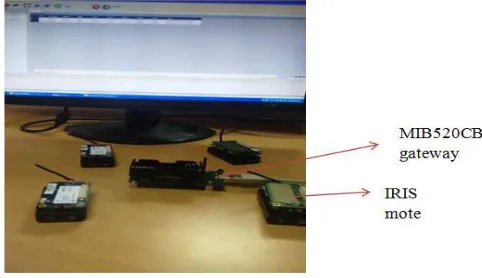
Flat based or data centric routing along with query based protocol is implemented in this work. The IRIS mote is having the capability to sense process and transfer the data. IRIS mote which is invention of MEMSIC is intended specifically for low power wireless sensor networks, it is a platform of high bandwidth and enhanced program reminiscence when related to MICA motes. The figure 1 shows the experimental set up of the IRIS mote along with the MIB520 gateway.
Fig 1: Experimental set up
MoteView acts as an interface between user and deployed network of wireless sensors.The health packets,forwarded packets,dropped packets,Number of retries,Battery voltage along with the quality which specifies the number of transmissions and retransmissions can be estimated. These values will thereby help in monitoring the health statics of the particular WSN network.
III. WIRELESS SENSOR NETWORK WITH IOT
ISSN(Online): 2319-8753 ISSN (Print): 2347-6710
International Journal of Innovative Research in Science,
Engineering and Technology
(A High Impact Factor, Monthly, Peer Reviewed Journal)
Visit: www.ijirset.com Vol. 7, Issue 12, December 2018
the entire data stream and then feeds the data into the internet. The various integration approaches are stack based [4] and topology based approaches [5]. The stack based approaches can be classified into front end solution, gateway solution and TCP/IP solution. The topology based approaches consists of hybrid solution and access point solution [6].
The solutions includes the gateway node which is present and does the byte lessening process like 6LoWPAN where the edge router is present to lessen the total number of bytes of internet to less number of bytes suitable for wireless sensor nodes. Resilience, user authentication, security, protocols used and hardware constraints have to be considered [6,9]. The IoT should pave a way for the nodes to identify it and make the device to device communication more reliable and feasible. The security and user acceptance about the integration pose an important challenge [7]
IV. PROPOSED SYSTEM
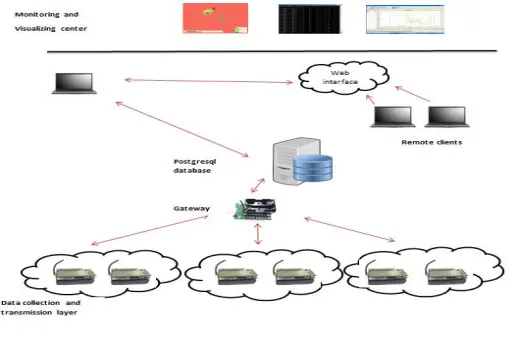
The node is identified itself with the node id. IRIS mote along with MDA100 is hired to support various applications. MoteView avails in estimating the data, commands, topologies, and packets released packets received, RSSI, temperature and light sensitivity readings and the value is stowed in PostgreSQL database. It avails in retrieving the data when a query is being given to it. The values in the database are being fed into the cloud. The PostgreSQL is fed into the internet with the help of any servers available. PostgreSQL database stores data in a secure manner which facilitates in retrieving data later whenever a query is being requested. Initially the motes are all interconnected together to the base station. Depending on the applications the sensors can be used. The figure 2 gives the proposed system wherein the motes are connected via the gateway to the database and to the monitoring center.
Fig 2: Proposed system
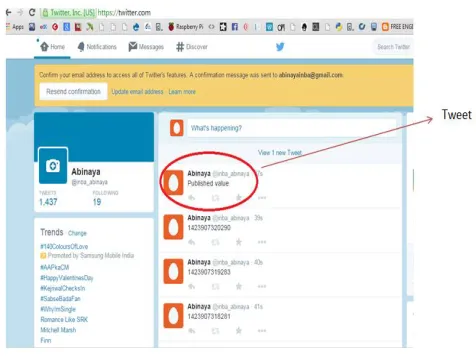
The above proposed method is implemented via http. The drawbacks of http demand the requirement of MQTT, which is implemented via raspberry pi. The raspberry pi is assigned an IP address and with the help of node red the nodes are dragged and the values are injected to the broker which tweets the value upon subscription.
V. RESULTS AND DISCUSSIONS
ISSN(Online): 2319-8753 ISSN (Print): 2347-6710
International Journal of Innovative Research in Science,
Engineering and Technology
(A High Impact Factor, Monthly, Peer Reviewed Journal)
Visit: www.ijirset.com Vol. 7, Issue 12, December 2018
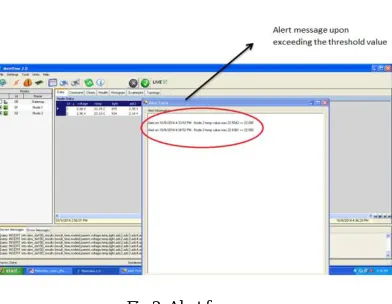
Fig 3: Alert form
The alert form will make acknowledge about the values which exceeds threshold and help to take necessary actions thereby keeping the values under limits. The figure 4 shows the MQTT implementation wherein the broker, topic, QoS and name can be found.
Fig 4: MQTT implementation
ISSN(Online): 2319-8753 ISSN (Print): 2347-6710
International Journal of Innovative Research in Science,
Engineering and Technology
(A High Impact Factor, Monthly, Peer Reviewed Journal)
Visit: www.ijirset.com Vol. 7, Issue 12, December 2018
Fig 5: Twitter message
VI. CONCLUSION
Thus remote monitoring and control helps for measurement of heterogeneous devices from a remote location and ability to alter the device functionality. The history of data is also collected which helps in monitoring the devices functionality that will help user to know when and where error has occurred. This monitoring of database is provided with some authentication which helps in limited access of the database. MQTT is standardized by OASIS; TCP based asynchronous type of message supporting many to many communications
REFERENCES
[1] Ying tao Jiang, Lei Zhang, and Ling Wang,”Wireless Sensor Networks and the Internet of Things Editorial International Journal of Distributed Sensor Networks” Volume 2 013, Article ID 58975
[2] Bello,O ,Zeadally.S.”Intelligent Device-to-Device Communication in the Internet of Things “in Systems Journal, IEEE (Volume:PP , Issue :99) [3].Memsic Powerful Sensing Solution, http://www.memsic.com/
[4] R. Roman, J. Lopez. ,’Integrating Wireless Sensor Networks and the Internet: a Security Analysis” Internet Research, Vol. 19, no. 2, pp. 246-
259, 2009.
[5] K. Martinez, R. Ong, and J. Hart, “Glacsweb: a Sensor Network for Hostile Environments,” in Proceedings of the Sensor and Ad Hoc Communications and Networks Conference (SECON), 2004.
[6]. D. Culler, D. Estrin, and M. Srivastava, “Guest Editors’ Introduction: Overview of Sensor Networks,” vol. 37, no. 8, 2004. [7] C.P Mayer, “Security and Privacy challenges in the Internet of Things”. KiVs Workshop on Global Sensor Network, 2009
[8] Alkiviadis Tsitsigkos, Fariborz Entezami, Tipu A. Ramrekha, Christos Politis and Emmanouil A. Panaousis “A case study of IoT using WSN and smartphones.
[9] Luzuriaga, J. E., Cano, J. C., Calafate, C., Manzoni, P., Perez, M., & Boronat, P. (2015, September),”Handling mobility in IoT applications using the MQTT protocol. In Internet Technologies and Applications” (ITA), 2015 (pp. 245-250). IEEE
[10] Al-Fuqaha, A., Guizani, M., Mohammadi, M., Aledhari, M., & Ayyash, M. (2015),”Internet of things: A survey on enabling technologies, protocols, and applications”. IEEE Communications Surveys & Tutorials, 17(4), 2347-2376
[11] Luzuriaga, J. E., Perez, M., Boronat, P., Cano, J. C., Calafate, C., & Manzoni, P. (2015, January),” A comparative evaluation of AMQP and MQTT protocols over unstable and mobile networks”. In Consumer Communications and Networking Conference (CCNC), 2015 12th Annual IEEE (pp. 931-936). IEEE.