ISSN(Online): 2319-8753
ISSN (Print): 2347-6710
I
nternational
J
ournal of
I
nnovative
R
esearch in
S
cience,
E
ngineering and
T
echnology
(An ISO 3297: 2007 Certified Organization) Vol. 6, Special Issue 11, May 2017
Analysis of RCC Framed Structure for
Column with Modelling Irregularities
Shital A. Navghare1, Amey Khedikar2
P.G. Student, Department of Civil Engineering, Tulsiramji Gaikwad-Patil College of Engineering& Technology,
Nagpur, Maharashtra, India1
Asst. Professor, Department of Civil Engineering, Tulsiramji Gaikwad-Patil College of Engineering & Technology,
Nagpur, Maharashtra, India2
ABSTRACT: The RCC Columns are the major component of building which carry and transfer the loads. Generally, regular (Rectangular, square or circular) shaped RCC columns are used for the construction. In order to improve the performance of the RCC Framed Structures under the influence of Dynamic Forces (forces generated by a given ground motion), regular shaped columns are compared with the other various RCC column cross sections (L-shaped, Tee-shaped) in model. Three models with each shaped the RCC columns are executed in ETAB software. The stress behavior of different cross sections of RCC columns in G+10 RCC framed structure isanalyzed by using Response Spectrum Method. The results indicate the comparative analysis and study of regular shaped and other various shaped column cross sections.
KEYWORDS:RCC Columns, ETAB Software, Dynamic Forces, Response Spectrum Method, L-shaped, Tee-shaped and Rectangular
I. INTRODUCTION
Experimental analysis is widely carried out to study individual component members and the concrete strength under various loading conditions.For a building to remain safe during earthquake shaking, columns (which receive forces from beams) should be stronger than beams. The engineers do not attempt to make earthquake-proof buildings that will not get damaged even during the rare but strong earthquake; such buildings will be too robust and also too expensive. Instead, the engineering intention is to make buildings earthquake-resistant; such buildings resist the effects of ground shaking, although they may get damaged severely but would not collapse during the strong earthquake.[9].
In recent years, special-shaped column structure won the national attention and love of the owners because of its equal thickness of columns and wall, excellent architectural appearance and high room rate.In 2006, Ministry of Construction of the People's Republic of China has issued "Technical specification for concrete structures with specially shaped columns" (JGJ149-2006), which has been implemented since August 1, 2006.[6].
ISSN(Online): 2319-8753
ISSN (Print): 2347-6710
I
nternational
J
ournal of
I
nnovative
R
esearch in
S
cience,
E
ngineering and
T
echnology
(An ISO 3297: 2007 Certified Organization) Vol. 6, Special Issue 11, May 2017
II. RELATEDWORK
Special-shaped column structure is the structure which column section is L-shaped, T-shapes, Z-shaped or cross-shaped. In the structure, Z-shaped reinforced concrete column is widely used in the stair case as well as the corner column of grid axis shift. Due to its significant difference in shape from L, T and cross-shaped columns, therefore, the Z-shaped column is also very different in carrying capacity and ductility from the special-shaped columns with three shapes mentioned above.[2].
In order to improve the seismic performance of the traditional reinforced concrete column, special-shaped columns are served as succedaneum. Xi’an University of Architecture and Technology has conducted in-depth research, which show that steel reinforced concrete special-shaped column is high and the seismic performance is excellent.[6].
III. METHODOLOGY
In the present report, Response Spectrum Method is taken for the analysis of RCC Framed Structure.This method is explained in IS 1893:2002 (Part I) for seismic load with all the required parameters. Another code is used for dead load & imposed load in IS 875:1987 (Part I & II). The following definitions shall apply which are applicable generally to all structures in response spectrum method.
1. As per IS 1893:2002 (Part I) Cl. No. 7.5.3, the total design lateral force or design seismic base shear (VB)
along X and Y direction shall be determined by the following expression. VB = Ah x W …(2.1)
Where, W = Seismic Weight as per Clause 7.4.2.
Ah = Design horizontal acceleration coefficientshall be determined by the following expression as per IS
1893:2002 (Part I) Clause 6.4.2. Ah = (Z/2) x (I/R) x (Sa/g) …(2.2)
Where, Z = Zone Factor (Table 2, Clause 6.4.2) I = Importance Factor (Table 6,
R = Response Reduction Factor (Table 7, Sa/g = Structural Response Factor (Clause
2. For determination of average response acceleration coefficient, it is required to calculate time period. As per IS 1893:2002, Page No.7, time period T is given by
… (2.3)
Where, h = Height of Structure d = Base Dimension
IV. MODELING
This building has been modelled as 3D Space frame model with six degree of freedom at each node, using ETAB software for stimulation of behaviour under seismic loading. The isometric 3D view and plan of the building model is shown as figure. The support condition is considered as fully fixed. The model is being design in three ways only with varying the column cross sections. All the three models are designed and analysed with ETABS software for base shear, displacement and joint reactions.
1. Model I – RCC G+10 Framed Structure with L-shaped Column:
ISSN(Online): 2319-8753
ISSN (Print): 2347-6710
I
nternational
J
ournal of
I
nnovative
R
esearch in
S
cience,
E
ngineering and
T
echnology
(An ISO 3297: 2007 Certified Organization) Vol. 6, Special Issue 11, May 2017
Table 1: Parameter of Model I
Levels of Building Size of Beam (mm)
Size of Column (mm)
Base to 2nd Floor 300 x 450 1000 x 1000 x 200
3rd to 6th Floor 300 x 450 900 x 900 x 200
7th to 10th Floor 300 x 450 800 x 800 x 200
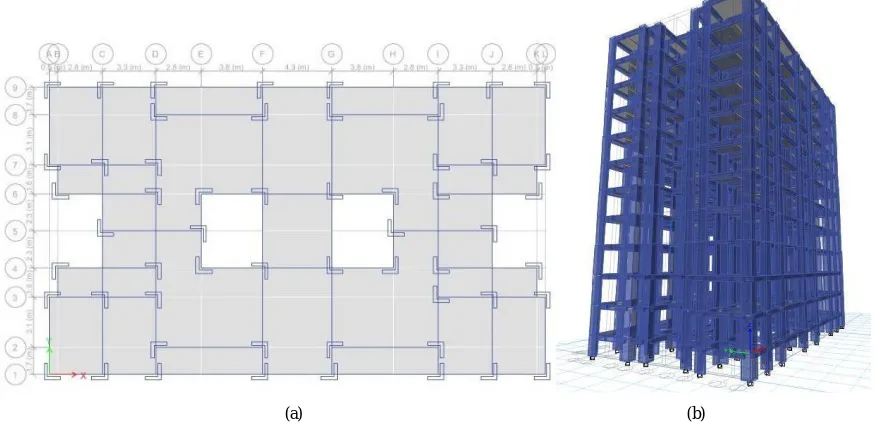
Table 1 is showing the dimensions of L-shaped column. All the other members of the structure have constant dimensions throughout the structure.
Fig. 1.G+10 RCC Framed Structure with L-shaped Column (a) Plan (b) 3D View
Fig 1 shows the G+10 RCC Framed Structure in which (a) shows the Plan of the structure having L-shaped column and (b) is the 3D view of the whole structure.
2. Model II – G+10 RCC Framed Structure with Tee-shaped Column:
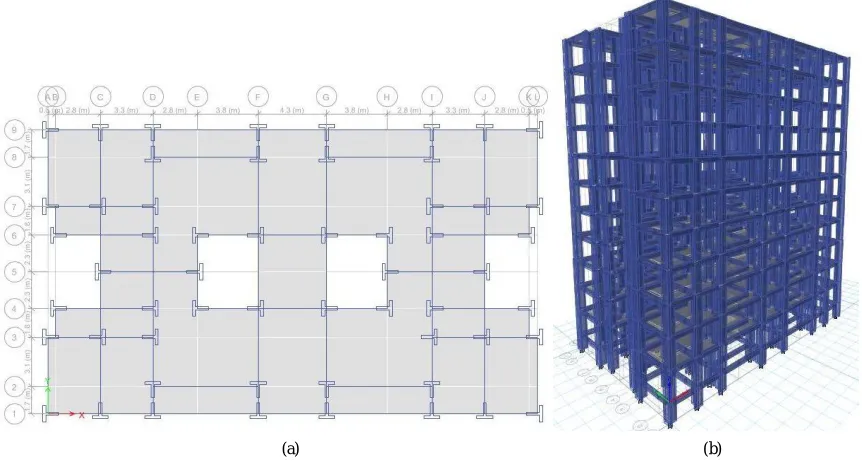
Model II has been modelled with Tee-shaped Columns. The dimensions of the column are varied by keeping the dimensions of all other component of the structure same. The sizes of column according to the floor levels are mentioned in Table 2.
Table 2: Parameter of Model II
Levels of Building Size of Beam (mm)
Size of Column (mm)
Base to 2nd Floor 300 x 450 1000 x 1000 x 200
3rd to 6th Floor 300 x 450 900 x 900 x 200
7th to 10th Floor 300 x 450 800 x 800 x 200
ISSN(Online): 2319-8753
ISSN (Print): 2347-6710
I
nternational
J
ournal of
I
nnovative
R
esearch in
S
cience,
E
ngineering and
T
echnology
(An ISO 3297: 2007 Certified Organization) Vol. 6, Special Issue 11, May 2017
Fig. 2.G+10 RCC Framed Structure with Tee-shaped Column (a) Plan (b) 3D View
Fig 2 is presenting Model II (a) Plan and (b) 3D View of the structure. Model II comprise of the T-shaped column by keeping all other parameters constant. This change has been done only to see the capacity of the special shaped column.
3. Model III– RCC G+10 Framed Structure with Rectangular Column:
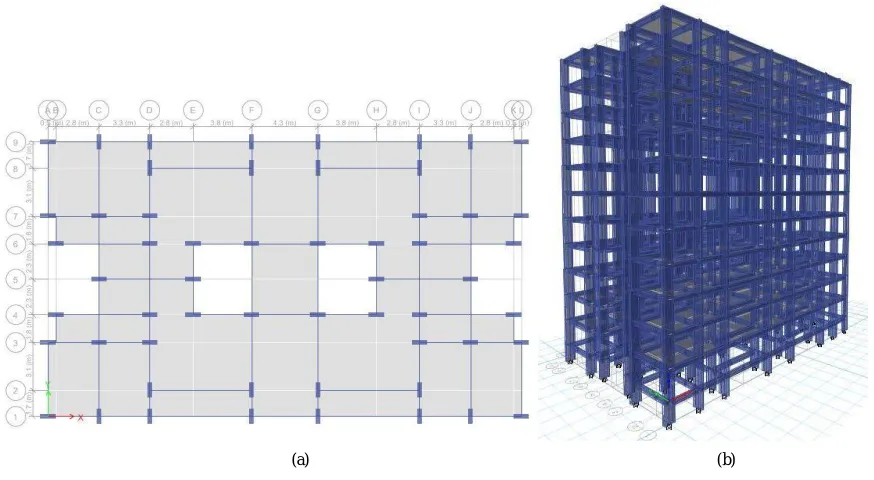
Model III has been designed with Rectangular columns, as per the sizes given in the Table 3. All other components of the structure have same dimensions throughout the structure. The changes in the dimensions of column are done with 100mm difference in its breadth.
Table 3: Parameter of Model III
Levels of Building Size of Beam (mm)
Size of Column (mm)
Base to 2nd Floor 300 x 450 1000 x 300
3rd to 6th Floor 300 x 450 900 x 300
7th to 10th Floor 300 x 450 800 x 300
In fig 3, (a) shows Plan and (b) shows 3D View of the RCC Framed structure. This structure is represents a model III with rectangular shaped column. The plan of the structure shows the shape of column, in which the width of column is taken equal to wall thickness i.e. 300mm.
ISSN(Online): 2319-8753
ISSN (Print): 2347-6710
I
nternational
J
ournal of
I
nnovative
R
esearch in
S
cience,
E
ngineering and
T
echnology
(An ISO 3297: 2007 Certified Organization) Vol. 6, Special Issue 11, May 2017
Fig. 3.G+10 RCC Framed Structure with Rectangular Column c/s (a) Plan (b) 3D View
V. EXPERIMENTAL RESULTS
In the present project report seismic design analysis of a rectangular plan building is carried out. Building is modelled as a 3D frame using ETAB software which is analysed by Response Spectrum method. Following observations have been drawn from the seismic analysis.
1. Base Shear Reaction:.
Table 4: Base Shear Reaction
Model Cross Sections of Column
Base Shear (KN)
EQx (X-Direction) EQy (Y-Direction)
I L 5746.985 5721.3509
II Tee 5647.5733 5549.6889
III Rectangular 5096.0176 4549.5625
It is the total design lateral force at the base of the structure. Variation of Base Shear in X as well as Y direction has been studied. The values of base shear are mentioned in Table 4
ISSN(Online): 2319-8753
ISSN (Print): 2347-6710
I
nternational
J
ournal of
I
nnovative
R
esearch in
S
cience,
E
ngineering and
T
echnology
(An ISO 3297: 2007 Certified Organization) Vol. 6, Special Issue 11, May 2017
Fig 4. Comparison of Base Shear Reaction
Fig. 4 is showing the base shear or lateral forces due to seismic loads (EQx & EQy)along x and y direction of structure for model I,II and III having three different column cross sections are mentioned on X-axis and the magnitude of the base shear has been mentioned on the Y-axis of graph.
2. Joint Displacement:
Table 5: Joint Displacement
Model Cross Sections of Column
Joint Displacement (mm)
Ux (X-Direction) Uy (Y-Direction) Uz (Z-Direction)
I L 17 14.8 8.8
II Tee 17.5 15.6 8.9
III Rectangular 19.4 19 10.5
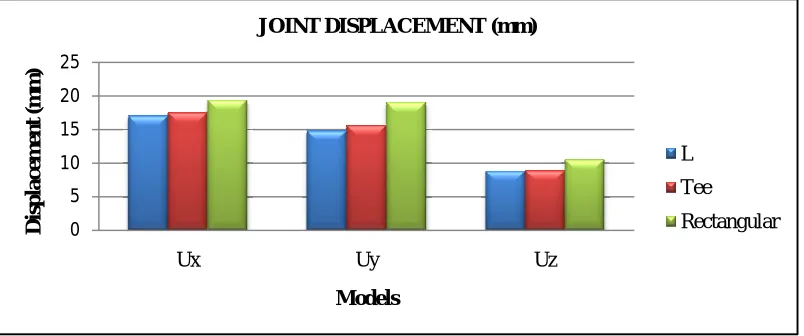
The joint displacement is the lateral movement of joint in three planes i.e. X, Y and Z. From the analysis of model I, II and III, the following results are derived which is given in Table 5.
Fig 5. Comparison of Joint Displacement
0 1000 2000 3000 4000 5000 6000 7000 EQx EQy B as e S h e ar (K N ) Models
BASE SHEAR (KN)
L Tee Rectangular 0 5 10 15 20 25
Ux Uy Uz
D is p lac e m e n t (m m ) Models
JOINT DISPLACEMENT (mm)
L
Tee
ISSN(Online): 2319-8753
ISSN (Print): 2347-6710
I
nternational
J
ournal of
I
nnovative
R
esearch in
S
cience,
E
ngineering and
T
echnology
(An ISO 3297: 2007 Certified Organization) Vol. 6, Special Issue 11, May 2017
The above fig. 5 presents the graph of joint displacement( Ux, Uy, Uz ) of the G+10 RCC framed structure. The X-axis of the graph shows three models in X, Y and Z-direction with their displacement and its values are mentioned on the Y-axis of the graph.
3. Joint Reactions:
Table 6: Joint Reactions
Model Cross Sections of Column
Joint Reactions (KN)
Fx (X-Direction) Fy (Y-Direction) Fz (Z-Direction)
I L 186.6631 194.2037 3963.3711
II Tee 202.6884 210.9999 3959.2511
III Rectangular 225.3871 255.6918 3907.3007
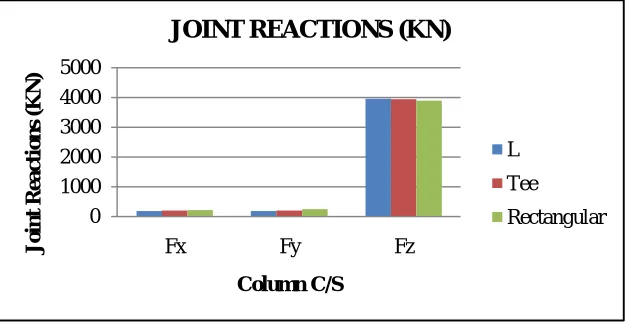
Table 6 is presening the joint reactions of three models for their respective column shapes. The results of analysis are clearly mentioned that joint reactions of the structures in X, Y and Z-direction.
Fig 6. Comparison of Joint Reaction
The fig. 6shows the graph of joint reaction (Fx, Fy, Fz ) for the G+10 RCC framed structure. The X-axis of the graph shows three models in X, Y and Z-direction with their reactions and its values are mentioned on the Y-axis of the graph.
VI. CONCLUSION
In the present study, analysis of G+10 RCC Framed Structure is carried out with varying shapes of column. Based on the analysis results for all models considered, following conclusions are drawn:
1. Model I with L-shaped column has maximum base shear along both X & Y-direction and Model III with rectangular columns has minimum base shear along X & Y-direction as shown in fig 3.
2. Fig 4 shows that the Model III with Rectangular columns has more joint displacement as compared to other two Models and Model I with L-shaped columns has least joint displacement along X, Y & Z-direction. 3. In fig 6, Model I has minimum value of joint reaction along X & Y-direction and has maximum values along
the Z-direction. The Model III has maximum value of joint reaction along X & Y-direction and has minimum value along Z-direction.
0 1000 2000 3000 4000 5000
Fx Fy Fz
Jo
in
t
R
e
ac
ti
o
n
s
(K
N
)
Column C/S
JOINT REACTIONS (KN)
L
Tee
ISSN(Online): 2319-8753
ISSN (Print): 2347-6710
I
nternational
J
ournal of
I
nnovative
R
esearch in
S
cience,
E
ngineering and
T
echnology
(An ISO 3297: 2007 Certified Organization) Vol. 6, Special Issue 11, May 2017
REFERENCES
[1] Kulkarni J.G., Kore P. N., S. B. Tanawade, “Analysis of Multi-storey Building Frames Subjected to Gravity and Seismic Loads with Varying Inertia”, International Journal of Engineering and Innovative Technology (IJEIT), Vol. 2, Issue 10,ISSN: 2277-3754, April 2013.
[2] Tiecheng Wang and Xuan Chen, “Non-linear Analysis of Z-Shaped Section Reinforced Concrete Column”,Applied Materials Research, Trans Tech Publications, Switzerland, ISSN: 1662-8985, VOL. 366, pp 276-280, 2012.
[3] Junting Jiao and Ronghua Yang, “Sensitivity Parameter Analysis of Bearing Capacity and Ductility of Reinforced Concrete Columns with Z-shaped Cross-section”,Advanced Material Research,Trans Tech Publications, Switzerland, Vol. 831, pp 158-163, 2014.
[4] Li Bai-shou and Yang Bin-bo, “Analysis Research of Reinforced Concrete Z-shaped Column Normal Section Bearing Capacity”, Applied Mechanics and Materials,Trans Tech Publications, Switzerland Vol. 94-96, pp 258-261, 2011.
[5] PreranaNampalli and PrakarshSangave, “Linear and Non-Linear Analysis of Reinforced Concrete Frames with Members of Varying Inertia”, Journal of Mechanical and Civil Engineering (IOSR-JMCE), Vol. 12, Issue 5 Ver. I,e-ISSN: 2278-1684,p-ISSN: 2320-334X, Sep. - Oct. 2015. [6] CAI Xinjiang, “The Comparative Analysis Of Seismic Performance On Three Different Forms of Special-Shaped Column Frame Structure”,
Journal Of Civil Engineering And Construction, Vol. 4, Issue 1, 2015.
[7] V. S. Pawar, P. M. Pawar, “Nonlinear Analysis of Reinforced Concrete Column with ANSYS”, International Research Journal of Engineering and Technology (IRJET), Volume 03, Issue No.06, e-ISSN: 2395-0056,p-ISSN: 2395-0072, June -2016.
[8] Ehab M. Lotfy, “Nonlinear Analysis of Reinforced Concrete Columns with Holes”, International Journal of Civil and Structural Engineering, Vol. 3, Issue 03, ISSN: 0976-4399, 2013.
[9] http://www.quora.com/