University of Windsor University of Windsor
Scholarship at UWindsor
Scholarship at UWindsor
Electronic Theses and Dissertations Theses, Dissertations, and Major Papers
1-1-2019
A Comparative Study of Document Representation Methods
A Comparative Study of Document Representation Methods
Ziyang Tian
University of Windsor
Follow this and additional works at: https://scholar.uwindsor.ca/etd
Recommended Citation Recommended Citation
Tian, Ziyang, "A Comparative Study of Document Representation Methods" (2019). Electronic Theses and Dissertations. 8183.
https://scholar.uwindsor.ca/etd/8183
A Comparative Study of Document
Representation Methods
By
Ziyang Tian
A Thesis
Submitted to the Faculty of Graduate Studies through the School of Computer Science in Partial Fulfillment of the Requirements for
the Degree of Master of Science at the University of Windsor
Windsor, Ontario, Canada
2019
c
A Comparative Study of Document Representation Methods
by
Ziyang Tian
APPROVED BY:
B. Shahrrava
Department of Electrical and Computer Engineering
A. Ngom
School of Computer Science
J. Lu, Advisor School of Computer Science
DECLARATION OF ORIGINALITY
I hereby certify that I am the sole author of this thesis and that no part of this
thesis has been published or submitted for publication.
I certify that, to the best of my knowledge, my thesis does not infringe upon
anyone’s copyright nor violate any proprietary rights and that any ideas, techniques,
quotations, or any other material from the work of other people included in my
thesis, published or otherwise, are fully acknowledged in accordance with the standard
referencing practices. Furthermore, to the extent that I have included copyrighted
material that surpasses the bounds of fair dealing within the meaning of the Canada
Copyright Act, I certify that I have obtained a written permission from the copyright
owner(s) to include such material(s) in my thesis and have included copies of such
copyright clearances to my appendix.
I declare that this is a true copy of my thesis, including any final revisions, as
approved by my thesis committee and the Graduate Studies office, and that this thesis
ABSTRACT
Document representation learning is crucial for downstream machine learning
tasks such as document classification. Recent neural network approaches such as
Doc2Vec and its variants are popular. Regarding its comparison with traditional
rep-resentation methods such as the TF-IDF method, the results are not very conclusive
due to several factors– Doc2vec has many hyper-parameters, resulting in performance
fluctuation; traditional methods have space to improve. More importantly, document
length and data size have impacts on the result. This thesis conducts a comparative
study of these methods, and propose to improve the TF-IDF weighting with mutual
information(MI). We find that Doc2vec works good only for short documents, and
only when the data size (the number of documents) is large. For long documents and
small data size, MI performs better. The experiments are conducted extensively on
11 data sets that are of a variety of combinations of document length and data size.
In addition, we study the relationship between TF-IDF and MI weighting. We
find that their correlation is high overall (Pearson correlation coefficient is over 0.9 on
all the data sets used in our thesis). For medium frequency words, the MI weighting
is always smaller than the TF-IDF weighting. However, for rare words and popular
words, MI diverges from TF-IDF greatly, and the weighting of MI is higher than
ACKNOWLEDGEMENTS
I would like to express my sincere appreciation to my supervisor Dr. Jianguo Lu,
for his constant guidance and encouragement during my whole Master’s period at the
University of Windsor. Without his valuable help, this thesis would not have been
possible.
I would also like to express my appreciation to my thesis committee members Dr.
Alioune Ngom and Dr. Behnam Shahrrava. Thank you all for your valuable guidance
and suggestions to this thesis.
Last but not least, I want to express my gratitude to my parents and my friends
TABLE OF CONTENTS
DECLARATION OF ORIGINALITY III
ABSTRACT IV
ACKNOWLEDGEMENTS V
LIST OF TABLES VIII
LIST OF FIGURES IX
1 Introduction 1
2 Review of the Literature 4
2.1 Na¨ıve Bayes[20] . . . 4
2.2 SVM(Support Vector Machine) with NB(Na¨ıve Bayes) features[21] . . 5
2.3 Character-level CNN[24] . . . 7
2.4 FastText[7] . . . 9
3 Traditional Methods For Document Representation 12 3.1 Term Frequency(TF) . . . 12
3.2 Term Frequency-Inverse Document Frequency . . . 15
3.3 Mutual Information Representation . . . 16
3.4 Comparing MI Representation with TF-IDF Representation . . . 19
3.4.1 Words that Occur Once . . . 20
3.4.2 Relationship with df . . . 24
3.4.3 Relationship with T F . . . 27
4 Neural Network Methods 33 4.1 Doc2vec - PV-DBOW . . . 33
4.2 Doc2Vec with Corruptions . . . 36
4.2.1 Doc2Vec PV-DM . . . 36
4.2.2 Doc2Vec with Corruption . . . 37
5 Experiments 40 5.1 Datasets . . . 40
5.1.1 Data Description . . . 41
5.1.2 Observation of Datasets . . . 43
5.2 Experimental Setup . . . 47
5.3 Comparison of MI and TF-IDF . . . 48
5.4 Compare of Neural Network Methods and the TF-IDF and MI . . . . 50
5.4.1 Hyper Parameters . . . 50
5.6 Impact of Shifting on MI . . . 58 5.6.1 What is Shifting? . . . 58 5.6.2 Experimental Results . . . 63
6 Conclusions 66
REFERENCES 68
LIST OF TABLES
1 Explanation of Symbols . . . 13
2 Example corpus of TF . . . 13
3 An example of document-word matrix for the corpus in Table 2. . . . 13
4 IDF of words in Table 2 . . . 15
5 Example of TF-IDF representation matrix . . . 16
6 Example of CT F, Di . . . 17
7 Example of MI representation matrix . . . 17
8 Pearson correlation coefficient between these two representations on the datasets used in our thesis. . . 19
9 The average of MI and TF-IDF when T F = CT F = df = 1. All the average of TF-IDF is greater than the average of the MI. . . 20
10 Detailed information of all datasets in this thesis. . . 40
11 Macro-F1 score of MI representation and TF-IDF representation on all datasets used in our thesis (Higher is better). Bold means better in that datasets. . . 48
12 P-value of significance test on the macro-F1 score between MI and TF-IDF results. Italic means no significant difference. . . 49
13 Experiments Records for TF, TF-IDF, MI, PV-DBOW and Doc2VecC on all datasets used in our thesis. . . 51
14 Number of data sets the different methods can give the best results. . 58
LIST OF FIGURES
1 Text classification system . . . 1
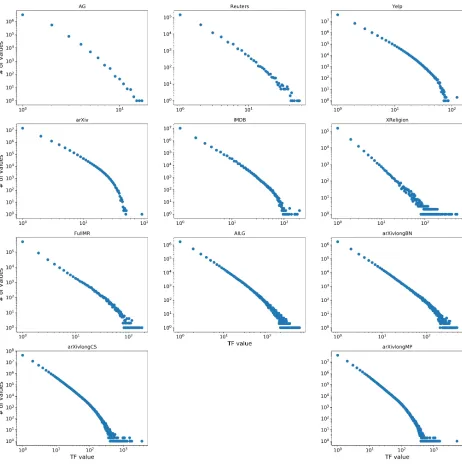
2 Distributions of TF values on all datasets used in this thesis. The
x-axis is the term frequency of the terms, and the y-x-axis is the times of
that term frequency appearance. Each dot is a term frequency, e.g., in
dataset AG, there are more than 106 terms with T F = 1 and nearly
106 with T F = 2. . . . 14
3 Distribution of MI values and TF-IDF values on datasets used in this
thesis. The x-axis is the weights of the terms, and the y-axis is the
times of that weight occurrence. . . 18
4 Distribution of documents lengths for the documents which contain the
terms whoseT F =CT F =df = 1. Red line means the average length
of the documents in the corpus. . . 21
5 Distribution of MI value for term whose CT F = df = 1 of dataset
used in this thesis. The x-axis is the MI weights for the terms with
CT F =df = 1 and the y-axis is the number of that weights occurrence.
The red line is the TF-IDF value for the terms whoseCT F =df = 1. 22
6 Values of MI and TF-IDF for term whose CT F = df = 1 of dataset
used in this thesis. We use the boxplot to plot the values of MI, and
we plot the TF-IDF as a redpoint since it is a constant . . . 23
7 Relation betweenCT F anddf on all datasets in this thesis. The y-axis
is the CT F and the x-axis is the df, and each point means represents
a term, and the dashed line is y=x meansCT F equal to the df. . . 25
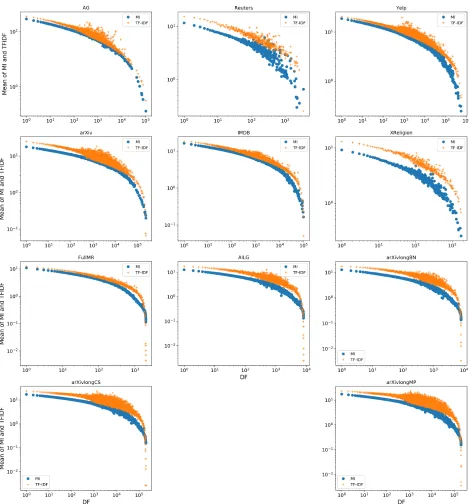
8 Average of TFIDF and MI value under different df of datasets in this
thesis. The x-axis is thedf of the terms, and the y-axis is the weights
of the corresponding df. The blue points show the average of the MI
weights and the orange points show the average of the TF-IDF weights. 26
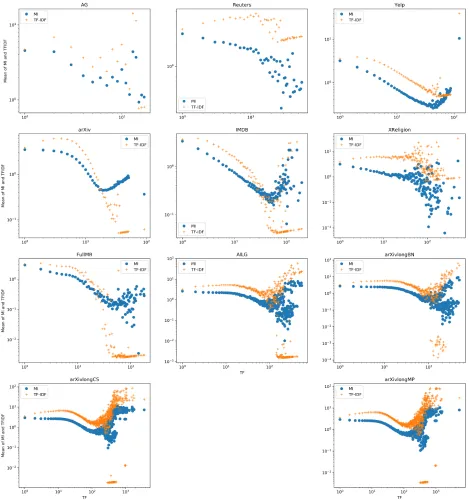
9 TF-IDF and MI value under different TF values. The x-axis is the TF
of the terms, and the y-axis is the weights of the corresponding TF.
Blue: MI weights, Orange: TF-IDF weights. The weights in the figure
is non-averaged . . . 28
10 Average of TF-IDF and MI values under different TF. The x-axis is the TF of the terms, and the y-axis is the weights of the corresponding TF. Blue: MI weights, Orange: TF-IDF weights. . . 29
12 Structure of PV-DBOW . . . 34
13 Structure of PV-DM . . . 36
14 Structure of Doc2VecC . . . 38
15 Length Distribution of all datasets in this thesis. The x-axis is the length of the documents. The y-axis is the percentage of the documents with the specified length on all documents. Each dot representation a length. For example, on dataset Yelp, there are about 0.1% documents whose document length is 2. . . 44
16 CTF-Frequency Distribution of all datasets in this thesis. The x-axis is the CTF of the terms, and the y-axis is the frequency of different CTF appears. . . 45
17 CTF-Rank Distribution of all datasets in this thesis. The y-axis is CTF of terms, and the x-axis is the rank of the frequency of CTF. . . 46
18 Improvement Ratio of MI comparing with TF-IDF . . . 49
19 Improvement Ratio of Doc2VecC comparing to PV-DBOW, the order of the datasets is sorted by average length. . . 51
20 Improvement Ratio of TF-IDF comparing to NN methods, the order of the datasets is sorted by average length. . . 52
21 Improvement Ratio of MI comparing to NN methods, the order of the datasets is sorted by average length. . . 53
23 F1 sore of MI, TF-IDF and Dov2VecC on all datasets used in our thesis
with small data size. . . 56
24 F1 sore of MI, TF-IDF and Dov2VecC on all datasets used in our thesis
with different data size. . . 57
25 Average of estimated TF changing with TF of datasets in this thesis.
The x-axis is the TF of the term. The y-axis is the average of the dT F
of the corresponding TF. The line means the dT F =T F. . . 60 26 Shift lines for different shifting methods. The x-axis is the TF of the
term. The y-axis is the average of the MI weights of the corresponding
TF. The lines mean that the value under the lines will be removed,
different lines represent different shift methods. . . 61
27 Remove ratio for different methods under different TFs. The x-axis is
the TF of the term. The y-axis is the percentage of the removed terms
of the corresponding TF. Different colour means different shift methods. 62
28 Impact of Shifting . . . 63
CHAPTER 1
Introduction
Document classification is an important technique nowadays, and it can be applied in
various areas. For example, when we build an academic search engine[8][2][3]
special-izing in computer science (CS), we need to judge whether a document crawled from the
web and online social networks is a CS paper; When we analyze the sentiment[1][11][19]
of movie reviews, we need to classify whether it is positive or negative. Hence, it is
necessary to find a method that can handle the classification problem with high
ac-curacy.
Inputs
(Documents) Step 1
Data Preprocessing
(e.g., Remove the punctuations)
Step 2
Feature Extraction
(transforming text into numerical vectors )
Step 3
Classification
(e.g., Logistic Regression, SVM, etc.)
Step 4
Outputs (Classification Results
eg. CS or Physics)
Fig. 1: Text classification system
The steps of a text classification system are shown in Fig. 1. To classify
docu-ments, at first, we take documents in natural language as our input, and then we need
to preprocess the documents. Preprocessing includes removing the punctuations,
1. INTRODUCTION
In the end, we can apply a classifier (such as Logistic Regression, SVM, and so on)
on the vectors to do the classification task. As we can see, the vectorization step is
essential for downstream machine learning tasks; a good representation can influence
the performance of the result. Thus, it is necessary to find a suitable vectorization
method.
In recent years, artificial neural network technique has made advances in many
areas. It has also been applied in document representation. The most well-known
method is Doc2vec[9], which is proposed by Le & Mikolov in 2014. In their paper, they
showed that the Doc2vec could beat many existing methods. However, the results
are not conclusive. First is that in their paper, they only conducted the experiments
on two datasets, which means that the datasets used in their experiments are limited.
Second is that in their later paper[13], they declared that the experiments in their
old paper had some problems, and the results are invalid. In that new paper, they
still showed that the Doc2vec is better than other methods. However, they only
experimented on one dataset. Limited dataset can not make people believe that this
method is always better.
This thesis addresses two questions: 1) whether neural network representation
methods are better than traditional methods. The traditional methods compared in
this thesis are TF (Term Frequency), and TF-IDF (Term Frequency -Inverse
Docu-ment Frequency), which are based on the frequency of the words. The neural network
methods used in this thesis are PV-DBOW (Distributed Bag of Words version of
Para-graph Vector)[9] model of Doc2Vec and Doc2VecC (Doc2Vec with Corruption)[5]. 2)
We proposed our own vectorized approach, Mutual Infomation representation. Our
method represents the documents by considering the estimated term frequency of
words and the actual term frequency of words. Our goal is to find out whether our
method can outperform the existing methods.
In our experiments, we find that the performance of the classification methods
has relations with both average length and sample size. For question 1, we find
that the neural network methods only have advances in the short documents with
1. INTRODUCTION
methods can give better performance. For question 2, our experiments show that our
MI representation can outperform the existing methods on the long documents, but
not stable on the short documents. We also discuss the relation between the value of
MI and TF-IDF since their formula is similar.
To find an answer to these two questions, we conducted a series of experiments on
various datasets, including AG’news[24], 20 Newsgroup[21], IMDB[11], Yelp Review[24],
Reuters[23], Full Movie Review[15], and the arXiv papers. We considered the data
size, the vocabulary size, and the average length as the principle to collect the datasets
since all these elements may influence the result of the vectorized method. The dataset
with the shortest average length (36) is AG’news, while the dataset with the longest
average length (1100) is arXiv papers with the title, abstract and introduction
sec-tion included (long arXiv). The dataset with the smallest vocabulary size (25,073)
is the 20news group, the dataset with the largest vocabulary size (1,606,482) is the
long arXiv as well. Thus, our datasets have a large scale on the average length and
vocabulary size so that we can evaluate the performance of the vectorized method in
CHAPTER 2
Review of the Literature
Many research focused on the classifiers or the entire classification system. From
these papers, we can learn how people do the text classifications and collect datasets
from them.
2.1
Na¨ıve Bayes[20]
Na¨ıve Bayes is a traditional classifier on many kinds of classification tasks. [20] shows
that the Na¨ıve Bayes still has a reliable performance on the document classification
task.
Data Set and Labeling
A dataset with 4000 documents classified in four different categories (i.e., business,
politics, sports, travels) is used in their experiments. All the categories are easily
differentiated. 30% data (i.e., 1200) are extracted randomly to build the training
dataset for the classifier. The remaining 2800 documents are used as the testing
dataset to do the evaluation task.
Experiments
The experiments are divided into four phases, and the whole procedure is classic in
the document classification task. Phase one is the pre-processing part; they removed
the stop words at first, and then adopted the missing data checking algorithm; after
2. REVIEW OF THE LITERATURE
about the feature selection, they used the Cfs Subset Evaluator and rank search
feature selection techniques to remove irrelevant or redundant attributes; for the
rank search method, they had compared both Gain ratio and Chi-square. Phase
three is the classifier comparison part; in their experiments, they compared the Na¨ıve
Bayes classifier with SVM (Support Vector Machine)[4], DT ( Decision Tree)[16] and
NN (Neural Network)[22]. Finally, phase four is about model evaluation, the results
measured by the recall, precision, and F1-score. The vectorized method used in their
experiments is TF-IDF (Term Frequency-Inverse Document Frequency).
Results
Firstly, they wanted to show whether the pre-processing and feature selection works;
here, they use the Na¨ıve Bayes as the classifier. The results show that the performance
of using pre-processing and the Gain ratio as the feature selection technique (F1 score
0.955) is even worse than the performance without any pre-processing and feature
selection (F1 score 0.969), but the performance of using pre-processing and the
Chi-square as the feature selection technique (F1 score 0.970) can be a little better. After
discussing the importance of pre-processing and feature selection, they compared
different classifiers. The results showed that the Na¨ıve Bayes could give the best
result (F1 score 0.970), and then is the SVM (F1 score 0.969), followed by the NN
(F1 score 0.930) and DT(F1 score 0.911).
2.2
SVM(Support Vector Machine) with NB(Na¨ıve
Bayes) features[21]
Variants of Na¨ıve Bayes (NB) and Support Vector Machine (SVM) often used as
baseline methods for text classification. [21] introduces a new variant of NB and
SVM, names NBSVM, which means SVM with NB features.
They formulated their main model variants as linear classifiers, and the prediction
2. REVIEW OF THE LITERATURE
training case i with y(i) ∈ {−1,1}. V is the set of features. They also defined the count vector as p = α+P
i:y(i)=1f(i) and q = α+ P
i:y(i)=−1f(i) for the smoothing
parameter α. The log-count ratio defined as
r = log (p/kpk1
q/kqk1) (1)
In MNB, x(k) = f(k), w = r and b = log (N
+/N−), N+, N− are the number of
postitive and negative training case. They found that binarizingf(k) is better in [14].
Thus, they took x(k) = ˆf(k) = 1
f(k) >0 , where 1 is the indicator function. ˆq, ˆp, ˆr
are calculated using ˆf(i) instead of f(i) in equation 1. For the SVM, x(k) = ˆf(k), and
w, b are obtained by minimizing
wTw+CX
i
max(0,1−y(i)(wTfˆ(i)+b))2 (2)
For their method NBSVM, they used x(k) = ˜f(k), where ˜f(k) = ˆr ◦fˆ(k) is the elementwise product. They found that an interpolation between MNB and SVM
gave good results for both long and short document, they reported the model as
w0 = (1−β) ¯w+βw. Where ¯w=kwk1/|V|is the mean magnitude of w, andβ ∈[0,1] is the interpolation parameter, which can be regarded as a form of regularization:
trust NB unless the SVM is confident.
Data Set and Labeling
In their works, they used eight different datasets; all the datasets are about reviews.
The datasets divided into two groups, snippets, and full-length reviews. Snippets
include four datasets, the average length of these datasets is around 20, two of them
are balanced, and another two are imbalanced. For the full-length datasets, there are
five datasets in total. One is the IMDB dataset, which is the well-known benchmark
dataset, include 25k reviews for both positive class and negative class, the average
length is 231. Another one is a full movie dataset, the average length of it is 787,
2. REVIEW OF THE LITERATURE
means it is not a large dataset. The remaining three datasets extracted from the 20
Newsgroup, and the average length are around 280; 20 Newsgroup is a benchmark
dataset as well.
Results
For the short reviews, their NBSVM classifier gave the best results on two of four
datasets. While on the other two datasets, the difference between NBSVM and
classi-fier who gave the best result is less than 0.5%. The results also showed that the MNB
performed better than SVM on the short document. For the long document, the
NBSVM also could give the best results or close to the best one. Overall, the results
showed that NBSVM is a robust performer on documents of all different lengths.
2.3
Character-level CNN[24]
Convolutional neural networks (CNN) usually applied to image processing. [24]
of-fered an empirical exploration of the use of character-level CNN for the text
classifi-cation.
Data Set and Labeling
The author focused on large-scale datasets since they want to show that their method
can work well and fast with large-scale datasets. All the datasets divided into training
and testing sets. There are overall eight datasets. AG’s news includes 120,000
train-ing samples and 7,600 test samples divided into four different classes. Sogou news is
a combination of the SogouCA and SogouCS news corpora. There are five different
classes, the number of training classes for each class is 90,000 and testing 12,000.
Since this dataset is in Chinese; they used the pypinyin and jieba package to process
the data. DBPedia is a crowd-sourced community effort to extract structured
infor-mation from Wikipedia; this dataset included 560,000 training samples and 70,000
2. REVIEW OF THE LITERATURE
One dataset only includes two classes, positive and negative, contains 560,000
train-ing and 38,000 testtrain-ing samples; another dataset includes five classes, from one star to
five stars, contains 650,000 training and 50,000 testing samples. The Amazon reviews
dataset has the same situation with Yelp review, includes two datasets. One only
includes the positive and negative, with 3.6 million training and 400,000 testing
sam-ples; another dataset includes five classes, with 3 million training and 650,000 testing
samples. The last dataset is Yahoo answer, includes ten classes and 140,000 training
samples and 5,000 testing samples for each class. All the datasets are balanced.
Methodology
Their models accept a sequence of encoded characters as input. The encoding is
done by prescribing an alphabet of sizem for the input language, and then quantize
each character using 1-of-m encoding (or “one-hot” encoding). Then, the sequence
of characters transformed into a sequence of msized vectors with a fixed length of l0.
Any character exceeding length l0 is ignored, and any characters that are not in the
alphabet, including blank characters quantized as all-zero vectors. The alphabet used
in all of their models consists of 70 characters, including 26 English letters, 10 digits,
33 other characters, and the new line character. They also compared with models
that used a different alphabet in which they distinguished between upper-case and
lower-case letters.
They designed 2 ConvNets – one large and one small. For the large network, the
l0 set to 1014, and for the small network, the l0 set to 256. Both networks contain 9
layers, 6 convolutional layers, and 3 fully-connected layers. They also insert 2 dropout
modules in between the 3 fully-connected layers to regularize, the dropout probability
is 0.5.
They also do the data augmentation in their experiment. Since the appropriate
with data augmentation techniques are useful for controlling generalization error for
deep learning models. However, for the document classification task, the existing data
augmentations are not suitable. Therefore, they experimented data augmentation by
2. REVIEW OF THE LITERATURE
the LibreOffice project. To decide on how many words to replace, they extract all
replaceable words from the given text and randomly chooser of them to be replaced.
The probability of numberrdetermined by a geometric distribution with parameterp
in whichP[r]∼pr. The indexsof the synonym chosen given the word also determined by another geometric distribution in which P[s] ∼ qs. In their experiment, they set
q= 0.5 andp= 0.5.
Results
They compared their method with the other seven methods. Five of them are
tra-ditional methods, including BoW(Bag-of-Words) and its TFIDF (Term Frequency
Inverse Document Frequency), Bag-of-ngrams and its TFIDF, Bag-of-means on word
embedding. The last one is the deep learning methods, LSTM (long-short term
mem-ory) and word-based ConvNets, which is applying the ConvNets on the word2vec. The
classifier for the traditional methods is multinomial logistic regression. The
bag-of-words model is constructed by selecting 50,000 most frequent bag-of-words from the training
subset. The bag-of-ngrams model is constructed by selecting the 500,000 most
fre-quent n-grams (up to 5-grams) from the training subset for each dataset. The results
showed that Bag-of-means always gave the worst results. Their methods can give the
best result on the large datasets, for the samples over 1 million the character-level
CNN can always perform better. For the smaller datasets, the ngram and its TFIDF
can do better.
2.4
FastText[7]
In [7], the author proposed a text classifier named fastText, which is often on par
with deep learning classifiers in terms of accuracy, and many orders of magnitude
2. REVIEW OF THE LITERATURE
Data Set and Labeling
The datasets used in this paper are the same as the datasets in [24]; the detailed
descriptions are section 2.3.
Methodology
The structure of the neural network only contains one hidden layer. For the input
layer, the input vectors are the document representation vector, which calculated by
averaging the word embeddings of the words in the document; the word embeddings
can be pre-trained word2vec representation or the Glove representation. The following
architecture is similar to the CBOW model of word2vec. They used the softmax
function f to compute the probability distribution over the predefined classes. For
a set of N documents, this leads to minimizing the negative loglikelihood over the
classes: −1 N
PN
n=1ynlogf(BAxn), where xn is the normalized bag of features of the nth document,ynthe label,AandBthe weight matrices. When the number of classes
is large, computing the linear classifier is computationally expensive. Thus they use
the Hierarchical softmax to reduce the time complexity. Bag of words is invariant
to word order, but taking this order explicitly into account is often computationally
expensive. Instead, they used a bag of n-grams as additional features to capture some
partial information about the local word order.
Results
They have compared their model with the character-level CNN and other methods
that are mentioned in that paper. They compared both the accuracy and training
time. The results showed that for accuracy, the fastText only gave the highest
per-formance on two datasets, but for other datasets, the accuracy is close to the highest
model. However, for the comparison of training time, the fastText had an excellent
performance. Comparing to the character-level CNN, the training time for a single
epoch on AG’s new of small char-CNN is 1 hour, but for the fastText is 1 second.
char-2. REVIEW OF THE LITERATURE
CNN is 2 days, but for the fastText is 10 seconds. In conclusion, fastText can train
CHAPTER 3
Traditional Methods For
Document Representation
3.1
Term Frequency(TF)
The most basic document representation method is probably the Term Frequency
(TF) vector, which can be dated back to 1957[10]. TF is the frequency of a term in
a document. The vector representation is based on TF lists words paired with their
TF. In TF matrix M, each row is a document, and each column is a word. Mij is the
TF of the word iin document j. Each of the documents in the corpus is represented
by a vector of equal length of |V|. |V|is the vocabulary size of the dataset.
Since the TF matrix is the most basic representation matrix, other traditional
representation matrices are all based on the changing of the TF matrix. Table 1 lists
some notations which are used in this thesis. Document lengthDi =P
|V|
j=1Mij is the number of tokens in the document; collective term frequency CT Fj =
Pn
i=1Mij is the total number of occurrences of the tokentj in the corpus;N =Pni=1P
|V|
j=1Mij is the total number of tokens in the corpus.
Table 3 is an example that shows how TF can be used to represents documents.
Suppose that there are three documents as listed in Table 2. The corresponding
3. TRADITIONAL METHODS FOR DOCUMENT REPRESENTATION
n Number of documents
l Average length of the dataset la =N/n
dfj Number of documents the termj appears
|V| Vocabulary size of the corpus
Di Length for the documenti Di =
P|V| j=1Mij
CT Fj Collective Term Frequency for term j CT Fj =
Pn i=1Mij
N Total number of terms N =Pn
i=1 P|V|
j=1Mij T Fij Term frequency of termj and document i T Fij =M ij
d
T Fij Estimated term frequency of termj and document i dT Fij =
CT Fj×Di
N
M Iij Mutual information weight of termj and document i MIij = log2 T Fij
d
T Fij
Table 1: Explanation of Symbols
docID words in document
1 learning deep neural networks
2 the creative director manages the creative department
3 deep learning for the channel coding
Table 2: Example corpus of TF
docID channel coding creative deep department director for learning manages neural network the 1 0 0 0 1 0 0 0 1 0 1 1 0 2 0 0 2 0 1 1 0 0 1 0 0 2 3 1 1 0 1 0 0 1 1 0 0 0 1
3. TRADITIONAL METHODS FOR DOCUMENT REPRESENTATION
3. TRADITIONAL METHODS FOR DOCUMENT REPRESENTATION
3.2
Term Frequency-Inverse Document Frequency
TF-IDF stands for Term Frequency-Inverse Document Frequency[17]; it is often used
in information retrieval and text mining. TF-IDF can be obtained by multiplying
term frequency and the inverse document frequency. The inverse document frequency
measures how important a term is to a document in a corpus. Since all the terms in
TF representation has the same importance, but in the practical applications, there
exists some terms appear many times but have little importance. The TF-IDF intends
to weight down the frequent terms while scaling up the rare ones, which means that
this method can play the feature selection role as well. The IDF is calculated using
the following formula:
IDFj = log2 n dfj
(1)
where n is the total number of documents, and dfj is the number of documents
the term j appears. For the example in Table 2, the IDF of the words are:
channel coding creative deep department director for learning manages neural network the
1.58 1.58 1.58 0.58 1.58 1.58 1.58 0.58 1.58 1.58 1.58 0.58
Table 4: IDF of words in Table 2
In my thesis, I use the sublinear-TF[12] to normalize the TF weight.
TFs =
1 + log2T F if T F > 0
0 if T F = 0
(2)
The reason for using the sublinear-TF is that if a word appears twenty times, it
does not mean this word in a document indeed twenty times more important than
the terms only appear once. Thus, we can use the logarithm of the term frequency
to make it more smooth.
Finally, the TF-IDF weights can be calculated by multiplying sublinear term
3. TRADITIONAL METHODS FOR DOCUMENT REPRESENTATION
docID channel coding creative deep department director for learning manages neural network the 1 0 0 0 0.58 0 0 0 0.58 0 1.58 1.58 0 2 0 0 3.17 0 1.58 1.58 0 0 1.58 0 0 1.70 3 1.58 1.58 0 0.58 0 0 1.58 0.58 0 0 0 0.58
Table 5: Example of TF-IDF representation matrix
TF-IDFij = (log2T Fij + 1)×log2 n dfj
(3)
Table 5 shows the TF-IDF representation of the example in Table 2.
3.3
Mutual Information Representation
Instead of TF-IDF, we can use the idea of Pointwise Mutual Information (PMI) to
reflect the importance of terms in a document and use these weights to represent
documents. P M Iij of the wordi in document j is defined as below:
P M Iij = log2 T Fij
d T Fij
(4)
where dT Fij is the expected term frequency if terms are randomly distributed in
all documents. It can be estimated by:
d T Fij =
CT Fj ×Di
N (5)
where CT Fj is collective term frequency for term j, and Di is the length for
document i. When the actual term frequency is higher than the estimated term
frequency, it means that the importance of the term in the document is higher than
it expected. Thus we need to give it a high weight. For the term whose actual term
frequency is equal or close to the estimated term frequency, which means that this
term is not significantly important to the document, the weight is close to zero. For
the terms that the estimated term frequency is higher than the actual term frequency,
3. TRADITIONAL METHODS FOR DOCUMENT REPRESENTATION
docID channel coding creative deep department director for learning manages neural network the Di
1 0 0 0 1 0 0 0 1 0 1 1 0 4 2 0 0 2 0 1 1 0 0 1 0 0 2 7 3 1 1 0 1 0 0 1 1 0 0 0 1 6 CTF 1 1 2 2 1 1 1 2 1 1 1 3 17
Table 6: Example of CT F, Di
docID channel coding creative deep department director for learning manages neural network the 1 0 0 0 1.09 0 0 0 1.09 0 2.09 2.09 0 2 0 0 1.28 0 1.28 1.28 0 0 1.28 0 0 0.70 3 1.50 1.50 0 0.50 0 0 1.50 0.50 0 0 0 0
Table 7: Example of MI representation matrix
is negative according to the formula. In our experiments, we remove the negative
values since they are meaningless, like Equation 6 shown, we call this PPMI (Positive
Pointwise Mutual Information).
P P M Iij =
0, if M Iij <0
P M Iij, otherwise
(6)
The final MI representation of the example in Table 2 is shown in Table 7. We can
see that compared to the TF-IDF representation last section, both MI and TF-IDF
representation reduce the weights for the terms appear in more than one document.
The difference is that for the term ”the” in document 3, the MI set the weight to
0 since log2 13××176 = −0.08 < 0, while TF-IDF still give it a small value. It means that our MI reduces the weights more aggressively. The wights for terms ”deep” and
”learning” are the same in documents 1 and 3 in TF-IDF representation, but different
in MI representation. The reason for this is that both these terms appear once in
each document, but document 3 is longer than document 1, we can see that the MI
representation is more specific for the single document while TF-IDF representation
considers more about the global distribution. We can analyze the relationship between
3. TRADITIONAL METHODS FOR DOCUMENT REPRESENTATION
3. TRADITIONAL METHODS FOR DOCUMENT REPRESENTATION
Datasets AG Reuters Yelp arXiv IMDB XReligion FullMR AILG arXivlongBN arXivlongCS arXivlongMP
correlation coefficient 0.97 0.94 0.97 0.93 0.96 0.95 0.94 0.90 0.91 0.90 0.90
Table 8: Pearson correlation coefficient between these two representations on the datasets used in our thesis.
3.4
Comparing MI Representation with TF-IDF
Representation
Table 8 shows the Pearson correlation coefficient between these two representations
on the datasets used in our thesis. It shows that these two representations are highly
similar. Both methods consider the term frequency as the primary attribute to
cal-culate the representation. Then, both reduce the weight of words that often occur in
other documents and increase the weight of rare words. Fig. 3 shows the distribution
of the weights of MI and TF-IDF, where the x-axis is the weights of the terms, and the
y-axis is the times of that weight occurrence, the counts are binned logarithmically,
it shows that the MI representation has more small wights, while TF-IDF has more
large weights. More precisely, we can analyze the relation between them according to
their formula.
According to Equation 4 and 5, we can expand the formula of MI representation:
M Iij = log2
T Fij ×N
Di×CT Fj = log2 T Fij ×l×n
Di×CT Fj = log2T Fij + log2
n CT Fj
+ log2 l Di
(7)
Besides, the formula for the TF-IDF with sublinear TF is:
(log2T Fij + 1)×log2 n dfj
= log2T Fij ×log2 n dfj
+ log2 n dfj
(8)
SinceT F,CT Fj anddfj play essential roles in the calculating of MI and TF-IDF.
3. TRADITIONAL METHODS FOR DOCUMENT REPRESENTATION
Datasets AG Reuters Yelp arXiv IMDB XReligion FullMR AILG arXivlongBN arXivlongCS arXivlongMP
Average of TF-IDF 16.96 11.97 19.19 17.87 16.61 10.95 10.97 12.97 12.97 17.61 17.61
Average of MI 16.91 11.57 18.8 17.84 16.33 9.33 10.87 12.74 12.79 17.36 17.35
Table 9: The average of MI and TF-IDF whenT F =CT F =df = 1. All the average of TF-IDF is greater than the average of the MI.
3.4.1
Words that Occur Once
We first compare those two weights for rare words. The rarest words are the words
that occur only once in the corpus, which implies that their document frequency and
term frequency are also one. Interestingly TF-IDF for those words is a constant that
is dictated by the number of documents n, as described in theorem 1:
Theorem 1. If the collective term frequency (CTF) of a word j is 1, then
T F IDFij = log2n.
Prove.
TF-IDFij = (log2T Fij + 1)×log2 n dfj
= log2 n dfj
= log2n (9)
As a constant, the TF-IDF value can not reflect the impact of document length.
The weight should be heavier in a shorter document. MI can reflect this as we can
see in the formula:
MIij =log2
T Fij ×N
Di×CT F
= log2 N Di
= log2 n×l Di
= log2n+ log2 l Di
(10)
MI fluctuates around log2n, depending on whether the document is longer than
the average length or not. Empirically we print out the average of MI and the average
of TF-IDF whenCT Fj = 1 for the datasets used in our thesis. The results are shown
in Table 9. We can observe that all the average of MI is smaller than the average of
TF-IDF. Hence we have theorem 2:
Theorem 2. For words that occur once in a corpus, their average MI is smaller
than log2n
3. TRADITIONAL METHODS FOR DOCUMENT REPRESENTATION
3. TRADITIONAL METHODS FOR DOCUMENT REPRESENTATION
3. TRADITIONAL METHODS FOR DOCUMENT REPRESENTATION
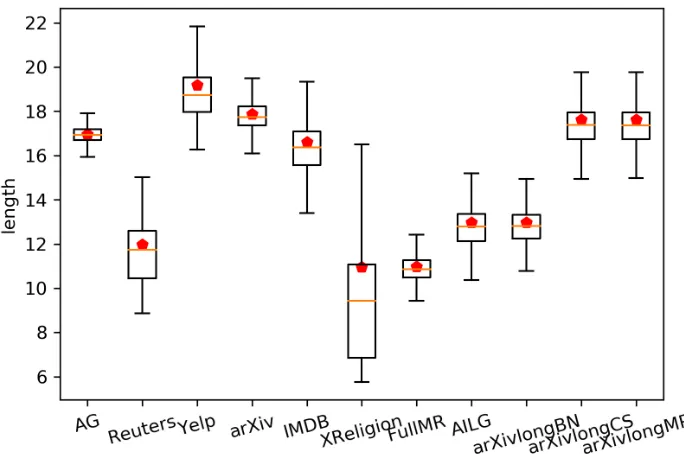
Fig. 6: Values of MI and TF-IDF for term whose CT F =df = 1 of dataset used in this thesis. We use the boxplot to plot the values of MI, and we plot the TF-IDF as a redpoint since it is a constant
and TF-IDF is that the MI has an extra log2 la
Di added. When we calculate the average of MI, we need to consider the sum of the MI, and since the only difference is log2 la
Di, we need to consider theP
mlog2 Dlai,mis the number of terms whoseCT F = 1. Since l the average length of documents in the corpus and Di is the document length, to
find out the value of P
mlog2 Dlai, we plot the distribution of documents lengths for the documents which contain the terms whose CT F = 1 in Fig. 4.
From the observation of Fig. 4, we can find that more documents with the
docu-ment length above average length contain the terms whoseCT F = 1. Thus, when we
calculate the P
mlog2 Dlai, we have P
mlog2 Dlai < 0. Here we can prove our theorem 2, the average of TF-IDF is greater than the average of MI when CT F = 1.
We also plot the distribution of the average of MI and TF-IDF whenCT F = 1 in
Fig. 5 and 6. In Fig. 6, we use the boxplot to plot the values of MI, and we plot the
TF-IDF as a redpoint, we can observe that the redpoint is higher than the median on
all datasets. In Fig. 5 since TF-IDF is a constant, we plot as a vertical red line. We
3. TRADITIONAL METHODS FOR DOCUMENT REPRESENTATION
of TF-IDF, and the left part has a little more value than the right part.
3.4.2
Relationship with
df
We plot how the average of TF-IDF and MI changes with the changing of df in Fig.
8. Base on the figure, we raise our theorem 3:
Theorem 3. Giving thedf as the variable, the average of TF-IDF is higher than
the average of MI when df < n2.
We prove this theorem though the formula of TF-IDF and MI.
MIij = log2T Fij + log2 n CT Fj
+ log2 la Di
TF-IDFij = log2T F ×log2 n dfj
+log2 n dfj
We can consider log2 CT Fn
j and log2
n
dfj as a comparison group, log2T Fij and log2T Fij ×log2
n
dfj as another group. For log2 la
Di, empirically when we calculate the average, it is a negative number. For log2CT Fn
j and log2
n
dfj, since CT Fj is the total number of term j appears in corpus and dfj is the number of documents term j appears, we can haveCT Fj ≥dfj. To check this relation, we also plot Fig. 7.
For log2T Fij and log2T Fij×log2 dfnj, we need to consider the value of log2
n dfj. When df < n2, means thatdfn >2, thus we have: We have:
log2 dfn j >1
log2T Fij ×log2 dfnj >log2T Fij
log2 dfn
j ≥log2
n
CT Fj (already know)
log2T Fij ×log2 n
dfj + log2
n
dfj >log2T Fij + log2
3. TRADITIONAL METHODS FOR DOCUMENT REPRESENTATION
3. TRADITIONAL METHODS FOR DOCUMENT REPRESENTATION
3. TRADITIONAL METHODS FOR DOCUMENT REPRESENTATION
log2 la
Di <0 (already know)
log2T Fij+ log2 CT Fn j >log2T Fij + log2
n
CT Fj + log2
la
Di
log2T Fij ×log2 n
dfj + log2
n
dfj >log2T Fij + log2
n
CT Fj + log2
la
Di
TF-IDFij >MIij
Here, our theorem 3 can be proved, and we can also observe this pattern in the
left part of Fig. 8.
3.4.3
Relationship with
T F
(a) TF-IDF and MI value under different TF values.
(b) Average of TF-IDF and MI values un-der different TF.
Fig. 11: MI and TFIDF values against TF on the FullMR dataset.
To understand how TF of a word is offset by its frequency in the corpus by those two
methods, we plot the MI and TFIDF values against TF in Fig 11a. As we can see,
there are too many data points, and the overall trend is obscured. Hence in panel (B),
we show the average for each TF value. From the plot, we make several observations:
1) the average of MI is smaller than the average of TFIDF overall, especially when
TF is small. 2) MI becomes bigger for larger TFs.
3. TRADITIONAL METHODS FOR DOCUMENT REPRESENTATION
3. TRADITIONAL METHODS FOR DOCUMENT REPRESENTATION
3. TRADITIONAL METHODS FOR DOCUMENT REPRESENTATION
shape of the TF-IDF is in multiple lines. According to the formula of TF-IDF,
TF-IDFij = (log2T Fij + 1)×log2 dfnj, whendfj is fixed, since n is a constant, log2
n dfj is a constant, only T F is the variable. Thus, there is a linear relation between
TF-IDF and T F. For each dfj, there is a line reflected in the graph. Since there
are many dfj in a corpus, the shape of the TF-IDF is in multiple lines.
The shape of the MI value corresponding to theT F is discrete. According
to the formula of MI, MIij = log2T Fij+ log2CT Fn j+ log2
la
Di, whenCT F is fixed, since nis a constant, log2 CT Fn
j is a constant. However, for log2
la
Di, sinceDi is the document length, Di is a variable. Thus, there does not exist a linear relation between
MI and T F, because there are two variables, Di and T F.
Base on Fig.9 and 10, we raise our hypothesis 1:
Hypothesis 1. When T F is small, the average of the TF-IDF is greater than
the average of MI, and when T F is large, the average of the relation between theses
two representation depends on thedf.
To justify the hypothesis, we need to compare the value of TFIDF and MI in two
cases.
Case 1: T F is Small
For wordswj whoseT Fij = 1,CT F could be bigger than one. According to Equation
7 and 8, the formula to calculate the MI representation can be regarded as
MI0ij = log2 n CT Fj
+ log2 la Di
(11)
and the formula for the TF-IDF representation can be regarded as
TF-IDF0ij = log2 n dfj
(12)
From Fig. 8, we know that the average of MI is smaller than TF-IDF at most
3. TRADITIONAL METHODS FOR DOCUMENT REPRESENTATION
TF-IDF0ij >MI0ij
log2T Fij + 1>log2T Fij
TF-IDF0ij ×(log2T Fij + 1)>MIij0 ×log2T Fij ,TF-IDF0ij >1&MI
0
ij >1
From the observation of Fig. 8 we can also know that the TF-IDF0ij >1&MI0ij >1.
Hence, the average of MI is smaller than TF-IDF for the words with small T Fij.
Case 2: T F is large
For words with high TF, there are two situations, 1) appear in many documents (dfj
is large), 2) only appear in few documents (dfj is small).
For the words with large dfj, the dfj of these are equal or close to the n. Thus,
the dfn
j → 1, and log2n/dfj → 0. According to the formula, the value of TF-IDF is close to 0. However, for the MI, we can transform the formula of it to:
M Iij = log2n+ log2 T Fij
CT Fj
+ log2 la Di
(13)
We can assume that la = Di, since if we want to make M Iij close to 0, we need
to make log2 T Fij
CT Fj → log2 1
n, means that make CT Fj close to T Fij ×n. However, it is impossible. For example on FullMR dataset, this situation happens only when
T Fij ≥ 50, and there are 2,000 documents in total in this dataset. Thus, if we want to make M Iij close to 0 for this situation, it need to have theCT Fj →50×2,000 = 100,000. However, from Fig. 7, we can find that the maximum CT F for FullMR
is 80,000, which is much less than 100,000. This restriction can also be observed on
other datasets. Thus, we can know that when both df and T F is large, the value of
M I is greater than the value of TF-IDF.
For another situation, the words with high T F only appear in a small number of
documents, which means that the dfj is small and the log2 n
3. TRADITIONAL METHODS FOR DOCUMENT REPRESENTATION
greater than the df, means that log2 n
CHAPTER 4
Neural Network Methods
Document embedding means to project the documents to a short and dense vector
representation. In TF-IDF representations, the dimension of the document
represen-tation depends on the vocabulary size, meaning that it can be sparse. Doc2Vec is the
most famous and widely used neural network method that can project the documents
into a dense vector space. Doc2Vec has two variants, and one is PV-DBOW
(Dis-tributed Bag of Words version of Paragraph Vector); the other is PV-DM (Dis(Dis-tributed
Memory version of Paragraph Vector). Doc2VecC (Doc2vec with Corruption) is the
variant of the PV-DM model; it changes the structure of PV-DM a little but improves
the performance a lot.
4.1
Doc2vec - PV-DBOW
The PV-DBOW model takes a document id as the input of the neural network to
predict the context words that are randomly sampled from the document with a fixed
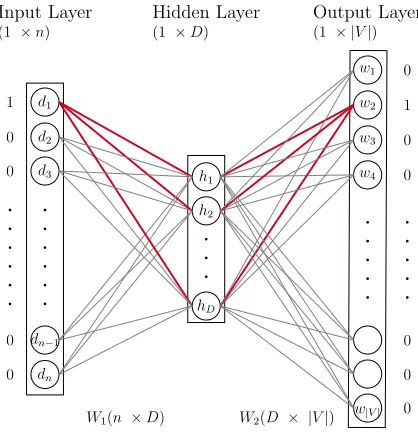
window. The structure of the PV-DBOW is simple: it is just a single layer neural
network, as shown in Fig. 12.
For each document, in each iteration of training progress, it randomly selects k
words from the document, and use the chosen words and document id di to create
k training pairs, [d1, w1],[d1, w1], ...,[d1, wk]. The training pairs are used to train the
document representation for the document di.
The input layer X is a one-hot vector, representing the document id. The length
4. NEURAL NETWORK METHODS . . . . . . . . . . . . . . Input Layer
(1 ×n)
W2(D × |V|)
W1(n ×D)
Output Layer
(1 × |V|)
Hidden Layer
(1 ×D)
d1
d2
d3
dn−1
dn h1 h2 hD w1 w4
w|V|
w3 w2 1 0 0 0 0 0 . . . . . . 0 0 0 0 1 0 . . . . .
Fig. 12: Structure of PV-DBOW
of the document with id 1, it sets 1 in the first location of the vector and 0s in other
locations.
The weight matrix W1 between the input layer and the hidden layer, also called
the document embedding matrix; this matrix is used to represent the documents.
The shape of the matrixW1 isn×d, wherenis the number of the document, anddis the dimension of the document representation set by users. There is no bias between
the input layer and the hidden layer.
Multiplying the X and W1 can get the hidden layer. Since the input layer is
just the one-hot vector for document id and W1 is the representation matrix for the
document representation matrix, the hidden layer here is the vector representation
for the training document.
The weight matrix W2 called the output matrix. The shape of W2 is d× |V|, where V is the vocabulary size. Then it uses the hidden layer to multiply with W2
can get the output layer. Finally, it applies the softmax on the output layer to get
the probability of words.
The object is to maximize the probability of the target word. Comparing the
probability of the probability generated from the output layer with the truth value
4. NEURAL NETWORK METHODS
loss to do the backpropagation to update the weight. After training, the well-trained
weight matrix W1 is the document representation matrix. The objective function of
PV-DBOW is shown in Equation 1:
J(θ) =−
n X
i=1 X wt∈di
logP(wt |di;θ) (1)
where wt are words randomly sampled from the document,n is the total number
of documents, di means document i.
Using softmax at the prediction step is expensive since for one document, it needs
V computations each iteration, here V is the vocabulary size. Thus, it can use the
Negative Sampling to reduce the time complexity. The negative sampling random
sample s negative terms (words not in document) and use the gradient ascent to
optimize the weights. Equation 2 is the probability function is used to sample the
negative terms.
P(wi) =
f(wi)3/4 Pn
j=0(f(wj)3/4)
(2)
where wi is the the word to select, f(wi) and f(wj) is the frequency of word wi
and wj appears in the corpus.
Without negative sampling, the model needs to update D× |V| weights in W2, since it needs to consider the probability of all words in the output layer. While with
negative sampling, it only needs to consider the probability of the target word and
the s negative sample. For example, if D= 100 and |V|= 10,000, without negative sampling, it needs to update 100×10,000 = 1,000,000 weights for W2; but with 5 negative samples, it only needs to update 100 ×(5 + 1) = 600 weights for W2. Complexity decreased dramatically. The objective function is changed with negative
sampling, is shown in equation 3:
Ji(θ) = X wt∈di
(logσ(vw2tdi) +
s X j∼P(w)
4. NEURAL NETWORK METHODS
uments, s is number of negative samples, σ(x) = 1
1+e−x is the sigmoid function.
4.2
Doc2Vec with Corruptions
4.2.1
Doc2Vec PV-DM
Doc2vec with Corruption[5] is the variant of the Doc2Vec PV-DM model, which takes
the context words and the document ID as input and predicts the central words of
the context. Firstly, let us view the structure of the PV-DM that is shown in Fig. 13.
. . . . . . . Input Layer
W11(V × D)
W12(N × D)
Output Layer
(1 ×V)
Hidden Layer
(1 ×D)
. . . . . . . . . .
Input V ector X1
(1 × V)
Input V ector X2
(1 × N)
W2(D × V)
Fig. 13: Structure of PV-DM
It is a single layer neural network as well. In the input layer, it takes two vectors
as input; first is the vectorX1 for context words, it sets 1 to all context words and 0
to others; another is the one-hot vectorX2 for document id.
Between the input layer and the hidden layer, there are two weight matrices; the
matrixW11is the words embedding matrix, which is used to store the representations
of the words; another matrix W12 is the documents embedding matrix which stores
4. NEURAL NETWORK METHODS
the context words vectors and uses X2×W12 to get the document representation for the document. Then it takes the average of the above results to get the hidden layer.
Then it uses the hidden layer to multiply the output matrix W2 to get the output
layer. Finally, it applies the softmax on the output layer to get the probability of
words.
The object is to maximize the probability of the central word. Comparing the
probability of the probability generated from the output layer with the truth value,
it can get the loss. Then it can use the loss to do the backpropagation to update
the weight. After training, the weight matrix W12 is the matrix to represent the
documents, and it can also get the weight matrixW11, which is the words embedding
matrix. Since the document representation matrix acts as a memory, which stores
the missing information here, it called the Distributed Memory version of Paragraph
Vector. The objective function of PV-DM is shown in equation 4:
J(θ) =−
n X
i=1 T−k X t=k+1
logP(wt |wt−k:wt+k;di;θ) (4)
where n is the total number of documents, k is window size, T is the length of
document di.
4.2.2
Doc2Vec with Corruption
The author of the Doc2VecC changed the structure of the PV-DM a little and
im-proved the performance and training speed a lot. In PV-DM, each document is
represented by a unique vector, but in Doc2VecC, they remove this vector. Instead,
they use the average of the words vectors in the documents. Fig. 14 shows the
structure of the Doc2VecC.
There are two vectors at the input layer as well. One is the vectorX1 for the
con-text words, which is the same as the PV-DM model. X2 is the vector that represents
the words randomly sampled from the document.
mask-out/drop-4. NEURAL NETWORK METHODS . . . . . . . Input Layer
W1(V × D)
Output Layer
(1 ×V)
Hidden Layer
(1 ×D)
. . . . . . . . . .
Input V ector X1
F or context words
(1 × V)
Input V ector X2
F or random sampled words
(1 × V)
W2(D × V)
Fig. 14: Structure of Doc2VecC
ument. Then it randomly set the values in the TF representation with the probability
q. Then it uses the 1/(1−q) to multiply with the rest values to get the new vector e
x. To summarize:
e xd=
0, with probability q
xd
1−q, otherwise
(5)
where exd is the values in the new vectorxeand xd is the original values in the TF representation for the document. Finally, it times the D1
i to the xe to get the input vector X2, Di is the document length for document i.
Between the input layer and the hidden layer, there is only one weight matrixW1,
which is the words representation matrix. X1×W1gives the sum of the words vectors of the context words, X2×W1 gives the average of the sum of the words vectors for words random sampled, and sum the above two results can get the hidden layer. The
following structures are the same as the PV-DM model, times the hidden layer with
the output matrix W2 to get the output layer and use the softmax to calculate the
probability and compare with the truth, get the loss to make gradient descent. The
4. NEURAL NETWORK METHODS
After the training, it can give a well-train words representation matrix W1, and
the document is represented by the average of the embeddings of the words in the
documents like equation 6 shows.
Vi = 1 Di
X w∈di
vw (6)
where Vi is the representation for document di, Di is the document length for di
CHAPTER 5
Experiments
5.1
Datasets
There are three aspects of the dataset considered as the main features when we collect
the data. One is the size of the dataset since we want to figure out whether the size
of data plays an essential role in the vectorized step. Another feature is the average
length. The third feature is the vocabulary size of the data, which can also influence
the performance of the vectorizing and classification results. The detailed information
of all the datasets used in this thesis is showing in Table 10.
Dataset # of Documents # of classes Vocab Size Average Length CV of Length CV of CTF
Datasets from Others
AG’s news 127,600 4 63,152 36 0.28 18.22 Reuters 4,000 2 15,907 91 1.07 11.09 Yelp Review Polarity 598,000 2 221,477 126 0.92 40.94 IMDB 100,000 2 138,514 225 0.75 34.27 20 News Group 1,985 2 25,073 235 2.57 13.39 Full Movie Review 2,000 2 38,880 627 0.44 17.76 arXiv CS vs., non-CS 240,000 2 163,543 145 0.43 40.32 Long arXiv CS vs., non-CS 200,000 2 1,606,482 1,100 0.66 117.50
Math vs., Physics 200,000 2 1,412,812 1,071 0.64 120.02 Business vs., not 8,000 2 157,844 1,081 0.60 39.90 AI vs., Machine Learning 8,000 2 145,001 1,085 0.64 34.13
5. EXPERIMENTS
5.1.1
Data Description
AG’s News
The AG(Antonio Gulli)’s corpus of news articles contains millions of news. It collects
news from more than 2000 news sources. Each data consists of a title and a short
description of the news. In our thesis, we use the largest four groups of news: Business,
Sports, World, and Sci/Tech. The dataset contains 127,600 documents, and they are
divided equally into four groups (31900 documents each class). This dataset is used
in [24][6].
Reuters News
Reuters News is a publically available version of the well-known Reuters-21578
“Mod” corpus for text categorization. It has been used in publications like [23].
Apte-Mod is a collection of 10,788 documents from the Reuters financial newswire service.
There are 90 categories in the corpus. In our experiments, we randomly select 4,000
documents from the largest two categories (‘earn’ and ‘acq’) equally.
Yelp Review Polarity
The Yelp Review dataset[24] is an open-source dataset provided by Yelp for NLP
training. The data we use in this thesis contains 598,000 reviews, and the dataset is
divided into two groups, positive and negative equally. This dataset is used in [24].
IMDB
The IMDB dataset[11]1 is the famous and common dataset for the sentiment analysis
and text classification. It contains 10,000 movie reviews that are taken from IMDB
(Internet Movie Database). The dataset is divided into three sub-dataset: 25,000
training data, 25,000 testing data, and 50,000 unlabeled data. In our experiments,
we mix the training and test datasets and used the 10-fold cross-validation. For
5. EXPERIMENTS
embeddings. There are only two classes in this dataset, positive and negative.
20 NewsGroups
The 20 Newsgroups dataset2 is a collection of approximately 20,000 newsgroup
docu-ments, partitioned (nearly) evenly across 20 different newsgroups. In our experiment,
since we want to conduct a dataset with the long average length, we only use two
newsgroups to do the classification task, which is “comp.windows.x” group (988
doc-uments) and “soc.religion.christian” group (997 docdoc-uments), we denote this dataset
as “XReligion”.
Full Movie Review
The Full Movie Review dataset[15] consists of 2000 full-length movie reviews. The
dataset is divided into two groups, positive and negative equally. Full Movie Review
is the dataset with the highest average length in our experiments.
arXiv
ArXiv is an open-source academic papers library that was started in 1991 and
main-tained by Cornell University Library. It collected millions of academic papers in areas
such as physics, mathematics, computer science, statistics, etc. The official website
provides access to download the full-text data (pdf format and LaTex format) and
the metadata. For the metadata, we can use the provided API to get the paper
ID, title, abstract, and author. We used the API to collect the metadata of papers
from 1990-01-01 to 2018-08-31. After removing the duplicates, there are 1,402,977
papers in total. Including 151,321 Computer Science papers, 314,003 Math papers,
19,615 Statistics papers, 15,285 Quantitative Biology papers, 59,65 Quantitative
Fi-nance papers, 278 Electrical Engineering and Systems Science papers and only 1,696
Economics papers, and the rest are 894,814 Physics papers. All the labels of the
arXiv documents are labelled by the author. In our experiments, directly do the
5. EXPERIMENTS
classification experiment on the entire data is too time-consuming, especially we are
running 10-fold cross-validation. To reduce the size of the data, we randomly select
120,000 docs from both the Computer Science category and non-CS categories, we
make them balanced. We denoted this dataset as “arXiv”; the papers in this dataset
only contain the title and abstract.
We also downloaded the full-text data in LaTeX format. Moreover, we had
ex-tracted the paper ID and the introduction subsection of papers. Then we merged the
introduction subsections and the title and abstracts we previous had according to the
paper ID and got the Long arXiv data set. In our experiment, we tested on a few
com-binations of the classes; all comcom-binations are balanced with docs sampled randomly.
Those combinations are arXivLongCS (CS vs. non-CS), arXivLongBN (Business vs.
non-Business), arXivLongMP (Math vs. Physics), AILG (AI vs. Machine Learning3).
5.1.2
Observation of Datasets
Fig. 15 shows the distribution of the document lengths for every dataset, the
x-axis is the lengths of the documents, and the y-x-axis is the percentage of the length
occurrence. Fig. 16 and 17 show the distribution of the CTF. We also list the
coefficient of variation of the length and CTF of all datasets in Table 10. The reason
for studying the distribution of CTF is that the CTF plays an important role in our
MI representation method. From Fig. 17 and 16, we can observe that all the data
follow Zipf’s Law. Since the CTF for different words can be different, the coefficient
of variation of CTF should be huge can related to the vocabulary size. Table 10 shows
that the CTF of all datasets follows the above pattern. From Fig. 15 and Table 10,
we can know that all the distribution of the length follows or closes to the normal
distribution, besides the Reuters and XReligion. The coefficient of variation of the
length distribution of XReligion is significantly large; it has many documents that
only include few words and many documents with thousands of words.
3In the official description, the AI labels cover all areas of AI except Vision, Robotics, Machine
5. EXPERIMENTS
5. EXPERIMENTS
5. EXPERIMENTS
5. EXPERIMENTS
5.2
Experimental Setup
In our experiments, we use the standard 10 fold cross-validation to evaluate the
performance. N fold is the dataset splitting technique. For example, if we use
10-fold, we divide the dataset into 10 parts at the beginning. First, we use [0,101] part
of the data to be the test set, and use [101 ,1010] part of the data to train the classifier.
And in the second iteration, use [101,102] part of the data to be the test set, and use
[0,101 ]S [102 ,10
10] part of the data to train the classifier. Iterate 10 times until all parts of the data have been tested and assigned a predicted class label. 10-fold
cross-validation is time-consuming, but the result is reliable. In our experiments, we use
ten 10-fold cross-validations to ensure the accuracy of the result.
Based on the results of the cross-validation, TP(True Positive), TN(True
Nega-tive), FP(False PosiNega-tive), FN(False Negative) are obtained. Thus we can evaluate the
results according to the F1 score as follows:
P recision= T P T P +F N
Recall= T P
T P +F P (1)
F1 = 2×
P recision×Recall P recision+Recall
The above formula is for the F1 for the binary classification problem, but we have
the multi-classes in one of our datasets, we can use themacro-F1[18] to evaluate the
result. The formula for macro-F1 is shown as bellow.
Macro-Precision = P recision1+...+P recisionn n
Macro-Recall = Recall1+...+Recalln
n (2)
Macro-F1 = 2× Macro-Precision×Macro-Recall
5. EXPERIMENTS
Datasets TF-IDF MI
AG’s news 0.8831 0.8804
Reuters 0.9823 0.9814
Yelp Review 0.9165 0.9099
arXiv 0.9304 0.9343
IMDB 0.8864 0.8846
XReligion 0.9700 0.9727
Full Movie Review 0.8662 0.8834
AILG 0.8803 0.8849
arXivLongBN 0.9822 0.9819
arXivLongMP 0.9733 0.9747
arXivLongCS 0.9618 0.9638
Table 11: Macro-F1 score of MI representation and TF-IDF representation on all datasets used in our thesis (Higher is better). Bold means better in that datasets.
5.3
Comparison of MI and TF-IDF
Firstly, we evaluated the performance of our MI representation against the TF-IDF.
Table 11 shows the macro-F1 score of two methods. Fig. 18 shows the
improve-ment ratio of the MI representation comparing to the TF-IDF representation; the
formula for improvement ratio is shown below. Here F1a is the macro-F1 of the MI
representation, and F1b is the macro-F1 of the TF-IDF representation.
Improvement Ratio = F1a−F1b F1b
×100 (3)
The order of the datasets in the above graph is sorted by average length. Fig. 18
shows that MI outperforms TF-IDF when the average length of the datasets is long.
The improvement ratio is especially high for the FullMR dataset. We also make a
significant test on the results to check the p-value, since we want to make sure the