ISSN(Online): 2319-8753 ISSN (Print): 2347-6710
I
nternational
J
ournal of
I
nnovative
R
esearch in
S
cience,
E
ngineering and
T
echnology
(A High Impact Factor, Monthly, Peer Reviewed Journal)
Visit: www.ijirset.com
Vol. 8, Issue 3, March 2019
E-Parking Reservation system based on IoT
for smart cities
G.K.Jakir Hussain1, O.S.Dharshini2, G.U.Kavipriya2, G.Jeevanandhini2
Assistant Professor (Selection Grade), Department of Electronics and communication Engineering, KPR Institute of
Engineering and Technology, Coimbatore, Tamil Nadu, India. 1
UG Student, Department of Electronics and communication Engineering, KPR Institute of Engineering and
Technology, Coimbatore, Tamil Nadu, India. 2
ABSTRACT: The concept of smart cities has gained great popularity in recent times. Because of the evolution of IoT the idea of smart city now seems to be achievable. To maximize the productivity and reliability of urban infrastructure consistent effects have been taken in the field of IoT. In the proposed system, we have built an IoT based Smart Parking System to address the problems such as, traffic congestion, limited car parking and road safety.An IoT module in the Smart Parking System is used to monitor and signalize the state of availability of each single parking slot. An end user can check the availability of parking slot and can book the slot accordingly through mobile application. The Optical Character Recognition is utilized to provide security using Raspberry-pi and the prototype based on Smart Parking System using IoT provides a solution to reduce the fuel consumption, traffic congestion and road safety.
KEYWORDS: Smart Parking System(SPS), Internet of Things(IoT), Raspberry-pi, Optical Character Recognition, Raspbian OS.
I. INTRODUCTION
An Internet of Things (IoT) was first introduced in 1999 and was first used by Kevin Aston at auto ID centre. The Internet of Things promises to connect all the real time objects to a network and they are communicating with each other with less involvement of humans. The magic of IoT is inter -communication of things using Internet. The two spectacular words in IoT are “Internet” and “Things”. Internet of Things is shortly defines as the real time objects in environment are attached with the sensors and controllers and they are connected to a network through wireless or wired connections. These connected devices are called Smart objects or Smart devices. The important benefits of Internet of things includes instantaneous response and control, sensor based decision, continuous tracking behavior etc. This IoT technology is prominent in various fields of applications some of them are smart grids, smart lighting, smart energy and smart cities etc.
One third of the world’s people are living in cities. The increasing vehicle on the road along with lack of available parking space has created parking related problems as well as increased the traffic congestion in urban areas. Finding of parking slot in cities is a hectic job for drivers to park their vehicles. Thus it is required to develop an automated Smart Parking management System it not only provides the driver to locate a suitable parking slot but it also reduces the fuel consumption as well as air population. It has been found that the parking of the vehicle in the suitable slot takes almost 15 minutes which increases the fuel consumption, traffic congestion and air pollution.
ISSN(Online): 2319-8753 ISSN (Print): 2347-6710
I
nternational
J
ournal of
I
nnovative
R
esearch in
S
cience,
E
ngineering and
T
echnology
(A High Impact Factor, Monthly, Peer Reviewed Journal)
Visit: www.ijirset.com
Vol. 8, Issue 3, March 2019
drivers rush to fill the limited spaces. So to address these issues we proposed an idea of reservation of parking slot using an IoT. Thus, this provides an IoT based E-parking system to address the following issues.
1. Real-time detection of improper parking.
2. Estimation of each vehicles duration of parking usage.
II. RELATED WORK
Over the past few years, there are significant numbers of smart parking systems are proposed and they are based on various technologies using optic Wireless Sensor Network(WSN),Radio Frequency Identification(RFID),Bluetooth and Zigbee sensors, IR sensors,VANET etc. Among these, a WSN based SPS proposed in [1] make use of low-cost sensor node and they deployed in the parking slots to monitor the status of the slot.The detected status is periodically reported to a database through the WSN gateway at the parking lot.
On the other hand, RFID based smart parking system proposed in [2] uses RFID reader and RFID tag for automatic check-out and check-in. The vehicle’s unique RFID tag value is read by the RFID reader in the parking lot entrance should need to match with the database value. A Vehicular ad hoc Network (VANET) system proposed in [3] is only suitable for large parking area. This system provides friendly parking information and navigation of parking slot in real time.
A parking system based on Bluetooth and Zigbee technology proposed in [4] is used for verifying the identity of the driver and also to find and book the vacant slot. The vacant slots are detected by using the Zigbee sensors deployed in each slot. The IR sensor based parking system proposed in [5] uses feedback mechanism to check whether the slot is empty or not. It is used to monitor the parking spaces. An efficient resource allocation-based parking system proposed in [6] which provide a driver to find the parking space at low cost and guaranteed parking reservation system. In the proposed system,we make use of all mixed linear integrated programming.
III. SYSTEM MODEL
ISSN(Online): 2319-8753 ISSN (Print): 2347-6710
I
nternational
J
ournal of
I
nnovative
R
esearch in
S
cience,
E
ngineering and
T
echnology
(A High Impact Factor, Monthly, Peer Reviewed Journal)
Visit: www.ijirset.com
Vol. 8, Issue 3, March 2019
The above figure shows the model of the system in which the client get the parking information through an app.Firstly, the user need to create an account in mobile application .The user has to login to his account to book a parking slot to park his vehicle. Once his vehicle reaches the parking slot, the vehicle license plate number is verified with the vehicle number stored in the database. This verification is done to avoid unauthorized parking in slot. The vehicles license plate image is captured and image processed for the verification .Once the verification process completed, the vehicle is allowed to occupy the booked slot. After the successful occupancy of the slot, the parking time starts. So, once the driver takes his vehicle from the slot the time stops and the parking charge bill is sent to his mail. The payment may be done by paying cash or using card.
IV. IMPLEMENTATION
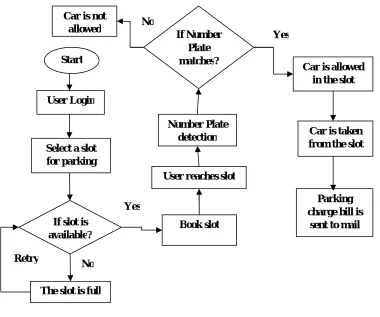
As the architecture is discussed in Section III, the working of the proposed system is explained with the help of a flowchart as given in Figure 2.
We implemented the system as a prototyping model with mobile app and toy car, but this system could be implemented in malls and multistory buildings, parking areas. The following procedure have been designed for booking a parking slot in our prototyping model.
Step 1: Install the app in mobile.
Step 2: create a new account by entering the credentials.
User Login
Select a slot for parking
User reaches slot Number Plate detection Start If Number Plate matches?
Car is allowed in the slot
If slot is available?
The slot is full
Car is taken from the slot
Parking charge bill is
sent to mail Car is not
allowed No
Yes
Yes
No Retry
Book slot
ISSN(Online): 2319-8753 ISSN (Print): 2347-6710
I
nternational
J
ournal of
I
nnovative
R
esearch in
S
cience,
E
ngineering and
T
echnology
(A High Impact Factor, Monthly, Peer Reviewed Journal)
Visit: www.ijirset.com
Vol. 8, Issue 3, March 2019
Step 3: Login to the registered account. Step 4: Select the location to park the vehicle. Step 5: Select the slot number for booking.
Step 6: If the selected slot is available, the app asks the user to enter the License plate number.
Step 7:After the vehicle reached the parking slot and then the verification process starts(only after the verification vehicle is allowed to occupy the slot).
Step 8: The parking charge is calculated from the slot occupancy time of vehicle. Then the parking charge bill is sent to the mail.
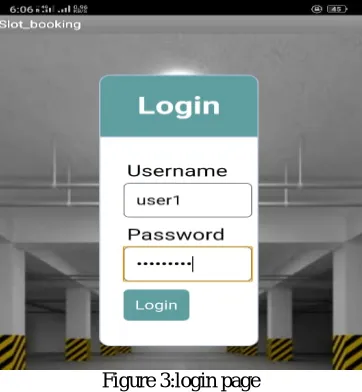
The bookingstepsare illustrated with figure.The figure 3 shows the login of the mobile app.
Figure 3:login page
If the user need to book a slot,then he needs to login to the registered account .After the login user allows to select the parking slot.The vehicle’s license plate numer and the mail id are neeeded book the slot.
ISSN(Online): 2319-8753 ISSN (Print): 2347-6710
I
nternational
J
ournal of
I
nnovative
R
esearch in
S
cience,
E
ngineering and
T
echnology
(A High Impact Factor, Monthly, Peer Reviewed Journal)
Visit: www.ijirset.com
Vol. 8, Issue 3, March 2019
The screenshot of slot list and slot booking page are shown in the figur 4and 5. From the list of parking space we can select the empty slot for parking.If the selected slot is free then it asks for vehicle number and Email id.By entering the details and click book slot to confirm the booking of the slot.
V. RESULTS OF LICENSE PLATE RECOGNITION
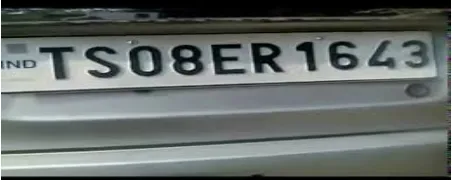
Once the vehicle enters the parking slot, the vehicles license plate image is captured and processed [8][9]for allowing the vehicle to park in the authorized slot. The image is processed with OpenCV Optical Character Recognition (OCR) and text recognition with Tesseract. The figure 6 shows the original image captured by the camera..
Figure 6: original image
Figure 7: character detection Figure 8: Recognized character
Then the image is processed. The image processing process has three important stages such as detection of license plate and recognition of character. The figure7 shows the character detection and figure 8 shows the recognized character.
VI. CONCLUSION
The Smart cities concept has always been a humanity dream. Great progress has been made in making smart cities a reality since the last couple of years. In terms of smart cities, the growth of the Internet of Things (IoT) and cloud technologies has created new possibilities. The core of building smart cities has always been smart parking facilities and traffic management systems. In this paper, we addressed the parking issue and present a integrated smart parking system based on IoT . The system we are proposing provides information on the availability of parking slots in a parking area in real time. User from remote locations could use our mobile application to book a parking slot for them. The efforts made in the paper are focused mainly on improving a city’s parking facilities and thus aiming to improve its people’s quality of life.
REFERENCES
[1] “Smart parking: An application of Optical Wireless Sensor Network”, Proceedings of the 2007 International Symposium on Applications and the Internet workshops(SAINTW’07),2007.
[2] “Automated vehicle parking using RFID”,ITSI- Transactions on Electrical and Electronics Engineering(ITSI-TEEE),Volune-1,Issue-2,2013. [3] R. Lu, X. Lin, H. Zhu and X. Shen, “SPARK: A New VANET Based Smart Parking System for Large Parking Lots”, IEEE INFOCOM 2009,
Rio de Janeiro,2009,pp.1413-1421:doi:10.1109/INFCOM.2009.5062057.
ISSN(Online): 2319-8753 ISSN (Print): 2347-6710
I
nternational
J
ournal of
I
nnovative
R
esearch in
S
cience,
E
ngineering and
T
echnology
(A High Impact Factor, Monthly, Peer Reviewed Journal)
Visit: www.ijirset.com
Vol. 8, Issue 3, March 2019
[5] Smart Parking Assist system using IOT, International Journal of Control Theory and Applications, volume9-Number 40,2016.
[6] A.O. Kotb, Y.C.Shen ,X. Zhu and Y. Hung,“Parker-A New Smart Car-Parking System Based on Dynamic Resource Allocation and Pricing” IEEE Trans.Intell.Transp.Syst.,vol.17,no.9,pp.2637-2647,2016.
[7] “Design of Automatic Number Plate Recognition on Android Smartphone Platform “Indonesian Journal of Electrical Engineering and computer science,vol.5,No.1,Jan 2017,DOI:10.11591.
[8] Karthikeyini.C,Rajamani.V & Bommanna Raja.K , “Exploring finger prints using composite minutiae descriptors to determine hereditary relation across multiple generations”, International Journal of Biomedical Engineering and Technology,Inderscience ,volume 15,No 3 ,pp.224-242,2014.