Vol. 3, Issue 12, December 2015
Scenario Based Performance and
Comparative Simulation Analysis of Routing
Protocols in MANET
Rashmi Pathak, Prof. Ajay Lala
Research Scholar, Dept. of Computer Science & Engineering, Gyan Ganga College of Technology, Jabalpur, India
Professor, Dept. of Computer Science & Engineering, Gyan Ganga College of Technology, Jabalpur, India
ABSTRACT
:
A mobile ad-hoc network (MANET) is composed of mobile nodes without any infrastructure. Mobile nodes self-organize to form a network over radio links. The goal of MANETs is to extend mobility into the realm of autonomous, mobile and wireless domains, where a set of nodes form the network routing infrastructure in an ad-hoc fashion. The majority of applications of MANETs are in areas where rapid deployment and dynamic reconfiguration are necessary and wired network is not available. These include military battlefields, emergency search, rescue sites, classrooms and conventions, where participants share information dynamically using their mobile devices. These applications lend themselves well to multicast operations. In addition, within a wireless medium, it is crucial to reduce the transmission overhead and power consumption. Multicasting can improve the efficiency of the wireless link when sending multiple copies of messages by exploiting the inherent broadcast property of wireless transmission. Hence, reliable multicast routing plays a significant role in MANETs. However, to offer effective and reliable multicast routing is difficult and challenging. In recent years, various multicast routing protocols have been proposed for MANETs.KEYWORDS: Mobile ad-hoc network (MANET); Multicast routing protocol; Taxonomy; Mobile node; Routing table
I.INTRODUCTION
Vol. 3, Issue 12, December 2015
Figure 1.1 Mobile Ad hoc Network
II.ROUTINGPROTOCOLS
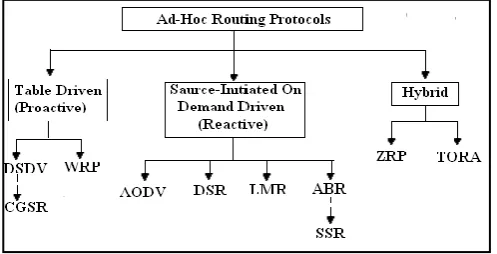
Depending on the application, different architectures and design goals/constraints have been considered for adhoc networks [5]. Performance of a routing protocol is closely related to the architectural model. So, routing protocols have been categorized under different sections shown in fig. Although aim of these protocols is the same: maximize throughput while minimizing packet loss, control overhead and energy usage still they give different results in different scenarios. Routing protocols are categorized under following headings but they are interrelated or dependent on each other.
Figure 1.2 Classifications of MANET Protocols
A. Source-Initiated Routing Protocols (Reactive protocols)
Source-initiated routing represents a class of routing protocols where the route is created only when the source requests a route to a destination. Routing process is subdivided into route discovery and route maintenance [19]. The routing process starts with route discovery in which network is flooded with route request packets. Once a route or multiple routes are obtained to the destination
.
Few of the reactive protocols are under listed:Dynamic Source Routing (DSR)
Vol. 3, Issue 12, December 2015
B. Proactive Routing Protocols (Table driven)
The class of proactive protocols maintains updated information of routes at every node about the source and destination of a packet[17]. Also, route updates are propagated throughout the network to keep the routing state information up to date. Few of the proactive protocols are as follows.
Destination-Sequenced Distance vector (DSDV) Optimized link state routing (OLSR)
Cluster head gateway switch routing (CGSR) Wireless routing protocol (WRP)
C. Hybrid Protocols
The hybrid routing schemes combine elements of reactive and proactive protocols. It has been observed that the areas where the links change relatively slowly are more compliant to proactive protocols whereas the areas of high mobility are more appropriate for reactive protocols.[1] after combining the concepts of both we get hybrid protocols which increases the overall performance of packet routing[14]. Hybrid protocols are as follows:
Zone routing protocol (ZRP) Fish eye state routing (FSR)
Landmark Adhoc routing (LANMAR) Distributed dynamic routing (DDR) Hybrid ant colony optimization (HACO)
Adhoc networking with swarm intelligence (ANSI)
D. Location Aware
Location Aware protocols represent the collection of protocols in which the co ordinates of the respective nodes are determined by Global positioning system and the location of every node is known to every other node. This class of protocols participates in predictive routing[11]. As the position of a node changes due to mobility, routes from source to destination needs to be updated. In [8] authors have used the concept of location aware routing to predict the nodes mobility to find optimized route from source to destination. Few representatives of this class are:
Location Aided Routing (LAR)
Distance Routing Effect Algorithm for Mobility (DREAM) Greedy perimeter state routing (GPSR)
Dynamic route maintenance (DRM)
E. Multi-path
Adhocnetworks are a collection of nodes scattered over a large area and connected through wireless links. Fig .There may be set of hops between source and destination and multiple paths or routes through which the data packets can travel. So the shortest or optimal path for packet delivery should be chosen. The main advantage of this scheme is the path with less number of hops or less congested may be chosen in order to deliver the packet in time securely[13]. Protocols under this section are:
Caching and multipath routing protocol (CHAMP) Split multipath routing (SMR)
Secure multipath routing (SecMR)
F. Hierarchical Protocols
As the size of network increases, routing table sizes and control packet overhead also increase. The main idea behind hierarchical protocols is to reduce this overhead. Hierarchical ad hoc routing clustering techniques to form tree like structure of nodes. Nodes at the higher levels of the hierarchy provide special services, improving the scalability and the efficiency of routing. [19] Hierarchical state routing (HSR), Core extraction distributed adhoc routing and hierarchical landmark routing are few protocols under this class.
G. Multicast Protocols
Vol. 3, Issue 12, December 2015
Dynamic core based multicast routing (DCMP) Energy efficient multicast routing Genetic algorithms for group multicast Content based multicasting (CBM).
III.EXISTING SYSTEM
In existing framework, inspects two directing conventions for versatile specially appointed networks– the Destination Sequenced Distance Vector (DSDV), the table-driven convention and the Ad hoc On-Demand Distance Vector steering (AODV)[19], an On –Demand convention and assesses both conventions in view of parcel conveyance portion and normal deferral while differing number of sources and stop time in vicinity of UDP movement having 50 hubs in the system. In this situation, all recreation result has finished with 15 and 30 wellspring of hubs. All re-enactment has done in Network Simulator 2. In existing framework having number of test system parameters utilized that is hub development model is Random waypoint, pace of hub is 0.25 m/s, transfer speed of the channel is 2Mb/s and transmission scope of the system is 250m. It likewise depicts the quantity of properties of steering convention and one of the properties Quality of administration clarified in subtle elements. After reproduction it break down that both of the conventions convey a more noteworthy rate of the began information parcels when there is little hub versatility, joining to 100% conveyance proportion when there is no hub movement. The parcel conveyance of AODV is practically free of the quantity of sources. AODV experiences end to end delays. DSDV parcel conveyance division is low for high portability situations. They infer that the AODV convention is the perfect decision for correspondence when the correspondence needs to happen under the UDP convention as the base.
IV.PROPOSED WORK
MANET has various steering conventions having distinctive properties which work in diverse size of the system because of element nature. The target of our work is to look at the execution and discovering re-enactment consequence of three existing steering conventions taking into account Table Driven and On interest conduct, specifically, Destination Sequenced Distance Vector (DSDV), Ad-hoc On-Demand Distance Vector (AODV) and Dynamic Source Routing (DSR) in the vicinity of diverse sorts of situation where ceaselessly expanding the quantity of hubs and they impart or change of parcel conveying from source hub to destination take long time. For versatile specially appointed systems taking into account the execution, and correlation has been made on the premise of their properties like throughput, Packet Delivery Ratio (PDR) and End to End Delay between two distinct situations – one by differing the quantity of hubs, and second by shifting the re-enactment time. In proposed work, we have made an investigative situation that demonstrates an examination structure for the general system conventions execution test. In this situation, we first recreate the general execution of each of the three conventions by utilizing ns-2 test system and discover their name yield. Second, we assess the execution of the convention which depends on three executions metric to be specific end to end delay, bundle conveyance proportion and throughput. At long last, we look at the execution of each steering convention over their outcome and examine the better execution between them.
The fundamental goal is to examine the working of AODV, DSR and DSDV conventions of MANET and to dissect which convention gives best result in distinctive situations. In the study we would perform the following:
i. Consider a MANET: Generally MANET has dynamic topology; power conservation is crucial and has variable capacity wireless links.
ii. Analysis of the protocols AODV, DSR and DSDV: The protocols AODV, DSR and DSDV can then be implemented on that network to observe their working.
iii. Analysis of the traffic pattern: The traffic pattern can be TCP or UDP according to the type of packets transmitted.
iv.
Analysis of the functionality of the protocols AODV, DSR and DSDV according to the performance parameters.
V.PERFORMANCE METRIC
Some following important performance metrics can be evaluated:-
Vol. 3, Issue 12, December 2015
ii. Throughput (messages/second): - The ratio of the number of data packets sent and the number of data packets received. Throughput of the protocol shows number of messages delivered per one second.
iii. Average End-to-End delay (seconds): - This metric is calculated by subtracting “time at which first packet was transmitted by source” from “time at which first data packet arrived to destination”. This includes all possible delays caused by buffering during route discovery latency, queuing at the interface queue, retransmission delays [16] at the MAC, propagation and transfer times.
VI.SCENARIO OF SIMULATION SETUP
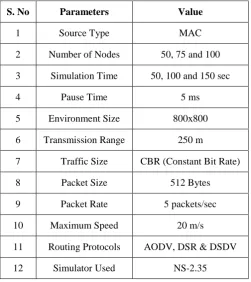
Every single broad reproduction was led utilizing NS-2.35. The recreated system comprised of 50, 75 and 100 hubs arbitrarily scattered in 800x800m territory at the beginning time of the reproduction. All re-enactment parameter are depicted in beneath table 1:
In this situation, I have taken two On Demand (Reactive) directing conventions, in particular AODV, DSR and one proactive steering convention DSDV. For all recreation result assess at diverse reproduction time like 50, 100 and 150 sec. at greatest rate of the hubs is 20 m/s and stop time is steady set to 5ms and the quantity of hubs is fluctuating as 50, 75, and 100. Transmission scopes of the system for conveyance the parcels starting with one hub then onto the next is 250 m.
Table 1.1 Simulation Parameter
VII.RESULTS ANDDISSCUSSION
SCENARIO 1
In this situation, the execution of convention contrast with deference with their bundle conveyance proportion estimation, and the quantity of hubs joined in a system as fluctuating with reproduction time to changing the quantity of
S. No Parameters Value
1 Source Type MAC
2 Number of Nodes 50, 75 and 100
3 Simulation Time 50, 100 and 150 sec
4 Pause Time 5 ms
5 Environment Size 800x800
6 Transmission Range 250 m
7 Traffic Size CBR (Constant Bit Rate)
8 Packet Size 512 Bytes
9 Packet Rate 5 packets/sec
10 Maximum Speed 20 m/s
11 Routing Protocols AODV, DSR & DSDV
Vol. 3, Issue 12, December 2015
associations, through which the correlation charts of AODV, DSDV and DSR got. All perception charts are appeared as below:
Figure 1.3 Comparison Graph between Packet Delivery Ratio vs Simulation time at 100 nodes
AODV and DSDV is higher than DSR at present for 50 hub in the system yet as the activity will increment with the quantity of hubs, for example, 75 and 100 hubs in the system, the PDR estimation of DSDV is most noticeably bad in more noteworthy number of hubs with long recreation time.
SCENARIO 2
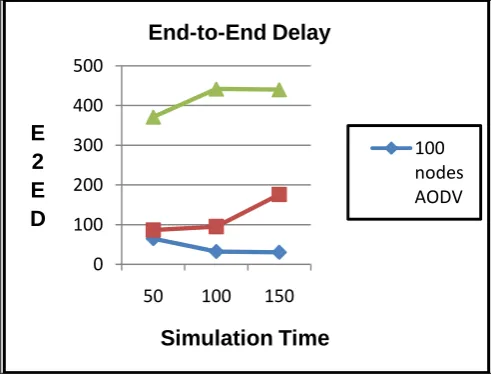
In this situation, the execution of convention looks at between normal End-to-End delay and recreation time alongside vicinity of movement hubs 50, 75 and 100 with fluctuating number of reproduction time i.e. 50, 100 and 150 sec in the system. The correlation diagrams between AODV, DSDV and DSR convention appeared in below.
Figure1.4 Comparison Graph between End-to-End Delays vs. Simulation time at 100 nodes
The figure demonstrates that at first for 100 hubs the End-to-End Delay for DSDV indicates most astounding worth as correlation to AODV and DSR. AODV again demonstrate low values at each purpose of re-enactment time in light of the fact that less estimations of AODV demonstrate the better execution.
0 0.2 0.4 0.6 0.8
50 100 150
P
D
R
Simulation Time
Packet Delivery Ratio
100 Nodes AODV
0 100 200 300 400 500
50 100 150
E
2
E
D
Simulation Time
End-to-End Delay
Vol. 3, Issue 12, December 2015
SCENARIO 3
In this situation, the execution of convention contrasts and regard to their throughput estimation. All correlation charts of AODV, DSDV and DSR for distinctive hubs with diverse reproduction time appeared in below:
Figure 1.5 Comparison Graph between Throughput vs Simulation time at 100 nodes
The figure demonstrates that at first for 100 hubs the throughput for DSDV indicates less esteem as past situation and AODV indicates most noteworthy quality from gazing purpose of reproduction to end. DSR again demonstrates a normal result in higher number of hubs.
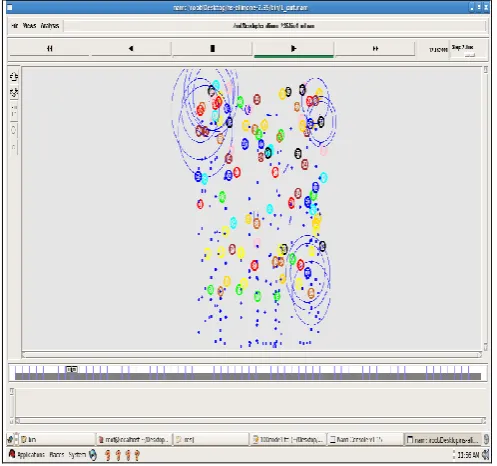
Figure 1.6 DSDV simulation result at 100 nodes running up to 100 seconds
Above figure shows that the network animation (NAM) output of DSDV protocol with presence of 100 nodes in the network and transmitting the data from 0 to 100 seconds.
0 200 400 600 800 1000
50 100 150
T
h
r
o
u
g
h
p
u
t
Simulation Time
Throughput
Vol. 3, Issue 12, December 2015
VIII.CONCLUSION AND FUTURE WORK
In this proposition, we have looked at the three mainstream steering conventions in the vicinity of diverse situation in system. The execution of DSR, AODV and DSDV directing conventions is dissected with recreation utilizing NS-2.35 test system situation accessible at 50, 75 and 100 hubs and the re-enactment time has changed from 50sec, 100sec and 150 sec on the premise of three parameters Average End-to-End delay, throughput, and bundle conveyance. In this exploration, we infer that the AODV performs better if there should arise an occurrence of bundle conveyance proportion, throughput and normal End-to-End delay at higher number of hubs. In throughput, DSR perform superior to anything DSDV when the reproduction time increments. DSDV performs superior to anything AODV for higher hub portability, if there should be an occurrence of end-to-end defer yet it creates normal result in PDR and throughput in substantial system.
After examination in diverse situation of system it can be down to earth that AODV perform superior to anything DSR and DSDV if there should be an occurrence of PDR and throughput in portability of hubs in long time in light of the fact that it has less directing overhead while DSDV is ended up being best in the event of end-to-end delay when hubs have high versatility considering the above said three measurements.
In future work we need to investigation of dependability of steering convention in vicinity of substantial number of hubs and mindful about which kind of convention gives the best execution if the measure of system will increment reasonably furthermore figured out the reproduction result in vicinity of distinctive situation in expansive size of the system and number of versatile hubs. Besides, these conventions examined don't address security issues; it is fascinating to watch the impacts of security increases to the execution of these conventions. The re-enactment study can be reached out to any future MANET steering conventions to encourage examination of the new convention to the current ones explored in this study. An energy model must be characterized and/or checked. The directing conventions can be tried as far as force utilization. New directing conventions can be produced utilizing power mindful steering. Test conventions in the crossover circumstance. The implementations of different routing protocols in ns2 have to be adapted to use them in hybrid simulations.
REFERENCES
[1] Routing protocols in ad hoc networks: A survey Azzedine Boukerche, Begumhan Tur gut, Nevin Aydin, Mohammad Z. Ahmad, Ladislau Bölöni, Damla Turgut.
[2] Hadi Noureddine, Qiang Ni, Geyong Min, Hamed Al-Raweshidy A New Link Lifetime Prediction Method for Greedy and Contention-based Routing in Mobile Ad Hoc Networks. In 10th International Conference on Computer and Information Technology pages 2662-2667 IEEE, 2010. Special Conference Issue: National Conference on Cloud Computing & Big Data
[3] By Parkavi Murphy John I, Dr.P.Vivekanandan A framework for Secure Routing in Mobile Ad hoc Networks. In Int. conf. On Advances In Engineering, Science And Management pages 453-458 IEEE, 2012.
[4] Qinghua Li, Sencun Zhu, Guohong Cao Routing in Socially Selfish Delay Tolerant Networks pub in IEEE INFOCOM 2010.
[5] Nenad S. Kojić, Marija B. Zajeganović Ivančić, Irini S. Reljin and Branimir New algorithm for packet routing in mobile ad-hoc networks JOURNAL OF AUTOMATIC CONTROL, UNIVERSITY OF BELGRADE, VOL. 20:pages 9-16, 2010 .
[6] Zhihao Guo, Shaya Sheikh, Camelia Al Najjar, Hyun Kim, Behnam Malakooti Mobile ad hoc network proactive routing with delay prediction using neural network- Pub Science+Business Media pages 1601-1620 Springer, 2009.
[7] Dervis Karaboga • Selcuk Okdem • Celal Ozturk Cluster based wireless sensor network routing using artificial bee colony algorithm Published Springer Science+Business Media, LLC 2012 .
[8] Heni KAANICHE and Farouk kamoun Mobility Prediction in Wireless Ad Hoc Networks using Neural Networks pub in Journal Of Telecommunications, pages 95- 101 2010.
[9] S. Singh, M. Woo, C. Raghavendra, Power-aware routing in mobile ad hoc networks, in: Proceedings of ACM MobiCom, October 1998, pp. 181– 190.
[10] L. Villasenor-Gonzalez, Y. Ge, L. Lamont, HOLSR:
a hierarchical proactive routing mechanism for mobile ad hoc networks, IEEE Communications Magazine 43 (7) (2005) 118–125. [11] J. Wang, E. Osagie, P. Thulasiraman, R. Thulasiram,
Hopnet: a hybrid ant colony optimization routing algorithm for mobile ad hoc network, Ad Hoc Networks 7 (4) (2009) 690–705.
[12] V. Ramesh, Dr. P. Subbaiah, N. Koteswar Rao and M.Janardhana Raju, “Performance Comparison and Analysis of DSDV and AODV for MANET”, IJCSE, ISSN 0975-3397, Vol. 02, No. 02, pp. 183-188, 2010.
[13] NS-2, the ns Manual (formally known as NS Documentation) available at http:// www. isi.edu / nsnam / ns/doc.
[14] S. D. Khatawkar, K. K. Pandyaji, R. M. Patil, V. M. Sali and U. L. Kulkarni,” Performance Comparison of DSDV, AODV, DSR, Routing protocols for MANETs”, International Conference on Computer Networks and Communication Systems, (CNCS 2012) IPCSIT, vol.35 IACSIT Press, Singapore,2012.
Vol. 3, Issue 12, December 2015
[16] Anuj K. Gupta and Dr. Anil K. Verma, “Performance analysis of AODV, DSR & TORA Routing Protocols”, IACSIT, ISSN: 1793-8236, Vol. 2, No. 02, April 2010.
[17] Anil Kumar Sharma and Neha Bhatia, “Behavioral Study of MANET Routing Protocols by using NS-2”, IJCEM, ISSN (Online): 2230-7893, Vol. 12, pp.100-104, April 2011.
[19]Samyak Shah, Amit Khandre, Mohesh Shirole and Girish Bhole, “Performance evaluation of ad hoc routing protocols using NS2 simulation”, National Conference on Mobile and Pervasive Computing (CoMPC)-2008.