The Definition of Context
and
its Implications for Language Teaching
by
Eva Illes
A Thesis Submitted in Partial Fulfilment of
the Requirements for the Degree of
DOCTOR OF PHILOSOPHY (PhD)
University of London Institute of Education
Abstract
The notion of context has come to the fore in recent years both in the study and teaching of language. Despite the oveniding importance attached to the concept and the number and variety of definitions provided, the lack of a comprehensive and workable definition based on systematic analysis has become increasingly apparent.
The present thesis intends to clear up the confusion that surrounds the concept. Its
main
contribution is a theoretical framework of two distinct perspectives on context, which emerges as a result of the scrutiny of numerous definitions available in language study. The framework is then applied to the investigation and categorisation of interpretations of context offered by various theories in linguistics.The pedagogic implementation of the framework aims to identifY which conception of context has informed a particular language teaching development. Once that has been established, it is examined how the application of one or the other perspective determines the constitution and characteristics of various trends in language pedagogy.
Table of Contents
Acknowledgements ... 10
Preamble ... 11
Why the Notion of Context? Chapter 1 ... 16
Definitions and Models of Context 1.1 Definitions of Context in Language Study ... 16
1.1.1 A Selection of Definitions... .... .... ... ... .. 16
1.1.2 Analysis ... 19
1.1.3 Issues Arising ... 21
1.1.3.1 Terminology ... 21
1.1.3.2 Opposing Perspectives ... 22
1.1.4 Conclusion 24 1.2 Firth's Definition of Context ... 26
1.2.1 Firth's Theory of Meaning ... 26
1.2.2 Firth's Definition ... 27
1.2.3 Analysis ... 27
1.2.3.1 Key Terms and Characteristics ... 27
1.2.3.2 Features of the Context of Situation ... 31
1.2.4 Application ... 32
1.2.5 Firth's Context of Situation - an Alternative Interpretation ... 33
1.2.6 Conclusion 34 1.3 Cognitive Background ... 36
1.3.1 Definition of Schema ... 36
1.3.2 Schema Theory ... 37
1.3.2.1 Outline 37 1.3.2.2 Criticism of Schema Theory ... 39
1.3.4 Connectionism ... 40
1.3.4.2 Characteristics of Connectionist Schemata ... 41
1.3.4.3 Criticism and Amendment of Connectionist Model 43 1.3.5 Conclusion ... 44
1.4 Summary ... 46
1.4.1 A Working Definition of Context ... " ... 46
1.4.2 Conceptions of Context ... 48
1.4.2.1 Analytical Model ... 48
1.4.2.2 Procedural Model ... 48
1.4.3 End and Forenote 49 Chapter 2 ... 51
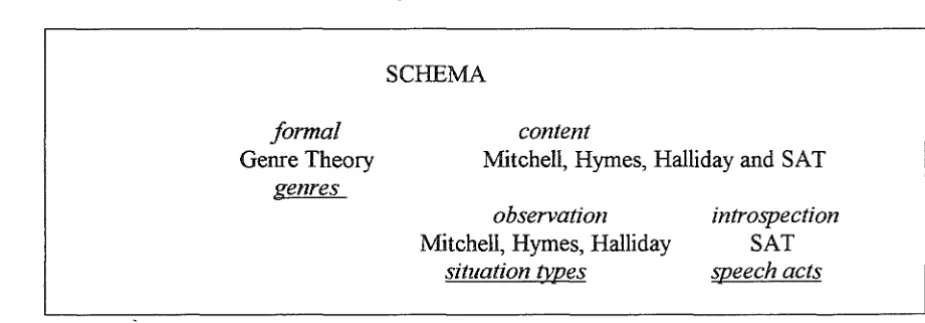
Analytical Models of Context 2.1 Mitchell's Adaptation of Firth's Model ... 51
2.1.1 The Application of Firth's Definition ... 51
2.1.2 Components of the Context of Situation ... 53
2.1.3 Mitchell's Contribution 54 2.2 Hymes's Definition ... 56
2.2.1 Introduction ... 56
2.2.2 Communicative Competence (CC) ... 57
2.2.3 Components of Context ... 58
2.2.4 Definition of Context 60 2.2.5 Conclusion ... 61
2.3 Halliday's Theory ... 63
2.3.1 Context and Situation ... 63
2.3.2 Context of Situation ... 63
2.3.3 Halliday's Model of Context ... 66
2.3.4 Halliday's Contribution ... 68
2.4. Genre Theory ... 69
2.4.1 Genre as a Schematic Construct 69 2.4.2 Context - Knowledge of Text Appropriateness ... 70
2.4.3 Genre Model of Context ... 72
2.5 Speech Act Theory ... 74
\
2.5.2 Context - Appropriateness Conditions ofIllocutionary Acts ... 76
2.5.2.1 Austin's Felicity Conditions ... 77
2.5.2.2 Searle 78 2.5.2.3 Labov and Fanshel ... 80
2.5.3 Summary and Critique of SAT Context ... 81
2.6 Analytical Models of Context - Summary ... 84
Chapter 3 ... 86
Procedural Models of Context 3.1 Ethnomethodology ... 86
3.1.1 The Perspective ofEthnomethodology ... 86
3.1.2 The Definition of Context 87 3.1.3 Context as Interpretative Procedures (IPs) ... 89
3.1.4 Application of IPs ... 90
3.1.5 Summary and Evaluation ... 91
3.2. Grice's Cooperative Principle ... 94
3.2.1 Introduction 94 3.2.2 Grice's Definition of Context ... 95
3.2.3 Context as the Cooperative Principle ... 96
3.2.3.1 The Cooperative Principle (CpL ... 96
3.2.3.2 The Maxims of the CP ... 97
3.2.4 Grice's Contribution ... 98
3.3 Relevance Theory ... 1 00 3.3.1 The Definition of Context ... 100
3.3.2 Context as Inferential Abilities ... 102
3.3.3 The Principle of Relevance ... 103
3.3.4 Relevance Theory - an Alternative to Grice's Cooperative Principle? ... 104
3.3.5 The Contribution of Relevance Theory ... 107
3.4 Widdowson's Model ... 108
3.4.1 The Definition of Context ... 108
3.4.2 Schemata 109 3.4.3 Procedures ... 110
3.4.5 Imperatives ... 113
3.4.6 Widdowson's Contribution 115 3.5 The Procedural Model of Context - Conclusions ... 117
Chapter 4 ... 118
From Language Study to Language Pedagogy: The Definition of Context and its Implementation 4.1 Theoretical Framework ... 118
4.1.1 General Description of Context ... 118
4. 1.2 Definition of the Analytical Model of Context ... 119
4. 1.3 Definition of the Procedural Model Context ... 120
4.1.4 The Definition of Context 122 4.2 Context in Language Pedagogy ... 125
4.2.1 Definitions of Context in Language Pedagogy ... 125
4.2.2 Similarities between Language Study and Language Pedagogy ... 129
4.2.2.1 Terminology ... 129
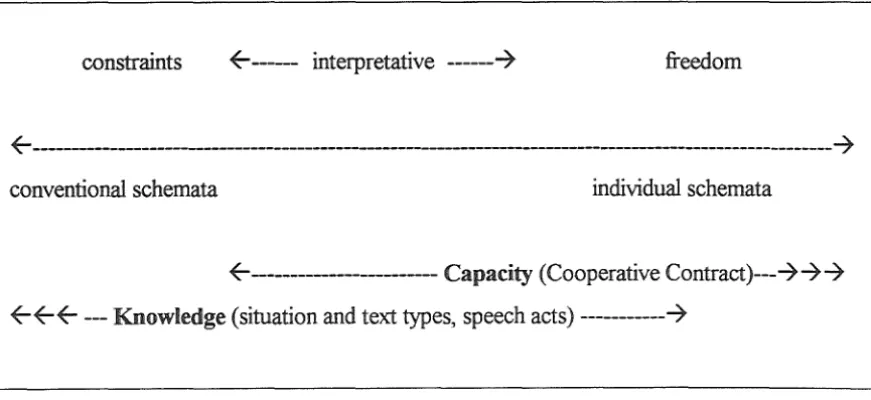
4.2.2.2 Polarities in the Perception of Context ... 130
4.2.3 Specific Features ... '" ... 131
4.2.4 Summary ... 132
4.3. Pedagogic Framework ... 134
4.3.1 Amendment of Pedagogic Definitions ... 134
4.3.2 Framework for Pedagogic Analysis ... 134
4.3.3 Linguistics Applied ... 138
Chapter 5 ... 139
Language Teaching Approaches and Methods Adopting an Analytical Perception of Context 5.1 Situational Language Teaching (SLT) ... 139
5.1.1 Structural SLT ... 139
5 .1.1.1 Characteristics ... 13 9 5.1.1.2 Criticism and Evaluation ... 140
5.1.2 The Situational Syllabus ... 142
5.1.2.2 Main Pedagogic Implications ... 144
5.1.2.3 Strengths and Weaknesses ... 145
5.1.2.4. Conclusion 147 5.2 The Notional-functional Approach ... 148
5.2.1 Communicative Functions 148 5.2.2 Real-life Language Use and Learner Needs ... 150
5.2.3 Contextual Analysis ... 152
5.2.3.1 Characteristics of Context ... 152
5.2.3.2 The Teaching of Functions ... 155
5.2.3.3 Authenticity ... 156
5.2.4 Critique and Evaluation ... 159
5.2.4.1 Context ... 159
5.2.4.2 Learner and Learning Needs ... 161
5.2.4.3 Authenticity ... 162
5.2.4.4 Learner-centredness 166 5.2.4.5 Communicative Syllabus ... 167
5.2.4.6 Further Implications ... 168
5.2.5 Summary ... 171
5.3 Genre Based Teaching Practices ... 173
5.3.1 Model for Teaching ... 173
5.3.2 Context ... 174
5.3.2.1 Analysis ... 174
5.3.2.2 Authenticity ... 176
5.3.3 Critique and Evaluation ... 176
5.4 Pedagogic Application of Analytical Models of Context - Summary ... 179
Chapter 6 ... 181
Language Teaching Approaches and Methods Adopting a Procedural Model of Context 6.1 Theoretical Background ... 181
6.2 Pedagogic Implications ... 182
6.2.3 The Learner ... 186
6.2.4 Learner-centredness ... 188
6.2.5 The Teacher ... 190
6.2.5.1 Characteristics ... 190
6.2.5.2 Consequences ... 191
6.2.6 Authenticity ... 192
6.2.7 Syllabus and methodology ... 194
6.3. The Implementation ofTLC Methodology ... 196
6.3.1 Introduction ... 196
6.3.2 Teaching Language Through Other Subjects ... 197
6.3.3 Exploiting the Classroom ... 198
6.3.4 Task-based Instruction (TBI) ... 200
6.3.4.1 Cognitive Tasks ... 203
6.3.4.2 Language Tasks ... .203
6.3.4.3 Interpersonal Tasks ... 204
6.3.5 Literature 205 6.3.6 Implications ofTLC Application ... .207
6.4 Summary ... 208
CHAPTER 7 ... 210
Recent Developments: Teaching Culture 7.1 Introduction ... 210
7.2. Teaching Culture in the Analytical Mode ... 210
7.2.1 General Features 210 7.2.2 British Studies (BS) ... 211
7.2.3 Intercultural Communicative Competence (ICC) ... 214
7.3. Procedural Perception of Culture in Teaching ... 217
7.4. Critique and Evaluation ... 219
7.4. 1 Analytical Paradigm ... 219
7.4.2 Procedural Paradigm ... .221
APPENDIX 1 ... 228
APPENDIX 2 ... 229
APPENDIX 3 ... 231
APPENDIX 4 ... 232
APPENDIX 5 ... 234
Acknowledgements
On my long journey there were many people who provided those much needed lifelines without which the thesis would have never materialised.
I am particularly grateful to my mends who played an important role at varying stages of this work: Marina Spiege~ Nicholas Drennan, Eva Pakolitz and Jeanne Bester for reading and commenting on drafts, Peter Medgyes and Neil Murray for their guidance and encouragement.
My special thanks are due to Christina Howell-Richardson whose unwavenng support helped me through the most difficult times.
I should also like to thank Rob Batstone for his patience, challenging questions and constructive suggestions.
I could not have hoped for a more inspiring supervisor than Henry Widdowson, to whom go my deepest gratitude and admiration. Working with him was a great privilege, for which I am infinitely thankfuL
My love and thanks to my family for the joyful distractions and for staying with me through all these years.
Preamble
Why the Notion of Context?
Context in Language Study
Since a shift from the paradigm of language as a fonnal system to the paradigm of the language user has taken place in linguistics (Mey 1993), context has become a key notion in language study.
The growth of interest in how language is used in real-life situations and what people mean when they exploit its meaning potential has been, in part, a reaction to Chomsky's treatment of language and the language user as abstract entities (Chomsky 1965:3). Questions concerning actual language use have been raised and it has become obvious that they can only be answered if the scope of linguistics is expanded and reference is made to the context in which language occurs.
As a consequence, the study of meaning has become the business of two distinct areas of inquiry in linguistics. Whereas semantics is concerned with the ways meaning is encoded in language,
pragmatics
focuses on meaning in context (Levinson 1983, Widdowson 1996b).* Meaning which inheres in the linguistic sign as a stable semantic property is called symbolic. Indexical meaning, on the other hand, is achieved pragmatically in relation to some context (Widdowson 1990:82). The sentence "Lovely day, isn't it?" may take on a variety of meanings in different contexts of use, depending on the specific features of situation the linguistic sign is linked to by the language user. The question above can, for instance, serve as a fonnulaic expression in the context of greeting, but can often mean the opposite when uttered in an ironic tone on a dull, rainy day. Alternatively, it may function as an expression of mockery when two learners of English replicate a cliche-ridden dialogue from their textbook outside the classroom. In any case, it is this meaning the sentence obtains when it becomes an utterance in relation to a context that forms the concern of pragmatics.Since context IS a feature that generally distinguishes pragmatics from
semantics, definitions of pragmatics are frequently formulated in reference to it Pragmatics has thus been seen as the inquiry into the contribution context makes to meaning (Yule 1996:92), or the examination of contextual and speaker meaning i.e. the interpretation of what people mean by their utterances in a particular context and how the context influences what is being said (Yule 1996:3).
The relationship between language and context has been of special interest As a result of it, pragmatics is often defined as the study of the correspondence or systematic relation of a language to situation and/or context (Oller 1970:506; Richards et al. 1992:284; Brown and Levinson in Yule 1996: 109), or "the study of the relations between language and context that are basic to an account of language understanding" (Levinson 1983:20).
Some definitions are formulated in terms of the constraints context may present On the one hand, pragmatics is therefore viewed as "the study of the conditions of human language uses as these are determined by the context of society" (Mey 1993:42). On the other hand, there are linguists (Mey (1993) and Yule (1996)) who stress the role of the language user, refer to user's context, and treat pragmatics as the investigation of the role of context in speaker meaning.
The context of society Mey cites and the systematic relations between language and context appear to delimit the inquiry to the first type of context provided for the sentence "Lovely day, isn't it?". It is the kind of situation whereby, due to common occurrence and predictability, it is relatively easy to establish a systematic correspondence between language and the social context. The ironic remark and the mockery of textbook dialogues, on the other hand, suggest less conventional contexts where the individual user's role is emphasised (Mey 1993, Yule 1996). It is this area of specific local conditions oflanguage use that Leech (1983:10) excludes from pragmatics, but which other linguists like Yule consider integral to the inquiry.
As the examples demonstrate, there exists an array of descriptions of pragmatics which has been partly brought about by the wide variety of contextual interpretations available in language study. The ambiguity surrounding the notion of context thus affects other areas of linguistic theory and results in the lack of a commonly accepted, standard definition for such a fundamental notion as pragmatics.
use such as cognitive psychology (Clark & Carlson 1981), what constitutes the concept has generally remained unclear. Attempts to elucidate the notion have only given rise to an increasing number of descriptions, which often complement or even contradict each other. Given these circumstances, it seems that an unequivocal definition of context in linguistic theory is not only essential but long overdue as well.
Context in Language Pedagogy
Alongside language study, significant changes have taken place in language teaching too. Dissatisfaction with the then dominant practices led teaching experts to tum to linguistic theory to develop new, more efficient approaches. Following linguistic trends, the attention has shifted from displaying knowledge of abstract linguistic rules to the ability to exploit this knowledge for effective communication in actual situations within language pedagogy as well. The name of the movement reflects the new emphasis: Communicative Language Teaching (CLT). The
aim
ofCLT is to promote use, that is meaning achieved in context, and the realisation of the language system through utterances rather than usage, i.e. the production of sentences which manifest the language system without any informing context (Widdowson 1978). In fact, the focus on use and context has become not only the basic premise but the force that binds together various approaches and methods under the umbrella term of CLT.In spite of the apparent unity, however, basic principles, such as authenticity and leamer-centredness have obtained contrasting interpretations within CLT (Widdowson
1996a). Other contradictions have arisen from a difference of emphasis, and it has largely remained unclear as to what exactly teaching communicatively in context entails: is it practising real-life situations, teaching notions and functions or creating conditions for effective learning which may considerably differ from real-life situations outside the classroom?
So even though context looms large in language teaching too, it has retained the kind of indefiniteness and multifacety that characterises the notion in linguistic theory. One reason for this may be the fact that language education has taken over context from linguistics without having really made systematic inquiries as to what implications the various linguistic theories and definitions have for the concept. The result has been an even wider array of often narrow or loose interpretations and a lack of concerted effort to delineate the term.
The burning need for the clarification and standardisation of context has thus been carried over from language study and is prevalent in language pedagogy as well.
The Contribution of Present Thesis
It has become evident in the above sections that although context plays an important role both in language study and pedagogy, neither
has
yet offered a definition which could equally be applied to the theory oflanguage use and the practice of teaching.The premise of this thesis is that context being such a pivotal concept needs to be properly described. Since in-depth and comprehensive analyses of the notion are scarce in language pedagogy, it is suggested that we turn to linguistics to examine how the definitions and models developed by language theory can bring about a comprehensive framework which then can be employed for pedagogic investigations.
The goal of this research is to effectively apply linguistics, i.e. to utilise the findings of language study for pedagogic purposes. In so doing, the thesis aims to fill the hiatus caused by the absence of an authoritative definition and intends to propose a workable contextual construct which can successfully be exploited for the analysis of various linguistic and language teaching movements.
End note: It must be pointed out that there is substantial overlap between the domains of pragmatics and discourse analysis as defined by Schiffrin (1994) and Coulthard (1977) for example. Although Schiffrin treats pragmatics as one of the six approaches v .. ithin discourse analysis (DA), in DA she includes areas
other linguists defining pragmatics in a \vider sense also eXl'lore e.g. speech act theory, the etlmography of speaking etc.
In the present work, it is suggested that, by and large, two schools of thought should be distinguished, which define discourse analysis either in quantitative or qualitative terms. The fonner
focuses on the structure and combinations of text chunks (Schiffiin 1994). The latter regards the discipline
as the analysis of contextualised stretches of language perceived to be meaningful and construed out of motivated choices by the language users for some communicative purpose (Cook 1989:156, Cook 1994a:l, Batstone 1994:136). (In fact, the division presented here corresponds to Schiffiin's (1994:42) distinction
identifYing two perspectives within discourse analysis according to their varying emphasis on structure and
Chapter 1
Definitions and Models of Context
1.1 Definitions of Context in Language Study
1.1.1 A Selection of Definitions
As a first attempt to grasp context, a selection of concise but often cursory definitions will be examined. A closer inspection will reveal that, despite their apparent diversity, these descriptions share commonalities and generalisable features which can serve as building blocks in the construction of a framework for the systematic analysis of context.
(1.) "The features of the non-linguistic world in relation to which linguistic units are systematically used. The term 'situation' is also used in this sense, as in the compound term 'situational context'.
(1a.) In its broadest sense, situational context includes the total non-linguistic background to a texi or utterance, including the immediate situation in which it is used, and the awareness by speaker and hearer of what has been said earlier and of any relevant ex1ernal beliefs or PRESUPPOSmONS.
(lb.) Others restrict the term to what is immediately observable m the co-occurring situation." (Crystal 1985: 71 )
(2.) "The CONTEXT of an utterance is a small subpart of the universe of discourse shared by speaker and hearer, and includes facts about the topic of the conversation in which the utterance occurs, and also facts about the situation in \"hich the conversation itself takes place .... The exact contexi of any utterance can never be specified with complete certainty. The notion of contexi is very flexible (even somewhat vague)." (Hurford & Heasley 1983:68-9)
the range of utterance-extemal variables that affect the use and interpretation of verbal behavior.
To assess the import of a language user's behavior, one must consider the social and
psychological world in which the language user operates at any given time. " (Oehs
1979:1-2).
"The concept of contex1 includes, minimally, language users' beliefs, and assumptions
about temporal, spatial, and social settings; prior, ongoing, and future actions (verbal,
non-verbal), and the state of knO\vledge and attentiveness of those participating in the social
interaction at hand. " (Oehs 1979:5)
(4a.) "CONTEXT has been understood in various ways, for example to include 'relevant'
aspects of the physical or social setting of an utterance.
(4b.) I shall consider context to be any background knowledge assumed to be shared by s
and h and which contributes to h's interpretation of what s means by a given utterance." (Leech
1983:13)
(5.) "A contex1 is a psychological construct, a subset of the hearer's assumptions of the
world. It is these assumptions, of course, rather than the actual state of the world, that affect the
interpretation of an utterance. A context in this sense is not limited to information about the
immediately physical environment or the immediately preceding utterances: expectations about
the future, scientific hypotheses or religious beliefs, anecdotal memories, general cultural
assumptions, beliefs about the mental state of the speaker, may all playa role in interpretation."
(Sperber & Wilson 1986:15-6)
(6.) "However, the contex1 of an utterance cannot simply be identified with the
spatiotemporal situation in which it occurs: it must be held to include, not only the relevant
objects and actions taking place at the time, but also the knowledge shared by the speaker and
hearer of what has been said earlier, in so far as this is pertinent to the understanding of the
utterance. It must also be taken to include the tacit acceptance by the speaker and hearer of all
relevant conventions, beliefs and presuppositions 'taken for granted' by the members of the speech
community to which the speaker and hearer belong. The fact that it is in practice, and perhaps
also in principle, impossible to give a full account of all these 'contex1ual' features should not be
taken as a reason for denying their existence or their relevance." (Lyons 1968:413)
(7.) "What then might one mean by context? First, one needs to distinguish between actual situations of utterance in their multiplicity of features, and the selection of just those features that
are culturally and linguistically relevant to the production and interpretation of utterances C ... )
The term context, of course, labels the latter C ... ).
conteA'tual features, we do not seem to have available any theory that will predict the relevance of
all such features, and this is perhaps an embarrassment to a definition that seems to rely on the
notion of conteA't." (Levinson 1983:22-3)
(8.) "It is, obviously, not possible for us in a teAtbook to permit you to have the eA-perience of
everyday discourse in what Stenning (1978) calls a 'normal conteA't', where the hearer is part of
the context and then experiences the teAt. We have to have recourse to what Stenning calls
'abnormal' conteA'tS, where the analyst reads the tex't and then has to try to provide the
characteristics of the context in which the text might have occurred." (BrO\m & Yule 1983:41-2)
(9.) "The situations which prompt people to utter speech, include every object and
happening in the universe. In order to give a scientifically accurate definition of meaning for every form of a language, we should have to have a scientifically accurate knowledge of
everything in the speaker's world. The actual eAtent of human knowledge is very small, compared
to this." (Bloomfield 1935:139)
(10.) "Whereas a COMMUNICATIVE SITUATION is an empirically real part of the real
world in which a great number of facts exist which have no SYSTEMATIC connection 'with the
utterance (either as an object or as an act), such as the temperature, the height of the speaker, or
whether grass is growing, a context is a highly idealized abstraction from such a situation and
contains only those facts which systematically determine the appropriateness of conventional
utterances. Part of such contex'tS will for example be speech participants and their internal
structures (knowledge, beliefs, purposes, intentions), the acts themselves and their structures, a
spatio-temporal characterization of the conteA't in order to localize it in some actual possible
world, etc."
"The first property of contex't to be emphasized is its 'dynamic' character. A context is not
just one possible world-state, but at least a sequence of world-states. Moreover, these situations do
not remain identical in time, but change. Hence, a contex't is a COURSE OF EVENTS." (van
Dijk 1977a:191-2)
(11.) Context ... ",vhich occurs before and/or after a word, a phrase or even a longer utterance or a text. The context often helps in understanding the particular meaning of the words,
phrase etc. For example, the word loud in loud music is usually understood as meaning "noisy"
whereas in tie with a loud pattern is understood as "unpleasantly colourful." (Richards et aL
1992:82)
contex'1 - the language that surrounds or accompanies the piece of discourse under analysis. The
second is the non-linguistic or experiential context within which the discourse takes place.
Non-linguistic contex'1S include: the type of communicative event (for example, joke, story, lecture,
greeting, conversation); the topic; the purpose of the event; the setting, including location, time of
day, season of year and physical aspects of the situation (for example, size of room, arrangement
of furniture); the participants and the relationships between them; and the background
knowledge and assumptions underlying the communicative event." (Nunan 1993a:7-8)
(13a.) "In other words, context is a schematic construct. It is not 'out there', so to speak, but
in the mind." (Widdowson 1996b:63)
(13b.) "Those aspects of the circumstances of actual language use which are taken as
relevant to meaning." (Widdowson 1996b:126)
(14.) "The physical environment in which a word is used." (Yule 1996: 128)
(l5a.) '''Give me all the information, and I'll predict what is going to happen, what this or
that utterance is supposed to mean.' However, this kind of method will never work, because the
concept of contex'1 that is invoked here is purely static; it bears a certain likeness to the thinking
of classical physics, where conditions preceding a particular state of affairs in the physical world
are thought of as completely determining the next development: a bit like a controlled experiment
in the physics classroom or in the laboratory." (Mey 1993:8)
(I5b.) "A context is dynamic, that is to say, it is an environment that is in steady
development, prompted by the continuous interaction of the people engaged in language use, the
users of the language. Contex1: is the quintessential pragmatic concept; it is by definition
proactive, just as people are." (Mey 1993: 10)
1.1.2 Analysis
The two questions the definitions seem to address concern a) what subpart of the universe context comprises, and
b) to what extent context is accessible to and describable by the researcher.
Yule (14) and 'others' in Crystal's definition (1b) perceive context as the physical
environment in which language is used. Most authors, however, tend to view the immediate physical setting as one of the various constituents that make up the notion (1,3,5,6,12).
In three cases (4,5,13a), context is seen as a purely psychological entity, which does not exist in the outside world but prevails in the mind of the speaker/hearer and should be seen as a set of assumptions about the world.
The majority of definitions, however, reveal a multifaceted concept which amalgamates not only the linguistic and physical environment but other aspects, such as the psychological or social (1,2,3,5,6,9,10,12). While in some cases no attempt is made to itemise the components (9,13a,13b), in definitions 1,2,3,5,6,10 and 12, the notion is broken down into some or all of the following constituent parts: the spatio-temporal and verbal environment and the social and psychological world oflanguage users.
Some authors (2,3,6,7,) highlight the acute problem of pinning down the concept. For Bloomfield (9) the reason is quantitative: as, in his view, a scientifically accurate description of context should include 'everything' both from the outside and inside world, the task of specifying exactly the phenomenon which triggers off speech is practically impossible.
Ocbs (3) attributes the difficulties to the fact that a significant part of the notion, the social and psychological attributes, is inaccessible to the researcher and cannot therefore be analysed in terms of variables like the immediate physical or verbal environment.
1.1.3 Issues Arising
1.1.3.1 Terminology
With regard to the setting in which an utterance takes place two expressions are used: context and situation.
In
definition 1., it is noted that the terms 'situation', 'situational context' and 'context' are often interchangeable and mainly signify 'the non-linguistic world in relation to which non-linguistic units are systematically used.'In
a similar vein, the boundary between context and situation is blurred in extract 12., where context is defined as situation which functions both as a prompt (also definition 9.) and the 'container' of discourse.Elsewhere, however, a clear distinction is made between the two terms. While situation is viewed as the 'actual', 'empirically real' part of the real world (6,7,10), context is conceived as an abstract notion derived from situation (10).
Alongside the actuality/abstraction axis, situation and context are also distinguished with regard to the domains they encompass. Whereas situation is described en masse, as the total setting with a multiplicity of elements (7,9,10), context comprises only a selection of those features of the situation which become important in instances of language use (4,6,7,10). Unlike situation, context here forms a systematic connection with the utterance in that it either determines the language used (1) or, more broadly, affects the interpretation or meaning of an utterance (4b,5,6,13b).
In
extract 10., the relevant features of situation that constitute context are restricted to the specific function of ensuring the appropriateness of conventional utterances.In
these definitions the notion of relevance becomes crucial since it serves as the device that separates context as a set of relevant features from situation which is perceived as a set of all - both relevant and irrelevant -components.The question of who decides which constituents of situation should be considered relevant is addressed indirectly in definition 8.
In
natural contexts (or 'normal' as Stenning calls them, see def 8) it is the participant who interprets the text and therefore defines the relevant features of the situation.In
what is described as 'abnormal' context, however, it is the analyst, an outsider acting post factum, who works out relevance from the text and,in
l.l.3.2 Opposing Perspectives
The actuality/abstraction distinction, which separates context from situation, is not the only polarity that emerges from the definitions. In fact, when exploring the nature of context, most linguists seem to perceive the notion in terms of opposite ends. The aim of what follows is to identify these poles and look at them in some detail.
a) Context: physical or mental?
The notion of context as a merely physical and observable phenomenon (1,4a, 14) and context as a solely psychological/schematic construct (4b,5, 13 a) seem to represent the two ends of a continuum with definitions in between incorporating both qualities (1,2,3,6,10,12).
Sperber and Wilson (5) who, like Widdowson (13a), argue that context is an exclusively mental entity, point out that the two worlds (the physical and the inner) may, in fact, be not only qualitatively different but contradictory too: the interpretation created by an individual on a particular occasion may considerably differ from what the other interactants see as the actual, 'objective' state of affairs.
Placing context in the mental domain, however, renders the notion less observable and analysable (3). Hence the claim that it is impossible to specify all relevant contextual features with complete certainty (2,3,7,9).
b) Context: individual or social?
Within the notion of context as a mental phenomenon, the social and the individual/psychological world of the language user are distinguished (3,4).
By linking context to appropriateness, van Dijk (10) indicates what nature these rules of use may
be.
Relevance, the device that separates the empirically real communicative situation from the 'highly idealized' context, in his case is related to a set of rules which determine socially acceptable language behaviour.Context seen as a psychological construct (5,13a), on the other hand, appears to include not only general cultural assumptions but individual elements such as 'anecdotal memories' as well. The unpredictability and unconventionality of the many idiosyncrasies of a person's mind then make it impossible to establish the same straightforward relationship with an utterance that van Dijk's conventional situations entaiL
c) Context: concrete or abstract?
Reference to context as immediately observable (1 b) renders the notion a concrete phenomenon.
As
has been observed earlier in L 1.3.1, some definitions (7, 10) assign this attribute to situation which is often seen as 'actual', or 'empirically real' as opposed to context which is a 'highly idealized abstraction' (10). The latter is a research convenience which narrows the domain of context and renders the notion suitable for scientific investigation.The reason for this is that whereas the description of context as an actual happening necessarily includes temporary, fortuitous and individual features, context as an abstract notion is the product of some kind of idealisation process that strips the concrete situation of these atypical elements. The outcome is a generalisation, the subject of standard inquiries.
d) Context: dynamic or static?
Mey (1Sb) and van Dijk (10) view context as a phenomenon which undergoes continuous change and never remains identical - both within and between situations. Each stage of this constant development represents a different world-state prompted by the continuous interaction between people.
however, can only be carried out if all relevant infonnation about the nature of context is presented in an accessible fonn to the linguist. Mey is also aware of the fact that the perception of context as a dynamic psychological construct inevitably requires an approach which is fundamentally different from the classical modus operandi. He, however, fails to suggest what kind of alternative means of delineation are available or would be suitable to describe context as a flexible entity.
1.1.4 Conclusion
The definitions of context above have shed light on the wide variety of interpretations linguistic theory offers. They have also confinned that there is no general agreement as to what constitutes the concept and how it should be described.
Despite the uncertainties, the investigation has proved worthwhile in that the features, which pertain to context and tend to represent different types of polarities, strongly indicate the prevalence of
opposing views of the notion. On the one hand, context
is presented as an abstract structure which comes about as the result of the analyst's insight, observation and generalisation of predictable states of the world or the mind. On the other hand, context is perceived as a dynamic phenomenon containing fortuitous as well as individual constituents which cannot be prefixed and defined in the conventional way.Apart from these emerging distinctive perspectives, the analysis of definitions has been beneficial in that it has drawn attention to three key notions which will be crucial for the description of context both in linguistics and language pedagogy.
rules of socially accepted language behaviour.
1.2 Firth's Definition of Context
The linguistic study which integrates schema, relevance and appropriateness as well as the polarities of attributes is Firth's delineation of context. Although it presents one of the most comprehensive and authoritative definitions of the notion, its concise nature allows for disparate readings. In addition, Firth's own narrow interpretation raises further questions about the nature of context. The following investigation attempts to exploit these merits and limitations of Firth's view of context to its own advantage and will further elaborate on the concept.
1.2.1 Firth's Theory of Meaning
Firth's theory of meaning hinges on the notion of context. Although he consistently refers to semantics, Firth's sole concern is, in fact,
pragmatics
(see Preamble). He refuses to accept that words and sentences can have meanings in and by themselves and firmly believes that "the complete meaning of a word is always contextual, and no study of meaning apart from a complete context can be taken seriously" (Firth 1957:7). All over, Firth argues that no text should be considered meaningful unless it can be referred to some generalised context of situation (Firth 1968:12-3). According to him, sentences such as '1 have not seen your father's pen, but 1 have read the book of your uncle's gardener.' (Firth 1957:24) may provide apt illustrations of grammar but represent nonsense at the semantic level since they cannot be related to any "observable and justifiable set of events in the run of experience" (Firth 1968:175)*.In fact, this exclusive view has been challenged by linguists such as Lyons (1966) who denies that a theory of meaning without semantics is sustainable and maintains that any linguistic description of meaning must account for intra-lingual phenomena (e.g. relations like synonymy and analytical implication etc.) too.
Apart from being thought provoking, Firth's insistence on recognising contextual meaning only has been of further benefit to linguistic study in that for a linguistic theory of this kind a workable definition of context must be a prerequisite .
1.2.2 Firth's Definition
Firth's attempt has resulted in the following succinct definition:
"My view was, and still is, that 'context of situation' is best used as a suitable schematic construct to apply to language events, and that it is a group of related categories at a different level from grammatical categories but rather of the same abstract nature. A context of situation for linguistic work brings into relation the following categories:
A The relevant features of participants: persons, personalities. (i) The verbal action of the participants.
(ii) The non-verbal action of the participants. B. The relevant objects.
C. The effect of the verbal action." (Firth 1957:182)
1.2.3 Analysis
1.2.3.1 Key Terms and Characteristics
Firth has borrowed the term 'context of situation' from Malinowski who has coined it to describe the environment in which an utterance becomes meaningful and achieves an "immediate and practical effect" (Malinowski 1935:52).
It is, in fact, Malinowski who has first broadened the conception and interpreted context not as co-text but as the setting in which words acquire meaning. By bursting "the bonds of mere linguistics" and carrying over "into the analysis of the general conditions under which a language is spoken" (Malinowski 1923:306), he has extended the scope of linguistic inquiry and entered the domain of pragmatics.
investigation.
Since such a goal requires a formula which is highly general by nature, Malinowski's perception of context as raw reality with
all
its immediacy and actuality has been replaced by a fully abstract notion devoid of concreteness (cf 1.1.3.2c).Firth has emphasised that the usefulness of this abstraction lies in the "renewal of connection", that
is,
relating it back to the observable setting from which it has been extracted (Firth 1968:168, 175). He has maintained that "without this constant flux of reapplication to the flux of experience, abstract linguistics has no justification" (Firth 1968:19). The notion of context for Firth can thus serve as intended,i.
e. a device of linguistic description which has been generalised from particular instances and is applied back to specific occurrences in order to be able analyse them. In this respect, Firth's context indeed bears a close resemblance to formal grammar as it also represents idealisations at a very general level, perhaps like the pattern of subject-verb-object in the English language (Batstone 1994).By defining context as a 'schematic construct' Firth presents the concept solely as a
mental entity (cf 1.1.3.2a), a schema which is a "general type, essential form, conception of what is common to
all
members ofa class" (The Concise Oxford Dictionary 1982:937).According to Firth, schemata are "frames of reference, a sort of scaffolding for the handling of events" (Firth 1957:181) which have no ontological status in the sense that they do not have existence. They represent generalisations which are "neither immanent nor transcendent" in that they do not exist 'out there' but are not beyond the reach of experience either. They are, in fact, located somewhere between the two and entail mental representations of the stereotypical extracted from experience.
The linguist's task is then to scrutinise "what is objective and observable in the group life of our fellows" (Firth 1968: 170), separate out the structures that make up the fabric of human existence and draw up schemata, which are not the depiction of the setting or the background but rather, correspond to a "set of categories in ordered relations abstracted from the life of man in the flux of events, from personality in society." (Firth 1968:200, my italics)
think" (Firth 1957:28) and "most give-and-take of conversation in our everyday life is stereotyped and very narrowly conditioned by our particular type of culture. It is a sort of roughly prescnbed social ritual, in which you generally say what the other fellow expects you, one way or another, to say." (Firth 1957:37)
The world according to Firth is thus like a stage where society is the author and the participants play the roles assigned to them by the culture into which they have been initiated. This provides law and order which he considers beneficial for both society and its members (Firth 1957:184). While growing up and being progressively incorporated into the social organisation, members of a society gradually learn how to act in accordance with the expectations created by their community. In this respect, Firth does not allow for much freedom or room for manoeuvre as far as the individual is concerned:
"You deceive yourself if you think: words are opinions on which your individual soul may soar in perfect freedom into limitless empyrean. Even in literature, where madness is sometimes called genius, such extreme forms of non-conformity are rare. The main stream of literature is governed by a healthy, though of course not absolute, conformity with hallowed tradition. Ordinary everyday conversation is much more narrowly determined than literary composition." (Firth 1964:94)
Not surprisingly, Firth regards highly idiosyncratic behaviour as "unusual", "misdirected" and "tactless" which entails "grave social risks" (Beaugrande 1991: 195). This orderly language behaviour is, in fact, what has been described as appropriateness in the previous section. In Firth's framework, context thus necessarily comprises the knowledge of those social rules which make language behaviour acceptable within a speech community.
It is for this reason that, according to Firth, sentences like the one quoted in 1.2.1 are nonsensical: if an utterance cannot be related to any customary or generalisable routine, it is perforce meaningless.
\
"A very rough parallel to this sort of context can be found in language manuals providing the learner with a picture of a railway station and the operative words for travelling by train. It is very rough. But it is parallel with the grammatical rules, and is based on the repetitive routines of initiated persons in the society under description" (Firth 1957: 182).
The fact that the Firthian context of situation is restricted to highly conventional routines requiring formulaic language necessarily implies that the concept attains a strictly social character with individual features purposefully left out (cf 1.1.3.2b).
By adopting the
'context of situation',
rather than the contextand
situation distinction as seen earlier in 1.1.3.1, Firth emphasises the relationship that exists between the two notions. While the context of situation is seen as part of the situation (which includes all the features of the setting), it only comprises those general categories of the situation that are relevant to 'linguistic work'. The division along which the context (of situation) is separated out of the situation does not therefore run along the actuality/abstraction axis (see 1.1.3.1) but is controlled by relevance instead.Since the main aim of human discourse is the maintenance of social order, to pertain means to serve this purpose. The pertinent features of Firth's context of situation are therefore those which are relevant to the generation of meaning in the Firthian sense, i.e., those constituents of the situation which contribute to the conservation of routines. As all language use is supposed to be geared towards the creation and perpetuation of continuity in the existing order, both relevance and the resulting combination of the characteristics of the situation must be permanent and steadily fixed. For Firth context as a dynamic entity is thus a non-viable option which would shake the very foundation of his framework.·
In
fact, in Firth's inquiry schemata (i.e. contexts) become such stable and obvious fixtures of the collective mind that they can be easily recognised. Since deviance is disapproved of and is therefore discounted, observing normality allows the analyst to establish what is appropriate and what is consequently relevant.In
other words, relevance and appropriateness are inextricably interwoven whereby the latter determines the former.As has become obvious from the above and Firth's uncharacteristically lucid statement - "The linguist decides what is relevant ... " (Firth 1968: 173 - my emphasis) - that
the linguistic work for the purposes of which the definition has been provided in the first place is to be carried out by the outside analyst rather than the inside participant (cf 1.1A).
1.2.3.2 Features of the Context of Situation
Participants
The most significant components of context are the participants who are defined in terms of persons and personalities. A social
person
is a bundle of parts, each with their appropriate lines. The relevant features of a participant as a person will be those which ensure that the participant is cast for the part and says his or her lines.Personality
is a wider concept including not only nurture but nature as well. Firth claims that in personality the two (the conformist and the individual) are amalgamated mainly through language which contributes hugely to one's initiation into a community and social organisation.Firth argues that since "science deals with large average effects" (Firth 1968:13), features and intentions of particular participants in particular instances cannot be accommodated by linguistics and should be assigned to
stylistics. Linguistics,
on the other hand, needs to focus on linking language studies withsocial
human nature and as such should "think of persons rather than individuals" (Firth 1957:186). As for context, Firth claims that personality can be included in the analysis in so far as it displays typical features (Firth 1957:188).Taking the railway travel example again, it means that the relevant feature of the participant as a person will be the fact that he or she is a passenger who wants to buy a ticket. Generalisable characteristics of the personality, such as the specific fonn of self-expression by a participant representing the working class, may also pertain while more particular features, like being chatty or not having enough change, will be discounted as atypical and fall outside the scope of inquiry. (Firth 1957: 185-6, 1968: 13)
Objects and effect
Firth has not provided many clues as to what exactly should be meant by these two components. When reconstructing the context for 'Ahng gunna gi' wun fer Ber'.', for instance, he assumes that it is so obvious what the relevant objects and the effect of the sentence are that there is no need to state them explicitly (Firth 1957:182). As the context for the Cockney version of the utterance "I'm going to get one for Bert." represents a typical speech event of customers in a pub, a possible interpretation of the relevant object and effect may be the pint and getting it for Bert.
In the other example of the railway travel situation, possible relevant objects may include the typical features of the environment which mark out the setting as a railway station, ticket office, ticket etc. I( however, objects are used in the sense of 'objectives', (Firth's famously vague wording allows for it), the purpose of the interaction might be buying a ticket and the effect of the verbal action could be the successful purchase of it.
Alternatively, relevant objects may be interpreted as the various purposes to which language can be put, i.e. speech functions such as greeting, blessing, praise etc. Firth points out that some speech functions, especially those employed in churches or law courts are binding by law and can produce serious effects. Others such as promises, although not legally binding, might be used with a similar effect in everyday life because of the conventional social force attached to them (Firth 1957:30, 1968: 178).
1.2.4 Application
Firth seems to be aware of his thOOI)" s limitations and claims that "descriptive linguistics is at its best when it concentrates on what I call restricted languages. A restricted language serves a circumscribed field of experience or action and can be said to have its own
grammar
and dictionary." (Firth 1968:87)1.2.5 Firth's Context of Situation - an Alternative Interpretation
Despite Firth's effort to produce a watertight analysis meeting the requirements of scientific inquiry of the time, his proposed definition of the context of situation can, in fact, accommodate an alternative, participant oriented reading.
As the definition itself does not specify who carries out the linguistic work and decides what pertains in a situation (cf 1.2.2), relevance can be assigned to the interactants engaged in making meaning in particular instances of language use. This is, in fact, what Stenning describes as 'normal' context, whereby the interlocutors determine what features of the situation will become pertinent and contribute to the creation or interpretation of a text (cf 1.1.1).
Participant defined relevance necessitates further alterations to Firth's model of context. If the pertinent components of context are selected by a particular language user who is allowed to act both as a person and full personality, features of context will inevitably contain idiosyncrasies. One reason for this is that what participants consider as salient on a specific occasion largely depends on their state of mind at the time of the interaction. There is normally an infinite number of factors which might affect their judgement of what is significant, including probably one of the most influential, the verbal action of the discourse partner. Any slightly unpredictable or out-of-the-ordinary response, for instance, may turn the conversation in an unexpected direction and force the participants to navigate their way through by making decisions regarding their actions on the spur of the moment.
An alternative model thus bears a close resemblance to Sperber and Wilson's context: a bundle of permanent and fortuitous, accidental and intended features (see 1.1.1 (5)). As a consequence, defining which elements of the situation come into play to create context here is a much more unpredictable business than in Firth's original scheme.
exception. There is always some kind of motivation or reason why people want to talk which necessarily creates a purpose, whether transactional or interactional (Nadudvari 1980, Medgyes 1986a). The goal oflanguage use is then another vital element of context and may correspond to Firth's second component of the definition, i.e. relevant objects, if the term 'object' is understood as the 'objective of the interaction'.
The definition rounds up the
full
cycle of the interactional procedure once the effect of the verbal action as the last category of the context of situation is included. It can entail the attainment of the objective of the interaction, i.e. the intended interpretation of the speech event and the realisation of the changes/satisfaction of the needs that have instigated the act of communication in the first place. Since relevance is also geared towards this end, language use here is to serve the individual demands of the language user rather than the maintenance of social order.Compared to Firth's original, the alternative contextual model encompasses a wider domain in that it contains social as well as individual elements (cf 1.1.3.2b) and also represents a more fluid concept (cf 1.1.3.2d). As a consequence, its analysis needs to go beyond what Firth terms as linguistics and has to move into the realm of what he calls stylistics in 1.2.4.1. This, on the one hand, implies that new methods, which enable the analyst to capture the dynamics and richness of context created in actual language use, need to be introduced (Mey 1993:10). On the other, it means that the range of speech events to which the resulting definition can be reapplied will necessarily be wider than Firth's set of highly ritualistic interactions.
1.2.6 Conclusion
Despite the unresolved issues and the new questions raised, Firth's definition presents a major step towards the understanding of context.
Most importantly, Firth has 'tidied up' the concept and introduced it as an abstraction as systematic and orderly as conventional formulae of investigation. He has
polarities (cf 1.1.3b,d). As the context of situation represents the structure of interactional norms in society and Firth views this social orderliness as something that needs to be preserved unchanged, context acquires similar qualities and is described as
social
andstatic.
As has been demonstrated, Firth's definition also allows for an alternative description of context which, in fact, comprises features that represent the opposites of some of the attributes that have been sanctioned by Firth. As a result,
within
Firth's framework context can also be presented as a dynamic, continuously changing entity which can contain individual and fortuitous components as well.The relationship between the three key notions has been worked out too. Firth has confirmed that
relevance
andappropriateness
are interrelated and that it is, indeed, the rules of socially acceptable language behaviour that govern relevance which defines what features of the situation come into play to make up aschema,
i.
e. the context of situation.Even though Firth has confirmed the legitimacy of the issues and clarified the notions which have been introduced in the previous section, his study has failed to provide the solid theoretical grounding that is necessary for a more accurate and in-depth study of context. With context defined as a psychological entity, it seems reasonable to tum to a discipline where such mental constructs are examined. Consequently, just as discourse analysis (Cook 1989, 1994a) or reading theory (Carrell and Eisterhold 1988, Lopes 1986) have employed cognitive psychology in their search for answers regarding questions of comprehension and discourse processing, the present research will investigate a field outside linguistics in order to assure that the concept in terms of which Firth has defined context is adequate for the description of context. It is also in cognitive psychology, where disparate views of schema have already been well documented, that we will seek to verify the existence of two types of contextual model. Furthermore, a closer inspection of the psychological background IS expected to provide a better
insight
into the nature of schema.End note: Although Firth has not an5\vered all the questions, his work has had a huge impact on several of the inquiries that v.ill play an important role in the formulation of a definition of contex1 in the present thesis. The notion of mental representations has become central to schema theory (see 1.3.2) and an essential part of Widdo'wson's model of context (see 3.4). The concept of relevance is one of the maxims of Grice's Cooperative Principle (see 3.2) and the pivot of Relevance Theory (see 3.3). Situation structures and types
feature prominently in Mitchell's, Hymes's and Halliday's (see 2.1; 2.2; 2.3), research. Functions, i.e. what
1.3 Cognitive Background
1.3.1 Definition of Schema
The definition of schema in cognitive psychology bears a close resemblance to Firth's context of situation. Most of the differences that exist lie in the amount of detail and the attention the notion is given in the two disciplines.
In cognitive psychology schemata are described as knowledge representations of the outside world which enable humans to reduce the endless diversity of life to manageable proportions. They are seen as the building blocks of cognition: structures for generic concepts stored in the memory upon which all information processing and the performance of cognitive acts depend. Schemata thus act as a link between humans and the outside world: they are representations of brain states which are, in turn, representations of our environment (Rumelhart and Norman 1985: 17).
As in Firth's study, schemata are abstracted from past experience. They arise as a result of extracting common elements from a range of situations or events, and form structures of stereotypic knowledge. Faced with new input, they are activated and serve as cognitive templates against which new experiences are matched and in terms of which they are comprehended (Rumelhart and Ortony 1977:131, Cook 1997a).
Like Firth's context, schemata in cognitive psychology also constitute patterns which present what is normally true, typical and accepted in a society. They project a social order on individual experience and thus may "help to account for the role of social constraints in conceptual information processing" (van Dijk 1977b :21). Mental structures conceptualising social conventions are necessarily culture specific and carry the implication that most members of a society or speech community will have a similar repertoire of these representational systems. Schemata thus provide individuals with order and guidelines for their thinking and behaviour as social beings and consequently represent their security in a world of infinite diversity.
apply to the given situation. Problems may arise when somebody from a different culture has a slightly different 'greeting schema' and may, as a result, interpret "How are you?" as a genuine question and respond with a grammatically correct but socially inappropriate litany of ailments and grievances.
Since schema in psychology seems congruent with Firth's context of situation in that both represent cognitive frameworks of regularities of social life and implicate the key concepts of
relevance
andappropriateness,
the exploitation of schema for the description of context appears justified.The following section will make up for some of the shortcomings of the research so far. On the one hand, Schema Theory will provide what Firth has failed to supply, i.e. a componential analysis. On the other, connectionist models will suggest ways in which the alternative perception of context/schema can
be
examined. Rather than being interested in constituents, connectionist models willbe
concerned with the means by which schemata acquire their contents and the manners these structures come into being and are employed in real-life situations.It must be noted that for the purposes of the present study the examination of an earlier period in the history of schema theory will be undertaken with later developments deliberately left out.
1.3.2 Schema Theory
1.3 .2.1 Outline
partonomies.
Objects arranged in a certain way in space present bigger units and make up what Howard (1987:45) calls 'scene schemata' or what O'Malley and Chamot (1990:20) refer to as 'forms of images' such as landscapes or the arrangement of a room. Expanding further and relating schemata to time results in 'event schemata' (Howard 1987:47) which encapsulate our abstract knowledge about situations and sequences of events. Concepts like BUY evoke the image of a whole situation with persons like the PURCHASER, the SELLER and objects like MONEY and MER~HANDISE. A BUYING situation also consists of sub events e.g.
greeting,
paying etc. (Rumelhart 1980).Frequently occurring schemata, which prescribe a certain sequence of actions, have been termed as
sCripts.
Schank and Abelson, who have developed the notion, suggest that there are scripts for every common type of social events. The purpose of scripts, in their view, is "to set up expectations about events that are likely to follow in a given situation. These scripts can be predicted because they have occurred inprecisely
this fashion before" (Schank 1976 quoted in Eysenk 1984: 127, my italics)One of the best known scripts proposed by Schank and Abelson is the RESTAURANT one. First, co-ordinates in relation to which the situation is going to be examined are identified. The componential analysis of the RESTAURANT script will consequently be conducted in terms of such variables as the participants in their particular roles, the necessary objects - props, entry conditions (the customer is hungry and has money) and results (the customer is not hungry and has less money; the owner has more money). The sequence of events is depicted in stages according to the chronological order throughout which they occur during typical situations (See Appendix 1, Anderson 1980:140-2, Rumelhart and Norman 1985 :40).
Schemata are sometimes explicitly compared to plays: both have various parts played by actors who say their lines prescribed by the script of the play. In the RESTAURANT schema, for instance, there are two main characters, the customer and the waiter with their distinguishable lines, the props - tables and chairs etc. A play's instantiation is a specific performance, just as the actualisation of the FACE schema is a particular face. (Rumelhart 1980, Howard 1987)
Firth and Schema Theory focus on highly conventionalised schemata/contexts which are rigid, prescriptive and predictable by nature and can therefore occur - as they claim - in 'precisely' the same fashion
all
over again. In fact, the categories Firth uses to define context closely correspond to the variables identified in the RESTAURANT script: the relevant features of participants are the particular roles they play, the relevant objects are the props, entry conditions and the relevant effect is the change that occurs in the physical, financial state of the interlocutors.These common features indicate that schema theory's conception of schemata and Firth's own interpretation of the definition of context represent the same type of modelling. They emphasise the social content and relevance in terms of the appropriateness constraints society imposes in order to maintain the orderliness of everyday life. The two theories are concerned with highly conventionalised contexts which display the kind of straightforward relationship between language and context to which van Dijk has referred in his definition (see 1.1.1). Furthermore, in both cases the componential analysis of such conventional contexts by an outside analyst is based on the assumption that these mental constructs are static and observable.
1.3.2.2 Criticism of Schema Theory
As in Firth's inquiry, such a view ofschemalcontext represents a somewhat restricted portrayal of the notion. Firstly, this kind of delineation can, by its nature, account for neither the individual differences that prevail in real life nor for schema as a kind of informal, private and inarticulated theory about the nature of events, objects or situations individuals come across (Rumelhart 1980). As a result, the features of description specified by an outside expert may not necessarily correspond to the features participants would select as relevant on a particular occasion.
Secondly, much of everyday discourse is not as ritualised and predictable as Firth or Schema Theory believe it to be. To a varying degree, there always seems to be room for manoeuvre: even highly constrained actors in a Chinese opera can add something which makes them and their performance unique. This being the case, cognitive psychology should be able to account for how "knowledge is also used to understand discourse about events that are not stereotyped" (Johnson-Laird 1983:371).